Introduction to Atomic Physics
Atomic energy is the source of power for both
nuclear reactors and nuclear weapons. This energy
comes from the splitting (fission) or joining
(fusion) of atoms. To understand the source of this
energy, one must first understand the atom.
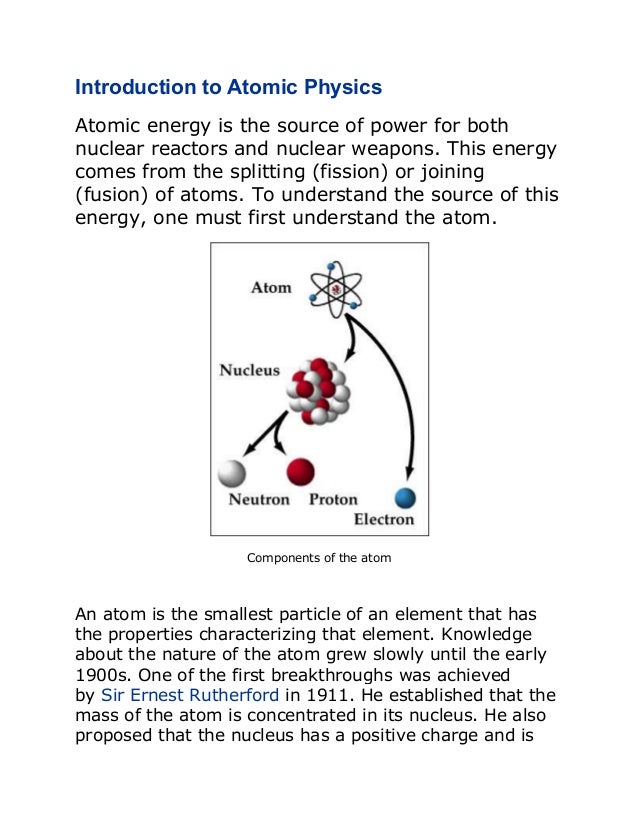
Components of the atom
An atom is the smallest particle of an element that has
the properties characterizing that element. Knowledge
about the nature of the atom grew slowly until the early
1900s. One of the first breakthroughs was achieved
by Sir Ernest Rutherford in 1911. He established that the
mass of the atom is concentrated in its nucleus. He also
proposed that the nucleus has a positive charge and is
surrounded by negatively charged electrons, which had
been discovered in 1897 by J. J. Thomson.
This theory of atomic structure was complemented
by Niels Bohr in 1913. The Bohr atom placed the
electrons in definite shells, or quantum levels.
Understanding the atom continues to be a focus for many
scientists.
Atomic Structure
An atom is a complex arrangement of negatively charged
electrons arranged in defined shells about a positively
charged nucleus. This nucleus contains most of the
atom's mass and is composed of protons and neutrons
(except for common hydrogen which has only one
proton). All atoms are roughly the same size. A
convenient unit of length for measuring atomic sizes is
the angstrom (Å), which is defined as 1 x 10⁻¹⁰
meters.
The diameter of an atom is approximately 2-3 Å.
In 1897, J. J. Thomson discovered the existence of the
electron, marking the beginning of modern atomic
physics. The negatively charged electrons follow a
random pattern within defined energy shells around the
nucleus. Most properties of atoms are based on the
number and arrangement of their electrons. The mass of
an electron is 9.1 x 10⁻³¹
kilograms.
One of the two types of particles found in the nucleus is
the proton. The existence of a positively charged particle,
a proton, in the nucleus was proved by Sir Ernest
Rutherford in 1919. The proton's charge is equal but
opposite to the negative charge of the electron. The
number of protons in the nucleus of an atom determines
what kind of chemical element it is. A proton has a mass
of 1.67 x 10⁻²⁷
kilograms.
The neutron is the other type of particle found in the
nucleus. It was discovered by a British physicist, Sir
James Chadwick. The neutron carries no electrical charge
and has the same mass as the proton. With a lack of
electrical charge, the neutron is not repelled by the cloud
of electrons or by the nucleus, making it a useful tool for
probing the structure of the atom.
Even the individual protons and neutrons have internal
structure, called quarks. Six types of quarks exist. These
subatomic particles cannot be freed and studied in
isolation. Current research continues into the structure of
the atom.
Atomic Isotopes
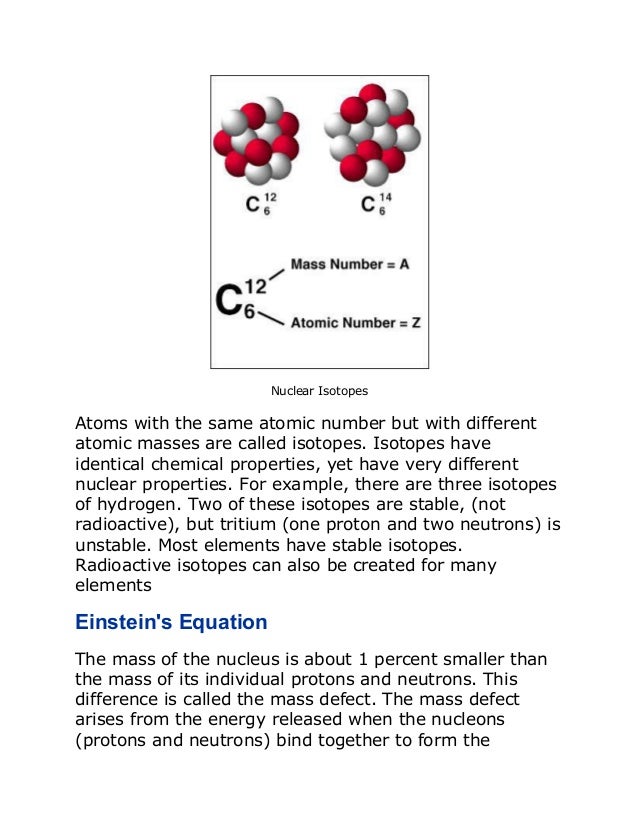
A major characteristic of an atom is its atomic number,
which is defined as the number of protons. The chemical
properties of an atom are determined by its atomic
number and is denoted by the symbol Z. The total
number of nucleons (protons and neutrons) in an atom is
the atomic mass number. This value is denoted by the
symbol A. The number of neutrons in an atom is denoted
by N. Thus the mass of an atom is A = N + Z.
Nuclear Isotopes
Atoms with the same atomic number but with different
atomic masses are called isotopes. Isotopes have
identical chemical properties, yet have very different
nuclear properties. For example, there are three isotopes
of hydrogen. Two of these isotopes are stable, (not
radioactive), but tritium (one proton and two neutrons) is
unstable. Most elements have stable isotopes.
Radioactive isotopes can also be created for many
elements
Einstein's Equation
The mass of the nucleus is about 1 percent smaller than
the mass of its individual protons and neutrons. This
difference is called the mass defect. The mass defect
arises from the energy released when the nucleons
(protons and neutrons) bind together to form the
nucleus. This energy is called the binding energy. The
binding energy determines which nuclei are stable and
how much energy is released in a nuclear reaction. Very
heavy nuclei and very light nuclei have low binding
energies. This implies that a heavy nucleus will release
energy when it splits apart (fission), and two light nuclei
will release energy when they join (fusion).
The hydrogen 2 nucleus, for example, composed of one
proton and one neutron, can be separated completely by
supplying 2.23 million electron volts (MeV) of energy.
Conversely, when a slowly moving neutron and proton
combine to form a hydrogen 2 nucleus, 2.23 MeV are
liberated.
The mass defect and binding energy are related by Albert
Einstein's formula, E = mc2
. In 1905, Einstein developed
the special theory of relativity. One of the implications of
this theory was that matter and energy are
interchangeable with one another. This equation states, a
mass (m) can be converted into an amount of energy
(E), where c is the speed of light. Because the speed of
light is a large number and thus c squared is huge, a
small amount of matter can be converted into a
tremendous amount of energy. This equation is the key
to the power of nuclear weapons and nuclear reactors.
Radioactive Decay
Radioactivity is the spontaneous disintegration of atomic
nuclei. This phenomenon was first reported in 1896 by
the French physicist Henri Becquerel. Marie Curie and her
husband Pierre Curie contributed further to the
understanding of radioactivity. Their research led to the
discovery of two new radioactive elements, polonium and
radium, and forced scientists to change their ideas about
the structure of the atom.
Radioactivity is the result of an atom trying to reach a
more stable nuclear configuration. The process of
radioactive decay, can be achieved via three primary
methods; a nucleus can change one of its neutrons into a
proton with the simultaneous emission of an electron
(beta decay), by emitting a helium nucleus (alpha
decay), or by spontaneous fission (splitting) into two
fragments. Often associated with these events is the
release of high energy photons or gamma rays. There are
some other method of radioactive decay, but they are
more exotic in nature.
one-half of the atomic nuclei of a radioactive sample to
decay. The radioactive isotope cobalt 60, which is used in
radiation cancer therapy, Each individual radioactive
substance has a characteristic decay period or half-life. A
half-life is the interval of time required for has, for
example, a half-life of 5.26 years. Thus after that
interval, a sample originally containing 16 grams of
cobalt 60 would contain only 8 grams of cobalt 60 and
would emit only half as much radiation. After another
interval of 5.26 years, the sample would contain only 4
grams of cobalt 60. Half-lives can range from thousands
of years to milliseconds.
Sometimes after undergoing radioactive decay, the new
atom is still left in a radioactive form. This means that
the atom will decay again as it attempts to reach a stable
nuclear state.
Alpha Decay
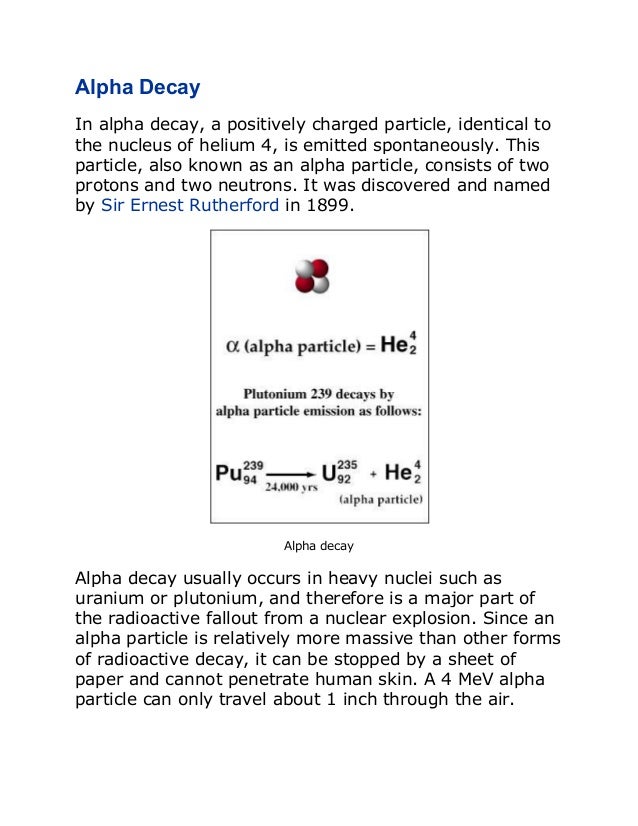
In alpha decay, a positively charged particle, identical to
the nucleus of helium 4, is emitted spontaneously. This
particle, also known as an alpha particle, consists of two
protons and two neutrons. It was discovered and named
by Sir Ernest Rutherford in 1899.
Alpha decay
Alpha decay usually occurs in heavy nuclei such as
uranium or plutonium, and therefore is a major part of
the radioactive fallout from a nuclear explosion. Since an
alpha particle is relatively more massive than other forms
of radioactive decay, it can be stopped by a sheet of
paper and cannot penetrate human skin. A 4 MeV alpha
particle can only travel about 1 inch through the air.
Although the range of an alpha particle is short, if an
alpha decaying element is ingested, the alpha particle
can do considerable damage to the surrounding tissue.
This is why plutonium, with a long half-life, is extremely
hazardous if ingested.
Beta Decay
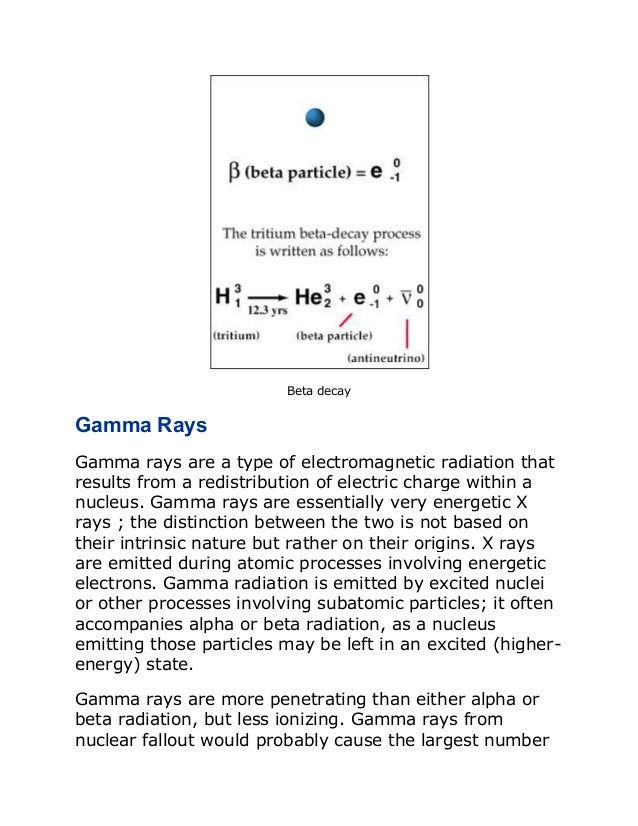
Atoms emit beta particles through a process known as
beta decay. Beta decay occurs when an atom has either
too many protons or too many neutrons in its nucleus.
Two types of beta decay can occur. One type (positive
beta decay) releases a positively charged beta particle
called a positron, and a neutrino; the other type
(negative beta decay) releases a negatively charged beta
particle called an electron, and an antineutrino. The
neutrino and the antineutrino are high energy elementary
particles with little or no mass and are released in order
to conserve energy during the decay process. Negative
beta decay is far more common than positive beta decay.
This form of radioactive decay was discovered by Sir
Ernest Rutherford in 1899, although the neutrino was not
observed until the 1960s. Beta particles have all the
characteristics of electrons. At the time of their emission,
they travel at nearly the speed of light. A typical .5 MeV
particle will travel about 10 feet through the air, and can
be stopped by 1-2 inches of wood.
Beta decay
Gamma Rays
Gamma rays are a type of electromagnetic radiation that
results from a redistribution of electric charge within a
nucleus. Gamma rays are essentially very energetic X
rays ; the distinction between the two is not based on
their intrinsic nature but rather on their origins. X rays
are emitted during atomic processes involving energetic
electrons. Gamma radiation is emitted by excited nuclei
or other processes involving subatomic particles; it often
accompanies alpha or beta radiation, as a nucleus
emitting those particles may be left in an excited (higher-
energy) state.
Gamma rays are more penetrating than either alpha or
beta radiation, but less ionizing. Gamma rays from
nuclear fallout would probably cause the largest number
of casualties in the event of the use of nuclear weapons
in a nuclear war. They produce damage similar to that
caused by X-rays such as burns, cancer, and genetic
mutations.
Spontaneous Fission
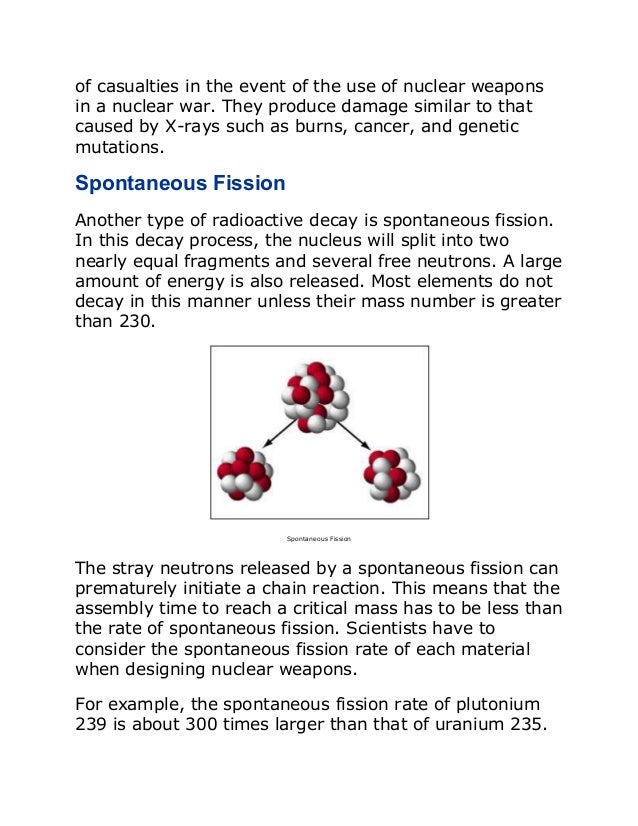
Another type of radioactive decay is spontaneous fission.
In this decay process, the nucleus will split into two
nearly equal fragments and several free neutrons. A large
amount of energy is also released. Most elements do not
decay in this manner unless their mass number is greater
than 230.
Spontaneous Fission
The stray neutrons released by a spontaneous fission can
prematurely initiate a chain reaction. This means that the
assembly time to reach a critical mass has to be less than
the rate of spontaneous fission. Scientists have to
consider the spontaneous fission rate of each material
when designing nuclear weapons.
For example, the spontaneous fission rate of plutonium
239 is about 300 times larger than that of uranium 235.
This forced scientists working on the Manhattan Project
to abandon work on a gun-type design that used
plutonium.

Introduction to Atomic Physics.pdf

  • 1.
    Introduction to AtomicPhysics Atomic energy is the source of power for both nuclear reactors and nuclear weapons. This energy comes from the splitting (fission) or joining (fusion) of atoms. To understand the source of this energy, one must first understand the atom. Components of the atom An atom is the smallest particle of an element that has the properties characterizing that element. Knowledge about the nature of the atom grew slowly until the early 1900s. One of the first breakthroughs was achieved by Sir Ernest Rutherford in 1911. He established that the mass of the atom is concentrated in its nucleus. He also proposed that the nucleus has a positive charge and is
  • 2.
    surrounded by negativelycharged electrons, which had been discovered in 1897 by J. J. Thomson. This theory of atomic structure was complemented by Niels Bohr in 1913. The Bohr atom placed the electrons in definite shells, or quantum levels. Understanding the atom continues to be a focus for many scientists. Atomic Structure An atom is a complex arrangement of negatively charged electrons arranged in defined shells about a positively charged nucleus. This nucleus contains most of the atom's mass and is composed of protons and neutrons (except for common hydrogen which has only one proton). All atoms are roughly the same size. A convenient unit of length for measuring atomic sizes is the angstrom (Å), which is defined as 1 x 10⁻¹⁰ meters. The diameter of an atom is approximately 2-3 Å. In 1897, J. J. Thomson discovered the existence of the electron, marking the beginning of modern atomic physics. The negatively charged electrons follow a random pattern within defined energy shells around the nucleus. Most properties of atoms are based on the number and arrangement of their electrons. The mass of an electron is 9.1 x 10⁻³¹ kilograms. One of the two types of particles found in the nucleus is the proton. The existence of a positively charged particle, a proton, in the nucleus was proved by Sir Ernest Rutherford in 1919. The proton's charge is equal but opposite to the negative charge of the electron. The
  • 3.
    number of protonsin the nucleus of an atom determines what kind of chemical element it is. A proton has a mass of 1.67 x 10⁻²⁷ kilograms. The neutron is the other type of particle found in the nucleus. It was discovered by a British physicist, Sir James Chadwick. The neutron carries no electrical charge and has the same mass as the proton. With a lack of electrical charge, the neutron is not repelled by the cloud of electrons or by the nucleus, making it a useful tool for probing the structure of the atom. Even the individual protons and neutrons have internal structure, called quarks. Six types of quarks exist. These subatomic particles cannot be freed and studied in isolation. Current research continues into the structure of the atom. Atomic Isotopes A major characteristic of an atom is its atomic number, which is defined as the number of protons. The chemical properties of an atom are determined by its atomic number and is denoted by the symbol Z. The total number of nucleons (protons and neutrons) in an atom is the atomic mass number. This value is denoted by the symbol A. The number of neutrons in an atom is denoted by N. Thus the mass of an atom is A = N + Z.
  • 4.
    Nuclear Isotopes Atoms withthe same atomic number but with different atomic masses are called isotopes. Isotopes have identical chemical properties, yet have very different nuclear properties. For example, there are three isotopes of hydrogen. Two of these isotopes are stable, (not radioactive), but tritium (one proton and two neutrons) is unstable. Most elements have stable isotopes. Radioactive isotopes can also be created for many elements Einstein's Equation The mass of the nucleus is about 1 percent smaller than the mass of its individual protons and neutrons. This difference is called the mass defect. The mass defect arises from the energy released when the nucleons (protons and neutrons) bind together to form the
  • 5.
    nucleus. This energyis called the binding energy. The binding energy determines which nuclei are stable and how much energy is released in a nuclear reaction. Very heavy nuclei and very light nuclei have low binding energies. This implies that a heavy nucleus will release energy when it splits apart (fission), and two light nuclei will release energy when they join (fusion). The hydrogen 2 nucleus, for example, composed of one proton and one neutron, can be separated completely by supplying 2.23 million electron volts (MeV) of energy. Conversely, when a slowly moving neutron and proton combine to form a hydrogen 2 nucleus, 2.23 MeV are liberated. The mass defect and binding energy are related by Albert Einstein's formula, E = mc2 . In 1905, Einstein developed the special theory of relativity. One of the implications of this theory was that matter and energy are interchangeable with one another. This equation states, a mass (m) can be converted into an amount of energy (E), where c is the speed of light. Because the speed of light is a large number and thus c squared is huge, a small amount of matter can be converted into a tremendous amount of energy. This equation is the key to the power of nuclear weapons and nuclear reactors. Radioactive Decay Radioactivity is the spontaneous disintegration of atomic nuclei. This phenomenon was first reported in 1896 by the French physicist Henri Becquerel. Marie Curie and her husband Pierre Curie contributed further to the understanding of radioactivity. Their research led to the
  • 6.
    discovery of twonew radioactive elements, polonium and radium, and forced scientists to change their ideas about the structure of the atom. Radioactivity is the result of an atom trying to reach a more stable nuclear configuration. The process of radioactive decay, can be achieved via three primary methods; a nucleus can change one of its neutrons into a proton with the simultaneous emission of an electron (beta decay), by emitting a helium nucleus (alpha decay), or by spontaneous fission (splitting) into two fragments. Often associated with these events is the release of high energy photons or gamma rays. There are some other method of radioactive decay, but they are more exotic in nature. one-half of the atomic nuclei of a radioactive sample to decay. The radioactive isotope cobalt 60, which is used in radiation cancer therapy, Each individual radioactive substance has a characteristic decay period or half-life. A half-life is the interval of time required for has, for example, a half-life of 5.26 years. Thus after that interval, a sample originally containing 16 grams of cobalt 60 would contain only 8 grams of cobalt 60 and would emit only half as much radiation. After another interval of 5.26 years, the sample would contain only 4 grams of cobalt 60. Half-lives can range from thousands of years to milliseconds. Sometimes after undergoing radioactive decay, the new atom is still left in a radioactive form. This means that the atom will decay again as it attempts to reach a stable nuclear state.
  • 7.
    Alpha Decay In alphadecay, a positively charged particle, identical to the nucleus of helium 4, is emitted spontaneously. This particle, also known as an alpha particle, consists of two protons and two neutrons. It was discovered and named by Sir Ernest Rutherford in 1899. Alpha decay Alpha decay usually occurs in heavy nuclei such as uranium or plutonium, and therefore is a major part of the radioactive fallout from a nuclear explosion. Since an alpha particle is relatively more massive than other forms of radioactive decay, it can be stopped by a sheet of paper and cannot penetrate human skin. A 4 MeV alpha particle can only travel about 1 inch through the air.
  • 8.
    Although the rangeof an alpha particle is short, if an alpha decaying element is ingested, the alpha particle can do considerable damage to the surrounding tissue. This is why plutonium, with a long half-life, is extremely hazardous if ingested. Beta Decay Atoms emit beta particles through a process known as beta decay. Beta decay occurs when an atom has either too many protons or too many neutrons in its nucleus. Two types of beta decay can occur. One type (positive beta decay) releases a positively charged beta particle called a positron, and a neutrino; the other type (negative beta decay) releases a negatively charged beta particle called an electron, and an antineutrino. The neutrino and the antineutrino are high energy elementary particles with little or no mass and are released in order to conserve energy during the decay process. Negative beta decay is far more common than positive beta decay. This form of radioactive decay was discovered by Sir Ernest Rutherford in 1899, although the neutrino was not observed until the 1960s. Beta particles have all the characteristics of electrons. At the time of their emission, they travel at nearly the speed of light. A typical .5 MeV particle will travel about 10 feet through the air, and can be stopped by 1-2 inches of wood.
  • 9.
    Beta decay Gamma Rays Gammarays are a type of electromagnetic radiation that results from a redistribution of electric charge within a nucleus. Gamma rays are essentially very energetic X rays ; the distinction between the two is not based on their intrinsic nature but rather on their origins. X rays are emitted during atomic processes involving energetic electrons. Gamma radiation is emitted by excited nuclei or other processes involving subatomic particles; it often accompanies alpha or beta radiation, as a nucleus emitting those particles may be left in an excited (higher- energy) state. Gamma rays are more penetrating than either alpha or beta radiation, but less ionizing. Gamma rays from nuclear fallout would probably cause the largest number
  • 10.
    of casualties inthe event of the use of nuclear weapons in a nuclear war. They produce damage similar to that caused by X-rays such as burns, cancer, and genetic mutations. Spontaneous Fission Another type of radioactive decay is spontaneous fission. In this decay process, the nucleus will split into two nearly equal fragments and several free neutrons. A large amount of energy is also released. Most elements do not decay in this manner unless their mass number is greater than 230. Spontaneous Fission The stray neutrons released by a spontaneous fission can prematurely initiate a chain reaction. This means that the assembly time to reach a critical mass has to be less than the rate of spontaneous fission. Scientists have to consider the spontaneous fission rate of each material when designing nuclear weapons. For example, the spontaneous fission rate of plutonium 239 is about 300 times larger than that of uranium 235.
  • 11.
    This forced scientistsworking on the Manhattan Project to abandon work on a gun-type design that used plutonium.