MORPHOSYNTAX
•Morphosyntax
•Morphology & Lexicology
•Morpheme
Soraya
#
Morphosyntax
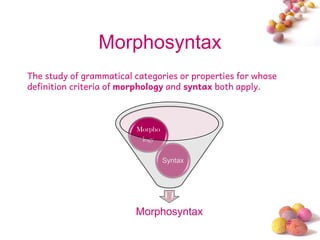
The study of grammatical categories or properties for whose
definition criteria of morphology and syntax both apply.
Morphosyntax
Syntax
Morpho
logy
#
Morphosyntax
• The study of grammatical categories or linguistic
units that have both morphological and syntactic
properties.
• The set of rules that govern linguistic units
whose properties are definable by both
morphological and syntactic criteria.
• The number category in Nouns, for example, may
be expressed morphologically (through
inflectional endings) and syntactically (through
agreement with verb).
• Tense, person, and voice are examples of other
morphosyntactic categories
#
Morphology VS Lexicology
Morphology is the branch of
linguistics that study the
structure of words in a
particular language and their
classification
• Morpheme : Smallest
meaningful unit of grammar
Lexicology is the study of
vocabulary of a language
• lexeme : The smallest unit
in the meaning system of a
language that can be
distinguished from other
similar unit
#
Morpheme
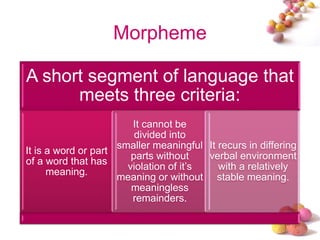
A short segment of language that
meets three criteria:
It is a word or part
of a word that has
meaning.
It cannot be
divided into
smaller meaningful
parts without
violation of it’s
meaning or without
meaningless
remainders.
It recurs in differing
verbal environment
with a relatively
stable meaning.
#
Classification of Morpheme
• A morpheme that can be uttered alone with
meaning (stand by itself)
• e.g. eat, view, play, etc
Free
Morpheme:
• A morpheme that cannot be uttered with
meaning. It is always annexed to one or other
morphemes to form a word.
• e.g. re-, -er, un-, -ly, etc
Bound
Morpheme:
• A Part of a word that has principal meaning.
Most of the bases are free morpheme but
some are bound.
• e.g. denial, lovable, etc
Base
Morpheme;
#
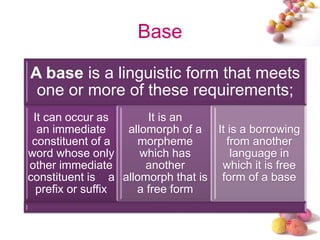
A base is a linguistic form that meets
one or more of these requirements;
It can occur as
an immediate
constituent of a
word whose only
other immediate
constituent is a
prefix or suffix
It is an
allomorph of a
morpheme
which has
another
allomorph that is
a free form
It is a borrowing
from another
language in
which it is free
form of a base
Base
#
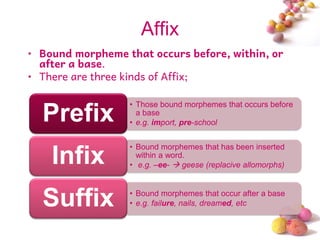
Affix
• Bound morpheme that occurs before, within, or
after a base.
• There are three kinds of Affix;
• Those bound morphemes that occurs before
a base
• e.g. import, pre-schoolPrefix
• Bound morphemes that has been inserted
within a word.
• e.g. –ee-  geese (replacive allomorphs)Infix
• Bound morphemes that occur after a base
• e.g. failure, nails, dreamed, etcSuffix

Introduction to morphosyntax

  • 1.
  • 2.
    # Morphosyntax The study ofgrammatical categories or properties for whose definition criteria of morphology and syntax both apply. Morphosyntax Syntax Morpho logy
  • 3.
    # Morphosyntax • The studyof grammatical categories or linguistic units that have both morphological and syntactic properties. • The set of rules that govern linguistic units whose properties are definable by both morphological and syntactic criteria. • The number category in Nouns, for example, may be expressed morphologically (through inflectional endings) and syntactically (through agreement with verb). • Tense, person, and voice are examples of other morphosyntactic categories
  • 4.
    # Morphology VS Lexicology Morphologyis the branch of linguistics that study the structure of words in a particular language and their classification • Morpheme : Smallest meaningful unit of grammar Lexicology is the study of vocabulary of a language • lexeme : The smallest unit in the meaning system of a language that can be distinguished from other similar unit
  • 5.
    # Morpheme A short segmentof language that meets three criteria: It is a word or part of a word that has meaning. It cannot be divided into smaller meaningful parts without violation of it’s meaning or without meaningless remainders. It recurs in differing verbal environment with a relatively stable meaning.
  • 6.
    # Classification of Morpheme •A morpheme that can be uttered alone with meaning (stand by itself) • e.g. eat, view, play, etc Free Morpheme: • A morpheme that cannot be uttered with meaning. It is always annexed to one or other morphemes to form a word. • e.g. re-, -er, un-, -ly, etc Bound Morpheme: • A Part of a word that has principal meaning. Most of the bases are free morpheme but some are bound. • e.g. denial, lovable, etc Base Morpheme;
  • 7.
    # A base isa linguistic form that meets one or more of these requirements; It can occur as an immediate constituent of a word whose only other immediate constituent is a prefix or suffix It is an allomorph of a morpheme which has another allomorph that is a free form It is a borrowing from another language in which it is free form of a base Base
  • 8.
    # Affix • Bound morphemethat occurs before, within, or after a base. • There are three kinds of Affix; • Those bound morphemes that occurs before a base • e.g. import, pre-schoolPrefix • Bound morphemes that has been inserted within a word. • e.g. –ee-  geese (replacive allomorphs)Infix • Bound morphemes that occur after a base • e.g. failure, nails, dreamed, etcSuffix