Paper Name : The Post-Colonial Literature
Presentation Topic :Key Concepts, Allegory,
Negritude,Globalization
Name: Solanki Pintu V
Sem : 3
Roll No : 29
Enrollment No: PG15101037
Email: solankipintu1991@gmail.com
Submitted to :
M.K. BHAVNAGAR UNIVERSITY
Department Of English
Allegory
➢ The basic meaning of allegory is "to say
another thing“ or “to speak otherwise”
➢ from Latin allegoria
➢ from Greek allegorein “to speak
figuratively"
➔ allos "other" + agoreuein “to make a speech
in public”
Allegory Definition
● Allegory is a figure of speech in which abstract
ideas and principles are described in terms of
characters, figures and events.
● It can be employed in prose and poetry to tell a
story with a purpose of teaching an idea and a
principle or explaining an idea or a principle.
● The objective of its use is to preach some kind
of a moral lesson.
An allegory is…
● A story, poem, or picture which can be
interpreted to reveal a hidden meaning,
typically a moral or political one.
● A story that acts as an extended metaphor
in which persons, abstract ideas, or events
represent not only themselves on the
literal level, but they also stand for
something else on the symbolic level.
Function of Allegory
● Writers use allegory to add different layers of
meanings to their works.
● Allegory makes their stories and characters
multidimensional,
● Allegory allows writers to put forward their moral
and political point of views.
● study of an allegorical piece of writing can give us
an insight into its writer’s mind as how he views
the world and how he wishes the world to be.
Examples of Allegory
● The Tempest by William
Shakespeare
● The Pilgrim's Progress by John
Bunyan
● The Scarlet Letter by Nathaniel
Hawthorne
● Animal Farm by George Orwell
● The Faerie Queene by
Edmund Spenser
Négritude
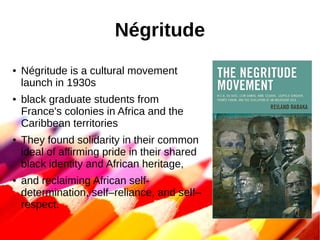
● Négritude is a cultural movement
launch in 1930s
● black graduate students from
France's colonies in Africa and the
Caribbean territories
● They found solidarity in their common
ideal of affirming pride in their shared
black identity and African heritage,
● and reclaiming African self-
determination, self–reliance, and self–
respect.
The Roots of Négritude
● The movement is deeply rooted in Pan-African
congresses
● The Negritude movement was influenced by the
Harlem Renaissance
● Authors such as Claude McKay and Langston
Hughes laid groundwork for black expression.
● The term was embraced by Frantz Fanon. Cesaire
and Senghor were mentors to Fanon and his work
reflects the sensibilities of Negritude.
Impact of negritude
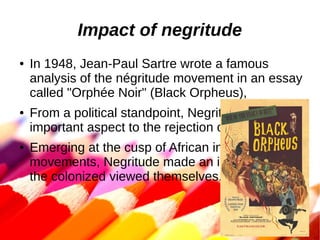
● In 1948, Jean-Paul Sartre wrote a famous
analysis of the négritude movement in an essay
called "Orphée Noir" (Black Orpheus),
● From a political standpoint, Negritude was an
important aspect to the rejection of colonialism
● Emerging at the cusp of African independence
movements, Negritude made an impact on how
the colonized viewed themselves.
Dominant figure in Negritude
Movement
● Aimé Césaire
● Léon Damas
● Léopold Sédar
● Senghor
● Paul Niger
Globalization
● Definition
Globalization is a process of interaction and
integration among the people, companies, and
governments of different nations, a process
driven by international trade and investment
and aided by information technology.
Origin of Globalization
● Some scholars place the origin of globalization in
modern times
● Others trace its history long before the European
age of discovery and voyages to the new world.
● since the Mid -1980’s the term Globalization has
been in increasing use and especially since the
Mid -1990’s and in literature Especially much
has been written on globalization and responses
to globalization.
Globalization and its
Relationship with Literature
● “all literature is now global, all
literature is a literature of
globalization.”
Susie O Brien and Imre‟
Szeman
● globalization and literature share some
meeting points in their institutional and
Structural edifices
● globalization are relevant to debates in literary
studies and certainly existing ideas of interest in
literature and literary studies fit with notions of
globalization.
●
Literature can also be considered to
be one of the product that is marketed
now on a global scale.
● Now many books, movies, and TV
programs are marketed across
national borders with or without
translation.
References
➢ http://staff.uny.ac.id/sites/default/files/pendidikan/else
➢ http://literarydevices.net/allegory/
➢ https://en.wikipedia.org/wiki/Allegory
➢ http://exhibitions.nypl.org/africanaage/essay-negritud
➢

Allegory, Negritude,Globalization

  • 1.
    Paper Name :The Post-Colonial Literature Presentation Topic :Key Concepts, Allegory, Negritude,Globalization Name: Solanki Pintu V Sem : 3 Roll No : 29 Enrollment No: PG15101037 Email: solankipintu1991@gmail.com Submitted to : M.K. BHAVNAGAR UNIVERSITY Department Of English
  • 2.
    Allegory ➢ The basicmeaning of allegory is "to say another thing“ or “to speak otherwise” ➢ from Latin allegoria ➢ from Greek allegorein “to speak figuratively" ➔ allos "other" + agoreuein “to make a speech in public”
  • 3.
    Allegory Definition ● Allegoryis a figure of speech in which abstract ideas and principles are described in terms of characters, figures and events. ● It can be employed in prose and poetry to tell a story with a purpose of teaching an idea and a principle or explaining an idea or a principle. ● The objective of its use is to preach some kind of a moral lesson.
  • 4.
    An allegory is… ●A story, poem, or picture which can be interpreted to reveal a hidden meaning, typically a moral or political one. ● A story that acts as an extended metaphor in which persons, abstract ideas, or events represent not only themselves on the literal level, but they also stand for something else on the symbolic level.
  • 5.
    Function of Allegory ●Writers use allegory to add different layers of meanings to their works. ● Allegory makes their stories and characters multidimensional, ● Allegory allows writers to put forward their moral and political point of views. ● study of an allegorical piece of writing can give us an insight into its writer’s mind as how he views the world and how he wishes the world to be.
  • 6.
    Examples of Allegory ●The Tempest by William Shakespeare ● The Pilgrim's Progress by John Bunyan ● The Scarlet Letter by Nathaniel Hawthorne ● Animal Farm by George Orwell ● The Faerie Queene by Edmund Spenser
  • 7.
    Négritude ● Négritude isa cultural movement launch in 1930s ● black graduate students from France's colonies in Africa and the Caribbean territories ● They found solidarity in their common ideal of affirming pride in their shared black identity and African heritage, ● and reclaiming African self- determination, self–reliance, and self– respect.
  • 8.
    The Roots ofNégritude ● The movement is deeply rooted in Pan-African congresses ● The Negritude movement was influenced by the Harlem Renaissance ● Authors such as Claude McKay and Langston Hughes laid groundwork for black expression. ● The term was embraced by Frantz Fanon. Cesaire and Senghor were mentors to Fanon and his work reflects the sensibilities of Negritude.
  • 9.
    Impact of negritude ●In 1948, Jean-Paul Sartre wrote a famous analysis of the négritude movement in an essay called "Orphée Noir" (Black Orpheus), ● From a political standpoint, Negritude was an important aspect to the rejection of colonialism ● Emerging at the cusp of African independence movements, Negritude made an impact on how the colonized viewed themselves.
  • 10.
    Dominant figure inNegritude Movement ● Aimé Césaire ● Léon Damas ● Léopold Sédar ● Senghor ● Paul Niger
  • 11.
    Globalization ● Definition Globalization isa process of interaction and integration among the people, companies, and governments of different nations, a process driven by international trade and investment and aided by information technology.
  • 12.
    Origin of Globalization ●Some scholars place the origin of globalization in modern times ● Others trace its history long before the European age of discovery and voyages to the new world. ● since the Mid -1980’s the term Globalization has been in increasing use and especially since the Mid -1990’s and in literature Especially much has been written on globalization and responses to globalization.
  • 13.
    Globalization and its Relationshipwith Literature ● “all literature is now global, all literature is a literature of globalization.” Susie O Brien and Imre‟ Szeman
  • 14.
    ● globalization andliterature share some meeting points in their institutional and Structural edifices ● globalization are relevant to debates in literary studies and certainly existing ideas of interest in literature and literary studies fit with notions of globalization.
  • 15.
    ● Literature can alsobe considered to be one of the product that is marketed now on a global scale. ● Now many books, movies, and TV programs are marketed across national borders with or without translation.
  • 16.
    References ➢ http://staff.uny.ac.id/sites/default/files/pendidikan/else ➢ http://literarydevices.net/allegory/ ➢https://en.wikipedia.org/wiki/Allegory ➢ http://exhibitions.nypl.org/africanaage/essay-negritud ➢