

This project was funded by the United States Agency for International Development’s 
African Education Initiative and developed in partnership with the United States 
Department of Agriculture; University of Wisconsin-Extension; Government of 
Rwanda’s Ministry of Education, Technology and Science, and Ministry of Agriculture; 
and Forum for Africa Women Educationalists (FAWE), Rwanda. 
With counsel from several Rwandan organizations and University of Wisconsin- 
Extension specialists, this Manual was developed by: 
Mary Crave, Ph.D., University of Wisconsin-Extension 
Janet Connelly, USDA Farm Service Agency 
Dawn Danz-Hale, University of Wisconsin-Extension 
Gabbriel Frigm, USDA Foreign Agricultural Service 
Jennifer Maurer, USDA Foreign Agricultural Service 
Julie Polt, USDA Farm Service Agency 
Thomas Syverud, University of Wisconsin-Extension 
Chad Wessen, USDA Foreign Agricultural Service 
Thanks also to the following individuals for their contributions to the Manual: 
Gayle Coleman, R.D., University of Wisconsin-Extension 
Michael Doyle, Ph.D., Bay Mills Community College, Michigan 
Maya Kadakia, Cherokee Middle School, Madison, Wisconsin 
November 2010 edition 
The U.S. Department of Agriculture (USDA) prohibits discrimination in all its programs and activities on the 
basis of race, color, national origin, age, disability, and where applicable, sex, marital status, familial status, 
parental status, religion, sexual orientation, genetic information, political beliefs, reprisal, or because all or part 
of an individual’s income is derived from any public assistance program. (Not all prohibited bases apply to all 
programs.) 
Persons with disabilities who require alternative means for communication of program information (Braille, large 
print, audiotape, etc.) should contact USDA’s TARGET Center at (202) 720--2600 (voice and TDD). 
To file a complaint of discrimination, write to USDA, Director, Office of Civil Rights, 1400 Independence Avenue, 
S.W., Washington, D.C. 20250-9410, or call (800) 795--3272 (voice) or (202) 720--6382 (TDD). USDA is an equal 
opportunity provider and employer.
Overview 
Cultivating Learning with School Gardens has these important objectives: 
1 
1. Provide a laboratory for experiential learning to complement the standard 
school curriculum in all disciplines. 
2. Contribute to the government’s focus on science, literacy, numeracy, and other 
educational priorities for both girls and boys. 
3. Contribute to the intellectual, psychological, physical, and vocational development 
of the students through enhanced learning methods. 
4. Increase parent and community involvement in the school and transfer skills 
and knowledge from the school garden to home and community. 
There are two major sections to this Manual, intended to be 
used together: 
1. Help for Teachers: Bringing the School Garden into the Classroom 
2. Steps to Developing a School Garden and Gardening Science
2 
In this Manual teachers learn the basics of a school garden 
laboratory: 
1. Tips on making a school garden successful—including working with the 
community, parents, and other organizations. 
2. How to develop student-focused learning activities that involve students 
in the school garden and classroom. 
3. How to use a square-meter garden as a laboratory for science and other 
disciplines. 
4. How to integrate a school garden into classroom curricula at the 
secondary level in all disciplines. 
5. How to demonstrate the steps in planning, cultivating and tending a 
school garden. 
The primary expected outcomes of this project are as follows: 
1. Increased capacity of teachers to develop and maintain a school garden 
and classroom learning activities to demonstrate and apply science and 
food production theory and practices. 
2. Increased capacity of teachers to use a school garden as a learning 
laboratory for students that further your country’s education policies. This 
includes developing student-focused activities in all disciplines. 
3. Increased student and teacher knowledge and skills of agricultural 
science, food production, nutrition, and plant and environmental 
sciences. 
4. Increased student nutrition through the production and consumption of 
fresh fruits and vegetables. 
5. Improved food security through student’s application of gardening skills 
in the homestead. 
6. Increased parent and community involvement in the school.
3 
Table of Contents 
Overview .................................................................................. 3 
Table of Contents ..................................................................... 5 
Section I: 
Help for Teachers: Bringing the School Garden into the Classroom ......6 
A. Introduction to School Gardens ....................................................6 
1. Major Aims of School Garden Programs ................................................10 
2. Major Benefits of School Gardens...........................................................12 
3. Core Beliefs and Convictions of a School Garden Project ....................14 
4. Elements Necessary for a School Garden Program ..............................16 
B. Involving the Community in Garden Management .....................17 
1. Garden Management Committee ............................................................17 
2. Build Community Support and Involvement 
With Open Door Events ............................................................................21 
3. Involve Students in Open Door Events ...................................................24 
4. Involve Youth Outside of School – After School Garden Clubs ............34 
C. Experiential (Child-Centered) Learning— 
Methods and Theory ...................................................................36 
1. Experiential Learning Cycle .....................................................................38 
2. Demonstration Methods ...........................................................................40 
3. Classroom Aids ..........................................................................................42 
D. Involving Students in the Garden ...............................................50 
E. Experimenting in the Garden and Classroom .............................56
F. Observation Skills ...................................................................... 78 
G. Using Experiential Activities in the Garden................................ 86 
Lesson Recommendations ............................................................................86 
How to Use the Lesson Recommendations .................................................87 
Classroom Lessons by Area of Discipline ....................................................89 
More Classroom Activities ...........................................................................180 
Section II. 
Basic Components and Steps to Developing a School Garden ...........190 
A. Introduction ............................................................................. 190 
B. The Five Basic Steps ................................................................. 191 
Step 1—Choosing a Site: Where to Put Your School Garden .......................................193 
Step 2—Preparing a Site: Choose your Garden Design ...............................................198 
Step 3—Planting the Garden ......................................................................................209 
Step 4—Tending the Garden .......................................................................................215 
Step 5—Harvesting, Preparing and Eating the Food ..................................................233 
C. More Gardening Science .......................................................... 247 
1. Garden Implements ...............................................................................................247 
2. Alternative Planting Methods ...............................................................................249 
3. Basic Plant Science ...............................................................................................258 
4. Compost: A Recipe for Success in the Garden .......................................................265 
5. Future Plantings ...................................................................................................269 
6. Agroforestry ..........................................................................................................280 
7. Steps to a Healthy Garden ....................................................................................282 
D. Nutrition .................................................................................. 297 
Basic Nutrition Theory ................................................................................................297 
E. Post-Harvest Food Handling ..................................................... 305 
F. Sanitary Milk Handling ............................................................308 
4
5 
Section III. 
Appendices 
A. Classroom Posters ...................................................................311 
B. Training Phase I Resources ......................................................315 
Section IV. 
References ........................................................................................323 
Section V. 
Teacher Observations and Notes .......................................................327
Aims, Benefits, Beliefs and Elements 
of School Gardens 
6 
Section I 
Help for Teachers: 
Bring the School Garden into the Classroom 
A. Introduction to School Gardens 
Gardening can be a fun and interesting way to help students learn. Meanwhile, 
of course gardens and their bounty help to improve food security. 
Many factors influence the success and sustainability of a school garden, 
including good gardening practices. Fortunately, we can learn from the 
successes and challenges of others around the world, made possible by 
research conducted by organizations such as the World Food Program and 
the Food and Agricultural Organization of the United Nations. Meanwhile, 
experience also tells us that school gardens are more beneficial and sustainable 
when they are incorporated into the school curriculum and classroom activities. 
Sustaining a school garden is just one goal of this project. We also aspire to 
improve the secondary school curriculum to help students succeed in school, in 
their community, and in life. This section of the Manual integrates experiential 
(child-centered) learning methods to bring the school garden into the 
classroom. We present materials and activities that include ideas for managing 
and improving the school gardens, and offer recommendations for classroom 
lessons aimed at helping students learn across the curriculum. 
School gardens have many benefits – and not just for the students who work 
in them and those that enjoy the food produced. When students learn new 
gardening techniques, they can pass them on to their parents and households. 
Communities benefit in turn when their citizens work together to support the 
garden, and community members can learn new gardening techniques. Local 
organizations and school gardens can enhance and complement each others’ 
programs in nutrition and health, income generation, and other social programs.
Aims, Benefits, Beliefs and Elements 
of School Gardens 
7 
Growing and using school gardens has many benefits. Many governments 
are keenly interested in increasing science literacy among both girls and boys. 
Gardening provides an excellent way for students to apply scientific theory and 
to better retain and understand that theory. The curriculum used in this training 
is designed with these issues at the forefront.
Aims, Benefits, Beliefs and Elements 
of School Gardens 
8 
1. Major Aims of School Garden Programs 
Educational Aims 
• Increase the relevance and quality of education for rural and urban 
children by introducing into the curricula important life skills. 
• Teach students how to establish and maintain home gardens and 
encourage the production and consumption of micronutrient-rich fruits 
and vegetables. 
• Provide active learning by linking gardens with other subjects. 
• Increase access to education by attracting children and their families 
to a school that addresses topics relevant to their lives. 
• Improve children’s attitudes towards agriculture and rural life. 
• Teach environmental issues, including how to grow safe food without 
using synthetic fertilizers and pesticides. 
• Teach practical nutrition education in order to promote healthy diets 
and lifestyles. 
• Provide students with a tool for survival at times of food shortages.
Aims, Benefits, Beliefs and Elements 
of School Gardens 
9 
Economic and Food Security Aims 
• Familiarize school children with sustainable production of food, 
especially methods that are applicable to their homestead or farm 
and important for household food security. 
• Improve food availability and diversity. 
• Enhance the nutritional quality of school meals. 
• Reduce the incidence of malnourished school children. 
• Increase school attendance and compensate for the loss in transfer of 
“life skills” from parents to children—especially in child-headed 
households. 
• Promote income-generation opportunities. 
Source: Special Programme for Food Security Doc 31, School Gardens Concept Paper, 
Food and Agriculture Organization of the United Nations (FAO), September 2004
Aims, Benefits, Beliefs and Elements 
of School Gardens 
10 
2. Major Benefits of School Gardens 
Students and communities can learn many things from school gardens. 
Intellectual Development—Academic Skills 
• Support core academic training, particularly in science and 
mathematics—real world hands-on experiences. 
• Enrich core curriculum in language arts through the introduction of 
new learning topics. 
• Learn about the environment and promote sustainable development. 
• Learn scientific methods. 
Psychological Development—Social and Moral Skills 
• Develop responsibility. 
• Learn the joy and dignity of work—foster work ethic. 
• Increase self-esteem and confidence. 
• Develop patience. 
• Develop a sense of cooperation and school spirit. 
• Learn respect for public and private property.
Aims, Benefits, Beliefs and Elements 
of School Gardens 
11 
Vocational Development—Life Skills 
• Demonstrate basic skills and vocational competencies. 
• Produce food and other commodities. 
• Make the most of limited resources, including food. 
• Engage in community service and environmental care. 
• Work with community organizations for mutual benefit. 
• Invest in lessons of leadership and decision making. 
• Transfer to household the skills learned in school. 
Physical Development 
• Provide nutritious food for students. 
• Reinforce public and personal health concepts.
Aims, Benefits, Beliefs and Elements 
of School Gardens 
12 
3. Core Beliefs and Convictions of a School 
Garden Project 
Most teachers and school administrators at schools with gardens agree that 
school gardens have many benefits and purposes. At the same time, the 
primary purpose of the garden and how it will function may vary from school 
to school, in part because of historical, cultural, and community differences. 
Before you take steps to establish a school garden it is important to explore the 
various beliefs, values and convictions which you and members of your school 
Garden Committee may have. 
In many cases, school gardens are partially sponsored by aid agencies. That 
means the sponsoring organization may have specific requirements of or intents 
for the school gardens. Be sure you understand these as you discuss some core 
beliefs about the purposes for your garden or how it will operate. 
Below are some possible beliefs or guidelines about school gardens. There 
is no right or wrong list of beliefs, and some of these statements may actually 
contradict each other. Use a pencil to check the beliefs you think are true for 
your school. You may want to discuss this with your school Garden Committee. 
  The primary purpose of the school garden is to produce food for students 
to eat at school. 
  The garden is a way to address food security concerns. 
  The garden should be used as a laboratory to help support lessons in 
geography, math, science, social studies, languages and music. 
  The garden is one tool that can help students expand their academic, 
vocational and social skills. 
  Students of all ages and abilities can contribute to and learn from the 
garden.
Aims, Benefits, Beliefs and Elements 
of School Gardens 
13 
  All students will work and learn in the garden. The garden will not be 
used as a reward or as a punishment. 
  The garden will be planned and managed by a team composed of 
community and school leaders and students. 
  The produce from the garden can be sold to generate income for 
the school. 
  Garden labor will come from students, teachers, and persons hired to 
cultivate and tend it. 
  We will have a school garden only if we find time and local interest. 
  Other _______________________________________________________________ 
  Other ______________________________________________________________ 
The garden can be integrated into animal husbandry projects. Non-governmental 
organizations can provide school garden expertise and resources.
Aims, Benefits, Beliefs and Elements 
of School Gardens 
14 
4. Elements Necessary for a School Garden Program 
Lessons learned from past experience around the world tell us there are key 
elements necessary for building and sustaining school gardens. 
This figure summarizes the main policy and strategic elements required for a 
successful school garden. 
Strong political commitment at national level 
(policy framework and guiding principles) 
School gardens initiative 
is part of the 
national strategy to 
expand rural people’s 
access to education and 
enhance its quality. 
Program is designed 
locally and adapted to 
specific local needs, 
with strong involvement 
of ministries of education 
and agriculture. 
“Educational” role of school gardens 
reflected in curricula 
Adequate access to land, water and 
technical assistance 
Students, parents and community all participate 
in planning and implementation 
Children become familiar with improved methods 
of sustainable food production 
School gardens linked with school feeding programs 
Source: Special Programme for Food Security Doc 31, School Gardens Concept Paper, 
Food and Agriculture Organization of the United Nations (FAO), September 2004.
Community Involvement and 
Open Door 
15 
B. Involving the Community in Garden Management 
Experience tells us that to be able to develop and sustain a school garden, 
there is much work to do from sociological and scientific perspectives alike. 
Good management is critical to the success of the garden. 
The previous pages outline some of the benefits 
and key elements of a school garden. All of these 
need to be considered. While the technical aspects 
of growing a garden are the same whether for a 
household or a school, there are many more factors 
that influence the success of a school garden. 
There is more to a 
school garden than 
planting a garden 
next to a school! 
Later in this Manual we outline some of the 
benefits and key elements of a school garden. 
1. Garden Managment Committee 
Both a benefit of and a challenge to a school garden is the number of people 
who have a stake or an interest in it. This combination of individuals and 
organizations includes the following: 
Local government officials 
Agriculture experts 
Farmers 
School administrators 
Teachers 
Students 
Parents 
School committee 
Community members 
Influential community members 
Business leaders 
Church or religious leaders 
Sponsoring aid organizations 
Other: _________________________________________________________________
Community Involvement and 
Open Door 
16 
The support of each group is vital; without it starting or maintaining your garden 
will be more difficult. People are more likely to support a project or activity if 
they feel they have had an opportunity to contribute to the related decisions and 
management. Each of these stakeholders will have influence or a perspective 
that will help improve the school garden. 
Gather a potential committee to manage and oversee the school garden. 
Include people who represent each of the stakeholders listed. Before you agree 
to have a garden, meet with this committee and discuss some of the tasks and 
issues involved. 
Think about ways that community problems or needs are addressed in your 
country. Use that as one guide to set up a Garden Committee for your school. 
At the first meeting, discuss the following points: 
• Purpose—Clarify the purpose of the garden. There are many possibilities: 
- to grow food for the students, 
- to grow food to sell to support the school, 
- to provide a laboratory, 
- to supplement the curriculum, 
- to further the social development of the students, 
- to demonstrate to the community. 
- Other: ___________________________________________________________ 
• Benefits—How the garden will benefit the students, the school as a 
whole, and the community. 
• Community Support—Think about how the community can help the 
school garden. Will community members agree that the food grown is for 
the school children? How will you keep the garden safe?
Community Involvement and 
Open Door 
17 
After discussing some of these issues, determine whether everyone is willing 
to support a school garden and if you should continue to explore any additional 
issues. If so, take time to consider these issues: 
• Costs—Tools, seeds, land, etc. What can be donated? What will you need 
to buy? Will you need to buy things (such as some seeds) in subsequent 
years to maintain the garden? Who will pay for this? 
• Maintenance—The students will do some of the garden work when they 
are at school. Meanwhile, teachers are very busy with their lessons. Are 
there additional people who can provide overall management and 
supervision of the garden? Who will do the gardening during school 
holidays or on weekends? Will parents take turns volunteering? Are there 
any community members who like to garden and who are willing to 
volunteer? How will you organize this? Will you hire people or use 
volunteers? 
• Leadership and Structure—Who will make decisions about managing 
the garden? Will it be the Garden Committee? Teachers? School 
administrator? You may want to select a chairman for the Garden 
Committee and ask other members to take responsibility for some 
specific tasks. 
• Site—Where will you locate the garden? Will the land be donated or lent 
to you? Is the location politically, religiously, and culturally appropriate 
for all students and their families? Think about security, access to water, 
and ways the community can learn from and support your garden. 
• Technical Assistance—A successful gardening project needs access to 
technical assistance when it is sought. Identify local experts who 
can help. This may include people with indigenous knowledge, 
agricultural professionals, or other persons.
Community Involvement and 
Open Door 
18 
• Contracts between Schools and Others—Some sponsors of school 
gardens develop agreements or contracts with schools to clarify the 
responsibilities of donors and stakeholders. Such a document may also 
list expectations for reporting or the role of the students. You may want 
to develop an agreement with your school and sponsors. If you do, make 
sure everyone who is addressed in the agreement receives a copy of it. 
• Other issues: ___________________________________________________ 
___________________________________________________ 
___________________________________________________ 
Summary 
There is no one correct way to manage your garden. Still, you must make sure 
you have leadership from people who represent all of the interested persons 
involved, and you must communicate progress and effects of the school garden 
to the people you represent. 
After you discuss and make decisions about these 
issues, determine how your Garden Committee 
will function. This may include how often you will 
meet, how any money will be handled, how long 
members will serve on the Garden Committee, and 
so on. Will you decide that individuals should retire 
from the committee after one or two years? Will 
the retirees be expected to ask others to join the 
committee? 
The more people you 
have involved in the 
Garden Committee, the 
more support you will 
have for the garden. 
Share your management plan with the rest of the teachers, the parents’ 
committee, and other groups who will be interested. Be transparent in your 
management. This transparency will increase the support you receive from the 
community, students, and parents, which in turn will improve the likelihood of a 
productive and successful garden. 
Good luck! You have a big responsibility that will influence the education and 
health of many boys and girls!
Community Involvement and 
Open Door 
19 
2. Build Community Support and Involvement With 
Open Door Events 
A wonderful way to gain community support for your garden is to foster ways 
for community members—in addition to the students—to learn and benefit from 
it. Teachers and students enjoy learning about new and productive gardening 
techniques, and so do community members. Instead of merely telling parents or 
neighbors about the garden, or letting them observe as they pass by, plan some 
events and take advantage of opportunities to invite them into the garden. 
An Open Door event is an excellent way to reach out to parents and the 
community. 
Open Door Events 
Reaching out to the 
Community Open Doors are popular around the 
community can take a 
world as opportunities to show new agricultural 
lot of time and effort, 
but the benefits far 
techniques. These events also help develop 
outweigh the efforts. 
community support for the school garden because 
they permit others to see the garden firsthand 
and to benefit from it directly by learning new 
agricultural techniques. 
There are many, many different ways to organize 
an Open Door. Here are steps or suggestions. 
Choose those activities that are most practical and beneficial to your 
community.
Community Involvement and 
Open Door 
20 
Steps to Planning an Open Door Event 
1. Planning Committee—Set up an Open Door planning committee. 
Start planning early. These events can be a lot of work and it is usually 
best to involve many people. Students should also be involved in 
planning and implementing the event…After all, it is their garden! 
2. Determine Goals—The Open Door might incorporate any or all of these 
goals, and can provide an opportunity: 
• for students to show off their work 
• to demonstrate food production techniques 
• to provide aid or partner agencies with an opportunity to describe 
their programs, especially as they may relate to gardening, farming, 
nutrition, or health 
• to recognize and perhaps reward gardening efforts. 
3. Choose a Date—Choose a date that best shows off the garden and is one 
when many community member might be able to come. Consider the 
school schedule, too. 
4. Promote—Advertise or promote the event using a variety of culturally 
appropriate methods. Keep in mind the fact that some people cannot 
read. Invite local dignitaries. This will attract more people and publicity 
and help promote the event. Be sure students know to invite their parents 
and neighbors, etc. 
5. Determine How—How will you “teach” those who come to the Open 
Door? Short demonstrations—both ongoing or at set times—are good 
teaching methods. Some people may want to talk one-on-one with an 
expert or have their gardening questions answered. Others may be simply 
curious; perhaps they like to observe experiments or look at a new 
variety of a fruit or vegetable in the garden. Finally, dramatic and 
entertaining presentations will engage students and community alike. 
The Planning Guide Worksheet and ideas for posters which follow will 
help you organize some of the tasks required for the Open Door.
Community Involvement and 
Open Door 
21 
6. Determine Who—Who will do what? Who will teach? Who will greet 
visitors? Who will answer questions, etc.? Be sure to invite local experts 
as part of your Open Door team, and that they come with a wide variety 
of expertise. Trained individuals from some aid organizations will be 
eager to share their knowledge and skills. Students can teach by 
demonstrating how they set up experiments and explaining what they 
learned as a result. 
7. Invite Partners—Invite various public agencies, non-governmental and/ 
or aid organizations to set up displays or kiosks to promote their 
programs that are relevant to the school garden, girls’ education, public 
health and nutrition, and many other issues. These organizations will 
vary from community to community. 
8. Involve the Community—Designate a regular time when community 
members and parents can visit the garden. For example, 3-5 PM on 
the third Thursday of each month in which school is in session. Post 
a sign with this information near the garden so people will know this is an 
ongoing opportunity. 
9. Involve Students— As detailed later, by having students help prepare for 
and host an Open Door, you help them enhance some of the many life 
skills that gardening helps to teach. 
10. Evaluate—After the event, spend some time discussing what went well 
and what you might do differently the next time. 
11. Congratulate—Congratulate each other. Celebrate your success!
Community Involvement and 
Open Door 
22 
3. Involve Students in Open Door Events 
It takes a lot of people to host a successful Open Door event. Fortunately, you 
have the Garden Committee and students to help out. Take time to carefully 
consider ways to involve the students as promoters, hosts, teachers, and more. 
As mentioned above, while working in gardens teaches students important life 
skills, when students help prepare for and host the open houses, these skills are 
enhanced and enriched even further. These skills include the following: 
• Communication skills 
• Management and organization skills 
• Agricultural and vocational skills 
• Leadership and cooperation skills 
• Academic competencies 
Students can benefit by participating in many ways: 
1. Promote—Students should help promote the Open Door. They should 
start by telling news of the upcoming event to their own family/household 
and continue to spread the word among the households nearby. It is good 
if people hear of the Open Door more than once, even a number of times. 
2. Host—A few older or advanced students should monitor different parts 
of the garden. They should be ready to answer questions or explain some 
of the technology, an experiment, or some of the ways in which they used 
the garden in their classroom.
Community Involvement and 
Open Door 
23 
3. Make Signs—Students should make signs explaining some of the 
experiments, detailing results and/or directions that others may try in 
their home gardens. 
4. Assign Student Roles—Make the Open Door event a type of 
“assignment” for the students. They will learn oral and written 
communication skills as well as more about the techniques they are 
explaining. Rotate the responsibilities so each student or group of 
students has an opportunity throughout the day. Those students who 
cannot host an Open Door station can contribute by preparing materials 
ahead of time. 
5. Introduce Parents—Parents may make a special effort to come to an 
Open Door when their child is a host. Teachers or members of the 
Garden Committee should make an effort to meet the parents and 
express appreciation for their support of their child’s education. 
La conservation de l’sau et les avantages de l’utilisation du 
1. ARROSER LE JARDIN LE MATIN 
2. ARROSER LE SOIR 
3. L’UTILISATION DU PAILLIS 
PAILLIS
Community Involvement and 
Open Door 
24 
Share Responsibility for an Open Door Event 
When you plan an Open Door, think of the many tasks that need to be 
managed. Make a list and assign or ask people to be responsible for some of 
the tasks. Students, other teachers, local experts, and the Garden Committee 
are all potential helpers. Here are some examples of tasks. Some are optional.
Community Involvement and 
Open Door 
25 
School Garden Open Door List of Tasks 
Person(s) Responsible 
Coordinate promotion. __________________________ 
Invite and host dignitaries and local officials. __________________________ 
Organize stations/places in the garden 
for each lesson or demonstration. __________________________ 
Coordinate lessons/demonstrations. __________________________ 
Lesson 1 __________________________ 
Lesson 2 __________________________ 
Lesson 3 __________________________ 
Lesson 4 __________________________ 
Etc. __________________________ 
Make informational signs and posters. __________________________ 
Greet people at the gate/door. __________________________ 
Manage traffic flow. __________________________ 
Greet and visit with parents. 
(The Director, head teacher, and/or 
teachers may want to do this.) __________________________ 
Have students sing and dance for guests. __________________________ 
Supervise students who are helping. __________________________ 
Gather feedback from guests. __________________________ 
Say good-bye, thank people for coming. __________________________
Community Involvement and 
Open Door 
26 
Demonstrate Lessons, Experiments or Practices 
Managing and conducting an Open Door event takes many hands. You will 
probably need to delegate demonstrations, lessons and other activities to 
other people or teams of people. These could be other teachers, the Garden 
Committee, parents or students. 
Some people may need a little help organizing all the tasks assigned to them. 
The Lesson Planning Guide below and Planning Guide Worksheet which 
follows are presented to help you think about some of the event’s components 
and how their related assignments will be carried out. 
School Garden Open Door Sample Lesson Planning Guide 
Activity/Lesson: Soil preparation demonstration. 
Purpose/Goal: Illustrate three major steps in preparing soil 
before planting. 
Person in charge: Jean Pierre 
Persons assisting: Andre, Brigitte, Gabriella 
Time being presented: Entire day, at 15 minute intervals 
Location being presented: Southwest corner of garden next to compost pits. 
Supplies needed: 1 wheel barrel of compost 
two 1 meter x 1 meter garden beds 
sign with directions and ingredients 
green bean seeds 
hoe 
rake 
shovel
Community Involvement and 
Open Door 
27 
Steps: (What you will say and do…) 
Before the demonstration/lesson: 
1. Make informational poster with advantages of good soil preparation, 
how much compost to add. 
2. Prepare 1 bed with finished product. 
3. Turn up half the soil in the first bed—use this to mix in composting. 
During the demonstration/lesson: 
1. Explain purpose of good soil preparation. (Improved soil textures, 
drainage, better germination, better root growth, more nutrients in soil.) 
2. Demonstrate how to remove weeds, turn over soil, add composting, 
rake smooth. 
3. Demonstrate how to sow seeds in well-prepared soil. 
4. Ask for questions. 
After the demonstration/lesson: 
1. Return supplies and tools. 
2. Mark seeds planted with stick and label. 
3. Remove sign. Save for next Open Door.
Community Involvement and 
Open Door 
28 
School Garden Open Door Lesson or Demonstration 
Planning Worksheet 
Activity/Lesson: _______________________________________________ 
Purpose/Goal: _______________________________________________ 
Person in charge: _______________________________________________ 
Persons assisting: _______________________________________________ 
Time being presented: _______________________________________________ 
Location being presented: _______________________________________________ 
Supplies needed: _______________________________________________ 
_______________________________________________ 
_______________________________________________
Community Involvement and 
Open Door 
29 
Steps: (What you will say and do) … 
Before the demonstration/lesson: 
1. ______________________________________________________________ 
2. ______________________________________________________________ 
3. ______________________________________________________________ 
4. ______________________________________________________________ 
During the demonstration/lesson: 
1. ______________________________________________________________ 
2. ______________________________________________________________ 
3. ______________________________________________________________ 
4. ______________________________________________________________ 
After the demonstration/lesson: 
1. ______________________________________________________________ 
2. ______________________________________________________________ 
3. ______________________________________________________________ 
4. ______________________________________________________________
Community Involvement and 
Open Door 
30 
Help People Learn at the Open Door— 
Use Informational Signs and Posters 
An Open Door is an informal educational event. Participants gain the most from 
such an event when a variety of visual aids are incorporated. When possible, 
use real materials to illustrate concepts and for demonstrations. Informational 
signs and posters also help. They reinforce what the demonstrator might say, 
provide detail that is difficult to remember, and help people learn on their own in 
situations when no one is on hand to elaborate. 
Here are some ideas for signs or posters you may want to make for an Open 
Door event: 
• Sponsors of the school garden—non-government groups, or Ministry of 
Agriculture, etc. 
• Purposes of the school garden. 
• Management of the school garden—Garden Committee members. 
• Production—vegetables and fruits grown in the garden. What happens to 
the produce. (Do students eat it? Is it sold? If sold, how is the money 
used?) 
• Topic of each demonstration or lesson—Composting, Nutrition, 
Vegetable Varieties, Soil Preparation, Natural Insecticides, Natural 
Fungicides, Water Conservation/Mulching, Transplanting Seedlings, 
Testing Seeds for Germination, etc. 
For each demonstration or lesson, make a poster that includes these items: 
• Title of experiment or method 
• Purpose 
• Simple steps or directions 
• How to apply or use in the garden
Community Involvement and 
Open Door 
31 
The poster style is important, too: 
• Make your posters on newsprint or a large piece of paper. 
• With a marker, use block printing—not cursive. People who do not 
read well cannot read cursive. 
• Use drawings whenever possible to further explain measurements and 
directions. Illustrations help people remember better—especially those 
who do not read well. 
Sample Poster for an 
Open Door Event
After School Garden Clubs 
32 
4. Involve Youth Outside of School—After School 
Garden Clubs 
Some schools provide students with easy access 
to the garden after school hours. Boarding schools 
are an example. Other schools may help students 
who belong to after-school clubs which teach about 
girls’ leaderships skills, safe sexual practices, 
help students who are HIV positive, and/or teach 
vocational skills. Often these clubs can help to 
provide individuals for working in the garden, 
or to maintain the garden when school is not in 
session, on weekends, or during other special 
circumstances. 
Be realistic so you can 
succeed! 
Here are some guidelines for working with clubs: 
1. Have a clearly stated purpose. Is the club’s purpose to earn money, to 
address a special interest, to teach skills, to help students study 
academics, to contribute to the community, or other? 
2. Clearly state what is expected from the club members. Must they attend a 
certain percentage of the meetings? Must they take turns with 
responsibilities? Do they need to “qualify” for membership or 
participation? Whatever the expectations are, it works well to list them on 
a poster or in a notebook that is available to everyone. When expectations 
are clear, it is easier to monitor those who are disruptive or who do not 
contribute as expected. 
3. Have an advisor or two who can provide guidance to the youth. Perhaps 
a teacher and parent can work together.
After School Garden Clubs 
33 
4. Determine how decisions will be made. Secondary students are usually 
very capable of making decisions about their organization. They can 
also elect their own leaders or decide to rotate responsibilities. Successful 
organizations ensure that all their members have a voice in the goals, 
activities, and decisions. 
5. Decide who will coordinate activities. Secondary students can take turns 
leading activities, tasks, meetings, etc. 
6. When holding meetings, make sure the purpose is clear. Provide a short 
outline or agenda. At the start of the meeting, ask if others have items 
they want to add to the agenda and be ready to revise or expand it; doing 
so will help ensure that all concerned can contribute to pertinent business 
and help manage the meeting efficiently. 
7. Recognize those who contribute to the well-being of the organization. 
Perhaps provide a certificate or other award to everyone who helped lead 
or carry out an activity. 
8. Celebrate your successes. Analyze what went well and what you might 
do differently to improve things that did not go as well. 
9. Set annual goals that are realistic. Perhaps your purpose is to coordinate 
a garden field day so that you can show off your garden to the 
community. Start small the first year; doing so will help ensure your 
success. You will probably determine that there are many additional 
things your club can accomplish. Be realistic so you can succeed!
Experiential Learning 
34 
C. Experiential (Child-Centered) Learning— 
Methods and Theory 
When we use learning methods that involve experiences such as hearing, 
saying and doing, it is called Experiential Learning. This section first reviews 
some theory of experiential learning; several activities and suggestions follow to 
help you incorporate experiential learning in your classroom. 
Think about a learning experience that was especially valuable for you, as the 
learner/student. How was the event structured or managed that made it a good 
experience? 
Think about a learning experience that was not productive or beneficial for you 
as the learner/student. Compare the structure and characteristics of the event 
with the positive event you just reviewed. 
In the positive learning experience you were probably highly involved or 
engaged in the lesson. The lesson was probably focused on you, rather than 
on the teacher and his/her expertise. The key concept here is how we learn, 
because how we learn information directly influences whether we remember or 
retain the concepts taught. 
Teaching Methods Influence Learning 
Teaching Methods 
When teachers use: 
Learning Methods 
When students: 
Retention Rate 
Students remember: 
Lecture, Radio Hear A Little 
Leaflet, Textbook Read A Little 
Display, Video See Some 
Drama, Demonstration, Film Hear and See Some 
Discussion Say A Lot 
Simulation, Practice, Laboratory, Game Do A Lot
Experiential Learning 
35 
This chart tells us that the more we involve the students and their senses in the 
learning process, the more likely they are to remember or retain the information 
or skills being taught. 
What learning methods do you usually use in the classroom? 
__________________________________________________________________________ 
__________________________________________________________________________ 
__________________________________________________________________________ 
What are the implications of this for your students? 
__________________________________________________________________________ 
__________________________________________________________________________ 
__________________________________________________________________________
Experiential Learning 
36 
1. Experiential Learning Cycle 
Learning is more than a student taking in information or participating in an 
activity. That is just one step in many. The learning cycle requires the learner to 
progress through three different phases so that information can be retained and 
used—immediately and in the future. When we have learned effectively we are 
able to apply the principles we have learned to new situations. 
Experience... 
the activity. Perform it. 
DO 
APPLY REFLECT 
Generalize... 
to connect the experience to 
the real-word. Give examples. 
Apply... 
what was learned to a similar 
or different situation; practice. 
Process 
Discuss and look at the 
experience; analyze and reflect.
Experiential Learning 
37 
What are the implications of experiential learning for you as learners in this 
training? 
__________________________________________________________________________ 
__________________________________________________________________________ 
__________________________________________________________________________ 
What are the implications of experiential learning for the students when you are 
teaching gardening concepts? 
__________________________________________________________________________ 
__________________________________________________________________________ 
__________________________________________________________________________
Experiential Learning 
38 
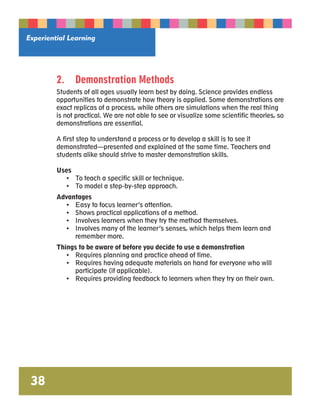
2. Demonstration Methods 
Students of all ages usually learn best by doing. Science provides endless 
opportunities to demonstrate how theory is applied. Some demonstrations are 
exact replicas of a process, while others are simulations when the real thing 
is not practical. We are not able to see or visualize some scientific theories, so 
demonstrations are essential. 
A first step to understand a process or to develop a skill is to see it 
demonstrated—presented and explained at the same time. Teachers and 
students alike should strive to master demonstration skills. 
Uses 
• To teach a specific skill or technique. 
• To model a step-by-step approach. 
Advantages 
• Easy to focus learner’s attention. 
• Shows practical applications of a method. 
• Involves learners when they try the method themselves. 
• Involves many of the learner’s senses, which helps them learn and 
remember more. 
Things to be aware of before you decide to use a demonstration 
• Requires planning and practice ahead of time. 
• Requires having adequate materials on hand for everyone who will 
participate (if applicable). 
• Requires providing feedback to learners when they try on their own.
Experiential Learning 
39 
Process 
• Introduce the demonstration: What is the purpose? 
• Present the material you are going to use. 
• Demonstrate. 
• Demonstrate again, explaining each step. 
• Invite the students to ask questions. 
• Have the students practice on their own. This will increase retention 
substantially. 
• Discuss how easy/difficult it was for them—summarize. 
• Innovation: Incorporate students’ ideas to improve the demonstration. 
Tips 
• Arrange the learning space and students so everyone can see. 
• Face the students as much as possible. 
• Have all your materials ready and in one place. 
• Ask some of the students to assist with the preparation and/or 
demonstration. 
What are some things you might demonstrate in your school garden or 
classroom? 
__________________________________________________________________________ 
__________________________________________________________________________ 
__________________________________________________________________________ 
Source: Training Trainers for Development, The Centre for Development and 
Population Activities, Washington, DC, U.S.A. (1995).
Experiential Learning 
40 
3. Classroom Aids 
Science and math concepts come alive when you use the garden to demonstrate 
or reinforce what is in your textbooks. Some textbooks assume you have access 
to laboratory equipment; whether or not this is the case, keep in mind that you 
and the students can make your own scientific equipment. 
A little creativity and resourcefulness is all you need to stock your own 
laboratory. You can use existing things from your natural environment (plants, 
insects, water, etc.) or make many simple devices that are locally available and 
free for demonstrating scientific concepts. 
Look around you. Collect discarded or free things you can use to demonstrate 
scientific or mathematical concepts. This might include the following items: 
• insects 
• large food tins 
• metal cans 
• old newspapers 
• plants 
• plastic bottles (1 liter or other sizes) 
• plastic bowls, trays and cups 
• sticks, long and straight 
• stones 
• string 
• other___________________________ 
The above items are used in the Classroom Lessons found later in this Manual. 
The next few pages present four sample Classroom Activities. First are 
directions for making two items that are important in studies with gardening 
and science: rain gauges and measuring tapes. Following these are two 
Classroom Activities that can be used for many disciplines: writing and 
performing songs and writing and performing dramas.
Experiential Learning 
41 
CLASSROOM ACTIVITY: 
Make a Rain Gauge 
We can tell if the garden needs rain with our own eyes and judgment. But 
collecting and measuring rain in a gauge can provide countless ways to involve 
students in scientific inquiry. You can use rain gauges and the data you collect 
from them in many lessons or experiments. By making your own rain gauges 
your supply will be plentiful; this means you can set out several in the garden 
for many students to see and use at one time. Meanwhile, using these rain 
gauges will remove the worry about the possibility of a commercial rain gauge 
being broken or stolen. 
To make a rain gauge: 
Collect these materials: 
• The school’s commercial rain gauge. (Note: store it in a secure place 
after you have finished this exercise.) 
• A discarded clear or transparent, 1-liter plastic bottle—cap and label 
removed. 
• A waterproof/permanent marking pen. 
• A knife or scissors to cut the bottle. 
• A pan or small bucket of water. 
Complete these steps: 
1. Cut the top off of the bottle so it is about half the original size. 
2. Pour exactly a depth of 1 cm. water into the commercial rain gauge. 
3. Pour the water from the rain gauge into the bottom of the bottle. Mark a 
line on the bottle at the top of the water and write “1 cm.” next to the line. 
4. Repeat steps 2 and 3, 1 cm. at a time until you reach the top of the bottle. 
As you add each centimeter of water, add 1 cm. to the amount you mark 
on the bottle (2 cm., 3 cm., 4 cm., etc.). 
You are using the commercial rain gauge to calibrate your handmade gauge. 
Note that it is necessary to mark the bottle after you pour an accurate amount 
of water into it because the bottom and sides of the bottle may not be flat or the 
bottle width may vary.
Experiential Learning 
42 
To use a rain gauge: 
• Attach it to a bamboo stake with string or tape. Place the stake in the 
ground away from trees, buildings or fences so that the rainfall above it 
will not be obstructed. Make sure the gauge itself is at eye level so 
students can read it easily. 
• Collect data from the rain gauge for use in experiments or teaching. 
Refer to the Classroom Lessons in this Manual for several ideas. 
• Use the rain gauges or similar devices in your classroom to measure 
liquids in experiments or in demonstrations of scientific principles.
Experiential Learning 
43 
CLASSROOM ACTIVITY: 
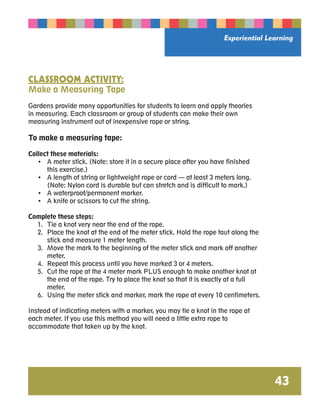
Make a Measuring Tape 
Gardens provide many opportunities for students to learn and apply theories 
in measuring. Each classroom or group of students can make their own 
measuring instrument out of inexpensive rope or string. 
To make a measuring tape: 
Collect these materials: 
• A meter stick. (Note: store it in a secure place after you have finished 
this exercise.) 
• A length of string or lightweight rope or cord — at least 3 meters long. 
(Note: Nylon cord is durable but can stretch and is difficult to mark.) 
• A waterproof/permanent marker. 
• A knife or scissors to cut the string. 
Complete these steps: 
1. Tie a knot very near the end of the rope. 
2. Place the knot at the end of the meter stick. Hold the rope taut along the 
stick and measure 1 meter length. 
3. Move the mark to the beginning of the meter stick and mark off another 
meter. 
4. Repeat this process until you have marked 3 or 4 meters. 
5. Cut the rope at the 4 meter mark PLUS enough to make another knot at 
the end of the rope. Try to place the knot so that it is exactly at a full 
meter. 
6. Using the meter stick and marker, mark the rope at every 10 centimeters. 
Instead of indicating meters with a marker, you may tie a knot in the rope at 
each meter. If you use this method you will need a little extra rope to 
accommodate that taken up by the knot.
Experiential Learning 
44 
CLASSROOM ACTIVITY: 
Write and Present a Song (Performance Arts) 
Songs are a powerful way to transmit our culture from one generation to the 
next. When we sing we use different skills and we can express ourselves in 
ways that reflect our culture. Many teachers use music and songs in school to 
help students remember important lessons while entertaining them at the same 
time. Meanwhile, songs also help to reinforce knowledge and attitudes about 
the school garden. Finally, writing and performing songs helps boost self-confidence 
and poise. 
A good song for students is simple and easy to remember, repeats important 
concepts, and has a melody that everyone can sing. 
Write a song about your school garden that you can teach the students. 
Consider writing a song in a local language. Or have the students write songs. 
Provide some guidelines: 
1. All students in the group must be involved in some way. 
2. List the specific gardening concepts that should be presented in the 
song. For example: 
• coming to school every day 
• cooperation and working together 
• appreciating nature 
• contributing to the garden 
• being respectful of the plants in the garden 
• keeping the garden secure 
• washing hands 
• nutrition and eating food grown in the garden
Experiential Learning 
45 
The songs can include actions for the students. For example, include gestures 
that simulate planting, the sun or rain, cooperation, etc. Because the students 
will be using more of their senses when they incorporate actions into songs this 
way, they will remember the concepts presented even more. 
3. Present the song to the rest of the class. Be respectful of each group 
when they are presenting their song. 
After each presentation, review and discuss the lessons learned from the song. 
Several activities presented later in this Manual actively use music to teach. 
Refer to Classroom Lessons: Write a Song and Teaching Garden Skills Through 
Dance and Music. 
Using songs is an 
entertaining way to 
teach during a 
garden Open Door.
Experiential Learning 
46 
CLASSROOM ACTIVITY: 
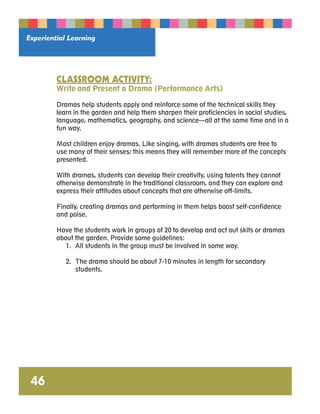
Write and Present a Drama (Performance Arts) 
Dramas help students apply and reinforce some of the technical skills they 
learn in the garden and help them sharpen their proficiencies in social studies, 
language, mathematics, geography, and science—all at the same time and in a 
fun way. 
Most children enjoy dramas. Like singing, with dramas students are free to 
use many of their senses; this means they will remember more of the concepts 
presented. 
With dramas, students can develop their creativity, using talents they cannot 
otherwise demonstrate in the traditional classroom, and they can explore and 
express their attitudes about concepts that are otherwise off-limits. 
Finally, creating dramas and performing in them helps boost self-confidence 
and poise. 
Have the students work in groups of 20 to develop and act out skits or dramas 
about the garden. Provide some guidelines: 
1. All students in the group must be involved in some way. 
2. The drama should be about 7-10 minutes in length for secondary 
students.
Experiential Learning 
47 
3. List the specific gardening concepts that should be presented in the 
drama. For example: 
• coming to school every day 
• cooperation and working together 
• appreciating nature 
• contributing to the garden 
• being respectful of the plants in the garden 
• keeping the garden secure 
• washing hands 
• nutrition and eating food grown in the garden 
4. Present the drama to the rest of the class. Be respectful of each group 
when they are presenting their drama. 
After each presentation, review and discuss the 
lessons learned from the drama. 
For several ideas on how to use dramas in the 
classroom, refer to the Classroom Lessons: Rooty 
Theatre and Rainstorm. 
Using drama is an 
entertaining way to 
teach during a garden 
Open Door.
Involving Students in the Garden 
48 
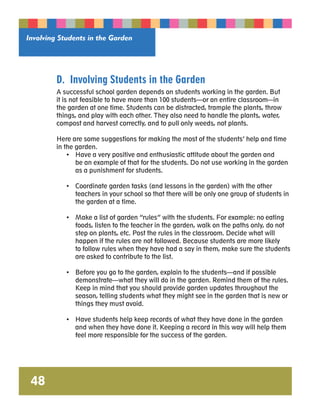
D. Involving Students in the Garden 
A successful school garden depends on students working in the garden. But 
it is not feasible to have more than 100 students—or an entire classroom–-in 
the garden at one time. Students can be distracted, trample the plants, throw 
things, and play with each other. They also need to handle the plants, water, 
compost and harvest correctly, and to pull only weeds, not plants. 
Here are some suggestions for making the most of the students’ help and time 
in the garden. 
• Have a very positive and enthusiastic attitude about the garden and 
be an example of that for the students. Do not use working in the garden 
as a punishment for students. 
• Coordinate garden tasks (and lessons in the garden) with the other 
teachers in your school so that there will be only one group of students in 
the garden at a time. 
• Make a list of garden “rules” with the students. For example: no eating 
foods, listen to the teacher in the garden, walk on the paths only, do not 
step on plants, etc. Post the rules in the classroom. Decide what will 
happen if the rules are not followed. Because students are more likely 
to follow rules when they have had a say in them, make sure the students 
are asked to contribute to the list. 
• Before you go to the garden, explain to the students—and if possible 
demonstrate—what they will do in the garden. Remind them of the rules. 
Keep in mind that you should provide garden updates throughout the 
season, telling students what they might see in the garden that is new or 
things they must avoid. 
• Have students help keep records of what they have done in the garden 
and when they have done it. Keeping a record in this way will help them 
feel more responsible for the success of the garden.
Involving Students in the Garden 
49 
• Students should work in groups of four or five, or more, and should 
take turns as group leader. The leaders can help monitor the other 
students in their group. When you are demonstrating something, make 
sure the group leaders for that day can see and understand the process 
well so that they can demonstrate it to the others. 
• Students who feel a sense of responsibility for the garden will be more 
likely to cooperate in hard work to make the garden a success. Think of 
opportunities for students to lead activities, demonstrations, and so on. 
What other ideas can you think of to involve students in the school garden? 
__________________________________________________________________________ 
__________________________________________________________________________ 
__________________________________________________________________________ 
__________________________________________________________________________
Involving Students in the Garden 
50 
Friendly Competition 
Students often enjoy competition between classmates or with other classes. 
Discuss with the class and the other teachers how you might design some 
friendly competition with the other students. Such good-natured competition 
can be a great incentive to do well in the garden. 
Decide what will determine the “winning entry.” The best vegetables? The best 
experiment? The most productive plot? The biggest sweet potato? 
Decide what kind of prize the winners will receive. Material prizes may be 
difficult to determine or obtain, so think of creative ways to reward students. 
Perhaps the losing team must clean the classroom of the winning team, for 
example. Again, involve the students; they may offer some innovative ideas for 
rewards. 
Growing a Good Gardener Attitude 
In some cultures, communities, or families, people who are more educated do 
not like to garden. They may feel gardening is for uneducated people who lack 
skills or knowledge. Discuss this concept with the students. Here are some 
examples of discussion starters: 
• Some educated people do not like to garden. Why? 
• Based on what students know about the science of gardening, is 
gardening for “ignorant” people? What kind of knowledge do good 
gardeners need? List the various kinds of science (soils, insects/ 
entomology, climate, seed propagation, plant science, etc.). 
• Think about your elders or ancestors. Did they survive because they 
didn’t know how to garden? 
• Think of some famous horticulturists or scientists. Where did they 
develop their interest in science? (Most likely many learned from a family 
member.) 
• How can students, as educated gardeners, use their knowledge and 
skills in the future?
Involving Students in the Garden 
51 
Point out that in some “western” cultures educated people like to garden. For 
them, gardening is satisfying; they value knowing where their food is coming 
from because they can count on the food’s quality and safety. These gardeners 
are proud of their accomplishments and many find their work in the garden to 
be a relaxing change from their professional work. 
A youth development organization titled “4-H” was founded in the early 
1900s in the United States from within a unit of the United States Department 
of Agriculture. At the time, agriculturists were finding it difficult to convince 
farmers to try new seed varieties and cultivation methods. As a solution, these 
leaders formed small 4-H clubs in which they could teach the information to 
boys and girls instead. In turn, these club members tried the new practices 
at home. Their mothers and fathers saw the success of these methods and 
adapted the practices themselves. (4-H clubs are still popular throughout the 
U.S., but the focus has expanded well beyond agriculture. The 4-H represents 
a well-rounded individual’s head, heart, hands, and health.) Examine how 
the lessons from this experience may be applicable to your country and to the 
students’ gardening skills and knowledge. 
Because some educated people don’t like to garden, the teachers may have 
less gardening experience or knowledge than their students, who may tend 
gardens at home. Teachers will do well to take steps to overcome this lack of 
expertise and to instill a good attitude about gardening in their peers (other 
instructors) and students alike.
Involving Students in the Garden 
52 
Here are some ways to grow a good garden attitude: 
1. The teachers can grow a small garden themselves to set a good example. 
It may only need to include one or two vegetables to serve the purpose. 
2. Teachers should ask students how they help in the home garden. 
Who makes the decisions about what to plant? About where to plant? 
Who determines what to do when there are disease or pest problems? 
What do the students contribute? What are their tasks? 
3. Let the students be the “experts.” Ask students to demonstrate or explain 
some of the steps to gardening. Ask the rest of the class to link what they 
see with some of the science theory they have been learning in the 
classroom. 
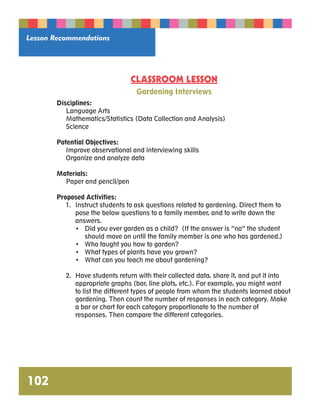
4. Assign students to interview elders about gardening practices. Compile 
what they learn in a book for reference in the library. Refer to Classroom 
Lesson: Gardening Interviews. 
A Famous Gardener 
While Nelson Mandela was a prisoner in South Africa he 
spent hours every day gardening. He grew vegetables, 
often in oil drums that had been cut in half. At one time 
he was caring for about 900 plants. In this way he 
improved his own diet and the diet of other prisoners — 
also those of his white warders!
Involving Students in the Garden 
53 
Child Labor 
Students can learn a lot by working in the garden. But they should not be 
treated as free labor. Discuss and set a school policy for how often the students 
will work in the garden. The World Food Program has determined that 1 hour/ 
week/student is reasonable. Since most schools have many students, this 
allotment may be substantial for adequately tending the garden. Additional 
students may volunteer to work more hours as part of a club or for other 
reasons. The school Garden Committee should set this policy. 
Can you think of other ways to involve students in the school garden?
Experimenting and Learning 
54 
E. Experimenting in the Garden and Classroom 
What is an Experiment? 
Much of our knowledge of science—including agriculture and nutrition—comes 
from experimentation. An experiment is a test of a hypothesis or prediction; 
the results of this test help us understand something. The term “experiment” 
is often used incorrectly. For example, when we try something to see what 
happens, but lack a second activity to compare our experience, this is not a true 
experiment. Without comparison we cannot be sure why or how the results 
came to be. 
In an experiment, all variables must be kept the same except one. The design of 
an experiment is sometimes called “protocol”. 
Why Experiment? 
Experimentation is a common and respected way to test a theory or procedure; 
the results of the experiment help us choose to adapt new practices or to 
change our behavior. When we do, see, or learn from an experiment, we can 
solve problems and improve the way we do something. The experiment—and 
interpreting its results—is a vital tool for agriculture, for science, and for many 
other disciplines. Experiments have other additional benefits as well: 
Experimentation teaches students many skills, including how to: 
• think critically 
• question 
• observe 
• analyze 
• keep records 
• apply mathematical theory 
• apply scientific theory 
• be a better consumer of information
Experimenting and Learning 
55 
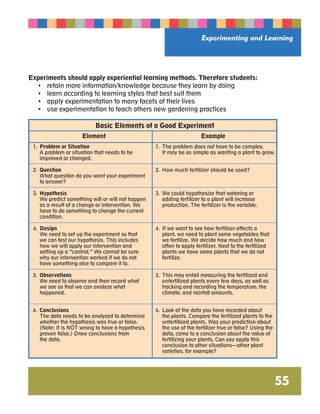
Experiments should apply experiential learning methods. Therefore students: 
• retain more information/knowledge because they learn by doing 
• learn according to learning styles that best suit them 
• apply experimentation to many facets of their lives 
• use experimentation to teach others new gardening practices 
Element Example 
1. Problem or Situation 
Basic Elements of a Good Experiment 
A problem or situation that needs to be 
improved or changed. 
2. Question 
What question do you want your experiment 
to answer? 
3. Hypothesis 
We predict something will or will not happen 
as a result of a change or intervention. We 
have to do something to change the current 
condition. 
4. Design 
We need to set up the experiment so that 
we can test our hypothesis. This includes 
how we will apply our intervention and 
setting up a “control.” We cannot be sure 
why our intervention worked if we do not 
have something else to compare it to. 
5. Observations 
We need to observe and then record what 
we see so that we can analyze what 
happened. 
6. Conclusions 
The data needs to be analyzed to determine 
whether the hypothesis was true or false. 
(Note: It is NOT wrong to have a hypothesis 
proven false.) Draw conclusions from 
the data. 
1. The problem does not have to be complex. 
It may be as simple as wanting a plant to grow. 
2. How much fertilizer should be used? 
3. We could hypothesize that watering or 
adding fertilizer to a plant will increase 
production. The fertilizer is the variable. 
4. If we want to see how fertilizer affects a 
plant, we need to plant some vegetables that 
we fertilize. We decide how much and how 
often to apply fertilizer. Next to the fertilized 
plants we have some plants that we do not 
fertilize. 
5. This may entail measuring the fertilized and 
unfertilized plants every few days, as well as 
tracking and recording the temperature, the 
climate, and rainfall amounts. 
6. Look at the data you have recorded about 
the plants. Compare the fertilized plants to the 
unfertilized plants. Was your prediction about 
the use of the fertilizer true or false? Using the 
data, come to a conclusion about the value of 
fertilizing your plants. Can you apply this 
conclusion to other situations—other plant 
varieties, for example?
56 
Some examples of experiments you can do in the garden follow. 
1. Seed Germination Medium: Soil With and Without Compost 
2. The Effect of Compost on Plant Growth 
3. Compost and Vegetable Yields 
4. Compost Production Techniques: Pit vs. Heap Compost 
5. Compost Production Techniques: Moisture in Covered vs. 
Uncovered Compost 
6. Tomato Disease Prevention 
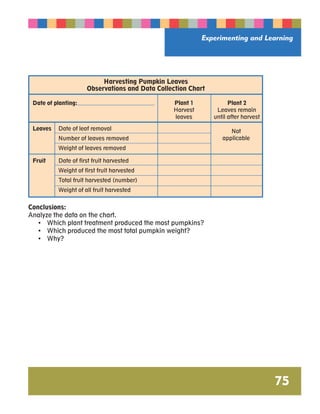
7. Harvesting Pumpkin Leaves
57 
EXPERIMENT 
Seed Germination Medium: Soil With and Without Compost 
Situation: 
High germination of vegetable seeds is critical. Seeds are expensive, and hot, 
dry weather can reduce seed germination rates. Fine, smaller soil particles 
allow greater seed-to-soil contact than do larger or lumpy soils, and thereby 
improve seed germination. Adding organic materials like compost can improve 
soils and seed germination. 
Question: 
Do seeds germinate better in untreated soil or in soil with compost added 
(compost-amended) soil? 
True or False Hypothesis: 
What do you predict will happen? For example, seeds germinate faster in 
compost-amended soil. 
Design: 
Plant and maintain two small garden areas. 
1. Prepare two small garden areas. 
2. In one garden only add a layer of finished compost and incorporate it into 
the soil. 
3. Plant both gardens indentically: 
• at the same time, 
• with the same vegetables, 
• with the plants aligned in the same pattern. 
(The number of seeds and types of vegetables should be identical.) 
4. Water each garden as necessary. (The amount of water and time of 
watering should be identical.) 
Number of Seeds Germinated 
Number of Seeds Planted 
% of 
Germination 
Rate 
x 100 = 
Seed Germination Formula: 
14 Seeds Germinated 
20 Seeds Planted 
70% 
Germination 
Rate 
x 100 = 
Example:
Experimenting and Learning 
58 
Observations: (Use a chart like the one provided here.) 
Check the planting daily: 
• When first seedling appears for each type of seed (tomato, pepper, etc.) 
record the date (one date per vegetable). 
Each week, for 3 weeks: 
• Record the percent of seed germination (use this formula as your guide). 
Seed Germination Medium: 
Soil With and Without Compost - Observations and Data Collection Chart 
Date of planting: 
Vegetable 
Compost-Amended Soil 
Natural (Untreated) Soil 
Vegetable 
Compost-Amended Soil 
Natural (Untreated) Soil 
Vegetable 
Compost-Amended Soil 
Natural (Untreated) Soil 
Vegetable 
Compost-Amended Soil 
Natural (Untreated) Soil 
Date first 
seedling 
emerges 
Conclusions: 
Analyze the data on the chart. 
Number of Seeds Germinated 
Number of Seeds Planted 
Percent germination 
Week 1 Week 2 Week 3 
• Did adding compost change the speed of germination? 
• If so, how? (Increased or decreased germination rate.) 
• Why? 
% of 
Germination 
Rate 
x 100 = 
Seed Germination Formula:
Experimenting and Learning 
59 
EXPERIMENT 
The Effect of Compost on Plant Growth 
Situation: 
Plants need natural fertilizer/compost to grow, but you do not know how much 
compost to apply. 
Question: 
How much compost should be applied to garden vegetable plants? 
True or False Hypothesis: 
What do you predict will happen? For example, the plants with the most 
compost applied all at once will grow most quickly and produce the most fruit. 
Design: 
Set up an experiment in which you grow green beans or any other vegetable for 
at least five weeks, using three methods: 
• a lot of compost at one time 
• a little compost often 
• no compost 
Plant 12 seedlings. Divide into three groups of four plants each—A, B, and C. 
Make sure all the plants are in one shared location. 
• Group A—add 5 cm. of compost at planting 
• Group B—add 1 cm. of compost each week for 5 weeks 
• Group C—do not compost 
Post signs on sticks so you and the students will know how each group was 
treated. For example: 
• Compost once at planting 
• Compost frequently 
• No compost 
Water each group the same. 
Compost 
once at 
planting 
Compost 
frequently 
No 
compost
Experimenting and Learning 
60 
Observations: (Use a chart like the one provided here.) 
Observe all of the groups for an equal length of time or until the plants are ready 
for harvesting. 
1. Once a week, measure the plants in each group. Calculate the average 
height of the plants in each group. 
2. If you continue the experiment until you harvest, count or weigh how 
much you harvest from each of the groups. Also observe and record any 
differences in quality. 
Conclusions: 
1. Analyze the data on the chart. At the end of the experiment, compare the 
growth of the plants in each group. 
• Which group grew the best? 
• How did the amount of composting influence the growth of the plants 
in that group? 
• Based on the data from your observations, was your hypothesis true 
or false? 
• Why or why not? 
2. Draw conclusions. 
• What can you conclude about the use of composting in growing this 
plant? 
• Is it better to use a lot of compost all at once? What about using a 
little compost more frequently? None at all? Why? 
• Would this practice apply to other plants? 
• How does composting benefit plants? What is in compost that helps 
plants grow? 
• What is in compost that makes more frequent application better? 
• Can you trust the results of your experiment? Could it be improved? 
Should it be repeated? 
• Are 12 plants a large enough sample?
Experimenting and Learning 
61 
The Effect of Compost on Plant Growth 
Observations and Data Collection Chart 
Group A 
5 cm. of compost 
added at planting 
Plant Height 
A-1 
Week 1 
average 
Week 2 
average 
Week 3 
average 
Week 4 
average 
Week 5 
average 
A-2 A-3 A-4 
Group B 
1 cm. of compost added 
each week for 5 weeks 
Plant Height 
B-1 B-2 B-3 B-4 
Etc. = Expand table (to include Week 6 until date of harvest). 
Group C 
no compost used 
Plant Height 
C-1 
Height at 
harvest 
Average 
height at 
harvest 
Total for 
produce 
at harvest 
Average 
for produce 
at harvest 
Quality of 
produce 
at harvest 
C-2 C-3 C-4
Experimenting and Learning 
62 
EXPERIMENT 
Compost and Vegetable Yields 
Situation: 
Continuously raising vegetables can deplete garden soils of nutrients. One way 
to restore soil nutrients is to add a form of organic matter—compost—to the 
soil. Traditional compost can be made using animal dung and plant material. If 
no animal dung is available, a plant-based compost can be made, using plant 
materials only. This can be added to the garden to improve soil fertility. 
Question: 
Does adding compost to a garden soil improve the yield of the vegetables 
grown? 
True or False Hypothesis: 
What do you predict will happen? For example, adding compost to garden soils 
improves vegetable yields. 
Design: 
Plant and maintain two square meter gardens. 
1. In one garden only add a layer of finished compost and incorporate it into 
the soil. 
2. Plant both gardens identically: 
• at the same time, 
• with the same vegetables, 
• with the plants aligned in the same pattern. 
(The number of seeds and types of vegetables should be identical.) 
3. Water each garden as necessary. 
(The amount of water and time of watering should be identical.)
Experimenting and Learning 
63 
Observations: (Use a chart like the one provided here.) 
1. Each week after planting: 
Seed Germination 
Record the percent of seed germination (use this formula as your 
guide). 
Number of Seeds Germinated 
Number of Seeds Planted 
Leaves on Plants 
Evaluate the overall color of the plant’s leaves. 
Use a scale of 1 to 5, where 1 = very pale green, 2 = pale green, 
3 = light green, 4 = normal green, and 5 = very dark green. 
2. At first harvest AND each week thereafter: 
Record the yield and quality of the vegetables. 
% of 
Germination 
Rate 
x 100 = 
Seed Germination Formula: 
14 Seeds Germinated 
20 Seeds Planted 
70% 
Germination 
Rate 
x 100 = 
Example:
Experimenting and Learning 
64 
Compost and Vegetable Yields 
Observations and Data Collection Chart 
Date of planting: 
Percent 
Germination 
Week 1 
Week 2 
Week 3 
Week 4 
Week 5 
Week 6 
Week 7 
Week 8 
Seed Germination Formula: 
Number of Seeds Germinated 
Number of Seeds Planted 
% of 
Germination 
Rate 
x 100 = 
Garden without Compost Garden with Compost 
Leaf 
Color 
Week 1 
Week 2 
Week 3 
Week 4 
Week 5 
Week 6 
Week 7 
Week 8 
Use a scale of 1-5: 
1 = very pale green 2 = pale green 3 = light green 4 = normal green 5 = dark green 
Garden without Compost Garden with Compost
Experimenting and Learning 
65 
Compost and Vegetable Yields 
Observations and Data Collection Chart 
Date of planting: 
Vegetable 
Yield 
Week 1 
Week 2 
Week 3 
Week 4 
Week 5 
Week 6 
Week 7 
Week 8 
Garden without Compost Garden with Compost 
Number of 
Total 
Number of 
vegetables 
Weight 
vegetables 
harvested 
harvested 
Total 
Weight 
Conclusions: 
Analyze the data on the chart. 
• Which garden yielded the most vegetables? 
• Did adding compost increase the yield of garden vegetables? 
• Why or why not?
Experimenting and Learning 
66 
EXPERIMENT 
Compost Production Techniques: 
Pit vs. Heap Compost 
Situation: 
Compost is used to improve soil condition and fertility, especially for vegetable 
production. Composting is a natural process. Traditional compost can be made 
using animal dung and plant material. If no animal dung is available, a plant-based 
compost can be made, using plant materials only. When compost can be 
made quickly it is ready to use sooner. Therefore, reducing the time it takes to 
make compost is important in reducing the cost of food production. 
Question: 
Which produces compost most quickly: composting in a pit or in a heap? 
True or False Hypothesis: 
What do you predict will happen? For example, pit-style composting produces 
usable compost faster than does an above-ground compost heap. 
Design: 
1. Prepare and maintain two types of compost (pit and heap). 
• Dig two identical compost pits and clean two identical areas for 
compost heaps. 
• Fill one compost pit and build one compost heap above ground in the 
cleared area. 
• Build each pile identically. (Use alternating layers of dry grass, green 
grass, a little finished compost, and a little wood ash.) 
• Water compost when necessary to keep it moist. (The amount of 
water and time of watering should be identical.) 
• Keep each compost covered with banana leaves or palm leaves. 
• Record the size of the pit materials and the heap materials.
Experimenting and Learning 
67 
2. Every two weeks, turn the materials. 
• First turning: 
Move pit materials from the first pit into the second pit. 
Move heap materials to the second (empty) cleared area. 
• Second turning: 
Move pit materials from the second pit back into the first pit. 
Move heap materials back to the original heap location. 
3. Repeat until either the pit or the heap compost is ready. The compost is 
usually ready in 6 to 8 weeks. 
Observations: (Use a chart like the one provided here.) 
1. Every two weeks, at turning: 
• Record the moisture level of each compost pile. Use a scale of 
1 to 5, where 1 = paper dry, 2 = dry, 3 = moist to the touch, 
4 = wet, and 5 = dripping wet. 
• Record the temperatures of each compost pile. 
2. At the end of the 8th week: 
• Measure the final volume of the complete compost pile.
Experimenting and Learning 
68 
Compost Production Techniques: 
Pit vs. Heap Compost 
Observations and Data Collection Chart 
Start Date: 
At Start 
Week 2 
Week 4 
Week 6 
Week 8 
Moisture 
Use a scale of 1 to 5 
NA NA 
Date Compost is Ready 
Pit Heap 
Note: NA means not applicable. 
Temperature 
Pit Heap 
Volume 
1 = paper dry 
2 = dry 
3 = moist to the touch 
4 = wet 
5 = dripping wet 
Pit Heap 
NA NA 
Pit Heap 
NA NA 
NA NA 
NA NA 
NA NA 
Conclusions: 
Analyze the data on the chart. 
• Which type of compost-making process was faster? 
• Why? 
• What role, if any, did the pit play in the decomposition process?
Experimenting and Learning 
69 
EXPERIMENT 
Compost Production Techniques: 
Moisture in Covered vs. Uncovered Compost 
Situation: 
Compost is an important resource in vegetable production. Traditional compost 
can be made using animal dung and plant material. If no animal dung is 
available, a plant-based compost can be made, using plant materials only. The 
decomposition process requires bacteria, carbon and nitrogen materials, and 
moisture. Maintaining the optimum moisture content in a compost heap will 
increase the rate of decomposition. Covering the compost heap may affect the 
moisture content and moisture retention. 
Question: 
Is it necessary to cover a compost heap to produce compost? 
True or False Hypothesis: 
What do you predict will happen? For example, a covered compost will produce 
usable compost more quickly than one that is not covered. 
Design: 
1. Construct and maintain two compost heaps. 
• The conditions for both heaps should be identical. (This includes sun, 
soil, type of garden, etc.) 
• Materials used in both heaps should be identical. (Use materials 
that are readily available: alternating layers of dry grass, green grass, 
a little compost, a little wood ash, and water.) 
2. Cover one heap and leave the other uncovered. 
3. Turn each pile every two weeks. 
4. Water each pile as necessary to keep it moist. (The amount of water and 
time of watering should be identical.)
Experimenting and Learning 
70 
Observations: (Use a chart like the one provided here.) 
1. Two weeks after construction, remove the cover and evaluate the 
two heaps. 
• Record the temperatures of each heap. 
• If you do not have a thermometer, feel each heap. Is it cool, warm, 
or hot to the touch? 
2. Every two weeks thereafter, until one compost heap is ready, evaluate 
both heaps: 
• Record the temperatures of each heap or note whether it is cool, 
warm, or hot. 
• Turn and water if necessary. 
A compost heap is ready when the original materials are no longer identifiable 
and the temperature of the heap is cool and consistent. 
Compost Production Techniques: 
Moisture in Covered vs. Uncovered Compost 
Observations and Data Collection Chart 
Start Date: 
Covered 
compost 
Temperature 
OR 
cool/warm/hot 
Temperature 
OR 
cool/warm/hot 
Uncovered 
compost 
Week 
2 
Conclusions: 
Analyze the data on the chart. 
Week 
4 
Week 
6 
Week 
8 
• How long did it take for each compost heap to be finished? 
• Did the covered or uncovered heap finish first? 
• Why? 
Date 
compost is 
ready
Experimenting and Learning 
71 
EXPERIMENT 
Tomato Disease Prevention 
Situation: 
Tomatoes are commonly raised for home consumption and for sale. These 
vegetables are very susceptible to fungus disease problems. Since chemical 
applications are expensive and present health issues, safer cultural control 
practices are recommended to minimize the impact of fungus diseases. Raising 
the tomato vines off the ground may minimize problems from moisture that can 
influence the growth and spread of fungus diseases. 
Question: 
When raising tomatoes is it better to stake them up or to allow them to grow on 
the ground? 
True or False Hypothesis: 
What do you predict will happen? For example, it is better to stake and grow 
tomatoes upright. 
Design: 
Transplant and maintain four tomato plants. 
1. Transplant four tomato plants into identical growing conditions (sun, soil, 
type of garden, etc.). 
2. Stake two of the tomato plants and tie them upright to grow off of the 
ground. 
3. Allow two tomato plants to grow on the ground without support. 
Observations: (Use a chart like the one provided on the next pages.)
Experimenting and Learning 
72 
Leaf Disease 
• Evaluate the percentage of disease affecting the leaves of each plant 
every week for six weeks. 
• Rate the percentage of disease on the leaves. 
Use a scale of 1 to 5, where 1 = no disease, 2 = 25% affected, 
3 = 50% affected, 4 = 75%, and 5 = 100% affected. 
Fruit Harvest 
• When the first tomato ripens, start recording the number and weight of 
the fruit harvested two times each week. 
Tomato Disease Prevention 
Observations and Data Collection Chart 
Date of planting: 
Leaf Disease 
(% of leaves that are 
diseased) 
Week 1 
Week 2 
Week 3 
Week 4 
Week 5 
Week 6 
Plants are permitted 
to grow on the ground 
Use a scale of 1 to 5 
1 = 10% affected 2 = 25% affected 3 = 50% affected 
4 = 75% affected 5 = 100% affected 
(same date for all plants) 
Plants are staked so they 
grow upright, off of 
the ground 
Plant 1 Plant 2 Plant 3 Plant 4
Experimenting and Learning 
73 
Fruit harvest 
Date of first harvest: 
(date will vary) 
First harvest 
Week 1 
Week 2 
Week 3 
Week 4 
Week 5 
Week 6 
sample #1 
sample #2 
sample #1 
sample #2 
sample #1 
sample #2 
sample #1 
sample #2 
sample #1 
sample #2 
sample #1 
sample #2 
Plant 1 Plant 2 Plant 3 Plant 4 
number 
of fruit 
Conclusions: 
Analyze the data on the chart. 
total 
weight 
number 
of fruit 
total 
weight 
number 
of fruit 
total 
weight 
number 
of fruit 
• Which system of raising tomatoes produces the most tomatoes? 
• Which system produces the healthiest (disease-free) tomatoes? 
• Why? 
total 
weight 
Tomato Disease Prevention 
Observations and Data Collection Chart 
Plants are staked so they 
grow upright, off of 
the ground 
Plants are permitted 
to grow on the ground
Experimenting and Learning 
74 
EXPERIMENT 
Harvesting Pumpkin Leaves 
Situation: 
Plants need and use their leaves for photosynthesis, which is the food 
production system in plants. Many times the leaves of vegetable plants are 
removed and eaten as greens. 
Question: 
Does the harvesting of pumpkin leaves before fruit harvest affect the yield, 
quality, and/or date of the fruit’s maturity? 
True or False Hypothesis: 
What do you predict will happen? For example, harvesting pumpkin leaves 
before fruit harvest will reduce yield and delay fruit production. 
Design: 
Plant and maintain two pumpkin plants. 
1. Plant two pumpkin plants near each other at the same time and treat 
them the same way. 
2. Harvest the leaves of Plant 1 in the traditional way. 
3. Do not disturb the leaves of Plant 2 until after the pumpkins are 
harvested. 
Observations: 
Use a chart like the one provided here to record: 
• The date of leaf removal, along with number and weight of leaves 
removed. 
• The date of the first fruit harvested for each plant. 
• Weight and number of vegetables harvested for each plant.
Experimenting and Learning 
75 
Harvesting Pumpkin Leaves 
Observations and Data Collection Chart 
Date of planting: 
Leaves Date of leaf removal 
Number of leaves removed 
Weight of leaves removed 
Plant 1 
Harvest 
leaves 
Plant 2 
Leaves remain 
until after harvest 
Not 
applicable 
Fruit Date of first fruit harvested 
Weight of first fruit harvested 
Total fruit harvested (number) 
Weight of all fruit harvested 
Conclusions: 
Analyze the data on the chart. 
• Which plant treatment produced the most pumpkins? 
• Which produced the most total pumpkin weight? 
• Why?
Experimenting and Learning 
76 
F. Observation Skills 
Seeing and recording the garden environment are critical elements in 
experiments and science. Therefore, when using the school garden as a 
teaching tool it is important to include student observations. Some students are 
naturally observant and notice many things they see, hear, smell, or feel around 
them. Others are not so observant and need help developing their observation 
skills. 
A second part of observation skills is describing what we see, hear, smell or 
feel. Some students will be good at describing their observations, others will 
need help. Observation skills are important in science and mathematics, as well 
as in other concepts. Good observers use all of their senses and, therefore, are 
more actively involved in learning. That means they are more likely to remember 
concepts. It is a type of experiential learning. 
At the beginning of the school year try the Observing, Comparing, and 
Describing activity on the following pages to help students develop their 
observation skills. The game teaches students how to describe something 
by discussing its properties. This may include size, shape, texture, color, and 
weight. 
This activity works well when accompanied by the Classroom Lesson entitled 
How Would You Describe It?
Experimenting and Learning 
77 
CLASSROOM LESSON 
Observing, Comparing and Describing 
PART 1: Describe and Object 
-Do this before Ten Questions (next page). 
Objectives: 
• Students will understand that all matter has properties that can be 
observed, defined, and recorded. 
• Students will observe, compare, and describe the structure of various 
objects. 
Materials: 
• large box or opaque plastic, paper bag, or cloth 
• two objects for students to describe 
• a collection of objects for students to describe, which might include a 
bowl, book, fruit or vegetable, rocks, leaves, shoes, cooking utensil, etc. 
Introduction: 
1. Ask students to name their favorite food. (Make sure it is a food that is 
familiar to all the students.) Say, “How could you describe, or tell about, 
your food so that someone else would have a very clear picture of it?” 
2. Help students think of words to describe properties, such as size, weight, 
color, hardness, shape, texture, odor, taste. 
3. Explain to students that everything in our known physical world has a 
structure that can be observed and described. 
4. Hold up an object and ask students to notice its parts. Explain that the 
parts of an object form its structure. 
5. Pass the object around the room. Ask the students to think of ways to 
describe its texture—how it feels. Think of words that describe texture. 
These might include rough, smooth, hard, soft, furry, etc.
Experimenting and Learning 
6. Pass the object around the room again and ask students to describe 
another property, such as weight (“It is as heavy as …”), size (“It is as 
big as…”) and so on. 
7. Test the students’ understanding of observing, comparing and describing 
by playing Ten Questions (next page). 
78
Experimenting and Learning 
79 
CLASSROOM LESSON 
Observing, Comparing and Describing 
PART 2: Ten Questions 
-Do this after Describe an Object (next page). 
1. Show students the plastic or paper bag. Tell them that you will place one 
of the two objects in the bag and hide the other. (You must hide the 
second object so students cannot guess the object in the bag by the 
process of simple elimination.) Students will try to guess which object is 
in the bag. 
2. Explain the rules: 
• Guesses must be stated in the form of questions. 
• The teacher may answer only “yes” or “no” to each question. 
• Students may not ask the name of the object. For example, they may 
not ask, “Is it a pencil?” 
• Questions should be about the object’s size, weight, color, shape, or 
texture. For example, students may ask, “Is it yellow?” or “Is it as big 
as my foot?” 
• Students who think they know what is hidden in the bag should keep 
their guesses to themselves until all 10 questions have been asked. 
• After the group has asked 10 questions, remove the object from the 
bag and show it to everyone. 
3. Model how to ask questions. For example, you might point to your shirt 
and say, “If I were going to hide this shirt in the bag, I might ask, ‘Is it 
soft?’ ‘Is it as heavy as a book?’ ‘Does it have words on it?’” One 
question not to ask is, “Is it a shirt?’” Allow time for students to practice 
asking suitable questions. 
4. Out of the sight of the students, place one object in the bag and hide the 
other. Play the game until all 10 questions have been asked. Then have 
the students guess what is in the bag.
Experimenting and Learning 
5. Play the game with two new objects. Pass the objects around and have 
the students observe them carefully to notice their size, weight, color, 
shape and texture. Then hide one of the objects and place the other one 
in the bag and repeat the game. 
80
Experimenting and Learning 
81 
CLASSROOM LESSON 
Observing, Comparing and Describing 
PART 3: Draw Conclusions 
-Do this after Describe an Object and Ten Questions (previous pages). 
Lead a discussion with the students about what they have learned. 
Some sample questions: 
• What are some different ways to describe something? 
Answer: Texture, size, weight, etc. 
• What sorts of questions helped you figure out what was hidden in 
the bag? 
Answer: Questions about the object’s properties. 
• What do we mean when we talk about structure? 
Answer: The parts of an object. 
• How will observation skills be used in the garden? 
Answer: Can describe the parts of plants and the environment. 
Can observe more closely and accurately. 
Tell the students they will use their skills in observing and describing 
throughout the year. Journaling is one way to use these skills. 
For additional ways to improve student skills in observations and description, 
refer to Classroom Lesson: How Would you Describe it?
Experimenting and Learning 
82 
CLASSROOM ACTIVITY 
Keep a Journal 
Journals are records of what happens around us. A newspaper is often called 
a journal because it records what happens in the community/region/world. 
Scientists and writers use journals to record what they see, hear, smell, feel, and 
taste. By reviewing what is in the journal, we can have fun remembering what 
has happened as well as draw some conclusions about something over a long 
period of time. 
Have your students make a journal about the garden or the environment around 
the school. 
1. Make a “journal” using a notebook, some loose papers, or a piece of 
flipchart paper. Direct students to use a pencil to write in their journal; 
because the pencil is waterproof their entries will not wash away if they 
get wet. Describe how to use the journal. 
2. Throughout the season, have the students list things they see, hear, 
smell, feel, etc., in the garden. Have them list the date, what they 
observe, and their name. They can do the same thing when they try a 
new food or activity. 
3. You can assign the students with the task of recording things in the 
journal at certain times or they can do it throughout the year. At particular 
times they may want to focus on particular things—the weather, the 
plants, the sun and rain, etc. If you have a year-long journal, you may 
need to remind them to write in it. 
4. During the year or at particular times, review the journal with the 
students. Have them draw some conclusions or make some observations. 
For example, are there themes or common observations that appear 
throughout the year? Are there other things that they have observed 
only at certain times? Why is this? What kinds of things did they 
observe? Did writing observations in the journal help them become more 
observant?
Experimenting and Learning 
83 
Sample Journal Entry 
This journal is a chronicle of our School Gardens activities. 
November 10, 2008: Discussed School Gardens concepts and 
developed a garden management plan. 
November 13, 2008: Reviewed needs for school garden and 
selected site. Garden site is directly south of 
classroom. Size of garden is to be 10 meters 
by 20 meters. Site needs to be secured, 
cleared, planted with Angolan Peas and 
fenced. 
November 14, 2008: Garden site has been cleared by a 
community member, Mr. Gasana. 
November 15, 2008: Garden site partially fenced by Father Semba. 
November 18, 2008: Garden completely fenced by 
Father Semba. 
November 20, 2008: Class prepared soil and planted 
Angolan Peas. 
November 22, 2008: Class set up rain gauge. 
November 24, 2008: Student (Marika Z.) measured rain, 
15mm. 
December 5, 2008: Started digging compost in pit. 
Class Journal Garden School 
was sunny today 
rained in afternoon
Lesson Recommendations 
84 
G. Using Experiential Activities in the Garden 
Lesson Recommendations 
Remember what you learned about experiential learning? When students learn 
by doing instead of by simply listening or seeing they remember substantially 
more. In general, a country’s Ministry of Education, Technology and Science 
has or should adopt policies to encourage improvements in academic areas 
such as science and agriculture, to enhance vocational training, and to 
broaden life skills. Using a school garden in teaching is consistent with these 
government policies. 
There are endless ways to use the garden as a laboratory. Meanwhile, almost 
any discipline that is customarily offered in secondary schools can be enhanced 
with lessons that incorporate a school garden. Become familiar with the lesson 
ideas in this section of the manual. Talk with other teachers. Try one or two 
new ideas each term. Over time, you will think of more opportunities to use the 
garden as a laboratory for teaching and learning. 
Some of the lesson ideas presented here may not be addressed on standard 
national exams. Nonetheless, it is important to keep in mind that when you use 
experiential learning methods throughout the curriculum your students will have 
better recall and knowledge of the topics you have covered, whether they are or 
are not on the exam, and long after the exam.
Lesson Recommendations 
85 
How to Use the Lesson Recommendations 
1. The chart on the next two pages lists dozens of lesson titles in seven 
different disciplines. The Xs in the grid indicate the disciplines that each 
lesson listed on the left will address. To find which lessons listed in the 
first/left column might be useful for you: 
• Locate your discipline(s) at the top of the columns in the chart 
(e.g. Geography, Language Arts). 
• Follow the column down the grid to find Xs. 
• Move across the grid to the left to find the title and page number of 
lessons that will address your discipline (e.g. Social Studies – lesson title: 
Gardening Interviews, page 104). 
• Turn to that page. 
You will notice that some lessons can help teach concepts that fit multiple 
disciplines. 
2. Look over the lesson for ideas on how to teach particular concepts. 
Ask yourself these questions: 
• Are the objectives consistent with what you are trying to teach? 
• Will the proposed activities help students learn more about the concepts 
or principles you are trying to teach? 
• Are the activities appropriate for the grade level you are teaching? 
Can you make the lesson simpler or more challenging if necessary? 
• Is this a good time in your curriculum to use this activity? 
• Do you have access to the material listed? 
If the answers are “yes”, think about how you will integrate these activities 
into your lesson plans.
Lesson Recommendations 
86 
3. Most likely the lesson recommendations are not written or presented 
in the same format that you use to write your lesson plans. These are only 
suggestions; take them and try the following: 
• Use your expertise as a teacher to adapt the lesson recommendations. 
• Use the information presented to further develop the lesson objectives. 
• Read through the proposed ideas. Add your own notes on timing or 
other tips. 
• Add an introduction or review to tie the lesson to previous lessons. 
• Add notes to tell the students what the next steps or lessons are in 
learning these principles. 
• Add more detail to help you carry out the proposed activities. 
• Adapt the evaluation questions to “test” the students and enable them 
to tell you what they have concluded about the lesson. (Try not to give 
them the answers.) 
• Try to ask questions that help the students understand the significance of 
the lesson and how the concepts might be applied in their lives. 
4. After you have tried the new lesson, evaluate yourself and how effective 
the lesson was. Make notes so that you can repeat your successes and make 
improvements for the next term or school year when you will teach the lesson 
again. 
5. As you think of new lesson ideas, share them with your fellow teachers. 
Ask them to do the same. Keep your ideas with this manual so that you and 
others can benefit.
Lesson Recommendations 
X X 
87 
Lesson Title 
Page 
Drama, 
Performing 
Arts, 
Visual Arts 
Geography 
Language 
Arts, 
Spelling 
Mathmatics/ 
Statistics 
Science 
Social 
Studies 
Classroom Lessons by Area of Discipline 
How Would You Describe it? 
Word Search 
I Am Thinking Of... 
Gardening Vocabulary “Pictionary” 
Scrambled Vegetables Game 
Do Not Fall in the River Vocabulary Game 
Rainstorm 
Garden Storytelling 
Gardening Interviews 
Music/Dance Traditions Interviews 
Indigenous Remedies Interviews 
Write a Song 
Garden Drama-Plant Growth 
Teaching Garden Skills Through Dance 
and Music 
Garden Poetry 1 - Free Verse 
Garden Poetry 2 - Haiku 
Garden Poetry 3 - Limericks 
Test the “Gardening Master” 
Perspective 
Make a Contour Map of the Garden 
Make a Map of the School 
Make a Map of Our Changing Landscape 
91 
94 
96 
97 
98 
99 
100 
102 
104 
106 
108 
110 
111 
113 
115 
117 
119 
121 
123 
125 
127 
129 
X 
X 
X 
X 
X 
X 
X 
X 
X 
X 
X 
X X X 
X 
X X 
X 
X 
X 
X 
X 
X 
X 
X 
X 
X 
X 
X 
X 
X 
X 
X X 
X 
X 
X 
X 
X 
X
Lesson Recommendations 
Lesson Title 
88 
Classroom Lessons by Area of Discipline 
Climate and Vegetation Zones of Africa 
Page 
Social 
Studies Drama, 
Performing 
Arts, 
Visual Arts 
Geography 
Language 
Arts, 
Spelling 
Mathmatics/ 
Statistics 
Science 
(includes Information Supplements: “Climate 
of Africa: and ”Natural Vegetation of Africa”) 
How Do Different Surfaces Affect Air Temperature? 
How Does Running Water Change a Landscape? 
How Do Roots Prevent Soil Erosion? 
Rooty Theater 
(includes “What Roots Do,” an 
Information Supplement) 
Measuring Rainfall 
Which Soil Soaks Up More Water? 
What Does the Plant Factory Need? 
Soil and Organic Matter Experiment 
Describe an Ecosystem 
How to Start Your Own Garden 
Cataloging Garden Plants 
How Do Plants Reproduce from One Parent? 
Where Do Plants Store Food? 
What Happens When You Cook a Vegetable? 
Which Items Are Biodegradable? 
Seed Germination Experiment 
More Classroom Lessons 
 French 
 Geography (Map Reading, Map Making) 
 Mathematics 
 Music 
 Science 
 Social Studies 
X X 
X 
X 
X 
X 
X 
X 
X 
X 
X 
X 
X 
X 
X 
X 
X 
X 
X X 
X X 
X 
X 
X 
X 
X 
X 
X 
X 
X X X X 
132 
138 
140 
143 
145 
151 
154 
157 
160 
161 
164 
165 
167 
169 
172 
175 
177 
180
Lesson Recommendations 
89 
CLASSROOM LESSON 
How Would You Describe It? 
Disciplines: 
Language Arts—French, English or local languages. You can do this activity 
in any language. 
Science—Biology 
Potential Objectives: 
Improve vocabulary 
Understand use of adjectives 
Improve observation and journal skills 
Note: You can make this lesson more simple or difficult to fit the grade level 
of the students. 
Materials: 
Paper and pencil/pen 
Proposed Activities: 
1. Explain how scientists need to have good observation and journal skills 
so they can accurately describe and report on their activities. 
• Use an example of something you have already discussed in the 
classroom that relates to the garden—the soil, the weather, the color 
of something, etc. 
• Give an example of how a word can be vague: heavy, dense, large. 
When you use these words, do they help the listener understand what 
is being described? 
Vague words are less helpful than more specific ones. 
2. For older students: Review what an adjective is. (An adjective describes 
a noun or pronoun.)
Lesson Recommendations 
3. Have students list at least five terms to describe each of the following 
ways we might describe things we see in the garden. 
Categories: 
Color Taste 
Consistency Temperature 
Shape Texture 
Size Weight 
Smell 
4. Have students share their lists with each other. How many adjectives did 
the class think of for each category? 
5. Discuss the adjectives to make sure each student understands them. 
6. For each category, have students write a sentence using one of the 
adjectives. Read them to the entire class. 
7. Discuss how their adjectives can be applied to scientific observation 
and records. 
Variations: 
1. Use fewer categories. 
2. Have students develop additional categories for listing adjectives. 
3. Have students write an entire paragraph using an adjective from each 
category. 
4. Have students translate adjectives from one language into another. 
For example: In French: sol; in English: sunny. 
90
Lesson Recommendations 
91 
5. Show students something from the garden (a small plant, etc.). 
Have students write a paragraph describing the item using vague or 
broad adjectives. Discuss the accuracy of their report. 
Have students rewrite the paragraph using more specific adjectives. 
Discuss the difference and value in the second paragraph. 
6. For older students: Give an example of how a word can be vague. 
For example: heavy, dense, and large. When you use these words, do 
they help the listener understand what is being described? Vague words 
are usually not as helpful as more specific terms in understanding 
science. 
Evaluation: 
Correct use of vocabulary. 
Composition, sentence structure. 
Questions asked. 
Discussion and participation in the activity.
CLASSROOM LESSON 
Word Search 
Lesson Recommendations 
Discipline: 
Language Arts—French 
Potential Objectives: 
Improve vocabulary 
Improve word recognition skills 
Improve observation skills 
Materials: 
Chalkboard and chalk 
Or paper and pencil/pen (if students make their own puzzles) 
Proposed Activities: 
1. Make puzzles like the one below using current vocabulary words from 
the garden. For elementary students, list the words vertically or 
horizontally. Older students can find words on the diagonal. Or, students 
can make their own puzzles. 
2. Put the puzzle on the chalkboard. List the words they should search for in 
the puzzle. 
3. To play the puzzle, circle the word on the puzzle and mark it off the list 
when students find it. The first time you use a puzzle like this, circle one 
word in the puzzle to help the students get started. (Refer to example 
provided.) Have students take turns coming to the board to circle a word 
they see. Letters can be used or circled for more than one word. 
92
Lesson Recommendations 
93 
Evaluation: 
Correct identification of all the vocabulary words. 
Discussion and participation in the activity. 
legumes 
jardinage 
ecologie 
arbre 
fruits 
sante 
nutrition 
soleil 
compost 
vitamine 
frais 
pluie 
alimentaires 
terre 
graine 
nature 
g r a i n e c o g l p y 
p x f h a j o p l u i e 
o b n r t a m c s a k f 
v u f t u r p e o s s r 
i d r e r d o s l t m a 
t m u n e i s c e e w i 
a l i m e n t a i r e s 
m a t u l a i u l r z a 
i r s q w g t v r e b n 
n b l a l e g u m e s t 
e r j d e c o l o g i e 
g e n u t r i t i o n h
Lesson Recommendations 
94 
CLASSROOM LESSON 
I Am Thinking Of... 
(a variation of 10 Questions Activity) 
Disciplines: 
Language Arts 
Science 
Potential Objectives: 
Increase understanding of specific plants and other garden items 
Improve descriptive skills 
Practice logical reasoning 
Materials: 
None 
Proposed Activities: 
1. Explain that you have an idea in your mind regarding “something 
from the garden.” Have students ask you questions to which you will 
respond with only a “yes” or a “no” answer. Begin with, “I am thinking 
of something from the garden.” 
2. Have students proceed to pose yes/no questions to you until a student 
figures out the correct answer. 
3. Direct that student to pose the next item for the class to guess and have 
students pose yes/no questions, this time to the student. 
Alternate Activities: 
1. Limit questions to twenty for older students. 
2. If the class is too large to play as a group, the game can be modeled once 
or twice as a whole group and students can be divided into groups of 
twenty or so. 
Evaluation: 
Discussion and participation in the activity.
Lesson Recommendations 
95 
CLASSROOM LESSON 
Gardening Vocabulary “Pictionary” 
Disciplines: 
Geography 
Language Arts 
Science—Biology, Chemistry 
Potential Objectives: 
Vocabulary comprehension 
Reviewing science concepts 
Visual Arts (Fine Motor Skills - Drawing) 
Materials: 
Individual chalkboards and chalk 
Or paper and pencil/pen 
Proposed Activities: 
1. Write down a variety of vocabulary words associated with the garden 
(or ask a student to do this). 
2. Have students work in groups of four or five (or more if needed). 
3. Ask a student (who can draw) from each group to approach you; provide 
her/him with a word that the others will try to guess. 
4. Have students return to their group. On your signal, ask students to 
start drawing the word, using no words or symbols, without speaking or 
making any noise at all, and making no response to those guessing other 
than ‘yes’ if correct. 
5. The group with the student who first figures out the mystery word wins. 
6. Continue the game, making sure to change the student artist within the 
group. 
Evaluation: 
Discussion and participation in the activity.
Lesson Recommendations 
96 
CLASSROOM LESSON 
Scrambled Vegetables Game 
Disciplines: 
Language Arts—French 
Potential Objectives: 
Learn to spell some of the 
foods grown in the school 
garden. 
Improve vocabulary 
Improve observation skills 
Materials: 
List of vegetables—scrambled 
Pictures of each vegetable 
Chalkboard and chalk 
Paper and pencil/pen 
Proposed Activities: 
1. On the chalkboard, write 
the list of scrambled words. 
Scrambled: Correct: 
roterca 
nabane 
tadecu pateo 
hocu 
nepadir 
metota 
nopvori 
bienaugre 
sima 
tocirah 
oucger 
2. Draw or hold up a picture of each vegetable. (You can omit this step 
for older students who need no hint and can unscramble the words 
without knowing what the choices are. Younger students may need the 
picture to help them.) 
3. Have students unscramble each word to spell it correctly. This can be 
done orally or in writing. Tell students the pictures may help them. 
4. Provide the correct answers. 
Evaluation: 
Discussion and participation in the activity. 
carrotte 
banana 
patate douce 
chou 
epinard 
tomate 
poivron 
aubergine 
mais 
haricot 
courge
Lesson Recommendations 
97 
CLASSROOM LESSON 
Do Not Fall in the River Vocabulary Game 
Disciplines: 
Language Arts 
Potential Objective: 
Improve vocabulary and spelling 
Materials: 
Individual chalkboards and chalk 
Or paper and pencil/pen 
Proposed Activities: 
Perform the exercise with the entire class, or instead divide the class into 
smaller groups. 
1. Choose a vocabulary word and do not tell the class what the word is. 
Draw dashes on the board to represent the number of letters in the word. 
2. Also on the board, draw a river with a person hanging by his/her hands 
from a tree limb above the river. The person should be holding on with 
both hands and the fingers should be clearly visible. (The quality of the 
drawing is not important.) 
3. Ask a student to guess a letter. If the letter is in the word, write it in the 
correct location(s) on the dash(es). If the letter is not in the word, write 
it on the board and adjust the drawing so that one of the person’s fingers 
is no longer hanging onto the branch. 
4. Continue the game until the person has fallen in the river, or until the 
word is correctly guessed. 
Evaluation: 
Discussion and participation in the activity.
Lesson Recommendations 
98 
CLASSROOM LESSON 
Rainstorm 
Disciplines: 
Drama/Performance Arts 
Social Studies—Cooperation 
Potential Objectives: 
Reinforce the concept of teamwork and cooperation 
Improve observation skills 
Materials: 
None 
Proposed Activities: 
1. Ask for four student volunteers. Assign each one of the following actions 
and ask them to demonstrate how to do it: 
• Snap fingers 
• Rub palms together 
• Slap hands against thighs 
• Stomp feet on the floor 
2. Point out that on their own each volunteer can do only so much with 
those sounds. Next, tell the class to watch what happens when everyone 
has a chance to get involved. 
3. Divide the group into four sections; assign a volunteer to lead each 
group. Explain that once you give the group the signal to start, they must 
keep up the action until you give the signal to stop 
4. Signal the finger snappers to begin. A few seconds later give the signal 
for the palm rubbers to join in. Wait a few more seconds before signaling 
the thigh slappers to get started. Finally have the foot stompers begin. 
(What started out sounding like a gentle rain should by now have turned 
into quite a storm!)
Lesson Recommendations 
99 
5. Wait a few seconds and then reverse the action to make the rainstorm 
subside. Begin by signaling the foot stompers to stop. Then have the 
thigh slappers stop, followed a few seconds later by the palm rubbers, 
until all that remains is the gentle sound of fingers snapping. 
Evaluation: 
What did you learn? 
What was the message in this activity? 
Answer: It is a good example of what can happen when everyone cooperates 
and works together. 
Using what you learned: 
Ask how this relates to working in the garden? In other situations at home 
or at school? 
Answer: Point out that the same thing is true whenever there is work to be 
done or a problem needs to be solved.
Lesson Recommendations 
100 
CLASSROOM LESSON 
Garden Storytelling 
Disciplines: 
Language Arts—French or Advanced English 
Potential Objectives: 
Increase language usage 
Improve creative and logical thinking 
Practice listening and cooperation 
Materials: 
None 
Proposed Activities: 
1. You or an advanced student should start the story, making sure it has a 
garden theme. 
2. Ask each student to contribute a part to the story orally. Instruct 
students to listen to the previous parts of the story so they can make a 
logical contribution. 
Example story starters: 
• I was walking by the garden as the sun was setting. I heard 
something...I couldn’t quite make out the sound. 
• Claudette and Isaac were preparing the garden soil. They were hoeing 
in the hot sun and sweating and sweating. It felt like they had been 
digging forever, but they weren’t moving very much soil. Claudette 
said she was really going to break up the dirt. She heaved up the hoe 
and hit the ground with all her might. A mighty clang sounded as her 
hoe bounced up into the air.
Lesson Recommendations 
101 
Alternate Activities: 
1. For young students—use this to review the activities they did in the 
garden that day. Begin with, “Today we worked in the garden. First…” 
2. For larger classes—divide the class into smaller groups. 
3. This activity is easily adaptable to other themes such as: current local 
events, cultural events (holidays), school, vacation, and so on. 
Evaluation: 
Discussion and participation in the activity.
Lesson Recommendations 
102 
CLASSROOM LESSON 
Gardening Interviews 
Disciplines: 
Language Arts 
Mathematics/Statistics (Data Collection and Analysis) 
Science 
Potential Objectives: 
Improve observational and interviewing skills 
Organize and analyze data 
Materials: 
Paper and pencil/pen 
Proposed Activities: 
1. Instruct students to ask questions related to gardening. Direct them to 
pose the below questions to a family member, and to write down the 
answers. 
• Did you ever garden as a child? (If the answer is “no” the student 
should move on until the family member is one who has gardened.) 
• Who taught you how to garden? 
• What types of plants have you grown? 
• What can you teach me about gardening? 
2. Have students return with their collected data, share it, and put it into 
appropriate graphs (bar, line plots, etc.). For example, you might want 
to list the different types of people from whom the students learned about 
gardening. Then count the number of responses in each category. Make 
a bar or chart for each category proportionate to the number of 
responses. Then compare the different categories.
Lesson Recommendations 
103 
3. Help students analyze the data by asking them questions about it. 
What are some trends or themes that they see? What can be concluded? 
Evaluation: 
Returning with interview data. 
Copying the charts/graphs. 
Conclusions drawn about the data. 
Discussion and participation in the activity.
Lesson Recommendations 
104 
CLASSROOM LESSON 
Music/Dance Traditions Interviews 
Disciplines: 
Drama/Performance Arts 
Language Arts 
Potential Objectives: 
Gather information 
Appreciate traditional arts 
Materials: 
None 
Proposed Activities: 
1. Have students ask questions related to traditional songs about gardening 
or dances that incorporate a gardening theme. Direct them to pose the 
below questions to a family or community member, and to write down the 
answers. 
• Do you know any songs or dances that are about planting? 
• Do you know any songs or dances that are about harvesting? 
• Do you know any songs or dances that are about gardening in 
general? 
2. Have students return with their collected data and share it with the class, 
either in small groups or with the entire class. 
3. Choose the best material. 
4. Have everyone learn the song(s) and or dance(s). Practice as a class 
warm-up activity.
Lesson Recommendations 
105 
Alternate Activities: 
1. If a particularly talented or knowledgeable individual is available, invite 
them to visit the class and share their knowledge. 
2. Have the class perform these songs and/or dances at an educational 
outreach event. 
Evaluation: 
Returning with interview data. 
Discussion and participation in the activity.
Lesson Recommendations 
106 
CLASSROOM LESSON 
Indigenous Remedies Interviews 
Disciplines: 
Language Arts 
Science 
Potential Objectives: 
Improve 
observational and 
interviewing skills. 
Write a page for a 
book. 
Materials: 
Paper and pencil/ 
pen 
Proposed Activities: 
Note: 
Some parents or other family members 
may be known for their local remedies or be 
considered local healers. This knowledge of 
traditional treatments or cures may provide 
a source of income for them, so they may 
want to keep the information a secret. 
Advise students to interview their parents 
and other family members about more 
commonly-known uses of plants. 
1. Ask for an example, or provide 
your own, of traditional ways that 
plants have been used for medicine, art, 
or other non-food uses. 
2. Instruct students to interview family 
members about traditional ways to use plants 
for medicine or other uses. Discuss potential questions they might ask. 
For example: 
• What is the plant type and shape? 
• What is it used for? 
• Where does it grow? 
• How does it grow? 
• What is the local name of the plant? 
• How did you (the family member) learn of this use?
Lesson Recommendations 
107 
Students should record the information in their notebooks. 
3. Have students return with their collected stories and share them with the 
class, either in small groups or with the entire class. 
4. Based on what the students know about scientific theory, guide them in 
discussing the best uses for traditional plants. (Potential questions below 
in evaluation section.) 
5. Have students create pages for a class book of indigenous knowledge. 
The book could include detailed drawings, instructions and even dried 
plant leaves. 
Alternate Activities: 
Use the book as a prize, to be kept at the school. 
Evaluation: 
Returning with interview data. 
Discussion and application of scientific principles. 
Creation of book pages and a book. 
What did you learn? 
What was the plant type and shape that was traditionally used? 
What was it used for? 
Where does it grow? Describe how it grows. 
If a plant is used for medicine, what is the substance or chemical in the 
plant that heals? 
Which uses are medically and scientifically sound? Which ones are not? 
If the plant uses are not sound, how do you think the myth got started or 
perpetuated? 
Using what you learned: 
Which of these uses of plants are you going to use? 
Which are you going to stop using? Why? 
Answers: Will vary. Be sure they are based on scientific theory.
Lesson Recommendations 
108 
CLASSROOM LESSON 
Write a Song 
Disciplines: 
Language Arts 
Science—Gardening Knowledge 
Potential Objective: 
Express knowledge of plant needs 
Materials: 
None 
Proposed Activities: 
1. Have students review what plants need in order to survive and thrive. 
List them on the chalkboard. 
2. Have students create a song about these important items and about 
taking care of plants. Provide criteria on length or type of song. 
3. Have each group present her/his song to the rest of the class. Vote on 
the best two or three. Have everyone learn the song(s) and practice as 
a class warm-up activity. 
Alternate Activities: 
1. Require older students to include more details, such as common plant 
illnesses and remedies. 
2. For large groups, divide students into groups, each with a particular 
focus—taking care of specific types of plants. 
Evaluation: 
Song creation and performance. 
Discussion and participation in the activity.
Lesson Recommendations 
109 
CLASSROOM LESSON 
Garden Drama-Plant Growth 
Disciplines: 
Drama/Performance Arts 
Language Arts 
Science 
Potential Objectives: 
Understand seed germination and seedling growth 
Materials: 
None 
Proposed Activities: 
1. Review the main theories, terms and steps in seed germination with 
the class. 
2. Break students into small groups. Have students act out their 
understanding of seedling germination and growth. You may need to 
assign some roles to help the students begin. Ask students to begin 
as seeds, and to grow into mature plants with water, sunlight, weeding 
and mulching. (The Classroom Lesson entitled Rooty Theater is an 
example of this kind of drama. However, it is more scripted than the 
students need to do with this lesson.) 
3. Discuss each of the dramas with the class. Was each role and step in 
the process accurately portrayed?
Lesson Recommendations 
110 
Alternate Activities: 
1. Have older students narrate skits, which should have more complex 
requirements, perhaps addressing situations of drought or disease. 
2. Make this activity into a series about gardening, focusing on various 
topics, such as how to harvest, washing dishes, preparing food, taking 
care of a goat, and so on. Each group could be assigned a different stage 
in the garden or food life cycle. 
Evaluation: 
Proper dramatization of key theories and scientific principles. 
Discussion and participation in the activity.
Lesson Recommendations 
111 
CLASSROOM LESSON 
Teaching Garden Skills through Dance and Music 
Disciplines: 
Drama/Performance Arts 
Language Arts 
Science 
Potential Objectives: 
Review gardening practices 
Develop student creativity, cooperation and public speaking skills 
Materials: 
None 
Proposed Activities: 
Have older students complete this activity only after they have a clear 
understanding of gardening practices. This activity could be used as an 
assessment. 
1. Introduce the assignment: older students will teach younger students 
basic gardening practices through song and dance. 
If this is not done as an assessment, have the class discuss and agree on topics 
and steps for each topic. For example, if the topic is preparing the soil, the steps 
are to remove weeds/trash, break up the soil, mix in compost... 
Determine how students will be grouped, such as by topic, performing arts 
interest, or other. Group students accordingly. 
2. Guide students in creating a dance and/or song for their assigned/chosen 
topic. What are the criteria? 
3. Have students share their dance or song with the rest of the class. 
Discuss each.
Lesson Recommendations 
112 
4. On a scheduled day, have students teach their song to a class of younger 
students; in so doing they will be helping younger students prepare for 
working in the garden. Have both groups of students continue to practice 
the dance and song as a warm-up. 
5. Have students support and motivate those working in the garden by 
singing and dancing for them. 
Alternate Activities: 
1. As mentioned above, this activity could be used as an assessment. 
2. This activity could serve as a performance piece for one of the 
Open Door days. 
Evaluation: 
Creation of dance/song and teaching it to the younger students. 
Discussion and participation in the activity.
Lesson Recommendations 
113 
CLASSROOM LESSON 
Garden Poetry 1-Free Verse 
Disciplines: 
Language Arts 
Potential Objectives: 
Introduce free verse poetry 
Practice writing poetry 
Increase writing competency 
Materials: 
Chalkboard and chalk 
and paper and pencil/pen 
Proposed Activities: 
EXAMPLE of free verse poetry: 
bursting from the crowd, 
she dances 
her feet adding to the rhythms of the drum 
graceful, energetic and...done 
her solo ending as instantaneously as it 
started 
1. Introduce poetry writing to the students. Ask students if they know any 
poems or if they have written any poetry. Explain that they will be writing 
free verse poetry that is based on the garden. 
2. Explain free verse poetry: There are no rules about which words or types 
of words must be used, and there are no required number of syllables. 
There are many structures possible. A few are: 
• rhyming (introduced in the next lesson), 
• alliteration (repetition of the same sound…example: Pauline played 
perfect piano; Dan drummed and danced until dawn), and 
• repetition of a word or phrase. 
3. Ask students to write their own free verse poem about the garden. 
• Remind students to use descriptive language to make their poems 
more vibrant. Use this as an opportunity to present or review some 
grammar tips. For example, adjectives describe nouns; adverbs 
describe a verb, an adjective, or another adverb and often end in “ly.” 
• Have students find a semi-solitary place near the garden where they 
can relax, observe, and write.
Lesson Recommendations 
114 
4. Have students share their poem with groups of students or the entire 
class. 
Alternate Activities: 
1. If this lesson feels too unstructured or the students do not seem to 
understand, review the senses with the students and have them describe 
the garden based on the senses (looks like..., sounds like..., feels like..., 
smells like..., tastes like...). 
Example: The heat of the earth rises from the garden, creating a tangible 
smell that I can almost taste. Invisible insects sing their eternal song and 
lull me to sleep. For younger students, they can actually use the five 
senses phrases (the garden looks like..., the garden sounds like..., etc.) 
2. Have students recite or perform these poems at an educational event. 
3. Have students make a book of these poems for the school library. 
4. Have students translate these poems into a different language. 
5. Have students incorporate some words from another language into the 
poems. 
Evaluation: 
Poem creation. 
Discussion and participation in the activity.
Lesson Recommendations 
115 
CLASSROOM LESSON 
Garden Poetry 2-Haiku 
Disciplines: 
Language Arts—French or English 
Potential Objectives: 
Introduce Haiku poetry 
Practice writing poetry 
Appreciate other cultures 
Understand the meaning of 
syllables 
Materials: 
Chalkboard and chalk 
and/or paper and pencil/pen 
Proposed Activities: 
EXAMPLE of Haiku poetry. 
This Haiku is about Haiku: 
I am first with five 
Then seven in the middle-- 
Five again to end. 
1. Show Japan on a map, if possible. Introduce Haiku poetry. 
• Haiku, a Japanese style of poetry, often describes one thing, such as 
an animal or a season. 
• In Haiku the first line has 5 syllables, the second line has 7, and the 
third line has 5. 
2. If necessary, review what a syllable is. A syllable is a part of a word 
pronounced as a unit. The word “syllable” has 3 syllables. The word 
“three” has 1 syllable. Practice counting syllables with the students; 
use common words. 
3. Ask students to write their own Haiku poem about the garden. 
• Remind students to use descriptive language to make their poems 
more vibrant. Use this as an opportunity to present or review some 
grammar tips. For example, adjectives describe nouns; adverbs 
describe a verb, an adjective, or another adverb and often end in “ly.” 
• Have students find a semi-solitary place near the garden where they 
can relax, observe, and write.
Lesson Recommendations 
116 
4. Have students share their poems with groups of students or the entire 
class. 
Alternate Activities: 
1. Use Haiku poetry as a “What am I?” activity in which students do 
not include the name of the item being described. The example here uses 
alliteration (repeats the sound of ‘B’ in this case). 
Hot, hot, ball of fire 
Brilliantly bright and blazing 
Beloved by all. 
Answer: the sun. 
2. Have students recite or perform these poems at an educational event. 
3. Collect the students’ poems to make a book for the school library. 
4. Have students translate these poems into a different language. 
5. Have students incorporate some words from another language into 
the poems. 
Evaluation: 
Poem creation. 
Discussion and participation in the activity.
Lesson Recommendations 
117 
CLASSROOM LESSON 
Garden Poetry 3-Limmericks 
Disciplines: 
Language Arts—French or English 
Potential Objectives: 
Understand the meaning of 
syllables, limericks, and 
rhyming 
Practice writing poetry 
Appreciate other cultures 
Appreciate nature 
Materials: 
Chalkboard and chalk 
and/or paper and pencil/pen 
Proposed Activities: 
1. Review various forms of poetry writing with the students. 
2. Show England on a map, if possible, and introduce limerick poetry. 
• A limerick is a poem with five lines. Edward Lear, an Englishman, 
made them famous in the 1800s. 
• The first, second and fifth lines rhyme with each other and have the 
same number of syllables (usually 8 or 9). The third and fourth lines 
rhyme with each other and have the same number of syllables 
(usually 5 or 6). 
• Explain that limericks often start with the line “There once was a...” 
or “There was a...” and are often silly. 
3. Introduce or review the concept of “rhyming.” 
• Say several rhyming words aloud and asks students what they notice 
about the words. 
• Give a key word and have students try rhyming it. (sun, green, plant, 
or other gardening words) 
EXAMPLE of an 8, 8, 6, 6, 9 syllable 
limerick by Edward Lear: 
There was an Old Man with a flute. 
A serpent ran into his boot, 
But he played day and night, 
Till the serpent took flight, 
And avoided that man with a flute.
Lesson Recommendations 
118 
4. Ask students to write their own limerick poem about the garden. 
• Remind students to use descriptive language to make their poems 
more vibrant. Use this as an opportunity to present or review some 
grammar tips. For example, adjectives describe nouns; adverbs 
describe a verb, an adjective, or another adverb and often end in “ly.” 
• Have students find a semi-solitary place near the garden where they 
can relax, observe, and write. 
5. Have students share their limerick with groups of students or the entire 
class. 
Alternate Activities: 
1. Have students recite or perform these limericks at an educational event. 
2. Collect the students’ poems to make a book for the school library. 
3. Have students translate these limericks into a different language. 
4. Have students incorporate some words from another language into the 
limericks. 
Evaluation: 
Poem creation. 
Discussion and participation in the activity.
Lesson Recommendations 
119 
CLASSROOM LESSON 
Test the “Gardening Master” 
Disciplines: 
Drama/Performance Arts 
Language Arts 
Science 
Potential Objective: 
Review of gardening knowledge 
Materials: 
Paper and pencil/pen 
Proposed Activities: 
1. Have students write scenarios/questions to be used to test the 
“gardening master.” 
2. Ask students to volunteer or choose someone to be the “gardening 
master.” 
3. Direct students to approach the “gardening master” and ask for help 
with their problem (the pre-conceived question in #1). The questioner 
should know the correct answer and should challenge the “gardening 
master” if he/she does not know it. 
4. If the “gardening master” does not know the answer, the questioner 
becomes the new “gardening master.”
Lesson Recommendations 
120 
Alternate Activities: 
1. If the class is large, separate students into groups of about 20. 
Confer with the askers about the question to be posed to the 
“gardening masters.” 
2. For younger students, develop the questions for them. 
Evaluation: 
Asking in-depth questions. 
Correctly answering questions or challenging the gardening master 
Discussion and participation in the activity.
Lesson Recommendations 
121 
CLASSROOM LESSON 
Perspective 
Disciplines: 
Geography 
Language Arts 
Science 
Potential Objectives: 
Improve observational skills 
Write from a perspective 
Apply theoretical concept to real life 
Materials: 
Individual chalkboards and chalk 
Or paper and pencil/pen 
Proposed Activities: 
1. Explain what perspective is. 
2. Have students venture out into the garden area, or any place outside the 
classroom. Instruct them to sit down or kneel, observe an insect, and 
write a narrative from the insect’s perspective. 
3. Have students return to the large group and share some of their 
narratives. 
Some examples: 
• What is the perspective of an ant as a human walks into the garden? 
• What is the perspective of the human?
Lesson Recommendations 
122 
4. Lead a discussion, incorporating issues of perspective. 
Some examples: 
• For most people a footstep is merely a footstep, but for an ant a 
footstep may be a catastrophe. Do we consider an ant as we are 
walking? Should we? 
• How does perspective/point of view relate to our lives? 
• How can looking at a situation from another perspective help us? 
• Who are the ants in our society? Who are the humans? 
• Does this mirror any societal issues (such as social/class 
stratification)? 
Alternate Activities: 
1. When doing this activity with younger students, take care to actively lead 
the discussion. 
2. Assign older students an essay (if appropriate) about taking a specific 
perspective or about the structure of society. 
Evaluation: 
Discussion and participation in the activity.
Lesson Recommendations 
123 
CLASSROOM LESSON 
Make a Contour Map of the Garden 
Disciplines: 
Geography (Map Making) 
Mathematics 
Potential Objectives: 
Practice taking measurements 
Learn how to draw and interpret a contour map 
Use appropriate scale 
Materials: 
Measuring stick/rope 
Chalkboard and chalk 
Or paper and pencil/pen for drawing the contour map 
Proposed Activities: 
1. Have students mark the outline of the school property on their 
chalkboard. 
2. Review how to use a take measure or measuring stick. 
3. Ask students to take turns measuring trees and other plants. Not every 
plant can be measured; choose every other one or so. 
4. Develop tables or grids on the chalkboard for recording the 
measurements. Mark the axis on the grid. For example, one axis may list 
the height of the plants or trees in centimeters or meters, while the 
second lists the types of plants. 
5. Show students how to record the plant heights in the appropriate areas 
on the chalkboard. 
6. Have students connect the lines, showing places in the garden with the 
same elevation.
Lesson Recommendations 
124 
7. Ask the students questions based on the contour map. 
• What is the lowest elevation shown? The highest? 
• What does it mean when the lines are close together? 
Answer: It is a steep increase/decrease in height. 
• How might people use contour maps in real life? 
Answer: Planning where to build something—a house, garden, 
school... 
• Who might use contour maps? 
Answer: Scientists, developers, urban planners... 
Alternate Activities: 
1. Create the contour map on the board and invite students to assist one at 
a time. 
2. Have students create a contour map of the school yard. Depending on 
the size of the school and garden, students may want to go into the 
community for this project. Review safety concerns first. 
Evaluation: 
Making the contour map. 
Discussion and participation in the activity.
Lesson Recommendations 
125 
CLASSROOM LESSON 
Make a Map of the School 
Disciplines: 
Geography—Map Making 
Potential Objectives: 
Improve map making skills 
Review parts of a map 
Materials: 
Individual chalkboards and chalk 
Or paper and pencil/pen 
Proposed Activities: 
1. Review the parts of a map (key, title, scale, author, and other features) 
with the students. 
2. Have students practice making maps of the school. Discuss scale and 
what features should be mapped. Provide some examples. 
3. Have students make a map of the school and yard individually or in 
teams. 
Alternate Activities: 
Require older students to create the maps to scale; this variation requires 
access to some means of measurement.
Lesson Recommendations 
126 
Evaluation: 
What did you learn? 
1. Review and compare the individual maps with the entire class. How do 
the maps vary? How are they consistent? Why? 
Using what you learned: 
1. How are maps used? What kind of maps or what kind of things do 
cartographers (map makers) make? 
2. How do maps vary according to their purpose or use? For example, what 
kind of features would a road map have? 
Answers: streets and roads, towns, rivers, lakes, location of fuel, hotels 
or other services for travelers. 
3. What kind of features would a soils map have? 
Answers: depth of different types of soils, water drainage or flow, water 
sources, other underground objects.
Lesson Recommendations 
127 
CLASSROOM LESSON 
Make a Map of Our Changing Landscape 
Disciplines: 
Geography—Map Making 
Potential Objectives: 
Improve observational and interviewing skills 
Improve map making skills 
Introduce concept of Urban Planning 
Historical analysis 
Materials: 
Individual chalkboards and chalk 
Or pencil/pen and paper 
Proposed Activities: 
1. Explain to students how to gather information about their village, 
particularly historical information. Divide the students into two groups. 
Each group will conduct some interviews—even if it is only speaking to 
family members—to obtain: 
• Information about the location of the school (village, community). 
When was the school erected? Have there been additions? Where 
and when? What was in that location before the school opened? 
• Information about other buildings. Other areas of the city/village. 
When was Building X erected? Have there been additions? 
Where and when? What was in that location before? 
2. Review how to make a map. What are common features of a map? 
Instruct students to create maps reflecting the information they have 
gathered about the village. The maps should reflect the village at various 
times in history, and should incorporate the information they have 
gathered (or which the teacher has provided). Ideally these maps should 
be created to scale and on paper so that other classes may view and 
analyze them.
Lesson Recommendations 
128 
3. Discuss the student information, taking care to include information about 
how decisions are made regarding whether buildings/farms should be 
located in certain areas. This discussion should include issues of 
deforestation, water pollution, and any other relevant issues. 
4. After reviewing these issues within a specific historical context, challenge 
students with a hypothetical situation. Some situations could be one of 
the following or something else specific to the village: 
• the school wants to build an addition 
• the village wants to build an assembly hall 
• there is not enough food for the village so the village leader wants to 
try a large cooperative garden 
5. Have students discuss and determine where these buildings/gardens 
etc. should be built. Ask them to explain why and defend their decisions 
in a presentation to the rest of the class. 
Alternate Activities: 
1. This activity is designed for more advanced students, yet it can be 
adapted for younger students as well. To do so, younger students may 
work on map reading skills with the teacher, using the maps created by 
the older students. 
2. The teacher or students themselves may write narratives based on one of 
the created maps. The students must choose the time period in which the 
story takes place.
Lesson Recommendations 
129 
Evaluation: 
What did you learn? 
1. What did you learn about the history of the village? 
2. Who was involved in determining where buildings should be placed? 
3. Are the locations of the buildings still in a place relative to their original 
intent? For example, is the Catholic church still in the middle of the 
town? Is the hospital in a noisy or a quiet location? Is the school large 
enough to accommodate the number of students who want to attend? 
If not, why do you think they have changed? 
Using what you learned: 
Who should be involved in determining where buildings should be located? 
Should citizens be involved? Business owners? The government? 
1. What kind of policies or laws should a community have to determine 
building placement? 
2. What kinds of information can ordinary citizens provide in determining 
the design of the village or placement of buildings? 
Answer: People who use services and buildings often have ideas that 
designers or builders do not have. For example, people who sell in the 
market may have recommendations about roads and market locations. 
3. Are there places in the village that are no longer well-situated? What are 
they? Why? What does this tell us about planning for environmental and 
social impact?
Lesson Recommendations 
130 
CLASSROOM LESSON 
Climate and Vegetation Zones in Africa 
Disciplines: 
Geography—Map Reading 
Science 
Potential Objectives: 
Introduce vegetation and climate zones 
Improve map reading skills 
Understand the connection between climate and vegetation 
Materials: 
Maps of Africa depicting climate and vegetation zones (immediately follows 
this lesson activity). 
Proposed Activities: 
Students must review what they have been working on in the garden. 
1. Ask students what plants would survive in their locale. 
2. Introduce/reintroduce the topics of climate and vegetation zones, using 
a Climate Map of Africa and of your country in particular, along with a 
Vegetation Map. Discuss/explain climate in general, and Africa’s climate 
zones. Have older students take notes on the various climate zones. 
3. Show the Vegetation Map and discuss it. Ask students to review the 
Vegetation Map, and to consider, in particular, how it will relate to the 
Climate Map. 
4. Ask students to review the plants grown in the garden and to consider in 
what other regions of Africa these plants might grow. 
5. Ask students some hypothetical questions relating to deforestation and 
desertification. (Examples:. What would happen to the types of 
vegetation that could be grown in ... if the climate changed to....)
Lesson Recommendations 
131 
Evaluation: 
What did you learn? 
Which plants grown in the school garden are consistent with the climate 
zone? Which ones are not? 
Answers: Will vary according to the specific plants the garden. 
Using what you learned: 
1. What characteristics of plants should we consider when choosing 
vegetables to plant in the garden? 
2. If we choose to plant vegetables not from our climate zone, 
what can we do to be more successful?
Lesson Recommendations 
132 
CLASSROOM LESSON 
Informational Supplement: 
Climate and Natural Vegetaion of Africa 
Climate of Africa 
The climate of any region depends mainly on temperature and rainfall. 
Most of Africa lies within the tropics 
or subtropics and has warm 
temperatures; its climates vary 
principally in the amount and 
seasonality of the precipitation 
they receive. 
Tropical rainforest 
Tropical wet and dry 
Tropical dry 
Mountain 
Mediterranean 
Middle latitude dry 
Humid subtropical
Lesson Recommendations 
133 
Tropical Wet - Rain Forest. This climate is hot with lots of rain year round; 
rainfall from 165 centimeters to between 254 to 381 centimeters a year is not 
uncommon. (By comparison, Los Angeles receives only 38 centimeters per 
year.) The seasons, such as they are, are characterized by changes in the 
amount of rainfall and can best be described as a wet season and a less 
wet season. The tropical wet climate is found only near the Equator, and 
temperatures do not change much from winter to summer. 
Tropical Dry. This climate is found roughly along the Tropic of Cancer and 
Tropic of Capricorn. The tropical dry climate is both very hot and very dry. 
The Sahara Desert, located on the Tropic of Cancer, is the largest and hottest 
desert on earth; the Kalahari Desert is located along the Tropic of Capricorn 
in southern Africa. Areas within the tropical dry region receive less than 51 
centimeters of rain per year, but there is wide variation in the actual amount an 
area receives from year to year. Temperatures during the day are high, but often 
nighttime temperatures are much lower. 
Tropical Wet and Dry. Between the tropical dry and tropical wet climates is 
found the tropical wet and dry climate, which has some characteristics of each. 
Temperatures are warm and stable throughout the year, but seasonal changes 
in wind patterns result in distinct wet and dry seasons. There is a wide range in 
the total seasonal rainfall, but the minimum is at least 51 centimeters per year. 
Montane (Mountain). This climate resembles those found at higher latitudes 
(closer to the North and South Poles). However, it is a special variation 
of the surrounding climate caused by the high elevation of a mountain; 
it characteristically has increased rainfall and decreased temperatures. 
Temperatures at the mountain top are colder than those at the base. Mt. 
Kilimanjaro (5,895 meters), the highest mountain in Africa, lies close to the 
Equator, yet it is capped with snow all year, while the lowlands that surround 
Mt. Kilimanjaro have a tropical wet and dry climate.
Lesson Recommendations 
134 
Natural Vegetation of Africa 
The vegetation that will grow in an area is determined primarily by the climate 
(temperature and rainfall) and the type of soil. 
These factors work together, but often one is of overriding importance; for 
example, in the desert, the lack of rainfall limits which plants can grow. 
Tropical rainforest 
Savanna 
Desert scrub 
Mountain 
Mediterranean scrub 
Tropical deciduous  scrub 
Mid latitude broadleaf
Lesson Recommendations 
135 
The variety of climate and soil conditions that occurs in Africa has produced 
a great diversity of plant species - each well adapted to and characteristic 
of the particular region in which it is found. An adaptation is any physical 
or behavioral characteristic that helps an organism survive in its natural 
environment. 
Plants grow together in recognizable patterns, often with the same neighbors 
wherever they are found. Just as people live together in what is called a 
community, the plant and animal populations that live together in a particular 
environment are known as a community. Within each community, the basic 
needs of the individuals are met. 
The plants and animals of a community depend upon one another, and there 
are close relationships between organisms in the same community. For 
example, small birds called oxpeckers feed on ticks and blood-sucking flies that 
live in the hair of the rhinoceros and other large mammals in Africa. 
The oxpecker benefits by having a source of food and the mammal benefits 
because the bird eats the ticks and flies, which are a potential source of illness 
and disease. In addition, the oxpecker also helps the rhinoceros by warning it of 
approaching danger by excitedly flying away. 
Plant communities in Africa include tropical rain forest, tropical deciduous 
forest and scrub, savanna, desert shrub, and montane. Compare the map of 
natural vegetation with the climate map. The communities follow roughly the 
same pattern as the climates because, as stated above, the climate largely 
determines the type of vegetation. You 
would not expect to see large 
trees in a desert, for instance, 
(except at oases) 
because trees require a 
lot of water to grow tall.
Lesson Recommendations 
136 
CLASSROOM LESSON 
How Do Different Surfaces Affect Air Temperature? 
Discipline: 
Science 
Potential Objectives: 
Understand how different materials affect air temperature 
Improve observation skills 
Materials: 
Measuring instrument with a 10 cm. mark 
Thermometer 
Clock or watch 
Paper and pencil/pen 
Proposed Activities: 
1. Select at least 4 sunny locations around your school building with 
different kinds of surfaces. Choose places that have some shade, some 
grass, are in the garden, and are on the cement or dirt soccer field. 
2. Use a chart like the one which follows. Ask students to predict the air 
temperature in each location. 
3. Instruct students on the proper way to hold the thermometer: 
• so that it is straight up 
• so that it is 10 cm. above the surface 
• so that the heat from your hands does not affect the temperature 
• with the bulb facing away from direct sun rays 
4. Go to each location as a group; have a different student measure the air 
temperatures. After 2 minutes, read and record the temperature. 
5. When you have finished collecting the temperature data, discuss 
the results.
Lesson Recommendations 
137 
Evaluation: 
What did you learn? 
1. What were the lowest and highest temperatures? 
Answers: Will vary. Discuss the differences between the highest 
and lowest temperatures. 
2. Which surface had the lowest reading? Answer: grassy surfaces. 
Which surfaces had the highest readings? Answers: cement, bare dirt. 
3. How did your predictions compare with the readings? 
Answers: Will vary. Help students improve their abilities to predict. 
Using what you learned: 
1. Which surface would warm your water fastest? 
Answer: the cement or hard surfaces. 
2. Which surface is the best for growing fruits and vegetables in the 
garden? 
Answer: Probably the garden or grass. While the grass is a little cooler, 
it still is able to use the heat from the sun to give energy to the plants. 
Location Surface Prediction of 
Air Temperature 
Actual 
Air Temperature 
1 
2 
3 
4 
How Do Different Surfaces Affect Air Temperature? 
Observations and Data Collection Chart
Lesson Recommendations 
138 
CLASSROOM LESSON 
How Does Running Water Change a Landscape? 
Discipline: 
Science 
Potential Objectives: 
Understand erosion 
Improve observation skills 
Note: This activity works well when followed by the next activity 
How Do Roots Prevent Soil Erosion? 
Materials: 
Soil 
Large, shallow pan 
Cup 
Water – 5 L 
Marking pen 
3 wooden blocks or cement slabs 
or 10–15 books 
Paper and pencil/pen
Lesson Recommendations 
139 
Proposed Activities: 
1. Make a “micro-landscape” with a hill of slightly moist soil at one end of 
the pan. Leave half of the pan empty to collect water. 
2. Draw a picture of the landscape. 
3. Place 1 block or a few books under the hill end of the pan. 
4. Have a student pour water from the cup slowly, like a slow and steady 
rainfall on the hill. 
5. Record the changes you observe in the chart below. 
6. Draw a picture of the new landscape. 
7. Place 2 more blocks or some more books under the hill end of the pan. 
8. Have a student repeat steps 4–6. 
9. Record the changes you observe in a chart like the one which follows. 
10. When you are finished, discuss the observations and results. 
How Does Running Water Change the Landscape? 
Observations and Data Collection Chart 
Water Changes 
Pan with 
- 1 block 
- a few books 
Pan with 
- 2 or more blocks 
- several books
Lesson Recommendations 
140 
Evaluation: 
What did you learn? 
1. Where did the erosion happen in your landscape? 
Answer: Accept students’ observations and help them conclude that 
most erosion occurred in the high regions of the landscape. 
2. Where were materials deposited? 
Answer: Where the running water slowed, especially in the low areas. 
3. What does erosion do to the landscape? 
Answer: Wears it down. 
4. How did the increase in slope affect the erosion of soil? 
Answer: More material was eroded and larger material was moved 
farther. 
Using what you learned: 
1. Describe how you think a landscape would look after many years of 
erosion by water. 
Answer: The landscape would be more level. Higher areas would be 
carried away; lower areas would fill in. May see crevasses in the hillside. 
2. How would erosion and deposition affect a steep landscape? 
Answer: The erosion of the landscape would be increased if the slope 
were increased. Deposition would increase. 
3. How would erosion and deposition affect a nearly flat landscape? 
Plan, experiment, and test your predications. 
Answer: Erosion and deposition would be decreased if the landscape 
were nearly flat. 
4. Some land in our country is hilly. How can we help decrease erosion in 
the hilly areas? 
Answer: Maintain vegetation year-round. Plant across the hills instead 
of up and down to stop the soil from eroding.
Lesson Recommendations 
141 
CLASSROOM LESSON 
How Do Roots Prevent Soil Erosion? 
Discipline: 
Science 
Potential Objectives: 
Understand the role of vegetation in preventing soil erosion 
Improve observation skills 
Materials: 
2 large shallow pans Books or blocks 
Cup Water 
Piece of sod Scissors or blade to cut grass 
Soil Paper and pencil/pen 
Proposed Activities: 
1. Have a student cut off the blades of grass from 
the piece of sod so only the roots remain. 
Place the piece of sod in one end of the pan. 
2. In the second pan, have a student pack enough loose soil so it is about 
the size and height of the soil in the piece of sod. 
3. Have the students tilt their pan by resting one end of each on about 5 or 6 
books, stones, or boards. (Each stack should be the same height.) 
4. With the cup, have each student water the contents of his/her pan. Use 
the same amount of water for each pan. Pour the water slowly, like a 
slow and steady rain. 
5. Observe the runoff materials in each pan and record your observations 
on a chart like the one which follows.
Lesson Recommendations 
142 
Evaluation: 
What did you learn? 
1. How were the piece of clipped sod and pan of loose soil different? 
Why did you need to cut off the blades of grass? 
Answer: We needed to see how the blades of grass affected the soil. 
The roots were left. 
2. Which pan contained the least amount of runoff materials? Why? 
Answer: The pan with the grass sod contained the least amount of runoff 
materials because the soil was held together by roots. 
3. What did you find in the runoff from each pan? 
Answer: There was more loose soil in the runoff from the pan without 
the sod. 
Using what you learned: 
1. What do the roots of trees and forest plants do for the soil? 
Answer: They hold the soil together and prevent erosion of the topsoil. 
2. In addition to soil erosion, what other problems are caused by completely 
clearing a forest area? 
Answer: The habitats of many animals and plants are destroyed and 
rainwater runs off instead of being absorbed by the soil. 
3. Why is reforestation 
important? 
Answer: To preserve the 
forests for use by future 
generations of organisms, 
including people. 
4. What are some things we 
can do to prevent 
erosion? 
Answers: Will vary. 
Pan 1 
Amount 
of Runoff 
Material 
in Runoff 
Amount 
of Runoff 
Material 
in Runoff 
Pan 2 
How Do Roots Prevent Soil Erosion? 
Observations and Data Collection Chart
Lesson Recommendations 
143 
CLASSROOM LESSON 
Rooty Theater 
Disciplines: 
Drama/Performance Arts 
Science 
Potential Objectives: 
Understanding the importance of plant root systems and how they work 
Improve observation skills 
Materials: 
Lesson content—Information Supplement: What Roots Do 
(immediately follows this activity). 
Large open space 
Paper and pencil/pen 
Proposed Activities: 
This activity is appropriate for 4-10 students; other students can observe. 
1. Review the materials What Roots Do with the class before dramatizing 
the concepts. 
2. Explain that the students are going to build a human root system and 
act out how it works. 
3. Have each student draw droplets of water. Direct students to make tiny 
dots in the water droplets to represent how plant nutrients are carried 
by the water.
Lesson Recommendations 
144 
4. Tap Root: Ask for one volunteer who will be the plants’ taproot (and 
kneel down in the center of the area). That person must be strong, as 
they have to go down deep into the soil in search of water and nutrients 
and hold onto the earth to keep the tree from blowing over. When the 
wind blows they say strong and loud: “I’M HOLDING TIGHT TO THE 
EARTH!” For extra drama they can grip the earth tightly with their 
hands. 
5. Fibrous Roots: Have 3-4 people, preferably girls with long hair, lay down 
with their feet towards the tap root and their bodies extending away from 
them. Spread out their hair to illustrate additional root hairs reaching out 
into the soil for water and nutrients. When the leader says “bring in 
the water and nutrients” have them make a slurping or sucking sound – 
“SLIIRRRRP!” While they are making the slurping sound have youth 
outside the root system pass the paper with the pictures of water droplets 
and nutrients to the fibrous roots. 
6. Have each group practice its lines and shout them with enthusiasm!
Lesson Recommendations 
145 
7. Now try some variations: 
Tell them a dust devil is coming with a strong wind that will put a lot of 
stress on the taproot. Make a strong wind blowing sound (SHWISH!). 
How will the taproot react? Will it be able to hold on without breaking? 
Now go through the hot dry season. The leader says “bring 
in the water and nutrients,” yet there is no water in the dry soil. This time 
the students outside the circle do not pass on the papers with the water 
droplets and nutrients. 
8. Ask the students: 
• How will the lateral roots react? 
• Will they grow tired of slurping with no water around? 
• What will they say? 
• What will they do? 
• What do you think would happen to a tomato plant during the hot dry 
season if it did not receive any water? 
9. Have students draw a picture of a tomato plant with no water in the dry 
season. 
Evaluation: 
What did you learn? 
1. How does a root system function? 
2. How did you feel being a part of the root system? 
3. Did you feel like you had to work together as roots to bring in the water 
and hold onto the ground? 
4. What would happen if one or more of the fibrous roots were not slurping 
in the water? 
5. How is it that each part of the root is important for the plant? 
6. What kind of decisions did you have to make during the dust devil storm, 
and during the hot dry season? 
7. Why do they think water is important for plants? 
8. What do taproots do? 
9. What do fibrous roots do? 
10. Have each student draw a root system.
Lesson Recommendations 
146 
Using what you learned: 
Ask students… 
1. The next time you put a plant into the garden would you treat the roots 
any differently? How? 
2. How can you gather more information about roots and how they function 
with the above ground portion of the plant? 
3. Do you know of cases when strong winds blew and trees were affected? 
What happened? 
4. If you were a tree what would happen if no one was watering you? 
5. How might the tree adapt to survive? 
6. What happens to root systems and trees during the dry season? 
7. What are some ways to keep the soil from drying out? 
Answer: Mulching plants helps them retain moisture. 
8. What time of year are major crops planted? Why are they planted then? 
What would happen if they were planted at a different time? 
Source: Frank Wertheim, Extension Master Gardening Coordinator, University 
of Maine, USA and consultant to the FAO sponsored Rural Youth Development 
project in Namibia.
Lesson Recommendations 
147 
CLASSROOM LESSON 
Rooty Theater Continued 
Information Supplement: What Roots Do 
Roots are a very important part of plants. Roots: 
• Provide the plant support by holding onto the ground. 
• Take in water and nutrients from the soil for the plant. 
• Some roots store food for the plant. 
For example, a carrot root stores food. Even after it is two years old this root 
provides the plant energy to flower and make seeds. 
Roots also: 
• Help the process of good soil formation by breaking apart bits of rock 
over a process of many years. 
• Help provide air and loosen a soil. 
• Provide tunnels for air to move and for insects, worms, and animals to 
move around. 
• Provide organic matter that helps improve the soil after the roots die and 
decompose. 
• Help protect the soil from erosion (washing or blowing away by wind 
and rain). 
• Help absorb and recycle water when it rains. 
Some special roots serve as food for humans: 
beets carrots radishes 
sweet potatoes turnips yams 
Can you think of other roots that serve as food?
Lesson Recommendations 
148 
Root Structure 
There are two basic kinds of roots. In both types of roots, the tiny root hairs 
provide a large surface area that reach out into the soil to absorb water and 
nutrients for the plant. 
Some roots have a primary taproot with a few smaller hairy roots. Such long 
and strong roots help to anchor the plant to the ground. Taproots can also reach 
deep into the soil and pull up nutrients and water from far below the earth. 
Carrots, sweet potatoes, beets, radishes and turnips are examples of roots that 
expand in size and are able to store “food” for the plant in the form of sugars 
and starches. 
Other plants have fibrous root systems that are a large network of smaller roots 
covered with billions of root hairs. Some fibrous root systems can have more 
than a million branching roots covered with billions of tiny root hairs. Beans and 
tomatoes are examples of vegetables that have a fibrous root system. 
Primary Taproot System Fibrous Root System
Lesson Recommendations 
149 
CLASSROOM LESSON 
Measuring Rainfall 
Disciplines: 
Geography (Map Reading) 
Mathematics 
Science 
Potential Objectives: 
Understand how rainfall affects the climate and garden 
Improve observation skills 
Materials: 
Rain gauges 
Paper and pencil/pen 
Textbook or reference book map of rainfall in Africa 
Proposed Activities: 
1. When rain is expected, have students place 2 or 3 rain gauges around 
the school grounds (in the garden, near the road, and in the play/soccer 
area). 
Use a chart like the one which follows for this activity. 
2. Measure the rain every day for a particular amount of time and record 
the amount in a notebook. Record the day, location of the gauge and 
amount of rain. Try to measure at the same time each day. After 
measuring, empty the gauge. What time of the day does most of the 
rain come? 
3. Measure or observe the growth of the garden. Is plant growth 
correlated to precipitation? How? (Add columns to your chart for noting 
the measurements of additional plants at each location.) 
4. Calculate the average amount of rain by location and/or by day or week. 
5. Examine maps of rainfall in your country. Discuss the rainfall in the 
specific area of your community and school.
Lesson Recommendations 
150 
Date Time 
Amount 
of Rain 
Evaluation: 
What did you learn? 
For science disciplines: 
Location 1 
Height 
of Plant 
Location 2 Location 3 
Amount 
of Rain 
Height 
of Plant 
1. How many centimeters of rain does your school receive, on the average? 
What is the most rainfall received in one day? 
Answers: Will vary. 
2. At what times of the year does most rain fall? 
3. At what time of day does most rain fall? Morning, afternoon, evening? 
4. What locations have the most rain? The least? 
Amount 
of Rain 
Height 
of Plant 
Measuring Rainfall (and Growth) 
Observations and Data Collection Chart 
(Try to measure the rainfall at the same time each day.) 
Date Time 
Date Time 
Date Time 
Date Time
Lesson Recommendations 
151 
For mathematics disciplines: 
Correct calculations of averages. 
Using what you learned: 
1. How does the amount of rain influence the growth of the garden? 
Answer: Too much rain can damage the plants. Too little rain, the plants 
will not grow. 
2. If the rain comes at particular times of the year, how does that influence 
when we plant our garden? 
Answer: We want to plant so the plants will grow in the rainy season 
but not before they establish roots so they will not be damaged and/or 
washed away. 
3. Is a lot of rain always good? 
Answer: Not always. Some plants need only a little moisture. Also, we do 
not want the plants to wash away. When it is too wet, plants will not 
establish good roots and then cannot absorb the nutrients in the soil. 
4. What are the implications of the amount of rainfall in your area for your 
garden? 
Answer: For food security in our country and community. 
5. Why does the government measure and record rainfall? 
Answer: They can anticipate which areas of the country will have 
inadequate rainfall. This is useful for establishing food and irrigation 
policies, developing housing for people, developing crop varieties, and 
other policies and programs.
Lesson Recommendations 
152 
CLASSROOM LESSON 
Which Soil Soaks Up More Water? 
Discipline: 
Geography 
Science 
Potential Objectives: 
Understand how soil condition affects water infiltration 
Improve observation skills 
Materials: 
2 different kinds of soil (perhaps some from the garden and some from 
the roadside) 
2 medium to large clear plastic bottles or metal cans 
Water 
Cup 
Watch with a second hand 
Marking pen 
Paper and pencil/pen 
Proposed Activities: 
1. Fill each bottle half full with a soil. Pack it down. 
2. Label each bottle/can with the type of soil. 
3. Pour 1/2 cup of water in each bottle or can with soil. With the watch, 
see how long it takes for the water to soak into the soil. Record the 
number of seconds. 
4. Add 1/2 cups of water until the soil cannot soak up any more. Record the 
number of cups on a chart like the one which follows.
Lesson Recommendations 
153 
Soil Type Soaking Time Number of Cups 
Garden 
(with compost) 
Roadside 
(without compost) 
Which Soil Soaks Up More Water? 
Observations and Data Collection Chart 
Evaluation: 
Soaking time answers will vary but should indicate that the garden soil soaks 
up water faster. 
Number of cups answers will vary but should show that the garden soil soaks 
up more water. 
What did you learn? 
1. Which soil soaks up water faster? 
Answer: Soil with compost soaks up water faster. 
2. Which soil soaks up the most water? 
Answer: Garden soil holds more water because it has more organic 
matter. It requires more cups of water to fill the soil.
Lesson Recommendations 
154 
Using what you learned: 
1. Which soil would have the least runoff during a heavy rain? Why? 
Answer: The garden soil would have the least runoff. It soaks up water 
faster than the hard, poor, soil from the roadside. 
2. Which kind of soil would have the largest mud puddles after a heavy 
rain? Why? 
Answer: The soil from the roadside and soil like it that is hard and low in 
organic materials, because the water would not soak in as fast. 
3. Which type of soil is better for the garden? Why? 
Answer: The soil enriched with organic matter is better for the garden. 
That matter not only helps the plants, it helps manage soil moisture.
Lesson Recommendations 
155 
CLASSROOM LESSON 
What Does the Plant Factory Need? 
Discipline: 
Science 
Potential Objectives: 
Understand how water and sun 
affect plant growth 
Improve observation skills 
Materials: 
3 identical bean plants in cans the same size 
String and piece of paper to label each plant 
Marking pen 
Water 
Ruler 
Paper and pencil/pen 
Proposed Activities: 
1. Label the Plants A, B, and C. 
2. Add water to Plant A until the soil is moist. Put Plant A in a dark place. 
3. Add the same amount of water to Plant B. Put Plant B in bright sunlight. 
4. Do not water Plant C. Put Plant C in bright sunlight. 
5. Add water to Plants A and B every other day. 
6. Measure each plant for 10 days. Record your observations on a chart like 
the one which follows.
Lesson Recommendations 
156 
Evaluation: 
What did you learn? 
After 10 days… 
Data should show Plant A grows but not well, Plant B grows the best, 
Plant C grows the least. 
1. Which plant is tall and healthy? 
Answer: The plant that had sun and water (plant B) should look tall 
and healthy. 
2. Which plant is tall but doesn’t look healthy? 
Answer: The plant with water in the reduced light (plant a) should be 
tall but have limited foliage. It may also be pale green or yellow. 
3. Which plant grew the least? 
Answer: The plant without water (plant C) probably died. 
Using what you learned: 
1. What do plants need to grow? 
Answer: The needs of the plants are varied; however, all plants need 
water and light in order to make food and grow. 
2. What would happen if you kept the soil soaked with water all of the time? 
Answer: Too much water is a problem for plants also. Roots that stand in 
water have difficulty getting the nutrients they need from the soil. 
3. How can we make sure the plants in our garden get the right amount of 
water to grow? 
Answer: Irrigate, water, use mulch to conserve moisture. Best to get 
plants started before the rains are too heavy so they can establish roots 
and obtain the nutrients they need from deeper in the soil.
Lesson Recommendations 
157 
Plant A 
Watered, no light 
Plant B 
Watered, bright light 
Plant C 
No water, bright light 
Day 1 
What Does the Plant Factory Need? 
Observations and Data Collection Chart 
Day 2 
Day 3 
Day 4 
Day 5 
Day 6 
Day 7 
Day 8 
Day 9 
Day 10
Lesson Recommendations 
158 
CLASSROOM LESSON 
Soil and Organic Matter Experiment 
Disciplines: 
Geography 
Science 
Potential Objectives: 
Understand how compost affects soil 
Materials: 
2 cups of soil that is hard and sticky 
½ cup of compost 
2 plates 
Water 
Mixing bowl or bucket 
Proposed Activities: 
1. Write COMPOST on one plate and NO COMPOST on the other. (If you 
cannot write on the plates, use two different colors and write on the 
chalkboard which color is COMPOST and which is NO COMPOST; save 
the information so you and the students can refer to it later.) 
2. Measure 1 cup of soil. Place the soil in the bowl. Add enough water to 
the soil to make a mud cake. (A soil low in clay will not hold together 
well, so you may have to try some different soil.) Put the mud cake on the 
plate marked NO COMPOST. 
3. In the bowl, mix the other 1 cup of soil with the ½ cup of compost. Add 
water to the mixture to make another mud cake. Put this cake on the plate 
marked COMPOST. 
4. Put both plates in the sun to dry. When the cakes are completely dry, 
break them apart with your fingers.
Lesson Recommendations 
159 
5. Observe the differences in the two cakes. Have the students feel the 
cakes on each plate. 
Evaluation: 
Discussion and participation in the activity.
Lesson Recommendations 
160 
CLASSROOM LESSON 
Describe an Ecosystem 
Disciplines: 
Geography 
Language Arts (French) 
Science 
This activity works well after discussing ecosystems. 
Potential Objectives: 
Develop creativity in describing science 
Use questioning techniques 
Improve observation skills 
Materials: 
Paper and pencil/pen 
Proposed Activities: 
1. Take the class to the garden or somewhere else outside the classroom. 
Have the students look around at the ecosystem. Discuss some of the 
things they might be seeing. 
2. Ask the students to describe an ecosystem, in writing. Remind them that 
some parts of the ecosystem may be visible to them, while other parts 
will not. 
3. Provide guidelines for the students on the description—length, etc. Keep 
in mind that you will need to evaluate the quality of the description. 
4. Ask some of the students to share parts of their description with the rest 
of the class. Ask the other students to comment on the accuracy of the 
content and the use of the terms used.
Lesson Recommendations 
161 
Alternate Activities: 
Have students interview each other in pairs. One student can pretend to 
be a writer for a local newspaper. The second student can pose as a part of 
the ecosystem (people are!) and should describe the ecosystem. The second 
student can also take the role of another living organism—a leaf, soil, water, 
carrot, etc. 
Evaluation: 
Correct use of vocabulary. Composition, sentence structure. 
Questions asked by the interviewer. 
Discussion and participation in the activity.
Lesson Recommendations 
162 
CLASSROOM LESSON 
How to Start Your Own Garden 
Disciplines: 
Language Arts 
Science 
Potential Objectives: 
Improve written and organizational skills 
Materials: 
Paper and pencil/pen 
Proposed Activities: 
Students discuss how to create a garden at home and come up with a 
standard set of instructions. 
1. Divide students into smaller groups and have them develop a series of 
guidelines. Be sure to discuss the differences between school and home 
in terms of space, resources, etc. 
2. Have students return to the entire group; instruct them to share their 
ideas, eventually agreeing on one set of instructions for setting up a 
garden at home. 
3. Using the set of guidelines developed have each student design a square 
meter, container or other small garden for their homestead. Have them 
list vegetables they would plant, and where. To determine their 
understanding of crop rotation, ask students to list what vegetables will 
be planted after previous plantings are harvested. 
Alternate Activities: 
Use this activity to evaluate older students’ knowledge of how to start a 
garden. 
Evaluation: 
Creation of handouts or flyer. 
Discussion and participation in the activity.
Lesson Recommendations 
163 
CLASSROOM LESSON 
Cataloging Garden Plants 
Disciplines: 
Science 
Potential Objectives: 
Practice page layout and organization 
Gather information 
Improve realistic drawing skills 
Materials: 
Paper and pencil/pen 
Proposed Activities: 
Have students gather in pairs or teams (whatever size seems appropriate). 
Assign students a plant on which they will focus (or students may choose). 
1. Have students organize information to make a page in a book; the book 
will catalogue all the plants in the garden. The page should include: 
• the name of the plant—in the main language(s) of the area 
• realistic drawings of the plant (seedling and mature) 
• the plant’s needs: sunlight/water 
• how to plant the seeds 
• what diseases or insects the plant is vulnerable to 
• ways to use the plant, and 
• how to prepare the plant as food 
2. Discuss why this important. 
3. Place the separate pages together to create a book for the school. 
This book may be the start of or part of the school library; the books 
may be given away at an educational event, or to a student who has 
shown exemplary effort in the garden.
Lesson Recommendations 
164 
Evaluation: 
Observation skills. 
Page creation. 
Discussion and participation in the activity.
Lesson Recommendations 
165 
CLASSROOM LESSON 
How Do Plants Reproduce from One Parent? 
Discipline: 
Science 
Potential Objectives: 
Understand vegetative reproduction and how it 
can be used in the garden. 
Improve observation skills. 
Materials: 
Sweet potato/yam 
Large plastic bottles or tins with top cut off 
Four small sticks/twigs 
Plant cutting 
Water 
Paper and pencil/pen 
Proposed Activities: 
1. Place a sweet potato in a large bottle of water so that at least half of the 
potato is under water. If needed, use wood sticks to hold the potato. 
(Only part of the potato should be immersed.) 
2. Keep the bottle in a dark place for a few days. After some roots have 
formed, place the jar in a warm, well-lit place. 
3. Place the plant stem cutting in a small bottle of water. Put the bottle in a 
warm, well-lit area. 
4. Observe the sweet potato and plant cutting several times a week for 
3 weeks. Add water to the sweet potato when needed. Replace the water 
around the plant cutting every other day. 
5. Record your observations each week on a chart like the one which 
follows.
Lesson Recommendations 
166 
Sweet potato 
How do Plants Reproduce from One Parent? 
Observations and Data Collection Chart 
Plant cutting 
Evaluation: 
What did you learn? 
Week 1 Week 2 Week 3 
1. What changes did you observe in the sweet potato and plant cutting? 
Answer: New parts began to grow. 
2. What was the new growth in the sweet potato? 
Answer: The sweet potato grew stems and leaves. 
3. What was the new growth in the plant cutting? 
Answer: The plant cutting grew roots. 
Using what you learned: 
1. If you planted the sweet potato and plant cutting in the garden, what do 
you think would happen? 
Answer: They would grow into new plants. 
2. How many parent potato plants are needed to reproduce? 
Answer: One parent potato plant is needed. This type of reproduction 
is called vegetative reproduction. 
3. How can this help us in our garden? 
Answer: We need to save some potatoes or cuttings to grow new plants. 
Then we do not need to buy seeds.
Lesson Recommendations 
167 
CLASSROOM LESSON 
Where Do Plants Store Food? 
Discipline: 
Science 
This activity builds on the previous activity: How do Plants Reproduce 
from one Parent? 
Potential Objectives: 
Understand how plants use stored food 
Improve observation skills 
Materials: 
2 potatoes—1 whole, 1 cut in half 
2 onions—1 whole, 1 cut in half 
2 plates or bowls (or old newspaper) 
Paper and pencil/pen 
Proposed Activities: 
1. Have students look at the cut onion and potato. Ask them to draw a 
picture of what they see. 
2. Place a whole onion and a whole potato on plates or bowls and set them 
aside in the classroom. 
3. Have students observe the potato and the onion for three weeks. 
Ask them to draw or describe what they observe on a chart like the one 
which follows.
Lesson Recommendations 
168 
Week 1 Week 2 Week 3 
Potato 
Where do Plants Store Food? 
Observations and Data Collection Chart 
Onion 
Evaluation: 
What did you learn? 
1. How did the potato change? 
Answer: The potato began to sprout. Shoots grew up and roots grew 
down. The potato shriveled because it used the food in the potato to 
grow sprouts. 
2. How did the onion change? 
Answer: The onion sprouted leaves above and roots below. The outer 
layer of the onion shriveled. 
3. Why do you think they began to change? 
Answer: The onion and potato were exposed to light and used the stored 
food to grow. They shriveled because they used the food to grow sprouts 
and leaves.
Lesson Recommendations 
169 
Using what you learned: 
1. What are some of the plants that we have in our garden that store food 
this way? 
Answers: Will vary. Perhaps cassava, yams, onions. 
2. How does this relate to people? 
Answer: The food stored in plants is the source of food for us. 
3. How did the onion change? 
Answer: The onion sprouted leaves above and roots below. The outer 
layer of the onion shriveled. 
4. Why do you think they began to change? 
Answer: The onion and potato were exposed to light and used the stored 
food to grow. They shriveled because they used the food to grow sprouts 
and leaves.
Lesson Recommendations 
170 
CLASSROOM LESSON 
What Happens When You Cook a Vegetable? 
Discipline: 
Science 
Potential Objectives: 
Understand how cooking changes food texture 
Improve observation skills 
Materials: 
Pots for cooking vegetables 
Knives and utensils for preparing vegetables. 
Vegetables commonly eaten raw and cooked (carrots, cabbage, tomatoes, 
etc.). 
Paper and markers to label the cooking method 
Proposed Activities: 
1. Explain that there are many good vegetables to eat from the garden, and 
that we need to eat vegetables every day to obtain the variety of nutrients 
our bodies need. Today the students are going to learn what happens 
when you cook vegetables in different ways. 
2. Have students list different ways vegetables can be cooked. Examples 
might be boiled, fried, steamed, stir-fried, etc. 
3. Ask students to suggest how each cooking method changes the texture, 
color, flavor and smell of vegetables. 
4. Assign students to work in at least three groups. For small classes, each 
group can prepare each of the vegetables. For large groups, have 
students prepare one vegetable in one way. 
5. All students should start by washing their hands. Prepare the vegetables, 
washing, peeling/trimming as necessary. Cut into bite-size pieces.
Lesson Recommendations 
171 
6. Have each group prepare vegetables using one of the following methods: 
• Boil vegetables covered with water for 10 minutes 
• Steam vegetables for 5 minutes: 4-5 cm. of water in the bottom of the 
pot with vegetables in a small basket places above the water. 
• Stir-fry the vegetables – cook on high heat using a thin coating of oil 
in the bottom of the pot. Stir constantly until vegetables are heated 
through. 
7. Have each group write their observations on a sheet of paper. Remind 
them to describe color, hardness, flavor and smell. 
8. After each group has prepared their vegetable, have them cut up 
samples and put them on a plate. Have everyone sample the vegetables. 
You can even include a 4th plate of raw vegetables for comparison. 
9. Have students state their preference for the cooking method for each 
vegetable. 
Evaluation: 
What did you learn? 
1. How does the cooking method affect the taste, texture, smell, and color 
of the vegetable? Why? 
Answer: Sometimes the color changes due to the acid in the foods. Some 
methods, such as boiling, make the food softer. Steaming keeps it crispy. 
2. How does the cooking affect the nutrient content of the vegetable? 
Answer: The longer food is cooked, the more nutrients are destroyed by 
heat or leached into the cooking water. 
3. What does orange- or green-colored cooking water indicate? 
Answer: The color shows how nutrients are lost in boiling. 
4. What did you discover about eating vegetables prepared differently? 
Answers: Will vary.
Lesson Recommendations 
172 
Using what you learned: 
1. What is the best way to prepare each of the foods to have them be the 
most nutritious while still palatable? 
Answers: Will vary by food. Boiling is a poor method because many 
nutrients are thrown away with the water. Steaming is better than 
boiling. 
2. How can people who are food insecure make the most of the food they 
do have? 
Answers: Will vary.
Lesson Recommendations 
173 
CLASSROOM LESSON 
Which Items Are Biodegradable? 
Discipline: 
Geography 
Science 
Potential Objective: 
Understand what kind of items decompose 
Materials: 
Refuse such as aluminum can, glass jar, plastic bag, plastic bottle, paper, 
banana peel 
4 stakes/sticks 
String 
Meter measurement 
Hoe 
Paper and pencil/pen 
Proposed Activities: 
1. Use stakes and string to mark off a one square meter area in the school 
yard. Remove the soil to a depth of 30 cm. in the area. 
2. Place the refuse in the bottom of the pit you have made. Separate the 
items so they do not touch. 
3. Have students make a top-view map of the pit. Instruct them to mark the 
location of each item. Ask students to predict what will happen to the 
items in the pit. Write down their answers. 
4. Carefully replace the soil in the pit. Do not disturb the refuse as you cover 
it with soil. Wait 30 days.
Lesson Recommendations 
174 
5. Carefully reopen the pit. Observe. Ask the students to write a description 
of each item. 
6. Remove the items and dispose of them in a refuse container. Try to make 
the area look like it did before you dug the pit, or better. 
Evaluation: 
What did you learn? 
1. What changes happened in the pit? 
Answer: Students should mention both chemical and physical changes. 
Some of the items will have started to decompose, such as the paper and 
the banana peel. Other items, especially those made of metal or plastic, 
will remain relatively unchanged. 
2. Were these results what you expected? Explain. 
Answers: Will vary. Refer back to the predictions the class made when 
you dug the pit. 
Using what you learned: 
1. Suppose you put all the items back in the pit and closed it. What would 
you expect to see if you reopened it after 30 more days? 
Answer: The biodegradable items would be more decomposed. The other 
items would not change significantly. 
2. What could you do to eliminate the amount of items along the roads or in 
the homesteads that do not biodegrade? 
Answer: It is best not to buy them. Re-use items, if possible. Dispose of 
items properly.
Lesson Recommendations 
175 
CLASSROOM LESSON 
Seed Germination Experiment 
Disciplines: 
Mathematics/Statistics 
Science 
Potential Objective: 
Understand how to test seed germination rates (seed viability). 
Materials: 
Seeds (minimum of 20) 
Clean cloth – 2 pieces 
Clean water 
Paper and pencil/pen 
Proposed Activities: 
1. Select the type of seed you want to test – beans, carrots, spinach, etc. If 
you obtain seeds from different sources, be sure to label them and keep 
them separate for a separate germination test. 
2. Soak the pieces of clean cloth in clean water. Wring out the cloths so 
they do not drip. Place a minimum of 20 seeds in organized rows on 
one of the cloths. Cover it with the second piece of cloth and loosely roll 
up the cloths. Repeat the test for other types of seeds or the same 
types of seeds from different sources. Label each roll of cloth with the 
type of vegetable, source of the seeds and the date. 
3. Place the rolled cloth in shade for 5-7 days. Unroll the cloth and examine 
the germination. Most seeds that are viable will have germinated by then. 
Count the number of seeds tested (e.g., NS=20). Count the number of 
seeds that germinated (e.g., GS=14).
Lesson Recommendations 
176 
4. Calculate the germination rate. 
See example in box. 
5. Record the germination rate (GR). 
Number of Seeds Germinated 
Number of Seeds Planted 
% of 
Germination 
Rate 
x 100 = 
Seed Germination Formula: 
14 Seeds Germinated 
20 Seeds Planted 
70% 
Germination 
Rate 
x 100 = 
Example:
Lesson Recommendations 
177 
Evaluation 
What did you learn? 
1. What was the seed germination rate? Is this good or bad? 
Answer: Varies depending upon seeds tested. 
The number should be between 0 and 100%. 
85-100% good 
51-84% fair 
0 -50% poor 
2. What factors influence the viability of seeds? 
Answer: Numerous factors influence seed viability including the variety 
of the seed, the age of the seeds and the conditions in which they were 
stored. 
Using What You Learned 
1. This experiment used a special type of mathematics to determine a rate. 
What is this called? Can you think of any other applications? 
Answer: This type of mathematics is called statistics. Statistics are used 
for many different types of situations in which a small sample of a 
population is tested to infer information about the entire population. 
2. What other simple statistics problems can be developed from the 
garden? 
Answer: There are many possibilities. Examples: the survival rate of 
different types of plants. The amount a fruit per plant that different plants 
produced. 
3. If a seed has a low germination rate, what should we do? 
Answer: Plant more of them to increase the number of those that 
germinate. Then there will be more plants. If the school has access to 
seeds from different sources, plant the seeds that have the highest 
germination rate. 
4. How can we improve the germination rate of our seeds? 
Answer: Collect and save seeds appropriately. Collect and save seeds 
from those species that have a high germination rate and that produce 
well and are free of disease.
Lesson Recommendations 
178 
3. More Classroom Lessons 
Languages 
Write 
Write poems, songs, sketches, debates, descriptions, puzzles, comments, 
dialogues, riddles, guessing games, tongue twizzlers/twisters using the garden 
or garden ecology as topics. Examples might be: What is a garden? How does 
a garden help me? What adjectives describe flowers or vegetables? What 
adverbs describe how I feel when I am working in the garden? Write a song 
about the seasons. 
Write about the rain, the garden, harvesting, working together, what they have 
learned in the garden, or other concepts important to the school garden. 
Grammar and Vocabulary 
Write sentences with new garden vocabulary words. Discuss how some words 
can be both a noun and verb (hoe, weed, water, harvest). 
Expressions and Proverbs 
Brainstorm about expressions and proverbs that are related to the garden. 
Themes might include cooperation, nature, health, growing food or caring for 
each other. Discuss the metaphorical meaning of the expression and its origin. 
Older students can make up their own proverbs. Translate the proverbs into 
another language. Is the meaning the same? 
Rhyme 
List words that rhyme with the names of some of the plants. Use the words to 
write a poem about the garden. 
Debate 
Strengthen skills and organizing and presenting thoughts by debating concerns 
such as the merits of small, intensive gardens versus large traditional gardens, 
or natural versus commercial fertilizers or pesticides.
Lesson Recommendations 
179 
Other: 
__________________________________________________________________________ 
__________________________________________________________________________ 
__________________________________________________________________________ 
__________________________________________________________________________ 
__________________________________________________________________________ 
Geography 
Maps 
Draw a map of the classroom. Discuss relationship and scale. Draw a map of 
the garden. Discuss the benefits of drawing fewer details, rather than too much 
detail. How can maps help us? 
Environmental Impact 
Compare the environmental impact of square meter or intensive gardens to 
traditional gardens. 
Population 
Study the effects of population density on land and the food supply. How does 
intensive gardening help or hurt? 
Measurement 
Measure the size of the garden. Calculate the total area. Design other garden 
shapes with the same total area that are adapted to local environmental and 
geographic conditions. 
Soil 
Discuss the texture and properties of the soil applicable to the crops grown in 
the garden (e.g. loam, sandy, clay…). If the soil is poor, how can it be amended 
or improved? What crops should be planted? Use the garden to demonstrate 
soil types and the characteristics and nutrients of various soils. Discuss the 
implications for the garden.
Lesson Recommendations 
180 
Landscape 
Study the landscape around the school and determine what is most suitable for 
agriculture. If the land is steep, how should crops be planted? 
Erosion 
Study soil erosion. Draw a map showing land contours. What are some ways 
to minimize erosion? Compare the erosion of sloping land that is planted to 
adjoining land that is not planted. Study the science of terracing. 
Water 
What is the source of water for the school garden? How does this affect the 
local ecology? 
Rainfall 
How are crops related to rainfall formation through transpiration? Show how 
two important garden management practices—mulching and irrigation—may 
vary from the wet season to the dry season. 
National Rainfall 
Show maps of the rainfall or topography of your country. Discuss the 
implications for your garden – the growing cycle, erosion, irrigation, soil quality, 
etc. 
Economics 
Study the economics of crop farming. What are the inputs and outputs? What 
is the value of the output? What determines what crops are grown? What are 
the economic principles of selling – supply and demand? Include government 
policies or local practices or beliefs that may influence what is grown along with 
the economics of growing and selling crops. 
Other: 
__________________________________________________________________________ 
__________________________________________________________________________ 
__________________________________________________________________________ 
__________________________________________________________________________ 
__________________________________________________________________________
Lesson Recommendations 
181 
Mathematics and Physics 
Story Problems 
Have teachers develop math story problems appropriate for their curriculum, 
using the garden as the context or application. 
Measurement 
Use the meter measures to have the students measure the garden, the school, 
the classroom, or other parts of their environment. Have them work in teams 
and compare their results to see if they are correct. 
Measure or calculate the distance between plants, rows, etc. 
Have the students measure their foot or hand and calculate how many “feet” or 
“hands” it is from one end of the garden to the other. Measure fingers to use as 
a guide to determine how far down in the dirt to plant the seeds. 
Weight 
How much does the produce from the garden weigh? Use a variety of formulas 
to determine, for example, how much 10 carrots weigh. Compare the weight of 
different foods. 
Volume 
Discuss volume vs. mass. Which is heavier, one pail of yams or one pail of 
beans. Why? 
Calculate 
Find out how much rice the cooks prepare for one day and how many students 
are in the school. Calculate how much each student would receive. 
Geometry 
Calculate angles, shapes of different geometric figures. 
Statistics 
Calculate the average number of produce per plant. Use the garden journal to 
calculate average rainfall or harvest from year to year.
Lesson Recommendations 
182 
Logarithms 
Calculate the ph of the soil. 
Costs/Francs 
Calculate the costs of planting and maintaining a garden. Estimate the potential 
income if the food were to be sold in the market. Determine how to calculate the 
profit. Compare costs of growing the vegetable to costs of buying them in the 
local market. 
Other: 
__________________________________________________________________________ 
__________________________________________________________________________ 
__________________________________________________________________________ 
__________________________________________________________________________ 
__________________________________________________________________________
Lesson Recommendations 
183 
Music 
Ant Chant 
Point out that all insects have three body parts and six legs. Then divide 
students into group of three to form ants: the first person is the head, the second 
person is the middle (thorax), and the third person is the stomach (abdomen). 
Have the second and third student place their hands on the shoulders of the 
student in front of them. 
Ask the students to practice walking together in rhythm, slowly chanting “left, 
right, left, right...” until their steps are together. 
Next, have them try marching to the “Ant Chant.” Ask them to take turns as 
leader. 
“Ant Chant” (slowly) 
Left and right, left and right, 
Ants work hard all day and night. 
Left and right, left and right, 
Don’t get left, step just right. (repeat) 
Optional: Students can make up their own chants. 
Other: 
__________________________________________________________________________ 
__________________________________________________________________________ 
__________________________________________________________________________ 
__________________________________________________________________________ 
__________________________________________________________________________
Lesson Recommendations 
184 
Science — Biology and Chemistry 
Demonstrate 
Use the garden to demonstrate theory and concepts related to common 
classroom lessons. Some examples: vascular systems in plants, microorganisms 
and plant decomposition, parts of a plant, soil chemistry, chemistry and 
pesticide preparation (including titration, dilution, concentrations), cycle of 
some elements (N2, O2, C) and their interactions, water and carbon dioxide 
cycles, plants and ph indicators and preparation, photosynthesis, transpiration, 
plant reproduction, seeds, proper balance of primary macro-nutrients (N, P, K), 
and diseases due to pests. 
Crop Rotation 
Plant two gardens side by side with identical plants. Continue for several 
months. In one garden, rotate the types of plants when replacing harvested 
vegetables. In the second garden, do not rotate the crops. Replant with the 
same vegetable for 2 or 3 seasons. Compare the two gardens for production, 
disease, and pests. Discuss why there may or may not have been a difference 
between the two gardens. 
Nutrition 
As plants are harvested, have students examine the quality of each. Determine 
what nutrition each contributes to the diet. Discuss how to prepare the food for 
maximum nutritional value. If the food is to be stored, discuss the conditions 
that will prolong the shelf-life. Include in the discussion the chemistry of the 
cooking and storing. 
Compost 
Compare the pit compost methods described with an area where everything is 
thrown together randomly. See the difference in how fast they decompose. 
Measure the temperature in the compost pile. Compare it to other temperatures 
in the garden or school. Why is it hotter than the garden?
Lesson Recommendations 
185 
Decomposition 
Observe a dead log, what it attracts, what grows on it, and what happens to it. 
Transpiration 
Put a plant in a plastic bag or closed clear plastic bottle. What happens to it? 
Put a plant in some water with some dye (berry juice). What happens to the 
plant? Why? 
Seed Spacing 
Plant carrot seeds in different thicknesses. After they germinate, thin some 
sections and leave other sections as they are (without thinning). What happens 
to the carrots as they grow? Which practice provides the best carrots? 
Insect Watch 
Have students walk around the school yard, the village, or their homestead to 
identify the most common local insects. Compare and discuss observations. 
What conclusions can be drawn? 
Cocoon Collecting 
Take a nature walk as a class to find cocoons. Collect a cocoon and bring it 
back to the classroom. Place it in an appropriate place for observation. Have 
the students note any changes in their garden journal. What is a cocoon? What 
happens to a caterpillar when it leaves the cocoon?
Lesson Recommendations 
Bees 
Many people do not understand the important role bees play in gardening and 
in ecology overall. Invite a beekeeper to speak to the class about the symbiotic 
relationship between plants and bees, including how bees pollinate plants and 
how honeybees produce honey. 
Other: 
__________________________________________________________________________ 
__________________________________________________________________________ 
__________________________________________________________________________ 
__________________________________________________________________________ 
__________________________________________________________________________ 
186
Lesson Recommendations 
Social Studies 
Discussions or activities that relate to cooperation and team work. 
Other: 
__________________________________________________________________________ 
__________________________________________________________________________ 
__________________________________________________________________________ 
__________________________________________________________________________ 
__________________________________________________________________________ 
187
Five Steps to Gardening 
188 
Section II 
Basic Components and Steps to Developing a 
School Garden 
A. Introduction 
Many people throughout the world—in some countries more than 90%— 
cultivate land for food! That means many of the country’s students and teachers 
may already know a lot about gardening. Meanwhile, most gardeners around 
the world are interested in learning how to produce more with fewer resources 
and less labor. Despite interest in and a heritage of gardening and many natural 
resources, there are still many challenges to growing food. In some countries, 
hilly terrain, a dense population with little land, depleted soil fertility, lack of 
rain, and limited access to improved seeds and fertilizer mean that conventional 
gardening practices are often inadequate or inappropriate. 
People around the world prefer different gardening practices. These practices 
depend on the culture, climate, resources, habits, knowledge and skills of the 
people doing the gardening. Simply put: there are many correct ways to garden. 
The techniques taught here can be used in any garden—for a household, a 
school, a group, or a community. In addition to the recommendations in this 
Manual and accompanying Pocket Guide, you may consult with local gardening 
experts and incorporate gardening methods that you are familiar with and that 
you know are successful. 
Gardening is science, and good gardening is based on sound scientific 
theory. Many of us have learned gardening techniques from family elders 
and neighbors. Like a home garden, the school garden produces food for 
consumption. But the school garden expands on this idea and also serves as 
a learning laboratory. A small garden right outside the classroom provides an 
inexpensive and sustainable laboratory where students learn to question, to 
observe, and to experiment.
Five Steps to Gardening 
189 
This section of the Manual has basic steps to planting and tending any 
type of garden. But the training will emphasize a particular type of garden: 
square meter gardens. With this type of small garden students have an 
entire ecosystem nearby, an environment in which they can grow a variety of 
vegetables in a small space and maximize the benefit of organic fertilizers and 
pest controls. 
This section lays out the various steps required for successful gardening, and 
provides some basic gardening science that can supplement your classroom 
texts. Gardening gives the students an opportunity to put scientific theory into 
practice. And students who understand the science of gardening can apply 
these theories to almost any type of plant or garden project. 
B. The Five Basic Steps 
Before we plant a school garden, let us first 
consider the garden as a system. 
A garden is a complex system of interconnected 
parts. Some of these components are living 
organisms that flourish in healthy soil, such as 
cultivated plants and their living companions: 
microorganisms, earthworms, insects, and 
numerous other life forms. 
A garden is much 
greater than the sum of 
its parts. 
These living components interact with non-living factors such as water, 
minerals, gases (air), and heat to form a dynamic living system, commonly 
referred to as an “ecosystem.” A garden is a miniature, human-made 
ecosystem. In natural ecosystems the removal of one component often 
negatively influences the entire system. This holds true in the cultivated garden 
as well. In other words, a garden is much greater than the sum of its parts.
Five Steps to Gardening 
190 
In addition, a garden is created, managed, tended, and harvested by people. 
This section describes how to develop a school garden, and presents five basic 
gardening steps/techniques: 
1. Choosing a site 
2. Preparing the site 
3. Planting the garden 
4. Tending the garden 
5. Harvesting, preparing and eating the food 
In addition to these five steps, the section includes several pages on gardening 
science—techniques you may want to use in your garden and theory to help 
teachers understand the science behind gardening.
Step 1: Choosing a Site 
191 
Step 1 
Choosing a Site: Where to Put Your School Garden 
The function and purpose of your school garden will help you decide where to 
plant it. Work with your Garden Committee to find the best and most feasible 
location. There are also various practical issues that should be considered. 
You are the center 
of your garden!
Step 1: Choosing a Site 
192 
Remember, the main purpose of a school garden is to provide a laboratory 
where students can learn about, enhance and complement your curricula in 
geography, mathematics, languages, biology and chemistry, social studies, and 
other academic disciplines. This aim should be the primary factor you consider 
when deciding where to locate a school garden or gardens. 
If you use intensive gardening such as square meter gardens or container 
gardens, you will want to have several gardens – perhaps one for each grade 
level or classroom. The gardens should be located in places that are easily 
accessible to the classroom so that students and teachers can come and go 
quickly for lessons and learning activities. Planting gardens side-by-side will 
allow for easy comparison and experimentation. 
It is important to arrange your school gardens so that they become living, 
functional systems that are self-sufficient. Keep in mind that some locations are 
better than others. Consider these important factors: 
• Water — You may have to carry water into the garden during dry periods. 
For that reason, locate the garden as close as possible to a natural 
source of water, such as a well or stream. In addition, is there another 
source of water nearby that you can use? For example, can you easily 
take advantage of collected rainwater or gray water (recycled water) 
nearby to water the garden? Keep in mind that any need to carry water 
will increase labor and may limit the practical size of the garden. 
• Traffic Patterns — Put the garden in a convenient spot so people can see 
it. It is easier to pick a weed or monitor progress if the garden is on a 
well-used path. Further, locate the garden as close to the school 
as possible to facilitate easy access for both students and school staff. 
In addition, the garden should be easy to enter and exit, and should be 
able to accommodate many people at once.
Step 1: Choosing a Site 
193 
• Security — You want the community to support your garden; this support 
will help ensure that the garden is productive and secure from damage 
by stray or wild animals, theft, or vandalism. How visible should it be? 
Are there people who can help keep it safe on weekends and school 
holidays when students and teachers are not around? In addition, you 
may need an additional barrier outside the garden fence to repel animals. 
• Sun — A garden needs at least 6 hours of full sunlight every day to grow 
most vegetables. Meanwhile, some plants do better in the shade and in 
cooler soil, so for these species some shade will be acceptable. 
• Topography — Is your garden on flat or sloping land? If on a slope, 
special techniques can be used to reduce erosion and retain water. 
• Ownership — A successful school garden involves parents and the 
community as well as students and teachers. Will the land be donated 
or lent to you? For how long? Do all ethnic groups consider the location 
appropriate and politically or religiously neutral? 
• Safety — Safety is critical in a school garden. Consider any potential 
sources of injury and how these can be prevented. For example, if the 
garden has a well, is it covered? 
• Other _________________? Can you think of other things that may 
influence the location of your garden?
STEP 1: Choosing a Site 
Observe! Observe! Observe! 
Observation is the critical key to successful 
gardening. Work with nature instead of 
trying to force your demands on the 
land and plants. 
Gardens are a system. Take time to 
become familiar with your land. 
Learn the patterns of the sun, 
wind, water, insects, plants, 
wildlife and human life. Feel how 
the wind hits your skin, smell the 
earth, look for patterns, use your 
observation skills to become aware 
of how the system is already 
interacting and how it will be affected 
when you put in a garden. 
194 
Here are some examples of how you can work to improve the garden system: 
• Barren soil can be turned into rich, fertile soil with 
mulch and compost. 
• Old buildings can be used to support vine crops. 
• Wet areas can be managed to help provide the rest of 
the garden with water. 
• Animal dung can be added to compost. 
• Unused plant material can be returned to the garden as compost or 
mulch. 
And examples of “automatic” benefits to the garden system that require no 
human intervention: 
• Birds eat insects, leave fertilizer and spread seed. 
• Bushes produce food and can be used as a fence.
Step 1: Choosing a Site 
195 
Keep trying! 
It takes a while to establish a school garden. The first three years can be the 
most challenging. Use this time to observe and understand the plants and the 
garden and how you can more thoroughly integrate the garden into your school. 
During this time, think of every failure as a success. Every time something fails 
we learn from it and improve our knowledge and experience. There is usually 
more than one solution to a challenge. Keep trying!
STEP 2: Preparing a Site 
196 
Step 2 
Preparing a Site: Choose Your Garden Design 
After you have found a location for your school garden, choose a design for the 
garden and prepare the soil for planting. There are many options for designing 
your garden: 
1. Use Garden Beds Wisely 
A low impact approach is the guiding 
principle for gardening. This means 
using practices that do the least 
damage to the soil and surrounding 
natural resources. Disturbing 
the soil can destroy thousands 
of years of work by many 
different organisms. Try to 
minimize environmental 
impacts when designing and 
preparing your garden. You can even tuck your garden into the space available, 
conforming to the shape of the land rather than to a specific geometric shape. 
Rectangle 
For beginning school gardens, a rectangle is a simple design that also allows 
students to measure geometric shapes; this is a fun way to learn math concepts. 
The rectangle can be any dimension or a combination of dimensions that make 
the best use of the land available. A simple rectangular design is recommended 
for beginning school gardens.
STEP 2: Preparing a Site 
197 
Sloped Beds/Terracing 
It is best to plant on flat ground, 
or at the bottom of a slope. High 
concentrations of nutrients are 
located there especially, because 
through time rain has washed over 
the soil above and nutrients have 
washed down the slope. If it is 
necessary to plant on the slope, try 
to mimic nature’s pattern: place logs 
or rocks perpendicular to the slope to 
form a terrace. These built-up edges 
will hold the soil, and each bed should 
be perpendicular to the slope and 
parallel to flat ground. Terracing helps 
conserve water and nutrients which would 
otherwise run down the slope. 
Raised Beds 
About one month prior to planting, 
spread compost liberally (about 20 
cm. high) in the area that you plan 
to cultivate. Just before planting, 
break the ground under the compost 
(about 10 cm. deep) and mix it with 
the overlaying compost. Then form the 
raised beds as defined by your garden 
plan, adding new compost where 
necessary to build up the bed. This method creates very fertile soil which will 
produce healthy plants and promote high yields. This method also works well 
with wet soils or during periods of high rainfall.
STEP 2: Preparing a Site 
198 
Trenched Beds 
This is a method to minimally impact the soil when there is a lack of rainfall. 
Dig trenches in a checkered pattern. Ideally the soil from the trench should be 
mounded up on the undisturbed soil to create a ridge about 30 cm. high. 
30cm original 
(SIDE VIEW) 
ground 
level 
15cm
STEP 2: Preparing a Site 
199 
2. Maximize Use of Space 
Trees, bushes, above-ground crops, and below-ground crops can all grow in the 
same area. You do not need a large garden! Instead, think of all the plants that 
can be grown in a small space. For example, in one small place you could climb 
a palm tree to harvest nuts, reach up to harvest papaya, and cut some cassava 
leaves. You could grow some ginger in the shade of these plants, cultivate 
yams so their vines 
crawl up the trees, 
and nurture peanut 
plants to carpet 
the ground. Sweet 
potatoes could grow 
there as well. This 
is called companion 
gardening. In 
addition to making 
4 meters 
1 meter 
good use of space, 
companion planting 
provides natural 
pest control and 
promotes favorable 
growing conditions 
or each plant. 
In a wide row bed you can grow 
four times as many vegetables 
as in a conventional row garden.
STEP 2: Preparing a Site 
200 
Square Meter Gardening 
Square Meter Gardening (SMG) is a type of intensive gardening that is gaining 
in popularity. It is based on the idea that traditional “wide row gardening” takes 
more time, work, water and space. With SMG quality vegetables can be grown 
in less space with less effort, on any type of ground, since the underlying soil 
is not used in the garden. SMG can be done in garden soil or used with raised 
beds. 
In this method, the garden space is divided into beds that are easily accessed 
from every side. A square meter garden (1.0m² ) is recommended for the first 
garden, with a path wide enough to comfortably work on each side of the bed. 
Divide each bed into squares that measure about 35 cm. on each side, and 
mark it out with sticks or twine to ensure that the square 
units remain visible as the garden matures. 
Plant different seeds in each square, to ensure that many 
types of crops are grown, and to maintain diversity and 
companion planting (described later). This diversity also 
helps to conserve seeds; meanwhile, it helps reduce 
over-planting, crowding, and the extra work of thinning 
plants. Common spacing is one plant per square for 
larger plants, four plants per square for medium large 
plants, nine plants per square for medium-small 
plants, and sixteen per square for small plants. 
For more on Square Meter Gardening, 
refer to the section entitled More 
Gardening Science.
STEP 2: Preparing a Site 
201 
3. Develop a Garden Plan 
After considering as many variables as possible, construct a garden plan. 
Such a plan is a “map” of your proposed garden and should include 
information such as the following: 
• size and dimensions of the garden 
• how the garden is oriented in relation to the environment 
• layout of the planting beds and crops to be planted in each 
and the location of various resources: 
• well/water source 
• composting pits 
• nursery/shade house 
• fencing/barriers 
• paths/access 
• trees/bananas, vines, etc. 
• shade tree(s) for rest area, etc.
STEP 2: Preparing a Site 
202 
fenceposts 
compost 
tree nursery 
spring onion 
morele black 
cabbage 
morele green 
amaranth 
sorrel 
carrot 
spinach 
okra 
North 
Secondary entrance 
stream 
banana 
taro 
pineapple 
Main entrance 
44m 
34m 
North 
Legend 
Legend 
South 
sorrel 
spinach 
morele green 
amaranthe 
endive 
eggplant 
okra 
18, 20m 
30, 80m 
42, 60m 
compost 
43, 60m 
16, 60m 
School Garden Plan 
Example A 
School Garden Plan 
Example B
STEP 2: Preparing a Site 
203 
Design the Garden with your Students and Colleagues 
There is no single best garden design. Be creative and “brainstorm” with your 
class for ideas. Consider creating a garden plan as a class project. 
1. Break your class into groups of 4 and have each group develop and draw 
a diagram of a garden plan. 
2. Discuss the advantages and disadvantages of each design. (If possible, 
invite others from the community who will be involved with the garden to 
participate in the discussion.) 
3. Select the best design or designs to best fit your situation. 
4. Draw this final plan on the board and have students copy it into their 
class notebook and/or into a class journal. Refer to the Activity entitled 
Keeping a Journal. 
After you develop and select a final garden plan it is time to prepare your 
garden site!
STEP 2: Preparing a Site 
4. Establish the Garden Site 
In many cases a fence or natural hedge should be established before 
developing a traditional (not square meter) garden. This is because the outside 
perimeter of the garden can be an important component in reducing weeds and 
damage from pests. This area can be a barrier to stop intruding domestic and 
feral animals. 
Implement the suggestions below to develop an effective garden perimeter: 
At minimum follow the first suggestion; each consecutive suggestion provides 
another level of protection, and following all five will provide the most 
protection. 
1. Secure the perimeter by surrounding the garden with a fence. 
2. Clear the area outside the fence about 2-5m wide. Keep the fence area 
weed free — both within and outside the fence — to avoid harboring 
pests and to eliminate any unwanted sources of weed seeds. 
3. Plant insect-repelling and/or insecticidal plants such as marigolds, 
pyrethrum (chrysanthemum), or daisies. Plant directly adjacent to the 
fence to repel pests away from the garden. 
4. Plant “defensive” plants such as 
sisal (Agave sisalana) or African milkbush 
(Euphorbia tirucalli) along the outer 
perimeter to repel animals. 
Sisal has sharp 
pointed puncturing 
leaves. The African 
milkbush has sticky 
and toxic latex (sap 
which 
repels 
most 
animals. 
204
STEP 2: Preparing a Site 
205 
5. Between the outer defensive perimeter and the insect-repelling plants 
that you have planted along the fence plant low-maintenance plants that 
are adapted to poor soils, such as cassava or taro. These help eliminate 
weeds further and provide additional food. 
Inform persons who could have an interest in using the area, or who may pass 
through the area with vehicles, animals, etc. about the garden site; this will 
eliminate damage to the site or potential conflicts of interest. 
Refer to the Pocket Guide for additional information on establishing a perimeter 
and/or animal-proof barrier. 
2-5m 
2-5m 2-5m 
2-5m
STEP 2: Preparing a Site 
206 
5. Prepare the Soil for a Traditional Garden 
1. Measure out and mark off the area you will use. 
2. Remove all large rocks and inorganic trash or debris—plastic, glass, 
aluminum, rubber, etc. 
3. Remove unwanted plants and turn over the soil to get it ready for planting 
green manure (described in the next step). 
4. Plant green manure: leguminous nitrogen-fixing 
plants such as Angolan peas (Cajanus indicus) 
or ground nuts (Arachis hypogea). These 
plants are members of the important nitrogen-fixing 
Legume Family (Fabaceae). As they 
decompose they help build new nitrogen-rich 
soil. If you have no access to Angolan peas or 
ground nuts, or prefer a different plant for 
green manure, be sure to choose another fast-growing 
leguminous plant that is easy to 
harvest. 
“Green manure” is a 
type of cover crop 
grown primarily to add 
nutrients and organic 
matter to the soil. 
5. About six weeks later, cut off the plants and work all the material back 
into the soil. By working the green manure into the soil this way you have 
added natural fertilizer. It is best if the soil can rest a few weeks after this 
step. 
6. Plant your garden. 
Ideally, plant your vegetables, fruits, and native plants in raised beds or 
trenched beds and add compost to the soil. 
Refer to Gardening with Raised Beds and Gardening with Trenched Beds in the 
section entitled More Gardening Science.
STEP 3: Planting the Garden 
207 
Step 3 
Planting the Garden 
1. Planting and Plant Types 
Methods for planting are as varied as the kinds of plants available. For 
example, small seeds such as carrots are “sprinkled” onto the soil, while large 
seeds like beans and corn are planted individually. Optimizing bed space is 
achieved by careful planting. In addition, planting times vary for different crops. 
Consult the Pocket Guide for additional planting information. 
Plants come in a variety of forms—from leafy and non-woody (herbaceous) to 
woody vining, trailing, shrubby, and trees. Where and how various plants will be 
planted depends on their overall growth form and whether they have a fibrous 
or tap root system. Grasses and other plants with fibrous roots have numerous 
thin roots throughout the upper layer of soil for the most part, whereas carrots 
and other plants with taproots form a single main root which penetrates deeply 
into the soil. 
Are Your Seeds Viable? 
The variety and quality of your seeds, how they have been stored, and planting 
conditions are some of the factors that can influence the viability or germination 
rate of your seeds. Although it is not absolutely necessary to do so, you may 
want to test your seeds for germination before you plant. When you know 
how viable your seeds are you can make the most of them by planting more 
if the germination rate is low or fewer if the rate is high. This well thought-out 
approach will help increase the productivity of your garden.
STEP 3: Planting the Garden 
208 
Use this simple seed test: 
1. Select the seed type to be tested. If you have seeds from more than one 
source, be sure to label them, to keep them separate, and to conduct a 
separate test on each group. Place 20 seeds in organized rows on a clean 
damp cloth. Cover the seed with another piece of clean cloth and roll up 
the cloth. Place the rolled cloth in a shady place for 5-7 days. Then 
examine the seeds; most viable seeds will have germinated within this 
period of time, and will display sprouts. 
2. Count the number of seeds 
that have germinated and 
divide that number by the 
number you first tested. 
This is your germination 
rate. If the germination 
rate (GR) is less than 85%, 
you should plant extra 
seeds. The lower the GR, 
the more (extra) seeds you 
must plant to ensure that 
the beds are fully planted. 
For example, if you want 
four squash plants but the 
germination rate was only 
70%, you will need to plant 
enough seeds for five or six 
plants. 
(More details are in the 
Classroom Lesson entitled 
Seed Germination.)
STEP 3: Planting the Garden 
209 
2. Plant Function and Structure 
The more we know about how a plant works and its various parts, the more we 
can do with our garden. 
• Roots: Plants have roots to both anchor the plant and to absorb water 
and nutrients from the soil. 
• Stems: Connected to the roots are stems; these serve to connect the roots 
to the leaves (provide structure), to store food, and to transport water and 
sugar. 
• Leaves: Leaves serve as solar collectors for the process of 
photosynthesis in which sunlight and CO2 are converted into sugar and 
transported by the stem to the roots. Refer to the photosynthesis diagram 
on page 259. 
• Flowers: Flowers are reproductive structures—often both male and 
female and containing both eggs and sperm. Many flowers require a 
pollinator (either animals, such as insects, or wind) in order to produce 
fruits with seeds. 
• Fruit: A fruit is a ripened, mature ovary. The fruit protects the seeds 
within and provides a means of seed dispersal. 
• Seeds: Seeds are resistant packages containing a baby plant with 
nourishment. 
As gardeners we draw on our knowledge of plants; these plants in turn produce 
the various vegetables, fruits, and seeds which provide the bulk of our nutrition.
STEP 3: Planting the Garden 
210 
3. Planting 
Create a garden map on paper; this “Master Garden Plan” will help you 
manage your garden. Use the Master Garden Plan to show what has been 
planted where; revise and update it as you add plants later. Make copies for all 
who are involved and distribute revised versions when necessary. Remember 
to update your Master Garden Plan(s) and records each time you plant and 
harvest so that you can be sure to rotate your crops. 
“Label” your garden plants. The labels help students and parents learn what 
the different plants look like and help you remember what you planted. Be sure 
to follow the planting map from the Master Garden Plan. 
• Mark off and label the rows and different things to be planted; use small 
signs with the name and drawing of each plant. 
• Attach the signs to a stick (about 40 cm. high); bamboo strips are 
excellent for this. 
• Place the stick at the end of each row or next to the plant. 
Plant your seeds or transplant your seedlings. Some plants you will plant as 
seeds, others as seedlings. For example, native plants (e.g. papaya) can be 
gathered elsewhere and transplanted as seedlings, or their seeds may be 
gathered and planted. 
For more on propagating and transplanting 
seedlings, refer to the section entitled: 
More Gardening Science.
STEP 3: Planting the Garden 
211 
Here are some general planting guidelines. 
• Most seeds should be planted in the 
soil twice the depth of the seed size. 
(Example: Plant a 1 ¼ cm. squash 
seed 2 ½ cm. deep.) 
• Wide plantings with groupings of 
plants produce higher yields and 
conserve nutrients, water and soil. 
For example, plants such as spinach 
and green beans grow better in a 
wide row of about 6 plants across 
instead of in a single row of the same number of plants. 
• Spacing. How large will the plant be when it is full grown? The answer 
should dictate plant spacing. Space the plants about one hand width 
apart. The foliage of a plant above ground and the roots underground 
both spread about the same amount. 
• Companion planting. When deciding what plants to put close together, 
consider the varied root depths. Varied root levels are preferable because 
each plant can use the nutrients at different levels in the soil. 
• Some plants like a lot of sunlight, while others grow better with more 
shade. Plant your garden so that each plant has favorable growing 
conditions. 
• Water seeds and plants thoroughly as soon as they are planted.
STEP 3: Planting the Garden 
Planting Depth - Some Examples 
Plant Length of Roots Sunlight Moisture 
Peppers 
(green and red) 
Carrots medium/deep partial sun keep soil moist below 4 cm. 
Onion shallow bright keep top soil moist 
212 
medium bright keep soil moist below 2 cm. 
The Pocket Guide provides more guidelines to help you decide when to plant, 
and includes some specific information for the various vegetable crops you may 
plant in your gardens. Also, seek help and advice from people in the community 
who have been growing plants like those you will be cultivating in your garden. 
As your gardening skills and knowledge improve, you may want to try some 
additional gardening techniques such as companion gardening and saving 
seeds. Both are described later in this Manual.
STEP 4: Tending the Garden 
213 
Step 4 
Tending the Garden 
Planting the right seeds or plants in the right 
place is only one part of the formula for good 
food production. Remember that the garden is an 
ecosystem. And like all ecosystems, a sustainable 
garden will include a multitude of organisms. 
Our task is to control our ecosystem by retaining 
beneficial organisms and omitting unwanted ones. 
Simply put, this means taking good care of your 
garden by composting, managing unwanted plants, 
watching for pests and disease, and watering. 
Like all ecosystems, a 
sustainable garden will 
include a multitude of 
organisms. 
We must monitor what nonliving elements are being removed or added. For 
example, if the garden is on a steep slope, do you expect all of the nutrients in 
the soil to remain in the garden or to leach downhill? What happens to your 
garden if you use synthetic fertilizers or insecticides? This section addresses 
these issues. 
1. Thin and Transplant Young Plants as Necessary 
Some plants—such as carrots or beetroot—should be thinned out after they 
sprout. Thinning improves yield because it helps the remaining plants grow 
larger and stronger. Other plants—such as tomatoes—may be transplanted 
(after they grow a few centimeters) from a more protected area to a place that 
gives them more room for vining and growing.
STEP 4: Tending the Garden 
214 
There are two ways to thin plants: 
1. By thinning the seeds themselves before planting. “Pre-thinning” works 
well for small seeds such as carrots and lettuce. Mix 1 part seeds to 
4 parts sterile sand. Sprinkle or scatter onto the soil. (Sand can be 
sterilized easily by heating it in a pan or tin over a fire for about an hour.) 
This method produces the most plants from 
the fewest seeds, requires less labor for 
thinning, and makes the most of scarce seeds. 
2. By removing excess plants after they have 
sprouted. Spread seed thinly over soil. After 
plants germinate, remove many of the seedlings 
so remaining plants have ample space and 
resources. 
2. Incorporate Compost to 
Provide Important Plant 
Nutrients 
Plants need essential nutrients to grow healthy and complete their life cycle. 
The big three—nitrogen, phosphorus, and potassium—are called macro-nutrients 
because they are needed in large amounts. 
Plants use these macro-nutrients in various ways: 
• Nitrogen is needed for green growth and protein in the plant. 
• Phosphorus is used for plant reproduction: flowers, fruits, and seeds. 
• Potassium aids in root growth, water uptake, and disease resistance.
STEP 4: Tending the Garden 
215 
Compost is an organic fertilizer that provides these essential plant nutrients in 
a 2-1-1 ratio (2 nitrogen, 2 phosphorus, 1-potassium). Compost provides a free 
and effective fertilizer for your plants and soil. Add compost to your garden 
when you plant a new crop; do so by working it into the soil with roughly one 
part compost to three parts soil. While a plant is growing, add compost to the 
base of it every week or two. Compost fertilizer works best when you use a small 
amount frequently, rather than a lot at one time. 
More information on compost and how to make it is provided in the section 
entitled More Gardening Science.
STEP 4: Tending the Garden 
216 
3. Apply Mulch 
Mulch is composed of coarse plant materials such as leaves, fibers, wood chips, 
etc. that can be placed directly into the garden at the base of plants, or used to 
create pathways and borders. Keep adding mulch to your garden so that it is 
about 8 cm. deep. Continually adding mulch has many benefits: 
• Conserves water—protects the soil from sun and wind evaporation. 
• Controls weeds—blocks sunlight to reduce weed growth. 
• Insulates soil—keeps soil cooler in hot temperatures. 
• Reduces erosion—slows water flow. 
• Improves soil structure—reduces compaction of soil, increases 
biological activity, adds nutrients. 
Larger objects can also be 
used for compost. Dead 
logs will rot in the garden 
and provide mulch. Trees 
decompose quickly in the 
tropics and can act as 
markers or barriers in the 
garden. 
Refer to the section entitled 
More Gardening Science for 
more information on mulch.
STEP 4: Tending the Garden 
217 
4. Water the Garden 
Since water is often a limiting factor for gardening during the dry season, 
wise use of all available water is essential. Irrigating the whole garden with 
flooding or channel irrigation tends to waste water. This is because when large 
quantities of water are supplied to the field at one time most of the water just 
flows over the crop and runs away without being taken up by the plants. 
Plants need about 3 cm. of rain each week. Set out a container to measure the 
rain. If you do not have 3 cm. of rain in about 7 days, you will need to water the 
garden. The best time to water is in the morning or early afternoon so leaves 
can dry before nightfall, thereby reducing the chance of disease from mildew. 
Tomatoes do not do well if their leaves get wet; when watering by hand, water 
deeply at the base of the plant to minimize water on the leaves. 
In many dry parts of the world, small-scale farmers are taking advantage of 
drip-irrigation. Some regions are very arid and receive only occasional seasonal 
rain. In these areas the integration of a simple gravity-fed drip irrigation system 
is recommended. A drip irrigation system is introduced next, and described in 
depth in the Pocket Guide. 
Keep in mind that plants have different root depths that affect how much 
water they need. Plants with shallow roots should have moist topsoil and, 
therefore, may need water more often than plants with deeper roots. Plants with 
medium-length roots can have dry topsoil, but the soil should be kept moist 
approximately 2 cm. below the surface. Plants with deep roots can have dry 
topsoil but should be kept 
moist approximately 4 cm. 
below the soil. 
Consult the Pocket Guide 
for an idea of root depth 
for some vegetables.
STEP 4: Tending the Garden 
218 
Drip Irrigation 
Drip irrigation uses low-cost plastic pipes laid on the ground to irrigate 
vegetables and orchards. This system of watering is designed for small farms 
and gardens, and is now more affordable than it once was. It is also known as 
trickle irrigation or micro-irrigation. 
With this system water is delivered at an unhurried, 
controlled rate; it drips slowly, either onto the soil 
surface or directly onto the root zone. This slow drip 
maintains a desirable balance of air and water in 
the soil and around the plant’s roots. Plants grow 
better with this favorable air-water balance and 
steady soil moisture. 
A drip irrigation system saves time and uses less 
water than a sprinkler can. This is because the 
With drip irrigation the 
water will be more likely 
to soak into the soil 
than to run off. 
water soaks in so well that both water run-off and evaporation to the air are 
reduced. 
Drip-irrigation works on terrace plantings and is especially useful on slopes as 
well. On these inclines gravity pulls water downhill, causing runoff and water 
waste, and making other methods of irrigation inefficient. 
The advantages of drip irrigation are many: 
• Water is distributed uniformly and efficiently within the root zone. 
• The garden can be on a small slope. 
• Water needs are reduced, and even recycled water may be used 
(explained in the next section). 
• Soil type is less important. 
• Soil erosion is reduced. 
• Labor needs are reduced.
STEP 4: Tending the Garden 
219 
Avoid the common mistakes of drip irrigation: filter the water, don’t make the 
system too large, and don’t over-water. In addition, keep in mind that drip 
irrigation has its own set of disadvantages: 
• Initial costs may be prohibitive; likewise the later costs to replace parts 
every 2 to 3 seasons. 
• Clogging may occur; water must be properly filtered and the system 
checked regularly. 
• Plant placement is vital; plant near the holes in the drip tape. 
• Visibility can be difficult; covered or buried irrigation systems can be 
hard to see, and therefore: 
- can be difficult to monitor 
- can pose a trip hazard, especially for children, if not covered and 
anchored. 
• System can be vulnerable; drip lines can be cut easily.
STEP 4: Tending the Garden 
220 
Bucket Drip Kits 
The low-cost bucket drip system is a type of drip irrigation that uses standard 
plastic buckets and lengths of hose, or “drip tape.” These are cut to the 
appropriate lengths for irrigating small areas. These “bucket drip kits”, first 
developed about 1990, are easy to assemble and manage. 
The water need not be of high quality, but it should be filtered. Water that has 
been used for washing—called gray water—is suitable for a bucket drip kit. 
This water that is used in the home is otherwise lost. While it is no longer fit for 
human consumption, it is not contaminated by waste products and need not 
be thrown out. This gray water is often good for watering vegetables, fruits or 
ornamentals. 
Set-up includes a 20 liter bucket 
with 30 meters of hose or drip 
tape connected to the bottom. 
Use several strong poles to make 
a support structure for the bucket, 
holding the bucket about 1 meter 
above the ground. Bucket height 
is important because gravity must 
provide sufficient water pressure 
to ensure even watering for the 
entire crop. Pour the water into 
the bucket twice a day. The water 
passes through a filter, fills the 
hose or drip tape, and is evenly 
distributed to approximately 100 
watering points. Use multiple 
lengths of hose or drip tapes to 
dispense water through spaced 
openings (common hole spacing 
is 35 cm.) throughout the entire 
garden.
STEP 4: Tending the Garden 
221 
Two bucket kits will produce enough vegetables for a family of seven and can 
last more than five years. Although the system is most suited to home gardens, 
it can be modified for a school garden. 
To set up the bucket systems: 
1. carefully cut a hole into the base of the bucket 
2. fit the hole with the filter plug and tubing 
3. flush the tubing to ensure that the system is clean 
4. connect the drip lines and flush the system again 
5. close off the ends of the drip lines. 
Homemade Drip Bottle Kit 
Used plastic water bottles work fine for a version of the bucket drip method. 
Put holes in the bottles along the bottom and sides, about ½ the way down. 
Bury the bottles part-way so they are standing up in the garden near plants’ 
root systems. The bottle neck should be above ground with the cap on. To use, 
remove the cap and fill the bottle with water. The water will penetrate to the 
depth of the bottle and spread out in all directions at root level. 
As an alternative, hang the plastic bottle on a stick next to the plant, with one 
hole in the bottom, for a day long drip irrigation system. Once again, filtered 
gray water is suitable for the bottle kit, whether the bottle is in the ground or 
suspended above it.
STEP 4: Tending the Garden 
222 
5. Rotate Crops 
Rotate crops from season to season. It helps to do so because different plants 
use and/or return different nutrients to the soil. Also, plants that are related tend 
to have the same pest and disease problems. In sum, if you rotate your crops 
pests will be less likely to eat them, and diseases may not establish or spread as 
easily. 
In addition, when you rotate crops you lessen the depletion of nutrients from 
the soil and actually help to rejuvenate it. Rotation is easy to do in the Square 
Meter Gardening system (detailed elsewhere in this Manual). 
This picture gives an example of how to rotate plants. Note the 5 groups of 
plant families. 
Group 1 Group 2 Group 3 Group 4 Group 5 
Wide 
Row Bed #1 
Wide 
Row Bed #2 
Leafy Vegetables Root Vegetables Fruit Vegetables Legumes Vines 
Vines Legumes Fruit Vegetables Root Vegetables Leafy Vegetables 
Group 5 Group 4 Group 3 Group 2 Group 1 
1 m 
5 meters 
5 steps
STEP 4: Tending the Garden 
223 
Leafy Vegetables 
Cabbage, cauliflower, lettuce, Swiss chard, amaranth, and spinach. Plants in 
the cabbage family take a lot of nutrients from the soil. Provide these plants 
with plenty of animal dung and compost fertilizer for optimum growth. 
Root Vegetables 
A diverse garden... 
Carrot, beet, sweet potato, garlic, and onion. Do not 
is a healthier garden 
apply fresh dung near the planting time for these 
and a more interesting 
garden! 
crops, as this may lead to forking of roots. Similarly, 
if too much nitrogen fertilizer is applied, the crops 
may produce many leaves but fewer roots and 
tubers. As mentioned above, plant these vegetables 
in different places after each harvest to prevent 
disease. 
Fruit Vegetables 
Tomato, potato, green and red pepper, and eggplant. These crops are in the 
same family and must not be grown one right after the other. Lettuce and Swiss 
chard are really leafy crops, but are placed in this group for rotation purposes; 
all in this group can harbor similar pests in the soil. 
Legumes 
Bush bean, pole bean, peanut and pea. Legumes are not very heavy feeders so 
they require less fertilizer. 
Like peas and peanuts, legumes replenish the soil by fixing nitrogen in the soil. 
As such, they are particularly valuable for crop rotation, because nitrogen is 
generally the most common limiting factor nutrient for plant growth.
STEP 4: Tending the Garden 
Vines 
Cucumber, pumpkin, squash, melon, watermelon. These vine crops are all part 
of the Cucurbits family and are subject to relatively few soil borne diseases. 
For crop rotation, it is 
important to know that 
the Fruit Vegetables and 
Cabbage families are the 
most likely to attract pests or 
become diseased, and they 
deplete more nutrients from 
the soil than plants in other 
plant families. Therefore, do 
not grow plants in the Fruit 
Vegetable or Leafy Vegetable 
families in the same place 
successively. 
For example: first plant and harvest a crop of tomatoes and peppers. Next, 
plant peanuts in that same soil. After the peanuts are harvested the soil will 
be replenished. Next plant vegetables from another family such as vines or 
cabbage. 
224
STEP 4: Tending the Garden 
6. Manage Weeds, Pests and Diseases 
The garden is an ecosystem, and a sustainable garden generally does not 
incorporate the use of synthetic fertilizers or pesticides. These chemicals are 
expensive and usually have side effects which interfere with natural, ongoing 
ecological processes. For example, over-use of artificial fertilizer keeps 
beneficial soil bacteria and fungi from growing and helping the soil, thus 
leading to long-term soil infertility. 
Weeds 
Weeds compete with garden plants for water, nutrients, and sunlight, and 
therefore should be removed as soon as possible. When weeding, be sure to 
remove the roots along with the plant. Many plants will sprout again if a portion 
of the plant or root is left in the soil. The best way to suppress weed growth in 
your garden is to cover areas of exposed soil with mulch. Also, remove weeds 
from areas next to your garden so that fewer weed seeds will blow or be carried 
into your garden. 
Pests 
• To control pests, have a variety of plants. Diversity discourages 
dissemination of crop-pests by insects because they must crawl/hop/fly 
to find the particular plant they are looking for. 
• Plants with a fragrance—such as onions, garlic, marigolds, 
cosmos, and licorice basil—deter insects because they can 
mask the fragrance of other plants and at 
the same time repel harmful 
insects. 
• Closely monitor your garden for 
pests. If any damage is found, try 
to determine the type of pest 
causing the damage. In many 
cases, if the pests are discovered 
early enough, they and their eggs 
can be removed by hand. 
225
• If the infestation is beyond simply removing the pests by hand, you may 
need to spray a natural insecticide. Refer to Using Natural Pesticides 
within the section on More Gardening Science for directions on how to 
prepare this. 
• Other approaches to pest management include using nature itself. If 
you let chickens run through the garden, they may eat a few tomatoes 
but they will also eat a large number of pests and deposit a little animal 
dung, a natural fertilizer. 
Diseases 
Plant diseases caused by viruses, bacteria, and fungi are more difficult to 
control. Most microbial plant diseases take advantage of already diseased or 
over-stressed plants. 
• Monoculture (growing only one type of plant), poor soil, incorrect plant 
culture, improper watering (too little or too much), or poor insect pest 
management increases the likelihood of plants becoming diseased. 
• Avoid overhead watering of leaves late in the day or at night, as some 
plants are more likely to become infected by fungal diseases such as 
mildew. 
• If diseases are discovered early enough, try to remove the 
infected portions as soon as possible; after such trimming be 
sure to thoroughly wash your hands (and any trimming 
equipment) before you touch healthy plants. 
• Burn or discard diseased portions and do so as far as 
possible from your garden. If much of the plant is 
diseased, it is probably best to remove the entire plant 
and dispose of it. 
STEP 4: Tending the Garden 
226
STEP 4: Tending the Garden 
Helpful and Harmful Animals 
While chickens can be helpful, animals such as goats may harm your garden 
by eating the plants and vegetables. It is important to keep these animals out 
of the garden. To do so, you can make a living hedge or a fence using living 
plants. This natural barrier is an easy way to keep unwanted animals away 
while creating fertilizer at the same time. 
Some plants work especially well in deterring animals. For example, if you 
plant Minguegue fig closely together you can create a living wall. Meanwhile, 
you can eat the figs and use the leaves as mulch and composting materials, 
and the vine creates a thicket that animals cannot easily penetrate. Adding 
an additional barrier of lemongrass outside of the Minguegue will create yet 
another layer to your border. Besides discouraging pests, lemongrass can be 
used as a food seasoning, a tea beverage, for mulch, and in compost. 
Other creatures of all sizes contribute to the 
richness of your garden soil. 
For example, earthworms aerate the soil 
and increase the quality of the soil. 
Chickens and frogs eat unwanted 
pests and deposit fertilizer in their 
dung. Bacteria that is naturally 
present in the soil helps mulch 
and dead plants decompose 
into soil. These various forms 
of life help to create a more 
diverse and balanced garden 
system. 
227
STEP 4: Tending the Garden 
228 
7. Keep Your Soil Fertile 
Keeping your soil fertile is just as important as tending your garden. As 
mentioned earlier, you should prepare your soil properly before you plant your 
garden; do so by adding a natural fertilizer (see page 284), along with compost. 
During the growing season you need to take the same steps to increase the life 
span and productivity of your garden: 
• apply compost, 
• apply mulch, and 
• rotate crops 
Soil, like the garden, is more than the sum of 
its parts. The soil is a complex, dynamic, living 
system; it is a repository, or bank, for the needs of 
the plant’s roots. These include a constant supply 
of water and air, along with numerous minerals 
such as nitrogen, iron, magnesium, and calcium. 
Because roots cannot photosynthesize below 
ground, they must respire. Most plants with roots 
submerged in water will eventually die. 
Soil, like the garden, is 
more than the sum of 
its parts. 
Soil is composed of materials from its parent material. This includes local 
rocks and accumulated dead plant and animal materials, combined with 
the organisms living within these materials. Hundreds of species of various 
organisms exist in just a spoonful of soil—from microscopic bacteria, fungi, 
and nematodes, to larger invertebrates such as insects, spiders, earthworms, 
and so on. Soil fertility is maintained by the constant weathering of inorganic 
materials combined with the addition of new organic material (compost) and 
the decomposition of these complex materials back into smaller, useable forms 
available for plants. 
Plants do best when they have a continual, long-term source of nutrients and 
water. When a crop is finished and debris is cleaned out, it is time to add 
organic matter to your garden soil. Use 2-4 cm. of compost or livestock dung; 
spread it over the entire garden area, and turn it into the top few centimeters of 
soil.
STEP 4: Tending the Garden 
229 
Plants 
Shoots and Roots 
Organic Matter 
Waste, residue, and metabolites 
from plants, animals and microbes. 
Bacteria 
Fungi 
Mycorrhizal fungi 
saprophytic fungi 
Nematodes 
Root-feeders 
Protozoa 
Amoebae, flagellates, and ciliates 
Nematodes 
Fungal- and bacterial-feeders 
Arthropods 
Shedders 
Nematodes 
Predators 
Arthropods 
Predators 
Birds 
Animals 
Soil Community 
Including Both Abiotic and Biotic Components
STEP 4: Tending the Garden 
230 
Garden Challenges and Garden Solutions 
Challenge Solution 
No water source nearby. 
Wild animals get into 
garden. 
No seeds provided by 
garden sponsor. 
Materials wear out. 
(For example, watering 
cans, hoes.) 
Garden requires care 
during school holidays. 
Garden is too large to 
manage weeds and 
watering. 
Compost supply is too 
meager. 
Garden produce is stolen. 
Parents or students are 
not motivated to help. 
Students do not want to 
eat new foods from the 
garden. 
• Dig a well. You may need to go very deep. 
• Have students bring water from home. 
• Recycle gray water 
• Plant sisal barrier outside fence. 
• Learn how to save seeds. 
• Use funds from the sale of garden produce to buy seeds. 
• Have students bring hoes or buckets from home for one day/week 
when it is their turn to work in the garden. 
• Use funds from the sale of garden produce to buy new 
materials. 
• Schedule students and parents to come to school to tend 
the garden. 
• Schedule older students to supervise younger students who are 
tending the garden. 
• Time planting so few or no plants need tending during holidays. 
• Use funds from the sale of garden produce to pay someone to 
care for the garden during holidays (or pay them with produce). 
• Alternate planting half of the garden at a time. Plant one half with 
vegetables. Plant the other half with a legume such as 
Angolan peas (Cajanus indicus) for green manure. You will be 
enriching the soil so it is ready for the next planting cycle. Then 
plant vegetables in the second half and legumes in the first half. 
• Create new compost piles. 
• Have students bring organic materials from home for the pits. 
• Build theft-proof fence with a door that locks. 
• Increase security by involving the community in the garden. 
• Relocate garden to more secure site. 
• Choose committee members who know how to handle people 
as well as plants. 
• Give praise, rewards, prizes and other incentives for children, 
teachers, helpers and committee members. 
• Publicize success and make garden activities visible to the public 
and the whole community. 
• Create pride, status, achievement and pleasure in the garden. 
• Have competition between the classes 
• Give lessons about the new foods. 
• Invite parents to a workshop on how to prepare the new foods. 
• Have the cooks mix the new foods with rice, cassava, or other 
familiar food.
STEP 5: Harvesting, Preparing and 
Eating 
231 
Step 5 
Harvesting, Preparing and Eating the Food 
Some plants will need to be harvested frequently and others just once. The 
Pocket Guide details when you should harvest each vegetable. Fruits are 
ready to harvest when they can be removed easily from the plant. Fruits that 
are harvested before they are fully ripe are less tasty and have fewer nutrients. 
Teach students why we pick crops only after they are ripe. 
Plant Days to Harvest Harvest Method 
Beans (bush) 
Days to Harvest and Method 
Examples 
Spinach 
Sweet potato 
Harvest frequently to 
encourage new growth 
Pick when larger leaves are 
15 - 20 cm. long. Harvest often 
so spinach continues to 
produce new leaves. 
Does not need water in the 
last weeks before harvest. Dig 
small amount to determine if 
ready to harvest. 
45 - 60 days 
46 - 60 days 
100 - 130 days
STEP 5: Harvesting, Preparing and 
Eating 
232 
1. What to do with Garden Produce 
The students need to learn how to harvest the garden vegetables, and should 
be able to observe the way they are prepared for eating. Students miss an 
important part of the garden and growing cycle lesson when they are not asked 
to help harvest the produce or to take it directly to the market. Further, Garden 
Committee members or teachers are missing the point if they take these steps 
on their own without the students. Instead, help the students connect what 
they do in planting and tending the garden to good eating and nutrition. Keep 
in mind that if garden produce is sold, the profit should go towards the greater 
good of the school, garden or students. It is not appropriate to use the earnings 
for parties, for bonuses to the Director, or for personal gain. 
As mentioned earlier in this Manual, the main purposes of the school garden 
are to do the following: 
• Provide a laboratory to supplement the standard school curriculum in 
all disciplines. 
• Contribute to science education for girls and boys. 
• Contribute to the intellectual, psychological, vocational, and physical 
development of students. 
• Instill in students the value of food production skills. 
• Transfer skills and knowledge from the school garden to home and 
community. 
• Produce food that contributes to a school feeding program. 
Use these purposes as your guide when determining what to do with the 
produce from the garden. As a teacher you actively encourage students to come 
to school (and to learn about gardening). Meanwhile, you should encourage the 
support and involvement of parents and the wider community.
STEP 5: Harvesting, Preparing and 
Eating 
233 
In addition to these guiding purposes, there is no reason why a well-planned 
and managed garden cannot also serve as a source of income for the school. 
This serves as another purpose for the school garden: 
• Produce income generating plants 
No single plant is best for providing income, simply because of the widely 
varying local situations. It is best to first plan for the school’s needs, and then to 
plant and perfect the cultivation of plants that will best provide income. 
Explore the local market and learn from parents and community members just 
which vegetables and fruits are most desired and which are limited in supply; 
these usually fetch the highest prices. Among these, determine if you have the 
area within your garden or school grounds, the expertise, the labor, and the 
resources to develop one or more income generating crop. 
The table on the following page offers some recommendations for the use of 
produce, along with potential advantages and disadvantages of each. You can 
choose one or two approaches or a combination.
STEP 5: Harvesting, Preparing and 
Eating 
234 
Ways to use Produce and the Advantages/Disadvantages of Each 
Use of produce Advantages Disadvantages 
Use in the school 
feeding program. 
Sell in the village 
market. * 
Sell to parents.** 
Students will eat more 
nutritious and tasty meals, be 
exposed to new foods, and see 
a connection between their 
work and the vegetables. 
Serves as an example for 
home gardens. 
Can earn money for the school 
for more seeds, fees, volunteer 
teachers, supplies, sports 
equipment, academic prizes, 
building repair, and supplies 
and foods for the feeding 
program, etc. 
Can promote the school 
garden to the wider community. 
Parents are aware of the 
benefits of the school garden. 
Can earn money for the school 
as listed above. 
Can help maintain garden when 
students are not in school. 
May not be enough food to 
serve all students. 
Produce may not be ready for 
consumption on a day when 
school is in session. 
No nutritional benefit for 
students. 
Students see the garden as a 
way to earn money rather than 
to eat better. 
Students may not be exposed 
to new foods. 
Students may not learn how to 
prepare and use the produce. 
Students may not understand 
how fresh produce can improve 
their health. 
Same as above. 
No nutritional benefit for 
students. 
Give as payment to 
people who work in 
the garden. 
* If you sell in the market, be sure to make a sign or to tell buyers that the vegetables 
came from the school garden. This will help build community awareness of and 
support for the school garden. 
**Have the students tell parents when the produce will be available so more parents 
have an opportunity to purchase.
STEP 5: Harvesting, Preparing and 
Eating 
235 
Eat Well!! 
Food does far more than relieve hunger! 
• Food is also important to help all boys and girls grow up strong and 
healthy. 
• Eating the right foods gives us energy to do our work and to play. 
• All foods contain nutrients—including vitamins and minerals—that our 
bodies need. 
• Proper nutrition helps people of all ages avoid getting some diseases and 
also helps us to recover when we are sick. 
• How our bodies use these nutrients is the science of nutrition. 
• Certain steps taken during harvesting, preparing and eating food can 
help us make the best use of the benefits that are present.
STEP 5: Harvesting, Preparing and 
Eating 
236 
2. Eat a Variety of Foods 
We cannot live on fruits and vegetables alone. We need grains and proteins 
to provide us with the additional nutrients. Section 3 which follows details the 
major nutritional benefits of each of the foods in the garden. 
Because many households are food insecure, it may be difficult for students 
to eat a variety of good food. The school garden is designed to provide foods 
that are healthy and to provide many of the nutrients the students need. 
Understanding the importance of different foods may motivate students and 
parents to strive for variety in their diets. 
1. Different plants provide different benefits, and no single food has all the 
nutrients we need. The example below shows the benefits of three 
common foods from the garden. 
Common Vegetables and their Health Benefits 
Plant Vitamin Health Benefits 
Cabbage 
Tomato 
Yellow/orange 
vegetable such 
as sweet potato 
A Snapshot 
- helps heal cuts and wounds. Protects 
from infection/boosts the immune 
system, keeps skin and gums healthy. 
Helps absorb iron. Helps eyes see 
at night. 
- fights malaria and other diseases 
- helps heal cuts and wounds. Protects 
from infection/boosts the immune 
system, keeps skin and gums healthy. 
Helps absorb iron. Helps eyes see 
at night. 
- builds and maintains healthy eyes, 
skin, bones 
- iron builds blood cells to fight anemia 
- vitamins A, C 
- zinc 
- vitamins A, C 
- vitamins A 
- iron
STEP 5: Harvesting, Preparing and 
Eating 
237 
2. Some nutrients stay in our bodies for several days; others we need daily. 
We store the vitamin A from sweet potatoes for several days because it is 
fat soluble. Conversely, we need vitamin C every day because it is water 
soluble and washes out of our bodies quickly in our urine. Vitamin C is 
found in many fruits and in tomatoes. 
3. Some nutrients need to work with another nutrient or partner in order to 
reach their full potential. For example, we cannot absorb calcium unless 
we also take in vitamin D. In turn, Vitamin D is present in eggs and can 
also be absorbed directly from the sun on our skin. The vitamin C in 
tomatoes helps us absorb the iron in spinach. 
4. Good nutrition can help fight malaria and other diseases. Foods rich 
in Vitamin A work best in combination with foods rich in zinc. This 
pairing is especially beneficial and easy to achieve. For example, 
combine spinach, carrots, and/or sweet potatoes (foods high in 
Vitamin A) with green beans and/or cabbage (foods rich in zinc). 
The more variety in 
your diet, the more 
likely you are to be 
healthy!
STEP 5: Harvesting, Preparing and 
Eating 
238 
3. Eat Nutritional Foods 
The vegetables grown in the school garden help our bodies in many ways. Here 
are the nutritional benefits of commonly grown vegetables. 
Refer to the section on More Gardening Science for more about basic nutrition. 
Nutritional Benefits of Common Fruits and Vegetables 
Plant Nutritional Benefits 
Good source of vitamin A, B, C, and calcium, iron. 
High in potassium and energy. 
Easily digested (good for infants and elderly persons). 
Small amounts of vitamin A and C. 
High in fiber, iron, zinc and potassium. 
Protein. 
Good source of fiber. 
Juice excellent source of antioxidants for cancer prevention. 
Very small amounts of iron, calcium, vitamin A and C. 
Leaves are much more nutritious, including good source of calcium. 
Vitamin A, C, zinc and fiber. 
Excellent source of vitamin A. 
High in vitamin C. 
Good source of fiber and some energy. 
High in vitamin C. 
Excellent source of vitamin C. 
Amaranth 
Banana 
Bean 
(Green Bean, 
French Bean) 
Beetroot 
Cabbage 
Carrot 
Cassava 
Cauliflower 
Citrus
STEP 5: Harvesting, Preparing and 
Eating 
239 
Nutritional Benefits of Common Fruits and Vegetables 
Plant Nutritional Benefits 
Excellent source of vitamin A and C, iron and calcium. 
Some vitamin B and K, folate and potassium. 
Energy, potassium, fiber, vitamin B. 
High in potassium. 
Vitamin A, C, K, iron, calcium, folate and potassium. 
Excellent source of vitamin A and C. 
Some iron. 
Excellent source of vitamin A and C, and potassium. 
Young onions have vitamin A and C, and potassium. 
Mature bulb onions have little food value. 
Excellent source of vitamin A and C. 
Contains papain, an enzyme which aids digestion. 
Excellent source of protein, fat, iron, vitamin B. 
Excellent source of vitamin A. High in vitamin C. 
Mostly useful for adding flavor. 
High in vitamin A and C. 
High in vitamin A and C. Some iron. 
Excellent source of vitamin C. Good source of potassium. 
Some iron and zinc. 
Collards 
Corn 
Eggplant 
Endive 
Kale 
Mango 
Onion 
Papaya 
Peanut 
(Ground Nut) 
Pepper 
(Green and Red) 
Pineapple 
Plantain 
Potato 
(Irish Potato)
STEP 5: Harvesting, Preparing and 
Eating 
Plant Nutritional Benefits 
240 
Nutritional Benefits of Common Fruits and Vegetables 
Fruit is high in vitamin A and energy. 
Leafy shoots are highly nutritious. 
Some vitamins, minerals and fiber. 
Excellent source of vitamin A. 
High in many other vitamins and nutrients, including vitamin B, 
C, K, iron, calcium, folate and potassium. 
Excellent source of vitamin A and C. 
Tender shoots and leaves are high in iron, vitamin A and C, 
and energy. 
Excellent source of vitamin A. 
Good source of vitamin C. 
Small amounts of calcium and iron. 
High in vitamin A and C, and lycopene. 
Fiber, vitamin C. 
Good source of vitamin C and fiber. 
Pumpkin 
Sorrel 
Spinach 
Sweet Potato 
Swiss Chard 
Tomato 
Watermelon 
Yam
STEP 5: Harvesting, Preparing and 
Eating 
241 
4. Cook Foods for Maximum Nutritional Value 
Most foods are healthier when they are eaten as directly from the garden 
as possible. Vitamins are very sensitive to heat, water and oxygen and are 
easily destroyed when we cook, bake, or dry the fruits and vegetables that 
contain them. For example, when we boil greens, many of the vitamins in the 
greens leach into the water. When we cook tomatoes, some of the vitamin C is 
destroyed. Drying sweet potatoes destroys some of the vitamin A that benefits 
our eyes. Therefore, it is best to cook fruits and vegetables with as little water— 
and in as short a time—as possible. That way, when you pour off the excess 
water, you are pouring out fewer nutrients. Better yet, do not waste the water 
and instead use it as a base for soup. 
To get the best value from your garden foods: 
• Don’t overcook – cook as lightly as possible. 
• Try steaming rather than boiling. 
• Cook conservatively, using very little water. This works best with 
vegetables that are not over-ripe. 
• If you boil vegetables, use the water for soup. 
• Make dishes like soups and stews that use the cooking water as part of 
the dish. 
• Put fruit and vegetable peels on the compost heap.
STEP 5: Harvesting, Preparing and 
Eating 
242 
5. Preserve Foods for Future Consumption 
Preserving and storing garden crops helps to improve food security for students 
and their families alike. By setting foods aside there is more to eat during the 
“hunger season” when the climate does not allow for good gardening. For 
example, throughout central Africa households dry cassava so that it will last 
until the next crop is harvested. A variety of processes are appropriate for 
various garden crops. Besides keeping foods edible for a longer period of time, 
foods that are properly preserved maintain much of their nutritional quality and 
remain disease-free longer. 
Some methods of preserving fruit and vegetables are suggested below. 
More information (including science) about preserving and handling garden 
crops post-harvest begins on page 305.
STEP 5: Harvesting, Preparing and 
Eating 
Preservation Methods for Some Common Fruits and Vegetables 
onion, sweet potato, 
pumpkin, yam 
beans, peas, pumpkin 
seeds, sunflower seeds, 
grains 
a) banana, green leafy 
vegetables, guava, 
mango, okra, tomato 
b) mango, pumpkin pulp 
banana, breadfruit, cowpea, 
pumpkin, sweet potato 
cabbage, cucumber 
beetroot, cabbage, carrot, 
potato, sweet potato 
243 
Method How to Examples 
Curing 
Simple drying and 
storing 
Shade or solar drying 
Flour 
Pickling 
Earth storage 
Lay out vegetables in an airy, shady 
place for a few days after harvesting. 
This thickens the skins and protects 
the soft vegetable inside. 
Dry oil seeds or legumes/beans on 
the plant or on racks. Store seeds in 
a protected place that is cool and dry. 
a) Dry fruits and vegetables in 
strips or slices in the shade or 
in a solar drier (a frame with a 
sheet plastic cover). Some fruits 
are blanched first in steam or 
boiling water to improve keeping, 
flavor and appearance. 
b) Some fruits are cooked and 
pulped, then dried to make 
fruit “leather.” 
Dry food well, pound into flour, and 
sieve. 
Many vegetables can be fermented, 
with or without salt, and then stored 
in salt water, vinegar or oil. 
Root vegetables in particular can be 
stored for several months below 
ground, where they remain cool. 
Bottling, canning and freezing are common methods of preserving fruits and 
vegetables but because they require considerable resources these methods may 
not be practical for many households or schools.
STEP 5: Harvesting, Preparing and 
Eating 
Wash your hands! 
Remind everyone of this 
important safety tip! 
244 
Everyone is vulnerable to a variety of food-related illnesses, these illnesses are 
spread easily by dirty hands. 
• Wash hands before preparing food! 
• Wash hands after using the toilet! 
These steps are easy and effective ways to prevent disease. Children in 
particular often suffer from diarrheal diseases that could be prevented simply 
by washing their hands.
More Gardening Science 
245 
C. More Gardening Science 
1. Garden Implements 
These supplies may be needed for establishing Square-Meter Gardens. 
For a classroom 
– one 1.3 meter X 3 meter garden: 
*1 shovel or grub hoe 
*1 garden hoe or rake 
*1 watering can 
*1 machete 
15 meters of string or twine 
20 small plant labels 
2 hand trowels (also called a garden spade) 
2 hand weeding claws 
1 seed starting tray with individual plant packs 
1 meter stick 
2 small spray bottles (or small buckets and brushes/brooms) 
10 assorted vegetable seed packages 
1 hand lens for identification 
1 small bucket 
Several wooden or metal stakes to support upright plants
More Gardening Science 
For a school site 
– with multiple square-meter classroom gardens. 
Share supplies from classroom to classroom, even from school to school. 
1 wheelbarrow 
1 high-low thermometer (a thermometer that records the daily high and 
low temperatures) 
1 rain gauge 
Organic pest and fungus control supplies (see pages 290-291) – lightweight 
cooking oil, liquid or cake soap, sodium bicarbonate (baking soda) 
1 large water barrel 
1 Pocket Guide and School Garden Manual 
2 small baskets for harvesting vegetables 
or home 
1 watering can 
1 machete 
1 shovel or hoe 
A length of string or twine 
6 to 8 vegetables, different seed packages 
1 hand tool for weeding 
Several wooden or metal stakes to support upright plants 
246
Alternative Planting Methods 
247 
2. Alternate Planting Methods 
As your school garden becomes more productive, you may want to try some of 
the following gardening variations. 
Companion Gardening 
This method mixes plants together to maximize space, provide natural pest 
control, and promote favorable growing conditions for each plant in the 
grouping. 
To maximize yields, interplant crops that have varied root levels. For example, 
onions, eggplant and peppers each have roots which seek nutrients at different 
depths in the soil. Each plant also promotes the proper biological functions to 
restore the nutrients that the other companion plants use.
Alternative Planting Methods 
Plant marigolds among your vegetable plants. Each plant emits a fragrance 
which deters unwanted insects and at the same time attracts beneficial insects 
which can help to promote strong, healthy plants. 
Some plants should not be planted together. They may stunt each other’s 
growth, attract harmful insects, or release chemicals that suppress growth. 
• Do not plant corn with tomatoes. 
• Do not plant potatoes near squash or peas. 
• Do not plant peas or beans next to onions. 
248
Alternative Planting Methods 
249 
Gardening with Terraces 
Does the ground slope, or have a lot of uneven terrain? A level garden is not 
necessary, but it sure makes gardening easier. 
If the site is on a slope, severe soil erosion problems can be caused by heavy 
rains, which can wash soil and valuable nutrients down to lower areas. 
Through time the garden will lose valuable topsoil, along with the compost and 
animal dung that you have worked so hard to add to build your soil. 
You do not want all your hard work to wash away over time! This can happen 
slowly or swiftly. If the site is sloped you can build terraces that will prevent 
runoff. 
Constructing simple terraces will prevent soil erosion and save your valuable 
topsoil.
Alternative Planting Methods 
Container Gardening 
This method uses containers instead of beds. Not every school has space for 
a single contiguous garden. You can also use containers to create additional 
smaller gardens that will supplement the larger garden. 
To garden in containers all you need are some sort of containers. Large cans, 
old buckets, and old tires all make great container beds! Small containers 
generally work well for seedlings only, so the bigger the container, the better. 
Larger containers hold moisture better, too. Make sure the bottom of the 
container is not sealed so that excess water can drain through. Fill the container 
with soil and compost and plant! 
Sack Gardening 
This method uses a cloth sack or a feed sack filled with mature compost or 
a compost/soil mixture. Cut holes in the sides, transplant seedlings into the 
holes and on the top. Usually leafy vegetables work best because they can 
be harvested repeatedly. Watering is easy; just pour it gently on the top. This 
method is appropriate especially when space is limited. 
250
Alternative Planting Methods 
251 
Shade House Gardening 
This method takes advantage of the shade. In sunny, tropical, and arid regions, 
there is often too much sun for the moisture available in the soil. This condition 
stunts plant growth. The shade house provides some partial shade during the 
hottest part of the day, thus saving precious water. In addition, a shade house is 
often necessary to start some plants, and can serve as a nursery for seedlings. 
To use a shade house, first determine the path of the sun, as the structure 
must provide shade from the sun during the hottest part of the day. Construct 
a simple rectangular structure using poles and a roof of loosely woven palm 
leaves. Take care to let in light during the cooler morning and afternoon hours. 
Experiment with various plants and determine which do better in partial shade 
rather than in direct sunlight. 
Refer to section Seedlings and a Seedling Nursery.
Gardening with Raised Beds 
Raised beds are simply regular garden beds that are raised above ground level. 
The beds can range from only a few centimeters high to nearly a meter high. 
There are advantages and disadvantages to gardening with raised beds 
Advantages of a defined bed above the soil level (or directly upon rock, when 
no soil is present) 
• easier to add compost and mulch 
• easier weeding and tending 
• reduced watering (depending upon how constructed) 
• increased soil aeration 
• reduced pests 
• improved growing surface for trailing plants such as squash. 
Disadvantages of raised beds: 
• require more materials and labor than regular beds. 
To construct a simple, raised bed dig out the bed and mix in extra soil and 
compost to increase its height to the desired level. As the compost decomposes 
and the soil compacts, the level will go down. To compensate for this add more 
compost regularly, especially after harvest when the bed is fallow. 
Higher raised beds—higher than 20 cm.—should have structural edges, or 
walls. Make these from boards, logs, branches, palm leaves, large rocks, old 
metal or plastic roofing, and so on. If available, use a thin layer of plastic or 
woven palm leaves to line the sides 
(not on the bottom); this will help 
retain water and extend the life 
of walls made from wood or other 
organic materials. 
Alternative Planting Methods 
252
Alternative Planting Methods 
Square Meter Gardening (SMG) 
Square Meter Gardening is a type of intensive gardening. This gardening 
method has been employed successfully around the world under many different 
conditions, including in containers, in raised beds, on tabletops or at ground 
level, and in only 10-15 cm. of soil. It works well for growing flowers, vegetables, 
herbs, and some fruits. 
Square Meter Gardening 
This is all you need to start a 
square meter garden: 
• a few seeds per square meter 
• the ability to make compost 
• the ability to water by hand 
• a sunny position or container 
SMG takes less time, 
labor, water, and space 
than does traditional 
wide-row gardening. 
With SMG the 
underlying soil is not 
used; instead compost-rich 
soil is added to 
existing soil. 
In this method, the 
garden space is divided 
into beds that are easily 
accessed from every 
side. Divide each bed into approximately one square meter units (1.0 m²) and 
mark it out with sticks or twine to ensure that these units remain visible as 
the garden matures. Allow room outside the square for a path wide enough to 
comfortably work on each side. 
253
Alternative Planting Methods 
Plant different seeds in each square; this will help ensure that many types of 
crops are grown, and will maintain diversity and companion planting. This 
diversity also helps to conserve seeds, and to reduce over-planting, crowding, 
and the extra work of thinning plants. Common spacing is one plant per square 
for larger plants, four plants per square for medium large plants, nine plants per 
square for medium-small plants, and sixteen per square for small plants. For 
more on plant spacing, see below. 
How Many Plants per Square? 
1 plant: tomato, pepper, cabbage, kale, eggplant, amaranth, etc. 
4 plants: Swiss chard, spinach, beans, greens, etc. 
9 plants: onion, beetroot, peas, etc. 
16 plants: carrots, scallions or spring onions, garlic, etc. 
Plants that normally take up meters of space as runners—such as pumpkins 
and sweet melons—are grown vertically on sturdy frames that are hung with 
netting, or on strings to support the developing crops. They can also be planted 
on corners and allowed to run over the edge. Vegetables that grow deep 
underground—such as potatoes or carrots—are grown in a square meter section 
that has taller sides so that 1/3 meter or more of framed soil depth is provided 
above the garden surface. 
In succession planting, a crop is harvested from a square, compost is added 
and the square is re-planted. It is important to replant with a different crop for 
rotation. Crop rotation reduces disease and insect problems. 
Weed and water the beds from the pathways, so the garden soil is never 
stepped on or compacted. Because a new soil mixture is used to create the 
garden, and a few handfuls of compost are added with each harvest to maintain 
soil fertility over time, the condition of the site’s underlying soil is not important. 
254
Alternative Planting Methods 
255 
Benefits of Square Meter Gardening 
1. Less work. Conventional gardening requires heavy tools to loosen the 
soil, whereas in this method, the soil is never compacted and it remains 
loose and loamy. Weeding takes only seconds to minutes, due to the light 
soil, the raised beds, and the easily-accessed plants. Harvests are 
increased because the soil is rich, the plants are well-spaced, and the 
weeds are few. 
2. Water savings. A soil mixture based upon compost or a rich-organic soil 
has water-holding capacities. Such a garden needs water less frequently 
and in much smaller quantities than with other gardening methods. 
Water is also spared by hand-watering directly at the plant roots, so that 
there is very little waste and tender young plants and seedlings are 
preserved. 
3. Little weeding. Because the plants are close together they form a 
living mulch and shade out many weed seeds before they have a chance 
to germinate. 
4. Pesticide / herbicide free. Natural insect repellent methods like 
companion planting become very efficient in a close space. As a result, 
pesticides are not necessary. The large variety of crops in a small space 
also prevents plant diseases from spreading easily. 
5. Accessibility. A bottom can be attached to the garden box, which can 
then be placed on a tabletop or raised platform for those who wish to 
garden without bending or squatting, or to make gardening easy for 
people with limited mobility. 
Source: Square Foot Gardening by Mel Bartholomew (see References) or at the 
SFG website: http://www.squarefootgardening.co. 
These gardens are called Square Foot Gardens in the United States and other 
places where the metric system is not used.
Basic Plant Science 
256 
3. Basic Plant Science 
Understanding the basic parts of plants and how they function together will 
help you create conditions that are best for your garden vegetables. 
The parts of a plant can be divided into two groups; 
• vegetative parts—roots, stems, leaves and leaf buds, 
• reproductive parts—flower buds, flowers, fruits, and seeds. 
Principle Parts of Plants 
flower 
leaf bud 
leaf 
flower bud 
stem 
seeds 
fruit
Basic Plant Science 
CO2 
Carbon Dioxide 
UV 
Oxygen 
Water 
H2O 
Minerals 
UV 
Sunlight 
Sunlight 
Oxygen 
Carbon 
Dioxide 
CO2 
O2 
O2 
257 
How Plants Grow and Develop 
You need to know how plants grow and develop if you hope to take good care 
of them in your garden. In an attempt to provide this information, we begin 
with the three major functions that are basic to plant growth: photosynthesis, 
respiration and translocation of water. Unlike animals, plants do not have 
a heart. Instead they take advantage of the unique properties of both plant 
structure and water. 
Photosynthesis and Respiration: 
Energy Conversions for Growth and Food 
The first process we describe is referred to as photosynthesis. 
• Carbon dioxide (CO2) diffuses through tiny pores 
(stomata) into the leaves. 
• Within the leaves sunlight 
and chlorophyll transform 
CO2 and water (H2O) 
(obtained from the roots) 
into sugar (carbohydrates). 
• Like animals, plants use 
the stored energy in sugar 
for growth. 
• A byproduct of this reaction 
is the release of oxygen 
(O2) into the air. 
The opposite of photosynthesis is 
respiration. 
• Energy from the sun 
(visible light) is used to 
form energy storage 
molecules (sugars). 
• The stored sugar energy is 
released and used. 
• The by-products of respiration 
are carbon dioxide (CO2) and 
water (H2O). 
Photosynthesis
Basic Plant Science 
258 
Photosynthesis and Respiration Compared 
Photosynthesis Respiration 
1. Produces food. 
2. Energy is stored. 
3. Occurs in cells that contain 
chlorophyll. 
4. Oxygen is released. 
5. Carbon dioxide is used. 
6. Water is used. 
1. Breaks down food for energy. 
2. Energy is released. 
3. Occurs in all living cells. 
4. Oxygen is used. 
5. Carbon dioxide is produced. 
6. Water is released.
Basic Plant Science 
259 
Transpiration: The Plant’s Water Pump 
Transpiration is the upward movement of water through a plant, and every plant 
is composed of a water-transporting network of tubular “veins” (xylem). 
Water and the nutrients it contains enters the plant through the roots. A 
combination of root pressure, capillary action, and water tension moves the 
water and nutrients up the xylem and throughout the plant, until the water 
is finally released as vapor through tiny holes (stomates). This evaporation 
process helps plants keep cool. 
Some of the water is used in the plant cells for processes like photosynthesis, 
but over 90 percent of the water that enters plant roots ultimately evaporates 
through the stomates. 
Dots represent 
relative humidity 
Stomates 
Plant Sugar 
• Plants are made of cellulose, 
a special kind of sugar. 
• Cellulose is hydrophilic; it attracts 
water much the way paper 
wicks up water.
Basic Plant Science 
260 
What Plants Need for Good Growth 
Now that you have a basic understanding of a plant’s “skeleton” and how a 
plant grows, let us explore what a plant needs to grow and prosper. 
Vegetables and fruits come from many different plant families. We eat many 
parts of plants — leaves, seeds, fruits, roots, tubers and flowers. Most plants 
need full sun, but some can tolerate or even prefer shade. Some vegetables 
and fruits grow well in cool weather. Others like it hot. Finally, plants differ in 
hardiness. Some can tolerate cool temperatures, while others die at the first 
frost. 
Despite these differences, all plants need certain things to grow, and how 
well a plant grows depends on the environment. Five factors influence the 
environment around a plant and the plant’s growth: 
Moisture + Air + Nutrients +Temperature + Light = Environment. 
If any factor is less than ideal, it will limit a plant’s growth. A smart gardener 
manages the plant’s environment so the plant grows well. These factors are 
now described. 
Moisture (Water) 
Water is essential for plant life and is the major part of all living cells. As 
mentioned earlier, water is important in photosynthesis; it moves nutrients 
throughout the plant, and it helps the plant control its temperature. 
Air 
Air is made up of many kinds of gases, including nitrogen, oxygen and carbon 
dioxide. Plants need carbon dioxide for photosynthesis. In a greenhouse that is 
too airtight, lack of carbon dioxide can limit plant growth. Oxygen, necessary for 
respiration, is rarely a limiting factor. Plants usually give off more oxygen than 
they use.
Basic Plant Science 
261 
Nutrients 
Like animals, plants require certain nutrients for healthy growth. For example: 
• Nitrogen is part of plant protein and chlorophyll; develops green leaves 
and promotes plant growth. 
• Phosphorus promotes flower and fruit production. 
• Potassium is needed in root development and disease resistance. 
Sixteen nutrients are necessary: 
Non-mineral 
Nutrients 
Nutrients Required by Plants 
Primary 
Macro-nutrients 
Secondary 
Macro-nutrients 
Micro-nutrients 
Needed by the plant 
in large amounts. 
Provided by the air. 
Needed by the plant 
in relatively large 
amounts. 
Needed by the plant 
in large amounts. 
Provided by the soil. 
Needed by the plant 
in relatively small 
amounts. 
H Hydrogen 
O Oxygen 
C Carbon 
N Nitrogen 
P Phosphorus 
K Potassium 
Ca Calcium 
S Sulphur 
Mg Magnesium 
B Boron 
Cl Chlorine 
Cu Copper 
Fe Iron 
Mn Maganese 
Mo Molybdenum 
Zn Zinc 
Among these nutrients, nitrogen (N) is often the most scarce. A simple and 
effective way to increase nitrogen in your garden is to grow leguminous “green 
manures” such as Angolan peas (Cajanus indica) or ground nuts (Arachis 
hypogea) 6-12 months before you plant. This is very important if you notice 
a decline in productivity or yellowing of leaves, even after you have added 
compost. 
Plants obtain all mineral nutrients from the soil, thus a healthy soil is vital for 
healthy plants and high produce yields. Soil fertility varies widely, and without 
official soil tests it is difficult to know how good your soil is. Nevertheless, you 
can make excellent soil easily by adding compost.
Basic Plant Science 
Temperature 
Plants have a comfort zone, much like people. Extreme temperatures — both 
hot and cold — stunt growth, resulting in poor quality plants. Some plants 
such as tomatoes, peppers, eggplant, cucumbers, and melons prefer warmer 
temperatures, and are best suited for the hottest growing season. Others such 
as lettuce, spinach, Swiss chard, and broccoli prefer cooler temperatures and 
are better suited to the cooler part of the growing season. 
Light 
Both quantity and quality of light have a major effect on plant growth. 
• Light quantity refers to the amount of sunlight. Of course, this varies with the 
seasons of the year. The more sunlight a plant receives, up to a point, the more 
food it can produce. 
• Light quality refers to the color or wavelength of the light that reaches the 
plant surface. It affects growth and flowering. 
• Photoperiod refers to the length of day and night, which affects flowering 
and other events in some plants. 
262
4. Compost: A Recipe for Success in the Garden 
Compost is created by combining organic materials to make a natural fertilizer. 
It is easy and costs nothing but can make a big difference in how well your 
garden produces. Compost can be made with or without animal dung. 
The decay of leaves, plant stalks, grasses, fruits and vegetables creates 
a nutrient-rich compost. When you add this compost to your garden you 
reintroduce required nutrients. 
It is important that all of these essential ingredients be present in compost: 
Air + Water + Carbon + Nitrogen + Microorganisms + Moisture = Compost 
Microorganisms such as fungi and bacteria make the materials decompose. 
After the microbes begin the decomposition, larger organisms such as worms 
and insects also help to break down the organic materials. 
From the organic compost materials, the microbes use the carbon (C) for food 
and the nitrogen (N) to build proteins. Without both types of materials (such 
as dung that is high in nitrogen and dried grass that is high in carbon), the 
microbes cannot do their job, and the compost process will be slow. 
Compost Materials 
While anything that was once alive can be composted, you should not put 
everything in your pile. These items are not good for the compost: 
• protein such as meat scraps and bones; they will attract unwanted 
animals 
• cat, dog, or human dung, as it may contain disease 
• diseased plants of the tomato family 
Compost 
263
Large materials like sticks and big chunks of wood will take longer to break 
down. If these are used in the compost, use a machete to chop the larger 
materials into smaller, finer pieces; this will speed up the composting process. 
Palm leaves and dead logs will rot in the garden, initially providing mulch and 
later providing compost. Most dead trees decompose quickly in the tropics and 
can act as markers or barriers in the garden. 
Smaller materials like sawdust or chopped leaves have more surface areas; this 
means the microbes have more area available on which they can do their work, 
and the materials will break down more quickly as a result. 
Compost 
264 
“Green Materials” 
High in Nitrogen 
Comes from things that are green 
or relatively fresh. 
“Brown Materials” 
High in Carbon 
Comes from things that are brown 
or drying up. 
• animal dung 
ok: dung from cattle, chickens, goats 
not ok: dung from cats or dogs 
• kitchen waste 
banana peel 
coffee and tea grounds 
egg shells 
fruit waste 
green leaves 
green weeds 
• banana leaves-fresh 
banana leaves-old 
banana stalks-old 
bean pods 
corn stalks 
dried grasses 
dried leaves 
millet stalks 
Compost Materials
Compost 
265 
Moisture 
Good compost will be made when the compost materials are damp, not wet. If 
it is too wet, the decomposing material will have a foul odor and be cool in the 
center. If it is too dry, the material will not break down quickly into compost. 
During the rainy season, cover the materials with a layer of grasses or long 
leaves to shed the extra rain. In the dry season, covering with leaves will help 
keep the moisture at the best level. 
After several weeks turn and mix the compost, to accomplish two important 
steps. Turning will start the heating or decomposition process again and will 
provide you with an opportunity to check the moisture level. Add dry leaves if 
the compost is too wet, sprinkle it with water if it is too dry. 
Wood Ash 
Sprinkle a little clean wood ash on the layers of materials when starting 
compost. Clean means no plastics have been burned in the ashes. Ash 
neutralizes the natural acidity that builds up during the composting process. 
While adding ash is not absolutely necessary, doing so may make the compost 
evolve more quickly. A little calcium (often called “Cal”) or limestone (often 
simply called “lime”) can also be used in place of ash to neutralize the 
compost. Wood ashes can be sprinkled directly on the garden to neutralize 
acidity and provide potassium. 
Starting the Compost 
It is very important to add some completed compost as a starter for the whole 
process. If you have no mature compost, add some good garden soil. This 
introduces the bacteria that are necessary if the decomposition process is to 
proceed quickly. 
A compost can be set up as a compost heap or a compost pile. Climate and 
resources will determine what is most appropriate. Compost can be made with 
or without animal dung, which is considered a green/high nitrogen material.
Compost 
266 
Make a Compost Heap or Pile 
1. Cover an area 2 meters x 2 meters square with a thick layer of brown/hig 
carbon materials. 
2. Add a layer of green/high nitrogen materials. 
3. Sprinkle with wood ash, calcium, or limestone. 
4. Add a few shovelfuls of finished compost or good garden soil. 
5. Repeat the process until the pile is heaped high. 
6. Water well and cover. 
7. Turn the pile in a few weeks, adjust the moisture level and cover again. 
8. Turn one more time. 
9. After several more weeks the compost should be complete and ready 
to use. 
Make a Compost Pit 
1. Choose a place at the edge of the garden to build a compost pit. 
2. Dig a pit 2 meters x 2 meters wide and 1 meter deep. 
3. Mix two parts brown/high carbon materials to one part green/high 
nitrogen materials. 
4. Let the mix rest for 1-2 weeks until it breaks down. Move it to another pit 
and begin again. 
5. You may want to make several compost pits so that you have compost at 
different stages and ready for fertilizer when you need it. If so: 
• Spread compost 
from pit 3 on the 
garden. 
• Move compost 
from pit 2 to pit 3. 
• After 2 weeks, 
move compost 
from pit 1 to pit 2. 
• Start new compost 
in pit 1.
Future Plantings 
267 
5. Future Plantings 
Saving Seeds 
Saving seeds from your harvested crop is the traditional way to ensure you have 
seeds to plant for the next season. This only works with open-pollinated seeds, 
meaning plants that self-pollinate or are pollinated naturally by the wind or 
insects. Some commercial seeds that you may buy are hybrids, meaning they 
are a cross between two different varieties. While they may be good plants, they 
will produce seeds that are sterile or of unknown quality. Whether the seed is 
hybrid should be a major consideration when buying seeds. 
Make plans to save seeds while you are planting the garden, keeping in mind 
that you will select out plants to save for seed and, therefore, will not be able to 
eat the fruits or vegetables from these plants. Select the best plants and biggest 
fruits or vegetables to save for seed. 
Further, save seeds from plants that go to seed quickly, those in the middle, 
and those at the end of their cycles so you will have a diversity of plants that 
will mature at different times. You want to have diversity in your seeds and 
plants so that you have a diverse and consistent garden. Finally, once you have 
selected a plant, be sure to mark it with a stick or other method so that everyone 
knows not to harvest it for food. 
It is easy to save seeds from certain vegetables and difficult to do so for others. 
Two plants that are easy to start with are beans and peppers. First, let the 
mature bean pods dry and the peppers turn red. Then collect and save the dry 
seeds until you are ready to plant a new crop. 
Tomato and cucumber seeds are also easy to save. Collect seeds from the 
mature fruits and place them in a small amount of water. Then place them in 
the sun for several days. The fungus that forms on the water will help preserve 
your seeds and prepare them for new growth. After three or four days, rinse 
your seeds, dry them, and save them for your next planting.
Future Plantings 
268 
Seeds are often produced in abundance, and they are easy to collect, store, and 
distribute. These are just some of their advantages over vegetative propagation 
(discussed below). 
For more information on saving seeds refer to the book Basic Seed Saving 
by the International Seed Saving Institute. (Complete citation in References 
Section.) 
Seed Saving Tips for Some Common Plants 
Amaranth - Allow the seed heads to dry, use a knife to remove the seed heads, and tarp 
the plants to catch the seed. Store. 
Chrysanthemum - Allow the flowers to dry naturally on the plant; the seeds will form in the 
central eye of each flower. Use a knife to remove the dry and browned seed heads and 
allow these to continue drying for a more few days. Crumble each seed head with your 
hands and gently blow the chaff away from the small, light-colored seeds. Store. 
Cucumber - Allow fruit to remain on the vine until it ripens to a golden color. Pick fruit, 
slice it lengthwise, and use a spoon to scrape out the jelly-like substance that contains the 
seeds. Place the jelly and seeds in a glass and add a little water. Loosely cover the glass; 
place in a warm location, and stir once a day. After 3 or 4 days a fungus will start to form 
on the top of the mixture. (This natural fungus aids in seed cleaning, preparation and 
separation.) Good seeds will sink to the bottom. Collect and rinse the seeds, spread seeds 
on a tarp, and allow them to dry completely. Break up the dry clumps of seeds, and store. 
Endive - Allow plants to dry completely after most of the flowers have set pods. Pry open 
pods to release dry, hard seeds. Store the seeds. 
Garlic - Save largest garlic cloves after harvest. Store the cloves. 
Marigold -Allow the flowers to dry naturally on the plant; the seeds will form in the central 
eye of each flower. Use a knife to remove the dry and browned seed heads and allow these 
to continue drying for a few more days. Store the seed heads and break them open when 
ready to plant.
Future Plantings 
Neem - Collect the seed kernels that remain on the ground after the birds or bats eat the 
fruit, or harvest mature, fully-ripe fruits for seeds. Wash seeds thoroughly, spread seeds on 
a tarp, and allow them to dry, preferably in the shade. To keep seeds from molding, store 
them in a well aerated sack. Molding seeds can have “aflatoxins,” which are highly toxic 
to human beings, even in low amounts. Germination is reduced if seeds are stored for 
longer than one month, and/or at temperatures above 45C. 
Pepper - Harvest mature, fully-ripe peppers for seeds. Cut the bottom off the fruit and 
carefully reach in to strip the seeds surrounding the central cone. Usually the seeds need 
no further cleaning. Allow the seeds to dry before storing for planting. 
Pumpkin - Because only fully-ripe fruit produces mature seeds, leave the pumpkins on the 
vine until their outer shell hardens; doing so will encourage further seed ripening. Chop 
open the fruit and scoop out seeds. Rinse clean with warm, running water. Allow the seeds 
to dry completely before storing. 
Sorrel - Allow the flowers to develop and dry naturally on the plant; the seeds will form in 
the central eye of each flower. Use a tarp to collect the seeds. Store. 
Spinach - Allow the plants to ripen and dry in place until they are brown colored. Pull entire 
plant and hang it in a cool, dry place. After the plant dries completely, strip the seeds by 
hand using an upward motion. Use gloves for prickly-seeded varieties. Use a tarp to 
collect the seeds or let them fall into a container. Chaff can be winnowed also to retrieve 
the remaining seeds. Store. 
Tomatoes - Cut a mature tomato in half and gently squeeze out the jelly-like substance that 
contains the seeds. (The tomato can still be eaten.) Place the jelly and seeds in a glass and 
add a little water. Loosely cover the glass, place it in a warm location and stir once a day. 
After 3 or 4 days a layer of fungus will start to form on the top of the mixture. (This natural 
fungus aids in seed cleaning, preparation and separation.) Good seeds will sink to the 
bottom. Collect and rinse the seeds, spread seeds on a tarp, and allow them to dry 
completely. Break up the dry clumps of seeds, and store. 
Watermelon - Fruit must be fully mature before harvested for seed. Leave on the vine until 
outer shell hardens to encourage further seed ripening. Chop open the fruit and scoop out 
seeds. Rinse clean with a stream of warm water, dry completely, and store. 
269 
Seed Saving Tips for Some Common Plants
Future Plantings 
270 
Direct Seeding in the Garden Bed 
Some plants such as such as carrots, radishes, and spinach do best when 
directly seeded into the garden because they do not transplant well. For others 
(next page), it is better to start seedlings in a protected seedling nursery, where 
you can concentrate the tender young seedlings and more easily control the 
growing conditions such as water, soil, and sun. 
Make a hole in the soil with a small stick or pencil, 2 –3 times the size of the 
seed. Place the seed in the hole and cover with soil. Never pack the soil, 
especially a wet soil. Refer to the section on spacing requirements located 
earlier in this Manual. 
Plant a small seed like carrots very shallow, barely 0.5 cm. below the surface. 
Plant a larger seed such as beans 3-4 cm. below the surface. Some seeds may 
be soaked in water to improve germination; for example, soak beans and peas 
one hour in warm water before planting. 
After the bed is seeded, lightly tamp down the area planted to help the seed 
make good contact with the soil.
Future Plantings 
Vegetables for Transplanting from the Nursery vs. Direct Seeding 
271 
Best for transplanting seedlings Best for direct seeding 
cabbage 
eggplant 
kale 
okra 
onion 
pepper 
(green and red) 
tomato 
3 - 5 weeks 
4 - 6 weeks 
3 - 5 weeks 
4 - 6 weeks 
3 - 6 weeks 
5 - 6 weeks 
4 - 6 weeks 
amaranth 
bean 
(French bean, 
green bean) 
beet 
carrot 
pumpkin 
spinach 
squash 
1 - 2 weeks 
immediately 
immediately 
1 - 2 weeks 
2 - 3 weeks 
3 - 6 weeks 
2 - 3 weeks 
Vegetable Seedlings ready 
for transplant 
Vegetable Seedlings ready 
for full sun
Future Plantings 
Vegetable Propagation 
Vegetative propagation is the second traditional 
way to produce more plants for future planting. 
Not all plants can be propagated by vegetative 
means, but those that can (e.g., bananas and 
sweet potatoes) have some important advantages 
over seeds. First, cuttings from the parent plant 
will “breed true.” This means the resulting plants 
will exhibit exactly the same qualities as the parent 
plant. In addition to retaining the same genetic 
line, numerous cuttings can be taken from the 
parent plant throughout the growing season and 
lifetime of the plant. Seeds can be obtained only 
Plants resulting from 
vegetable propagation... 
...are genetically 
identical to the parent 
plant. 
later in the growing season (often at the end of the plant’s life cycle) when the 
fruit has matured. 
272 
Seedlings and a Seed Nursery 
You can make a small shelter out of poles and shade netting and/or leaves to 
serve as the protective shelter for a nursery. Constructing a simple roof of grass 
or palm leaves can make a good alternative to shade netting. 
Note: Some light should penetrate through the shading roof; do not make the 
roof too dense. 
To construct your seedling nursery get a few good strong poles with a forked 
end. The poles should be about chest height so that when they are put into the 
ground they are about waist high. You may place a few poles across the top 
to serve as a frame for the shading roof. The shelter does not need to be very 
big for an average school garden. One meter wide by three meters long should 
provide plenty of space and transplants for a traditional garden.
Future Plantings 
Growing Transplants 
You may start transplants in individual containers, such as metal cans or 
you may start them directly in the soil in the ground of the nursery. If you use 
containers make sure you make holes in the bottoms so excess water can drain 
out. Start your transplants early enough so they will be ready for planting when 
the time is right. 
Growing seedlings in the nursery requires some dedication and skill. Melons, 
cucumbers and squash can be difficult to transplant. Grow them from seed in 
large containers so they only have to be transplanted once: right into the garden 
when the seedlings are ready. Or direct seed these plants right into the garden. 
When starting plants, consider the soil. To use ordinary topsoil from your 
garden, sterilize it first so it is free of disease organisms. It is easy to sterilize the 
soil: bake it in the sun for several days under a sheet of clear or black plastic, or 
under tin roofing material. 
Enrich the sterilized soil with good amounts of organic matter such as compost 
or very well rotted dung. This mixture is important, whether you are planting 
in containers or directly in the ground. Mix ½ half garden soil with ½ good 
compost or well-rotted dung for your seedling germination soil. 
273
Future Plantings 
274 
Steps for Starting Transplants 
1. Mix ½ half sterilized garden soil with ½ good compost or well-rotted dung 
for your seedling germination soil. 
2. Placement 
• In garden: 
Make rows 15 centimeters apart and 0.5 centimeters deep across the 
nursery planting bed. Sow 2 seeds per 1 centimeter in the row. 
• In containers: 
Make holes in the bottom for drainage. Fill the container with 
seedling germination soil until it overflows, and then pat it down 
gently. Sow a number of seeds as appropriate for the size of container. 
3. Cover seed with the soil no deeper than twice their thickness. Press 
lightly. Water gently with a watering can or spray lightly over a palm leaf. 
Take care not to water with a strong stream or you may erode the soil and 
seeds away.
Future Plantings 
275 
4. When seedlings emerge you must thin them to allow enough room for a 
healthy transplant to grow. Whether in the garden or containers, this 
means 1 seedling every 2 centimeters. Larger seedlings may need 
additional thinning. Overcrowded plants will look thin and spindly and 
will be less healthy. 
5. Reduce watering and expose the containers to a little more sun each day 
for a week before transplanting. This will toughen the plants and reduce 
the shock of transplanting. 
The seedling on the right 
is the correct size for 
transplanting into the garden
Future Plantings 
276 
Transplanting into the Garden 
Have the garden soil ready before you transplant. Transplant in late afternoon 
or early evening; this will give the tender young transplant the night and early 
morning to recover and it will be less likely to wilt before being exposed to the 
full sun. 
1. Dig a hole large enough to hold the transplant roots. Add a handful or 
two of compost to the transplant hole to help seedlings get off to a good 
start. Fill the hole with water and allow it to drain. This will ensure that 
the soil surrounding the transplant will have adequate moisture. 
2. Transplant only the most healthy and vigorous seedlings. This means the 
seedlings must have good roots and at least two sets of well-developed, 
true leaves. 
3. Take special care to handle the transplants. To avoid damaging the roots 
or stems, you should handle them gently by the leaves, not the stem. 
Remove the seedlings with a trowel, taking along a good size root and 
soil ball. This will help minimize the “transplant shock” to the seedling. 
4. Except for tomatoes, replant all seedlings at a depth that matches their 
depth in the seedling container. Tomatoes are an exception to this and 
can be planted 4 cm. or so deeper than they were in the seedling bed. 
Tomatoes will spout new roots 
from the stem and have a 
stronger, deeper root 
system.
Future Plantings 
277 
5. Space the plants according to the guidelines on pages 213-214 (or refer 
to page 256 if you are planting in a Square Meter garden). 
6. Press soil firmly around the roots of transplants and water lightly to allow 
soil to settle around the transplant. 
Water each plant regularly to keep the soil from drying out. An occasional 
watering with a very dilute fertilizer made from animal dung tea may help if 
your plants are growing slowly and lack a healthy green color. 
Refer to the section Natural Fertilizers for recipes to make fertilizer teas. 
Protecting New Transplants from the Sun 
Plants recently transplanted from the shade 
nursery are not accustomed to the full sun. To 
prevent new transplants from wilting and to allow 
them to slowly adjust to the full sun of the garden, 
use small branches with leaves attached to give 
them some shade for a few days. 
Even with this care, seedlings will undergo some 
transplant shock from being exposed to the harsh 
sun of the garden, as opposed to the protected 
environment of the seedling nursery.
Agroforestry 
278 
6. Agro forestry 
Agro forestry is the combination of a garden mixed with trees. In Central 
America this technique was developed over a thousand years ago and gave rise 
to sophisticated “kitchen gardens” which provide a wide variety of native foods 
including avocados, papayas, chocolate, and vanilla. 
Trees can provide many benefits to your garden’s ecosystem. Wood from 
branches that have died back can provide fuel for cooking, as can dried leaves, 
which are also useful for mulch or in compost. At the same time, nutritious 
and flavorful additions to the school lunch can come from the fruits and nuts 
produced by the trees, and the honey produced by bees as they pollinate the 
trees’ flowers when it is in bloom. 
As discussed under the section on Shade House Gardening, some locations 
benefit from partial shade. Gardens in these situations can use partial shading 
from selected canopy trees, just as is the case with coffee and cocoa plants in 
many regions of the world. Before you select a specific tree think about what 
species could yield the most for your garden. Do you want fruit only? Firewood? 
Shade? Choose wisely!
Agroforestry 
279 
Transplanting Trees 
To transplant a tree to your garden: 
• Be sure that the tree is compatible with your garden. When it matures will 
it shade your garden? Does it form root sprouts that will grow into new 
trees? Could it eventually monopolize your garden? Does it suppress 
other plants from growing by emitting plant growth inhibitors 
(allelopathic)? 
• Look at the tree you will be bringing into your garden and observe its 
natural environment. Notice things such as the direction it is facing, if it 
is in a shaded or sunny area, or if the ground is moist or dry. If possible, 
replant the tree so it is placed in a direction that matches the original 
orientation. 
• Look at the plants that are growing next to the tree. If possible, take 
some of the earth the tree was growing in, as well as the plants 
surrounding it (excluding weeds). Bringing some of the tree’s original 
environment along with it gives the tree an easier transition from its old 
home to its new home. Simply put: there is already an ecosystem set up 
for the tree; if you bring some along with the tree, it will provide more 
benefits. 
Small trees are far easier to transplant than those which are more mature. Plant 
smaller trees in your garden every year or two so that you have trees of different 
ages. Then you will have fruit to harvest every year. When a tree stops bearing 
fruit, remove it and plant a new one in about the same place.
Weed and Pest Control 
280 
7. Steps to a Healthy Garden 
Plan your garden to include vegetables and 
plants that are indigenous to the area; they will 
be a good source of food. When you plant native 
plants they are already in balance with the natural 
environment. Through genetic and biological 
diversity the plants have characteristics that 
help them to be healthy and to grow well for that 
particular environment. Besides needing less 
watering and weeding, native plants are more 
likely to be disease resistant. 
Your garden’s best 
friends... 
...are naturally 
occurring and beneficial 
insects! 
Know Your Garden 
Smart gardening is based on understanding nature’s interactions, and savvy 
gardeners know what is happening in their gardens. They regularly inspect 
the plants for insect damage, for disease, and for other signs indicating that 
intervention is needed (such as plant wilt, for example). Many times pest 
problems are cyclical; they repeat at the same time or same season of the year, 
or during periods of similar weather, for example, the rainy season. 
Do not turn to chemicals at the first sign of a pest. The more often we use 
garden chemicals, the greater the risk we have of running into health, 
environmental or resistance 
problems. Besides, most 
insects are helpful; only a few 
are harmful. Usually a garden 
can tolerate some harmful 
insects without experiencing 
significant damage. 
To learn about your garden… 
get down on your hands and 
knees and look closely!
Weed and Pest Control 
281 
It is important to make your garden a 
healthy place for your plants and a place 
that is unattractive to pests. 
• Choose the right plant species. 
• Provide the right amount of moisture. 
• Do not over- or under-fertilize. 
• Rotate vegetables. 
• Keep your garden clean. Remove weeds because they can harbor 
disease and insect pests. 
• Time plantings to avoid peak insect infestations. Sometimes the most 
destructive phases of an insect’s life are brief and predictable. Plant so 
that you avoid pest attacks. 
• Encourage naturally occurring and beneficial insects, as well as frogs, 
toads and other insect-eating creatures. These are your garden’s best 
friends. Certain insects cause no damage and actually do good work in 
the garden, such as eradicating other insects that injure plants. Lady 
beetles, lace wings, certain mites, praying mantises, braconid wasps, 
assassin bugs, and minute pirate bugs are all “good bugs.” 
• Identify the problem. Do not jump to conclusions. Think back. Did a past 
experience with this pest require control? Did you have trouble with this 
pest last year? 
• Determine the problem potential. Is the current problem likely to become 
serious enough to justify some kind of treatment? Sometimes when you 
first encounter a problem it will have already run its course, meaning no 
further damage may occur. Sometimes the damage will be minimal. 
Decide what you and your garden can tolerate. 
• Select the least toxic approach. Try the simplest and safest control first. 
Observe results. Record your results for future reference. Besides 
detailing which plants were attacked by which pests, include information 
such as actions taken and the outcome. Keep in mind that overuse or 
continuous use of pesticides or herbicides can lead to pesticide or 
herbicide resistance in insects and weeds.
Weed and Pest Control 
282 
Applying Natural Fertilizers 
The ecology of your garden is a great source of natural wealth for fertilizing your 
plants without the expense and negative consequences of artificial or chemical 
fertilizers. Prepare these recipes using compost or dung for ready-to-apply 
fertilizer that costs nothing but has great yields. 
Natural Fertilizers - Recipes and Uses 
COMPOST TEA or ANIMAL DUNG TEA 
Place 1 shovelful of animal dung or compost in a large bucket 
(approximately 20 liters). 
Cover loosely or not at all. 
Stir once a day. 
Allow this “tea” mixture to ferment for two weeks. 
After fermentation: 
Strain or filter the tea. 
Dilute 1 part tea to 2 parts water. 
Apply: 
Use to water large plants. 
NOTE: Do not use dung from 
dogs, cats or humans. 
PLANT TEA 
Chop green sappy leaves into small pieces. 
Place 1 shovelful of choppings in a large bucket 
(approximately 20 liters). 
Cover loosely or not at all. 
Stir every three days. 
Allow this “tea” mixture to ferment for two weeks. 
After fermentation: 
Strain or filter the tea. 
Dilute 1 part tea to 2 parts water. 
Apply: 
Use to water large plants.
Weed and Pest Control 
283 
Controlling Pests 
Pests are objectionable organisms that can harm crops. As such, a pest can be 
a plant, an insect, or an animal. When most people think of pests they think of 
insects, but fungi, viruses, bacteria, weeds, rodents and other organisms can be 
as destructive as insects. They may all compete with us for food, inflict injury, or 
just be annoying. Fortunately, we can control pests or limit their impact without 
damaging our environment. 
Insects and other creatures are an important part of a healthy ecosystem. A 
pest-free garden is expensive and impractical. In fact, a pest-free garden is 
actually undesirable. Your goal should be to keep pest populations below the 
level at which they cause unacceptable damage. If you allow a low level of 
pests to survive, some of their natural enemies will also survive. That is good! 
In the village, it is usually not practical to control pests with chemical pesticides, 
which are often unavailable and expensive. When a pesticide is used 
improperly, negative effects can result: it may leave harmful pesticide residues 
on the food; it may make handling the plants more hazardous; and it may harm 
beneficial insects, earthworms, birds and even livestock. 
Insects 
Insect pests can be controlled in two ways: 
1. using non-toxic control methods such as natural pesticides 
2. using chemical pesticides.
Weed and Pest Control 
Remove Spent Plants to Reduce Disease and Insect Carryover 
Remove plants in the garden when they stop producing fruits and vegetables. 
For example, after harvest remove all of the cucumber and squash vines. 
Compost these plants if they have not been infected by disease or insects. 
If diseased, dispose of far away from the garden. 
284 
The natural methods are always less expensive and more benign. Here is a list 
of non-toxic methods: 
• Prune out insect-infested areas of plants. 
• Dislodge insects gently with a stream of water or a brush. 
• Handpick insects from plants and drop them into a bucket of soapy 
water. 
• If cutworms shear off your transplants, gently dig in the soil to find and 
kill the cutworm. Then you can transplant another plant. 
• Remove diseased plants and harvested plant remains. 
Weeds 
Weeds can be controlled in various ways: 
• Pull by hand. 
• Cultivate with a hoe where appropriate. 
• Use mulches generously. 
• Use chemical or natural herbicides.
Weed and Pest Control 
285 
Diseases 
A plant disease is the disturbance of the physiology, structure or function of the 
plant. 
There are two causes of plant diseases. 
1. Biotic causes involve infectious pathogens that spread from plant to 
plant. The three most common are fungi, bacteria and viruses. 
2. Abiotic causes are non-living; including such things as excess moisture, 
shortage of plant nutrients and heat extremes. 
Disease symptoms are the changes in the plant produced by the disease. 
Usually these are discolored, malformed or dying regions on plants. 
Examples: 
Necrotic or dead 
areas: rots, spots and 
blights. 
Discoloration-yellowing 
or 
chlorosis of leaves. 
Galls are overgrowth 
of plant tissue. 
Stunting of plants or 
general overall poor 
growth. 
Wilting of the whole 
plant. 
Plant Diseases: Examples of signs and symptoms. 
SIGNS 
Fungal 
fruiting 
structures 
Mycelia 
(mildew) 
Ooze 
Cysts 
SYMPTOMS 
Shoot blight 
Leaf blight 
Fruit spot 
Fruit rot 
Leaf spots 
Canker 
Wilt 
Vascular streaking 
Gall 
Root rot
Weed and Pest Control 
Plant Diseases 
The Disease Triangle 
286 
Diseases can be controlled in various ways. 
As is shown in this Disease Triangle illustration, there are three main factors in 
disease prevention and control. They are listed on each corner; 
Susceptible 
Host 
No 
Disease 
No 
e Disease 
No 
Disease 
No 
Disease 
No 
Disease 
No 
Disease 
Pathogen Favorable 
Environment 
A susceptible host must be planted, the pathogen must be present, and the 
environment must be favorable for the disease. 
All three factors must be present or there will be no disease, as inside the center 
of the triangle.
Weed and Pest Control 
287 
What can you do? Here are a few ways to control each factor; 
• Susceptible Host—Plant disease-resistant varieties or vegetable. 
• Favorable Environment—Use proper watering techniques; time watering 
so that foliage dries by nightfall and allow adequate space between 
plants; prune for good air circulation. 
• Pathogen—Maintain clean plantings to reduce pathogen amount; 
remove diseased plants and harvested plant remains out of the garden; 
rotate by planting different crop families after one another; use organic 
homemade solutions. 
• Chemical pesticides are the last option. 
Using Natural Pesticides 
Always test a homemade solution before using it. To do so, apply a little of 
the natural pesticide on a few leaves of several types of plants, wait a day, 
and check for damage. If no problems occur, go ahead and apply the natural 
pesticide. 
To make these recipes stronger, add one small spoon of high-quality cooking 
oil. Remember: never apply during the hot and sunny part of the day, especially 
if the mixture contains oil. Doing so could 
cause the leaf to burn. 
Rain will rinse off the insecticide; reapply 
when necessary. Re-check plants often 
and reapply solution to new plant growth.
Weed and Pest Control 
Recipe for Natural Insecticides Consider these Natural Repellants 
288 
The following recipes are for simple and natural pesticides which are safe to 
use in the garden. 
Soapy mixture 
To control soft-bodied insects like aphids, use 
a small spoon of soap in four liters of warm 
water. 
After preparation, apply to portions of 
plants being attacked by pests (include 
both upper and lower sides of leaves). 
Use a small mop, broom or brush made from 
twigs, grass, or strips of cloth tied together. 
Rain will rinse off the insecticide; reapply 
when necessary. 
Always test a homemade solution before using it. 
To do so, apply a little of the natural pesticide on a 
few leaves of several types of plants, wait a day, and 
check for damage. If no problems occur, apply the 
natural pesticide. 
A garlic solution will repel aphids, catepillars, 
cutworms and flea beetles. 
Put 3 small spoons of chopped garlic and 
2 small spoons of mineral oil in a pint of water 
for 24 hours. 
A hot pepper solution will repel aphids, beetles 
and thrips. 
Put 2 spoons of chopped hot peppers, 2 small 
spoons of chopped garlic, and 1 small spoon 
of soap in a liter of water for 24 hours. 
A neem leaf solution suffocates soft-bodied 
insects like aphids. It also is effective as a 
repellant to many insects early in their life. 
Chop the leaves and seeds of the neem tree 
into a bucket of water to soak for a day. 
Natural tea 
Crush the leaves and make a strong tea from 
marigold, cosmos, or licorice basil. 
Method: 
1. Strain the mixture through a cloth (a sock 
will work). 
2. Mix the first or second pesticide mixture 
in a bucket of water; the third and fourth 
solutions need not be diluted. 
3. Apply to portions of plants being attacked 
by pests (include both upper and lower 
leaves). Use a small mop, broom or 
brush made from twigs, grass, or strips 
of cloth tied together. Rain will rinse off 
the insecticide; reapply when necessary.
Weed and Pest Control 
289 
Recipe for a Natural Fungicide 
Ingredients: 
1 heaped spoon of grated soap 
2 cups hot water 
1 heaped spoon of sodium bicarbonate (baking soda) 
Method: 
1. Dissolve soap in water. 
2. Add baking soda and mix well. 
3. Mix one cup of fungicide mixture with 10 cups (1 small 
bucket) of water. 
4. Apply to portions of plants (including both upper and 
lower sides of leaves) before the disease progresses. Use 
a small mop, broom or brush made from twigs, grass or 
strips of cloth tied together. Rain will wash off the 
fungicide, so reapply solutions when necessary. 
Always test a homemade solution before using it. To do so, apply a little of 
the natural fungicide on a few leaves of several types of plants, wait a day, 
and check for damage. If no problems occur, apply the natural fungicide.
Weed and Pest Control 
290 
Using Chemical Pesticides 
Types of Pesticides 
In general there are three different types of pesticides, and each addresses a 
specific type of pest problem. 
Herbicides for weed control are either: 
• contact (the leaves burn and die), or 
• systemic (the leaves and roots are killed). 
Insecticides for insect control are short-term or residual (meaning the 
insecticide lasts a long time), and are either: 
• narrow-spectrum, which kills only the target 
pest, or 
• broad-spectrum, which kills all kinds 
of insects (both “bad” and “good” 
insects). 
Fungicides are commonly used for 
leaf fungus diseases, and are either: 
• narrow-spectrum, which stops only 
the target fungi, or 
• broad-spectrum, which stops a 
wide range of fungi. 
Fungicides that are applied after the 
disease starts (post-infection) are usually less 
effective than “protectants,” which are fungicides 
that are used to prevent diseases.
Weed and Pest Control 
291 
Integrated Pest Management (IPM) 
This phrase is used to describe a decision-making process in which all 
pertinent pest management strategies are considered and used as appropriate. 
It is designed to prevent pest outbreaks while reducing negative impacts to 
either humans or the environment. 
IPM includes four basic steps: 
1. Pests can cause a little or a lot of damage. Determine what an 
acceptable pest or damage level is. Emphasize control, not eradication. 
We can never eliminate all pests, and it is neither safe nor economically 
feasible to try to do so. 
2. Provide the best growing conditions possible to grow the healthiest crop 
possible: 
• keep a clean weed-free garden, 
• grow a variety of plants, 
• learn about and protect the beneficial insects in the garden. 
3. Monitor for pests often, keep records to help you forecast when to expect 
the pest, and learn about the pest’s life cycle so it is easier to control. 
4. Remove pest insects by hand. Apply natural pesticides if necessary. Use 
chemical pesticides as a last resort only. Apply them safely at the weak 
point in the life cycle of the pest. 
Pesticide Hazards 
Pesticides can be dangerous, and the hazards they pose reflect two major 
components: pesticide toxicity and pesticide exposure.
Weed and Pest Control 
292 
Pesticide Toxicity 
On the pesticide container label a Signal Word or Phrase will provide a measure 
of the pesticide’s toxicity. Along with the signal words are details about the 
minimum amount of the solution needed to produce that level of toxicity: 
Danger or Danger/Poison means the solution is highly toxic, 
a few drops to a small spoonful causes corrosion 
Moderately Toxic – Warning 
1 small-large spoonful causes severe irritation 
Slightly Toxic – Caution 
1 large spoonful to .5 liters (.5 kilogram) causes moderate irritation 
Relatively Nontoxic – Caution 
More than .5 liters (or 0.5 kilograms) causes mild irritation 
Pesticide Exposure 
It is important to minimize your exposure to pesticides. The most common 
type of pesticide exposure occurs through your skin. This dermal exposure 
comes from not washing your hands after handling or spilling a pesticide, from 
wearing contaminated clothing, and from exposure to pesticide spray drift. 
Exposure by swallowing a pesticide is dangerous but not common. Such oral 
exposure can occur from using a pesticide and then not washing your hands 
before eating or smoking, from re-using pesticide containers for other purposes 
(such as for carrying or storing water), and from eating food that has been 
contaminated with pesticides. 
Inhalation exposure occurs when pesticides are breathed into the lungs, which 
absorb pesticides rapidly when these toxins are inhaled. This can occur when 
handling pesticides in poorly vented areas, when handling dusts or powders 
and breathing the dust, when using a poorly-fitting respirator mask (or not 
using one at all), and when you are exposed to pesticide drift (defined below).
293 
The last type of exposure is through the eye. This can occur when you rub your 
eyes or forehead with your hands or contaminated gloves after handling a 
pesticide. In addition, while mixing or applying pesticides it is important to wear 
protective glasses so the solution cannot splash or drift into your eyes. 
Reduce Pesticide Spray Drift 
Pesticide spray drift is the major cause of environmental contamination and 
personal exposure. This drift occurs when you are exposed to pesticide spray 
droplets or pesticide fumes. To avoid pesticide spray drift always consider the 
wind speed and direction, and apply early or late in the day when there is less 
wind. Pesticide spray drift is more likely to occur when the air is very dry, the 
humidity is relatively low, and the temperatures are hot. In addition, generally 
a high-pressure spray will have smaller-size droplets, and the smaller the 
droplets, the more spray drift will occur. In other words, the more you pump the 
sprayer, the more you increase the chance of spray drift.
Weed and Pest Control 
General Precautions When Handling and Using Pesticides 
• Wear protective equipment: glasses, mask, long-sleeve shirt, and 
rubber gloves. 
• Never eat, drink, or smoke while handling pesticides. 
• Wash your hands after handling pesticides. 
• After using pesticides, wash well, change your clothes, and wash them 
separately from other laundry. 
• Decontaminate the person exposed to the pesticides. 
• Be careful not to contaminate yourself. 
• In the case of dermal exposure, remove contaminated clothes and wash 
skin thoroughly with soap and water. 
• In the case of oral exposure, flush mouth and gargle with clean water. 
• In the case of inhalation exposure, move to fresh air, loosen clothes, and 
remain quiet. 
• Keep victim warm and take victim to the doctor. 
294 
General First Aid Recommendations
Nutrition 
295 
D. Nutrition 
For many people, food security is a problem. This means they do not eat 
regularly, or if they do, they are not always able to eat the right types of foods. 
Food is important for far more than relieving hunger. All foods contain 
nutrients—including vitamins and minerals—that our bodies need. How our 
bodies use these nutrients is the science of nutrition. Food is also important to 
help boys and girls grow up strong and healthy. Eating the right foods gives us 
energy to do our work and to play. It can help people of all ages to avoid getting 
some diseases and can also help us get better if we are sick. There are things 
one can do in harvesting, preparing and eating food that can help us make the 
best use of our foods and their benefits. 
In this section we will review some of the basic theory of nutrition and learn how 
to make the most of the foods in our gardens and in our country. This includes 
harvesting, sanitation, and milking cows. 
We can organize or categorize foods by the type of nutrition and vitamins 
they provide as well as by the types of food products that are derived. Using a 
combination of both methods helps to ensure that we choose balanced diets. 
Basic Nutrition Theory 
Types of Nutrients 
Nutrition is the science of how food nourishes our bodies. 
Foods are complex substances. You might enjoy food because it tastes good 
and satisfies you when you are hungry. But your body needs the substances in 
food to function.
Nutrition 
296 
All foods contain nutrients that your body cannot make. These nutrients and 
the energy they provide are essential to your health. During digestion, food 
is broken down into nutrients which are absorbed into your bloodstream and 
carried to every cell of your body, where the major work of body function 
happens. There are more than 40 nutrients in food that fit within six major 
groups. Each nutrient has a specific and unique function that works in 
partnership for good health. 
Carbohydrates 
Provide energy. Most fruits and many vegetables are good sources of 
carbohydrates. One type of carbohydrate is fiber. Fiber helps us digest our 
food and helps protect us against some diseases. Because fiber helps food 
move more quickly through our digestive system, many believe it helps prevent 
diseases such as colon and rectal cancer. 
Good food sources: All sweet fruits, cereal grains (rice, maize, wheat, millet, 
etc.); and starchy roots (cassava, potatoes, yams) are the body’s main source of 
energy, or calories. 
Fats 
Provide energy. Some fats are needed as building materials and help the body 
to use certain vitamins. They supply energy, too. But they have other uses. Fats 
help carry nutrients and are part of many cells in our bodies. There are many 
types of fats; some are beneficial and some can be harmful. 
Good food sources: All vegetable and animal oils and fats; lard, butter, ghee, 
margarine; some meat and meat products; some types of fish; nuts and 
soybeans.
Nutrition 
297 
Minerals 
Minerals have a role similar to vitamins. Each mineral helps you in different 
ways. 
Calcium - Important for body maintenance and for strong, healthy bones and 
teeth. 
Good food sources: milk and dairy products; small fish eaten with bones; 
beans and peas; dark-green leaves. 
Iron - A major component of red blood cells, necessary to keep all of the 
body’s cells working properly. Iron is especially important for girls and 
women of child-bearing age. The body can use iron more efficiently if it is 
eaten along with vitamin C. 
Good food sources: liver, meat, whole grain cereals, fish, eggs, many 
legumes, green leafy vegetables and dried fruits. 
Potassium - Maintains the body’s fluid balance-a vital function. Also helps 
our body use carbohydrates and proteins. 
Good food sources: most fruits-especially bananas and cantaloupes; 
vegetables, dairy products, fish, lean meats and poultry. 
Zinc - A mineral, that when used in combination with vitamin A, helps our 
body fight malaria and other diseases. 
Good food sources: cabbage, green beans. 
Proteins 
Proteins are made up of amino acids, the building blocks that build, repair and 
maintain body tissue. Proteins build and maintain muscle, blood, skin, bone 
and other tissues and organs in the body. 
Good food sources: all types of meat, poultry, fish, beans, peas, soybeans, 
groundnuts, milk, cheese, yogurt and eggs.
Nutrition 
298 
Vitamins 
Vitamins start many body processes by setting off chemical reactions in body 
cells. Each vitamin regulates different body processes. The vitamins and 
minerals in our foods help us. 
Vitamin A - Needed for building and maintaining healthy tissues throughout 
the body, particularly the eyes, skin, bones and tissues of the respiratory 
and digestive tracts. It is also important for effective functioning of the 
immune system. 
Good food sources: breast milk, liver, eggs and 
dairy products; palm oil; many dark-colored 
vegetables (e.g. carrots, dark-yellow and orange 
sweet potatoes, pumpkin, mango, papaya). 
Vitamin B complex - Thiamin, riboflavin, niacin, 
vitamin B6, folate, pantothenic acid, vitamin B12, 
and biotin-Needed for converting carbohydrates, 
fat and protein into energy and for using them to 
build and repair the body’s tissues. Folate, a type 
Because their roles are 
so specific, one vitamin 
cannot replace another. 
of vitamin B, is needed to make healthy blood cells and is very important for 
pregnant women. We need foods with vitamin B every day. 
Good food sources: dark-green vegetables, groundnuts, beans, peas, 
cereals, meat, fish, eggs, dairy products. 
Vitamin C - Needed to increase absorption of dietary iron and for connective 
tissue, which binds the body’s cells together. Speeds healing and boosts the 
immune system. We need foods with vitamin C every day. 
Good food sources: most fruits, especially citrus and guava, and many 
vegetables. 
Vitamin D - Helps body absorb and use calcium. 
Good food sources: fish oils, eggs and milk 
Vitamin K - Helps blood clot. 
Good food sources: leafy green vegetables, milk, soybean oil, eggs.
Nutrition 
299 
Fiber 
While fiber is not a nutrient, it is critical to digestion. Fiber carries other 
nutrients, helps us feel full, and assists in digestion. 
Good food sources: whole grain cereals, starchy roots, fruits, most vegetables, 
beans, peas, oilseeds. 
Water 
Water carries nutrients and other body chemicals to your cells and carries away 
waste products. Water helps keep your body maintain normal temperature. 
Types of Foods 
To help us eat the right balance of these nutrients, we group foods into 5 main 
categories. Getting the right amount or a balance of food from each category is 
the key to eating right. It’s best to eat foods from each category every day. 
Dairy 
Helps build your bones and keeps them strong. Calcium also helps your teeth. 
Younger children need 2 servings. A small cup (about .25 liters) of milk or 1 
handful of cooked spinach is 1 serving. People who cannot digest milk should 
be sure to eat the equivalent vegetables. Teenagers need 3 servings from this 
group each day. 
Good food sources: milk and foods made from milk, such as yogurt and cheese. 
Vegetables such as green soybeans, okra, and spinach.
Fruits 
Most fruits have many different vitamins that are important to help your body 
grow and heal itself when you are sick or hurt. They help heal cuts and wounds, 
keep your teeth and gums healthy, and help protect you against infections. The 
minerals in fruits help your heart. It is nearly impossible to eat too many fruits. 
At least 2 servings of fruit each day are best for people of any age. A small, ripe 
mango is about one serving. 
Good food sources: mangoes, bananas, papaya, tamarind, watermelon 
and guava. 
Grains 
Grains are also a good source of energy. The vitamins and minerals found in 
grains help your blood and help your body release energy from protein, fat and 
carbohydrates. Some grains have iron, something our blood needs. Teenage 
youths should try to eat the equivalent of 5 servings of grain each day. About 1 
adult-size handful of cooked grain is considered a single serving. 
Good food sources: rice and bread. Even better are foods with whole grains and 
the additional nutrients they provide; these foods include whole grain cornmeal, 
millet and sorghum. 
Meats 
Meat is a source of protein, and protein is a building block for bones, muscles, 
nerve tissue, skin and blood. Meats are also a source of iron, a mineral essential 
to hemoglobin. Hemoglobin carries oxygen from our lungs to every cell in our 
bodies. Girls and women who menstruate are constantly replenishing blood in 
their system and can become anemic if they don’t have enough iron for healthy 
blood. Girls, younger boys and women need 2 servings of food from this group 
each day. Older boys and active men need 3 servings. An egg is one serving. 
Good food sources: meats such as beef, chicken, pork; fish; also peanuts, 
lentils, soybeans and other types of beans. 
Nutrition 
300
Nutrition 
301 
Vegetables 
Like fruits, vegetables have many different nutrients that help our bodies in 
many ways. Also like fruits, it is difficult to eat too many vegetables. At least 3 
servings of vegetables each day are best for all ages. About 1 adult handful of 
cut up or cooked vegetables is one serving. 
Good food sources and specific benefits: 
Green beans provide protein as well as other nutrients. 
Spinach has iron, which is good for your blood. 
Sweet potatoes, yams carrots, and plantain help your eyes and skin. 
Tomatoes, green and red peppers, okra, and cucumbers help heal wounds 
and help our skin. 
Starchy vegetables like cassava, corn, and potatoes help us feel full and 
help produce energy in our cells, but they are not as nutritious as many 
other types of vegetables.
Nutrition 
302 
A Look at Simple Nutrition Classification in Rwanda 
Recently, public health educators and nutritionists in Rwanda began to classify 
foods into three main categories according to the contribution of the food in 
the diet. This alternative method for classifying foods is deliberately basic 
and general. It is designed to be easier to understand and apply, especially 
for people with little education or training in science or nutrition or those who 
are caring for someone who is ill, such as HIV positive, when good nutrition is 
especially critical. These categories and examples of common foods in each 
category are listed below. 
Starches 
Starches are a good source of fiber but have only limitied vitamins and minerals. 
They help satisfy hunger because they help us feel full. Finally, starches are the 
basis for many other dishes when proteins, vegetables or seasonings are added. 
This food group includes cassava, Irish potatoes (the skins are nutritious), rice, 
ugali, bread, white sweet potatoes, and yams. 
Proteins 
This food group includes dried beans, eggs, fish, groundnuts, lentils, meat 
(beef, goat and other), milk, chicken, and soya. 
Fruits and Vegetables 
This food group includes avocado, bananas, cabbage, carrots, papaya, passion 
fruit, peppers, pineapple, and tomatoes.
Food Storage and Handling 
303 
Teachers should be aware that some curriculum may categorize foods 
differently than presented above. For example, instead of the categories 
presented here, others may categorize foods into Fats, Proteins and 
Carbohydrates. The nutritional benefits of each type of food and its role in 
how our bodies function are explained in previous pages. The Starches and 
Fruits and Vegetables categories used by Rwandan public health workers 
are considered Carbohydrates, but as described above, not all carbohydrates 
contribute nutrition to the diet. Take the time to explain the difference between 
starches and fruits and vegetables; doing so can help students make healthier 
food choices. 
E. Post-Harvest Food Handling 
Vegetables and fruits are living organisms that continue to change after 
harvest. Sometimes these changes are desirable, but usually they are not. 
“Shelf life” describes the period of time a material may be stored and remain 
suitable for use. Schools and families can extend the shelf-life of fresh 
vegetables—for several days or even long past the growing season—if they 
understand and apply a few food science principles. 
Once picked, vegetables will respire, meaning they use their stored sugars 
to produce carbon dioxide and heat. The more rapid the rate of respiration, 
the faster a vegetable will use up the stored food supply, the greater the heat 
produced, and the shorter the postharvest life of a give food. Foods with 
lower respiration rates can be stored longer. The chart below illustrates how 
respiration rates vary among foods.
Food Storage and Handling 
Very low 
Low 
Moderate 
High 
Extremely high 
304 
Respiration Rates 
for Some Common Fruits and Vegetables 
dried fruits, nuts 
apples, garlic, grapes, onions, potatoes (mature Irish 
potatoes), sweet potatoes 
cabbages, carrots, lettuce, peppers (green and red), 
potatoes (immature Irish potatoes), tomatoes 
beans (French beans, green beans), green onions 
corn, mushrooms, peas 
Vegetables also give off ethylene, a ripening hormone which promotes 
senescence (biological deterioration). Detrimental effects of senescence 
include the following: 
• loss of green color 
• shedding of leaves or flowers 
• russet spotting in lettuce or greens 
• sprouting of potatoes 
• bitterness in carrots 
• general weakening of the vegetable. 
The effects of ethylene are influenced by the amount of the hormone that is 
present, the length of time the vegetable is exposed to it, and the temperature at 
which the vegetable is stored. While foods that are kept at lower temperatures 
are affected less by ethylene, many vegetables become more sensitive to 
ethylene as they mature or age. Do not store vegetables that are high in 
ethylene with those that are sensitive to ethylene, or the latter will ripen too 
fast and not last as long as otherwise possible. Examples of poor combinations 
include storing apples with potatoes or tomatoes.
Food Storage and Handling 
305 
Transpiration, the loss of moisture from living produce, is one of the primary 
determinants of postharvest life and quality. The rate of moisture loss depends 
on both the commodity and the environment, and is influenced by many 
physical and morphological factors. These factors include storage environment, 
surface-to-mass ratio, and injury. High humidity also helps to limit moisture 
losses. 
Many organisms such as fungi and bacteria that cause decay cannot invade 
sound, undamaged tissue. But as the tissue becomes older, respiration, 
ethylene, and transpiration cause the fruit or vegetable to become weaker and 
more subject to invasion. 
The maturity of some vegetables when they are harvested also affects their 
shelf-life. Produce should be neither immature nor over mature. For example, 
immature pumpkins will have inferior eating quality because they contain fewer 
stored carbohydrates. Immature fruit will have more decay and weight loss 
during storage than mature fruits. On the other hand, fruit that is over mature at 
harvest will tend to have more storage decay. 
The most effective way to keep vegetables longer is to store them in a cool 
place with high humidity. This climate or condition may be a challenge in 
Africa. For alternative methods, the chart on page 245 of this manual outlines 
several simple ways to preserve foods. 
You may want to experiment with preserving foods of similar size and maturity. 
Ask students to store fruits at different temperatures, moisture levels, and 
conditions. Check every day or two to see how the fruit or vegetable has 
decayed, shriveled, sprouted, or changed in any other way. What can you 
conclude from this experiment for particular fruits and vegetables? What was 
the science behind the changes in the food? What is the best way to preserve 
the value of particular fruits and vegetables?
Food Storage and Handling 
306 
F. Sanitary Milk Handling 
Many people like to drink milk, and milk fits within the dairy group—one of the 
food groups we talked about. Milk is important for strong bones and teeth, and 
is a good source of protein. 
Like the proper preparation of fruits and vegetables, milk handling is very 
important. Fresh milk can be tasty and nutritious. But dirt in the milk can harbor 
bacteria that can make the milk taste bad, spoil the milk, or even make you sick 
when you drink it. Take these precautions to keep the milk safe and clean. 
When milking 
1. Clean the cow’s (or goat’s) udder. Remove any loose grass, dirt, dung, or 
debris with a soft brush or rag. Brush off the back legs and belly, too, to 
remove loose dirt.
Food Storage and Handling 
307 
2. Wash your hands with soap and water. Make sure your clothes are free of 
any soil that might contaminate the milk. Wear a hat or scarf so your hair 
won’t fall into the milk. 
3. Wash the teats with warm water and a CLEAN rag. 
4. Test each teat for infection or mastitis by squirting a small amount of 
milk into a dark plate or bowl. Look closely to see that the milk is free of 
blood, clumps, or other signs of poor quality. If a teat is bad, express 
the milk and set it aside, treat the cow with medicine, or seek help from 
a veterinarian. Do NOT drink the milk from a cow that is being treated 
with antibiotics. 
5. Express the milk into a clean, metal bowl or pail that you can wash 
with soap and hot water. Do not use a calabash or organic receptacle. 
It is impossible to clean organic containers thoroughly and harmful 
bacteria can grow in them. 
After milking 
1. Dip each teat in an iodine solution to prevent bacteria from entering into 
the milk duct. 
2. Cover the milk bowl or pail and take the milk immediately to be strained. 
3. Strain the milk into another clean, metal bowl or pail. Cover it. 
4. Chill the fresh milk in a larger pan of cold water in a cool, dark place. 
5. Wash your milking equipment in hot, soapy water and let it dry upside 
down on a drying rack. 
For more details on sanitary milking processes, contact your Ministry of 
Agriculture staff or Heifer International staff.
Appendices 
308 
Section III: 
Appendices 
This Teachers Guide was developed as one of several resources for training 
secondary school teachers in Rwanda, but the concepts can be utilized and 
applied in any country. The Manual can stand alone as a source of information, 
and includes steps for developing a school garden and for engaging the 
community in school garden management. It also details ways teachers can 
bring the garden into the classroom and use the garden as a laboratory, and 
includes additional materials that were developed to enhance teacher training 
and student education. 
The first three pages of the Manual provide a context and purpose for the book. 
We include here additional resources and materials so that organizations and 
schools throughout Africa or other continents can use and/or revise the Manual 
to help them provide training appropriate to their goals and contexts. 
Appendices 
A. Classroom Posters 
• Benefits of a School Garden 
• Parts of a Plant 
• Garden Growing Cycle 
• Monocots and Dicots 
• Photosynthesis 
• Life Cycle of Insects 
• Benefits of Crop Rotation 
B. Training Phase I Resources 
• Teacher Training Agenda 
• Action Plan 
• Teacher Evaluation Instrument 
• Teacher Monitoring Instrument
Appendices 
309 
A. Classroom Posters
Appendices 
Parts of a Plant 
310 
Bud 
Fruit 
Flower 
Stem 
Leaf 
Roots
Appendices 
311 
Photosynthesis
Appendices 
312
Appendices 
313 
B. Teacher Training Agendas and Evaluation 
Instruments 
Teacher Training 
Agenda, Phase I 
Objectives: 
As a result of this training, teachers will be able to do the following: 
1. Understand the benefits of a school garden to the students and to the 
school. 
2. Plant and maintain a garden to use as a learning laboratory for lower-secondary 
students in their school. 
3. Apply scientific theory in a school garden. 
4. Develop and use lessons in all disciplines that integrate the school 
garden. 
Use a school-garden laboratory to incorporate and advance cross-cutting issues 
critical to your country’s educational policy.
Training Agenda 
Day 1 - AM 
Opening Ceremony 
Introductions 
Training Goals and Objectives 
Training Expectations and Process 
Manual Contents 
Benefits of School Gardens 
Day 1 - PM 
Garden Design 
Role of Questioning in Science 
Growing a Good Garden Attitude 
Summary, Evaluation and Adjournment 
Day 2 – AM 
Introduction to Day 
Experiential Learning 
Vegetable Selection 
Seed Germination 
Day 2 – PM 
Soil Fertility 
Integrating the Garden into the Classroom 
Summary, Evaluation and Adjournment 
Day 3 – AM 
Introduction to Day 
Composting 
Garden as a Laboratory 
Demonstration Skills 
Observation Skills 
Journals 
Day 3 – PM 
Experimentation in Science 
Nutrition in Rwanda 
Non-science Lesson Example 
Lesson Preparation Time for Next Day 
Summary, Evaluation and Adjournment 
Day 4 – AM 
Introduction to Day 
Organic Pest Control 
Water Management 
Bringing the Garden into the Classroom – 
Teachers Present Lessons 
Day 4 – PM 
Training Wrap-up 
Bringing the Training Back to School – 
Action Plans 
Next Training Plans 
Training Evaluation 
Feedback on Manual and Materials 
Closing Ceremony 
Appendices 
314
Appendices 
315 
Teacher Training 
Teacher Action Plan 
Make two copies of your action plan. Keep one for yourself. 
Give the second copy to the trainers/NGO/USDA. 
Name of Teacher: 
Name of School: 
Plans for taking this training back to the other teachers in your school: 
Plans for taking this training back to the students in your school: 
Plans for personally implementing this training in your classroom:
Appendices 
316 
Teacher Training 
Evaluation Instrument, Phase I 
Your evaluation of the school garden training will be used to improve the 
training and materials for other schools. Please be honest. Your answers 
are anonymous. Please tell us how each part of the training improved your 
knowledge, if it was useful, and if you are confident in applying what you 
learned. 
For each topic in questions 1-3, circle the number that best represents what you 
think. 
1. Garden Science 
Alternative 
garden designs 
Plant growth 
Soil fertility 
Composting 
Organic pest control 
1 = none 
2 = little 
3 = some 
4 = much 
1 = none 
2 = little 
3 = some 
4 = much 
1 = none 
2 = little 
3 = some 
4 = much 
1 = none 
2 = little 
3 = some 
4 = much 
Knowledge 
now 
Knowledge 
before 
the training 
Usefulness of 
information 
or practice 
Confidence in 
using in your 
classroom 
Circle the number in each column that best represents your opinion. 
1 2 3 4 
1 2 3 4 
1 2 3 4 
1 2 3 4 
1 2 3 4 
1 2 3 4 
1 2 3 4 
1 2 3 4 
1 2 3 4 
1 2 3 4 
1 2 3 4 
1 2 3 4 
1 2 3 4 
1 2 3 4 
1 2 3 4 
1 2 3 4 
1 2 3 4 
1 2 3 4 
1 2 3 4 
1 2 3 4 
Topic
Appendices 
317 
2. Teaching with a School Garden 
Aims, benefits and 
elements of 
School Gardens 
Experiential 
(child-centered) 
learning 
Demonstration 
methods 
How to conduct 
an experiment 
Role of 
questioning in 
science 
Contribution of 
School Garden to 
student nutrition 
Using journals 
Teaching and 
using observation 
skills 
1 = none 
2 = little 
3 = some 
4 = much 
1 = none 
2 = little 
3 = some 
4 = much 
1 = none 
2 = little 
3 = some 
4 = much 
1 = none 
2 = little 
3 = some 
4 = much 
Knowledge 
now 
Knowledge 
before 
the training 
Usefulness of 
information 
or practice 
Confidence in 
using in your 
classroom 
Circle the number in each column that best represents your opinion. 
1 2 3 4 
1 2 3 4 
1 2 3 4 
1 2 3 4 
1 2 3 4 
1 2 3 4 
1 2 3 4 
1 2 3 4 
1 2 3 4 
1 2 3 4 
1 2 3 4 
1 2 3 4 
1 2 3 4 
1 2 3 4 
1 2 3 4 
1 2 3 4 
1 2 3 4 
1 2 3 4 
1 2 3 4 
1 2 3 4 
1 2 3 4 
1 2 3 4 
1 2 3 4 
1 2 3 4 
1 2 3 4 
1 2 3 4 
1 2 3 4 
1 2 3 4 
1 2 3 4 
1 2 3 4 
1 2 3 4 
1 2 3 4 
Topic
Appendices 
318 
Discipline 1 
Discipline 2 
1 = none 
2 = little 
3 = some 
4 = much 
1 = none 
2 = little 
3 = some 
4 = much 
1 = none 
2 = little 
3 = some 
4 = much 
1 = none 
2 = little 
3 = some 
4 = much 
Will do this 
now 
Knowledge 
before 
the training 
Usefulness of 
information 
or practice 
Confidence in 
using in your 
classroom 
Circle the number in each column that best represents your opinion. 
1 2 3 4 
1 2 3 4 
1 2 3 4 
1 2 3 4 
1 2 3 4 
1 2 3 4 
1 2 3 4 
1 2 3 4 
What grade levels do you teach? 
What discipline(s) do you teach? 1. 
2. 
For the discipline(s) you just listed, please circle the numbers below that best 
describe how well you integrate garden activities and concepts into that particular 
curriculum. 
3. The best part of the training was: 
4. To improve the training I would suggest:
Appendices 
319 
5. Please tell us about yourself. 
For the purposes of this training I am (check all that apply): 
a teacher 
a community member 
a school administrator 
other 
If you are a teacher, how many years have you been teaching? (check one) 
1-2 years 
3-5 years 
6-10 years 
11 or more years 
What is the highest level of formal education you have had? (check one) 
some secondary education but no diploma 
secondary diploma 
some higher education but no degree 
higher education degree 
6. Is there anything else you would like to tell us about the training, the manual, 
or the school gardens project? If so, please write your comments here. 
Thank you!
Appendices 
320 
Teacher Training 
Project Monitoring Instrument, Phase I 
Garden Site 
Draw map of garden on back. Label what is planted in each square. 
Name of person completing this report: 
Date: 
Name of School: 
Location of School (village/town): 
Number of Students in School: 
Step 
Site Chosen 
Garden Prepared 
Garden Planted 
Garden Maintained 
Vegetables/Fruits 
Harvested, Section 
Replanted 
Other potential progress 
Experiment in progress: 
Progress - check one 
Teachers integrated garden 
into classroom or taught in 
the garden: 
Other progress toward 
Action Plan: 
Need help with: 
Comments 
Location: (e.g. next to school) 
By whom? (students, teachers, committee, parents...) 
Size: 
By whom? 
By whom? 
If yes, list type and amount of food: 
Use of food: 
Sold or School Feeding 
NO YES If “yes” briefly describe the experiment: 
NO YES 
If “yes” give examples 
example 
discipline 
grade level 
# of students 
Yes 
Planning 
date 
expected 
No
Section IV: 
References 
AFRICA: One Continent. Many Worlds. 
Website: http://www.nhm.org/africa/ 
A Simple Home Drip Irrigation System by Michael A. Ivie. 
Gardeners Factsheet #20. Cooperative Extension. University of the Virgin 
Islands. (Revised November 1994.) 
On-line: http://www.uvi.edu/pub-relations/uvi/home.html 
American Dietetics Association’s Complete Food and Nutrition Guide, 
by Roberta Larson Duyff and American Dietetic Association. Chronimed 
Publishing, Minneapolis, Minnesota, USA. (1998) (Re-released 2006 by John 
Wiley  Sons, Hoboken, New Jersey, USA.) 
Basic Seed Saving, by Bill McDorman. International Seed Saving Institute, 
Ketchum, Idaho, USA. (1994) 
On-line: http://www.seedsave.org/issi/issi_904.html 
References 
Building Bridges: Reaching People Through Communication, Communication 
Activities for 4-H Clubs and Other Youth Groups, Item #Comm07, University of 
Wisconsin–Extension, Madison, Wisconsin, USA. (No date.) 
On-line: http://learningstore.uwex.edu/ 
Chapin Bucket Irrigation Kit, by Richard D. Chapin. Chapin Third World Project 
and Chapin Watermatics, Watertown, New York, USA. (No date.) 
On-line: http://www.chapinlivingwaters.org/ 
Companion Planting: Basic Concepts and Resources, by George Kuepper and 
Mardi Dodson. National Sustainable Agriculture Information Service (ATTRA), 
Fayetteville, Arkansas, USA. Publication #IP 125/71. (2001) 
On-line: http://attra.ncat.org/attra-pub/PDF/complant.pdf 
321
References 
322 
Easy Gardening Series, by Dan Lineberger and others. The Agriculture 
Program of the Texas Cooperative Extension Horticulture Information Resource, 
Texas AM University System, College Station, Texas, USA. (Various dates.) 
On-line: http://aggie-horticulture.tamu.edu/extension/gardening.html 
Food Sources of Selected Nutrients. (Appendix B of Dietary Guidelines for 
Americans 2005, published every 5 years since 1980 by the Department of 
Health and Human Services (HHS) and the Department of Agriculture (USDA), 
both in Washington, D.C., USA. 
On-line: http://www.health.gov/dietaryguidelines/ 
Got Dirt? A 5-a-day Garden Tool Kit for Implementing Community, Child Care 
and School Gardens. Wisconsin Department of Public Instruction, Madison, 
Wisconsin, USA. (2005) 
On-line: www.ideas.wisconsin.edu/wyf/gotdirtcomplete.pdf 
(A) Guide to Tropical and Sub-Tropical Vegetables, by Nick Acrivos. Brevard 
Rare Fruit Council, Inc., Melbourne, Florida, USA. (1988) 
Available at many on-line bookstores. 
Handbook of Tropical and Subtropical Horticulture, by Ernest Mortensen and 
Ervin T. Bullard. Agency for International Development (USAID), Washington, 
D.C., USA. (1970) (Reprinted by University Press of the Pacific in 2005.) 
Available at many on-line bookstores. 
Harvesting Vegetables, by Erv Evans and Larry Bass. Publication # HIL-8108. 
North Carolina Cooperative Extension Service, Department of Horticultural 
Science, North Carolina State University, Raleigh, North Carolina, USA. (1997) 
How Food Affects You, Wisconsin Nutrition Education Program. Item #B3479. 
University of Wisconsin–Extension, Madison, Wisconsin, USA. (2002) 
On-line: http://learningstore.uwex.edu/
References 
323 
Namibian Vegetable Gardener Course, by Frank Wertheim, University of Maine 
Cooperative Extension, York County Office, Springvale, Maine, USA [and 
Food and Agriculture Organization of the United Nations (FAO) Rural Youth 
Development project in Namibia]. (2003) 
Naiveté: Native American Technology and Art. 
On-line: http://www.nativetech.org/cornhusk/threesisters.html 
Nutrition Education in the Primary Schools: A planning Guide for Curriculum 
Development (vol.1—The Reader; vol.2—The Activities). Food and Agriculture 
Organization of the United Nations (FAO), Rome, Italy. (2006) 
Postharvest Handling. Integrated Crop  Pest Management Guidelines for 
Commercial Vegetable Production. Cornell Cooperative Extension, Ithaca, 
New York, USA (2008). 
On-line: http://www.nysaes.cornell.edu/recommends/ 
Postharvest Handling and Cooling of Fresh Fruits, Vegetables, and Flowers 
for Small Farms, by L.G. Wilson, M.D. Boyette, and E.A. Estes, Department of 
Horticultural Science, North Carolina Cooperative Extension Service, Raleigh, 
North Carolina, USA (1995). 
On-line: http://www.ces.ncsu.edu/depts/hort/hil/post-index.html 
Pumpkin: Winter Squash—Recommendations for Maintaining Postharvest 
Quality, by Marita Cantwell and Trevor V. Suslow. Postharvest Technology 
Research  Information Center, Department of Plant Sciences, University of 
California, Davis, California, USA (2006). 
On-line: http://postharvest.ucdavis.edu/Produce/ProduceFacts/ 
School Gardens Concept Paper, Special Programme for Food Security. 
Document # 31, Food and Agriculture Organization of the United Nations 
(FAO), Rome, Italy. (2004) 
Science In Your World textbook series, by Jay K. Hackett and Richard H. 
Moyer. MacMillan-McGraw-Hill School Publishing Company, New York, New 
York, USA. (1991)
References 
324 
Setting Up and Running a School Garden: A Manual for Teachers, Parents and 
Communities. Accession No: 431461. Food and Agriculture Organization of the 
United Nations (FAO), Rome, Italy. (2005) 
On-line: http://www.fao.org/docrep/009/a0218e/a0218e00.htm 
Square Foot Gardening, by Mel Bartholomew. Rodale Press, Emmaus, 
Pennsylvania, USA. (1981) (Revised version published as All New Square Foot 
Gardening. Cool Springs Press, Franklin, Tennessee, USA. 2006.) 
On-line: http://www.squarefootgardening.com 
Training Trainers for Development: Conducting a Workshop on Participatory 
Training Techniques. The Centre for Development and Population Activities, 
Washington, D.C., USA. (1995) 
On-line: http://www.cedpa.org/content/publication/detail/757 
United States Department of Agriculture (USDA) internet web sites: 
On-line: www.mypyramid.gov and 
(The) World’s Healthiest Foods, Essential Guide for the Healthiest Way of 
Eating, by the George Mateljan Foundation, Honolulu, Hawaii, USA. 2007. 
On-line: http://www.WHFoods.org 
(The) Young Virginia Gardener, Virginia Tech, Office of Environmental 
Horticulture, Blacksburg, Virginia, USA. 
On-line: www.hort.vt.edu/envirohort
Notes 
325 
Section V: 
Teacher’s Observations and Notes
Notes 
326
Notes 
327
Notes 
328
Notes 
329
Notes 
330
Notes 
331
Notes 
332
Notes 
333
Notes 
334
1 2 3 4 5 6 7 8 9 10 11 12 13 14 15 16 17 18 19 20 21 22 23 24 25 26 
90 80 
100 
100 
80 
110 
70 
120 
60 
130 
50 
140 
40 
150 
30 
160 
20 
170 
10 
70 
110 
60 
120 
50 
130 
40 
140 
30 
150 
20 
160 
10 
170 
0 180 0 180
Secondary School, Cultivating Learning with School Gardens - Teachers Handbook

Secondary School, Cultivating Learning with School Gardens - Teachers Handbook

  • 2.
    This project wasfunded by the United States Agency for International Development’s African Education Initiative and developed in partnership with the United States Department of Agriculture; University of Wisconsin-Extension; Government of Rwanda’s Ministry of Education, Technology and Science, and Ministry of Agriculture; and Forum for Africa Women Educationalists (FAWE), Rwanda. With counsel from several Rwandan organizations and University of Wisconsin- Extension specialists, this Manual was developed by: Mary Crave, Ph.D., University of Wisconsin-Extension Janet Connelly, USDA Farm Service Agency Dawn Danz-Hale, University of Wisconsin-Extension Gabbriel Frigm, USDA Foreign Agricultural Service Jennifer Maurer, USDA Foreign Agricultural Service Julie Polt, USDA Farm Service Agency Thomas Syverud, University of Wisconsin-Extension Chad Wessen, USDA Foreign Agricultural Service Thanks also to the following individuals for their contributions to the Manual: Gayle Coleman, R.D., University of Wisconsin-Extension Michael Doyle, Ph.D., Bay Mills Community College, Michigan Maya Kadakia, Cherokee Middle School, Madison, Wisconsin November 2010 edition The U.S. Department of Agriculture (USDA) prohibits discrimination in all its programs and activities on the basis of race, color, national origin, age, disability, and where applicable, sex, marital status, familial status, parental status, religion, sexual orientation, genetic information, political beliefs, reprisal, or because all or part of an individual’s income is derived from any public assistance program. (Not all prohibited bases apply to all programs.) Persons with disabilities who require alternative means for communication of program information (Braille, large print, audiotape, etc.) should contact USDA’s TARGET Center at (202) 720--2600 (voice and TDD). To file a complaint of discrimination, write to USDA, Director, Office of Civil Rights, 1400 Independence Avenue, S.W., Washington, D.C. 20250-9410, or call (800) 795--3272 (voice) or (202) 720--6382 (TDD). USDA is an equal opportunity provider and employer.
  • 3.
    Overview Cultivating Learningwith School Gardens has these important objectives: 1 1. Provide a laboratory for experiential learning to complement the standard school curriculum in all disciplines. 2. Contribute to the government’s focus on science, literacy, numeracy, and other educational priorities for both girls and boys. 3. Contribute to the intellectual, psychological, physical, and vocational development of the students through enhanced learning methods. 4. Increase parent and community involvement in the school and transfer skills and knowledge from the school garden to home and community. There are two major sections to this Manual, intended to be used together: 1. Help for Teachers: Bringing the School Garden into the Classroom 2. Steps to Developing a School Garden and Gardening Science
  • 4.
    2 In thisManual teachers learn the basics of a school garden laboratory: 1. Tips on making a school garden successful—including working with the community, parents, and other organizations. 2. How to develop student-focused learning activities that involve students in the school garden and classroom. 3. How to use a square-meter garden as a laboratory for science and other disciplines. 4. How to integrate a school garden into classroom curricula at the secondary level in all disciplines. 5. How to demonstrate the steps in planning, cultivating and tending a school garden. The primary expected outcomes of this project are as follows: 1. Increased capacity of teachers to develop and maintain a school garden and classroom learning activities to demonstrate and apply science and food production theory and practices. 2. Increased capacity of teachers to use a school garden as a learning laboratory for students that further your country’s education policies. This includes developing student-focused activities in all disciplines. 3. Increased student and teacher knowledge and skills of agricultural science, food production, nutrition, and plant and environmental sciences. 4. Increased student nutrition through the production and consumption of fresh fruits and vegetables. 5. Improved food security through student’s application of gardening skills in the homestead. 6. Increased parent and community involvement in the school.
  • 5.
    3 Table ofContents Overview .................................................................................. 3 Table of Contents ..................................................................... 5 Section I: Help for Teachers: Bringing the School Garden into the Classroom ......6 A. Introduction to School Gardens ....................................................6 1. Major Aims of School Garden Programs ................................................10 2. Major Benefits of School Gardens...........................................................12 3. Core Beliefs and Convictions of a School Garden Project ....................14 4. Elements Necessary for a School Garden Program ..............................16 B. Involving the Community in Garden Management .....................17 1. Garden Management Committee ............................................................17 2. Build Community Support and Involvement With Open Door Events ............................................................................21 3. Involve Students in Open Door Events ...................................................24 4. Involve Youth Outside of School – After School Garden Clubs ............34 C. Experiential (Child-Centered) Learning— Methods and Theory ...................................................................36 1. Experiential Learning Cycle .....................................................................38 2. Demonstration Methods ...........................................................................40 3. Classroom Aids ..........................................................................................42 D. Involving Students in the Garden ...............................................50 E. Experimenting in the Garden and Classroom .............................56
  • 6.
    F. Observation Skills...................................................................... 78 G. Using Experiential Activities in the Garden................................ 86 Lesson Recommendations ............................................................................86 How to Use the Lesson Recommendations .................................................87 Classroom Lessons by Area of Discipline ....................................................89 More Classroom Activities ...........................................................................180 Section II. Basic Components and Steps to Developing a School Garden ...........190 A. Introduction ............................................................................. 190 B. The Five Basic Steps ................................................................. 191 Step 1—Choosing a Site: Where to Put Your School Garden .......................................193 Step 2—Preparing a Site: Choose your Garden Design ...............................................198 Step 3—Planting the Garden ......................................................................................209 Step 4—Tending the Garden .......................................................................................215 Step 5—Harvesting, Preparing and Eating the Food ..................................................233 C. More Gardening Science .......................................................... 247 1. Garden Implements ...............................................................................................247 2. Alternative Planting Methods ...............................................................................249 3. Basic Plant Science ...............................................................................................258 4. Compost: A Recipe for Success in the Garden .......................................................265 5. Future Plantings ...................................................................................................269 6. Agroforestry ..........................................................................................................280 7. Steps to a Healthy Garden ....................................................................................282 D. Nutrition .................................................................................. 297 Basic Nutrition Theory ................................................................................................297 E. Post-Harvest Food Handling ..................................................... 305 F. Sanitary Milk Handling ............................................................308 4
  • 7.
    5 Section III. Appendices A. Classroom Posters ...................................................................311 B. Training Phase I Resources ......................................................315 Section IV. References ........................................................................................323 Section V. Teacher Observations and Notes .......................................................327
  • 8.
    Aims, Benefits, Beliefsand Elements of School Gardens 6 Section I Help for Teachers: Bring the School Garden into the Classroom A. Introduction to School Gardens Gardening can be a fun and interesting way to help students learn. Meanwhile, of course gardens and their bounty help to improve food security. Many factors influence the success and sustainability of a school garden, including good gardening practices. Fortunately, we can learn from the successes and challenges of others around the world, made possible by research conducted by organizations such as the World Food Program and the Food and Agricultural Organization of the United Nations. Meanwhile, experience also tells us that school gardens are more beneficial and sustainable when they are incorporated into the school curriculum and classroom activities. Sustaining a school garden is just one goal of this project. We also aspire to improve the secondary school curriculum to help students succeed in school, in their community, and in life. This section of the Manual integrates experiential (child-centered) learning methods to bring the school garden into the classroom. We present materials and activities that include ideas for managing and improving the school gardens, and offer recommendations for classroom lessons aimed at helping students learn across the curriculum. School gardens have many benefits – and not just for the students who work in them and those that enjoy the food produced. When students learn new gardening techniques, they can pass them on to their parents and households. Communities benefit in turn when their citizens work together to support the garden, and community members can learn new gardening techniques. Local organizations and school gardens can enhance and complement each others’ programs in nutrition and health, income generation, and other social programs.
  • 9.
    Aims, Benefits, Beliefsand Elements of School Gardens 7 Growing and using school gardens has many benefits. Many governments are keenly interested in increasing science literacy among both girls and boys. Gardening provides an excellent way for students to apply scientific theory and to better retain and understand that theory. The curriculum used in this training is designed with these issues at the forefront.
  • 10.
    Aims, Benefits, Beliefsand Elements of School Gardens 8 1. Major Aims of School Garden Programs Educational Aims • Increase the relevance and quality of education for rural and urban children by introducing into the curricula important life skills. • Teach students how to establish and maintain home gardens and encourage the production and consumption of micronutrient-rich fruits and vegetables. • Provide active learning by linking gardens with other subjects. • Increase access to education by attracting children and their families to a school that addresses topics relevant to their lives. • Improve children’s attitudes towards agriculture and rural life. • Teach environmental issues, including how to grow safe food without using synthetic fertilizers and pesticides. • Teach practical nutrition education in order to promote healthy diets and lifestyles. • Provide students with a tool for survival at times of food shortages.
  • 11.
    Aims, Benefits, Beliefsand Elements of School Gardens 9 Economic and Food Security Aims • Familiarize school children with sustainable production of food, especially methods that are applicable to their homestead or farm and important for household food security. • Improve food availability and diversity. • Enhance the nutritional quality of school meals. • Reduce the incidence of malnourished school children. • Increase school attendance and compensate for the loss in transfer of “life skills” from parents to children—especially in child-headed households. • Promote income-generation opportunities. Source: Special Programme for Food Security Doc 31, School Gardens Concept Paper, Food and Agriculture Organization of the United Nations (FAO), September 2004
  • 12.
    Aims, Benefits, Beliefsand Elements of School Gardens 10 2. Major Benefits of School Gardens Students and communities can learn many things from school gardens. Intellectual Development—Academic Skills • Support core academic training, particularly in science and mathematics—real world hands-on experiences. • Enrich core curriculum in language arts through the introduction of new learning topics. • Learn about the environment and promote sustainable development. • Learn scientific methods. Psychological Development—Social and Moral Skills • Develop responsibility. • Learn the joy and dignity of work—foster work ethic. • Increase self-esteem and confidence. • Develop patience. • Develop a sense of cooperation and school spirit. • Learn respect for public and private property.
  • 13.
    Aims, Benefits, Beliefsand Elements of School Gardens 11 Vocational Development—Life Skills • Demonstrate basic skills and vocational competencies. • Produce food and other commodities. • Make the most of limited resources, including food. • Engage in community service and environmental care. • Work with community organizations for mutual benefit. • Invest in lessons of leadership and decision making. • Transfer to household the skills learned in school. Physical Development • Provide nutritious food for students. • Reinforce public and personal health concepts.
  • 14.
    Aims, Benefits, Beliefsand Elements of School Gardens 12 3. Core Beliefs and Convictions of a School Garden Project Most teachers and school administrators at schools with gardens agree that school gardens have many benefits and purposes. At the same time, the primary purpose of the garden and how it will function may vary from school to school, in part because of historical, cultural, and community differences. Before you take steps to establish a school garden it is important to explore the various beliefs, values and convictions which you and members of your school Garden Committee may have. In many cases, school gardens are partially sponsored by aid agencies. That means the sponsoring organization may have specific requirements of or intents for the school gardens. Be sure you understand these as you discuss some core beliefs about the purposes for your garden or how it will operate. Below are some possible beliefs or guidelines about school gardens. There is no right or wrong list of beliefs, and some of these statements may actually contradict each other. Use a pencil to check the beliefs you think are true for your school. You may want to discuss this with your school Garden Committee.   The primary purpose of the school garden is to produce food for students to eat at school.   The garden is a way to address food security concerns.   The garden should be used as a laboratory to help support lessons in geography, math, science, social studies, languages and music.   The garden is one tool that can help students expand their academic, vocational and social skills.   Students of all ages and abilities can contribute to and learn from the garden.
  • 15.
    Aims, Benefits, Beliefsand Elements of School Gardens 13   All students will work and learn in the garden. The garden will not be used as a reward or as a punishment.   The garden will be planned and managed by a team composed of community and school leaders and students.   The produce from the garden can be sold to generate income for the school.   Garden labor will come from students, teachers, and persons hired to cultivate and tend it.   We will have a school garden only if we find time and local interest.   Other _______________________________________________________________   Other _______________________________________________________________   Other ______________________________________________________________ The garden can be integrated into animal husbandry projects. Non-governmental organizations can provide school garden expertise and resources.
  • 16.
    Aims, Benefits, Beliefsand Elements of School Gardens 14 4. Elements Necessary for a School Garden Program Lessons learned from past experience around the world tell us there are key elements necessary for building and sustaining school gardens. This figure summarizes the main policy and strategic elements required for a successful school garden. Strong political commitment at national level (policy framework and guiding principles) School gardens initiative is part of the national strategy to expand rural people’s access to education and enhance its quality. Program is designed locally and adapted to specific local needs, with strong involvement of ministries of education and agriculture. “Educational” role of school gardens reflected in curricula Adequate access to land, water and technical assistance Students, parents and community all participate in planning and implementation Children become familiar with improved methods of sustainable food production School gardens linked with school feeding programs Source: Special Programme for Food Security Doc 31, School Gardens Concept Paper, Food and Agriculture Organization of the United Nations (FAO), September 2004.
  • 17.
    Community Involvement and Open Door 15 B. Involving the Community in Garden Management Experience tells us that to be able to develop and sustain a school garden, there is much work to do from sociological and scientific perspectives alike. Good management is critical to the success of the garden. The previous pages outline some of the benefits and key elements of a school garden. All of these need to be considered. While the technical aspects of growing a garden are the same whether for a household or a school, there are many more factors that influence the success of a school garden. There is more to a school garden than planting a garden next to a school! Later in this Manual we outline some of the benefits and key elements of a school garden. 1. Garden Managment Committee Both a benefit of and a challenge to a school garden is the number of people who have a stake or an interest in it. This combination of individuals and organizations includes the following: Local government officials Agriculture experts Farmers School administrators Teachers Students Parents School committee Community members Influential community members Business leaders Church or religious leaders Sponsoring aid organizations Other: _________________________________________________________________
  • 18.
    Community Involvement and Open Door 16 The support of each group is vital; without it starting or maintaining your garden will be more difficult. People are more likely to support a project or activity if they feel they have had an opportunity to contribute to the related decisions and management. Each of these stakeholders will have influence or a perspective that will help improve the school garden. Gather a potential committee to manage and oversee the school garden. Include people who represent each of the stakeholders listed. Before you agree to have a garden, meet with this committee and discuss some of the tasks and issues involved. Think about ways that community problems or needs are addressed in your country. Use that as one guide to set up a Garden Committee for your school. At the first meeting, discuss the following points: • Purpose—Clarify the purpose of the garden. There are many possibilities: - to grow food for the students, - to grow food to sell to support the school, - to provide a laboratory, - to supplement the curriculum, - to further the social development of the students, - to demonstrate to the community. - Other: ___________________________________________________________ • Benefits—How the garden will benefit the students, the school as a whole, and the community. • Community Support—Think about how the community can help the school garden. Will community members agree that the food grown is for the school children? How will you keep the garden safe?
  • 19.
    Community Involvement and Open Door 17 After discussing some of these issues, determine whether everyone is willing to support a school garden and if you should continue to explore any additional issues. If so, take time to consider these issues: • Costs—Tools, seeds, land, etc. What can be donated? What will you need to buy? Will you need to buy things (such as some seeds) in subsequent years to maintain the garden? Who will pay for this? • Maintenance—The students will do some of the garden work when they are at school. Meanwhile, teachers are very busy with their lessons. Are there additional people who can provide overall management and supervision of the garden? Who will do the gardening during school holidays or on weekends? Will parents take turns volunteering? Are there any community members who like to garden and who are willing to volunteer? How will you organize this? Will you hire people or use volunteers? • Leadership and Structure—Who will make decisions about managing the garden? Will it be the Garden Committee? Teachers? School administrator? You may want to select a chairman for the Garden Committee and ask other members to take responsibility for some specific tasks. • Site—Where will you locate the garden? Will the land be donated or lent to you? Is the location politically, religiously, and culturally appropriate for all students and their families? Think about security, access to water, and ways the community can learn from and support your garden. • Technical Assistance—A successful gardening project needs access to technical assistance when it is sought. Identify local experts who can help. This may include people with indigenous knowledge, agricultural professionals, or other persons.
  • 20.
    Community Involvement and Open Door 18 • Contracts between Schools and Others—Some sponsors of school gardens develop agreements or contracts with schools to clarify the responsibilities of donors and stakeholders. Such a document may also list expectations for reporting or the role of the students. You may want to develop an agreement with your school and sponsors. If you do, make sure everyone who is addressed in the agreement receives a copy of it. • Other issues: ___________________________________________________ ___________________________________________________ ___________________________________________________ Summary There is no one correct way to manage your garden. Still, you must make sure you have leadership from people who represent all of the interested persons involved, and you must communicate progress and effects of the school garden to the people you represent. After you discuss and make decisions about these issues, determine how your Garden Committee will function. This may include how often you will meet, how any money will be handled, how long members will serve on the Garden Committee, and so on. Will you decide that individuals should retire from the committee after one or two years? Will the retirees be expected to ask others to join the committee? The more people you have involved in the Garden Committee, the more support you will have for the garden. Share your management plan with the rest of the teachers, the parents’ committee, and other groups who will be interested. Be transparent in your management. This transparency will increase the support you receive from the community, students, and parents, which in turn will improve the likelihood of a productive and successful garden. Good luck! You have a big responsibility that will influence the education and health of many boys and girls!
  • 21.
    Community Involvement and Open Door 19 2. Build Community Support and Involvement With Open Door Events A wonderful way to gain community support for your garden is to foster ways for community members—in addition to the students—to learn and benefit from it. Teachers and students enjoy learning about new and productive gardening techniques, and so do community members. Instead of merely telling parents or neighbors about the garden, or letting them observe as they pass by, plan some events and take advantage of opportunities to invite them into the garden. An Open Door event is an excellent way to reach out to parents and the community. Open Door Events Reaching out to the Community Open Doors are popular around the community can take a world as opportunities to show new agricultural lot of time and effort, but the benefits far techniques. These events also help develop outweigh the efforts. community support for the school garden because they permit others to see the garden firsthand and to benefit from it directly by learning new agricultural techniques. There are many, many different ways to organize an Open Door. Here are steps or suggestions. Choose those activities that are most practical and beneficial to your community.
  • 22.
    Community Involvement and Open Door 20 Steps to Planning an Open Door Event 1. Planning Committee—Set up an Open Door planning committee. Start planning early. These events can be a lot of work and it is usually best to involve many people. Students should also be involved in planning and implementing the event…After all, it is their garden! 2. Determine Goals—The Open Door might incorporate any or all of these goals, and can provide an opportunity: • for students to show off their work • to demonstrate food production techniques • to provide aid or partner agencies with an opportunity to describe their programs, especially as they may relate to gardening, farming, nutrition, or health • to recognize and perhaps reward gardening efforts. 3. Choose a Date—Choose a date that best shows off the garden and is one when many community member might be able to come. Consider the school schedule, too. 4. Promote—Advertise or promote the event using a variety of culturally appropriate methods. Keep in mind the fact that some people cannot read. Invite local dignitaries. This will attract more people and publicity and help promote the event. Be sure students know to invite their parents and neighbors, etc. 5. Determine How—How will you “teach” those who come to the Open Door? Short demonstrations—both ongoing or at set times—are good teaching methods. Some people may want to talk one-on-one with an expert or have their gardening questions answered. Others may be simply curious; perhaps they like to observe experiments or look at a new variety of a fruit or vegetable in the garden. Finally, dramatic and entertaining presentations will engage students and community alike. The Planning Guide Worksheet and ideas for posters which follow will help you organize some of the tasks required for the Open Door.
  • 23.
    Community Involvement and Open Door 21 6. Determine Who—Who will do what? Who will teach? Who will greet visitors? Who will answer questions, etc.? Be sure to invite local experts as part of your Open Door team, and that they come with a wide variety of expertise. Trained individuals from some aid organizations will be eager to share their knowledge and skills. Students can teach by demonstrating how they set up experiments and explaining what they learned as a result. 7. Invite Partners—Invite various public agencies, non-governmental and/ or aid organizations to set up displays or kiosks to promote their programs that are relevant to the school garden, girls’ education, public health and nutrition, and many other issues. These organizations will vary from community to community. 8. Involve the Community—Designate a regular time when community members and parents can visit the garden. For example, 3-5 PM on the third Thursday of each month in which school is in session. Post a sign with this information near the garden so people will know this is an ongoing opportunity. 9. Involve Students— As detailed later, by having students help prepare for and host an Open Door, you help them enhance some of the many life skills that gardening helps to teach. 10. Evaluate—After the event, spend some time discussing what went well and what you might do differently the next time. 11. Congratulate—Congratulate each other. Celebrate your success!
  • 24.
    Community Involvement and Open Door 22 3. Involve Students in Open Door Events It takes a lot of people to host a successful Open Door event. Fortunately, you have the Garden Committee and students to help out. Take time to carefully consider ways to involve the students as promoters, hosts, teachers, and more. As mentioned above, while working in gardens teaches students important life skills, when students help prepare for and host the open houses, these skills are enhanced and enriched even further. These skills include the following: • Communication skills • Management and organization skills • Agricultural and vocational skills • Leadership and cooperation skills • Academic competencies Students can benefit by participating in many ways: 1. Promote—Students should help promote the Open Door. They should start by telling news of the upcoming event to their own family/household and continue to spread the word among the households nearby. It is good if people hear of the Open Door more than once, even a number of times. 2. Host—A few older or advanced students should monitor different parts of the garden. They should be ready to answer questions or explain some of the technology, an experiment, or some of the ways in which they used the garden in their classroom.
  • 25.
    Community Involvement and Open Door 23 3. Make Signs—Students should make signs explaining some of the experiments, detailing results and/or directions that others may try in their home gardens. 4. Assign Student Roles—Make the Open Door event a type of “assignment” for the students. They will learn oral and written communication skills as well as more about the techniques they are explaining. Rotate the responsibilities so each student or group of students has an opportunity throughout the day. Those students who cannot host an Open Door station can contribute by preparing materials ahead of time. 5. Introduce Parents—Parents may make a special effort to come to an Open Door when their child is a host. Teachers or members of the Garden Committee should make an effort to meet the parents and express appreciation for their support of their child’s education. La conservation de l’sau et les avantages de l’utilisation du 1. ARROSER LE JARDIN LE MATIN 2. ARROSER LE SOIR 3. L’UTILISATION DU PAILLIS PAILLIS
  • 26.
    Community Involvement and Open Door 24 Share Responsibility for an Open Door Event When you plan an Open Door, think of the many tasks that need to be managed. Make a list and assign or ask people to be responsible for some of the tasks. Students, other teachers, local experts, and the Garden Committee are all potential helpers. Here are some examples of tasks. Some are optional.
  • 27.
    Community Involvement and Open Door 25 School Garden Open Door List of Tasks Person(s) Responsible Coordinate promotion. __________________________ Invite and host dignitaries and local officials. __________________________ Organize stations/places in the garden for each lesson or demonstration. __________________________ Coordinate lessons/demonstrations. __________________________ Lesson 1 __________________________ Lesson 2 __________________________ Lesson 3 __________________________ Lesson 4 __________________________ Etc. __________________________ Make informational signs and posters. __________________________ Greet people at the gate/door. __________________________ Manage traffic flow. __________________________ Greet and visit with parents. (The Director, head teacher, and/or teachers may want to do this.) __________________________ Have students sing and dance for guests. __________________________ Supervise students who are helping. __________________________ Gather feedback from guests. __________________________ Say good-bye, thank people for coming. __________________________
  • 28.
    Community Involvement and Open Door 26 Demonstrate Lessons, Experiments or Practices Managing and conducting an Open Door event takes many hands. You will probably need to delegate demonstrations, lessons and other activities to other people or teams of people. These could be other teachers, the Garden Committee, parents or students. Some people may need a little help organizing all the tasks assigned to them. The Lesson Planning Guide below and Planning Guide Worksheet which follows are presented to help you think about some of the event’s components and how their related assignments will be carried out. School Garden Open Door Sample Lesson Planning Guide Activity/Lesson: Soil preparation demonstration. Purpose/Goal: Illustrate three major steps in preparing soil before planting. Person in charge: Jean Pierre Persons assisting: Andre, Brigitte, Gabriella Time being presented: Entire day, at 15 minute intervals Location being presented: Southwest corner of garden next to compost pits. Supplies needed: 1 wheel barrel of compost two 1 meter x 1 meter garden beds sign with directions and ingredients green bean seeds hoe rake shovel
  • 29.
    Community Involvement and Open Door 27 Steps: (What you will say and do…) Before the demonstration/lesson: 1. Make informational poster with advantages of good soil preparation, how much compost to add. 2. Prepare 1 bed with finished product. 3. Turn up half the soil in the first bed—use this to mix in composting. During the demonstration/lesson: 1. Explain purpose of good soil preparation. (Improved soil textures, drainage, better germination, better root growth, more nutrients in soil.) 2. Demonstrate how to remove weeds, turn over soil, add composting, rake smooth. 3. Demonstrate how to sow seeds in well-prepared soil. 4. Ask for questions. After the demonstration/lesson: 1. Return supplies and tools. 2. Mark seeds planted with stick and label. 3. Remove sign. Save for next Open Door.
  • 30.
    Community Involvement and Open Door 28 School Garden Open Door Lesson or Demonstration Planning Worksheet Activity/Lesson: _______________________________________________ Purpose/Goal: _______________________________________________ Person in charge: _______________________________________________ Persons assisting: _______________________________________________ Time being presented: _______________________________________________ Location being presented: _______________________________________________ Supplies needed: _______________________________________________ _______________________________________________ _______________________________________________
  • 31.
    Community Involvement and Open Door 29 Steps: (What you will say and do) … Before the demonstration/lesson: 1. ______________________________________________________________ 2. ______________________________________________________________ 3. ______________________________________________________________ 4. ______________________________________________________________ During the demonstration/lesson: 1. ______________________________________________________________ 2. ______________________________________________________________ 3. ______________________________________________________________ 4. ______________________________________________________________ After the demonstration/lesson: 1. ______________________________________________________________ 2. ______________________________________________________________ 3. ______________________________________________________________ 4. ______________________________________________________________
  • 32.
    Community Involvement and Open Door 30 Help People Learn at the Open Door— Use Informational Signs and Posters An Open Door is an informal educational event. Participants gain the most from such an event when a variety of visual aids are incorporated. When possible, use real materials to illustrate concepts and for demonstrations. Informational signs and posters also help. They reinforce what the demonstrator might say, provide detail that is difficult to remember, and help people learn on their own in situations when no one is on hand to elaborate. Here are some ideas for signs or posters you may want to make for an Open Door event: • Sponsors of the school garden—non-government groups, or Ministry of Agriculture, etc. • Purposes of the school garden. • Management of the school garden—Garden Committee members. • Production—vegetables and fruits grown in the garden. What happens to the produce. (Do students eat it? Is it sold? If sold, how is the money used?) • Topic of each demonstration or lesson—Composting, Nutrition, Vegetable Varieties, Soil Preparation, Natural Insecticides, Natural Fungicides, Water Conservation/Mulching, Transplanting Seedlings, Testing Seeds for Germination, etc. For each demonstration or lesson, make a poster that includes these items: • Title of experiment or method • Purpose • Simple steps or directions • How to apply or use in the garden
  • 33.
    Community Involvement and Open Door 31 The poster style is important, too: • Make your posters on newsprint or a large piece of paper. • With a marker, use block printing—not cursive. People who do not read well cannot read cursive. • Use drawings whenever possible to further explain measurements and directions. Illustrations help people remember better—especially those who do not read well. Sample Poster for an Open Door Event
  • 34.
    After School GardenClubs 32 4. Involve Youth Outside of School—After School Garden Clubs Some schools provide students with easy access to the garden after school hours. Boarding schools are an example. Other schools may help students who belong to after-school clubs which teach about girls’ leaderships skills, safe sexual practices, help students who are HIV positive, and/or teach vocational skills. Often these clubs can help to provide individuals for working in the garden, or to maintain the garden when school is not in session, on weekends, or during other special circumstances. Be realistic so you can succeed! Here are some guidelines for working with clubs: 1. Have a clearly stated purpose. Is the club’s purpose to earn money, to address a special interest, to teach skills, to help students study academics, to contribute to the community, or other? 2. Clearly state what is expected from the club members. Must they attend a certain percentage of the meetings? Must they take turns with responsibilities? Do they need to “qualify” for membership or participation? Whatever the expectations are, it works well to list them on a poster or in a notebook that is available to everyone. When expectations are clear, it is easier to monitor those who are disruptive or who do not contribute as expected. 3. Have an advisor or two who can provide guidance to the youth. Perhaps a teacher and parent can work together.
  • 35.
    After School GardenClubs 33 4. Determine how decisions will be made. Secondary students are usually very capable of making decisions about their organization. They can also elect their own leaders or decide to rotate responsibilities. Successful organizations ensure that all their members have a voice in the goals, activities, and decisions. 5. Decide who will coordinate activities. Secondary students can take turns leading activities, tasks, meetings, etc. 6. When holding meetings, make sure the purpose is clear. Provide a short outline or agenda. At the start of the meeting, ask if others have items they want to add to the agenda and be ready to revise or expand it; doing so will help ensure that all concerned can contribute to pertinent business and help manage the meeting efficiently. 7. Recognize those who contribute to the well-being of the organization. Perhaps provide a certificate or other award to everyone who helped lead or carry out an activity. 8. Celebrate your successes. Analyze what went well and what you might do differently to improve things that did not go as well. 9. Set annual goals that are realistic. Perhaps your purpose is to coordinate a garden field day so that you can show off your garden to the community. Start small the first year; doing so will help ensure your success. You will probably determine that there are many additional things your club can accomplish. Be realistic so you can succeed!
  • 36.
    Experiential Learning 34 C. Experiential (Child-Centered) Learning— Methods and Theory When we use learning methods that involve experiences such as hearing, saying and doing, it is called Experiential Learning. This section first reviews some theory of experiential learning; several activities and suggestions follow to help you incorporate experiential learning in your classroom. Think about a learning experience that was especially valuable for you, as the learner/student. How was the event structured or managed that made it a good experience? Think about a learning experience that was not productive or beneficial for you as the learner/student. Compare the structure and characteristics of the event with the positive event you just reviewed. In the positive learning experience you were probably highly involved or engaged in the lesson. The lesson was probably focused on you, rather than on the teacher and his/her expertise. The key concept here is how we learn, because how we learn information directly influences whether we remember or retain the concepts taught. Teaching Methods Influence Learning Teaching Methods When teachers use: Learning Methods When students: Retention Rate Students remember: Lecture, Radio Hear A Little Leaflet, Textbook Read A Little Display, Video See Some Drama, Demonstration, Film Hear and See Some Discussion Say A Lot Simulation, Practice, Laboratory, Game Do A Lot
  • 37.
    Experiential Learning 35 This chart tells us that the more we involve the students and their senses in the learning process, the more likely they are to remember or retain the information or skills being taught. What learning methods do you usually use in the classroom? __________________________________________________________________________ __________________________________________________________________________ __________________________________________________________________________ What are the implications of this for your students? __________________________________________________________________________ __________________________________________________________________________ __________________________________________________________________________
  • 38.
    Experiential Learning 36 1. Experiential Learning Cycle Learning is more than a student taking in information or participating in an activity. That is just one step in many. The learning cycle requires the learner to progress through three different phases so that information can be retained and used—immediately and in the future. When we have learned effectively we are able to apply the principles we have learned to new situations. Experience... the activity. Perform it. DO APPLY REFLECT Generalize... to connect the experience to the real-word. Give examples. Apply... what was learned to a similar or different situation; practice. Process Discuss and look at the experience; analyze and reflect.
  • 39.
    Experiential Learning 37 What are the implications of experiential learning for you as learners in this training? __________________________________________________________________________ __________________________________________________________________________ __________________________________________________________________________ What are the implications of experiential learning for the students when you are teaching gardening concepts? __________________________________________________________________________ __________________________________________________________________________ __________________________________________________________________________
  • 40.
    Experiential Learning 38 2. Demonstration Methods Students of all ages usually learn best by doing. Science provides endless opportunities to demonstrate how theory is applied. Some demonstrations are exact replicas of a process, while others are simulations when the real thing is not practical. We are not able to see or visualize some scientific theories, so demonstrations are essential. A first step to understand a process or to develop a skill is to see it demonstrated—presented and explained at the same time. Teachers and students alike should strive to master demonstration skills. Uses • To teach a specific skill or technique. • To model a step-by-step approach. Advantages • Easy to focus learner’s attention. • Shows practical applications of a method. • Involves learners when they try the method themselves. • Involves many of the learner’s senses, which helps them learn and remember more. Things to be aware of before you decide to use a demonstration • Requires planning and practice ahead of time. • Requires having adequate materials on hand for everyone who will participate (if applicable). • Requires providing feedback to learners when they try on their own.
  • 41.
    Experiential Learning 39 Process • Introduce the demonstration: What is the purpose? • Present the material you are going to use. • Demonstrate. • Demonstrate again, explaining each step. • Invite the students to ask questions. • Have the students practice on their own. This will increase retention substantially. • Discuss how easy/difficult it was for them—summarize. • Innovation: Incorporate students’ ideas to improve the demonstration. Tips • Arrange the learning space and students so everyone can see. • Face the students as much as possible. • Have all your materials ready and in one place. • Ask some of the students to assist with the preparation and/or demonstration. What are some things you might demonstrate in your school garden or classroom? __________________________________________________________________________ __________________________________________________________________________ __________________________________________________________________________ Source: Training Trainers for Development, The Centre for Development and Population Activities, Washington, DC, U.S.A. (1995).
  • 42.
    Experiential Learning 40 3. Classroom Aids Science and math concepts come alive when you use the garden to demonstrate or reinforce what is in your textbooks. Some textbooks assume you have access to laboratory equipment; whether or not this is the case, keep in mind that you and the students can make your own scientific equipment. A little creativity and resourcefulness is all you need to stock your own laboratory. You can use existing things from your natural environment (plants, insects, water, etc.) or make many simple devices that are locally available and free for demonstrating scientific concepts. Look around you. Collect discarded or free things you can use to demonstrate scientific or mathematical concepts. This might include the following items: • insects • large food tins • metal cans • old newspapers • plants • plastic bottles (1 liter or other sizes) • plastic bowls, trays and cups • sticks, long and straight • stones • string • other___________________________ The above items are used in the Classroom Lessons found later in this Manual. The next few pages present four sample Classroom Activities. First are directions for making two items that are important in studies with gardening and science: rain gauges and measuring tapes. Following these are two Classroom Activities that can be used for many disciplines: writing and performing songs and writing and performing dramas.
  • 43.
    Experiential Learning 41 CLASSROOM ACTIVITY: Make a Rain Gauge We can tell if the garden needs rain with our own eyes and judgment. But collecting and measuring rain in a gauge can provide countless ways to involve students in scientific inquiry. You can use rain gauges and the data you collect from them in many lessons or experiments. By making your own rain gauges your supply will be plentiful; this means you can set out several in the garden for many students to see and use at one time. Meanwhile, using these rain gauges will remove the worry about the possibility of a commercial rain gauge being broken or stolen. To make a rain gauge: Collect these materials: • The school’s commercial rain gauge. (Note: store it in a secure place after you have finished this exercise.) • A discarded clear or transparent, 1-liter plastic bottle—cap and label removed. • A waterproof/permanent marking pen. • A knife or scissors to cut the bottle. • A pan or small bucket of water. Complete these steps: 1. Cut the top off of the bottle so it is about half the original size. 2. Pour exactly a depth of 1 cm. water into the commercial rain gauge. 3. Pour the water from the rain gauge into the bottom of the bottle. Mark a line on the bottle at the top of the water and write “1 cm.” next to the line. 4. Repeat steps 2 and 3, 1 cm. at a time until you reach the top of the bottle. As you add each centimeter of water, add 1 cm. to the amount you mark on the bottle (2 cm., 3 cm., 4 cm., etc.). You are using the commercial rain gauge to calibrate your handmade gauge. Note that it is necessary to mark the bottle after you pour an accurate amount of water into it because the bottom and sides of the bottle may not be flat or the bottle width may vary.
  • 44.
    Experiential Learning 42 To use a rain gauge: • Attach it to a bamboo stake with string or tape. Place the stake in the ground away from trees, buildings or fences so that the rainfall above it will not be obstructed. Make sure the gauge itself is at eye level so students can read it easily. • Collect data from the rain gauge for use in experiments or teaching. Refer to the Classroom Lessons in this Manual for several ideas. • Use the rain gauges or similar devices in your classroom to measure liquids in experiments or in demonstrations of scientific principles.
  • 45.
    Experiential Learning 43 CLASSROOM ACTIVITY: Make a Measuring Tape Gardens provide many opportunities for students to learn and apply theories in measuring. Each classroom or group of students can make their own measuring instrument out of inexpensive rope or string. To make a measuring tape: Collect these materials: • A meter stick. (Note: store it in a secure place after you have finished this exercise.) • A length of string or lightweight rope or cord — at least 3 meters long. (Note: Nylon cord is durable but can stretch and is difficult to mark.) • A waterproof/permanent marker. • A knife or scissors to cut the string. Complete these steps: 1. Tie a knot very near the end of the rope. 2. Place the knot at the end of the meter stick. Hold the rope taut along the stick and measure 1 meter length. 3. Move the mark to the beginning of the meter stick and mark off another meter. 4. Repeat this process until you have marked 3 or 4 meters. 5. Cut the rope at the 4 meter mark PLUS enough to make another knot at the end of the rope. Try to place the knot so that it is exactly at a full meter. 6. Using the meter stick and marker, mark the rope at every 10 centimeters. Instead of indicating meters with a marker, you may tie a knot in the rope at each meter. If you use this method you will need a little extra rope to accommodate that taken up by the knot.
  • 46.
    Experiential Learning 44 CLASSROOM ACTIVITY: Write and Present a Song (Performance Arts) Songs are a powerful way to transmit our culture from one generation to the next. When we sing we use different skills and we can express ourselves in ways that reflect our culture. Many teachers use music and songs in school to help students remember important lessons while entertaining them at the same time. Meanwhile, songs also help to reinforce knowledge and attitudes about the school garden. Finally, writing and performing songs helps boost self-confidence and poise. A good song for students is simple and easy to remember, repeats important concepts, and has a melody that everyone can sing. Write a song about your school garden that you can teach the students. Consider writing a song in a local language. Or have the students write songs. Provide some guidelines: 1. All students in the group must be involved in some way. 2. List the specific gardening concepts that should be presented in the song. For example: • coming to school every day • cooperation and working together • appreciating nature • contributing to the garden • being respectful of the plants in the garden • keeping the garden secure • washing hands • nutrition and eating food grown in the garden
  • 47.
    Experiential Learning 45 The songs can include actions for the students. For example, include gestures that simulate planting, the sun or rain, cooperation, etc. Because the students will be using more of their senses when they incorporate actions into songs this way, they will remember the concepts presented even more. 3. Present the song to the rest of the class. Be respectful of each group when they are presenting their song. After each presentation, review and discuss the lessons learned from the song. Several activities presented later in this Manual actively use music to teach. Refer to Classroom Lessons: Write a Song and Teaching Garden Skills Through Dance and Music. Using songs is an entertaining way to teach during a garden Open Door.
  • 48.
    Experiential Learning 46 CLASSROOM ACTIVITY: Write and Present a Drama (Performance Arts) Dramas help students apply and reinforce some of the technical skills they learn in the garden and help them sharpen their proficiencies in social studies, language, mathematics, geography, and science—all at the same time and in a fun way. Most children enjoy dramas. Like singing, with dramas students are free to use many of their senses; this means they will remember more of the concepts presented. With dramas, students can develop their creativity, using talents they cannot otherwise demonstrate in the traditional classroom, and they can explore and express their attitudes about concepts that are otherwise off-limits. Finally, creating dramas and performing in them helps boost self-confidence and poise. Have the students work in groups of 20 to develop and act out skits or dramas about the garden. Provide some guidelines: 1. All students in the group must be involved in some way. 2. The drama should be about 7-10 minutes in length for secondary students.
  • 49.
    Experiential Learning 47 3. List the specific gardening concepts that should be presented in the drama. For example: • coming to school every day • cooperation and working together • appreciating nature • contributing to the garden • being respectful of the plants in the garden • keeping the garden secure • washing hands • nutrition and eating food grown in the garden 4. Present the drama to the rest of the class. Be respectful of each group when they are presenting their drama. After each presentation, review and discuss the lessons learned from the drama. For several ideas on how to use dramas in the classroom, refer to the Classroom Lessons: Rooty Theatre and Rainstorm. Using drama is an entertaining way to teach during a garden Open Door.
  • 50.
    Involving Students inthe Garden 48 D. Involving Students in the Garden A successful school garden depends on students working in the garden. But it is not feasible to have more than 100 students—or an entire classroom–-in the garden at one time. Students can be distracted, trample the plants, throw things, and play with each other. They also need to handle the plants, water, compost and harvest correctly, and to pull only weeds, not plants. Here are some suggestions for making the most of the students’ help and time in the garden. • Have a very positive and enthusiastic attitude about the garden and be an example of that for the students. Do not use working in the garden as a punishment for students. • Coordinate garden tasks (and lessons in the garden) with the other teachers in your school so that there will be only one group of students in the garden at a time. • Make a list of garden “rules” with the students. For example: no eating foods, listen to the teacher in the garden, walk on the paths only, do not step on plants, etc. Post the rules in the classroom. Decide what will happen if the rules are not followed. Because students are more likely to follow rules when they have had a say in them, make sure the students are asked to contribute to the list. • Before you go to the garden, explain to the students—and if possible demonstrate—what they will do in the garden. Remind them of the rules. Keep in mind that you should provide garden updates throughout the season, telling students what they might see in the garden that is new or things they must avoid. • Have students help keep records of what they have done in the garden and when they have done it. Keeping a record in this way will help them feel more responsible for the success of the garden.
  • 51.
    Involving Students inthe Garden 49 • Students should work in groups of four or five, or more, and should take turns as group leader. The leaders can help monitor the other students in their group. When you are demonstrating something, make sure the group leaders for that day can see and understand the process well so that they can demonstrate it to the others. • Students who feel a sense of responsibility for the garden will be more likely to cooperate in hard work to make the garden a success. Think of opportunities for students to lead activities, demonstrations, and so on. What other ideas can you think of to involve students in the school garden? __________________________________________________________________________ __________________________________________________________________________ __________________________________________________________________________ __________________________________________________________________________
  • 52.
    Involving Students inthe Garden 50 Friendly Competition Students often enjoy competition between classmates or with other classes. Discuss with the class and the other teachers how you might design some friendly competition with the other students. Such good-natured competition can be a great incentive to do well in the garden. Decide what will determine the “winning entry.” The best vegetables? The best experiment? The most productive plot? The biggest sweet potato? Decide what kind of prize the winners will receive. Material prizes may be difficult to determine or obtain, so think of creative ways to reward students. Perhaps the losing team must clean the classroom of the winning team, for example. Again, involve the students; they may offer some innovative ideas for rewards. Growing a Good Gardener Attitude In some cultures, communities, or families, people who are more educated do not like to garden. They may feel gardening is for uneducated people who lack skills or knowledge. Discuss this concept with the students. Here are some examples of discussion starters: • Some educated people do not like to garden. Why? • Based on what students know about the science of gardening, is gardening for “ignorant” people? What kind of knowledge do good gardeners need? List the various kinds of science (soils, insects/ entomology, climate, seed propagation, plant science, etc.). • Think about your elders or ancestors. Did they survive because they didn’t know how to garden? • Think of some famous horticulturists or scientists. Where did they develop their interest in science? (Most likely many learned from a family member.) • How can students, as educated gardeners, use their knowledge and skills in the future?
  • 53.
    Involving Students inthe Garden 51 Point out that in some “western” cultures educated people like to garden. For them, gardening is satisfying; they value knowing where their food is coming from because they can count on the food’s quality and safety. These gardeners are proud of their accomplishments and many find their work in the garden to be a relaxing change from their professional work. A youth development organization titled “4-H” was founded in the early 1900s in the United States from within a unit of the United States Department of Agriculture. At the time, agriculturists were finding it difficult to convince farmers to try new seed varieties and cultivation methods. As a solution, these leaders formed small 4-H clubs in which they could teach the information to boys and girls instead. In turn, these club members tried the new practices at home. Their mothers and fathers saw the success of these methods and adapted the practices themselves. (4-H clubs are still popular throughout the U.S., but the focus has expanded well beyond agriculture. The 4-H represents a well-rounded individual’s head, heart, hands, and health.) Examine how the lessons from this experience may be applicable to your country and to the students’ gardening skills and knowledge. Because some educated people don’t like to garden, the teachers may have less gardening experience or knowledge than their students, who may tend gardens at home. Teachers will do well to take steps to overcome this lack of expertise and to instill a good attitude about gardening in their peers (other instructors) and students alike.
  • 54.
    Involving Students inthe Garden 52 Here are some ways to grow a good garden attitude: 1. The teachers can grow a small garden themselves to set a good example. It may only need to include one or two vegetables to serve the purpose. 2. Teachers should ask students how they help in the home garden. Who makes the decisions about what to plant? About where to plant? Who determines what to do when there are disease or pest problems? What do the students contribute? What are their tasks? 3. Let the students be the “experts.” Ask students to demonstrate or explain some of the steps to gardening. Ask the rest of the class to link what they see with some of the science theory they have been learning in the classroom. 4. Assign students to interview elders about gardening practices. Compile what they learn in a book for reference in the library. Refer to Classroom Lesson: Gardening Interviews. A Famous Gardener While Nelson Mandela was a prisoner in South Africa he spent hours every day gardening. He grew vegetables, often in oil drums that had been cut in half. At one time he was caring for about 900 plants. In this way he improved his own diet and the diet of other prisoners — also those of his white warders!
  • 55.
    Involving Students inthe Garden 53 Child Labor Students can learn a lot by working in the garden. But they should not be treated as free labor. Discuss and set a school policy for how often the students will work in the garden. The World Food Program has determined that 1 hour/ week/student is reasonable. Since most schools have many students, this allotment may be substantial for adequately tending the garden. Additional students may volunteer to work more hours as part of a club or for other reasons. The school Garden Committee should set this policy. Can you think of other ways to involve students in the school garden?
  • 56.
    Experimenting and Learning 54 E. Experimenting in the Garden and Classroom What is an Experiment? Much of our knowledge of science—including agriculture and nutrition—comes from experimentation. An experiment is a test of a hypothesis or prediction; the results of this test help us understand something. The term “experiment” is often used incorrectly. For example, when we try something to see what happens, but lack a second activity to compare our experience, this is not a true experiment. Without comparison we cannot be sure why or how the results came to be. In an experiment, all variables must be kept the same except one. The design of an experiment is sometimes called “protocol”. Why Experiment? Experimentation is a common and respected way to test a theory or procedure; the results of the experiment help us choose to adapt new practices or to change our behavior. When we do, see, or learn from an experiment, we can solve problems and improve the way we do something. The experiment—and interpreting its results—is a vital tool for agriculture, for science, and for many other disciplines. Experiments have other additional benefits as well: Experimentation teaches students many skills, including how to: • think critically • question • observe • analyze • keep records • apply mathematical theory • apply scientific theory • be a better consumer of information
  • 57.
    Experimenting and Learning 55 Experiments should apply experiential learning methods. Therefore students: • retain more information/knowledge because they learn by doing • learn according to learning styles that best suit them • apply experimentation to many facets of their lives • use experimentation to teach others new gardening practices Element Example 1. Problem or Situation Basic Elements of a Good Experiment A problem or situation that needs to be improved or changed. 2. Question What question do you want your experiment to answer? 3. Hypothesis We predict something will or will not happen as a result of a change or intervention. We have to do something to change the current condition. 4. Design We need to set up the experiment so that we can test our hypothesis. This includes how we will apply our intervention and setting up a “control.” We cannot be sure why our intervention worked if we do not have something else to compare it to. 5. Observations We need to observe and then record what we see so that we can analyze what happened. 6. Conclusions The data needs to be analyzed to determine whether the hypothesis was true or false. (Note: It is NOT wrong to have a hypothesis proven false.) Draw conclusions from the data. 1. The problem does not have to be complex. It may be as simple as wanting a plant to grow. 2. How much fertilizer should be used? 3. We could hypothesize that watering or adding fertilizer to a plant will increase production. The fertilizer is the variable. 4. If we want to see how fertilizer affects a plant, we need to plant some vegetables that we fertilize. We decide how much and how often to apply fertilizer. Next to the fertilized plants we have some plants that we do not fertilize. 5. This may entail measuring the fertilized and unfertilized plants every few days, as well as tracking and recording the temperature, the climate, and rainfall amounts. 6. Look at the data you have recorded about the plants. Compare the fertilized plants to the unfertilized plants. Was your prediction about the use of the fertilizer true or false? Using the data, come to a conclusion about the value of fertilizing your plants. Can you apply this conclusion to other situations—other plant varieties, for example?
  • 58.
    56 Some examplesof experiments you can do in the garden follow. 1. Seed Germination Medium: Soil With and Without Compost 2. The Effect of Compost on Plant Growth 3. Compost and Vegetable Yields 4. Compost Production Techniques: Pit vs. Heap Compost 5. Compost Production Techniques: Moisture in Covered vs. Uncovered Compost 6. Tomato Disease Prevention 7. Harvesting Pumpkin Leaves
  • 59.
    57 EXPERIMENT SeedGermination Medium: Soil With and Without Compost Situation: High germination of vegetable seeds is critical. Seeds are expensive, and hot, dry weather can reduce seed germination rates. Fine, smaller soil particles allow greater seed-to-soil contact than do larger or lumpy soils, and thereby improve seed germination. Adding organic materials like compost can improve soils and seed germination. Question: Do seeds germinate better in untreated soil or in soil with compost added (compost-amended) soil? True or False Hypothesis: What do you predict will happen? For example, seeds germinate faster in compost-amended soil. Design: Plant and maintain two small garden areas. 1. Prepare two small garden areas. 2. In one garden only add a layer of finished compost and incorporate it into the soil. 3. Plant both gardens indentically: • at the same time, • with the same vegetables, • with the plants aligned in the same pattern. (The number of seeds and types of vegetables should be identical.) 4. Water each garden as necessary. (The amount of water and time of watering should be identical.) Number of Seeds Germinated Number of Seeds Planted % of Germination Rate x 100 = Seed Germination Formula: 14 Seeds Germinated 20 Seeds Planted 70% Germination Rate x 100 = Example:
  • 60.
    Experimenting and Learning 58 Observations: (Use a chart like the one provided here.) Check the planting daily: • When first seedling appears for each type of seed (tomato, pepper, etc.) record the date (one date per vegetable). Each week, for 3 weeks: • Record the percent of seed germination (use this formula as your guide). Seed Germination Medium: Soil With and Without Compost - Observations and Data Collection Chart Date of planting: Vegetable Compost-Amended Soil Natural (Untreated) Soil Vegetable Compost-Amended Soil Natural (Untreated) Soil Vegetable Compost-Amended Soil Natural (Untreated) Soil Vegetable Compost-Amended Soil Natural (Untreated) Soil Date first seedling emerges Conclusions: Analyze the data on the chart. Number of Seeds Germinated Number of Seeds Planted Percent germination Week 1 Week 2 Week 3 • Did adding compost change the speed of germination? • If so, how? (Increased or decreased germination rate.) • Why? % of Germination Rate x 100 = Seed Germination Formula:
  • 61.
    Experimenting and Learning 59 EXPERIMENT The Effect of Compost on Plant Growth Situation: Plants need natural fertilizer/compost to grow, but you do not know how much compost to apply. Question: How much compost should be applied to garden vegetable plants? True or False Hypothesis: What do you predict will happen? For example, the plants with the most compost applied all at once will grow most quickly and produce the most fruit. Design: Set up an experiment in which you grow green beans or any other vegetable for at least five weeks, using three methods: • a lot of compost at one time • a little compost often • no compost Plant 12 seedlings. Divide into three groups of four plants each—A, B, and C. Make sure all the plants are in one shared location. • Group A—add 5 cm. of compost at planting • Group B—add 1 cm. of compost each week for 5 weeks • Group C—do not compost Post signs on sticks so you and the students will know how each group was treated. For example: • Compost once at planting • Compost frequently • No compost Water each group the same. Compost once at planting Compost frequently No compost
  • 62.
    Experimenting and Learning 60 Observations: (Use a chart like the one provided here.) Observe all of the groups for an equal length of time or until the plants are ready for harvesting. 1. Once a week, measure the plants in each group. Calculate the average height of the plants in each group. 2. If you continue the experiment until you harvest, count or weigh how much you harvest from each of the groups. Also observe and record any differences in quality. Conclusions: 1. Analyze the data on the chart. At the end of the experiment, compare the growth of the plants in each group. • Which group grew the best? • How did the amount of composting influence the growth of the plants in that group? • Based on the data from your observations, was your hypothesis true or false? • Why or why not? 2. Draw conclusions. • What can you conclude about the use of composting in growing this plant? • Is it better to use a lot of compost all at once? What about using a little compost more frequently? None at all? Why? • Would this practice apply to other plants? • How does composting benefit plants? What is in compost that helps plants grow? • What is in compost that makes more frequent application better? • Can you trust the results of your experiment? Could it be improved? Should it be repeated? • Are 12 plants a large enough sample?
  • 63.
    Experimenting and Learning 61 The Effect of Compost on Plant Growth Observations and Data Collection Chart Group A 5 cm. of compost added at planting Plant Height A-1 Week 1 average Week 2 average Week 3 average Week 4 average Week 5 average A-2 A-3 A-4 Group B 1 cm. of compost added each week for 5 weeks Plant Height B-1 B-2 B-3 B-4 Etc. = Expand table (to include Week 6 until date of harvest). Group C no compost used Plant Height C-1 Height at harvest Average height at harvest Total for produce at harvest Average for produce at harvest Quality of produce at harvest C-2 C-3 C-4
  • 64.
    Experimenting and Learning 62 EXPERIMENT Compost and Vegetable Yields Situation: Continuously raising vegetables can deplete garden soils of nutrients. One way to restore soil nutrients is to add a form of organic matter—compost—to the soil. Traditional compost can be made using animal dung and plant material. If no animal dung is available, a plant-based compost can be made, using plant materials only. This can be added to the garden to improve soil fertility. Question: Does adding compost to a garden soil improve the yield of the vegetables grown? True or False Hypothesis: What do you predict will happen? For example, adding compost to garden soils improves vegetable yields. Design: Plant and maintain two square meter gardens. 1. In one garden only add a layer of finished compost and incorporate it into the soil. 2. Plant both gardens identically: • at the same time, • with the same vegetables, • with the plants aligned in the same pattern. (The number of seeds and types of vegetables should be identical.) 3. Water each garden as necessary. (The amount of water and time of watering should be identical.)
  • 65.
    Experimenting and Learning 63 Observations: (Use a chart like the one provided here.) 1. Each week after planting: Seed Germination Record the percent of seed germination (use this formula as your guide). Number of Seeds Germinated Number of Seeds Planted Leaves on Plants Evaluate the overall color of the plant’s leaves. Use a scale of 1 to 5, where 1 = very pale green, 2 = pale green, 3 = light green, 4 = normal green, and 5 = very dark green. 2. At first harvest AND each week thereafter: Record the yield and quality of the vegetables. % of Germination Rate x 100 = Seed Germination Formula: 14 Seeds Germinated 20 Seeds Planted 70% Germination Rate x 100 = Example:
  • 66.
    Experimenting and Learning 64 Compost and Vegetable Yields Observations and Data Collection Chart Date of planting: Percent Germination Week 1 Week 2 Week 3 Week 4 Week 5 Week 6 Week 7 Week 8 Seed Germination Formula: Number of Seeds Germinated Number of Seeds Planted % of Germination Rate x 100 = Garden without Compost Garden with Compost Leaf Color Week 1 Week 2 Week 3 Week 4 Week 5 Week 6 Week 7 Week 8 Use a scale of 1-5: 1 = very pale green 2 = pale green 3 = light green 4 = normal green 5 = dark green Garden without Compost Garden with Compost
  • 67.
    Experimenting and Learning 65 Compost and Vegetable Yields Observations and Data Collection Chart Date of planting: Vegetable Yield Week 1 Week 2 Week 3 Week 4 Week 5 Week 6 Week 7 Week 8 Garden without Compost Garden with Compost Number of Total Number of vegetables Weight vegetables harvested harvested Total Weight Conclusions: Analyze the data on the chart. • Which garden yielded the most vegetables? • Did adding compost increase the yield of garden vegetables? • Why or why not?
  • 68.
    Experimenting and Learning 66 EXPERIMENT Compost Production Techniques: Pit vs. Heap Compost Situation: Compost is used to improve soil condition and fertility, especially for vegetable production. Composting is a natural process. Traditional compost can be made using animal dung and plant material. If no animal dung is available, a plant-based compost can be made, using plant materials only. When compost can be made quickly it is ready to use sooner. Therefore, reducing the time it takes to make compost is important in reducing the cost of food production. Question: Which produces compost most quickly: composting in a pit or in a heap? True or False Hypothesis: What do you predict will happen? For example, pit-style composting produces usable compost faster than does an above-ground compost heap. Design: 1. Prepare and maintain two types of compost (pit and heap). • Dig two identical compost pits and clean two identical areas for compost heaps. • Fill one compost pit and build one compost heap above ground in the cleared area. • Build each pile identically. (Use alternating layers of dry grass, green grass, a little finished compost, and a little wood ash.) • Water compost when necessary to keep it moist. (The amount of water and time of watering should be identical.) • Keep each compost covered with banana leaves or palm leaves. • Record the size of the pit materials and the heap materials.
  • 69.
    Experimenting and Learning 67 2. Every two weeks, turn the materials. • First turning: Move pit materials from the first pit into the second pit. Move heap materials to the second (empty) cleared area. • Second turning: Move pit materials from the second pit back into the first pit. Move heap materials back to the original heap location. 3. Repeat until either the pit or the heap compost is ready. The compost is usually ready in 6 to 8 weeks. Observations: (Use a chart like the one provided here.) 1. Every two weeks, at turning: • Record the moisture level of each compost pile. Use a scale of 1 to 5, where 1 = paper dry, 2 = dry, 3 = moist to the touch, 4 = wet, and 5 = dripping wet. • Record the temperatures of each compost pile. 2. At the end of the 8th week: • Measure the final volume of the complete compost pile.
  • 70.
    Experimenting and Learning 68 Compost Production Techniques: Pit vs. Heap Compost Observations and Data Collection Chart Start Date: At Start Week 2 Week 4 Week 6 Week 8 Moisture Use a scale of 1 to 5 NA NA Date Compost is Ready Pit Heap Note: NA means not applicable. Temperature Pit Heap Volume 1 = paper dry 2 = dry 3 = moist to the touch 4 = wet 5 = dripping wet Pit Heap NA NA Pit Heap NA NA NA NA NA NA NA NA Conclusions: Analyze the data on the chart. • Which type of compost-making process was faster? • Why? • What role, if any, did the pit play in the decomposition process?
  • 71.
    Experimenting and Learning 69 EXPERIMENT Compost Production Techniques: Moisture in Covered vs. Uncovered Compost Situation: Compost is an important resource in vegetable production. Traditional compost can be made using animal dung and plant material. If no animal dung is available, a plant-based compost can be made, using plant materials only. The decomposition process requires bacteria, carbon and nitrogen materials, and moisture. Maintaining the optimum moisture content in a compost heap will increase the rate of decomposition. Covering the compost heap may affect the moisture content and moisture retention. Question: Is it necessary to cover a compost heap to produce compost? True or False Hypothesis: What do you predict will happen? For example, a covered compost will produce usable compost more quickly than one that is not covered. Design: 1. Construct and maintain two compost heaps. • The conditions for both heaps should be identical. (This includes sun, soil, type of garden, etc.) • Materials used in both heaps should be identical. (Use materials that are readily available: alternating layers of dry grass, green grass, a little compost, a little wood ash, and water.) 2. Cover one heap and leave the other uncovered. 3. Turn each pile every two weeks. 4. Water each pile as necessary to keep it moist. (The amount of water and time of watering should be identical.)
  • 72.
    Experimenting and Learning 70 Observations: (Use a chart like the one provided here.) 1. Two weeks after construction, remove the cover and evaluate the two heaps. • Record the temperatures of each heap. • If you do not have a thermometer, feel each heap. Is it cool, warm, or hot to the touch? 2. Every two weeks thereafter, until one compost heap is ready, evaluate both heaps: • Record the temperatures of each heap or note whether it is cool, warm, or hot. • Turn and water if necessary. A compost heap is ready when the original materials are no longer identifiable and the temperature of the heap is cool and consistent. Compost Production Techniques: Moisture in Covered vs. Uncovered Compost Observations and Data Collection Chart Start Date: Covered compost Temperature OR cool/warm/hot Temperature OR cool/warm/hot Uncovered compost Week 2 Conclusions: Analyze the data on the chart. Week 4 Week 6 Week 8 • How long did it take for each compost heap to be finished? • Did the covered or uncovered heap finish first? • Why? Date compost is ready
  • 73.
    Experimenting and Learning 71 EXPERIMENT Tomato Disease Prevention Situation: Tomatoes are commonly raised for home consumption and for sale. These vegetables are very susceptible to fungus disease problems. Since chemical applications are expensive and present health issues, safer cultural control practices are recommended to minimize the impact of fungus diseases. Raising the tomato vines off the ground may minimize problems from moisture that can influence the growth and spread of fungus diseases. Question: When raising tomatoes is it better to stake them up or to allow them to grow on the ground? True or False Hypothesis: What do you predict will happen? For example, it is better to stake and grow tomatoes upright. Design: Transplant and maintain four tomato plants. 1. Transplant four tomato plants into identical growing conditions (sun, soil, type of garden, etc.). 2. Stake two of the tomato plants and tie them upright to grow off of the ground. 3. Allow two tomato plants to grow on the ground without support. Observations: (Use a chart like the one provided on the next pages.)
  • 74.
    Experimenting and Learning 72 Leaf Disease • Evaluate the percentage of disease affecting the leaves of each plant every week for six weeks. • Rate the percentage of disease on the leaves. Use a scale of 1 to 5, where 1 = no disease, 2 = 25% affected, 3 = 50% affected, 4 = 75%, and 5 = 100% affected. Fruit Harvest • When the first tomato ripens, start recording the number and weight of the fruit harvested two times each week. Tomato Disease Prevention Observations and Data Collection Chart Date of planting: Leaf Disease (% of leaves that are diseased) Week 1 Week 2 Week 3 Week 4 Week 5 Week 6 Plants are permitted to grow on the ground Use a scale of 1 to 5 1 = 10% affected 2 = 25% affected 3 = 50% affected 4 = 75% affected 5 = 100% affected (same date for all plants) Plants are staked so they grow upright, off of the ground Plant 1 Plant 2 Plant 3 Plant 4
  • 75.
    Experimenting and Learning 73 Fruit harvest Date of first harvest: (date will vary) First harvest Week 1 Week 2 Week 3 Week 4 Week 5 Week 6 sample #1 sample #2 sample #1 sample #2 sample #1 sample #2 sample #1 sample #2 sample #1 sample #2 sample #1 sample #2 Plant 1 Plant 2 Plant 3 Plant 4 number of fruit Conclusions: Analyze the data on the chart. total weight number of fruit total weight number of fruit total weight number of fruit • Which system of raising tomatoes produces the most tomatoes? • Which system produces the healthiest (disease-free) tomatoes? • Why? total weight Tomato Disease Prevention Observations and Data Collection Chart Plants are staked so they grow upright, off of the ground Plants are permitted to grow on the ground
  • 76.
    Experimenting and Learning 74 EXPERIMENT Harvesting Pumpkin Leaves Situation: Plants need and use their leaves for photosynthesis, which is the food production system in plants. Many times the leaves of vegetable plants are removed and eaten as greens. Question: Does the harvesting of pumpkin leaves before fruit harvest affect the yield, quality, and/or date of the fruit’s maturity? True or False Hypothesis: What do you predict will happen? For example, harvesting pumpkin leaves before fruit harvest will reduce yield and delay fruit production. Design: Plant and maintain two pumpkin plants. 1. Plant two pumpkin plants near each other at the same time and treat them the same way. 2. Harvest the leaves of Plant 1 in the traditional way. 3. Do not disturb the leaves of Plant 2 until after the pumpkins are harvested. Observations: Use a chart like the one provided here to record: • The date of leaf removal, along with number and weight of leaves removed. • The date of the first fruit harvested for each plant. • Weight and number of vegetables harvested for each plant.
  • 77.
    Experimenting and Learning 75 Harvesting Pumpkin Leaves Observations and Data Collection Chart Date of planting: Leaves Date of leaf removal Number of leaves removed Weight of leaves removed Plant 1 Harvest leaves Plant 2 Leaves remain until after harvest Not applicable Fruit Date of first fruit harvested Weight of first fruit harvested Total fruit harvested (number) Weight of all fruit harvested Conclusions: Analyze the data on the chart. • Which plant treatment produced the most pumpkins? • Which produced the most total pumpkin weight? • Why?
  • 78.
    Experimenting and Learning 76 F. Observation Skills Seeing and recording the garden environment are critical elements in experiments and science. Therefore, when using the school garden as a teaching tool it is important to include student observations. Some students are naturally observant and notice many things they see, hear, smell, or feel around them. Others are not so observant and need help developing their observation skills. A second part of observation skills is describing what we see, hear, smell or feel. Some students will be good at describing their observations, others will need help. Observation skills are important in science and mathematics, as well as in other concepts. Good observers use all of their senses and, therefore, are more actively involved in learning. That means they are more likely to remember concepts. It is a type of experiential learning. At the beginning of the school year try the Observing, Comparing, and Describing activity on the following pages to help students develop their observation skills. The game teaches students how to describe something by discussing its properties. This may include size, shape, texture, color, and weight. This activity works well when accompanied by the Classroom Lesson entitled How Would You Describe It?
  • 79.
    Experimenting and Learning 77 CLASSROOM LESSON Observing, Comparing and Describing PART 1: Describe and Object -Do this before Ten Questions (next page). Objectives: • Students will understand that all matter has properties that can be observed, defined, and recorded. • Students will observe, compare, and describe the structure of various objects. Materials: • large box or opaque plastic, paper bag, or cloth • two objects for students to describe • a collection of objects for students to describe, which might include a bowl, book, fruit or vegetable, rocks, leaves, shoes, cooking utensil, etc. Introduction: 1. Ask students to name their favorite food. (Make sure it is a food that is familiar to all the students.) Say, “How could you describe, or tell about, your food so that someone else would have a very clear picture of it?” 2. Help students think of words to describe properties, such as size, weight, color, hardness, shape, texture, odor, taste. 3. Explain to students that everything in our known physical world has a structure that can be observed and described. 4. Hold up an object and ask students to notice its parts. Explain that the parts of an object form its structure. 5. Pass the object around the room. Ask the students to think of ways to describe its texture—how it feels. Think of words that describe texture. These might include rough, smooth, hard, soft, furry, etc.
  • 80.
    Experimenting and Learning 6. Pass the object around the room again and ask students to describe another property, such as weight (“It is as heavy as …”), size (“It is as big as…”) and so on. 7. Test the students’ understanding of observing, comparing and describing by playing Ten Questions (next page). 78
  • 81.
    Experimenting and Learning 79 CLASSROOM LESSON Observing, Comparing and Describing PART 2: Ten Questions -Do this after Describe an Object (next page). 1. Show students the plastic or paper bag. Tell them that you will place one of the two objects in the bag and hide the other. (You must hide the second object so students cannot guess the object in the bag by the process of simple elimination.) Students will try to guess which object is in the bag. 2. Explain the rules: • Guesses must be stated in the form of questions. • The teacher may answer only “yes” or “no” to each question. • Students may not ask the name of the object. For example, they may not ask, “Is it a pencil?” • Questions should be about the object’s size, weight, color, shape, or texture. For example, students may ask, “Is it yellow?” or “Is it as big as my foot?” • Students who think they know what is hidden in the bag should keep their guesses to themselves until all 10 questions have been asked. • After the group has asked 10 questions, remove the object from the bag and show it to everyone. 3. Model how to ask questions. For example, you might point to your shirt and say, “If I were going to hide this shirt in the bag, I might ask, ‘Is it soft?’ ‘Is it as heavy as a book?’ ‘Does it have words on it?’” One question not to ask is, “Is it a shirt?’” Allow time for students to practice asking suitable questions. 4. Out of the sight of the students, place one object in the bag and hide the other. Play the game until all 10 questions have been asked. Then have the students guess what is in the bag.
  • 82.
    Experimenting and Learning 5. Play the game with two new objects. Pass the objects around and have the students observe them carefully to notice their size, weight, color, shape and texture. Then hide one of the objects and place the other one in the bag and repeat the game. 80
  • 83.
    Experimenting and Learning 81 CLASSROOM LESSON Observing, Comparing and Describing PART 3: Draw Conclusions -Do this after Describe an Object and Ten Questions (previous pages). Lead a discussion with the students about what they have learned. Some sample questions: • What are some different ways to describe something? Answer: Texture, size, weight, etc. • What sorts of questions helped you figure out what was hidden in the bag? Answer: Questions about the object’s properties. • What do we mean when we talk about structure? Answer: The parts of an object. • How will observation skills be used in the garden? Answer: Can describe the parts of plants and the environment. Can observe more closely and accurately. Tell the students they will use their skills in observing and describing throughout the year. Journaling is one way to use these skills. For additional ways to improve student skills in observations and description, refer to Classroom Lesson: How Would you Describe it?
  • 84.
    Experimenting and Learning 82 CLASSROOM ACTIVITY Keep a Journal Journals are records of what happens around us. A newspaper is often called a journal because it records what happens in the community/region/world. Scientists and writers use journals to record what they see, hear, smell, feel, and taste. By reviewing what is in the journal, we can have fun remembering what has happened as well as draw some conclusions about something over a long period of time. Have your students make a journal about the garden or the environment around the school. 1. Make a “journal” using a notebook, some loose papers, or a piece of flipchart paper. Direct students to use a pencil to write in their journal; because the pencil is waterproof their entries will not wash away if they get wet. Describe how to use the journal. 2. Throughout the season, have the students list things they see, hear, smell, feel, etc., in the garden. Have them list the date, what they observe, and their name. They can do the same thing when they try a new food or activity. 3. You can assign the students with the task of recording things in the journal at certain times or they can do it throughout the year. At particular times they may want to focus on particular things—the weather, the plants, the sun and rain, etc. If you have a year-long journal, you may need to remind them to write in it. 4. During the year or at particular times, review the journal with the students. Have them draw some conclusions or make some observations. For example, are there themes or common observations that appear throughout the year? Are there other things that they have observed only at certain times? Why is this? What kinds of things did they observe? Did writing observations in the journal help them become more observant?
  • 85.
    Experimenting and Learning 83 Sample Journal Entry This journal is a chronicle of our School Gardens activities. November 10, 2008: Discussed School Gardens concepts and developed a garden management plan. November 13, 2008: Reviewed needs for school garden and selected site. Garden site is directly south of classroom. Size of garden is to be 10 meters by 20 meters. Site needs to be secured, cleared, planted with Angolan Peas and fenced. November 14, 2008: Garden site has been cleared by a community member, Mr. Gasana. November 15, 2008: Garden site partially fenced by Father Semba. November 18, 2008: Garden completely fenced by Father Semba. November 20, 2008: Class prepared soil and planted Angolan Peas. November 22, 2008: Class set up rain gauge. November 24, 2008: Student (Marika Z.) measured rain, 15mm. December 5, 2008: Started digging compost in pit. Class Journal Garden School was sunny today rained in afternoon
  • 86.
    Lesson Recommendations 84 G. Using Experiential Activities in the Garden Lesson Recommendations Remember what you learned about experiential learning? When students learn by doing instead of by simply listening or seeing they remember substantially more. In general, a country’s Ministry of Education, Technology and Science has or should adopt policies to encourage improvements in academic areas such as science and agriculture, to enhance vocational training, and to broaden life skills. Using a school garden in teaching is consistent with these government policies. There are endless ways to use the garden as a laboratory. Meanwhile, almost any discipline that is customarily offered in secondary schools can be enhanced with lessons that incorporate a school garden. Become familiar with the lesson ideas in this section of the manual. Talk with other teachers. Try one or two new ideas each term. Over time, you will think of more opportunities to use the garden as a laboratory for teaching and learning. Some of the lesson ideas presented here may not be addressed on standard national exams. Nonetheless, it is important to keep in mind that when you use experiential learning methods throughout the curriculum your students will have better recall and knowledge of the topics you have covered, whether they are or are not on the exam, and long after the exam.
  • 87.
    Lesson Recommendations 85 How to Use the Lesson Recommendations 1. The chart on the next two pages lists dozens of lesson titles in seven different disciplines. The Xs in the grid indicate the disciplines that each lesson listed on the left will address. To find which lessons listed in the first/left column might be useful for you: • Locate your discipline(s) at the top of the columns in the chart (e.g. Geography, Language Arts). • Follow the column down the grid to find Xs. • Move across the grid to the left to find the title and page number of lessons that will address your discipline (e.g. Social Studies – lesson title: Gardening Interviews, page 104). • Turn to that page. You will notice that some lessons can help teach concepts that fit multiple disciplines. 2. Look over the lesson for ideas on how to teach particular concepts. Ask yourself these questions: • Are the objectives consistent with what you are trying to teach? • Will the proposed activities help students learn more about the concepts or principles you are trying to teach? • Are the activities appropriate for the grade level you are teaching? Can you make the lesson simpler or more challenging if necessary? • Is this a good time in your curriculum to use this activity? • Do you have access to the material listed? If the answers are “yes”, think about how you will integrate these activities into your lesson plans.
  • 88.
    Lesson Recommendations 86 3. Most likely the lesson recommendations are not written or presented in the same format that you use to write your lesson plans. These are only suggestions; take them and try the following: • Use your expertise as a teacher to adapt the lesson recommendations. • Use the information presented to further develop the lesson objectives. • Read through the proposed ideas. Add your own notes on timing or other tips. • Add an introduction or review to tie the lesson to previous lessons. • Add notes to tell the students what the next steps or lessons are in learning these principles. • Add more detail to help you carry out the proposed activities. • Adapt the evaluation questions to “test” the students and enable them to tell you what they have concluded about the lesson. (Try not to give them the answers.) • Try to ask questions that help the students understand the significance of the lesson and how the concepts might be applied in their lives. 4. After you have tried the new lesson, evaluate yourself and how effective the lesson was. Make notes so that you can repeat your successes and make improvements for the next term or school year when you will teach the lesson again. 5. As you think of new lesson ideas, share them with your fellow teachers. Ask them to do the same. Keep your ideas with this manual so that you and others can benefit.
  • 89.
    Lesson Recommendations XX 87 Lesson Title Page Drama, Performing Arts, Visual Arts Geography Language Arts, Spelling Mathmatics/ Statistics Science Social Studies Classroom Lessons by Area of Discipline How Would You Describe it? Word Search I Am Thinking Of... Gardening Vocabulary “Pictionary” Scrambled Vegetables Game Do Not Fall in the River Vocabulary Game Rainstorm Garden Storytelling Gardening Interviews Music/Dance Traditions Interviews Indigenous Remedies Interviews Write a Song Garden Drama-Plant Growth Teaching Garden Skills Through Dance and Music Garden Poetry 1 - Free Verse Garden Poetry 2 - Haiku Garden Poetry 3 - Limericks Test the “Gardening Master” Perspective Make a Contour Map of the Garden Make a Map of the School Make a Map of Our Changing Landscape 91 94 96 97 98 99 100 102 104 106 108 110 111 113 115 117 119 121 123 125 127 129 X X X X X X X X X X X X X X X X X X X X X X X X X X X X X X X X X X X X X X X X
  • 90.
    Lesson Recommendations LessonTitle 88 Classroom Lessons by Area of Discipline Climate and Vegetation Zones of Africa Page Social Studies Drama, Performing Arts, Visual Arts Geography Language Arts, Spelling Mathmatics/ Statistics Science (includes Information Supplements: “Climate of Africa: and ”Natural Vegetation of Africa”) How Do Different Surfaces Affect Air Temperature? How Does Running Water Change a Landscape? How Do Roots Prevent Soil Erosion? Rooty Theater (includes “What Roots Do,” an Information Supplement) Measuring Rainfall Which Soil Soaks Up More Water? What Does the Plant Factory Need? Soil and Organic Matter Experiment Describe an Ecosystem How to Start Your Own Garden Cataloging Garden Plants How Do Plants Reproduce from One Parent? Where Do Plants Store Food? What Happens When You Cook a Vegetable? Which Items Are Biodegradable? Seed Germination Experiment More Classroom Lessons French Geography (Map Reading, Map Making) Mathematics Music Science Social Studies X X X X X X X X X X X X X X X X X X X X X X X X X X X X X X X X X X 132 138 140 143 145 151 154 157 160 161 164 165 167 169 172 175 177 180
  • 91.
    Lesson Recommendations 89 CLASSROOM LESSON How Would You Describe It? Disciplines: Language Arts—French, English or local languages. You can do this activity in any language. Science—Biology Potential Objectives: Improve vocabulary Understand use of adjectives Improve observation and journal skills Note: You can make this lesson more simple or difficult to fit the grade level of the students. Materials: Paper and pencil/pen Proposed Activities: 1. Explain how scientists need to have good observation and journal skills so they can accurately describe and report on their activities. • Use an example of something you have already discussed in the classroom that relates to the garden—the soil, the weather, the color of something, etc. • Give an example of how a word can be vague: heavy, dense, large. When you use these words, do they help the listener understand what is being described? Vague words are less helpful than more specific ones. 2. For older students: Review what an adjective is. (An adjective describes a noun or pronoun.)
  • 92.
    Lesson Recommendations 3.Have students list at least five terms to describe each of the following ways we might describe things we see in the garden. Categories: Color Taste Consistency Temperature Shape Texture Size Weight Smell 4. Have students share their lists with each other. How many adjectives did the class think of for each category? 5. Discuss the adjectives to make sure each student understands them. 6. For each category, have students write a sentence using one of the adjectives. Read them to the entire class. 7. Discuss how their adjectives can be applied to scientific observation and records. Variations: 1. Use fewer categories. 2. Have students develop additional categories for listing adjectives. 3. Have students write an entire paragraph using an adjective from each category. 4. Have students translate adjectives from one language into another. For example: In French: sol; in English: sunny. 90
  • 93.
    Lesson Recommendations 91 5. Show students something from the garden (a small plant, etc.). Have students write a paragraph describing the item using vague or broad adjectives. Discuss the accuracy of their report. Have students rewrite the paragraph using more specific adjectives. Discuss the difference and value in the second paragraph. 6. For older students: Give an example of how a word can be vague. For example: heavy, dense, and large. When you use these words, do they help the listener understand what is being described? Vague words are usually not as helpful as more specific terms in understanding science. Evaluation: Correct use of vocabulary. Composition, sentence structure. Questions asked. Discussion and participation in the activity.
  • 94.
    CLASSROOM LESSON WordSearch Lesson Recommendations Discipline: Language Arts—French Potential Objectives: Improve vocabulary Improve word recognition skills Improve observation skills Materials: Chalkboard and chalk Or paper and pencil/pen (if students make their own puzzles) Proposed Activities: 1. Make puzzles like the one below using current vocabulary words from the garden. For elementary students, list the words vertically or horizontally. Older students can find words on the diagonal. Or, students can make their own puzzles. 2. Put the puzzle on the chalkboard. List the words they should search for in the puzzle. 3. To play the puzzle, circle the word on the puzzle and mark it off the list when students find it. The first time you use a puzzle like this, circle one word in the puzzle to help the students get started. (Refer to example provided.) Have students take turns coming to the board to circle a word they see. Letters can be used or circled for more than one word. 92
  • 95.
    Lesson Recommendations 93 Evaluation: Correct identification of all the vocabulary words. Discussion and participation in the activity. legumes jardinage ecologie arbre fruits sante nutrition soleil compost vitamine frais pluie alimentaires terre graine nature g r a i n e c o g l p y p x f h a j o p l u i e o b n r t a m c s a k f v u f t u r p e o s s r i d r e r d o s l t m a t m u n e i s c e e w i a l i m e n t a i r e s m a t u l a i u l r z a i r s q w g t v r e b n n b l a l e g u m e s t e r j d e c o l o g i e g e n u t r i t i o n h
  • 96.
    Lesson Recommendations 94 CLASSROOM LESSON I Am Thinking Of... (a variation of 10 Questions Activity) Disciplines: Language Arts Science Potential Objectives: Increase understanding of specific plants and other garden items Improve descriptive skills Practice logical reasoning Materials: None Proposed Activities: 1. Explain that you have an idea in your mind regarding “something from the garden.” Have students ask you questions to which you will respond with only a “yes” or a “no” answer. Begin with, “I am thinking of something from the garden.” 2. Have students proceed to pose yes/no questions to you until a student figures out the correct answer. 3. Direct that student to pose the next item for the class to guess and have students pose yes/no questions, this time to the student. Alternate Activities: 1. Limit questions to twenty for older students. 2. If the class is too large to play as a group, the game can be modeled once or twice as a whole group and students can be divided into groups of twenty or so. Evaluation: Discussion and participation in the activity.
  • 97.
    Lesson Recommendations 95 CLASSROOM LESSON Gardening Vocabulary “Pictionary” Disciplines: Geography Language Arts Science—Biology, Chemistry Potential Objectives: Vocabulary comprehension Reviewing science concepts Visual Arts (Fine Motor Skills - Drawing) Materials: Individual chalkboards and chalk Or paper and pencil/pen Proposed Activities: 1. Write down a variety of vocabulary words associated with the garden (or ask a student to do this). 2. Have students work in groups of four or five (or more if needed). 3. Ask a student (who can draw) from each group to approach you; provide her/him with a word that the others will try to guess. 4. Have students return to their group. On your signal, ask students to start drawing the word, using no words or symbols, without speaking or making any noise at all, and making no response to those guessing other than ‘yes’ if correct. 5. The group with the student who first figures out the mystery word wins. 6. Continue the game, making sure to change the student artist within the group. Evaluation: Discussion and participation in the activity.
  • 98.
    Lesson Recommendations 96 CLASSROOM LESSON Scrambled Vegetables Game Disciplines: Language Arts—French Potential Objectives: Learn to spell some of the foods grown in the school garden. Improve vocabulary Improve observation skills Materials: List of vegetables—scrambled Pictures of each vegetable Chalkboard and chalk Paper and pencil/pen Proposed Activities: 1. On the chalkboard, write the list of scrambled words. Scrambled: Correct: roterca nabane tadecu pateo hocu nepadir metota nopvori bienaugre sima tocirah oucger 2. Draw or hold up a picture of each vegetable. (You can omit this step for older students who need no hint and can unscramble the words without knowing what the choices are. Younger students may need the picture to help them.) 3. Have students unscramble each word to spell it correctly. This can be done orally or in writing. Tell students the pictures may help them. 4. Provide the correct answers. Evaluation: Discussion and participation in the activity. carrotte banana patate douce chou epinard tomate poivron aubergine mais haricot courge
  • 99.
    Lesson Recommendations 97 CLASSROOM LESSON Do Not Fall in the River Vocabulary Game Disciplines: Language Arts Potential Objective: Improve vocabulary and spelling Materials: Individual chalkboards and chalk Or paper and pencil/pen Proposed Activities: Perform the exercise with the entire class, or instead divide the class into smaller groups. 1. Choose a vocabulary word and do not tell the class what the word is. Draw dashes on the board to represent the number of letters in the word. 2. Also on the board, draw a river with a person hanging by his/her hands from a tree limb above the river. The person should be holding on with both hands and the fingers should be clearly visible. (The quality of the drawing is not important.) 3. Ask a student to guess a letter. If the letter is in the word, write it in the correct location(s) on the dash(es). If the letter is not in the word, write it on the board and adjust the drawing so that one of the person’s fingers is no longer hanging onto the branch. 4. Continue the game until the person has fallen in the river, or until the word is correctly guessed. Evaluation: Discussion and participation in the activity.
  • 100.
    Lesson Recommendations 98 CLASSROOM LESSON Rainstorm Disciplines: Drama/Performance Arts Social Studies—Cooperation Potential Objectives: Reinforce the concept of teamwork and cooperation Improve observation skills Materials: None Proposed Activities: 1. Ask for four student volunteers. Assign each one of the following actions and ask them to demonstrate how to do it: • Snap fingers • Rub palms together • Slap hands against thighs • Stomp feet on the floor 2. Point out that on their own each volunteer can do only so much with those sounds. Next, tell the class to watch what happens when everyone has a chance to get involved. 3. Divide the group into four sections; assign a volunteer to lead each group. Explain that once you give the group the signal to start, they must keep up the action until you give the signal to stop 4. Signal the finger snappers to begin. A few seconds later give the signal for the palm rubbers to join in. Wait a few more seconds before signaling the thigh slappers to get started. Finally have the foot stompers begin. (What started out sounding like a gentle rain should by now have turned into quite a storm!)
  • 101.
    Lesson Recommendations 99 5. Wait a few seconds and then reverse the action to make the rainstorm subside. Begin by signaling the foot stompers to stop. Then have the thigh slappers stop, followed a few seconds later by the palm rubbers, until all that remains is the gentle sound of fingers snapping. Evaluation: What did you learn? What was the message in this activity? Answer: It is a good example of what can happen when everyone cooperates and works together. Using what you learned: Ask how this relates to working in the garden? In other situations at home or at school? Answer: Point out that the same thing is true whenever there is work to be done or a problem needs to be solved.
  • 102.
    Lesson Recommendations 100 CLASSROOM LESSON Garden Storytelling Disciplines: Language Arts—French or Advanced English Potential Objectives: Increase language usage Improve creative and logical thinking Practice listening and cooperation Materials: None Proposed Activities: 1. You or an advanced student should start the story, making sure it has a garden theme. 2. Ask each student to contribute a part to the story orally. Instruct students to listen to the previous parts of the story so they can make a logical contribution. Example story starters: • I was walking by the garden as the sun was setting. I heard something...I couldn’t quite make out the sound. • Claudette and Isaac were preparing the garden soil. They were hoeing in the hot sun and sweating and sweating. It felt like they had been digging forever, but they weren’t moving very much soil. Claudette said she was really going to break up the dirt. She heaved up the hoe and hit the ground with all her might. A mighty clang sounded as her hoe bounced up into the air.
  • 103.
    Lesson Recommendations 101 Alternate Activities: 1. For young students—use this to review the activities they did in the garden that day. Begin with, “Today we worked in the garden. First…” 2. For larger classes—divide the class into smaller groups. 3. This activity is easily adaptable to other themes such as: current local events, cultural events (holidays), school, vacation, and so on. Evaluation: Discussion and participation in the activity.
  • 104.
    Lesson Recommendations 102 CLASSROOM LESSON Gardening Interviews Disciplines: Language Arts Mathematics/Statistics (Data Collection and Analysis) Science Potential Objectives: Improve observational and interviewing skills Organize and analyze data Materials: Paper and pencil/pen Proposed Activities: 1. Instruct students to ask questions related to gardening. Direct them to pose the below questions to a family member, and to write down the answers. • Did you ever garden as a child? (If the answer is “no” the student should move on until the family member is one who has gardened.) • Who taught you how to garden? • What types of plants have you grown? • What can you teach me about gardening? 2. Have students return with their collected data, share it, and put it into appropriate graphs (bar, line plots, etc.). For example, you might want to list the different types of people from whom the students learned about gardening. Then count the number of responses in each category. Make a bar or chart for each category proportionate to the number of responses. Then compare the different categories.
  • 105.
    Lesson Recommendations 103 3. Help students analyze the data by asking them questions about it. What are some trends or themes that they see? What can be concluded? Evaluation: Returning with interview data. Copying the charts/graphs. Conclusions drawn about the data. Discussion and participation in the activity.
  • 106.
    Lesson Recommendations 104 CLASSROOM LESSON Music/Dance Traditions Interviews Disciplines: Drama/Performance Arts Language Arts Potential Objectives: Gather information Appreciate traditional arts Materials: None Proposed Activities: 1. Have students ask questions related to traditional songs about gardening or dances that incorporate a gardening theme. Direct them to pose the below questions to a family or community member, and to write down the answers. • Do you know any songs or dances that are about planting? • Do you know any songs or dances that are about harvesting? • Do you know any songs or dances that are about gardening in general? 2. Have students return with their collected data and share it with the class, either in small groups or with the entire class. 3. Choose the best material. 4. Have everyone learn the song(s) and or dance(s). Practice as a class warm-up activity.
  • 107.
    Lesson Recommendations 105 Alternate Activities: 1. If a particularly talented or knowledgeable individual is available, invite them to visit the class and share their knowledge. 2. Have the class perform these songs and/or dances at an educational outreach event. Evaluation: Returning with interview data. Discussion and participation in the activity.
  • 108.
    Lesson Recommendations 106 CLASSROOM LESSON Indigenous Remedies Interviews Disciplines: Language Arts Science Potential Objectives: Improve observational and interviewing skills. Write a page for a book. Materials: Paper and pencil/ pen Proposed Activities: Note: Some parents or other family members may be known for their local remedies or be considered local healers. This knowledge of traditional treatments or cures may provide a source of income for them, so they may want to keep the information a secret. Advise students to interview their parents and other family members about more commonly-known uses of plants. 1. Ask for an example, or provide your own, of traditional ways that plants have been used for medicine, art, or other non-food uses. 2. Instruct students to interview family members about traditional ways to use plants for medicine or other uses. Discuss potential questions they might ask. For example: • What is the plant type and shape? • What is it used for? • Where does it grow? • How does it grow? • What is the local name of the plant? • How did you (the family member) learn of this use?
  • 109.
    Lesson Recommendations 107 Students should record the information in their notebooks. 3. Have students return with their collected stories and share them with the class, either in small groups or with the entire class. 4. Based on what the students know about scientific theory, guide them in discussing the best uses for traditional plants. (Potential questions below in evaluation section.) 5. Have students create pages for a class book of indigenous knowledge. The book could include detailed drawings, instructions and even dried plant leaves. Alternate Activities: Use the book as a prize, to be kept at the school. Evaluation: Returning with interview data. Discussion and application of scientific principles. Creation of book pages and a book. What did you learn? What was the plant type and shape that was traditionally used? What was it used for? Where does it grow? Describe how it grows. If a plant is used for medicine, what is the substance or chemical in the plant that heals? Which uses are medically and scientifically sound? Which ones are not? If the plant uses are not sound, how do you think the myth got started or perpetuated? Using what you learned: Which of these uses of plants are you going to use? Which are you going to stop using? Why? Answers: Will vary. Be sure they are based on scientific theory.
  • 110.
    Lesson Recommendations 108 CLASSROOM LESSON Write a Song Disciplines: Language Arts Science—Gardening Knowledge Potential Objective: Express knowledge of plant needs Materials: None Proposed Activities: 1. Have students review what plants need in order to survive and thrive. List them on the chalkboard. 2. Have students create a song about these important items and about taking care of plants. Provide criteria on length or type of song. 3. Have each group present her/his song to the rest of the class. Vote on the best two or three. Have everyone learn the song(s) and practice as a class warm-up activity. Alternate Activities: 1. Require older students to include more details, such as common plant illnesses and remedies. 2. For large groups, divide students into groups, each with a particular focus—taking care of specific types of plants. Evaluation: Song creation and performance. Discussion and participation in the activity.
  • 111.
    Lesson Recommendations 109 CLASSROOM LESSON Garden Drama-Plant Growth Disciplines: Drama/Performance Arts Language Arts Science Potential Objectives: Understand seed germination and seedling growth Materials: None Proposed Activities: 1. Review the main theories, terms and steps in seed germination with the class. 2. Break students into small groups. Have students act out their understanding of seedling germination and growth. You may need to assign some roles to help the students begin. Ask students to begin as seeds, and to grow into mature plants with water, sunlight, weeding and mulching. (The Classroom Lesson entitled Rooty Theater is an example of this kind of drama. However, it is more scripted than the students need to do with this lesson.) 3. Discuss each of the dramas with the class. Was each role and step in the process accurately portrayed?
  • 112.
    Lesson Recommendations 110 Alternate Activities: 1. Have older students narrate skits, which should have more complex requirements, perhaps addressing situations of drought or disease. 2. Make this activity into a series about gardening, focusing on various topics, such as how to harvest, washing dishes, preparing food, taking care of a goat, and so on. Each group could be assigned a different stage in the garden or food life cycle. Evaluation: Proper dramatization of key theories and scientific principles. Discussion and participation in the activity.
  • 113.
    Lesson Recommendations 111 CLASSROOM LESSON Teaching Garden Skills through Dance and Music Disciplines: Drama/Performance Arts Language Arts Science Potential Objectives: Review gardening practices Develop student creativity, cooperation and public speaking skills Materials: None Proposed Activities: Have older students complete this activity only after they have a clear understanding of gardening practices. This activity could be used as an assessment. 1. Introduce the assignment: older students will teach younger students basic gardening practices through song and dance. If this is not done as an assessment, have the class discuss and agree on topics and steps for each topic. For example, if the topic is preparing the soil, the steps are to remove weeds/trash, break up the soil, mix in compost... Determine how students will be grouped, such as by topic, performing arts interest, or other. Group students accordingly. 2. Guide students in creating a dance and/or song for their assigned/chosen topic. What are the criteria? 3. Have students share their dance or song with the rest of the class. Discuss each.
  • 114.
    Lesson Recommendations 112 4. On a scheduled day, have students teach their song to a class of younger students; in so doing they will be helping younger students prepare for working in the garden. Have both groups of students continue to practice the dance and song as a warm-up. 5. Have students support and motivate those working in the garden by singing and dancing for them. Alternate Activities: 1. As mentioned above, this activity could be used as an assessment. 2. This activity could serve as a performance piece for one of the Open Door days. Evaluation: Creation of dance/song and teaching it to the younger students. Discussion and participation in the activity.
  • 115.
    Lesson Recommendations 113 CLASSROOM LESSON Garden Poetry 1-Free Verse Disciplines: Language Arts Potential Objectives: Introduce free verse poetry Practice writing poetry Increase writing competency Materials: Chalkboard and chalk and paper and pencil/pen Proposed Activities: EXAMPLE of free verse poetry: bursting from the crowd, she dances her feet adding to the rhythms of the drum graceful, energetic and...done her solo ending as instantaneously as it started 1. Introduce poetry writing to the students. Ask students if they know any poems or if they have written any poetry. Explain that they will be writing free verse poetry that is based on the garden. 2. Explain free verse poetry: There are no rules about which words or types of words must be used, and there are no required number of syllables. There are many structures possible. A few are: • rhyming (introduced in the next lesson), • alliteration (repetition of the same sound…example: Pauline played perfect piano; Dan drummed and danced until dawn), and • repetition of a word or phrase. 3. Ask students to write their own free verse poem about the garden. • Remind students to use descriptive language to make their poems more vibrant. Use this as an opportunity to present or review some grammar tips. For example, adjectives describe nouns; adverbs describe a verb, an adjective, or another adverb and often end in “ly.” • Have students find a semi-solitary place near the garden where they can relax, observe, and write.
  • 116.
    Lesson Recommendations 114 4. Have students share their poem with groups of students or the entire class. Alternate Activities: 1. If this lesson feels too unstructured or the students do not seem to understand, review the senses with the students and have them describe the garden based on the senses (looks like..., sounds like..., feels like..., smells like..., tastes like...). Example: The heat of the earth rises from the garden, creating a tangible smell that I can almost taste. Invisible insects sing their eternal song and lull me to sleep. For younger students, they can actually use the five senses phrases (the garden looks like..., the garden sounds like..., etc.) 2. Have students recite or perform these poems at an educational event. 3. Have students make a book of these poems for the school library. 4. Have students translate these poems into a different language. 5. Have students incorporate some words from another language into the poems. Evaluation: Poem creation. Discussion and participation in the activity.
  • 117.
    Lesson Recommendations 115 CLASSROOM LESSON Garden Poetry 2-Haiku Disciplines: Language Arts—French or English Potential Objectives: Introduce Haiku poetry Practice writing poetry Appreciate other cultures Understand the meaning of syllables Materials: Chalkboard and chalk and/or paper and pencil/pen Proposed Activities: EXAMPLE of Haiku poetry. This Haiku is about Haiku: I am first with five Then seven in the middle-- Five again to end. 1. Show Japan on a map, if possible. Introduce Haiku poetry. • Haiku, a Japanese style of poetry, often describes one thing, such as an animal or a season. • In Haiku the first line has 5 syllables, the second line has 7, and the third line has 5. 2. If necessary, review what a syllable is. A syllable is a part of a word pronounced as a unit. The word “syllable” has 3 syllables. The word “three” has 1 syllable. Practice counting syllables with the students; use common words. 3. Ask students to write their own Haiku poem about the garden. • Remind students to use descriptive language to make their poems more vibrant. Use this as an opportunity to present or review some grammar tips. For example, adjectives describe nouns; adverbs describe a verb, an adjective, or another adverb and often end in “ly.” • Have students find a semi-solitary place near the garden where they can relax, observe, and write.
  • 118.
    Lesson Recommendations 116 4. Have students share their poems with groups of students or the entire class. Alternate Activities: 1. Use Haiku poetry as a “What am I?” activity in which students do not include the name of the item being described. The example here uses alliteration (repeats the sound of ‘B’ in this case). Hot, hot, ball of fire Brilliantly bright and blazing Beloved by all. Answer: the sun. 2. Have students recite or perform these poems at an educational event. 3. Collect the students’ poems to make a book for the school library. 4. Have students translate these poems into a different language. 5. Have students incorporate some words from another language into the poems. Evaluation: Poem creation. Discussion and participation in the activity.
  • 119.
    Lesson Recommendations 117 CLASSROOM LESSON Garden Poetry 3-Limmericks Disciplines: Language Arts—French or English Potential Objectives: Understand the meaning of syllables, limericks, and rhyming Practice writing poetry Appreciate other cultures Appreciate nature Materials: Chalkboard and chalk and/or paper and pencil/pen Proposed Activities: 1. Review various forms of poetry writing with the students. 2. Show England on a map, if possible, and introduce limerick poetry. • A limerick is a poem with five lines. Edward Lear, an Englishman, made them famous in the 1800s. • The first, second and fifth lines rhyme with each other and have the same number of syllables (usually 8 or 9). The third and fourth lines rhyme with each other and have the same number of syllables (usually 5 or 6). • Explain that limericks often start with the line “There once was a...” or “There was a...” and are often silly. 3. Introduce or review the concept of “rhyming.” • Say several rhyming words aloud and asks students what they notice about the words. • Give a key word and have students try rhyming it. (sun, green, plant, or other gardening words) EXAMPLE of an 8, 8, 6, 6, 9 syllable limerick by Edward Lear: There was an Old Man with a flute. A serpent ran into his boot, But he played day and night, Till the serpent took flight, And avoided that man with a flute.
  • 120.
    Lesson Recommendations 118 4. Ask students to write their own limerick poem about the garden. • Remind students to use descriptive language to make their poems more vibrant. Use this as an opportunity to present or review some grammar tips. For example, adjectives describe nouns; adverbs describe a verb, an adjective, or another adverb and often end in “ly.” • Have students find a semi-solitary place near the garden where they can relax, observe, and write. 5. Have students share their limerick with groups of students or the entire class. Alternate Activities: 1. Have students recite or perform these limericks at an educational event. 2. Collect the students’ poems to make a book for the school library. 3. Have students translate these limericks into a different language. 4. Have students incorporate some words from another language into the limericks. Evaluation: Poem creation. Discussion and participation in the activity.
  • 121.
    Lesson Recommendations 119 CLASSROOM LESSON Test the “Gardening Master” Disciplines: Drama/Performance Arts Language Arts Science Potential Objective: Review of gardening knowledge Materials: Paper and pencil/pen Proposed Activities: 1. Have students write scenarios/questions to be used to test the “gardening master.” 2. Ask students to volunteer or choose someone to be the “gardening master.” 3. Direct students to approach the “gardening master” and ask for help with their problem (the pre-conceived question in #1). The questioner should know the correct answer and should challenge the “gardening master” if he/she does not know it. 4. If the “gardening master” does not know the answer, the questioner becomes the new “gardening master.”
  • 122.
    Lesson Recommendations 120 Alternate Activities: 1. If the class is large, separate students into groups of about 20. Confer with the askers about the question to be posed to the “gardening masters.” 2. For younger students, develop the questions for them. Evaluation: Asking in-depth questions. Correctly answering questions or challenging the gardening master Discussion and participation in the activity.
  • 123.
    Lesson Recommendations 121 CLASSROOM LESSON Perspective Disciplines: Geography Language Arts Science Potential Objectives: Improve observational skills Write from a perspective Apply theoretical concept to real life Materials: Individual chalkboards and chalk Or paper and pencil/pen Proposed Activities: 1. Explain what perspective is. 2. Have students venture out into the garden area, or any place outside the classroom. Instruct them to sit down or kneel, observe an insect, and write a narrative from the insect’s perspective. 3. Have students return to the large group and share some of their narratives. Some examples: • What is the perspective of an ant as a human walks into the garden? • What is the perspective of the human?
  • 124.
    Lesson Recommendations 122 4. Lead a discussion, incorporating issues of perspective. Some examples: • For most people a footstep is merely a footstep, but for an ant a footstep may be a catastrophe. Do we consider an ant as we are walking? Should we? • How does perspective/point of view relate to our lives? • How can looking at a situation from another perspective help us? • Who are the ants in our society? Who are the humans? • Does this mirror any societal issues (such as social/class stratification)? Alternate Activities: 1. When doing this activity with younger students, take care to actively lead the discussion. 2. Assign older students an essay (if appropriate) about taking a specific perspective or about the structure of society. Evaluation: Discussion and participation in the activity.
  • 125.
    Lesson Recommendations 123 CLASSROOM LESSON Make a Contour Map of the Garden Disciplines: Geography (Map Making) Mathematics Potential Objectives: Practice taking measurements Learn how to draw and interpret a contour map Use appropriate scale Materials: Measuring stick/rope Chalkboard and chalk Or paper and pencil/pen for drawing the contour map Proposed Activities: 1. Have students mark the outline of the school property on their chalkboard. 2. Review how to use a take measure or measuring stick. 3. Ask students to take turns measuring trees and other plants. Not every plant can be measured; choose every other one or so. 4. Develop tables or grids on the chalkboard for recording the measurements. Mark the axis on the grid. For example, one axis may list the height of the plants or trees in centimeters or meters, while the second lists the types of plants. 5. Show students how to record the plant heights in the appropriate areas on the chalkboard. 6. Have students connect the lines, showing places in the garden with the same elevation.
  • 126.
    Lesson Recommendations 124 7. Ask the students questions based on the contour map. • What is the lowest elevation shown? The highest? • What does it mean when the lines are close together? Answer: It is a steep increase/decrease in height. • How might people use contour maps in real life? Answer: Planning where to build something—a house, garden, school... • Who might use contour maps? Answer: Scientists, developers, urban planners... Alternate Activities: 1. Create the contour map on the board and invite students to assist one at a time. 2. Have students create a contour map of the school yard. Depending on the size of the school and garden, students may want to go into the community for this project. Review safety concerns first. Evaluation: Making the contour map. Discussion and participation in the activity.
  • 127.
    Lesson Recommendations 125 CLASSROOM LESSON Make a Map of the School Disciplines: Geography—Map Making Potential Objectives: Improve map making skills Review parts of a map Materials: Individual chalkboards and chalk Or paper and pencil/pen Proposed Activities: 1. Review the parts of a map (key, title, scale, author, and other features) with the students. 2. Have students practice making maps of the school. Discuss scale and what features should be mapped. Provide some examples. 3. Have students make a map of the school and yard individually or in teams. Alternate Activities: Require older students to create the maps to scale; this variation requires access to some means of measurement.
  • 128.
    Lesson Recommendations 126 Evaluation: What did you learn? 1. Review and compare the individual maps with the entire class. How do the maps vary? How are they consistent? Why? Using what you learned: 1. How are maps used? What kind of maps or what kind of things do cartographers (map makers) make? 2. How do maps vary according to their purpose or use? For example, what kind of features would a road map have? Answers: streets and roads, towns, rivers, lakes, location of fuel, hotels or other services for travelers. 3. What kind of features would a soils map have? Answers: depth of different types of soils, water drainage or flow, water sources, other underground objects.
  • 129.
    Lesson Recommendations 127 CLASSROOM LESSON Make a Map of Our Changing Landscape Disciplines: Geography—Map Making Potential Objectives: Improve observational and interviewing skills Improve map making skills Introduce concept of Urban Planning Historical analysis Materials: Individual chalkboards and chalk Or pencil/pen and paper Proposed Activities: 1. Explain to students how to gather information about their village, particularly historical information. Divide the students into two groups. Each group will conduct some interviews—even if it is only speaking to family members—to obtain: • Information about the location of the school (village, community). When was the school erected? Have there been additions? Where and when? What was in that location before the school opened? • Information about other buildings. Other areas of the city/village. When was Building X erected? Have there been additions? Where and when? What was in that location before? 2. Review how to make a map. What are common features of a map? Instruct students to create maps reflecting the information they have gathered about the village. The maps should reflect the village at various times in history, and should incorporate the information they have gathered (or which the teacher has provided). Ideally these maps should be created to scale and on paper so that other classes may view and analyze them.
  • 130.
    Lesson Recommendations 128 3. Discuss the student information, taking care to include information about how decisions are made regarding whether buildings/farms should be located in certain areas. This discussion should include issues of deforestation, water pollution, and any other relevant issues. 4. After reviewing these issues within a specific historical context, challenge students with a hypothetical situation. Some situations could be one of the following or something else specific to the village: • the school wants to build an addition • the village wants to build an assembly hall • there is not enough food for the village so the village leader wants to try a large cooperative garden 5. Have students discuss and determine where these buildings/gardens etc. should be built. Ask them to explain why and defend their decisions in a presentation to the rest of the class. Alternate Activities: 1. This activity is designed for more advanced students, yet it can be adapted for younger students as well. To do so, younger students may work on map reading skills with the teacher, using the maps created by the older students. 2. The teacher or students themselves may write narratives based on one of the created maps. The students must choose the time period in which the story takes place.
  • 131.
    Lesson Recommendations 129 Evaluation: What did you learn? 1. What did you learn about the history of the village? 2. Who was involved in determining where buildings should be placed? 3. Are the locations of the buildings still in a place relative to their original intent? For example, is the Catholic church still in the middle of the town? Is the hospital in a noisy or a quiet location? Is the school large enough to accommodate the number of students who want to attend? If not, why do you think they have changed? Using what you learned: Who should be involved in determining where buildings should be located? Should citizens be involved? Business owners? The government? 1. What kind of policies or laws should a community have to determine building placement? 2. What kinds of information can ordinary citizens provide in determining the design of the village or placement of buildings? Answer: People who use services and buildings often have ideas that designers or builders do not have. For example, people who sell in the market may have recommendations about roads and market locations. 3. Are there places in the village that are no longer well-situated? What are they? Why? What does this tell us about planning for environmental and social impact?
  • 132.
    Lesson Recommendations 130 CLASSROOM LESSON Climate and Vegetation Zones in Africa Disciplines: Geography—Map Reading Science Potential Objectives: Introduce vegetation and climate zones Improve map reading skills Understand the connection between climate and vegetation Materials: Maps of Africa depicting climate and vegetation zones (immediately follows this lesson activity). Proposed Activities: Students must review what they have been working on in the garden. 1. Ask students what plants would survive in their locale. 2. Introduce/reintroduce the topics of climate and vegetation zones, using a Climate Map of Africa and of your country in particular, along with a Vegetation Map. Discuss/explain climate in general, and Africa’s climate zones. Have older students take notes on the various climate zones. 3. Show the Vegetation Map and discuss it. Ask students to review the Vegetation Map, and to consider, in particular, how it will relate to the Climate Map. 4. Ask students to review the plants grown in the garden and to consider in what other regions of Africa these plants might grow. 5. Ask students some hypothetical questions relating to deforestation and desertification. (Examples:. What would happen to the types of vegetation that could be grown in ... if the climate changed to....)
  • 133.
    Lesson Recommendations 131 Evaluation: What did you learn? Which plants grown in the school garden are consistent with the climate zone? Which ones are not? Answers: Will vary according to the specific plants the garden. Using what you learned: 1. What characteristics of plants should we consider when choosing vegetables to plant in the garden? 2. If we choose to plant vegetables not from our climate zone, what can we do to be more successful?
  • 134.
    Lesson Recommendations 132 CLASSROOM LESSON Informational Supplement: Climate and Natural Vegetaion of Africa Climate of Africa The climate of any region depends mainly on temperature and rainfall. Most of Africa lies within the tropics or subtropics and has warm temperatures; its climates vary principally in the amount and seasonality of the precipitation they receive. Tropical rainforest Tropical wet and dry Tropical dry Mountain Mediterranean Middle latitude dry Humid subtropical
  • 135.
    Lesson Recommendations 133 Tropical Wet - Rain Forest. This climate is hot with lots of rain year round; rainfall from 165 centimeters to between 254 to 381 centimeters a year is not uncommon. (By comparison, Los Angeles receives only 38 centimeters per year.) The seasons, such as they are, are characterized by changes in the amount of rainfall and can best be described as a wet season and a less wet season. The tropical wet climate is found only near the Equator, and temperatures do not change much from winter to summer. Tropical Dry. This climate is found roughly along the Tropic of Cancer and Tropic of Capricorn. The tropical dry climate is both very hot and very dry. The Sahara Desert, located on the Tropic of Cancer, is the largest and hottest desert on earth; the Kalahari Desert is located along the Tropic of Capricorn in southern Africa. Areas within the tropical dry region receive less than 51 centimeters of rain per year, but there is wide variation in the actual amount an area receives from year to year. Temperatures during the day are high, but often nighttime temperatures are much lower. Tropical Wet and Dry. Between the tropical dry and tropical wet climates is found the tropical wet and dry climate, which has some characteristics of each. Temperatures are warm and stable throughout the year, but seasonal changes in wind patterns result in distinct wet and dry seasons. There is a wide range in the total seasonal rainfall, but the minimum is at least 51 centimeters per year. Montane (Mountain). This climate resembles those found at higher latitudes (closer to the North and South Poles). However, it is a special variation of the surrounding climate caused by the high elevation of a mountain; it characteristically has increased rainfall and decreased temperatures. Temperatures at the mountain top are colder than those at the base. Mt. Kilimanjaro (5,895 meters), the highest mountain in Africa, lies close to the Equator, yet it is capped with snow all year, while the lowlands that surround Mt. Kilimanjaro have a tropical wet and dry climate.
  • 136.
    Lesson Recommendations 134 Natural Vegetation of Africa The vegetation that will grow in an area is determined primarily by the climate (temperature and rainfall) and the type of soil. These factors work together, but often one is of overriding importance; for example, in the desert, the lack of rainfall limits which plants can grow. Tropical rainforest Savanna Desert scrub Mountain Mediterranean scrub Tropical deciduous scrub Mid latitude broadleaf
  • 137.
    Lesson Recommendations 135 The variety of climate and soil conditions that occurs in Africa has produced a great diversity of plant species - each well adapted to and characteristic of the particular region in which it is found. An adaptation is any physical or behavioral characteristic that helps an organism survive in its natural environment. Plants grow together in recognizable patterns, often with the same neighbors wherever they are found. Just as people live together in what is called a community, the plant and animal populations that live together in a particular environment are known as a community. Within each community, the basic needs of the individuals are met. The plants and animals of a community depend upon one another, and there are close relationships between organisms in the same community. For example, small birds called oxpeckers feed on ticks and blood-sucking flies that live in the hair of the rhinoceros and other large mammals in Africa. The oxpecker benefits by having a source of food and the mammal benefits because the bird eats the ticks and flies, which are a potential source of illness and disease. In addition, the oxpecker also helps the rhinoceros by warning it of approaching danger by excitedly flying away. Plant communities in Africa include tropical rain forest, tropical deciduous forest and scrub, savanna, desert shrub, and montane. Compare the map of natural vegetation with the climate map. The communities follow roughly the same pattern as the climates because, as stated above, the climate largely determines the type of vegetation. You would not expect to see large trees in a desert, for instance, (except at oases) because trees require a lot of water to grow tall.
  • 138.
    Lesson Recommendations 136 CLASSROOM LESSON How Do Different Surfaces Affect Air Temperature? Discipline: Science Potential Objectives: Understand how different materials affect air temperature Improve observation skills Materials: Measuring instrument with a 10 cm. mark Thermometer Clock or watch Paper and pencil/pen Proposed Activities: 1. Select at least 4 sunny locations around your school building with different kinds of surfaces. Choose places that have some shade, some grass, are in the garden, and are on the cement or dirt soccer field. 2. Use a chart like the one which follows. Ask students to predict the air temperature in each location. 3. Instruct students on the proper way to hold the thermometer: • so that it is straight up • so that it is 10 cm. above the surface • so that the heat from your hands does not affect the temperature • with the bulb facing away from direct sun rays 4. Go to each location as a group; have a different student measure the air temperatures. After 2 minutes, read and record the temperature. 5. When you have finished collecting the temperature data, discuss the results.
  • 139.
    Lesson Recommendations 137 Evaluation: What did you learn? 1. What were the lowest and highest temperatures? Answers: Will vary. Discuss the differences between the highest and lowest temperatures. 2. Which surface had the lowest reading? Answer: grassy surfaces. Which surfaces had the highest readings? Answers: cement, bare dirt. 3. How did your predictions compare with the readings? Answers: Will vary. Help students improve their abilities to predict. Using what you learned: 1. Which surface would warm your water fastest? Answer: the cement or hard surfaces. 2. Which surface is the best for growing fruits and vegetables in the garden? Answer: Probably the garden or grass. While the grass is a little cooler, it still is able to use the heat from the sun to give energy to the plants. Location Surface Prediction of Air Temperature Actual Air Temperature 1 2 3 4 How Do Different Surfaces Affect Air Temperature? Observations and Data Collection Chart
  • 140.
    Lesson Recommendations 138 CLASSROOM LESSON How Does Running Water Change a Landscape? Discipline: Science Potential Objectives: Understand erosion Improve observation skills Note: This activity works well when followed by the next activity How Do Roots Prevent Soil Erosion? Materials: Soil Large, shallow pan Cup Water – 5 L Marking pen 3 wooden blocks or cement slabs or 10–15 books Paper and pencil/pen
  • 141.
    Lesson Recommendations 139 Proposed Activities: 1. Make a “micro-landscape” with a hill of slightly moist soil at one end of the pan. Leave half of the pan empty to collect water. 2. Draw a picture of the landscape. 3. Place 1 block or a few books under the hill end of the pan. 4. Have a student pour water from the cup slowly, like a slow and steady rainfall on the hill. 5. Record the changes you observe in the chart below. 6. Draw a picture of the new landscape. 7. Place 2 more blocks or some more books under the hill end of the pan. 8. Have a student repeat steps 4–6. 9. Record the changes you observe in a chart like the one which follows. 10. When you are finished, discuss the observations and results. How Does Running Water Change the Landscape? Observations and Data Collection Chart Water Changes Pan with - 1 block - a few books Pan with - 2 or more blocks - several books
  • 142.
    Lesson Recommendations 140 Evaluation: What did you learn? 1. Where did the erosion happen in your landscape? Answer: Accept students’ observations and help them conclude that most erosion occurred in the high regions of the landscape. 2. Where were materials deposited? Answer: Where the running water slowed, especially in the low areas. 3. What does erosion do to the landscape? Answer: Wears it down. 4. How did the increase in slope affect the erosion of soil? Answer: More material was eroded and larger material was moved farther. Using what you learned: 1. Describe how you think a landscape would look after many years of erosion by water. Answer: The landscape would be more level. Higher areas would be carried away; lower areas would fill in. May see crevasses in the hillside. 2. How would erosion and deposition affect a steep landscape? Answer: The erosion of the landscape would be increased if the slope were increased. Deposition would increase. 3. How would erosion and deposition affect a nearly flat landscape? Plan, experiment, and test your predications. Answer: Erosion and deposition would be decreased if the landscape were nearly flat. 4. Some land in our country is hilly. How can we help decrease erosion in the hilly areas? Answer: Maintain vegetation year-round. Plant across the hills instead of up and down to stop the soil from eroding.
  • 143.
    Lesson Recommendations 141 CLASSROOM LESSON How Do Roots Prevent Soil Erosion? Discipline: Science Potential Objectives: Understand the role of vegetation in preventing soil erosion Improve observation skills Materials: 2 large shallow pans Books or blocks Cup Water Piece of sod Scissors or blade to cut grass Soil Paper and pencil/pen Proposed Activities: 1. Have a student cut off the blades of grass from the piece of sod so only the roots remain. Place the piece of sod in one end of the pan. 2. In the second pan, have a student pack enough loose soil so it is about the size and height of the soil in the piece of sod. 3. Have the students tilt their pan by resting one end of each on about 5 or 6 books, stones, or boards. (Each stack should be the same height.) 4. With the cup, have each student water the contents of his/her pan. Use the same amount of water for each pan. Pour the water slowly, like a slow and steady rain. 5. Observe the runoff materials in each pan and record your observations on a chart like the one which follows.
  • 144.
    Lesson Recommendations 142 Evaluation: What did you learn? 1. How were the piece of clipped sod and pan of loose soil different? Why did you need to cut off the blades of grass? Answer: We needed to see how the blades of grass affected the soil. The roots were left. 2. Which pan contained the least amount of runoff materials? Why? Answer: The pan with the grass sod contained the least amount of runoff materials because the soil was held together by roots. 3. What did you find in the runoff from each pan? Answer: There was more loose soil in the runoff from the pan without the sod. Using what you learned: 1. What do the roots of trees and forest plants do for the soil? Answer: They hold the soil together and prevent erosion of the topsoil. 2. In addition to soil erosion, what other problems are caused by completely clearing a forest area? Answer: The habitats of many animals and plants are destroyed and rainwater runs off instead of being absorbed by the soil. 3. Why is reforestation important? Answer: To preserve the forests for use by future generations of organisms, including people. 4. What are some things we can do to prevent erosion? Answers: Will vary. Pan 1 Amount of Runoff Material in Runoff Amount of Runoff Material in Runoff Pan 2 How Do Roots Prevent Soil Erosion? Observations and Data Collection Chart
  • 145.
    Lesson Recommendations 143 CLASSROOM LESSON Rooty Theater Disciplines: Drama/Performance Arts Science Potential Objectives: Understanding the importance of plant root systems and how they work Improve observation skills Materials: Lesson content—Information Supplement: What Roots Do (immediately follows this activity). Large open space Paper and pencil/pen Proposed Activities: This activity is appropriate for 4-10 students; other students can observe. 1. Review the materials What Roots Do with the class before dramatizing the concepts. 2. Explain that the students are going to build a human root system and act out how it works. 3. Have each student draw droplets of water. Direct students to make tiny dots in the water droplets to represent how plant nutrients are carried by the water.
  • 146.
    Lesson Recommendations 144 4. Tap Root: Ask for one volunteer who will be the plants’ taproot (and kneel down in the center of the area). That person must be strong, as they have to go down deep into the soil in search of water and nutrients and hold onto the earth to keep the tree from blowing over. When the wind blows they say strong and loud: “I’M HOLDING TIGHT TO THE EARTH!” For extra drama they can grip the earth tightly with their hands. 5. Fibrous Roots: Have 3-4 people, preferably girls with long hair, lay down with their feet towards the tap root and their bodies extending away from them. Spread out their hair to illustrate additional root hairs reaching out into the soil for water and nutrients. When the leader says “bring in the water and nutrients” have them make a slurping or sucking sound – “SLIIRRRRP!” While they are making the slurping sound have youth outside the root system pass the paper with the pictures of water droplets and nutrients to the fibrous roots. 6. Have each group practice its lines and shout them with enthusiasm!
  • 147.
    Lesson Recommendations 145 7. Now try some variations: Tell them a dust devil is coming with a strong wind that will put a lot of stress on the taproot. Make a strong wind blowing sound (SHWISH!). How will the taproot react? Will it be able to hold on without breaking? Now go through the hot dry season. The leader says “bring in the water and nutrients,” yet there is no water in the dry soil. This time the students outside the circle do not pass on the papers with the water droplets and nutrients. 8. Ask the students: • How will the lateral roots react? • Will they grow tired of slurping with no water around? • What will they say? • What will they do? • What do you think would happen to a tomato plant during the hot dry season if it did not receive any water? 9. Have students draw a picture of a tomato plant with no water in the dry season. Evaluation: What did you learn? 1. How does a root system function? 2. How did you feel being a part of the root system? 3. Did you feel like you had to work together as roots to bring in the water and hold onto the ground? 4. What would happen if one or more of the fibrous roots were not slurping in the water? 5. How is it that each part of the root is important for the plant? 6. What kind of decisions did you have to make during the dust devil storm, and during the hot dry season? 7. Why do they think water is important for plants? 8. What do taproots do? 9. What do fibrous roots do? 10. Have each student draw a root system.
  • 148.
    Lesson Recommendations 146 Using what you learned: Ask students… 1. The next time you put a plant into the garden would you treat the roots any differently? How? 2. How can you gather more information about roots and how they function with the above ground portion of the plant? 3. Do you know of cases when strong winds blew and trees were affected? What happened? 4. If you were a tree what would happen if no one was watering you? 5. How might the tree adapt to survive? 6. What happens to root systems and trees during the dry season? 7. What are some ways to keep the soil from drying out? Answer: Mulching plants helps them retain moisture. 8. What time of year are major crops planted? Why are they planted then? What would happen if they were planted at a different time? Source: Frank Wertheim, Extension Master Gardening Coordinator, University of Maine, USA and consultant to the FAO sponsored Rural Youth Development project in Namibia.
  • 149.
    Lesson Recommendations 147 CLASSROOM LESSON Rooty Theater Continued Information Supplement: What Roots Do Roots are a very important part of plants. Roots: • Provide the plant support by holding onto the ground. • Take in water and nutrients from the soil for the plant. • Some roots store food for the plant. For example, a carrot root stores food. Even after it is two years old this root provides the plant energy to flower and make seeds. Roots also: • Help the process of good soil formation by breaking apart bits of rock over a process of many years. • Help provide air and loosen a soil. • Provide tunnels for air to move and for insects, worms, and animals to move around. • Provide organic matter that helps improve the soil after the roots die and decompose. • Help protect the soil from erosion (washing or blowing away by wind and rain). • Help absorb and recycle water when it rains. Some special roots serve as food for humans: beets carrots radishes sweet potatoes turnips yams Can you think of other roots that serve as food?
  • 150.
    Lesson Recommendations 148 Root Structure There are two basic kinds of roots. In both types of roots, the tiny root hairs provide a large surface area that reach out into the soil to absorb water and nutrients for the plant. Some roots have a primary taproot with a few smaller hairy roots. Such long and strong roots help to anchor the plant to the ground. Taproots can also reach deep into the soil and pull up nutrients and water from far below the earth. Carrots, sweet potatoes, beets, radishes and turnips are examples of roots that expand in size and are able to store “food” for the plant in the form of sugars and starches. Other plants have fibrous root systems that are a large network of smaller roots covered with billions of root hairs. Some fibrous root systems can have more than a million branching roots covered with billions of tiny root hairs. Beans and tomatoes are examples of vegetables that have a fibrous root system. Primary Taproot System Fibrous Root System
  • 151.
    Lesson Recommendations 149 CLASSROOM LESSON Measuring Rainfall Disciplines: Geography (Map Reading) Mathematics Science Potential Objectives: Understand how rainfall affects the climate and garden Improve observation skills Materials: Rain gauges Paper and pencil/pen Textbook or reference book map of rainfall in Africa Proposed Activities: 1. When rain is expected, have students place 2 or 3 rain gauges around the school grounds (in the garden, near the road, and in the play/soccer area). Use a chart like the one which follows for this activity. 2. Measure the rain every day for a particular amount of time and record the amount in a notebook. Record the day, location of the gauge and amount of rain. Try to measure at the same time each day. After measuring, empty the gauge. What time of the day does most of the rain come? 3. Measure or observe the growth of the garden. Is plant growth correlated to precipitation? How? (Add columns to your chart for noting the measurements of additional plants at each location.) 4. Calculate the average amount of rain by location and/or by day or week. 5. Examine maps of rainfall in your country. Discuss the rainfall in the specific area of your community and school.
  • 152.
    Lesson Recommendations 150 Date Time Amount of Rain Evaluation: What did you learn? For science disciplines: Location 1 Height of Plant Location 2 Location 3 Amount of Rain Height of Plant 1. How many centimeters of rain does your school receive, on the average? What is the most rainfall received in one day? Answers: Will vary. 2. At what times of the year does most rain fall? 3. At what time of day does most rain fall? Morning, afternoon, evening? 4. What locations have the most rain? The least? Amount of Rain Height of Plant Measuring Rainfall (and Growth) Observations and Data Collection Chart (Try to measure the rainfall at the same time each day.) Date Time Date Time Date Time Date Time
  • 153.
    Lesson Recommendations 151 For mathematics disciplines: Correct calculations of averages. Using what you learned: 1. How does the amount of rain influence the growth of the garden? Answer: Too much rain can damage the plants. Too little rain, the plants will not grow. 2. If the rain comes at particular times of the year, how does that influence when we plant our garden? Answer: We want to plant so the plants will grow in the rainy season but not before they establish roots so they will not be damaged and/or washed away. 3. Is a lot of rain always good? Answer: Not always. Some plants need only a little moisture. Also, we do not want the plants to wash away. When it is too wet, plants will not establish good roots and then cannot absorb the nutrients in the soil. 4. What are the implications of the amount of rainfall in your area for your garden? Answer: For food security in our country and community. 5. Why does the government measure and record rainfall? Answer: They can anticipate which areas of the country will have inadequate rainfall. This is useful for establishing food and irrigation policies, developing housing for people, developing crop varieties, and other policies and programs.
  • 154.
    Lesson Recommendations 152 CLASSROOM LESSON Which Soil Soaks Up More Water? Discipline: Geography Science Potential Objectives: Understand how soil condition affects water infiltration Improve observation skills Materials: 2 different kinds of soil (perhaps some from the garden and some from the roadside) 2 medium to large clear plastic bottles or metal cans Water Cup Watch with a second hand Marking pen Paper and pencil/pen Proposed Activities: 1. Fill each bottle half full with a soil. Pack it down. 2. Label each bottle/can with the type of soil. 3. Pour 1/2 cup of water in each bottle or can with soil. With the watch, see how long it takes for the water to soak into the soil. Record the number of seconds. 4. Add 1/2 cups of water until the soil cannot soak up any more. Record the number of cups on a chart like the one which follows.
  • 155.
    Lesson Recommendations 153 Soil Type Soaking Time Number of Cups Garden (with compost) Roadside (without compost) Which Soil Soaks Up More Water? Observations and Data Collection Chart Evaluation: Soaking time answers will vary but should indicate that the garden soil soaks up water faster. Number of cups answers will vary but should show that the garden soil soaks up more water. What did you learn? 1. Which soil soaks up water faster? Answer: Soil with compost soaks up water faster. 2. Which soil soaks up the most water? Answer: Garden soil holds more water because it has more organic matter. It requires more cups of water to fill the soil.
  • 156.
    Lesson Recommendations 154 Using what you learned: 1. Which soil would have the least runoff during a heavy rain? Why? Answer: The garden soil would have the least runoff. It soaks up water faster than the hard, poor, soil from the roadside. 2. Which kind of soil would have the largest mud puddles after a heavy rain? Why? Answer: The soil from the roadside and soil like it that is hard and low in organic materials, because the water would not soak in as fast. 3. Which type of soil is better for the garden? Why? Answer: The soil enriched with organic matter is better for the garden. That matter not only helps the plants, it helps manage soil moisture.
  • 157.
    Lesson Recommendations 155 CLASSROOM LESSON What Does the Plant Factory Need? Discipline: Science Potential Objectives: Understand how water and sun affect plant growth Improve observation skills Materials: 3 identical bean plants in cans the same size String and piece of paper to label each plant Marking pen Water Ruler Paper and pencil/pen Proposed Activities: 1. Label the Plants A, B, and C. 2. Add water to Plant A until the soil is moist. Put Plant A in a dark place. 3. Add the same amount of water to Plant B. Put Plant B in bright sunlight. 4. Do not water Plant C. Put Plant C in bright sunlight. 5. Add water to Plants A and B every other day. 6. Measure each plant for 10 days. Record your observations on a chart like the one which follows.
  • 158.
    Lesson Recommendations 156 Evaluation: What did you learn? After 10 days… Data should show Plant A grows but not well, Plant B grows the best, Plant C grows the least. 1. Which plant is tall and healthy? Answer: The plant that had sun and water (plant B) should look tall and healthy. 2. Which plant is tall but doesn’t look healthy? Answer: The plant with water in the reduced light (plant a) should be tall but have limited foliage. It may also be pale green or yellow. 3. Which plant grew the least? Answer: The plant without water (plant C) probably died. Using what you learned: 1. What do plants need to grow? Answer: The needs of the plants are varied; however, all plants need water and light in order to make food and grow. 2. What would happen if you kept the soil soaked with water all of the time? Answer: Too much water is a problem for plants also. Roots that stand in water have difficulty getting the nutrients they need from the soil. 3. How can we make sure the plants in our garden get the right amount of water to grow? Answer: Irrigate, water, use mulch to conserve moisture. Best to get plants started before the rains are too heavy so they can establish roots and obtain the nutrients they need from deeper in the soil.
  • 159.
    Lesson Recommendations 157 Plant A Watered, no light Plant B Watered, bright light Plant C No water, bright light Day 1 What Does the Plant Factory Need? Observations and Data Collection Chart Day 2 Day 3 Day 4 Day 5 Day 6 Day 7 Day 8 Day 9 Day 10
  • 160.
    Lesson Recommendations 158 CLASSROOM LESSON Soil and Organic Matter Experiment Disciplines: Geography Science Potential Objectives: Understand how compost affects soil Materials: 2 cups of soil that is hard and sticky ½ cup of compost 2 plates Water Mixing bowl or bucket Proposed Activities: 1. Write COMPOST on one plate and NO COMPOST on the other. (If you cannot write on the plates, use two different colors and write on the chalkboard which color is COMPOST and which is NO COMPOST; save the information so you and the students can refer to it later.) 2. Measure 1 cup of soil. Place the soil in the bowl. Add enough water to the soil to make a mud cake. (A soil low in clay will not hold together well, so you may have to try some different soil.) Put the mud cake on the plate marked NO COMPOST. 3. In the bowl, mix the other 1 cup of soil with the ½ cup of compost. Add water to the mixture to make another mud cake. Put this cake on the plate marked COMPOST. 4. Put both plates in the sun to dry. When the cakes are completely dry, break them apart with your fingers.
  • 161.
    Lesson Recommendations 159 5. Observe the differences in the two cakes. Have the students feel the cakes on each plate. Evaluation: Discussion and participation in the activity.
  • 162.
    Lesson Recommendations 160 CLASSROOM LESSON Describe an Ecosystem Disciplines: Geography Language Arts (French) Science This activity works well after discussing ecosystems. Potential Objectives: Develop creativity in describing science Use questioning techniques Improve observation skills Materials: Paper and pencil/pen Proposed Activities: 1. Take the class to the garden or somewhere else outside the classroom. Have the students look around at the ecosystem. Discuss some of the things they might be seeing. 2. Ask the students to describe an ecosystem, in writing. Remind them that some parts of the ecosystem may be visible to them, while other parts will not. 3. Provide guidelines for the students on the description—length, etc. Keep in mind that you will need to evaluate the quality of the description. 4. Ask some of the students to share parts of their description with the rest of the class. Ask the other students to comment on the accuracy of the content and the use of the terms used.
  • 163.
    Lesson Recommendations 161 Alternate Activities: Have students interview each other in pairs. One student can pretend to be a writer for a local newspaper. The second student can pose as a part of the ecosystem (people are!) and should describe the ecosystem. The second student can also take the role of another living organism—a leaf, soil, water, carrot, etc. Evaluation: Correct use of vocabulary. Composition, sentence structure. Questions asked by the interviewer. Discussion and participation in the activity.
  • 164.
    Lesson Recommendations 162 CLASSROOM LESSON How to Start Your Own Garden Disciplines: Language Arts Science Potential Objectives: Improve written and organizational skills Materials: Paper and pencil/pen Proposed Activities: Students discuss how to create a garden at home and come up with a standard set of instructions. 1. Divide students into smaller groups and have them develop a series of guidelines. Be sure to discuss the differences between school and home in terms of space, resources, etc. 2. Have students return to the entire group; instruct them to share their ideas, eventually agreeing on one set of instructions for setting up a garden at home. 3. Using the set of guidelines developed have each student design a square meter, container or other small garden for their homestead. Have them list vegetables they would plant, and where. To determine their understanding of crop rotation, ask students to list what vegetables will be planted after previous plantings are harvested. Alternate Activities: Use this activity to evaluate older students’ knowledge of how to start a garden. Evaluation: Creation of handouts or flyer. Discussion and participation in the activity.
  • 165.
    Lesson Recommendations 163 CLASSROOM LESSON Cataloging Garden Plants Disciplines: Science Potential Objectives: Practice page layout and organization Gather information Improve realistic drawing skills Materials: Paper and pencil/pen Proposed Activities: Have students gather in pairs or teams (whatever size seems appropriate). Assign students a plant on which they will focus (or students may choose). 1. Have students organize information to make a page in a book; the book will catalogue all the plants in the garden. The page should include: • the name of the plant—in the main language(s) of the area • realistic drawings of the plant (seedling and mature) • the plant’s needs: sunlight/water • how to plant the seeds • what diseases or insects the plant is vulnerable to • ways to use the plant, and • how to prepare the plant as food 2. Discuss why this important. 3. Place the separate pages together to create a book for the school. This book may be the start of or part of the school library; the books may be given away at an educational event, or to a student who has shown exemplary effort in the garden.
  • 166.
    Lesson Recommendations 164 Evaluation: Observation skills. Page creation. Discussion and participation in the activity.
  • 167.
    Lesson Recommendations 165 CLASSROOM LESSON How Do Plants Reproduce from One Parent? Discipline: Science Potential Objectives: Understand vegetative reproduction and how it can be used in the garden. Improve observation skills. Materials: Sweet potato/yam Large plastic bottles or tins with top cut off Four small sticks/twigs Plant cutting Water Paper and pencil/pen Proposed Activities: 1. Place a sweet potato in a large bottle of water so that at least half of the potato is under water. If needed, use wood sticks to hold the potato. (Only part of the potato should be immersed.) 2. Keep the bottle in a dark place for a few days. After some roots have formed, place the jar in a warm, well-lit place. 3. Place the plant stem cutting in a small bottle of water. Put the bottle in a warm, well-lit area. 4. Observe the sweet potato and plant cutting several times a week for 3 weeks. Add water to the sweet potato when needed. Replace the water around the plant cutting every other day. 5. Record your observations each week on a chart like the one which follows.
  • 168.
    Lesson Recommendations 166 Sweet potato How do Plants Reproduce from One Parent? Observations and Data Collection Chart Plant cutting Evaluation: What did you learn? Week 1 Week 2 Week 3 1. What changes did you observe in the sweet potato and plant cutting? Answer: New parts began to grow. 2. What was the new growth in the sweet potato? Answer: The sweet potato grew stems and leaves. 3. What was the new growth in the plant cutting? Answer: The plant cutting grew roots. Using what you learned: 1. If you planted the sweet potato and plant cutting in the garden, what do you think would happen? Answer: They would grow into new plants. 2. How many parent potato plants are needed to reproduce? Answer: One parent potato plant is needed. This type of reproduction is called vegetative reproduction. 3. How can this help us in our garden? Answer: We need to save some potatoes or cuttings to grow new plants. Then we do not need to buy seeds.
  • 169.
    Lesson Recommendations 167 CLASSROOM LESSON Where Do Plants Store Food? Discipline: Science This activity builds on the previous activity: How do Plants Reproduce from one Parent? Potential Objectives: Understand how plants use stored food Improve observation skills Materials: 2 potatoes—1 whole, 1 cut in half 2 onions—1 whole, 1 cut in half 2 plates or bowls (or old newspaper) Paper and pencil/pen Proposed Activities: 1. Have students look at the cut onion and potato. Ask them to draw a picture of what they see. 2. Place a whole onion and a whole potato on plates or bowls and set them aside in the classroom. 3. Have students observe the potato and the onion for three weeks. Ask them to draw or describe what they observe on a chart like the one which follows.
  • 170.
    Lesson Recommendations 168 Week 1 Week 2 Week 3 Potato Where do Plants Store Food? Observations and Data Collection Chart Onion Evaluation: What did you learn? 1. How did the potato change? Answer: The potato began to sprout. Shoots grew up and roots grew down. The potato shriveled because it used the food in the potato to grow sprouts. 2. How did the onion change? Answer: The onion sprouted leaves above and roots below. The outer layer of the onion shriveled. 3. Why do you think they began to change? Answer: The onion and potato were exposed to light and used the stored food to grow. They shriveled because they used the food to grow sprouts and leaves.
  • 171.
    Lesson Recommendations 169 Using what you learned: 1. What are some of the plants that we have in our garden that store food this way? Answers: Will vary. Perhaps cassava, yams, onions. 2. How does this relate to people? Answer: The food stored in plants is the source of food for us. 3. How did the onion change? Answer: The onion sprouted leaves above and roots below. The outer layer of the onion shriveled. 4. Why do you think they began to change? Answer: The onion and potato were exposed to light and used the stored food to grow. They shriveled because they used the food to grow sprouts and leaves.
  • 172.
    Lesson Recommendations 170 CLASSROOM LESSON What Happens When You Cook a Vegetable? Discipline: Science Potential Objectives: Understand how cooking changes food texture Improve observation skills Materials: Pots for cooking vegetables Knives and utensils for preparing vegetables. Vegetables commonly eaten raw and cooked (carrots, cabbage, tomatoes, etc.). Paper and markers to label the cooking method Proposed Activities: 1. Explain that there are many good vegetables to eat from the garden, and that we need to eat vegetables every day to obtain the variety of nutrients our bodies need. Today the students are going to learn what happens when you cook vegetables in different ways. 2. Have students list different ways vegetables can be cooked. Examples might be boiled, fried, steamed, stir-fried, etc. 3. Ask students to suggest how each cooking method changes the texture, color, flavor and smell of vegetables. 4. Assign students to work in at least three groups. For small classes, each group can prepare each of the vegetables. For large groups, have students prepare one vegetable in one way. 5. All students should start by washing their hands. Prepare the vegetables, washing, peeling/trimming as necessary. Cut into bite-size pieces.
  • 173.
    Lesson Recommendations 171 6. Have each group prepare vegetables using one of the following methods: • Boil vegetables covered with water for 10 minutes • Steam vegetables for 5 minutes: 4-5 cm. of water in the bottom of the pot with vegetables in a small basket places above the water. • Stir-fry the vegetables – cook on high heat using a thin coating of oil in the bottom of the pot. Stir constantly until vegetables are heated through. 7. Have each group write their observations on a sheet of paper. Remind them to describe color, hardness, flavor and smell. 8. After each group has prepared their vegetable, have them cut up samples and put them on a plate. Have everyone sample the vegetables. You can even include a 4th plate of raw vegetables for comparison. 9. Have students state their preference for the cooking method for each vegetable. Evaluation: What did you learn? 1. How does the cooking method affect the taste, texture, smell, and color of the vegetable? Why? Answer: Sometimes the color changes due to the acid in the foods. Some methods, such as boiling, make the food softer. Steaming keeps it crispy. 2. How does the cooking affect the nutrient content of the vegetable? Answer: The longer food is cooked, the more nutrients are destroyed by heat or leached into the cooking water. 3. What does orange- or green-colored cooking water indicate? Answer: The color shows how nutrients are lost in boiling. 4. What did you discover about eating vegetables prepared differently? Answers: Will vary.
  • 174.
    Lesson Recommendations 172 Using what you learned: 1. What is the best way to prepare each of the foods to have them be the most nutritious while still palatable? Answers: Will vary by food. Boiling is a poor method because many nutrients are thrown away with the water. Steaming is better than boiling. 2. How can people who are food insecure make the most of the food they do have? Answers: Will vary.
  • 175.
    Lesson Recommendations 173 CLASSROOM LESSON Which Items Are Biodegradable? Discipline: Geography Science Potential Objective: Understand what kind of items decompose Materials: Refuse such as aluminum can, glass jar, plastic bag, plastic bottle, paper, banana peel 4 stakes/sticks String Meter measurement Hoe Paper and pencil/pen Proposed Activities: 1. Use stakes and string to mark off a one square meter area in the school yard. Remove the soil to a depth of 30 cm. in the area. 2. Place the refuse in the bottom of the pit you have made. Separate the items so they do not touch. 3. Have students make a top-view map of the pit. Instruct them to mark the location of each item. Ask students to predict what will happen to the items in the pit. Write down their answers. 4. Carefully replace the soil in the pit. Do not disturb the refuse as you cover it with soil. Wait 30 days.
  • 176.
    Lesson Recommendations 174 5. Carefully reopen the pit. Observe. Ask the students to write a description of each item. 6. Remove the items and dispose of them in a refuse container. Try to make the area look like it did before you dug the pit, or better. Evaluation: What did you learn? 1. What changes happened in the pit? Answer: Students should mention both chemical and physical changes. Some of the items will have started to decompose, such as the paper and the banana peel. Other items, especially those made of metal or plastic, will remain relatively unchanged. 2. Were these results what you expected? Explain. Answers: Will vary. Refer back to the predictions the class made when you dug the pit. Using what you learned: 1. Suppose you put all the items back in the pit and closed it. What would you expect to see if you reopened it after 30 more days? Answer: The biodegradable items would be more decomposed. The other items would not change significantly. 2. What could you do to eliminate the amount of items along the roads or in the homesteads that do not biodegrade? Answer: It is best not to buy them. Re-use items, if possible. Dispose of items properly.
  • 177.
    Lesson Recommendations 175 CLASSROOM LESSON Seed Germination Experiment Disciplines: Mathematics/Statistics Science Potential Objective: Understand how to test seed germination rates (seed viability). Materials: Seeds (minimum of 20) Clean cloth – 2 pieces Clean water Paper and pencil/pen Proposed Activities: 1. Select the type of seed you want to test – beans, carrots, spinach, etc. If you obtain seeds from different sources, be sure to label them and keep them separate for a separate germination test. 2. Soak the pieces of clean cloth in clean water. Wring out the cloths so they do not drip. Place a minimum of 20 seeds in organized rows on one of the cloths. Cover it with the second piece of cloth and loosely roll up the cloths. Repeat the test for other types of seeds or the same types of seeds from different sources. Label each roll of cloth with the type of vegetable, source of the seeds and the date. 3. Place the rolled cloth in shade for 5-7 days. Unroll the cloth and examine the germination. Most seeds that are viable will have germinated by then. Count the number of seeds tested (e.g., NS=20). Count the number of seeds that germinated (e.g., GS=14).
  • 178.
    Lesson Recommendations 176 4. Calculate the germination rate. See example in box. 5. Record the germination rate (GR). Number of Seeds Germinated Number of Seeds Planted % of Germination Rate x 100 = Seed Germination Formula: 14 Seeds Germinated 20 Seeds Planted 70% Germination Rate x 100 = Example:
  • 179.
    Lesson Recommendations 177 Evaluation What did you learn? 1. What was the seed germination rate? Is this good or bad? Answer: Varies depending upon seeds tested. The number should be between 0 and 100%. 85-100% good 51-84% fair 0 -50% poor 2. What factors influence the viability of seeds? Answer: Numerous factors influence seed viability including the variety of the seed, the age of the seeds and the conditions in which they were stored. Using What You Learned 1. This experiment used a special type of mathematics to determine a rate. What is this called? Can you think of any other applications? Answer: This type of mathematics is called statistics. Statistics are used for many different types of situations in which a small sample of a population is tested to infer information about the entire population. 2. What other simple statistics problems can be developed from the garden? Answer: There are many possibilities. Examples: the survival rate of different types of plants. The amount a fruit per plant that different plants produced. 3. If a seed has a low germination rate, what should we do? Answer: Plant more of them to increase the number of those that germinate. Then there will be more plants. If the school has access to seeds from different sources, plant the seeds that have the highest germination rate. 4. How can we improve the germination rate of our seeds? Answer: Collect and save seeds appropriately. Collect and save seeds from those species that have a high germination rate and that produce well and are free of disease.
  • 180.
    Lesson Recommendations 178 3. More Classroom Lessons Languages Write Write poems, songs, sketches, debates, descriptions, puzzles, comments, dialogues, riddles, guessing games, tongue twizzlers/twisters using the garden or garden ecology as topics. Examples might be: What is a garden? How does a garden help me? What adjectives describe flowers or vegetables? What adverbs describe how I feel when I am working in the garden? Write a song about the seasons. Write about the rain, the garden, harvesting, working together, what they have learned in the garden, or other concepts important to the school garden. Grammar and Vocabulary Write sentences with new garden vocabulary words. Discuss how some words can be both a noun and verb (hoe, weed, water, harvest). Expressions and Proverbs Brainstorm about expressions and proverbs that are related to the garden. Themes might include cooperation, nature, health, growing food or caring for each other. Discuss the metaphorical meaning of the expression and its origin. Older students can make up their own proverbs. Translate the proverbs into another language. Is the meaning the same? Rhyme List words that rhyme with the names of some of the plants. Use the words to write a poem about the garden. Debate Strengthen skills and organizing and presenting thoughts by debating concerns such as the merits of small, intensive gardens versus large traditional gardens, or natural versus commercial fertilizers or pesticides.
  • 181.
    Lesson Recommendations 179 Other: __________________________________________________________________________ __________________________________________________________________________ __________________________________________________________________________ __________________________________________________________________________ __________________________________________________________________________ Geography Maps Draw a map of the classroom. Discuss relationship and scale. Draw a map of the garden. Discuss the benefits of drawing fewer details, rather than too much detail. How can maps help us? Environmental Impact Compare the environmental impact of square meter or intensive gardens to traditional gardens. Population Study the effects of population density on land and the food supply. How does intensive gardening help or hurt? Measurement Measure the size of the garden. Calculate the total area. Design other garden shapes with the same total area that are adapted to local environmental and geographic conditions. Soil Discuss the texture and properties of the soil applicable to the crops grown in the garden (e.g. loam, sandy, clay…). If the soil is poor, how can it be amended or improved? What crops should be planted? Use the garden to demonstrate soil types and the characteristics and nutrients of various soils. Discuss the implications for the garden.
  • 182.
    Lesson Recommendations 180 Landscape Study the landscape around the school and determine what is most suitable for agriculture. If the land is steep, how should crops be planted? Erosion Study soil erosion. Draw a map showing land contours. What are some ways to minimize erosion? Compare the erosion of sloping land that is planted to adjoining land that is not planted. Study the science of terracing. Water What is the source of water for the school garden? How does this affect the local ecology? Rainfall How are crops related to rainfall formation through transpiration? Show how two important garden management practices—mulching and irrigation—may vary from the wet season to the dry season. National Rainfall Show maps of the rainfall or topography of your country. Discuss the implications for your garden – the growing cycle, erosion, irrigation, soil quality, etc. Economics Study the economics of crop farming. What are the inputs and outputs? What is the value of the output? What determines what crops are grown? What are the economic principles of selling – supply and demand? Include government policies or local practices or beliefs that may influence what is grown along with the economics of growing and selling crops. Other: __________________________________________________________________________ __________________________________________________________________________ __________________________________________________________________________ __________________________________________________________________________ __________________________________________________________________________
  • 183.
    Lesson Recommendations 181 Mathematics and Physics Story Problems Have teachers develop math story problems appropriate for their curriculum, using the garden as the context or application. Measurement Use the meter measures to have the students measure the garden, the school, the classroom, or other parts of their environment. Have them work in teams and compare their results to see if they are correct. Measure or calculate the distance between plants, rows, etc. Have the students measure their foot or hand and calculate how many “feet” or “hands” it is from one end of the garden to the other. Measure fingers to use as a guide to determine how far down in the dirt to plant the seeds. Weight How much does the produce from the garden weigh? Use a variety of formulas to determine, for example, how much 10 carrots weigh. Compare the weight of different foods. Volume Discuss volume vs. mass. Which is heavier, one pail of yams or one pail of beans. Why? Calculate Find out how much rice the cooks prepare for one day and how many students are in the school. Calculate how much each student would receive. Geometry Calculate angles, shapes of different geometric figures. Statistics Calculate the average number of produce per plant. Use the garden journal to calculate average rainfall or harvest from year to year.
  • 184.
    Lesson Recommendations 182 Logarithms Calculate the ph of the soil. Costs/Francs Calculate the costs of planting and maintaining a garden. Estimate the potential income if the food were to be sold in the market. Determine how to calculate the profit. Compare costs of growing the vegetable to costs of buying them in the local market. Other: __________________________________________________________________________ __________________________________________________________________________ __________________________________________________________________________ __________________________________________________________________________ __________________________________________________________________________
  • 185.
    Lesson Recommendations 183 Music Ant Chant Point out that all insects have three body parts and six legs. Then divide students into group of three to form ants: the first person is the head, the second person is the middle (thorax), and the third person is the stomach (abdomen). Have the second and third student place their hands on the shoulders of the student in front of them. Ask the students to practice walking together in rhythm, slowly chanting “left, right, left, right...” until their steps are together. Next, have them try marching to the “Ant Chant.” Ask them to take turns as leader. “Ant Chant” (slowly) Left and right, left and right, Ants work hard all day and night. Left and right, left and right, Don’t get left, step just right. (repeat) Optional: Students can make up their own chants. Other: __________________________________________________________________________ __________________________________________________________________________ __________________________________________________________________________ __________________________________________________________________________ __________________________________________________________________________
  • 186.
    Lesson Recommendations 184 Science — Biology and Chemistry Demonstrate Use the garden to demonstrate theory and concepts related to common classroom lessons. Some examples: vascular systems in plants, microorganisms and plant decomposition, parts of a plant, soil chemistry, chemistry and pesticide preparation (including titration, dilution, concentrations), cycle of some elements (N2, O2, C) and their interactions, water and carbon dioxide cycles, plants and ph indicators and preparation, photosynthesis, transpiration, plant reproduction, seeds, proper balance of primary macro-nutrients (N, P, K), and diseases due to pests. Crop Rotation Plant two gardens side by side with identical plants. Continue for several months. In one garden, rotate the types of plants when replacing harvested vegetables. In the second garden, do not rotate the crops. Replant with the same vegetable for 2 or 3 seasons. Compare the two gardens for production, disease, and pests. Discuss why there may or may not have been a difference between the two gardens. Nutrition As plants are harvested, have students examine the quality of each. Determine what nutrition each contributes to the diet. Discuss how to prepare the food for maximum nutritional value. If the food is to be stored, discuss the conditions that will prolong the shelf-life. Include in the discussion the chemistry of the cooking and storing. Compost Compare the pit compost methods described with an area where everything is thrown together randomly. See the difference in how fast they decompose. Measure the temperature in the compost pile. Compare it to other temperatures in the garden or school. Why is it hotter than the garden?
  • 187.
    Lesson Recommendations 185 Decomposition Observe a dead log, what it attracts, what grows on it, and what happens to it. Transpiration Put a plant in a plastic bag or closed clear plastic bottle. What happens to it? Put a plant in some water with some dye (berry juice). What happens to the plant? Why? Seed Spacing Plant carrot seeds in different thicknesses. After they germinate, thin some sections and leave other sections as they are (without thinning). What happens to the carrots as they grow? Which practice provides the best carrots? Insect Watch Have students walk around the school yard, the village, or their homestead to identify the most common local insects. Compare and discuss observations. What conclusions can be drawn? Cocoon Collecting Take a nature walk as a class to find cocoons. Collect a cocoon and bring it back to the classroom. Place it in an appropriate place for observation. Have the students note any changes in their garden journal. What is a cocoon? What happens to a caterpillar when it leaves the cocoon?
  • 188.
    Lesson Recommendations Bees Many people do not understand the important role bees play in gardening and in ecology overall. Invite a beekeeper to speak to the class about the symbiotic relationship between plants and bees, including how bees pollinate plants and how honeybees produce honey. Other: __________________________________________________________________________ __________________________________________________________________________ __________________________________________________________________________ __________________________________________________________________________ __________________________________________________________________________ 186
  • 189.
    Lesson Recommendations SocialStudies Discussions or activities that relate to cooperation and team work. Other: __________________________________________________________________________ __________________________________________________________________________ __________________________________________________________________________ __________________________________________________________________________ __________________________________________________________________________ 187
  • 190.
    Five Steps toGardening 188 Section II Basic Components and Steps to Developing a School Garden A. Introduction Many people throughout the world—in some countries more than 90%— cultivate land for food! That means many of the country’s students and teachers may already know a lot about gardening. Meanwhile, most gardeners around the world are interested in learning how to produce more with fewer resources and less labor. Despite interest in and a heritage of gardening and many natural resources, there are still many challenges to growing food. In some countries, hilly terrain, a dense population with little land, depleted soil fertility, lack of rain, and limited access to improved seeds and fertilizer mean that conventional gardening practices are often inadequate or inappropriate. People around the world prefer different gardening practices. These practices depend on the culture, climate, resources, habits, knowledge and skills of the people doing the gardening. Simply put: there are many correct ways to garden. The techniques taught here can be used in any garden—for a household, a school, a group, or a community. In addition to the recommendations in this Manual and accompanying Pocket Guide, you may consult with local gardening experts and incorporate gardening methods that you are familiar with and that you know are successful. Gardening is science, and good gardening is based on sound scientific theory. Many of us have learned gardening techniques from family elders and neighbors. Like a home garden, the school garden produces food for consumption. But the school garden expands on this idea and also serves as a learning laboratory. A small garden right outside the classroom provides an inexpensive and sustainable laboratory where students learn to question, to observe, and to experiment.
  • 191.
    Five Steps toGardening 189 This section of the Manual has basic steps to planting and tending any type of garden. But the training will emphasize a particular type of garden: square meter gardens. With this type of small garden students have an entire ecosystem nearby, an environment in which they can grow a variety of vegetables in a small space and maximize the benefit of organic fertilizers and pest controls. This section lays out the various steps required for successful gardening, and provides some basic gardening science that can supplement your classroom texts. Gardening gives the students an opportunity to put scientific theory into practice. And students who understand the science of gardening can apply these theories to almost any type of plant or garden project. B. The Five Basic Steps Before we plant a school garden, let us first consider the garden as a system. A garden is a complex system of interconnected parts. Some of these components are living organisms that flourish in healthy soil, such as cultivated plants and their living companions: microorganisms, earthworms, insects, and numerous other life forms. A garden is much greater than the sum of its parts. These living components interact with non-living factors such as water, minerals, gases (air), and heat to form a dynamic living system, commonly referred to as an “ecosystem.” A garden is a miniature, human-made ecosystem. In natural ecosystems the removal of one component often negatively influences the entire system. This holds true in the cultivated garden as well. In other words, a garden is much greater than the sum of its parts.
  • 192.
    Five Steps toGardening 190 In addition, a garden is created, managed, tended, and harvested by people. This section describes how to develop a school garden, and presents five basic gardening steps/techniques: 1. Choosing a site 2. Preparing the site 3. Planting the garden 4. Tending the garden 5. Harvesting, preparing and eating the food In addition to these five steps, the section includes several pages on gardening science—techniques you may want to use in your garden and theory to help teachers understand the science behind gardening.
  • 193.
    Step 1: Choosinga Site 191 Step 1 Choosing a Site: Where to Put Your School Garden The function and purpose of your school garden will help you decide where to plant it. Work with your Garden Committee to find the best and most feasible location. There are also various practical issues that should be considered. You are the center of your garden!
  • 194.
    Step 1: Choosinga Site 192 Remember, the main purpose of a school garden is to provide a laboratory where students can learn about, enhance and complement your curricula in geography, mathematics, languages, biology and chemistry, social studies, and other academic disciplines. This aim should be the primary factor you consider when deciding where to locate a school garden or gardens. If you use intensive gardening such as square meter gardens or container gardens, you will want to have several gardens – perhaps one for each grade level or classroom. The gardens should be located in places that are easily accessible to the classroom so that students and teachers can come and go quickly for lessons and learning activities. Planting gardens side-by-side will allow for easy comparison and experimentation. It is important to arrange your school gardens so that they become living, functional systems that are self-sufficient. Keep in mind that some locations are better than others. Consider these important factors: • Water — You may have to carry water into the garden during dry periods. For that reason, locate the garden as close as possible to a natural source of water, such as a well or stream. In addition, is there another source of water nearby that you can use? For example, can you easily take advantage of collected rainwater or gray water (recycled water) nearby to water the garden? Keep in mind that any need to carry water will increase labor and may limit the practical size of the garden. • Traffic Patterns — Put the garden in a convenient spot so people can see it. It is easier to pick a weed or monitor progress if the garden is on a well-used path. Further, locate the garden as close to the school as possible to facilitate easy access for both students and school staff. In addition, the garden should be easy to enter and exit, and should be able to accommodate many people at once.
  • 195.
    Step 1: Choosinga Site 193 • Security — You want the community to support your garden; this support will help ensure that the garden is productive and secure from damage by stray or wild animals, theft, or vandalism. How visible should it be? Are there people who can help keep it safe on weekends and school holidays when students and teachers are not around? In addition, you may need an additional barrier outside the garden fence to repel animals. • Sun — A garden needs at least 6 hours of full sunlight every day to grow most vegetables. Meanwhile, some plants do better in the shade and in cooler soil, so for these species some shade will be acceptable. • Topography — Is your garden on flat or sloping land? If on a slope, special techniques can be used to reduce erosion and retain water. • Ownership — A successful school garden involves parents and the community as well as students and teachers. Will the land be donated or lent to you? For how long? Do all ethnic groups consider the location appropriate and politically or religiously neutral? • Safety — Safety is critical in a school garden. Consider any potential sources of injury and how these can be prevented. For example, if the garden has a well, is it covered? • Other _________________? Can you think of other things that may influence the location of your garden?
  • 196.
    STEP 1: Choosinga Site Observe! Observe! Observe! Observation is the critical key to successful gardening. Work with nature instead of trying to force your demands on the land and plants. Gardens are a system. Take time to become familiar with your land. Learn the patterns of the sun, wind, water, insects, plants, wildlife and human life. Feel how the wind hits your skin, smell the earth, look for patterns, use your observation skills to become aware of how the system is already interacting and how it will be affected when you put in a garden. 194 Here are some examples of how you can work to improve the garden system: • Barren soil can be turned into rich, fertile soil with mulch and compost. • Old buildings can be used to support vine crops. • Wet areas can be managed to help provide the rest of the garden with water. • Animal dung can be added to compost. • Unused plant material can be returned to the garden as compost or mulch. And examples of “automatic” benefits to the garden system that require no human intervention: • Birds eat insects, leave fertilizer and spread seed. • Bushes produce food and can be used as a fence.
  • 197.
    Step 1: Choosinga Site 195 Keep trying! It takes a while to establish a school garden. The first three years can be the most challenging. Use this time to observe and understand the plants and the garden and how you can more thoroughly integrate the garden into your school. During this time, think of every failure as a success. Every time something fails we learn from it and improve our knowledge and experience. There is usually more than one solution to a challenge. Keep trying!
  • 198.
    STEP 2: Preparinga Site 196 Step 2 Preparing a Site: Choose Your Garden Design After you have found a location for your school garden, choose a design for the garden and prepare the soil for planting. There are many options for designing your garden: 1. Use Garden Beds Wisely A low impact approach is the guiding principle for gardening. This means using practices that do the least damage to the soil and surrounding natural resources. Disturbing the soil can destroy thousands of years of work by many different organisms. Try to minimize environmental impacts when designing and preparing your garden. You can even tuck your garden into the space available, conforming to the shape of the land rather than to a specific geometric shape. Rectangle For beginning school gardens, a rectangle is a simple design that also allows students to measure geometric shapes; this is a fun way to learn math concepts. The rectangle can be any dimension or a combination of dimensions that make the best use of the land available. A simple rectangular design is recommended for beginning school gardens.
  • 199.
    STEP 2: Preparinga Site 197 Sloped Beds/Terracing It is best to plant on flat ground, or at the bottom of a slope. High concentrations of nutrients are located there especially, because through time rain has washed over the soil above and nutrients have washed down the slope. If it is necessary to plant on the slope, try to mimic nature’s pattern: place logs or rocks perpendicular to the slope to form a terrace. These built-up edges will hold the soil, and each bed should be perpendicular to the slope and parallel to flat ground. Terracing helps conserve water and nutrients which would otherwise run down the slope. Raised Beds About one month prior to planting, spread compost liberally (about 20 cm. high) in the area that you plan to cultivate. Just before planting, break the ground under the compost (about 10 cm. deep) and mix it with the overlaying compost. Then form the raised beds as defined by your garden plan, adding new compost where necessary to build up the bed. This method creates very fertile soil which will produce healthy plants and promote high yields. This method also works well with wet soils or during periods of high rainfall.
  • 200.
    STEP 2: Preparinga Site 198 Trenched Beds This is a method to minimally impact the soil when there is a lack of rainfall. Dig trenches in a checkered pattern. Ideally the soil from the trench should be mounded up on the undisturbed soil to create a ridge about 30 cm. high. 30cm original (SIDE VIEW) ground level 15cm
  • 201.
    STEP 2: Preparinga Site 199 2. Maximize Use of Space Trees, bushes, above-ground crops, and below-ground crops can all grow in the same area. You do not need a large garden! Instead, think of all the plants that can be grown in a small space. For example, in one small place you could climb a palm tree to harvest nuts, reach up to harvest papaya, and cut some cassava leaves. You could grow some ginger in the shade of these plants, cultivate yams so their vines crawl up the trees, and nurture peanut plants to carpet the ground. Sweet potatoes could grow there as well. This is called companion gardening. In addition to making 4 meters 1 meter good use of space, companion planting provides natural pest control and promotes favorable growing conditions or each plant. In a wide row bed you can grow four times as many vegetables as in a conventional row garden.
  • 202.
    STEP 2: Preparinga Site 200 Square Meter Gardening Square Meter Gardening (SMG) is a type of intensive gardening that is gaining in popularity. It is based on the idea that traditional “wide row gardening” takes more time, work, water and space. With SMG quality vegetables can be grown in less space with less effort, on any type of ground, since the underlying soil is not used in the garden. SMG can be done in garden soil or used with raised beds. In this method, the garden space is divided into beds that are easily accessed from every side. A square meter garden (1.0m² ) is recommended for the first garden, with a path wide enough to comfortably work on each side of the bed. Divide each bed into squares that measure about 35 cm. on each side, and mark it out with sticks or twine to ensure that the square units remain visible as the garden matures. Plant different seeds in each square, to ensure that many types of crops are grown, and to maintain diversity and companion planting (described later). This diversity also helps to conserve seeds; meanwhile, it helps reduce over-planting, crowding, and the extra work of thinning plants. Common spacing is one plant per square for larger plants, four plants per square for medium large plants, nine plants per square for medium-small plants, and sixteen per square for small plants. For more on Square Meter Gardening, refer to the section entitled More Gardening Science.
  • 203.
    STEP 2: Preparinga Site 201 3. Develop a Garden Plan After considering as many variables as possible, construct a garden plan. Such a plan is a “map” of your proposed garden and should include information such as the following: • size and dimensions of the garden • how the garden is oriented in relation to the environment • layout of the planting beds and crops to be planted in each and the location of various resources: • well/water source • composting pits • nursery/shade house • fencing/barriers • paths/access • trees/bananas, vines, etc. • shade tree(s) for rest area, etc.
  • 204.
    STEP 2: Preparinga Site 202 fenceposts compost tree nursery spring onion morele black cabbage morele green amaranth sorrel carrot spinach okra North Secondary entrance stream banana taro pineapple Main entrance 44m 34m North Legend Legend South sorrel spinach morele green amaranthe endive eggplant okra 18, 20m 30, 80m 42, 60m compost 43, 60m 16, 60m School Garden Plan Example A School Garden Plan Example B
  • 205.
    STEP 2: Preparinga Site 203 Design the Garden with your Students and Colleagues There is no single best garden design. Be creative and “brainstorm” with your class for ideas. Consider creating a garden plan as a class project. 1. Break your class into groups of 4 and have each group develop and draw a diagram of a garden plan. 2. Discuss the advantages and disadvantages of each design. (If possible, invite others from the community who will be involved with the garden to participate in the discussion.) 3. Select the best design or designs to best fit your situation. 4. Draw this final plan on the board and have students copy it into their class notebook and/or into a class journal. Refer to the Activity entitled Keeping a Journal. After you develop and select a final garden plan it is time to prepare your garden site!
  • 206.
    STEP 2: Preparinga Site 4. Establish the Garden Site In many cases a fence or natural hedge should be established before developing a traditional (not square meter) garden. This is because the outside perimeter of the garden can be an important component in reducing weeds and damage from pests. This area can be a barrier to stop intruding domestic and feral animals. Implement the suggestions below to develop an effective garden perimeter: At minimum follow the first suggestion; each consecutive suggestion provides another level of protection, and following all five will provide the most protection. 1. Secure the perimeter by surrounding the garden with a fence. 2. Clear the area outside the fence about 2-5m wide. Keep the fence area weed free — both within and outside the fence — to avoid harboring pests and to eliminate any unwanted sources of weed seeds. 3. Plant insect-repelling and/or insecticidal plants such as marigolds, pyrethrum (chrysanthemum), or daisies. Plant directly adjacent to the fence to repel pests away from the garden. 4. Plant “defensive” plants such as sisal (Agave sisalana) or African milkbush (Euphorbia tirucalli) along the outer perimeter to repel animals. Sisal has sharp pointed puncturing leaves. The African milkbush has sticky and toxic latex (sap which repels most animals. 204
  • 207.
    STEP 2: Preparinga Site 205 5. Between the outer defensive perimeter and the insect-repelling plants that you have planted along the fence plant low-maintenance plants that are adapted to poor soils, such as cassava or taro. These help eliminate weeds further and provide additional food. Inform persons who could have an interest in using the area, or who may pass through the area with vehicles, animals, etc. about the garden site; this will eliminate damage to the site or potential conflicts of interest. Refer to the Pocket Guide for additional information on establishing a perimeter and/or animal-proof barrier. 2-5m 2-5m 2-5m 2-5m
  • 208.
    STEP 2: Preparinga Site 206 5. Prepare the Soil for a Traditional Garden 1. Measure out and mark off the area you will use. 2. Remove all large rocks and inorganic trash or debris—plastic, glass, aluminum, rubber, etc. 3. Remove unwanted plants and turn over the soil to get it ready for planting green manure (described in the next step). 4. Plant green manure: leguminous nitrogen-fixing plants such as Angolan peas (Cajanus indicus) or ground nuts (Arachis hypogea). These plants are members of the important nitrogen-fixing Legume Family (Fabaceae). As they decompose they help build new nitrogen-rich soil. If you have no access to Angolan peas or ground nuts, or prefer a different plant for green manure, be sure to choose another fast-growing leguminous plant that is easy to harvest. “Green manure” is a type of cover crop grown primarily to add nutrients and organic matter to the soil. 5. About six weeks later, cut off the plants and work all the material back into the soil. By working the green manure into the soil this way you have added natural fertilizer. It is best if the soil can rest a few weeks after this step. 6. Plant your garden. Ideally, plant your vegetables, fruits, and native plants in raised beds or trenched beds and add compost to the soil. Refer to Gardening with Raised Beds and Gardening with Trenched Beds in the section entitled More Gardening Science.
  • 209.
    STEP 3: Plantingthe Garden 207 Step 3 Planting the Garden 1. Planting and Plant Types Methods for planting are as varied as the kinds of plants available. For example, small seeds such as carrots are “sprinkled” onto the soil, while large seeds like beans and corn are planted individually. Optimizing bed space is achieved by careful planting. In addition, planting times vary for different crops. Consult the Pocket Guide for additional planting information. Plants come in a variety of forms—from leafy and non-woody (herbaceous) to woody vining, trailing, shrubby, and trees. Where and how various plants will be planted depends on their overall growth form and whether they have a fibrous or tap root system. Grasses and other plants with fibrous roots have numerous thin roots throughout the upper layer of soil for the most part, whereas carrots and other plants with taproots form a single main root which penetrates deeply into the soil. Are Your Seeds Viable? The variety and quality of your seeds, how they have been stored, and planting conditions are some of the factors that can influence the viability or germination rate of your seeds. Although it is not absolutely necessary to do so, you may want to test your seeds for germination before you plant. When you know how viable your seeds are you can make the most of them by planting more if the germination rate is low or fewer if the rate is high. This well thought-out approach will help increase the productivity of your garden.
  • 210.
    STEP 3: Plantingthe Garden 208 Use this simple seed test: 1. Select the seed type to be tested. If you have seeds from more than one source, be sure to label them, to keep them separate, and to conduct a separate test on each group. Place 20 seeds in organized rows on a clean damp cloth. Cover the seed with another piece of clean cloth and roll up the cloth. Place the rolled cloth in a shady place for 5-7 days. Then examine the seeds; most viable seeds will have germinated within this period of time, and will display sprouts. 2. Count the number of seeds that have germinated and divide that number by the number you first tested. This is your germination rate. If the germination rate (GR) is less than 85%, you should plant extra seeds. The lower the GR, the more (extra) seeds you must plant to ensure that the beds are fully planted. For example, if you want four squash plants but the germination rate was only 70%, you will need to plant enough seeds for five or six plants. (More details are in the Classroom Lesson entitled Seed Germination.)
  • 211.
    STEP 3: Plantingthe Garden 209 2. Plant Function and Structure The more we know about how a plant works and its various parts, the more we can do with our garden. • Roots: Plants have roots to both anchor the plant and to absorb water and nutrients from the soil. • Stems: Connected to the roots are stems; these serve to connect the roots to the leaves (provide structure), to store food, and to transport water and sugar. • Leaves: Leaves serve as solar collectors for the process of photosynthesis in which sunlight and CO2 are converted into sugar and transported by the stem to the roots. Refer to the photosynthesis diagram on page 259. • Flowers: Flowers are reproductive structures—often both male and female and containing both eggs and sperm. Many flowers require a pollinator (either animals, such as insects, or wind) in order to produce fruits with seeds. • Fruit: A fruit is a ripened, mature ovary. The fruit protects the seeds within and provides a means of seed dispersal. • Seeds: Seeds are resistant packages containing a baby plant with nourishment. As gardeners we draw on our knowledge of plants; these plants in turn produce the various vegetables, fruits, and seeds which provide the bulk of our nutrition.
  • 212.
    STEP 3: Plantingthe Garden 210 3. Planting Create a garden map on paper; this “Master Garden Plan” will help you manage your garden. Use the Master Garden Plan to show what has been planted where; revise and update it as you add plants later. Make copies for all who are involved and distribute revised versions when necessary. Remember to update your Master Garden Plan(s) and records each time you plant and harvest so that you can be sure to rotate your crops. “Label” your garden plants. The labels help students and parents learn what the different plants look like and help you remember what you planted. Be sure to follow the planting map from the Master Garden Plan. • Mark off and label the rows and different things to be planted; use small signs with the name and drawing of each plant. • Attach the signs to a stick (about 40 cm. high); bamboo strips are excellent for this. • Place the stick at the end of each row or next to the plant. Plant your seeds or transplant your seedlings. Some plants you will plant as seeds, others as seedlings. For example, native plants (e.g. papaya) can be gathered elsewhere and transplanted as seedlings, or their seeds may be gathered and planted. For more on propagating and transplanting seedlings, refer to the section entitled: More Gardening Science.
  • 213.
    STEP 3: Plantingthe Garden 211 Here are some general planting guidelines. • Most seeds should be planted in the soil twice the depth of the seed size. (Example: Plant a 1 ¼ cm. squash seed 2 ½ cm. deep.) • Wide plantings with groupings of plants produce higher yields and conserve nutrients, water and soil. For example, plants such as spinach and green beans grow better in a wide row of about 6 plants across instead of in a single row of the same number of plants. • Spacing. How large will the plant be when it is full grown? The answer should dictate plant spacing. Space the plants about one hand width apart. The foliage of a plant above ground and the roots underground both spread about the same amount. • Companion planting. When deciding what plants to put close together, consider the varied root depths. Varied root levels are preferable because each plant can use the nutrients at different levels in the soil. • Some plants like a lot of sunlight, while others grow better with more shade. Plant your garden so that each plant has favorable growing conditions. • Water seeds and plants thoroughly as soon as they are planted.
  • 214.
    STEP 3: Plantingthe Garden Planting Depth - Some Examples Plant Length of Roots Sunlight Moisture Peppers (green and red) Carrots medium/deep partial sun keep soil moist below 4 cm. Onion shallow bright keep top soil moist 212 medium bright keep soil moist below 2 cm. The Pocket Guide provides more guidelines to help you decide when to plant, and includes some specific information for the various vegetable crops you may plant in your gardens. Also, seek help and advice from people in the community who have been growing plants like those you will be cultivating in your garden. As your gardening skills and knowledge improve, you may want to try some additional gardening techniques such as companion gardening and saving seeds. Both are described later in this Manual.
  • 215.
    STEP 4: Tendingthe Garden 213 Step 4 Tending the Garden Planting the right seeds or plants in the right place is only one part of the formula for good food production. Remember that the garden is an ecosystem. And like all ecosystems, a sustainable garden will include a multitude of organisms. Our task is to control our ecosystem by retaining beneficial organisms and omitting unwanted ones. Simply put, this means taking good care of your garden by composting, managing unwanted plants, watching for pests and disease, and watering. Like all ecosystems, a sustainable garden will include a multitude of organisms. We must monitor what nonliving elements are being removed or added. For example, if the garden is on a steep slope, do you expect all of the nutrients in the soil to remain in the garden or to leach downhill? What happens to your garden if you use synthetic fertilizers or insecticides? This section addresses these issues. 1. Thin and Transplant Young Plants as Necessary Some plants—such as carrots or beetroot—should be thinned out after they sprout. Thinning improves yield because it helps the remaining plants grow larger and stronger. Other plants—such as tomatoes—may be transplanted (after they grow a few centimeters) from a more protected area to a place that gives them more room for vining and growing.
  • 216.
    STEP 4: Tendingthe Garden 214 There are two ways to thin plants: 1. By thinning the seeds themselves before planting. “Pre-thinning” works well for small seeds such as carrots and lettuce. Mix 1 part seeds to 4 parts sterile sand. Sprinkle or scatter onto the soil. (Sand can be sterilized easily by heating it in a pan or tin over a fire for about an hour.) This method produces the most plants from the fewest seeds, requires less labor for thinning, and makes the most of scarce seeds. 2. By removing excess plants after they have sprouted. Spread seed thinly over soil. After plants germinate, remove many of the seedlings so remaining plants have ample space and resources. 2. Incorporate Compost to Provide Important Plant Nutrients Plants need essential nutrients to grow healthy and complete their life cycle. The big three—nitrogen, phosphorus, and potassium—are called macro-nutrients because they are needed in large amounts. Plants use these macro-nutrients in various ways: • Nitrogen is needed for green growth and protein in the plant. • Phosphorus is used for plant reproduction: flowers, fruits, and seeds. • Potassium aids in root growth, water uptake, and disease resistance.
  • 217.
    STEP 4: Tendingthe Garden 215 Compost is an organic fertilizer that provides these essential plant nutrients in a 2-1-1 ratio (2 nitrogen, 2 phosphorus, 1-potassium). Compost provides a free and effective fertilizer for your plants and soil. Add compost to your garden when you plant a new crop; do so by working it into the soil with roughly one part compost to three parts soil. While a plant is growing, add compost to the base of it every week or two. Compost fertilizer works best when you use a small amount frequently, rather than a lot at one time. More information on compost and how to make it is provided in the section entitled More Gardening Science.
  • 218.
    STEP 4: Tendingthe Garden 216 3. Apply Mulch Mulch is composed of coarse plant materials such as leaves, fibers, wood chips, etc. that can be placed directly into the garden at the base of plants, or used to create pathways and borders. Keep adding mulch to your garden so that it is about 8 cm. deep. Continually adding mulch has many benefits: • Conserves water—protects the soil from sun and wind evaporation. • Controls weeds—blocks sunlight to reduce weed growth. • Insulates soil—keeps soil cooler in hot temperatures. • Reduces erosion—slows water flow. • Improves soil structure—reduces compaction of soil, increases biological activity, adds nutrients. Larger objects can also be used for compost. Dead logs will rot in the garden and provide mulch. Trees decompose quickly in the tropics and can act as markers or barriers in the garden. Refer to the section entitled More Gardening Science for more information on mulch.
  • 219.
    STEP 4: Tendingthe Garden 217 4. Water the Garden Since water is often a limiting factor for gardening during the dry season, wise use of all available water is essential. Irrigating the whole garden with flooding or channel irrigation tends to waste water. This is because when large quantities of water are supplied to the field at one time most of the water just flows over the crop and runs away without being taken up by the plants. Plants need about 3 cm. of rain each week. Set out a container to measure the rain. If you do not have 3 cm. of rain in about 7 days, you will need to water the garden. The best time to water is in the morning or early afternoon so leaves can dry before nightfall, thereby reducing the chance of disease from mildew. Tomatoes do not do well if their leaves get wet; when watering by hand, water deeply at the base of the plant to minimize water on the leaves. In many dry parts of the world, small-scale farmers are taking advantage of drip-irrigation. Some regions are very arid and receive only occasional seasonal rain. In these areas the integration of a simple gravity-fed drip irrigation system is recommended. A drip irrigation system is introduced next, and described in depth in the Pocket Guide. Keep in mind that plants have different root depths that affect how much water they need. Plants with shallow roots should have moist topsoil and, therefore, may need water more often than plants with deeper roots. Plants with medium-length roots can have dry topsoil, but the soil should be kept moist approximately 2 cm. below the surface. Plants with deep roots can have dry topsoil but should be kept moist approximately 4 cm. below the soil. Consult the Pocket Guide for an idea of root depth for some vegetables.
  • 220.
    STEP 4: Tendingthe Garden 218 Drip Irrigation Drip irrigation uses low-cost plastic pipes laid on the ground to irrigate vegetables and orchards. This system of watering is designed for small farms and gardens, and is now more affordable than it once was. It is also known as trickle irrigation or micro-irrigation. With this system water is delivered at an unhurried, controlled rate; it drips slowly, either onto the soil surface or directly onto the root zone. This slow drip maintains a desirable balance of air and water in the soil and around the plant’s roots. Plants grow better with this favorable air-water balance and steady soil moisture. A drip irrigation system saves time and uses less water than a sprinkler can. This is because the With drip irrigation the water will be more likely to soak into the soil than to run off. water soaks in so well that both water run-off and evaporation to the air are reduced. Drip-irrigation works on terrace plantings and is especially useful on slopes as well. On these inclines gravity pulls water downhill, causing runoff and water waste, and making other methods of irrigation inefficient. The advantages of drip irrigation are many: • Water is distributed uniformly and efficiently within the root zone. • The garden can be on a small slope. • Water needs are reduced, and even recycled water may be used (explained in the next section). • Soil type is less important. • Soil erosion is reduced. • Labor needs are reduced.
  • 221.
    STEP 4: Tendingthe Garden 219 Avoid the common mistakes of drip irrigation: filter the water, don’t make the system too large, and don’t over-water. In addition, keep in mind that drip irrigation has its own set of disadvantages: • Initial costs may be prohibitive; likewise the later costs to replace parts every 2 to 3 seasons. • Clogging may occur; water must be properly filtered and the system checked regularly. • Plant placement is vital; plant near the holes in the drip tape. • Visibility can be difficult; covered or buried irrigation systems can be hard to see, and therefore: - can be difficult to monitor - can pose a trip hazard, especially for children, if not covered and anchored. • System can be vulnerable; drip lines can be cut easily.
  • 222.
    STEP 4: Tendingthe Garden 220 Bucket Drip Kits The low-cost bucket drip system is a type of drip irrigation that uses standard plastic buckets and lengths of hose, or “drip tape.” These are cut to the appropriate lengths for irrigating small areas. These “bucket drip kits”, first developed about 1990, are easy to assemble and manage. The water need not be of high quality, but it should be filtered. Water that has been used for washing—called gray water—is suitable for a bucket drip kit. This water that is used in the home is otherwise lost. While it is no longer fit for human consumption, it is not contaminated by waste products and need not be thrown out. This gray water is often good for watering vegetables, fruits or ornamentals. Set-up includes a 20 liter bucket with 30 meters of hose or drip tape connected to the bottom. Use several strong poles to make a support structure for the bucket, holding the bucket about 1 meter above the ground. Bucket height is important because gravity must provide sufficient water pressure to ensure even watering for the entire crop. Pour the water into the bucket twice a day. The water passes through a filter, fills the hose or drip tape, and is evenly distributed to approximately 100 watering points. Use multiple lengths of hose or drip tapes to dispense water through spaced openings (common hole spacing is 35 cm.) throughout the entire garden.
  • 223.
    STEP 4: Tendingthe Garden 221 Two bucket kits will produce enough vegetables for a family of seven and can last more than five years. Although the system is most suited to home gardens, it can be modified for a school garden. To set up the bucket systems: 1. carefully cut a hole into the base of the bucket 2. fit the hole with the filter plug and tubing 3. flush the tubing to ensure that the system is clean 4. connect the drip lines and flush the system again 5. close off the ends of the drip lines. Homemade Drip Bottle Kit Used plastic water bottles work fine for a version of the bucket drip method. Put holes in the bottles along the bottom and sides, about ½ the way down. Bury the bottles part-way so they are standing up in the garden near plants’ root systems. The bottle neck should be above ground with the cap on. To use, remove the cap and fill the bottle with water. The water will penetrate to the depth of the bottle and spread out in all directions at root level. As an alternative, hang the plastic bottle on a stick next to the plant, with one hole in the bottom, for a day long drip irrigation system. Once again, filtered gray water is suitable for the bottle kit, whether the bottle is in the ground or suspended above it.
  • 224.
    STEP 4: Tendingthe Garden 222 5. Rotate Crops Rotate crops from season to season. It helps to do so because different plants use and/or return different nutrients to the soil. Also, plants that are related tend to have the same pest and disease problems. In sum, if you rotate your crops pests will be less likely to eat them, and diseases may not establish or spread as easily. In addition, when you rotate crops you lessen the depletion of nutrients from the soil and actually help to rejuvenate it. Rotation is easy to do in the Square Meter Gardening system (detailed elsewhere in this Manual). This picture gives an example of how to rotate plants. Note the 5 groups of plant families. Group 1 Group 2 Group 3 Group 4 Group 5 Wide Row Bed #1 Wide Row Bed #2 Leafy Vegetables Root Vegetables Fruit Vegetables Legumes Vines Vines Legumes Fruit Vegetables Root Vegetables Leafy Vegetables Group 5 Group 4 Group 3 Group 2 Group 1 1 m 5 meters 5 steps
  • 225.
    STEP 4: Tendingthe Garden 223 Leafy Vegetables Cabbage, cauliflower, lettuce, Swiss chard, amaranth, and spinach. Plants in the cabbage family take a lot of nutrients from the soil. Provide these plants with plenty of animal dung and compost fertilizer for optimum growth. Root Vegetables A diverse garden... Carrot, beet, sweet potato, garlic, and onion. Do not is a healthier garden apply fresh dung near the planting time for these and a more interesting garden! crops, as this may lead to forking of roots. Similarly, if too much nitrogen fertilizer is applied, the crops may produce many leaves but fewer roots and tubers. As mentioned above, plant these vegetables in different places after each harvest to prevent disease. Fruit Vegetables Tomato, potato, green and red pepper, and eggplant. These crops are in the same family and must not be grown one right after the other. Lettuce and Swiss chard are really leafy crops, but are placed in this group for rotation purposes; all in this group can harbor similar pests in the soil. Legumes Bush bean, pole bean, peanut and pea. Legumes are not very heavy feeders so they require less fertilizer. Like peas and peanuts, legumes replenish the soil by fixing nitrogen in the soil. As such, they are particularly valuable for crop rotation, because nitrogen is generally the most common limiting factor nutrient for plant growth.
  • 226.
    STEP 4: Tendingthe Garden Vines Cucumber, pumpkin, squash, melon, watermelon. These vine crops are all part of the Cucurbits family and are subject to relatively few soil borne diseases. For crop rotation, it is important to know that the Fruit Vegetables and Cabbage families are the most likely to attract pests or become diseased, and they deplete more nutrients from the soil than plants in other plant families. Therefore, do not grow plants in the Fruit Vegetable or Leafy Vegetable families in the same place successively. For example: first plant and harvest a crop of tomatoes and peppers. Next, plant peanuts in that same soil. After the peanuts are harvested the soil will be replenished. Next plant vegetables from another family such as vines or cabbage. 224
  • 227.
    STEP 4: Tendingthe Garden 6. Manage Weeds, Pests and Diseases The garden is an ecosystem, and a sustainable garden generally does not incorporate the use of synthetic fertilizers or pesticides. These chemicals are expensive and usually have side effects which interfere with natural, ongoing ecological processes. For example, over-use of artificial fertilizer keeps beneficial soil bacteria and fungi from growing and helping the soil, thus leading to long-term soil infertility. Weeds Weeds compete with garden plants for water, nutrients, and sunlight, and therefore should be removed as soon as possible. When weeding, be sure to remove the roots along with the plant. Many plants will sprout again if a portion of the plant or root is left in the soil. The best way to suppress weed growth in your garden is to cover areas of exposed soil with mulch. Also, remove weeds from areas next to your garden so that fewer weed seeds will blow or be carried into your garden. Pests • To control pests, have a variety of plants. Diversity discourages dissemination of crop-pests by insects because they must crawl/hop/fly to find the particular plant they are looking for. • Plants with a fragrance—such as onions, garlic, marigolds, cosmos, and licorice basil—deter insects because they can mask the fragrance of other plants and at the same time repel harmful insects. • Closely monitor your garden for pests. If any damage is found, try to determine the type of pest causing the damage. In many cases, if the pests are discovered early enough, they and their eggs can be removed by hand. 225
  • 228.
    • If theinfestation is beyond simply removing the pests by hand, you may need to spray a natural insecticide. Refer to Using Natural Pesticides within the section on More Gardening Science for directions on how to prepare this. • Other approaches to pest management include using nature itself. If you let chickens run through the garden, they may eat a few tomatoes but they will also eat a large number of pests and deposit a little animal dung, a natural fertilizer. Diseases Plant diseases caused by viruses, bacteria, and fungi are more difficult to control. Most microbial plant diseases take advantage of already diseased or over-stressed plants. • Monoculture (growing only one type of plant), poor soil, incorrect plant culture, improper watering (too little or too much), or poor insect pest management increases the likelihood of plants becoming diseased. • Avoid overhead watering of leaves late in the day or at night, as some plants are more likely to become infected by fungal diseases such as mildew. • If diseases are discovered early enough, try to remove the infected portions as soon as possible; after such trimming be sure to thoroughly wash your hands (and any trimming equipment) before you touch healthy plants. • Burn or discard diseased portions and do so as far as possible from your garden. If much of the plant is diseased, it is probably best to remove the entire plant and dispose of it. STEP 4: Tending the Garden 226
  • 229.
    STEP 4: Tendingthe Garden Helpful and Harmful Animals While chickens can be helpful, animals such as goats may harm your garden by eating the plants and vegetables. It is important to keep these animals out of the garden. To do so, you can make a living hedge or a fence using living plants. This natural barrier is an easy way to keep unwanted animals away while creating fertilizer at the same time. Some plants work especially well in deterring animals. For example, if you plant Minguegue fig closely together you can create a living wall. Meanwhile, you can eat the figs and use the leaves as mulch and composting materials, and the vine creates a thicket that animals cannot easily penetrate. Adding an additional barrier of lemongrass outside of the Minguegue will create yet another layer to your border. Besides discouraging pests, lemongrass can be used as a food seasoning, a tea beverage, for mulch, and in compost. Other creatures of all sizes contribute to the richness of your garden soil. For example, earthworms aerate the soil and increase the quality of the soil. Chickens and frogs eat unwanted pests and deposit fertilizer in their dung. Bacteria that is naturally present in the soil helps mulch and dead plants decompose into soil. These various forms of life help to create a more diverse and balanced garden system. 227
  • 230.
    STEP 4: Tendingthe Garden 228 7. Keep Your Soil Fertile Keeping your soil fertile is just as important as tending your garden. As mentioned earlier, you should prepare your soil properly before you plant your garden; do so by adding a natural fertilizer (see page 284), along with compost. During the growing season you need to take the same steps to increase the life span and productivity of your garden: • apply compost, • apply mulch, and • rotate crops Soil, like the garden, is more than the sum of its parts. The soil is a complex, dynamic, living system; it is a repository, or bank, for the needs of the plant’s roots. These include a constant supply of water and air, along with numerous minerals such as nitrogen, iron, magnesium, and calcium. Because roots cannot photosynthesize below ground, they must respire. Most plants with roots submerged in water will eventually die. Soil, like the garden, is more than the sum of its parts. Soil is composed of materials from its parent material. This includes local rocks and accumulated dead plant and animal materials, combined with the organisms living within these materials. Hundreds of species of various organisms exist in just a spoonful of soil—from microscopic bacteria, fungi, and nematodes, to larger invertebrates such as insects, spiders, earthworms, and so on. Soil fertility is maintained by the constant weathering of inorganic materials combined with the addition of new organic material (compost) and the decomposition of these complex materials back into smaller, useable forms available for plants. Plants do best when they have a continual, long-term source of nutrients and water. When a crop is finished and debris is cleaned out, it is time to add organic matter to your garden soil. Use 2-4 cm. of compost or livestock dung; spread it over the entire garden area, and turn it into the top few centimeters of soil.
  • 231.
    STEP 4: Tendingthe Garden 229 Plants Shoots and Roots Organic Matter Waste, residue, and metabolites from plants, animals and microbes. Bacteria Fungi Mycorrhizal fungi saprophytic fungi Nematodes Root-feeders Protozoa Amoebae, flagellates, and ciliates Nematodes Fungal- and bacterial-feeders Arthropods Shedders Nematodes Predators Arthropods Predators Birds Animals Soil Community Including Both Abiotic and Biotic Components
  • 232.
    STEP 4: Tendingthe Garden 230 Garden Challenges and Garden Solutions Challenge Solution No water source nearby. Wild animals get into garden. No seeds provided by garden sponsor. Materials wear out. (For example, watering cans, hoes.) Garden requires care during school holidays. Garden is too large to manage weeds and watering. Compost supply is too meager. Garden produce is stolen. Parents or students are not motivated to help. Students do not want to eat new foods from the garden. • Dig a well. You may need to go very deep. • Have students bring water from home. • Recycle gray water • Plant sisal barrier outside fence. • Learn how to save seeds. • Use funds from the sale of garden produce to buy seeds. • Have students bring hoes or buckets from home for one day/week when it is their turn to work in the garden. • Use funds from the sale of garden produce to buy new materials. • Schedule students and parents to come to school to tend the garden. • Schedule older students to supervise younger students who are tending the garden. • Time planting so few or no plants need tending during holidays. • Use funds from the sale of garden produce to pay someone to care for the garden during holidays (or pay them with produce). • Alternate planting half of the garden at a time. Plant one half with vegetables. Plant the other half with a legume such as Angolan peas (Cajanus indicus) for green manure. You will be enriching the soil so it is ready for the next planting cycle. Then plant vegetables in the second half and legumes in the first half. • Create new compost piles. • Have students bring organic materials from home for the pits. • Build theft-proof fence with a door that locks. • Increase security by involving the community in the garden. • Relocate garden to more secure site. • Choose committee members who know how to handle people as well as plants. • Give praise, rewards, prizes and other incentives for children, teachers, helpers and committee members. • Publicize success and make garden activities visible to the public and the whole community. • Create pride, status, achievement and pleasure in the garden. • Have competition between the classes • Give lessons about the new foods. • Invite parents to a workshop on how to prepare the new foods. • Have the cooks mix the new foods with rice, cassava, or other familiar food.
  • 233.
    STEP 5: Harvesting,Preparing and Eating 231 Step 5 Harvesting, Preparing and Eating the Food Some plants will need to be harvested frequently and others just once. The Pocket Guide details when you should harvest each vegetable. Fruits are ready to harvest when they can be removed easily from the plant. Fruits that are harvested before they are fully ripe are less tasty and have fewer nutrients. Teach students why we pick crops only after they are ripe. Plant Days to Harvest Harvest Method Beans (bush) Days to Harvest and Method Examples Spinach Sweet potato Harvest frequently to encourage new growth Pick when larger leaves are 15 - 20 cm. long. Harvest often so spinach continues to produce new leaves. Does not need water in the last weeks before harvest. Dig small amount to determine if ready to harvest. 45 - 60 days 46 - 60 days 100 - 130 days
  • 234.
    STEP 5: Harvesting,Preparing and Eating 232 1. What to do with Garden Produce The students need to learn how to harvest the garden vegetables, and should be able to observe the way they are prepared for eating. Students miss an important part of the garden and growing cycle lesson when they are not asked to help harvest the produce or to take it directly to the market. Further, Garden Committee members or teachers are missing the point if they take these steps on their own without the students. Instead, help the students connect what they do in planting and tending the garden to good eating and nutrition. Keep in mind that if garden produce is sold, the profit should go towards the greater good of the school, garden or students. It is not appropriate to use the earnings for parties, for bonuses to the Director, or for personal gain. As mentioned earlier in this Manual, the main purposes of the school garden are to do the following: • Provide a laboratory to supplement the standard school curriculum in all disciplines. • Contribute to science education for girls and boys. • Contribute to the intellectual, psychological, vocational, and physical development of students. • Instill in students the value of food production skills. • Transfer skills and knowledge from the school garden to home and community. • Produce food that contributes to a school feeding program. Use these purposes as your guide when determining what to do with the produce from the garden. As a teacher you actively encourage students to come to school (and to learn about gardening). Meanwhile, you should encourage the support and involvement of parents and the wider community.
  • 235.
    STEP 5: Harvesting,Preparing and Eating 233 In addition to these guiding purposes, there is no reason why a well-planned and managed garden cannot also serve as a source of income for the school. This serves as another purpose for the school garden: • Produce income generating plants No single plant is best for providing income, simply because of the widely varying local situations. It is best to first plan for the school’s needs, and then to plant and perfect the cultivation of plants that will best provide income. Explore the local market and learn from parents and community members just which vegetables and fruits are most desired and which are limited in supply; these usually fetch the highest prices. Among these, determine if you have the area within your garden or school grounds, the expertise, the labor, and the resources to develop one or more income generating crop. The table on the following page offers some recommendations for the use of produce, along with potential advantages and disadvantages of each. You can choose one or two approaches or a combination.
  • 236.
    STEP 5: Harvesting,Preparing and Eating 234 Ways to use Produce and the Advantages/Disadvantages of Each Use of produce Advantages Disadvantages Use in the school feeding program. Sell in the village market. * Sell to parents.** Students will eat more nutritious and tasty meals, be exposed to new foods, and see a connection between their work and the vegetables. Serves as an example for home gardens. Can earn money for the school for more seeds, fees, volunteer teachers, supplies, sports equipment, academic prizes, building repair, and supplies and foods for the feeding program, etc. Can promote the school garden to the wider community. Parents are aware of the benefits of the school garden. Can earn money for the school as listed above. Can help maintain garden when students are not in school. May not be enough food to serve all students. Produce may not be ready for consumption on a day when school is in session. No nutritional benefit for students. Students see the garden as a way to earn money rather than to eat better. Students may not be exposed to new foods. Students may not learn how to prepare and use the produce. Students may not understand how fresh produce can improve their health. Same as above. No nutritional benefit for students. Give as payment to people who work in the garden. * If you sell in the market, be sure to make a sign or to tell buyers that the vegetables came from the school garden. This will help build community awareness of and support for the school garden. **Have the students tell parents when the produce will be available so more parents have an opportunity to purchase.
  • 237.
    STEP 5: Harvesting,Preparing and Eating 235 Eat Well!! Food does far more than relieve hunger! • Food is also important to help all boys and girls grow up strong and healthy. • Eating the right foods gives us energy to do our work and to play. • All foods contain nutrients—including vitamins and minerals—that our bodies need. • Proper nutrition helps people of all ages avoid getting some diseases and also helps us to recover when we are sick. • How our bodies use these nutrients is the science of nutrition. • Certain steps taken during harvesting, preparing and eating food can help us make the best use of the benefits that are present.
  • 238.
    STEP 5: Harvesting,Preparing and Eating 236 2. Eat a Variety of Foods We cannot live on fruits and vegetables alone. We need grains and proteins to provide us with the additional nutrients. Section 3 which follows details the major nutritional benefits of each of the foods in the garden. Because many households are food insecure, it may be difficult for students to eat a variety of good food. The school garden is designed to provide foods that are healthy and to provide many of the nutrients the students need. Understanding the importance of different foods may motivate students and parents to strive for variety in their diets. 1. Different plants provide different benefits, and no single food has all the nutrients we need. The example below shows the benefits of three common foods from the garden. Common Vegetables and their Health Benefits Plant Vitamin Health Benefits Cabbage Tomato Yellow/orange vegetable such as sweet potato A Snapshot - helps heal cuts and wounds. Protects from infection/boosts the immune system, keeps skin and gums healthy. Helps absorb iron. Helps eyes see at night. - fights malaria and other diseases - helps heal cuts and wounds. Protects from infection/boosts the immune system, keeps skin and gums healthy. Helps absorb iron. Helps eyes see at night. - builds and maintains healthy eyes, skin, bones - iron builds blood cells to fight anemia - vitamins A, C - zinc - vitamins A, C - vitamins A - iron
  • 239.
    STEP 5: Harvesting,Preparing and Eating 237 2. Some nutrients stay in our bodies for several days; others we need daily. We store the vitamin A from sweet potatoes for several days because it is fat soluble. Conversely, we need vitamin C every day because it is water soluble and washes out of our bodies quickly in our urine. Vitamin C is found in many fruits and in tomatoes. 3. Some nutrients need to work with another nutrient or partner in order to reach their full potential. For example, we cannot absorb calcium unless we also take in vitamin D. In turn, Vitamin D is present in eggs and can also be absorbed directly from the sun on our skin. The vitamin C in tomatoes helps us absorb the iron in spinach. 4. Good nutrition can help fight malaria and other diseases. Foods rich in Vitamin A work best in combination with foods rich in zinc. This pairing is especially beneficial and easy to achieve. For example, combine spinach, carrots, and/or sweet potatoes (foods high in Vitamin A) with green beans and/or cabbage (foods rich in zinc). The more variety in your diet, the more likely you are to be healthy!
  • 240.
    STEP 5: Harvesting,Preparing and Eating 238 3. Eat Nutritional Foods The vegetables grown in the school garden help our bodies in many ways. Here are the nutritional benefits of commonly grown vegetables. Refer to the section on More Gardening Science for more about basic nutrition. Nutritional Benefits of Common Fruits and Vegetables Plant Nutritional Benefits Good source of vitamin A, B, C, and calcium, iron. High in potassium and energy. Easily digested (good for infants and elderly persons). Small amounts of vitamin A and C. High in fiber, iron, zinc and potassium. Protein. Good source of fiber. Juice excellent source of antioxidants for cancer prevention. Very small amounts of iron, calcium, vitamin A and C. Leaves are much more nutritious, including good source of calcium. Vitamin A, C, zinc and fiber. Excellent source of vitamin A. High in vitamin C. Good source of fiber and some energy. High in vitamin C. Excellent source of vitamin C. Amaranth Banana Bean (Green Bean, French Bean) Beetroot Cabbage Carrot Cassava Cauliflower Citrus
  • 241.
    STEP 5: Harvesting,Preparing and Eating 239 Nutritional Benefits of Common Fruits and Vegetables Plant Nutritional Benefits Excellent source of vitamin A and C, iron and calcium. Some vitamin B and K, folate and potassium. Energy, potassium, fiber, vitamin B. High in potassium. Vitamin A, C, K, iron, calcium, folate and potassium. Excellent source of vitamin A and C. Some iron. Excellent source of vitamin A and C, and potassium. Young onions have vitamin A and C, and potassium. Mature bulb onions have little food value. Excellent source of vitamin A and C. Contains papain, an enzyme which aids digestion. Excellent source of protein, fat, iron, vitamin B. Excellent source of vitamin A. High in vitamin C. Mostly useful for adding flavor. High in vitamin A and C. High in vitamin A and C. Some iron. Excellent source of vitamin C. Good source of potassium. Some iron and zinc. Collards Corn Eggplant Endive Kale Mango Onion Papaya Peanut (Ground Nut) Pepper (Green and Red) Pineapple Plantain Potato (Irish Potato)
  • 242.
    STEP 5: Harvesting,Preparing and Eating Plant Nutritional Benefits 240 Nutritional Benefits of Common Fruits and Vegetables Fruit is high in vitamin A and energy. Leafy shoots are highly nutritious. Some vitamins, minerals and fiber. Excellent source of vitamin A. High in many other vitamins and nutrients, including vitamin B, C, K, iron, calcium, folate and potassium. Excellent source of vitamin A and C. Tender shoots and leaves are high in iron, vitamin A and C, and energy. Excellent source of vitamin A. Good source of vitamin C. Small amounts of calcium and iron. High in vitamin A and C, and lycopene. Fiber, vitamin C. Good source of vitamin C and fiber. Pumpkin Sorrel Spinach Sweet Potato Swiss Chard Tomato Watermelon Yam
  • 243.
    STEP 5: Harvesting,Preparing and Eating 241 4. Cook Foods for Maximum Nutritional Value Most foods are healthier when they are eaten as directly from the garden as possible. Vitamins are very sensitive to heat, water and oxygen and are easily destroyed when we cook, bake, or dry the fruits and vegetables that contain them. For example, when we boil greens, many of the vitamins in the greens leach into the water. When we cook tomatoes, some of the vitamin C is destroyed. Drying sweet potatoes destroys some of the vitamin A that benefits our eyes. Therefore, it is best to cook fruits and vegetables with as little water— and in as short a time—as possible. That way, when you pour off the excess water, you are pouring out fewer nutrients. Better yet, do not waste the water and instead use it as a base for soup. To get the best value from your garden foods: • Don’t overcook – cook as lightly as possible. • Try steaming rather than boiling. • Cook conservatively, using very little water. This works best with vegetables that are not over-ripe. • If you boil vegetables, use the water for soup. • Make dishes like soups and stews that use the cooking water as part of the dish. • Put fruit and vegetable peels on the compost heap.
  • 244.
    STEP 5: Harvesting,Preparing and Eating 242 5. Preserve Foods for Future Consumption Preserving and storing garden crops helps to improve food security for students and their families alike. By setting foods aside there is more to eat during the “hunger season” when the climate does not allow for good gardening. For example, throughout central Africa households dry cassava so that it will last until the next crop is harvested. A variety of processes are appropriate for various garden crops. Besides keeping foods edible for a longer period of time, foods that are properly preserved maintain much of their nutritional quality and remain disease-free longer. Some methods of preserving fruit and vegetables are suggested below. More information (including science) about preserving and handling garden crops post-harvest begins on page 305.
  • 245.
    STEP 5: Harvesting,Preparing and Eating Preservation Methods for Some Common Fruits and Vegetables onion, sweet potato, pumpkin, yam beans, peas, pumpkin seeds, sunflower seeds, grains a) banana, green leafy vegetables, guava, mango, okra, tomato b) mango, pumpkin pulp banana, breadfruit, cowpea, pumpkin, sweet potato cabbage, cucumber beetroot, cabbage, carrot, potato, sweet potato 243 Method How to Examples Curing Simple drying and storing Shade or solar drying Flour Pickling Earth storage Lay out vegetables in an airy, shady place for a few days after harvesting. This thickens the skins and protects the soft vegetable inside. Dry oil seeds or legumes/beans on the plant or on racks. Store seeds in a protected place that is cool and dry. a) Dry fruits and vegetables in strips or slices in the shade or in a solar drier (a frame with a sheet plastic cover). Some fruits are blanched first in steam or boiling water to improve keeping, flavor and appearance. b) Some fruits are cooked and pulped, then dried to make fruit “leather.” Dry food well, pound into flour, and sieve. Many vegetables can be fermented, with or without salt, and then stored in salt water, vinegar or oil. Root vegetables in particular can be stored for several months below ground, where they remain cool. Bottling, canning and freezing are common methods of preserving fruits and vegetables but because they require considerable resources these methods may not be practical for many households or schools.
  • 246.
    STEP 5: Harvesting,Preparing and Eating Wash your hands! Remind everyone of this important safety tip! 244 Everyone is vulnerable to a variety of food-related illnesses, these illnesses are spread easily by dirty hands. • Wash hands before preparing food! • Wash hands after using the toilet! These steps are easy and effective ways to prevent disease. Children in particular often suffer from diarrheal diseases that could be prevented simply by washing their hands.
  • 247.
    More Gardening Science 245 C. More Gardening Science 1. Garden Implements These supplies may be needed for establishing Square-Meter Gardens. For a classroom – one 1.3 meter X 3 meter garden: *1 shovel or grub hoe *1 garden hoe or rake *1 watering can *1 machete 15 meters of string or twine 20 small plant labels 2 hand trowels (also called a garden spade) 2 hand weeding claws 1 seed starting tray with individual plant packs 1 meter stick 2 small spray bottles (or small buckets and brushes/brooms) 10 assorted vegetable seed packages 1 hand lens for identification 1 small bucket Several wooden or metal stakes to support upright plants
  • 248.
    More Gardening Science For a school site – with multiple square-meter classroom gardens. Share supplies from classroom to classroom, even from school to school. 1 wheelbarrow 1 high-low thermometer (a thermometer that records the daily high and low temperatures) 1 rain gauge Organic pest and fungus control supplies (see pages 290-291) – lightweight cooking oil, liquid or cake soap, sodium bicarbonate (baking soda) 1 large water barrel 1 Pocket Guide and School Garden Manual 2 small baskets for harvesting vegetables or home 1 watering can 1 machete 1 shovel or hoe A length of string or twine 6 to 8 vegetables, different seed packages 1 hand tool for weeding Several wooden or metal stakes to support upright plants 246
  • 249.
    Alternative Planting Methods 247 2. Alternate Planting Methods As your school garden becomes more productive, you may want to try some of the following gardening variations. Companion Gardening This method mixes plants together to maximize space, provide natural pest control, and promote favorable growing conditions for each plant in the grouping. To maximize yields, interplant crops that have varied root levels. For example, onions, eggplant and peppers each have roots which seek nutrients at different depths in the soil. Each plant also promotes the proper biological functions to restore the nutrients that the other companion plants use.
  • 250.
    Alternative Planting Methods Plant marigolds among your vegetable plants. Each plant emits a fragrance which deters unwanted insects and at the same time attracts beneficial insects which can help to promote strong, healthy plants. Some plants should not be planted together. They may stunt each other’s growth, attract harmful insects, or release chemicals that suppress growth. • Do not plant corn with tomatoes. • Do not plant potatoes near squash or peas. • Do not plant peas or beans next to onions. 248
  • 251.
    Alternative Planting Methods 249 Gardening with Terraces Does the ground slope, or have a lot of uneven terrain? A level garden is not necessary, but it sure makes gardening easier. If the site is on a slope, severe soil erosion problems can be caused by heavy rains, which can wash soil and valuable nutrients down to lower areas. Through time the garden will lose valuable topsoil, along with the compost and animal dung that you have worked so hard to add to build your soil. You do not want all your hard work to wash away over time! This can happen slowly or swiftly. If the site is sloped you can build terraces that will prevent runoff. Constructing simple terraces will prevent soil erosion and save your valuable topsoil.
  • 252.
    Alternative Planting Methods Container Gardening This method uses containers instead of beds. Not every school has space for a single contiguous garden. You can also use containers to create additional smaller gardens that will supplement the larger garden. To garden in containers all you need are some sort of containers. Large cans, old buckets, and old tires all make great container beds! Small containers generally work well for seedlings only, so the bigger the container, the better. Larger containers hold moisture better, too. Make sure the bottom of the container is not sealed so that excess water can drain through. Fill the container with soil and compost and plant! Sack Gardening This method uses a cloth sack or a feed sack filled with mature compost or a compost/soil mixture. Cut holes in the sides, transplant seedlings into the holes and on the top. Usually leafy vegetables work best because they can be harvested repeatedly. Watering is easy; just pour it gently on the top. This method is appropriate especially when space is limited. 250
  • 253.
    Alternative Planting Methods 251 Shade House Gardening This method takes advantage of the shade. In sunny, tropical, and arid regions, there is often too much sun for the moisture available in the soil. This condition stunts plant growth. The shade house provides some partial shade during the hottest part of the day, thus saving precious water. In addition, a shade house is often necessary to start some plants, and can serve as a nursery for seedlings. To use a shade house, first determine the path of the sun, as the structure must provide shade from the sun during the hottest part of the day. Construct a simple rectangular structure using poles and a roof of loosely woven palm leaves. Take care to let in light during the cooler morning and afternoon hours. Experiment with various plants and determine which do better in partial shade rather than in direct sunlight. Refer to section Seedlings and a Seedling Nursery.
  • 254.
    Gardening with RaisedBeds Raised beds are simply regular garden beds that are raised above ground level. The beds can range from only a few centimeters high to nearly a meter high. There are advantages and disadvantages to gardening with raised beds Advantages of a defined bed above the soil level (or directly upon rock, when no soil is present) • easier to add compost and mulch • easier weeding and tending • reduced watering (depending upon how constructed) • increased soil aeration • reduced pests • improved growing surface for trailing plants such as squash. Disadvantages of raised beds: • require more materials and labor than regular beds. To construct a simple, raised bed dig out the bed and mix in extra soil and compost to increase its height to the desired level. As the compost decomposes and the soil compacts, the level will go down. To compensate for this add more compost regularly, especially after harvest when the bed is fallow. Higher raised beds—higher than 20 cm.—should have structural edges, or walls. Make these from boards, logs, branches, palm leaves, large rocks, old metal or plastic roofing, and so on. If available, use a thin layer of plastic or woven palm leaves to line the sides (not on the bottom); this will help retain water and extend the life of walls made from wood or other organic materials. Alternative Planting Methods 252
  • 255.
    Alternative Planting Methods Square Meter Gardening (SMG) Square Meter Gardening is a type of intensive gardening. This gardening method has been employed successfully around the world under many different conditions, including in containers, in raised beds, on tabletops or at ground level, and in only 10-15 cm. of soil. It works well for growing flowers, vegetables, herbs, and some fruits. Square Meter Gardening This is all you need to start a square meter garden: • a few seeds per square meter • the ability to make compost • the ability to water by hand • a sunny position or container SMG takes less time, labor, water, and space than does traditional wide-row gardening. With SMG the underlying soil is not used; instead compost-rich soil is added to existing soil. In this method, the garden space is divided into beds that are easily accessed from every side. Divide each bed into approximately one square meter units (1.0 m²) and mark it out with sticks or twine to ensure that these units remain visible as the garden matures. Allow room outside the square for a path wide enough to comfortably work on each side. 253
  • 256.
    Alternative Planting Methods Plant different seeds in each square; this will help ensure that many types of crops are grown, and will maintain diversity and companion planting. This diversity also helps to conserve seeds, and to reduce over-planting, crowding, and the extra work of thinning plants. Common spacing is one plant per square for larger plants, four plants per square for medium large plants, nine plants per square for medium-small plants, and sixteen per square for small plants. For more on plant spacing, see below. How Many Plants per Square? 1 plant: tomato, pepper, cabbage, kale, eggplant, amaranth, etc. 4 plants: Swiss chard, spinach, beans, greens, etc. 9 plants: onion, beetroot, peas, etc. 16 plants: carrots, scallions or spring onions, garlic, etc. Plants that normally take up meters of space as runners—such as pumpkins and sweet melons—are grown vertically on sturdy frames that are hung with netting, or on strings to support the developing crops. They can also be planted on corners and allowed to run over the edge. Vegetables that grow deep underground—such as potatoes or carrots—are grown in a square meter section that has taller sides so that 1/3 meter or more of framed soil depth is provided above the garden surface. In succession planting, a crop is harvested from a square, compost is added and the square is re-planted. It is important to replant with a different crop for rotation. Crop rotation reduces disease and insect problems. Weed and water the beds from the pathways, so the garden soil is never stepped on or compacted. Because a new soil mixture is used to create the garden, and a few handfuls of compost are added with each harvest to maintain soil fertility over time, the condition of the site’s underlying soil is not important. 254
  • 257.
    Alternative Planting Methods 255 Benefits of Square Meter Gardening 1. Less work. Conventional gardening requires heavy tools to loosen the soil, whereas in this method, the soil is never compacted and it remains loose and loamy. Weeding takes only seconds to minutes, due to the light soil, the raised beds, and the easily-accessed plants. Harvests are increased because the soil is rich, the plants are well-spaced, and the weeds are few. 2. Water savings. A soil mixture based upon compost or a rich-organic soil has water-holding capacities. Such a garden needs water less frequently and in much smaller quantities than with other gardening methods. Water is also spared by hand-watering directly at the plant roots, so that there is very little waste and tender young plants and seedlings are preserved. 3. Little weeding. Because the plants are close together they form a living mulch and shade out many weed seeds before they have a chance to germinate. 4. Pesticide / herbicide free. Natural insect repellent methods like companion planting become very efficient in a close space. As a result, pesticides are not necessary. The large variety of crops in a small space also prevents plant diseases from spreading easily. 5. Accessibility. A bottom can be attached to the garden box, which can then be placed on a tabletop or raised platform for those who wish to garden without bending or squatting, or to make gardening easy for people with limited mobility. Source: Square Foot Gardening by Mel Bartholomew (see References) or at the SFG website: http://www.squarefootgardening.co. These gardens are called Square Foot Gardens in the United States and other places where the metric system is not used.
  • 258.
    Basic Plant Science 256 3. Basic Plant Science Understanding the basic parts of plants and how they function together will help you create conditions that are best for your garden vegetables. The parts of a plant can be divided into two groups; • vegetative parts—roots, stems, leaves and leaf buds, • reproductive parts—flower buds, flowers, fruits, and seeds. Principle Parts of Plants flower leaf bud leaf flower bud stem seeds fruit
  • 259.
    Basic Plant Science CO2 Carbon Dioxide UV Oxygen Water H2O Minerals UV Sunlight Sunlight Oxygen Carbon Dioxide CO2 O2 O2 257 How Plants Grow and Develop You need to know how plants grow and develop if you hope to take good care of them in your garden. In an attempt to provide this information, we begin with the three major functions that are basic to plant growth: photosynthesis, respiration and translocation of water. Unlike animals, plants do not have a heart. Instead they take advantage of the unique properties of both plant structure and water. Photosynthesis and Respiration: Energy Conversions for Growth and Food The first process we describe is referred to as photosynthesis. • Carbon dioxide (CO2) diffuses through tiny pores (stomata) into the leaves. • Within the leaves sunlight and chlorophyll transform CO2 and water (H2O) (obtained from the roots) into sugar (carbohydrates). • Like animals, plants use the stored energy in sugar for growth. • A byproduct of this reaction is the release of oxygen (O2) into the air. The opposite of photosynthesis is respiration. • Energy from the sun (visible light) is used to form energy storage molecules (sugars). • The stored sugar energy is released and used. • The by-products of respiration are carbon dioxide (CO2) and water (H2O). Photosynthesis
  • 260.
    Basic Plant Science 258 Photosynthesis and Respiration Compared Photosynthesis Respiration 1. Produces food. 2. Energy is stored. 3. Occurs in cells that contain chlorophyll. 4. Oxygen is released. 5. Carbon dioxide is used. 6. Water is used. 1. Breaks down food for energy. 2. Energy is released. 3. Occurs in all living cells. 4. Oxygen is used. 5. Carbon dioxide is produced. 6. Water is released.
  • 261.
    Basic Plant Science 259 Transpiration: The Plant’s Water Pump Transpiration is the upward movement of water through a plant, and every plant is composed of a water-transporting network of tubular “veins” (xylem). Water and the nutrients it contains enters the plant through the roots. A combination of root pressure, capillary action, and water tension moves the water and nutrients up the xylem and throughout the plant, until the water is finally released as vapor through tiny holes (stomates). This evaporation process helps plants keep cool. Some of the water is used in the plant cells for processes like photosynthesis, but over 90 percent of the water that enters plant roots ultimately evaporates through the stomates. Dots represent relative humidity Stomates Plant Sugar • Plants are made of cellulose, a special kind of sugar. • Cellulose is hydrophilic; it attracts water much the way paper wicks up water.
  • 262.
    Basic Plant Science 260 What Plants Need for Good Growth Now that you have a basic understanding of a plant’s “skeleton” and how a plant grows, let us explore what a plant needs to grow and prosper. Vegetables and fruits come from many different plant families. We eat many parts of plants — leaves, seeds, fruits, roots, tubers and flowers. Most plants need full sun, but some can tolerate or even prefer shade. Some vegetables and fruits grow well in cool weather. Others like it hot. Finally, plants differ in hardiness. Some can tolerate cool temperatures, while others die at the first frost. Despite these differences, all plants need certain things to grow, and how well a plant grows depends on the environment. Five factors influence the environment around a plant and the plant’s growth: Moisture + Air + Nutrients +Temperature + Light = Environment. If any factor is less than ideal, it will limit a plant’s growth. A smart gardener manages the plant’s environment so the plant grows well. These factors are now described. Moisture (Water) Water is essential for plant life and is the major part of all living cells. As mentioned earlier, water is important in photosynthesis; it moves nutrients throughout the plant, and it helps the plant control its temperature. Air Air is made up of many kinds of gases, including nitrogen, oxygen and carbon dioxide. Plants need carbon dioxide for photosynthesis. In a greenhouse that is too airtight, lack of carbon dioxide can limit plant growth. Oxygen, necessary for respiration, is rarely a limiting factor. Plants usually give off more oxygen than they use.
  • 263.
    Basic Plant Science 261 Nutrients Like animals, plants require certain nutrients for healthy growth. For example: • Nitrogen is part of plant protein and chlorophyll; develops green leaves and promotes plant growth. • Phosphorus promotes flower and fruit production. • Potassium is needed in root development and disease resistance. Sixteen nutrients are necessary: Non-mineral Nutrients Nutrients Required by Plants Primary Macro-nutrients Secondary Macro-nutrients Micro-nutrients Needed by the plant in large amounts. Provided by the air. Needed by the plant in relatively large amounts. Needed by the plant in large amounts. Provided by the soil. Needed by the plant in relatively small amounts. H Hydrogen O Oxygen C Carbon N Nitrogen P Phosphorus K Potassium Ca Calcium S Sulphur Mg Magnesium B Boron Cl Chlorine Cu Copper Fe Iron Mn Maganese Mo Molybdenum Zn Zinc Among these nutrients, nitrogen (N) is often the most scarce. A simple and effective way to increase nitrogen in your garden is to grow leguminous “green manures” such as Angolan peas (Cajanus indica) or ground nuts (Arachis hypogea) 6-12 months before you plant. This is very important if you notice a decline in productivity or yellowing of leaves, even after you have added compost. Plants obtain all mineral nutrients from the soil, thus a healthy soil is vital for healthy plants and high produce yields. Soil fertility varies widely, and without official soil tests it is difficult to know how good your soil is. Nevertheless, you can make excellent soil easily by adding compost.
  • 264.
    Basic Plant Science Temperature Plants have a comfort zone, much like people. Extreme temperatures — both hot and cold — stunt growth, resulting in poor quality plants. Some plants such as tomatoes, peppers, eggplant, cucumbers, and melons prefer warmer temperatures, and are best suited for the hottest growing season. Others such as lettuce, spinach, Swiss chard, and broccoli prefer cooler temperatures and are better suited to the cooler part of the growing season. Light Both quantity and quality of light have a major effect on plant growth. • Light quantity refers to the amount of sunlight. Of course, this varies with the seasons of the year. The more sunlight a plant receives, up to a point, the more food it can produce. • Light quality refers to the color or wavelength of the light that reaches the plant surface. It affects growth and flowering. • Photoperiod refers to the length of day and night, which affects flowering and other events in some plants. 262
  • 265.
    4. Compost: ARecipe for Success in the Garden Compost is created by combining organic materials to make a natural fertilizer. It is easy and costs nothing but can make a big difference in how well your garden produces. Compost can be made with or without animal dung. The decay of leaves, plant stalks, grasses, fruits and vegetables creates a nutrient-rich compost. When you add this compost to your garden you reintroduce required nutrients. It is important that all of these essential ingredients be present in compost: Air + Water + Carbon + Nitrogen + Microorganisms + Moisture = Compost Microorganisms such as fungi and bacteria make the materials decompose. After the microbes begin the decomposition, larger organisms such as worms and insects also help to break down the organic materials. From the organic compost materials, the microbes use the carbon (C) for food and the nitrogen (N) to build proteins. Without both types of materials (such as dung that is high in nitrogen and dried grass that is high in carbon), the microbes cannot do their job, and the compost process will be slow. Compost Materials While anything that was once alive can be composted, you should not put everything in your pile. These items are not good for the compost: • protein such as meat scraps and bones; they will attract unwanted animals • cat, dog, or human dung, as it may contain disease • diseased plants of the tomato family Compost 263
  • 266.
    Large materials likesticks and big chunks of wood will take longer to break down. If these are used in the compost, use a machete to chop the larger materials into smaller, finer pieces; this will speed up the composting process. Palm leaves and dead logs will rot in the garden, initially providing mulch and later providing compost. Most dead trees decompose quickly in the tropics and can act as markers or barriers in the garden. Smaller materials like sawdust or chopped leaves have more surface areas; this means the microbes have more area available on which they can do their work, and the materials will break down more quickly as a result. Compost 264 “Green Materials” High in Nitrogen Comes from things that are green or relatively fresh. “Brown Materials” High in Carbon Comes from things that are brown or drying up. • animal dung ok: dung from cattle, chickens, goats not ok: dung from cats or dogs • kitchen waste banana peel coffee and tea grounds egg shells fruit waste green leaves green weeds • banana leaves-fresh banana leaves-old banana stalks-old bean pods corn stalks dried grasses dried leaves millet stalks Compost Materials
  • 267.
    Compost 265 Moisture Good compost will be made when the compost materials are damp, not wet. If it is too wet, the decomposing material will have a foul odor and be cool in the center. If it is too dry, the material will not break down quickly into compost. During the rainy season, cover the materials with a layer of grasses or long leaves to shed the extra rain. In the dry season, covering with leaves will help keep the moisture at the best level. After several weeks turn and mix the compost, to accomplish two important steps. Turning will start the heating or decomposition process again and will provide you with an opportunity to check the moisture level. Add dry leaves if the compost is too wet, sprinkle it with water if it is too dry. Wood Ash Sprinkle a little clean wood ash on the layers of materials when starting compost. Clean means no plastics have been burned in the ashes. Ash neutralizes the natural acidity that builds up during the composting process. While adding ash is not absolutely necessary, doing so may make the compost evolve more quickly. A little calcium (often called “Cal”) or limestone (often simply called “lime”) can also be used in place of ash to neutralize the compost. Wood ashes can be sprinkled directly on the garden to neutralize acidity and provide potassium. Starting the Compost It is very important to add some completed compost as a starter for the whole process. If you have no mature compost, add some good garden soil. This introduces the bacteria that are necessary if the decomposition process is to proceed quickly. A compost can be set up as a compost heap or a compost pile. Climate and resources will determine what is most appropriate. Compost can be made with or without animal dung, which is considered a green/high nitrogen material.
  • 268.
    Compost 266 Makea Compost Heap or Pile 1. Cover an area 2 meters x 2 meters square with a thick layer of brown/hig carbon materials. 2. Add a layer of green/high nitrogen materials. 3. Sprinkle with wood ash, calcium, or limestone. 4. Add a few shovelfuls of finished compost or good garden soil. 5. Repeat the process until the pile is heaped high. 6. Water well and cover. 7. Turn the pile in a few weeks, adjust the moisture level and cover again. 8. Turn one more time. 9. After several more weeks the compost should be complete and ready to use. Make a Compost Pit 1. Choose a place at the edge of the garden to build a compost pit. 2. Dig a pit 2 meters x 2 meters wide and 1 meter deep. 3. Mix two parts brown/high carbon materials to one part green/high nitrogen materials. 4. Let the mix rest for 1-2 weeks until it breaks down. Move it to another pit and begin again. 5. You may want to make several compost pits so that you have compost at different stages and ready for fertilizer when you need it. If so: • Spread compost from pit 3 on the garden. • Move compost from pit 2 to pit 3. • After 2 weeks, move compost from pit 1 to pit 2. • Start new compost in pit 1.
  • 269.
    Future Plantings 267 5. Future Plantings Saving Seeds Saving seeds from your harvested crop is the traditional way to ensure you have seeds to plant for the next season. This only works with open-pollinated seeds, meaning plants that self-pollinate or are pollinated naturally by the wind or insects. Some commercial seeds that you may buy are hybrids, meaning they are a cross between two different varieties. While they may be good plants, they will produce seeds that are sterile or of unknown quality. Whether the seed is hybrid should be a major consideration when buying seeds. Make plans to save seeds while you are planting the garden, keeping in mind that you will select out plants to save for seed and, therefore, will not be able to eat the fruits or vegetables from these plants. Select the best plants and biggest fruits or vegetables to save for seed. Further, save seeds from plants that go to seed quickly, those in the middle, and those at the end of their cycles so you will have a diversity of plants that will mature at different times. You want to have diversity in your seeds and plants so that you have a diverse and consistent garden. Finally, once you have selected a plant, be sure to mark it with a stick or other method so that everyone knows not to harvest it for food. It is easy to save seeds from certain vegetables and difficult to do so for others. Two plants that are easy to start with are beans and peppers. First, let the mature bean pods dry and the peppers turn red. Then collect and save the dry seeds until you are ready to plant a new crop. Tomato and cucumber seeds are also easy to save. Collect seeds from the mature fruits and place them in a small amount of water. Then place them in the sun for several days. The fungus that forms on the water will help preserve your seeds and prepare them for new growth. After three or four days, rinse your seeds, dry them, and save them for your next planting.
  • 270.
    Future Plantings 268 Seeds are often produced in abundance, and they are easy to collect, store, and distribute. These are just some of their advantages over vegetative propagation (discussed below). For more information on saving seeds refer to the book Basic Seed Saving by the International Seed Saving Institute. (Complete citation in References Section.) Seed Saving Tips for Some Common Plants Amaranth - Allow the seed heads to dry, use a knife to remove the seed heads, and tarp the plants to catch the seed. Store. Chrysanthemum - Allow the flowers to dry naturally on the plant; the seeds will form in the central eye of each flower. Use a knife to remove the dry and browned seed heads and allow these to continue drying for a more few days. Crumble each seed head with your hands and gently blow the chaff away from the small, light-colored seeds. Store. Cucumber - Allow fruit to remain on the vine until it ripens to a golden color. Pick fruit, slice it lengthwise, and use a spoon to scrape out the jelly-like substance that contains the seeds. Place the jelly and seeds in a glass and add a little water. Loosely cover the glass; place in a warm location, and stir once a day. After 3 or 4 days a fungus will start to form on the top of the mixture. (This natural fungus aids in seed cleaning, preparation and separation.) Good seeds will sink to the bottom. Collect and rinse the seeds, spread seeds on a tarp, and allow them to dry completely. Break up the dry clumps of seeds, and store. Endive - Allow plants to dry completely after most of the flowers have set pods. Pry open pods to release dry, hard seeds. Store the seeds. Garlic - Save largest garlic cloves after harvest. Store the cloves. Marigold -Allow the flowers to dry naturally on the plant; the seeds will form in the central eye of each flower. Use a knife to remove the dry and browned seed heads and allow these to continue drying for a few more days. Store the seed heads and break them open when ready to plant.
  • 271.
    Future Plantings Neem- Collect the seed kernels that remain on the ground after the birds or bats eat the fruit, or harvest mature, fully-ripe fruits for seeds. Wash seeds thoroughly, spread seeds on a tarp, and allow them to dry, preferably in the shade. To keep seeds from molding, store them in a well aerated sack. Molding seeds can have “aflatoxins,” which are highly toxic to human beings, even in low amounts. Germination is reduced if seeds are stored for longer than one month, and/or at temperatures above 45C. Pepper - Harvest mature, fully-ripe peppers for seeds. Cut the bottom off the fruit and carefully reach in to strip the seeds surrounding the central cone. Usually the seeds need no further cleaning. Allow the seeds to dry before storing for planting. Pumpkin - Because only fully-ripe fruit produces mature seeds, leave the pumpkins on the vine until their outer shell hardens; doing so will encourage further seed ripening. Chop open the fruit and scoop out seeds. Rinse clean with warm, running water. Allow the seeds to dry completely before storing. Sorrel - Allow the flowers to develop and dry naturally on the plant; the seeds will form in the central eye of each flower. Use a tarp to collect the seeds. Store. Spinach - Allow the plants to ripen and dry in place until they are brown colored. Pull entire plant and hang it in a cool, dry place. After the plant dries completely, strip the seeds by hand using an upward motion. Use gloves for prickly-seeded varieties. Use a tarp to collect the seeds or let them fall into a container. Chaff can be winnowed also to retrieve the remaining seeds. Store. Tomatoes - Cut a mature tomato in half and gently squeeze out the jelly-like substance that contains the seeds. (The tomato can still be eaten.) Place the jelly and seeds in a glass and add a little water. Loosely cover the glass, place it in a warm location and stir once a day. After 3 or 4 days a layer of fungus will start to form on the top of the mixture. (This natural fungus aids in seed cleaning, preparation and separation.) Good seeds will sink to the bottom. Collect and rinse the seeds, spread seeds on a tarp, and allow them to dry completely. Break up the dry clumps of seeds, and store. Watermelon - Fruit must be fully mature before harvested for seed. Leave on the vine until outer shell hardens to encourage further seed ripening. Chop open the fruit and scoop out seeds. Rinse clean with a stream of warm water, dry completely, and store. 269 Seed Saving Tips for Some Common Plants
  • 272.
    Future Plantings 270 Direct Seeding in the Garden Bed Some plants such as such as carrots, radishes, and spinach do best when directly seeded into the garden because they do not transplant well. For others (next page), it is better to start seedlings in a protected seedling nursery, where you can concentrate the tender young seedlings and more easily control the growing conditions such as water, soil, and sun. Make a hole in the soil with a small stick or pencil, 2 –3 times the size of the seed. Place the seed in the hole and cover with soil. Never pack the soil, especially a wet soil. Refer to the section on spacing requirements located earlier in this Manual. Plant a small seed like carrots very shallow, barely 0.5 cm. below the surface. Plant a larger seed such as beans 3-4 cm. below the surface. Some seeds may be soaked in water to improve germination; for example, soak beans and peas one hour in warm water before planting. After the bed is seeded, lightly tamp down the area planted to help the seed make good contact with the soil.
  • 273.
    Future Plantings Vegetablesfor Transplanting from the Nursery vs. Direct Seeding 271 Best for transplanting seedlings Best for direct seeding cabbage eggplant kale okra onion pepper (green and red) tomato 3 - 5 weeks 4 - 6 weeks 3 - 5 weeks 4 - 6 weeks 3 - 6 weeks 5 - 6 weeks 4 - 6 weeks amaranth bean (French bean, green bean) beet carrot pumpkin spinach squash 1 - 2 weeks immediately immediately 1 - 2 weeks 2 - 3 weeks 3 - 6 weeks 2 - 3 weeks Vegetable Seedlings ready for transplant Vegetable Seedlings ready for full sun
  • 274.
    Future Plantings VegetablePropagation Vegetative propagation is the second traditional way to produce more plants for future planting. Not all plants can be propagated by vegetative means, but those that can (e.g., bananas and sweet potatoes) have some important advantages over seeds. First, cuttings from the parent plant will “breed true.” This means the resulting plants will exhibit exactly the same qualities as the parent plant. In addition to retaining the same genetic line, numerous cuttings can be taken from the parent plant throughout the growing season and lifetime of the plant. Seeds can be obtained only Plants resulting from vegetable propagation... ...are genetically identical to the parent plant. later in the growing season (often at the end of the plant’s life cycle) when the fruit has matured. 272 Seedlings and a Seed Nursery You can make a small shelter out of poles and shade netting and/or leaves to serve as the protective shelter for a nursery. Constructing a simple roof of grass or palm leaves can make a good alternative to shade netting. Note: Some light should penetrate through the shading roof; do not make the roof too dense. To construct your seedling nursery get a few good strong poles with a forked end. The poles should be about chest height so that when they are put into the ground they are about waist high. You may place a few poles across the top to serve as a frame for the shading roof. The shelter does not need to be very big for an average school garden. One meter wide by three meters long should provide plenty of space and transplants for a traditional garden.
  • 275.
    Future Plantings GrowingTransplants You may start transplants in individual containers, such as metal cans or you may start them directly in the soil in the ground of the nursery. If you use containers make sure you make holes in the bottoms so excess water can drain out. Start your transplants early enough so they will be ready for planting when the time is right. Growing seedlings in the nursery requires some dedication and skill. Melons, cucumbers and squash can be difficult to transplant. Grow them from seed in large containers so they only have to be transplanted once: right into the garden when the seedlings are ready. Or direct seed these plants right into the garden. When starting plants, consider the soil. To use ordinary topsoil from your garden, sterilize it first so it is free of disease organisms. It is easy to sterilize the soil: bake it in the sun for several days under a sheet of clear or black plastic, or under tin roofing material. Enrich the sterilized soil with good amounts of organic matter such as compost or very well rotted dung. This mixture is important, whether you are planting in containers or directly in the ground. Mix ½ half garden soil with ½ good compost or well-rotted dung for your seedling germination soil. 273
  • 276.
    Future Plantings 274 Steps for Starting Transplants 1. Mix ½ half sterilized garden soil with ½ good compost or well-rotted dung for your seedling germination soil. 2. Placement • In garden: Make rows 15 centimeters apart and 0.5 centimeters deep across the nursery planting bed. Sow 2 seeds per 1 centimeter in the row. • In containers: Make holes in the bottom for drainage. Fill the container with seedling germination soil until it overflows, and then pat it down gently. Sow a number of seeds as appropriate for the size of container. 3. Cover seed with the soil no deeper than twice their thickness. Press lightly. Water gently with a watering can or spray lightly over a palm leaf. Take care not to water with a strong stream or you may erode the soil and seeds away.
  • 277.
    Future Plantings 275 4. When seedlings emerge you must thin them to allow enough room for a healthy transplant to grow. Whether in the garden or containers, this means 1 seedling every 2 centimeters. Larger seedlings may need additional thinning. Overcrowded plants will look thin and spindly and will be less healthy. 5. Reduce watering and expose the containers to a little more sun each day for a week before transplanting. This will toughen the plants and reduce the shock of transplanting. The seedling on the right is the correct size for transplanting into the garden
  • 278.
    Future Plantings 276 Transplanting into the Garden Have the garden soil ready before you transplant. Transplant in late afternoon or early evening; this will give the tender young transplant the night and early morning to recover and it will be less likely to wilt before being exposed to the full sun. 1. Dig a hole large enough to hold the transplant roots. Add a handful or two of compost to the transplant hole to help seedlings get off to a good start. Fill the hole with water and allow it to drain. This will ensure that the soil surrounding the transplant will have adequate moisture. 2. Transplant only the most healthy and vigorous seedlings. This means the seedlings must have good roots and at least two sets of well-developed, true leaves. 3. Take special care to handle the transplants. To avoid damaging the roots or stems, you should handle them gently by the leaves, not the stem. Remove the seedlings with a trowel, taking along a good size root and soil ball. This will help minimize the “transplant shock” to the seedling. 4. Except for tomatoes, replant all seedlings at a depth that matches their depth in the seedling container. Tomatoes are an exception to this and can be planted 4 cm. or so deeper than they were in the seedling bed. Tomatoes will spout new roots from the stem and have a stronger, deeper root system.
  • 279.
    Future Plantings 277 5. Space the plants according to the guidelines on pages 213-214 (or refer to page 256 if you are planting in a Square Meter garden). 6. Press soil firmly around the roots of transplants and water lightly to allow soil to settle around the transplant. Water each plant regularly to keep the soil from drying out. An occasional watering with a very dilute fertilizer made from animal dung tea may help if your plants are growing slowly and lack a healthy green color. Refer to the section Natural Fertilizers for recipes to make fertilizer teas. Protecting New Transplants from the Sun Plants recently transplanted from the shade nursery are not accustomed to the full sun. To prevent new transplants from wilting and to allow them to slowly adjust to the full sun of the garden, use small branches with leaves attached to give them some shade for a few days. Even with this care, seedlings will undergo some transplant shock from being exposed to the harsh sun of the garden, as opposed to the protected environment of the seedling nursery.
  • 280.
    Agroforestry 278 6.Agro forestry Agro forestry is the combination of a garden mixed with trees. In Central America this technique was developed over a thousand years ago and gave rise to sophisticated “kitchen gardens” which provide a wide variety of native foods including avocados, papayas, chocolate, and vanilla. Trees can provide many benefits to your garden’s ecosystem. Wood from branches that have died back can provide fuel for cooking, as can dried leaves, which are also useful for mulch or in compost. At the same time, nutritious and flavorful additions to the school lunch can come from the fruits and nuts produced by the trees, and the honey produced by bees as they pollinate the trees’ flowers when it is in bloom. As discussed under the section on Shade House Gardening, some locations benefit from partial shade. Gardens in these situations can use partial shading from selected canopy trees, just as is the case with coffee and cocoa plants in many regions of the world. Before you select a specific tree think about what species could yield the most for your garden. Do you want fruit only? Firewood? Shade? Choose wisely!
  • 281.
    Agroforestry 279 TransplantingTrees To transplant a tree to your garden: • Be sure that the tree is compatible with your garden. When it matures will it shade your garden? Does it form root sprouts that will grow into new trees? Could it eventually monopolize your garden? Does it suppress other plants from growing by emitting plant growth inhibitors (allelopathic)? • Look at the tree you will be bringing into your garden and observe its natural environment. Notice things such as the direction it is facing, if it is in a shaded or sunny area, or if the ground is moist or dry. If possible, replant the tree so it is placed in a direction that matches the original orientation. • Look at the plants that are growing next to the tree. If possible, take some of the earth the tree was growing in, as well as the plants surrounding it (excluding weeds). Bringing some of the tree’s original environment along with it gives the tree an easier transition from its old home to its new home. Simply put: there is already an ecosystem set up for the tree; if you bring some along with the tree, it will provide more benefits. Small trees are far easier to transplant than those which are more mature. Plant smaller trees in your garden every year or two so that you have trees of different ages. Then you will have fruit to harvest every year. When a tree stops bearing fruit, remove it and plant a new one in about the same place.
  • 282.
    Weed and PestControl 280 7. Steps to a Healthy Garden Plan your garden to include vegetables and plants that are indigenous to the area; they will be a good source of food. When you plant native plants they are already in balance with the natural environment. Through genetic and biological diversity the plants have characteristics that help them to be healthy and to grow well for that particular environment. Besides needing less watering and weeding, native plants are more likely to be disease resistant. Your garden’s best friends... ...are naturally occurring and beneficial insects! Know Your Garden Smart gardening is based on understanding nature’s interactions, and savvy gardeners know what is happening in their gardens. They regularly inspect the plants for insect damage, for disease, and for other signs indicating that intervention is needed (such as plant wilt, for example). Many times pest problems are cyclical; they repeat at the same time or same season of the year, or during periods of similar weather, for example, the rainy season. Do not turn to chemicals at the first sign of a pest. The more often we use garden chemicals, the greater the risk we have of running into health, environmental or resistance problems. Besides, most insects are helpful; only a few are harmful. Usually a garden can tolerate some harmful insects without experiencing significant damage. To learn about your garden… get down on your hands and knees and look closely!
  • 283.
    Weed and PestControl 281 It is important to make your garden a healthy place for your plants and a place that is unattractive to pests. • Choose the right plant species. • Provide the right amount of moisture. • Do not over- or under-fertilize. • Rotate vegetables. • Keep your garden clean. Remove weeds because they can harbor disease and insect pests. • Time plantings to avoid peak insect infestations. Sometimes the most destructive phases of an insect’s life are brief and predictable. Plant so that you avoid pest attacks. • Encourage naturally occurring and beneficial insects, as well as frogs, toads and other insect-eating creatures. These are your garden’s best friends. Certain insects cause no damage and actually do good work in the garden, such as eradicating other insects that injure plants. Lady beetles, lace wings, certain mites, praying mantises, braconid wasps, assassin bugs, and minute pirate bugs are all “good bugs.” • Identify the problem. Do not jump to conclusions. Think back. Did a past experience with this pest require control? Did you have trouble with this pest last year? • Determine the problem potential. Is the current problem likely to become serious enough to justify some kind of treatment? Sometimes when you first encounter a problem it will have already run its course, meaning no further damage may occur. Sometimes the damage will be minimal. Decide what you and your garden can tolerate. • Select the least toxic approach. Try the simplest and safest control first. Observe results. Record your results for future reference. Besides detailing which plants were attacked by which pests, include information such as actions taken and the outcome. Keep in mind that overuse or continuous use of pesticides or herbicides can lead to pesticide or herbicide resistance in insects and weeds.
  • 284.
    Weed and PestControl 282 Applying Natural Fertilizers The ecology of your garden is a great source of natural wealth for fertilizing your plants without the expense and negative consequences of artificial or chemical fertilizers. Prepare these recipes using compost or dung for ready-to-apply fertilizer that costs nothing but has great yields. Natural Fertilizers - Recipes and Uses COMPOST TEA or ANIMAL DUNG TEA Place 1 shovelful of animal dung or compost in a large bucket (approximately 20 liters). Cover loosely or not at all. Stir once a day. Allow this “tea” mixture to ferment for two weeks. After fermentation: Strain or filter the tea. Dilute 1 part tea to 2 parts water. Apply: Use to water large plants. NOTE: Do not use dung from dogs, cats or humans. PLANT TEA Chop green sappy leaves into small pieces. Place 1 shovelful of choppings in a large bucket (approximately 20 liters). Cover loosely or not at all. Stir every three days. Allow this “tea” mixture to ferment for two weeks. After fermentation: Strain or filter the tea. Dilute 1 part tea to 2 parts water. Apply: Use to water large plants.
  • 285.
    Weed and PestControl 283 Controlling Pests Pests are objectionable organisms that can harm crops. As such, a pest can be a plant, an insect, or an animal. When most people think of pests they think of insects, but fungi, viruses, bacteria, weeds, rodents and other organisms can be as destructive as insects. They may all compete with us for food, inflict injury, or just be annoying. Fortunately, we can control pests or limit their impact without damaging our environment. Insects and other creatures are an important part of a healthy ecosystem. A pest-free garden is expensive and impractical. In fact, a pest-free garden is actually undesirable. Your goal should be to keep pest populations below the level at which they cause unacceptable damage. If you allow a low level of pests to survive, some of their natural enemies will also survive. That is good! In the village, it is usually not practical to control pests with chemical pesticides, which are often unavailable and expensive. When a pesticide is used improperly, negative effects can result: it may leave harmful pesticide residues on the food; it may make handling the plants more hazardous; and it may harm beneficial insects, earthworms, birds and even livestock. Insects Insect pests can be controlled in two ways: 1. using non-toxic control methods such as natural pesticides 2. using chemical pesticides.
  • 286.
    Weed and PestControl Remove Spent Plants to Reduce Disease and Insect Carryover Remove plants in the garden when they stop producing fruits and vegetables. For example, after harvest remove all of the cucumber and squash vines. Compost these plants if they have not been infected by disease or insects. If diseased, dispose of far away from the garden. 284 The natural methods are always less expensive and more benign. Here is a list of non-toxic methods: • Prune out insect-infested areas of plants. • Dislodge insects gently with a stream of water or a brush. • Handpick insects from plants and drop them into a bucket of soapy water. • If cutworms shear off your transplants, gently dig in the soil to find and kill the cutworm. Then you can transplant another plant. • Remove diseased plants and harvested plant remains. Weeds Weeds can be controlled in various ways: • Pull by hand. • Cultivate with a hoe where appropriate. • Use mulches generously. • Use chemical or natural herbicides.
  • 287.
    Weed and PestControl 285 Diseases A plant disease is the disturbance of the physiology, structure or function of the plant. There are two causes of plant diseases. 1. Biotic causes involve infectious pathogens that spread from plant to plant. The three most common are fungi, bacteria and viruses. 2. Abiotic causes are non-living; including such things as excess moisture, shortage of plant nutrients and heat extremes. Disease symptoms are the changes in the plant produced by the disease. Usually these are discolored, malformed or dying regions on plants. Examples: Necrotic or dead areas: rots, spots and blights. Discoloration-yellowing or chlorosis of leaves. Galls are overgrowth of plant tissue. Stunting of plants or general overall poor growth. Wilting of the whole plant. Plant Diseases: Examples of signs and symptoms. SIGNS Fungal fruiting structures Mycelia (mildew) Ooze Cysts SYMPTOMS Shoot blight Leaf blight Fruit spot Fruit rot Leaf spots Canker Wilt Vascular streaking Gall Root rot
  • 288.
    Weed and PestControl Plant Diseases The Disease Triangle 286 Diseases can be controlled in various ways. As is shown in this Disease Triangle illustration, there are three main factors in disease prevention and control. They are listed on each corner; Susceptible Host No Disease No e Disease No Disease No Disease No Disease No Disease Pathogen Favorable Environment A susceptible host must be planted, the pathogen must be present, and the environment must be favorable for the disease. All three factors must be present or there will be no disease, as inside the center of the triangle.
  • 289.
    Weed and PestControl 287 What can you do? Here are a few ways to control each factor; • Susceptible Host—Plant disease-resistant varieties or vegetable. • Favorable Environment—Use proper watering techniques; time watering so that foliage dries by nightfall and allow adequate space between plants; prune for good air circulation. • Pathogen—Maintain clean plantings to reduce pathogen amount; remove diseased plants and harvested plant remains out of the garden; rotate by planting different crop families after one another; use organic homemade solutions. • Chemical pesticides are the last option. Using Natural Pesticides Always test a homemade solution before using it. To do so, apply a little of the natural pesticide on a few leaves of several types of plants, wait a day, and check for damage. If no problems occur, go ahead and apply the natural pesticide. To make these recipes stronger, add one small spoon of high-quality cooking oil. Remember: never apply during the hot and sunny part of the day, especially if the mixture contains oil. Doing so could cause the leaf to burn. Rain will rinse off the insecticide; reapply when necessary. Re-check plants often and reapply solution to new plant growth.
  • 290.
    Weed and PestControl Recipe for Natural Insecticides Consider these Natural Repellants 288 The following recipes are for simple and natural pesticides which are safe to use in the garden. Soapy mixture To control soft-bodied insects like aphids, use a small spoon of soap in four liters of warm water. After preparation, apply to portions of plants being attacked by pests (include both upper and lower sides of leaves). Use a small mop, broom or brush made from twigs, grass, or strips of cloth tied together. Rain will rinse off the insecticide; reapply when necessary. Always test a homemade solution before using it. To do so, apply a little of the natural pesticide on a few leaves of several types of plants, wait a day, and check for damage. If no problems occur, apply the natural pesticide. A garlic solution will repel aphids, catepillars, cutworms and flea beetles. Put 3 small spoons of chopped garlic and 2 small spoons of mineral oil in a pint of water for 24 hours. A hot pepper solution will repel aphids, beetles and thrips. Put 2 spoons of chopped hot peppers, 2 small spoons of chopped garlic, and 1 small spoon of soap in a liter of water for 24 hours. A neem leaf solution suffocates soft-bodied insects like aphids. It also is effective as a repellant to many insects early in their life. Chop the leaves and seeds of the neem tree into a bucket of water to soak for a day. Natural tea Crush the leaves and make a strong tea from marigold, cosmos, or licorice basil. Method: 1. Strain the mixture through a cloth (a sock will work). 2. Mix the first or second pesticide mixture in a bucket of water; the third and fourth solutions need not be diluted. 3. Apply to portions of plants being attacked by pests (include both upper and lower leaves). Use a small mop, broom or brush made from twigs, grass, or strips of cloth tied together. Rain will rinse off the insecticide; reapply when necessary.
  • 291.
    Weed and PestControl 289 Recipe for a Natural Fungicide Ingredients: 1 heaped spoon of grated soap 2 cups hot water 1 heaped spoon of sodium bicarbonate (baking soda) Method: 1. Dissolve soap in water. 2. Add baking soda and mix well. 3. Mix one cup of fungicide mixture with 10 cups (1 small bucket) of water. 4. Apply to portions of plants (including both upper and lower sides of leaves) before the disease progresses. Use a small mop, broom or brush made from twigs, grass or strips of cloth tied together. Rain will wash off the fungicide, so reapply solutions when necessary. Always test a homemade solution before using it. To do so, apply a little of the natural fungicide on a few leaves of several types of plants, wait a day, and check for damage. If no problems occur, apply the natural fungicide.
  • 292.
    Weed and PestControl 290 Using Chemical Pesticides Types of Pesticides In general there are three different types of pesticides, and each addresses a specific type of pest problem. Herbicides for weed control are either: • contact (the leaves burn and die), or • systemic (the leaves and roots are killed). Insecticides for insect control are short-term or residual (meaning the insecticide lasts a long time), and are either: • narrow-spectrum, which kills only the target pest, or • broad-spectrum, which kills all kinds of insects (both “bad” and “good” insects). Fungicides are commonly used for leaf fungus diseases, and are either: • narrow-spectrum, which stops only the target fungi, or • broad-spectrum, which stops a wide range of fungi. Fungicides that are applied after the disease starts (post-infection) are usually less effective than “protectants,” which are fungicides that are used to prevent diseases.
  • 293.
    Weed and PestControl 291 Integrated Pest Management (IPM) This phrase is used to describe a decision-making process in which all pertinent pest management strategies are considered and used as appropriate. It is designed to prevent pest outbreaks while reducing negative impacts to either humans or the environment. IPM includes four basic steps: 1. Pests can cause a little or a lot of damage. Determine what an acceptable pest or damage level is. Emphasize control, not eradication. We can never eliminate all pests, and it is neither safe nor economically feasible to try to do so. 2. Provide the best growing conditions possible to grow the healthiest crop possible: • keep a clean weed-free garden, • grow a variety of plants, • learn about and protect the beneficial insects in the garden. 3. Monitor for pests often, keep records to help you forecast when to expect the pest, and learn about the pest’s life cycle so it is easier to control. 4. Remove pest insects by hand. Apply natural pesticides if necessary. Use chemical pesticides as a last resort only. Apply them safely at the weak point in the life cycle of the pest. Pesticide Hazards Pesticides can be dangerous, and the hazards they pose reflect two major components: pesticide toxicity and pesticide exposure.
  • 294.
    Weed and PestControl 292 Pesticide Toxicity On the pesticide container label a Signal Word or Phrase will provide a measure of the pesticide’s toxicity. Along with the signal words are details about the minimum amount of the solution needed to produce that level of toxicity: Danger or Danger/Poison means the solution is highly toxic, a few drops to a small spoonful causes corrosion Moderately Toxic – Warning 1 small-large spoonful causes severe irritation Slightly Toxic – Caution 1 large spoonful to .5 liters (.5 kilogram) causes moderate irritation Relatively Nontoxic – Caution More than .5 liters (or 0.5 kilograms) causes mild irritation Pesticide Exposure It is important to minimize your exposure to pesticides. The most common type of pesticide exposure occurs through your skin. This dermal exposure comes from not washing your hands after handling or spilling a pesticide, from wearing contaminated clothing, and from exposure to pesticide spray drift. Exposure by swallowing a pesticide is dangerous but not common. Such oral exposure can occur from using a pesticide and then not washing your hands before eating or smoking, from re-using pesticide containers for other purposes (such as for carrying or storing water), and from eating food that has been contaminated with pesticides. Inhalation exposure occurs when pesticides are breathed into the lungs, which absorb pesticides rapidly when these toxins are inhaled. This can occur when handling pesticides in poorly vented areas, when handling dusts or powders and breathing the dust, when using a poorly-fitting respirator mask (or not using one at all), and when you are exposed to pesticide drift (defined below).
  • 295.
    293 The lasttype of exposure is through the eye. This can occur when you rub your eyes or forehead with your hands or contaminated gloves after handling a pesticide. In addition, while mixing or applying pesticides it is important to wear protective glasses so the solution cannot splash or drift into your eyes. Reduce Pesticide Spray Drift Pesticide spray drift is the major cause of environmental contamination and personal exposure. This drift occurs when you are exposed to pesticide spray droplets or pesticide fumes. To avoid pesticide spray drift always consider the wind speed and direction, and apply early or late in the day when there is less wind. Pesticide spray drift is more likely to occur when the air is very dry, the humidity is relatively low, and the temperatures are hot. In addition, generally a high-pressure spray will have smaller-size droplets, and the smaller the droplets, the more spray drift will occur. In other words, the more you pump the sprayer, the more you increase the chance of spray drift.
  • 296.
    Weed and PestControl General Precautions When Handling and Using Pesticides • Wear protective equipment: glasses, mask, long-sleeve shirt, and rubber gloves. • Never eat, drink, or smoke while handling pesticides. • Wash your hands after handling pesticides. • After using pesticides, wash well, change your clothes, and wash them separately from other laundry. • Decontaminate the person exposed to the pesticides. • Be careful not to contaminate yourself. • In the case of dermal exposure, remove contaminated clothes and wash skin thoroughly with soap and water. • In the case of oral exposure, flush mouth and gargle with clean water. • In the case of inhalation exposure, move to fresh air, loosen clothes, and remain quiet. • Keep victim warm and take victim to the doctor. 294 General First Aid Recommendations
  • 297.
    Nutrition 295 D.Nutrition For many people, food security is a problem. This means they do not eat regularly, or if they do, they are not always able to eat the right types of foods. Food is important for far more than relieving hunger. All foods contain nutrients—including vitamins and minerals—that our bodies need. How our bodies use these nutrients is the science of nutrition. Food is also important to help boys and girls grow up strong and healthy. Eating the right foods gives us energy to do our work and to play. It can help people of all ages to avoid getting some diseases and can also help us get better if we are sick. There are things one can do in harvesting, preparing and eating food that can help us make the best use of our foods and their benefits. In this section we will review some of the basic theory of nutrition and learn how to make the most of the foods in our gardens and in our country. This includes harvesting, sanitation, and milking cows. We can organize or categorize foods by the type of nutrition and vitamins they provide as well as by the types of food products that are derived. Using a combination of both methods helps to ensure that we choose balanced diets. Basic Nutrition Theory Types of Nutrients Nutrition is the science of how food nourishes our bodies. Foods are complex substances. You might enjoy food because it tastes good and satisfies you when you are hungry. But your body needs the substances in food to function.
  • 298.
    Nutrition 296 Allfoods contain nutrients that your body cannot make. These nutrients and the energy they provide are essential to your health. During digestion, food is broken down into nutrients which are absorbed into your bloodstream and carried to every cell of your body, where the major work of body function happens. There are more than 40 nutrients in food that fit within six major groups. Each nutrient has a specific and unique function that works in partnership for good health. Carbohydrates Provide energy. Most fruits and many vegetables are good sources of carbohydrates. One type of carbohydrate is fiber. Fiber helps us digest our food and helps protect us against some diseases. Because fiber helps food move more quickly through our digestive system, many believe it helps prevent diseases such as colon and rectal cancer. Good food sources: All sweet fruits, cereal grains (rice, maize, wheat, millet, etc.); and starchy roots (cassava, potatoes, yams) are the body’s main source of energy, or calories. Fats Provide energy. Some fats are needed as building materials and help the body to use certain vitamins. They supply energy, too. But they have other uses. Fats help carry nutrients and are part of many cells in our bodies. There are many types of fats; some are beneficial and some can be harmful. Good food sources: All vegetable and animal oils and fats; lard, butter, ghee, margarine; some meat and meat products; some types of fish; nuts and soybeans.
  • 299.
    Nutrition 297 Minerals Minerals have a role similar to vitamins. Each mineral helps you in different ways. Calcium - Important for body maintenance and for strong, healthy bones and teeth. Good food sources: milk and dairy products; small fish eaten with bones; beans and peas; dark-green leaves. Iron - A major component of red blood cells, necessary to keep all of the body’s cells working properly. Iron is especially important for girls and women of child-bearing age. The body can use iron more efficiently if it is eaten along with vitamin C. Good food sources: liver, meat, whole grain cereals, fish, eggs, many legumes, green leafy vegetables and dried fruits. Potassium - Maintains the body’s fluid balance-a vital function. Also helps our body use carbohydrates and proteins. Good food sources: most fruits-especially bananas and cantaloupes; vegetables, dairy products, fish, lean meats and poultry. Zinc - A mineral, that when used in combination with vitamin A, helps our body fight malaria and other diseases. Good food sources: cabbage, green beans. Proteins Proteins are made up of amino acids, the building blocks that build, repair and maintain body tissue. Proteins build and maintain muscle, blood, skin, bone and other tissues and organs in the body. Good food sources: all types of meat, poultry, fish, beans, peas, soybeans, groundnuts, milk, cheese, yogurt and eggs.
  • 300.
    Nutrition 298 Vitamins Vitamins start many body processes by setting off chemical reactions in body cells. Each vitamin regulates different body processes. The vitamins and minerals in our foods help us. Vitamin A - Needed for building and maintaining healthy tissues throughout the body, particularly the eyes, skin, bones and tissues of the respiratory and digestive tracts. It is also important for effective functioning of the immune system. Good food sources: breast milk, liver, eggs and dairy products; palm oil; many dark-colored vegetables (e.g. carrots, dark-yellow and orange sweet potatoes, pumpkin, mango, papaya). Vitamin B complex - Thiamin, riboflavin, niacin, vitamin B6, folate, pantothenic acid, vitamin B12, and biotin-Needed for converting carbohydrates, fat and protein into energy and for using them to build and repair the body’s tissues. Folate, a type Because their roles are so specific, one vitamin cannot replace another. of vitamin B, is needed to make healthy blood cells and is very important for pregnant women. We need foods with vitamin B every day. Good food sources: dark-green vegetables, groundnuts, beans, peas, cereals, meat, fish, eggs, dairy products. Vitamin C - Needed to increase absorption of dietary iron and for connective tissue, which binds the body’s cells together. Speeds healing and boosts the immune system. We need foods with vitamin C every day. Good food sources: most fruits, especially citrus and guava, and many vegetables. Vitamin D - Helps body absorb and use calcium. Good food sources: fish oils, eggs and milk Vitamin K - Helps blood clot. Good food sources: leafy green vegetables, milk, soybean oil, eggs.
  • 301.
    Nutrition 299 Fiber While fiber is not a nutrient, it is critical to digestion. Fiber carries other nutrients, helps us feel full, and assists in digestion. Good food sources: whole grain cereals, starchy roots, fruits, most vegetables, beans, peas, oilseeds. Water Water carries nutrients and other body chemicals to your cells and carries away waste products. Water helps keep your body maintain normal temperature. Types of Foods To help us eat the right balance of these nutrients, we group foods into 5 main categories. Getting the right amount or a balance of food from each category is the key to eating right. It’s best to eat foods from each category every day. Dairy Helps build your bones and keeps them strong. Calcium also helps your teeth. Younger children need 2 servings. A small cup (about .25 liters) of milk or 1 handful of cooked spinach is 1 serving. People who cannot digest milk should be sure to eat the equivalent vegetables. Teenagers need 3 servings from this group each day. Good food sources: milk and foods made from milk, such as yogurt and cheese. Vegetables such as green soybeans, okra, and spinach.
  • 302.
    Fruits Most fruitshave many different vitamins that are important to help your body grow and heal itself when you are sick or hurt. They help heal cuts and wounds, keep your teeth and gums healthy, and help protect you against infections. The minerals in fruits help your heart. It is nearly impossible to eat too many fruits. At least 2 servings of fruit each day are best for people of any age. A small, ripe mango is about one serving. Good food sources: mangoes, bananas, papaya, tamarind, watermelon and guava. Grains Grains are also a good source of energy. The vitamins and minerals found in grains help your blood and help your body release energy from protein, fat and carbohydrates. Some grains have iron, something our blood needs. Teenage youths should try to eat the equivalent of 5 servings of grain each day. About 1 adult-size handful of cooked grain is considered a single serving. Good food sources: rice and bread. Even better are foods with whole grains and the additional nutrients they provide; these foods include whole grain cornmeal, millet and sorghum. Meats Meat is a source of protein, and protein is a building block for bones, muscles, nerve tissue, skin and blood. Meats are also a source of iron, a mineral essential to hemoglobin. Hemoglobin carries oxygen from our lungs to every cell in our bodies. Girls and women who menstruate are constantly replenishing blood in their system and can become anemic if they don’t have enough iron for healthy blood. Girls, younger boys and women need 2 servings of food from this group each day. Older boys and active men need 3 servings. An egg is one serving. Good food sources: meats such as beef, chicken, pork; fish; also peanuts, lentils, soybeans and other types of beans. Nutrition 300
  • 303.
    Nutrition 301 Vegetables Like fruits, vegetables have many different nutrients that help our bodies in many ways. Also like fruits, it is difficult to eat too many vegetables. At least 3 servings of vegetables each day are best for all ages. About 1 adult handful of cut up or cooked vegetables is one serving. Good food sources and specific benefits: Green beans provide protein as well as other nutrients. Spinach has iron, which is good for your blood. Sweet potatoes, yams carrots, and plantain help your eyes and skin. Tomatoes, green and red peppers, okra, and cucumbers help heal wounds and help our skin. Starchy vegetables like cassava, corn, and potatoes help us feel full and help produce energy in our cells, but they are not as nutritious as many other types of vegetables.
  • 304.
    Nutrition 302 ALook at Simple Nutrition Classification in Rwanda Recently, public health educators and nutritionists in Rwanda began to classify foods into three main categories according to the contribution of the food in the diet. This alternative method for classifying foods is deliberately basic and general. It is designed to be easier to understand and apply, especially for people with little education or training in science or nutrition or those who are caring for someone who is ill, such as HIV positive, when good nutrition is especially critical. These categories and examples of common foods in each category are listed below. Starches Starches are a good source of fiber but have only limitied vitamins and minerals. They help satisfy hunger because they help us feel full. Finally, starches are the basis for many other dishes when proteins, vegetables or seasonings are added. This food group includes cassava, Irish potatoes (the skins are nutritious), rice, ugali, bread, white sweet potatoes, and yams. Proteins This food group includes dried beans, eggs, fish, groundnuts, lentils, meat (beef, goat and other), milk, chicken, and soya. Fruits and Vegetables This food group includes avocado, bananas, cabbage, carrots, papaya, passion fruit, peppers, pineapple, and tomatoes.
  • 305.
    Food Storage andHandling 303 Teachers should be aware that some curriculum may categorize foods differently than presented above. For example, instead of the categories presented here, others may categorize foods into Fats, Proteins and Carbohydrates. The nutritional benefits of each type of food and its role in how our bodies function are explained in previous pages. The Starches and Fruits and Vegetables categories used by Rwandan public health workers are considered Carbohydrates, but as described above, not all carbohydrates contribute nutrition to the diet. Take the time to explain the difference between starches and fruits and vegetables; doing so can help students make healthier food choices. E. Post-Harvest Food Handling Vegetables and fruits are living organisms that continue to change after harvest. Sometimes these changes are desirable, but usually they are not. “Shelf life” describes the period of time a material may be stored and remain suitable for use. Schools and families can extend the shelf-life of fresh vegetables—for several days or even long past the growing season—if they understand and apply a few food science principles. Once picked, vegetables will respire, meaning they use their stored sugars to produce carbon dioxide and heat. The more rapid the rate of respiration, the faster a vegetable will use up the stored food supply, the greater the heat produced, and the shorter the postharvest life of a give food. Foods with lower respiration rates can be stored longer. The chart below illustrates how respiration rates vary among foods.
  • 306.
    Food Storage andHandling Very low Low Moderate High Extremely high 304 Respiration Rates for Some Common Fruits and Vegetables dried fruits, nuts apples, garlic, grapes, onions, potatoes (mature Irish potatoes), sweet potatoes cabbages, carrots, lettuce, peppers (green and red), potatoes (immature Irish potatoes), tomatoes beans (French beans, green beans), green onions corn, mushrooms, peas Vegetables also give off ethylene, a ripening hormone which promotes senescence (biological deterioration). Detrimental effects of senescence include the following: • loss of green color • shedding of leaves or flowers • russet spotting in lettuce or greens • sprouting of potatoes • bitterness in carrots • general weakening of the vegetable. The effects of ethylene are influenced by the amount of the hormone that is present, the length of time the vegetable is exposed to it, and the temperature at which the vegetable is stored. While foods that are kept at lower temperatures are affected less by ethylene, many vegetables become more sensitive to ethylene as they mature or age. Do not store vegetables that are high in ethylene with those that are sensitive to ethylene, or the latter will ripen too fast and not last as long as otherwise possible. Examples of poor combinations include storing apples with potatoes or tomatoes.
  • 307.
    Food Storage andHandling 305 Transpiration, the loss of moisture from living produce, is one of the primary determinants of postharvest life and quality. The rate of moisture loss depends on both the commodity and the environment, and is influenced by many physical and morphological factors. These factors include storage environment, surface-to-mass ratio, and injury. High humidity also helps to limit moisture losses. Many organisms such as fungi and bacteria that cause decay cannot invade sound, undamaged tissue. But as the tissue becomes older, respiration, ethylene, and transpiration cause the fruit or vegetable to become weaker and more subject to invasion. The maturity of some vegetables when they are harvested also affects their shelf-life. Produce should be neither immature nor over mature. For example, immature pumpkins will have inferior eating quality because they contain fewer stored carbohydrates. Immature fruit will have more decay and weight loss during storage than mature fruits. On the other hand, fruit that is over mature at harvest will tend to have more storage decay. The most effective way to keep vegetables longer is to store them in a cool place with high humidity. This climate or condition may be a challenge in Africa. For alternative methods, the chart on page 245 of this manual outlines several simple ways to preserve foods. You may want to experiment with preserving foods of similar size and maturity. Ask students to store fruits at different temperatures, moisture levels, and conditions. Check every day or two to see how the fruit or vegetable has decayed, shriveled, sprouted, or changed in any other way. What can you conclude from this experiment for particular fruits and vegetables? What was the science behind the changes in the food? What is the best way to preserve the value of particular fruits and vegetables?
  • 308.
    Food Storage andHandling 306 F. Sanitary Milk Handling Many people like to drink milk, and milk fits within the dairy group—one of the food groups we talked about. Milk is important for strong bones and teeth, and is a good source of protein. Like the proper preparation of fruits and vegetables, milk handling is very important. Fresh milk can be tasty and nutritious. But dirt in the milk can harbor bacteria that can make the milk taste bad, spoil the milk, or even make you sick when you drink it. Take these precautions to keep the milk safe and clean. When milking 1. Clean the cow’s (or goat’s) udder. Remove any loose grass, dirt, dung, or debris with a soft brush or rag. Brush off the back legs and belly, too, to remove loose dirt.
  • 309.
    Food Storage andHandling 307 2. Wash your hands with soap and water. Make sure your clothes are free of any soil that might contaminate the milk. Wear a hat or scarf so your hair won’t fall into the milk. 3. Wash the teats with warm water and a CLEAN rag. 4. Test each teat for infection or mastitis by squirting a small amount of milk into a dark plate or bowl. Look closely to see that the milk is free of blood, clumps, or other signs of poor quality. If a teat is bad, express the milk and set it aside, treat the cow with medicine, or seek help from a veterinarian. Do NOT drink the milk from a cow that is being treated with antibiotics. 5. Express the milk into a clean, metal bowl or pail that you can wash with soap and hot water. Do not use a calabash or organic receptacle. It is impossible to clean organic containers thoroughly and harmful bacteria can grow in them. After milking 1. Dip each teat in an iodine solution to prevent bacteria from entering into the milk duct. 2. Cover the milk bowl or pail and take the milk immediately to be strained. 3. Strain the milk into another clean, metal bowl or pail. Cover it. 4. Chill the fresh milk in a larger pan of cold water in a cool, dark place. 5. Wash your milking equipment in hot, soapy water and let it dry upside down on a drying rack. For more details on sanitary milking processes, contact your Ministry of Agriculture staff or Heifer International staff.
  • 310.
    Appendices 308 SectionIII: Appendices This Teachers Guide was developed as one of several resources for training secondary school teachers in Rwanda, but the concepts can be utilized and applied in any country. The Manual can stand alone as a source of information, and includes steps for developing a school garden and for engaging the community in school garden management. It also details ways teachers can bring the garden into the classroom and use the garden as a laboratory, and includes additional materials that were developed to enhance teacher training and student education. The first three pages of the Manual provide a context and purpose for the book. We include here additional resources and materials so that organizations and schools throughout Africa or other continents can use and/or revise the Manual to help them provide training appropriate to their goals and contexts. Appendices A. Classroom Posters • Benefits of a School Garden • Parts of a Plant • Garden Growing Cycle • Monocots and Dicots • Photosynthesis • Life Cycle of Insects • Benefits of Crop Rotation B. Training Phase I Resources • Teacher Training Agenda • Action Plan • Teacher Evaluation Instrument • Teacher Monitoring Instrument
  • 311.
    Appendices 309 A.Classroom Posters
  • 312.
    Appendices Parts ofa Plant 310 Bud Fruit Flower Stem Leaf Roots
  • 313.
  • 314.
  • 315.
    Appendices 313 B.Teacher Training Agendas and Evaluation Instruments Teacher Training Agenda, Phase I Objectives: As a result of this training, teachers will be able to do the following: 1. Understand the benefits of a school garden to the students and to the school. 2. Plant and maintain a garden to use as a learning laboratory for lower-secondary students in their school. 3. Apply scientific theory in a school garden. 4. Develop and use lessons in all disciplines that integrate the school garden. Use a school-garden laboratory to incorporate and advance cross-cutting issues critical to your country’s educational policy.
  • 316.
    Training Agenda Day1 - AM Opening Ceremony Introductions Training Goals and Objectives Training Expectations and Process Manual Contents Benefits of School Gardens Day 1 - PM Garden Design Role of Questioning in Science Growing a Good Garden Attitude Summary, Evaluation and Adjournment Day 2 – AM Introduction to Day Experiential Learning Vegetable Selection Seed Germination Day 2 – PM Soil Fertility Integrating the Garden into the Classroom Summary, Evaluation and Adjournment Day 3 – AM Introduction to Day Composting Garden as a Laboratory Demonstration Skills Observation Skills Journals Day 3 – PM Experimentation in Science Nutrition in Rwanda Non-science Lesson Example Lesson Preparation Time for Next Day Summary, Evaluation and Adjournment Day 4 – AM Introduction to Day Organic Pest Control Water Management Bringing the Garden into the Classroom – Teachers Present Lessons Day 4 – PM Training Wrap-up Bringing the Training Back to School – Action Plans Next Training Plans Training Evaluation Feedback on Manual and Materials Closing Ceremony Appendices 314
  • 317.
    Appendices 315 TeacherTraining Teacher Action Plan Make two copies of your action plan. Keep one for yourself. Give the second copy to the trainers/NGO/USDA. Name of Teacher: Name of School: Plans for taking this training back to the other teachers in your school: Plans for taking this training back to the students in your school: Plans for personally implementing this training in your classroom:
  • 318.
    Appendices 316 TeacherTraining Evaluation Instrument, Phase I Your evaluation of the school garden training will be used to improve the training and materials for other schools. Please be honest. Your answers are anonymous. Please tell us how each part of the training improved your knowledge, if it was useful, and if you are confident in applying what you learned. For each topic in questions 1-3, circle the number that best represents what you think. 1. Garden Science Alternative garden designs Plant growth Soil fertility Composting Organic pest control 1 = none 2 = little 3 = some 4 = much 1 = none 2 = little 3 = some 4 = much 1 = none 2 = little 3 = some 4 = much 1 = none 2 = little 3 = some 4 = much Knowledge now Knowledge before the training Usefulness of information or practice Confidence in using in your classroom Circle the number in each column that best represents your opinion. 1 2 3 4 1 2 3 4 1 2 3 4 1 2 3 4 1 2 3 4 1 2 3 4 1 2 3 4 1 2 3 4 1 2 3 4 1 2 3 4 1 2 3 4 1 2 3 4 1 2 3 4 1 2 3 4 1 2 3 4 1 2 3 4 1 2 3 4 1 2 3 4 1 2 3 4 1 2 3 4 Topic
  • 319.
    Appendices 317 2.Teaching with a School Garden Aims, benefits and elements of School Gardens Experiential (child-centered) learning Demonstration methods How to conduct an experiment Role of questioning in science Contribution of School Garden to student nutrition Using journals Teaching and using observation skills 1 = none 2 = little 3 = some 4 = much 1 = none 2 = little 3 = some 4 = much 1 = none 2 = little 3 = some 4 = much 1 = none 2 = little 3 = some 4 = much Knowledge now Knowledge before the training Usefulness of information or practice Confidence in using in your classroom Circle the number in each column that best represents your opinion. 1 2 3 4 1 2 3 4 1 2 3 4 1 2 3 4 1 2 3 4 1 2 3 4 1 2 3 4 1 2 3 4 1 2 3 4 1 2 3 4 1 2 3 4 1 2 3 4 1 2 3 4 1 2 3 4 1 2 3 4 1 2 3 4 1 2 3 4 1 2 3 4 1 2 3 4 1 2 3 4 1 2 3 4 1 2 3 4 1 2 3 4 1 2 3 4 1 2 3 4 1 2 3 4 1 2 3 4 1 2 3 4 1 2 3 4 1 2 3 4 1 2 3 4 1 2 3 4 Topic
  • 320.
    Appendices 318 Discipline1 Discipline 2 1 = none 2 = little 3 = some 4 = much 1 = none 2 = little 3 = some 4 = much 1 = none 2 = little 3 = some 4 = much 1 = none 2 = little 3 = some 4 = much Will do this now Knowledge before the training Usefulness of information or practice Confidence in using in your classroom Circle the number in each column that best represents your opinion. 1 2 3 4 1 2 3 4 1 2 3 4 1 2 3 4 1 2 3 4 1 2 3 4 1 2 3 4 1 2 3 4 What grade levels do you teach? What discipline(s) do you teach? 1. 2. For the discipline(s) you just listed, please circle the numbers below that best describe how well you integrate garden activities and concepts into that particular curriculum. 3. The best part of the training was: 4. To improve the training I would suggest:
  • 321.
    Appendices 319 5.Please tell us about yourself. For the purposes of this training I am (check all that apply): a teacher a community member a school administrator other If you are a teacher, how many years have you been teaching? (check one) 1-2 years 3-5 years 6-10 years 11 or more years What is the highest level of formal education you have had? (check one) some secondary education but no diploma secondary diploma some higher education but no degree higher education degree 6. Is there anything else you would like to tell us about the training, the manual, or the school gardens project? If so, please write your comments here. Thank you!
  • 322.
    Appendices 320 TeacherTraining Project Monitoring Instrument, Phase I Garden Site Draw map of garden on back. Label what is planted in each square. Name of person completing this report: Date: Name of School: Location of School (village/town): Number of Students in School: Step Site Chosen Garden Prepared Garden Planted Garden Maintained Vegetables/Fruits Harvested, Section Replanted Other potential progress Experiment in progress: Progress - check one Teachers integrated garden into classroom or taught in the garden: Other progress toward Action Plan: Need help with: Comments Location: (e.g. next to school) By whom? (students, teachers, committee, parents...) Size: By whom? By whom? If yes, list type and amount of food: Use of food: Sold or School Feeding NO YES If “yes” briefly describe the experiment: NO YES If “yes” give examples example discipline grade level # of students Yes Planning date expected No
  • 323.
    Section IV: References AFRICA: One Continent. Many Worlds. Website: http://www.nhm.org/africa/ A Simple Home Drip Irrigation System by Michael A. Ivie. Gardeners Factsheet #20. Cooperative Extension. University of the Virgin Islands. (Revised November 1994.) On-line: http://www.uvi.edu/pub-relations/uvi/home.html American Dietetics Association’s Complete Food and Nutrition Guide, by Roberta Larson Duyff and American Dietetic Association. Chronimed Publishing, Minneapolis, Minnesota, USA. (1998) (Re-released 2006 by John Wiley Sons, Hoboken, New Jersey, USA.) Basic Seed Saving, by Bill McDorman. International Seed Saving Institute, Ketchum, Idaho, USA. (1994) On-line: http://www.seedsave.org/issi/issi_904.html References Building Bridges: Reaching People Through Communication, Communication Activities for 4-H Clubs and Other Youth Groups, Item #Comm07, University of Wisconsin–Extension, Madison, Wisconsin, USA. (No date.) On-line: http://learningstore.uwex.edu/ Chapin Bucket Irrigation Kit, by Richard D. Chapin. Chapin Third World Project and Chapin Watermatics, Watertown, New York, USA. (No date.) On-line: http://www.chapinlivingwaters.org/ Companion Planting: Basic Concepts and Resources, by George Kuepper and Mardi Dodson. National Sustainable Agriculture Information Service (ATTRA), Fayetteville, Arkansas, USA. Publication #IP 125/71. (2001) On-line: http://attra.ncat.org/attra-pub/PDF/complant.pdf 321
  • 324.
    References 322 EasyGardening Series, by Dan Lineberger and others. The Agriculture Program of the Texas Cooperative Extension Horticulture Information Resource, Texas AM University System, College Station, Texas, USA. (Various dates.) On-line: http://aggie-horticulture.tamu.edu/extension/gardening.html Food Sources of Selected Nutrients. (Appendix B of Dietary Guidelines for Americans 2005, published every 5 years since 1980 by the Department of Health and Human Services (HHS) and the Department of Agriculture (USDA), both in Washington, D.C., USA. On-line: http://www.health.gov/dietaryguidelines/ Got Dirt? A 5-a-day Garden Tool Kit for Implementing Community, Child Care and School Gardens. Wisconsin Department of Public Instruction, Madison, Wisconsin, USA. (2005) On-line: www.ideas.wisconsin.edu/wyf/gotdirtcomplete.pdf (A) Guide to Tropical and Sub-Tropical Vegetables, by Nick Acrivos. Brevard Rare Fruit Council, Inc., Melbourne, Florida, USA. (1988) Available at many on-line bookstores. Handbook of Tropical and Subtropical Horticulture, by Ernest Mortensen and Ervin T. Bullard. Agency for International Development (USAID), Washington, D.C., USA. (1970) (Reprinted by University Press of the Pacific in 2005.) Available at many on-line bookstores. Harvesting Vegetables, by Erv Evans and Larry Bass. Publication # HIL-8108. North Carolina Cooperative Extension Service, Department of Horticultural Science, North Carolina State University, Raleigh, North Carolina, USA. (1997) How Food Affects You, Wisconsin Nutrition Education Program. Item #B3479. University of Wisconsin–Extension, Madison, Wisconsin, USA. (2002) On-line: http://learningstore.uwex.edu/
  • 325.
    References 323 NamibianVegetable Gardener Course, by Frank Wertheim, University of Maine Cooperative Extension, York County Office, Springvale, Maine, USA [and Food and Agriculture Organization of the United Nations (FAO) Rural Youth Development project in Namibia]. (2003) Naiveté: Native American Technology and Art. On-line: http://www.nativetech.org/cornhusk/threesisters.html Nutrition Education in the Primary Schools: A planning Guide for Curriculum Development (vol.1—The Reader; vol.2—The Activities). Food and Agriculture Organization of the United Nations (FAO), Rome, Italy. (2006) Postharvest Handling. Integrated Crop Pest Management Guidelines for Commercial Vegetable Production. Cornell Cooperative Extension, Ithaca, New York, USA (2008). On-line: http://www.nysaes.cornell.edu/recommends/ Postharvest Handling and Cooling of Fresh Fruits, Vegetables, and Flowers for Small Farms, by L.G. Wilson, M.D. Boyette, and E.A. Estes, Department of Horticultural Science, North Carolina Cooperative Extension Service, Raleigh, North Carolina, USA (1995). On-line: http://www.ces.ncsu.edu/depts/hort/hil/post-index.html Pumpkin: Winter Squash—Recommendations for Maintaining Postharvest Quality, by Marita Cantwell and Trevor V. Suslow. Postharvest Technology Research Information Center, Department of Plant Sciences, University of California, Davis, California, USA (2006). On-line: http://postharvest.ucdavis.edu/Produce/ProduceFacts/ School Gardens Concept Paper, Special Programme for Food Security. Document # 31, Food and Agriculture Organization of the United Nations (FAO), Rome, Italy. (2004) Science In Your World textbook series, by Jay K. Hackett and Richard H. Moyer. MacMillan-McGraw-Hill School Publishing Company, New York, New York, USA. (1991)
  • 326.
    References 324 SettingUp and Running a School Garden: A Manual for Teachers, Parents and Communities. Accession No: 431461. Food and Agriculture Organization of the United Nations (FAO), Rome, Italy. (2005) On-line: http://www.fao.org/docrep/009/a0218e/a0218e00.htm Square Foot Gardening, by Mel Bartholomew. Rodale Press, Emmaus, Pennsylvania, USA. (1981) (Revised version published as All New Square Foot Gardening. Cool Springs Press, Franklin, Tennessee, USA. 2006.) On-line: http://www.squarefootgardening.com Training Trainers for Development: Conducting a Workshop on Participatory Training Techniques. The Centre for Development and Population Activities, Washington, D.C., USA. (1995) On-line: http://www.cedpa.org/content/publication/detail/757 United States Department of Agriculture (USDA) internet web sites: On-line: www.mypyramid.gov and (The) World’s Healthiest Foods, Essential Guide for the Healthiest Way of Eating, by the George Mateljan Foundation, Honolulu, Hawaii, USA. 2007. On-line: http://www.WHFoods.org (The) Young Virginia Gardener, Virginia Tech, Office of Environmental Horticulture, Blacksburg, Virginia, USA. On-line: www.hort.vt.edu/envirohort
  • 327.
    Notes 325 SectionV: Teacher’s Observations and Notes
  • 328.
  • 329.
  • 330.
  • 331.
  • 332.
  • 333.
  • 334.
  • 335.
  • 336.
  • 337.
    1 2 34 5 6 7 8 9 10 11 12 13 14 15 16 17 18 19 20 21 22 23 24 25 26 90 80 100 100 80 110 70 120 60 130 50 140 40 150 30 160 20 170 10 70 110 60 120 50 130 40 140 30 150 20 160 10 170 0 180 0 180