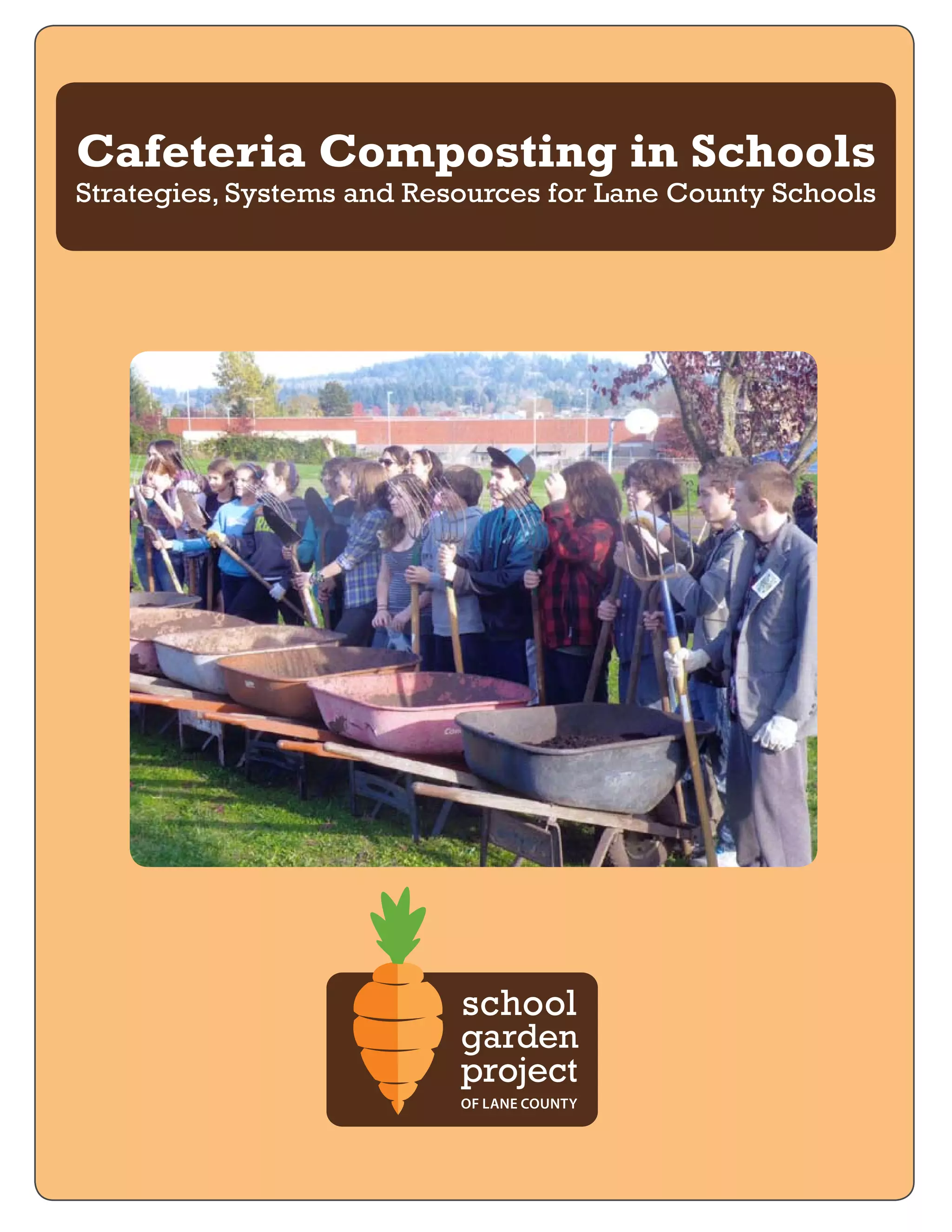
Cafeteria Composting in Schools 
Strategies, Systems and Resources for Lane County Schools
CAFETERIA 
COMPOSTING IN 
SCHOOLS 
By Rachel Elise 
Sanders with input 
from the original 
SGP Compost Manual 
by Rosie Sweetman, 
2013 
The School Garden 
Project of Lane 
County 
(541) 284-1001 
info@schoolgardenproject.org 
Who is this manual 
designed for? 
This manual is for 
anyone who is in-terested 
in helping 
schools implement 
composting pro-grams: 
students, 
teachers, commu-nity 
members, food 
service staff, custo-dians, 
volunteers, 
parents and anyone 
else with an interest 
in composting. 
Contents 
Why Compost at Schools? (p. 1) 
Building Support (p. 1) 
Ideas for Involving Community and 
School Support (p. 2) 
Conducting a Waste Audit (p. 3) 
On-site Composting (p. 4-5) 
City of Eugene’s Commercial Compost 
Program: Love Food Not Waste (p. 6) 
Combination of On-Site and Com-mercial 
Composting (p. 7) 
Choosing an Appropriate System and 
Site (p. 8) 
Implementing Your Program (p. 8-9) 
Appendix: Resource Guide (p. 10-11) 
a. Local Resources 
b. Business Contacts 
c. Useful School Composting Contacts 
d. Carbon/Nitrogen Sources and Ratio Chart 
e. Troubleshooting Guide 
f. MASCOT Checklist 
g. FAQ: Compost Safety
Why Compost at Schools? 
On average, a school of 200 students generates 75 pounds of compostable 
waste each week, or over 3,000 pounds per year. Here in Eugene, over 50% 
of the waste sent to landfills is compostable. 
These wasted resources are also a lost opportunity to teach our youth lifelong 
sustainable practices. By establishing composting programs at schools, we 
can reduce landfill waste, educate students about the relevance of resource 
conservation and composting, and generate a useful amendment to boost 
the health of school vegetable and habitat gardens. 
Successful programs are fundamentally student-driven, with support provid-ed 
by volunteers and school staff. Numerous local schools, such as Edison, 
Edgewood, Adams, and Cesar Chavez, have implemented low-cost, sustain-able 
cafeteria composting programs that represent a sound educational, 
Building Support 
While the enthusiasm and energy to start a composting program might start with 
one person, the best way to create a functional, thriving school composting program 
is to engage a broad group of stakeholders in the effort: students, parents, teachers, 
administrators, community members, and (most importantly!) cafeteria and main-tenance 
staff. This is an important first step. By energizing students, developing a 
group of key volunteers, and gathering input from school staff from the beginning of 
your program, your efforts are much more likely to succeed. 
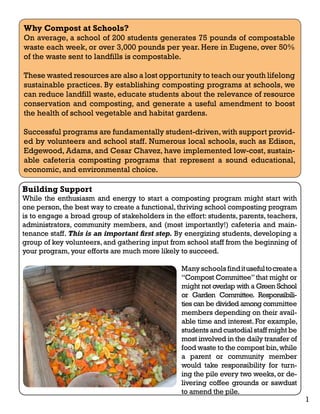
Many schools find it useful to create a 
“Compost Committee” that might or 
might not overlap with a Green School 
or Garden Committee. Responsibili-ties 
can be divided among committee 
members depending on their avail-able 
time and interest. For example, 
students and custodial staff might be 
most involved in the daily transfer of 
food waste to the compost bin, while 
a parent or community member 
would take responsibility for turn-ing 
the pile every two weeks, or de-livering 
coffee grounds or sawdust 
to amend the pile. 
economic, and environmental choice. 
1
Ideas for Involving Community and School Staff 
1Present the idea of a composting program at a PTO or school 
board meeting. Have your facts ready about how much money 
the school spends on waste disposal, what volume of compostable 
waste a typical school sends to the landfill in a year, and how you 
see a composting program fitting with the school’s mission. 
2 Solicit parent or community volunteers to help by doing a very 
straightforward job on the compost team, e.g. ordering leaves 
from the City in the fall, or helping with bin construction. Consider 
ways to move volunteers from the “outer circle” of one-time jobs to an 
“inner circle” of consistent caretaking responsibilities. 
3 Talk with cafeteria and maintenance staff about your ideas for 
the program. Ask them how a program could be set up so that it 
wouldn’t create extra work for them. 
4 Highlight the benefits of implementing a composting program 
with your school principal, or at a staff meeting. Becoming a certi-fied 
Oregon Green School gives the school prestige and access to grant funds 
and conference participation. 
5 Ask teachers whether they can think of students who would like 
to be part of a “Green Team” to train other students to sort com-post, 
and to help with daily tasks. 
6 Partner with other groups and organizations for assistance such 
as Lane County Extension Service Compost Specialists, the Oregon 
Green Schools Association, your local Neighborhood Association or Grange, 
the City of Eugene, and the School Garden Project. 
7 Keep in mind that it’s fine to start small. If cafeteria staff is re-luctant 
to jump into post-consumer composting, consider start-ing 
by composting leftovers from the salad bar once a week, and build 
on your small successes. A typical building process looks like this. 
Some schools start by composting everything at once wi thout 
real izing that the compost process is part science and part art. A 
learning curve is involved. 
• Compost salad bar material once a week 
• Compost salad bar materials every day 
• Compost food scraps from lunches on a voluntary basis 
• Compost all bread products as well 
• Compost classroom snacks 
• Compost breakfast foods as well 
• Compost after-school program snacks 
2
Conducting a Waste Audit 
Conducting a waste audit is a fun, hands-on step in implementing a 
school compost program. Is not only helps to identify how much vol-ume 
of compostable material is 
generated by the cafeteria, it also 
gets students, teachers and staff 
thinking about the waste stream 
and what comprises it. Not all food 
material can be composted on-site, 
and during the waste audit process 
participants learn how to appropri-ately 
separate based on the type of 
compost program you are starting 
(on-site, commercial composting or a combination of the two). The au-dit 
will identify the weekly volume of compost and thus help determine 
what size of operation and system will work best. 
When conducting a waste audit, try to involve students, faculty and 
cafeteria staff. While a two-week time frame is ideal, the audit can 
be done over a one-week or even one-day period. In Eugene, Oregon 
Green School Coordinators and/or OSU Extension Compost Special-ists 
are often available to assist with or lead waste audits. 
To conduct a waste audit: 
1Choose an appropriate day ahead of time to perform the audit, making 
sure to notify kitchen staff. 
Have materials available. 
2 Place bucket in kitchen to collect preparation waste (this is the waste 
produced before the meal is served including fruit peels, lettuce cores, 
veggie scraps, etc.). 
3 Decide how you want to sort your compost for the audit. Do you want to 
sort out all possible compostable materials or only the things that could 
be composted on-site? Once you’ve decided, place two or three clearly la-beled 
bins or trashcans in the cafeteria wherever the trash cans usually stand. 
Using five gallon buckets makes measurement easier. Label one bin “Fruits, 
Vegetables and Napkins” or “Food Scraps” and another “Waste” or “Plastic 
and wrappers.” Have plastic gloves and spatulas available to help sort the 
food waste. 
4 As students approach the sorting station, help them to scrape their food 
waste and trash into the appropriate bin. This is a good place to involve 
student helpers as “compost monitors.” 
5 Record the volume (and weight) of the compostable food at the end of 
the lunch period. 
The following chart will help with converting the gallons 
collected to the cubic feet 
volume necessary for determining an appropriate compost-ing 
system. A 3’x 3’x 3’ bin equals 27 cubic feet. 
7 1/2 gallons................................ 1 cubic foot 
45 gallons divided by 7.5 ................6 cubic feet 
202 gallons.................................27 cubic feet 
3
Overview of Compost Programs 
Now that you have a good estimate of the volume of compost generated in a 
week, you may now determine what type of program will work best. Options for 
your compost program include: 
•On-site bin system (or alternate on-site system, see appendix) 
•Commercial compost program Love Food Not Waste 
•A combination of both an on-site bin system and commercial compost program 
When choosing what type of compost program to start, there are many factors 
to consider besides volume. These include availability of volunteers, cost, labor, 
amount/type of food and yard waste, available land or site, and the age of the 
students. 
On-Site Bin System 
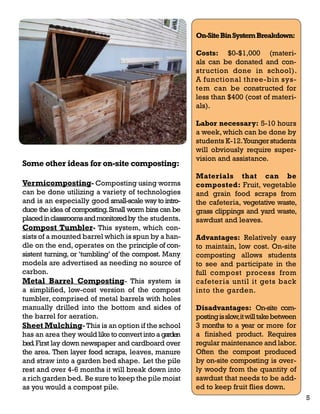
Bin systems range from backyard black plastic domes to a three-bin wooden structure. 
The bin needs to be at least large enough for a 3x 3x 3 foot pile to sustain the high 
temperatures necessary for good composting. Food waste is added to the bin along 
with a carbon source such as leaves or sawdust. The active compost pile should be 
turned intermittently to incorporate air and eventually set to rest until it is fully 
decomposed (a process called “finishing” or “curing”). 
It is important to make sure the bin is rodent proof. This can be accomplished by 
installing ¼ inch hardware cloth on the ground and around the sides of the bin if 
rodents are a concern on site. Installing a lid will help with pests, odor, and 
moisture levels. If plastic domes are used, it is recommended to have multiple vessels 
because they tend to fill up quickly and will need 6-12 months to fully decompose. 
If space allows, preference should be 
given to the three-bin structures be-cause 
they are easier to turn, and can 
hold more material than the black plas-tic 
domes. Thus, composting efforts 
can be expanded in the future as 
needed. The non-active bins can hold 
carbon materials (leaves, sawdust) or 
finishing compost. The bin structure 
also allows students and others to see 
the compost process and observe it 
more thoroughly than if it is contained 
under black plastic domes. 
4
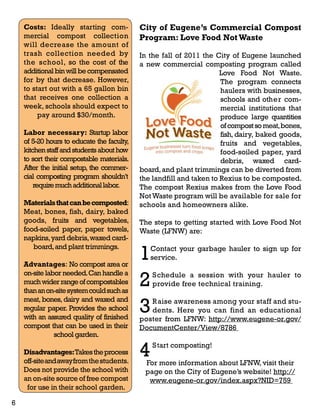
On-Site Bin System Breakdown: 
Costs: $0-$1,000 (materi-als 
can be donated and con-struction 
done in school). 
A functional three-bin sys-tem 
can be constructed for 
less than $400 (cost of materi-als). 
Labor necessary: 5-10 hours 
a week, which can be done by 
students K-12. Younger students 
will obviously require super-vision 
and assistance. 
Materials that can be 
composted: Fruit, vegetable 
and grain food scraps from 
the cafeteria, vegetative waste, 
grass clippings and yard waste, 
sawdust and leaves. 
Advantages: Relatively easy 
to maintain, low cost. On-site 
composting allows students 
to see and participate in the 
full compost process from 
cafeteria until it gets back 
into the garden. 
Disadvantages: On-site com-posting 
is slow, it will take between 
3 months to a year or more for 
a finished product. Requires 
regular maintenance and labor. 
Often the compost produced 
by on-site composting is over-ly 
woody from the quantity of 
sawdust that needs to be add-ed 
to keep fruit flies down. 
Some other ideas for on-site composting: 
Vermicomposting- Composting using worms 
can be done utilizing a variety of technologies 
and is an especially good small-scale way to intro-duce 
the idea of composting. Small worm bins can be 
placed in classrooms and monitored by the students. 
Compost Tumbler- This system, which con-sists 
of a mounted barrel which is spun by a han-dle 
on the end, operates on the principle of con-sistent 
turning, or ‘tumbling’ of the compost. Many 
models are advertised as needing no source of 
carbon. 
Metal Barrel Composting- This system is 
a simplified, low-cost version of the compost 
tumbler, comprised of metal barrels with holes 
manually drilled into the bottom and sides of 
the barrel for aeration. 
Sheet Mulching- This is an option if the school 
has an area they would like to convert into a garden 
bed. First lay down newspaper and cardboard over 
the area. Then layer food scraps, leaves, manure 
and straw into a garden bed shape. Let the pile 
rest and over 4-6 months it will break down into 
a rich garden bed. Be sure to keep the pile moist 
as you would a compost pile. 
5
Costs: Ideally starting com-mercial 
compost collection 
will decrease the amount of 
trash collection needed by 
the school, so the cost of the 
additional bin will be compensated 
for by that decrease. However, 
to start out with a 65 gallon bin 
that receives one collection a 
week, schools should expect to 
pay around $30/month. 
Labor necessary: Startup labor 
of 5-20 hours to educate the faculty, 
kitchen staff and students about how 
to sort their compostable materials. 
After the initial setup, the commer-cial 
composting program shouldn’t 
require much additional labor. 
Materials that can be composted: 
Meat, bones, fish, dairy, baked 
goods, fruits and vegetables, 
food-soiled paper, paper towels, 
napkins, yard debris, waxed card-board, 
and plant trimmings. 
Advantages: No compost area or 
on-site labor needed. Can handle a 
much wider range of compostables 
than an on-site system could such as 
meat, bones, dairy and waxed and 
regular paper. Provides the school 
with an assured quality of finished 
compost that can be used in their 
school garden. 
Disadvantages: Takes the process 
off-site and away from the students. 
Does not provide the school with 
an on-site source of free compost 
for use in their school garden. 
City of Eugene’s Commercial Compost 
Program: Love Food Not Waste 
In the fall of 2011 the City of Eugene launched 
a new commercial composting program called 
Love Food Not Waste. 
The program connects 
haulers with businesses, 
schools and other com-mercial 
institutions that 
produce large quantities 
of compost so meat, bones, 
fish, dairy, baked goods, 
fruits and vegetables, 
food-soiled paper, yard 
debris, waxed card-board, 
and plant trimmings can be diverted from 
the landfill and taken to Rexius to be composted. 
The compost Rexius makes from the Love Food 
Not Waste program will be available for sale for 
schools and homeowners alike. 
The steps to getting started with Love Food Not 
Waste (LFNW) are: 
1 Contact your garbage hauler to sign up for 
service. 
2 Schedule a session with your hauler to 
provide free technical training. 
3 Raise awareness among your staff and stu-dents. 
Here you can find an educational 
poster from LFNW: http://www.eugene-or.gov/ 
DocumentCenter/View/8786 
4 Start composting! 
For more information about LFNW, visit their 
page on the City of Eugene’s website! http:// 
www.eugene-or.gov/index.aspx?NID=759 
6
Costs: As with the commercial 
composting program, the combi-nation 
of on-site and commercial 
composting will decrease the 
amount of trash collection needed 
by the school, so the cost of the ad-ditional 
bin should be off-set by 
the reduction in the garbage bin. 
To start out with a 35-gallon bin that 
receives one collection a week, 
schools should expect to pay around 
$15/month. 
Labor necessary: Startup labor of 
5-20 hours to educate the faculty, 
kitchen staff and students about 
how to sort their compostable 
materials. Expect between 5-10 
hours of work every week for your 
on-site composting. 
Materials that can be compost-ed: 
Meat, bones, fish, dairy, baked 
goods, fruits and vegetables, 
food-soiled paper, paper towels, 
napkins, yard debris, waxed card-board, 
and plant trimmings. 
Advantages: The school can 
both compost 100% of their 
compostable materials while 
also maintaining the education-al 
opportunities of the on-site 
compost program. The school 
can continue to make their own 
compost on-site, which can be 
used in their school garden. 
Disadvantages: It does still 
require all of the work of an 
on-site composting program. 
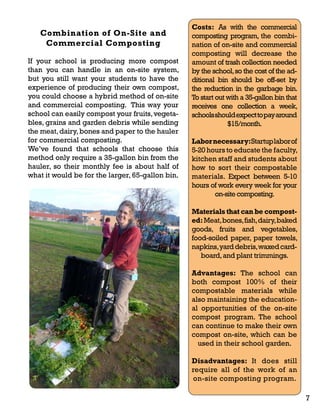
Combination of On-Site and 
Commercial Composting 
If your school is producing more compost 
than you can handle in an on-site system, 
but you still want your students to have the 
experience of producing their own compost, 
you could choose a hybrid method of on-site 
and commercial composting. This way your 
school can easily compost your fruits, vegeta-bles, 
grains and garden debris while sending 
the meat, dairy, bones and paper to the hauler 
for commercial composting. 
We’ve found that schools that choose this 
method only require a 35-gallon bin from the 
hauler, so their monthly fee is about half of 
what it would be for the larger, 65-gallon bin. 
7
Choosing an Appropriate Program 
Before deciding on a system for your school, evaluate the strength of your compost 
committee or volunteer team. Is there a teacher that would be willing to have his/ 
her classroom take on the composting maintenance? Are there parents or commu-nity 
members who will be willing to volunteer with turning the compost? Is there a 
custodian or food service employee that will help set up the cafeteria sorting system 
before breakfast and lunch, and tell a teacher if something has gone wrong? 
If you do have an active group, a helpful step in choosing which compost system 
will work at your school is to visit other schools of a comparable size that have are 
doing cafeteria composting and discuss how their program works for them. 
Implementing Your Compost Program 
Once you have your system in place and your compost team is ready to get going, it 
will be time to train the student body to sort their waste. In the cafeteria it is impor-tant 
to have clear signs and waste collection station(s). Place the compost collection 
bucket next to the garbage/tray collection area. Signs should be posted for both 
compost and garbage and making the distinction between the two. If you are doing a 
combination of on-site and commercial composting, make sure students know which foods 
can be composted on-site, and which foods such as meat and dairy should be sorted 
into the off-site compost bin. All of these signs should have clear pictures as well as 
words so young students can follow along too. 
• During the first two weeks of the compost program it is important to have a compost 
monitor helping students sort out their compost but the monitor is not needed after the 
students have become used to the new sorting system. The monitor simply stands by the 
compost and trash and helps students sort their food scraps correctly. 
• Have someone, preferably a student or two, scheduled to empty compost at the end 
of the lunch period. A system that has proven to work well at Edison Elementary is 
assigning two students a day to empty the compost, with one student’s duties rolling 
over to the next day. At Irving Elementary, two stu-dents 
are on duty for one week and it is always a 
job of the 5th grade. 
• If you are doing on-site composting have students 
or volunteers record the volume/weight of the com-post 
and empty it into the active compost bin. There 
they can also record the temperature of the pile and 
make any observations such as site and smell (or a 
parent volunteer can do this part). Students then 
add a layer of carbon material to the pile (leaves or 
sawdust). 
8
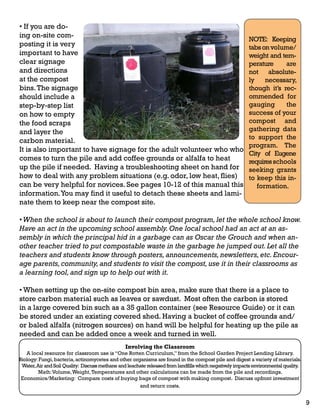
• If you are do-ing 
on-site com-posting 
it is very 
important to have 
clear signage 
and directions 
at the compost 
bins. The signage 
should include a 
step-by-step list 
on how to empty 
the food scraps 
and layer the 
carbon material. 
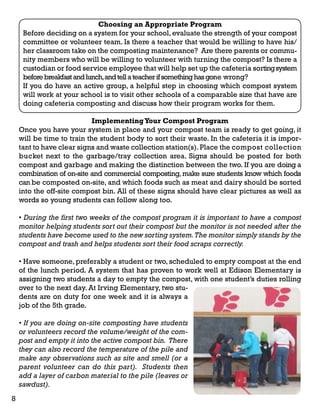
It is also important to have signage for the adult volunteer who who 
comes to turn the pile and add coffee grounds or alfalfa to heat 
up the pile if needed. Having a troubleshooting sheet on hand for 
how to deal with any problem situations (e.g. odor, low heat, flies) 
can be very helpful for novices. See pages 10-12 of this manual this 
information. You may find it useful to detach these sheets and lami-nate 
them to keep near the compost site. 
NOTE: Keeping 
tabs on volume/ 
weight and tem-perature 
are 
not absolute-ly 
necessary, 
though it’s rec-ommended 
for 
gauging the 
success of your 
compost and 
gathering data 
to support the 
program. The 
City of Eugene 
requires schools 
seeking grants 
to keep this in-formation. 
• When the school is about to launch their compost program, let the whole school know. 
Have an act in the upcoming school assembly. One local school had an act at an as-sembly 
in which the principal hid in a garbage can as Oscar the Grouch and when an-other 
teacher tried to put compostable waste in the garbage he jumped out. Let all the 
teachers and students know through posters, announcements, newsletters, etc. Encour-age 
parents, community, and students to visit the compost, use it in their classrooms as 
a learning tool, and sign up to help out with it. 
• When setting up the on-site compost bin area, make sure that there is a place to 
store carbon material such as leaves or sawdust. Most often the carbon is stored 
in a large covered bin such as a 35 gallon container (see Resource Guide) or it can 
be stored under an existing covered shed. Having a bucket of coffee grounds and/ 
or baled alfalfa (nitrogen sources) on hand will be helpful for heating up the pile as 
needed and can be added once a week and turned in well. 
Involving the Classroom 
A local resource for classroom use is “One Rotten Curriculum,” from the School Garden Project Lending Library. 
Biology: Fungi, bacteria, actinomycetes and other organisms are found in the compost pile and digest a variety of materials. 
Water, Air and Soil Quality: Discuss methane and leachate released from landfills which negatively impacts environmental quality. 
Math: Volume, Weight, Temperatures and other calculations can be made from the pile and recordings. 
Economics/Marketing: Compare costs of buying bags of compost with making compost. Discuss upfront investment 
and return costs. 
9
Appendix: 
Local Resource Guide 
Bins: There are 55 gallon plastic containers available for $10 at Emerald Valley Kitchen. 
There are also 55 gallon metal drums available at Glory Bee for $10. 
Buckets: There are buckets available for free at Emerald Valley Kitchen, and occasionally 
at Dairy Girl. Check other local food processors. 
Leaves: Often the district grounds crew can provide access to leaves collected on school 
grounds. If there are no leaves available, free leaves are available from the City of Eugene. 
For most compost systems, one will not need the 7 yard delivery they offer so it is best to 
get a load from one of the community garden sites: 
Amazon and Alton Baker are best. (See City of Eugene Website: www.eugene-or.gov for 
directions to gardens) 
Coffee Grounds: Coffee Grounds are great source of nitrogen. It may be easiest to go to a 
local coffee shop and ask for coffee grounds when you need them but there are some sites 
in Eugene with existing grounds distribution programs. Sweet Life Pattissere has coffee 
grounds accessible at all times in the parking lot under the cover of a plastic cabinet, be 
sure to return the buckets back to the cabinet after emptying the coffee grounds. Other 
locations include, but are not limited to: Starbucks, Market of Choice, Supreme Bean, One 
Cup, Full City Coffee, Dutch Bros at 13th and Garfield and Allan Bros. Be sure to bring con-tainers 
and wear gloves. 
Sawdust: 4J District schools can place a work order to the district and receive sawdust 
for free. Sawdust and woodchips are generally available from school wood shops, local 
arborists, wood workers or craftsmen. Try to avoid sawdust that has been made from wood 
with glue; the glue can be toxic. 
Other odds and ends: For other odds and ends such as nails and screws, hardware cloth, 
wood, and posts there are a number of good places to check out. BRING Recycling is al-ways 
a good first place to go before heading to other hardware stores. 
Business Contacts 
BRING Recycling..................4446 Franklin Blvd. Eugene..............................541-746-3023 
True Value............................2825 Willamette St. Eugene..............................541-726-0950 
3041 Main St. Springfield..................................541-367-2221 
Jerry’s Home Improvement........2600 Hwy. 99 North Eugene.........................541-689-1911 
2525 Olympic St. Springfield...........................541-736-7000 
Coastal Farm & Home Supply.....2200 W. 6th St. Eugene..................................541-349-0556 
Glory Bee, Inc...................120 N. Seneca, Eugene...........................................541-689-0913 
Sweet Life Patisserie...........755 Monroe, Eugene............................................541-683-5676 
Emerald Valley Kitchen.........90472 Woodruff, Eugene....................................800-588-7782 
10
Useful School Composting Contacts 
Anne Donahue...City of Eugene Compost & Urban Agriculture Coordinator...541-682- 
5542 anne.c.donahue@ci.eugene.or.us 
• General support for implementing school compost programs 
Josh Frankel...Oregon Green Schools & Partners for Sustainable Schools...541-636-0096 
greenschools@live.com 
• Information on Oregon Green School certification 
• Information on OSGA grant opportunities 
Patti Driscoll...OSU Compost Specialist.......patti.driscoll@juno.com 
• Resource for expert volunteers 
• Technical expertise on compost systems 
Jenny Laxton...School Garden Project...541-284-1001...jenny@schoolgardenproject.org 
• Educational resources and presentations 
• Support for establishing school gardens 
Stephanie Scafa...City of Eugene Love Food Not Waste Coordinator 
stephanie.scafa@ci.eugene.or.us 
Brett Jacobs...BRING Education Coordinator...541-746-3023...brettj@bringrecycling.org 
• Presentations and resources on vermicomposting 
City of Eugene Leaf Program....541-682-5383.......www.eugene-or.gov/leaf 
• If you mention that you are requesting the leaves for a school, your order will be given priority. 
Helpful Websites 
Mansfield Compost Program: http://www.ct.gov/deep/cwp/view. 
asp?a=2718&q=325392&deepNav_GID=1645#Download 
• Comprehensive guide to school composting 
Oregon State Extension Service Compost Specialists: http://extension.oregonstate.edu/ 
lane/gardens/compost 
• In-depth technical information on composting 
City of Eugene Leaf Program: http://www.eugene-or.gov/leaf 
• Downloadable PDF of Leaf Delivery Form (fill out and mail in) 
• Information on how to use leaves as mulch or compost material 
11
Appendix II: FAQ & Troubleshooting 
Carbon to Nitrogen Ratio Guide Green Mountain 
HIGH CARBON C:N 
Straw (slow to break down 
but great for aeraion) 
75:1 
Leaves 60:1 
Newspaper 175:1 
Sawdust 325:1 
Wood Chips (slow to break 
down but offer good aeration) 
400:1 
Cardboard, Shredded 350:1 
HIGH NITROGEN 
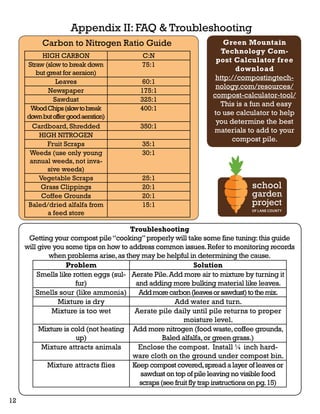
Fruit Scraps 35:1 
Weeds (use only young 
annual weeds, not inva-sive 
weeds) 
30:1 
Vegetable Scraps 25:1 
Grass Clippings 20:1 
Coffee Grounds 20:1 
Baled/dried alfalfa from 
a feed store 
15:1 
Technology Com-post 
Calculator free 
download 
http://compostingtech-nology. 
com/resources/ 
compost-calculator-tool/ 
This is a fun and easy 
to use calculator to help 
you determine the best 
materials to add to your 
compost pile. 
Troubleshooting 
Getting your compost pile “cooking” properly will take some fine tuning: this guide 
will give you some tips on how to address common issues. Refer to monitoring records 
when problems arise, as they may be helpful in determining the cause. 
Problem Solution 
Smells like rotten eggs (sul-fur) 
Aerate Pile. Add more air to mixture by turning it 
and adding more bulking material like leaves. 
Smells sour (like ammonia) Add more carbon (leaves or sawdust) to the mix. 
Mixture is dry Add water and turn. 
Mixture is too wet Aerate pile daily until pile returns to proper 
moisture level. 
Mixture is cold (not heating 
up) 
Add more nitrogen (food waste, coffee grounds, 
Baled alfalfa, or green grass.) 
Mixture attracts animals Enclose the compost. Install ¼ inch hard-ware 
cloth on the ground under compost bin. 
Mixture attracts flies Keep compost covered, spread a layer of leaves or 
sawdust on top of pile leaving no visible food 
scraps (see fruit fly trap instructions on pg. 15) 
12
MASCOT Checklist 
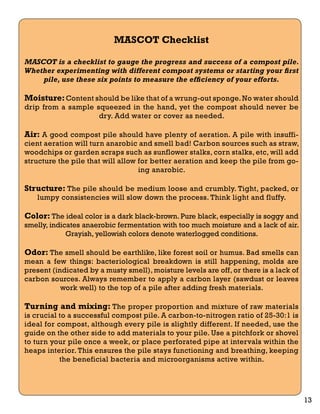
MASCOT is a checklist to gauge the progress and success of a compost pile. 
Whether experimenting with different compost systems or starting your first 
pile, use these six points to measure the efficiency of your efforts. 
Moisture: Content should be like that of a wrung-out sponge. No water should 
drip from a sample squeezed in the hand, yet the compost should never be 
dry. Add water or cover as needed. 
Air: A good compost pile should have plenty of aeration. A pile with insuffi-cient 
aeration will turn anarobic and smell bad! Carbon sources such as straw, 
woodchips or garden scraps such as sunflower stalks, corn stalks, etc, will add 
structure the pile that will allow for better aeration and keep the pile from go-ing 
anarobic. 
Structure: The pile should be medium loose and crumbly. Tight, packed, or 
lumpy consistencies will slow down the process. Think light and fluffy. 
Color: The ideal color is a dark black-brown. Pure black, especially is soggy and 
smelly, indicates anaerobic fermentation with too much moisture and a lack of air. 
Grayish, yellowish colors denote waterlogged conditions. 
Odor: The smell should be earthlike, like forest soil or humus. Bad smells can 
mean a few things: bacteriological breakdown is still happening, molds are 
present (indicated by a musty smell), moisture levels are off, or there is a lack of 
carbon sources. Always remember to apply a carbon layer (sawdust or leaves 
work well) to the top of a pile after adding fresh materials. 
Turning and mixing: The proper proportion and mixture of raw materials 
is crucial to a successful compost pile. A carbon-to-nitrogen ratio of 25-30:1 is 
ideal for compost, although every pile is slightly different. If needed, use the 
guide on the other side to add materials to your pile. Use a pitchfork or shovel 
to turn your pile once a week, or place perforated pipe at intervals within the 
heaps interior. This ensures the pile stays functioning and breathing, keeping 
the beneficial bacteria and microorganisms active within. 
13
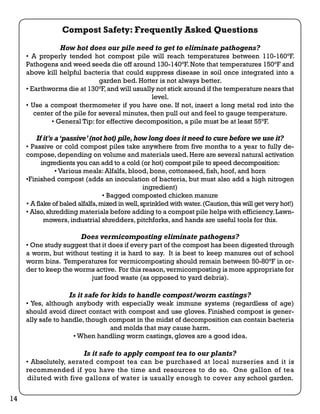
Compost Safety: Frequently Asked Questions 
How hot does our pile need to get to eliminate pathogens? 
• A properly tended hot compost pile will reach temperatures between 110-160°F. 
Pathogens and weed seeds die off around 130-140°F. Note that temperatures 150°F and 
above kill helpful bacteria that could suppress disease in soil once integrated into a 
garden bed. Hotter is not always better. 
• Earthworms die at 130°F, and will usually not stick around if the temperature nears that 
level. 
• Use a compost thermometer if you have one. If not, insert a long metal rod into the 
center of the pile for several minutes, then pull out and feel to gauge temperature. 
• General Tip: for effective decomposition, a pile must be at least 55°F. 
If it’s a ‘passive’ (not hot) pile, how long does it need to cure before we use it? 
• Passive or cold compost piles take anywhere from five months to a year to fully de-compose, 
depending on volume and materials used. Here are several natural activation 
ingredients you can add to a cold (or hot) compost pile to speed decomposition: 
• Various meals: Alfalfa, blood, bone, cottonseed, fish, hoof, and horn 
•Finished compost (adds an inoculation of bacteria, but must also add a high nitrogen 
ingredient) 
• Bagged composted chicken manure 
• A flake of baled alfalfa, mixed in well, sprinkled with water. (Caution, this will get very hot!) 
• Also, shredding materials before adding to a compost pile helps with efficiency. Lawn-mowers, 
industrial shredders, pitchforks, and hands are useful tools for this. 
Does vermicomposting eliminate pathogens? 
• One study suggest that it does if every part of the compost has been digested through 
a worm, but without testing it is hard to say. It is best to keep manures out of school 
worm bins. Temperatures for vermicomposting should remain between 50-80°F in or-der 
to keep the worms active. For this reason, vermicomposting is more appropriate for 
just food waste (as opposed to yard debris). 
Is it safe for kids to handle compost/worm castings? 
• Yes, although anybody with especially weak immune systems (regardless of age) 
should avoid direct contact with compost and use gloves. Finished compost is gener-ally 
safe to handle, though compost in the midst of decomposition can contain bacteria 
and molds that may cause harm. 
• When handling worm castings, gloves are a good idea. 
Is it safe to apply compost tea to our plants? 
• Absolutely, aerated compost tea can be purchased at local nurseries and it is 
recommended if you have the time and resources to do so. One gallon of tea 
diluted with five gallons of water is usually enough to cover any school garden. 
14
• The most troublesome pest is fruit flies. Make a vinegar trap by securing a 12 oz water 
bottle to the inside of the bin. Add ½ cup of apple cider vinegar to the empty bottle. 
Add one or two drops of dish soap. The fruit flies will fly in, attracted to the smell, and 
drown in the vinegar. This method works best when a thick layer of sawdust is covering 
the food scraps at all times, because flies can’t dig! 
Is it safe to use manure in our compost program? 
• It is best not to add raw manure of any kind because school compost piles are not man-aged 
in a way that will ensure that salmonella and fecal coliforms are all killed off. We 
don’t want to spread those pathogens around our school vegetables. People with weak-ened 
immune systems are especially vulnerable to pathogens, and should wear gloves 
when handling school compost and vermicompost. 
• The 4J School District food provider has a guideline that suggests manure should not 
be used in the garden or in the compost. Why use manure when there are so many other 
great sources of nitrogen to use like coffee grounds or fresh grass clippings? For a 
quick nitrogen boost that will heat up compost fast, bales of dried alfalfa work very well, 
smell great, and store easily next to the compost area. High nitrogen alfalfa means more 
nutrient rich compost when used in the garden. 
Will rodents and other pests get into the bins? 
• It is important to remember that we live in an urban environment and urban critters 
will be attracted to school compost areas for warmth, food, and habitat. 
• To prevent rodents and other critters from showing up, use ¼ inch hardware cloth to 
line the bottom and sides of the bin, especially if using a simple open air or palette bin 
system. A fitted lid is also necessary. 
• If properly maintained, a compost pile usually won’t attract dogs or raccoons, both of 
which are more interested in garbage cans and cat food left on front porches. 
• Odor, above all else, will attract animals, so always remember to finish with a layer of carbon 
(dry browns) on top when adding material to a pile. This acts as an odor-trapping blanket. 
• If rodents persist in your compost, it could be due to high rodent activity in your 
neighborhood and you could consider switching to the City’s new Love Food 
Not Waste commercial composting program. Contact Stephanie Scafa with the 
City of Eugene for more information: stephanie.scafa@ci.eugene.or.us. 
• Sawdust and dried leaves are excellent materials for a carbon layer to deter all man-ner 
of pests! 
Always remember to wash hands well after working in the compost site 
and garden! 
15
This manual was created by The School Garden 
Project of Lane County with financial support and 
techinical assistance from The City of Eugene. 
www.schoolgardenproject.org

Cafeteria Composting in Schools: Strategies, Systems and Resources for Lane County Schools

  • 1.
    Cafeteria Composting inSchools Strategies, Systems and Resources for Lane County Schools
  • 2.
    CAFETERIA COMPOSTING IN SCHOOLS By Rachel Elise Sanders with input from the original SGP Compost Manual by Rosie Sweetman, 2013 The School Garden Project of Lane County (541) 284-1001 info@schoolgardenproject.org Who is this manual designed for? This manual is for anyone who is in-terested in helping schools implement composting pro-grams: students, teachers, commu-nity members, food service staff, custo-dians, volunteers, parents and anyone else with an interest in composting. Contents Why Compost at Schools? (p. 1) Building Support (p. 1) Ideas for Involving Community and School Support (p. 2) Conducting a Waste Audit (p. 3) On-site Composting (p. 4-5) City of Eugene’s Commercial Compost Program: Love Food Not Waste (p. 6) Combination of On-Site and Com-mercial Composting (p. 7) Choosing an Appropriate System and Site (p. 8) Implementing Your Program (p. 8-9) Appendix: Resource Guide (p. 10-11) a. Local Resources b. Business Contacts c. Useful School Composting Contacts d. Carbon/Nitrogen Sources and Ratio Chart e. Troubleshooting Guide f. MASCOT Checklist g. FAQ: Compost Safety
  • 3.
    Why Compost atSchools? On average, a school of 200 students generates 75 pounds of compostable waste each week, or over 3,000 pounds per year. Here in Eugene, over 50% of the waste sent to landfills is compostable. These wasted resources are also a lost opportunity to teach our youth lifelong sustainable practices. By establishing composting programs at schools, we can reduce landfill waste, educate students about the relevance of resource conservation and composting, and generate a useful amendment to boost the health of school vegetable and habitat gardens. Successful programs are fundamentally student-driven, with support provid-ed by volunteers and school staff. Numerous local schools, such as Edison, Edgewood, Adams, and Cesar Chavez, have implemented low-cost, sustain-able cafeteria composting programs that represent a sound educational, Building Support While the enthusiasm and energy to start a composting program might start with one person, the best way to create a functional, thriving school composting program is to engage a broad group of stakeholders in the effort: students, parents, teachers, administrators, community members, and (most importantly!) cafeteria and main-tenance staff. This is an important first step. By energizing students, developing a group of key volunteers, and gathering input from school staff from the beginning of your program, your efforts are much more likely to succeed. Many schools find it useful to create a “Compost Committee” that might or might not overlap with a Green School or Garden Committee. Responsibili-ties can be divided among committee members depending on their avail-able time and interest. For example, students and custodial staff might be most involved in the daily transfer of food waste to the compost bin, while a parent or community member would take responsibility for turn-ing the pile every two weeks, or de-livering coffee grounds or sawdust to amend the pile. economic, and environmental choice. 1
  • 4.
    Ideas for InvolvingCommunity and School Staff 1Present the idea of a composting program at a PTO or school board meeting. Have your facts ready about how much money the school spends on waste disposal, what volume of compostable waste a typical school sends to the landfill in a year, and how you see a composting program fitting with the school’s mission. 2 Solicit parent or community volunteers to help by doing a very straightforward job on the compost team, e.g. ordering leaves from the City in the fall, or helping with bin construction. Consider ways to move volunteers from the “outer circle” of one-time jobs to an “inner circle” of consistent caretaking responsibilities. 3 Talk with cafeteria and maintenance staff about your ideas for the program. Ask them how a program could be set up so that it wouldn’t create extra work for them. 4 Highlight the benefits of implementing a composting program with your school principal, or at a staff meeting. Becoming a certi-fied Oregon Green School gives the school prestige and access to grant funds and conference participation. 5 Ask teachers whether they can think of students who would like to be part of a “Green Team” to train other students to sort com-post, and to help with daily tasks. 6 Partner with other groups and organizations for assistance such as Lane County Extension Service Compost Specialists, the Oregon Green Schools Association, your local Neighborhood Association or Grange, the City of Eugene, and the School Garden Project. 7 Keep in mind that it’s fine to start small. If cafeteria staff is re-luctant to jump into post-consumer composting, consider start-ing by composting leftovers from the salad bar once a week, and build on your small successes. A typical building process looks like this. Some schools start by composting everything at once wi thout real izing that the compost process is part science and part art. A learning curve is involved. • Compost salad bar material once a week • Compost salad bar materials every day • Compost food scraps from lunches on a voluntary basis • Compost all bread products as well • Compost classroom snacks • Compost breakfast foods as well • Compost after-school program snacks 2
  • 5.
    Conducting a WasteAudit Conducting a waste audit is a fun, hands-on step in implementing a school compost program. Is not only helps to identify how much vol-ume of compostable material is generated by the cafeteria, it also gets students, teachers and staff thinking about the waste stream and what comprises it. Not all food material can be composted on-site, and during the waste audit process participants learn how to appropri-ately separate based on the type of compost program you are starting (on-site, commercial composting or a combination of the two). The au-dit will identify the weekly volume of compost and thus help determine what size of operation and system will work best. When conducting a waste audit, try to involve students, faculty and cafeteria staff. While a two-week time frame is ideal, the audit can be done over a one-week or even one-day period. In Eugene, Oregon Green School Coordinators and/or OSU Extension Compost Special-ists are often available to assist with or lead waste audits. To conduct a waste audit: 1Choose an appropriate day ahead of time to perform the audit, making sure to notify kitchen staff. Have materials available. 2 Place bucket in kitchen to collect preparation waste (this is the waste produced before the meal is served including fruit peels, lettuce cores, veggie scraps, etc.). 3 Decide how you want to sort your compost for the audit. Do you want to sort out all possible compostable materials or only the things that could be composted on-site? Once you’ve decided, place two or three clearly la-beled bins or trashcans in the cafeteria wherever the trash cans usually stand. Using five gallon buckets makes measurement easier. Label one bin “Fruits, Vegetables and Napkins” or “Food Scraps” and another “Waste” or “Plastic and wrappers.” Have plastic gloves and spatulas available to help sort the food waste. 4 As students approach the sorting station, help them to scrape their food waste and trash into the appropriate bin. This is a good place to involve student helpers as “compost monitors.” 5 Record the volume (and weight) of the compostable food at the end of the lunch period. The following chart will help with converting the gallons collected to the cubic feet volume necessary for determining an appropriate compost-ing system. A 3’x 3’x 3’ bin equals 27 cubic feet. 7 1/2 gallons................................ 1 cubic foot 45 gallons divided by 7.5 ................6 cubic feet 202 gallons.................................27 cubic feet 3
  • 6.
    Overview of CompostPrograms Now that you have a good estimate of the volume of compost generated in a week, you may now determine what type of program will work best. Options for your compost program include: •On-site bin system (or alternate on-site system, see appendix) •Commercial compost program Love Food Not Waste •A combination of both an on-site bin system and commercial compost program When choosing what type of compost program to start, there are many factors to consider besides volume. These include availability of volunteers, cost, labor, amount/type of food and yard waste, available land or site, and the age of the students. On-Site Bin System Bin systems range from backyard black plastic domes to a three-bin wooden structure. The bin needs to be at least large enough for a 3x 3x 3 foot pile to sustain the high temperatures necessary for good composting. Food waste is added to the bin along with a carbon source such as leaves or sawdust. The active compost pile should be turned intermittently to incorporate air and eventually set to rest until it is fully decomposed (a process called “finishing” or “curing”). It is important to make sure the bin is rodent proof. This can be accomplished by installing ¼ inch hardware cloth on the ground and around the sides of the bin if rodents are a concern on site. Installing a lid will help with pests, odor, and moisture levels. If plastic domes are used, it is recommended to have multiple vessels because they tend to fill up quickly and will need 6-12 months to fully decompose. If space allows, preference should be given to the three-bin structures be-cause they are easier to turn, and can hold more material than the black plas-tic domes. Thus, composting efforts can be expanded in the future as needed. The non-active bins can hold carbon materials (leaves, sawdust) or finishing compost. The bin structure also allows students and others to see the compost process and observe it more thoroughly than if it is contained under black plastic domes. 4
  • 7.
    On-Site Bin SystemBreakdown: Costs: $0-$1,000 (materi-als can be donated and con-struction done in school). A functional three-bin sys-tem can be constructed for less than $400 (cost of materi-als). Labor necessary: 5-10 hours a week, which can be done by students K-12. Younger students will obviously require super-vision and assistance. Materials that can be composted: Fruit, vegetable and grain food scraps from the cafeteria, vegetative waste, grass clippings and yard waste, sawdust and leaves. Advantages: Relatively easy to maintain, low cost. On-site composting allows students to see and participate in the full compost process from cafeteria until it gets back into the garden. Disadvantages: On-site com-posting is slow, it will take between 3 months to a year or more for a finished product. Requires regular maintenance and labor. Often the compost produced by on-site composting is over-ly woody from the quantity of sawdust that needs to be add-ed to keep fruit flies down. Some other ideas for on-site composting: Vermicomposting- Composting using worms can be done utilizing a variety of technologies and is an especially good small-scale way to intro-duce the idea of composting. Small worm bins can be placed in classrooms and monitored by the students. Compost Tumbler- This system, which con-sists of a mounted barrel which is spun by a han-dle on the end, operates on the principle of con-sistent turning, or ‘tumbling’ of the compost. Many models are advertised as needing no source of carbon. Metal Barrel Composting- This system is a simplified, low-cost version of the compost tumbler, comprised of metal barrels with holes manually drilled into the bottom and sides of the barrel for aeration. Sheet Mulching- This is an option if the school has an area they would like to convert into a garden bed. First lay down newspaper and cardboard over the area. Then layer food scraps, leaves, manure and straw into a garden bed shape. Let the pile rest and over 4-6 months it will break down into a rich garden bed. Be sure to keep the pile moist as you would a compost pile. 5
  • 8.
    Costs: Ideally startingcom-mercial compost collection will decrease the amount of trash collection needed by the school, so the cost of the additional bin will be compensated for by that decrease. However, to start out with a 65 gallon bin that receives one collection a week, schools should expect to pay around $30/month. Labor necessary: Startup labor of 5-20 hours to educate the faculty, kitchen staff and students about how to sort their compostable materials. After the initial setup, the commer-cial composting program shouldn’t require much additional labor. Materials that can be composted: Meat, bones, fish, dairy, baked goods, fruits and vegetables, food-soiled paper, paper towels, napkins, yard debris, waxed card-board, and plant trimmings. Advantages: No compost area or on-site labor needed. Can handle a much wider range of compostables than an on-site system could such as meat, bones, dairy and waxed and regular paper. Provides the school with an assured quality of finished compost that can be used in their school garden. Disadvantages: Takes the process off-site and away from the students. Does not provide the school with an on-site source of free compost for use in their school garden. City of Eugene’s Commercial Compost Program: Love Food Not Waste In the fall of 2011 the City of Eugene launched a new commercial composting program called Love Food Not Waste. The program connects haulers with businesses, schools and other com-mercial institutions that produce large quantities of compost so meat, bones, fish, dairy, baked goods, fruits and vegetables, food-soiled paper, yard debris, waxed card-board, and plant trimmings can be diverted from the landfill and taken to Rexius to be composted. The compost Rexius makes from the Love Food Not Waste program will be available for sale for schools and homeowners alike. The steps to getting started with Love Food Not Waste (LFNW) are: 1 Contact your garbage hauler to sign up for service. 2 Schedule a session with your hauler to provide free technical training. 3 Raise awareness among your staff and stu-dents. Here you can find an educational poster from LFNW: http://www.eugene-or.gov/ DocumentCenter/View/8786 4 Start composting! For more information about LFNW, visit their page on the City of Eugene’s website! http:// www.eugene-or.gov/index.aspx?NID=759 6
  • 9.
    Costs: As withthe commercial composting program, the combi-nation of on-site and commercial composting will decrease the amount of trash collection needed by the school, so the cost of the ad-ditional bin should be off-set by the reduction in the garbage bin. To start out with a 35-gallon bin that receives one collection a week, schools should expect to pay around $15/month. Labor necessary: Startup labor of 5-20 hours to educate the faculty, kitchen staff and students about how to sort their compostable materials. Expect between 5-10 hours of work every week for your on-site composting. Materials that can be compost-ed: Meat, bones, fish, dairy, baked goods, fruits and vegetables, food-soiled paper, paper towels, napkins, yard debris, waxed card-board, and plant trimmings. Advantages: The school can both compost 100% of their compostable materials while also maintaining the education-al opportunities of the on-site compost program. The school can continue to make their own compost on-site, which can be used in their school garden. Disadvantages: It does still require all of the work of an on-site composting program. Combination of On-Site and Commercial Composting If your school is producing more compost than you can handle in an on-site system, but you still want your students to have the experience of producing their own compost, you could choose a hybrid method of on-site and commercial composting. This way your school can easily compost your fruits, vegeta-bles, grains and garden debris while sending the meat, dairy, bones and paper to the hauler for commercial composting. We’ve found that schools that choose this method only require a 35-gallon bin from the hauler, so their monthly fee is about half of what it would be for the larger, 65-gallon bin. 7
  • 10.
    Choosing an AppropriateProgram Before deciding on a system for your school, evaluate the strength of your compost committee or volunteer team. Is there a teacher that would be willing to have his/ her classroom take on the composting maintenance? Are there parents or commu-nity members who will be willing to volunteer with turning the compost? Is there a custodian or food service employee that will help set up the cafeteria sorting system before breakfast and lunch, and tell a teacher if something has gone wrong? If you do have an active group, a helpful step in choosing which compost system will work at your school is to visit other schools of a comparable size that have are doing cafeteria composting and discuss how their program works for them. Implementing Your Compost Program Once you have your system in place and your compost team is ready to get going, it will be time to train the student body to sort their waste. In the cafeteria it is impor-tant to have clear signs and waste collection station(s). Place the compost collection bucket next to the garbage/tray collection area. Signs should be posted for both compost and garbage and making the distinction between the two. If you are doing a combination of on-site and commercial composting, make sure students know which foods can be composted on-site, and which foods such as meat and dairy should be sorted into the off-site compost bin. All of these signs should have clear pictures as well as words so young students can follow along too. • During the first two weeks of the compost program it is important to have a compost monitor helping students sort out their compost but the monitor is not needed after the students have become used to the new sorting system. The monitor simply stands by the compost and trash and helps students sort their food scraps correctly. • Have someone, preferably a student or two, scheduled to empty compost at the end of the lunch period. A system that has proven to work well at Edison Elementary is assigning two students a day to empty the compost, with one student’s duties rolling over to the next day. At Irving Elementary, two stu-dents are on duty for one week and it is always a job of the 5th grade. • If you are doing on-site composting have students or volunteers record the volume/weight of the com-post and empty it into the active compost bin. There they can also record the temperature of the pile and make any observations such as site and smell (or a parent volunteer can do this part). Students then add a layer of carbon material to the pile (leaves or sawdust). 8
  • 11.
    • If youare do-ing on-site com-posting it is very important to have clear signage and directions at the compost bins. The signage should include a step-by-step list on how to empty the food scraps and layer the carbon material. It is also important to have signage for the adult volunteer who who comes to turn the pile and add coffee grounds or alfalfa to heat up the pile if needed. Having a troubleshooting sheet on hand for how to deal with any problem situations (e.g. odor, low heat, flies) can be very helpful for novices. See pages 10-12 of this manual this information. You may find it useful to detach these sheets and lami-nate them to keep near the compost site. NOTE: Keeping tabs on volume/ weight and tem-perature are not absolute-ly necessary, though it’s rec-ommended for gauging the success of your compost and gathering data to support the program. The City of Eugene requires schools seeking grants to keep this in-formation. • When the school is about to launch their compost program, let the whole school know. Have an act in the upcoming school assembly. One local school had an act at an as-sembly in which the principal hid in a garbage can as Oscar the Grouch and when an-other teacher tried to put compostable waste in the garbage he jumped out. Let all the teachers and students know through posters, announcements, newsletters, etc. Encour-age parents, community, and students to visit the compost, use it in their classrooms as a learning tool, and sign up to help out with it. • When setting up the on-site compost bin area, make sure that there is a place to store carbon material such as leaves or sawdust. Most often the carbon is stored in a large covered bin such as a 35 gallon container (see Resource Guide) or it can be stored under an existing covered shed. Having a bucket of coffee grounds and/ or baled alfalfa (nitrogen sources) on hand will be helpful for heating up the pile as needed and can be added once a week and turned in well. Involving the Classroom A local resource for classroom use is “One Rotten Curriculum,” from the School Garden Project Lending Library. Biology: Fungi, bacteria, actinomycetes and other organisms are found in the compost pile and digest a variety of materials. Water, Air and Soil Quality: Discuss methane and leachate released from landfills which negatively impacts environmental quality. Math: Volume, Weight, Temperatures and other calculations can be made from the pile and recordings. Economics/Marketing: Compare costs of buying bags of compost with making compost. Discuss upfront investment and return costs. 9
  • 12.
    Appendix: Local ResourceGuide Bins: There are 55 gallon plastic containers available for $10 at Emerald Valley Kitchen. There are also 55 gallon metal drums available at Glory Bee for $10. Buckets: There are buckets available for free at Emerald Valley Kitchen, and occasionally at Dairy Girl. Check other local food processors. Leaves: Often the district grounds crew can provide access to leaves collected on school grounds. If there are no leaves available, free leaves are available from the City of Eugene. For most compost systems, one will not need the 7 yard delivery they offer so it is best to get a load from one of the community garden sites: Amazon and Alton Baker are best. (See City of Eugene Website: www.eugene-or.gov for directions to gardens) Coffee Grounds: Coffee Grounds are great source of nitrogen. It may be easiest to go to a local coffee shop and ask for coffee grounds when you need them but there are some sites in Eugene with existing grounds distribution programs. Sweet Life Pattissere has coffee grounds accessible at all times in the parking lot under the cover of a plastic cabinet, be sure to return the buckets back to the cabinet after emptying the coffee grounds. Other locations include, but are not limited to: Starbucks, Market of Choice, Supreme Bean, One Cup, Full City Coffee, Dutch Bros at 13th and Garfield and Allan Bros. Be sure to bring con-tainers and wear gloves. Sawdust: 4J District schools can place a work order to the district and receive sawdust for free. Sawdust and woodchips are generally available from school wood shops, local arborists, wood workers or craftsmen. Try to avoid sawdust that has been made from wood with glue; the glue can be toxic. Other odds and ends: For other odds and ends such as nails and screws, hardware cloth, wood, and posts there are a number of good places to check out. BRING Recycling is al-ways a good first place to go before heading to other hardware stores. Business Contacts BRING Recycling..................4446 Franklin Blvd. Eugene..............................541-746-3023 True Value............................2825 Willamette St. Eugene..............................541-726-0950 3041 Main St. Springfield..................................541-367-2221 Jerry’s Home Improvement........2600 Hwy. 99 North Eugene.........................541-689-1911 2525 Olympic St. Springfield...........................541-736-7000 Coastal Farm & Home Supply.....2200 W. 6th St. Eugene..................................541-349-0556 Glory Bee, Inc...................120 N. Seneca, Eugene...........................................541-689-0913 Sweet Life Patisserie...........755 Monroe, Eugene............................................541-683-5676 Emerald Valley Kitchen.........90472 Woodruff, Eugene....................................800-588-7782 10
  • 13.
    Useful School CompostingContacts Anne Donahue...City of Eugene Compost & Urban Agriculture Coordinator...541-682- 5542 anne.c.donahue@ci.eugene.or.us • General support for implementing school compost programs Josh Frankel...Oregon Green Schools & Partners for Sustainable Schools...541-636-0096 greenschools@live.com • Information on Oregon Green School certification • Information on OSGA grant opportunities Patti Driscoll...OSU Compost Specialist.......patti.driscoll@juno.com • Resource for expert volunteers • Technical expertise on compost systems Jenny Laxton...School Garden Project...541-284-1001...jenny@schoolgardenproject.org • Educational resources and presentations • Support for establishing school gardens Stephanie Scafa...City of Eugene Love Food Not Waste Coordinator stephanie.scafa@ci.eugene.or.us Brett Jacobs...BRING Education Coordinator...541-746-3023...brettj@bringrecycling.org • Presentations and resources on vermicomposting City of Eugene Leaf Program....541-682-5383.......www.eugene-or.gov/leaf • If you mention that you are requesting the leaves for a school, your order will be given priority. Helpful Websites Mansfield Compost Program: http://www.ct.gov/deep/cwp/view. asp?a=2718&q=325392&deepNav_GID=1645#Download • Comprehensive guide to school composting Oregon State Extension Service Compost Specialists: http://extension.oregonstate.edu/ lane/gardens/compost • In-depth technical information on composting City of Eugene Leaf Program: http://www.eugene-or.gov/leaf • Downloadable PDF of Leaf Delivery Form (fill out and mail in) • Information on how to use leaves as mulch or compost material 11
  • 14.
    Appendix II: FAQ& Troubleshooting Carbon to Nitrogen Ratio Guide Green Mountain HIGH CARBON C:N Straw (slow to break down but great for aeraion) 75:1 Leaves 60:1 Newspaper 175:1 Sawdust 325:1 Wood Chips (slow to break down but offer good aeration) 400:1 Cardboard, Shredded 350:1 HIGH NITROGEN Fruit Scraps 35:1 Weeds (use only young annual weeds, not inva-sive weeds) 30:1 Vegetable Scraps 25:1 Grass Clippings 20:1 Coffee Grounds 20:1 Baled/dried alfalfa from a feed store 15:1 Technology Com-post Calculator free download http://compostingtech-nology. com/resources/ compost-calculator-tool/ This is a fun and easy to use calculator to help you determine the best materials to add to your compost pile. Troubleshooting Getting your compost pile “cooking” properly will take some fine tuning: this guide will give you some tips on how to address common issues. Refer to monitoring records when problems arise, as they may be helpful in determining the cause. Problem Solution Smells like rotten eggs (sul-fur) Aerate Pile. Add more air to mixture by turning it and adding more bulking material like leaves. Smells sour (like ammonia) Add more carbon (leaves or sawdust) to the mix. Mixture is dry Add water and turn. Mixture is too wet Aerate pile daily until pile returns to proper moisture level. Mixture is cold (not heating up) Add more nitrogen (food waste, coffee grounds, Baled alfalfa, or green grass.) Mixture attracts animals Enclose the compost. Install ¼ inch hard-ware cloth on the ground under compost bin. Mixture attracts flies Keep compost covered, spread a layer of leaves or sawdust on top of pile leaving no visible food scraps (see fruit fly trap instructions on pg. 15) 12
  • 15.
    MASCOT Checklist MASCOTis a checklist to gauge the progress and success of a compost pile. Whether experimenting with different compost systems or starting your first pile, use these six points to measure the efficiency of your efforts. Moisture: Content should be like that of a wrung-out sponge. No water should drip from a sample squeezed in the hand, yet the compost should never be dry. Add water or cover as needed. Air: A good compost pile should have plenty of aeration. A pile with insuffi-cient aeration will turn anarobic and smell bad! Carbon sources such as straw, woodchips or garden scraps such as sunflower stalks, corn stalks, etc, will add structure the pile that will allow for better aeration and keep the pile from go-ing anarobic. Structure: The pile should be medium loose and crumbly. Tight, packed, or lumpy consistencies will slow down the process. Think light and fluffy. Color: The ideal color is a dark black-brown. Pure black, especially is soggy and smelly, indicates anaerobic fermentation with too much moisture and a lack of air. Grayish, yellowish colors denote waterlogged conditions. Odor: The smell should be earthlike, like forest soil or humus. Bad smells can mean a few things: bacteriological breakdown is still happening, molds are present (indicated by a musty smell), moisture levels are off, or there is a lack of carbon sources. Always remember to apply a carbon layer (sawdust or leaves work well) to the top of a pile after adding fresh materials. Turning and mixing: The proper proportion and mixture of raw materials is crucial to a successful compost pile. A carbon-to-nitrogen ratio of 25-30:1 is ideal for compost, although every pile is slightly different. If needed, use the guide on the other side to add materials to your pile. Use a pitchfork or shovel to turn your pile once a week, or place perforated pipe at intervals within the heaps interior. This ensures the pile stays functioning and breathing, keeping the beneficial bacteria and microorganisms active within. 13
  • 16.
    Compost Safety: FrequentlyAsked Questions How hot does our pile need to get to eliminate pathogens? • A properly tended hot compost pile will reach temperatures between 110-160°F. Pathogens and weed seeds die off around 130-140°F. Note that temperatures 150°F and above kill helpful bacteria that could suppress disease in soil once integrated into a garden bed. Hotter is not always better. • Earthworms die at 130°F, and will usually not stick around if the temperature nears that level. • Use a compost thermometer if you have one. If not, insert a long metal rod into the center of the pile for several minutes, then pull out and feel to gauge temperature. • General Tip: for effective decomposition, a pile must be at least 55°F. If it’s a ‘passive’ (not hot) pile, how long does it need to cure before we use it? • Passive or cold compost piles take anywhere from five months to a year to fully de-compose, depending on volume and materials used. Here are several natural activation ingredients you can add to a cold (or hot) compost pile to speed decomposition: • Various meals: Alfalfa, blood, bone, cottonseed, fish, hoof, and horn •Finished compost (adds an inoculation of bacteria, but must also add a high nitrogen ingredient) • Bagged composted chicken manure • A flake of baled alfalfa, mixed in well, sprinkled with water. (Caution, this will get very hot!) • Also, shredding materials before adding to a compost pile helps with efficiency. Lawn-mowers, industrial shredders, pitchforks, and hands are useful tools for this. Does vermicomposting eliminate pathogens? • One study suggest that it does if every part of the compost has been digested through a worm, but without testing it is hard to say. It is best to keep manures out of school worm bins. Temperatures for vermicomposting should remain between 50-80°F in or-der to keep the worms active. For this reason, vermicomposting is more appropriate for just food waste (as opposed to yard debris). Is it safe for kids to handle compost/worm castings? • Yes, although anybody with especially weak immune systems (regardless of age) should avoid direct contact with compost and use gloves. Finished compost is gener-ally safe to handle, though compost in the midst of decomposition can contain bacteria and molds that may cause harm. • When handling worm castings, gloves are a good idea. Is it safe to apply compost tea to our plants? • Absolutely, aerated compost tea can be purchased at local nurseries and it is recommended if you have the time and resources to do so. One gallon of tea diluted with five gallons of water is usually enough to cover any school garden. 14
  • 17.
    • The mosttroublesome pest is fruit flies. Make a vinegar trap by securing a 12 oz water bottle to the inside of the bin. Add ½ cup of apple cider vinegar to the empty bottle. Add one or two drops of dish soap. The fruit flies will fly in, attracted to the smell, and drown in the vinegar. This method works best when a thick layer of sawdust is covering the food scraps at all times, because flies can’t dig! Is it safe to use manure in our compost program? • It is best not to add raw manure of any kind because school compost piles are not man-aged in a way that will ensure that salmonella and fecal coliforms are all killed off. We don’t want to spread those pathogens around our school vegetables. People with weak-ened immune systems are especially vulnerable to pathogens, and should wear gloves when handling school compost and vermicompost. • The 4J School District food provider has a guideline that suggests manure should not be used in the garden or in the compost. Why use manure when there are so many other great sources of nitrogen to use like coffee grounds or fresh grass clippings? For a quick nitrogen boost that will heat up compost fast, bales of dried alfalfa work very well, smell great, and store easily next to the compost area. High nitrogen alfalfa means more nutrient rich compost when used in the garden. Will rodents and other pests get into the bins? • It is important to remember that we live in an urban environment and urban critters will be attracted to school compost areas for warmth, food, and habitat. • To prevent rodents and other critters from showing up, use ¼ inch hardware cloth to line the bottom and sides of the bin, especially if using a simple open air or palette bin system. A fitted lid is also necessary. • If properly maintained, a compost pile usually won’t attract dogs or raccoons, both of which are more interested in garbage cans and cat food left on front porches. • Odor, above all else, will attract animals, so always remember to finish with a layer of carbon (dry browns) on top when adding material to a pile. This acts as an odor-trapping blanket. • If rodents persist in your compost, it could be due to high rodent activity in your neighborhood and you could consider switching to the City’s new Love Food Not Waste commercial composting program. Contact Stephanie Scafa with the City of Eugene for more information: stephanie.scafa@ci.eugene.or.us. • Sawdust and dried leaves are excellent materials for a carbon layer to deter all man-ner of pests! Always remember to wash hands well after working in the compost site and garden! 15
  • 18.
    This manual wascreated by The School Garden Project of Lane County with financial support and techinical assistance from The City of Eugene. www.schoolgardenproject.org