FINANCIAL AID FOR
INTERNATIONAL
STUDENTS
GOALS
 What Financial Aid Is
 Terms & Acronyms
 Types & Sources of Aid
 Application Process & Forms
 Creative Ways to Pay
 Timeline
INTERNATIONAL OR
FOREIGN STUDENTS
 Defined as:
Students that will need a visa (F-1) to
study in the United States
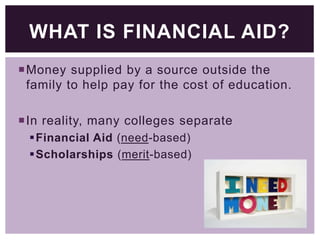
WHAT IS FINANCIAL AID?
Money supplied by a source outside the
family to help pay for the cost of education.
In reality, many colleges separate
Financial Aid (need-based)
Scholarships (merit-based)
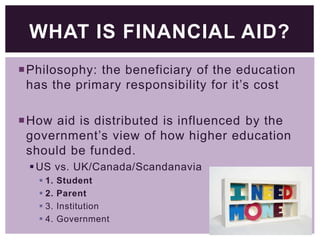
WHAT IS FINANCIAL AID?
Philosophy: the beneficiary of the education
has the primary responsibility for it’s cost
How aid is distributed is influenced by the
government’s view of how higher education
should be funded.
 US vs. UK/Canada/Scandanavia
 1.
 2.
 3.
 4.

Student
Parent
Institution
Government
FINANCIAL AID IS...
 An assistance device
 Not designed to replace a family’s (primary)
contribution
 Not based on what the parent’s would LIKE to pay
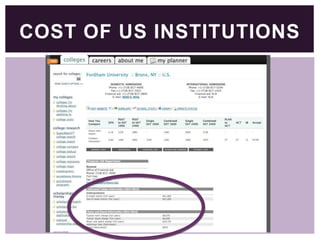
COST OF US INSTITUTIONS
TERMS
 Need Based
 Merit Based

 Need Blind
 Need Aware (Most US Colleges & Universities)
 Unmet Need
ACRONYMS
 COA – Cost of Attendance
 EFC – Expected Family Contribution

 SAR – Student Aid Report
 CSS Profile – College Student Scholarship
EXPECTED FAMILY
CONTRIBUTION
Parent’s Contribution
+ Student’s Contribution
Expected Family Contribution

Calculated ability to pay may not match
family willingness to pay!
DETERMINING NEED
Cost of Attendance
- Expected Family Contribution
Eligibility or Financial Need
COA
• Billable Costs: Tuition, Room &
Board, Fees, Health Insurance

• Indirect Costs: Books, Spending
Money, Transportation from Manila,
etc.
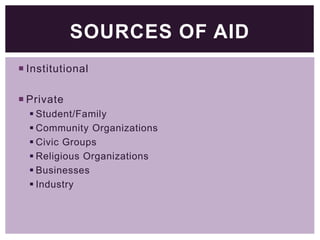
SOURCES OF AID
 Institutional
 Private
 Student/Family
 Community Organizations
 Civic Groups
 Religious Organizations
 Businesses
 Industry
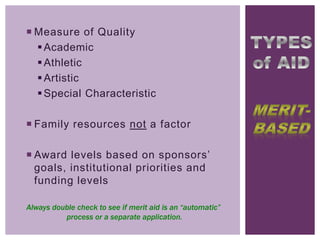
 Measure of Quality
 Academic
 Athletic
 Artistic
 Special Characteristic
 Family resources not a factor
 Award levels based on sponsors’
goals, institutional priorities and
funding levels
Always double check to see if merit aid is an “automatic”
process or a separate application.
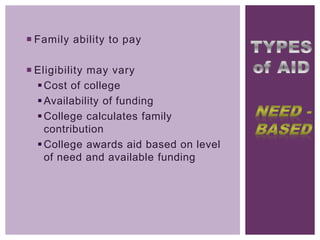
 Family ability to pay
 Eligibility may vary
 Cost of college
 Availability of funding
 College calculates family
contribution
 College awards aid based on level
of need and available funding
HOW TO APPLY
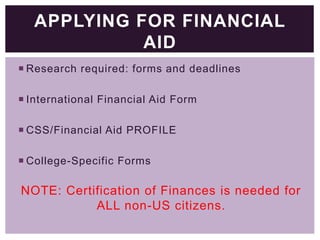
APPLYING FOR FINANCIAL
AID
 Research required: forms and deadlines
 International Financial Aid Form

 CSS/Financial Aid PROFILE
 College-Specific Forms

NOTE: Certification of Finances is needed for
ALL non-US citizens.
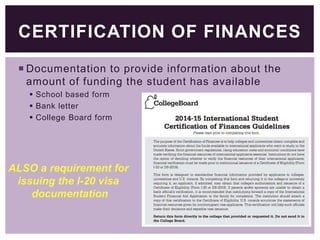
CERTIFICATION OF FINANCES
 Documentation to provide information about the
amount of funding the student has available
 School based form
 Bank letter
 College Board form

ALSO a requirement for
issuing the I-20 visa
documentation
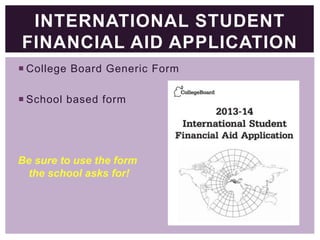
INTERNATIONAL STUDENT
FINANCIAL AID APPLICATION
 College Board Generic Form
 School based form

Be sure to use the form
the school asks for!
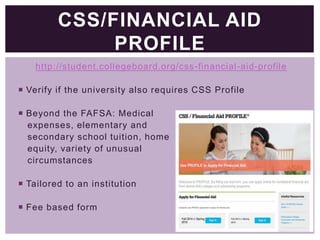
CSS/FINANCIAL AID
PROFILE
http://student.collegeboard.org/css -financial-aid-profile
 Verify if the university also requires CSS Profile
 Beyond the FAFSA: Medical
expenses, elementary and
secondary school tuition, home
equity, variety of unusual
circumstances

 Tailored to an institution
 Fee based form
FORMS & DOCUMENTS
 Parent tax returns
 Student tax returns
 Divorced or separated parent information
 Other information to verify





Income
Assets
Family Size
Special circumstances
WWW.INTERNATIONALSCHOLARSHIPS.COM
CREATIVE WAYS TO “PAY”
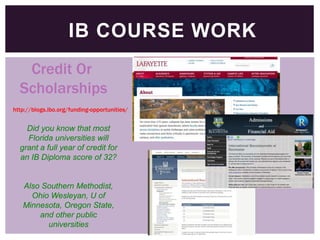
IB COURSE WORK
Credit Or
Scholarships
http://blogs.ibo.org/funding-opportunities/

Did you know that most
Florida universities will
grant a full year of credit for
an IB Diploma score of 32?

Also Southern Methodist,
Ohio Wesleyan, U of
Minnesota, Oregon State,
and other public
universities
NON-RESIDENT TUITION
SCHOLARSHIP

•
•
•
•
•
•
•

Oklahoma State
Colorado State
Auburn
U of Texas
U of Washington
Idaho State University
Minnesota State University Campuses
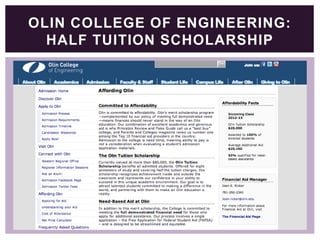
OLIN COLLEGE OF ENGINEERING:
HALF TUITION SCHOLARSHIP
UNIVERSITY OF MINNESOTA:
NEW NEED-BASED SCHOLARSHIPS
WOMEN’S COLLEGES

Women’s colleges are
traditionally generous with
scholarships for international
students.
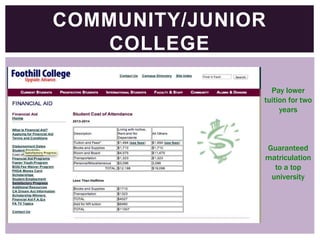
COMMUNITY/JUNIOR
COLLEGE
Pay lower
tuition for two
years

Guaranteed
matriculation
to a top
university
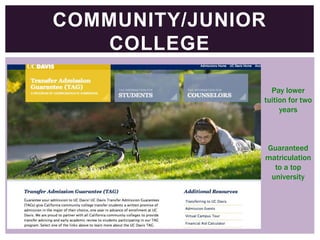
COMMUNITY/JUNIOR
COLLEGE
Pay lower
tuition for two
years

Guaranteed
matriculation
to a top
university
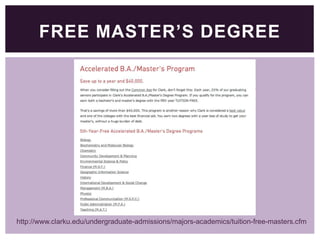
FREE MASTER’S DEGREE

http://www.clarku.edu/undergraduate-admissions/majors-academics/tuition-free-masters.cfm
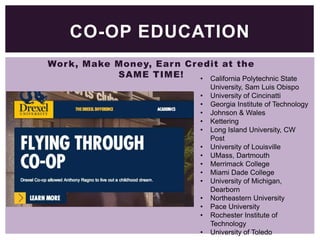
CO-OP EDUCATION
Wor k, Make Money, Ear n Credit at the
SAME TIME!
• California Polytechnic State
•
•
•
•
•
•
•
•
•
•
•
•
•
•

University, Sam Luis Obispo
University of Cincinatti
Georgia Institute of Technology
Johnson & Wales
Kettering
Long Island University, CW
Post
University of Louisville
UMass, Dartmouth
Merrimack College
Miami Dade College
University of Michigan,
Dearborn
Northeastern University
Pace University
Rochester Institute of
Technology
University of Toledo
WHAT TO DO NOW
JUNIOR YEAR
 Research colleges and financial aid websites
thoroughly
 Determine what your real level of need is
 Have realistic conversations with students about
what you can afford now
 Talk to representatives who visit ISM. They don’t
work for the Financial Aid office, but can provide
some insight.
 Visit the Financial Aid office when visiting campuses
 Do well academically
SENIOR YEAR: 1 ST
SEMESTER
 Get organized
 Deadlines: Scholarship/Aid deadlines might be earlier
 Complete college applications
 Register for CSS Profile if needed
 Gather information needed for:
 CSS Profile
 International Financial Aid Form

 Check each university’s website
SENIOR YEAR: 2 ND
SEMESTER
 February – April





Receive award letters
Evaluate awards
Contact University if necessary
Make decisions

 April – June





Follow university’s procedures
Send required forms
Signatures
Deposit
POINTS TO REMEMBER
POINTS TO REMEMBER
 US View: Paying for university may require some
sacrifice (vacations, helpers, etc.)
 Deadlines vary by institution
 Write or call the institution if any information is
unclear or if there are any unanswered questions
(DO NOT ASSUME!)
 Be prepared to provide documentation of family
resources
POINTS TO REMEMBER
 Some aid requires you to re-apply every year
 Some aid may be contingent on grades/GPA to
maintain aid
 Keep copies of forms completed as well as
supporting documentation
 Tax forms
 Employer’s statements
 Bank statements
THANK YOU FOR
COMING!
This presentation will be posted on the HS
Guidance blog in the next week.

http://guidance.ism-online.org/

US Financial Aid (International)

  • 1.
  • 2.
    GOALS  What FinancialAid Is  Terms & Acronyms  Types & Sources of Aid  Application Process & Forms  Creative Ways to Pay  Timeline
  • 3.
    INTERNATIONAL OR FOREIGN STUDENTS Defined as: Students that will need a visa (F-1) to study in the United States
  • 4.
    WHAT IS FINANCIALAID? Money supplied by a source outside the family to help pay for the cost of education. In reality, many colleges separate Financial Aid (need-based) Scholarships (merit-based)
  • 5.
    WHAT IS FINANCIALAID? Philosophy: the beneficiary of the education has the primary responsibility for it’s cost How aid is distributed is influenced by the government’s view of how higher education should be funded.  US vs. UK/Canada/Scandanavia  1.  2.  3.  4. Student Parent Institution Government
  • 6.
    FINANCIAL AID IS... An assistance device  Not designed to replace a family’s (primary) contribution  Not based on what the parent’s would LIKE to pay
  • 7.
    COST OF USINSTITUTIONS
  • 8.
    TERMS  Need Based Merit Based  Need Blind  Need Aware (Most US Colleges & Universities)  Unmet Need
  • 9.
    ACRONYMS  COA –Cost of Attendance  EFC – Expected Family Contribution  SAR – Student Aid Report  CSS Profile – College Student Scholarship
  • 10.
    EXPECTED FAMILY CONTRIBUTION Parent’s Contribution +Student’s Contribution Expected Family Contribution Calculated ability to pay may not match family willingness to pay!
  • 11.
    DETERMINING NEED Cost ofAttendance - Expected Family Contribution Eligibility or Financial Need COA • Billable Costs: Tuition, Room & Board, Fees, Health Insurance • Indirect Costs: Books, Spending Money, Transportation from Manila, etc.
  • 12.
    SOURCES OF AID Institutional  Private  Student/Family  Community Organizations  Civic Groups  Religious Organizations  Businesses  Industry
  • 13.
     Measure ofQuality  Academic  Athletic  Artistic  Special Characteristic  Family resources not a factor  Award levels based on sponsors’ goals, institutional priorities and funding levels Always double check to see if merit aid is an “automatic” process or a separate application.
  • 14.
     Family abilityto pay  Eligibility may vary  Cost of college  Availability of funding  College calculates family contribution  College awards aid based on level of need and available funding
  • 15.
  • 16.
    APPLYING FOR FINANCIAL AID Research required: forms and deadlines  International Financial Aid Form  CSS/Financial Aid PROFILE  College-Specific Forms NOTE: Certification of Finances is needed for ALL non-US citizens.
  • 17.
    CERTIFICATION OF FINANCES Documentation to provide information about the amount of funding the student has available  School based form  Bank letter  College Board form ALSO a requirement for issuing the I-20 visa documentation
  • 18.
    INTERNATIONAL STUDENT FINANCIAL AIDAPPLICATION  College Board Generic Form  School based form Be sure to use the form the school asks for!
  • 19.
    CSS/FINANCIAL AID PROFILE http://student.collegeboard.org/css -financial-aid-profile Verify if the university also requires CSS Profile  Beyond the FAFSA: Medical expenses, elementary and secondary school tuition, home equity, variety of unusual circumstances  Tailored to an institution  Fee based form
  • 20.
    FORMS & DOCUMENTS Parent tax returns  Student tax returns  Divorced or separated parent information  Other information to verify     Income Assets Family Size Special circumstances
  • 21.
  • 22.
  • 23.
    IB COURSE WORK CreditOr Scholarships http://blogs.ibo.org/funding-opportunities/ Did you know that most Florida universities will grant a full year of credit for an IB Diploma score of 32? Also Southern Methodist, Ohio Wesleyan, U of Minnesota, Oregon State, and other public universities
  • 24.
    NON-RESIDENT TUITION SCHOLARSHIP • • • • • • • Oklahoma State ColoradoState Auburn U of Texas U of Washington Idaho State University Minnesota State University Campuses
  • 25.
    OLIN COLLEGE OFENGINEERING: HALF TUITION SCHOLARSHIP
  • 26.
    UNIVERSITY OF MINNESOTA: NEWNEED-BASED SCHOLARSHIPS
  • 27.
    WOMEN’S COLLEGES Women’s collegesare traditionally generous with scholarships for international students.
  • 28.
    COMMUNITY/JUNIOR COLLEGE Pay lower tuition fortwo years Guaranteed matriculation to a top university
  • 29.
    COMMUNITY/JUNIOR COLLEGE Pay lower tuition fortwo years Guaranteed matriculation to a top university
  • 30.
  • 31.
    CO-OP EDUCATION Wor k,Make Money, Ear n Credit at the SAME TIME! • California Polytechnic State • • • • • • • • • • • • • • University, Sam Luis Obispo University of Cincinatti Georgia Institute of Technology Johnson & Wales Kettering Long Island University, CW Post University of Louisville UMass, Dartmouth Merrimack College Miami Dade College University of Michigan, Dearborn Northeastern University Pace University Rochester Institute of Technology University of Toledo
  • 32.
  • 33.
    JUNIOR YEAR  Researchcolleges and financial aid websites thoroughly  Determine what your real level of need is  Have realistic conversations with students about what you can afford now  Talk to representatives who visit ISM. They don’t work for the Financial Aid office, but can provide some insight.  Visit the Financial Aid office when visiting campuses  Do well academically
  • 34.
    SENIOR YEAR: 1ST SEMESTER  Get organized  Deadlines: Scholarship/Aid deadlines might be earlier  Complete college applications  Register for CSS Profile if needed  Gather information needed for:  CSS Profile  International Financial Aid Form  Check each university’s website
  • 35.
    SENIOR YEAR: 2ND SEMESTER  February – April     Receive award letters Evaluate awards Contact University if necessary Make decisions  April – June     Follow university’s procedures Send required forms Signatures Deposit
  • 36.
  • 37.
    POINTS TO REMEMBER US View: Paying for university may require some sacrifice (vacations, helpers, etc.)  Deadlines vary by institution  Write or call the institution if any information is unclear or if there are any unanswered questions (DO NOT ASSUME!)  Be prepared to provide documentation of family resources
  • 38.
    POINTS TO REMEMBER Some aid requires you to re-apply every year  Some aid may be contingent on grades/GPA to maintain aid  Keep copies of forms completed as well as supporting documentation  Tax forms  Employer’s statements  Bank statements
  • 39.
    THANK YOU FOR COMING! Thispresentation will be posted on the HS Guidance blog in the next week. http://guidance.ism-online.org/