Welcome
to
College Search Process
Admissions- Applying
There are usually three ways to apply:
• Online Application:
• Paper Application
• The Common Application
– Online
– Paper
Accepting applications
Early Action/ Early Decision
Deadline by Major Program
Rolling admission basis.
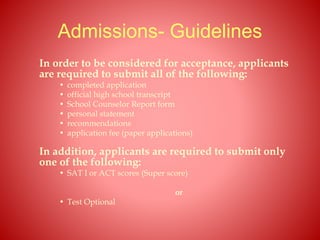
Admissions- Guidelines
In order to be considered for acceptance, applicants
are required to submit all of the following:
• completed application
• official high school transcript
• School Counselor Report form
• personal statement
• recommendations
• application fee (paper applications)
In addition, applicants are required to submit only
one of the following:
• SAT I or ACT scores (Super score)
or
• Test Optional
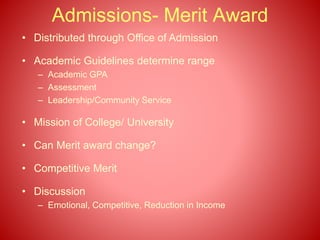
Admissions- Merit Award
• Distributed through Office of Admission
• Academic Guidelines determine range
– Academic GPA
– Assessment
– Leadership/Community Service
• Mission of College/ University
• Can Merit award change?
• Competitive Merit
• Discussion
– Emotional, Competitive, Reduction in Income
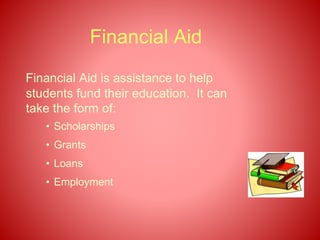
Financial Aid
Financial Aid is assistance to help
students fund their education. It can
take the form of:
• Scholarships
• Grants
• Loans
• Employment
Welcome
to
Financial Aid Night
2016-2017 Application Process
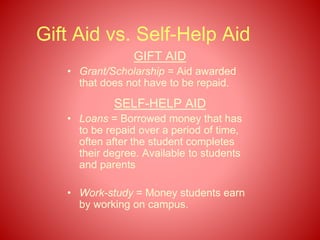
Gift Aid vs. Self-Help Aid
GIFT AID
• Grant/Scholarship = Aid awarded
that does not have to be repaid.
SELF-HELP AID
• Loans = Borrowed money that has
to be repaid over a period of time,
often after the student completes
their degree. Available to students
and parents
• Work-study = Money students earn
by working on campus.
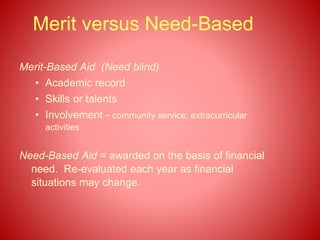
Merit versus Need-Based
Merit-Based Aid (Need blind)
• Academic record
• Skills or talents
• Involvement - community service; extracurricular
activities
Need-Based Aid = awarded on the basis of financial
need. Re-evaluated each year as financial
situations may change.
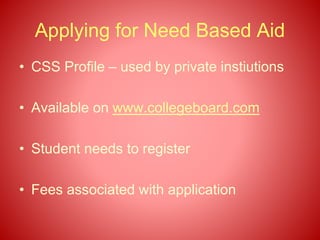
Applying for Need Based Aid
• CSS Profile – used by private instiutions
• Available on www.collegeboard.com
• Student needs to register
• Fees associated with application
Applying for Need Based Aid
• Schools may also require an institutional
application.
• Check web sites of each school student is
applying to
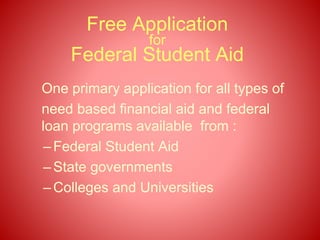
Free Application
for
Federal Student Aid
One primary application for all types of
need based financial aid and federal
loan programs available from :
–Federal Student Aid
–State governments
–Colleges and Universities
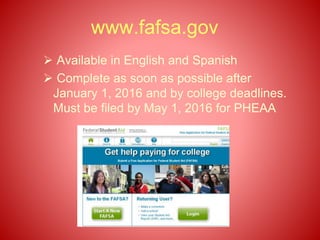
www.fafsa.gov
 Available in English and Spanish
 Complete as soon as possible after
January 1, 2016 and by college deadlines.
Must be filed by May 1, 2016 for PHEAA
Federal Student Aid ID
www.fsaid.ed.gov
• Parent & student sign FAFSA electronically.
Additional uses:
• submit info and make corrections online.
• sign Promissory Notes for Direct Loans.

• Access Financial Aid history on NLSDS
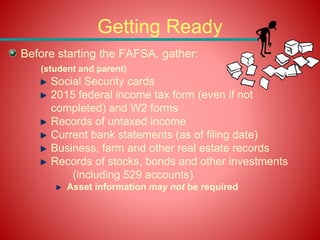
Getting Ready
Before starting the FAFSA, gather:
(student and parent)
Social Security cards
2015 federal income tax form (even if not
completed) and W2 forms
Records of untaxed income
Current bank statements (as of filing date)
Business, farm and other real estate records
Records of stocks, bonds and other investments
(including 529 accounts)
Asset information may not be required
FAFSA-Filing Tips
• Based on prior calendar year tax return
• May use estimated income and taxes
• May submit prior to college acceptance
• PA residents must file by May 1 for state
grant consideration; state will follow up with
student (via email)
Three Ways to File FAFSA
File online at www.fafsa.gov
Download electronic FAFSA PDF file, print,
complete and mail or complete PDF
FAFSA online, print and mail
Request paper FAFSA from Federal
Student Aid Information Center (FSAIC) at
1-800-4-FED-AID or 1-800-433-3243
FAFSA on the Web
• The IRS Data Retrieval will be available
February 7, 2016
• Also available in Corrections
• Electronically filed tax return information
will be available from the IRS in 2-3 weeks,
data from paper tax returns will be
available in 6-8 weeks.

General student information
• Name
• State of legal residence
• Social Security Number
• Citizenship
FAFSA
FAFSA
Student demographic information
• Marital status
• Selective Service Registration
• Drug Conviction Question
• Parents’ Educational Background
FAFSA
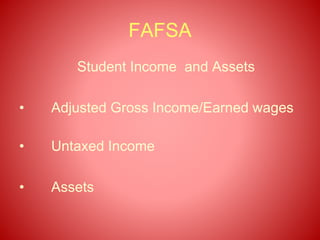
Student Income and Assets
• Adjusted Gross Income/Earned wages
• Untaxed Income
• Assets
FAFSA
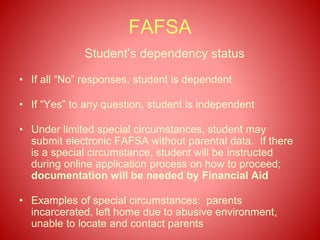
Student’s dependency status
• If all “No” responses, student is dependent
• If “Yes” to any question, student is independent
• Under limited special circumstances, student may
submit electronic FAFSA without parental data. If there
is a special circumstance, student will be instructed
during online application process on how to proceed;
documentation will be needed by Financial Aid
• Examples of special circumstances: parents
incarcerated, left home due to abusive environment,
unable to locate and contact parents
FAFSA
Data for parents of dependent students
• Parents’ name, social security number,
date of birth
FAFSA
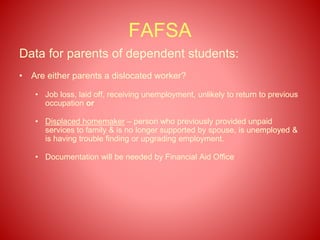
Data for parents of dependent students:
• Are either parents a dislocated worker?
• Job loss, laid off, receiving unemployment, unlikely to return to previous
occupation or
• Displaced homemaker – person who previously provided unpaid
services to family & is no longer supported by spouse, is unemployed &
is having trouble finding or upgrading employment.
• Documentation will be needed by Financial Aid Office
FAFSA
Financial data for parents of dependent
students:
• Tax filing status and return type
already completed, will file, will not file
1040, 1040A/EZ, foreign tax return
wages, adjusted gross income, federal tax paid
FAFSA
Financial data for parents of dependent
students:
• Adjusted Gross Income (AGI) for 2015
• Income earned from work
FAFSA
Financial data for parents of dependent
students:
• 2015 Additional Financial Information
– Education credits on tax return,
– child support paid/received
– payment to tax deferred pension,
– IRA deductions
FAFSA
• Cash, savings, and checking
• Net worth of investments:
– Net worth equals current value minus debt
– Don’t include primary home, life insurance, retirement plans
– Do include real estate, money market, mutual funds, CD’s, stocks,
education savings plans (even if owned by student, parent reports in
parent section)
– Review instructions for all items to be reported
FAFSA
Asset data for parents of dependent
students:
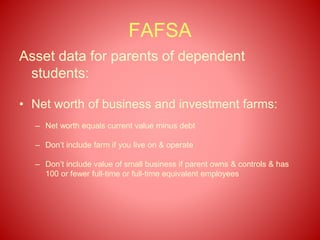
• Net worth of business and investment farms:
– Net worth equals current value minus debt
– Don’t include farm if you live on & operate
– Don’t include value of small business if parent owns & controls & has
100 or fewer full-time or full-time equivalent employees
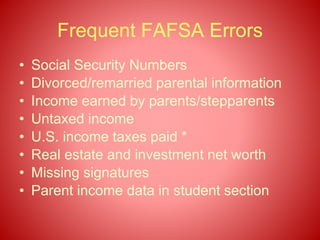
Frequent FAFSA Errors
• Social Security Numbers
• Divorced/remarried parental information
• Income earned by parents/stepparents
• Untaxed income
• U.S. income taxes paid *
• Real estate and investment net worth
• Missing signatures
• Parent income data in student section
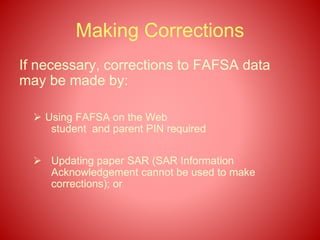
Making Corrections
If necessary, corrections to FAFSA data
may be made by:
 Using FAFSA on the Web
student and parent PIN required
 Updating paper SAR (SAR Information
Acknowledgement cannot be used to make
corrections); or
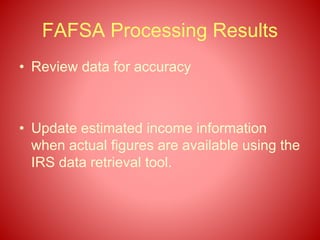
FAFSA Processing Results
• Review data for accuracy
• Update estimated income information
when actual figures are available using the
IRS data retrieval tool.
FAFSA Processing Results
• CPS notifies student of FAFSA processing
results by:
– E-mail notification containing a direct link to
student’s on-line SAR if student’s e-mail was
provided on paper or electronic FAFSA
• Student with FSA ID can view SAR on-line at
www.fafsa.gov.
• Separate electronic record sent to colleges 10 -
14 days after filed; record also sent to state
EFC-Expected Family Contribution
Once the FAFSA is processed the result is
the “Expected Family Contribution” or the
EFC.
The EFC is determined by a federal formula
and is an index used by the college ,
federal, and state government to
determine need based aid eligibility.
The EFC is not equivalent to out-of-pocket
costs.
Cost of Attendance
Includes:
• Tuition
• Fees
• Room and Board
• Books and Supplies
• Personal Expenses
• Transportation
• Loan Fees
Cost of Attendance
• Will vary by college
• Will vary by housing status
(commuter vs. resident)
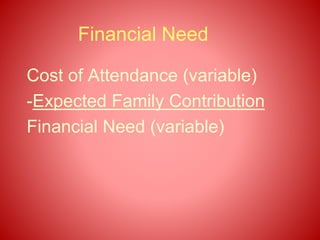
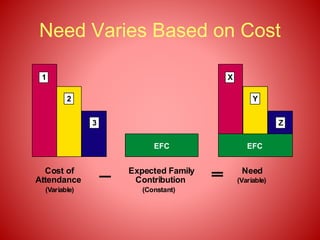
Financial Need
Cost of Attendance (variable)
-Expected Family Contribution
Financial Need (variable)
Need Varies Based on Cost
X
Y
Z
Cost of Expected Family Need
Attendance Contribution (Variable)
(Variable) (Constant)
1
2
3
EFC EFC
College Timelines
• Vary based on Admissions procedures
• Be aware of deadlines
• Some schools review financial need prior
to making admissions offer
• Scholarship awards may come with
acceptance
• Admission deposit deadlines vary
Other Sources of Funds
• ROTC Scholarships
• Office of Vocational Rehabilitation
• Private business scholarships (e.g.,
Wal-Mart, Gates Foundation, etc.)
• Civic organizations & churches(e.g.,
PTA, Elks Club, Rotary, Kiwanis, etc.)
• Cp 33 VA benefits – Yellow Ribbon
Private Scholarship Search
Free Internet scholarship search engines:
• FinAid on the Web: www.finaid.org
• College Board: www.collegeboard.com
• FastWeb: www.fastweb.com
• GoCollege: The Collegiate Websource:
www.gocollege.com
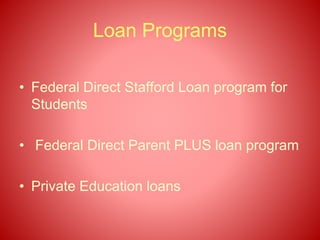
Loan Programs
• Federal Direct Stafford Loan program for
Students
• Federal Direct Parent PLUS loan program
• Private Education loans
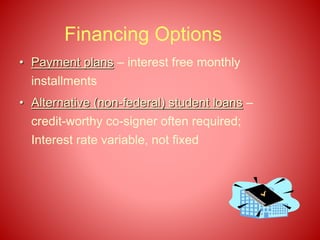
Financing Options
• Payment plans – interest free monthly
installments
• Alternative (non-federal) student loans –
credit-worthy co-signer often required;
Interest rate variable, not fixed
Resources for Students
• Institutional Financial Aid Offices
• PHEAA:
– www.pheaa.org
– 1-800-692-7392
• U.S. Department of Education:
– www.studentaid.ed.gov
– www.federalstudentaid.ed.gov
– 1-800-4FEDAID (1-800-433-3243)
Questions?
Thank you!
King’s College Contacts
Office of Admission Financial Aid Office

Financial aid presentation 15 16

  • 1.
  • 2.
    Admissions- Applying There areusually three ways to apply: • Online Application: • Paper Application • The Common Application – Online – Paper Accepting applications Early Action/ Early Decision Deadline by Major Program Rolling admission basis.
  • 3.
    Admissions- Guidelines In orderto be considered for acceptance, applicants are required to submit all of the following: • completed application • official high school transcript • School Counselor Report form • personal statement • recommendations • application fee (paper applications) In addition, applicants are required to submit only one of the following: • SAT I or ACT scores (Super score) or • Test Optional
  • 4.
    Admissions- Merit Award •Distributed through Office of Admission • Academic Guidelines determine range – Academic GPA – Assessment – Leadership/Community Service • Mission of College/ University • Can Merit award change? • Competitive Merit • Discussion – Emotional, Competitive, Reduction in Income
  • 5.
    Financial Aid Financial Aidis assistance to help students fund their education. It can take the form of: • Scholarships • Grants • Loans • Employment
  • 6.
  • 7.
    Gift Aid vs.Self-Help Aid GIFT AID • Grant/Scholarship = Aid awarded that does not have to be repaid. SELF-HELP AID • Loans = Borrowed money that has to be repaid over a period of time, often after the student completes their degree. Available to students and parents • Work-study = Money students earn by working on campus.
  • 8.
    Merit versus Need-Based Merit-BasedAid (Need blind) • Academic record • Skills or talents • Involvement - community service; extracurricular activities Need-Based Aid = awarded on the basis of financial need. Re-evaluated each year as financial situations may change.
  • 9.
    Applying for NeedBased Aid • CSS Profile – used by private instiutions • Available on www.collegeboard.com • Student needs to register • Fees associated with application
  • 10.
    Applying for NeedBased Aid • Schools may also require an institutional application. • Check web sites of each school student is applying to
  • 11.
    Free Application for Federal StudentAid One primary application for all types of need based financial aid and federal loan programs available from : –Federal Student Aid –State governments –Colleges and Universities
  • 12.
    www.fafsa.gov  Available inEnglish and Spanish  Complete as soon as possible after January 1, 2016 and by college deadlines. Must be filed by May 1, 2016 for PHEAA
  • 13.
    Federal Student AidID www.fsaid.ed.gov • Parent & student sign FAFSA electronically. Additional uses: • submit info and make corrections online. • sign Promissory Notes for Direct Loans. • Access Financial Aid history on NLSDS
  • 14.
    Getting Ready Before startingthe FAFSA, gather: (student and parent) Social Security cards 2015 federal income tax form (even if not completed) and W2 forms Records of untaxed income Current bank statements (as of filing date) Business, farm and other real estate records Records of stocks, bonds and other investments (including 529 accounts) Asset information may not be required
  • 15.
    FAFSA-Filing Tips • Basedon prior calendar year tax return • May use estimated income and taxes • May submit prior to college acceptance • PA residents must file by May 1 for state grant consideration; state will follow up with student (via email)
  • 16.
    Three Ways toFile FAFSA File online at www.fafsa.gov Download electronic FAFSA PDF file, print, complete and mail or complete PDF FAFSA online, print and mail Request paper FAFSA from Federal Student Aid Information Center (FSAIC) at 1-800-4-FED-AID or 1-800-433-3243
  • 17.
    FAFSA on theWeb • The IRS Data Retrieval will be available February 7, 2016 • Also available in Corrections • Electronically filed tax return information will be available from the IRS in 2-3 weeks, data from paper tax returns will be available in 6-8 weeks.
  • 18.
    General student information •Name • State of legal residence • Social Security Number • Citizenship FAFSA
  • 19.
    FAFSA Student demographic information •Marital status • Selective Service Registration • Drug Conviction Question • Parents’ Educational Background
  • 20.
    FAFSA Student Income andAssets • Adjusted Gross Income/Earned wages • Untaxed Income • Assets
  • 21.
    FAFSA Student’s dependency status •If all “No” responses, student is dependent • If “Yes” to any question, student is independent • Under limited special circumstances, student may submit electronic FAFSA without parental data. If there is a special circumstance, student will be instructed during online application process on how to proceed; documentation will be needed by Financial Aid • Examples of special circumstances: parents incarcerated, left home due to abusive environment, unable to locate and contact parents
  • 22.
    FAFSA Data for parentsof dependent students • Parents’ name, social security number, date of birth
  • 23.
    FAFSA Data for parentsof dependent students: • Are either parents a dislocated worker? • Job loss, laid off, receiving unemployment, unlikely to return to previous occupation or • Displaced homemaker – person who previously provided unpaid services to family & is no longer supported by spouse, is unemployed & is having trouble finding or upgrading employment. • Documentation will be needed by Financial Aid Office
  • 24.
    FAFSA Financial data forparents of dependent students: • Tax filing status and return type already completed, will file, will not file 1040, 1040A/EZ, foreign tax return wages, adjusted gross income, federal tax paid
  • 25.
    FAFSA Financial data forparents of dependent students: • Adjusted Gross Income (AGI) for 2015 • Income earned from work
  • 26.
    FAFSA Financial data forparents of dependent students: • 2015 Additional Financial Information – Education credits on tax return, – child support paid/received – payment to tax deferred pension, – IRA deductions
  • 27.
    FAFSA • Cash, savings,and checking • Net worth of investments: – Net worth equals current value minus debt – Don’t include primary home, life insurance, retirement plans – Do include real estate, money market, mutual funds, CD’s, stocks, education savings plans (even if owned by student, parent reports in parent section) – Review instructions for all items to be reported
  • 28.
    FAFSA Asset data forparents of dependent students: • Net worth of business and investment farms: – Net worth equals current value minus debt – Don’t include farm if you live on & operate – Don’t include value of small business if parent owns & controls & has 100 or fewer full-time or full-time equivalent employees
  • 29.
    Frequent FAFSA Errors •Social Security Numbers • Divorced/remarried parental information • Income earned by parents/stepparents • Untaxed income • U.S. income taxes paid * • Real estate and investment net worth • Missing signatures • Parent income data in student section
  • 30.
    Making Corrections If necessary,corrections to FAFSA data may be made by:  Using FAFSA on the Web student and parent PIN required  Updating paper SAR (SAR Information Acknowledgement cannot be used to make corrections); or
  • 31.
    FAFSA Processing Results •Review data for accuracy • Update estimated income information when actual figures are available using the IRS data retrieval tool.
  • 32.
    FAFSA Processing Results •CPS notifies student of FAFSA processing results by: – E-mail notification containing a direct link to student’s on-line SAR if student’s e-mail was provided on paper or electronic FAFSA • Student with FSA ID can view SAR on-line at www.fafsa.gov. • Separate electronic record sent to colleges 10 - 14 days after filed; record also sent to state
  • 33.
    EFC-Expected Family Contribution Oncethe FAFSA is processed the result is the “Expected Family Contribution” or the EFC. The EFC is determined by a federal formula and is an index used by the college , federal, and state government to determine need based aid eligibility. The EFC is not equivalent to out-of-pocket costs.
  • 34.
    Cost of Attendance Includes: •Tuition • Fees • Room and Board • Books and Supplies • Personal Expenses • Transportation • Loan Fees
  • 35.
    Cost of Attendance •Will vary by college • Will vary by housing status (commuter vs. resident)
  • 36.
    Financial Need Cost ofAttendance (variable) -Expected Family Contribution Financial Need (variable)
  • 37.
    Need Varies Basedon Cost X Y Z Cost of Expected Family Need Attendance Contribution (Variable) (Variable) (Constant) 1 2 3 EFC EFC
  • 38.
    College Timelines • Varybased on Admissions procedures • Be aware of deadlines • Some schools review financial need prior to making admissions offer • Scholarship awards may come with acceptance • Admission deposit deadlines vary
  • 39.
    Other Sources ofFunds • ROTC Scholarships • Office of Vocational Rehabilitation • Private business scholarships (e.g., Wal-Mart, Gates Foundation, etc.) • Civic organizations & churches(e.g., PTA, Elks Club, Rotary, Kiwanis, etc.) • Cp 33 VA benefits – Yellow Ribbon
  • 40.
    Private Scholarship Search FreeInternet scholarship search engines: • FinAid on the Web: www.finaid.org • College Board: www.collegeboard.com • FastWeb: www.fastweb.com • GoCollege: The Collegiate Websource: www.gocollege.com
  • 41.
    Loan Programs • FederalDirect Stafford Loan program for Students • Federal Direct Parent PLUS loan program • Private Education loans
  • 42.
    Financing Options • Paymentplans – interest free monthly installments • Alternative (non-federal) student loans – credit-worthy co-signer often required; Interest rate variable, not fixed
  • 43.
    Resources for Students •Institutional Financial Aid Offices • PHEAA: – www.pheaa.org – 1-800-692-7392 • U.S. Department of Education: – www.studentaid.ed.gov – www.federalstudentaid.ed.gov – 1-800-4FEDAID (1-800-433-3243)
  • 44.
  • 45.
    King’s College Contacts Officeof Admission Financial Aid Office