Financial Aid 101
Agenda
• Basic Information: What, Who and How
• How is Financial Need Calculated
• Federal Programs
• State Programs

• Filling out the FAFSA
• Additional Resources

2
What is Financial Aid?
• Financial Aid is money to pay for college or
career school
• Examples of financial aid include:
– Grants
– Scholarships
– Loans
– Work-Study Programs

3
Sources of Financial Aid
• Federal government
• State government
• Colleges and universities
• Private foundations

• Employers and private companies
• Professional and service organizations

4
Types of Financial Aid

• Merit-Based

Scholarship (Hope Scholarship)

• Need-Based Grant (Pell Grant and FSEOG)
• Non-Need Based Grants (HOPE Grant)
• Student or Parent Loans
• Employment Opportunities, Work Study
• Military Aid and Grants
• Savings Plans

5
Who Can Get Federal Student Aid?
• U.S. citizen or permanent resident
• High school graduate or GED recipient
• Eligible degree/certificate program
• Valid Social Security number
• Males registered for Selective Service
• Satisfactory academic progress
How is Financial Need Calculated?
• Financial need is determined by Cost of
Attendance (COA) and Expected Family
Contribution (EFC)
• COA is tuition, fees, room and board,
transportation, etc. established by the school
• EFC comes from what you report on the Free
Application for Federal Student Aid (FAFSA)

COA – EFC = Financial Need
Factors that Influence EFC
• For Parents
– Income

– Savings
– Assets
– Age
– Number in College

– Family Size

• For Students
– Income
– Savings
– Independent/dependent
Factors that Influence EFC
• Assets that are EXCLUDED from the FEDERAL
family contribution calculation
– Family home
– Family farm (under special circumstances)
– Retirement contributions (IRA, KEOGH, 401K, etc.)
What are the Federal Programs?

Federal Grants and Work Study
• Pell Grant
– Max. Amount $5,645
– Full-time student (12 or more hrs.)
– Based on $0 EFC

• Federal Supplemental Educational Opportunity
Grant (FSEOG)
– Undergraduates only
– Awards range from $100 - $4,000

• Work-Study Award

10
What are the Federal Programs?
Federal Loans
• Federal Perkins Loan

• Direct Subsidized Loan
– Interest is paid by the government while enrolled (at
least half-time)

• Direct Unsubsidized Loan
– Student is responsible for paying the interest on the
loan

• Federal PLUS Loan – for parents of undergraduate
students

• Grad PLUS Loan – for graduate and professional
students

11
Student Loan Limits 2013 – 2014 Academic Year

Initial Loan Amount for
Dependent Students whose
Parents are Eligible for a
PLUS Loan

Base

Additional
Unsubsidized

Annual Maximum
Amount

Freshmen

$3,500

$2,000

$5,500

Sophomore

$4,500

$2,000

$6,500

Junior/Senior

$5,500

$2,000

$7,500

Independent Students and
Dependent Students whose
Parents were Denied a PLUS
Loan

Base

Additional
Unsubsidized

Annual Maximum
Amount

Freshmen

$3,500

$6,000

$9,500

Sophomore

$4,500

$6,000

$10,500

Junior/Senior

$5,500

$7,000

$12,500

12
What are Some State Programs?
Georgia-Specific Programs
• Academic or Merit Scholarships
– HOPE Scholarship
– Zell Miller Scholarship

• Grants
– HOPE Grant
– Strategic Industries Workforce Development Grant
(SIWDG)
– HOPE GED Grant

• Loans
– Student Access Loan Program

13
Student Access Loan Program
• This was program was created in 2008, but
funded for the first time for FY 2012
• Low interest loan program targeted to students
who experience unmet need or a gap in their
college financing
• Students may borrow up to $10,000 per year and
$40,000 in their lifetime
• Students must be able to demonstrate that they
have exhausted all other financial aid sources
and must have completed the Free Application
for Federal Student Aid (FAFSA)

• The annual interest rate is 1% and borrowers
will be required to pay interest while in school
14
How do Individuals Apply for Aid?
• Federal aid: FREE Application for Federal Student
Aid (FAFSA) at www.fafsa.gov
• State aid: most states make awards based on your
FAFSA data
• School aid: contact financial aid office at schools
you are considering

• Scholarships: each scholarship provider has its
own requirements

15
Filling Out the

FREE Application for
Federal Student Aid (FAFSA)

16
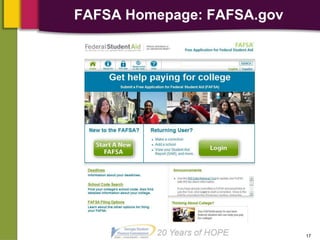
FAFSA Homepage: FAFSA.gov

17
FAFSA Deadlines
How to Complete the FAFSA
• To complete the FAFSA,
you will need:
– Completed tax returns
– Information on untaxed
income, such as child
support
– Household information

• To Request a Paper
FAFSA:
– Call 1-800-4-FED-AID
– Download the FAFSA PDF
at fasfa.gov

19
Find the Answers on FAFSA.gov
FAFSA.gov Help Options
FAFSA on the Web Worksheet

These questions will determine
whether the student is a dependent
or independent student. These are
the only questions that the
Government uses in making this
determination.
Parent Section of Worksheet

23
IRS Data Retrieval

• The applicant will be

validated.
• The applicant will have

the option to “Transfer”
the tax information to
the FAFSA.
Special Circumstances
• Cannot report on FAFSA
• Send explanation to financial aid office at each
college
• College will review special circumstances:
– Request additional documentation
– Decisions are final and cannot be appealed to U.S.
Department of Education
Examples of Special Circumstances:
• Change in employment status
• Medical expenses not covered by insurance
• Change in parent marital status
• Unusual dependent care expenses
• Student cannot obtain parent information
Sign and Submit

• 3 Signature Options
– Sign electronically

w/PIN
– Print Signature Page
– Submit without

signatures
Confirmation Page

•
•
•

•
•

Confirmation Number
Data Release Number (DRN)
EFC estimate
Pell Grant and Direct Loan
estimates
Option for parents to transfer
information to an application
for a sibling
FAFSA Processing Results
• Student will receive a Student Aid Report (SAR)
• Colleges listed on your FAFSA will receive the
Institutional Student Information Record (ISIR)
approximately 10 to 14 days after FAFSA
submitted
• College reviews Institutional Student
Information Record (ISIR)
– May request additional documentation, such as
copies of federal tax returns
Sample Award Letter

29
Financial Aid Award Offer
Name:
ID:

Doe, John
000 00 0128

Housing: On-Campus
Residency: In-State

May 21, 2013

Award #: 01
Estimated Cost of Attendance
Expected Family Contribution

2 Semesters

Established Financial Need

$17,076
0
$17,076

Type of Aid

Fall

Spring

Summer

Total

Accept?

Federal Pell Grant

$2,823

$2,822

$0

$5,645

Yes or No

HOPE Scholarship

$3,013

$3,013

$0

$6,026

Yes or No

Federal Direct Loan – Sub

$1,750

$1,750

$0

$3,500

Yes or No

Federal Direct Loan - Unsub

$1,000

$1,000

$0

$2,000

Yes or No

Total for Academic Year

$17,171
Additional Resources
• GAcollege411.org
• GSFC.org
• FAFSA.gov
• StudentAid.gov
– Prepare for College
– Types of Aid

– Who Gets Aid
– Apply for Aid
– Repay Your Loans

31
We’re Here to Help You

32
Contact Us

800.505.4732

outreach@gsfc.org

33
Be Social

34
GSFC and GAcollege411

OUR MISSION
To promote and increase access to
education beyond high school for
Georgians.

OUR VISION
To be the premier provider of student
financial aid and educational services for
Georgians.

35

2014 Financial Aid

  • 1.
  • 2.
    Agenda • Basic Information:What, Who and How • How is Financial Need Calculated • Federal Programs • State Programs • Filling out the FAFSA • Additional Resources 2
  • 3.
    What is FinancialAid? • Financial Aid is money to pay for college or career school • Examples of financial aid include: – Grants – Scholarships – Loans – Work-Study Programs 3
  • 4.
    Sources of FinancialAid • Federal government • State government • Colleges and universities • Private foundations • Employers and private companies • Professional and service organizations 4
  • 5.
    Types of FinancialAid • Merit-Based Scholarship (Hope Scholarship) • Need-Based Grant (Pell Grant and FSEOG) • Non-Need Based Grants (HOPE Grant) • Student or Parent Loans • Employment Opportunities, Work Study • Military Aid and Grants • Savings Plans 5
  • 6.
    Who Can GetFederal Student Aid? • U.S. citizen or permanent resident • High school graduate or GED recipient • Eligible degree/certificate program • Valid Social Security number • Males registered for Selective Service • Satisfactory academic progress
  • 7.
    How is FinancialNeed Calculated? • Financial need is determined by Cost of Attendance (COA) and Expected Family Contribution (EFC) • COA is tuition, fees, room and board, transportation, etc. established by the school • EFC comes from what you report on the Free Application for Federal Student Aid (FAFSA) COA – EFC = Financial Need
  • 8.
    Factors that InfluenceEFC • For Parents – Income – Savings – Assets – Age – Number in College – Family Size • For Students – Income – Savings – Independent/dependent
  • 9.
    Factors that InfluenceEFC • Assets that are EXCLUDED from the FEDERAL family contribution calculation – Family home – Family farm (under special circumstances) – Retirement contributions (IRA, KEOGH, 401K, etc.)
  • 10.
    What are theFederal Programs? Federal Grants and Work Study • Pell Grant – Max. Amount $5,645 – Full-time student (12 or more hrs.) – Based on $0 EFC • Federal Supplemental Educational Opportunity Grant (FSEOG) – Undergraduates only – Awards range from $100 - $4,000 • Work-Study Award 10
  • 11.
    What are theFederal Programs? Federal Loans • Federal Perkins Loan • Direct Subsidized Loan – Interest is paid by the government while enrolled (at least half-time) • Direct Unsubsidized Loan – Student is responsible for paying the interest on the loan • Federal PLUS Loan – for parents of undergraduate students • Grad PLUS Loan – for graduate and professional students 11
  • 12.
    Student Loan Limits2013 – 2014 Academic Year Initial Loan Amount for Dependent Students whose Parents are Eligible for a PLUS Loan Base Additional Unsubsidized Annual Maximum Amount Freshmen $3,500 $2,000 $5,500 Sophomore $4,500 $2,000 $6,500 Junior/Senior $5,500 $2,000 $7,500 Independent Students and Dependent Students whose Parents were Denied a PLUS Loan Base Additional Unsubsidized Annual Maximum Amount Freshmen $3,500 $6,000 $9,500 Sophomore $4,500 $6,000 $10,500 Junior/Senior $5,500 $7,000 $12,500 12
  • 13.
    What are SomeState Programs? Georgia-Specific Programs • Academic or Merit Scholarships – HOPE Scholarship – Zell Miller Scholarship • Grants – HOPE Grant – Strategic Industries Workforce Development Grant (SIWDG) – HOPE GED Grant • Loans – Student Access Loan Program 13
  • 14.
    Student Access LoanProgram • This was program was created in 2008, but funded for the first time for FY 2012 • Low interest loan program targeted to students who experience unmet need or a gap in their college financing • Students may borrow up to $10,000 per year and $40,000 in their lifetime • Students must be able to demonstrate that they have exhausted all other financial aid sources and must have completed the Free Application for Federal Student Aid (FAFSA) • The annual interest rate is 1% and borrowers will be required to pay interest while in school 14
  • 15.
    How do IndividualsApply for Aid? • Federal aid: FREE Application for Federal Student Aid (FAFSA) at www.fafsa.gov • State aid: most states make awards based on your FAFSA data • School aid: contact financial aid office at schools you are considering • Scholarships: each scholarship provider has its own requirements 15
  • 16.
    Filling Out the FREEApplication for Federal Student Aid (FAFSA) 16
  • 17.
  • 18.
  • 19.
    How to Completethe FAFSA • To complete the FAFSA, you will need: – Completed tax returns – Information on untaxed income, such as child support – Household information • To Request a Paper FAFSA: – Call 1-800-4-FED-AID – Download the FAFSA PDF at fasfa.gov 19
  • 20.
    Find the Answerson FAFSA.gov
  • 21.
  • 22.
    FAFSA on theWeb Worksheet These questions will determine whether the student is a dependent or independent student. These are the only questions that the Government uses in making this determination.
  • 23.
    Parent Section ofWorksheet 23
  • 24.
    IRS Data Retrieval •The applicant will be validated. • The applicant will have the option to “Transfer” the tax information to the FAFSA.
  • 25.
    Special Circumstances • Cannotreport on FAFSA • Send explanation to financial aid office at each college • College will review special circumstances: – Request additional documentation – Decisions are final and cannot be appealed to U.S. Department of Education Examples of Special Circumstances: • Change in employment status • Medical expenses not covered by insurance • Change in parent marital status • Unusual dependent care expenses • Student cannot obtain parent information
  • 26.
    Sign and Submit •3 Signature Options – Sign electronically w/PIN – Print Signature Page – Submit without signatures
  • 27.
    Confirmation Page • • • • • Confirmation Number DataRelease Number (DRN) EFC estimate Pell Grant and Direct Loan estimates Option for parents to transfer information to an application for a sibling
  • 28.
    FAFSA Processing Results •Student will receive a Student Aid Report (SAR) • Colleges listed on your FAFSA will receive the Institutional Student Information Record (ISIR) approximately 10 to 14 days after FAFSA submitted • College reviews Institutional Student Information Record (ISIR) – May request additional documentation, such as copies of federal tax returns
  • 29.
  • 30.
    Financial Aid AwardOffer Name: ID: Doe, John 000 00 0128 Housing: On-Campus Residency: In-State May 21, 2013 Award #: 01 Estimated Cost of Attendance Expected Family Contribution 2 Semesters Established Financial Need $17,076 0 $17,076 Type of Aid Fall Spring Summer Total Accept? Federal Pell Grant $2,823 $2,822 $0 $5,645 Yes or No HOPE Scholarship $3,013 $3,013 $0 $6,026 Yes or No Federal Direct Loan – Sub $1,750 $1,750 $0 $3,500 Yes or No Federal Direct Loan - Unsub $1,000 $1,000 $0 $2,000 Yes or No Total for Academic Year $17,171
  • 31.
    Additional Resources • GAcollege411.org •GSFC.org • FAFSA.gov • StudentAid.gov – Prepare for College – Types of Aid – Who Gets Aid – Apply for Aid – Repay Your Loans 31
  • 32.
    We’re Here toHelp You 32
  • 33.
  • 34.
  • 35.
    GSFC and GAcollege411 OURMISSION To promote and increase access to education beyond high school for Georgians. OUR VISION To be the premier provider of student financial aid and educational services for Georgians. 35