Zentangle Project
Elements of Design 
• Line: is the path of a point moving through 
space. 
• Shape: is a closed line. Shapes can be 
geometric, or organic; natural shapes. Shapes 
are flat and can express length and width. 
• Texture: Is the surface quality that can be seen 
and felt. 
• Space: the area around or in between objects. 
Positive and Negative Space.
•What kind of lines 
do you see in this 
image? Curvy? Zig- 
Zag? 
•What kind of shapes 
do you see? Are they 
all geometric or are 
they all organic, or 
both? 
•Do you see texture? 
How do you think 
different pieces of 
the design would 
feel if you could 
touch them?
Principles of Design 
• Emphasis: refers to the created center of interest, 
the place in an artwork where your eye first lands 
• Pattern: refers to the repetition or reoccurrence 
of a design element, exact or varied, which 
establishes a visual beat. 
• Proportion/ Scale: Proportion is the size 
relationship of parts to a whole and to one 
another. Scale refers to relating size to a constant, 
such as a human body.
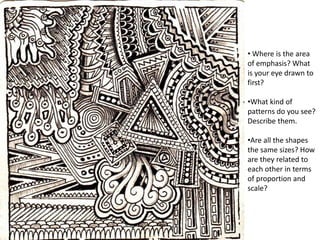
• Where is the area 
of emphasis? What 
is your eye drawn to 
first? 
•What kind of 
patterns do you see? 
Describe them. 
•Are all the shapes 
the same sizes? How 
are they related to 
each other in terms 
of proportion and 
scale?
Steps: 
1. Divide animal picture into 3 sections 
2. Create three rectangles on paper. 1.5 inches boarder 
from sides of paper, .5 inches in between rectangles. 
3. Create a grid on animal picture so you are able to 
replicate onto rectangles as closely as possible. 
4. Begin drawing animal and background onto the 
rectangles with pencil- CONTOUR LINES 
5. Divide animal and background up into sections so that 
you can create different Zentangle patterns (Think 
about dividing in up in areas of light and dark.)
Things to think about: 
• What areas of the drawing do you want to 
look darker? How do we show that with 
zentangle patterns? How do you show if 
something is lighter? 
• What areas do you want to stand out? How do 
you show that? 
• How will you show positive and negative 
space?
Zentangle

Zentangle

  • 1.
  • 3.
    Elements of Design • Line: is the path of a point moving through space. • Shape: is a closed line. Shapes can be geometric, or organic; natural shapes. Shapes are flat and can express length and width. • Texture: Is the surface quality that can be seen and felt. • Space: the area around or in between objects. Positive and Negative Space.
  • 4.
    •What kind oflines do you see in this image? Curvy? Zig- Zag? •What kind of shapes do you see? Are they all geometric or are they all organic, or both? •Do you see texture? How do you think different pieces of the design would feel if you could touch them?
  • 5.
    Principles of Design • Emphasis: refers to the created center of interest, the place in an artwork where your eye first lands • Pattern: refers to the repetition or reoccurrence of a design element, exact or varied, which establishes a visual beat. • Proportion/ Scale: Proportion is the size relationship of parts to a whole and to one another. Scale refers to relating size to a constant, such as a human body.
  • 6.
    • Where isthe area of emphasis? What is your eye drawn to first? •What kind of patterns do you see? Describe them. •Are all the shapes the same sizes? How are they related to each other in terms of proportion and scale?
  • 8.
    Steps: 1. Divideanimal picture into 3 sections 2. Create three rectangles on paper. 1.5 inches boarder from sides of paper, .5 inches in between rectangles. 3. Create a grid on animal picture so you are able to replicate onto rectangles as closely as possible. 4. Begin drawing animal and background onto the rectangles with pencil- CONTOUR LINES 5. Divide animal and background up into sections so that you can create different Zentangle patterns (Think about dividing in up in areas of light and dark.)
  • 10.
    Things to thinkabout: • What areas of the drawing do you want to look darker? How do we show that with zentangle patterns? How do you show if something is lighter? • What areas do you want to stand out? How do you show that? • How will you show positive and negative space?