Urban planning!
!
The Sumerians were the first society to create the city itself as a built form in Mesopotamia. They
were proud of this achievement as attested in the Epic of Gilgamesh which opens with a
description of Uruk its walls, streets, markets, temples, and gardens. Uruk itself is significant as the
center of an urban culture which both colonized and urbanized western Asia. The growth of the city
was partly planned and partly organic. Planning is evident in the walls, high temple district, main
canal with harbor, and main street. The finer structure of residential and commercial spaces is the
reaction of economic forces to the spatial limits imposed by the planned areas resulting in an
irregular design with regular features. The typical city divided space into residential, mixed use,
commercial, and civic spaces. The residential areas were grouped by profession. At the core of the
city was a high temple complex always sited slightly off of the geographical center. This high
temple usually predated the founding of the city and was the nucleus around which the urban form
grew. The districts adjacent to gates had a special religious and economic function. The city always
included a belt of irrigated agricultural land including small hamlets. A network of roads and canals
connected the city to this land.!
!
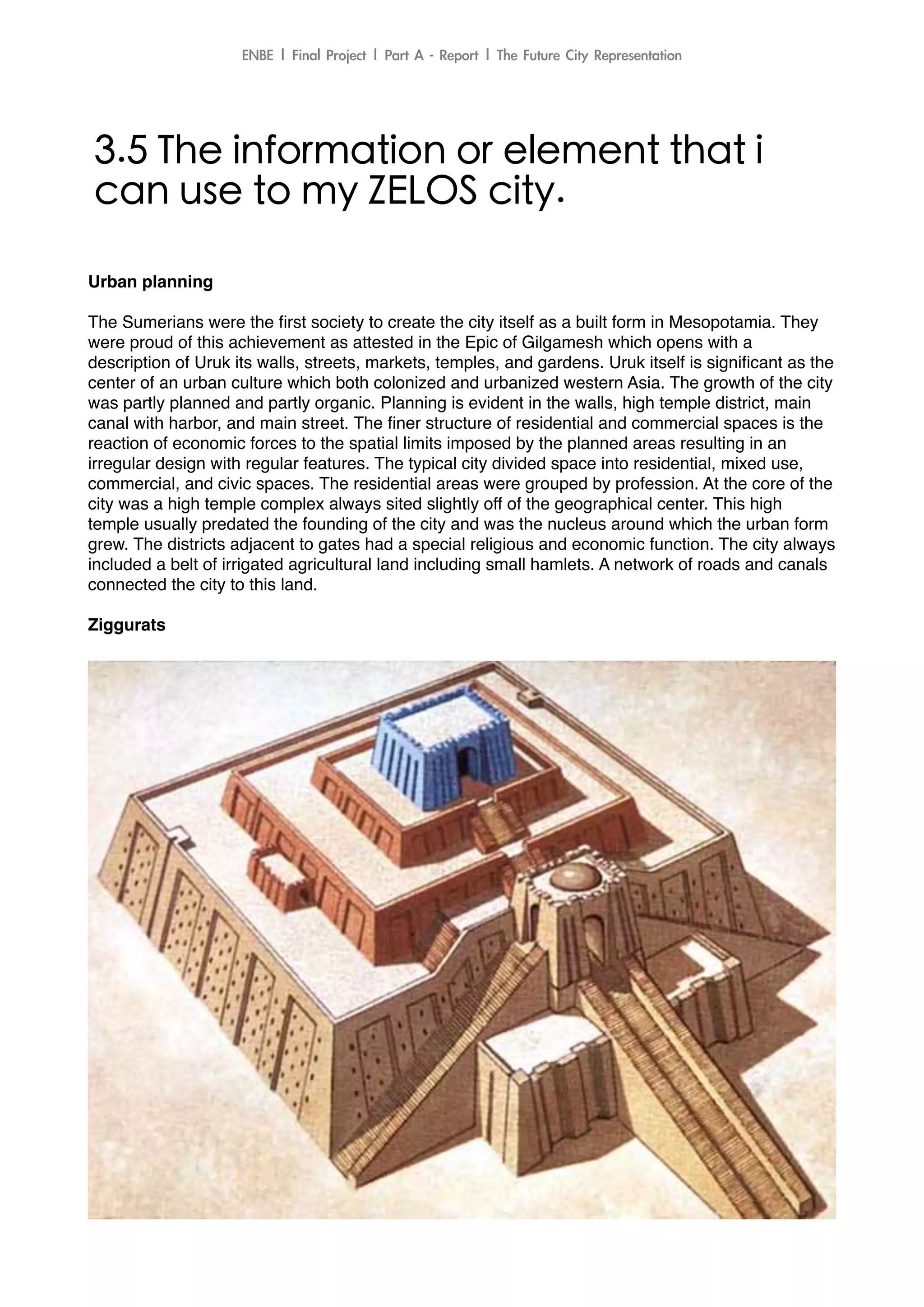
Ziggurats!
3.5 The information or element that i
can use to my ZELOS city.
ENBE	 |	 Final	 Project	 |	 Part	 A	 -	 Report	 |	 The	 Future	 City	 Representation
!
Ziggurats were huge pyramidal temple towers built in the ancient Mesopotamian valley and
western Iranian plateau, having the form of a terraced step pyramid of successively receding
stories or levels. The top of the ziggurat was flat, unlike many pyramids. The step pyramid style
began near the end of the Early Dynastic Period. Built in receding tiers upon a rectangular, oval, or
square platform, the ziggurat was a pyramidal structure. Sun-baked bricks made up the core of the
ziggurat with facings of fired bricks on the outside. The number of tiers ranged from two to seven,
with a shrine or temple at the summit. Access to the shrine was provided by a series of ramps on
one side of the ziggurat or by a spiral ramp from base to summit. It has been suggested that
ziggurats were built to resemble mountains, but there is little textual or archaeological evidence to
support that hypothesis.Classical ziggurats emerged in the Neo-Sumerian Period with articulated
buttresses, vitreous brick sheathing, and entasis in the elevation. The Ziggurat of Ur is the best
example of this style. Another change in temple design in this period was a straight as opposed to
bent-axis approach to the temple.!
!
Ur-Nammu's ziggurat at Ur was designed as a three-stage construction, but today only two of
these survive. This entire mudbrick core structure was originally given a facing of baked brick
envelope set in bitumen, 2.5 m on the first lowest stage, and 1.15 m on the second. Each of these
baked bricks were stamped with the name of the king. The sloping walls of the stages were
buttressed. The access to the top was by means of a triple monumental staircase, which all
converges at a portal that opened on a landing between the first and second stages. The height of
the first stage was about 11 m while the second stage rose some 5.7 m. Usually, a third stage is
reconstructed by the excavator of the ziggurat (Leonard Woolley), and crowned by a temple. At the
Chogha Zanbil ziggurat, archaeologists have found massive reed ropes that ran across the core of
the ziggurat structure and tied together the mudbrick mass.!
!
!
The most impressive and famous of Sumerian buildings are the ziggurats, large layered platforms
which supported temples. Some scholars have theorized that these structures might have been the
basis of the Tower of Babel described in Genesis. Sumerian cylinder seals also depict houses built
from reeds not unlike those built by the Marsh Arabs of Southern Iraq until as recently as 400 AD.
The Sumerians also developed the arch, which enabled them to develop a strong type of roof
called a dome. They built this by constructing several arches.!
!
!
I will use the design of ziggurat as my city hall design, in the
city hall will included train station, elevator to the upper level of
the building, government building, science lab and control
system area.
ENBE	 |	 Final	 Project	 |	 Part	 A	 -	 Report	 |	 The	 Future	 City	 Representation

Zelos 3.5

  • 1.
    Urban planning! ! The Sumerianswere the first society to create the city itself as a built form in Mesopotamia. They were proud of this achievement as attested in the Epic of Gilgamesh which opens with a description of Uruk its walls, streets, markets, temples, and gardens. Uruk itself is significant as the center of an urban culture which both colonized and urbanized western Asia. The growth of the city was partly planned and partly organic. Planning is evident in the walls, high temple district, main canal with harbor, and main street. The finer structure of residential and commercial spaces is the reaction of economic forces to the spatial limits imposed by the planned areas resulting in an irregular design with regular features. The typical city divided space into residential, mixed use, commercial, and civic spaces. The residential areas were grouped by profession. At the core of the city was a high temple complex always sited slightly off of the geographical center. This high temple usually predated the founding of the city and was the nucleus around which the urban form grew. The districts adjacent to gates had a special religious and economic function. The city always included a belt of irrigated agricultural land including small hamlets. A network of roads and canals connected the city to this land.! ! Ziggurats! 3.5 The information or element that i can use to my ZELOS city. ENBE | Final Project | Part A - Report | The Future City Representation
  • 2.
    ! Ziggurats were hugepyramidal temple towers built in the ancient Mesopotamian valley and western Iranian plateau, having the form of a terraced step pyramid of successively receding stories or levels. The top of the ziggurat was flat, unlike many pyramids. The step pyramid style began near the end of the Early Dynastic Period. Built in receding tiers upon a rectangular, oval, or square platform, the ziggurat was a pyramidal structure. Sun-baked bricks made up the core of the ziggurat with facings of fired bricks on the outside. The number of tiers ranged from two to seven, with a shrine or temple at the summit. Access to the shrine was provided by a series of ramps on one side of the ziggurat or by a spiral ramp from base to summit. It has been suggested that ziggurats were built to resemble mountains, but there is little textual or archaeological evidence to support that hypothesis.Classical ziggurats emerged in the Neo-Sumerian Period with articulated buttresses, vitreous brick sheathing, and entasis in the elevation. The Ziggurat of Ur is the best example of this style. Another change in temple design in this period was a straight as opposed to bent-axis approach to the temple.! ! Ur-Nammu's ziggurat at Ur was designed as a three-stage construction, but today only two of these survive. This entire mudbrick core structure was originally given a facing of baked brick envelope set in bitumen, 2.5 m on the first lowest stage, and 1.15 m on the second. Each of these baked bricks were stamped with the name of the king. The sloping walls of the stages were buttressed. The access to the top was by means of a triple monumental staircase, which all converges at a portal that opened on a landing between the first and second stages. The height of the first stage was about 11 m while the second stage rose some 5.7 m. Usually, a third stage is reconstructed by the excavator of the ziggurat (Leonard Woolley), and crowned by a temple. At the Chogha Zanbil ziggurat, archaeologists have found massive reed ropes that ran across the core of the ziggurat structure and tied together the mudbrick mass.! ! ! The most impressive and famous of Sumerian buildings are the ziggurats, large layered platforms which supported temples. Some scholars have theorized that these structures might have been the basis of the Tower of Babel described in Genesis. Sumerian cylinder seals also depict houses built from reeds not unlike those built by the Marsh Arabs of Southern Iraq until as recently as 400 AD. The Sumerians also developed the arch, which enabled them to develop a strong type of roof called a dome. They built this by constructing several arches.! ! ! I will use the design of ziggurat as my city hall design, in the city hall will included train station, elevator to the upper level of the building, government building, science lab and control system area. ENBE | Final Project | Part A - Report | The Future City Representation