International Research Journal of Engineering and Technology (IRJET) e-ISSN: 2395-0056
Volume: 10 Issue: 01 | Jan 2023 www.irjet.net p-ISSN: 2395-0072
© 2022, IRJET | Impact Factor value: 7.529 | ISO 9001:2008 Certified Journal | Page 315
Virtual Mouse Control Using Hand Gestures
Yash Yadav1, Abhishek Hazare2, Rushab Dungarwal3, Pratham Sharma4, Shefali Raina5.
1,2,3,4LY B. Tech Computer Engineering, Science & Technology, Vishwakarma University, Pune, India – 411048
5Assistant Professor, Dept. of Computer Engineering, Vishwakarma University, Pune, India - 411048
--------------------------------------------------------------------------***-----------------------------------------------------------------------
ABSTRACT
There have been many developments towards the Human-Computer Interaction(HCI). Many moduleshavebeendevelopedto
help the physical world interact with the digital world. Most existing approaches involve changingmousepartssuchasadding
more buttons or changing the position of the tracking ball. Our proposed system serves a new approach for controllingmouse
movement using Colored object, marker motion tracking and hand tracking. The project mainly aims at mouse cursor
movements and click events based on the object detection and marker identification. We will be using a camera for computer
vision technology, such as image segmentation and gesture recognition, tooverseemousetasks(leftandrightclicking,double-
clicking, and scrolling) and show how it can perform everything that the current mouse devices can. The software will be
developed in Python Language, OpenCV and PyAutoGUI for mouse functions. Identifying gestures is a difficult task which
involves many aspects such as motion modeling, motion analysis, pattern recognition and machine learning. We will use
colored objects to perform actions such as the mouse movement and click events. This method mainly focuses on the use of a
Web Camera to develop a virtual Human-Computer Interaction device.
Keeping all the important factors in mind a system has been created which identifies the movement of hand and its various
gestures. Hence after recognizing the gestures various mouse activities can be performed.
Keywords: Human-Computer Interaction (HCI), Motion tracking, Hand tracking.
1. INTRODUCTION .
1.1 INTRODUCTION
Computer technology has tremendously grown up over the past years and has become a necessary part of everyday life. The
first Computer part that human’s access for Human Computer Interaction(HCI)isthemouse.Themouseislessappropriatefor
HCI in some reality things, like with Human Machine Interaction. There have been many explorations on different ways to
control the computer mouse for HCI. The first natural and intuitive technique for HCI, that is a viable replacement for the
computer mouse can be the introduction of hand gestures into computer systems. This project is thus mainly focusedtowards
developing a computer management system using hand gestures. Most laptops and systems which are home these days are
equipped with webcams that have greatly help to deploy in security applications utilizing face recognition so as to get the
extended use of a digital camera, it may be utilized for vision based mostly CC, whichmightconstructivelyhelpsustoeliminate
the necessity for a mouse or mouse pad. The utilization of a digital camera may be greatly extended to different HCI (Human
Computer Interaction) applications like a signal languagedatabaseormotioncontroller.Overthepastdecadestherehave been
vital advancements in HCI technologies for gaming functions. We are looking forward to applying techniques to use a camera
and computer technology, such as image segmentation and gesture recognition to manage tasks that are performed byMouse
and show how it can perform everything that the current mouse devices can.
1.2 MOTIVATION
The main purpose of implementing this system is to help the ambitious physically challenged people who want to work on a
computer. There are many ambitious physically challenged people in society who want to work on a computer. This system
would help them. There are many people who don't feel comfortable with a touchpad. This system would provideflexibilityto
people and would be convenient for users who are not comfortable with a touchpad. We all want to mirror our experiences in
the real world into a computer. This system would allow that.
1.3 AIM AND SCOPE OBJECTIVE
This project attempts to use gestures to control the computer cursor rather than pointing and clicking a mouse or directly
touching the display, lowering hardware costs and increasing the quality of life for physically challenged persons. One of the
International Research Journal of Engineering and Technology (IRJET) e-ISSN: 2395-0056
Volume: 10 Issue: 01 | Jan 2023 www.irjet.net p-ISSN: 2395-0072
© 2022, IRJET | Impact Factor value: 7.529 | ISO 9001:2008 Certified Journal | Page 316
project's goals is to assist people who are suffering from Carpal Tunnel Syndrome. Carpal Tunnel Syndrome affects morethan
10 million people in India each year. This would be beneficial to them.
1.4 OUR CONTRIBUTION
We developed an algorithm to control mouse movement and other mouse activities by using hand gestures to eliminate the
usage of mouse as far as possible. To summarize, this paper makes the following contributions:
● This project provides a major prevention to the Carpal Tunnel Syndrome. Recently all the work has been running on
PCs. Due to the heavy usage of mouse, many people are affected with Carpal Tunnel Syndrome. As per the statistics,
there are more than 10 million cases per year in India. Carpal tunnel syndrome is a common condition that causes
pain, numbness, and tingling in the hand and arm. The condition occurs when one of the major nervestothehand,the
median nerve is squeezed or compressed as it travels through the wrist.
● The algorithm works in such a way that people with physical challenges could use the PCs easily through hand
gestures.
● We have implemented this project in our homes so that the elderly people find it much easier to interact withthePCs.
2. LITERATURE SURVEY
a. Description of Related Theory:
There are two main approaches for Hand Gesture Recognition for HCI (Human-Computer Interaction); the first is hardware
based and the second is vision-based. One of the hardware-based approaches proposed by Quam (1990) uses a data glove to
achieve gesture recognition. This method needs the user to wear a sophisticated data glove which makes some gestures
difficult to perform. Vision-based HCI can be classified into two categories, Color marker-based approach, and color marker-
less approach. The color marker-based approach requires the user towearcolormarkersorgloves,whilethecolor markerless
approach doesn’t require that.
b. Microsoft applied for patent based on Gesture and Voice recognition system:
The engineers at Microsoft have applied for two patents detailing the Architecture to control the personal computer
using hand gestures and voice input. Earlier Microsoft showed controlling devices by muscle movement, and now they
are interested in gesture and voice-based systems. Their basic idea is to use voice, gesture,mouse,orkeyboardasinputs
to a computer. They talk about using both voice and gesture together to control various actions on the computer. To
ascertain when to consider movement as input, it depends on the volume area around it. The correspondence with the
computer has to be within the volume area before the system starts considering the movement asinput.Whenagesture
is made, the screen will identify it and show you options on the screen like move, close, scroll, and flick.
c. Kinect for Xbox 360 will be using gesture and voice commands:
Kinect is a controller-free gaming experience for the Xbox 360 video game platform. Microsoft says that maybe later it
will be supported by personal computers via Windows 8. It is based on a webcam-style device for the Xbox 360 console.
It allows users to control and interact with the Xbox 360 without the necessitytophysicallytouchthecontrollerthrough
a user interfaceusing gestures, spoken instructions, orgiven objects and pictures.Theprojectisaimedtowardwidening
the Xbox 360's audience beyond its typical gamer base.
d. A Gesture-Based control for handheld devices using Accelerometers:
The Korean Department of Information andCommunication presented a paper to demonstratehow the signals from an
accelerometer can be processed to accurately identify user gestures after applying a slight movement to a handheld
device. For gesture-based control to be efficacious in handheld devices, the overheads involved in recognizing gestures
should be minimal, and the motion should be accurately identified in real operational environments.
3. PROBLEM STATEMENT .
As we look at the topic, Cursor Movement on object motion, it is an application that helps in acknowledging hand gestures or
movement of the hand which is being used by people. It can be attained by the utilization of image processing techniques. It is
International Research Journal of Engineering and Technology (IRJET) e-ISSN: 2395-0056
Volume: 10 Issue: 01 | Jan 2023 www.irjet.net p-ISSN: 2395-0072
© 2022, IRJET | Impact Factor value: 7.529 | ISO 9001:2008 Certified Journal | Page 317
the most interesting application that one can work on and implement in this physical world in a comfortable way. It is one of
the applications which will work on hand gestures that are being shown by the user through the system using this project in a
comfortable manner.
Cursor Movement on Object Motion is a system that uses no physical device for controlling the mouse cursor of the computer.
Basically we will be using our palm. The video of the motion of the hand will be captured by the web camera which will be
acting as a sensor. The hand is tracked and by looking at its motion, the mouse cursor is being controlled. In order for the
cursor to move, we will use our hand within the viewing area of the camera. There's a Region of Interest in which the hand
should be placed. The video generated by the camera isdetectedandanalyzedusingimageprocessingandthecomputercursor
moves or displays its click events according to the hand movement and its gestures.
4. PROPOSED SYSTEM ARCHITECTURE .
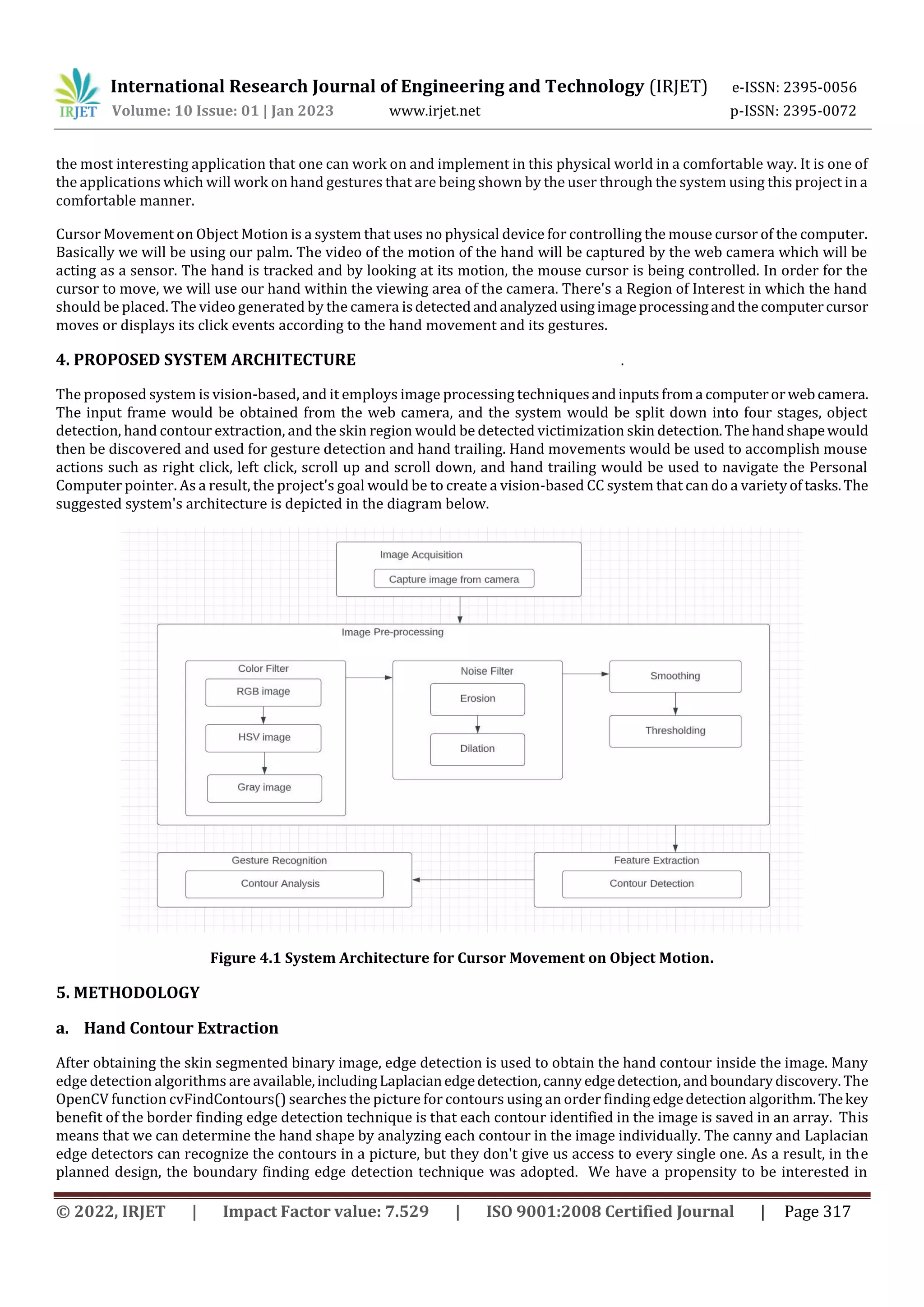
The proposed system is vision-based, and it employs image processing techniquesandinputsfroma computerorwebcamera.
The input frame would be obtained from the web camera, and the system would be split down into four stages, object
detection, hand contour extraction, and the skin region would be detected victimization skin detection.Thehandshapewould
then be discovered and used for gesture detection and hand trailing. Hand movements would be used to accomplish mouse
actions such as right click, left click, scroll up and scroll down, and hand trailing would be used to navigate the Personal
Computer pointer. As a result, the project's goal would be to create a vision-based CC system that can do a varietyof tasks.The
suggested system's architecture is depicted in the diagram below.
Figure 4.1 System Architecture for Cursor Movement on Object Motion.
5. METHODOLOGY
a. Hand Contour Extraction
After obtaining the skin segmented binary image, edge detection is used to obtain the hand contour inside the image. Many
edge detection algorithms are available,includingLaplacianedgedetection,canny edgedetection,and boundarydiscovery.The
OpenCV function cvFindContours() searches the picture for contours using an order findingedgedetection algorithm.Thekey
benefit of the border finding edge detection technique is that each contour identified in the image is saved in an array. This
means that we can determine the hand shape by analyzing each contour in the image individually. The canny and Laplacian
edge detectors can recognize the contours in a picture, but they don't give us access to every single one. As a result, in the
planned design, the boundary finding edge detection technique was adopted. We have a propensity to be interested in
International Research Journal of Engineering and Technology (IRJET) e-ISSN: 2395-0056
Volume: 10 Issue: 01 | Jan 2023 www.irjet.net p-ISSN: 2395-0072
© 2022, IRJET | Impact Factor value: 7.529 | ISO 9001:2008 Certified Journal | Page 318
extracting the hand contour as part of the contour extraction approach so that form analysis may be performed on it to
determine the hand gesture. The little contours are likely to be noise andshouldbeignored.Theassumption wasmadethatthe
hand contour is the largest contour in the image, thereby ignoring all noise contours. If the face shape is larger than the hand
contour, this assumption may be false. To address this flaw, the face section of the frame should be removed. The assumption
was that the hand was the only moving item in the photograph, and thattheface wasrelativelymotionlessincomparisontothe
hand. This means that background subtraction can be used to remove rid of the image's stationary pixels, as well as the face
region. This is frequently done using the OpenCV function "BackgroundSubtractorMOG2."
b. Hand Tracking
Hand gestures are used to control the pointer's movement. The center of the palm should be discovered initially in order to
locate the hand. The approach for determining the hand center form has the benefit of being simple and straightforward to
perform. The shortest distance between each point inside the inscribed circle and the contour was measured, with the point
with the greatest distance being recorded as the center. The radius of the hand was calculated as the distance between the
center of the hand and the hand contour.The hand center was determined for each successive frame, and the tip of the finger
was known and used for hand tracking utilizing the hand center.
c. Gesture Recognition
The proposed design's gesture recognition technology is a hybrid of two technologies proposed by Yeo and Balazs. The hand
contour's convexity faults must first be computed. The hand contour's convexity defects were determined using the OpenCV
built-in function "cvConvexityDefects." The convexitydefect'sparameters(startpoint, endpoint,anddepthpoint)arestoredin
a series of arrays.
d. Cursor Control
Once the hand gestures have been identified, mappingcompletelyseparatehandgesturestospecificmouseoperationswill bea
breeze.
6. RELEVANT MATHEMATICAL MODEL ASSOCIATED WITH THE PROJECT .
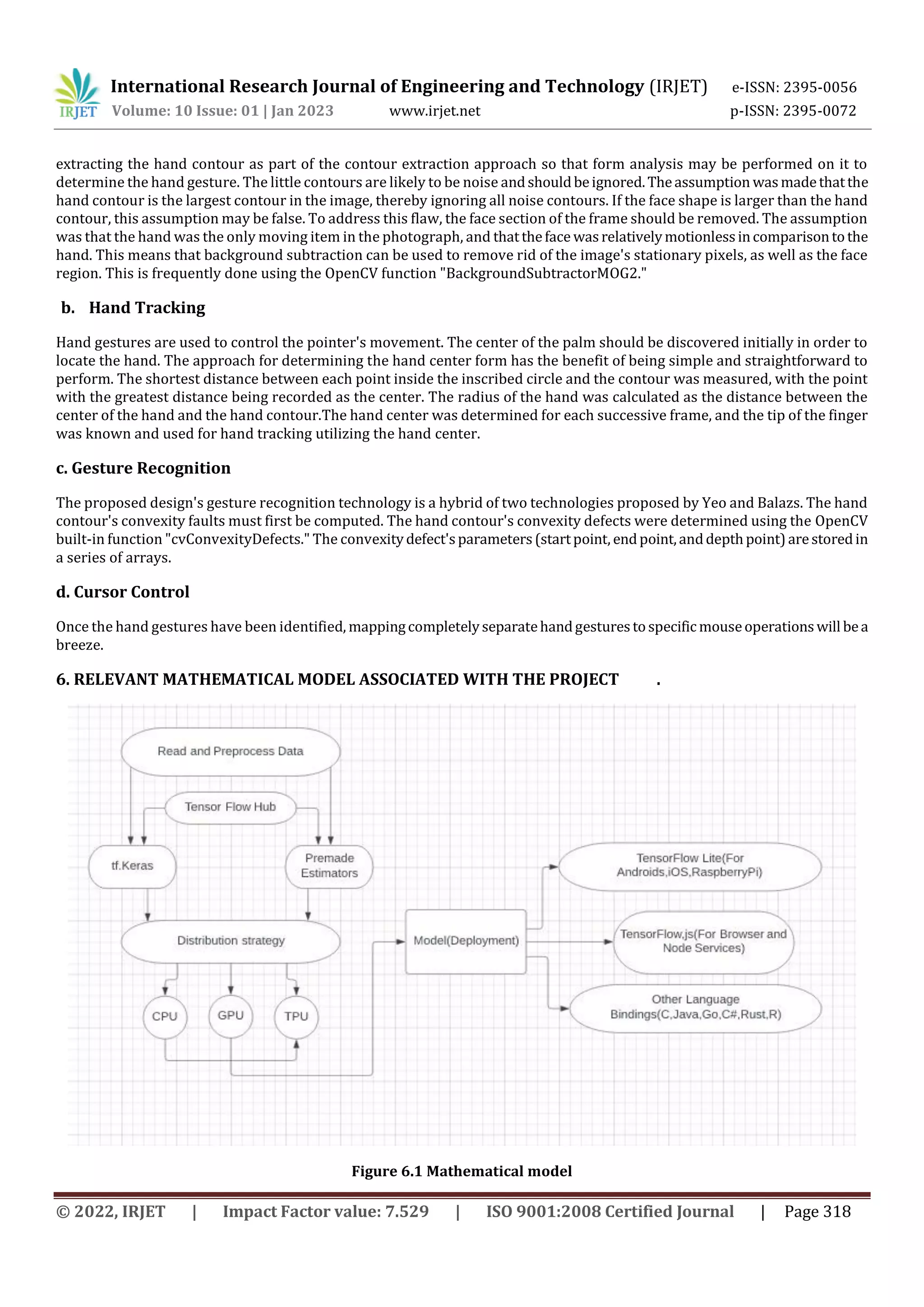
Figure 6.1 Mathematical model
International Research Journal of Engineering and Technology (IRJET) e-ISSN: 2395-0056
Volume: 10 Issue: 01 | Jan 2023 www.irjet.net p-ISSN: 2395-0072
© 2022, IRJET | Impact Factor value: 7.529 | ISO 9001:2008 Certified Journal | Page 319
The preprocessed data gathered from computer peripherals (i.e. camera, sensors, etc.) is shown in the above diagram going
through the TensorFlow algorithm. It divides the workload amongst the computer processors. Once all of the processes have
been completed, each processor transfers the process to the development model, which thenshowstheresultaccordingtothe
various services.
7. CONCLUSION
This project will do away with the requirement for a mouse or any other physical device to control cursor movement. For the
implementation of our proposed task, we will use OpenCV for object detection. The mouse can be moved with a great level of
precision and accuracy. Better Human-Computer Interaction(HCI) is achieved. It is also useful in Augmented Reality, current
gaming, and computer graphics. In the context of computer graphics and gaming, this technology has been implemented in
modern gaming consoles to produce interactive games that detect and interpret a person's movements as orders. The major
goal is to eliminate the usage of any physical device, such as a mouse, and instead rely on a webcam, which is readily available
with the laptop. Although this initiative offers numerous benefits, it also has significant disadvantages. If the background
picture clashes with the given image, it may offer an incorrect result and may not perform properly. As a result, it's best to use
this technique when the background light and the colour of the object don't combine. On PCs with poor resolution and
computational capability, the system may run slower. If the camera has a high resolution, the system may be slow, but this
problem can be rectified by lowering the image resolution.
8. REFERENCES
[1] A. Erdem, E. Yardimci, Y. Atalay, V. Cetin, A. E, “Computer Vision Based Mouse”, Acoustics, Speech, and Signal Processing,
Proceedings. (ICASS). IEEE International Conference, 2002.
[2] K. Pendke, P.Khuje, S. Narnaware, S. Thool, S. Nimje, “Computer Cursor Control Mechanism by Using Hand Gesture
Recognition”, International Journal of Computer Science and Mobile Computing, Vol.4 Issue.3, March- 2015,pg.293- 300.
[3] A Banerjee, A. Ghosh, K. Bharadwaj, H. Saikia, “Mouse Control Using a Web Camera Based on Colour Detection”,
International Journal of Computer Trends and Technology (IJCTT) – volume 9 number 1– Mar 2014.
[4] Yadav, A. Pandey, A. Singh, A. Kumar, “Computer Mouse Implementation Using Object Detection and Image Processing ”,
International Journal of Computer Applications. (IJCA), Volume 69-Number 21, 2013.
[5] D. Verma, et al., “Vision Based Computer Mouse Controlling Using Hand Gestures”, International Journal of Engineering
Sciences & Research Technology.(IJESRT), 7(6): June, 2018.
[6] Hojoon Park, “A Method for Controlling the MouseMovementusinga Real TimeCamera”,BrownUniversity,Providence,RI,
USA, Department of computer science, 2013.
[7] Chu-Feng Lien, “Portable Vision-Based HCI – A Realtime Hand Mouse System on Handheld Devices”, National Taiwan
University, Computer Science and Information Engineering Department.
[8] Onkar Yadav, Sagar Makwana, Pandhari Yadav, Prof. Leena Raut, “International Journal ofEngineeringSciences&Research
Technology (IJESRT)”, 2017.

Virtual Mouse Control Using Hand Gestures

  • 1.
    International Research Journalof Engineering and Technology (IRJET) e-ISSN: 2395-0056 Volume: 10 Issue: 01 | Jan 2023 www.irjet.net p-ISSN: 2395-0072 © 2022, IRJET | Impact Factor value: 7.529 | ISO 9001:2008 Certified Journal | Page 315 Virtual Mouse Control Using Hand Gestures Yash Yadav1, Abhishek Hazare2, Rushab Dungarwal3, Pratham Sharma4, Shefali Raina5. 1,2,3,4LY B. Tech Computer Engineering, Science & Technology, Vishwakarma University, Pune, India – 411048 5Assistant Professor, Dept. of Computer Engineering, Vishwakarma University, Pune, India - 411048 --------------------------------------------------------------------------***----------------------------------------------------------------------- ABSTRACT There have been many developments towards the Human-Computer Interaction(HCI). Many moduleshavebeendevelopedto help the physical world interact with the digital world. Most existing approaches involve changingmousepartssuchasadding more buttons or changing the position of the tracking ball. Our proposed system serves a new approach for controllingmouse movement using Colored object, marker motion tracking and hand tracking. The project mainly aims at mouse cursor movements and click events based on the object detection and marker identification. We will be using a camera for computer vision technology, such as image segmentation and gesture recognition, tooverseemousetasks(leftandrightclicking,double- clicking, and scrolling) and show how it can perform everything that the current mouse devices can. The software will be developed in Python Language, OpenCV and PyAutoGUI for mouse functions. Identifying gestures is a difficult task which involves many aspects such as motion modeling, motion analysis, pattern recognition and machine learning. We will use colored objects to perform actions such as the mouse movement and click events. This method mainly focuses on the use of a Web Camera to develop a virtual Human-Computer Interaction device. Keeping all the important factors in mind a system has been created which identifies the movement of hand and its various gestures. Hence after recognizing the gestures various mouse activities can be performed. Keywords: Human-Computer Interaction (HCI), Motion tracking, Hand tracking. 1. INTRODUCTION . 1.1 INTRODUCTION Computer technology has tremendously grown up over the past years and has become a necessary part of everyday life. The first Computer part that human’s access for Human Computer Interaction(HCI)isthemouse.Themouseislessappropriatefor HCI in some reality things, like with Human Machine Interaction. There have been many explorations on different ways to control the computer mouse for HCI. The first natural and intuitive technique for HCI, that is a viable replacement for the computer mouse can be the introduction of hand gestures into computer systems. This project is thus mainly focusedtowards developing a computer management system using hand gestures. Most laptops and systems which are home these days are equipped with webcams that have greatly help to deploy in security applications utilizing face recognition so as to get the extended use of a digital camera, it may be utilized for vision based mostly CC, whichmightconstructivelyhelpsustoeliminate the necessity for a mouse or mouse pad. The utilization of a digital camera may be greatly extended to different HCI (Human Computer Interaction) applications like a signal languagedatabaseormotioncontroller.Overthepastdecadestherehave been vital advancements in HCI technologies for gaming functions. We are looking forward to applying techniques to use a camera and computer technology, such as image segmentation and gesture recognition to manage tasks that are performed byMouse and show how it can perform everything that the current mouse devices can. 1.2 MOTIVATION The main purpose of implementing this system is to help the ambitious physically challenged people who want to work on a computer. There are many ambitious physically challenged people in society who want to work on a computer. This system would help them. There are many people who don't feel comfortable with a touchpad. This system would provideflexibilityto people and would be convenient for users who are not comfortable with a touchpad. We all want to mirror our experiences in the real world into a computer. This system would allow that. 1.3 AIM AND SCOPE OBJECTIVE This project attempts to use gestures to control the computer cursor rather than pointing and clicking a mouse or directly touching the display, lowering hardware costs and increasing the quality of life for physically challenged persons. One of the
  • 2.
    International Research Journalof Engineering and Technology (IRJET) e-ISSN: 2395-0056 Volume: 10 Issue: 01 | Jan 2023 www.irjet.net p-ISSN: 2395-0072 © 2022, IRJET | Impact Factor value: 7.529 | ISO 9001:2008 Certified Journal | Page 316 project's goals is to assist people who are suffering from Carpal Tunnel Syndrome. Carpal Tunnel Syndrome affects morethan 10 million people in India each year. This would be beneficial to them. 1.4 OUR CONTRIBUTION We developed an algorithm to control mouse movement and other mouse activities by using hand gestures to eliminate the usage of mouse as far as possible. To summarize, this paper makes the following contributions: ● This project provides a major prevention to the Carpal Tunnel Syndrome. Recently all the work has been running on PCs. Due to the heavy usage of mouse, many people are affected with Carpal Tunnel Syndrome. As per the statistics, there are more than 10 million cases per year in India. Carpal tunnel syndrome is a common condition that causes pain, numbness, and tingling in the hand and arm. The condition occurs when one of the major nervestothehand,the median nerve is squeezed or compressed as it travels through the wrist. ● The algorithm works in such a way that people with physical challenges could use the PCs easily through hand gestures. ● We have implemented this project in our homes so that the elderly people find it much easier to interact withthePCs. 2. LITERATURE SURVEY a. Description of Related Theory: There are two main approaches for Hand Gesture Recognition for HCI (Human-Computer Interaction); the first is hardware based and the second is vision-based. One of the hardware-based approaches proposed by Quam (1990) uses a data glove to achieve gesture recognition. This method needs the user to wear a sophisticated data glove which makes some gestures difficult to perform. Vision-based HCI can be classified into two categories, Color marker-based approach, and color marker- less approach. The color marker-based approach requires the user towearcolormarkersorgloves,whilethecolor markerless approach doesn’t require that. b. Microsoft applied for patent based on Gesture and Voice recognition system: The engineers at Microsoft have applied for two patents detailing the Architecture to control the personal computer using hand gestures and voice input. Earlier Microsoft showed controlling devices by muscle movement, and now they are interested in gesture and voice-based systems. Their basic idea is to use voice, gesture,mouse,orkeyboardasinputs to a computer. They talk about using both voice and gesture together to control various actions on the computer. To ascertain when to consider movement as input, it depends on the volume area around it. The correspondence with the computer has to be within the volume area before the system starts considering the movement asinput.Whenagesture is made, the screen will identify it and show you options on the screen like move, close, scroll, and flick. c. Kinect for Xbox 360 will be using gesture and voice commands: Kinect is a controller-free gaming experience for the Xbox 360 video game platform. Microsoft says that maybe later it will be supported by personal computers via Windows 8. It is based on a webcam-style device for the Xbox 360 console. It allows users to control and interact with the Xbox 360 without the necessitytophysicallytouchthecontrollerthrough a user interfaceusing gestures, spoken instructions, orgiven objects and pictures.Theprojectisaimedtowardwidening the Xbox 360's audience beyond its typical gamer base. d. A Gesture-Based control for handheld devices using Accelerometers: The Korean Department of Information andCommunication presented a paper to demonstratehow the signals from an accelerometer can be processed to accurately identify user gestures after applying a slight movement to a handheld device. For gesture-based control to be efficacious in handheld devices, the overheads involved in recognizing gestures should be minimal, and the motion should be accurately identified in real operational environments. 3. PROBLEM STATEMENT . As we look at the topic, Cursor Movement on object motion, it is an application that helps in acknowledging hand gestures or movement of the hand which is being used by people. It can be attained by the utilization of image processing techniques. It is
  • 3.
    International Research Journalof Engineering and Technology (IRJET) e-ISSN: 2395-0056 Volume: 10 Issue: 01 | Jan 2023 www.irjet.net p-ISSN: 2395-0072 © 2022, IRJET | Impact Factor value: 7.529 | ISO 9001:2008 Certified Journal | Page 317 the most interesting application that one can work on and implement in this physical world in a comfortable way. It is one of the applications which will work on hand gestures that are being shown by the user through the system using this project in a comfortable manner. Cursor Movement on Object Motion is a system that uses no physical device for controlling the mouse cursor of the computer. Basically we will be using our palm. The video of the motion of the hand will be captured by the web camera which will be acting as a sensor. The hand is tracked and by looking at its motion, the mouse cursor is being controlled. In order for the cursor to move, we will use our hand within the viewing area of the camera. There's a Region of Interest in which the hand should be placed. The video generated by the camera isdetectedandanalyzedusingimageprocessingandthecomputercursor moves or displays its click events according to the hand movement and its gestures. 4. PROPOSED SYSTEM ARCHITECTURE . The proposed system is vision-based, and it employs image processing techniquesandinputsfroma computerorwebcamera. The input frame would be obtained from the web camera, and the system would be split down into four stages, object detection, hand contour extraction, and the skin region would be detected victimization skin detection.Thehandshapewould then be discovered and used for gesture detection and hand trailing. Hand movements would be used to accomplish mouse actions such as right click, left click, scroll up and scroll down, and hand trailing would be used to navigate the Personal Computer pointer. As a result, the project's goal would be to create a vision-based CC system that can do a varietyof tasks.The suggested system's architecture is depicted in the diagram below. Figure 4.1 System Architecture for Cursor Movement on Object Motion. 5. METHODOLOGY a. Hand Contour Extraction After obtaining the skin segmented binary image, edge detection is used to obtain the hand contour inside the image. Many edge detection algorithms are available,includingLaplacianedgedetection,canny edgedetection,and boundarydiscovery.The OpenCV function cvFindContours() searches the picture for contours using an order findingedgedetection algorithm.Thekey benefit of the border finding edge detection technique is that each contour identified in the image is saved in an array. This means that we can determine the hand shape by analyzing each contour in the image individually. The canny and Laplacian edge detectors can recognize the contours in a picture, but they don't give us access to every single one. As a result, in the planned design, the boundary finding edge detection technique was adopted. We have a propensity to be interested in
  • 4.
    International Research Journalof Engineering and Technology (IRJET) e-ISSN: 2395-0056 Volume: 10 Issue: 01 | Jan 2023 www.irjet.net p-ISSN: 2395-0072 © 2022, IRJET | Impact Factor value: 7.529 | ISO 9001:2008 Certified Journal | Page 318 extracting the hand contour as part of the contour extraction approach so that form analysis may be performed on it to determine the hand gesture. The little contours are likely to be noise andshouldbeignored.Theassumption wasmadethatthe hand contour is the largest contour in the image, thereby ignoring all noise contours. If the face shape is larger than the hand contour, this assumption may be false. To address this flaw, the face section of the frame should be removed. The assumption was that the hand was the only moving item in the photograph, and thattheface wasrelativelymotionlessincomparisontothe hand. This means that background subtraction can be used to remove rid of the image's stationary pixels, as well as the face region. This is frequently done using the OpenCV function "BackgroundSubtractorMOG2." b. Hand Tracking Hand gestures are used to control the pointer's movement. The center of the palm should be discovered initially in order to locate the hand. The approach for determining the hand center form has the benefit of being simple and straightforward to perform. The shortest distance between each point inside the inscribed circle and the contour was measured, with the point with the greatest distance being recorded as the center. The radius of the hand was calculated as the distance between the center of the hand and the hand contour.The hand center was determined for each successive frame, and the tip of the finger was known and used for hand tracking utilizing the hand center. c. Gesture Recognition The proposed design's gesture recognition technology is a hybrid of two technologies proposed by Yeo and Balazs. The hand contour's convexity faults must first be computed. The hand contour's convexity defects were determined using the OpenCV built-in function "cvConvexityDefects." The convexitydefect'sparameters(startpoint, endpoint,anddepthpoint)arestoredin a series of arrays. d. Cursor Control Once the hand gestures have been identified, mappingcompletelyseparatehandgesturestospecificmouseoperationswill bea breeze. 6. RELEVANT MATHEMATICAL MODEL ASSOCIATED WITH THE PROJECT . Figure 6.1 Mathematical model
  • 5.
    International Research Journalof Engineering and Technology (IRJET) e-ISSN: 2395-0056 Volume: 10 Issue: 01 | Jan 2023 www.irjet.net p-ISSN: 2395-0072 © 2022, IRJET | Impact Factor value: 7.529 | ISO 9001:2008 Certified Journal | Page 319 The preprocessed data gathered from computer peripherals (i.e. camera, sensors, etc.) is shown in the above diagram going through the TensorFlow algorithm. It divides the workload amongst the computer processors. Once all of the processes have been completed, each processor transfers the process to the development model, which thenshowstheresultaccordingtothe various services. 7. CONCLUSION This project will do away with the requirement for a mouse or any other physical device to control cursor movement. For the implementation of our proposed task, we will use OpenCV for object detection. The mouse can be moved with a great level of precision and accuracy. Better Human-Computer Interaction(HCI) is achieved. It is also useful in Augmented Reality, current gaming, and computer graphics. In the context of computer graphics and gaming, this technology has been implemented in modern gaming consoles to produce interactive games that detect and interpret a person's movements as orders. The major goal is to eliminate the usage of any physical device, such as a mouse, and instead rely on a webcam, which is readily available with the laptop. Although this initiative offers numerous benefits, it also has significant disadvantages. If the background picture clashes with the given image, it may offer an incorrect result and may not perform properly. As a result, it's best to use this technique when the background light and the colour of the object don't combine. On PCs with poor resolution and computational capability, the system may run slower. If the camera has a high resolution, the system may be slow, but this problem can be rectified by lowering the image resolution. 8. REFERENCES [1] A. Erdem, E. Yardimci, Y. Atalay, V. Cetin, A. E, “Computer Vision Based Mouse”, Acoustics, Speech, and Signal Processing, Proceedings. (ICASS). IEEE International Conference, 2002. [2] K. Pendke, P.Khuje, S. Narnaware, S. Thool, S. Nimje, “Computer Cursor Control Mechanism by Using Hand Gesture Recognition”, International Journal of Computer Science and Mobile Computing, Vol.4 Issue.3, March- 2015,pg.293- 300. [3] A Banerjee, A. Ghosh, K. Bharadwaj, H. Saikia, “Mouse Control Using a Web Camera Based on Colour Detection”, International Journal of Computer Trends and Technology (IJCTT) – volume 9 number 1– Mar 2014. [4] Yadav, A. Pandey, A. Singh, A. Kumar, “Computer Mouse Implementation Using Object Detection and Image Processing ”, International Journal of Computer Applications. (IJCA), Volume 69-Number 21, 2013. [5] D. Verma, et al., “Vision Based Computer Mouse Controlling Using Hand Gestures”, International Journal of Engineering Sciences & Research Technology.(IJESRT), 7(6): June, 2018. [6] Hojoon Park, “A Method for Controlling the MouseMovementusinga Real TimeCamera”,BrownUniversity,Providence,RI, USA, Department of computer science, 2013. [7] Chu-Feng Lien, “Portable Vision-Based HCI – A Realtime Hand Mouse System on Handheld Devices”, National Taiwan University, Computer Science and Information Engineering Department. [8] Onkar Yadav, Sagar Makwana, Pandhari Yadav, Prof. Leena Raut, “International Journal ofEngineeringSciences&Research Technology (IJESRT)”, 2017.