Proper and Common
Nouns
To capitalise or not to capitalise . . .
Lesson Objective
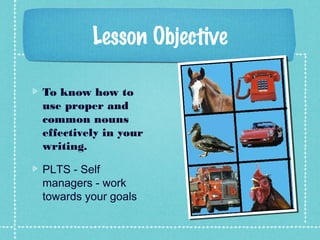
To know how to
use proper and
common nouns
effectively in your
writing.
PLTS - Self
managers - work
towards your goals
Proper Nouns
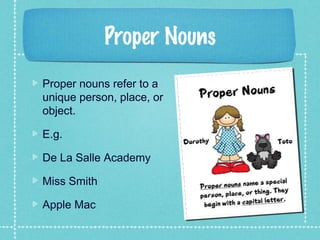
Proper nouns refer to a
unique person, place, or
object.
E.g.
De La Salle Academy
Miss Smith
Apple Mac
Common Nouns
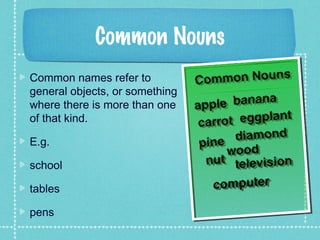
Common names refer to
general objects, or something
where there is more than one
of that kind.
E.g.
school
tables
pens
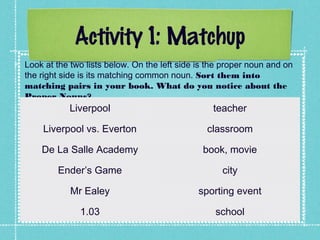
Activity 1: Matchup
Look at the two lists below. On the left side is the proper noun and on
the right side is its matching common noun. Sort them into
matching pairs in your book. What do you notice about the
Proper Nouns?
Liverpool teacher
Liverpool vs. Everton classroom
De La Salle Academy book, movie
Ender’s Game city
Mr Ealey sporting event
1.03 school
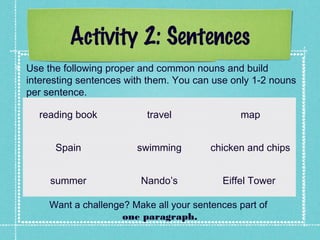
Activity 2: Sentences
Use the following proper and common nouns and build
interesting sentences with them. You can use only 1-2 nouns
per sentence.
reading book travel map
Spain swimming chicken and chips
summer Nando’s Eiffel Tower
Want a challenge? Make all your sentences part of
one paragraph.
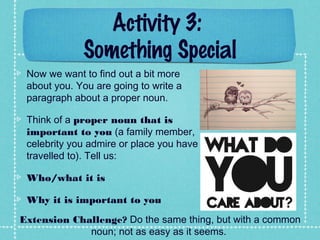
Activity 3:
Something Special
Now we want to find out a bit more
about you. You are going to write a
paragraph about a proper noun.
Think of a proper noun that is
important to you (a family member,
celebrity you admire or place you have
travelled to). Tell us:
Who/what it is
Why it is important to you
Extension Challenge? Do the same thing, but with a common
noun; not as easy as it seems.
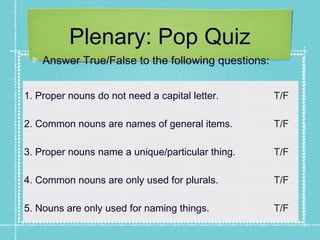
Plenary: Pop Quiz
Answer True/False to the following questions:
1. Proper nouns do not need a capital letter. T/F
2. Common nouns are names of general items. T/F
3. Proper nouns name a unique/particular thing. T/F
4. Common nouns are only used for plurals. T/F
5. Nouns are only used for naming things. T/F

Yr8 t2 literacy less 2 proper nouns

  • 1.
    Proper and Common Nouns Tocapitalise or not to capitalise . . .
  • 2.
    Lesson Objective To knowhow to use proper and common nouns effectively in your writing. PLTS - Self managers - work towards your goals
  • 3.
    Proper Nouns Proper nounsrefer to a unique person, place, or object. E.g. De La Salle Academy Miss Smith Apple Mac
  • 4.
    Common Nouns Common namesrefer to general objects, or something where there is more than one of that kind. E.g. school tables pens
  • 5.
    Activity 1: Matchup Lookat the two lists below. On the left side is the proper noun and on the right side is its matching common noun. Sort them into matching pairs in your book. What do you notice about the Proper Nouns? Liverpool teacher Liverpool vs. Everton classroom De La Salle Academy book, movie Ender’s Game city Mr Ealey sporting event 1.03 school
  • 6.
    Activity 2: Sentences Usethe following proper and common nouns and build interesting sentences with them. You can use only 1-2 nouns per sentence. reading book travel map Spain swimming chicken and chips summer Nando’s Eiffel Tower Want a challenge? Make all your sentences part of one paragraph.
  • 7.
    Activity 3: Something Special Nowwe want to find out a bit more about you. You are going to write a paragraph about a proper noun. Think of a proper noun that is important to you (a family member, celebrity you admire or place you have travelled to). Tell us: Who/what it is Why it is important to you Extension Challenge? Do the same thing, but with a common noun; not as easy as it seems.
  • 8.
    Plenary: Pop Quiz AnswerTrue/False to the following questions: 1. Proper nouns do not need a capital letter. T/F 2. Common nouns are names of general items. T/F 3. Proper nouns name a unique/particular thing. T/F 4. Common nouns are only used for plurals. T/F 5. Nouns are only used for naming things. T/F