Modal Verbs
Getting your point across!
Lesson Objective
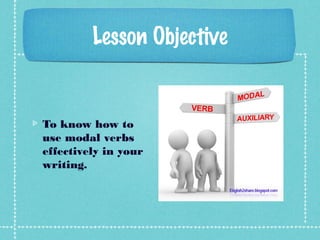
To know how to
use modal verbs
effectively in your
writing.
Modal Verbs
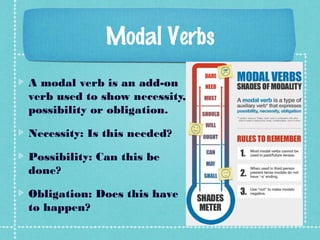
A modal verb is an add-on
verb used to show necessity,
possibility or obligation.
Necessity: Is this needed?
Possibility: Can this be
done?
Obligation: Does this have
to happen?
Modal Verbs
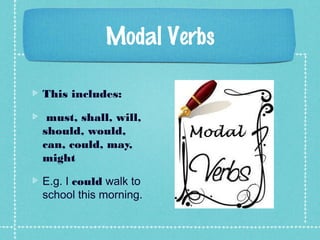
This includes:
must, shall, will,
should, would,
can, could, may,
might
E.g. I could walk to
school this morning.
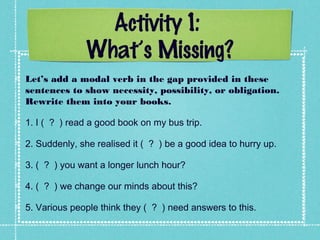
Activity 1:
What’s Missing?
Let’s add a modal verb in the gap provided in these
sentences to show necessity, possibility, or obligation.
Rewrite them into your books.
1. I ( ? ) read a good book on my bus trip.
2. Suddenly, she realised it ( ? ) be a good idea to hurry up.
3. ( ? ) you want a longer lunch hour?
4. ( ? ) we change our minds about this?
5. Various people think they ( ? ) need answers to this.
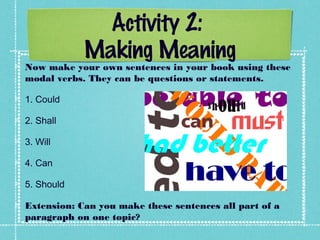
Activity 2:
Making Meaning
Now make your own sentences in your book using these
modal verbs. They can be questions or statements.
1. Could
2. Shall
3. Will
4. Can
5. Should
Extension: Can you make these sentences all part of a
paragraph on one topic?
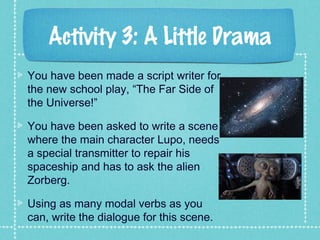
Activity 3: A Little Drama
You have been made a script writer for
the new school play, “The Far Side of
the Universe!”
You have been asked to write a scene
where the main character Lupo, needs
a special transmitter to repair his
spaceship and has to ask the alien
Zorberg.
Using as many modal verbs as you
can, write the dialogue for this scene.
Peer Assessment
Swap with the person next to you.
Read their work and check to see
that:
Proper nouns have capitals
Subject and object pronouns are
used correctly.
Then give them a medal and a
mission (something they did well
and something to work on).
Plenary
How does
knowing about
modal verbs help
you improve your
writing?
Plenary
How does
knowing about
modal verbs help
you improve your
writing?

Yr 8 t2 literacy less 4 modal verbs

  • 1.
  • 2.
    Lesson Objective To knowhow to use modal verbs effectively in your writing.
  • 3.
    Modal Verbs A modalverb is an add-on verb used to show necessity, possibility or obligation. Necessity: Is this needed? Possibility: Can this be done? Obligation: Does this have to happen?
  • 4.
    Modal Verbs This includes: must,shall, will, should, would, can, could, may, might E.g. I could walk to school this morning.
  • 5.
    Activity 1: What’s Missing? Let’sadd a modal verb in the gap provided in these sentences to show necessity, possibility, or obligation. Rewrite them into your books. 1. I ( ? ) read a good book on my bus trip. 2. Suddenly, she realised it ( ? ) be a good idea to hurry up. 3. ( ? ) you want a longer lunch hour? 4. ( ? ) we change our minds about this? 5. Various people think they ( ? ) need answers to this.
  • 6.
    Activity 2: Making Meaning Nowmake your own sentences in your book using these modal verbs. They can be questions or statements. 1. Could 2. Shall 3. Will 4. Can 5. Should Extension: Can you make these sentences all part of a paragraph on one topic?
  • 7.
    Activity 3: ALittle Drama You have been made a script writer for the new school play, “The Far Side of the Universe!” You have been asked to write a scene where the main character Lupo, needs a special transmitter to repair his spaceship and has to ask the alien Zorberg. Using as many modal verbs as you can, write the dialogue for this scene.
  • 8.
    Peer Assessment Swap withthe person next to you. Read their work and check to see that: Proper nouns have capitals Subject and object pronouns are used correctly. Then give them a medal and a mission (something they did well and something to work on).
  • 9.
    Plenary How does knowing about modalverbs help you improve your writing?
  • 10.
    Plenary How does knowing about modalverbs help you improve your writing?