Design
Thinking:
ALIGNMENT ACTIVITIES
TO ENSURE PROJECT SUCCESS
Lisa Ghisolf • Gizmo Creative Factory, Inc.
@gizmodesign • #ntcwpday
Lisa Ghisolf • @gizmodesign • #ntcwpday
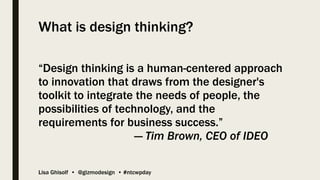
What is design thinking?
“Design thinking is a human-centered approach
to innovation that draws from the designer's
toolkit to integrate the needs of people, the
possibilities of technology, and the
requirements for business success.”
— Tim Brown, CEO of IDEO
Lisa Ghisolf • @gizmodesign • #ntcwpday
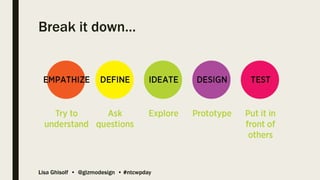
Break it down…
Lisa Ghisolf • @gizmodesign • #ntcwpday
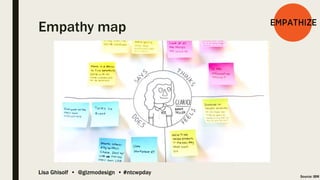
Empathy map
Source: IBM
Lisa Ghisolf • @gizmodesign • #ntcwpday
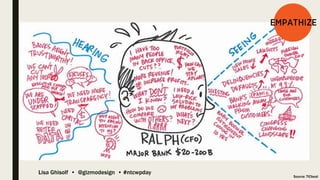
Source: TICbeat
Lisa Ghisolf • @gizmodesign • #ntcwpday
Ask the questions
■ How do they think about their fears
and hopes?
■ What do they hear when other people talk
about your organization/its website?
■ What do they see when they use your
website? What is the environment?
■ What do they say or feel when using your
website, whether in private or public?
■ What are their pain points when using your
website?
■ Is this a positive or a painful experience for
them?
■ What does a typical day look like in their
world?
■ Do they hear positive feedback about your
organization from external sources?
■ What do they hope to gain from using your
website?
■ Has your user repeated quotes or defining
words?
■ Example: Donating blood… What does it
represent? What is embedded in the act of
donating? What can be donated and what
cannot? Where does it come from?
(Questions via Copyblogger, Quora)
Lisa Ghisolf • @gizmodesign • #ntcwpday
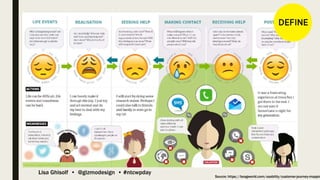
Supporter or donor “customer journey"
■ How do they interact with the org and how do
they feel during these interactions?
■ Sample findings from MSF Canada:
– The communications Carla (donor)
receives after her first gift have included
a thank-you call, welcome package,
personal email, 2016 annual appeal,
requests to sign petitions, bi-annual
newsletters and holiday solicitations.
– Feels noticed, appreciated and made to
feel as though she is having an impact
– House mailing stream, limited
personalized messaging, and being
made to feel as though the organization
wants another gift quickly were seen as
negatives.
– Strategies gleaned from the exercise
include more new-donor-appropriate
communications, leveraging constituent
relationship management (CRM) data to
create better segmentation, sending
thank-you videos from the field and
increasing opportunities for engagement
— including telephone town hall
meetings and invitations to documentary
screenings and other events.
Source:
http://www.thenonprofittimes.com/news-
articles/map-donors-giving-journey/
Lisa Ghisolf • @gizmodesign • #ntcwpday
Source: https://boagworld.com/usability/customer-journey-mappin
Lisa Ghisolf • @gizmodesign • #ntcwpday
“Rather than beginning with shiny new
technology, we start by trying to establish
deep, personal empathy with our users to
determine their needs and wants. We must
fill in two blanks: our users need a better
way to ___ BECAUSE ___. The because
portion is a big deal.”
–Dr. James Patell, stanford d.School
source: CNN
Lisa Ghisolf • @gizmodesign • #ntcwpday
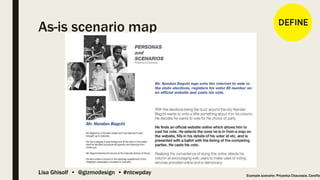
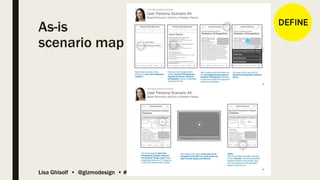
As-is scenario map
Example scenario: Priyanka Chaurasia, Coroflot
Lisa Ghisolf • @gizmodesign • #ntcwpday
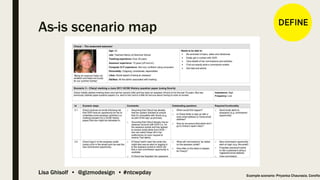
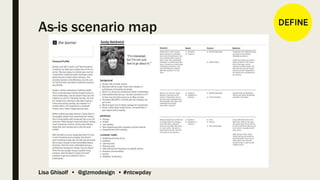
As-is scenario map
Example scenario: Priyanka Chaurasia, Coroflot
Lisa Ghisolf • @gizmodesign • #ntcwpday
As-is
scenario map
Lisa Ghisolf • @gizmodesign • #ntcwpday
As-is scenario map
Lisa Ghisolf • @gizmodesign • #ntcwpday
Ideate
■ Have a clear goal
■ Diversity matters
■ Don't shoot down ideas
■ Question your assumptions
■ No negativity, no teasing for
crazy ideas
■ Put lots of ideas on the table—
no matter how silly
■ Start with problem statements
■ Make sure you record all ideas
■ Revisit
■ HOW MIGHT WE…
Lisa Ghisolf • @gizmodesign • #ntcwpday
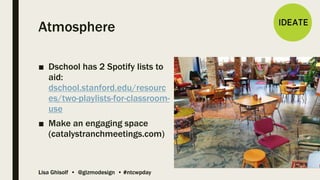
Atmosphere
■ Dschool has 2 Spotify lists to
aid:
dschool.stanford.edu/resourc
es/two-playlists-for-classroom-
use
■ Make an engaging space
(catalystranchmeetings.com)
Lisa Ghisolf • @gizmodesign • #ntcwpday
Improv
1.Yes, AND…
2.Alphabet
3.Sound ball
4.Machine
5.Freeze
6.Body movement
evolution
Lisa Ghisolf • @gizmodesign • #ntcwpday
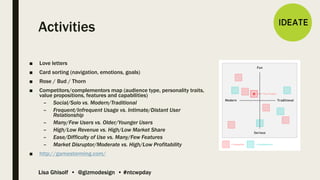
Activities
■ Love letters
■ Card sorting (navigation, emotions, goals)
■ Rose / Bud / Thorn
■ Competitors/complementors map (audience type, personality traits,
value propositions, features and capabilities)
– Social/Solo vs. Modern/Traditional
– Frequent/Infrequent Usage vs. Intimate/Distant User
Relationship
– Many/Few Users vs. Older/Younger Users
– High/Low Revenue vs. High/Low Market Share
– Ease/Difficulty of Use vs. Many/Few Features
– Market Disruptor/Moderate vs. High/Low Profitability
■ http://gamestorming.com/
Lisa Ghisolf • @gizmodesign • #ntcwpday
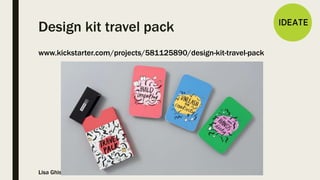
Design kit travel pack
www.kickstarter.com/projects/581125890/design-kit-travel-pack
Lisa Ghisolf • @gizmodesign • #ntcwpday
“Have the mindset of testing to learn, not
testing to validate. This is where many
people get tripped up; they try to perfect
the idea rather than use a low-fidelity
prototype to learn from people.”
—Brendan Boyle, founder of IDEO Toy Lab
Lisa Ghisolf • @gizmodesign • #ntcwpday
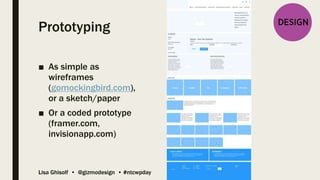
Prototyping
■ As simple as
wireframes
(gomockingbird.com),
or a sketch/paper
■ Or a coded prototype
(framer.com,
invisionapp.com)
Lisa Ghisolf • @gizmodesign • #ntcwpday
User testing
■ feedbacktools.org/
■ usertest.io/
■ uxcam.com/
■ usabilityhub.com/
■ brutalteardowns.com/
Lisa Ghisolf • @gizmodesign • #ntcwpday
Resources
■ dschool.stanford.edu/resources/the-bootcamp-bootleg
■ www.kickstarter.com/projects/581125890/design-kit-
travel-pack
Lisa Ghisolf • @gizmodesign • #ntcwpday
Thank you!
Lisa Ghisolf
lisa@gizmo-design.com
@gizmodesign
slideshare.com/gizmodeign

Design Thinking: Alignment Activities to Ensure Project Success

  • 1.
    Design Thinking: ALIGNMENT ACTIVITIES TO ENSUREPROJECT SUCCESS Lisa Ghisolf • Gizmo Creative Factory, Inc. @gizmodesign • #ntcwpday
  • 2.
    Lisa Ghisolf •@gizmodesign • #ntcwpday What is design thinking? “Design thinking is a human-centered approach to innovation that draws from the designer's toolkit to integrate the needs of people, the possibilities of technology, and the requirements for business success.” — Tim Brown, CEO of IDEO
  • 3.
    Lisa Ghisolf •@gizmodesign • #ntcwpday Break it down…
  • 4.
    Lisa Ghisolf •@gizmodesign • #ntcwpday Empathy map Source: IBM
  • 5.
    Lisa Ghisolf •@gizmodesign • #ntcwpday Source: TICbeat
  • 6.
    Lisa Ghisolf •@gizmodesign • #ntcwpday Ask the questions ■ How do they think about their fears and hopes? ■ What do they hear when other people talk about your organization/its website? ■ What do they see when they use your website? What is the environment? ■ What do they say or feel when using your website, whether in private or public? ■ What are their pain points when using your website? ■ Is this a positive or a painful experience for them? ■ What does a typical day look like in their world? ■ Do they hear positive feedback about your organization from external sources? ■ What do they hope to gain from using your website? ■ Has your user repeated quotes or defining words? ■ Example: Donating blood… What does it represent? What is embedded in the act of donating? What can be donated and what cannot? Where does it come from? (Questions via Copyblogger, Quora)
  • 7.
    Lisa Ghisolf •@gizmodesign • #ntcwpday Supporter or donor “customer journey" ■ How do they interact with the org and how do they feel during these interactions? ■ Sample findings from MSF Canada: – The communications Carla (donor) receives after her first gift have included a thank-you call, welcome package, personal email, 2016 annual appeal, requests to sign petitions, bi-annual newsletters and holiday solicitations. – Feels noticed, appreciated and made to feel as though she is having an impact – House mailing stream, limited personalized messaging, and being made to feel as though the organization wants another gift quickly were seen as negatives. – Strategies gleaned from the exercise include more new-donor-appropriate communications, leveraging constituent relationship management (CRM) data to create better segmentation, sending thank-you videos from the field and increasing opportunities for engagement — including telephone town hall meetings and invitations to documentary screenings and other events. Source: http://www.thenonprofittimes.com/news- articles/map-donors-giving-journey/
  • 8.
    Lisa Ghisolf •@gizmodesign • #ntcwpday Source: https://boagworld.com/usability/customer-journey-mappin
  • 9.
    Lisa Ghisolf •@gizmodesign • #ntcwpday “Rather than beginning with shiny new technology, we start by trying to establish deep, personal empathy with our users to determine their needs and wants. We must fill in two blanks: our users need a better way to ___ BECAUSE ___. The because portion is a big deal.” –Dr. James Patell, stanford d.School source: CNN
  • 10.
    Lisa Ghisolf •@gizmodesign • #ntcwpday As-is scenario map Example scenario: Priyanka Chaurasia, Coroflot
  • 11.
    Lisa Ghisolf •@gizmodesign • #ntcwpday As-is scenario map Example scenario: Priyanka Chaurasia, Coroflot
  • 12.
    Lisa Ghisolf •@gizmodesign • #ntcwpday As-is scenario map
  • 13.
    Lisa Ghisolf •@gizmodesign • #ntcwpday As-is scenario map
  • 14.
    Lisa Ghisolf •@gizmodesign • #ntcwpday Ideate ■ Have a clear goal ■ Diversity matters ■ Don't shoot down ideas ■ Question your assumptions ■ No negativity, no teasing for crazy ideas ■ Put lots of ideas on the table— no matter how silly ■ Start with problem statements ■ Make sure you record all ideas ■ Revisit ■ HOW MIGHT WE…
  • 15.
    Lisa Ghisolf •@gizmodesign • #ntcwpday Atmosphere ■ Dschool has 2 Spotify lists to aid: dschool.stanford.edu/resourc es/two-playlists-for-classroom- use ■ Make an engaging space (catalystranchmeetings.com)
  • 16.
    Lisa Ghisolf •@gizmodesign • #ntcwpday Improv 1.Yes, AND… 2.Alphabet 3.Sound ball 4.Machine 5.Freeze 6.Body movement evolution
  • 17.
    Lisa Ghisolf •@gizmodesign • #ntcwpday Activities ■ Love letters ■ Card sorting (navigation, emotions, goals) ■ Rose / Bud / Thorn ■ Competitors/complementors map (audience type, personality traits, value propositions, features and capabilities) – Social/Solo vs. Modern/Traditional – Frequent/Infrequent Usage vs. Intimate/Distant User Relationship – Many/Few Users vs. Older/Younger Users – High/Low Revenue vs. High/Low Market Share – Ease/Difficulty of Use vs. Many/Few Features – Market Disruptor/Moderate vs. High/Low Profitability ■ http://gamestorming.com/
  • 18.
    Lisa Ghisolf •@gizmodesign • #ntcwpday Design kit travel pack www.kickstarter.com/projects/581125890/design-kit-travel-pack
  • 19.
    Lisa Ghisolf •@gizmodesign • #ntcwpday “Have the mindset of testing to learn, not testing to validate. This is where many people get tripped up; they try to perfect the idea rather than use a low-fidelity prototype to learn from people.” —Brendan Boyle, founder of IDEO Toy Lab
  • 20.
    Lisa Ghisolf •@gizmodesign • #ntcwpday Prototyping ■ As simple as wireframes (gomockingbird.com), or a sketch/paper ■ Or a coded prototype (framer.com, invisionapp.com)
  • 21.
    Lisa Ghisolf •@gizmodesign • #ntcwpday User testing ■ feedbacktools.org/ ■ usertest.io/ ■ uxcam.com/ ■ usabilityhub.com/ ■ brutalteardowns.com/
  • 22.
    Lisa Ghisolf •@gizmodesign • #ntcwpday Resources ■ dschool.stanford.edu/resources/the-bootcamp-bootleg ■ www.kickstarter.com/projects/581125890/design-kit- travel-pack
  • 23.
    Lisa Ghisolf •@gizmodesign • #ntcwpday Thank you! Lisa Ghisolf lisa@gizmo-design.com @gizmodesign slideshare.com/gizmodeign

Editor's Notes

  • #5 Hang up where it’s viewable by everyone. Invite people to add their own ideas. Remotely, do it in a shared document.
  • #11 What they should go through, what the expected path is.