IMPACTING YOUTH
DEVELOPMENT WITH
ENTREREPENRUSHIP
Frank E. Pobutkiewicz
Managing Director, Whiteboard Youth Ventures
frank@whiteboardyouthventures.com
© Whiteboard Youth Ventures 2017
Publication Date: May 1, 2017
I. About Whiteboard Youth Ventures
II. Whiteboard Founder
III. Why Youth Entrepreneurship?
IV. Young Entrepreneur Challenge Program
V. Program Overview
VI. Workshops
VII. Mission & Goals
VIII. Teaching Methods
IX. Outcomes
CONTENTS
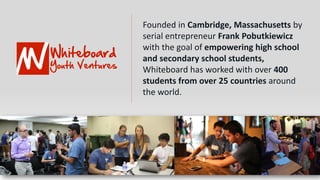
Founded in Cambridge, Massachusetts by
serial entrepreneur Frank Pobutkiewicz
with the goal of empowering high school
and secondary school students,
Whiteboard has worked with over 400
students from over 25 countries around
the world.
Frank Pobutkiewicz
Educator, Entrepreneur, Speaker, Writer
• Top ranked global debate coach
• Serial entrepreneur, having started or
advised 8 companies since 2010
• B.Sc. Business Administration, B.A.
International Relations from Boston
University
• His students attend Harvard, Yale, the
University of Pennsylvania, the
University of Chicago, Stanford,
Dartmouth, Brown, and many more
• TEDx Talk: Rapid Market Validation
• Two books scheduled to be published
in 2018
WHY YOUTH
ENTREPRENEURSHIP
IS IMPORTANT
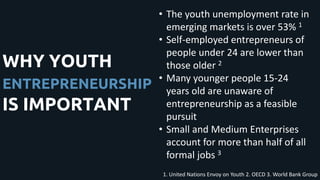
• The youth unemployment rate in
emerging markets is over 53% 1
• Self-employed entrepreneurs of
people under 24 are lower than
those older 2
• Many younger people 15-24
years old are unaware of
entrepreneurship as a feasible
pursuit
• Small and Medium Enterprises
account for more than half of all
formal jobs 3
1. United Nations Envoy on Youth 2. OECD 3. World Bank Group
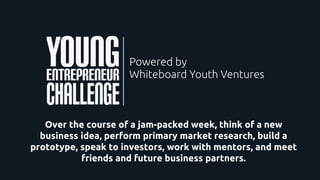
Over the course of a jam-packed week, think of a new
business idea, perform primary market research, build a
prototype, speak to investors, work with mentors, and meet
friends and future business partners.
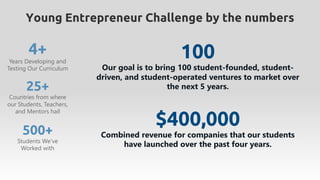
Young Entrepreneur Challenge by the numbers
4+
Years Developing and
Testing Our Curriculum
25+
Countries from where
our Students, Teachers,
and Mentors hail
500+
Students We’ve
Worked with
100
Our goal is to bring 100 student-founded, student-
driven, and student-operated ventures to market over
the next 5 years.
$400,000
Combined revenue for companies that our students
have launched over the past four years.
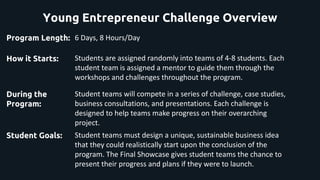
Young Entrepreneur Challenge Overview
Program Length:
How it Starts:
During the
Program:
6 Days, 8 Hours/Day
Students are assigned randomly into teams of 4-8 students. Each
student team is assigned a mentor to guide them through the
workshops and challenges throughout the program.
Student teams will compete in a series of challenge, case studies,
business consultations, and presentations. Each challenge is
designed to help teams make progress on their overarching
project.
Student Goals: Student teams must design a unique, sustainable business idea
that they could realistically start upon the conclusion of the
program. The Final Showcase gives student teams the chance to
present their progress and plans if they were to launch.
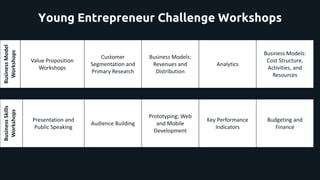
Young Entrepreneur Challenge Workshops
BusinessModel
Workshops
Value Proposition
Workshops
Customer
Segmentation and
Primary Research
Business Models:
Revenues and
Distribution
Analytics
Business Models:
Cost Structure,
Activities, and
Resources
BusinessSkills
Workshops
Presentation and
Public Speaking
Audience Building
Prototyping; Web
and Mobile
Development
Key Performance
Indicators
Budgeting and
Finance
Primary Mission: Increase analytical aptitude by using
entrepreneurship as a vehicle to inspire students.
Business Knowledge Goals (Areas of Knowledge):
1. Ensure students understand how business creates
value for stakeholders and how that value can be
transferred;
2. Explain how the value created by businesses is
matched to the needs of customers and how
businesses can incorporate customer feedback into
design;
3. Demonstrate how value can be translated into
revenue and profit in a responsible, sustainable
manner.
Business Skills Goals (Areas of Practice):
1. Equip students with the minimum skill set to plan and
launch a new venture;
2. Demonstrate and practice how to match brand and
marketing goals to customer-facing vehicles, such as a
web and social media presence;
3. Ensure students understand how to create a budget,
analyze key metrics, and make decisions using data-
driven analysis.
MISSION AND GOALS
Young Entrepreneur
Challenge
Curriculum Design Matrix
AreaofPractice
Presentation&PublicSpeaking
AudienceBuilding
Prototyping&Web/Mobile
Design
AnalyticsandKeyPerformance
Indicators
Budgeting&Finance
21st Century
Learning
Skills:
AreaofKnowledge
UnitTopic
Value Proposition
Creativity&Innovation
CriticalThinking&ProblemSolving
Communication&Collaboration
InformationLiteracy
Customer Segmentation and
Relationships
Channel Distribution
Revenue Steams and Pricing
Key Resources, Activities, and
Partnerships
Cost Structure
Pattern Recognition
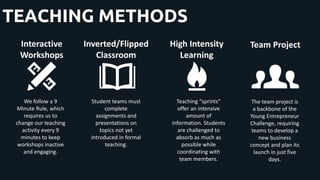
TEACHING METHODS
Interactive
Workshops
Inverted/Flipped
Classroom
High Intensity
Learning
Team Project
We follow a 9
Minute Rule, which
requires us to
change our teaching
activity every 9
minutes to keep
workshops inactive
and engaging.
Student teams must
complete
assignments and
presentations on
topics not yet
introduced in formal
teaching.
Teaching “sprints”
offer an intensive
amount of
information. Students
are challenged to
absorb as much as
possible while
coordinating with
team members.
The team project is
a backbone of the
Young Entrepreneur
Challenge, requiring
teams to develop a
new business
concept and plan its
launch in just five
days.
Young Entrepreneur Challenge Outcomes
Final Showcase & Awards
The community is invited to participate
in our Final Showcase, giving all of the
student teams the opportunity to
present in front of community leaders,
family, and friends. We also award a
Founder Award to one student on each
team.
Boston Invitation
The winning team and students who win
Founder Awards will be given an
invitation to participate in the Boston
Young Entrepreneur Challenge, which
attracts students from around the world
to compete in Boston, held on BU’s and
MIT’s campuses.
Whiteboard Network
Participants, students and teachers, will
join the global Whiteboard Youth
Network, the largest network on youth
entrepreneurs in the world. Participants
will also gain access to additional
resources on the Whiteboard website.
Whiteboard Certification
All students who successfully complete
the Young Entrepreneur Challenge earn a
Whiteboard Youth Venture Certificate,
certifying an understanding of business
models and skills taught during the
programs.
IMPACTING YOUTH
DEVELOPMENT WITH
ENTREREPENRUSHIP
Frank E. Pobutkiewicz
Managing Director, Whiteboard Youth Ventures
frank@whiteboardyouthventures.com
© Whiteboard Youth Ventures 2017
Publication Date: May 1, 2017

Young Entrepreneur Challenge

  • 1.
    IMPACTING YOUTH DEVELOPMENT WITH ENTREREPENRUSHIP FrankE. Pobutkiewicz Managing Director, Whiteboard Youth Ventures frank@whiteboardyouthventures.com © Whiteboard Youth Ventures 2017 Publication Date: May 1, 2017
  • 2.
    I. About WhiteboardYouth Ventures II. Whiteboard Founder III. Why Youth Entrepreneurship? IV. Young Entrepreneur Challenge Program V. Program Overview VI. Workshops VII. Mission & Goals VIII. Teaching Methods IX. Outcomes CONTENTS
  • 3.
    Founded in Cambridge,Massachusetts by serial entrepreneur Frank Pobutkiewicz with the goal of empowering high school and secondary school students, Whiteboard has worked with over 400 students from over 25 countries around the world.
  • 4.
    Frank Pobutkiewicz Educator, Entrepreneur,Speaker, Writer • Top ranked global debate coach • Serial entrepreneur, having started or advised 8 companies since 2010 • B.Sc. Business Administration, B.A. International Relations from Boston University • His students attend Harvard, Yale, the University of Pennsylvania, the University of Chicago, Stanford, Dartmouth, Brown, and many more • TEDx Talk: Rapid Market Validation • Two books scheduled to be published in 2018
  • 5.
    WHY YOUTH ENTREPRENEURSHIP IS IMPORTANT •The youth unemployment rate in emerging markets is over 53% 1 • Self-employed entrepreneurs of people under 24 are lower than those older 2 • Many younger people 15-24 years old are unaware of entrepreneurship as a feasible pursuit • Small and Medium Enterprises account for more than half of all formal jobs 3 1. United Nations Envoy on Youth 2. OECD 3. World Bank Group
  • 6.
    Over the courseof a jam-packed week, think of a new business idea, perform primary market research, build a prototype, speak to investors, work with mentors, and meet friends and future business partners.
  • 7.
    Young Entrepreneur Challengeby the numbers 4+ Years Developing and Testing Our Curriculum 25+ Countries from where our Students, Teachers, and Mentors hail 500+ Students We’ve Worked with 100 Our goal is to bring 100 student-founded, student- driven, and student-operated ventures to market over the next 5 years. $400,000 Combined revenue for companies that our students have launched over the past four years.
  • 8.
    Young Entrepreneur ChallengeOverview Program Length: How it Starts: During the Program: 6 Days, 8 Hours/Day Students are assigned randomly into teams of 4-8 students. Each student team is assigned a mentor to guide them through the workshops and challenges throughout the program. Student teams will compete in a series of challenge, case studies, business consultations, and presentations. Each challenge is designed to help teams make progress on their overarching project. Student Goals: Student teams must design a unique, sustainable business idea that they could realistically start upon the conclusion of the program. The Final Showcase gives student teams the chance to present their progress and plans if they were to launch.
  • 9.
    Young Entrepreneur ChallengeWorkshops BusinessModel Workshops Value Proposition Workshops Customer Segmentation and Primary Research Business Models: Revenues and Distribution Analytics Business Models: Cost Structure, Activities, and Resources BusinessSkills Workshops Presentation and Public Speaking Audience Building Prototyping; Web and Mobile Development Key Performance Indicators Budgeting and Finance
  • 10.
    Primary Mission: Increaseanalytical aptitude by using entrepreneurship as a vehicle to inspire students. Business Knowledge Goals (Areas of Knowledge): 1. Ensure students understand how business creates value for stakeholders and how that value can be transferred; 2. Explain how the value created by businesses is matched to the needs of customers and how businesses can incorporate customer feedback into design; 3. Demonstrate how value can be translated into revenue and profit in a responsible, sustainable manner. Business Skills Goals (Areas of Practice): 1. Equip students with the minimum skill set to plan and launch a new venture; 2. Demonstrate and practice how to match brand and marketing goals to customer-facing vehicles, such as a web and social media presence; 3. Ensure students understand how to create a budget, analyze key metrics, and make decisions using data- driven analysis. MISSION AND GOALS
  • 11.
    Young Entrepreneur Challenge Curriculum DesignMatrix AreaofPractice Presentation&PublicSpeaking AudienceBuilding Prototyping&Web/Mobile Design AnalyticsandKeyPerformance Indicators Budgeting&Finance 21st Century Learning Skills: AreaofKnowledge UnitTopic Value Proposition Creativity&Innovation CriticalThinking&ProblemSolving Communication&Collaboration InformationLiteracy Customer Segmentation and Relationships Channel Distribution Revenue Steams and Pricing Key Resources, Activities, and Partnerships Cost Structure Pattern Recognition
  • 12.
    TEACHING METHODS Interactive Workshops Inverted/Flipped Classroom High Intensity Learning TeamProject We follow a 9 Minute Rule, which requires us to change our teaching activity every 9 minutes to keep workshops inactive and engaging. Student teams must complete assignments and presentations on topics not yet introduced in formal teaching. Teaching “sprints” offer an intensive amount of information. Students are challenged to absorb as much as possible while coordinating with team members. The team project is a backbone of the Young Entrepreneur Challenge, requiring teams to develop a new business concept and plan its launch in just five days.
  • 13.
    Young Entrepreneur ChallengeOutcomes Final Showcase & Awards The community is invited to participate in our Final Showcase, giving all of the student teams the opportunity to present in front of community leaders, family, and friends. We also award a Founder Award to one student on each team. Boston Invitation The winning team and students who win Founder Awards will be given an invitation to participate in the Boston Young Entrepreneur Challenge, which attracts students from around the world to compete in Boston, held on BU’s and MIT’s campuses. Whiteboard Network Participants, students and teachers, will join the global Whiteboard Youth Network, the largest network on youth entrepreneurs in the world. Participants will also gain access to additional resources on the Whiteboard website. Whiteboard Certification All students who successfully complete the Young Entrepreneur Challenge earn a Whiteboard Youth Venture Certificate, certifying an understanding of business models and skills taught during the programs.
  • 14.
    IMPACTING YOUTH DEVELOPMENT WITH ENTREREPENRUSHIP FrankE. Pobutkiewicz Managing Director, Whiteboard Youth Ventures frank@whiteboardyouthventures.com © Whiteboard Youth Ventures 2017 Publication Date: May 1, 2017