You will not become agile
by implementing scrum
• Challenge
1. Projects
2. Managers
3. Decisions
4. Culture
• Directions
FUTURE-PROOF YOUR
ORGANIZATION
ORGANIZE RESPONSIVENESS
by
Jurriaan Kamer
CHALLENGE
What do we often encounter?
Bureaucratic
OS language
• Rules
• Roles
• Plans
• Reports
Change 0%
Jim
engineer
“sure,
but…”
“Can we do
scrum?”
Torch boss
So they go for a
local implementation © image by Steve Denning
Marketing
Finance
HR Ops
Management is part of a system
that prevents them from achieving
the necessary changes
(like getting
rid of waterfall)
AGILE ENTERPRISES
photo by Giuseppe Milophoto by Techcrunch
• Challenge
1. Projects
2. Managers
3. Decisions
4. Culture
• Directions
Project management + scrum = ?
PROJECTS
WE DON’T JUST DO SCRUM
WE DO
WATER
-SCRUM
-FALL
Bob
project manager
Leon
product owner
Bob
project manager Mr. PMO
PID
PSA
€
“I urgently need
a detailed estimate”
“Can’t we just
start?”
“But, you
promised…!”
“We need another
sprint”
“All your projects
are late”
“I don’t control
the resources”
“We have a
great idea!”
“My stakeholders
don’t approve”
PROJECTS
IN
AGILE ENTERPRISES
Everybody knows why the
company
exists and what the
priorities are
@agile_cio principle #1
Teams have full autonomy:
they decide HOW
to achieve a
certain goal
@agile_cio principle #2
No projects
No deadlines
No approvals
@agile_cio principle #3
You build it,
you run it
No handovers
@agile_cio principle #4
We don’t need
a framework
@agile_cio principle #5
• Challenge
1. Projects
2. Managers
3. Decisions
4. Culture
• Directions
MANAGERS
What management behavior
kills agility?
“I tell people what to
do so I stay in control
and I can drive
shareholder value”
“I can’t…”
“Please attend this
urgent meeting”
“This whole scrum
thing is very
disappointing”
“Deliver it on the 1st of December
even if you have to
work weekends!”
MANAGERS
IN
AGILE ENTERPRISES
Managers encourage
collaboration to solve
problems rather than
dictating a solution
@agile_cio principle #6
Managers job: designing
an optimal environment
where the work can
happen and teams can
grow @agile_cio principle #7
Managers are engineers
@agile_cio principle #8
• Challenge
1. Projects
2. Managers
3. Decisions
4. Culture
• Directions
What factors mainly influence
decision making in corporates?
DECISIONS
Costs, budgets,ROI
& Opinions
Decision making is based on
DECISIONS
IN
AGILE ENTERPRISES
Making money is
the result of
product excellence
@agile_cio principle #9
Data-driven instead
of HIPPOs
@agile_cio principle #10
• Challenge
1. Projects
2. Managers
3. Decisions
4. Culture
• Directions
What is the difference between
corporate and agile culture?
CULTURE
Pathological Bureaucratic
Information is hidden Information may be ignored
Responsibilities are shirked Responsibility is compartmented
Failure is covered up Orgs are just and merciful
New ideas are crushed New ideas create problems
A typology of organisational cultures (Westrum, 2004)
Corporate culture at odds with core agile values
CULTURE
IN
AGILE ENTERPRISES
Explicit culture
statements, based
on trust
@agile_cio principle #11
Failure
=
learning
=
innovation@agile_cio principle #12
Direct communication
instead of
through layers
@agile_cio principle #13
“People who say it cannot
be done should not
interrupt those who 

are doing it”
@agile_cio principle #14
• Challenge
1. Projects
2. Managers
3. Decisions
4. Culture
• Directions
How to get there?
DIRECTIONS
Talk to the executive 

who feels the pain
1. acknowledge
2. desireable future
3. willingness
4. ability
5. self-knowledge
Evolution
or
revolution?
© image by Michael Sahota
Culture bubble
Bring the challenge
to the team €
Let go of people who don’t
want to be part of the transition
Agility is not a gem that
can be bought.
It’s painful and hard work
1. Projects
2. Managers
3. Decisions
4. Culture
Be prepared to kill old habits
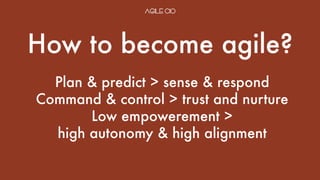
How to become agile?
Plan & predict > sense & respond
Command & control > trust and nurture
Low empowerement >
high autonomy & high alignment
@AGILE_CIO
WWW.AGILECIO.NET
by
Jurriaan Kamer

You will not become agile by implementing scrum