OS H
How Humans Work
Field Guide to Happiness
Stefan Knecht | Manager | it-economics | @knechtomat
Agility:
Emancipation
Changing
Attitudes
What Shapes
Behavior?
Attraction, Fear and
Resistance
Nudging Corporate
Structures.
Risks, Gains and a
Nobel Prize
Biases and a Social
Engine: OS H
Twisting the Social
Workplace
What makes
Teams perform?
Individuals
Collaboration
Change
Image taken from Jurgen Apello, 2012.How to Change the World: Change Management 3.0. Jojo Ventures BV
Emancipation
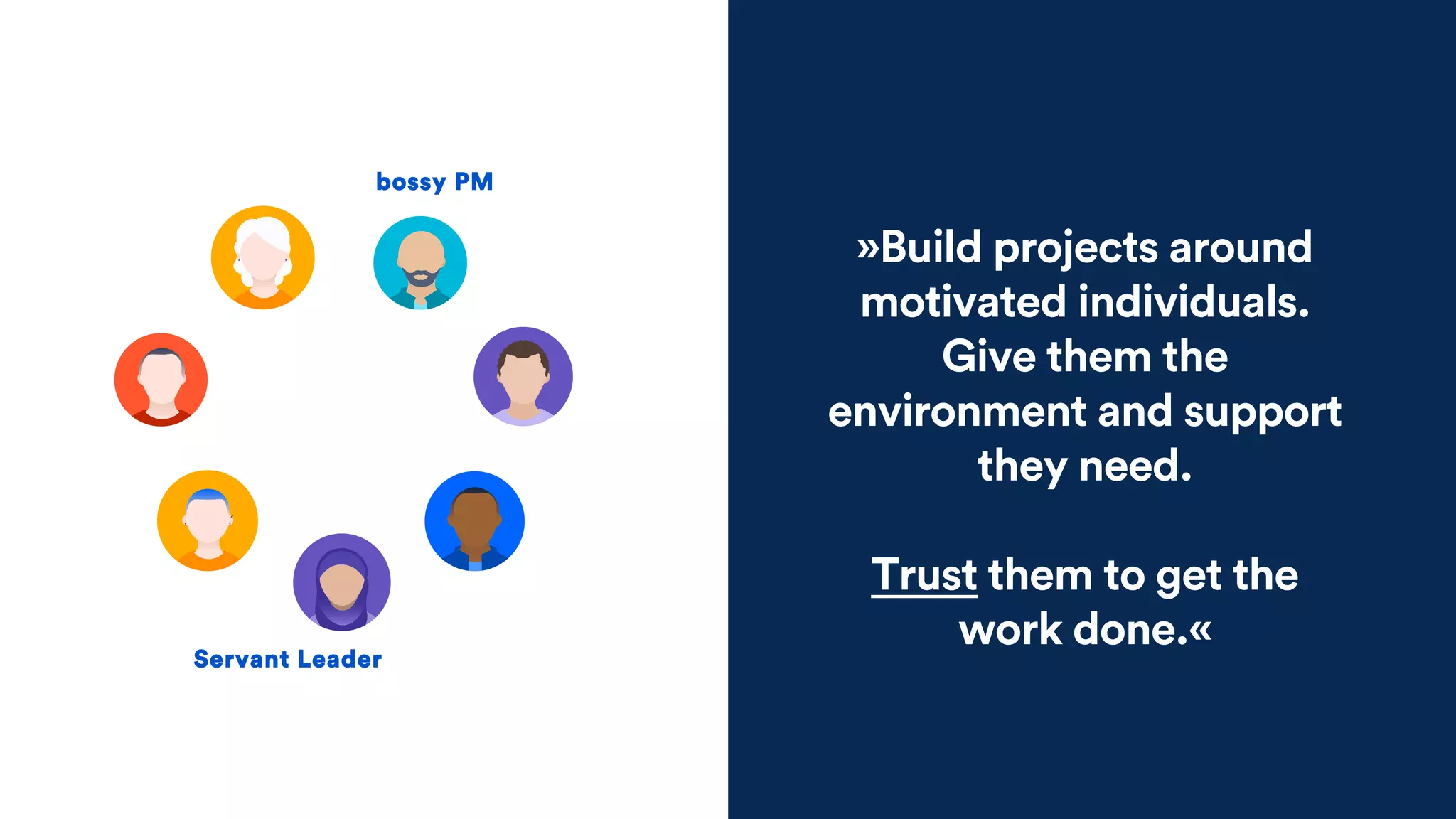
»Build projects around
motivated individuals. Give
them the environment and
support they need.
Trust them to get the work
done.«
Servant Leader
bossy PM
With agile
comes
openness and
transparency.
You can’t hide less pleasant
things any longer.
ChristophNiemann„SundaySketches“http://www.christophniemann.com/portfolio/sunday-sketches-2/
… and
unknown
challenges.
Becoming agile
… is about changing
attitudes.
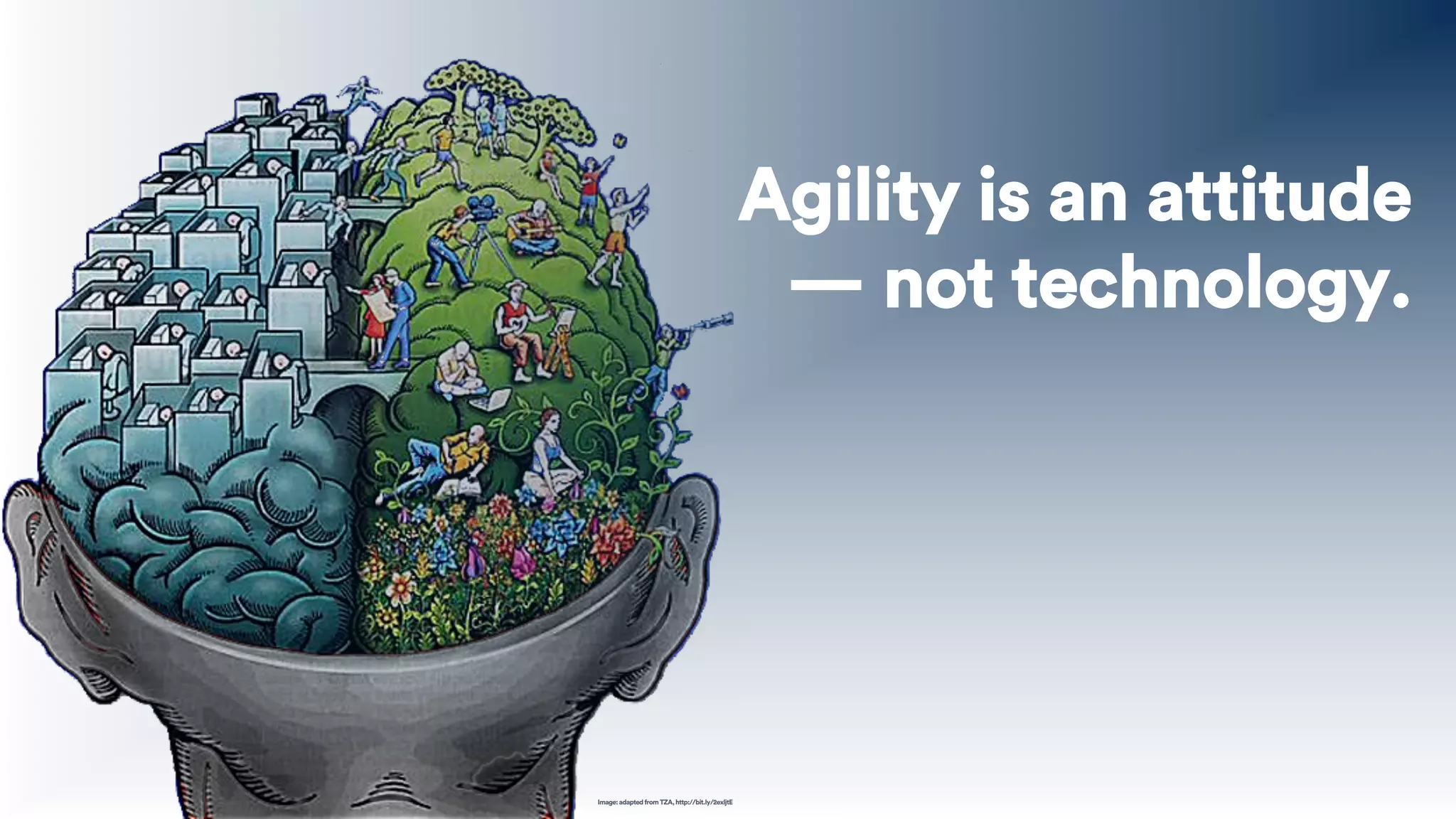
Image: adapted from TZA, http://bit.ly/2exljtE
Agility is an attitude
— not technology.
Change can be Easy.
(Well, it isn‘t sometimes.)
People change behavior
quickly. If it’s fun.
http://a.abcnews.com/images/US/epa_pokemon_go_player_jc_160721_31x13_1600.jpg
They spend hours and pay
real money for
surreal items.
adapted from http://bit.ly/2o3vNDy
Rocketing adoption rates
— if needs are fulfilled.
http://a.abcnews.com/images/US/epa_pokemon_go_player_jc_160721_31x13_1600.jpg
viaPeterGlaserhttp://bit.ly/2nAVGH8
How Behavior is shaped.
(Trivial formula.)
Kurt Levin: Pioneer of social, organizational, and applied psychology. Studied
group dynamics and organizational development.
B = f (P, E)
Lewin, Kurt (1936). Principles of Topological Psychology. New York: McGraw-Hill. pp. 4–7
Repeat:
You
cannot
change people.
image adapted from Practice and Science of Standard Barbering. 1959. Vaughn Barber School. Milady Publishing Company; New York, NY
(Try it with your significant other.)
Oh no. Don’t.
B = f (P, E)
As you can‘t change the Person ...
... nudge Behavior
by changing the Environment.
Lewin, Kurt (1936). Principles of Topological Psychology. New York: McGraw-Hill. pp. 4–7
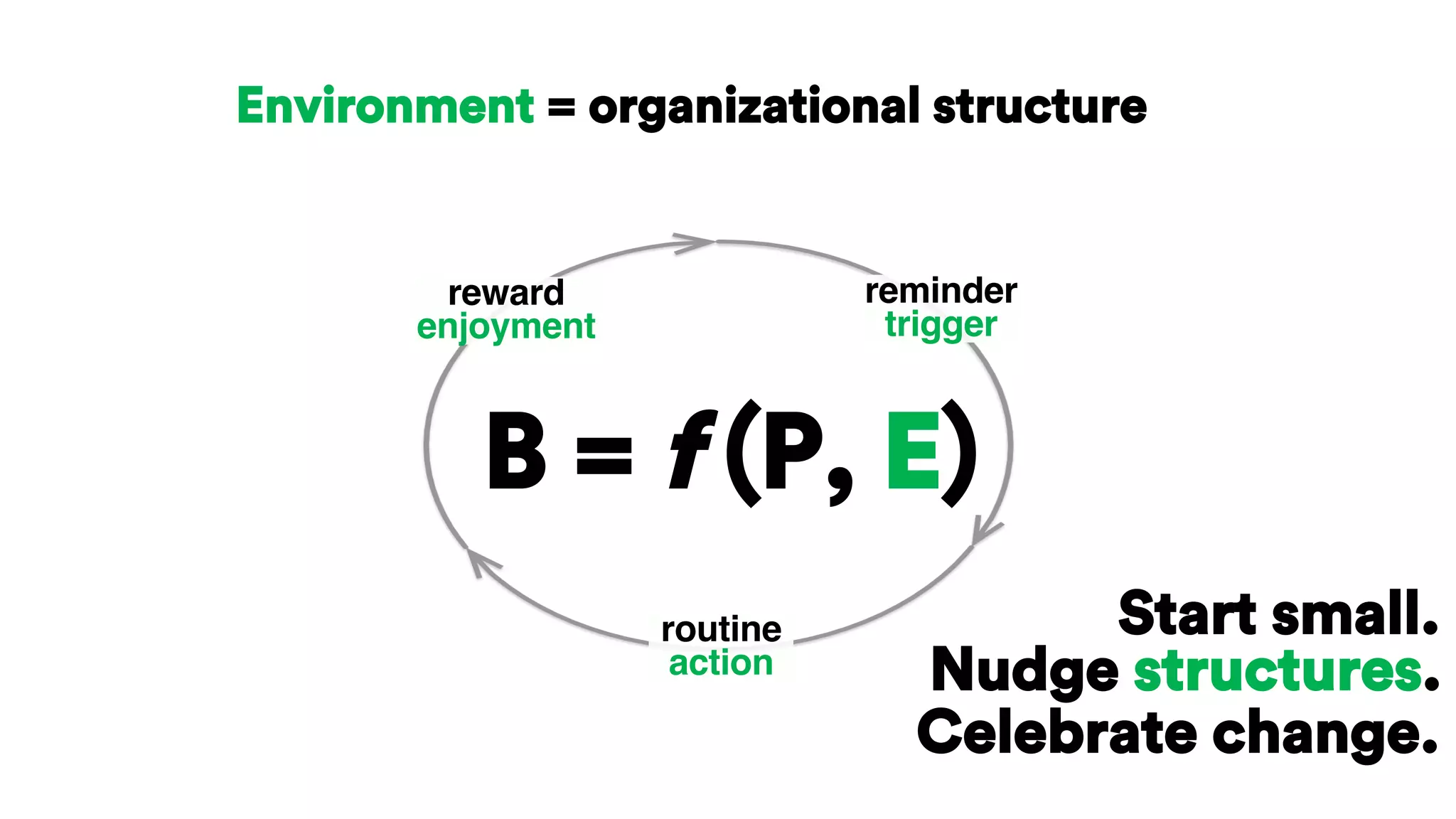
Environment = organizational structure
B = f (P, E)
Start small.
reminder

trigger
routine

action
reward

enjoyment
Nudge structures.
Celebrate change.
Corporate Culture is the
Organizational OS.
Nudge this first.
©StefanKnecht
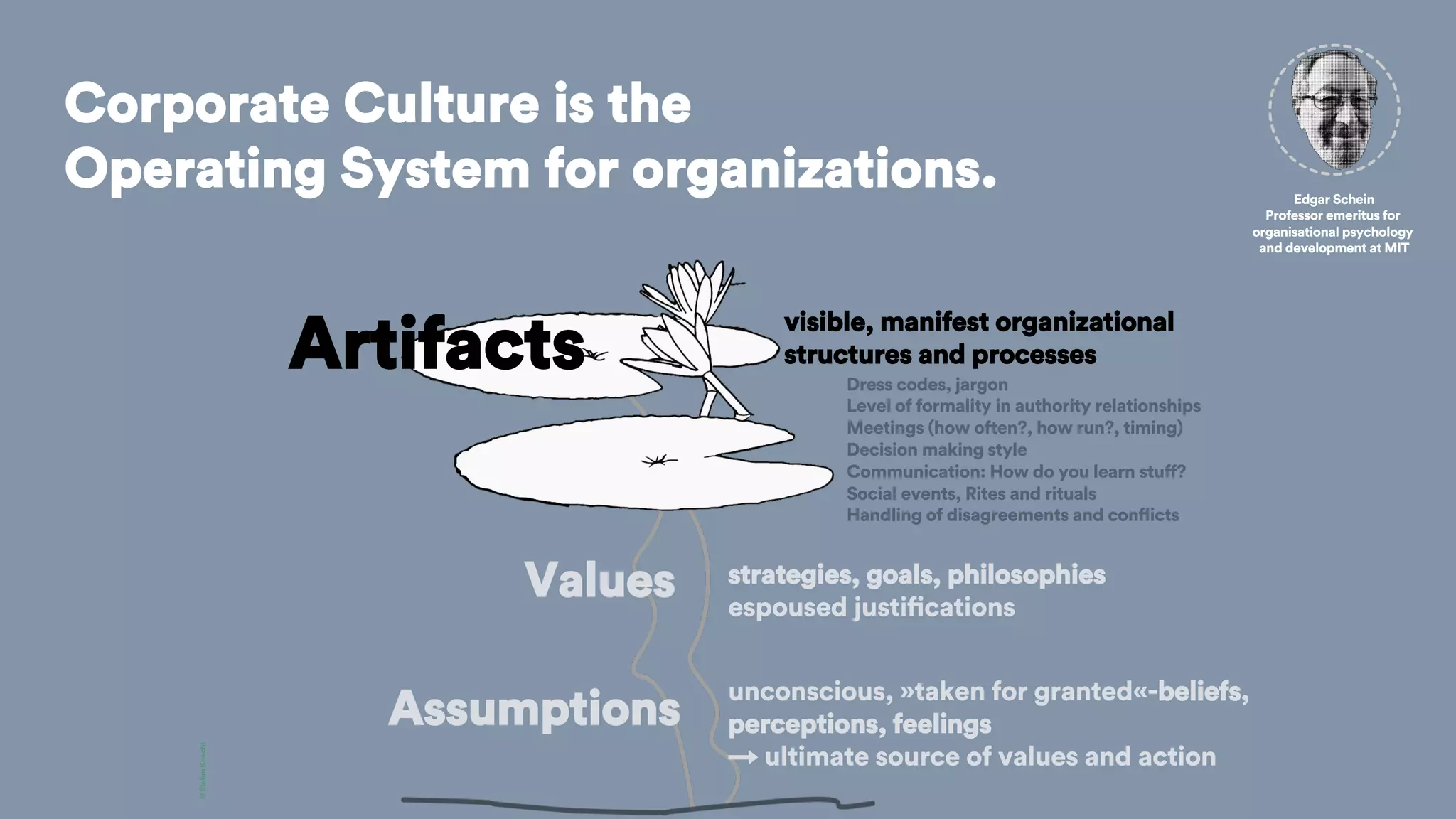
Corporate Culture is the
Operating System for organizations.
visible, manifest organizational
structures and processes
unconscious, »taken for granted«-beliefs,
perceptions, feelings
→ ultimate source of values and action
strategies, goals, philosophies
espoused justifications
Dress codes, jargon
Level of formality in authority relationships
Meetings (how often?, how run?, timing)
Decision making style
Communication: How do you learn stuff?
Social events, Rites and rituals
Handling of disagreements and conflicts
Artifacts
Values
Assumptions
Edgar Schein
Professor emeritus for
organisational psychology and
development at MIT
How to identify your Corporate Culture?
Ask: »How we do things here to succeed?«
Schneider,William(2000).TheReengineeringAlternative,McGraw-Hill—seeanonlinesurveyathttps://www.surveymonkey.com/r/VVNT5FB
Collaboration

»working together«
Cultivation

»growing people

who fulfil our vision«
Competence

»being the best«
Control

»getting and keeping control«
William Schneider,
organizational
psychologist: core
culture model
Schneider: Core Culture Model
military
universitychurch
family
©StefanKnecht
Traditional Change
Programs usually fail.
How do people react to imminent
corporate change initiatives?
status
money
esteem
privileges
gaining
loosing
culture
agile
»Culture eats strategy
for breakfast.«
Change cannot be ordered.
(put yourself into the shoes
of those in fear of losing.)
©StefanKnecht
Wait for those ...
… that have to
loose something.
ital. work with hands, handle
latin mano
etymol.: horse training
With agile transitions and
self-organizing teams,
middle management
suffers most.
What else offers status,
influence ... what can be gained if
classical management roles
disappear?
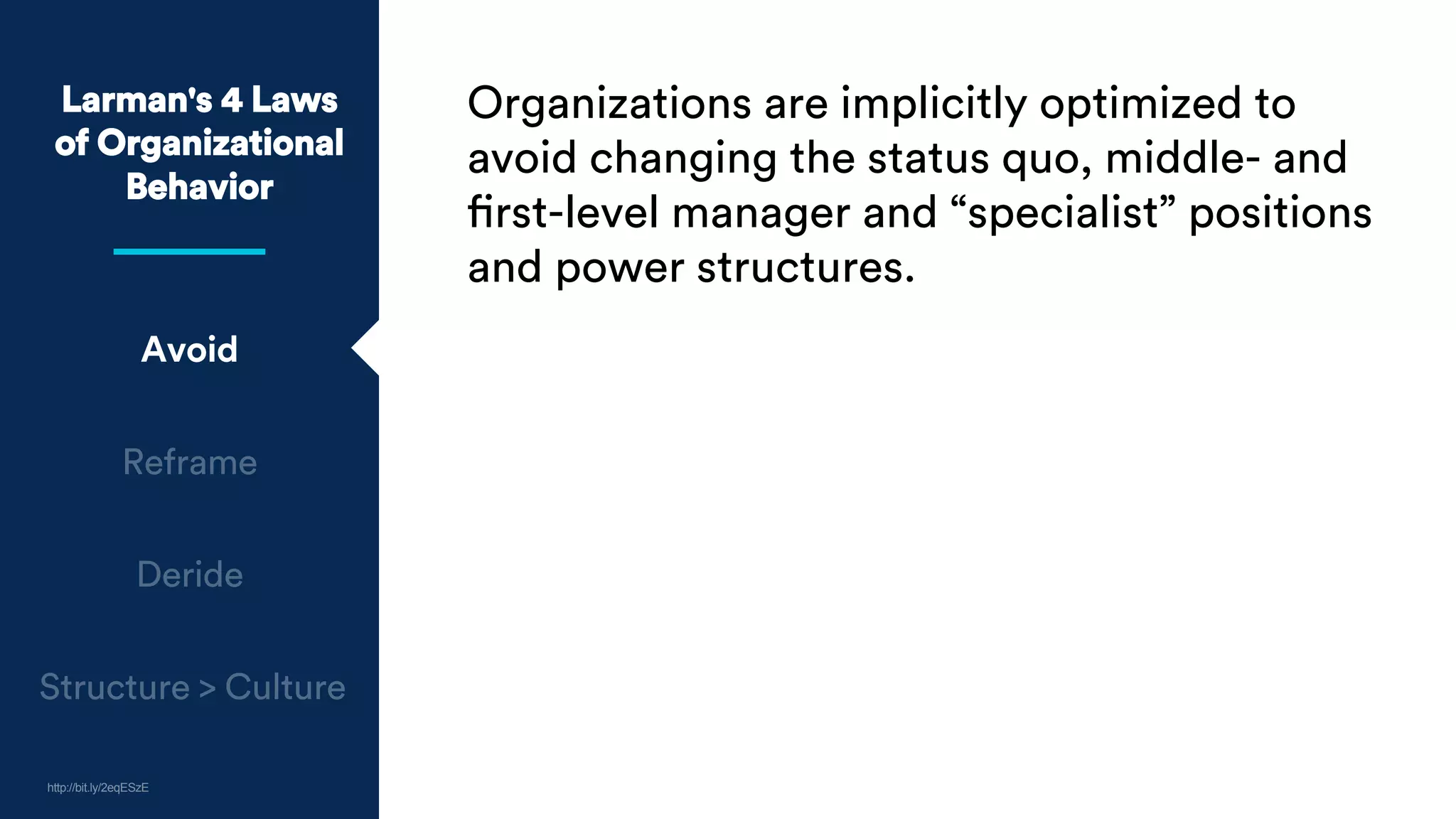
Organizations are implicitly optimized to
avoid changing the status quo, middle- and
first-level manager and “specialist” positions
and power structures.
Larman's 4 Laws
of Organizational
Behavior
Avoid
Reframe
Deride
Structure > Culture
!
http://bit.ly/2eqESzE
Any change initiative will be reduced to
redefining or overloading the new
terminology to mean basically the same as
status quo.
Larman's 4 Laws
of Organizational
Behavior
Reframe
Avoid
Deride
Structure > Culture
!
http://bit.ly/2eqESzE
Any change initiative will be derided as
“theoretical”, "religion", and “needing pragmatic
customization for local concerns” — which
deflects from addressing weaknesses and
manager/specialist status quo.
Larman's 4 Laws
of Organizational
Behavior
Deride
Avoid
Reframe
Structure > Culture
!
http://bit.ly/2eqESzE
Culture
follows
structure.
Larman's 4 Laws
of Organizational
Behavior
Deride
Avoid
Reframe
Structure > Culture
!
http://bit.ly/2eqESzE
Craig Larman
Co-creator of LeSS
(large-scale Scrum)
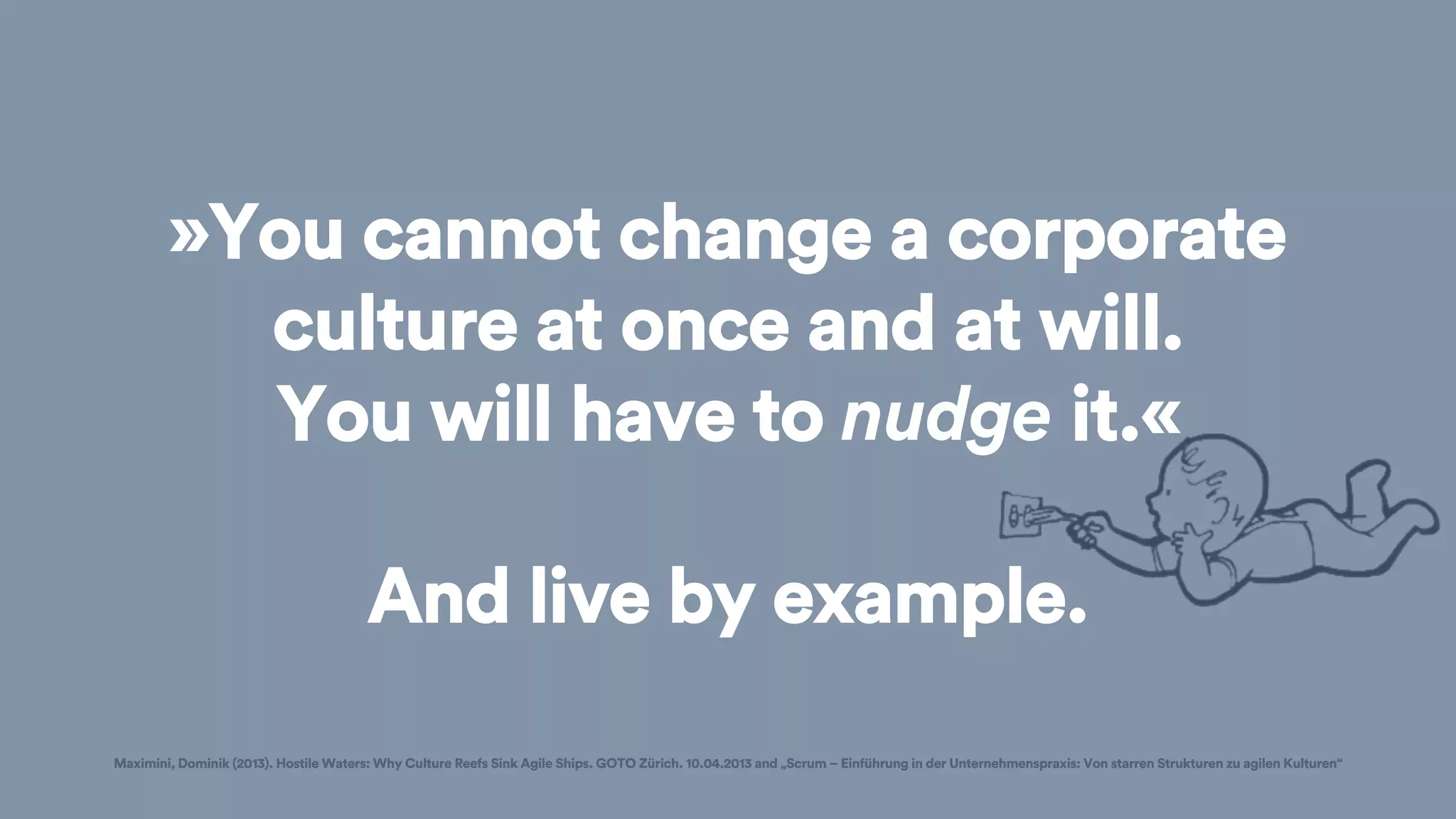
»You cannot change a
corporate culture at once and at
will.
You will have to nudge it.«
And live by example.
Maximini, Dominik (2013). Hostile Waters: Why Culture Reefs Sink Agile Ships. GOTO Zürich. 10.04.2013 and „Scrum – Einführung in der Unternehmenspraxis: Von starren Strukturen zu agilen Kulturen“
»(Only) when you
change the system,
peoples’ behavior
changes.«
Individual behavior is a product
of the corporate operating
system.
Fundamental change —
not tampering.
Birch, Travis. “Reflections on Agile Business Leadership.” Agile Advice, August 14, 2013. http://bit.ly/2fqkGPl.
Pixton, Pollyanna, Paul Gibson and Niel Nickolaisen. The Agile Culture - Leading through Trust and Ownership.
Addison-Wesley, 2014. p23
Transistions are systemic
Challenges under Risk.
As a manager, manage the system — not people.
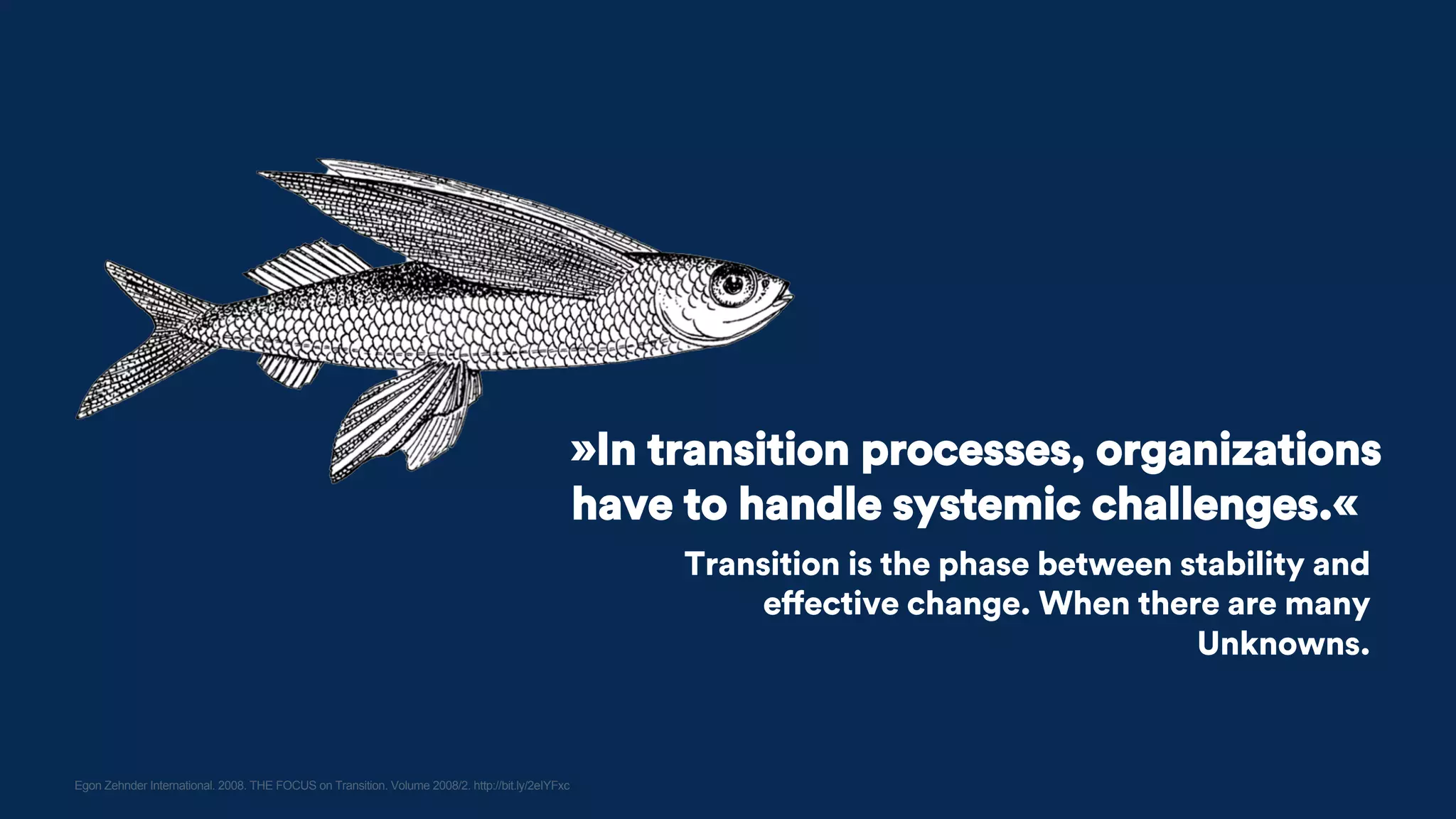
»In transition processes, organizations
have to handle systemic challenges.«
Transition is the phase between stability and
effective change. When there are many Unknowns.
Egon Zehnder International. 2008. THE FOCUS on Transition. Volume 2008/2. http://bit.ly/2eIYFxc
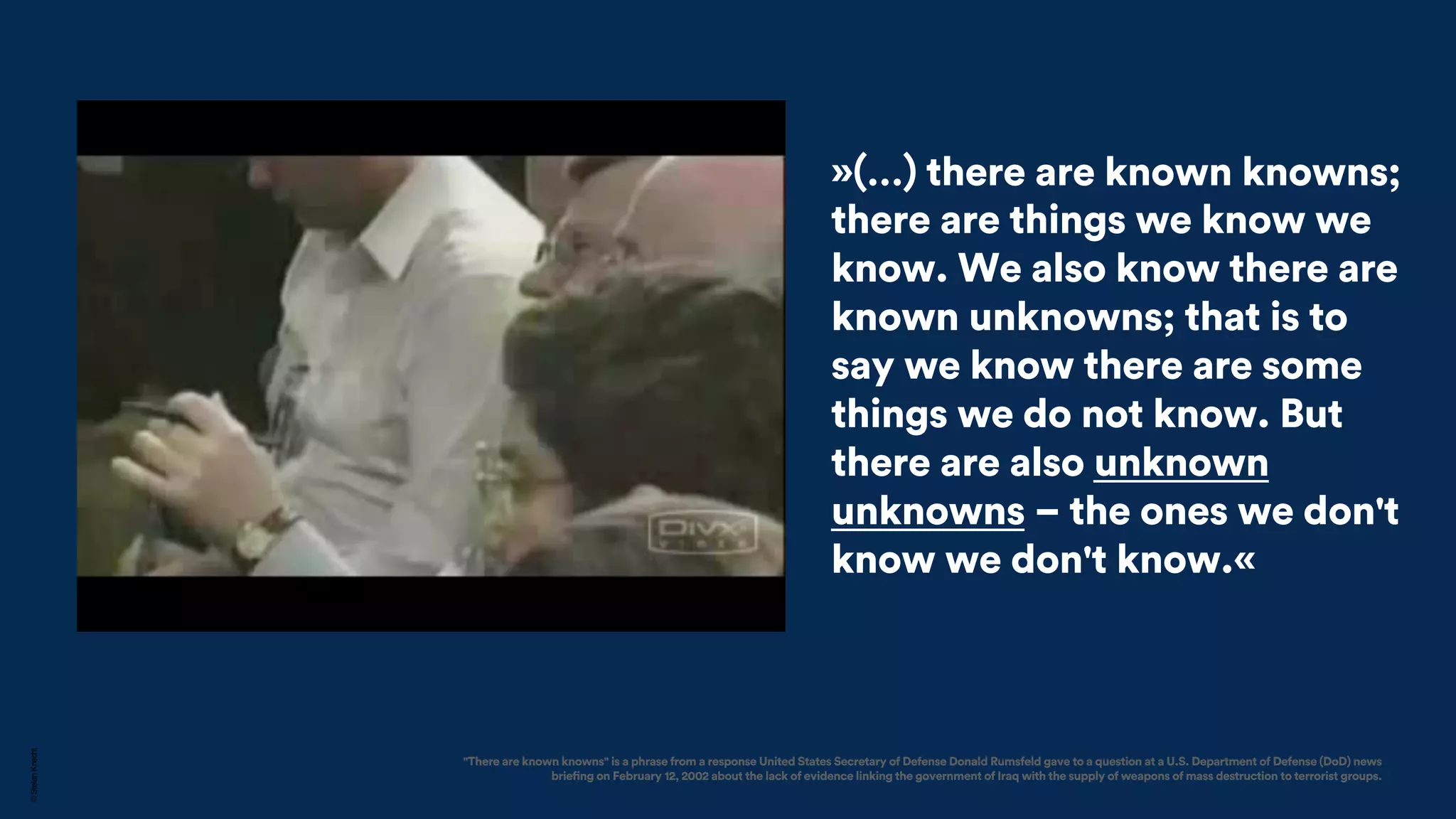
"There are known knowns" is a phrase from a response United States Secretary of Defense Donald Rumsfeld gave to a question at a U.S. Department of Defense (DoD) news briefing on
February 12, 2002 about the lack of evidence linking the government of Iraq with the supply of weapons of mass destruction to terrorist groups.
»(…) there are known knowns;
there are things we know we
know. We also know there are
known unknowns; that is to say
we know there are some things
we do not know. But there are
also unknown unknowns – the
ones we don't know we don't
know.«
©StefanKnecht
“(…) we are not rational creatures but
instinct-driven with an innate tendency
to risk-aversion and prone to a myriad
of systematic biases.”
Daniel Kahneman,
»the world's most influential
living psychologist«
How do people choose between probabilistic alternatives that
involve risk, where the probabilities of outcomes are known?
Change, Risk vs Losses
and the ‘stubborn middle management’
»Risk-aversion increases with perceived ‘ownership’ —
which also explains why middle management levels often exhibit
particularly stubborn resistance to change –
espousing a stick-in-the-mud intransigence (…)«
»People are only risk-averse when they
have assets to preserve or something to lose
– material and organizational assets, status,
security, familiar routines.«
©StefanKnecht
(Kahneman’s 2002 Nobel Memorial Prize in Economic
Sciences for the Prospect Theory in 1 sentence.)
»People tend to avoid risks
when seeking gains, but
choose risks to avoid sure
losses.«
©StefanKnecht
Humans are
systematically biased.
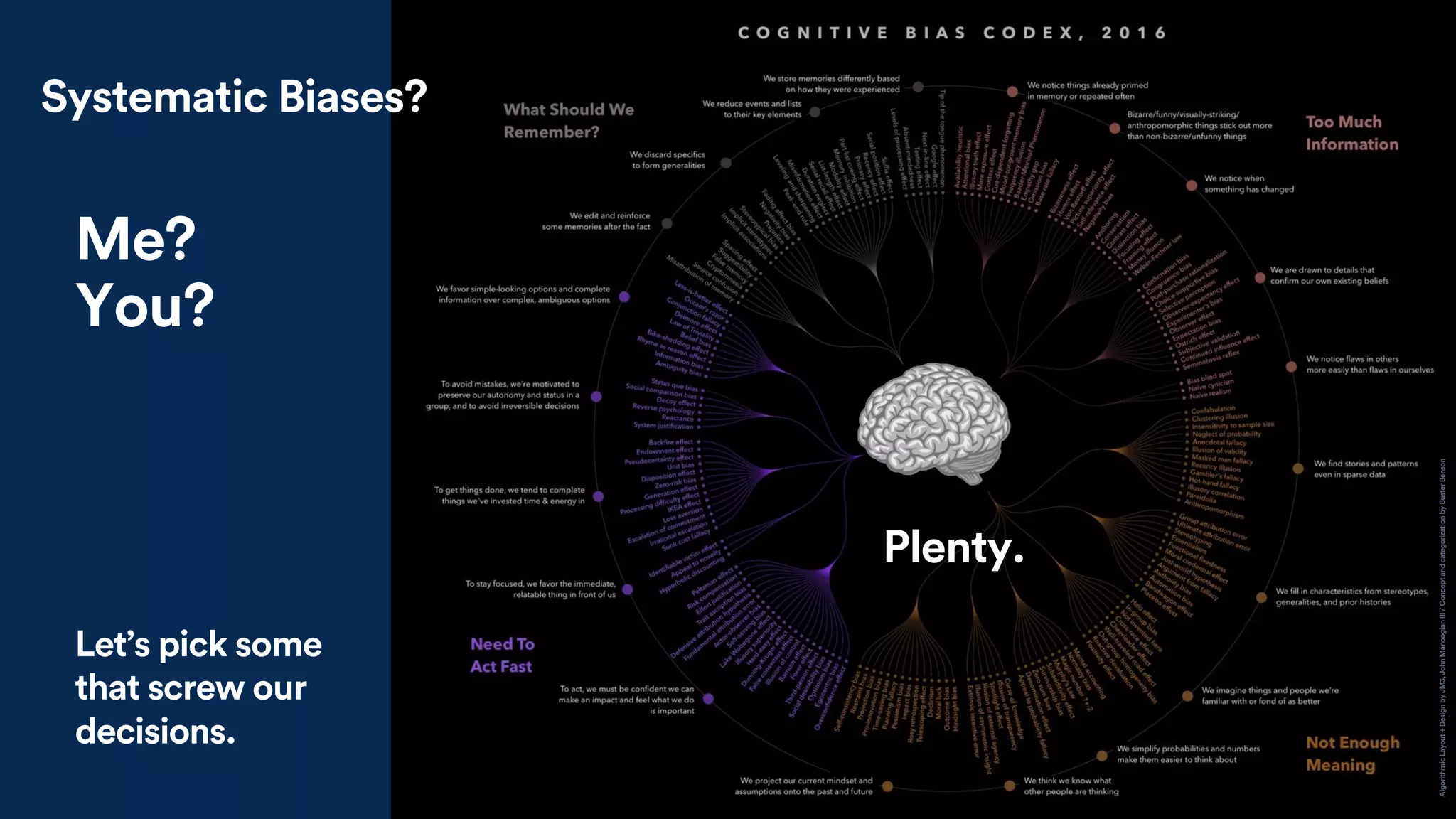
Systematic Biases?
Let’s pick some that
screw our decisions.
Me?
You?
AlgorithmicLayout+DesignbyJM3,JohnManoogianIII/ConceptandcategorizationbyBusterBenson
Plenty.
Anchoring bias
Availability heuristic
Bandwagon effect
Blind-spot bias
Choice-supportive bias
Clustering illusion
Confirmation bias
Conservatism bias
Information bias
Ostrich effect
Outcome bias
Overconfidence
Placebo effect
Pro-innovation bias
Recency bias
Salience bias
Selective perception
Stereotyping bias
Survivorship bias
Zero-risk bias
Adapted from: Business Insider, Shana Lebowitz und Samantha Lee. 26.08.2015 - http://bit.ly/2hQEnz6
©StefanKnecht
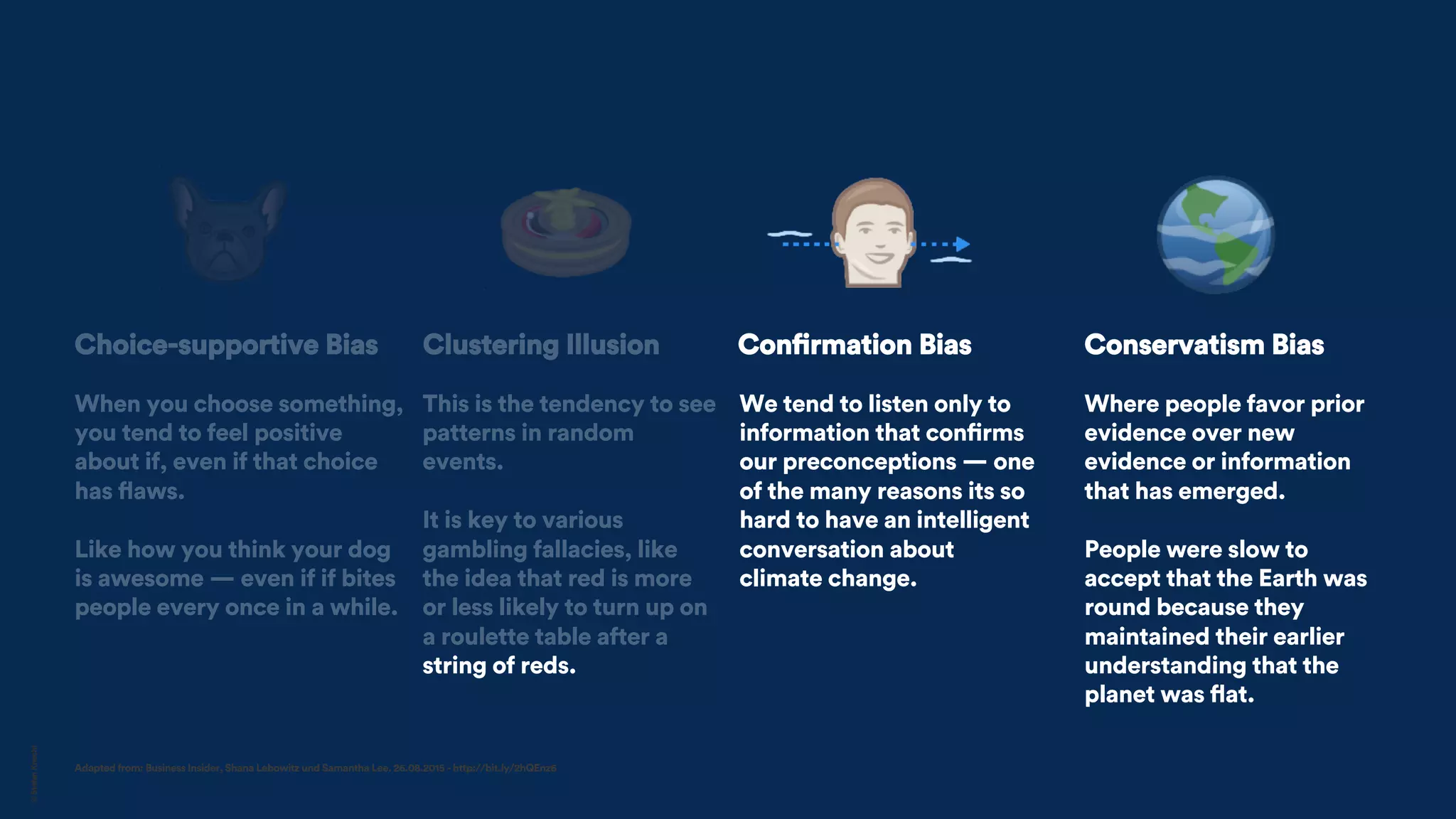
Clustering Illusion
This is the tendency to see
patterns in random events.
It is key to various gambling
fallacies, like the idea that
red is more or less likely to
turn up on a roulette table
after a string of reds.
Confirmation Bias
We tend to listen only to
information that confirms our
preconceptions — one of
the many reasons its so
hard to have an intelligent
conversation about climate
change.
Conservatism Bias
Where people favor prior
evidence over new evidence
or information that has
emerged.
People were slow to accept
that the Earth was round
because they maintained
their earlier understanding
that the planet was flat.
Choice-supportive Bias
When you choose something,
you tend to feel positive about
if, even if that choice has flaws.
Like how you think your dog is
awesome — even if if bites
people every once in a while.
Adapted from: Business Insider, Shana Lebowitz und Samantha Lee. 26.08.2015 - http://bit.ly/2hQEnz6
©StefanKnecht
Now for the really scary stuff.
Psychology.
Bonus track:
Why this is relevant for
managing change and transitions.
©StefanKnecht
How Humans
Work
Welcome to our Kernel.
Source: Micaël Reynaud, http://bit.ly/2dP34gz
OS HHuman Operating System
Stalking the Brain with fMRI
Functional magnetic resonance imaging provides
neuroscientists a real-time view into operating brains.
©StefanKnecht
Social and physical pain are
located in the same brain areas.
Illustration: Samuel Valasco; Source: Eisenberger, Lieberman and Williams, Science, 2003 (social pain images); Lieberman et al., “The neural Correlates of
Placebo Effects: A Disruption Account." Neuroimage, May 2004 (physical pain images)
Social Pain
Physical Pain
©StefanKnecht
=
Social needs are primary needs.
David Rock. 2009. Managing with the Brain in Mind - Neuroscience research is revealing the social nature of the high-performance
workplace. Strategy & Business, Issue 56 (originally published by Booz & Company). http://bit.ly/2e2l8F7
Our brains are rooted to minimize
perceived threats and maximize potential
rewards.
©StefanKnecht
David Rock
Neuroscientist
SCARF, a
neuroscientific
motivation model
Human Social Operating Conditions
relative importance
to others
being able to
predict the future
a sense of control
over events
a sense of safety
with others
a perception of
fair exchanges
StefanKnecht
tatus
ertainty
utonomyelatedness
airness
Maslow liked lists a lot.
He admitted to have
‘invented’ the pyramid.
Never presented any
scientific data.
Primates have a highly honed sense of fairness.
Like Humans.
https://www.youtube.com/watch?v=-KSryJXDpZo
©StefanKnecht
Without Emotions, Reason
gets nowhere.
The »dual-process« brain
Kahneman emphasized we are
employing two fundamentally
different modes of thought:
Illustration by Julia Suits, The New Yorker Cartoonist & author of The Extraordinary Catalog of Peculiar Inventions. Also see http://bit.ly/2iMSkDl and https://en.wikipedia.org/wiki/Dual_process_theory
©StefanKnecht
System 1 is fast, intuitive, associative,
metaphorical, automatic, impressio-
nistic, and it can't be switched off.
Its operations involve no sense of
intentional control, but it's the »secret
author of many of the choices and
judgments you make«.
Illustration by Julia Suits, The New Yorker Cartoonist & author of The Extraordinary Catalog of Peculiar Inventions. Also see http://bit.ly/2iMSkDl and https://en.wikipedia.org/wiki/Dual_process_theory
©StefanKnecht
System 2 is slow, deliberate, effortful.
Its operations require attention.
System 2 takes over, rather unwillingly,
when things get difficult.
It's »the conscious being you call 'I'«.
To experience System 2 now:
‘What is 13 x 27?’
©StefanKnecht
Reason is the charioteer. The horses are
emotions, one good, one bad. The good
horse naturally pulls towards rational goals.
The unruly bad horse must be battled.
Without emotions,
reason gets nowhere.
Illustration by Julia Suits, The New Yorker Cartoonist & author of The Extraordinary Catalog of Peculiar Inventions.
http://bigthink.com/errors-we-live-by/reason-emotion-kahneman-is-the-freud-slayer - Plato: Wikipedia
Plato
Philosopher
Plato explained the same by
comparing the mind to a two
horse chariot.
Illustration by Julia Suits, The New Yorker Cartoonist & author of The Extraordinary Catalog of Peculiar Inventions.
©StefanKnecht
Processes Company goals
Structure/s
KPIs
Products
Services
Organization
Infrastructure
Performance
Ratio
Emotions
Power
Influence
Collaboration
Beliefs
Relations
Desires
Privileges
Habits
Norms
Ethics
Trust
Safety
Status
Autonomy
Our social traits are older
than ratio.
Süddeutsche Zeitung, 23.12.2013, http://bit.ly/2exORWq
©StefanKnecht
Süddeutsche Zeitung, 23.12.2013, http://bit.ly/2exORWq
©StefanKnecht
There’s only a thin
cultural coating that
differentiates us.
©StefanKnecht
Mooallem, Jon. 2017. „Neanderthals Were People, Too“. The New York Times, Januar 11. https://www.nytimes.com/
2017/01/11/magazine/neanderthals-were-people-too.html.
»Neandertals were people too.
New research shows they shared many behaviors
that we long believed to be uniquely human.«
OS H is 300.000 years old.
The workplace is a
social system.
(So stop treating people as hairy computers.)
»(…) »Most processes operating in the background
when your brain is at rest are involved in thinking
about other people and yourself.«
brain idle = think social
Rock, David. “Managing with the Brain in Mind.” Strategy+business Magazine, PwC AUTUMN 2009, no. 56 (2009): p59–69.
»The human brain’s physiological and
neurological reactions are (…) shaped by social
interaction.«
»Although a job is often regarded as a purely
economic transaction, an exchange of labor for
money, first and foremost the brain experiences the
workplace as a social system.«
workplace = social system
Rock, David. “Managing with the Brain in Mind.” Strategy+business Magazine, PwC AUTUMN 2009, no. 56 (2009): p59–69.
»The human brain’s physiological and
neurological reactions are (…) shaped by social
interaction.«
»An organization that appeals to value money
and rank more than a basic sense of respect
will stimulate threat responses among
employees who aren’t at the top of the heap.«
Rock, David. “Managing with the Brain in Mind.” Strategy+business Magazine, PwC AUTUMN 2009, no. 56 (2009): p59–69.
Hint: respect doesn’t cost you anything.
respect > rank
»The human brain’s physiological and
neurological reactions are (…) shaped by social
interaction.«
What makes teams perform?
Hint: it‘s not excellence.
No patterns or
any evidence
High-performance Teams:
What Google did.
5 YEARS,
MILLIONS SPENT:
Duhigg, Charles. “What Google Learned From Its Quest to Build the Perfect Team.” The New York Times, February 25, 2016. http://nyti.ms/2ecPWno (registration req), Image adapted from James Graham.
Rozovsky, Julia. “re:Work - The Five Keys to a Successful Google Team.” Accessed November 6, 2016. http://bit.ly/2ecNu0e — 200+ interviews , 250+ attributes of 180+ active Google teams
… that team
composition made
any difference to
performance.
»Who is on a team
matters less than how
team members interact,
structure their work, and
view their contributions.«
High-performance Teams:
What Google did.
Understanding and
influencing group norms
were the keys to
improving team
performance.
Guide: Understand team effectiveness: https://rework.withgoogle.com/print/guides/5721312655835136/
Conversational turn-taking Empathy
Above average teams shared two behaviors:
Group members speak in roughly
the same proportion »(…) if only
one person or a small group
spoke all the time, the collective
intelligence declined.«
A high »average social sensitivity«
—
… a fancy way of saying they were
skilled at intuiting how others felt based
on their tone of voice, expressions and
other nonverbal cues.
Edmondson, Amy. “Psychological Safety and Learning Behavior in Work Teams.” Administrative Science Quarterly 44 (June 1999): 350–83. doi:10.2307/2666999. — 12’ TED video: http://bit.ly/2fxNRyH
»People tend to avoid risks when seeking
gains, but choose risks to avoid sure losses.«
OS H is old and robust ➝ our brains make
behave us ➝ we’re not rational but instinct-
driven.
We are systematically biased in decisions.
The workplace is a social system that is to be
nudged ➝ Culture follows Structure
➝ Leader’s behavior guides Teams
Changing learned attitudes works through
➝ empathy, realizing emotions and
psychological safety
Recap.
Attribution — You must give appropriate credit, provide a
link to the license, and indicate if changes were made. You
may do so in any reasonable manner, but not in any way
that suggests the licensor endorses you or your use.
ShareAlike — If you remix, transform, or build upon the
material, you must distribute your contributions under the
same license as the original.
CC BY-SA 4.0
This is built on other
people’s ideas
STEFAN KNECHT | MANAGER | IT-ECONOMICS | @KNECHTOMAT
Thank you!
The Key to Great Teams: Understanding the Human Operating System

The Key to Great Teams: Understanding the Human Operating System

  • 1.
    OS H How HumansWork Field Guide to Happiness Stefan Knecht | Manager | it-economics | @knechtomat
  • 2.
    Agility: Emancipation Changing Attitudes What Shapes Behavior? Attraction, Fearand Resistance Nudging Corporate Structures. Risks, Gains and a Nobel Prize Biases and a Social Engine: OS H Twisting the Social Workplace What makes Teams perform?
  • 3.
    Individuals Collaboration Change Image taken fromJurgen Apello, 2012.How to Change the World: Change Management 3.0. Jojo Ventures BV Emancipation
  • 4.
    »Build projects around motivatedindividuals. Give them the environment and support they need. Trust them to get the work done.« Servant Leader bossy PM
  • 5.
    With agile comes openness and transparency. Youcan’t hide less pleasant things any longer. ChristophNiemann„SundaySketches“http://www.christophniemann.com/portfolio/sunday-sketches-2/
  • 6.
  • 7.
    Becoming agile … isabout changing attitudes.
  • 8.
    Image: adapted fromTZA, http://bit.ly/2exljtE Agility is an attitude — not technology.
  • 9.
    Change can beEasy. (Well, it isn‘t sometimes.)
  • 10.
    People change behavior quickly.If it’s fun. http://a.abcnews.com/images/US/epa_pokemon_go_player_jc_160721_31x13_1600.jpg
  • 11.
    They spend hoursand pay real money for surreal items. adapted from http://bit.ly/2o3vNDy
  • 12.
    Rocketing adoption rates —if needs are fulfilled. http://a.abcnews.com/images/US/epa_pokemon_go_player_jc_160721_31x13_1600.jpg
  • 13.
  • 15.
    How Behavior isshaped. (Trivial formula.)
  • 16.
    Kurt Levin: Pioneerof social, organizational, and applied psychology. Studied group dynamics and organizational development. B = f (P, E) Lewin, Kurt (1936). Principles of Topological Psychology. New York: McGraw-Hill. pp. 4–7
  • 17.
    Repeat: You cannot change people. image adaptedfrom Practice and Science of Standard Barbering. 1959. Vaughn Barber School. Milady Publishing Company; New York, NY (Try it with your significant other.) Oh no. Don’t.
  • 18.
    B = f(P, E) As you can‘t change the Person ... ... nudge Behavior by changing the Environment. Lewin, Kurt (1936). Principles of Topological Psychology. New York: McGraw-Hill. pp. 4–7
  • 19.
    Environment = organizationalstructure B = f (P, E) Start small. reminder
 trigger routine
 action reward
 enjoyment Nudge structures. Celebrate change.
  • 20.
    Corporate Culture isthe Organizational OS. Nudge this first.
  • 21.
    ©StefanKnecht Corporate Culture isthe Operating System for organizations. visible, manifest organizational structures and processes unconscious, »taken for granted«-beliefs, perceptions, feelings → ultimate source of values and action strategies, goals, philosophies espoused justifications Dress codes, jargon Level of formality in authority relationships Meetings (how often?, how run?, timing) Decision making style Communication: How do you learn stuff? Social events, Rites and rituals Handling of disagreements and conflicts Artifacts Values Assumptions Edgar Schein Professor emeritus for organisational psychology and development at MIT
  • 22.
    How to identifyyour Corporate Culture? Ask: »How we do things here to succeed?« Schneider,William(2000).TheReengineeringAlternative,McGraw-Hill—seeanonlinesurveyathttps://www.surveymonkey.com/r/VVNT5FB Collaboration
 »working together« Cultivation
 »growing people
 who fulfil our vision« Competence
 »being the best« Control
 »getting and keeping control« William Schneider, organizational psychologist: core culture model
  • 23.
    Schneider: Core CultureModel military universitychurch family ©StefanKnecht
  • 24.
  • 25.
    How do peoplereact to imminent corporate change initiatives? status money esteem privileges gaining loosing
  • 26.
  • 27.
    Change cannot beordered. (put yourself into the shoes of those in fear of losing.)
  • 28.
    ©StefanKnecht Wait for those... … that have to loose something.
  • 29.
    ital. work withhands, handle latin mano etymol.: horse training
  • 30.
    With agile transitionsand self-organizing teams, middle management suffers most. What else offers status, influence ... what can be gained if classical management roles disappear?
  • 31.
    Organizations are implicitlyoptimized to avoid changing the status quo, middle- and first-level manager and “specialist” positions and power structures. Larman's 4 Laws of Organizational Behavior Avoid Reframe Deride Structure > Culture ! http://bit.ly/2eqESzE
  • 32.
    Any change initiativewill be reduced to redefining or overloading the new terminology to mean basically the same as status quo. Larman's 4 Laws of Organizational Behavior Reframe Avoid Deride Structure > Culture ! http://bit.ly/2eqESzE
  • 33.
    Any change initiativewill be derided as “theoretical”, "religion", and “needing pragmatic customization for local concerns” — which deflects from addressing weaknesses and manager/specialist status quo. Larman's 4 Laws of Organizational Behavior Deride Avoid Reframe Structure > Culture ! http://bit.ly/2eqESzE
  • 34.
    Culture follows structure. Larman's 4 Laws ofOrganizational Behavior Deride Avoid Reframe Structure > Culture ! http://bit.ly/2eqESzE Craig Larman Co-creator of LeSS (large-scale Scrum)
  • 36.
    »You cannot changea corporate culture at once and at will. You will have to nudge it.« And live by example. Maximini, Dominik (2013). Hostile Waters: Why Culture Reefs Sink Agile Ships. GOTO Zürich. 10.04.2013 and „Scrum – Einführung in der Unternehmenspraxis: Von starren Strukturen zu agilen Kulturen“
  • 37.
    »(Only) when you changethe system, peoples’ behavior changes.« Individual behavior is a product of the corporate operating system. Fundamental change — not tampering. Birch, Travis. “Reflections on Agile Business Leadership.” Agile Advice, August 14, 2013. http://bit.ly/2fqkGPl. Pixton, Pollyanna, Paul Gibson and Niel Nickolaisen. The Agile Culture - Leading through Trust and Ownership. Addison-Wesley, 2014. p23
  • 38.
    Transistions are systemic Challengesunder Risk. As a manager, manage the system — not people.
  • 39.
    »In transition processes,organizations have to handle systemic challenges.« Transition is the phase between stability and effective change. When there are many Unknowns. Egon Zehnder International. 2008. THE FOCUS on Transition. Volume 2008/2. http://bit.ly/2eIYFxc
  • 40.
    "There are knownknowns" is a phrase from a response United States Secretary of Defense Donald Rumsfeld gave to a question at a U.S. Department of Defense (DoD) news briefing on February 12, 2002 about the lack of evidence linking the government of Iraq with the supply of weapons of mass destruction to terrorist groups. »(…) there are known knowns; there are things we know we know. We also know there are known unknowns; that is to say we know there are some things we do not know. But there are also unknown unknowns – the ones we don't know we don't know.« ©StefanKnecht
  • 41.
    “(…) we arenot rational creatures but instinct-driven with an innate tendency to risk-aversion and prone to a myriad of systematic biases.” Daniel Kahneman, »the world's most influential living psychologist« How do people choose between probabilistic alternatives that involve risk, where the probabilities of outcomes are known?
  • 42.
    Change, Risk vsLosses and the ‘stubborn middle management’ »Risk-aversion increases with perceived ‘ownership’ — which also explains why middle management levels often exhibit particularly stubborn resistance to change – espousing a stick-in-the-mud intransigence (…)« »People are only risk-averse when they have assets to preserve or something to lose – material and organizational assets, status, security, familiar routines.« ©StefanKnecht
  • 43.
    (Kahneman’s 2002 NobelMemorial Prize in Economic Sciences for the Prospect Theory in 1 sentence.) »People tend to avoid risks when seeking gains, but choose risks to avoid sure losses.« ©StefanKnecht
  • 44.
  • 45.
    Systematic Biases? Let’s picksome that screw our decisions. Me? You? AlgorithmicLayout+DesignbyJM3,JohnManoogianIII/ConceptandcategorizationbyBusterBenson Plenty.
  • 46.
    Anchoring bias Availability heuristic Bandwagoneffect Blind-spot bias Choice-supportive bias Clustering illusion Confirmation bias Conservatism bias Information bias Ostrich effect Outcome bias Overconfidence Placebo effect Pro-innovation bias Recency bias Salience bias Selective perception Stereotyping bias Survivorship bias Zero-risk bias Adapted from: Business Insider, Shana Lebowitz und Samantha Lee. 26.08.2015 - http://bit.ly/2hQEnz6 ©StefanKnecht
  • 47.
    Clustering Illusion This isthe tendency to see patterns in random events. It is key to various gambling fallacies, like the idea that red is more or less likely to turn up on a roulette table after a string of reds. Confirmation Bias We tend to listen only to information that confirms our preconceptions — one of the many reasons its so hard to have an intelligent conversation about climate change. Conservatism Bias Where people favor prior evidence over new evidence or information that has emerged. People were slow to accept that the Earth was round because they maintained their earlier understanding that the planet was flat. Choice-supportive Bias When you choose something, you tend to feel positive about if, even if that choice has flaws. Like how you think your dog is awesome — even if if bites people every once in a while. Adapted from: Business Insider, Shana Lebowitz und Samantha Lee. 26.08.2015 - http://bit.ly/2hQEnz6 ©StefanKnecht
  • 48.
    Now for thereally scary stuff.
  • 49.
  • 50.
    Bonus track: Why thisis relevant for managing change and transitions. ©StefanKnecht How Humans Work
  • 51.
    Welcome to ourKernel. Source: Micaël Reynaud, http://bit.ly/2dP34gz OS HHuman Operating System
  • 52.
    Stalking the Brainwith fMRI Functional magnetic resonance imaging provides neuroscientists a real-time view into operating brains. ©StefanKnecht
  • 53.
    Social and physicalpain are located in the same brain areas. Illustration: Samuel Valasco; Source: Eisenberger, Lieberman and Williams, Science, 2003 (social pain images); Lieberman et al., “The neural Correlates of Placebo Effects: A Disruption Account." Neuroimage, May 2004 (physical pain images) Social Pain Physical Pain ©StefanKnecht =
  • 54.
    Social needs areprimary needs. David Rock. 2009. Managing with the Brain in Mind - Neuroscience research is revealing the social nature of the high-performance workplace. Strategy & Business, Issue 56 (originally published by Booz & Company). http://bit.ly/2e2l8F7 Our brains are rooted to minimize perceived threats and maximize potential rewards. ©StefanKnecht David Rock Neuroscientist SCARF, a neuroscientific motivation model
  • 55.
    Human Social OperatingConditions relative importance to others being able to predict the future a sense of control over events a sense of safety with others a perception of fair exchanges StefanKnecht tatus ertainty utonomyelatedness airness
  • 56.
    Maslow liked listsa lot. He admitted to have ‘invented’ the pyramid. Never presented any scientific data.
  • 57.
    Primates have ahighly honed sense of fairness. Like Humans. https://www.youtube.com/watch?v=-KSryJXDpZo ©StefanKnecht
  • 58.
  • 59.
    The »dual-process« brain Kahnemanemphasized we are employing two fundamentally different modes of thought: Illustration by Julia Suits, The New Yorker Cartoonist & author of The Extraordinary Catalog of Peculiar Inventions. Also see http://bit.ly/2iMSkDl and https://en.wikipedia.org/wiki/Dual_process_theory ©StefanKnecht System 1 is fast, intuitive, associative, metaphorical, automatic, impressio- nistic, and it can't be switched off. Its operations involve no sense of intentional control, but it's the »secret author of many of the choices and judgments you make«.
  • 60.
    Illustration by JuliaSuits, The New Yorker Cartoonist & author of The Extraordinary Catalog of Peculiar Inventions. Also see http://bit.ly/2iMSkDl and https://en.wikipedia.org/wiki/Dual_process_theory ©StefanKnecht System 2 is slow, deliberate, effortful. Its operations require attention. System 2 takes over, rather unwillingly, when things get difficult. It's »the conscious being you call 'I'«. To experience System 2 now: ‘What is 13 x 27?’
  • 61.
    ©StefanKnecht Reason is thecharioteer. The horses are emotions, one good, one bad. The good horse naturally pulls towards rational goals. The unruly bad horse must be battled. Without emotions, reason gets nowhere. Illustration by Julia Suits, The New Yorker Cartoonist & author of The Extraordinary Catalog of Peculiar Inventions. http://bigthink.com/errors-we-live-by/reason-emotion-kahneman-is-the-freud-slayer - Plato: Wikipedia Plato Philosopher Plato explained the same by comparing the mind to a two horse chariot.
  • 62.
    Illustration by JuliaSuits, The New Yorker Cartoonist & author of The Extraordinary Catalog of Peculiar Inventions. ©StefanKnecht
  • 64.
  • 65.
    Our social traitsare older than ratio. Süddeutsche Zeitung, 23.12.2013, http://bit.ly/2exORWq ©StefanKnecht
  • 66.
    Süddeutsche Zeitung, 23.12.2013,http://bit.ly/2exORWq ©StefanKnecht There’s only a thin cultural coating that differentiates us.
  • 67.
  • 68.
    Mooallem, Jon. 2017.„Neanderthals Were People, Too“. The New York Times, Januar 11. https://www.nytimes.com/ 2017/01/11/magazine/neanderthals-were-people-too.html. »Neandertals were people too. New research shows they shared many behaviors that we long believed to be uniquely human.« OS H is 300.000 years old.
  • 69.
    The workplace isa social system. (So stop treating people as hairy computers.)
  • 70.
    »(…) »Most processesoperating in the background when your brain is at rest are involved in thinking about other people and yourself.« brain idle = think social Rock, David. “Managing with the Brain in Mind.” Strategy+business Magazine, PwC AUTUMN 2009, no. 56 (2009): p59–69. »The human brain’s physiological and neurological reactions are (…) shaped by social interaction.«
  • 71.
    »Although a jobis often regarded as a purely economic transaction, an exchange of labor for money, first and foremost the brain experiences the workplace as a social system.« workplace = social system Rock, David. “Managing with the Brain in Mind.” Strategy+business Magazine, PwC AUTUMN 2009, no. 56 (2009): p59–69. »The human brain’s physiological and neurological reactions are (…) shaped by social interaction.«
  • 72.
    »An organization thatappeals to value money and rank more than a basic sense of respect will stimulate threat responses among employees who aren’t at the top of the heap.« Rock, David. “Managing with the Brain in Mind.” Strategy+business Magazine, PwC AUTUMN 2009, no. 56 (2009): p59–69. Hint: respect doesn’t cost you anything. respect > rank »The human brain’s physiological and neurological reactions are (…) shaped by social interaction.«
  • 73.
    What makes teamsperform? Hint: it‘s not excellence.
  • 74.
    No patterns or anyevidence High-performance Teams: What Google did. 5 YEARS, MILLIONS SPENT: Duhigg, Charles. “What Google Learned From Its Quest to Build the Perfect Team.” The New York Times, February 25, 2016. http://nyti.ms/2ecPWno (registration req), Image adapted from James Graham. Rozovsky, Julia. “re:Work - The Five Keys to a Successful Google Team.” Accessed November 6, 2016. http://bit.ly/2ecNu0e — 200+ interviews , 250+ attributes of 180+ active Google teams … that team composition made any difference to performance.
  • 75.
    »Who is ona team matters less than how team members interact, structure their work, and view their contributions.« High-performance Teams: What Google did. Understanding and influencing group norms were the keys to improving team performance. Guide: Understand team effectiveness: https://rework.withgoogle.com/print/guides/5721312655835136/
  • 76.
    Conversational turn-taking Empathy Aboveaverage teams shared two behaviors: Group members speak in roughly the same proportion »(…) if only one person or a small group spoke all the time, the collective intelligence declined.« A high »average social sensitivity« — … a fancy way of saying they were skilled at intuiting how others felt based on their tone of voice, expressions and other nonverbal cues. Edmondson, Amy. “Psychological Safety and Learning Behavior in Work Teams.” Administrative Science Quarterly 44 (June 1999): 350–83. doi:10.2307/2666999. — 12’ TED video: http://bit.ly/2fxNRyH
  • 77.
    »People tend toavoid risks when seeking gains, but choose risks to avoid sure losses.« OS H is old and robust ➝ our brains make behave us ➝ we’re not rational but instinct- driven. We are systematically biased in decisions. The workplace is a social system that is to be nudged ➝ Culture follows Structure ➝ Leader’s behavior guides Teams Changing learned attitudes works through ➝ empathy, realizing emotions and psychological safety Recap.
  • 78.
    Attribution — Youmust give appropriate credit, provide a link to the license, and indicate if changes were made. You may do so in any reasonable manner, but not in any way that suggests the licensor endorses you or your use. ShareAlike — If you remix, transform, or build upon the material, you must distribute your contributions under the same license as the original. CC BY-SA 4.0 This is built on other people’s ideas
  • 79.
    STEFAN KNECHT |MANAGER | IT-ECONOMICS | @KNECHTOMAT Thank you!