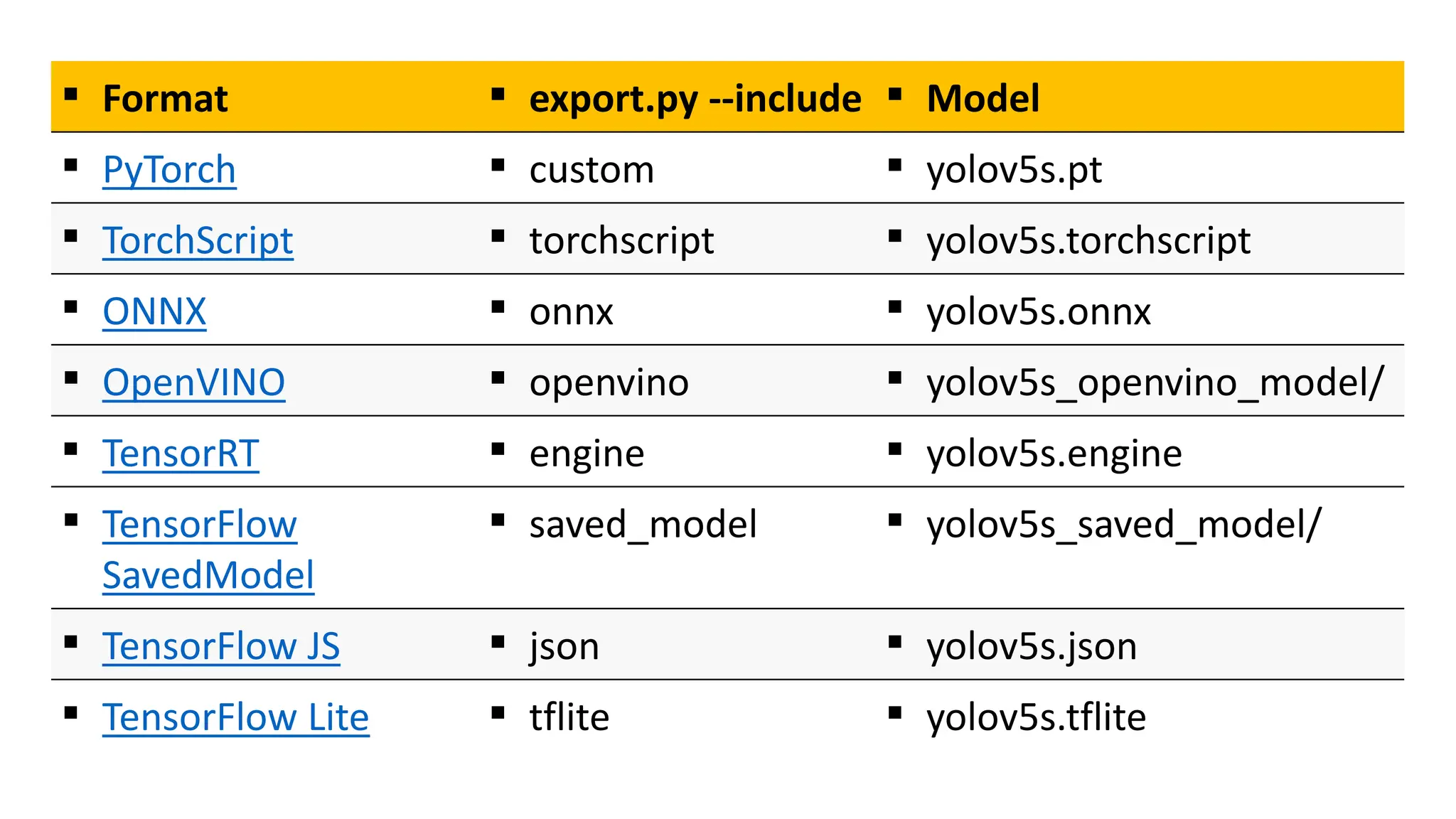
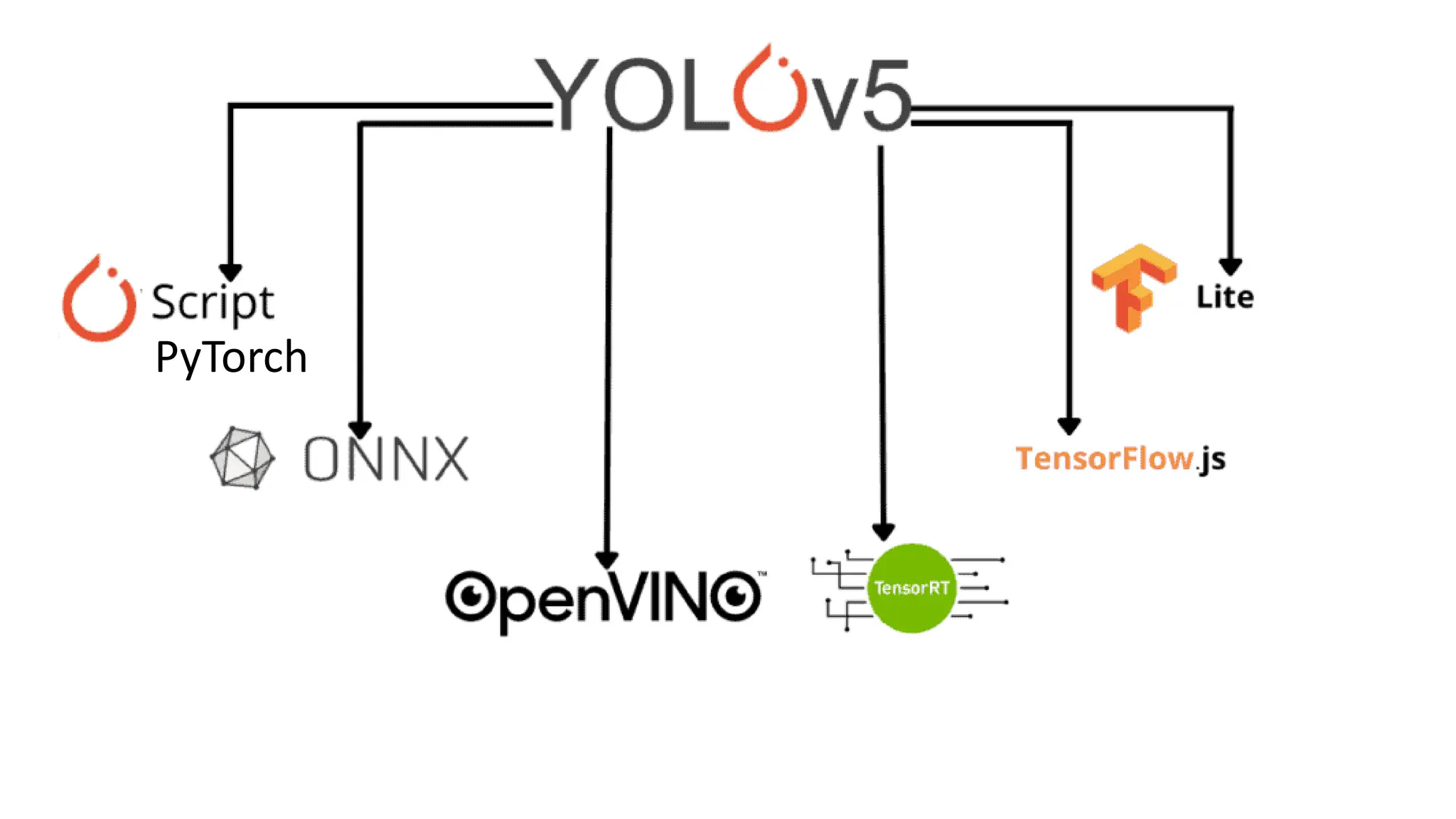
 Format  export.py --include  Model
 PyTorch  custom  yolov5s.pt
 TorchScript  torchscript  yolov5s.torchscript
 ONNX  onnx  yolov5s.onnx
 OpenVINO  openvino  yolov5s_openvino_model/
 TensorRT  engine  yolov5s.engine
 TensorFlow
SavedModel
 saved_model  yolov5s_saved_model/
 TensorFlow JS  json  yolov5s.json
 TensorFlow Lite  tflite  yolov5s.tflite
PyTorch
Import cv2
import torch
Import numpy as np
# Model
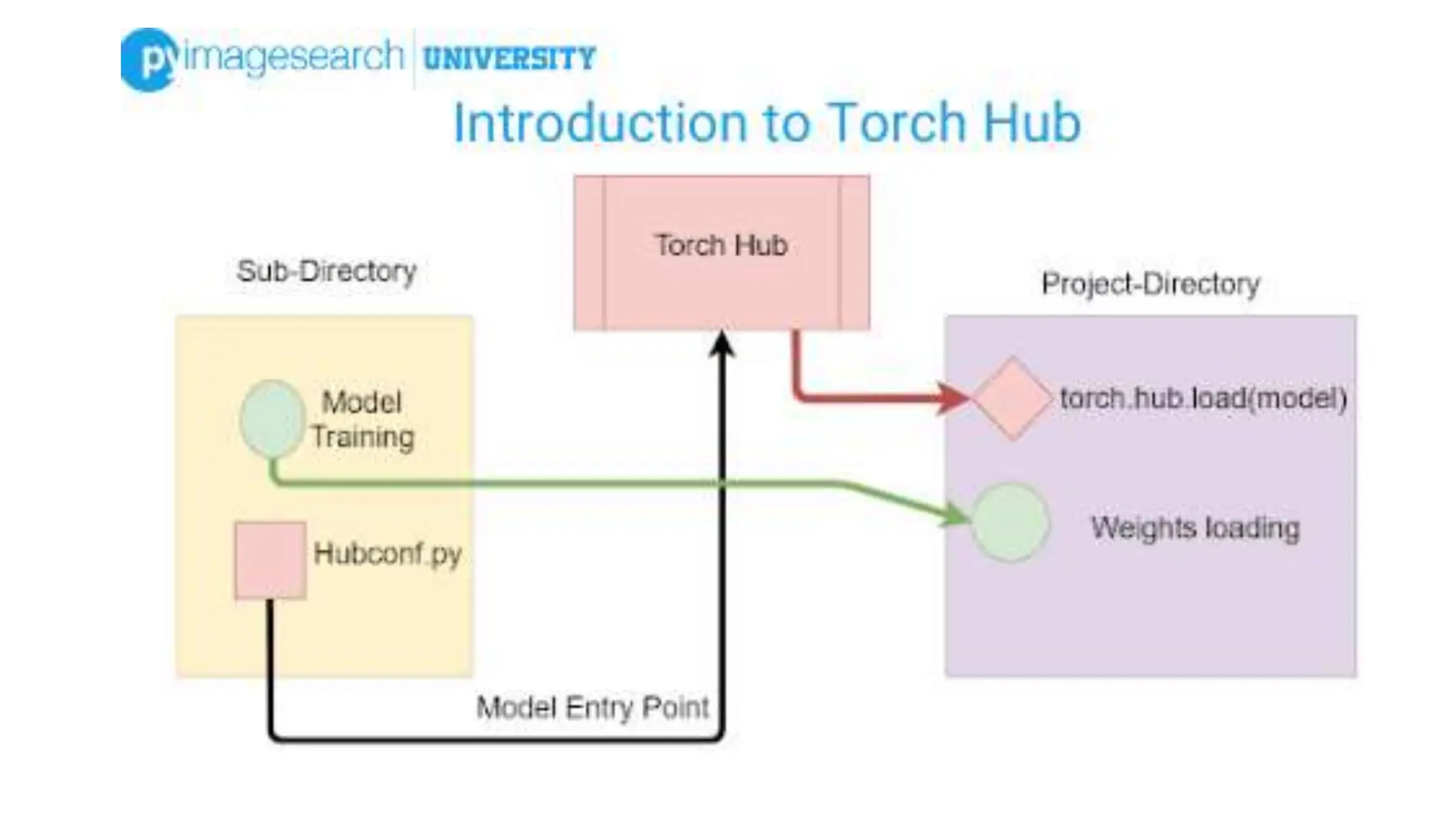
model = torch.hub.load('ultralytics/yolov5', 'yolov5s', pretrained=True)
model = torch.hub.load('ultralytics/yolov5’, ‘custom’, path=’best.pt')
# Images
imgs = ['https://ultralytics.com/images/zidane.jpg'] # batch of images
# Inference
results = model(imgs)
# Results
results.print()
results.save()
results.show()
results.xyxy[0] # img1 predictions (tensor)
results.pandas().xyxy[0] # img1 predictions (pandas)
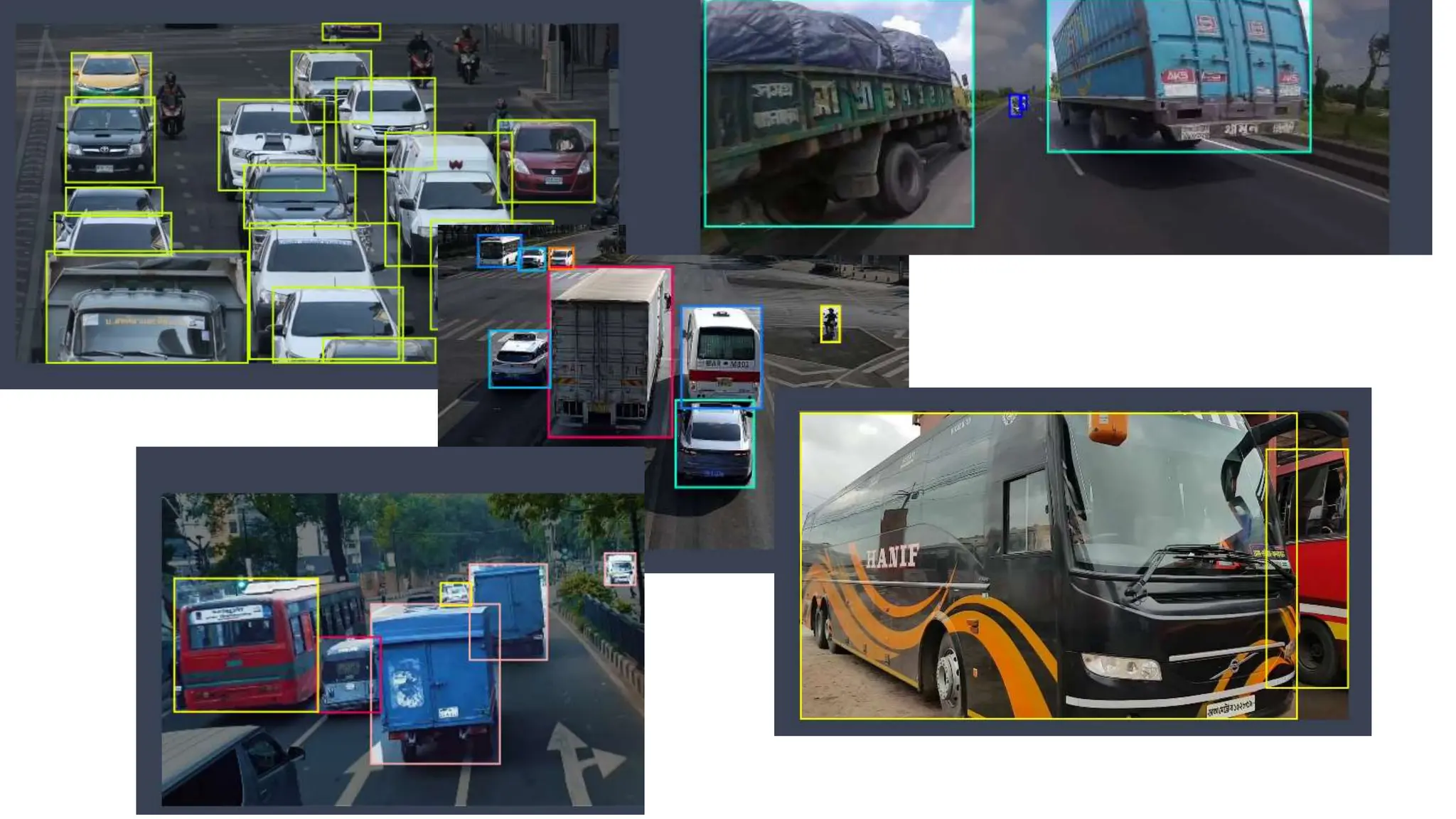
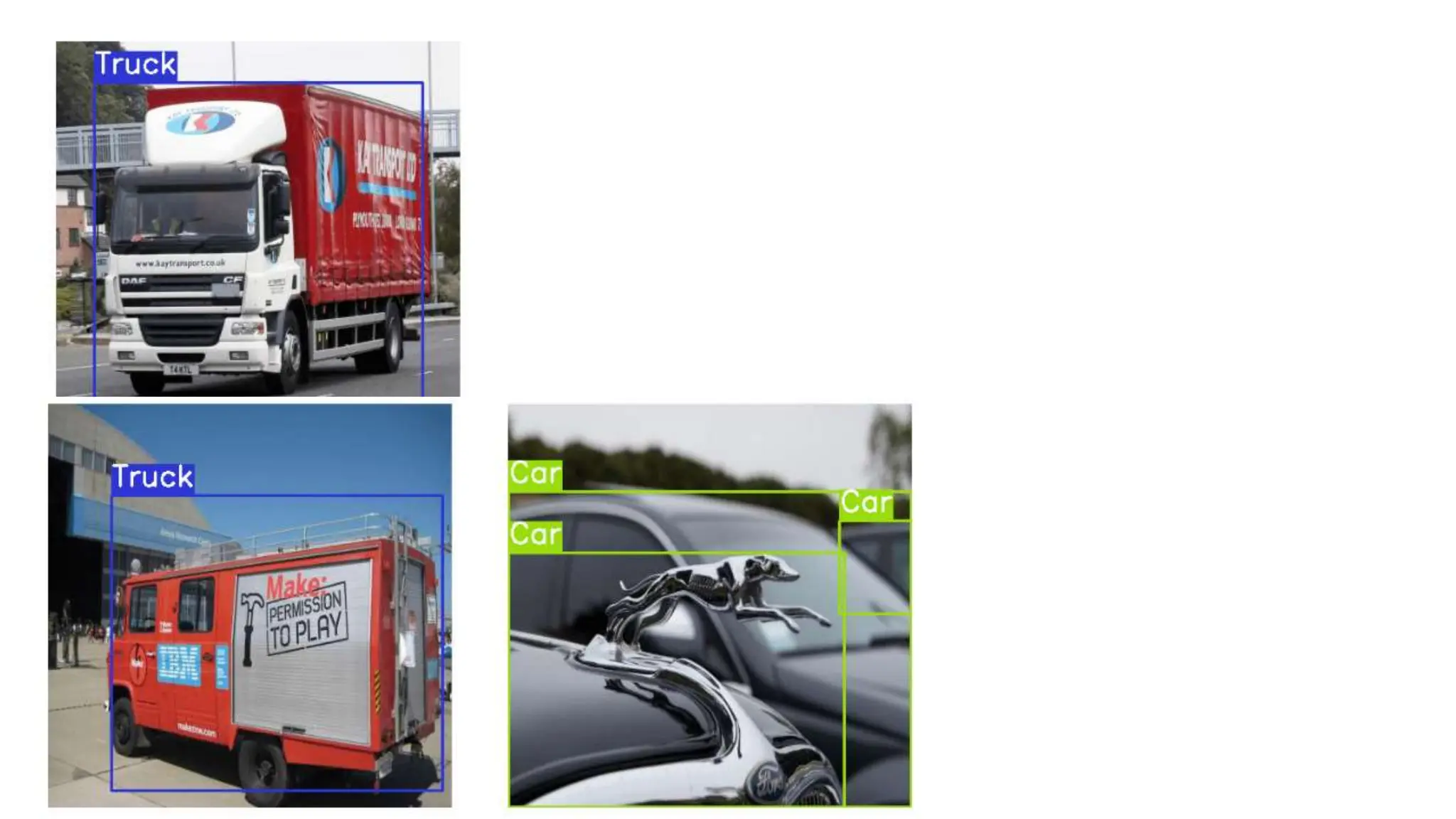
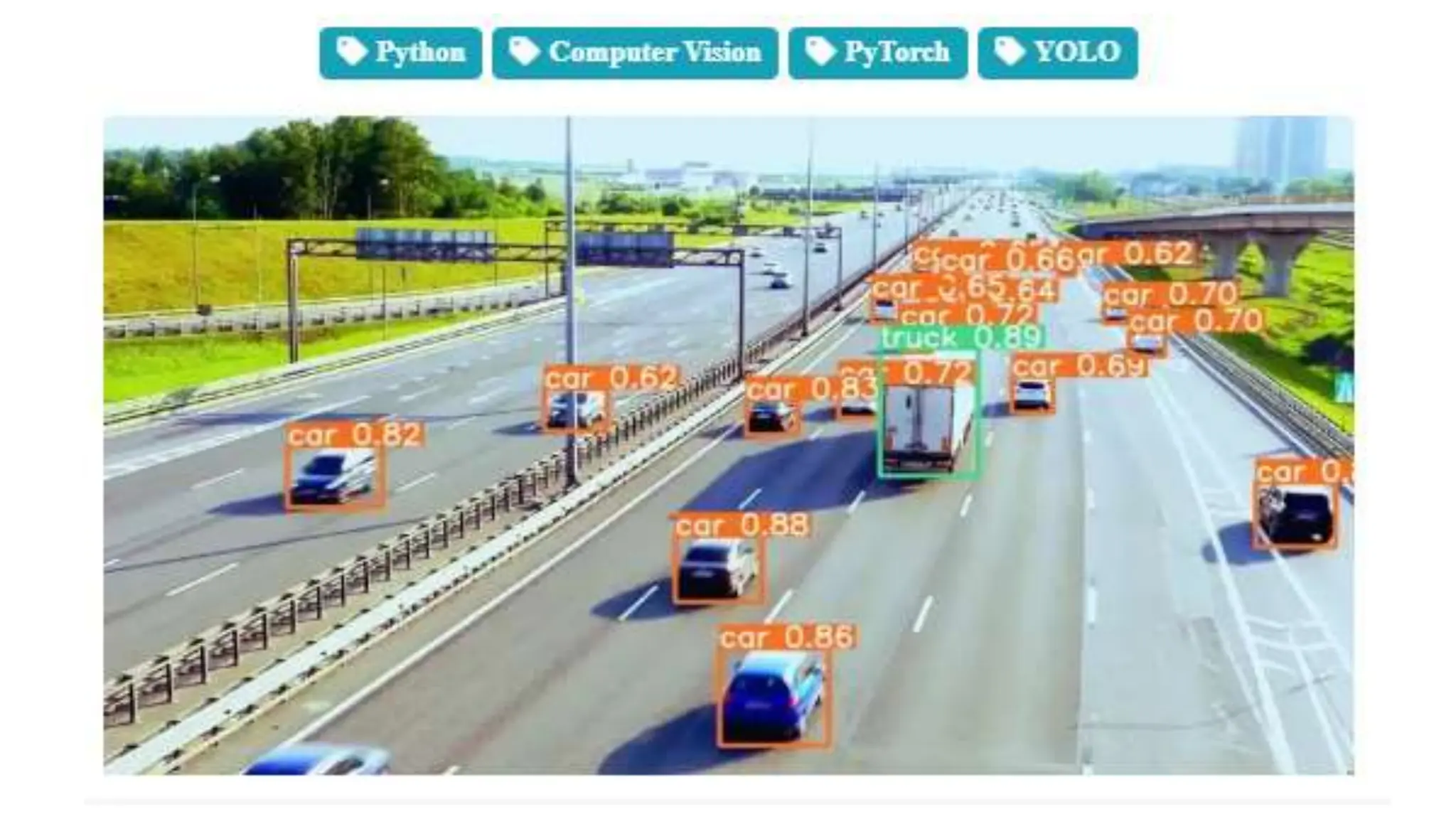
Object detection is a computer vision task that involves identifying and localizing objects
in an image or video. It is a challenging task that requires both localizing objects in the
image and classifying what type of object has been detected.
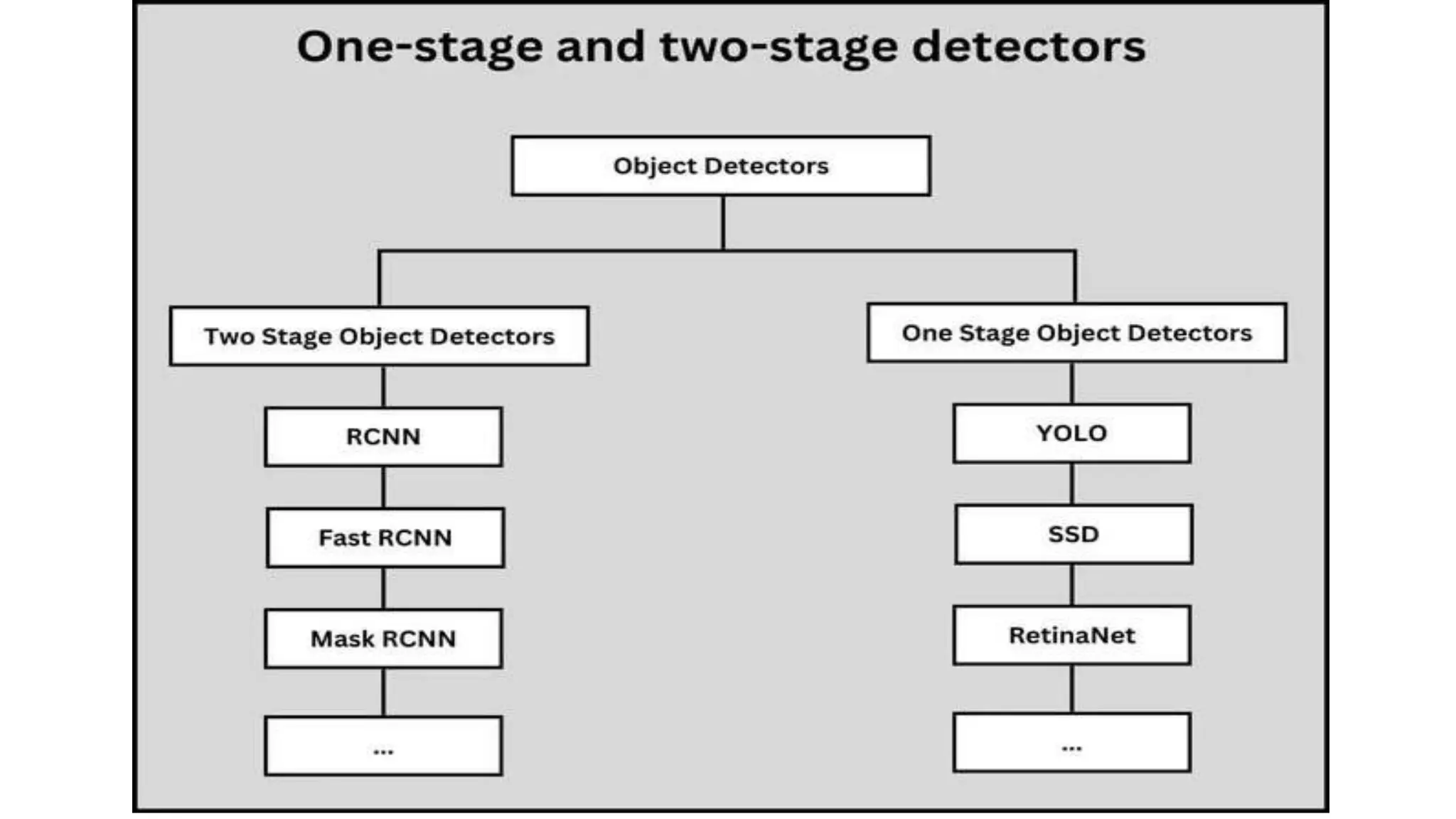
There are primarily two types of deep learning-based object detection algorithms: one-
stage and two-stage detectors.
One-stage detectors, such as YOLO, SSD, and RetinaNet, directly predict bounding
boxes and class probabilities in a single pass. These algorithms are much faster than
two-stage detectors, but they are less accurate.
Two-stage detectors, such as RCNN, Faster R-CNN, and Mask R-CNN, use two
networks: The first network, called a region proposal network (RPN), proposes regions
where objects are likely to be present. The second network (a classifier) classifies the
proposed regions into different classes of objects
YOLO datasets pytorch.pptx

YOLO datasets pytorch.pptx

  • 6.
     Format export.py --include  Model  PyTorch  custom  yolov5s.pt  TorchScript  torchscript  yolov5s.torchscript  ONNX  onnx  yolov5s.onnx  OpenVINO  openvino  yolov5s_openvino_model/  TensorRT  engine  yolov5s.engine  TensorFlow SavedModel  saved_model  yolov5s_saved_model/  TensorFlow JS  json  yolov5s.json  TensorFlow Lite  tflite  yolov5s.tflite
  • 8.
  • 15.
    Import cv2 import torch Importnumpy as np # Model model = torch.hub.load('ultralytics/yolov5', 'yolov5s', pretrained=True) model = torch.hub.load('ultralytics/yolov5’, ‘custom’, path=’best.pt') # Images imgs = ['https://ultralytics.com/images/zidane.jpg'] # batch of images # Inference results = model(imgs) # Results results.print() results.save() results.show() results.xyxy[0] # img1 predictions (tensor) results.pandas().xyxy[0] # img1 predictions (pandas)
  • 16.
    Object detection isa computer vision task that involves identifying and localizing objects in an image or video. It is a challenging task that requires both localizing objects in the image and classifying what type of object has been detected. There are primarily two types of deep learning-based object detection algorithms: one- stage and two-stage detectors. One-stage detectors, such as YOLO, SSD, and RetinaNet, directly predict bounding boxes and class probabilities in a single pass. These algorithms are much faster than two-stage detectors, but they are less accurate. Two-stage detectors, such as RCNN, Faster R-CNN, and Mask R-CNN, use two networks: The first network, called a region proposal network (RPN), proposes regions where objects are likely to be present. The second network (a classifier) classifies the proposed regions into different classes of objects