By:
Yifan Shen
•   Revolve- The spinning around the sun.
•   Rotate- Spinning around itself, not around another thing.
•   Orbit- Going around an object.
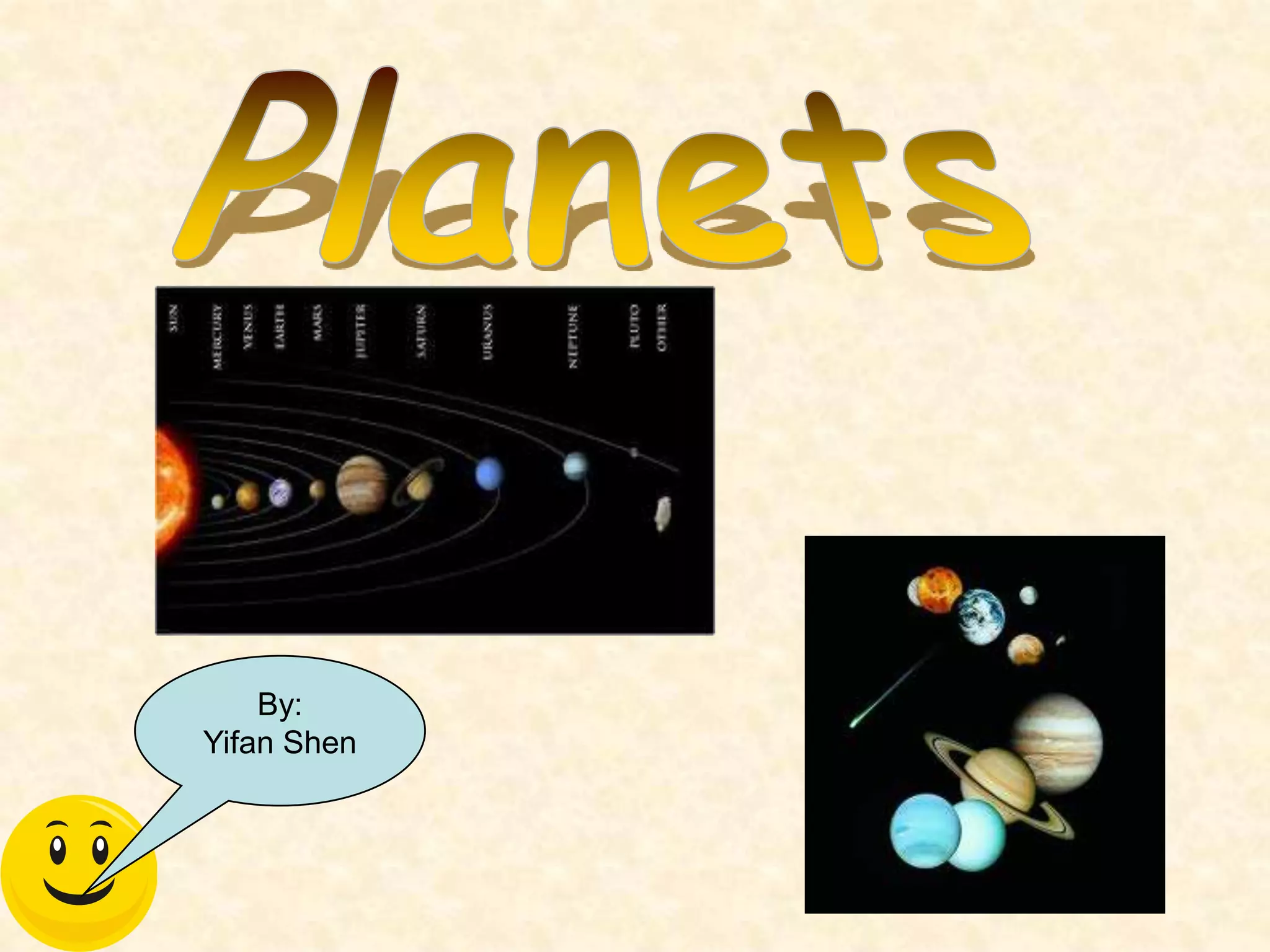
•   8 planets found (excluding dwarf planets.)
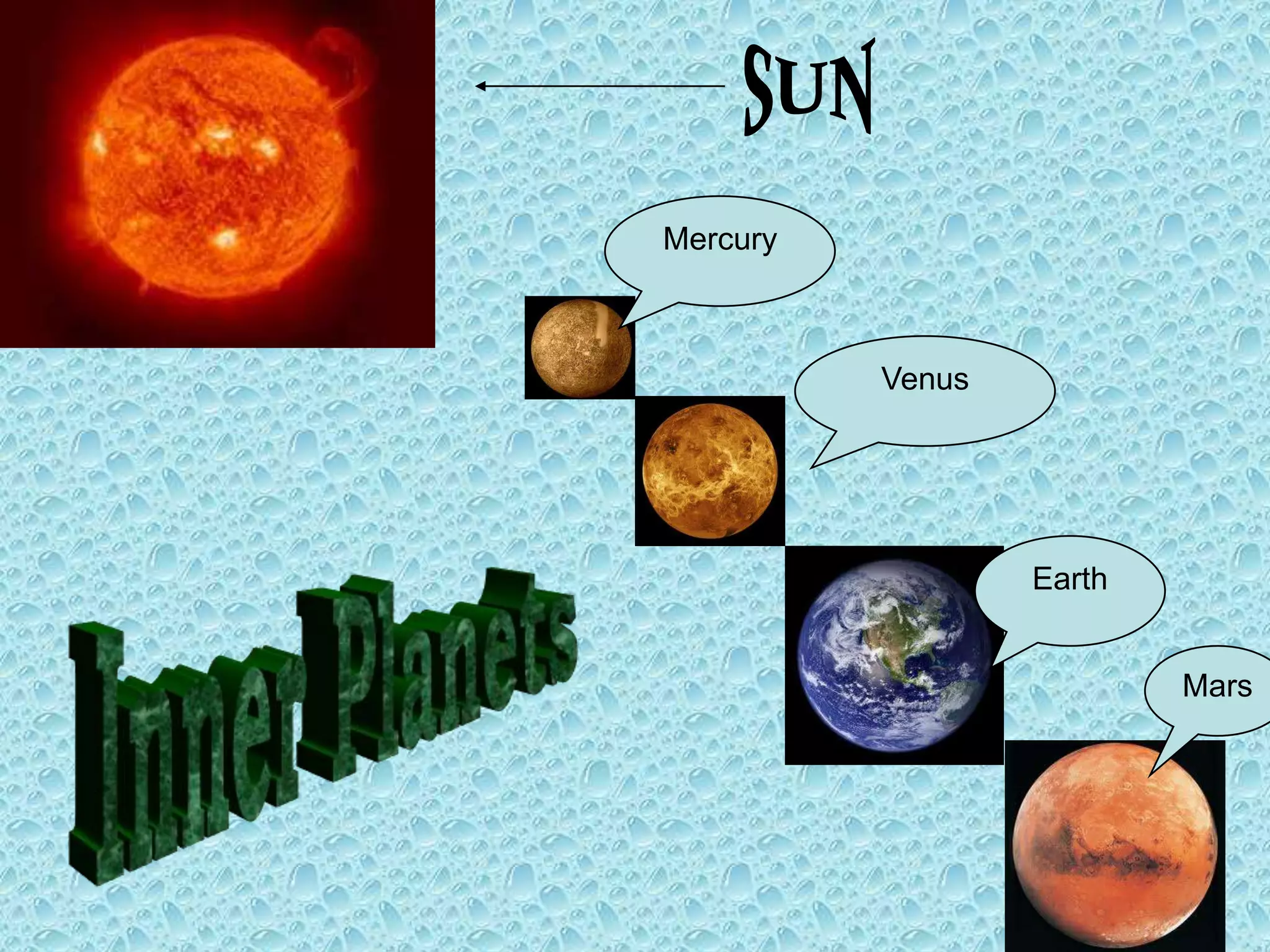
Mercury


          Venus


                  Earth


                          Mars
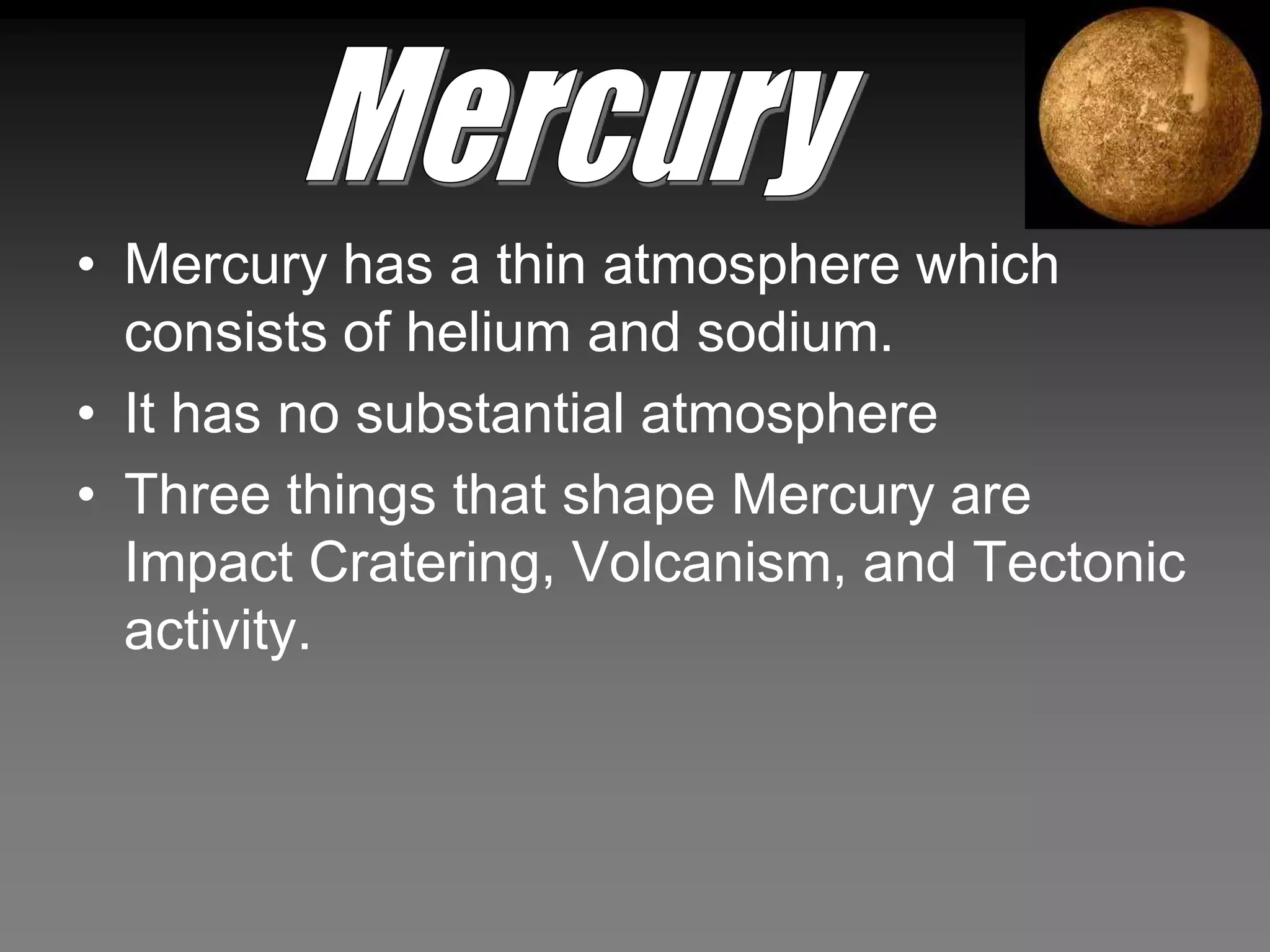
• Mercury has a thin atmosphere which
  consists of helium and sodium.
• It has no substantial atmosphere
• Three things that shape Mercury are
  Impact Cratering, Volcanism, and Tectonic
  activity.
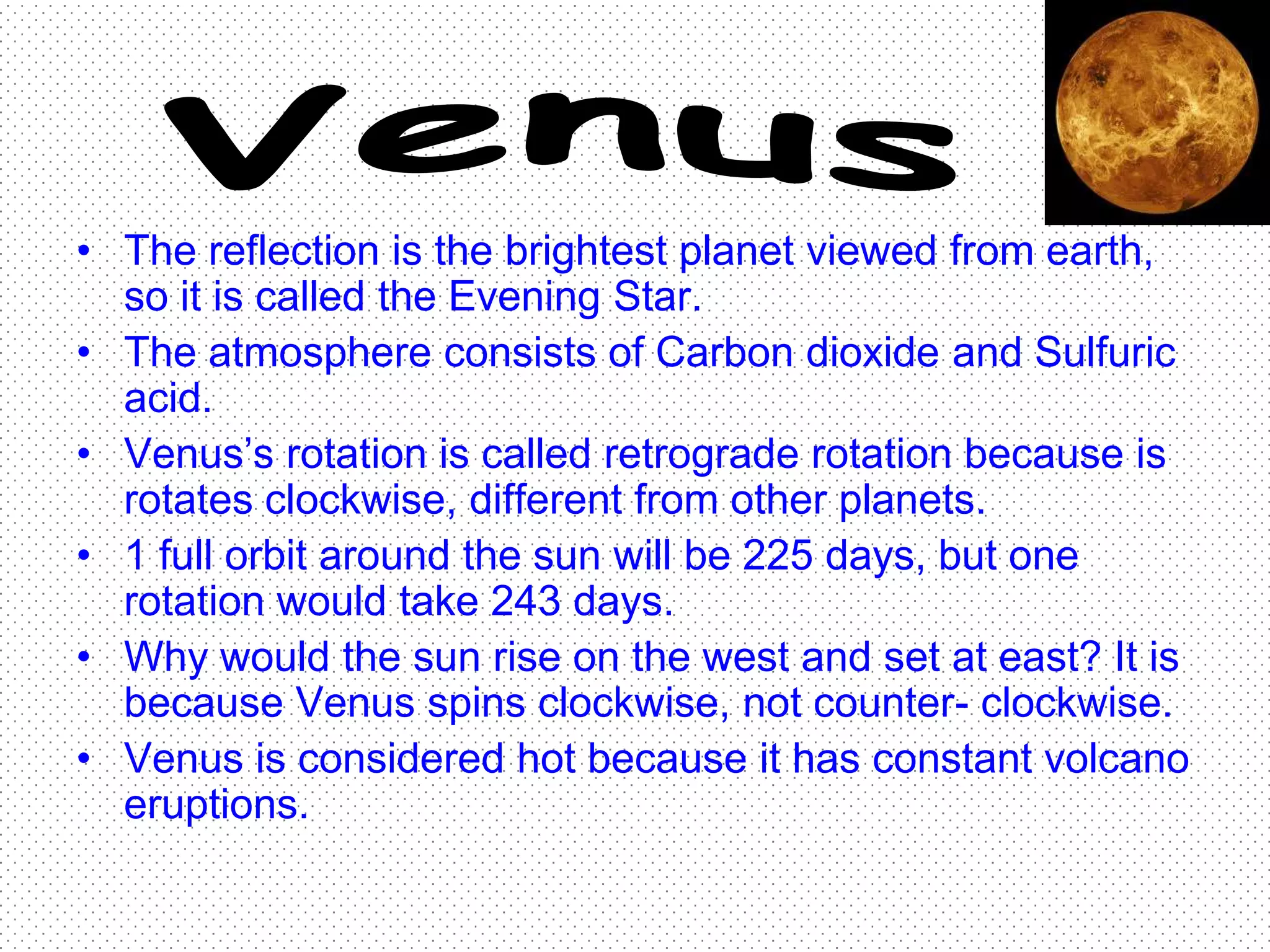
• The reflection is the brightest planet viewed from earth,
  so it is called the Evening Star.
• The atmosphere consists of Carbon dioxide and Sulfuric
  acid.
• Venus’s rotation is called retrograde rotation because is
  rotates clockwise, different from other planets.
• 1 full orbit around the sun will be 225 days, but one
  rotation would take 243 days.
• Why would the sun rise on the west and set at east? It is
  because Venus spins clockwise, not counter- clockwise.
• Venus is considered hot because it has constant volcano
  eruptions.
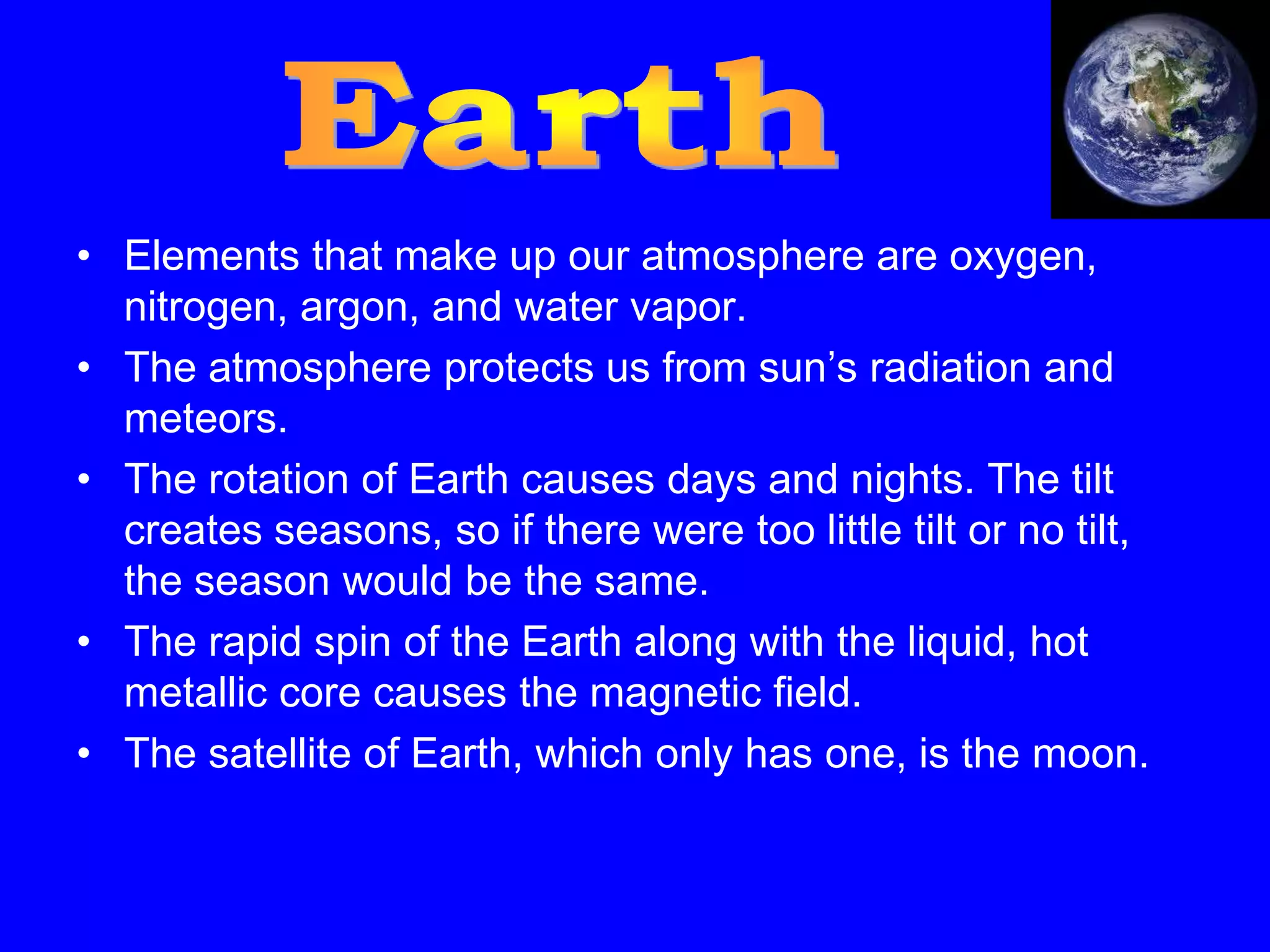
• Elements that make up our atmosphere are oxygen,
  nitrogen, argon, and water vapor.
• The atmosphere protects us from sun’s radiation and
  meteors.
• The rotation of Earth causes days and nights. The tilt
  creates seasons, so if there were too little tilt or no tilt,
  the season would be the same.
• The rapid spin of the Earth along with the liquid, hot
  metallic core causes the magnetic field.
• The satellite of Earth, which only has one, is the moon.
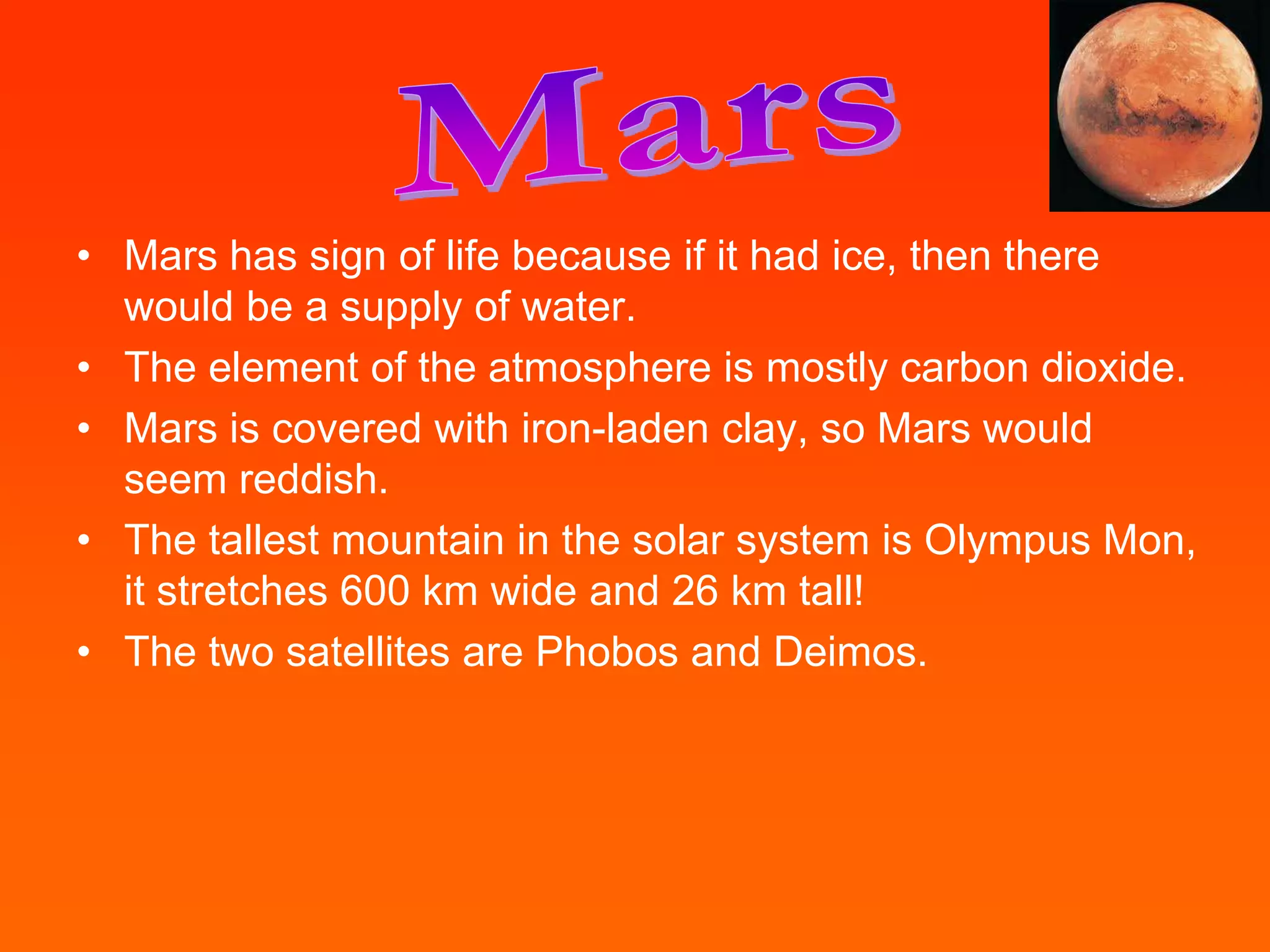
• Mars has sign of life because if it had ice, then there
  would be a supply of water.
• The element of the atmosphere is mostly carbon dioxide.
• Mars is covered with iron-laden clay, so Mars would
  seem reddish.
• The tallest mountain in the solar system is Olympus Mon,
  it stretches 600 km wide and 26 km tall!
• The two satellites are Phobos and Deimos.
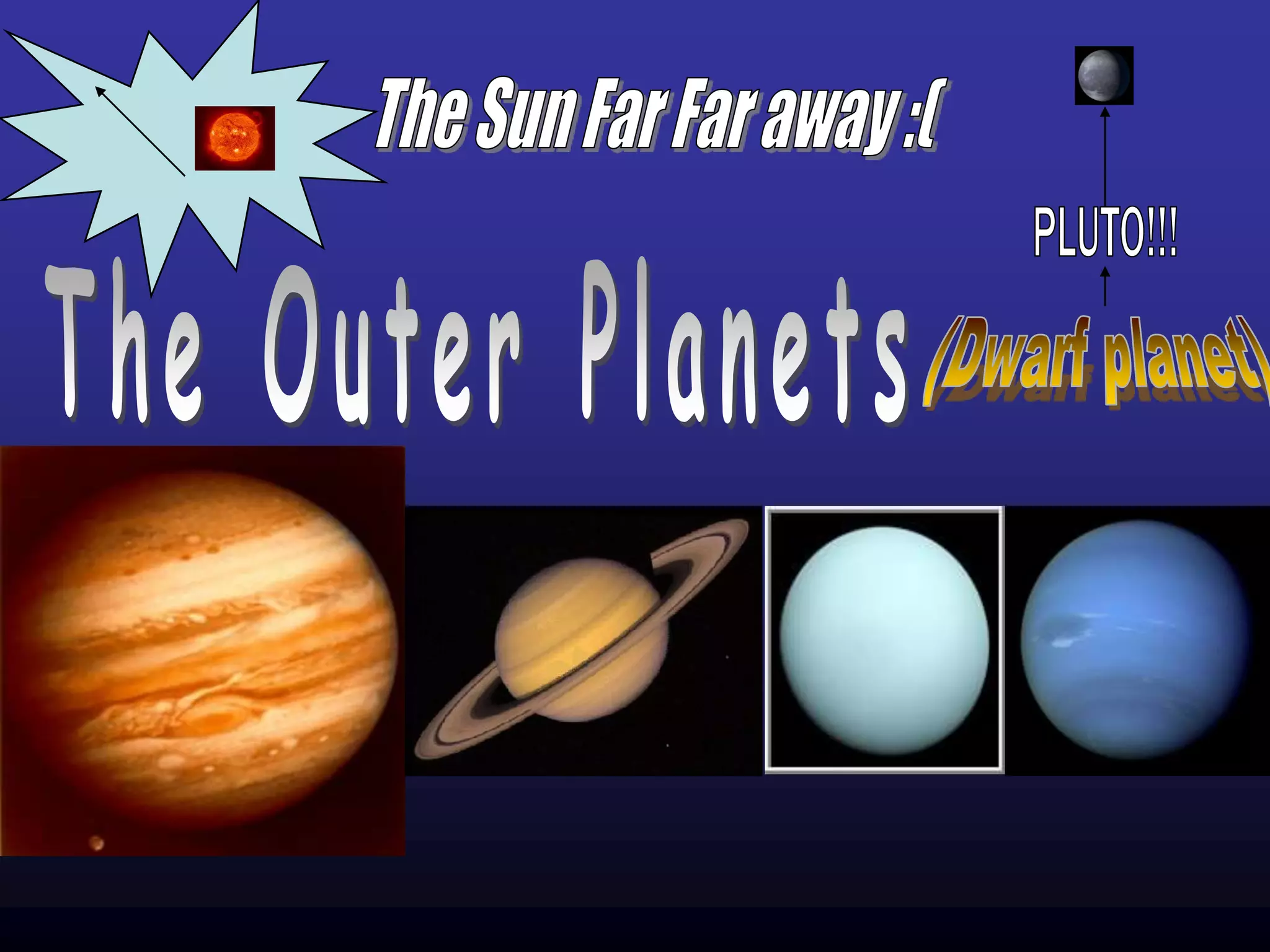
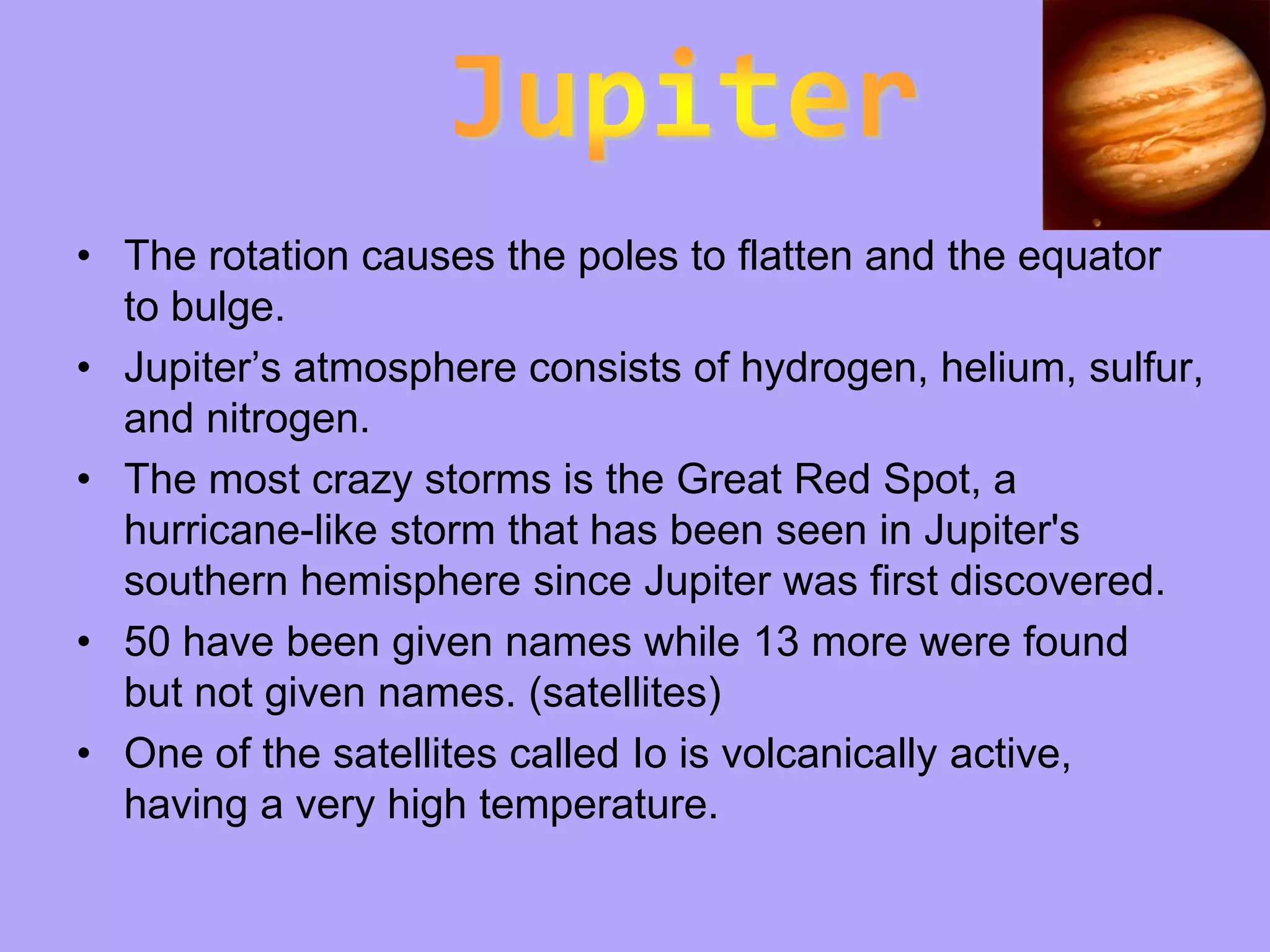
• The rotation causes the poles to flatten and the equator
  to bulge.
• Jupiter’s atmosphere consists of hydrogen, helium, sulfur,
  and nitrogen.
• The most crazy storms is the Great Red Spot, a
  hurricane-like storm that has been seen in Jupiter's
  southern hemisphere since Jupiter was first discovered.
• 50 have been given names while 13 more were found
  but not given names. (satellites)
• One of the satellites called Io is volcanically active,
  having a very high temperature.
• The atmosphere consists of hydrogen and helium.
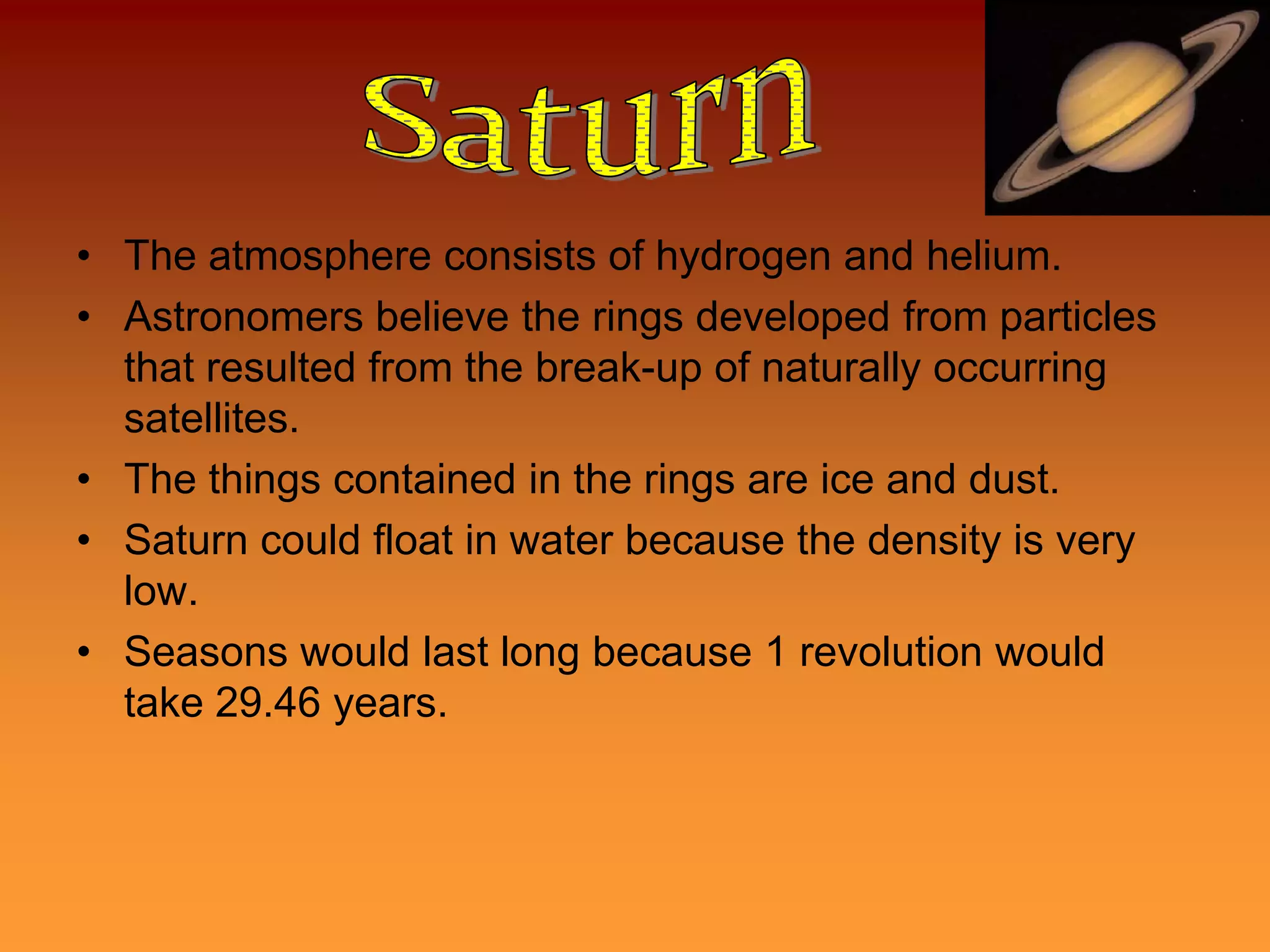
• Astronomers believe the rings developed from particles
  that resulted from the break-up of naturally occurring
  satellites.
• The things contained in the rings are ice and dust.
• Saturn could float in water because the density is very
  low.
• Seasons would last long because 1 revolution would
  take 29.46 years.
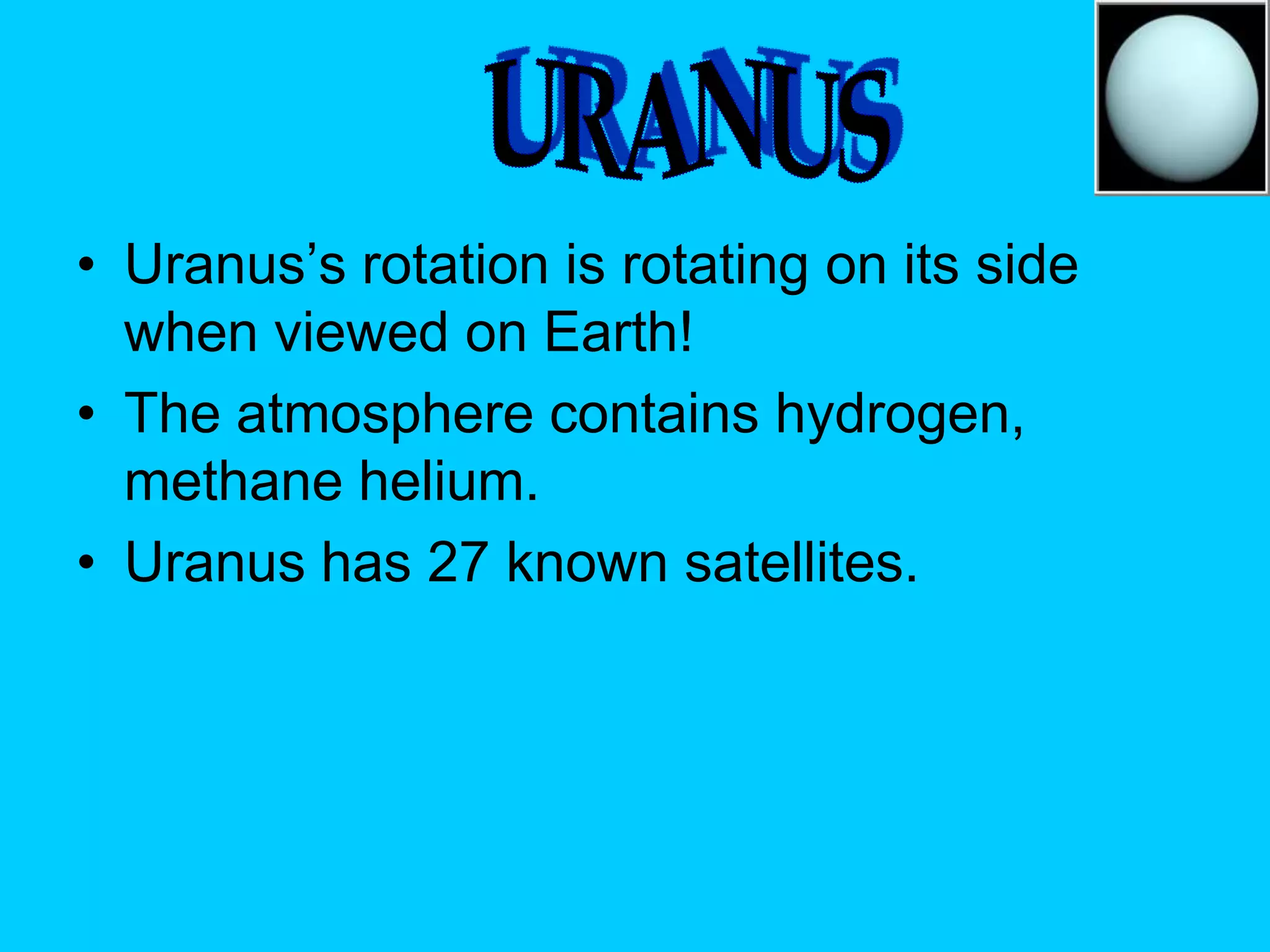
• Uranus’s rotation is rotating on its side
  when viewed on Earth!
• The atmosphere contains hydrogen,
  methane helium.
• Uranus has 27 known satellites.
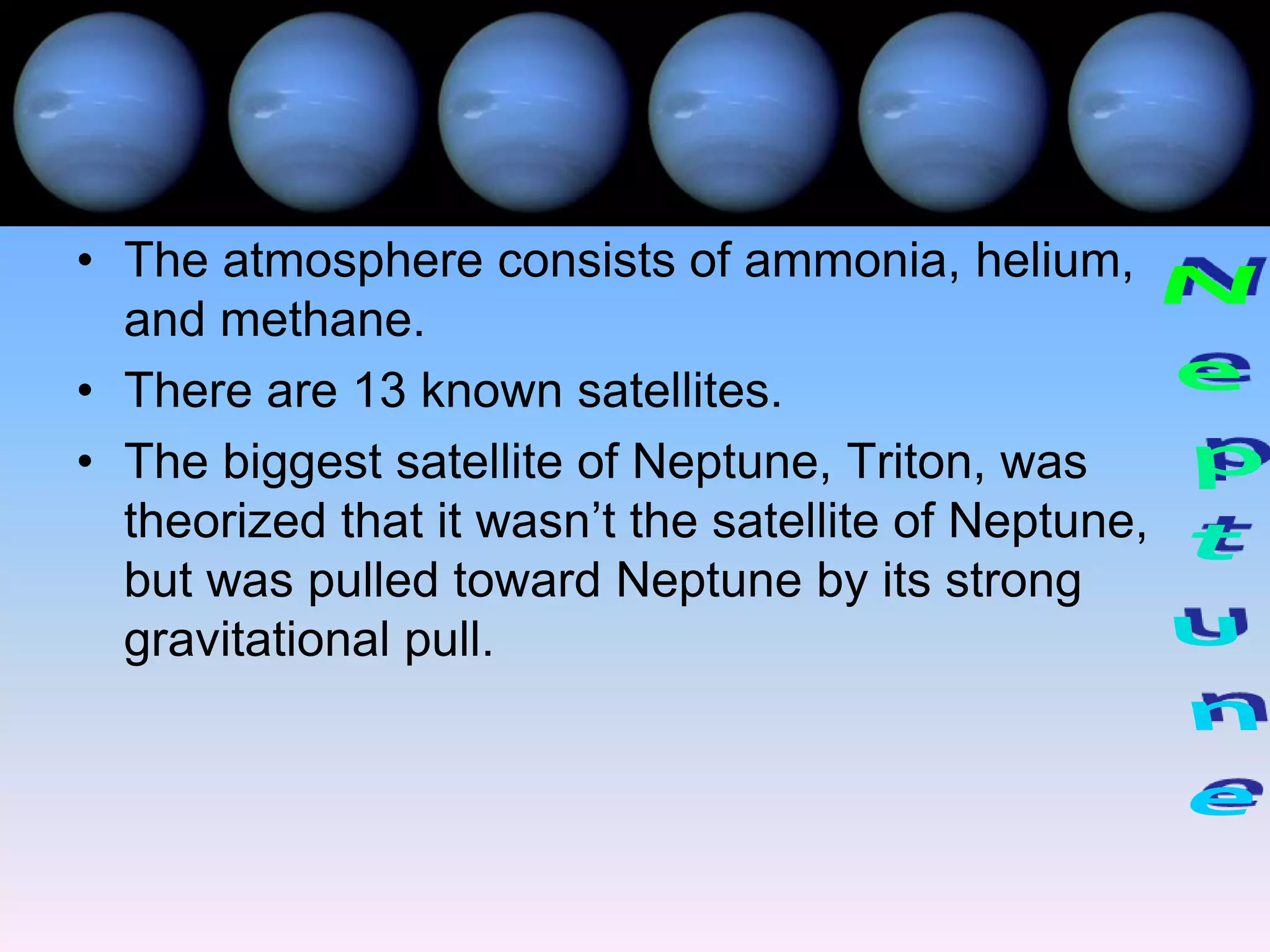
• The atmosphere consists of ammonia, helium,
  and methane.
• There are 13 known satellites.
• The biggest satellite of Neptune, Triton, was
  theorized that it wasn’t the satellite of Neptune,
  but was pulled toward Neptune by its strong
  gravitational pull.
Pluto!
         Ceres!
                  Eris!
• The name of the 3 moons of Pluto is Nix,
  Charon, Hydra.
• Using a spectroscope, scientists have
  seen methane and water vapor on Charon.
• Charon appears to be more blue in color
  than Pluto.
• It takes 4.6 Earth Years for 1 revolution.
• It was considered an asteroid because it
  was in the asteroid belt.
• Its surface is probably covered with a
  mixture of water ice, carbonates, and clays.
•   It was originally named Xena.
•   It takes 557 Earth years for 1 revolution.
•   The name of Eris’s moon is Dysnomia.
•   It didn’t have the rights to be a planet.
• Thanks to: WEEBLY, STARCHILD, AND
  EVERYTHING ELSE THAT HAS HELPED
  ME. YAY!
Yifan planets

Yifan planets

  • 1.
  • 2.
    Revolve- The spinning around the sun. • Rotate- Spinning around itself, not around another thing. • Orbit- Going around an object. • 8 planets found (excluding dwarf planets.)
  • 3.
    Mercury Venus Earth Mars
  • 4.
    • Mercury hasa thin atmosphere which consists of helium and sodium. • It has no substantial atmosphere • Three things that shape Mercury are Impact Cratering, Volcanism, and Tectonic activity.
  • 5.
    • The reflectionis the brightest planet viewed from earth, so it is called the Evening Star. • The atmosphere consists of Carbon dioxide and Sulfuric acid. • Venus’s rotation is called retrograde rotation because is rotates clockwise, different from other planets. • 1 full orbit around the sun will be 225 days, but one rotation would take 243 days. • Why would the sun rise on the west and set at east? It is because Venus spins clockwise, not counter- clockwise. • Venus is considered hot because it has constant volcano eruptions.
  • 6.
    • Elements thatmake up our atmosphere are oxygen, nitrogen, argon, and water vapor. • The atmosphere protects us from sun’s radiation and meteors. • The rotation of Earth causes days and nights. The tilt creates seasons, so if there were too little tilt or no tilt, the season would be the same. • The rapid spin of the Earth along with the liquid, hot metallic core causes the magnetic field. • The satellite of Earth, which only has one, is the moon.
  • 7.
    • Mars hassign of life because if it had ice, then there would be a supply of water. • The element of the atmosphere is mostly carbon dioxide. • Mars is covered with iron-laden clay, so Mars would seem reddish. • The tallest mountain in the solar system is Olympus Mon, it stretches 600 km wide and 26 km tall! • The two satellites are Phobos and Deimos.
  • 9.
    • The rotationcauses the poles to flatten and the equator to bulge. • Jupiter’s atmosphere consists of hydrogen, helium, sulfur, and nitrogen. • The most crazy storms is the Great Red Spot, a hurricane-like storm that has been seen in Jupiter's southern hemisphere since Jupiter was first discovered. • 50 have been given names while 13 more were found but not given names. (satellites) • One of the satellites called Io is volcanically active, having a very high temperature.
  • 10.
    • The atmosphereconsists of hydrogen and helium. • Astronomers believe the rings developed from particles that resulted from the break-up of naturally occurring satellites. • The things contained in the rings are ice and dust. • Saturn could float in water because the density is very low. • Seasons would last long because 1 revolution would take 29.46 years.
  • 11.
    • Uranus’s rotationis rotating on its side when viewed on Earth! • The atmosphere contains hydrogen, methane helium. • Uranus has 27 known satellites.
  • 12.
    • The atmosphereconsists of ammonia, helium, and methane. • There are 13 known satellites. • The biggest satellite of Neptune, Triton, was theorized that it wasn’t the satellite of Neptune, but was pulled toward Neptune by its strong gravitational pull.
  • 13.
    Pluto! Ceres! Eris!
  • 14.
    • The nameof the 3 moons of Pluto is Nix, Charon, Hydra. • Using a spectroscope, scientists have seen methane and water vapor on Charon. • Charon appears to be more blue in color than Pluto.
  • 15.
    • It takes4.6 Earth Years for 1 revolution. • It was considered an asteroid because it was in the asteroid belt. • Its surface is probably covered with a mixture of water ice, carbonates, and clays.
  • 16.
    It was originally named Xena. • It takes 557 Earth years for 1 revolution. • The name of Eris’s moon is Dysnomia. • It didn’t have the rights to be a planet.
  • 17.
    • Thanks to:WEEBLY, STARCHILD, AND EVERYTHING ELSE THAT HAS HELPED ME. YAY!