Optimal Learning
for Fun and Profit
Scott Clark, Ph.D.
Yelp Open House
11/20/13

sclark@yelp.com

@DrScottClark
Outline of Talk

● Optimal Learning
○ What is it?
○ Why do we care?
● Multi-armed bandits
○ Definition and motivation
○ Examples
● Bayesian global optimization
○ Optimal experiment design
○ Uses to extend traditional A/B testing
What is optimal learning?

Optimal learning addresses the challenge of
how to collect information as efficiently as
possible, primarily for settings where
collecting information is time consuming
and expensive.
Source: optimallearning.princeton.edu
Part I:
Multi-Armed Bandits
What are multi-armed bandits?

THE SETUP
●
●
●
●

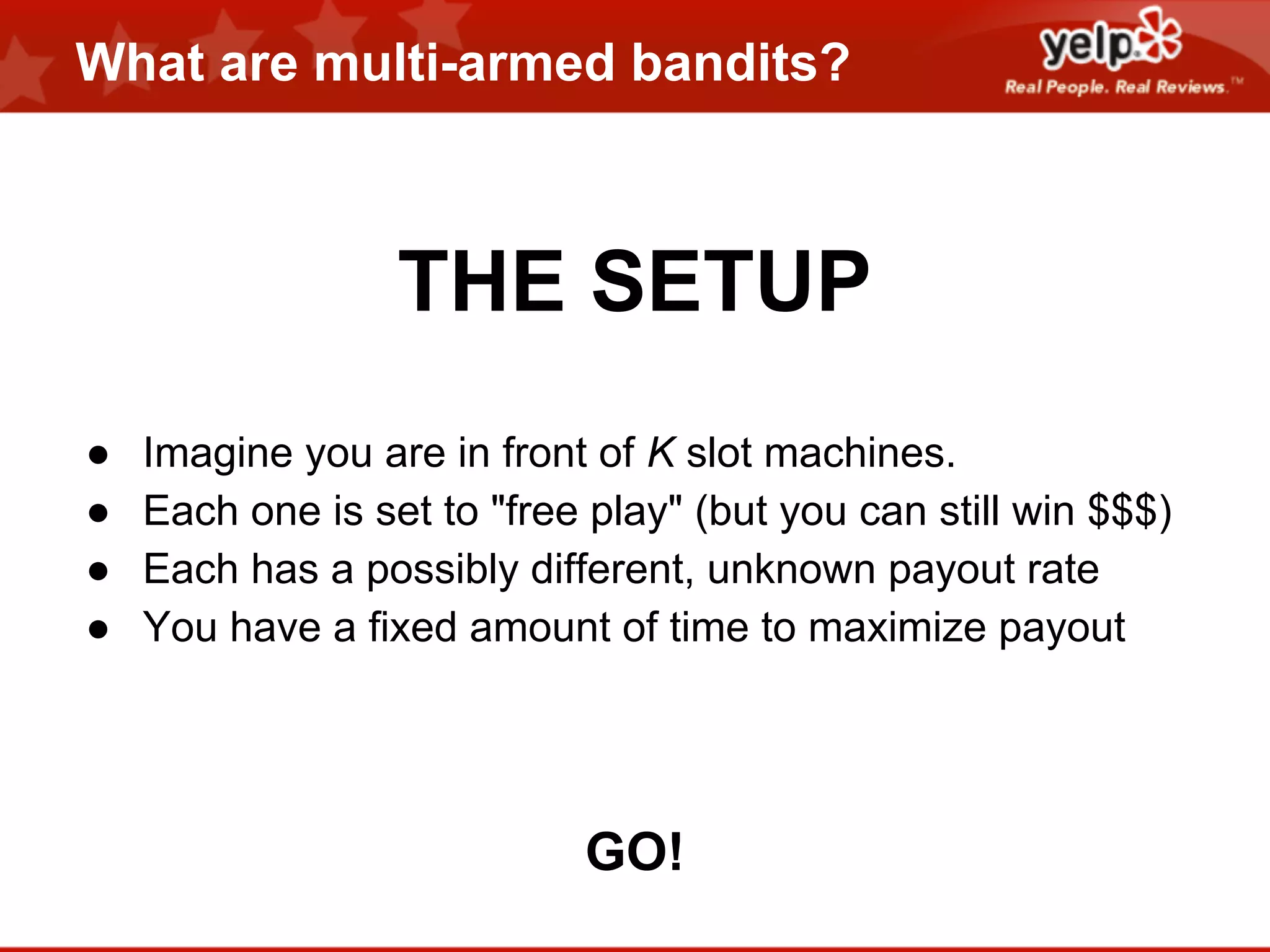
Imagine you are in front of K slot machines.
Each one is set to "free play" (but you can still win $$$)
Each has a possibly different, unknown payout rate
You have a fixed amount of time to maximize payout

GO!
What are multi-armed bandits?

THE SETUP
(math version)

[Robbins 1952]
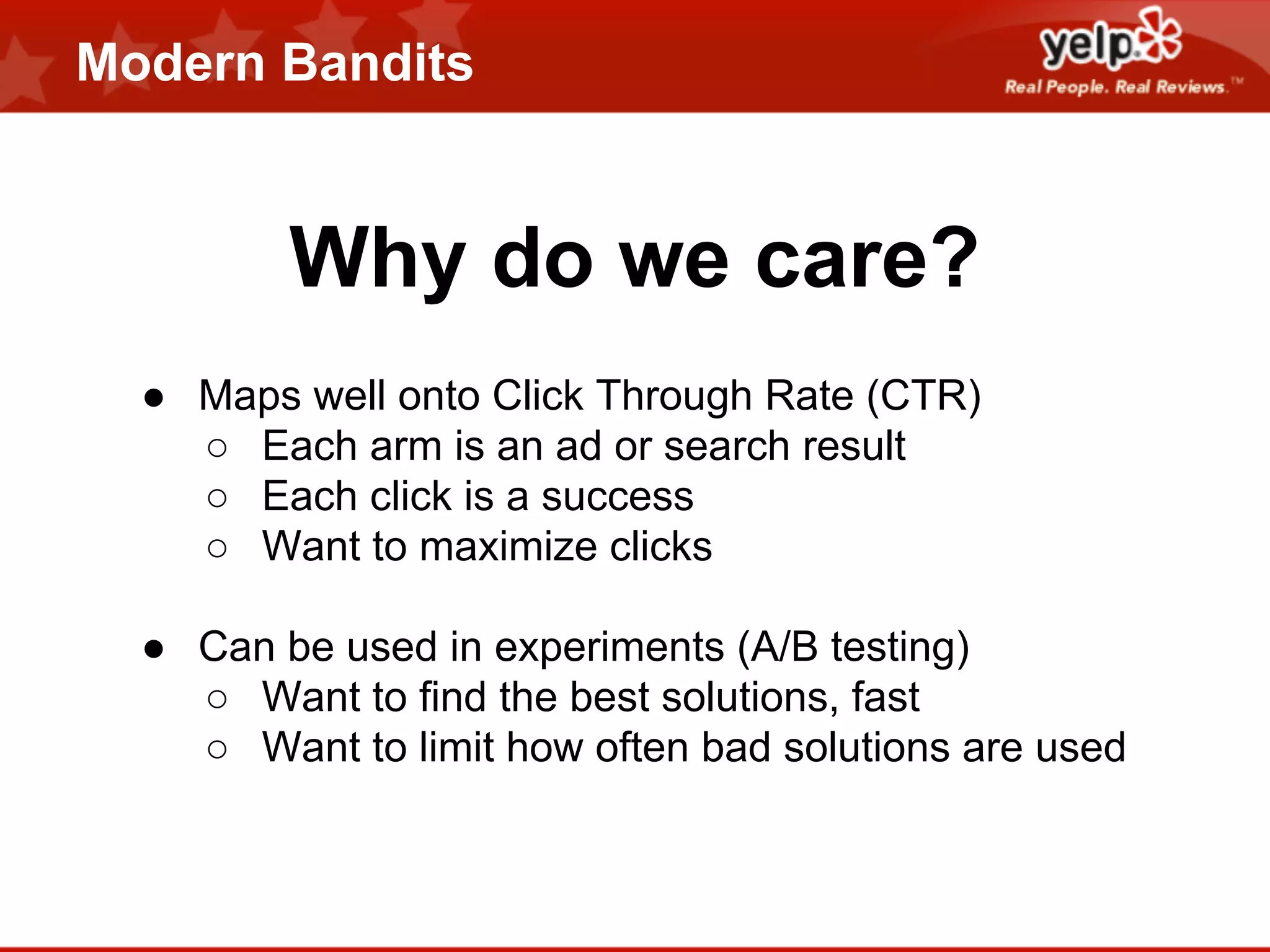
Modern Bandits

Why do we care?
● Maps well onto Click Through Rate (CTR)
○ Each arm is an ad or search result
○ Each click is a success
○ Want to maximize clicks
● Can be used in experiments (A/B testing)
○ Want to find the best solutions, fast
○ Want to limit how often bad solutions are used
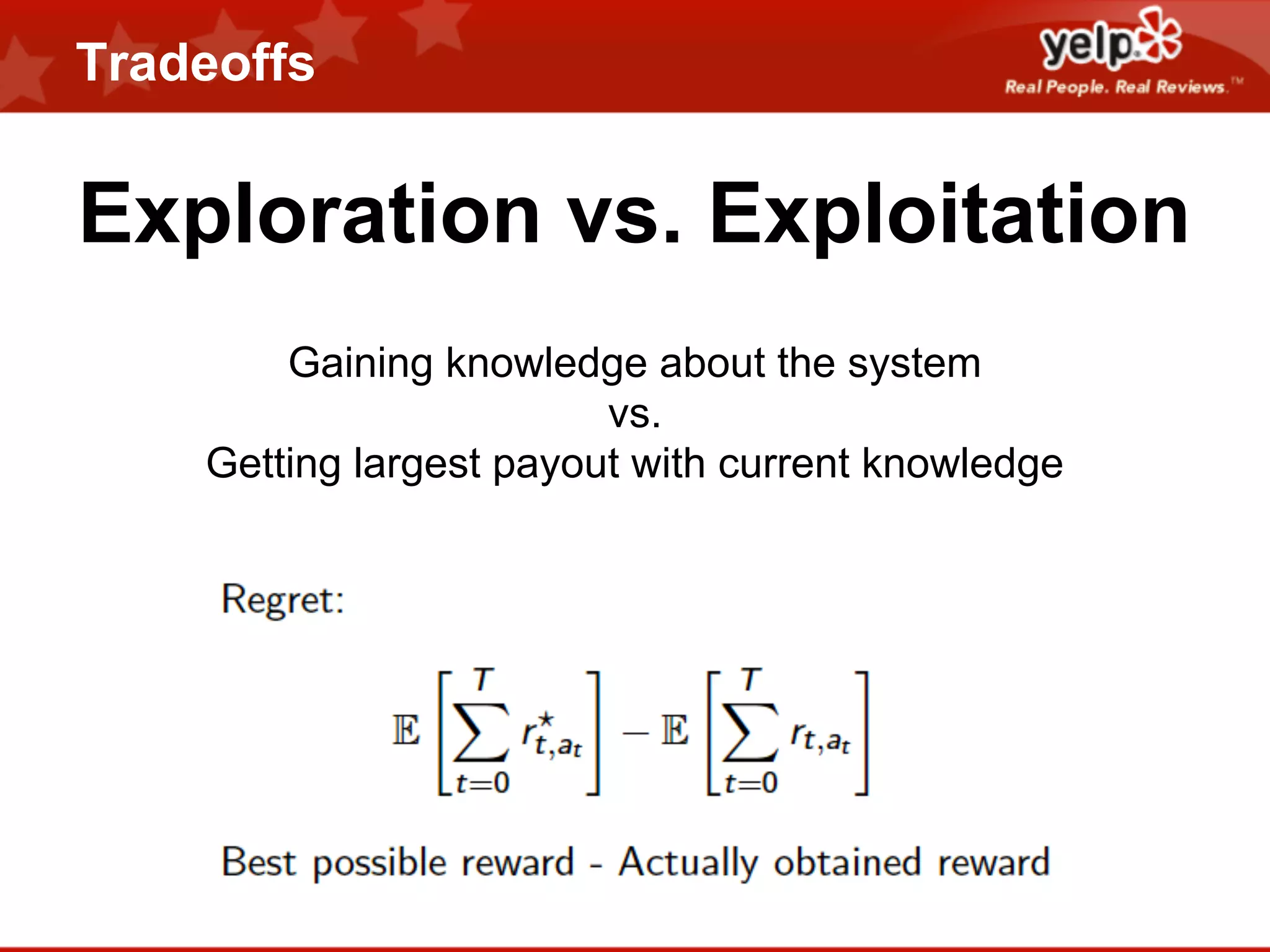
Tradeoffs

Exploration vs. Exploitation
Gaining knowledge about the system
vs.
Getting largest payout with current knowledge
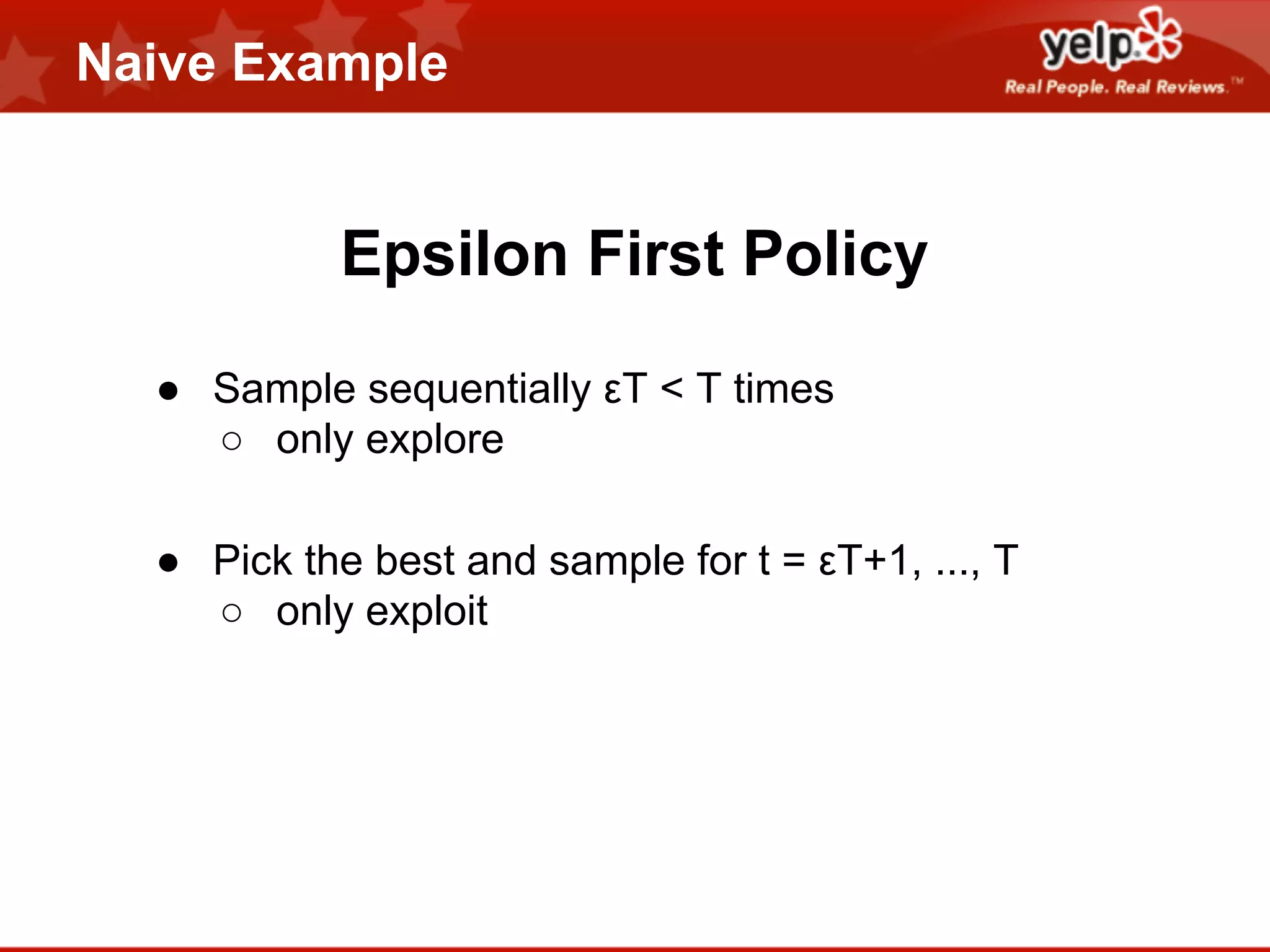
Naive Example

Epsilon First Policy
● Sample sequentially εT < T times
○ only explore
● Pick the best and sample for t = εT+1, ..., T
○ only exploit
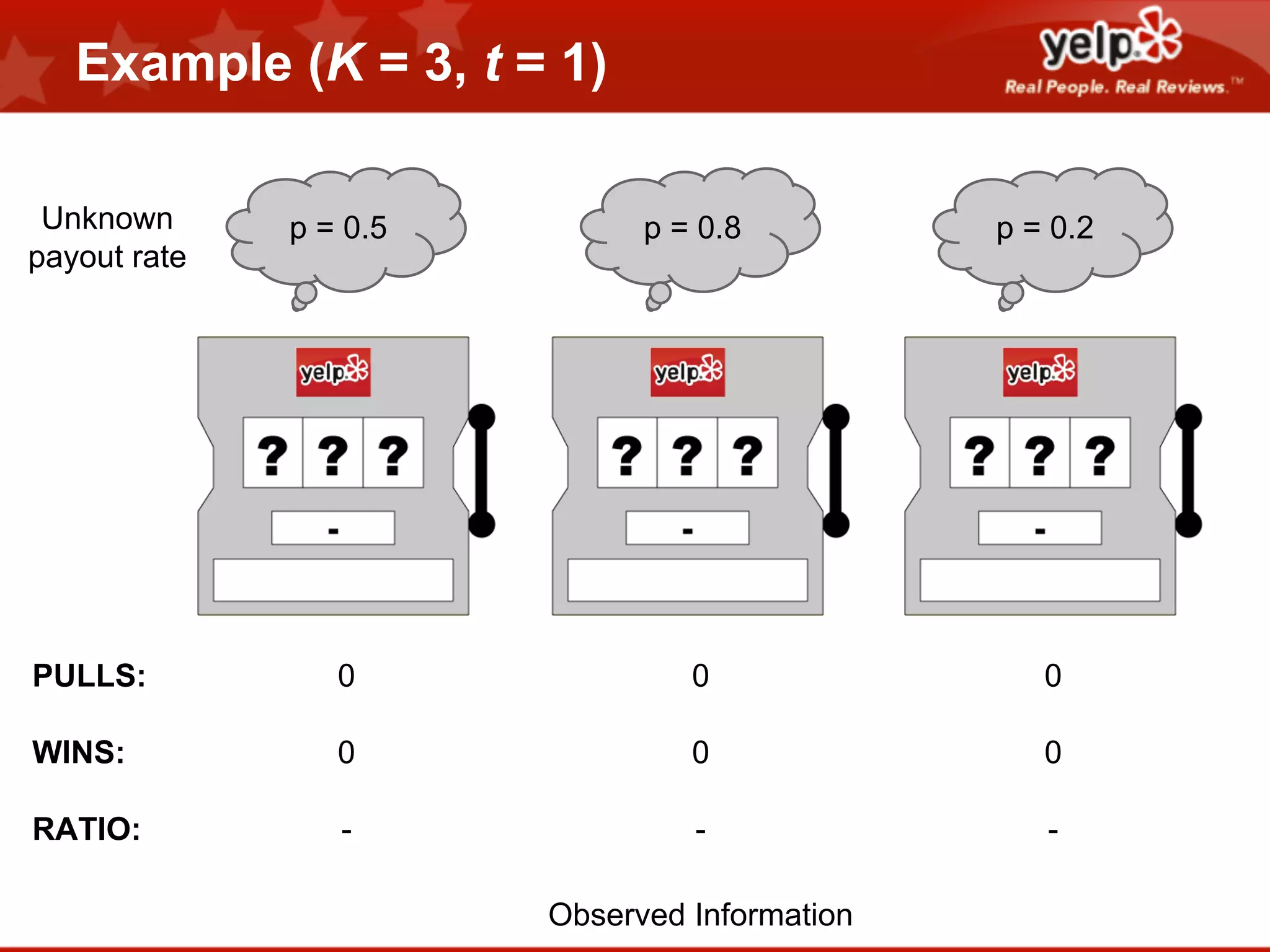
Example (K = 3, t = 1)
Unknown
payout rate

p = 0.5

p = 0.8

p = 0.2

PULLS:

0

0

0

WINS:

0

0

0

RATIO:

-

-

-

Observed Information
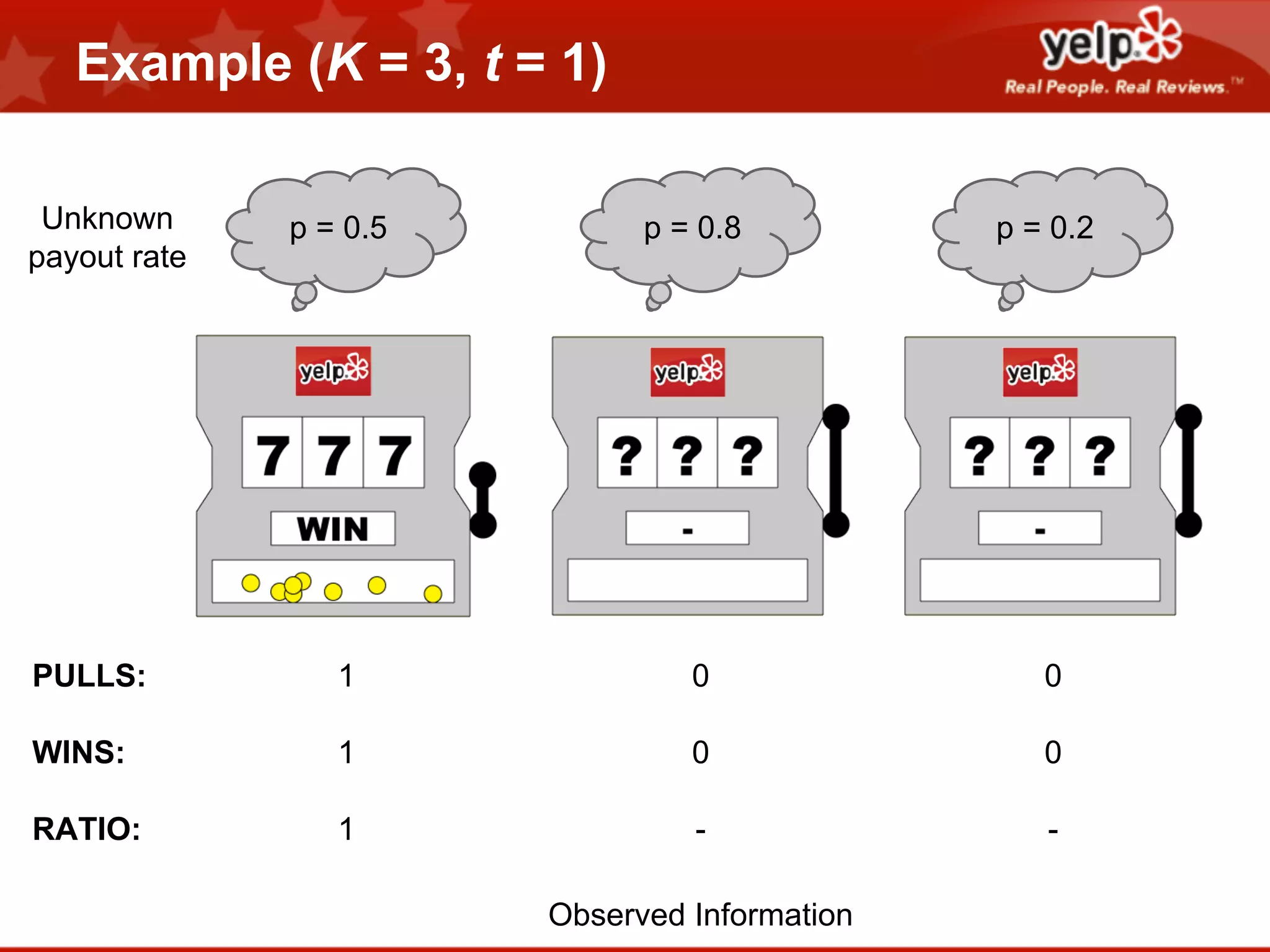
Example (K = 3, t = 1)
Unknown
payout rate

p = 0.5

p = 0.8

p = 0.2

PULLS:

1

0

0

WINS:

1

0

0

RATIO:

1

-

-

Observed Information
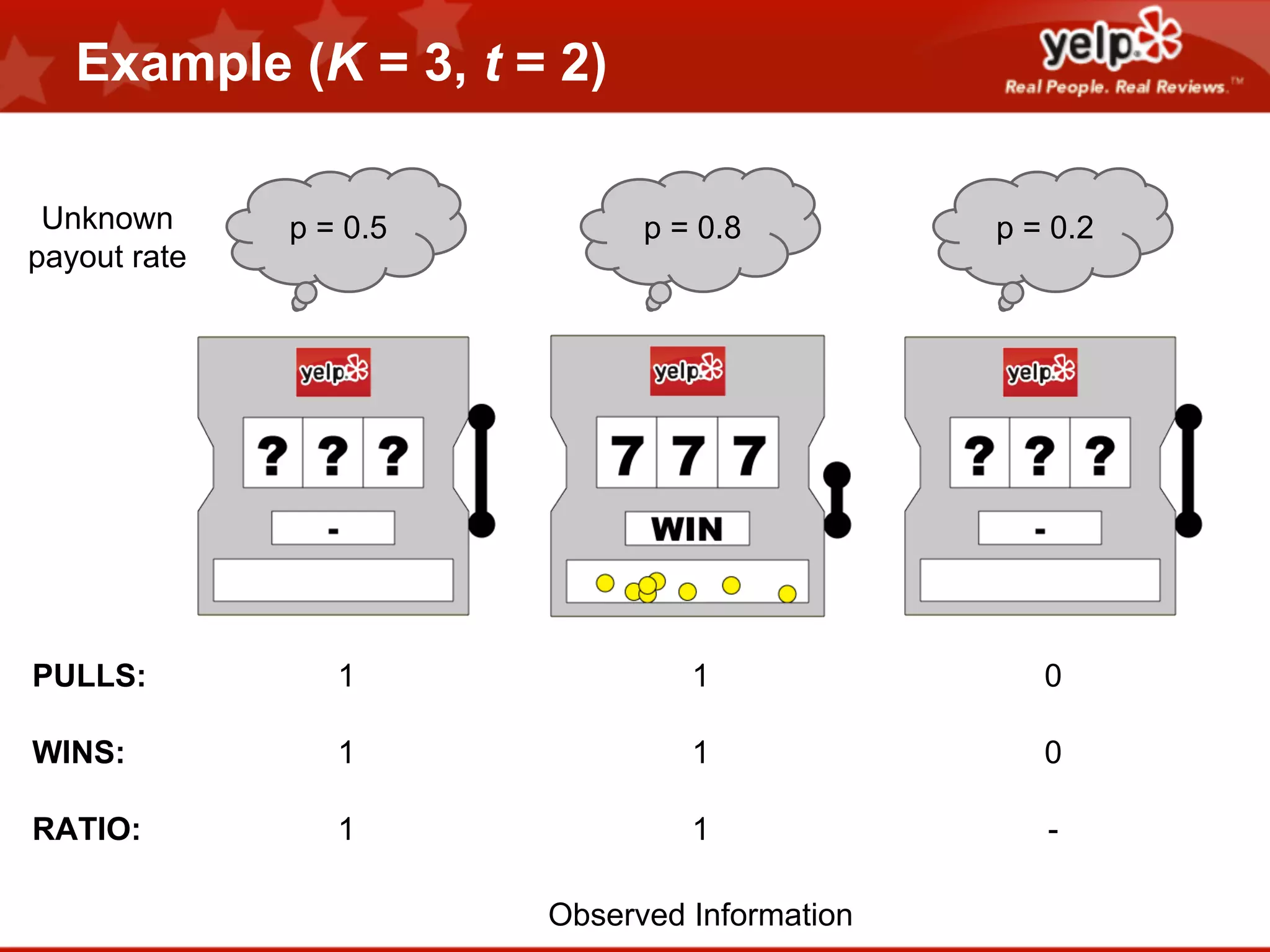
Example (K = 3, t = 2)
Unknown
payout rate

p = 0.5

p = 0.8

p = 0.2

PULLS:

1

1

0

WINS:

1

1

0

RATIO:

1

1

-

Observed Information
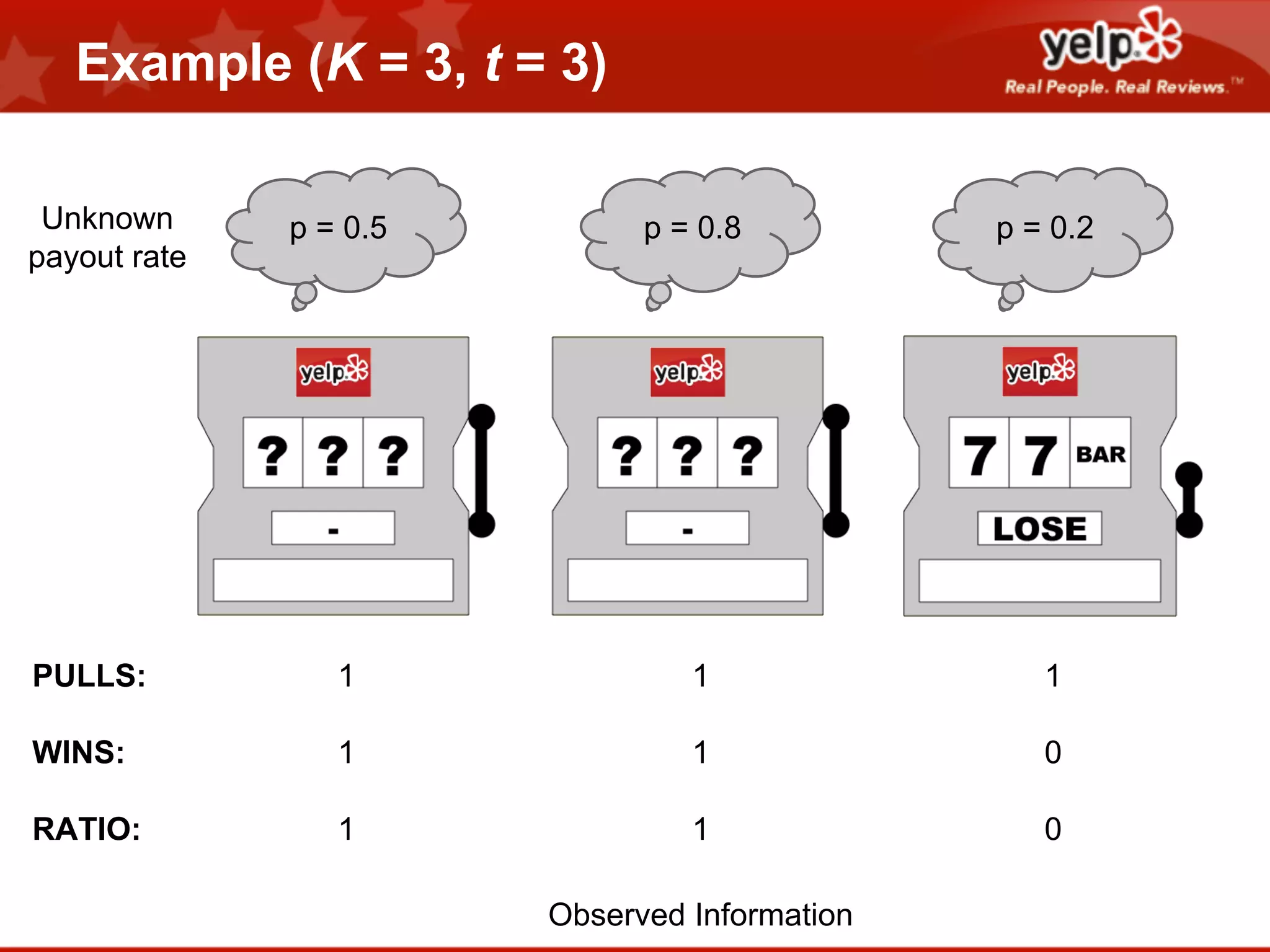
Example (K = 3, t = 3)
Unknown
payout rate

p = 0.5

p = 0.8

p = 0.2

PULLS:

1

1

1

WINS:

1

1

0

RATIO:

1

1

0

Observed Information
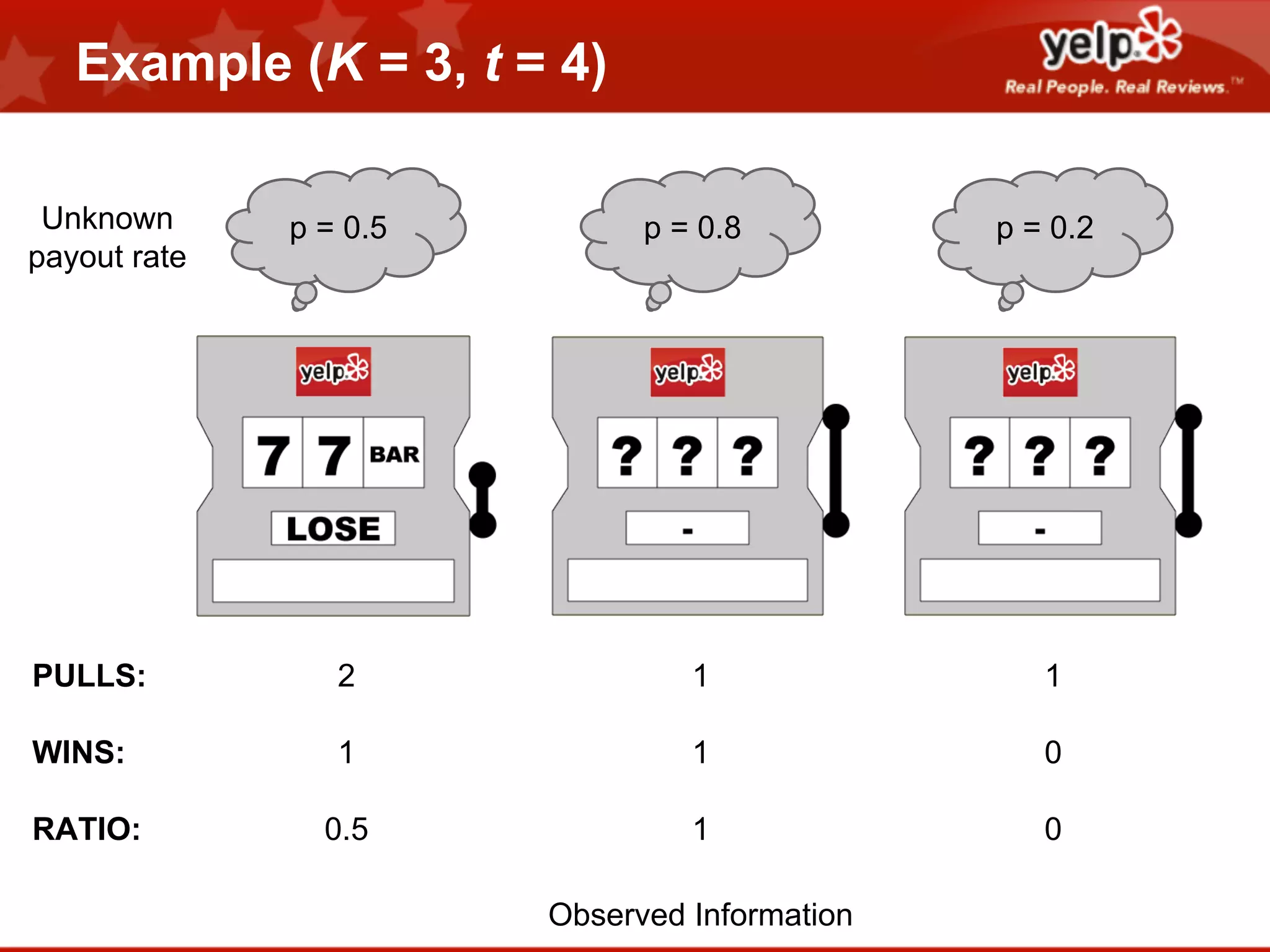
Example (K = 3, t = 4)
Unknown
payout rate

p = 0.5

p = 0.8

p = 0.2

PULLS:

2

1

1

WINS:

1

1

0

RATIO:

0.5

1

0

Observed Information
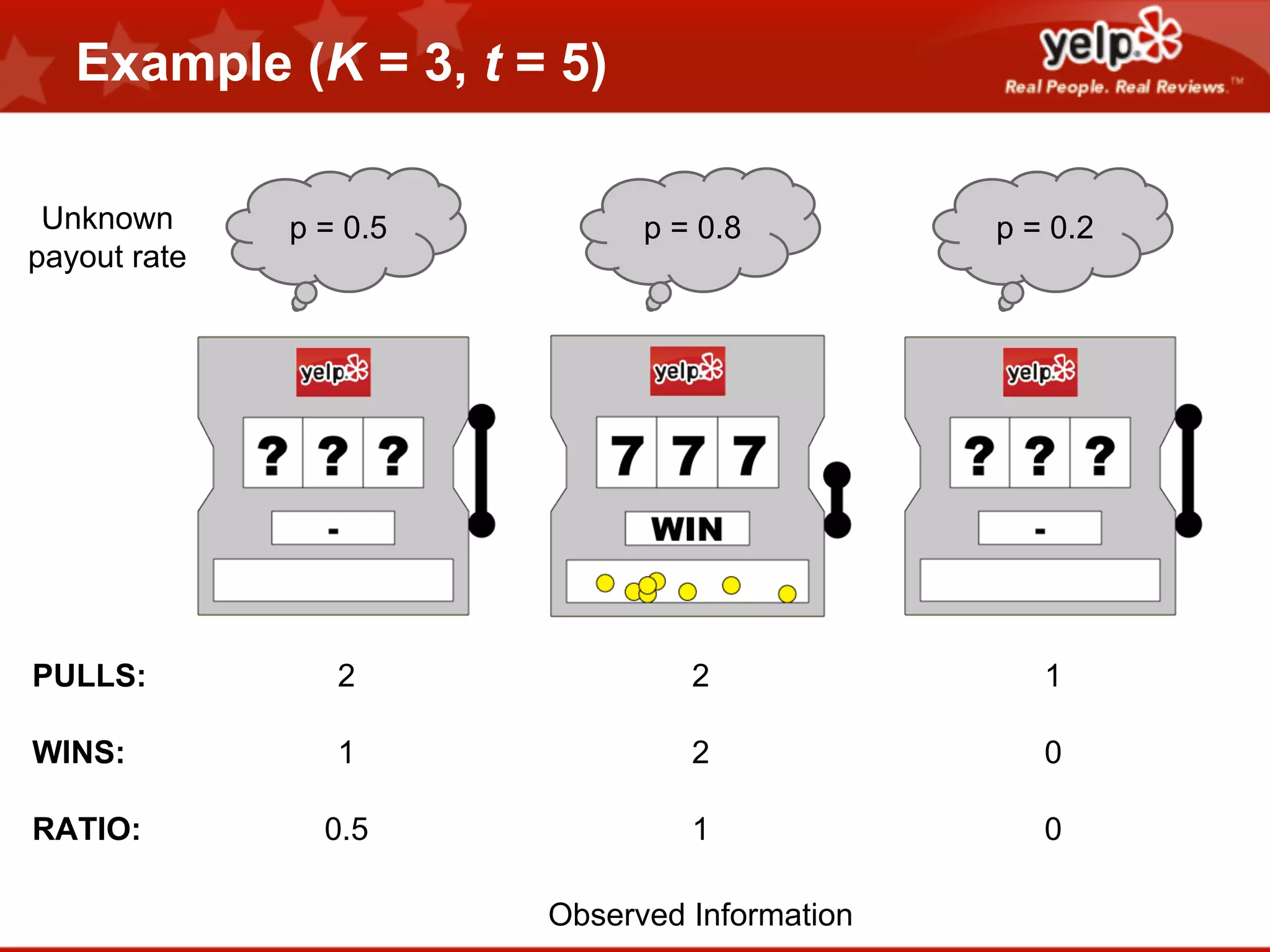
Example (K = 3, t = 5)
Unknown
payout rate

p = 0.5

p = 0.8

p = 0.2

PULLS:

2

2

1

WINS:

1

2

0

RATIO:

0.5

1

0

Observed Information
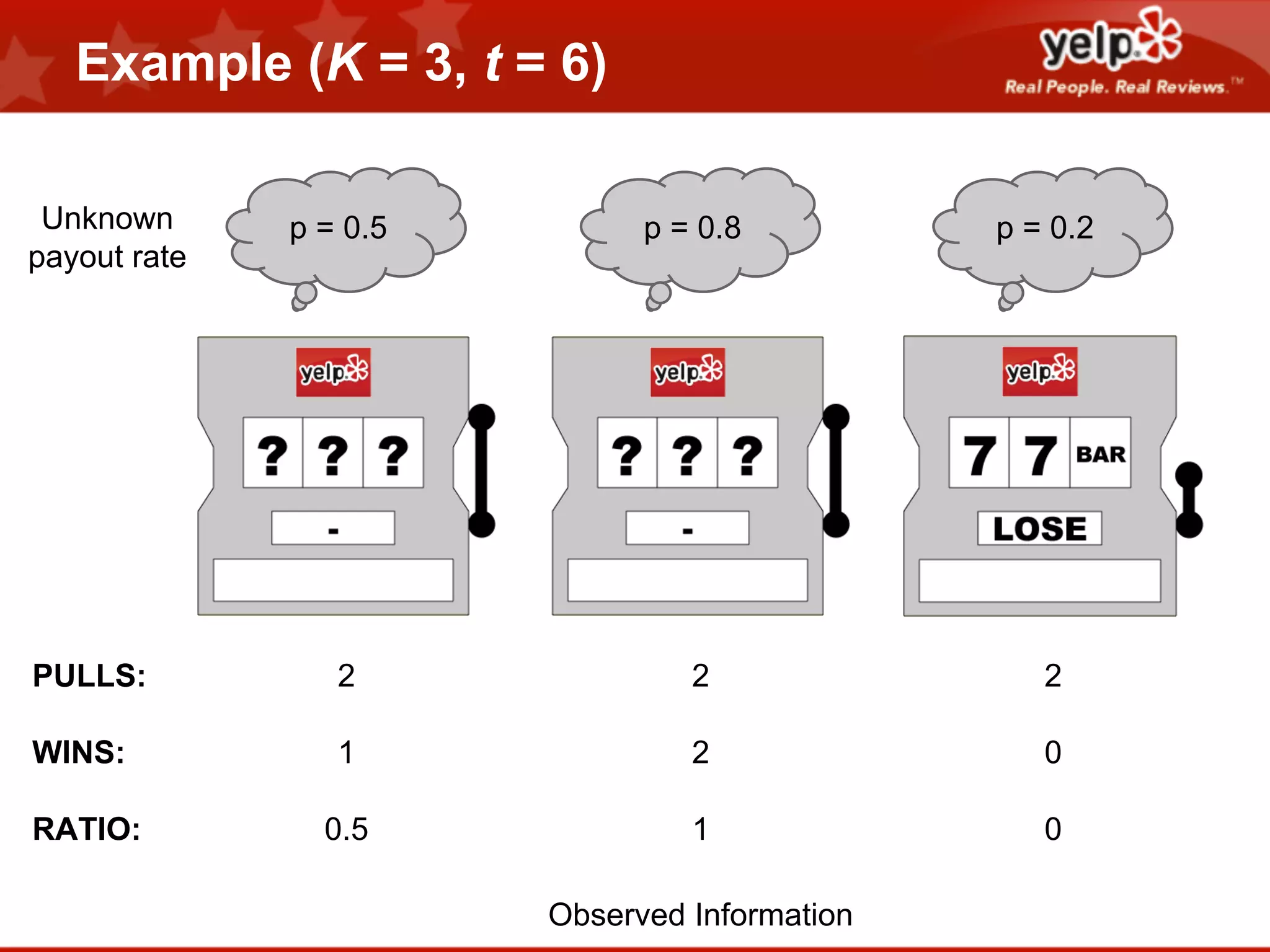
Example (K = 3, t = 6)
Unknown
payout rate

p = 0.5

p = 0.8

p = 0.2

PULLS:

2

2

2

WINS:

1

2

0

RATIO:

0.5

1

0

Observed Information
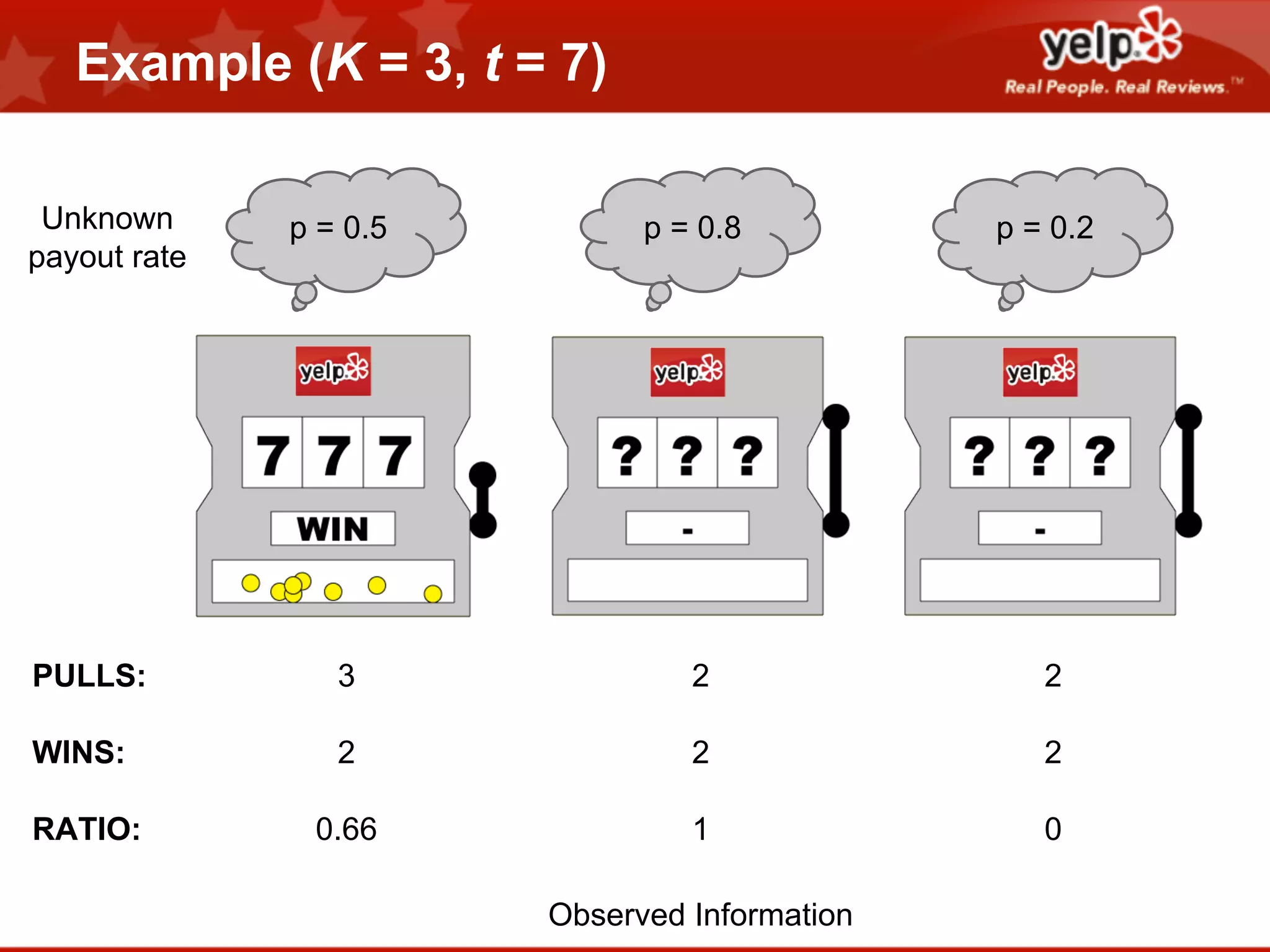
Example (K = 3, t = 7)
Unknown
payout rate

p = 0.5

p = 0.8

p = 0.2

PULLS:

3

2

2

WINS:

2

2

2

RATIO:

0.66

1

0

Observed Information
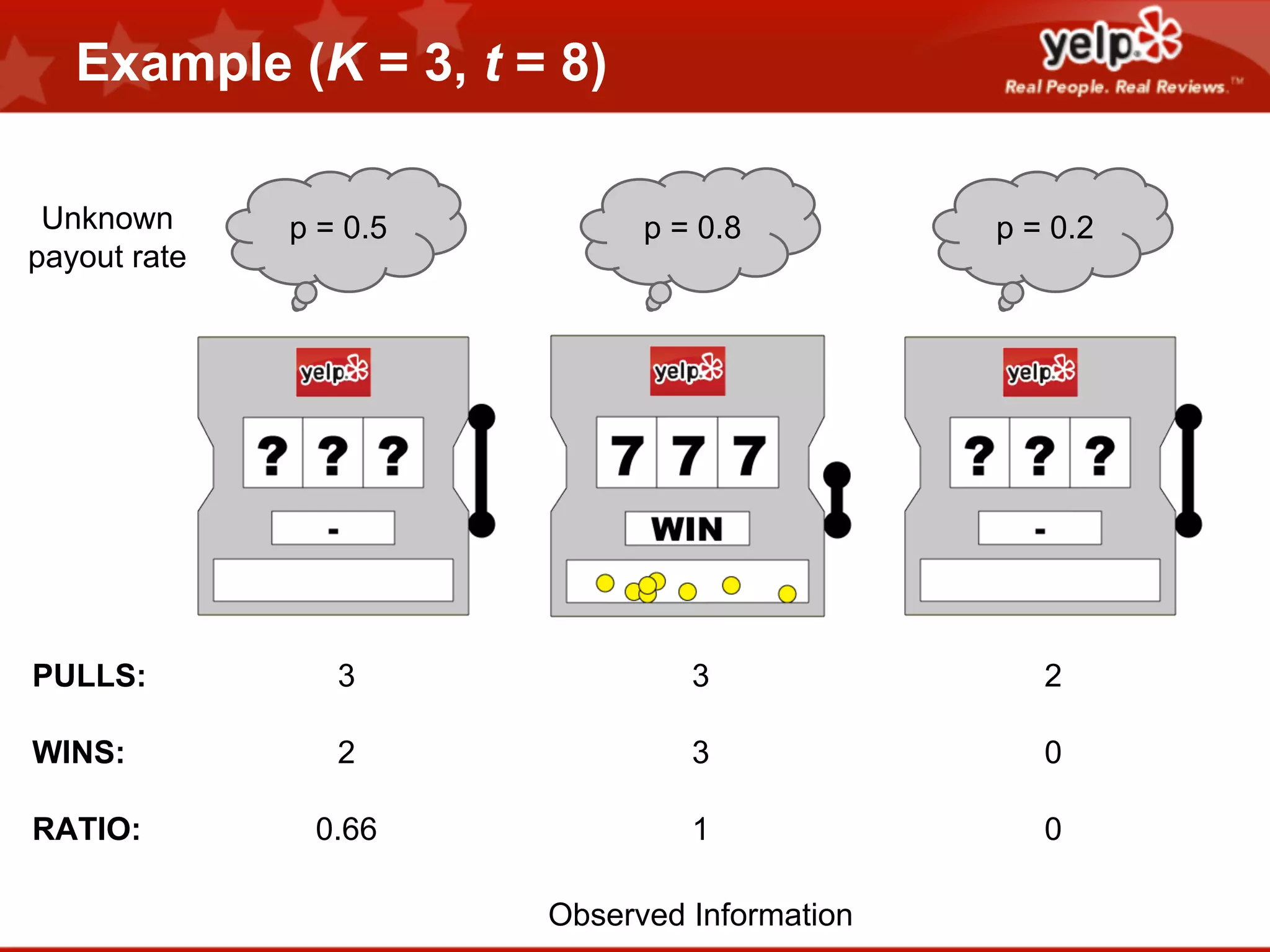
Example (K = 3, t = 8)
Unknown
payout rate

p = 0.5

p = 0.8

p = 0.2

PULLS:

3

3

2

WINS:

2

3

0

RATIO:

0.66

1

0

Observed Information
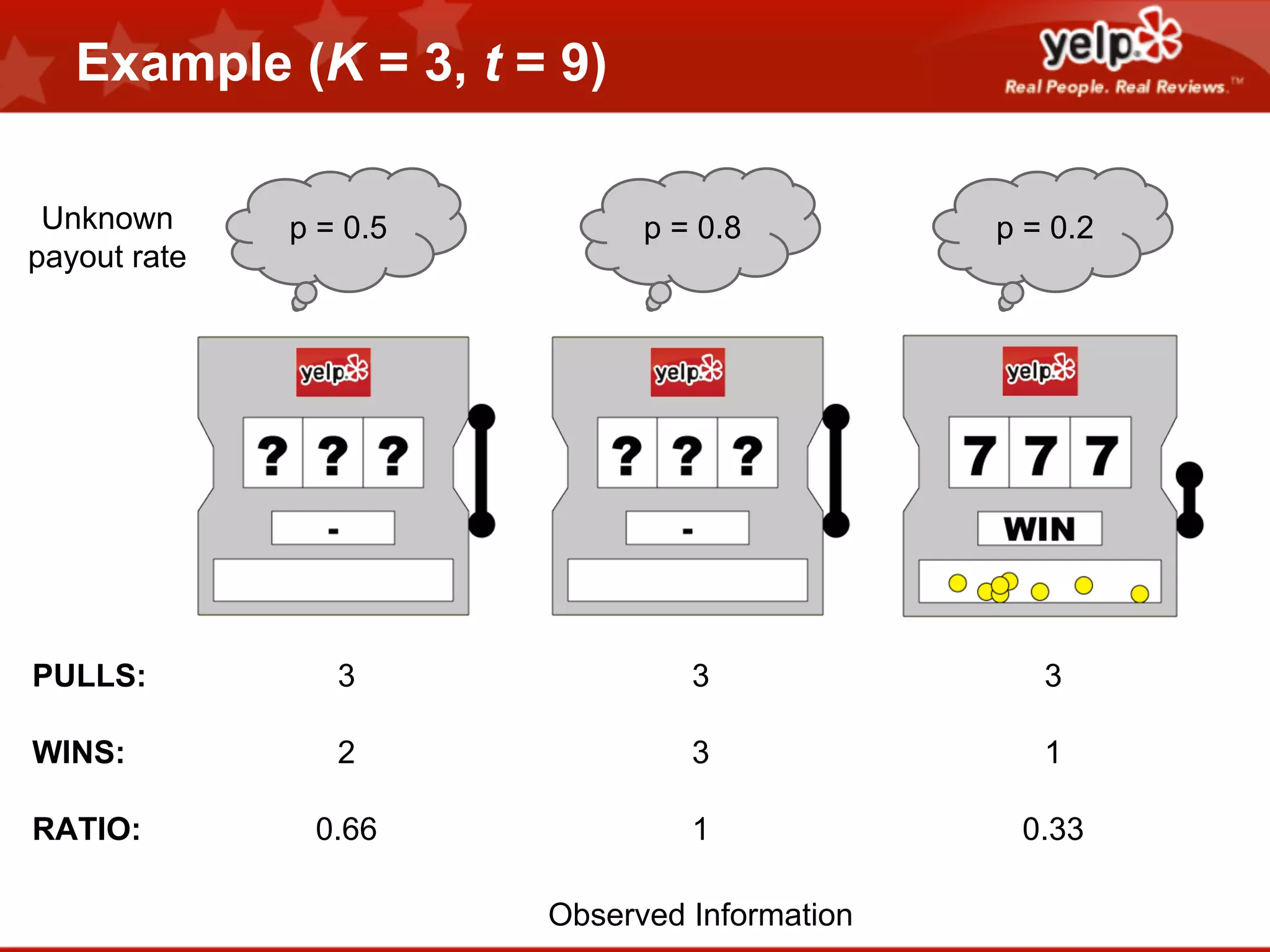
Example (K = 3, t = 9)
Unknown
payout rate

p = 0.5

p = 0.8

p = 0.2

PULLS:

3

3

3

WINS:

2

3

1

RATIO:

0.66

1

0.33

Observed Information
Example (K = 3, t > 9)

Exploit!
Profit!
Right?
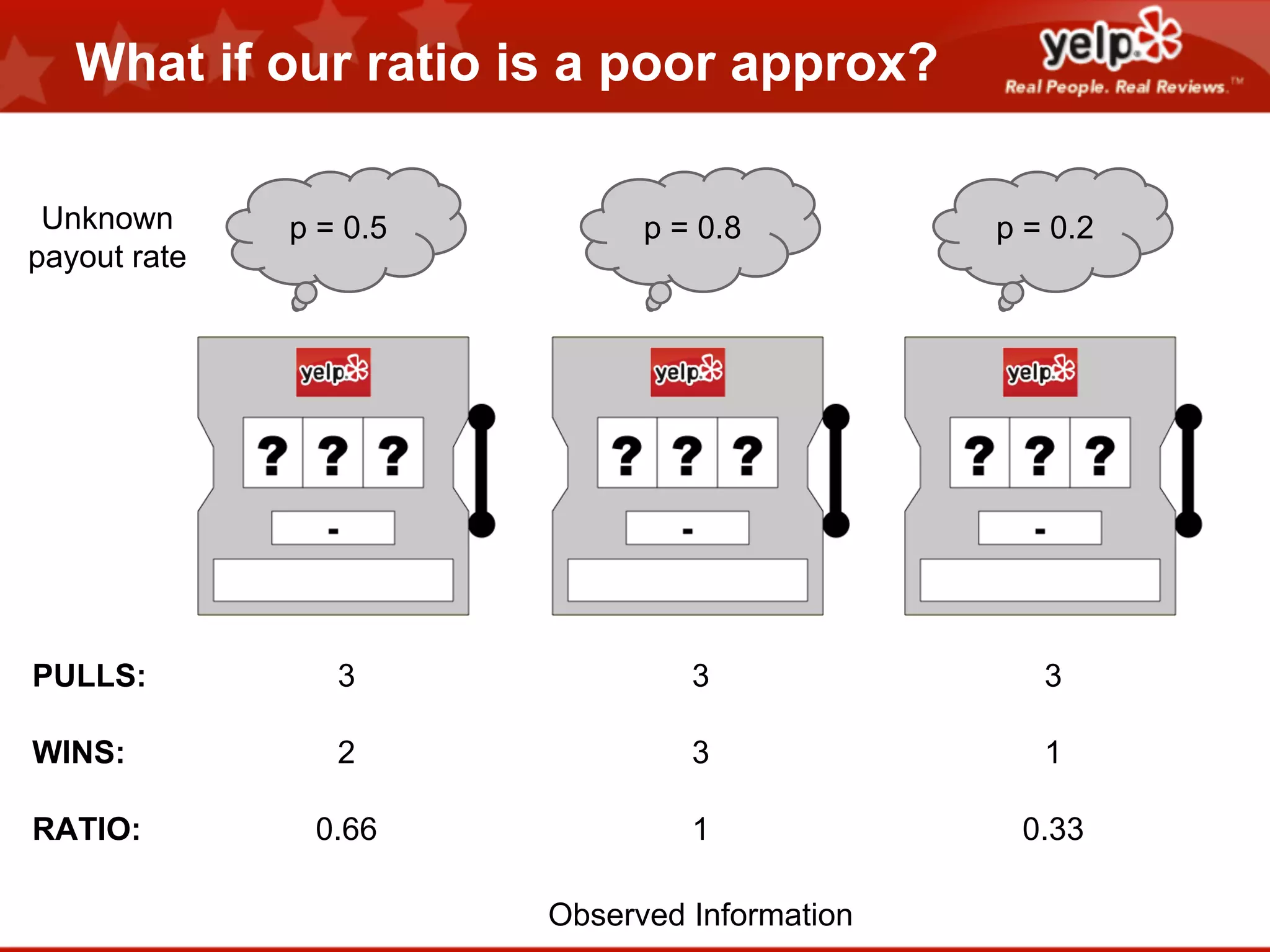
What if our ratio is a poor approx?
Unknown
payout rate

p = 0.5

p = 0.8

p = 0.2

PULLS:

3

3

3

WINS:

2

3

1

RATIO:

0.66

1

0.33

Observed Information
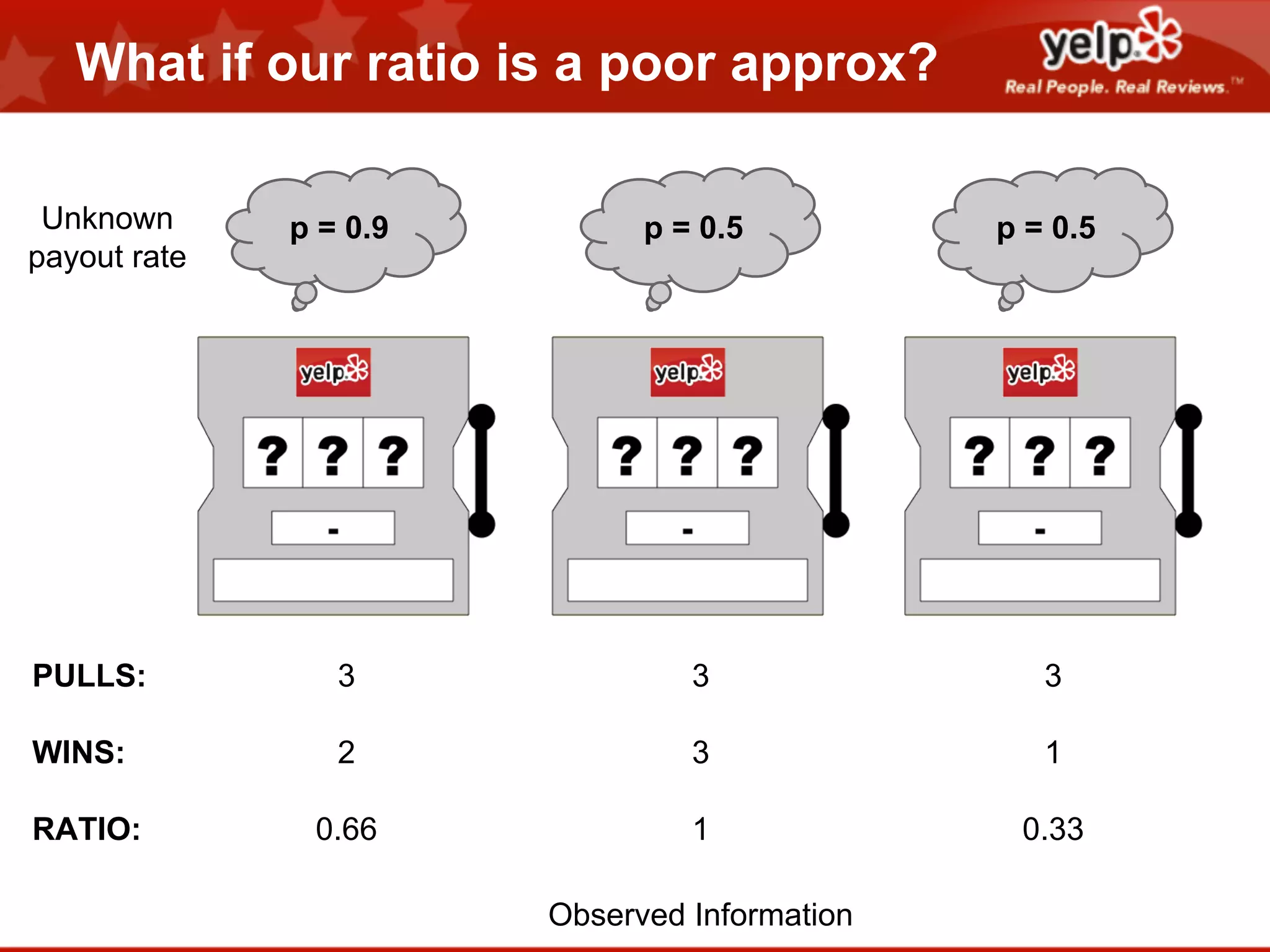
What if our ratio is a poor approx?
Unknown
payout rate

p = 0.9

p = 0.5

p = 0.5

PULLS:

3

3

3

WINS:

2

3

1

RATIO:

0.66

1

0.33

Observed Information
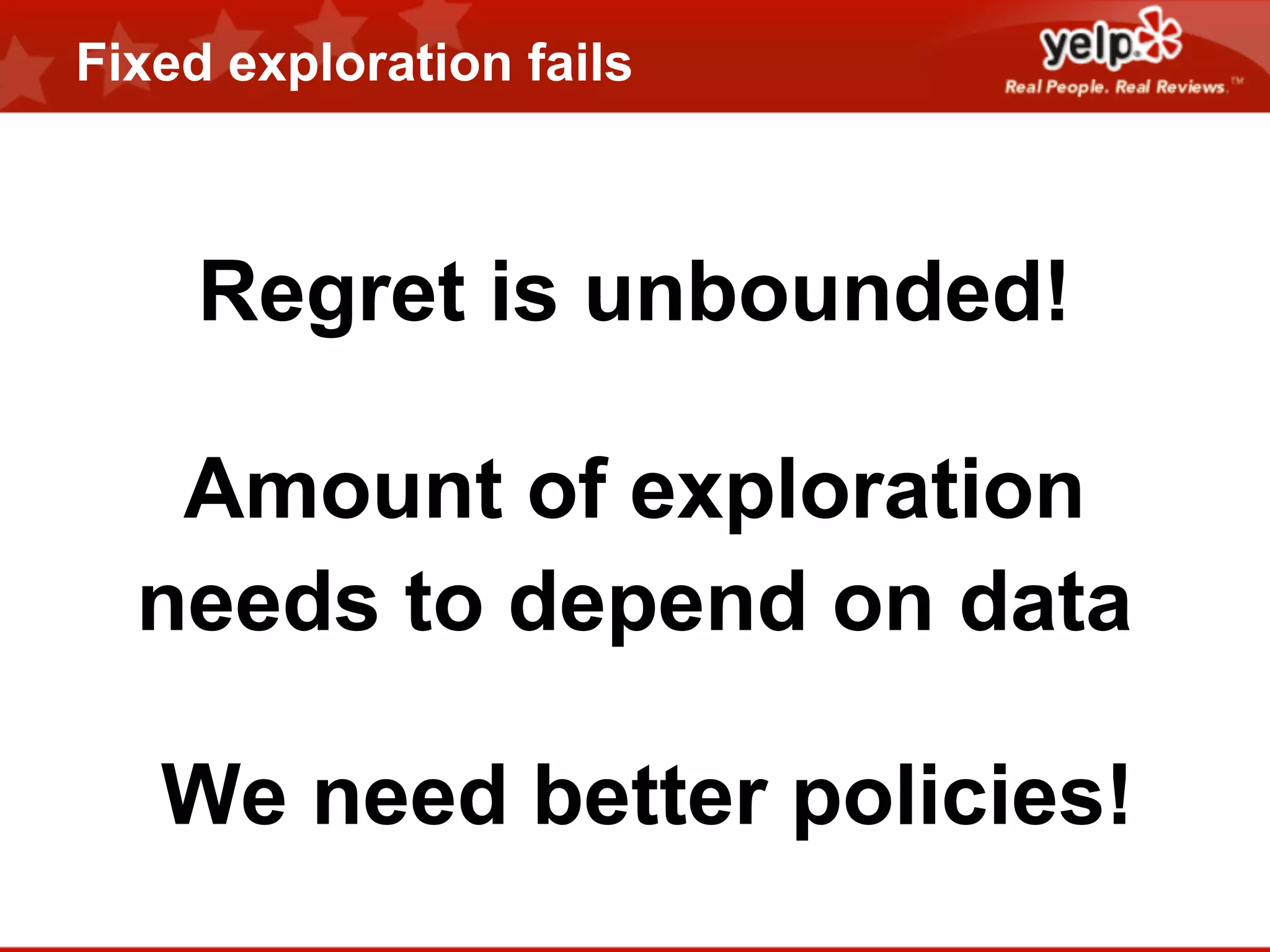
Fixed exploration fails

Regret is unbounded!
Amount of exploration
needs to depend on data
We need better policies!
What should we do?

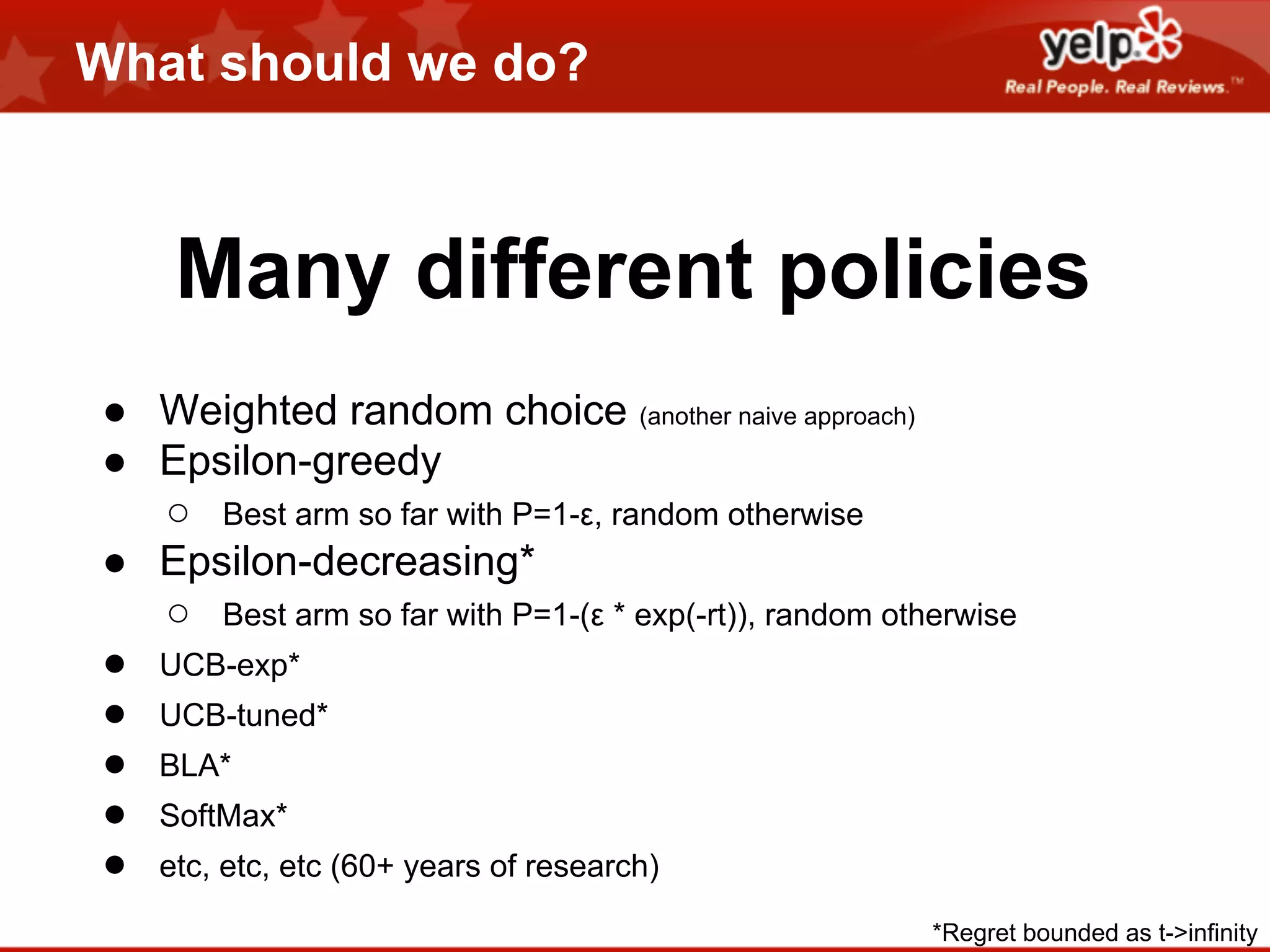
Many different policies
● Weighted random choice (another naive approach)
● Epsilon-greedy
○ Best arm so far with P=1-ε, random otherwise
● Epsilon-decreasing*
○ Best arm so far with P=1-(ε * exp(-rt)), random otherwise
● UCB-exp*
● UCB-tuned*
● BLA*
● SoftMax*
● etc, etc, etc (60+ years of research)
*Regret bounded as t->infinity
Extensions and complications

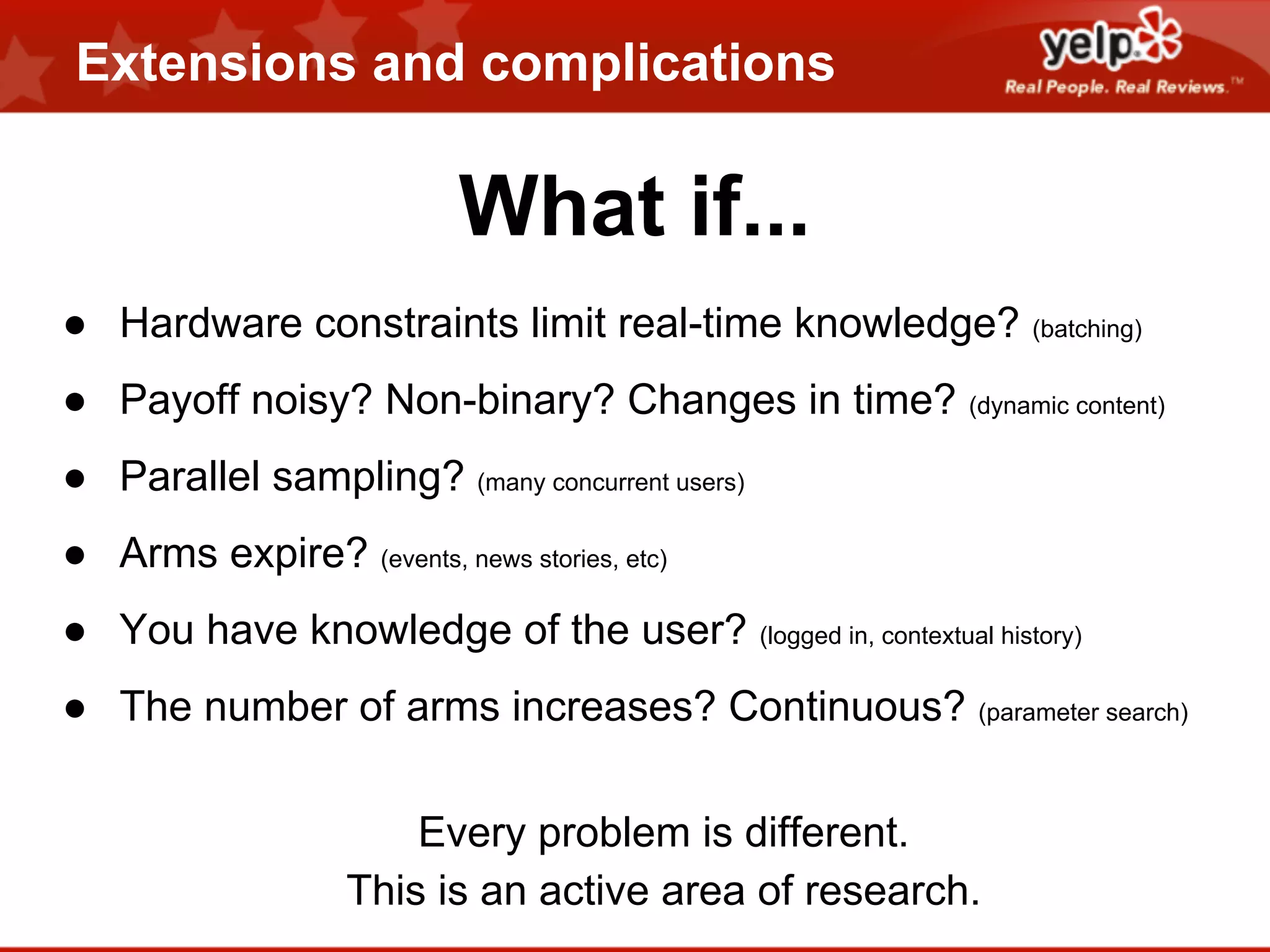
What if...
● Hardware constraints limit real-time knowledge? (batching)
● Payoff noisy? Non-binary? Changes in time? (dynamic content)
● Parallel sampling? (many concurrent users)
● Arms expire? (events, news stories, etc)
● You have knowledge of the user? (logged in, contextual history)
● The number of arms increases? Continuous? (parameter search)
Every problem is different.
This is an active area of research.
Part II:
Global Optimization
What is global optimization?

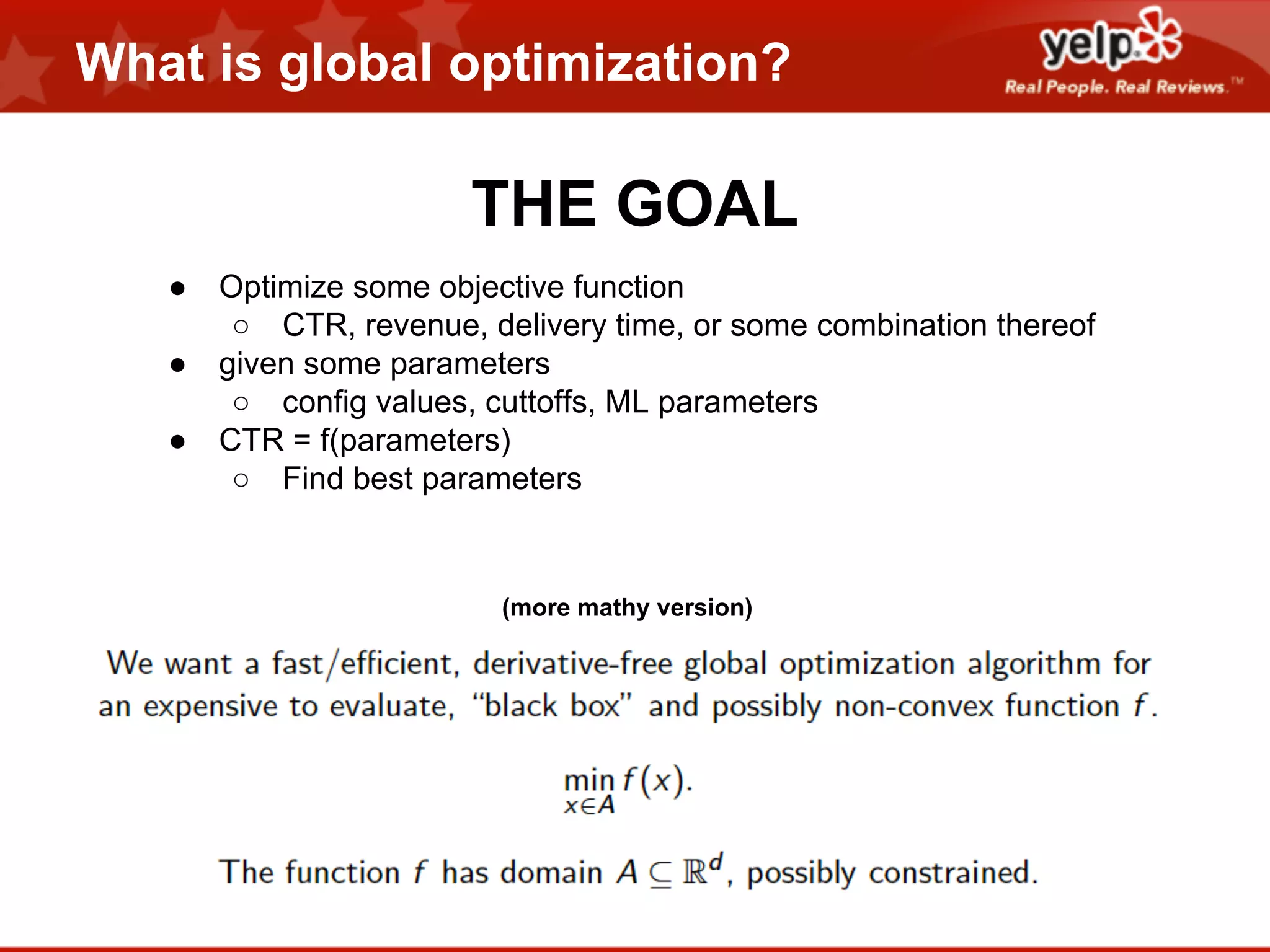
THE GOAL
●
●
●

Optimize some objective function
○ CTR, revenue, delivery time, or some combination thereof
given some parameters
○ config values, cuttoffs, ML parameters
CTR = f(parameters)
○ Find best parameters

(more mathy version)
What is MOE?

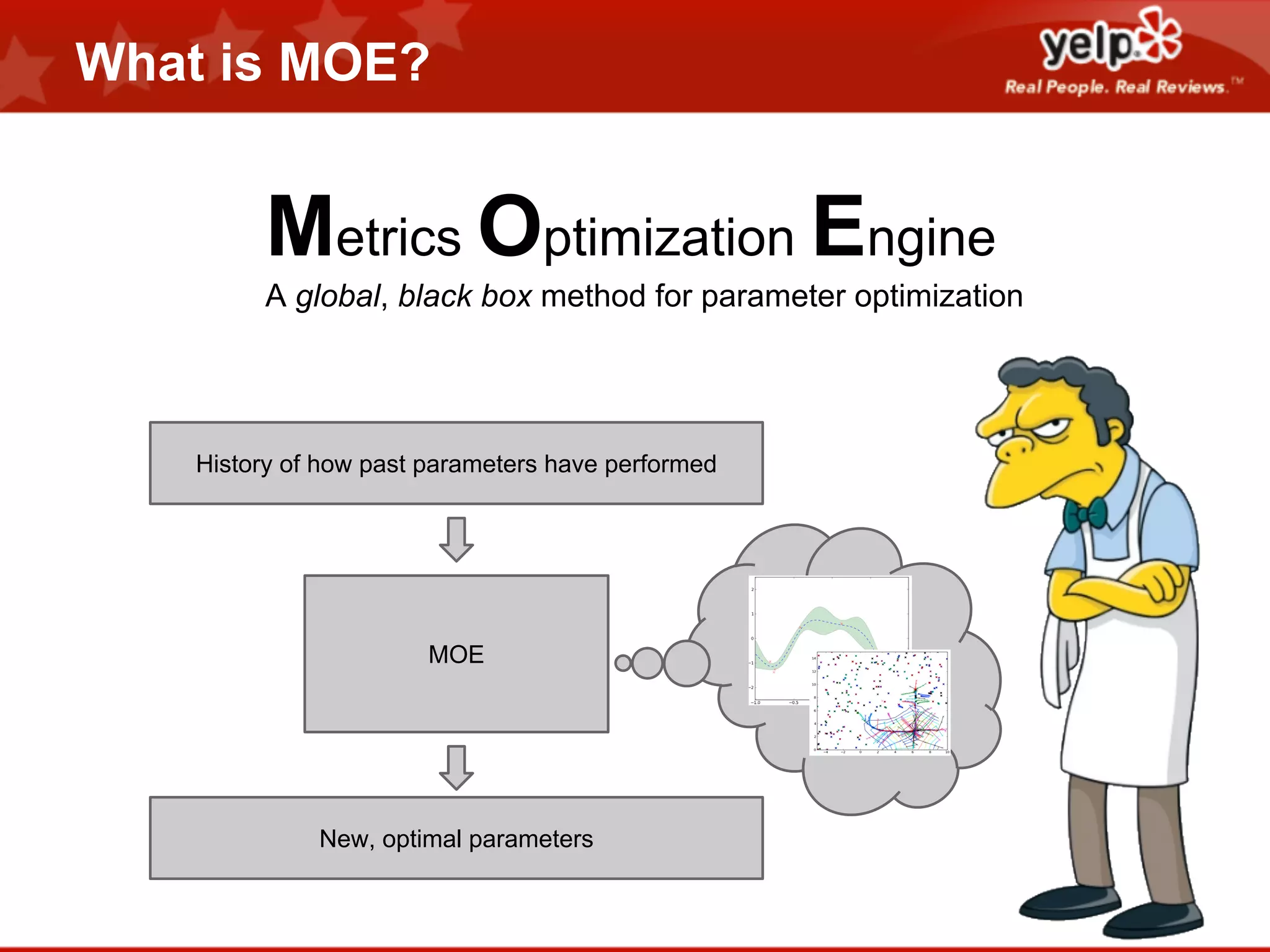
Metrics Optimization Engine
A global, black box method for parameter optimization

History of how past parameters have performed

MOE

New, optimal parameters
What does MOE do?
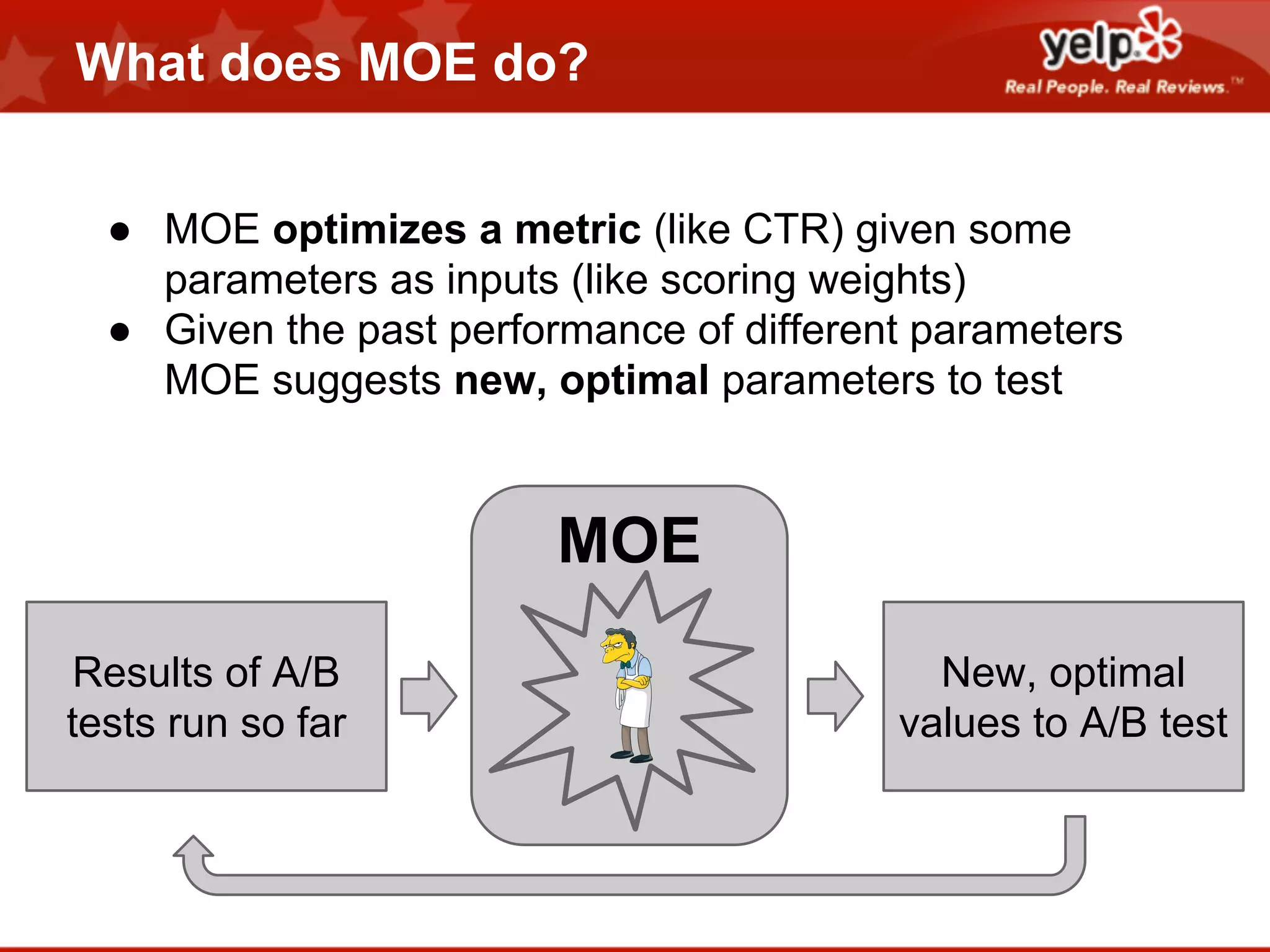
● MOE optimizes a metric (like CTR) given some
parameters as inputs (like scoring weights)
● Given the past performance of different parameters
MOE suggests new, optimal parameters to test

MOE
Results of A/B
tests run so far

New, optimal
values to A/B test
Example Experiment
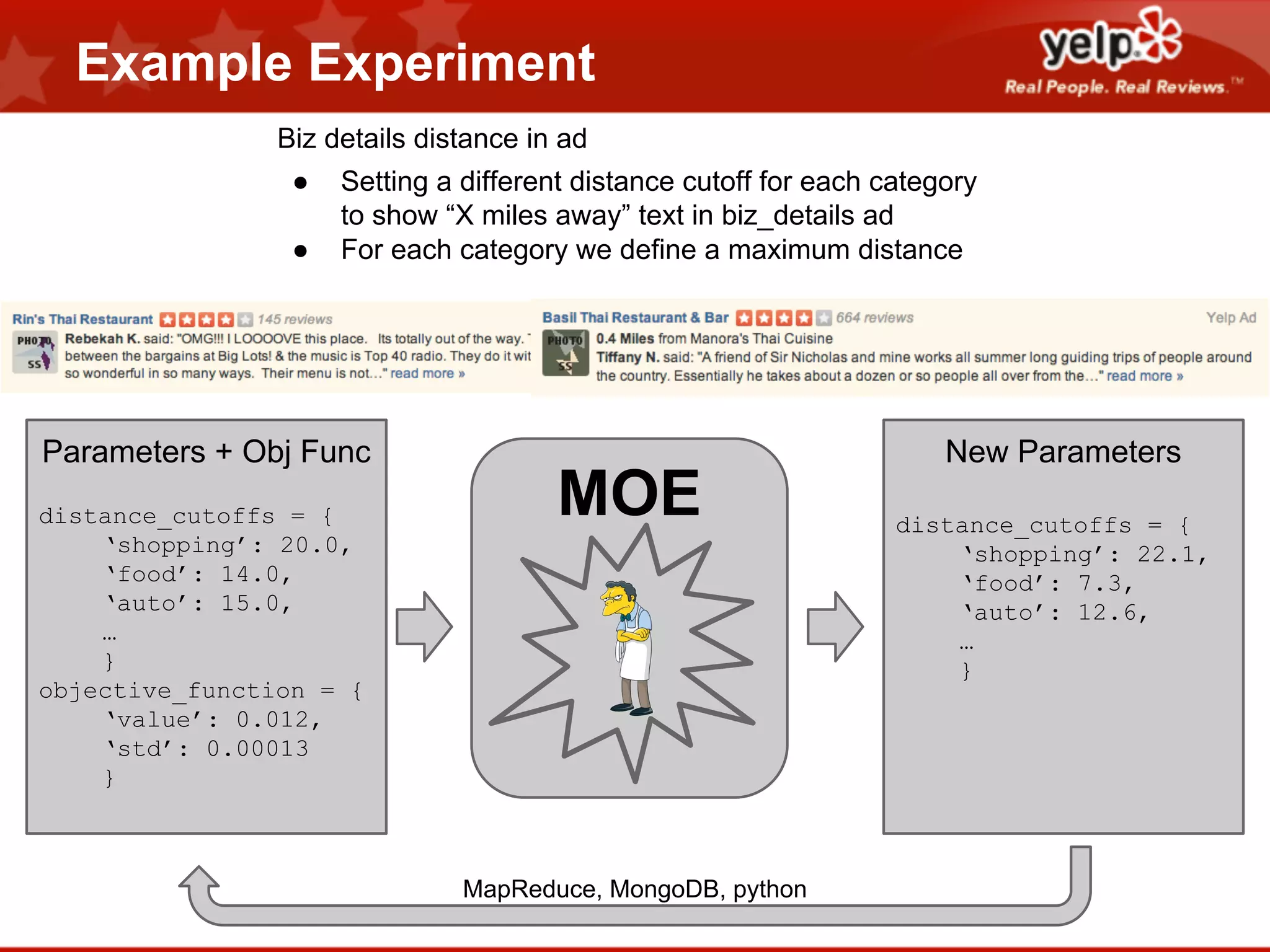
Biz details distance in ad
●
●

Setting a different distance cutoff for each category
to show “X miles away” text in biz_details ad
For each category we define a maximum distance

Parameters + Obj Func
distance_cutoffs = {
‘shopping’: 20.0,
‘food’: 14.0,
‘auto’: 15.0,
…
}
objective_function = {
‘value’: 0.012,
‘std’: 0.00013
}

MOE

MapReduce, MongoDB, python

New Parameters
distance_cutoffs = {
‘shopping’: 22.1,
‘food’: 7.3,
‘auto’: 12.6,
…
}
Why do we need MOE?
● Parameter optimization is hard
○ Finding the perfect set of parameters takes a long time
○ Hope it is well behaved and try to move in the right direction
○ Not possible as number of parameters increases

● Intractable to find best set of parameters in all situations
○ Thousands of combinations of program type, flow, category
○ Finding the best parameters manually is impossible

● Heuristics quickly break down in the real world
○ Dependent parameters (changes to one change all others)
○ Many parameters at once (location, category, map, place, ...)
○ Non-linear (complexity and chaos break assumptions)

MOE solves all of these problems in an optimal way
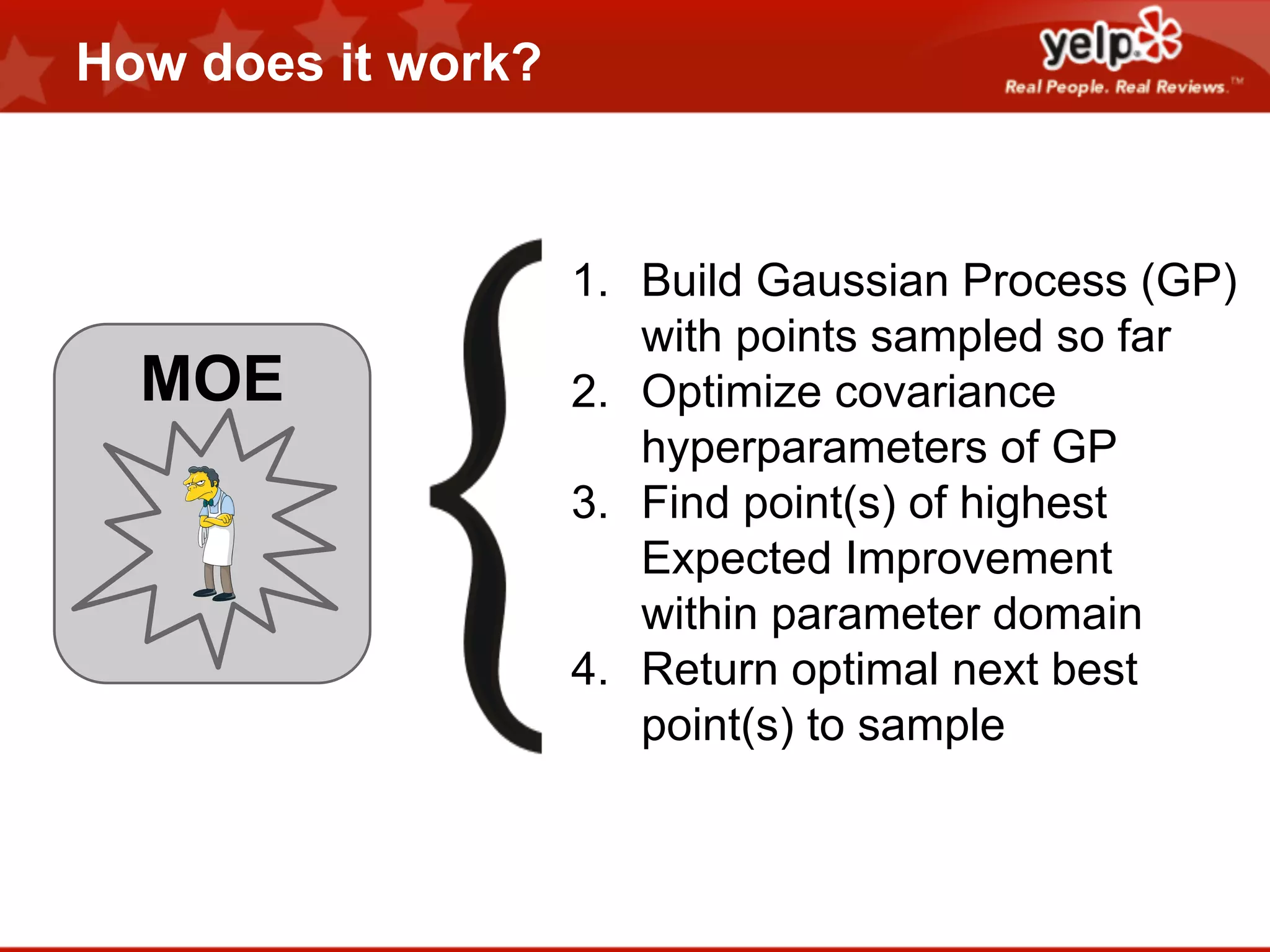
How does it work?

MOE

1. Build Gaussian Process (GP)
with points sampled so far
2. Optimize covariance
hyperparameters of GP
3. Find point(s) of highest
Expected Improvement
within parameter domain
4. Return optimal next best
point(s) to sample
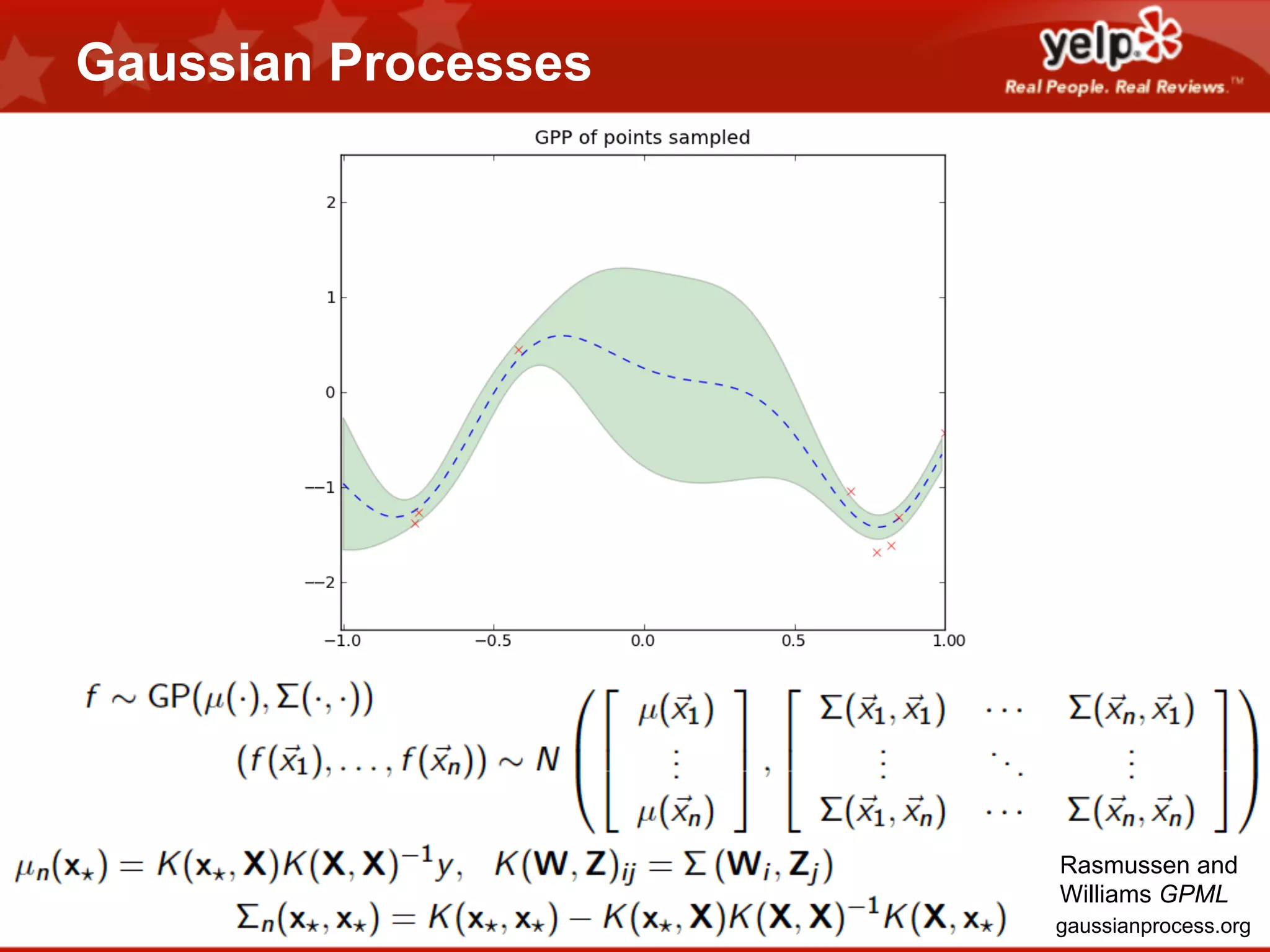
Gaussian Processes

Rasmussen and
Williams GPML
gaussianprocess.org
Optimizing Covariance Hyperparameters
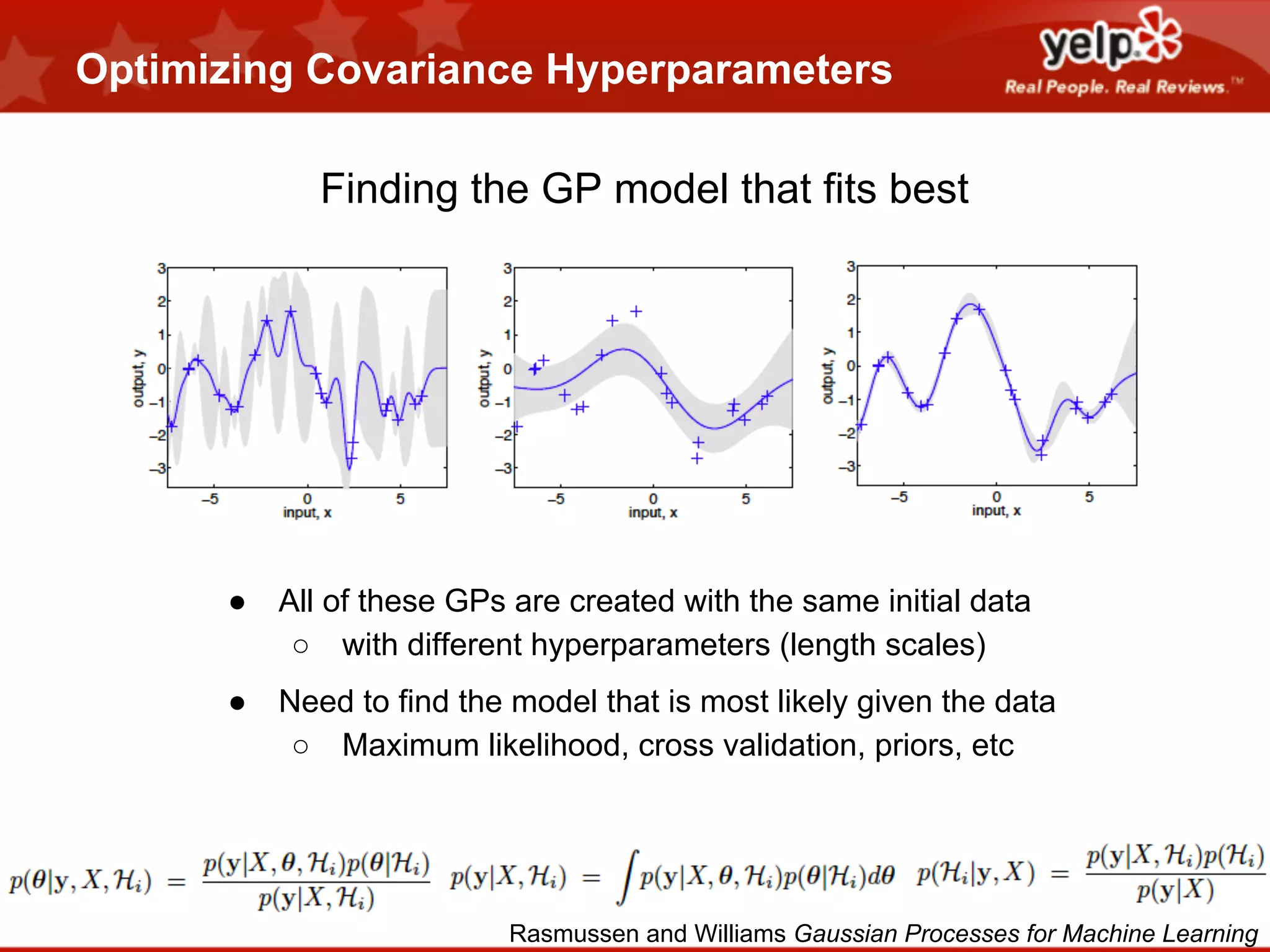
Finding the GP model that fits best

●

All of these GPs are created with the same initial data
○ with different hyperparameters (length scales)

●

Need to find the model that is most likely given the data
○ Maximum likelihood, cross validation, priors, etc

Rasmussen and Williams Gaussian Processes for Machine Learning
Find point(s) of highest expected improvement
Expected Improvement of sampling two points

We want to find the point(s) that are expected to beat the best point seen so far the most.

[Jones, Schonlau, Welsch 1998]
[Clark, Frazier 2012]
What is MOE doing right now?

MOE is now live in production
● MOE is informing active experiments
● MOE is successfully optimizing towards all given metrics
● MOE treats the underlying system it is optimizing as a black box,
allowing it to be easily extended to any system

Ongoing:
● Looking into best path towards contributing it back to the
community, if/when we decide to open source.
● MOE + bandits = <3
Questions?

Questions?

sclark@yelp.com
@DrScottClark

"Optimal Learning for Fun and Profit" by Scott Clark (Presented at The Yelp Engineering Open House 11/20/13)

  • 1.
    Optimal Learning for Funand Profit Scott Clark, Ph.D. Yelp Open House 11/20/13 sclark@yelp.com @DrScottClark
  • 2.
    Outline of Talk ●Optimal Learning ○ What is it? ○ Why do we care? ● Multi-armed bandits ○ Definition and motivation ○ Examples ● Bayesian global optimization ○ Optimal experiment design ○ Uses to extend traditional A/B testing
  • 3.
    What is optimallearning? Optimal learning addresses the challenge of how to collect information as efficiently as possible, primarily for settings where collecting information is time consuming and expensive. Source: optimallearning.princeton.edu
  • 4.
  • 5.
    What are multi-armedbandits? THE SETUP ● ● ● ● Imagine you are in front of K slot machines. Each one is set to "free play" (but you can still win $$$) Each has a possibly different, unknown payout rate You have a fixed amount of time to maximize payout GO!
  • 6.
    What are multi-armedbandits? THE SETUP (math version) [Robbins 1952]
  • 7.
    Modern Bandits Why dowe care? ● Maps well onto Click Through Rate (CTR) ○ Each arm is an ad or search result ○ Each click is a success ○ Want to maximize clicks ● Can be used in experiments (A/B testing) ○ Want to find the best solutions, fast ○ Want to limit how often bad solutions are used
  • 8.
    Tradeoffs Exploration vs. Exploitation Gainingknowledge about the system vs. Getting largest payout with current knowledge
  • 9.
    Naive Example Epsilon FirstPolicy ● Sample sequentially εT < T times ○ only explore ● Pick the best and sample for t = εT+1, ..., T ○ only exploit
  • 10.
    Example (K =3, t = 1) Unknown payout rate p = 0.5 p = 0.8 p = 0.2 PULLS: 0 0 0 WINS: 0 0 0 RATIO: - - - Observed Information
  • 11.
    Example (K =3, t = 1) Unknown payout rate p = 0.5 p = 0.8 p = 0.2 PULLS: 1 0 0 WINS: 1 0 0 RATIO: 1 - - Observed Information
  • 12.
    Example (K =3, t = 2) Unknown payout rate p = 0.5 p = 0.8 p = 0.2 PULLS: 1 1 0 WINS: 1 1 0 RATIO: 1 1 - Observed Information
  • 13.
    Example (K =3, t = 3) Unknown payout rate p = 0.5 p = 0.8 p = 0.2 PULLS: 1 1 1 WINS: 1 1 0 RATIO: 1 1 0 Observed Information
  • 14.
    Example (K =3, t = 4) Unknown payout rate p = 0.5 p = 0.8 p = 0.2 PULLS: 2 1 1 WINS: 1 1 0 RATIO: 0.5 1 0 Observed Information
  • 15.
    Example (K =3, t = 5) Unknown payout rate p = 0.5 p = 0.8 p = 0.2 PULLS: 2 2 1 WINS: 1 2 0 RATIO: 0.5 1 0 Observed Information
  • 16.
    Example (K =3, t = 6) Unknown payout rate p = 0.5 p = 0.8 p = 0.2 PULLS: 2 2 2 WINS: 1 2 0 RATIO: 0.5 1 0 Observed Information
  • 17.
    Example (K =3, t = 7) Unknown payout rate p = 0.5 p = 0.8 p = 0.2 PULLS: 3 2 2 WINS: 2 2 2 RATIO: 0.66 1 0 Observed Information
  • 18.
    Example (K =3, t = 8) Unknown payout rate p = 0.5 p = 0.8 p = 0.2 PULLS: 3 3 2 WINS: 2 3 0 RATIO: 0.66 1 0 Observed Information
  • 19.
    Example (K =3, t = 9) Unknown payout rate p = 0.5 p = 0.8 p = 0.2 PULLS: 3 3 3 WINS: 2 3 1 RATIO: 0.66 1 0.33 Observed Information
  • 20.
    Example (K =3, t > 9) Exploit! Profit! Right?
  • 21.
    What if ourratio is a poor approx? Unknown payout rate p = 0.5 p = 0.8 p = 0.2 PULLS: 3 3 3 WINS: 2 3 1 RATIO: 0.66 1 0.33 Observed Information
  • 22.
    What if ourratio is a poor approx? Unknown payout rate p = 0.9 p = 0.5 p = 0.5 PULLS: 3 3 3 WINS: 2 3 1 RATIO: 0.66 1 0.33 Observed Information
  • 23.
    Fixed exploration fails Regretis unbounded! Amount of exploration needs to depend on data We need better policies!
  • 24.
    What should wedo? Many different policies ● Weighted random choice (another naive approach) ● Epsilon-greedy ○ Best arm so far with P=1-ε, random otherwise ● Epsilon-decreasing* ○ Best arm so far with P=1-(ε * exp(-rt)), random otherwise ● UCB-exp* ● UCB-tuned* ● BLA* ● SoftMax* ● etc, etc, etc (60+ years of research) *Regret bounded as t->infinity
  • 25.
    Extensions and complications Whatif... ● Hardware constraints limit real-time knowledge? (batching) ● Payoff noisy? Non-binary? Changes in time? (dynamic content) ● Parallel sampling? (many concurrent users) ● Arms expire? (events, news stories, etc) ● You have knowledge of the user? (logged in, contextual history) ● The number of arms increases? Continuous? (parameter search) Every problem is different. This is an active area of research.
  • 26.
  • 27.
    What is globaloptimization? THE GOAL ● ● ● Optimize some objective function ○ CTR, revenue, delivery time, or some combination thereof given some parameters ○ config values, cuttoffs, ML parameters CTR = f(parameters) ○ Find best parameters (more mathy version)
  • 28.
    What is MOE? MetricsOptimization Engine A global, black box method for parameter optimization History of how past parameters have performed MOE New, optimal parameters
  • 29.
    What does MOEdo? ● MOE optimizes a metric (like CTR) given some parameters as inputs (like scoring weights) ● Given the past performance of different parameters MOE suggests new, optimal parameters to test MOE Results of A/B tests run so far New, optimal values to A/B test
  • 30.
    Example Experiment Biz detailsdistance in ad ● ● Setting a different distance cutoff for each category to show “X miles away” text in biz_details ad For each category we define a maximum distance Parameters + Obj Func distance_cutoffs = { ‘shopping’: 20.0, ‘food’: 14.0, ‘auto’: 15.0, … } objective_function = { ‘value’: 0.012, ‘std’: 0.00013 } MOE MapReduce, MongoDB, python New Parameters distance_cutoffs = { ‘shopping’: 22.1, ‘food’: 7.3, ‘auto’: 12.6, … }
  • 31.
    Why do weneed MOE? ● Parameter optimization is hard ○ Finding the perfect set of parameters takes a long time ○ Hope it is well behaved and try to move in the right direction ○ Not possible as number of parameters increases ● Intractable to find best set of parameters in all situations ○ Thousands of combinations of program type, flow, category ○ Finding the best parameters manually is impossible ● Heuristics quickly break down in the real world ○ Dependent parameters (changes to one change all others) ○ Many parameters at once (location, category, map, place, ...) ○ Non-linear (complexity and chaos break assumptions) MOE solves all of these problems in an optimal way
  • 32.
    How does itwork? MOE 1. Build Gaussian Process (GP) with points sampled so far 2. Optimize covariance hyperparameters of GP 3. Find point(s) of highest Expected Improvement within parameter domain 4. Return optimal next best point(s) to sample
  • 33.
  • 34.
    Optimizing Covariance Hyperparameters Findingthe GP model that fits best ● All of these GPs are created with the same initial data ○ with different hyperparameters (length scales) ● Need to find the model that is most likely given the data ○ Maximum likelihood, cross validation, priors, etc Rasmussen and Williams Gaussian Processes for Machine Learning
  • 35.
    Find point(s) ofhighest expected improvement Expected Improvement of sampling two points We want to find the point(s) that are expected to beat the best point seen so far the most. [Jones, Schonlau, Welsch 1998] [Clark, Frazier 2012]
  • 36.
    What is MOEdoing right now? MOE is now live in production ● MOE is informing active experiments ● MOE is successfully optimizing towards all given metrics ● MOE treats the underlying system it is optimizing as a black box, allowing it to be easily extended to any system Ongoing: ● Looking into best path towards contributing it back to the community, if/when we decide to open source. ● MOE + bandits = <3
  • 37.