G
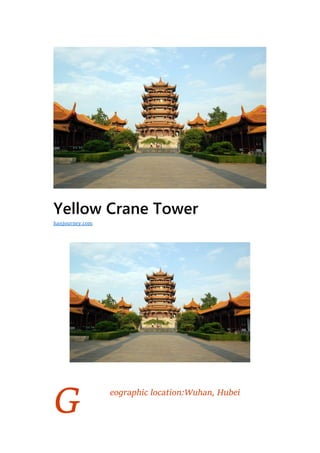
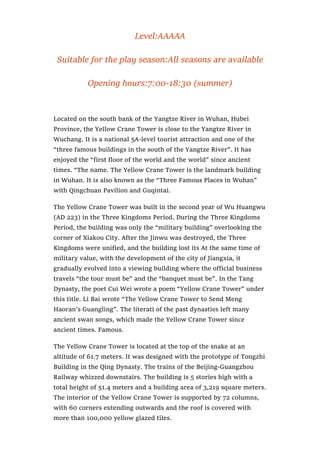
Yellow Crane Tower
eographic location:Wuhan, Hubei
hanjourney.com
Level:AAAAA
Suitable for the play season:All seasons are available
Opening hours:7:00-18:30 (summer)
Located on the south bank of the Yangtze River in Wuhan, Hubei
Province, the Yellow Crane Tower is close to the Yangtze River in
Wuchang. It is a national 5A-level tourist attraction and one of the
“three famous buildings in the south of the Yangtze River”. It has
enjoyed the “first floor of the world and the world” since ancient
times. “The name. The Yellow Crane Tower is the landmark building
in Wuhan. It is also known as the “Three Famous Places in Wuhan”
with Qingchuan Pavilion and Guqintai.
The Yellow Crane Tower was built in the second year of Wu Huangwu
(AD 223) in the Three Kingdoms Period. During the Three Kingdoms
Period, the building was only the “military building” overlooking the
corner of Xiakou City. After the Jinwu was destroyed, the Three
Kingdoms were unified, and the building lost its At the same time of
military value, with the development of the city of Jiangxia, it
gradually evolved into a viewing building where the official business
travels “the tour must be” and the “banquet must be”. In the Tang
Dynasty, the poet Cui Wei wrote a poem “Yellow Crane Tower” under
this title. Li Bai wrote “The Yellow Crane Tower to Send Meng
Haoran’s Guangling”. The literati of the past dynasties left many
ancient swan songs, which made the Yellow Crane Tower since
ancient times. Famous.
The Yellow Crane Tower is located at the top of the snake at an
altitude of 61.7 meters. It was designed with the prototype of Tongzhi
Building in the Qing Dynasty. The trains of the Beijing-Guangzhou
Railway whizzed downstairs. The building is 5 stories high with a
total height of 51.4 meters and a building area of 3,219 square meters.
The interior of the Yellow Crane Tower is supported by 72 columns,
with 60 corners extending outwards and the roof is covered with
more than 100,000 yellow glazed tiles.
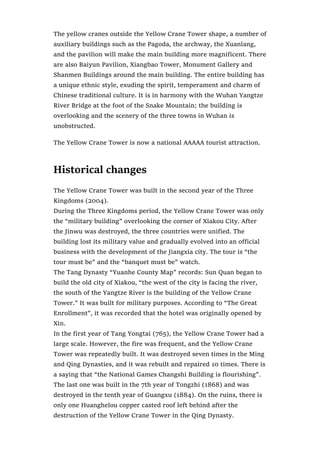
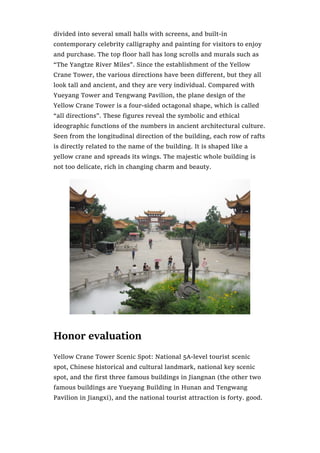
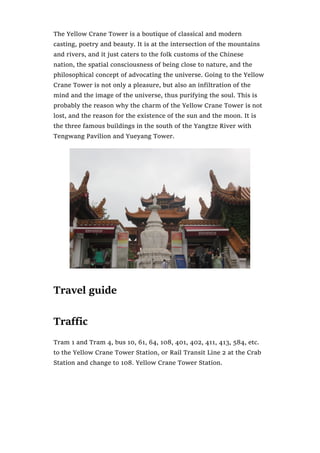
The yellow cranes outside the Yellow Crane Tower shape, a number of
auxiliary buildings such as the Pagoda, the archway, the Xuanlang,
and the pavilion will make the main building more magnificent. There
are also Baiyun Pavilion, Xiangbao Tower, Monument Gallery and
Shanmen Buildings around the main building. The entire building has
a unique ethnic style, exuding the spirit, temperament and charm of
Chinese traditional culture. It is in harmony with the Wuhan Yangtze
River Bridge at the foot of the Snake Mountain; the building is
overlooking and the scenery of the three towns in Wuhan is
unobstructed.
The Yellow Crane Tower is now a national AAAAA tourist attraction.
Historical changes
The Yellow Crane Tower was built in the second year of the Three
Kingdoms (2004).
During the Three Kingdoms period, the Yellow Crane Tower was only
the “military building” overlooking the corner of Xiakou City. After
the Jinwu was destroyed, the three countries were unified. The
building lost its military value and gradually evolved into an official
business with the development of the Jiangxia city. The tour is “the
tour must be” and the “banquet must be” watch.
The Tang Dynasty “Yuanhe County Map” records: Sun Quan began to
build the old city of Xiakou, “the west of the city is facing the river,
the south of the Yangtze River is the building of the Yellow Crane
Tower.” It was built for military purposes. According to “The Great
Enrollment”, it was recorded that the hotel was originally opened by
Xin.
In the first year of Tang Yongtai (765), the Yellow Crane Tower had a
large scale. However, the fire was frequent, and the Yellow Crane
Tower was repeatedly built. It was destroyed seven times in the Ming
and Qing Dynasties, and it was rebuilt and repaired 10 times. There is
a saying that “the National Games Changshi Building is flourishing”.
The last one was built in the 7th year of Tongzhi (1868) and was
destroyed in the tenth year of Guangxu (1884). On the ruins, there is
only one Huanghelou copper casted roof left behind after the
destruction of the Yellow Crane Tower in the Qing Dynasty.
From the Northern Song Dynasty to the 1950s, the Yellow Crane
Tower was also used as a famous mountain of Taoism. It is the dojo of
Lu Dongbin’s preaching, practice, and education. “Dao Zang·Ji Shi
Zhen Xian Ti Dao Tong Jian” said: “Lv Zu went to the Yellow Crane
Tower on May 20, and went to the heavens in the afternoon. So it was
preserved as a sacred sacred sacred sacred sacred sacred sacred
sacred.” Said its yellow crane tower to stay in the holy.
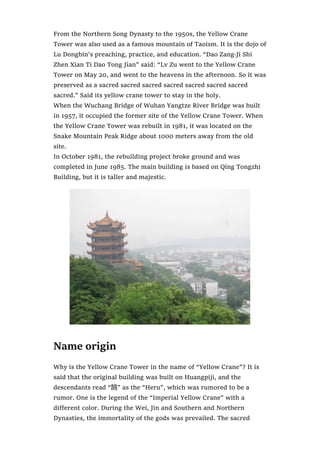
When the Wuchang Bridge of Wuhan Yangtze River Bridge was built
in 1957, it occupied the former site of the Yellow Crane Tower. When
the Yellow Crane Tower was rebuilt in 1981, it was located on the
Snake Mountain Peak Ridge about 1000 meters away from the old
site.
In October 1981, the rebuilding project broke ground and was
completed in June 1985. The main building is based on Qing Tongzhi
Building, but it is taller and majestic.
Name origin
Why is the Yellow Crane Tower in the name of “Yellow Crane”? It is
said that the original building was built on Huangpiji, and the
descendants read “鹄” as the “Heru”, which was rumored to be a
rumor. One is the legend of the “Imperial Yellow Crane” with a
different color. During the Wei, Jin and Southern and Northern
Dynasties, the immortality of the gods was prevailed. The sacred
words about the Yellow Crane Tower were also formed in the context
of the development of the whimsical novels of “Strange Power”. The
legend of the cross crane is first appeared in the writings of the
Southern Dynasty scientist Zu Chongzhi. In his “Remarks”, “The
Crane of the Crane” was later recorded by Lu Xun in the “History of
Ancient Novels”: The original site of the Yellow Crane Tower was in
the head of the Yellow Crane, Snake Mountain, Wuchang, Hubei.
According to legend, this place was originally Xin In order to thank
her for her thousand cups, the hotel opened a crane on the wall
before the trip, telling it to dance down. Since then, the business has
been booming. After ten years, the Taoist priests came back and took
the flute, and the Taoist priests crossed the yellow crane and went
straight to the sky. In order to commemorate the fairy who helped
her get rich, Xin’s name was “Yellow Crane Tower”.
The same is true of the “Record” quoted in “Jiangxia County”.
According to it, there was a person named Xin who used to sell
alcohol. One day, a very sturdy, but well-dressed guest, looked calmly
and asked Xin: “Can you give me a drink?” Xin’s not scorned because
of the other’s clothes, and hurriedly took a big A glass of wine is
served. After half a year, Sin’s did not show the tired look because the
guest could not pay for the money, and still invited the guest to drink
every day. One day, the guest told Xin, “I owe you a lot of money,
there is no way to pay you back.” So I took out the orange peel from
the basket and drew a crane on the wall, because the orange peel is
yellow, the painted crane Also yellow. As long as the people in the
seat sing and sing, the yellow crane on the wall will dance with the
singing, taking a beat and dancing. The guests in the hotel will pay for
it when they see this wonderful thing.
After so many years, Xin has accumulated a lot of wealth. One day,
the well-dressed guest floated to the hotel again. Xin’s thanks and
said, I am willing to support you and meet all your needs. The guest
replied with a smile: Where am I coming for this? Then I took out the
flute and blew a few songs. Not long after, I saw the white clouds
coming down from the sky. The yellow crane on the painting flew to
the front of the guests with the white clouds, and the guests crossed
the back of the crane and flew to the sky by the white clouds. Xin In
order to thank and commemorate this guest, he built a pavilion on
Huangjiji with the silver two earned in ten years. At first, people
called it “Xin’s House”. Later it was called the “Yellow Crane Tower.”
Landscape introduction
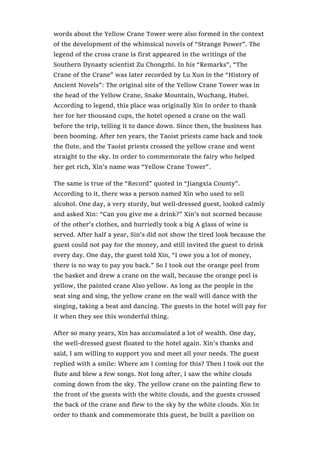
The Yellow Crane Tower, completed in 1985, is more spectacular than
the old one. This is because the Yangtze River Bridge on the Dajiang
River is in front of it, and the 24-storey Qingchuan Hotel is across the
river. This group of buildings, complement each other, makes
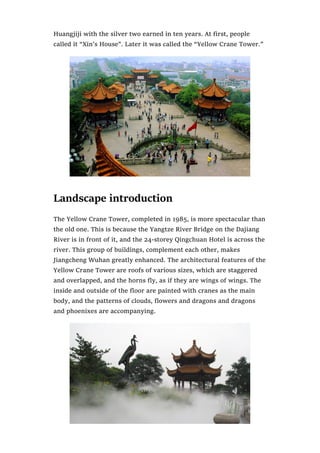
Jiangcheng Wuhan greatly enhanced. The architectural features of the
Yellow Crane Tower are roofs of various sizes, which are staggered
and overlapped, and the horns fly, as if they are wings of wings. The
inside and outside of the floor are painted with cranes as the main
body, and the patterns of clouds, flowers and dragons and dragons
and phoenixes are accompanying.
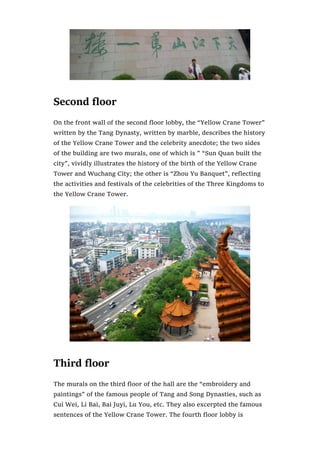
First floor
The front wall of the first floor hall is a huge ceramic mural depicting
the theme of “White Cloud Yellow Crane”. The surrounding space
displays important documents about the Yellow Crane Tower, the
prints of famous poems, and replicas of the Yellow Crane Tower
paintings of the past. The 2nd to 5th floors have different themes, and
each has its own characteristics in layout, decoration and display.
Stepping out of the outer corridor of the five-story hall, looking up
and looking at it. It is nearly 90 meters above the river surface, and
the scenery on both sides of the river is always in sight. The area
around the Snake Mountain where the Yellow Crane Tower is located
is the Yellow Crane Tower Park. Many flowers and trees have been
planted, as well as some arches, porches, pavilions, galleries and
other buildings. There is a poetry monument, which houses many
stone engraved with the works of famous poets of the past. The
ancient attractions in the area around the Snake Mountain will be
restored one after another and become a symbol of Wuhan.
There are also buildings such as pagodas, monuments and mountain
gates built around the main building. The entire building has a unique
ethnic style. Inside the Yellow Crane Tower, the layers are different
in style. The ground floor is a tall and spacious hall. The center of the
algae is more than 10 meters high. On the front wall is a huge “White
Cloud Yellow Crane” ceramic mural.
Second floor
On the front wall of the second floor lobby, the “Yellow Crane Tower”
written by the Tang Dynasty, written by marble, describes the history
of the Yellow Crane Tower and the celebrity anecdote; the two sides
of the building are two murals, one of which is ” “Sun Quan built the
city”, vividly illustrates the history of the birth of the Yellow Crane
Tower and Wuchang City; the other is “Zhou Yu Banquet”, reflecting
the activities and festivals of the celebrities of the Three Kingdoms to
the Yellow Crane Tower.
Third floor
The murals on the third floor of the hall are the “embroidery and
paintings” of the famous people of Tang and Song Dynasties, such as
Cui Wei, Li Bai, Bai Juyi, Lu You, etc. They also excerpted the famous
sentences of the Yellow Crane Tower. The fourth floor lobby is
divided into several small halls with screens, and built-in
contemporary celebrity calligraphy and painting for visitors to enjoy
and purchase. The top floor hall has long scrolls and murals such as
“The Yangtze River Miles”. Since the establishment of the Yellow
Crane Tower, the various directions have been different, but they all
look tall and ancient, and they are very individual. Compared with
Yueyang Tower and Tengwang Pavilion, the plane design of the
Yellow Crane Tower is a four-sided octagonal shape, which is called
“all directions”. These figures reveal the symbolic and ethical
ideographic functions of the numbers in ancient architectural culture.
Seen from the longitudinal direction of the building, each row of rafts
is directly related to the name of the building. It is shaped like a
yellow crane and spreads its wings. The majestic whole building is
not too delicate, rich in changing charm and beauty.
Honor evaluation
Yellow Crane Tower Scenic Spot: National 5A-level tourist scenic
spot, Chinese historical and cultural landmark, national key scenic
spot, and the first three famous buildings in Jiangnan (the other two
famous buildings are Yueyang Building in Hunan and Tengwang
Pavilion in Jiangxi), and the national tourist attraction is forty. good.
The Yellow Crane Tower is a boutique of classical and modern
casting, poetry and beauty. It is at the intersection of the mountains
and rivers, and it just caters to the folk customs of the Chinese
nation, the spatial consciousness of being close to nature, and the
philosophical concept of advocating the universe. Going to the Yellow
Crane Tower is not only a pleasure, but also an infiltration of the
mind and the image of the universe, thus purifying the soul. This is
probably the reason why the charm of the Yellow Crane Tower is not
lost, and the reason for the existence of the sun and the moon. It is
the three famous buildings in the south of the Yangtze River with
Tengwang Pavilion and Yueyang Tower.
Travel guide
Traffic
Tram 1 and Tram 4, bus 10, 61, 64, 108, 401, 402, 411, 413, 584, etc.
to the Yellow Crane Tower Station, or Rail Transit Line 2 at the Crab
Station and change to 108. Yellow Crane Tower Station.
Business hours
Spring and autumn schedule (March 1st – March 31st, October 1st –
November 9th)
8:00 to open the door to sell tickets, 17:00 to stop selling tickets,
18:00 cleaning.
Second, summer work schedule (April 1 – October 31)
Tickets are opened at 8:00, tickets are sold at 18:20, and clean at
18:45.
Ticket price
Yellow Crane Tower full ticket: 70 yuan / person
Yellow Crane Tower Half Ticket: 35 yuan / person
Yellow Crane Tower Annual Pass: 60 yuan / person (limited to Wuhan
citizens)
Great Wuhan Travel Card: Unlimited free of charge within one year
(except May 1st and 11th)


Yellow crane tower

  • 1.
    G Yellow Crane Tower eographiclocation:Wuhan, Hubei hanjourney.com
  • 2.
    Level:AAAAA Suitable for theplay season:All seasons are available Opening hours:7:00-18:30 (summer) Located on the south bank of the Yangtze River in Wuhan, Hubei Province, the Yellow Crane Tower is close to the Yangtze River in Wuchang. It is a national 5A-level tourist attraction and one of the “three famous buildings in the south of the Yangtze River”. It has enjoyed the “first floor of the world and the world” since ancient times. “The name. The Yellow Crane Tower is the landmark building in Wuhan. It is also known as the “Three Famous Places in Wuhan” with Qingchuan Pavilion and Guqintai. The Yellow Crane Tower was built in the second year of Wu Huangwu (AD 223) in the Three Kingdoms Period. During the Three Kingdoms Period, the building was only the “military building” overlooking the corner of Xiakou City. After the Jinwu was destroyed, the Three Kingdoms were unified, and the building lost its At the same time of military value, with the development of the city of Jiangxia, it gradually evolved into a viewing building where the official business travels “the tour must be” and the “banquet must be”. In the Tang Dynasty, the poet Cui Wei wrote a poem “Yellow Crane Tower” under this title. Li Bai wrote “The Yellow Crane Tower to Send Meng Haoran’s Guangling”. The literati of the past dynasties left many ancient swan songs, which made the Yellow Crane Tower since ancient times. Famous. The Yellow Crane Tower is located at the top of the snake at an altitude of 61.7 meters. It was designed with the prototype of Tongzhi Building in the Qing Dynasty. The trains of the Beijing-Guangzhou Railway whizzed downstairs. The building is 5 stories high with a total height of 51.4 meters and a building area of 3,219 square meters. The interior of the Yellow Crane Tower is supported by 72 columns, with 60 corners extending outwards and the roof is covered with more than 100,000 yellow glazed tiles.
  • 3.
    The yellow cranesoutside the Yellow Crane Tower shape, a number of auxiliary buildings such as the Pagoda, the archway, the Xuanlang, and the pavilion will make the main building more magnificent. There are also Baiyun Pavilion, Xiangbao Tower, Monument Gallery and Shanmen Buildings around the main building. The entire building has a unique ethnic style, exuding the spirit, temperament and charm of Chinese traditional culture. It is in harmony with the Wuhan Yangtze River Bridge at the foot of the Snake Mountain; the building is overlooking and the scenery of the three towns in Wuhan is unobstructed. The Yellow Crane Tower is now a national AAAAA tourist attraction. Historical changes The Yellow Crane Tower was built in the second year of the Three Kingdoms (2004). During the Three Kingdoms period, the Yellow Crane Tower was only the “military building” overlooking the corner of Xiakou City. After the Jinwu was destroyed, the three countries were unified. The building lost its military value and gradually evolved into an official business with the development of the Jiangxia city. The tour is “the tour must be” and the “banquet must be” watch. The Tang Dynasty “Yuanhe County Map” records: Sun Quan began to build the old city of Xiakou, “the west of the city is facing the river, the south of the Yangtze River is the building of the Yellow Crane Tower.” It was built for military purposes. According to “The Great Enrollment”, it was recorded that the hotel was originally opened by Xin. In the first year of Tang Yongtai (765), the Yellow Crane Tower had a large scale. However, the fire was frequent, and the Yellow Crane Tower was repeatedly built. It was destroyed seven times in the Ming and Qing Dynasties, and it was rebuilt and repaired 10 times. There is a saying that “the National Games Changshi Building is flourishing”. The last one was built in the 7th year of Tongzhi (1868) and was destroyed in the tenth year of Guangxu (1884). On the ruins, there is only one Huanghelou copper casted roof left behind after the destruction of the Yellow Crane Tower in the Qing Dynasty.
  • 4.
    From the NorthernSong Dynasty to the 1950s, the Yellow Crane Tower was also used as a famous mountain of Taoism. It is the dojo of Lu Dongbin’s preaching, practice, and education. “Dao Zang·Ji Shi Zhen Xian Ti Dao Tong Jian” said: “Lv Zu went to the Yellow Crane Tower on May 20, and went to the heavens in the afternoon. So it was preserved as a sacred sacred sacred sacred sacred sacred sacred sacred.” Said its yellow crane tower to stay in the holy. When the Wuchang Bridge of Wuhan Yangtze River Bridge was built in 1957, it occupied the former site of the Yellow Crane Tower. When the Yellow Crane Tower was rebuilt in 1981, it was located on the Snake Mountain Peak Ridge about 1000 meters away from the old site. In October 1981, the rebuilding project broke ground and was completed in June 1985. The main building is based on Qing Tongzhi Building, but it is taller and majestic. Name origin Why is the Yellow Crane Tower in the name of “Yellow Crane”? It is said that the original building was built on Huangpiji, and the descendants read “鹄” as the “Heru”, which was rumored to be a rumor. One is the legend of the “Imperial Yellow Crane” with a different color. During the Wei, Jin and Southern and Northern Dynasties, the immortality of the gods was prevailed. The sacred
  • 5.
    words about theYellow Crane Tower were also formed in the context of the development of the whimsical novels of “Strange Power”. The legend of the cross crane is first appeared in the writings of the Southern Dynasty scientist Zu Chongzhi. In his “Remarks”, “The Crane of the Crane” was later recorded by Lu Xun in the “History of Ancient Novels”: The original site of the Yellow Crane Tower was in the head of the Yellow Crane, Snake Mountain, Wuchang, Hubei. According to legend, this place was originally Xin In order to thank her for her thousand cups, the hotel opened a crane on the wall before the trip, telling it to dance down. Since then, the business has been booming. After ten years, the Taoist priests came back and took the flute, and the Taoist priests crossed the yellow crane and went straight to the sky. In order to commemorate the fairy who helped her get rich, Xin’s name was “Yellow Crane Tower”. The same is true of the “Record” quoted in “Jiangxia County”. According to it, there was a person named Xin who used to sell alcohol. One day, a very sturdy, but well-dressed guest, looked calmly and asked Xin: “Can you give me a drink?” Xin’s not scorned because of the other’s clothes, and hurriedly took a big A glass of wine is served. After half a year, Sin’s did not show the tired look because the guest could not pay for the money, and still invited the guest to drink every day. One day, the guest told Xin, “I owe you a lot of money, there is no way to pay you back.” So I took out the orange peel from the basket and drew a crane on the wall, because the orange peel is yellow, the painted crane Also yellow. As long as the people in the seat sing and sing, the yellow crane on the wall will dance with the singing, taking a beat and dancing. The guests in the hotel will pay for it when they see this wonderful thing. After so many years, Xin has accumulated a lot of wealth. One day, the well-dressed guest floated to the hotel again. Xin’s thanks and said, I am willing to support you and meet all your needs. The guest replied with a smile: Where am I coming for this? Then I took out the flute and blew a few songs. Not long after, I saw the white clouds coming down from the sky. The yellow crane on the painting flew to the front of the guests with the white clouds, and the guests crossed the back of the crane and flew to the sky by the white clouds. Xin In order to thank and commemorate this guest, he built a pavilion on
  • 6.
    Huangjiji with thesilver two earned in ten years. At first, people called it “Xin’s House”. Later it was called the “Yellow Crane Tower.” Landscape introduction The Yellow Crane Tower, completed in 1985, is more spectacular than the old one. This is because the Yangtze River Bridge on the Dajiang River is in front of it, and the 24-storey Qingchuan Hotel is across the river. This group of buildings, complement each other, makes Jiangcheng Wuhan greatly enhanced. The architectural features of the Yellow Crane Tower are roofs of various sizes, which are staggered and overlapped, and the horns fly, as if they are wings of wings. The inside and outside of the floor are painted with cranes as the main body, and the patterns of clouds, flowers and dragons and dragons and phoenixes are accompanying.
  • 7.
    First floor The frontwall of the first floor hall is a huge ceramic mural depicting the theme of “White Cloud Yellow Crane”. The surrounding space displays important documents about the Yellow Crane Tower, the prints of famous poems, and replicas of the Yellow Crane Tower paintings of the past. The 2nd to 5th floors have different themes, and each has its own characteristics in layout, decoration and display. Stepping out of the outer corridor of the five-story hall, looking up and looking at it. It is nearly 90 meters above the river surface, and the scenery on both sides of the river is always in sight. The area around the Snake Mountain where the Yellow Crane Tower is located is the Yellow Crane Tower Park. Many flowers and trees have been planted, as well as some arches, porches, pavilions, galleries and other buildings. There is a poetry monument, which houses many stone engraved with the works of famous poets of the past. The ancient attractions in the area around the Snake Mountain will be restored one after another and become a symbol of Wuhan. There are also buildings such as pagodas, monuments and mountain gates built around the main building. The entire building has a unique ethnic style. Inside the Yellow Crane Tower, the layers are different in style. The ground floor is a tall and spacious hall. The center of the algae is more than 10 meters high. On the front wall is a huge “White Cloud Yellow Crane” ceramic mural.
  • 8.
    Second floor On thefront wall of the second floor lobby, the “Yellow Crane Tower” written by the Tang Dynasty, written by marble, describes the history of the Yellow Crane Tower and the celebrity anecdote; the two sides of the building are two murals, one of which is ” “Sun Quan built the city”, vividly illustrates the history of the birth of the Yellow Crane Tower and Wuchang City; the other is “Zhou Yu Banquet”, reflecting the activities and festivals of the celebrities of the Three Kingdoms to the Yellow Crane Tower. Third floor The murals on the third floor of the hall are the “embroidery and paintings” of the famous people of Tang and Song Dynasties, such as Cui Wei, Li Bai, Bai Juyi, Lu You, etc. They also excerpted the famous sentences of the Yellow Crane Tower. The fourth floor lobby is
  • 9.
    divided into severalsmall halls with screens, and built-in contemporary celebrity calligraphy and painting for visitors to enjoy and purchase. The top floor hall has long scrolls and murals such as “The Yangtze River Miles”. Since the establishment of the Yellow Crane Tower, the various directions have been different, but they all look tall and ancient, and they are very individual. Compared with Yueyang Tower and Tengwang Pavilion, the plane design of the Yellow Crane Tower is a four-sided octagonal shape, which is called “all directions”. These figures reveal the symbolic and ethical ideographic functions of the numbers in ancient architectural culture. Seen from the longitudinal direction of the building, each row of rafts is directly related to the name of the building. It is shaped like a yellow crane and spreads its wings. The majestic whole building is not too delicate, rich in changing charm and beauty. Honor evaluation Yellow Crane Tower Scenic Spot: National 5A-level tourist scenic spot, Chinese historical and cultural landmark, national key scenic spot, and the first three famous buildings in Jiangnan (the other two famous buildings are Yueyang Building in Hunan and Tengwang Pavilion in Jiangxi), and the national tourist attraction is forty. good.
  • 10.
    The Yellow CraneTower is a boutique of classical and modern casting, poetry and beauty. It is at the intersection of the mountains and rivers, and it just caters to the folk customs of the Chinese nation, the spatial consciousness of being close to nature, and the philosophical concept of advocating the universe. Going to the Yellow Crane Tower is not only a pleasure, but also an infiltration of the mind and the image of the universe, thus purifying the soul. This is probably the reason why the charm of the Yellow Crane Tower is not lost, and the reason for the existence of the sun and the moon. It is the three famous buildings in the south of the Yangtze River with Tengwang Pavilion and Yueyang Tower. Travel guide Traffic Tram 1 and Tram 4, bus 10, 61, 64, 108, 401, 402, 411, 413, 584, etc. to the Yellow Crane Tower Station, or Rail Transit Line 2 at the Crab Station and change to 108. Yellow Crane Tower Station.
  • 11.
    Business hours Spring andautumn schedule (March 1st – March 31st, October 1st – November 9th) 8:00 to open the door to sell tickets, 17:00 to stop selling tickets, 18:00 cleaning. Second, summer work schedule (April 1 – October 31) Tickets are opened at 8:00, tickets are sold at 18:20, and clean at 18:45. Ticket price Yellow Crane Tower full ticket: 70 yuan / person Yellow Crane Tower Half Ticket: 35 yuan / person Yellow Crane Tower Annual Pass: 60 yuan / person (limited to Wuhan citizens) Great Wuhan Travel Card: Unlimited free of charge within one year (except May 1st and 11th) 