Year 9 GCSE
Options Information
Evening
What will you do?
 Broad and balanced curriculum
 Subjects that allow you to follow a
variety of career paths
 Subjects that inspire you to carry-on to
A-level and beyond
How do you go about making
these choices?
 Read through the options booklet
carefully, preferably with your parents!
 Ask your subject teachers for advice
 You can also ask your tutor, HoYs
(9,10 or 11), Mr Reddin or Mr Ryce
Choosing GCSE subjects
Don’t…
 choose subjects because they are ‘easy’
 choose subjects because you like a
teacher
 avoid subjects because you dislike a
teacher/think a teacher dislikes you
 It is important to get this right first time –
it is difficult to change courses once you
have started!
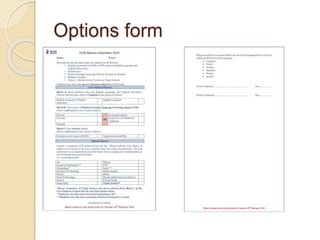
Options form
Options form
Process
 There are a number of core subjects
◦ Mathematics
◦ English (English and English Literature)
◦ Science (Double Award or Triple Award)
◦ RS
◦ Modern Foreign Language (French,
German, Spanish)
Options – You select up to 3
GCSEs from the following
 Art & Design
 Computer Science
 Classical Civilization
 Design &Technology
 Drama
 Food Technology
 French (German or Spanish can be chosen as a core Second
Language)
 Geography
 History
 ICT
 Latin
 Media Studies
 Music
 Physical Education
 Triple Science: Biology, Chemistry, Physics
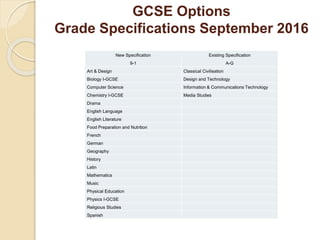
GCSE Options
Grade Specifications September 2016
New Specification
9-1
Existing Specification
A-G
Art & Design Classical Civilisation
Biology I-GCSE Design and Technology
Computer Science Information & Communications Technology
Chemistry I-GCSE Media Studies
Drama
English Language
English Literature
Food Preparation and Nutrition
French
German
Geography
History
Latin
Mathematics
Music
Physical Education
Physics I-GCSE
Religious Studies
Spanish
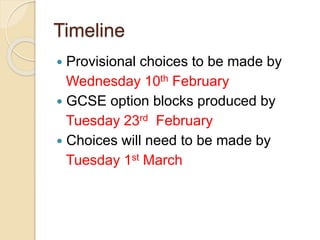
Timeline
 Provisional choices to be made by
Wednesday 10th February
 GCSE option blocks produced by
Tuesday 23rd February
 Choices will need to be made by
Tuesday 1st March
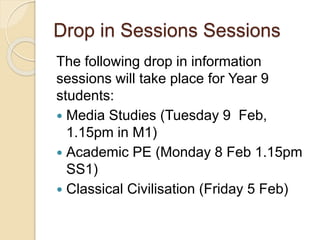
Drop in Sessions Sessions
The following drop in information
sessions will take place for Year 9
students:
 Media Studies (Tuesday 9 Feb,
1.15pm in M1)
 Academic PE (Monday 8 Feb 1.15pm
SS1)
 Classical Civilisation (Friday 5 Feb)
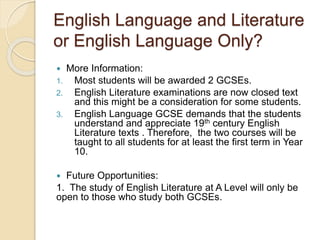
English Language and Literature
or English Language Only?
 More Information:
1. Most students will be awarded 2 GCSEs.
2. English Literature examinations are now closed text
and this might be a consideration for some students.
3. English Language GCSE demands that the students
understand and appreciate 19th century English
Literature texts . Therefore, the two courses will be
taught to all students for at least the first term in Year
10.
 Future Opportunities:
1. The study of English Literature at A Level will only be
open to those who study both GCSEs.
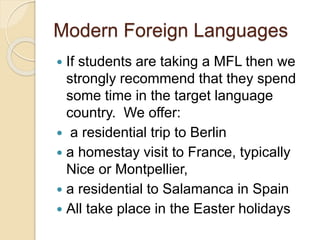
Modern Foreign Languages
 If students are taking a MFL then we
strongly recommend that they spend
some time in the target language
country. We offer:
 a residential trip to Berlin
 a homestay visit to France, typically
Nice or Montpellier,
 a residential to Salamanca in Spain
 All take place in the Easter holidays
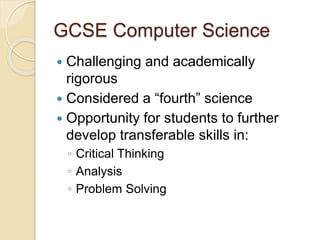
GCSE Computer Science
 Challenging and academically
rigorous
 Considered a “fourth” science
 Opportunity for students to further
develop transferable skills in:
◦ Critical Thinking
◦ Analysis
◦ Problem Solving
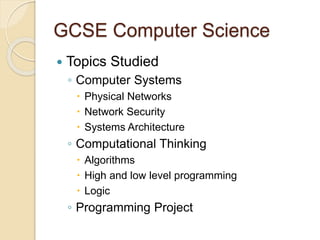
GCSE Computer Science
 Topics Studied
◦ Computer Systems
 Physical Networks
 Network Security
 Systems Architecture
◦ Computational Thinking
 Algorithms
 High and low level programming
 Logic
◦ Programming Project
International GCSE
Option Choices in
Science
International GCSE
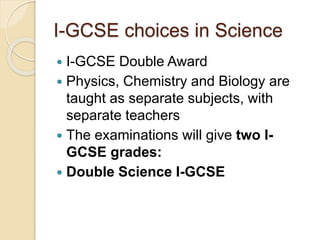
I-GCSE choices in Science
 I-GCSE Double Award
 Physics, Chemistry and Biology are
taught as separate subjects, with
separate teachers
 The examinations will give two I-
GCSE grades:
 Double Science I-GCSE
I-GCSE choices in Science
 I-GCSE Triple Sciences
 Physics, Chemistry and Biology. Also
taught separately. The examinations
will give three I-GCSE grades:
 Biology I-GCSE
 Chemistry I-GCSE
 Physics I-GCSE
Double Science
 There will be in total 12 periods of
Science per fortnight
 The students are taught in ability
groups (sets)
 The Double Science curriculum will
allow access to any Science A levels –
providing the grades are good enough
Triple Science
 Students choosing this route will study
Science instead of an option subject
 18 periods of Science per fortnight
 More rigorous than Double Science
 There will be no sets – the most able
Science students study Triple Science
and so the groups will be of a similar
ability level
I-GCSE
 The assessment is through
terminal papers only
 There is no coursework
assessment of practical work in
the Sciences. Scientific method
and experimental technique are
assessed as part of the written
examinations
 The course content has more
breadth and depth than GCSE and
is deemed to be a good
Edexcel I-GCSE
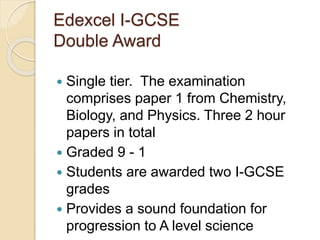
Double Award
 Single tier. The examination
comprises paper 1 from Chemistry,
Biology, and Physics. Three 2 hour
papers in total
 Graded 9 - 1
 Students are awarded two I-GCSE
grades
 Provides a sound foundation for
progression to A level science
Edexcel I-GCSE
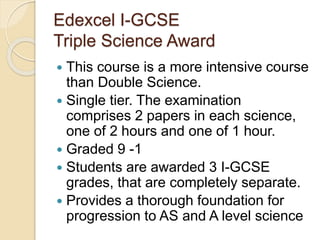
Triple Science Award
 This course is a more intensive course
than Double Science.
 Single tier. The examination
comprises 2 papers in each science,
one of 2 hours and one of 1 hour.
 Graded 9 -1
 Students are awarded 3 I-GCSE
grades, that are completely separate.
 Provides a thorough foundation for
progression to AS and A level science
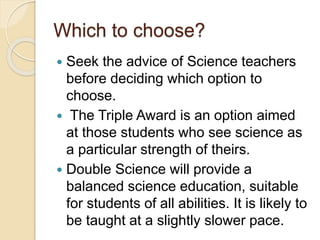
Which to choose?
 Seek the advice of Science teachers
before deciding which option to
choose.
 The Triple Award is an option aimed
at those students who see science as
a particular strength of theirs.
 Double Science will provide a
balanced science education, suitable
for students of all abilities. It is likely to
be taught at a slightly slower pace.
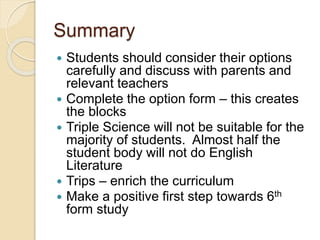
Summary
 Students should consider their options
carefully and discuss with parents and
relevant teachers
 Complete the option form – this creates
the blocks
 Triple Science will not be suitable for the
majority of students. Almost half the
student body will not do English
Literature
 Trips – enrich the curriculum
 Make a positive first step towards 6th
form study
Year 9 GCSE
Options Information
Evening

Year 9 GCSE options information evening 2016 final

  • 1.
    Year 9 GCSE OptionsInformation Evening
  • 2.
    What will youdo?  Broad and balanced curriculum  Subjects that allow you to follow a variety of career paths  Subjects that inspire you to carry-on to A-level and beyond
  • 3.
    How do yougo about making these choices?  Read through the options booklet carefully, preferably with your parents!  Ask your subject teachers for advice  You can also ask your tutor, HoYs (9,10 or 11), Mr Reddin or Mr Ryce
  • 4.
    Choosing GCSE subjects Don’t… choose subjects because they are ‘easy’  choose subjects because you like a teacher  avoid subjects because you dislike a teacher/think a teacher dislikes you  It is important to get this right first time – it is difficult to change courses once you have started!
  • 5.
  • 6.
  • 7.
    Process  There area number of core subjects ◦ Mathematics ◦ English (English and English Literature) ◦ Science (Double Award or Triple Award) ◦ RS ◦ Modern Foreign Language (French, German, Spanish)
  • 8.
    Options – Youselect up to 3 GCSEs from the following  Art & Design  Computer Science  Classical Civilization  Design &Technology  Drama  Food Technology  French (German or Spanish can be chosen as a core Second Language)  Geography  History  ICT  Latin  Media Studies  Music  Physical Education  Triple Science: Biology, Chemistry, Physics
  • 9.
    GCSE Options Grade SpecificationsSeptember 2016 New Specification 9-1 Existing Specification A-G Art & Design Classical Civilisation Biology I-GCSE Design and Technology Computer Science Information & Communications Technology Chemistry I-GCSE Media Studies Drama English Language English Literature Food Preparation and Nutrition French German Geography History Latin Mathematics Music Physical Education Physics I-GCSE Religious Studies Spanish
  • 10.
    Timeline  Provisional choicesto be made by Wednesday 10th February  GCSE option blocks produced by Tuesday 23rd February  Choices will need to be made by Tuesday 1st March
  • 11.
    Drop in SessionsSessions The following drop in information sessions will take place for Year 9 students:  Media Studies (Tuesday 9 Feb, 1.15pm in M1)  Academic PE (Monday 8 Feb 1.15pm SS1)  Classical Civilisation (Friday 5 Feb)
  • 12.
    English Language andLiterature or English Language Only?  More Information: 1. Most students will be awarded 2 GCSEs. 2. English Literature examinations are now closed text and this might be a consideration for some students. 3. English Language GCSE demands that the students understand and appreciate 19th century English Literature texts . Therefore, the two courses will be taught to all students for at least the first term in Year 10.  Future Opportunities: 1. The study of English Literature at A Level will only be open to those who study both GCSEs.
  • 13.
    Modern Foreign Languages If students are taking a MFL then we strongly recommend that they spend some time in the target language country. We offer:  a residential trip to Berlin  a homestay visit to France, typically Nice or Montpellier,  a residential to Salamanca in Spain  All take place in the Easter holidays
  • 14.
    GCSE Computer Science Challenging and academically rigorous  Considered a “fourth” science  Opportunity for students to further develop transferable skills in: ◦ Critical Thinking ◦ Analysis ◦ Problem Solving
  • 15.
    GCSE Computer Science Topics Studied ◦ Computer Systems  Physical Networks  Network Security  Systems Architecture ◦ Computational Thinking  Algorithms  High and low level programming  Logic ◦ Programming Project
  • 16.
    International GCSE Option Choicesin Science International GCSE
  • 17.
    I-GCSE choices inScience  I-GCSE Double Award  Physics, Chemistry and Biology are taught as separate subjects, with separate teachers  The examinations will give two I- GCSE grades:  Double Science I-GCSE
  • 18.
    I-GCSE choices inScience  I-GCSE Triple Sciences  Physics, Chemistry and Biology. Also taught separately. The examinations will give three I-GCSE grades:  Biology I-GCSE  Chemistry I-GCSE  Physics I-GCSE
  • 19.
    Double Science  Therewill be in total 12 periods of Science per fortnight  The students are taught in ability groups (sets)  The Double Science curriculum will allow access to any Science A levels – providing the grades are good enough
  • 20.
    Triple Science  Studentschoosing this route will study Science instead of an option subject  18 periods of Science per fortnight  More rigorous than Double Science  There will be no sets – the most able Science students study Triple Science and so the groups will be of a similar ability level
  • 21.
    I-GCSE  The assessmentis through terminal papers only  There is no coursework assessment of practical work in the Sciences. Scientific method and experimental technique are assessed as part of the written examinations  The course content has more breadth and depth than GCSE and is deemed to be a good
  • 22.
    Edexcel I-GCSE Double Award Single tier. The examination comprises paper 1 from Chemistry, Biology, and Physics. Three 2 hour papers in total  Graded 9 - 1  Students are awarded two I-GCSE grades  Provides a sound foundation for progression to A level science
  • 23.
    Edexcel I-GCSE Triple ScienceAward  This course is a more intensive course than Double Science.  Single tier. The examination comprises 2 papers in each science, one of 2 hours and one of 1 hour.  Graded 9 -1  Students are awarded 3 I-GCSE grades, that are completely separate.  Provides a thorough foundation for progression to AS and A level science
  • 24.
    Which to choose? Seek the advice of Science teachers before deciding which option to choose.  The Triple Award is an option aimed at those students who see science as a particular strength of theirs.  Double Science will provide a balanced science education, suitable for students of all abilities. It is likely to be taught at a slightly slower pace.
  • 25.
    Summary  Students shouldconsider their options carefully and discuss with parents and relevant teachers  Complete the option form – this creates the blocks  Triple Science will not be suitable for the majority of students. Almost half the student body will not do English Literature  Trips – enrich the curriculum  Make a positive first step towards 6th form study
  • 26.
    Year 9 GCSE OptionsInformation Evening