STUDY IN AUSTRALIA (&NZ)
JUKO 2015
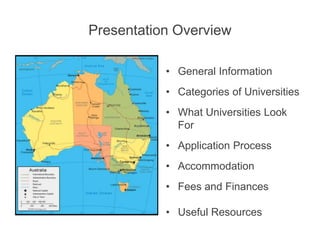
Presentation Overview
• General Information
• Categories of Universities
• What Universities Look
For
• Application Process
• Accommodation
• Fees and Finances
• Useful Resources
General Information about Australian
Universities
• Over 1,000 higher
education institutions
• Over 22,000 courses to
choose from
• Over 1,000,000 students
in education
• 8 universities ranked in
the world’s top 100
• 3rd highest number of
international students
after US and UK
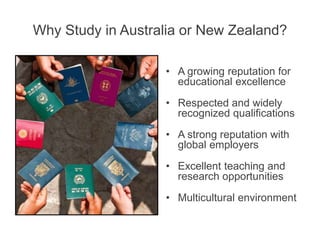
Why Study in Australia or New Zealand?
• A growing reputation for
educational excellence
• Respected and widely
recognized qualifications
• A strong reputation with
global employers
• Excellent teaching and
research opportunities
• Multicultural environment
More Practical Reasons
• Three year or four year
degree programs
• A narrower focus on your
chosen major
• Work Opportunities
• Easy application process
• No need for the SAT or
ACT
Tertiary Education in Australia
• Australia has 43
universities. 40 are
public, 2 international and
1 private.
• There are numerous
Institutes of Technology.
• There are also a large
number of TAFE Schools
(Technical and Further
Education Schools).
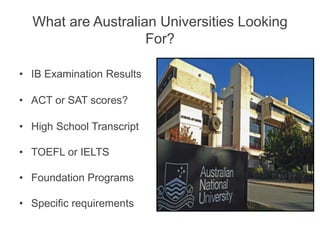
What are Australian Universities Looking
For?
• IB Examination Results
• ACT or SAT scores?
• High School Transcript
• TOEFL or IELTS
• Foundation Programs
• Specific requirements
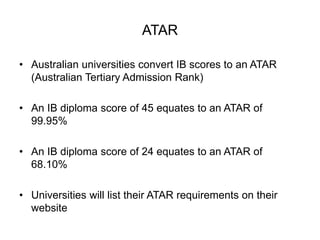
ATAR
• Australian universities convert IB scores to an ATAR
(Australian Tertiary Admission Rank)
• An IB diploma score of 45 equates to an ATAR of
99.95%
• An IB diploma score of 24 equates to an ATAR of
68.10%
• Universities will list their ATAR requirements on their
website
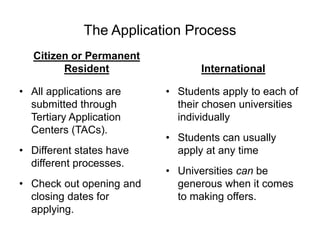
The Application Process
Citizen or Permanent
Resident
• All applications are
submitted through
Tertiary Application
Centers (TACs).
• Different states have
different processes.
• Check out opening and
closing dates for
applying.
International
• Students apply to each of
their chosen universities
individually
• Students can usually
apply at any time
• Universities can be
generous when it comes
to making offers.
Application Windows
• Most Australian universities use a semester model and
admit students in February and July/August.
• Students must consider the pros and cons of February or
July admission (Orientation, Course offerings etc.).
• What do ISM students do? Take a gap year?
• Offers will be conditional for July but unconditional for
February as applicants will already have their IB diploma
score
Student Accommodation
• Less than 10% of all
students live on
campus
• The application
process can be very
competitive and
require letters of
recommendation.
Helping the Student Decide
• Is the student being realistic? Check out the university
website to find out the minimum number of IB points
required.
• The IB diploma is generally required for direct entry to an
undergraduate course. For IB certificate students, it is
possible to take a foundation year.
• Other qualifications are accepted. More detailed
information can be found at each university’s website.
• The timeline suits ISM students.
New Zealand
• 8 Universities and numerous polytechnics
• Students apply to each university individually
• There are different application schemes. It depends on
the university the student is applying to.
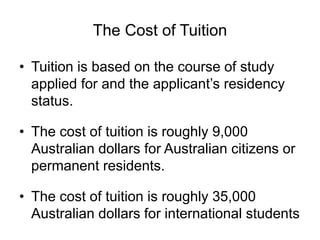
The Cost of Tuition
• Tuition is based on the course of study
applied for and the applicant’s residency
status.
• The cost of tuition is roughly 9,000
Australian dollars for Australian citizens or
permanent residents.
• The cost of tuition is roughly 35,000
Australian dollars for international students
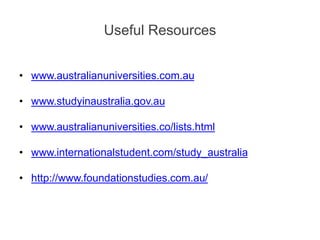
Useful Resources
• www.australianuniversities.com.au
• www.studyinaustralia.gov.au
• www.australianuniversities.co/lists.html
• www.internationalstudent.com/study_australia
• http://www.foundationstudies.com.au/

JUKO 2015 - Australian Universities

  • 1.
    STUDY IN AUSTRALIA(&NZ) JUKO 2015
  • 2.
    Presentation Overview • GeneralInformation • Categories of Universities • What Universities Look For • Application Process • Accommodation • Fees and Finances • Useful Resources
  • 3.
    General Information aboutAustralian Universities • Over 1,000 higher education institutions • Over 22,000 courses to choose from • Over 1,000,000 students in education • 8 universities ranked in the world’s top 100 • 3rd highest number of international students after US and UK
  • 4.
    Why Study inAustralia or New Zealand? • A growing reputation for educational excellence • Respected and widely recognized qualifications • A strong reputation with global employers • Excellent teaching and research opportunities • Multicultural environment
  • 5.
    More Practical Reasons •Three year or four year degree programs • A narrower focus on your chosen major • Work Opportunities • Easy application process • No need for the SAT or ACT
  • 6.
    Tertiary Education inAustralia • Australia has 43 universities. 40 are public, 2 international and 1 private. • There are numerous Institutes of Technology. • There are also a large number of TAFE Schools (Technical and Further Education Schools).
  • 7.
    What are AustralianUniversities Looking For? • IB Examination Results • ACT or SAT scores? • High School Transcript • TOEFL or IELTS • Foundation Programs • Specific requirements
  • 8.
    ATAR • Australian universitiesconvert IB scores to an ATAR (Australian Tertiary Admission Rank) • An IB diploma score of 45 equates to an ATAR of 99.95% • An IB diploma score of 24 equates to an ATAR of 68.10% • Universities will list their ATAR requirements on their website
  • 9.
    The Application Process Citizenor Permanent Resident • All applications are submitted through Tertiary Application Centers (TACs). • Different states have different processes. • Check out opening and closing dates for applying. International • Students apply to each of their chosen universities individually • Students can usually apply at any time • Universities can be generous when it comes to making offers.
  • 11.
    Application Windows • MostAustralian universities use a semester model and admit students in February and July/August. • Students must consider the pros and cons of February or July admission (Orientation, Course offerings etc.). • What do ISM students do? Take a gap year? • Offers will be conditional for July but unconditional for February as applicants will already have their IB diploma score
  • 12.
    Student Accommodation • Lessthan 10% of all students live on campus • The application process can be very competitive and require letters of recommendation.
  • 13.
    Helping the StudentDecide • Is the student being realistic? Check out the university website to find out the minimum number of IB points required. • The IB diploma is generally required for direct entry to an undergraduate course. For IB certificate students, it is possible to take a foundation year. • Other qualifications are accepted. More detailed information can be found at each university’s website. • The timeline suits ISM students.
  • 14.
    New Zealand • 8Universities and numerous polytechnics • Students apply to each university individually • There are different application schemes. It depends on the university the student is applying to.
  • 15.
    The Cost ofTuition • Tuition is based on the course of study applied for and the applicant’s residency status. • The cost of tuition is roughly 9,000 Australian dollars for Australian citizens or permanent residents. • The cost of tuition is roughly 35,000 Australian dollars for international students
  • 16.
    Useful Resources • www.australianuniversities.com.au •www.studyinaustralia.gov.au • www.australianuniversities.co/lists.html • www.internationalstudent.com/study_australia • http://www.foundationstudies.com.au/