MONOLOGUE
Objective: meaning ofmonologue and identify where its used.
• A monologue is a speech, or story given by a single character in a story
using first person point of view. In drama, it is the vocalization of a
character's thoughts; in literature, the verbalization. Its telling the
story from observant`s point of view.
• Prefix “monos” means alone or one while “logos” means “speech.” These
speeches are used by writers to express a character's thoughts,
emotions, or ideas.
• Sentence starters for monologue:... It all started last week when I
asked for.... I can't believe she would do this to me..... The thing
about _______ is that it's always......
3.
• In theatre,a monologue is a speech presented by a
single character, most often to express their
thoughts aloud, though sometimes also to directly
address ...
• Your monologue should begin and end with a purpose.
Create an outline that includes a beginning, middle,
and end for the monologue.
5.
Features of Monologue
1.Onevoice telling a story from one point of view.Told
in first person point of view.
2.Include facts and opinions.
3.Include speaker`s feelings and attitude.
4.Gradually reveal bits of information.
6.
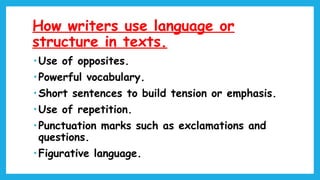
How writers uselanguage or
structure in texts.
• Use of opposites.
• Powerful vocabulary.
• Short sentences to build tension or emphasis.
• Use of repetition.
• Punctuation marks such as exclamations and
questions.
• Figurative language.
7.
SUSPENSE TEXT
Suspense-story thatends when a reader don't
know what is going to happen next
A writer creates suspense through a controlled release
of information to readers that raises key questions
and makes readers eager, but terrified, to find out
what happens.
Suspense ensures the reader will have enough interest
to continue reading throughout the piece.
8.
Features of suspensestory
• Unusual characters, setting and situation.
• Withholding information.(keeps you wondering)
• Cliffhanger(keeps you guessing at the end.)
• Foreshadowing (author gives hints about what may happen later in
the story)
• Dilemma(problem or conflict)
• Dramatic actions.
• Irony(signifies the opposite, typically for humorous or emphatic
effect.)
9.
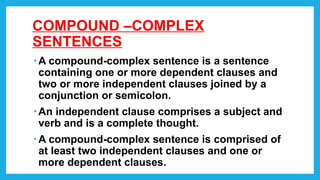
COMPOUND –COMPLEX
SENTENCES
• Acompound-complex sentence is a sentence
containing one or more dependent clauses and
two or more independent clauses joined by a
conjunction or semicolon.
• An independent clause comprises a subject and
verb and is a complete thought.
• A compound-complex sentence is comprised of
at least two independent clauses and one or
more dependent clauses.
10.
Examples
• After Ifinish work, I will go to the gym, and I will
meet my friend for dinner.
• She studied hard for her exam, but she still
failed because she didn't understand the
material.
• Though Mitchell prefers watching romantic
films, he rented the latest spy thriller, and he
enjoyed it very much.
11.
TRAVEL WRITING
• Travelwriting is writing that describes places the
author has visited and the experiences they had
while travelling.
What is the main purpose of travel writing?
•
Travel writing has a way of transporting the
reader to new places. When done well, it can even
inspire others to explore, experience new things,
and gain an appreciation of different cultures.
12.
Examples of TravelWriting
• "By the Railway Side" by Alice Meynell.
• Lists and Anaphora in Bill Bryson's "Neither Here Nor There"
• Lists in William Least Heat-Moon's Place Description.
• "London From a Distance" by Ford Madox Ford.
• "Niagara Falls" by Rupert Brooke.
• "Nights in London" by Thomas Burke.
13.
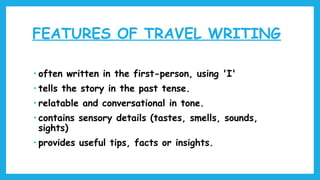
FEATURES OF TRAVELWRITING
• often written in the first-person, using 'I'
• tells the story in the past tense.
• relatable and conversational in tone.
• contains sensory details (tastes, smells, sounds,
sights)
• provides useful tips, facts or insights.
15.
SPEECH WRITING
• Speechwriting is the method of conveying a thought or
message to a reader using the correct punctuation and
expression. Speech writing isn't much different from any
other form of narrative writing.
• Speech writing is the process of writing something that is
generally meant to be delivered to a large audience. Speech
writing is more or less like essay writing with an aim to either
convince someone of a certain viewpoint or make a public
statement.
Types of speeches
• Persuasive, entertaining ,motivational and informative
16.
Structuring the Speech
•Introduction: Introduce the topic and your
views on the topic briefly.
• Body: Give a detailed explanation of your
topic. Your focus should be to inform and
educate your audience on the said topic.
• Conclusion: Voice out your
thoughts/suggestions. Your intention here
should be to make them think/act.
17.
How to writea speech
• Choose an important topic. The first step in writing a speech is deciding what
it may be about. ...
• Consider your audience. ...
• Prepare a structure. ...
• Begin with a strong point. ...
• Use concrete details and visual aids. ...
• Include a personal element. ...
• Consider rhetorical devices. ...
• End memorably.
18.
The key ideasfor how to start a
speech
• Hook the audience with a catchy opening like an anecdote or
rhetorical question.
• Make sure the speech (and introduction) focuses on one
central message.
• Have a clear structure.
19.
Features of speechwriting
• Rhetorical questions
• Statistics
• Set up imaginary scene-fictional scene in audiences mind
• Use transition words
• Its monologue
• Use of persuasive devices
• Academic speech use formal language and its impersonal
• Emotive language
• Use of personal pronouns we and our to involve the audience
20.
• Figurative languagesuch as similes, repetition ,alliteration and
metaphors
• Use of quotes and memorable phrases.
• Use ellipsis for dramatic pause that is silence involved.
• Use of facts and opinions.
21.
NEWSPAPER ARTICLES
• Newspapersare needed so as to know what is happening in local and
worldwide.
• Terms used in newspaper reports;
• a. Headline-Form of title that tells readers what the newspaper is
about. Always written in alliteration form.
• b. Byline-name of the reporter and often appears at the beginning
of the report.
• c. Report-an account of something that has happened.
• d. Column-a piece of writing that appears regularly in a newspaper
or magazine.
22.
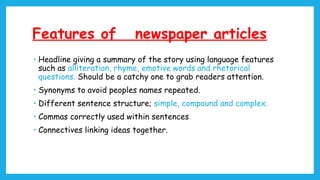
Features of newspaperarticles
• Headline giving a summary of the story using language features
such as alliteration, rhyme, emotive words and rhetorical
questions. Should be a catchy one to grab readers attention.
• Synonyms to avoid peoples names repeated.
• Different sentence structure; simple, compound and complex.
• Commas correctly used within sentences
• Connectives linking ideas together.
23.
• Written inpast tense.
• Eye witness accounts (these are people who were actually
there)Can either be in reported or direct speech.
• Involve facts and opinions.
• The first paragraph sums the story up.
• Presented in paragraphs.
• The story always finishes with some reference to what happens
afterwards.
24.
FILM WRITING REVIEW
•Review means to assess (something) formally with the intention
of instituting change if necessary. Synonyms include: discuss, evaluate,
assess appraise and judge.
• The review should be informative for others and end with a summarising
statement.
Purpose of writing a review
• inform.
• describe.
• analyse.
• advise.
25.
What is amovie review?
• A movie review also known as a film review, is an opinionated
recount of a movie written by somebody who has recently seen
it.
• Most movie reviews will be a combination of persuasive and
informative, in that they will inform readers about key features of
the movie (such as its title, its director, the main actors and a
brief synopsis of the plot) while also offering the writer's
opinions of different features of the movie (such as the directing,
the editing, the special effects and the acting).
26.
Features of afilm review
• Title of the film, the year it was made and the director.
• Summary of the plot (without giving away the end).
• Your own opinion.
• Strengths and weaknesses of the film with specific details.
• Use powerful adjectives and adverbs to add further details.
27.
What to includein film review?
• The film's title.
• An eye-catching heading.
• The genre (type of film).
• The audience. Who is the film for?
• The director, main actors, when it was made, has it won any awards?
• The plot. A brief summary that doesn't mention the ending!
• Your opinion.
• Your evaluation.
29.
TIME CONNECTIVES
Objective: ableto use time connectives correctly in
sentences.
• Time connectives are words that join phrases or sentences together to
help us understand when something is happening. Also known as
temporal connectives. Answer the question WHEN
• Examples: before, after, next, just then, shortly, afterwards, last,
eventually, firstly, secondly and thirdly.
Examples in sentences
• After dinner you must do your homework.
• Josie helped mum to set the table before dinner.
• To mark the end of the match, eventually, the whistle blew.
30.
POINT OF VIEW
•Objective: able to identify sentences in different point of view.
Point of view is about who tells or reports a story or an account. It is also
called the narrative voice. There are only three types of narrative voice:
a. First person narrative :used in diaries and other personal accounts.
Pronouns used include: I, me, mine, we, us and ours.
b. Second person narrative: when the reader is part of the account and
addresses the reader directly. Pronouns used are you and yours.
c. Third person narrative: an outside`s point of view like a reporter or a
narrator. Pronouns used include: he, him, his, she, her, hers, it, they,
them, theirs.
31.
HAIKU POEMS
Objective: ableto write an example of haiku
poem.
• Syllable: a word or part of a word that has one vowel
sound.
• Haiku is an ancient form of Japanese poem.
• A haiku is an unrhymed poem consisting of 17
syllables arranged in three lines of 5, 7, and 5
syllables respectively.
• A haiku emphasizes imagery, usually of landscapes,
seasons and the time of day.
32.
Rules applying towriting haiku
• There are no more than 17 syllables.
• Haiku is composed of only 3 lines.
• Typically, every first line of Haiku has 5 syllables,
the second line has 7 syllables and the third has 5
syllables.
Example of a Haiku Poem
The sky is so blue. (5)
• The sun is so warm up high. (7)
• I love the summer.(5)
33.
Flash Fiction
• Flashfiction is a genre of fiction which is very short
story.
• Synonym for flash fiction is micro fiction, micro stories,
short stories and sudden fiction.
• Flash fiction will include a variety of literary devices
such as imagery and symbolism. These devices help
pull the reader into the story. It often features a plot
twist or surprise ending.
34.
Use of symbolismand imagery
• Symbolism is a figure of speech in which a person, situation,
word, or object is used to represent another thing. Some of the
effects of using symbolism include:
a. It acts as a visual aid for readers to better understand complex
ideas of concepts.
b. It helps readers follow a book's central theme more easily.
c. It allows writers to write their ideas more creatively and artfully.
d. It allows readers to think about and interpret the author's words
35.
Some examples ofsymbolism
• A rainbow symbolizes hope.
• A dove symbolizes peace.
• Key symbolize answer, solution to a problem.
• Fire symbolize knowledge, passion.
• Flowing water represents an era of rebirth or recovery.
36.
Use of imagery
•Imagery creates mental images in the readers' mind.
• Imagery can improve a reader's experience of the text
by immersing them more deeply by appealing to their
senses.
• Imagery in writing can aim at a reader's sense of taste,
smell, touch, hearing, or sight through vivid
descriptions.
37.
• Establishing aworld or setting
• Creating empathy for a character’s experience
• Immersing a character into a situation
38.
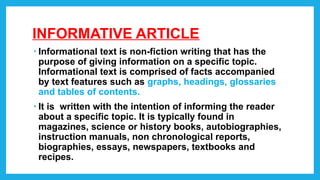
INFORMATIVE ARTICLE
• Informationaltext is non-fiction writing that has the
purpose of giving information on a specific topic.
Informational text is comprised of facts accompanied
by text features such as graphs, headings, glossaries
and tables of contents.
• It is written with the intention of informing the reader
about a specific topic. It is typically found in
magazines, science or history books, autobiographies,
instruction manuals, non chronological reports,
biographies, essays, newspapers, textbooks and
recipes.
39.
Features of anInformation Text
• Main title - This sums up the topic.
• Headings and sub-headings - These are used to introduce the content of
different paragraphs to help the reader navigate the text.
• Paragraphs - These are the main bodies of text that include the topic
information.
• Bullet-pointed lists - Ordering key information in a list is a great way of telling
the reader what they need to know about the subject.
• Photographs and illustrations - Information texts include images to make the
information easier to understand. These can be realistic photos or annotated
diagrams.
• Captions- Captions are used to describe included photographs and
illustrations
40.
Basic purpose ofinformative texts
• Sharing new information with readers.
• Describing a process.
• Clarifying a concept.
• Giving an explanation of why or how.
• Detailing parts of a greater whole.
42.
MAGAZINE ARTICLE
• Amagazine article is a nonfiction text that stands on its own
within a publication. Examples include a profile of a significant
person, an opinion piece or personal essay. They deal with
issues over a period of time unlike newspaper which are daily
and weekly.
• It is published weekly, monthly or annually and consists of a
wealth of information. There are magazines about many topics
including cars, fashion and lifestyle.
How do you structure a magazine article?
• The introduction hooks the reader with a strong quote. The body
develops the subject. The conclusion leaves the reader with a
question.
43.
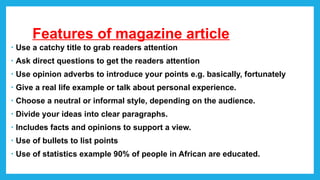
Features of magazinearticle
• Use a catchy title to grab readers attention
• Ask direct questions to get the readers attention
• Use opinion adverbs to introduce your points e.g. basically, fortunately
• Give a real life example or talk about personal experience.
• Choose a neutral or informal style, depending on the audience.
• Divide your ideas into clear paragraphs.
• Includes facts and opinions to support a view.
• Use of bullets to list points
• Use of statistics example 90% of people in African are educated.
44.
• Give peoplesopinions either in direct or reported speech.
• Pronoun YOU to involve the reader.
• Use of commas, dashes and brackets as parenthesis.
• Use simple, compound and complex sentences for effect.
• Use of powerful verbs such as marvel
• Use of adjectives and adjective phrases e.g. dramatic,
stunning, underwater.
• Use of active and passive verbs.
45.
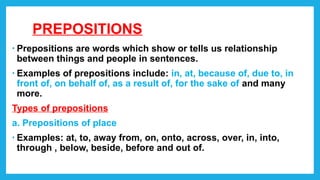
PREPOSITIONS
• Prepositions arewords which show or tells us relationship
between things and people in sentences.
• Examples of prepositions include: in, at, because of, due to, in
front of, on behalf of, as a result of, for the sake of and many
more.
Types of prepositions
a. Prepositions of place
• Examples: at, to, away from, on, onto, across, over, in, into,
through , below, beside, before and out of.
46.
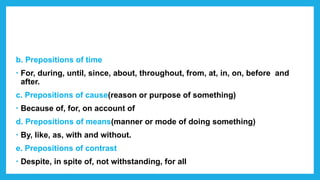
b. Prepositions oftime
• For, during, until, since, about, throughout, from, at, in, on, before and
after.
c. Prepositions of cause(reason or purpose of something)
• Because of, for, on account of
d. Prepositions of means(manner or mode of doing something)
• By, like, as, with and without.
e. Prepositions of contrast
• Despite, in spite of, not withstanding, for all
47.
f. Prepositions ofexception and addition
• Except for, apart from, except, besides and as well as.
48.
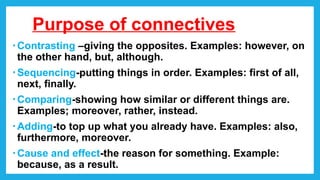
Purpose of connectives
•Contrasting –giving the opposites. Examples: however, on
the other hand, but, although.
• Sequencing-putting things in order. Examples: first of all,
next, finally.
• Comparing-showing how similar or different things are.
Examples; moreover, rather, instead.
• Adding-to top up what you already have. Examples: also,
furthermore, moreover.
• Cause and effect-the reason for something. Example:
because, as a result.
49.
• Reinforcing points-toecho a given point. Examples:
besides this, this proves, increasingly.
• Summing up points-to summarise a given point.
Examples: as result, thanks to this, therefore.
• Explaining points-to give more details of a point.
Examples: in other words, that meant, for example.
• Introducing points-For example, Such as, furthermore,
finally.
50.
Embedded clauses
• Anembedded clause is a clause that appears within a main
clause. Embedded clauses are used to give extra information
and explanation about the main clause in which they appear.
Parentheses (brackets, commas or dashes) are often used to
separate an embedded clause from the main clause. An
embedded clause is another way of using a subordinate clause,
but in the middle of a sentence. It becomes embedded in the
sentence.
Examples of Embedded Clauses
• Sandra, as soon as she heard about her gran, rushed to the
hospital.
• The school, which had beautiful stained-glass windows, stood
on a hill.
51.
Rhyme and rhythm
•Rhyme is when words have the same sound as another. It deals with
sounds and not spelling. Example dough and tough don’t rhyme but
tough and stuff rhyme.
Purpose of rhyme
• Enhance meaning since the words that rhyme are given special
attention.
• Make the poem musical or rhythmic hence enjoyable.
• Make poem memorable
• Create mood in a poem.
• Rhythm is regular repeated pattern of sound or movement common
in music and poetry.