;: .'
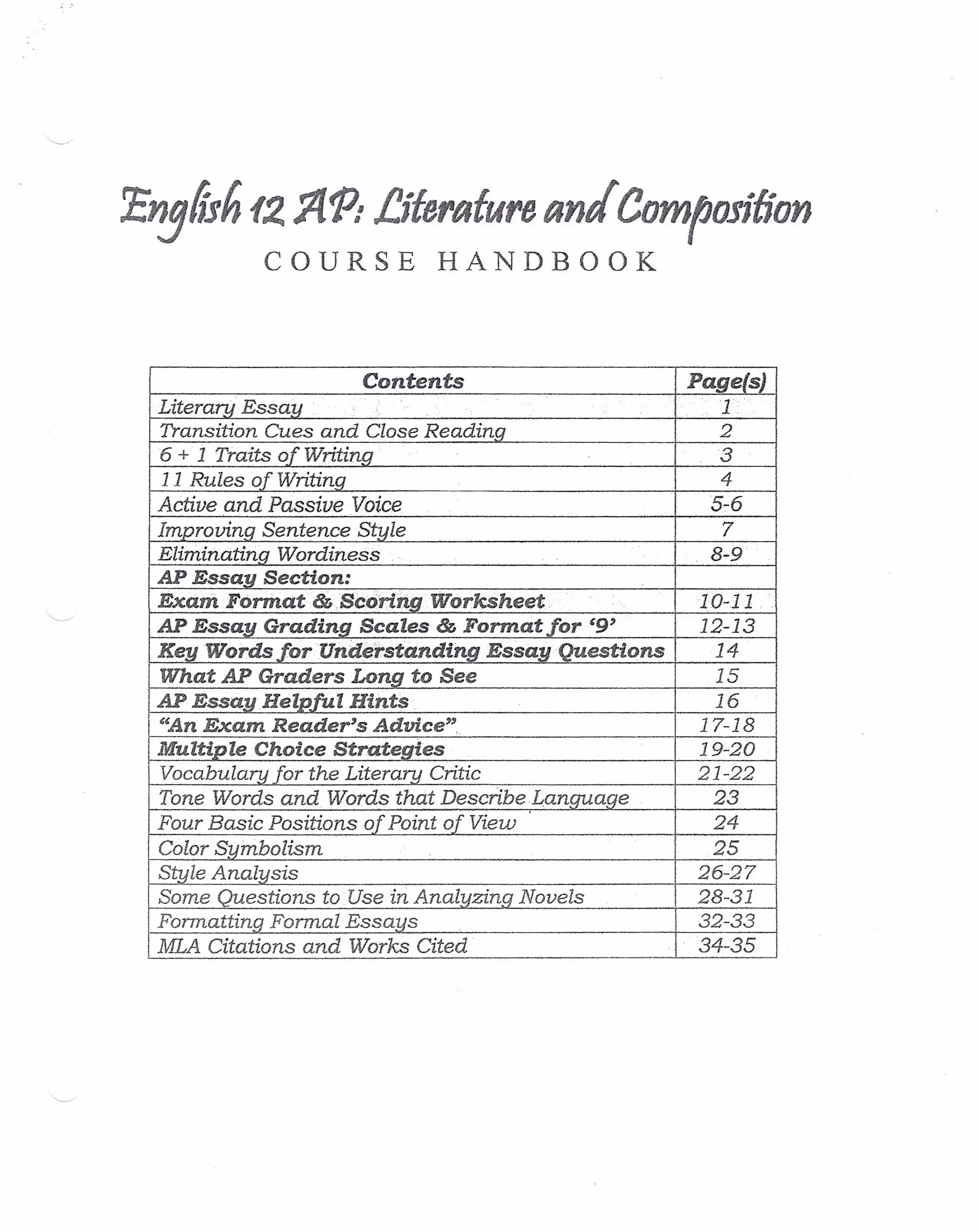
'EYlJ6Sh f2,;t{1J: literature ani Composffion
COURSE HANDBOOK
Contents Pagels)
Literaru Eesau . '1
Transition Cues and Close Reading 2
6 + 1 Traits of Writing· 3
11 Rules of Writing 4
Active and Passive Voice S·6
Improving Sentence Stule 7
Eliminating Wordiness 8-9
AP Essay Section:
Exam Format&,Sctiri1ig. Worksheet 10-11 ....
AP Essay Grading Scales & Format for '9' 12-13
KeyWords forUndersfanding Essay Questions 14
What AP Graders Long to See 15
I AP Essay Helpful Hints 16
"An Exam Reader's Advice" 17-18
Multiple Choice Strategies 19-20
Vocabularu for the Literaru Critic 21-22 I
Tone Words and Words that Describe Lanauaqe 23
Four Basic Positions of Point of View 24
Color Symbolism 25
Style Analysis 26-27
Some Questions to Use in Analyzing Novels 28-31
Formatting Formal Essaue 32-33
MLA Citations and Works Cited 34-35
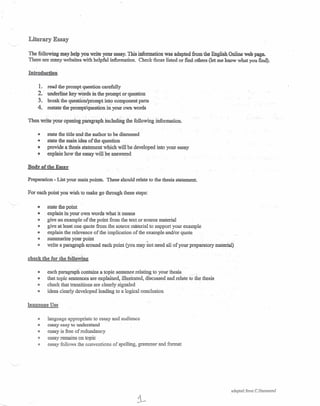
Literary Essay
The following may help you write your essay. This information was adapted from the English Online web page.
There are many websites with helpful information. Check those listed or find others (let me know what you find).
Introduction
1. read the prompt question carefully
2. underline key WordS in the prompt or question
3. break the question/prompt into component parts
4. restate the prompt/question in your own words
Then write your opening paragraph includfu.g the following information,
e state the title and the author to be discussed
G state the main idea of the question
o provide a thesis statement which will be developed into your essay
Ib explain how the essay win be answered
Body of the Essay
Preparation - List your main points. These should relate to the thesis statement.
For each point you wish to make go through these steps:
'--- 0
G
e
III
<Ill
Ii
e
state the point
explain in your own words what it means
give an example of the point from the text or source material
give at least one quote from the source material to support your example
explain the relevance of the implication of the example and/or quote
summarize your point _
write a paragraph around each point (you may riot need all of your preparatory material)
check the for the following
@ each paragraph contains a topic sentence relating to your thesis.
e that topic sentences are explained, illustrated, discussed and relate to the thesis
<11 check that transitions are clearly signaled
e ideas clearly developed leading to a logical conclusion
language Use
<11 language appropriate to essay and audience
G essay easy to understand
e essay is free of redundancy
<ll essay remains on topic
e essay follows the conventions of spelling, grammar and format
adapted from C.H,31nmond
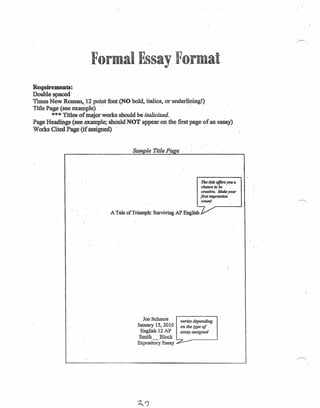
Formal Essay Format
Requii-ements:
Double spaced
Times New Roman, 12 point font (NO bold, italics, or underliningl)
Title Page (see example) . ..
*** Titles of major works should be italicized.
Page Headings (see .~ample;shOtPdNOT appear on the first page of an essay) .
Works Cited Page (if assigned) .
Sample Title Page
The title offen you a
chance to be
creative: Make your
first impression
counsl
A Tale ofTriumpb: Surviving APEnglisb
varies depending
on the type oj .
essay assigned
Joe Schmoe
January 15,2010
English 12 AP
Smith _ Block
Expository Essay
.~.
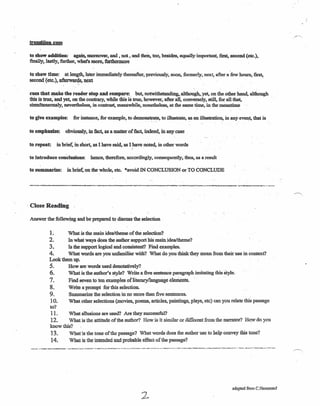
transition cues
to show addition: again; ·moreover, and , not. a:n4thea, too, besides, equally important, first; second (etc.),
finally, lastly, further, what's more, furthermore
to show time: at length, later immediately thereafter, previously, soon, formerly, next, after a 'few hours, first,
second (etc.), afterwar~, next '
cues that make the reader stop and compare: but, notwitbstandlng,altbough,Set. on the, other hand,althQpgh
this is 1rIle~and yet, on the contrary, while this 'istree, however, after aI1, conversely, still. for all that,
simultaneously, nevertheless, in contrast, meanwhile, nonetheless, at the same time, inthemeanthne
to give examples: for instance, for example, to demonstrate, to illustrate, as an illustration, in any event, that is
,- -. .
to emphasize: obviously, in fact, as a matter of fact, indeed, in any case
to repeat in brief, in short, as I have said, as I have noted. in other words
to introduce conclusions: hence, therefore, accordingly. consequently, thus, as a result
to summarize: in brief, on the whole, etc. *avoid IN CONCLUSION or TO CONCWDE
, Close Reading
Answer the following and be prepared to discuss the selection '
1. What is the main idea/theme of the selection?
2. In what ways does the author support his main idea/theme?
3. Is the support logical and consistent/ Find examples,
4. What words are you unfamiliar with? What do you think they mean from their use in context?
Look them up.
S. How are words used denotatively?
6. What is the author's style? Write a five sentence paragraph imitating this'style.
7. Find seven to ten examples of literary !language elements.
8. Write a prompt for this selection.
9. Summarize the selection in no more than five sentences.
10. What other selections (movies, poems, articles, paintings, plays, etc) can you relate this passage
to?
11. What allusions are used? Are they successful?
12. What is the attitude of the author? How is it similar or different from the narrator? Howdo you
know this?
13. Whatis the tone of the passage? What words does the author use to help convey this tone?
14. What is the intended and probable effect of the passage?
adapted from C.Hammand
2.
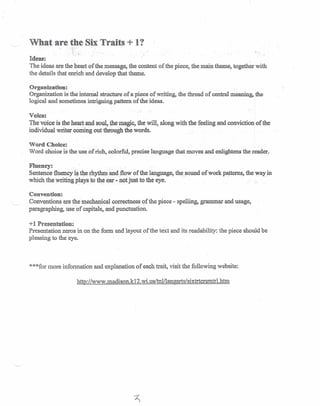
What are the Six Traits + I?
. -~
..Ideas:
The ideas are the heart of the message, the content of the piece, the main theme, together with
the details that enrich and develop that theme.
Organization:
Organization is the internal structure of a piece of writing, the thread of central meaning, the
logical and sometimes intriguing pattern of the ideas.
Voice:
The voice is the heart and soul, the magic, the will, along with the feeling and conviction of the
individual writer coming out through the words.
Word Choice:
Word choice is the use of rich, colorful, precise language that moves and enlightens the reader..
Fluency:
Sentence fluency ·i.~.the rhythm -and.flow of the language, the sound of work patterns, the way. in
which the writing plays to theear - not just to the eye. . ~ .
Convention:
Conventions are the mechanical correctness of the piece - spelling, grammar and usage,
paragraphing, useof capitals, and punctuation.
+1 Presentation:
Presentation zeros in on the form and layout of the text and its readability: the piece should be
pleasing to the eye.
***for more information and explanation of each trait, visit the following website:
http://www.madison.k12.wius/tn1Jlangarts/sixtrtcrsmtrl.htm
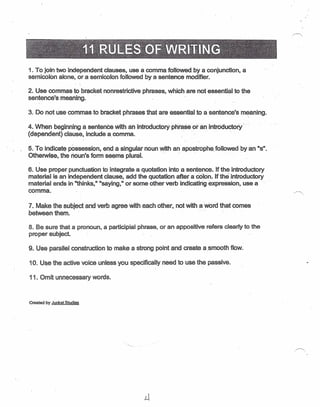
1. To join two independent clauses, use a comma followed. by a conjunCtion, a
semicolon alone, or a semicolon followed by a sentence modifier;
2. Use commas to bracket nonrestrictive phrases, which are not essential to the
sentence's meaning. . . . . , .
3. Do not use commas to bracket phrases that are essential to a sentence's meaning.
4. When beginning a sentenCe With an introductorY phrase or an introductory
(dependent) clause, include a.comma.
5. To indicate poeseeslon, end a singular noun With an apostrophe. followed byan AS".
Otherwise, the noun's form seems plural. .. .. .' .
6. Use proper punctuation to integrate a quotation into a sentence. Ifthe introductory
material is an independent clause, add the quotation afteracclcn, Ifthe introductory
material ends in "thinks," Itsaying,Itor some other verb indicating expression, use a .'
comma.
7. Make the subject and verb agree with each other. not with a word that comes
between them. ' ." '
8. Be sure that a pronoun, a participial phrase. or an appositive refers clearly to the
proper subject. .
9. Use parallel construction to make a strong point and create asmooth flow.
1O. U~e the active voice unless you specifically need to use the passive.
11. Omit unnecessary words.
Created by Junket Studies
Active and Passive Voice
Voice The voice of a verb tells whether the subject of the sentence performs or receives the
action. In English there are two voices, passive and active.
Active Voice In active voice,the subject perforl'M the action expressed by the verb: The
student wrote Q song.
Passive Voice In passive voice, the subject receives the action expressed by the verb: A song
was written by the student. .
Forming Tenses of Passive Verbs
The passive voice always consists of two parts: a form of the verb Uta bell .•.past participle:
'[:":~:~:~=:~T~;~~~:-='-~::~r:~'~:c:::~!~;~~;~.-~~~~~'·f;;'~-~:==:.jl;,.---------- ..-- -- ----.--.-.; 1-- ·-·-- ..---··-----·-·-·--..····..··..·· -·----··-···..··-"-'-';
IiPresent Hit is cleaned qr::::~:;..:::::::;.;=::.:....::::::=·:::;:::;·:=..::.:::::::::;;:::~j'" .::::::;;::::::~:::::;;.;::::::::::-:..::..::;;:::;::::.:.=.: ..:..::........:.:;-:.~.-:-:.:: ..;:::..:;:::.:::....--~ I
IPast qit was cleaned H
,•.._......•......._ '.-- _........................•....•..... """'-' .....•......... -... . ..'j
ilF;;;;-------- --. ~---Hit willbe cl~a~d ---·---· ·----~I
.1..._.•......._ .. .__..... __.....•.._._.~-'-_..... __ . .:.._.';l...-._ .. _ .•__, ._~ .__.... •. _ ..__.. :__:_.. _ .• __. ._. _ .....• '!
•fP--;'esentp~rlec:;----l!ithas been clea~ed- !i, _.._ _ . ~..,L _.__.._ ___. .. __ j
:t~~~!"_P!~~~·~~~--··--~~~·-][i!..~.·..~~~-~..c~~_~!i·-·-==·=~__.·.·~.-]I..r···--..•·..-·-·-- - ·--------·--·--·· .--.--- -..--.--- ..---- -- ---.- - -- -.........,i
j future perfect :!it will have been cleaned ']
:-:::~-::::::.-.:::::....::::.::::.::.::::..=~;:::.:::.:..:::.;.:~-.:::.:.::.:.::::: ..-::.~::.:.:::-;:.:.:~::-:.:::::::=:..:.:.:::...:..:.-..::.:::.-=-:...:..::.:.=:::=---:-~:-:::.::::...:...::::.::.:...~-..,;-:::-::. ...::::~:.~~-:~.:::...-:..;;...:..:~j
Uses of Passive Voice
Use the passive voiceto:
Call attention to receiver of the action rather than the performer:
The professor was hit by three snowballs.
Point out the receiver of the action when performer is unknown or unimportant:
A love letter was slipped under the door.
The signs wit! be posted.
Avoid calling attention to the performer of the action (known as the "institutional passive"):
The fines will be collected _on Monday.
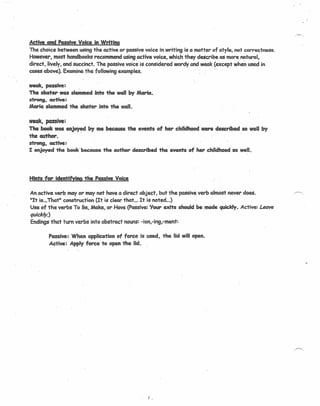
Active and Passive Voice in Writing
Thecheice between using the active or passive voice in writing is a matter of style, not correctness.'
However, most handbooks recommend using active voice, which they describe as morenaturol,
direct, lively, and succinct. The passive voice is considered wordy and weak (except when used in
cases above). Examine the following examples. '
weak, pa$Sive: .
The skater was slammed into the wall by Maria.
strong, cctive:
Maria slammed the skater into the wall.
weak, passive:
The book was enjoy~d by me because the events of her childhood were described so well by
the author.
strong, cctive:
1:enjoyed the beek beeeuse the author described the events of' her childhood so well.
Hints for identifying the Passive Voice
Anactive verb mayor may not have a direct object, but the passive verb almost never does. .r>.
lilt is...That" construction (It is clear that ... It is noted ...)
Use of the verbs To Be, Make, or Have (Passive: Your exits should be made quickly. Active: Leave
quickly.)
Endings that turn verbs into abstract nouns: -ion,-ing,-ment:
Passive: When application of force is used, the lid will open.
Active: Apply force to open the lid.
f _
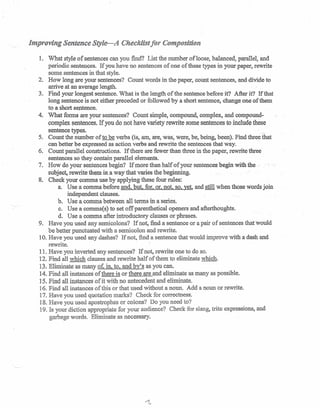
Improving Sentence Style-A Checklist for Composition
1. What style of sentences can you find? List the number of loose, balanced, parallel, and
periodic sentences. If you have no sentences of one of these types in your paper, rewrite
some sentences in that style.
2. How long are your sentences? Count words in the paper, count sentences, and divide to-
arrive at an average length.
3. Find your longest sentence. What is the length of the sentence before it? After it? If that
long sentence is not either preceded or followed by a short sentence, change, one of them
to a short sentence.
4. What forms are your sentences? Count simple, compound, complex, and compound-
complex sentences. If you do not have variety rewrite some sentences to include these
sentence types.,
5. Count the number of to be verbs (is, am, are, was, were, be, being, been). Find three that
can better be expressed as action verbs and rewrite the sentences that way.
6. Count parallel constructions. If there are fewer than three in the paper, rewrite three
sentences so they contain parallel elements.
7. How do your sentences begin? If more than half of your sentences begin with.tae..
subject.rewrite them-in a way that varies the beginning.
8. Check your comma use by applying these four rules:
a. Use a comma before and. but for. or, not. so, yet, and still when those words join
independent clauses.
b. Use a.comma between all tenus in a series.
c. Use a comma(s) to set offparenthetical openers and afterthoughts.
d. Use a comma after introductory clauses or phrases.
9. Have you used any semicolons? If not, :finda sentence or a pair of sentences that would
be better punctuated with a semicolon and rewrite.
10. Have you used any dashes? If not, find a sentence that would improve with a dash and
rewrite.
11. Have you inverted any sentences? If not, rewrite one to do so.
12. Find an which clauses and rewrite half of them to eliminate which.
13. Eliminate as many of, in, to, and by's as you can.
14. Find all instances of there is or there are and eliminate as many as possible.
15. Find all instances of it with no antecedent and eliminate.
16. Find all instances of this or that used 'without a noun. Add a noun or rewrite.
17. Have you 'used quotation marks? Check for correctness:
18. Have you used apostrophes or colons? Do you need to?
19. Is your diction appropriate for your audience? Check for slang, trite expressions, and
garbage words. Eliminate as necessary.
Eliminating Wordiness from your Writing
at the present time
in the present circumstances
at this point in time
at this moment '
in this day and age
at that point in time
in those days
in that period"
in many cases
in some caseS
in exceptional.cases. , "
in most cases
consider as, consider asi:Jeing
I consider study as being necessary
to success.
despite the fact that
, regardless of the fact that
due to the fact that
for the purpose of
by virtue of the fact that
the reason is because
in Q position to, in order to
in the area of '
in the event that. }
in the event of
in case of
In the event that fire breaks out. leave the files behind:
Use !!Ql! or ~
Use then.
Use often.
Use sometimes.
Use rarely.
Use most.
Use: I consider study necessary to success.
Use although.
Use because.
'Use cen.
Use near or in.
Use if with a verb.
If fire breaks out I leave the files behind
in terms of
[Revise out of your prose.]
The new curriculum was designed in terms of student needs and fa.culty ability. '
,The new curriculum considers bothstudent needs and faculty ability.
The new curriculum was designed to match faculty ability with student needs
in the final analYSis
in no uncertain terms
in the nature of
things of that nature
refer back
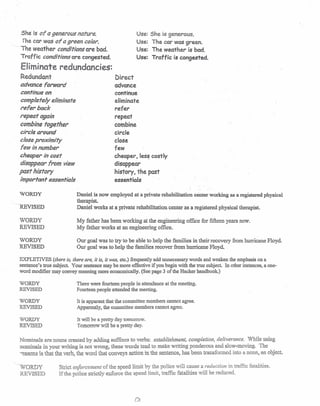
He is of a complex character.
Use finally, or drop the phrase entirely.
Drop the phrase, or use firmly or dearly.
Use like or things lik~that.
Use only refer.
Use: He is complex.
She is of a generous nature.
Ihe car was of agreen color.
,-. The weather conditions are bad.
Traffic conditions are congested.
Eliminate redundancies:
Redundant
advance forward
continue on
completely eliminate
refer back
repeat again
combine together
circle around
close proximity
few in number
cheaper in cost
disappear from view
past history
important essentials
WORDY
<:»
REVISED
WORDY
REVISED
WORDY
REVISED
Use: She is generous.
Use: The car was green.
Use: The weather is bad.
Use: Traffic is congested.
Direct
advance
continue
eliminate
refer
repeat
combine
circle
close
few
cheaper, less costly
disappear
history, the past
essentials
Daniel is now employed at a private rehabilitation center working as a registered physical
therapist.
Daniel works at a private rehabilitation center as a registered physical therapist.
My father has been working at the engineering office for fifteen years now.
My father works at an engineering office.
Our goal was to try to be able to help the families in their recovery from hurricane Floyd.
Our goal was to help the families recover from hurricane Floyd. .
EXPLETIVES (there is, there are, it is, it was, etc.) frequently add unnecessary words and weaken the emphasis on a
sentence's true subject. Your sentence may be more effective if you begin with the true subject. In other instances, a one-
word modifier may convey meaning more economically. (See page 3 of the Hacker handbook.)
WORDY
REVISED
WORDY
REVISED
WORDY
REVISED
There were fourteen people in attendance at the meeting.
Fourteen people attended the meeting.
It is apparent that the committee members cannot agree.
Apparently, the committee members cannot agree.
It will be a pretty day tomorrow.
Tomorrow will be a pretty day.
Nominals are nouns created by adding suffixes to verbs: establishment, completion, deliverance. While using
nominals in your writing is not wrong, these words tend to make writing ponderous and slow-moving. The
-easom; is that the verb, the word that conveys action in the sentence, has been transformed into a noun, an object.
'--
WORDY
REVISED
Strict enforcement of the speed limit by the police will cause a reduction in traffic fatalities.
If the police strictly enforce the speed limit, traffic fatalities will be reduced.
~,
, '
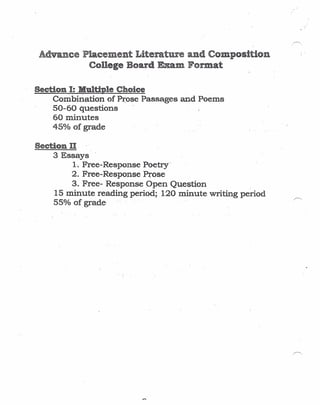
Advance Placement Literature and Composition
College Board Exam. Format
Section .1:Multiple Choice
Combination of Prose Passages and Poems
50-60 questions
60 minutes
450/0 of grade
Section II
3 Essays
1·.Free-Response Poetry'
2. Free-Response Prose
30 Free- Response Open Question
15 minute reading period; 120 minute writing period
55% of grade .
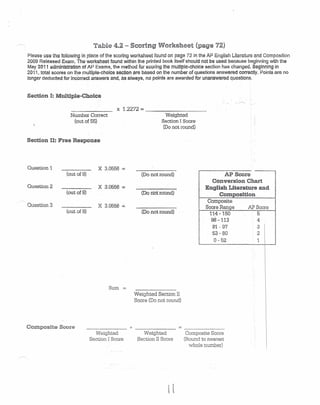
Table 4.2 - Scoring Worksheet (page 72)
Please use the following in place of the scoring worksheet found on page 72 in the AP English Literature and Composition
2009 Released Exam. The worksheet found within the printed book itself should not be used because beginning with the
May 2011 administration of AP Exams, the method for scoring the multiple-choice section has changed. Beginning in
2011, total scores on the multlple-cnolce section are based on the number of questions answered correctly. Points are no
longer deducted for incorrect answers andas always, no points are awarded for unanswered questions.
Section I: Multiple-Choice
x 1.2272 == _
Number Correct
(out of 55)
Weighted
Section IScore
(Donot round)
Section II: Free Response
Question 1 X 3.0556 ==
(out of 9) (Do not round)
Question 2 X 3:0556 ==
(out of 9) (Do nhiround)
Question 3 X 3.0556 =
(out of 9) (Do not round)
Sum ==
Weighted Section II
Score (Do not round)
Composite Score
Weighted
Section I Score
Weighted
Section II Score
Il
AP Score
Conversion Chart
English Literature and
Composition
Composite
Score Range APScore
114 --150
98 -113
81 - 97
53- 80
0-52
5
4
3
2
1
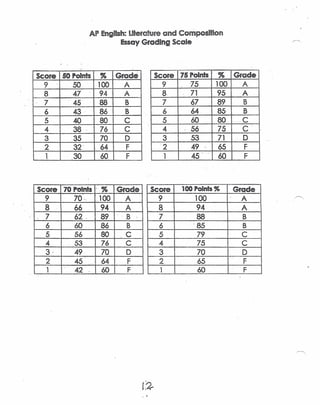
AP English: Literature and Composifiolll
Essay Grading Scale
d."
Score 50Poinfs % Grade
9 50 100 A
8 47 94 A
I· 7 ·45 88 B
6 43 86 B
5 40 80 c·
4 38 . 76 C
3 35 70 D
2 32· 64 F
1 30 60 F
Score· 70Poinfs '% Grade
zo
..
9 100 A
8 66 94 A
7 62 . 89 . ·.B
6 60 86 B
5 56 80 .c
4 53 76 C
3· 49 70 D
2 45 .. 64 F
1 42 60 F
Score 75 Points . %, Grade ..
9 75 100 A
8· 71 95 A
7 67 89 B
6 64 85 B
... 5 60 80- - -- C
4 56 75 C
3 53 .7,1 . .. 0
·2 49 ,
65 F
1 45· 60 F
.Score . 100 Points % Grade
9 100 A
8 94 A
7 88 B
6 ·85 B
5 79 C
4 75 C
3 70 I D
2 65 F
1 60 F
, .
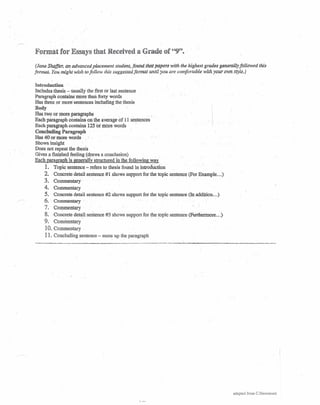
Format for Essays that Received a Grade of "9" •.
(Jane Shtiffer, an advanced placement student, jourut that papers with the highest grades generally followed this
format. YOH might wish to follow this suggested format until you are comfortable with your own style.)
Introduction ...
Includes-thesis - Usually the first or last sentence
Paragraph contains more than forty words
Has three or more sentences including thethesis
Body
Has. two or more paragraphs I .
Each paragraph contains on the average of 11·sentences
Each paragraph contains 125 ormore words .
Concluding Paragraph
HaS 40 or-more words- ..
Shows insight
Does not repeat the thesis
Gives a finished feeling (draws a conclusion)
Each paragraph is generally structured In the following way
1. Topic sentence .;...refers to thesis found in introaJ~tion
2. Conc~ete detail sentence #1 shows support for the topic sentence (For Example ... )
3. Commentary'
4. Commentary
5. Concrete detail sentence #2 shows support for the topic sentence (In addition ... )
6 .. Commentary
7. Commentary
8. Concrete detail sentence #3 shows support for the topic sentence (FUrthermore ... )
9. Commentary . .
10. Commentary
11. Concluding sentence - sums up the paragraph
adapted from C.,Hauunond
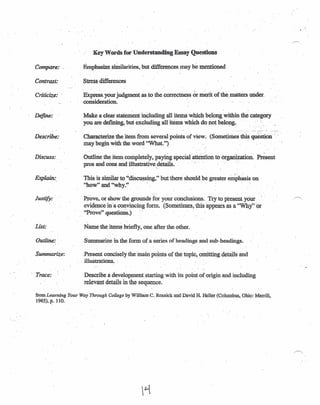
Compare: .
Contrast:
Criticize:
Define:
Describe:
Discussi
Explains
Justify: .
List;
Outline: .
Summarize:
Trace:
. Key Words for Understanding Essay Questions
·Emphasize similarities.but differences may be mentioned .
Stress differences
EXpress. your judgment asto the correctness ~r merit of the matters under.
Consideration. . - .. _.
Make a clear statement including all items which belong within the category
you are defining, but exeludingallitemswhich do not belong. .' .. ~"
Characterize the item from several points of view. (Sometimes-this qu~tion: .:..
may begin with the word "What,")
Outfule the item completely, paying special. attention toorganization, Pl~ent
pros and cons and illustrative ~tai1s. . . . ,
This is sim.ilar to "discussing," but there should be greater e~ph~sis on
"how" and "why." " .' '
·Prove, or show the grounds for your conclusions. Try to present your
evidence in 'a convincing form. (Sometimes, this appears as a "Why" 'or
·''Prove'' questions.) . .
Name the items briefly, one after the other.
'. .
Summarize in theform Qia series of headings and sub-headings.
.Present concisely the main points of the topic, omitting details and
. illustrations. . .
Describe a development starting with its point of origin and including
relevant details in the sequence.
from Learning Your Way Through College by William C. Resnick and David H. Heller (Columbus, Ohio: Merrill,
1965). p. 110. .
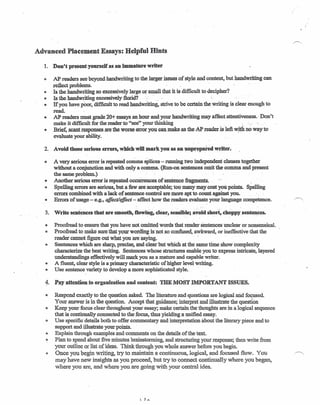
Advanced Placement Essays: Helpful Hints
1. Don't present yourself as an immature writer
o AP readers see beyond handwriting to the larger issues of style and content, but handwriting can
reflect problems.
" Is the handwriting so excessively large or small that it is difficult to decipher?
e Is the handwriting excessively florid? :-'. '
• If you have poor, difficult to read handwriting, strive to be certain the writing is clear enough to
read.
• AP readers must grade 20t essays an hour and your handwriting may affect attentiveness., Don't
make it difficult for the reader to "see" your thinking . _ , '
• Brief, scant responses.are the worse error you can make-as theAP reader is leftwjthno way to
evaluate your ability.
2. Avoid those serious errors, which will mark you as an uilp~~~ed writer.
o A very serious error is repeated comma splices - running two mdependentclanses together
without a conjunction and with only a corinna. (Run-on Sentences omit the-comma and Present
the same problem.)
• Another serious error is repeated occurrences of sentence fragments: '"
e Spelling errors are serious, but a few are acceptable; too many may.cost you points. Spelling
errors combined with a lack of sentence control are more apt to count against you. "
• Errors of usage - e.g., affect/effect - affect how the readers evaluate your language competence. ~
3. Write sentences that are smooth, tlOwing, clear, sensible; avoid short,eh~ppy' sente~c~s.
~ Proofread to ensure that you have not omitted words that render sentences unclear or nonsensical.
) Proofread to make sure that your wording is-not so confused, awkward, or ineffective that the
reader cannot figure out what you are 'saying. -
., Sentences which are sharp, precise, and clear but which at the same time show complexity
characterize the best writing. Sentences whose structures enable you to express intricate, layered
understandings effectively will mark you as a mature and capable writer.
o A fluent, clear style is a primary characteristic of higher level writing.
• Use sentence variety to develop a more sophisticated style. ,
4. Pay attention to organization and content: THE l'IOST IMPORTAl~T ISSUES.
• Respond exactly to the question asked. The literature and questions are logical arid focused,
Your answer is in the question. Accept that guidance; interpret and illustrate the question
e Keep your focus clear throughout your essay; make certain the thoughts are in a logical sequence
that is continually connected to-the focus, thus yielding a unified essay.
e Use specificdetails both to offer commentary and interpretation about the literary piece and to
support and illustrate your points.
o Explain through examples and-comments on the details of the text.
-3 Plan to spend about five minutes brainstorming, and structuring your response; then write from
your outline or list of ideas. Think through you whole answer before you begin.
•• Once you begin writing, try to maintain a continuous, logical, and focused flow. You ~,
may have new insights as you proceed, but try to connect continually where you began,
where you are, and where you are going with your central idea.
 1A
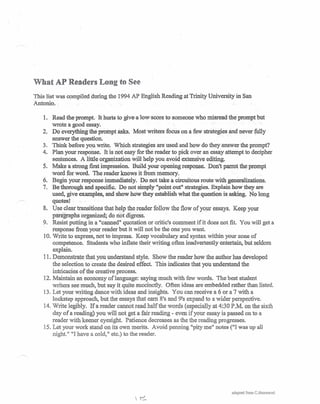
What AP Readers Long to See
This list was compiled during the 1994 AP English Reading at Trinity University in San
Antonio ..
1. Read the prompt. ·It hurts to give -a low-score to someone who misread the prompt but
wrote a good essay.
2. Do everything the prompt asks. Most writers focus on a few strategies and never fully
answer the question.
3. Think before you write. Which strategies are used and how do they answer the prompt?
4. Plan your response. It is not easy for the reader to pick over an essay attempt to decipher
sentences. A little organization will help you avoid extensive editing.
5. Make a.strong fir~t impression. Build your opening response. Don't parrot theprompt
word for word. The reader knows it from memory.
6. Begin your response immediately. Do not take acircuitous route with generalizations.
7. Be thorough and specific. Do not simply "point out" strategies. Explain how they are
used, give examples, and show .how they establish what the question is asking. No long
r=> quotes!
8. Use clear transitions that help the reader follow the flow of your essays. Keep your
paragraphs organized; do not digress.
9. Resist putting in a "canned" quotation or critic's comment if it does not fit. You will get a
response from your reader but it will not be the one you want.
10. Write to express, not to impress. Keep vocabulary and syntax within your zone of
competence. Students who inflate their writing ofteninadvertently entertain, but seldom
explain.
11. Demonstrate that you understand style. Show the reader how the author has developed
the selection to create the desired effect .. This indicates that you understand the
intricacies of the creative process.
12. Maintain an economy of language: saying much with few words. The best student
writers see much, but say it quite succinctly. Often ideas are embedded rather than listed.
13. Let your writing dance with ideas and insights. You can receive a 6 or a 7 with a
lockstep approach, but the essays that earn 8's and 9's expand to a wider perspective.
14. Write legibly. If a reader cannot read half the words (especially at 4:30 P.M. on the sixth
day of a reading) you will not get a fair reading - even if your essay is passed on to a
reader with keener eyesight. Patience decreases as the the reading progresses.
15. Let your work stand on its own merits. Avoid penning Ilpity me" notes ("1 was up all
night."· "I have a cold, II etc.) to the reader.
,---,
adapted from CJ"J~,ITlmand
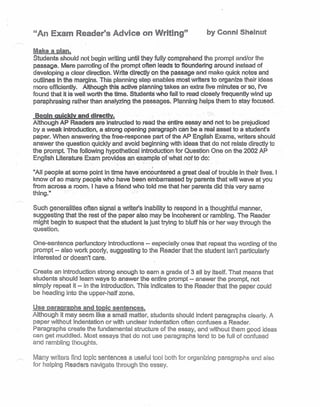
"An Exam Reader's Advice on Writing" by Conni Sheinut
Make a plan.
Students should not begin writing until they fully comprehend the prompt and/or the
passage. Mere parroting of the prompt often leads to floundering around instead of
developing a clear direction. Write directly on the passage-and make quick notes and
outlines in the margins. This planning step enables most writers to organize their ideas
more efficiently. Although this active planning takes an extra five minutes or so, I've
found that it is well worth the time. Students who 'fail'to read closely frequently wind up
paraphrasing rather than analyzing the passages. Planning, helps them to stay focused.
Begin quickly and ,directly. "
Although AP Readers areinstructed to read the entire, essay and- not to be prejudiced
by a weak introduction, astrong opening paragraph can be a real asset to a student's
paper. When answering the free-response part of the AP English Exams, writers should
answer the question quickly and avoid beginning with ideas that do not relate directly to
the prompt. The following hypothetical mtroductlon for Ouestion One on the 2002 AP
English Literature Exam provides an ex~tnple of what not to do:
,
"Ail people at some point in time have: encountered a great deal of trouble in their lives. I
know of so many people who have been 'embarrassed by parents that will wave at you
from across a room. Ihave a friend who told me that her parents did this very same
thing." . , . '
Such generalities often signal a writer's inability to respond in a thoughtful manner,
suggesting that the rest of the paper also may be incoherent or rambling. The Reader
might begin to suspect that the student is just trying to bluff his or her way through the
question.
One-sentence perfunctory introductions - especially ones that repeat the wording of the
prompt -- a/so work poorly, suggesting to the Reader that the student isn't particularly
interested or doesn't care.
Create an introduction strong enough to earn a grade of 3 aU by itself. That means that
students should learn ways to answer the entire prompt -- answer the prompt, not
simply repeat it -- in the introduction. This indicates to the Reader that the paper could
be heading into the upper-halt zone.
Use paragraphs and topic sentences. '
Although it may seem like a small matter, students should indent paragraphs clearly, A
paper without indentation or with unclear indentation often confuses a Reader.
Paragraphs create the fundamental structure of the essay, and without them good ideas
can get muddled. Most essays that do notuse paragraphs tend to be full of confused
and rambling thoughts.
Many writers find topic sentences a useful tool both for organizing paragraphs and also
for helping Readers navigate through the essay.
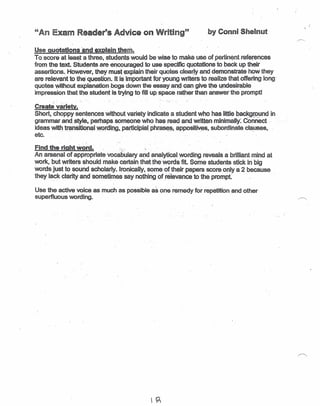
"An Exam Reader's A~vice on Writing" _by Conni_Shelnut
Use quotations 'and explain them.
To. score at least a three, students would be wise to make use of pertinent references
from the text. StUdents are encouraged to USf:l,5peC~ quotations to back up their
assertions ..However, they mU$~~?Cplaln.their quotes clea~ly and demonstrate how they
are relevant to the question.Jt is important fQr young writers to realize that offering long'
quotes without explanatlon.bogs down the essayanQ can give tl)e undesirable
impression that the student is trying to fill UP.space. r~er than answer the prompt!. '.
Create variety.
Short, choppy sentences without variety indicate a student who has little backg(ound in
grammarancLstyle, perhaps someone Vlh<)' has read and written--minimally:· COnnect "
ideas witIl ~nsitio~~1 WQr(jil'!g,_par:tl~ipjal.phras~ ~PPO$itjv§lS, $ubpr"dJDatecia,u$es,
etc. -
Find the right word. :~.,.~ :..
An arsenal' of appropriate voCabulary aDdanalytieal. wording- reveals a brilliant mind at
work, but writers should make certain thatthe words fit. Some students stick in big
words just to sound scholarly. Ironically. some of-their papers score only a 2 because
they lack clarity and scmetsnes say nothing ot.relevaoceto the prompt
Use the active voice as much as possible as one remedy for repetition and other
superfluous wording.
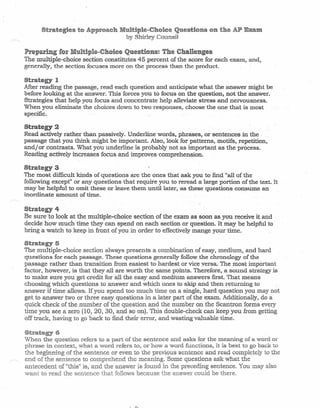
by Shirley Counsil
Preparing Multiple-ChoiceQuestions: The Challenges
The multiple-choice section constitutes 45 percent of the score for each exam, and,
generally, the section focuses more on the process than the product.
Strategy 1
After reading the passage, read each question and anticipate what the answer might be
before looking at the answer. This forces you to focus on the question,not the answer.
Strategies that help you focus and concentrate help alleviate stress and nervousness.
When you eliminate the choices down to two responses, choose the one that is most
specific.
Strategy 2
Read actively rather than passively. Underline words, phrases, or sentences in the
passage that you think might be important. Also, look for patterns, moille, repetition,
andj or contrasts. What you underline is probably not as important as the process.
Reading actively increases focus and improves comprehension.
Strategy 3
The most difficult kinds of questions are the ones that ask you to find "all of the
following except" or any questions that require you to reread a large portion of the text. It
may be helpful to omit these or.Ieave them unti1later, as these questions consume an
inordinate amount of time. .
Strategy 4
Be sure to look at the multiple-choice section of the exam as soon as you receive it and
decide how much time they can spend on each section or question. It may be helpful to
bring a watch to keep in front of you in order to effectively mange your time.
Strategy 5
The multiple-choice section always presents a combination of easy, medium.rand hard
questions for each passage. These questions generally follow the chronology of the
passage rather than transition from easiest to hardest or vice versa. The most important
factor, however. is that they all are worth the same points. Therefore, a sound strategy is
to make sure you get credit for all the easy and medium answers first. That means
choosing which questions to answer and which ones to skip and then returning to
answer if time allows. If you spend too much time on a single, .hard question you may not
get to answer two or three easy questions in a later part of .the exam. Additionally r do a
quick check of the number of the question and the number on the Scantron forms every
time you see a zero (10,20,30, and so on). This double-check can keep you from getting
off track, having to go back to find their error, and wasting valuable time.
St:!!~at~~gy6
When the question refers to a part of the sentence and asks for the meaning of a word or
phrase in context, what a word refers to, or how a word functions, it is best to go back to
the beginning of the sentence or even to the previous sentence and read completely to
of the sentence to comprehend the meaning. Some questions ask what the
antecedent of "this" is, and the answer is found in the preceding sentence. You may also
want to read the sentence follows because answer could be there.
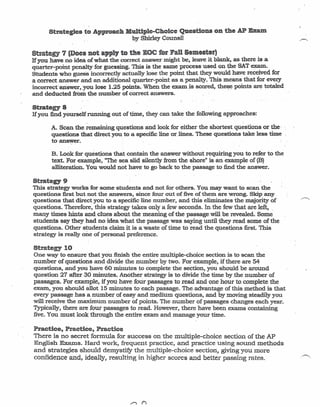
Strategies to Approach Multiple-Choice Questions on the AP Exam
by Shirley Counsil
Strategy 7 IDees Dot apply to the EO(! for Fall Semester) .
.Ifyou have no idea ofwhat the correct answer might be, leave,it blank, as there is a
quarter-point penalty for guessing. This is the same process used on the SATexam.
Students who guess incorrectly actually lose the point that they would have received for
a correct answer and an additional quarter-point as a penalty. This means that for every
Incorrect answer, you lose 1.25 points. When the exam is scored, these points are totaled
and deducted from the number of correct answers.
Strategy 8
Ifyou find yourself running out of time, they can take the followingapproaches:
. .
A. Scan the remaining questions and look for either the shortest questions. or the' '.
questions that direct you to a specific line or.lines. These questions take less time :.
to answer.
B. Lookfor questions that contain the answer without requiring you to refer to the
text. For example, "Thesea slid silently from the shore" is an example of (B)
alliteration. Youwould not have to go back to the passage to find the answer.
Strategy 9
This strategy works for some students and not for others. You may want to scan the
questions first but not the answers, since four out of fiveof them are wrong. Skip any.
questions that direct you to a specific line number, and this eliminates the majority of
questions. Therefore, this strategy takes only a few seconds. In.the fewthat are left, _.
many times hints and clues about the meaning ofthe passage-will be revealed. Some'
students say they had no idea what the-passage was saying until they read some of the
questions. Other students claim it is a waste of time to read the questions first. This
strategy is really one of personal preference.
Strategy 10
One way to ensure that you finish the entire multiple-choice section is to scan the .
number of questions and divide the number by two. For example, if there-are 54· .
questions, and you have 60 minutes to complete the section, you should be around
question 27 after 30 minutes. Another strategy is to dividethe time by .the number of
passages. For example, ifyouhave·forirpassagesto read and one hour to.complete the
exam, you should allot 15 minutes to each passage. The.advantage of this method is that
every passage has a number of easy and medium questions, and by movingsteadily you
will receive the maximum number of points. The number of passages changes each year..
Typically, there arefour passages to read. However,there have been exams containing
five.You must look through the entire exam and manage your time.
Practice, Practice, Practic~
There is no secret formula for success on the multiple-choice section of the AP
English Exams. Hard work, frequent practice, and practice using sound methods
and strategies should demystify the multiple-choice seetioni, giving you more
confidenceand, ideally,.resulting in higher scores and bettJr passing rates.·~
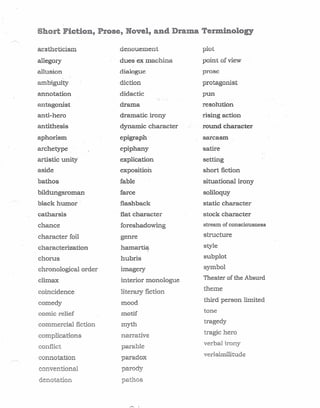
Short Fiction, Prose, Novel, and Drama Terminology
/""""-.
aestheticism denouement plot
allegory dues ex machina point of view
allusion dialogue prose
ambiguity diction protagonist
annotation didactic pun
antagonist drama resolution
anti-hero dramatic, irony rising action
antithesis dynamic character round character
aphorism epigraph sarcasm
archetype· epiphany . satire
artistic unity explication setting
aside expositioh short fiction
bathos fable situational irony
bildungsroman farce soliloquy
black humor . flashback static character
catharsis flat character stock character
chance foreshadowing stream of consciousness
character foil genre structure
characterization hamartia style
,
chorus hubris subplot
chronological order imagery symbol
climax interior monologue Theater of the Absurd
coincidence literary fiction theme
comedy mood third person Iimited
comic relief motif tone
commercial fiction myth tragedy
complications narrative
tragic hero
conflict parable
verbal irony
connotation paradox
verisimilitude
conventional parody
denotation pathos
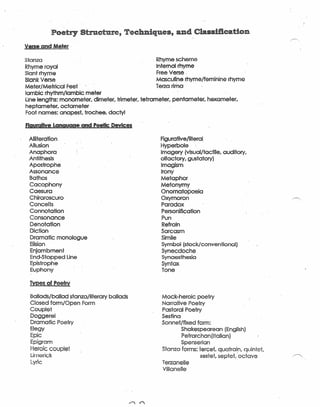
Poetry Structure, Techniques, and Classification
Verse and Meter
stanza
Rhyme royal
Slant rhyme
Blank Verse
Meter/Metrical Feet·
Iambic rhythm/iambic meter
Line lengths: monometer, dimeter, trimeter, tetrameter, pentameter, hexameter,
heptameter, odometer-
Foot names: anapest trochee, dactyl
Rhyme scheme
Intemal rhyme
Free Verse-
Masculine rhyme/feminine rhyme
Terzo rirno :
Figurgtive language and Poetic Devices
Alliteration
Allusion
Anaphora
Antithesis
Apostrophe
Assonance
Bathos
Cacophony
Caesura
Chiraroscuro
Conceits
Connotation
Consonance
Denotation
Diction
Dramatic monologue
Elision
Enjambment
End-Stopped Line
Epistrophe
Euphony
Figurative/literal
Hyperbole
Imagery (visual/tactile, auditory,
olfactory, gustatory)
Imagism
Irony
Metaphor
Metonymy
Onomatopoeia
Oxymoron
Paradox
Personification
Pun
Refrain
Sarcasm
Simile
Symbol (stock/conventional)
Synecdoche
Synaesthesia
Syntax
Tone
Types of Poetry
Bal/ads/ballad stcnzc/literorv ballads
Closed form/Open Form
Couplet
Doggerel
Dramatic Poetry
Elegy
Epic
Epigram
Heroic couplet
limerick
Lyric
Mock-heroic poetry
Narrative Poetry
Pastoral Poetry
Sestina
Sonnet/fixed form:
Shakespearean (English)
Petrarchan (Italian)
Spenserian
Stanza forms: tercel, quotroln. quintet.
sestet, septet, octave
Terzoneile
Viilanelle
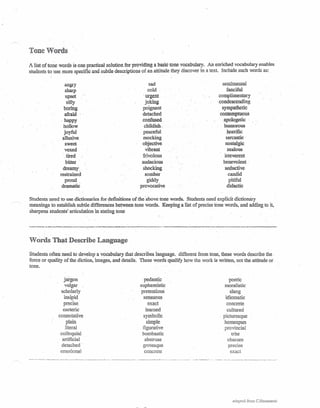
Tone Words
A list of tone words is one practical solution for providing a bask: tone vocabulary. An enriched vocabulary enables
students to use more specific and subtle descriptions of an attitude they discover in a text Inchidesuch words as:
angry
sharp
upset
silly
boring
afraid
happy
hollow
joyful
allusive.
sweet
vexed
tired
bitter .
dreamy
restrained
proud.
dramatic
sad
cold
'urgent
joking
poignant
detached
contused
childish,
peaceful
mocking
objective
vibrant
frivolous
audacious
shocking
somber
giddy
provocative
sentimental
fanciful
complimentary
.condescending
sympathetic
contemptuous
apologetic .
humorous
~orrific
sarcastic'
nostalgic
zealous
, irreverent
benevolent .
seductive
candid
pitiful
didactic
Students need to use dictionaries for definitions of the 'above tone words. Students need explicit dictionary
meanings to establish subtle differences between tone words. Keeping a list of precise tone words,· and adding to it,
sharpens students' articulation in stating tone .
.-~-~-"-'-----~
Words That Describe Language
Students often need to develop a vocabulary that describes language. different from tone, these words describe the .
force or quality of the diction, images, and details. These words qualify how the work is written, not the attitude or
tone.
jargon pedantic poetic
vulgar euphemistic moralistic
scholarly pretentious slang
insipid sensuous idiomatic
precise exact concrete
esoteric learned cultured
connotative symbolic picturesque
plain simple homespun
literal figurative provincial
colloquial bombastic trite
artificial abstruse obscure
detached grotesque precise
emotional concrete exact
adapted from C.Hammcnd
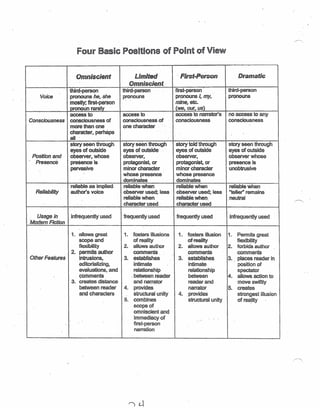
four Basic Positions of Point of View
Omniscient Limited . First-Person Dramatic
Omniscient·
thir~person third-person first-person third-person
Voice pronouns he, she pronouns pronouns I. my, pronouns
.mostly; first-person mine, etc • .,
pronoun rarely (we, our, us)
access to access to access to narrator's no access to any
Consciousness consciousness of consciousness of consciousness consciousness
more than one one character .
characte~ perhaps
all '
story seen through story seen through story told'through story seen through
eyes of outside eyes of outside' eyes ,of outside eyes of outside
Position and observer, whose observer, observer, observer whose
Presence presence is protagonist, or protagonist, or presence is
pervasive minor character minor character unobtrusive
,.
whose presence whose presence
dominates dominates
reliable as implied reliable When reliable when reliable when
Reliability author's voice observer used; less observer used; less "teller" remaIns
reliable when .reliablewheo. neutral
character used character used
Usage in ,infrequently used frequently used frequently used . infrequently used
Modern Fiction
1. allows great 1. fosters illusions 1. fosters illusion 1. Permits great
scope and ofr~lity of reality flexibility
flexibility 2. allows author 2. allows author 2. forbids author
2. permits author comments comments comments
Other Features intrusions, 3. establishes 3. establishes 3. places reader in
editorializing, intimate intimate position of
evaluations, and relationship relationship spectator
comments .between r.eader between 4. all9ws action to
3. creates distance and narrator reader and move swiftly
between reader 4. provides .. narrator 5. creates
and characters structural unity 4. provides strongest illusion
5. combines structural unity ofrea,lity
scope of
Iomniscient and
immediacy of . '. ' .
I
first-person
narration
Some Color Symbolism
spirit, intellect life, vitality
reflection, blood, sacrifice,
analysis mart dom
medium of truth
aggression,
violence, an er
constancy of sky strength
simplicity fire
frustrated
love
ambition
aspirations' of
mortal combat..,
irit
east China) sun (Mayan
rebirth or
south (Mexico)
resurrection
fidelity riches
mystery easy virtue
deception blasphemy
uncertain heIl,devil
water sulfur
ready for action
center of earth
China)
degradation
(easily tainted
.envy (China)
ambiguity
intuition
suspicion
White
absence of color
all ofspectrum of
light
innocence
urifieation
restoration (of lost
innocence)
:.purity/truth
.transfiguration .
transcendence
glory
transformation
] ..
.,;'~.'. B'1" k' ,'"." ' ac ,"..••;;'~• n
, • ~ • ~ '" '<'.
reversal ,of
a osites
lack of
consciousness
descent intO
darkness
brack-gray-white;
.' -.resUrrection
water
fertility
Water symbolism is suggestive of: primordial fluid; source of life; source of all things; beginning and end of all;
flood - drowning and dissolving; death; layers of psyche; ambivalence; life/fertility; submersion/destruction;
afterlife; realm of the dead; chaos; rain -: life force; rime; eternity; cleansing/washing away spells, sins; baptism;
water/fire duality (passive, active); cure/punishment; return to reality; ,energy of unconscious; dangerous energy
when it overflows
Biedermann, Hans. Dictionary of Symbolism. New York: Facts on File, Inc., 1992
adapted from C.Hammond
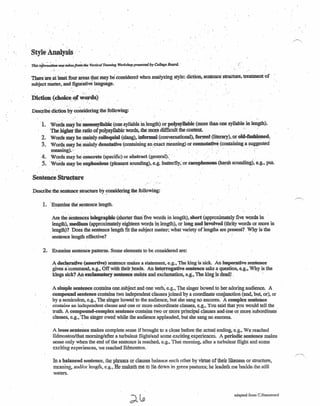
Style' Analysis' .
. '. . . . .
There 'are at least four areas that may hi considered when analyzing style: diction. sentence structure. treatment of
subject matter, andfiguiative language. .' .
....
Diction.(dioi~.~f,!~)"ds)
Describe diction by considering theJollowing:
'1. Wordsmay:lliiDionosyDabk-(one syUabie inlength)or polysyllabic (more than one syllable in length).
The higher the ratio of polysyllabic words, the more difficult the content _.",'
2. Words may bemainly colloquial (slang), informal (conversational), fo~ (literary), or old-f3Shiljned:
3. Woid.~ may.~.mainly denotative (containing anexactmeaning) or'oounotativt (contaiDing a~~ggested
meaningj.»: .
4. Words may be c-oncrete (Specific) or abstract (general),' . . '. . .
5. ·.Words may beeuphoDious (pleasant sounding), e.g. butterfly; or CacophonOus (harsh sounding), e.g .• pus,
Sentence Struetare
Describe the sentence structure by considering the following: .,~, . .
.~
1. Examine the' sentence length.,
Are the 'Sentenc~ telegrapbic (shorter than' five words in length), short (approximately five words in
length), m~ (approximately eighteen wordsinlength), or long and involved (thrity words or more in
. length)? Does the sentence length fit the subject matter; what variety oflengtbs .are present? Why is the
sentence length effective? .
2. Examine sentence patterns. Some elements to be considered are:
A declarative (assertive) sentence makes a statement, e.g., The king is 'sick, An im~ve sentence
givesacommand, e.g., Off with their heads. An interrogative sentence asks a question, e.g., Why is the
kings sick? An exclamatorY sentence ~es and exclamation, e.g., The king is dead! .
A snnpie sentence contains one.subject and one verb, e.g., The singer bowed to her adoring audience. A
compouwheDtence contains' two independent clauses joined bya coordinate conjunction (and, bu~ or}. or
by a semicolon, e.g., The singer bowed to the audience. but she sang no encores. A complex sentence
contains an independent clause and one or more subordinate clauses, e.g., You said that you would tell. the
truth. A compound-complex sentence contains two or more principal clauses and 'one' or more 'subordinate'
clauses. e.g., The singer owed while the audience applauded, but she sang no .encores. .
A loose.sentence makes complete sense if brought to a close before the actual ending. e.g., We reached
.Edmonton/that morning/after a turbulent flight/and some excitingexperiences. A periodic sentence makes
sense only when the end of the sentence is reached, e.g., That morning, after a turbulent flight and some
exciting experiences, we reached Edmonton.
In a balanced sentence, the phrases or clauses balance each other by virtue of their likeness or structure,
meaning, and/or length, e.g., He maketh me to lie down in green pastures; he leadeth me beside. the still
waters.
adapted from C.Hammond
. .
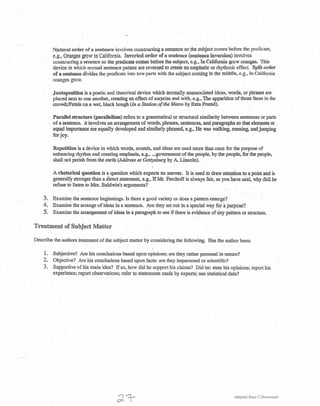
Natural order of a. sentence involves constructing a sentence so the subject comes before the predicate,
e:g., Oranges grow in California. Inverted order -ofa sentence (sente~einve:rsion) involves
constructing a senence so the predicate comes before the subject, e.g., In California grow oranges. This
device in which normal sentence patters are reversed to create an emphatic or rhythmic effect. Split order
of a sentence divides the predicate into tow parts with the subject corning in the middle, c.g" In California
oranges grow.
Juxtaposition is a poetic and rhetorical device which normally unassociated ideas, words. or phrases are '
placed next to one another, creating an effect of surprise and with, e.g .• The apparition of those faces in the
crowd;IPetaIS on a wet, black bough (In a Station of the Metro by Ezra Pound). .. .
Parallel structure (parallelism) refers to a grammatical or structural similarity between sentences or parts
of a sentence. it involves an .arrangement of words, phrases, sentences, and Paragraphs so that elements or ,
equal importance are equally developed and similarly, phrased, e.g., He was walking, running, and jumping
b~ .
Repetition is a device in which words, sounds. and ideas are used more than once for the purpose of
enhancing rhythm and creating emphasis, e.g., ...government of the people, by the people, for the people,
shall not perish from the earth (Address at Gettysburg by A. Ljncoln).· .
A rhetorlcal question isa question which expects no answer. It is used to dra,& attention to ~ point and is
generally stronger than a direct statement, e.g., If Mr. Ferchoff is always fair, as you nave said, why didi he
. refuse to listen to Mrs. Baldwin's arguments?
3 .. Examine the. sentence beginnings. Is there a good variety or does a pattern emerge?
4. Examin~ the arrange of ideas in a sentence. Are they set out in a special ;/ay i~r~.purpose?
5. Examine the arrangement of ideas in a paragraph to see if there is evidence of any pattern or structure.
Treatment of Subject Matter
Describe the authors treatment of the subject matter by considering the following. Has the author been:
. !
1. .Subjective? Are his conclusions based upon opinions; are they rather personal in nature?
2. Objective? Are his conclusions based upon facts: are they impersonal or scientific? .
3. Supportive of his main idea? .If so, how did he support his claims? Did he: state his opinions; report his
experience; report observations; refer to statements made by experts: use statistical data?
adapted from C.Ha.i11mond
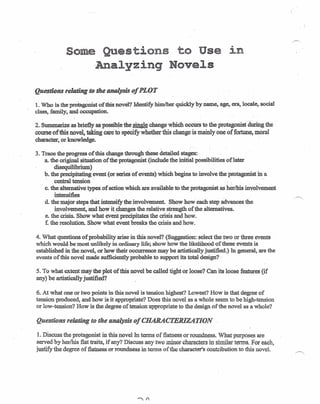
Some Questions to Use 1n
·Analyz.inq Novels
Questions relating to the analysis 0/PLOT
1. Who is the protagonist of thisnovel? Identify himlher quickly by name, age, era, locale, social
class, family, and occupation. .
2. Summarize as briefly as possible the single change which occurs to the protagonist during the
course-of this novel, takingeareto specify whether this change is mainly one of fortune, moral
character, or knowledge.
3. Trace the progressof this change through these detailed stages:'
a. the original situation of the protagonist (include the initial possibilities oflater
disequilibrium )
b. the precipitating event (or series of events) which begins to involve the protagonist in a
. . centraltension .. ..... . .-
c. the alternative types of action which are available to the protagonist as her/his involvement
intensifies ._
d. the major steps thatintensify theinvolvement, Show how' each step advances the
involvement,' and how itchanges the relative strength of the altematives.
e. the crisis. Show what event precipitates the crisis and how:
f. the resolution. Show what event breaks the crisis and how.
4. What questions of probability arise in this novel? (Suggestion: select the two or three events
which would be most unlikely in ordinary life; show how the likelihood of these events is
established in the novel, or how their occurrence may be artistically justified.) In general, are the
events of this novel made sufficiently probable to support its total designv-
5. To what extent may the plot of this novel be called tight or loose? Can its loose features (if
any) be artistically justified?
6. At what one or two points in this nove) is tension highest? Lowest? How is that degree of
tension produced, and how is it appropriate? Does this novel as a whole seem to be high-tension
or low-tension? How is the degree of tension .appropriate to the design of the novel as a whole?
Questions relating to the analysis oj CHARACTERIZATION
1. Discuss the protagonist in this novel In terms of flatness or roundness. What purposes are
served by her/his flat traits, if any? Discuss any two minor characters in similar terms. For each,
justify the degree of flatness or roundness in terms of the character's contribution to this novel.
,~
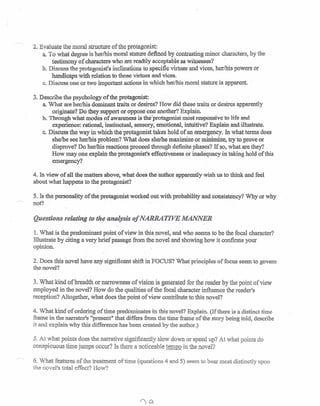
2. Evaluate the moral structure of the protagonist:
a. To what degree is her/his moral stature defined by contrasting minor characters, by the
testimony of characters who are readily acceptable as witnesses?
h. Discuss the protagonist's inclinations to specific virtues and vices, her/his powers or
handicaps with relation to those virtues and vices.
c. Discuss one or two important actions in which her/his moral stature is apparent.
3. Describe the psychology of the protagonist:
a.What are her/his dominant traits or desires? How did these traits or desires apparently
originate? Do they support or oppose one another? Explain.
b. Through what modes of awareness- is the'protagonist most responsive to life and
experience: rational, instinctual, sensory, emotional, intuitive? Explain and illustrate.
c. Discuss the way in which the protagonist takes hold of an emergency. In what terms does
she/he see her/his problem? What does she/hemaximize or minimize, try to prove or
disprove? Do her/his reactions proceed through definite phases? If so, what are they?
How may one explain.the protagonist's effectiveness or inadequacy in taking hold of this
emergency?
4. In view of all the matters above, what does-the author apparently wish us to think and feel
about what happens to the protagonist?
5. Is the personality of the protagonist worked out with probability and consistency? Why or why
not?
Questions relating to the analysis of NARRATIVE MANNER
1. What is the predominant point of view in this novel, and who seems to be the focal character?
Illustrate by citing a very brief passage from the novel and showing how it confirms your
opinion.
2. Does this novel have any significant shift in FOCUS? What principles of focus seem to govern
the novel?
3. What kind of breadth or narrowness of vision is generated for the reader by the point of view
employed in the novel? How do the qualities of the focal character influence the reader's
reception? Altogether, what does the point of view contribute to this novel?
4. What kind of ordering of time predominates in this novel? Explain. (If there is a distinct time
frame in the narrator's "present" that differs from the time frame of the story being told, describe
it and explain why this difference has been created by the author.)
5. At what points does the narrative significantly slow down or speed up? At what points do
conspicuous time jumps occur? Is there a noticeable tem1!Qin the novel?
6. What features of me treatment of time (questions 4 and 5) seem to bear most distinctly upon
the novel's total effect? How?
7. Select several passages from this novel, each reasonably briet, and use them to illustrate-a
discussion of such stylistic matters as these: _ -
- a. special qualities of diction and sentence structure _
b. the use of style to Individuate the speech, thought, and personality of given characters
c. the implied presence ofthe narrator or "author"; her/his level of artificiality; her/his
personality
d. the basic vision of life which the style of the novel reflects and extends
- -
8. Take any important character or event of this novel, and describe the kind of distance at which
the reader is placed. What factors help to determine this placement-and how? ·What contribution
to this novel as' a whole. Ismade, by the author's choice of distance for this character or event?
Que~nsrelevant to the analysisof IDEA
1. To what extent does this novel stress idea through the use of generalizing devices. lllustrate
the more obvious uses.
2. According to this novel, what kind of behavior makes. for lasting human worth or for human
waste? If a heroic ideal is implied by this novel, describe it.
3. What specific social problems does the author seem to-regard as unsolved? What causes seem
to be mainly responsible, and why? From. where is one led to believe that a solution may come?
Explain.
4. Evaluate the relative importance in influencing the outcome of the novel of the following:
physical nature, biological make-up, intimate personal relationships, societyGeneralize, to show
what the novelist seems to regard as the chief area in which human destiny is formed.
5. As set forth in this novel, to what extent is any individual able to manage these formative
conditions? (The soundness and the external success of the admirable characters might be _
brought into the discussion here.) Through what mode of awareness do the admirable characters
behave most soundly and with greatest external success?
6. To what extent is the individual's final outcome helped or hindered by forces outside her/his
control? In this nove] are these influences benignant, malignant, or indifferent?
7. To what extent are all these ideas based upon the concept of a guiding tendency, force, spirit,
or God in the universe? If the author of fhis novel has implied such a force or being, what are its
attributes and what is its relationship to man? (If more than. one view seems to be expressed,
describe each view and explain the author's apparent preference.)
AD
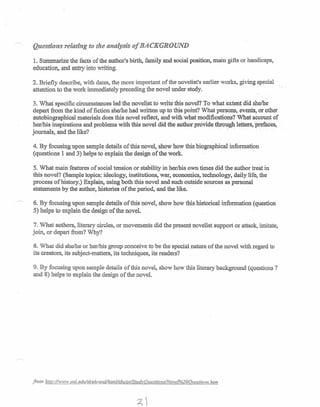
Questions relating to the analysis of BACKGROUND
1. Summarize the facts of the author's birth, family and social position, main gifts or handicaps,
education, and entry into writing.
2. Briefly describe, with dates, the more important of the novelist's earlier works, giving special
attention to the work immediately preceding the novel under study.
3. What specific circumstances led the novelist to write this novel? To what extent did she/he
depart from the kind of fiction she/he had written up to this point? What persons, events, or other
autobiographical materials does this novel reflect, and with what modifications? What account of
her/his inspirations and problems with this novel did the author provide through letters, prefaces,
journals, and the like? ' ,
4. By focusing upon sample details of this novel, show how this biographical information
(questions 1 and 3) helps to explain the design of the work.
5. What main features of social tension or stability in her/his own times did the author treat in
this novel? (Sample topics: ideology, institutions, war, economics, technology, daily life, the
process of history.) Explain, using both this novel and such outside sources as personal
statements by the author, histories of the period, and the like.
6. By focusing upon sample details of this novel, show how this historical information (question
5) helps to explain the design of the novel,
7. What authors, literary circles, or movements did the present novelist support or attack, imitate,
join, or depart from? Why?
8. What did she/he or her/his group conceive to be the special nature of the novel with regard to
its creators, its subject-matters, its techniques, its readers?
9. By focusing upon sample details of this novel, show how this literary background (questions 7
and 8) helps to explain the design of the novel.
from hup ://W}V,'v', un!, edulsbehre,.ndlhlmllsbsiteIStudvQuestior/,sINovel%20Q,/eslions. him
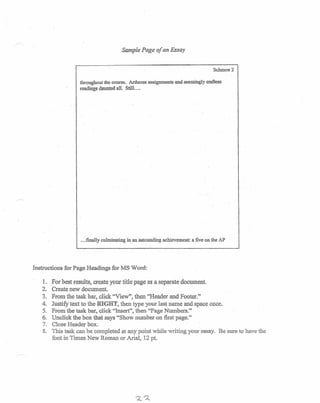
Sample Page of an Essay
Schmoe Z
throughout the course. Arduous assignments and seemingly.endless
readings daunted all. Still. ...
.,.finally culminating in an astounding achievement: a five on the AP
Instructions for Page Headings for MS Word:
1. For best results, create your title page as a separate document.
2. Create new document.
3. From the task bar, click "View", then "Header and Footer."
4. Justify text to the RIGHT, then type your last name and space once.
5. From the task bar, click "Insert", then "Page Numbers."
6. Unclickthe box that says "Show number on first page."
7. Close Header box.
8. This task can be completed at any point while writing your essay. Be sure to have the
font in Times New Roman or Arial, 12 pt.
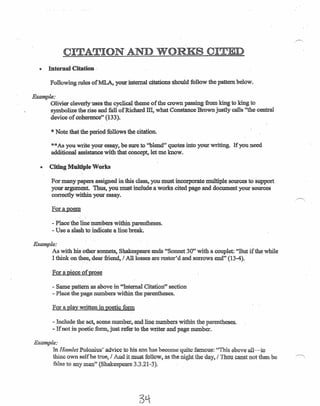
CITATION'AND WORKS CITED
• Internal Citation ",
Following rules ofMLA, your internal citations should follow the pattern below.
Example:
Olivier cleverly uses the cyclical theme of the crown passing from king to king to
symbolize the rise and fall of Richard ill, what Constance Brown justly calls "the central
device of coherence" (133).
*Note that the period follows the citation.
**As you write your essay, be sure to "blend" quotes into your writing. If you need
additional assistance with that concept, let me know.
• Citing Multiple Works
For many papers assigned in this class, you must incorporate multiple sources to support,
your argument. Thus, you must include a works cited page and document your sources
correctly within your essay.
For a poem
- Placethe line numbers within parentheses.
- Use a slash to indicate a line break.
Example:
As with his other sonnets, Shakespeare ends "Sonnet 30" with a couplet: "But if the while
I think on thee, dear friend, I All losses are restor'd and sorrows end" (13-4). '
For a piece of prose
- Same pattern as above in "Internal Citation" section
- Place the page numbers within the parentheses.
For a play written in poetic form
- Include the, act, scene number, and line numbers within the parentheses.
- If not in poetic form, just refer to the writer and page number.
Example:
In Hamlet Polonius' advice to his son has become quite famous: "This above all-to
thine own self be true, / And it must follow, as the night the day, / Thou canst not then be '~
false to any man" (Shakespeare 3.3.21~3).
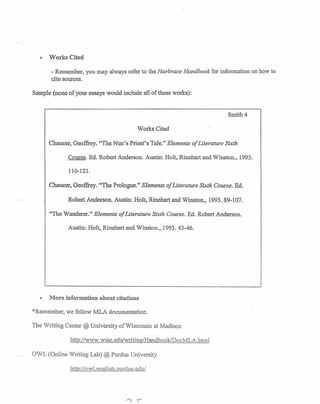
iI Works Cited
- Remember, you may always refer to the Harbrace Handbook for information on how to
cite sources.
Sample (none of your essays would include all of these works):
Smith-s .
Works Cited
Chaucer, Geoffrey. "The Nun's Priest's Tale." Elements of Literature Sixth
, Course. Ed. Robert Anderson. Austin: Holt, Rinehart and Winston., 1993.
110-121.
Chaucer, Geoffrey. "The Prologue." Elements of Literature Sixth Course. Ed.
Robert Anderson. Austin: Holt, Rinehart and Winston., 1993. 89-107.
'Tile Wanderer." Elements of Literature Sixth Course. Ed. Robert Anderson.
Austin: Holt, Rinehart and Vinston~, 1993.43-46 ..
e More information about citations
"Remember, we follow MLA documentation.
The Writing Center @ University of VIisconsin at Madison
http://Ww./ .wisc.edulwritingiHandbook/DocMLA.btml
OWL (Online 'Writing Lab) @ Purdue University
http://ow1.english.1)urdue.edu/

English 12 ap course handbook

  • 1.
    ;: .' 'EYlJ6Sh f2,;t{1J:literature ani Composffion COURSE HANDBOOK Contents Pagels) Literaru Eesau . '1 Transition Cues and Close Reading 2 6 + 1 Traits of Writing· 3 11 Rules of Writing 4 Active and Passive Voice S·6 Improving Sentence Stule 7 Eliminating Wordiness 8-9 AP Essay Section: Exam Format&,Sctiri1ig. Worksheet 10-11 .... AP Essay Grading Scales & Format for '9' 12-13 KeyWords forUndersfanding Essay Questions 14 What AP Graders Long to See 15 I AP Essay Helpful Hints 16 "An Exam Reader's Advice" 17-18 Multiple Choice Strategies 19-20 Vocabularu for the Literaru Critic 21-22 I Tone Words and Words that Describe Lanauaqe 23 Four Basic Positions of Point of View 24 Color Symbolism 25 Style Analysis 26-27 Some Questions to Use in Analyzing Novels 28-31 Formatting Formal Essaue 32-33 MLA Citations and Works Cited 34-35
  • 2.
    Literary Essay The followingmay help you write your essay. This information was adapted from the English Online web page. There are many websites with helpful information. Check those listed or find others (let me know what you find). Introduction 1. read the prompt question carefully 2. underline key WordS in the prompt or question 3. break the question/prompt into component parts 4. restate the prompt/question in your own words Then write your opening paragraph includfu.g the following information, e state the title and the author to be discussed G state the main idea of the question o provide a thesis statement which will be developed into your essay Ib explain how the essay win be answered Body of the Essay Preparation - List your main points. These should relate to the thesis statement. For each point you wish to make go through these steps: '--- 0 G e III <Ill Ii e state the point explain in your own words what it means give an example of the point from the text or source material give at least one quote from the source material to support your example explain the relevance of the implication of the example and/or quote summarize your point _ write a paragraph around each point (you may riot need all of your preparatory material) check the for the following @ each paragraph contains a topic sentence relating to your thesis. e that topic sentences are explained, illustrated, discussed and relate to the thesis <11 check that transitions are clearly signaled e ideas clearly developed leading to a logical conclusion language Use <11 language appropriate to essay and audience G essay easy to understand e essay is free of redundancy <ll essay remains on topic e essay follows the conventions of spelling, grammar and format adapted from C.H,31nmond
  • 3.
    Formal Essay Format Requii-ements: Doublespaced Times New Roman, 12 point font (NO bold, italics, or underliningl) Title Page (see example) . .. *** Titles of major works should be italicized. Page Headings (see .~ample;shOtPdNOT appear on the first page of an essay) . Works Cited Page (if assigned) . Sample Title Page The title offen you a chance to be creative: Make your first impression counsl A Tale ofTriumpb: Surviving APEnglisb varies depending on the type oj . essay assigned Joe Schmoe January 15,2010 English 12 AP Smith _ Block Expository Essay .~.
  • 4.
    transition cues to showaddition: again; ·moreover, and , not. a:n4thea, too, besides, equally important, first; second (etc.), finally, lastly, further, what's more, furthermore to show time: at length, later immediately thereafter, previously, soon, formerly, next, after a 'few hours, first, second (etc.), afterwar~, next ' cues that make the reader stop and compare: but, notwitbstandlng,altbough,Set. on the, other hand,althQpgh this is 1rIle~and yet, on the contrary, while this 'istree, however, after aI1, conversely, still. for all that, simultaneously, nevertheless, in contrast, meanwhile, nonetheless, at the same time, inthemeanthne to give examples: for instance, for example, to demonstrate, to illustrate, as an illustration, in any event, that is ,- -. . to emphasize: obviously, in fact, as a matter of fact, indeed, in any case to repeat in brief, in short, as I have said, as I have noted. in other words to introduce conclusions: hence, therefore, accordingly. consequently, thus, as a result to summarize: in brief, on the whole, etc. *avoid IN CONCLUSION or TO CONCWDE , Close Reading Answer the following and be prepared to discuss the selection ' 1. What is the main idea/theme of the selection? 2. In what ways does the author support his main idea/theme? 3. Is the support logical and consistent/ Find examples, 4. What words are you unfamiliar with? What do you think they mean from their use in context? Look them up. S. How are words used denotatively? 6. What is the author's style? Write a five sentence paragraph imitating this'style. 7. Find seven to ten examples of literary !language elements. 8. Write a prompt for this selection. 9. Summarize the selection in no more than five sentences. 10. What other selections (movies, poems, articles, paintings, plays, etc) can you relate this passage to? 11. What allusions are used? Are they successful? 12. What is the attitude of the author? How is it similar or different from the narrator? Howdo you know this? 13. Whatis the tone of the passage? What words does the author use to help convey this tone? 14. What is the intended and probable effect of the passage? adapted from C.Hammand 2.
  • 5.
    What are theSix Traits + I? . -~ ..Ideas: The ideas are the heart of the message, the content of the piece, the main theme, together with the details that enrich and develop that theme. Organization: Organization is the internal structure of a piece of writing, the thread of central meaning, the logical and sometimes intriguing pattern of the ideas. Voice: The voice is the heart and soul, the magic, the will, along with the feeling and conviction of the individual writer coming out through the words. Word Choice: Word choice is the use of rich, colorful, precise language that moves and enlightens the reader.. Fluency: Sentence fluency ·i.~.the rhythm -and.flow of the language, the sound of work patterns, the way. in which the writing plays to theear - not just to the eye. . ~ . Convention: Conventions are the mechanical correctness of the piece - spelling, grammar and usage, paragraphing, useof capitals, and punctuation. +1 Presentation: Presentation zeros in on the form and layout of the text and its readability: the piece should be pleasing to the eye. ***for more information and explanation of each trait, visit the following website: http://www.madison.k12.wius/tn1Jlangarts/sixtrtcrsmtrl.htm
  • 6.
    1. To jointwo independent clauses, use a comma followed. by a conjunCtion, a semicolon alone, or a semicolon followed by a sentence modifier; 2. Use commas to bracket nonrestrictive phrases, which are not essential to the sentence's meaning. . . . . , . 3. Do not use commas to bracket phrases that are essential to a sentence's meaning. 4. When beginning a sentenCe With an introductorY phrase or an introductory (dependent) clause, include a.comma. 5. To indicate poeseeslon, end a singular noun With an apostrophe. followed byan AS". Otherwise, the noun's form seems plural. .. .. .' . 6. Use proper punctuation to integrate a quotation into a sentence. Ifthe introductory material is an independent clause, add the quotation afteracclcn, Ifthe introductory material ends in "thinks," Itsaying,Itor some other verb indicating expression, use a .' comma. 7. Make the subject and verb agree with each other. not with a word that comes between them. ' ." ' 8. Be sure that a pronoun, a participial phrase. or an appositive refers clearly to the proper subject. . 9. Use parallel construction to make a strong point and create asmooth flow. 1O. U~e the active voice unless you specifically need to use the passive. 11. Omit unnecessary words. Created by Junket Studies
  • 7.
    Active and PassiveVoice Voice The voice of a verb tells whether the subject of the sentence performs or receives the action. In English there are two voices, passive and active. Active Voice In active voice,the subject perforl'M the action expressed by the verb: The student wrote Q song. Passive Voice In passive voice, the subject receives the action expressed by the verb: A song was written by the student. . Forming Tenses of Passive Verbs The passive voice always consists of two parts: a form of the verb Uta bell .•.past participle: '[:":~:~:~=:~T~;~~~:-='-~::~r:~'~:c:::~!~;~~;~.-~~~~~'·f;;'~-~:==:.jl;,.---------- ..-- -- ----.--.-.; 1-- ·-·-- ..---··-----·-·-·--..····..··..·· -·----··-···..··-"-'-'; IiPresent Hit is cleaned qr::::~:;..:::::::;.;=::.:....::::::=·:::;:::;·:=..::.:::::::::;;:::~j'" .::::::;;::::::~:::::;;.;::::::::::-:..::..::;;:::;::::.:.=.: ..:..::........:.:;-:.~.-:-:.:: ..;:::..:;:::.:::....--~ I IPast qit was cleaned H ,•.._......•......._ '.-- _........................•....•..... """'-' .....•......... -... . ..'j ilF;;;;-------- --. ~---Hit willbe cl~a~d ---·---· ·----~I .1..._.•......._ .. .__..... __.....•.._._.~-'-_..... __ . .:.._.';l...-._ .. _ .•__, ._~ .__.... •. _ ..__.. :__:_.. _ .• __. ._. _ .....• '! •fP--;'esentp~rlec:;----l!ithas been clea~ed- !i, _.._ _ . ~..,L _.__.._ ___. .. __ j :t~~~!"_P!~~~·~~~--··--~~~·-][i!..~.·..~~~-~..c~~_~!i·-·-==·=~__.·.·~.-]I..r···--..•·..-·-·-- - ·--------·--·--·· .--.--- -..--.--- ..---- -- ---.- - -- -.........,i j future perfect :!it will have been cleaned '] :-:::~-::::::.-.:::::....::::.::::.::.::::..=~;:::.:::.:..:::.;.:~-.:::.:.::.:.::::: ..-::.~::.:.:::-;:.:.:~::-:.:::::::=:..:.:.:::...:..:.-..::.:::.-=-:...:..::.:.=:::=---:-~:-:::.::::...:...::::.::.:...~-..,;-:::-::. ...::::~:.~~-:~.:::...-:..;;...:..:~j Uses of Passive Voice Use the passive voiceto: Call attention to receiver of the action rather than the performer: The professor was hit by three snowballs. Point out the receiver of the action when performer is unknown or unimportant: A love letter was slipped under the door. The signs wit! be posted. Avoid calling attention to the performer of the action (known as the "institutional passive"): The fines will be collected _on Monday.
  • 8.
    Active and PassiveVoice in Writing Thecheice between using the active or passive voice in writing is a matter of style, not correctness.' However, most handbooks recommend using active voice, which they describe as morenaturol, direct, lively, and succinct. The passive voice is considered wordy and weak (except when used in cases above). Examine the following examples. ' weak, pa$Sive: . The skater was slammed into the wall by Maria. strong, cctive: Maria slammed the skater into the wall. weak, passive: The book was enjoy~d by me because the events of her childhood were described so well by the author. strong, cctive: 1:enjoyed the beek beeeuse the author described the events of' her childhood so well. Hints for identifying the Passive Voice Anactive verb mayor may not have a direct object, but the passive verb almost never does. .r>. lilt is...That" construction (It is clear that ... It is noted ...) Use of the verbs To Be, Make, or Have (Passive: Your exits should be made quickly. Active: Leave quickly.) Endings that turn verbs into abstract nouns: -ion,-ing,-ment: Passive: When application of force is used, the lid will open. Active: Apply force to open the lid. f _
  • 9.
    Improving Sentence Style-AChecklist for Composition 1. What style of sentences can you find? List the number of loose, balanced, parallel, and periodic sentences. If you have no sentences of one of these types in your paper, rewrite some sentences in that style. 2. How long are your sentences? Count words in the paper, count sentences, and divide to- arrive at an average length. 3. Find your longest sentence. What is the length of the sentence before it? After it? If that long sentence is not either preceded or followed by a short sentence, change, one of them to a short sentence. 4. What forms are your sentences? Count simple, compound, complex, and compound- complex sentences. If you do not have variety rewrite some sentences to include these sentence types., 5. Count the number of to be verbs (is, am, are, was, were, be, being, been). Find three that can better be expressed as action verbs and rewrite the sentences that way. 6. Count parallel constructions. If there are fewer than three in the paper, rewrite three sentences so they contain parallel elements. 7. How do your sentences begin? If more than half of your sentences begin with.tae.. subject.rewrite them-in a way that varies the beginning. 8. Check your comma use by applying these four rules: a. Use a comma before and. but for. or, not. so, yet, and still when those words join independent clauses. b. Use a.comma between all tenus in a series. c. Use a comma(s) to set offparenthetical openers and afterthoughts. d. Use a comma after introductory clauses or phrases. 9. Have you used any semicolons? If not, :finda sentence or a pair of sentences that would be better punctuated with a semicolon and rewrite. 10. Have you used any dashes? If not, find a sentence that would improve with a dash and rewrite. 11. Have you inverted any sentences? If not, rewrite one to do so. 12. Find an which clauses and rewrite half of them to eliminate which. 13. Eliminate as many of, in, to, and by's as you can. 14. Find all instances of there is or there are and eliminate as many as possible. 15. Find all instances of it with no antecedent and eliminate. 16. Find all instances of this or that used 'without a noun. Add a noun or rewrite. 17. Have you 'used quotation marks? Check for correctness: 18. Have you used apostrophes or colons? Do you need to? 19. Is your diction appropriate for your audience? Check for slang, trite expressions, and garbage words. Eliminate as necessary.
  • 10.
    Eliminating Wordiness fromyour Writing at the present time in the present circumstances at this point in time at this moment ' in this day and age at that point in time in those days in that period" in many cases in some caseS in exceptional.cases. , " in most cases consider as, consider asi:Jeing I consider study as being necessary to success. despite the fact that , regardless of the fact that due to the fact that for the purpose of by virtue of the fact that the reason is because in Q position to, in order to in the area of ' in the event that. } in the event of in case of In the event that fire breaks out. leave the files behind: Use !!Ql! or ~ Use then. Use often. Use sometimes. Use rarely. Use most. Use: I consider study necessary to success. Use although. Use because. 'Use cen. Use near or in. Use if with a verb. If fire breaks out I leave the files behind in terms of [Revise out of your prose.] The new curriculum was designed in terms of student needs and fa.culty ability. ' ,The new curriculum considers bothstudent needs and faculty ability. The new curriculum was designed to match faculty ability with student needs in the final analYSis in no uncertain terms in the nature of things of that nature refer back He is of a complex character. Use finally, or drop the phrase entirely. Drop the phrase, or use firmly or dearly. Use like or things lik~that. Use only refer. Use: He is complex.
  • 11.
    She is ofa generous nature. Ihe car was of agreen color. ,-. The weather conditions are bad. Traffic conditions are congested. Eliminate redundancies: Redundant advance forward continue on completely eliminate refer back repeat again combine together circle around close proximity few in number cheaper in cost disappear from view past history important essentials WORDY <:» REVISED WORDY REVISED WORDY REVISED Use: She is generous. Use: The car was green. Use: The weather is bad. Use: Traffic is congested. Direct advance continue eliminate refer repeat combine circle close few cheaper, less costly disappear history, the past essentials Daniel is now employed at a private rehabilitation center working as a registered physical therapist. Daniel works at a private rehabilitation center as a registered physical therapist. My father has been working at the engineering office for fifteen years now. My father works at an engineering office. Our goal was to try to be able to help the families in their recovery from hurricane Floyd. Our goal was to help the families recover from hurricane Floyd. . EXPLETIVES (there is, there are, it is, it was, etc.) frequently add unnecessary words and weaken the emphasis on a sentence's true subject. Your sentence may be more effective if you begin with the true subject. In other instances, a one- word modifier may convey meaning more economically. (See page 3 of the Hacker handbook.) WORDY REVISED WORDY REVISED WORDY REVISED There were fourteen people in attendance at the meeting. Fourteen people attended the meeting. It is apparent that the committee members cannot agree. Apparently, the committee members cannot agree. It will be a pretty day tomorrow. Tomorrow will be a pretty day. Nominals are nouns created by adding suffixes to verbs: establishment, completion, deliverance. While using nominals in your writing is not wrong, these words tend to make writing ponderous and slow-moving. The -easom; is that the verb, the word that conveys action in the sentence, has been transformed into a noun, an object. '-- WORDY REVISED Strict enforcement of the speed limit by the police will cause a reduction in traffic fatalities. If the police strictly enforce the speed limit, traffic fatalities will be reduced.
  • 12.
    ~, , ' Advance PlacementLiterature and Composition College Board Exam. Format Section .1:Multiple Choice Combination of Prose Passages and Poems 50-60 questions 60 minutes 450/0 of grade Section II 3 Essays 1·.Free-Response Poetry' 2. Free-Response Prose 30 Free- Response Open Question 15 minute reading period; 120 minute writing period 55% of grade .
  • 13.
    Table 4.2 -Scoring Worksheet (page 72) Please use the following in place of the scoring worksheet found on page 72 in the AP English Literature and Composition 2009 Released Exam. The worksheet found within the printed book itself should not be used because beginning with the May 2011 administration of AP Exams, the method for scoring the multiple-choice section has changed. Beginning in 2011, total scores on the multlple-cnolce section are based on the number of questions answered correctly. Points are no longer deducted for incorrect answers andas always, no points are awarded for unanswered questions. Section I: Multiple-Choice x 1.2272 == _ Number Correct (out of 55) Weighted Section IScore (Donot round) Section II: Free Response Question 1 X 3.0556 == (out of 9) (Do not round) Question 2 X 3:0556 == (out of 9) (Do nhiround) Question 3 X 3.0556 = (out of 9) (Do not round) Sum == Weighted Section II Score (Do not round) Composite Score Weighted Section I Score Weighted Section II Score Il AP Score Conversion Chart English Literature and Composition Composite Score Range APScore 114 --150 98 -113 81 - 97 53- 80 0-52 5 4 3 2 1
  • 14.
    AP English: Literatureand Composifiolll Essay Grading Scale d." Score 50Poinfs % Grade 9 50 100 A 8 47 94 A I· 7 ·45 88 B 6 43 86 B 5 40 80 c· 4 38 . 76 C 3 35 70 D 2 32· 64 F 1 30 60 F Score· 70Poinfs '% Grade zo .. 9 100 A 8 66 94 A 7 62 . 89 . ·.B 6 60 86 B 5 56 80 .c 4 53 76 C 3· 49 70 D 2 45 .. 64 F 1 42 60 F Score 75 Points . %, Grade .. 9 75 100 A 8· 71 95 A 7 67 89 B 6 64 85 B ... 5 60 80- - -- C 4 56 75 C 3 53 .7,1 . .. 0 ·2 49 , 65 F 1 45· 60 F .Score . 100 Points % Grade 9 100 A 8 94 A 7 88 B 6 ·85 B 5 79 C 4 75 C 3 70 I D 2 65 F 1 60 F , .
  • 15.
    Format for Essaysthat Received a Grade of "9" •. (Jane Shtiffer, an advanced placement student, jourut that papers with the highest grades generally followed this format. YOH might wish to follow this suggested format until you are comfortable with your own style.) Introduction ... Includes-thesis - Usually the first or last sentence Paragraph contains more than forty words Has three or more sentences including thethesis Body Has. two or more paragraphs I . Each paragraph contains on the average of 11·sentences Each paragraph contains 125 ormore words . Concluding Paragraph HaS 40 or-more words- .. Shows insight Does not repeat the thesis Gives a finished feeling (draws a conclusion) Each paragraph is generally structured In the following way 1. Topic sentence .;...refers to thesis found in introaJ~tion 2. Conc~ete detail sentence #1 shows support for the topic sentence (For Example ... ) 3. Commentary' 4. Commentary 5. Concrete detail sentence #2 shows support for the topic sentence (In addition ... ) 6 .. Commentary 7. Commentary 8. Concrete detail sentence #3 shows support for the topic sentence (FUrthermore ... ) 9. Commentary . . 10. Commentary 11. Concluding sentence - sums up the paragraph adapted from C.,Hauunond
  • 16.
    Compare: . Contrast: Criticize: Define: Describe: Discussi Explains Justify: . List; Outline:. Summarize: Trace: . Key Words for Understanding Essay Questions ·Emphasize similarities.but differences may be mentioned . Stress differences EXpress. your judgment asto the correctness ~r merit of the matters under. Consideration. . - .. _. Make a clear statement including all items which belong within the category you are defining, but exeludingallitemswhich do not belong. .' .. ~" Characterize the item from several points of view. (Sometimes-this qu~tion: .:.. may begin with the word "What,") Outfule the item completely, paying special. attention toorganization, Pl~ent pros and cons and illustrative ~tai1s. . . . , This is sim.ilar to "discussing," but there should be greater e~ph~sis on "how" and "why." " .' ' ·Prove, or show the grounds for your conclusions. Try to present your evidence in 'a convincing form. (Sometimes, this appears as a "Why" 'or ·''Prove'' questions.) . . Name the items briefly, one after the other. '. . Summarize in theform Qia series of headings and sub-headings. .Present concisely the main points of the topic, omitting details and . illustrations. . . Describe a development starting with its point of origin and including relevant details in the sequence. from Learning Your Way Through College by William C. Resnick and David H. Heller (Columbus, Ohio: Merrill, 1965). p. 110. .
  • 17.
    Advanced Placement Essays:Helpful Hints 1. Don't present yourself as an immature writer o AP readers see beyond handwriting to the larger issues of style and content, but handwriting can reflect problems. " Is the handwriting so excessively large or small that it is difficult to decipher? e Is the handwriting excessively florid? :-'. ' • If you have poor, difficult to read handwriting, strive to be certain the writing is clear enough to read. • AP readers must grade 20t essays an hour and your handwriting may affect attentiveness., Don't make it difficult for the reader to "see" your thinking . _ , ' • Brief, scant responses.are the worse error you can make-as theAP reader is leftwjthno way to evaluate your ability. 2. Avoid those serious errors, which will mark you as an uilp~~~ed writer. o A very serious error is repeated comma splices - running two mdependentclanses together without a conjunction and with only a corinna. (Run-on Sentences omit the-comma and Present the same problem.) • Another serious error is repeated occurrences of sentence fragments: '" e Spelling errors are serious, but a few are acceptable; too many may.cost you points. Spelling errors combined with a lack of sentence control are more apt to count against you. " • Errors of usage - e.g., affect/effect - affect how the readers evaluate your language competence. ~ 3. Write sentences that are smooth, tlOwing, clear, sensible; avoid short,eh~ppy' sente~c~s. ~ Proofread to ensure that you have not omitted words that render sentences unclear or nonsensical. ) Proofread to make sure that your wording is-not so confused, awkward, or ineffective that the reader cannot figure out what you are 'saying. - ., Sentences which are sharp, precise, and clear but which at the same time show complexity characterize the best writing. Sentences whose structures enable you to express intricate, layered understandings effectively will mark you as a mature and capable writer. o A fluent, clear style is a primary characteristic of higher level writing. • Use sentence variety to develop a more sophisticated style. , 4. Pay attention to organization and content: THE l'IOST IMPORTAl~T ISSUES. • Respond exactly to the question asked. The literature and questions are logical arid focused, Your answer is in the question. Accept that guidance; interpret and illustrate the question e Keep your focus clear throughout your essay; make certain the thoughts are in a logical sequence that is continually connected to-the focus, thus yielding a unified essay. e Use specificdetails both to offer commentary and interpretation about the literary piece and to support and illustrate your points. o Explain through examples and-comments on the details of the text. -3 Plan to spend about five minutes brainstorming, and structuring your response; then write from your outline or list of ideas. Think through you whole answer before you begin. •• Once you begin writing, try to maintain a continuous, logical, and focused flow. You ~, may have new insights as you proceed, but try to connect continually where you began, where you are, and where you are going with your central idea. 1A
  • 18.
    What AP ReadersLong to See This list was compiled during the 1994 AP English Reading at Trinity University in San Antonio .. 1. Read the prompt. ·It hurts to give -a low-score to someone who misread the prompt but wrote a good essay. 2. Do everything the prompt asks. Most writers focus on a few strategies and never fully answer the question. 3. Think before you write. Which strategies are used and how do they answer the prompt? 4. Plan your response. It is not easy for the reader to pick over an essay attempt to decipher sentences. A little organization will help you avoid extensive editing. 5. Make a.strong fir~t impression. Build your opening response. Don't parrot theprompt word for word. The reader knows it from memory. 6. Begin your response immediately. Do not take acircuitous route with generalizations. 7. Be thorough and specific. Do not simply "point out" strategies. Explain how they are used, give examples, and show .how they establish what the question is asking. No long r=> quotes! 8. Use clear transitions that help the reader follow the flow of your essays. Keep your paragraphs organized; do not digress. 9. Resist putting in a "canned" quotation or critic's comment if it does not fit. You will get a response from your reader but it will not be the one you want. 10. Write to express, not to impress. Keep vocabulary and syntax within your zone of competence. Students who inflate their writing ofteninadvertently entertain, but seldom explain. 11. Demonstrate that you understand style. Show the reader how the author has developed the selection to create the desired effect .. This indicates that you understand the intricacies of the creative process. 12. Maintain an economy of language: saying much with few words. The best student writers see much, but say it quite succinctly. Often ideas are embedded rather than listed. 13. Let your writing dance with ideas and insights. You can receive a 6 or a 7 with a lockstep approach, but the essays that earn 8's and 9's expand to a wider perspective. 14. Write legibly. If a reader cannot read half the words (especially at 4:30 P.M. on the sixth day of a reading) you will not get a fair reading - even if your essay is passed on to a reader with keener eyesight. Patience decreases as the the reading progresses. 15. Let your work stand on its own merits. Avoid penning Ilpity me" notes ("1 was up all night."· "I have a cold, II etc.) to the reader. ,---, adapted from CJ"J~,ITlmand
  • 19.
    "An Exam Reader'sAdvice on Writing" by Conni Sheinut Make a plan. Students should not begin writing until they fully comprehend the prompt and/or the passage. Mere parroting of the prompt often leads to floundering around instead of developing a clear direction. Write directly on the passage-and make quick notes and outlines in the margins. This planning step enables most writers to organize their ideas more efficiently. Although this active planning takes an extra five minutes or so, I've found that it is well worth the time. Students who 'fail'to read closely frequently wind up paraphrasing rather than analyzing the passages. Planning, helps them to stay focused. Begin quickly and ,directly. " Although AP Readers areinstructed to read the entire, essay and- not to be prejudiced by a weak introduction, astrong opening paragraph can be a real asset to a student's paper. When answering the free-response part of the AP English Exams, writers should answer the question quickly and avoid beginning with ideas that do not relate directly to the prompt. The following hypothetical mtroductlon for Ouestion One on the 2002 AP English Literature Exam provides an ex~tnple of what not to do: , "Ail people at some point in time have: encountered a great deal of trouble in their lives. I know of so many people who have been 'embarrassed by parents that will wave at you from across a room. Ihave a friend who told me that her parents did this very same thing." . , . ' Such generalities often signal a writer's inability to respond in a thoughtful manner, suggesting that the rest of the paper also may be incoherent or rambling. The Reader might begin to suspect that the student is just trying to bluff his or her way through the question. One-sentence perfunctory introductions - especially ones that repeat the wording of the prompt -- a/so work poorly, suggesting to the Reader that the student isn't particularly interested or doesn't care. Create an introduction strong enough to earn a grade of 3 aU by itself. That means that students should learn ways to answer the entire prompt -- answer the prompt, not simply repeat it -- in the introduction. This indicates to the Reader that the paper could be heading into the upper-halt zone. Use paragraphs and topic sentences. ' Although it may seem like a small matter, students should indent paragraphs clearly, A paper without indentation or with unclear indentation often confuses a Reader. Paragraphs create the fundamental structure of the essay, and without them good ideas can get muddled. Most essays that do notuse paragraphs tend to be full of confused and rambling thoughts. Many writers find topic sentences a useful tool both for organizing paragraphs and also for helping Readers navigate through the essay.
  • 20.
    "An Exam Reader'sA~vice on Writing" _by Conni_Shelnut Use quotations 'and explain them. To. score at least a three, students would be wise to make use of pertinent references from the text. StUdents are encouraged to USf:l,5peC~ quotations to back up their assertions ..However, they mU$~~?Cplaln.their quotes clea~ly and demonstrate how they are relevant to the question.Jt is important fQr young writers to realize that offering long' quotes without explanatlon.bogs down the essayanQ can give tl)e undesirable impression that the student is trying to fill UP.space. r~er than answer the prompt!. '. Create variety. Short, choppy sentences without variety indicate a student who has little backg(ound in grammarancLstyle, perhaps someone Vlh<)' has read and written--minimally:· COnnect " ideas witIl ~nsitio~~1 WQr(jil'!g,_par:tl~ipjal.phras~ ~PPO$itjv§lS, $ubpr"dJDatecia,u$es, etc. - Find the right word. :~.,.~ :.. An arsenal' of appropriate voCabulary aDdanalytieal. wording- reveals a brilliant mind at work, but writers should make certain thatthe words fit. Some students stick in big words just to sound scholarly. Ironically. some of-their papers score only a 2 because they lack clarity and scmetsnes say nothing ot.relevaoceto the prompt Use the active voice as much as possible as one remedy for repetition and other superfluous wording.
  • 21.
    by Shirley Counsil PreparingMultiple-ChoiceQuestions: The Challenges The multiple-choice section constitutes 45 percent of the score for each exam, and, generally, the section focuses more on the process than the product. Strategy 1 After reading the passage, read each question and anticipate what the answer might be before looking at the answer. This forces you to focus on the question,not the answer. Strategies that help you focus and concentrate help alleviate stress and nervousness. When you eliminate the choices down to two responses, choose the one that is most specific. Strategy 2 Read actively rather than passively. Underline words, phrases, or sentences in the passage that you think might be important. Also, look for patterns, moille, repetition, andj or contrasts. What you underline is probably not as important as the process. Reading actively increases focus and improves comprehension. Strategy 3 The most difficult kinds of questions are the ones that ask you to find "all of the following except" or any questions that require you to reread a large portion of the text. It may be helpful to omit these or.Ieave them unti1later, as these questions consume an inordinate amount of time. . Strategy 4 Be sure to look at the multiple-choice section of the exam as soon as you receive it and decide how much time they can spend on each section or question. It may be helpful to bring a watch to keep in front of you in order to effectively mange your time. Strategy 5 The multiple-choice section always presents a combination of easy, medium.rand hard questions for each passage. These questions generally follow the chronology of the passage rather than transition from easiest to hardest or vice versa. The most important factor, however. is that they all are worth the same points. Therefore, a sound strategy is to make sure you get credit for all the easy and medium answers first. That means choosing which questions to answer and which ones to skip and then returning to answer if time allows. If you spend too much time on a single, .hard question you may not get to answer two or three easy questions in a later part of .the exam. Additionally r do a quick check of the number of the question and the number on the Scantron forms every time you see a zero (10,20,30, and so on). This double-check can keep you from getting off track, having to go back to find their error, and wasting valuable time. St:!!~at~~gy6 When the question refers to a part of the sentence and asks for the meaning of a word or phrase in context, what a word refers to, or how a word functions, it is best to go back to the beginning of the sentence or even to the previous sentence and read completely to of the sentence to comprehend the meaning. Some questions ask what the antecedent of "this" is, and the answer is found in the preceding sentence. You may also want to read the sentence follows because answer could be there.
  • 22.
    Strategies to ApproachMultiple-Choice Questions on the AP Exam by Shirley Counsil Strategy 7 IDees Dot apply to the EO(! for Fall Semester) . .Ifyou have no idea ofwhat the correct answer might be, leave,it blank, as there is a quarter-point penalty for guessing. This is the same process used on the SATexam. Students who guess incorrectly actually lose the point that they would have received for a correct answer and an additional quarter-point as a penalty. This means that for every Incorrect answer, you lose 1.25 points. When the exam is scored, these points are totaled and deducted from the number of correct answers. Strategy 8 Ifyou find yourself running out of time, they can take the followingapproaches: . . A. Scan the remaining questions and look for either the shortest questions. or the' '. questions that direct you to a specific line or.lines. These questions take less time :. to answer. B. Lookfor questions that contain the answer without requiring you to refer to the text. For example, "Thesea slid silently from the shore" is an example of (B) alliteration. Youwould not have to go back to the passage to find the answer. Strategy 9 This strategy works for some students and not for others. You may want to scan the questions first but not the answers, since four out of fiveof them are wrong. Skip any. questions that direct you to a specific line number, and this eliminates the majority of questions. Therefore, this strategy takes only a few seconds. In.the fewthat are left, _. many times hints and clues about the meaning ofthe passage-will be revealed. Some' students say they had no idea what the-passage was saying until they read some of the questions. Other students claim it is a waste of time to read the questions first. This strategy is really one of personal preference. Strategy 10 One way to ensure that you finish the entire multiple-choice section is to scan the . number of questions and divide the number by two. For example, if there-are 54· . questions, and you have 60 minutes to complete the section, you should be around question 27 after 30 minutes. Another strategy is to dividethe time by .the number of passages. For example, ifyouhave·forirpassagesto read and one hour to.complete the exam, you should allot 15 minutes to each passage. The.advantage of this method is that every passage has a number of easy and medium questions, and by movingsteadily you will receive the maximum number of points. The number of passages changes each year.. Typically, there arefour passages to read. However,there have been exams containing five.You must look through the entire exam and manage your time. Practice, Practice, Practic~ There is no secret formula for success on the multiple-choice section of the AP English Exams. Hard work, frequent practice, and practice using sound methods and strategies should demystify the multiple-choice seetioni, giving you more confidenceand, ideally,.resulting in higher scores and bettJr passing rates.·~
  • 23.
    Short Fiction, Prose,Novel, and Drama Terminology /""""-. aestheticism denouement plot allegory dues ex machina point of view allusion dialogue prose ambiguity diction protagonist annotation didactic pun antagonist drama resolution anti-hero dramatic, irony rising action antithesis dynamic character round character aphorism epigraph sarcasm archetype· epiphany . satire artistic unity explication setting aside expositioh short fiction bathos fable situational irony bildungsroman farce soliloquy black humor . flashback static character catharsis flat character stock character chance foreshadowing stream of consciousness character foil genre structure characterization hamartia style , chorus hubris subplot chronological order imagery symbol climax interior monologue Theater of the Absurd coincidence literary fiction theme comedy mood third person Iimited comic relief motif tone commercial fiction myth tragedy complications narrative tragic hero conflict parable verbal irony connotation paradox verisimilitude conventional parody denotation pathos
  • 24.
    Poetry Structure, Techniques,and Classification Verse and Meter stanza Rhyme royal Slant rhyme Blank Verse Meter/Metrical Feet· Iambic rhythm/iambic meter Line lengths: monometer, dimeter, trimeter, tetrameter, pentameter, hexameter, heptameter, odometer- Foot names: anapest trochee, dactyl Rhyme scheme Intemal rhyme Free Verse- Masculine rhyme/feminine rhyme Terzo rirno : Figurgtive language and Poetic Devices Alliteration Allusion Anaphora Antithesis Apostrophe Assonance Bathos Cacophony Caesura Chiraroscuro Conceits Connotation Consonance Denotation Diction Dramatic monologue Elision Enjambment End-Stopped Line Epistrophe Euphony Figurative/literal Hyperbole Imagery (visual/tactile, auditory, olfactory, gustatory) Imagism Irony Metaphor Metonymy Onomatopoeia Oxymoron Paradox Personification Pun Refrain Sarcasm Simile Symbol (stock/conventional) Synecdoche Synaesthesia Syntax Tone Types of Poetry Bal/ads/ballad stcnzc/literorv ballads Closed form/Open Form Couplet Doggerel Dramatic Poetry Elegy Epic Epigram Heroic couplet limerick Lyric Mock-heroic poetry Narrative Poetry Pastoral Poetry Sestina Sonnet/fixed form: Shakespearean (English) Petrarchan (Italian) Spenserian Stanza forms: tercel, quotroln. quintet. sestet, septet, octave Terzoneile Viilanelle
  • 25.
    Tone Words A listof tone words is one practical solution for providing a bask: tone vocabulary. An enriched vocabulary enables students to use more specific and subtle descriptions of an attitude they discover in a text Inchidesuch words as: angry sharp upset silly boring afraid happy hollow joyful allusive. sweet vexed tired bitter . dreamy restrained proud. dramatic sad cold 'urgent joking poignant detached contused childish, peaceful mocking objective vibrant frivolous audacious shocking somber giddy provocative sentimental fanciful complimentary .condescending sympathetic contemptuous apologetic . humorous ~orrific sarcastic' nostalgic zealous , irreverent benevolent . seductive candid pitiful didactic Students need to use dictionaries for definitions of the 'above tone words. Students need explicit dictionary meanings to establish subtle differences between tone words. Keeping a list of precise tone words,· and adding to it, sharpens students' articulation in stating tone . .-~-~-"-'-----~ Words That Describe Language Students often need to develop a vocabulary that describes language. different from tone, these words describe the . force or quality of the diction, images, and details. These words qualify how the work is written, not the attitude or tone. jargon pedantic poetic vulgar euphemistic moralistic scholarly pretentious slang insipid sensuous idiomatic precise exact concrete esoteric learned cultured connotative symbolic picturesque plain simple homespun literal figurative provincial colloquial bombastic trite artificial abstruse obscure detached grotesque precise emotional concrete exact adapted from C.Hammcnd
  • 26.
    four Basic Positionsof Point of View Omniscient Limited . First-Person Dramatic Omniscient· thir~person third-person first-person third-person Voice pronouns he, she pronouns pronouns I. my, pronouns .mostly; first-person mine, etc • ., pronoun rarely (we, our, us) access to access to access to narrator's no access to any Consciousness consciousness of consciousness of consciousness consciousness more than one one character . characte~ perhaps all ' story seen through story seen through story told'through story seen through eyes of outside eyes of outside' eyes ,of outside eyes of outside Position and observer, whose observer, observer, observer whose Presence presence is protagonist, or protagonist, or presence is pervasive minor character minor character unobtrusive ,. whose presence whose presence dominates dominates reliable as implied reliable When reliable when reliable when Reliability author's voice observer used; less observer used; less "teller" remaIns reliable when .reliablewheo. neutral character used character used Usage in ,infrequently used frequently used frequently used . infrequently used Modern Fiction 1. allows great 1. fosters illusions 1. fosters illusion 1. Permits great scope and ofr~lity of reality flexibility flexibility 2. allows author 2. allows author 2. forbids author 2. permits author comments comments comments Other Features intrusions, 3. establishes 3. establishes 3. places reader in editorializing, intimate intimate position of evaluations, and relationship relationship spectator comments .between r.eader between 4. all9ws action to 3. creates distance and narrator reader and move swiftly between reader 4. provides .. narrator 5. creates and characters structural unity 4. provides strongest illusion 5. combines structural unity ofrea,lity scope of Iomniscient and immediacy of . '. ' . I first-person narration
  • 27.
    Some Color Symbolism spirit,intellect life, vitality reflection, blood, sacrifice, analysis mart dom medium of truth aggression, violence, an er constancy of sky strength simplicity fire frustrated love ambition aspirations' of mortal combat.., irit east China) sun (Mayan rebirth or south (Mexico) resurrection fidelity riches mystery easy virtue deception blasphemy uncertain heIl,devil water sulfur ready for action center of earth China) degradation (easily tainted .envy (China) ambiguity intuition suspicion White absence of color all ofspectrum of light innocence urifieation restoration (of lost innocence) :.purity/truth .transfiguration . transcendence glory transformation ] .. .,;'~.'. B'1" k' ,'"." ' ac ,"..••;;'~• n , • ~ • ~ '" '<'. reversal ,of a osites lack of consciousness descent intO darkness brack-gray-white; .' -.resUrrection water fertility Water symbolism is suggestive of: primordial fluid; source of life; source of all things; beginning and end of all; flood - drowning and dissolving; death; layers of psyche; ambivalence; life/fertility; submersion/destruction; afterlife; realm of the dead; chaos; rain -: life force; rime; eternity; cleansing/washing away spells, sins; baptism; water/fire duality (passive, active); cure/punishment; return to reality; ,energy of unconscious; dangerous energy when it overflows Biedermann, Hans. Dictionary of Symbolism. New York: Facts on File, Inc., 1992 adapted from C.Hammond
  • 28.
    Style' Analysis' . .'. . . . . There 'are at least four areas that may hi considered when analyzing style: diction. sentence structure. treatment of subject matter, andfiguiative language. .' . .... Diction.(dioi~.~f,!~)"ds) Describe diction by considering theJollowing: '1. Wordsmay:lliiDionosyDabk-(one syUabie inlength)or polysyllabic (more than one syllable in length). The higher the ratio of polysyllabic words, the more difficult the content _.",' 2. Words may bemainly colloquial (slang), informal (conversational), fo~ (literary), or old-f3Shiljned: 3. Woid.~ may.~.mainly denotative (containing anexactmeaning) or'oounotativt (contaiDing a~~ggested meaningj.»: . 4. Words may be c-oncrete (Specific) or abstract (general),' . . '. . . 5. ·.Words may beeuphoDious (pleasant sounding), e.g. butterfly; or CacophonOus (harsh sounding), e.g .• pus, Sentence Struetare Describe the sentence structure by considering the following: .,~, . . .~ 1. Examine the' sentence length., Are the 'Sentenc~ telegrapbic (shorter than' five words in length), short (approximately five words in length), m~ (approximately eighteen wordsinlength), or long and involved (thrity words or more in . length)? Does the sentence length fit the subject matter; what variety oflengtbs .are present? Why is the sentence length effective? . 2. Examine sentence patterns. Some elements to be considered are: A declarative (assertive) sentence makes a statement, e.g., The king is 'sick, An im~ve sentence givesacommand, e.g., Off with their heads. An interrogative sentence asks a question, e.g., Why is the kings sick? An exclamatorY sentence ~es and exclamation, e.g., The king is dead! . A snnpie sentence contains one.subject and one verb, e.g., The singer bowed to her adoring audience. A compouwheDtence contains' two independent clauses joined bya coordinate conjunction (and, bu~ or}. or by a semicolon, e.g., The singer bowed to the audience. but she sang no encores. A complex sentence contains an independent clause and one or more subordinate clauses, e.g., You said that you would tell. the truth. A compound-complex sentence contains two or more principal clauses and 'one' or more 'subordinate' clauses. e.g., The singer owed while the audience applauded, but she sang no .encores. . A loose.sentence makes complete sense if brought to a close before the actual ending. e.g., We reached .Edmonton/that morning/after a turbulent flight/and some excitingexperiences. A periodic sentence makes sense only when the end of the sentence is reached, e.g., That morning, after a turbulent flight and some exciting experiences, we reached Edmonton. In a balanced sentence, the phrases or clauses balance each other by virtue of their likeness or structure, meaning, and/or length, e.g., He maketh me to lie down in green pastures; he leadeth me beside. the still waters. adapted from C.Hammond
  • 29.
    . . Natural orderof a. sentence involves constructing a sentence so the subject comes before the predicate, e:g., Oranges grow in California. Inverted order -ofa sentence (sente~einve:rsion) involves constructing a senence so the predicate comes before the subject, e.g., In California grow oranges. This device in which normal sentence patters are reversed to create an emphatic or rhythmic effect. Split order of a sentence divides the predicate into tow parts with the subject corning in the middle, c.g" In California oranges grow. Juxtaposition is a poetic and rhetorical device which normally unassociated ideas, words. or phrases are ' placed next to one another, creating an effect of surprise and with, e.g .• The apparition of those faces in the crowd;IPetaIS on a wet, black bough (In a Station of the Metro by Ezra Pound). .. . Parallel structure (parallelism) refers to a grammatical or structural similarity between sentences or parts of a sentence. it involves an .arrangement of words, phrases, sentences, and Paragraphs so that elements or , equal importance are equally developed and similarly, phrased, e.g., He was walking, running, and jumping b~ . Repetition is a device in which words, sounds. and ideas are used more than once for the purpose of enhancing rhythm and creating emphasis, e.g., ...government of the people, by the people, for the people, shall not perish from the earth (Address at Gettysburg by A. Ljncoln).· . A rhetorlcal question isa question which expects no answer. It is used to dra,& attention to ~ point and is generally stronger than a direct statement, e.g., If Mr. Ferchoff is always fair, as you nave said, why didi he . refuse to listen to Mrs. Baldwin's arguments? 3 .. Examine the. sentence beginnings. Is there a good variety or does a pattern emerge? 4. Examin~ the arrange of ideas in a sentence. Are they set out in a special ;/ay i~r~.purpose? 5. Examine the arrangement of ideas in a paragraph to see if there is evidence of any pattern or structure. Treatment of Subject Matter Describe the authors treatment of the subject matter by considering the following. Has the author been: . ! 1. .Subjective? Are his conclusions based upon opinions; are they rather personal in nature? 2. Objective? Are his conclusions based upon facts: are they impersonal or scientific? . 3. Supportive of his main idea? .If so, how did he support his claims? Did he: state his opinions; report his experience; report observations; refer to statements made by experts: use statistical data? adapted from C.Ha.i11mond
  • 30.
    Some Questions toUse 1n ·Analyz.inq Novels Questions relating to the analysis 0/PLOT 1. Who is the protagonist of thisnovel? Identify himlher quickly by name, age, era, locale, social class, family, and occupation. . 2. Summarize as briefly as possible the single change which occurs to the protagonist during the course-of this novel, takingeareto specify whether this change is mainly one of fortune, moral character, or knowledge. 3. Trace the progressof this change through these detailed stages:' a. the original situation of the protagonist (include the initial possibilities oflater disequilibrium ) b. the precipitating event (or series of events) which begins to involve the protagonist in a . . centraltension .. ..... . .- c. the alternative types of action which are available to the protagonist as her/his involvement intensifies ._ d. the major steps thatintensify theinvolvement, Show how' each step advances the involvement,' and how itchanges the relative strength of the altematives. e. the crisis. Show what event precipitates the crisis and how: f. the resolution. Show what event breaks the crisis and how. 4. What questions of probability arise in this novel? (Suggestion: select the two or three events which would be most unlikely in ordinary life; show how the likelihood of these events is established in the novel, or how their occurrence may be artistically justified.) In general, are the events of this novel made sufficiently probable to support its total designv- 5. To what extent may the plot of this novel be called tight or loose? Can its loose features (if any) be artistically justified? 6. At what one or two points in this nove) is tension highest? Lowest? How is that degree of tension produced, and how is it appropriate? Does this novel as a whole seem to be high-tension or low-tension? How is the degree of tension .appropriate to the design of the novel as a whole? Questions relating to the analysis oj CHARACTERIZATION 1. Discuss the protagonist in this novel In terms of flatness or roundness. What purposes are served by her/his flat traits, if any? Discuss any two minor characters in similar terms. For each, justify the degree of flatness or roundness in terms of the character's contribution to this novel.
  • 31.
    ,~ 2. Evaluate themoral structure of the protagonist: a. To what degree is her/his moral stature defined by contrasting minor characters, by the testimony of characters who are readily acceptable as witnesses? h. Discuss the protagonist's inclinations to specific virtues and vices, her/his powers or handicaps with relation to those virtues and vices. c. Discuss one or two important actions in which her/his moral stature is apparent. 3. Describe the psychology of the protagonist: a.What are her/his dominant traits or desires? How did these traits or desires apparently originate? Do they support or oppose one another? Explain. b. Through what modes of awareness- is the'protagonist most responsive to life and experience: rational, instinctual, sensory, emotional, intuitive? Explain and illustrate. c. Discuss the way in which the protagonist takes hold of an emergency. In what terms does she/he see her/his problem? What does she/hemaximize or minimize, try to prove or disprove? Do her/his reactions proceed through definite phases? If so, what are they? How may one explain.the protagonist's effectiveness or inadequacy in taking hold of this emergency? 4. In view of all the matters above, what does-the author apparently wish us to think and feel about what happens to the protagonist? 5. Is the personality of the protagonist worked out with probability and consistency? Why or why not? Questions relating to the analysis of NARRATIVE MANNER 1. What is the predominant point of view in this novel, and who seems to be the focal character? Illustrate by citing a very brief passage from the novel and showing how it confirms your opinion. 2. Does this novel have any significant shift in FOCUS? What principles of focus seem to govern the novel? 3. What kind of breadth or narrowness of vision is generated for the reader by the point of view employed in the novel? How do the qualities of the focal character influence the reader's reception? Altogether, what does the point of view contribute to this novel? 4. What kind of ordering of time predominates in this novel? Explain. (If there is a distinct time frame in the narrator's "present" that differs from the time frame of the story being told, describe it and explain why this difference has been created by the author.) 5. At what points does the narrative significantly slow down or speed up? At what points do conspicuous time jumps occur? Is there a noticeable tem1!Qin the novel? 6. What features of me treatment of time (questions 4 and 5) seem to bear most distinctly upon the novel's total effect? How?
  • 32.
    7. Select severalpassages from this novel, each reasonably briet, and use them to illustrate-a discussion of such stylistic matters as these: _ - - a. special qualities of diction and sentence structure _ b. the use of style to Individuate the speech, thought, and personality of given characters c. the implied presence ofthe narrator or "author"; her/his level of artificiality; her/his personality d. the basic vision of life which the style of the novel reflects and extends - - 8. Take any important character or event of this novel, and describe the kind of distance at which the reader is placed. What factors help to determine this placement-and how? ·What contribution to this novel as' a whole. Ismade, by the author's choice of distance for this character or event? Que~nsrelevant to the analysisof IDEA 1. To what extent does this novel stress idea through the use of generalizing devices. lllustrate the more obvious uses. 2. According to this novel, what kind of behavior makes. for lasting human worth or for human waste? If a heroic ideal is implied by this novel, describe it. 3. What specific social problems does the author seem to-regard as unsolved? What causes seem to be mainly responsible, and why? From. where is one led to believe that a solution may come? Explain. 4. Evaluate the relative importance in influencing the outcome of the novel of the following: physical nature, biological make-up, intimate personal relationships, societyGeneralize, to show what the novelist seems to regard as the chief area in which human destiny is formed. 5. As set forth in this novel, to what extent is any individual able to manage these formative conditions? (The soundness and the external success of the admirable characters might be _ brought into the discussion here.) Through what mode of awareness do the admirable characters behave most soundly and with greatest external success? 6. To what extent is the individual's final outcome helped or hindered by forces outside her/his control? In this nove] are these influences benignant, malignant, or indifferent? 7. To what extent are all these ideas based upon the concept of a guiding tendency, force, spirit, or God in the universe? If the author of fhis novel has implied such a force or being, what are its attributes and what is its relationship to man? (If more than. one view seems to be expressed, describe each view and explain the author's apparent preference.) AD
  • 33.
    Questions relating tothe analysis of BACKGROUND 1. Summarize the facts of the author's birth, family and social position, main gifts or handicaps, education, and entry into writing. 2. Briefly describe, with dates, the more important of the novelist's earlier works, giving special attention to the work immediately preceding the novel under study. 3. What specific circumstances led the novelist to write this novel? To what extent did she/he depart from the kind of fiction she/he had written up to this point? What persons, events, or other autobiographical materials does this novel reflect, and with what modifications? What account of her/his inspirations and problems with this novel did the author provide through letters, prefaces, journals, and the like? ' , 4. By focusing upon sample details of this novel, show how this biographical information (questions 1 and 3) helps to explain the design of the work. 5. What main features of social tension or stability in her/his own times did the author treat in this novel? (Sample topics: ideology, institutions, war, economics, technology, daily life, the process of history.) Explain, using both this novel and such outside sources as personal statements by the author, histories of the period, and the like. 6. By focusing upon sample details of this novel, show how this historical information (question 5) helps to explain the design of the novel, 7. What authors, literary circles, or movements did the present novelist support or attack, imitate, join, or depart from? Why? 8. What did she/he or her/his group conceive to be the special nature of the novel with regard to its creators, its subject-matters, its techniques, its readers? 9. By focusing upon sample details of this novel, show how this literary background (questions 7 and 8) helps to explain the design of the novel. from hup ://W}V,'v', un!, edulsbehre,.ndlhlmllsbsiteIStudvQuestior/,sINovel%20Q,/eslions. him
  • 34.
    Sample Page ofan Essay Schmoe Z throughout the course. Arduous assignments and seemingly.endless readings daunted all. Still. ... .,.finally culminating in an astounding achievement: a five on the AP Instructions for Page Headings for MS Word: 1. For best results, create your title page as a separate document. 2. Create new document. 3. From the task bar, click "View", then "Header and Footer." 4. Justify text to the RIGHT, then type your last name and space once. 5. From the task bar, click "Insert", then "Page Numbers." 6. Unclickthe box that says "Show number on first page." 7. Close Header box. 8. This task can be completed at any point while writing your essay. Be sure to have the font in Times New Roman or Arial, 12 pt.
  • 35.
    CITATION'AND WORKS CITED •Internal Citation ", Following rules ofMLA, your internal citations should follow the pattern below. Example: Olivier cleverly uses the cyclical theme of the crown passing from king to king to symbolize the rise and fall of Richard ill, what Constance Brown justly calls "the central device of coherence" (133). *Note that the period follows the citation. **As you write your essay, be sure to "blend" quotes into your writing. If you need additional assistance with that concept, let me know. • Citing Multiple Works For many papers assigned in this class, you must incorporate multiple sources to support, your argument. Thus, you must include a works cited page and document your sources correctly within your essay. For a poem - Placethe line numbers within parentheses. - Use a slash to indicate a line break. Example: As with his other sonnets, Shakespeare ends "Sonnet 30" with a couplet: "But if the while I think on thee, dear friend, I All losses are restor'd and sorrows end" (13-4). ' For a piece of prose - Same pattern as above in "Internal Citation" section - Place the page numbers within the parentheses. For a play written in poetic form - Include the, act, scene number, and line numbers within the parentheses. - If not in poetic form, just refer to the writer and page number. Example: In Hamlet Polonius' advice to his son has become quite famous: "This above all-to thine own self be true, / And it must follow, as the night the day, / Thou canst not then be '~ false to any man" (Shakespeare 3.3.21~3).
  • 36.
    iI Works Cited -Remember, you may always refer to the Harbrace Handbook for information on how to cite sources. Sample (none of your essays would include all of these works): Smith-s . Works Cited Chaucer, Geoffrey. "The Nun's Priest's Tale." Elements of Literature Sixth , Course. Ed. Robert Anderson. Austin: Holt, Rinehart and Winston., 1993. 110-121. Chaucer, Geoffrey. "The Prologue." Elements of Literature Sixth Course. Ed. Robert Anderson. Austin: Holt, Rinehart and Winston., 1993. 89-107. 'Tile Wanderer." Elements of Literature Sixth Course. Ed. Robert Anderson. Austin: Holt, Rinehart and Vinston~, 1993.43-46 .. e More information about citations "Remember, we follow MLA documentation. The Writing Center @ University of VIisconsin at Madison http://Ww./ .wisc.edulwritingiHandbook/DocMLA.btml OWL (Online 'Writing Lab) @ Purdue University http://ow1.english.1)urdue.edu/