Narrative Theory

Narrative theory, or narratology, is
 the study of narrative or story,
       written or otherwise.
Gustav Freytag
   Gustav was a German novelist and playwright.
   In 1839, he settled in Breslau, as Privatdozent (Private lecturer) is a title conferred in some
    European university systems, especially in German-speaking countries, for someone who
    pursues an academic career and holds all formal qualifications.

 He helped to conduct it until 1861, then again from 1867 till
1870. For a short time he edited a new periodical,
 Im neuen Reich. In 1863 he developed what is known
 as ‘Freytag's pyramid’. The dramatic structure is the structure
 of a dramatic work such as a play or film. Many scholars have
 analyzed dramatic structure, beginning with Aristotle in his
 Poetics. Gustav use’s his analysis on ancient Greek and                           QuickTimeª and a
                                                                                     decompressor
Shakespearean drama.                                                       are needed to see this picture.
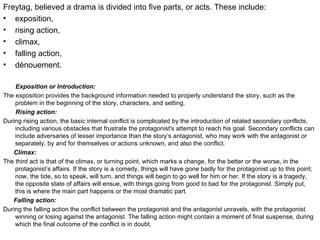
Freytag, believed a drama is divided into five parts, or acts. These include:
• exposition,
• rising action,
• climax,
• falling action,
• dénouement.

    Exposition or Introduction:
The exposition provides the background information needed to properly understand the story, such as the
    problem in the beginning of the story, characters, and setting.
    Rising action:
During rising action, the basic internal conflict is complicated by the introduction of related secondary conflicts,
    including various obstacles that frustrate the protagonist's attempt to reach his goal. Secondary conflicts can
    include adversaries of lesser importance than the story’s antagonist, who may work with the antagonist or
    separately, by and for themselves or actions unknown, and also the conflict.
   Climax:
The third act is that of the climax, or turning point, which marks a change, for the better or the worse, in the
    protagonist’s affairs. If the story is a comedy, things will have gone badly for the protagonist up to this point;
    now, the tide, so to speak, will turn, and things will begin to go well for him or her. If the story is a tragedy,
    the opposite state of affairs will ensue, with things going from good to bad for the protagonist. Simply put,
    this is where the main part happens or the most dramatic part.
   Falling action:
During the falling action the conflict between the protagonist and the antagonist unravels, with the protagonist
    winning or losing against the antagonist. The falling action might contain a moment of final suspense, during
    which the final outcome of the conflict is in doubt.
Dénouement, resolution, or catastrophe:
•  The dénouement comprises events between the falling action and the actual ending scene
   of the drama or narrative and serves as the conclusion of the story. Conflicts are resolved,
   creating normality for the characters and a sense of catharsis, or release of tension and
   anxiety, for the reader. Etymologically, the French word dénouement is derived from the
   Old French word dénouer, "to untie", and from nodus, Latin for "knot." Simply put,
   dénouement is the unraveling or untying of the complexities of a plot.
•  The comedy ends with a dénouement (a conclusion) in which the protagonist is better off
   than at the story's outset. The tragedy ends with a catastrophe in which the protagonist is
   worse off than at the beginning of the narrative. Exemplary of a comic dénouement is the
   final scene of Shakespeare’s comedy As You Like It, in which couples marry, an evildoer
   repents, two disguised characters are revealed for all to see, and a ruler is restored to
   power. In Shakespeare's tragedies, the dénouement is usually the death of one or more
   characters.
•  More modern works may have no dénouement, because of a quick or surprise ending.


(taken off the internet)
• Although Freytag's analysis of dramatic structure is based on
  five-act plays, it can be applied (sometimes in a modified
  manner) to short stories and novels. However the pyramid is not
  always easy to use, especially in modern plays, for example
  Alfred Uhry's "Driving Miss Daisy", which is actually divided into
  25 scenes without concrete acts.
•   Freytag's literary fame was made universal by the publication of his novel, Soll
    und Haben (Debit and Credit), which was translated into almost all European
    languages. Its main purpose is the recommendation of the German middle class
    as the soundest element in the nation, but it also has a more directly patriotic
    intention in the contrast it draws between the supposedly homely virtues of the
    German, while presenting in negative light Poles and Jews.

Year 13 gustav freytag

  • 1.
    Narrative Theory Narrative theory,or narratology, is the study of narrative or story, written or otherwise.
  • 2.
    Gustav Freytag Gustav was a German novelist and playwright. In 1839, he settled in Breslau, as Privatdozent (Private lecturer) is a title conferred in some European university systems, especially in German-speaking countries, for someone who pursues an academic career and holds all formal qualifications. He helped to conduct it until 1861, then again from 1867 till 1870. For a short time he edited a new periodical, Im neuen Reich. In 1863 he developed what is known as ‘Freytag's pyramid’. The dramatic structure is the structure of a dramatic work such as a play or film. Many scholars have analyzed dramatic structure, beginning with Aristotle in his Poetics. Gustav use’s his analysis on ancient Greek and QuickTimeª and a decompressor Shakespearean drama. are needed to see this picture.
  • 3.
    Freytag, believed adrama is divided into five parts, or acts. These include: • exposition, • rising action, • climax, • falling action, • dénouement. Exposition or Introduction: The exposition provides the background information needed to properly understand the story, such as the problem in the beginning of the story, characters, and setting. Rising action: During rising action, the basic internal conflict is complicated by the introduction of related secondary conflicts, including various obstacles that frustrate the protagonist's attempt to reach his goal. Secondary conflicts can include adversaries of lesser importance than the story’s antagonist, who may work with the antagonist or separately, by and for themselves or actions unknown, and also the conflict. Climax: The third act is that of the climax, or turning point, which marks a change, for the better or the worse, in the protagonist’s affairs. If the story is a comedy, things will have gone badly for the protagonist up to this point; now, the tide, so to speak, will turn, and things will begin to go well for him or her. If the story is a tragedy, the opposite state of affairs will ensue, with things going from good to bad for the protagonist. Simply put, this is where the main part happens or the most dramatic part. Falling action: During the falling action the conflict between the protagonist and the antagonist unravels, with the protagonist winning or losing against the antagonist. The falling action might contain a moment of final suspense, during which the final outcome of the conflict is in doubt.
  • 4.
    Dénouement, resolution, orcatastrophe: • The dénouement comprises events between the falling action and the actual ending scene of the drama or narrative and serves as the conclusion of the story. Conflicts are resolved, creating normality for the characters and a sense of catharsis, or release of tension and anxiety, for the reader. Etymologically, the French word dénouement is derived from the Old French word dénouer, "to untie", and from nodus, Latin for "knot." Simply put, dénouement is the unraveling or untying of the complexities of a plot. • The comedy ends with a dénouement (a conclusion) in which the protagonist is better off than at the story's outset. The tragedy ends with a catastrophe in which the protagonist is worse off than at the beginning of the narrative. Exemplary of a comic dénouement is the final scene of Shakespeare’s comedy As You Like It, in which couples marry, an evildoer repents, two disguised characters are revealed for all to see, and a ruler is restored to power. In Shakespeare's tragedies, the dénouement is usually the death of one or more characters. • More modern works may have no dénouement, because of a quick or surprise ending. (taken off the internet)
  • 5.
    • Although Freytag'sanalysis of dramatic structure is based on five-act plays, it can be applied (sometimes in a modified manner) to short stories and novels. However the pyramid is not always easy to use, especially in modern plays, for example Alfred Uhry's "Driving Miss Daisy", which is actually divided into 25 scenes without concrete acts.
  • 6.
    Freytag's literary fame was made universal by the publication of his novel, Soll und Haben (Debit and Credit), which was translated into almost all European languages. Its main purpose is the recommendation of the German middle class as the soundest element in the nation, but it also has a more directly patriotic intention in the contrast it draws between the supposedly homely virtues of the German, while presenting in negative light Poles and Jews.