Stanley British Primary School Professional Learning 2011-2012
Mission Statement We engage, challenge, and inspire children to reach their potential and develop their own voices within an inclusive, diverse, and collaborative community that values distinct contributions and abilities. We prepare teachers to implement our vision, mission, and values, and we share our educational approach with the larger community.
Our Guiding Questions How are we meeting each child’s needs? How do we measure what children already know as well as what they can do within a lesson, unit, school year?
Goals for Today Begin to answer our guiding questions by getting smarter about assessment and “data” Name what we already do and how it supports student learning Expand our collective knowledge about assessment and the use of data to “inform” instruction Clarify the 2011-2012 School Wide Professional Learning Objectives Review the “new” lesson plan format and Observation Cycle
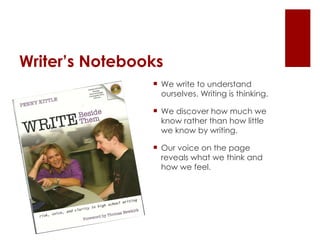
Writer’s Notebooks We write to understand ourselves. Writing is thinking. We discover how much we know rather than how little we know by writing. Our voice on the page reveals what we think and how we feel.
In your writer’s notebook Think about a time when you learned something new…
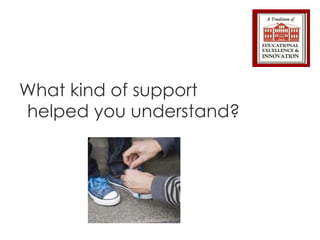
What kind of support helped you understand?
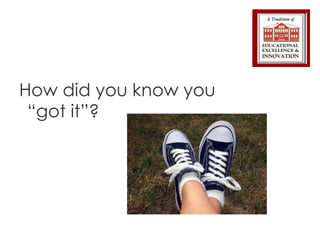
How did you know you “got it”?
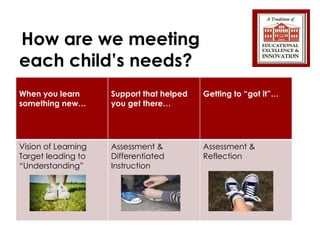
How are we meeting each child’s needs? When you learn something new… Support that helped you get there… Getting to “got it”… Vision of Learning Target leading to “ Understanding” Assessment & Differentiated  Instruction Assessment & Reflection
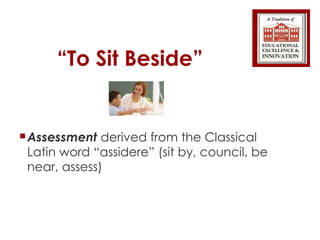
“ To Sit Beside” Assessment  derived from the Classical Latin word “assidere” (sit by, council, be near, assess)
Assessment of Learning Assessment for Learning Assessment As Learning
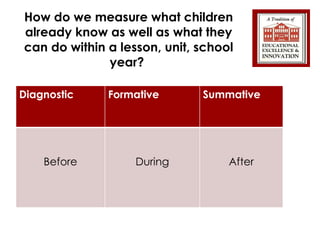
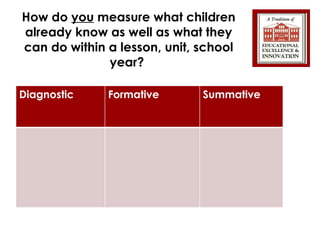
  How do we measure what children already know as well as what they can do within a lesson, unit, school year?  Diagnostic Formative Summative Before During After
Diagnostic Assessment Designed to determine a student’s entry point relative to the  learning objectives   as a unit of study begins Differentiation: readiness, interest, learning profile
Formative Assessment On-going “informative” assessment for learning designed to follow a student’s progress toward attaining the  learning objectives . Differentiation: adjusting & planning next instructional steps as you teach
Summative Assessment Assessment of learning. Measures whether a student is able to reach or exceed  learning objectives  after a lesson or unit is over 1 point in time;  Provides information for planning an upcoming unit
  How do  you  measure what children already know as well as what they can do within a lesson, unit, school year?  Diagnostic Formative Summative
Catch your questions What questions do you have about assessment? Use those questions to set a purpose for your reading Be prepared to share your insights with a partner who read a different article
Growing Our Understanding “ The Best Value in formative Assessment,” Steven and Jan Chappuis “ Learning To Love Assessment,” Carol Ann Tomlinson
Read & Take a Break Be prepared to share ideas at  10:45
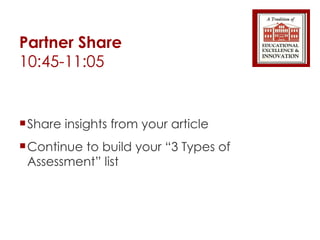
Partner Share 10:45-11:05 Share insights from your article Continue to build your “3 Types of Assessment” list
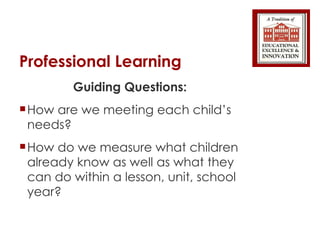
Professional Learning  Guiding Questions: How are we meeting each child’s needs? How do we measure what children already know as well as what they can do within a lesson, unit, school year?
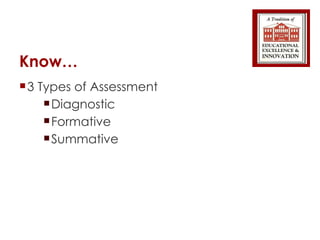
Know… 3 Types of Assessment Diagnostic Formative Summative
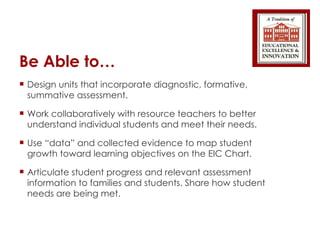
Be Able to… Design units that incorporate diagnostic, formative, summative assessment. Work collaboratively with resource teachers to better understand individual students and meet their needs. Use “data” and collected evidence to map student growth toward learning objectives on the EIC Chart. Articulate student progress and relevant assessment information to families and students. Share how student needs are being met.
Learning Activities School wide professional Learning Grade Level Team Meetings Internal Learning Lab Classrooms Individual reflection through coaching conversations, and the observation cycle with Tim, Joanna, Stephanie, Allison, Lynne
The Observation Cycle  includes… Creating a lesson using the revised lesson plan document Completing a self reflection on the lesson
Exit Slip Formative Assessment for us! Let us know your thinking  Leave Exit Slips on the table Please take the silver buckets if you can use them for your classroom!
“ The real voyage of discovery consists not in seeking new landscapes but in having new eyes.”  -Marcel Proust

Assessment powerpoint 3 compatible

  • 1.
    Stanley British PrimarySchool Professional Learning 2011-2012
  • 2.
    Mission Statement Weengage, challenge, and inspire children to reach their potential and develop their own voices within an inclusive, diverse, and collaborative community that values distinct contributions and abilities. We prepare teachers to implement our vision, mission, and values, and we share our educational approach with the larger community.
  • 3.
    Our Guiding QuestionsHow are we meeting each child’s needs? How do we measure what children already know as well as what they can do within a lesson, unit, school year?
  • 4.
    Goals for TodayBegin to answer our guiding questions by getting smarter about assessment and “data” Name what we already do and how it supports student learning Expand our collective knowledge about assessment and the use of data to “inform” instruction Clarify the 2011-2012 School Wide Professional Learning Objectives Review the “new” lesson plan format and Observation Cycle
  • 5.
    Writer’s Notebooks Wewrite to understand ourselves. Writing is thinking. We discover how much we know rather than how little we know by writing. Our voice on the page reveals what we think and how we feel.
  • 6.
    In your writer’snotebook Think about a time when you learned something new…
  • 7.
    What kind ofsupport helped you understand?
  • 8.
    How did youknow you “got it”?
  • 9.
    How are wemeeting each child’s needs? When you learn something new… Support that helped you get there… Getting to “got it”… Vision of Learning Target leading to “ Understanding” Assessment & Differentiated Instruction Assessment & Reflection
  • 10.
    “ To SitBeside” Assessment derived from the Classical Latin word “assidere” (sit by, council, be near, assess)
  • 11.
    Assessment of LearningAssessment for Learning Assessment As Learning
  • 12.
    Howdo we measure what children already know as well as what they can do within a lesson, unit, school year? Diagnostic Formative Summative Before During After
  • 13.
    Diagnostic Assessment Designedto determine a student’s entry point relative to the learning objectives as a unit of study begins Differentiation: readiness, interest, learning profile
  • 14.
    Formative Assessment On-going“informative” assessment for learning designed to follow a student’s progress toward attaining the learning objectives . Differentiation: adjusting & planning next instructional steps as you teach
  • 15.
    Summative Assessment Assessmentof learning. Measures whether a student is able to reach or exceed learning objectives after a lesson or unit is over 1 point in time; Provides information for planning an upcoming unit
  • 16.
    Howdo you measure what children already know as well as what they can do within a lesson, unit, school year? Diagnostic Formative Summative
  • 17.
    Catch your questionsWhat questions do you have about assessment? Use those questions to set a purpose for your reading Be prepared to share your insights with a partner who read a different article
  • 18.
    Growing Our Understanding“ The Best Value in formative Assessment,” Steven and Jan Chappuis “ Learning To Love Assessment,” Carol Ann Tomlinson
  • 19.
    Read & Takea Break Be prepared to share ideas at 10:45
  • 20.
    Partner Share 10:45-11:05Share insights from your article Continue to build your “3 Types of Assessment” list
  • 21.
    Professional Learning Guiding Questions: How are we meeting each child’s needs? How do we measure what children already know as well as what they can do within a lesson, unit, school year?
  • 22.
    Know… 3 Typesof Assessment Diagnostic Formative Summative
  • 23.
    Be Able to…Design units that incorporate diagnostic, formative, summative assessment. Work collaboratively with resource teachers to better understand individual students and meet their needs. Use “data” and collected evidence to map student growth toward learning objectives on the EIC Chart. Articulate student progress and relevant assessment information to families and students. Share how student needs are being met.
  • 24.
    Learning Activities Schoolwide professional Learning Grade Level Team Meetings Internal Learning Lab Classrooms Individual reflection through coaching conversations, and the observation cycle with Tim, Joanna, Stephanie, Allison, Lynne
  • 25.
    The Observation Cycle includes… Creating a lesson using the revised lesson plan document Completing a self reflection on the lesson
  • 26.
    Exit Slip FormativeAssessment for us! Let us know your thinking Leave Exit Slips on the table Please take the silver buckets if you can use them for your classroom!
  • 27.
    “ The realvoyage of discovery consists not in seeking new landscapes but in having new eyes.” -Marcel Proust

Editor's Notes

  • #4 Origin of guiding questions
  • #10 Automatic