AFT201 STORY DEVELOPMENT
(FrayTag Model)
Do you know what is
Freytag’s Pyramid?
Yes or no
Dramatic Structure
According to
Aristotle, that effective stories can be broken down
into elements, usually including exposition, rising
action, climax, falling action, and resolution, and that
when writers are constructing a story they should
include these five elements.
What is Freytag’s Pyramid
Freytag’s Pyramid is a dramatic structural framework
developed by Gustav Freytag, a German playwright and
novelist of the mid-nineteenth century. He theorized that
effective stories could be broken into two halves, the play and
counterplay, with the climax in the middle.
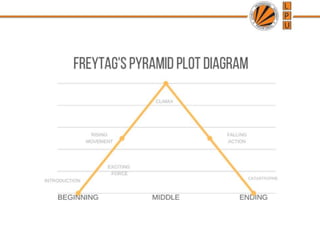
These two halves create a pyramid or triangle shape
containing five dramatic elements: introduction, rising
movement, climax, falling movement, and denouement or
catastrophe.
Gustav Freytag originally formulated Freytag’s
Pyramid in his 1863 book Freytag’s Technique of
the Drama, and over the last more than 150 years,
it has become one of the most commonly taught
dramatic structures in the world, finding its
way into thousands of classrooms and writing
workshops.
5 Elements of Freytag’s Pyramid
1. Introduction
2. Rising Movement
3. Climax
4. Falling Action
5. Catastrophe or Denouement (Ending)
1. Introduction
The introduction contains both the exposition and
“exciting force”:
Exposition. This is a scene in which no major changes
occur and the point is to introduce the main characters,
time period, and tone, and set up the “exciting force.”
Exciting Force. Freytag also calls this the “complication,”
and other frameworks call it the “inciting incident,” when
some force of will on the part of the protagonist or an
outside complication forces the protagonist into motion.
2. Rising Movement
Now that the chief action has been started, the
story builds in action toward the climax.
Any characters who have not as of yet been
introduced should be introduced here.
3. Climax
In this framework, the climax can be thought of as a
reflection point. If things have gone well for the
protagonist, at the climax they start to fall apart
tragically.
Or in a comedy, if things have been going poorly for
the protagonist, things start improving.
4. Falling Action
In the falling action, things continue to either devolve
for the protagonist or, in the case of a comedy,
improve, leading up to the “force of the final
suspense,” a moment before the catastrophe, when
the author projects the final catastrophe and
prepares the audience for it.
5. Catastrophe or Denouement
Freytag was chiefly focused on tragedy, not comedy, and he
saw the ending phase of a story as the moment of
catastrophe, in which the main character is finally undone
by their own choices, actions, and energy.
After the catastrophe is a moment of catharsis, where the
action of the story is resolved and the tension releases as
the audience takes in the story’s final outcome.

3 lecture (fraytag model) 16 1-2021

  • 1.
  • 2.
    Do you knowwhat is Freytag’s Pyramid? Yes or no
  • 3.
    Dramatic Structure According to Aristotle,that effective stories can be broken down into elements, usually including exposition, rising action, climax, falling action, and resolution, and that when writers are constructing a story they should include these five elements.
  • 4.
    What is Freytag’sPyramid Freytag’s Pyramid is a dramatic structural framework developed by Gustav Freytag, a German playwright and novelist of the mid-nineteenth century. He theorized that effective stories could be broken into two halves, the play and counterplay, with the climax in the middle. These two halves create a pyramid or triangle shape containing five dramatic elements: introduction, rising movement, climax, falling movement, and denouement or catastrophe.
  • 6.
    Gustav Freytag originallyformulated Freytag’s Pyramid in his 1863 book Freytag’s Technique of the Drama, and over the last more than 150 years, it has become one of the most commonly taught dramatic structures in the world, finding its way into thousands of classrooms and writing workshops.
  • 7.
    5 Elements ofFreytag’s Pyramid 1. Introduction 2. Rising Movement 3. Climax 4. Falling Action 5. Catastrophe or Denouement (Ending)
  • 8.
    1. Introduction The introductioncontains both the exposition and “exciting force”: Exposition. This is a scene in which no major changes occur and the point is to introduce the main characters, time period, and tone, and set up the “exciting force.” Exciting Force. Freytag also calls this the “complication,” and other frameworks call it the “inciting incident,” when some force of will on the part of the protagonist or an outside complication forces the protagonist into motion.
  • 9.
    2. Rising Movement Nowthat the chief action has been started, the story builds in action toward the climax. Any characters who have not as of yet been introduced should be introduced here.
  • 10.
    3. Climax In thisframework, the climax can be thought of as a reflection point. If things have gone well for the protagonist, at the climax they start to fall apart tragically. Or in a comedy, if things have been going poorly for the protagonist, things start improving.
  • 11.
    4. Falling Action Inthe falling action, things continue to either devolve for the protagonist or, in the case of a comedy, improve, leading up to the “force of the final suspense,” a moment before the catastrophe, when the author projects the final catastrophe and prepares the audience for it.
  • 12.
    5. Catastrophe orDenouement Freytag was chiefly focused on tragedy, not comedy, and he saw the ending phase of a story as the moment of catastrophe, in which the main character is finally undone by their own choices, actions, and energy. After the catastrophe is a moment of catharsis, where the action of the story is resolved and the tension releases as the audience takes in the story’s final outcome.