I here by express my sincere thanks to all  of my faculties of FRANKFINN for guiding us  since one year. I'm happy to be a part of my institution And also I thank each and every students of my class for their encouragement and support. Above all am great full for ALMIGHTY  for blessing me to complete my course successfully
Aviation industry is playing a major role in the world. In this research  I have included the ‘low cost airlines in India’. A low-cost carrier or low-cost airline (also known as a no-frills, discount or budget carrier or airline) is an airline that offers generally low fares in exchange for eliminating many traditional passenger services.
I had identified that there is a scope for conducting a research study relating to ‘Low Cost Airlines’. In order to enter the Airline industry, we need to acquire basic knowledge of low cost airlines. This research explains low cost airlines in India.  History The first low cost airline is generally considered to be the American company Southwest which launched in 1971, with the then revolutionary concept that you could lower the cost of ticket prices by eliminating some of the extras and therefore save passengers money. The baton was picked up in the UK by Ryanair, in 1990, still the biggest contender in the field.
Cost advantage Low cost airlines provide air service at costs 25-50% lower than a full service airline.  The cost structure of a full service Indian airline is given in the figure below: An Illustration of the Cost structure of Full Service Airlines as a % of Operating Expense: (Source: ICRA report, Civil Aviation, April 2005) Breakdown of Cost savings (Source: www.indiastats.com) The cost advantage of the low cost carrier is a result of savings on various factors given below:
__  ___  _______  _  ____
In India, low cost carriers came into existence in 2003 when Air Deccan launched its first low cost airline and that was the first move to open the doors of the airlines industry for middle class. The Indian economy has grown at an average rate of around 8% in the last decade. The rise in business and leisure travel (both domestic and international) due to this growth, India emerging as a major origin and destination for international travel have all had a significant impact on commercial aviation in India. The new phenomenon in India is Low  cost airlines. If mobile phone was a dream for Indians quite some time back, the telecom revolution has  changed it. Similarly, the low cost airlines effect has begun to be felt among Indians. More Indians are now willing to give a try to fly between places, rather than using air conditioned sleeper class coaches of railways.
Understanding the market, the low cost airlines in India have also responded well. With just one airlines in 2004,  now there are five low cost airliners operating to various  destinations across India. Gone are the days when flying means only to metros, now these low cost airlines connect smaller cities and towns. On one hand, the low fares of the “low -cost” players changed the growth dynamics of the industry. On trunk routes such as Mumbai-Delhi or Delhi-Bangalore, the fares of these airlines were close to the fares of air-conditioned rail travel.  According to the airports authority of India (AAI), the passenger traffic is expected to grow at over 20% in the next five years. Since 2003 there has been sharp increase in both domestic and international traffic carried by and in capacity of Indian carriers.
 
Early indications suggest it’s fairly certain that the price of flying will rise, with Gordon Brown’s pre-Budget report announcing small increases in Air Passenger Duty. It’s down to individual flight companies to decide how much of this cost will be passed on directly to its passengers, but the more the Duty increases, the more likely we’ll notice the difference in price.  Flights within Europe will come under the jurisdiction of the Emissions Trading Scheme by 2011, meaning that airlines will be issued with pollution permits and have to pay for exceeding the permitted levels of emissions. Airlines that reduce their carbon emissions will be able to sell back permits.
India's main international carrier, state-run Air-India, announced last month it will be starting next April a low-cost airline that will fly to the Middle East and Southeast Asian countries. A top-ranked civil aviation ministry official told AFP at least three airlines have applied for permission to fly domestic routes, offering fares expected to be around 20 to 30 per cent below prevailing market rates. The private firms do not currently have airline operations in the country. One Middle East-based international carrier, Air Arabia, is also keen to operate low cost-flights to India, media reports say. India will have five-to-six low-cost airlines," according to a senior official of the Centre for Asia Pacific Aviation, a privately owned Singapore-based aviation consultancy service. But name yet to come. This would come as welcome news for Indian travelers as flights to destinations abroad are often cheaper on foreign carriers than travel within the country on domestic airlines.
 
 
In the recent years, many people all over the world have taken up travelling. Especially, the tourist inflow in India has increased tremendously. This has subsequently led to increase in a number of low cost airlines in India. Low cost airlines refer to airlines that offer discount airfares. Low cost airlines in India have made travelling easier and affordable for numerous travellers. Since they offer huge discounts, these low cost airlines make travelling by air attractive and cheap.  They also offer lot of added advantages such as online booking, online check-ins, mobile booking and booking through agents
The cost of the airfare may be cheaper, but in a  weather related emergency you have no option to switch your ticket to another airline  – in other words, you’re stuck until things get better – or like hundreds of people found out this week, you go NO WHERE except back to your home.   Federal law does not require airlines to do much when vacation plans are ruined by bad  weather.  Airlines are required only to refund the cost of the ticket . And judging from the e-mail we received this week, a lot of travelers are still under the impression that airlines put passengers up at hotels or pay for meals for weather delayed flights –  those days are long gone!   Low cost air travel is obviously appealing, however many travelers are not aware that low cost airlines like JetBlue have  no agreement with other airlines   to shift passengers during an emergency.  ____________
When quoting vacation packages,  especially in the winter season , we book the entire air flight connections with the major airline carriers. This sometimes becomes an issue when travelers feel we may not looking to get the best airline deal for them.  Here’s our position  – if a weather delay, or other emergency does occur, by booking with a major carrier we work to get clients on another airline, or the next available flight.  One of the last things we want is to have clients calling us, and we are unable to assist them with their travel plans. 
IATA: IX ICAO:AXB Callsign:EXPRESSINDIA Founded April 2005 Hubs Calicut International Airport Cochin International Airport Trivandrum International Airport  Focus cities Chennai Mumbai  Mangalore  Fleet size  24 (+ 1 orders) Parent company   Air India  ,  Headquarters :Mumbai,India Key people:Arvind Jadhav, CMD Website:www.airindiaexpress.in
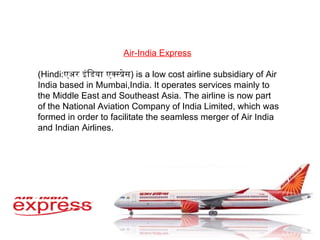
Air-India Express   (Hindi: एअर इंडिया एक्स्प्रेस ) is a low cost airline subsidiary of Air India based in Mumbai,India. It operates services mainly to the Middle East and Southeast Asia. The airline is now part of the National Aviation Company of India Limited, which was formed in order to facilitate the seamless merger of Air India and Indian Airlines.
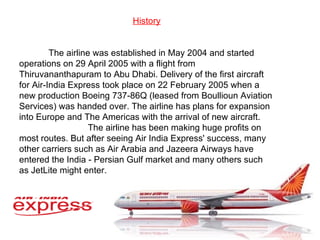
History The airline was established in May 2004 and started operations on 29 April 2005 with a flight from Thiruvananthapuram to Abu Dhabi. Delivery of the first aircraft for Air-India Express took place on 22 February 2005 when a new production Boeing 737-86Q (leased from Boullioun Aviation Services) was handed over. The airline has plans for expansion into Europe and The Americas with the arrival of new aircraft. The airline has been making huge profits on most routes. But after seeing Air India Express' success, many other carriers such as Air Arabia and Jazeera Airways have entered the India - Persian Gulf market and many others such as JetLite might enter.
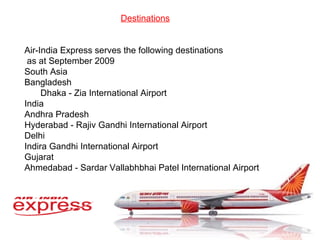
Destinations Air-India Express serves the following destinations as at September 2009 South Asia Bangladesh Dhaka - Zia International Airport  India  Andhra Pradesh Hyderabad - Rajiv Gandhi International Airport  Delhi  Indira Gandhi International Airport  Gujarat  Ahmedabad - Sardar Vallabhbhai Patel International Airport
Jammu & Kashmir  Srinagar - Srinagar Airport  Karnataka  Mangalore - Mangalore International Airport  Kerala  Kochi - Cochin International Airport hub  Kozhikode - Calicut International Airport hub  Thiruvananthapuram - Trivandrum International Airport hub Maharashtra Mumbai - Chhatrapati Shivaji International Airport  Nagpur - Dr. Babasaheb Ambedkar International Airport  Pune - Pune International Airport  Punjab  Amritsar - Raja Sansi International Airport  Rajasthan  Jaipur - Jaipur Airport  Tamil Nadu   Chennai - Chennai International Airport  Tiruchirapalli - Tiruchirapalli Airport  Uttar Pradesh  Lucknow - Amausi Airport  West Bengal  Kolkata - Netaji Subhash Chandra Bose International Airport
Sri Lanka  Colombo - Bandaranaike International Airport  Southeast Asia Malaysia  Kuala Lumpur - Kuala Lumpur International  Airport  Singapore  Singapore Changi Airport  Thailand  Bangkok - Suvarnabhumi Airport  Southwest Asia Bahrain  Bahrain International Airport  Kuwait  Kuwait International Airport  Oman  Muscat - Muscat International Airport  Salalah - Salalah Airport  Qatar  Doha - Doha International Airport  United Arab Emirates  Abu Dhabi - Abu Dhabi International Airport  Al Ain- Al Ain International Airport  Dubai - Dubai International Airport  Sharjah- Sharjah International Airport
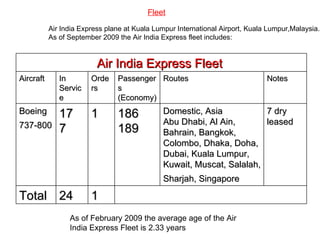
Air India Express plane at Kuala Lumpur International Airport, Kuala Lumpur,Malaysia. As of September 2009 the Air India Express fleet includes: As of February 2009 the average age of the Air India Express Fleet is 2.33 years Fleet Air India Express Fleet   Aircraft  In Service  Orders  Passengers (Economy)  Routes Notes Boeing 737-800   17 7 1  186 189  Domestic, Asia Abu Dhabi, Al Ain, Bahrain, Bangkok, Colombo, Dhaka, Doha, Dubai, Kuala Lumpur, Kuwait, Muscat, Salalah, Sharjah, Singapore   7 dry leased  Total  24 1
Google Aviation modules Bibliography
After completing this research study I realized that Aviation Industry plays a major role in the day to day life. I was able to under stand that different types of ‘ low cost airlines in India’  and the advantages&disadvantages of low cost airlines,the future of low cost airlines etc… Summary and Conclusion

Yasar .....1

  • 1.
  • 2.
    I here byexpress my sincere thanks to all of my faculties of FRANKFINN for guiding us since one year. I'm happy to be a part of my institution And also I thank each and every students of my class for their encouragement and support. Above all am great full for ALMIGHTY for blessing me to complete my course successfully
  • 3.
    Aviation industry isplaying a major role in the world. In this research I have included the ‘low cost airlines in India’. A low-cost carrier or low-cost airline (also known as a no-frills, discount or budget carrier or airline) is an airline that offers generally low fares in exchange for eliminating many traditional passenger services.
  • 4.
    I had identifiedthat there is a scope for conducting a research study relating to ‘Low Cost Airlines’. In order to enter the Airline industry, we need to acquire basic knowledge of low cost airlines. This research explains low cost airlines in India. History The first low cost airline is generally considered to be the American company Southwest which launched in 1971, with the then revolutionary concept that you could lower the cost of ticket prices by eliminating some of the extras and therefore save passengers money. The baton was picked up in the UK by Ryanair, in 1990, still the biggest contender in the field.
  • 5.
    Cost advantage Lowcost airlines provide air service at costs 25-50% lower than a full service airline. The cost structure of a full service Indian airline is given in the figure below: An Illustration of the Cost structure of Full Service Airlines as a % of Operating Expense: (Source: ICRA report, Civil Aviation, April 2005) Breakdown of Cost savings (Source: www.indiastats.com) The cost advantage of the low cost carrier is a result of savings on various factors given below:
  • 6.
    __ ___ _______ _ ____
  • 7.
    In India, lowcost carriers came into existence in 2003 when Air Deccan launched its first low cost airline and that was the first move to open the doors of the airlines industry for middle class. The Indian economy has grown at an average rate of around 8% in the last decade. The rise in business and leisure travel (both domestic and international) due to this growth, India emerging as a major origin and destination for international travel have all had a significant impact on commercial aviation in India. The new phenomenon in India is Low cost airlines. If mobile phone was a dream for Indians quite some time back, the telecom revolution has changed it. Similarly, the low cost airlines effect has begun to be felt among Indians. More Indians are now willing to give a try to fly between places, rather than using air conditioned sleeper class coaches of railways.
  • 8.
    Understanding the market,the low cost airlines in India have also responded well. With just one airlines in 2004, now there are five low cost airliners operating to various destinations across India. Gone are the days when flying means only to metros, now these low cost airlines connect smaller cities and towns. On one hand, the low fares of the “low -cost” players changed the growth dynamics of the industry. On trunk routes such as Mumbai-Delhi or Delhi-Bangalore, the fares of these airlines were close to the fares of air-conditioned rail travel. According to the airports authority of India (AAI), the passenger traffic is expected to grow at over 20% in the next five years. Since 2003 there has been sharp increase in both domestic and international traffic carried by and in capacity of Indian carriers.
  • 9.
  • 10.
    Early indications suggestit’s fairly certain that the price of flying will rise, with Gordon Brown’s pre-Budget report announcing small increases in Air Passenger Duty. It’s down to individual flight companies to decide how much of this cost will be passed on directly to its passengers, but the more the Duty increases, the more likely we’ll notice the difference in price. Flights within Europe will come under the jurisdiction of the Emissions Trading Scheme by 2011, meaning that airlines will be issued with pollution permits and have to pay for exceeding the permitted levels of emissions. Airlines that reduce their carbon emissions will be able to sell back permits.
  • 11.
    India's main internationalcarrier, state-run Air-India, announced last month it will be starting next April a low-cost airline that will fly to the Middle East and Southeast Asian countries. A top-ranked civil aviation ministry official told AFP at least three airlines have applied for permission to fly domestic routes, offering fares expected to be around 20 to 30 per cent below prevailing market rates. The private firms do not currently have airline operations in the country. One Middle East-based international carrier, Air Arabia, is also keen to operate low cost-flights to India, media reports say. India will have five-to-six low-cost airlines," according to a senior official of the Centre for Asia Pacific Aviation, a privately owned Singapore-based aviation consultancy service. But name yet to come. This would come as welcome news for Indian travelers as flights to destinations abroad are often cheaper on foreign carriers than travel within the country on domestic airlines.
  • 12.
  • 13.
  • 14.
    In the recentyears, many people all over the world have taken up travelling. Especially, the tourist inflow in India has increased tremendously. This has subsequently led to increase in a number of low cost airlines in India. Low cost airlines refer to airlines that offer discount airfares. Low cost airlines in India have made travelling easier and affordable for numerous travellers. Since they offer huge discounts, these low cost airlines make travelling by air attractive and cheap. They also offer lot of added advantages such as online booking, online check-ins, mobile booking and booking through agents
  • 15.
    The cost ofthe airfare may be cheaper, but in a weather related emergency you have no option to switch your ticket to another airline – in other words, you’re stuck until things get better – or like hundreds of people found out this week, you go NO WHERE except back to your home.  Federal law does not require airlines to do much when vacation plans are ruined by bad weather. Airlines are required only to refund the cost of the ticket . And judging from the e-mail we received this week, a lot of travelers are still under the impression that airlines put passengers up at hotels or pay for meals for weather delayed flights – those days are long gone! Low cost air travel is obviously appealing, however many travelers are not aware that low cost airlines like JetBlue have no agreement with other airlines to shift passengers during an emergency. ____________
  • 16.
    When quoting vacationpackages, especially in the winter season , we book the entire air flight connections with the major airline carriers. This sometimes becomes an issue when travelers feel we may not looking to get the best airline deal for them. Here’s our position – if a weather delay, or other emergency does occur, by booking with a major carrier we work to get clients on another airline, or the next available flight.  One of the last things we want is to have clients calling us, and we are unable to assist them with their travel plans. 
  • 17.
    IATA: IX ICAO:AXBCallsign:EXPRESSINDIA Founded April 2005 Hubs Calicut International Airport Cochin International Airport Trivandrum International Airport Focus cities Chennai Mumbai Mangalore Fleet size 24 (+ 1 orders) Parent company Air India , Headquarters :Mumbai,India Key people:Arvind Jadhav, CMD Website:www.airindiaexpress.in
  • 18.
    Air-India Express (Hindi: एअर इंडिया एक्स्प्रेस ) is a low cost airline subsidiary of Air India based in Mumbai,India. It operates services mainly to the Middle East and Southeast Asia. The airline is now part of the National Aviation Company of India Limited, which was formed in order to facilitate the seamless merger of Air India and Indian Airlines.
  • 19.
    History The airlinewas established in May 2004 and started operations on 29 April 2005 with a flight from Thiruvananthapuram to Abu Dhabi. Delivery of the first aircraft for Air-India Express took place on 22 February 2005 when a new production Boeing 737-86Q (leased from Boullioun Aviation Services) was handed over. The airline has plans for expansion into Europe and The Americas with the arrival of new aircraft. The airline has been making huge profits on most routes. But after seeing Air India Express' success, many other carriers such as Air Arabia and Jazeera Airways have entered the India - Persian Gulf market and many others such as JetLite might enter.
  • 20.
    Destinations Air-India Expressserves the following destinations as at September 2009 South Asia Bangladesh Dhaka - Zia International Airport India Andhra Pradesh Hyderabad - Rajiv Gandhi International Airport Delhi Indira Gandhi International Airport Gujarat Ahmedabad - Sardar Vallabhbhai Patel International Airport
  • 21.
    Jammu & Kashmir Srinagar - Srinagar Airport Karnataka Mangalore - Mangalore International Airport Kerala Kochi - Cochin International Airport hub Kozhikode - Calicut International Airport hub Thiruvananthapuram - Trivandrum International Airport hub Maharashtra Mumbai - Chhatrapati Shivaji International Airport Nagpur - Dr. Babasaheb Ambedkar International Airport Pune - Pune International Airport Punjab Amritsar - Raja Sansi International Airport Rajasthan Jaipur - Jaipur Airport Tamil Nadu Chennai - Chennai International Airport Tiruchirapalli - Tiruchirapalli Airport Uttar Pradesh Lucknow - Amausi Airport West Bengal Kolkata - Netaji Subhash Chandra Bose International Airport
  • 22.
    Sri Lanka Colombo - Bandaranaike International Airport Southeast Asia Malaysia Kuala Lumpur - Kuala Lumpur International Airport Singapore Singapore Changi Airport Thailand Bangkok - Suvarnabhumi Airport Southwest Asia Bahrain Bahrain International Airport Kuwait Kuwait International Airport Oman Muscat - Muscat International Airport Salalah - Salalah Airport Qatar Doha - Doha International Airport United Arab Emirates Abu Dhabi - Abu Dhabi International Airport Al Ain- Al Ain International Airport Dubai - Dubai International Airport Sharjah- Sharjah International Airport
  • 23.
    Air India Expressplane at Kuala Lumpur International Airport, Kuala Lumpur,Malaysia. As of September 2009 the Air India Express fleet includes: As of February 2009 the average age of the Air India Express Fleet is 2.33 years Fleet Air India Express Fleet Aircraft In Service Orders Passengers (Economy) Routes Notes Boeing 737-800 17 7 1 186 189 Domestic, Asia Abu Dhabi, Al Ain, Bahrain, Bangkok, Colombo, Dhaka, Doha, Dubai, Kuala Lumpur, Kuwait, Muscat, Salalah, Sharjah, Singapore 7 dry leased Total 24 1
  • 24.
  • 25.
    After completing thisresearch study I realized that Aviation Industry plays a major role in the day to day life. I was able to under stand that different types of ‘ low cost airlines in India’ and the advantages&disadvantages of low cost airlines,the future of low cost airlines etc… Summary and Conclusion