
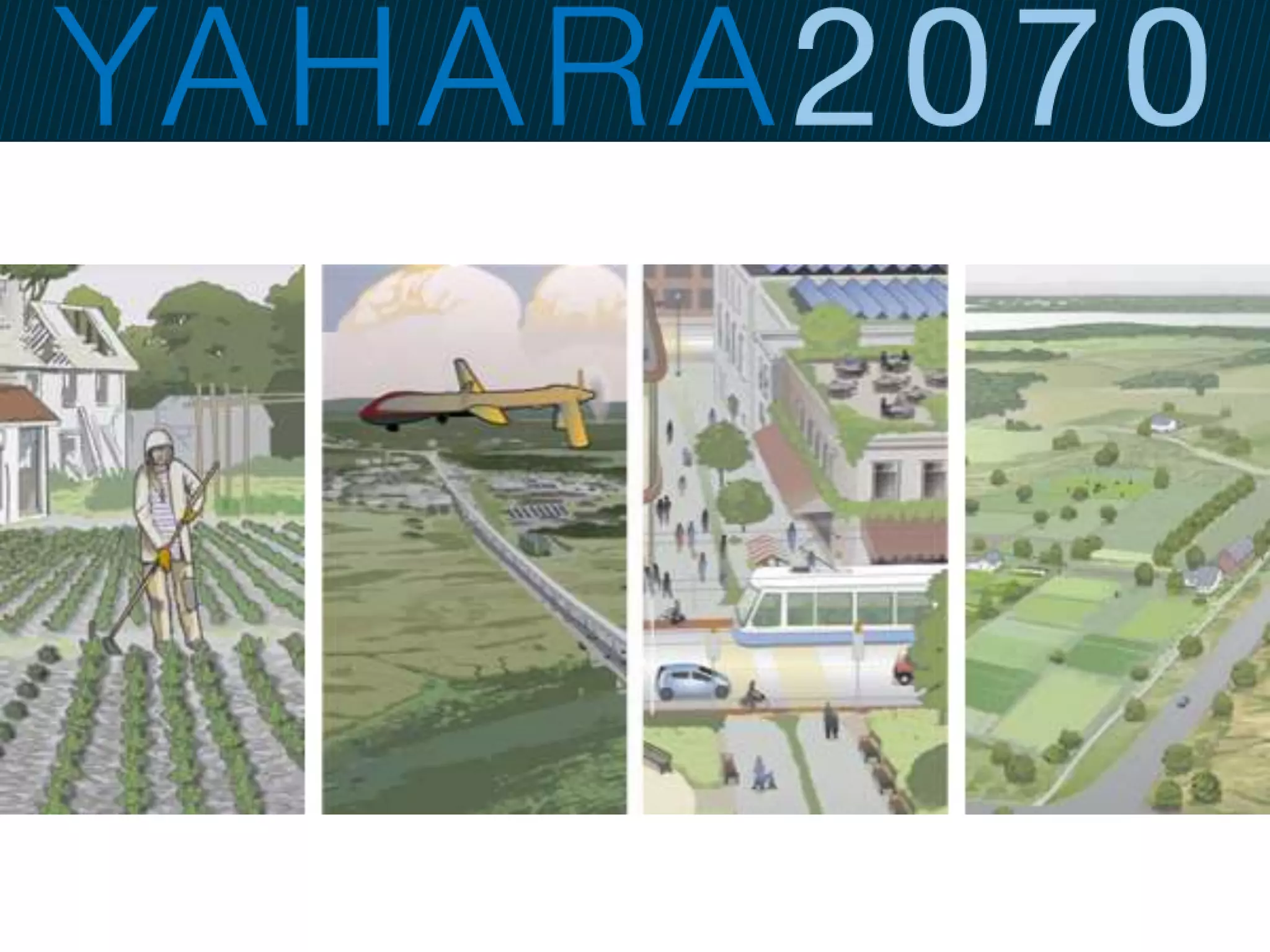
Possible futures for the Yahara Watershed
The Science of Future Thinking
“People are embedded parts of the biosphere and shape it,
from local to global scales, from the past to the future. At
the same time people are fundamentally dependent on
the capacity of the biosphere to sustain human
development.” -- Carl Folke, Stockholm Resilience Center
Future thinking is important
because…
But sustaining nature and human
development is a complex problem:
• Uncertainty is high.
• Time frames of environmental change
span many generations.
• People will reach different
conclusions.
• Multiple solutions are “good enough.”
To approach complex problems, we can
• Assume uncertainty is large, changeable, and
co-created by people and nature.
• Emphasize the diversity of perspectives.
• Stress learning by individuals and groups.
• Expect the unexpected.
“While the future is uncertain and much of it is
beyond our control, we can control many aspects of
it. We choose our future: we create it by what we do
or fail to do.”
– Wendy Schultz, futurist
Importantly, we must recognize we can
make choices about the future.
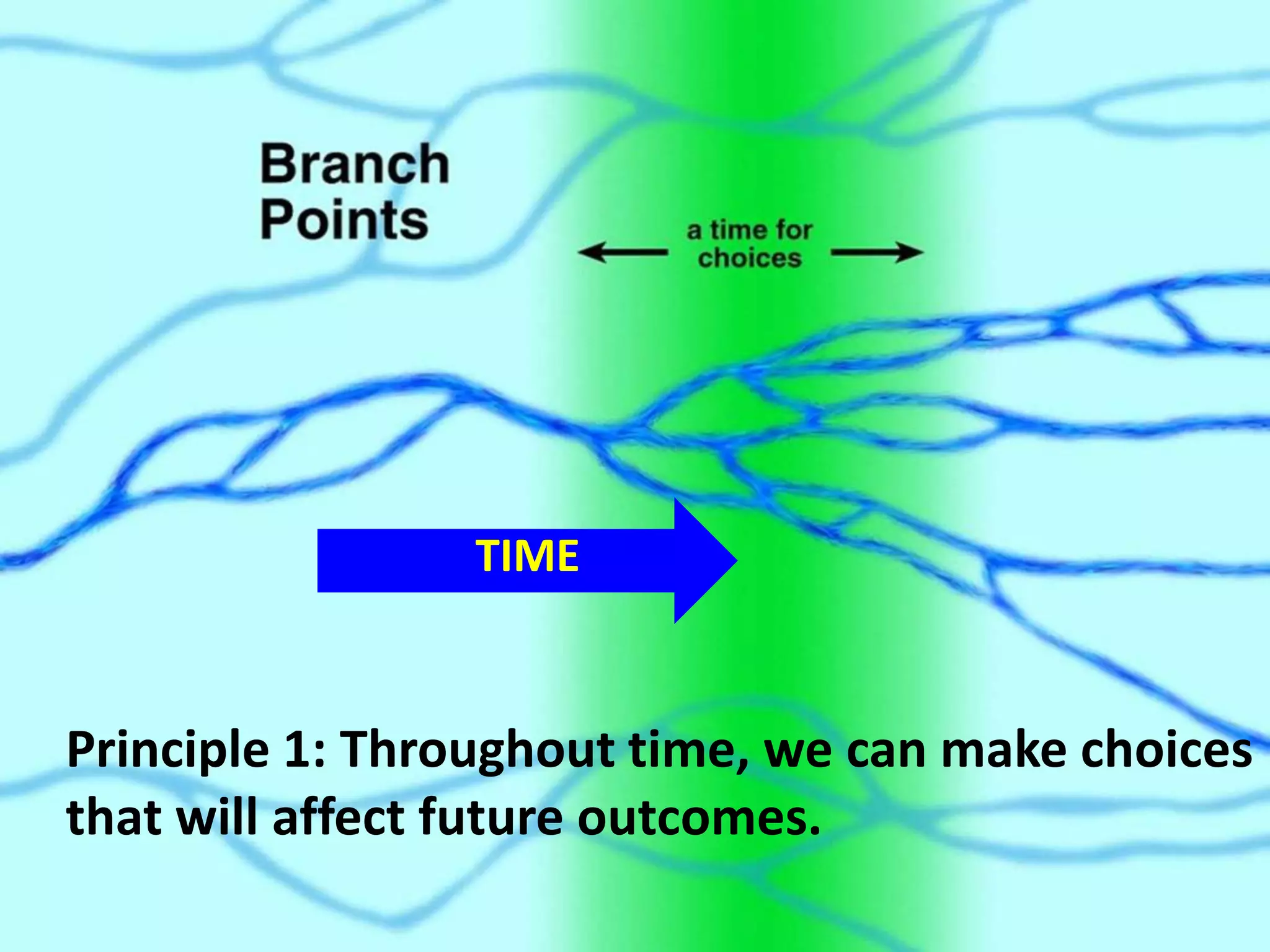
TIME
Principle 1: Throughout time, we can make choices
that will affect future outcomes.
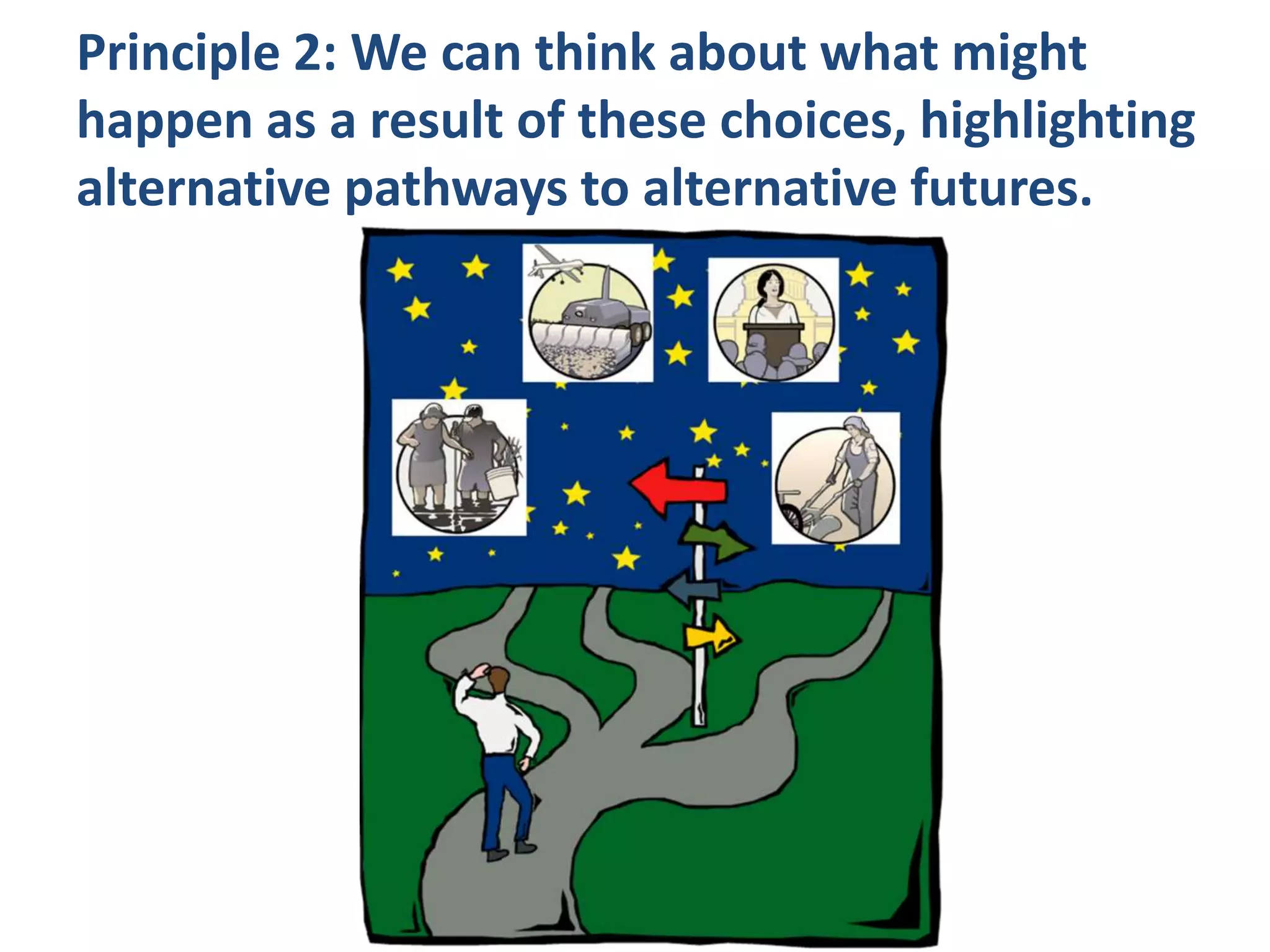
Principle 2: We can think about what might
happen as a result of these choices, highlighting
alternative pathways to alternative futures.
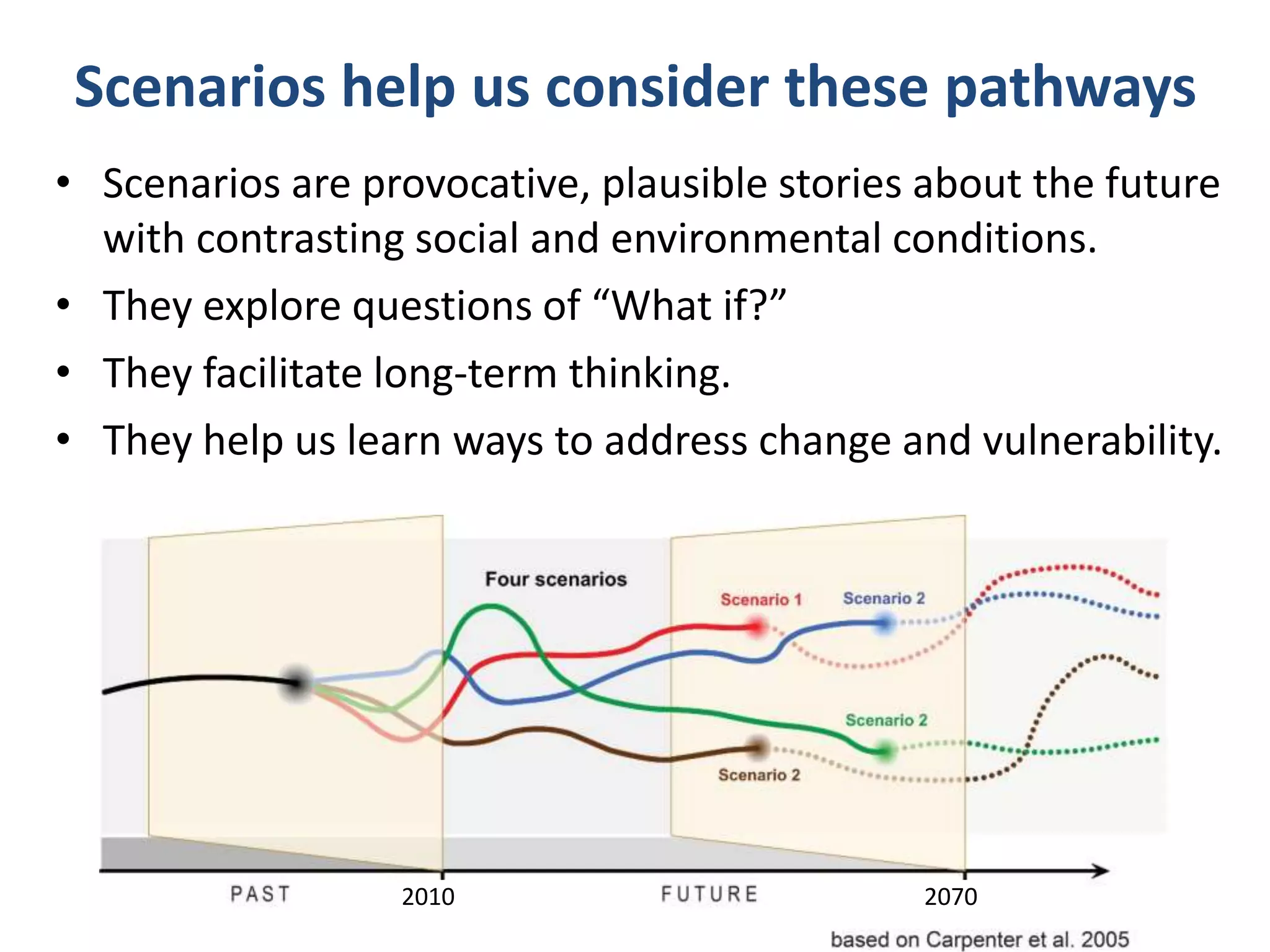
Scenarios help us consider these pathways
• Scenarios are provocative, plausible stories about the future
with contrasting social and environmental conditions.
• They explore questions of “What if?”
• They facilitate long-term thinking.
• They help us learn ways to address change and vulnerability.
20702010
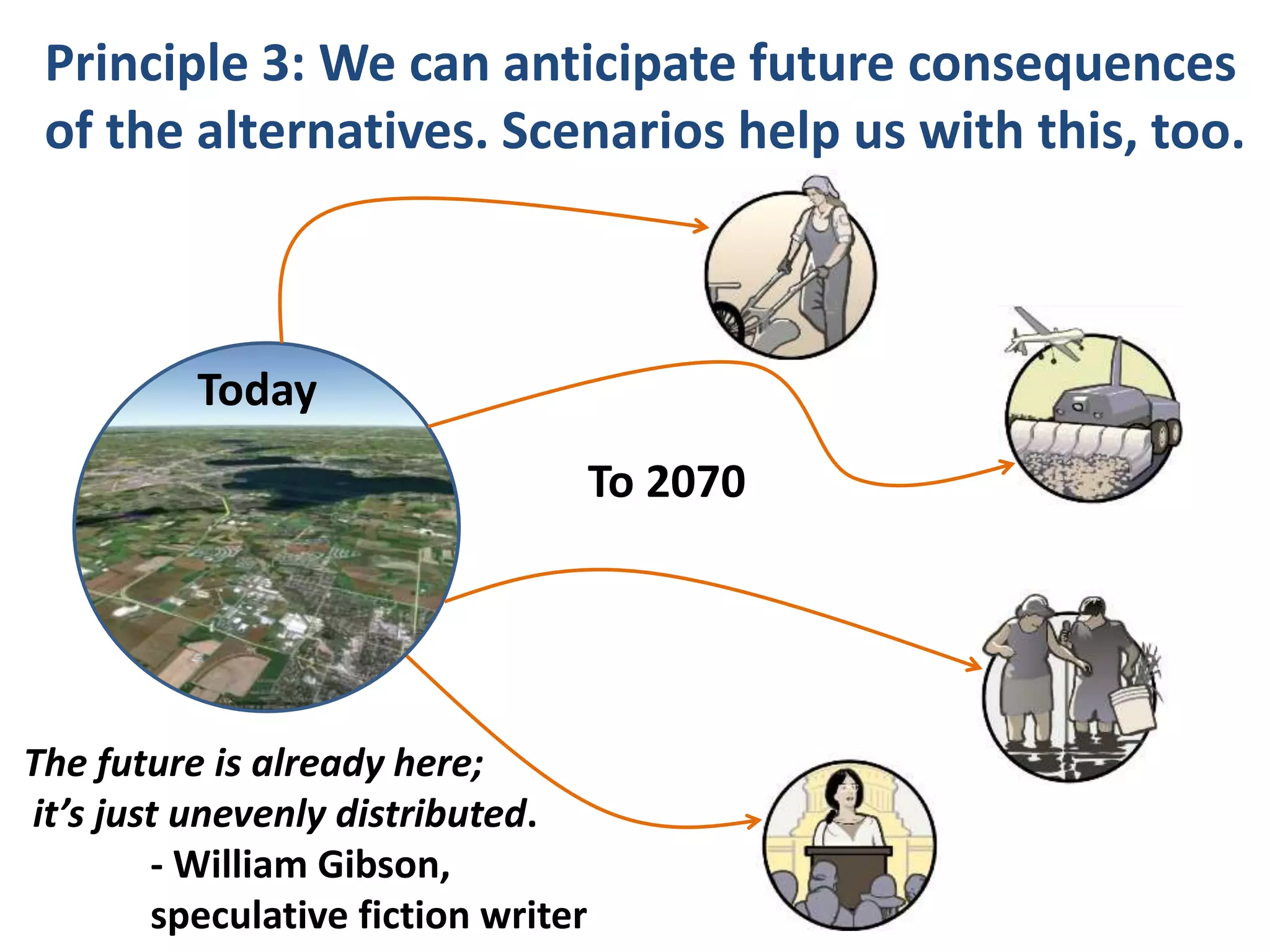
To 2070
Today
Principle 3: We can anticipate future consequences
of the alternatives. Scenarios help us with this, too.
The future is already here;
it’s just unevenly distributed.
- William Gibson,
speculative fiction writer
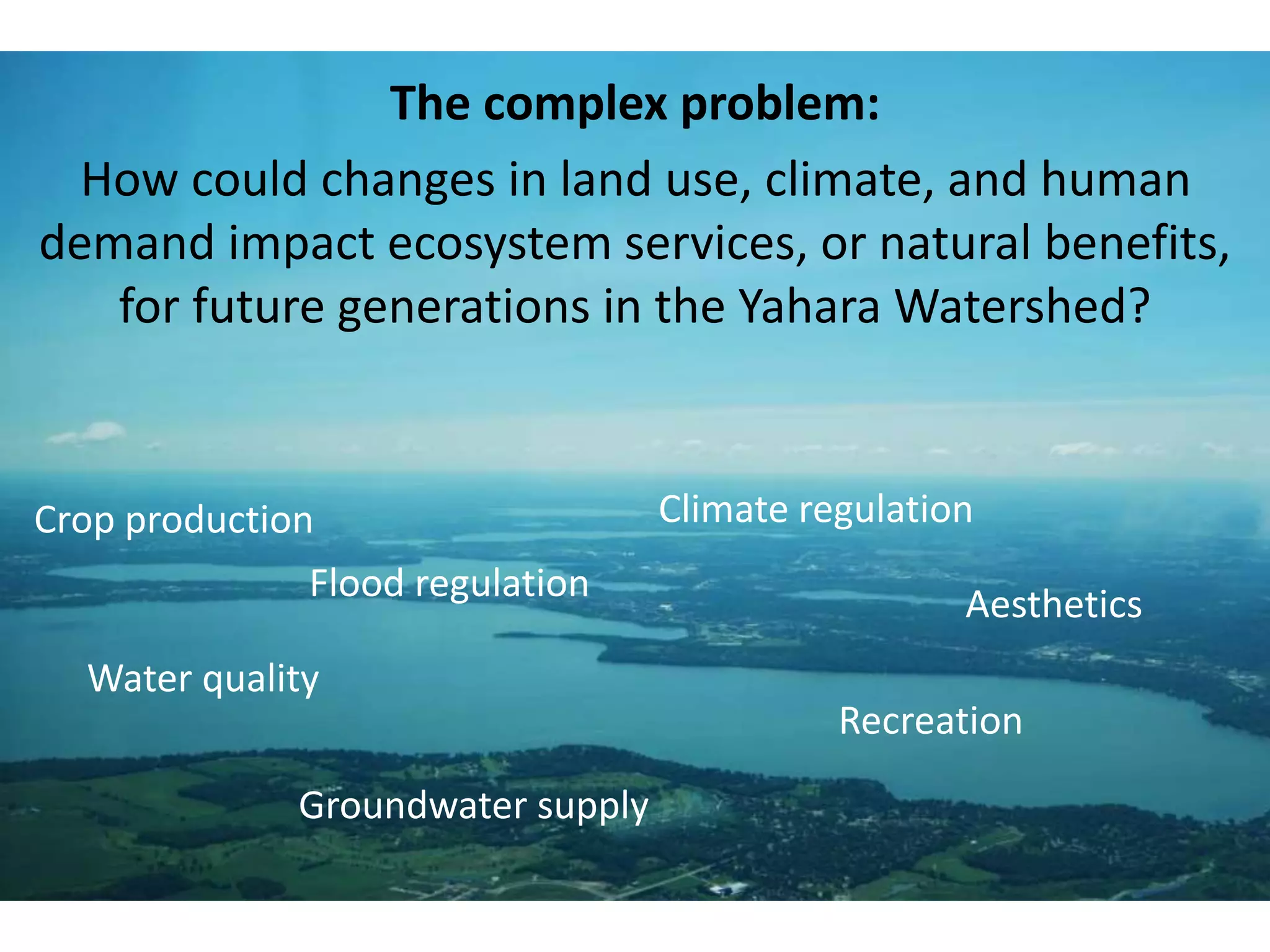
Water quality
Groundwater supply
Climate regulationCrop production
Flood regulation
Recreation
Aesthetics
The complex problem:
How could changes in land use, climate, and human
demand impact ecosystem services, or natural benefits,
for future generations in the Yahara Watershed?
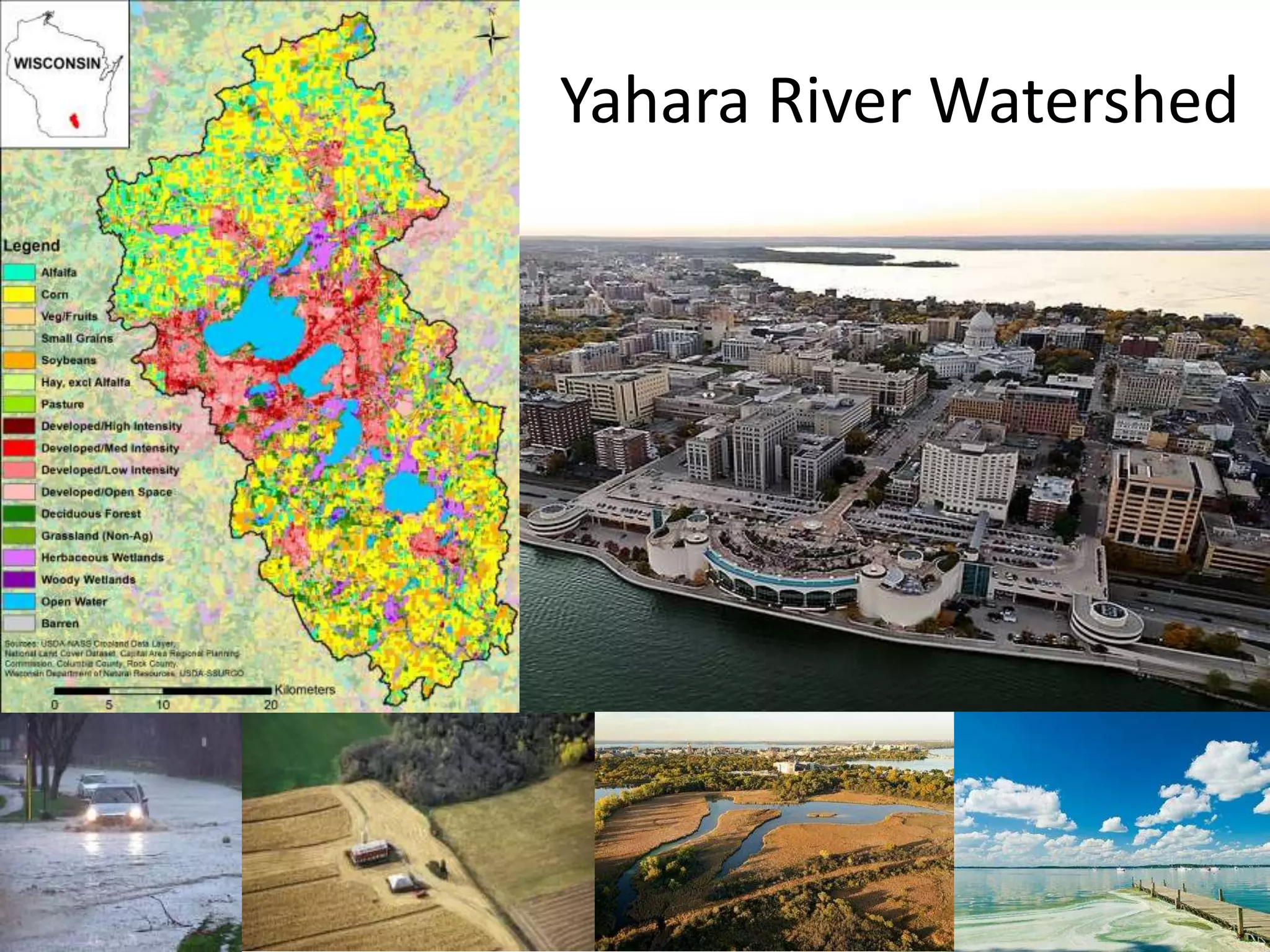
Yahara River Watershed
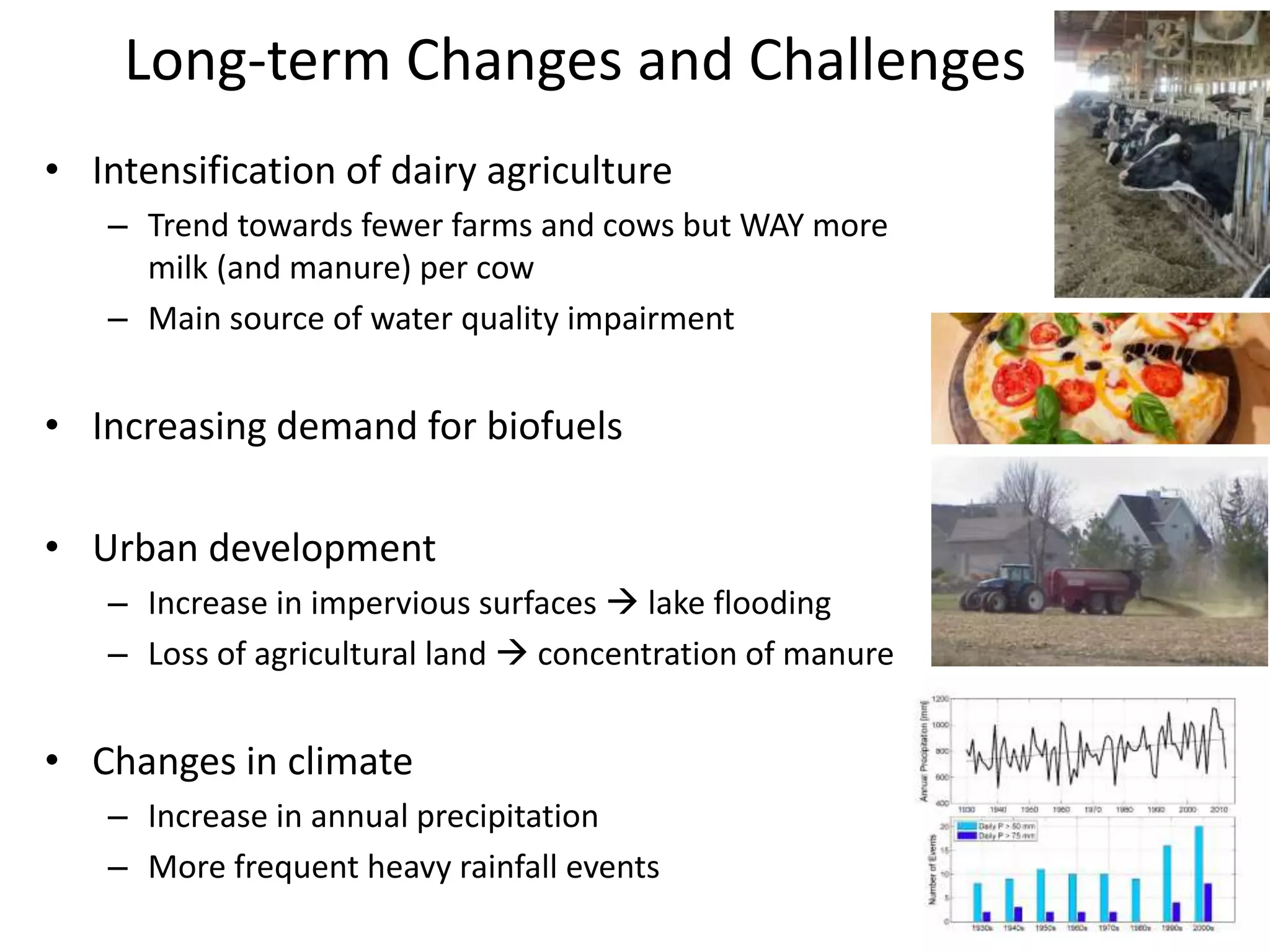
Long-term Changes and Challenges
• Intensification of dairy agriculture
– Trend towards fewer farms and cows but WAY more
milk (and manure) per cow
– Main source of water quality impairment
• Increasing demand for biofuels
• Urban development
– Increase in impervious surfaces  lake flooding
– Loss of agricultural land  concentration of manure
• Changes in climate
– Increase in annual precipitation
– More frequent heavy rainfall events
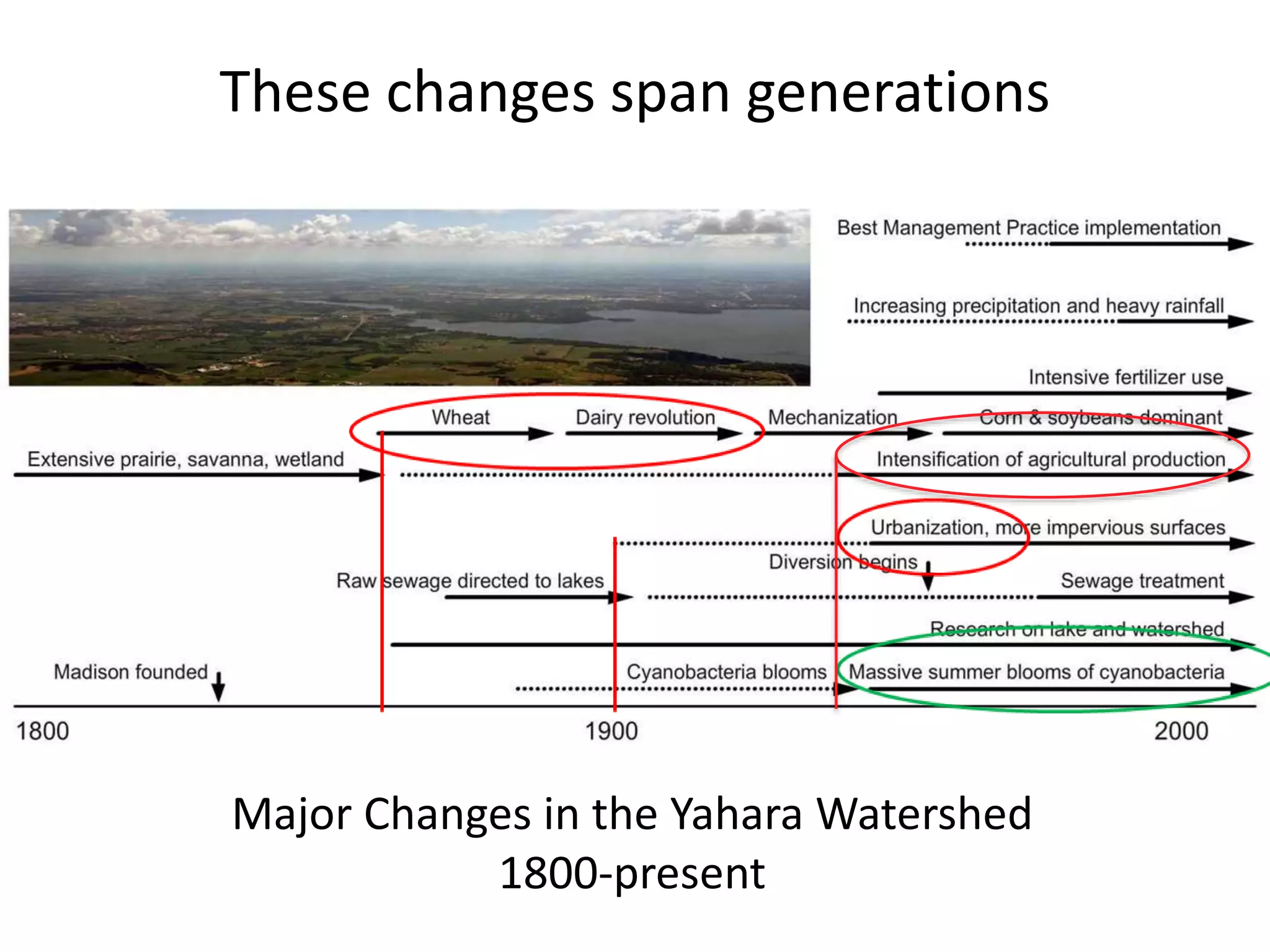
These changes span generations
Major Changes in the Yahara Watershed
1800-present
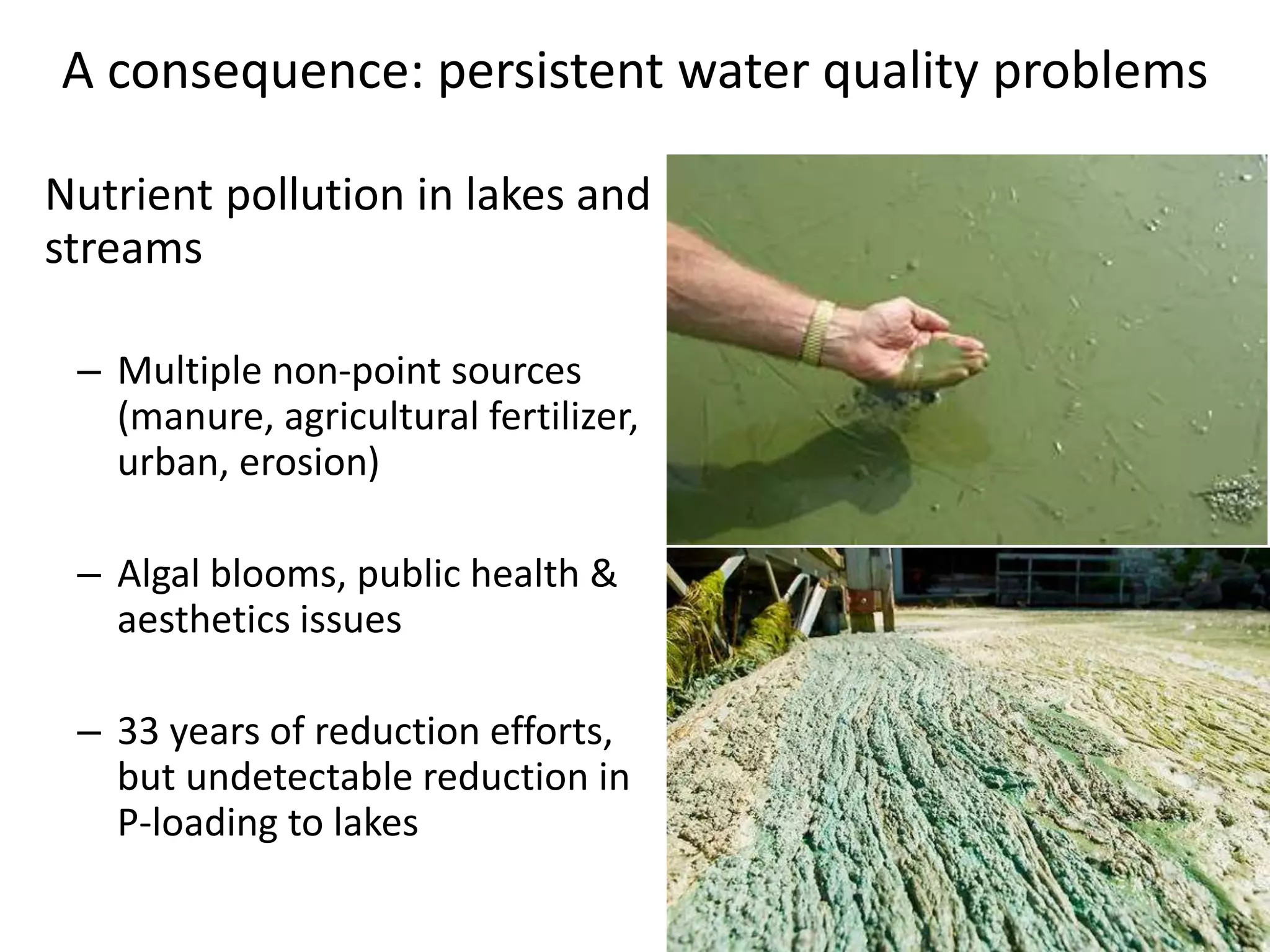
A consequence: persistent water quality problems
Nutrient pollution in lakes and
streams
– Multiple non-point sources
(manure, agricultural fertilizer,
urban, erosion)
– Algal blooms, public health &
aesthetics issues
– 33 years of reduction efforts,
but undetectable reduction in
P-loading to lakes
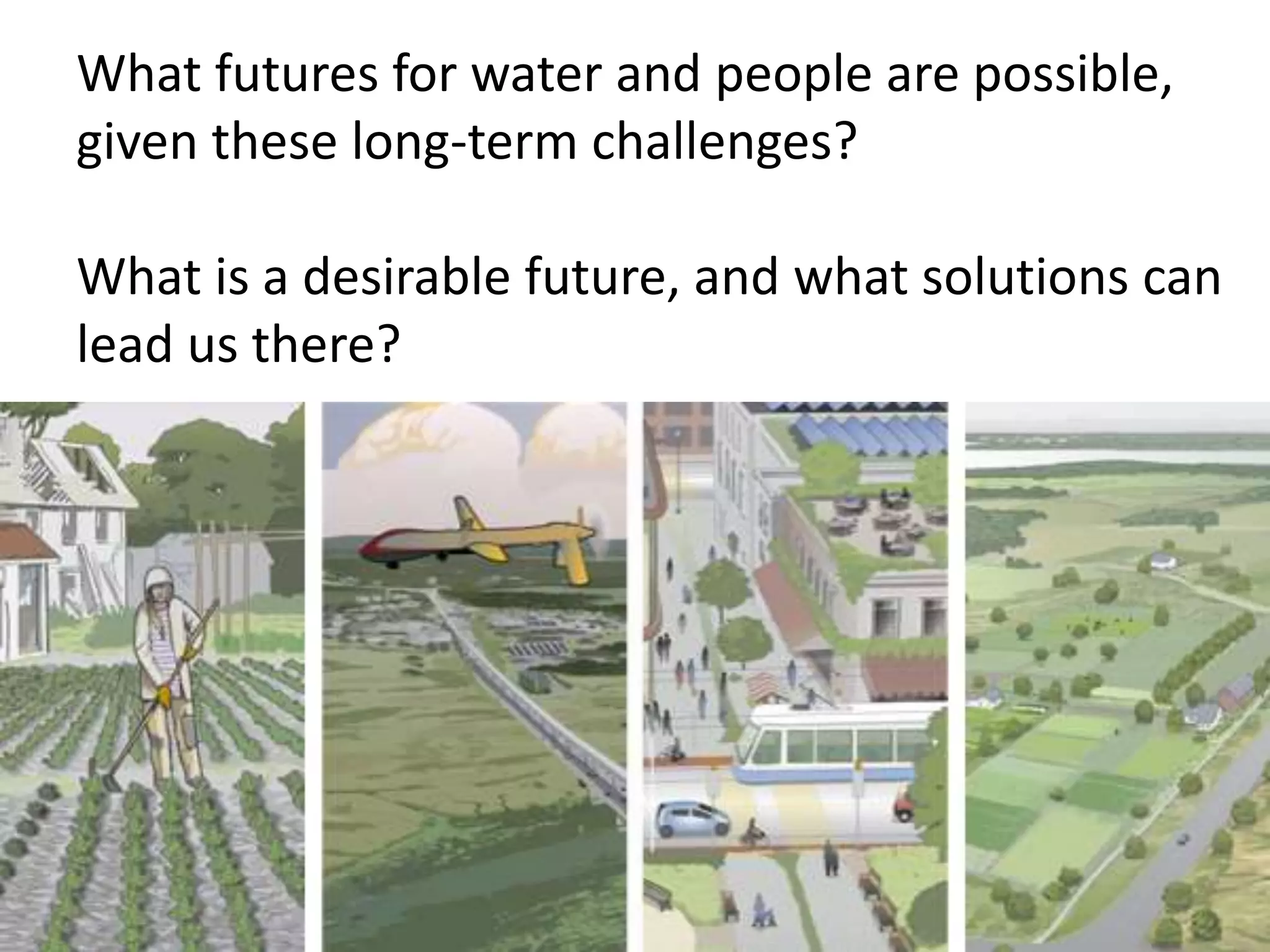
What futures for water and people are possible,
given these long-term challenges?
What is a desirable future, and what solutions can
lead us there?
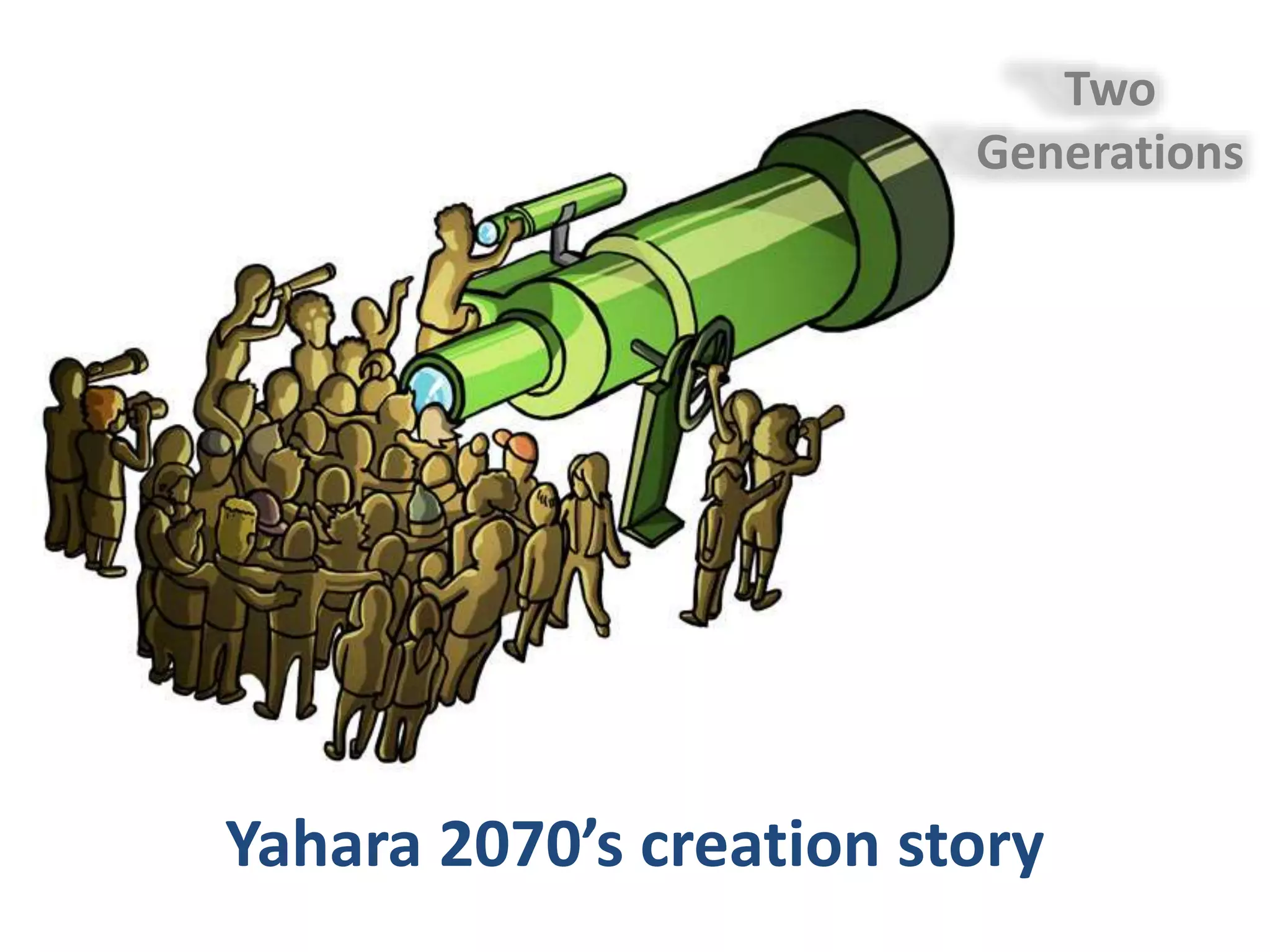
Yahara 2070’s creation story
Two
Generations
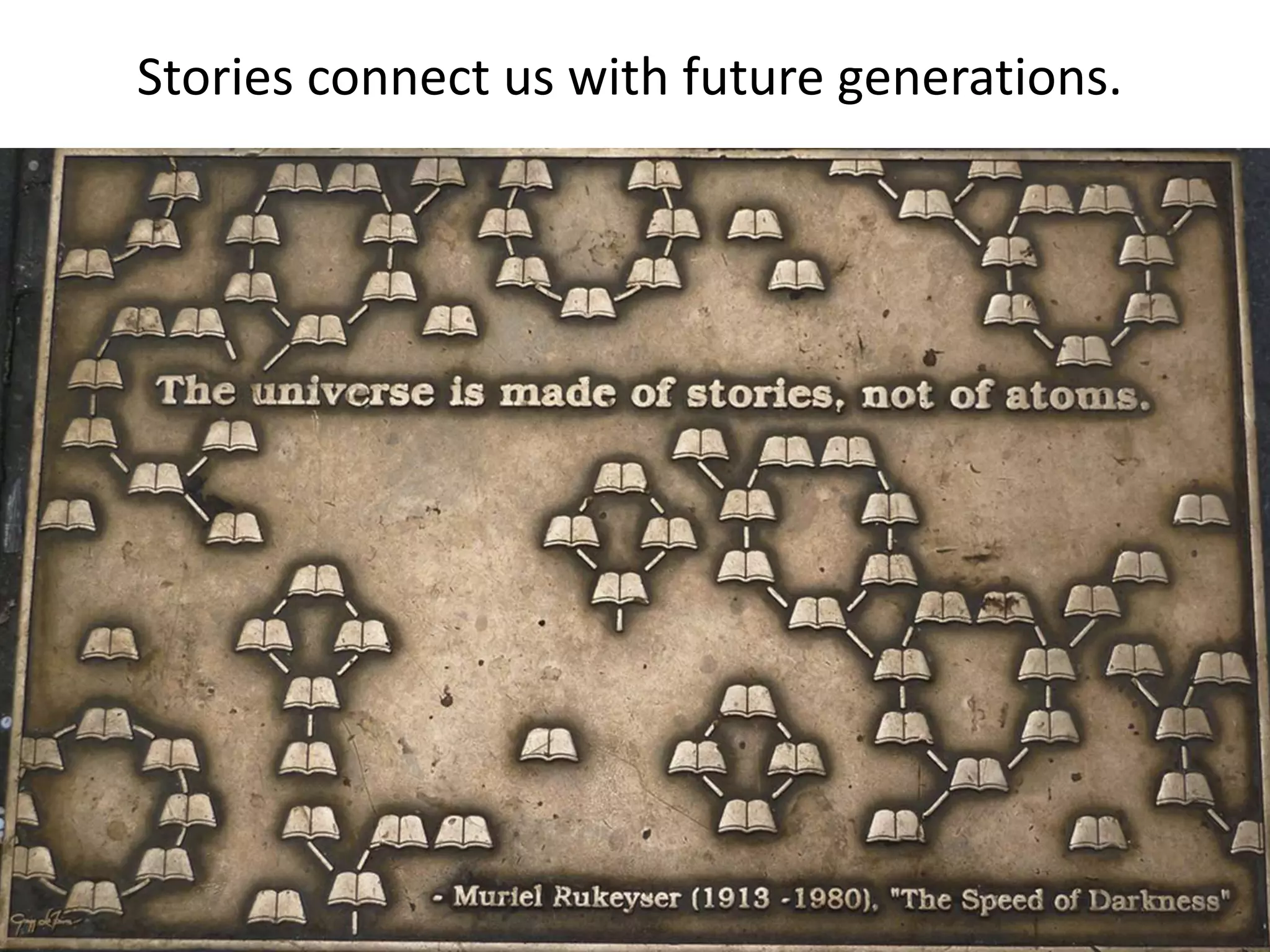
Stories connect us with future generations.
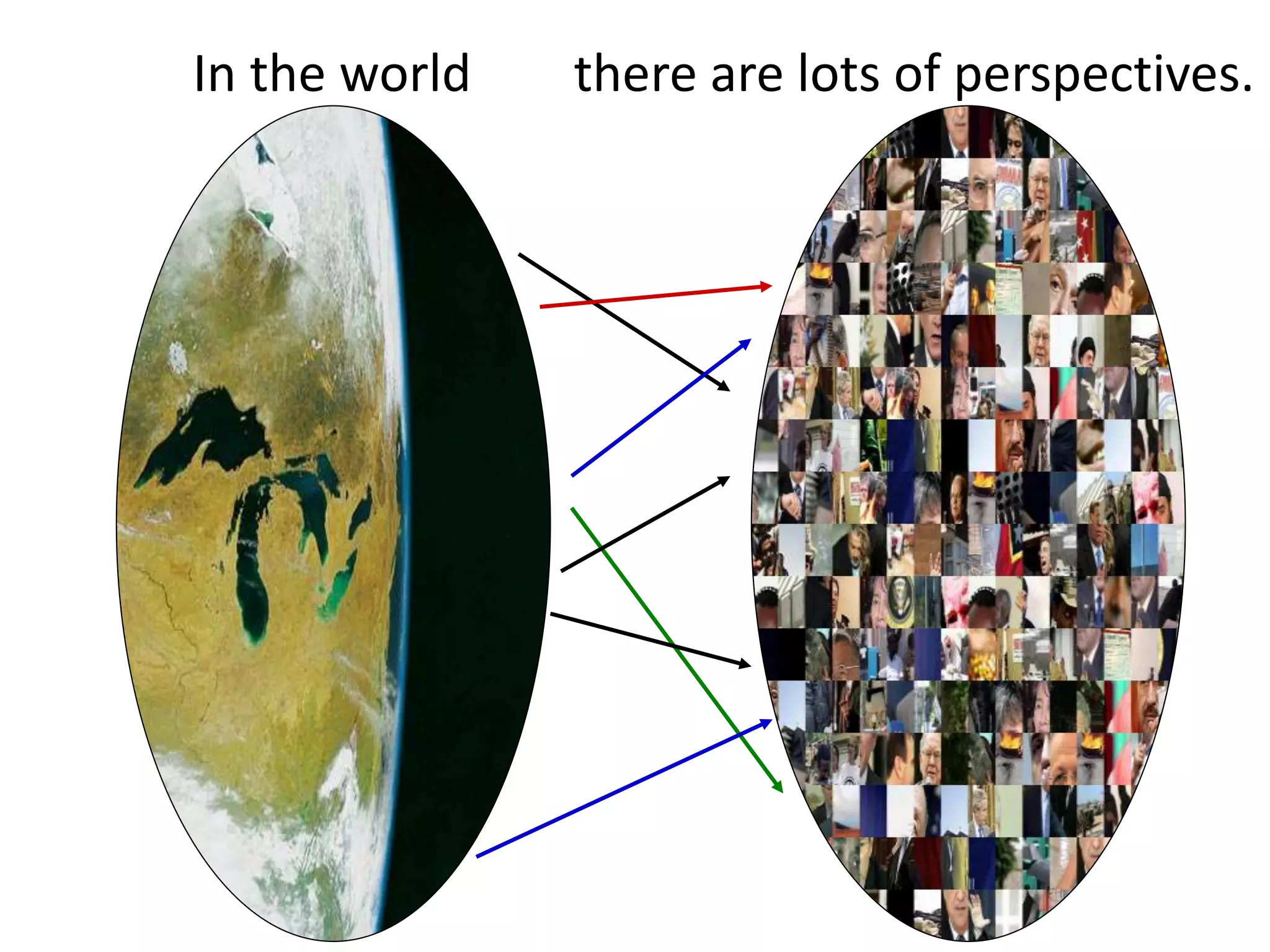
In the world there are lots of perspectives.
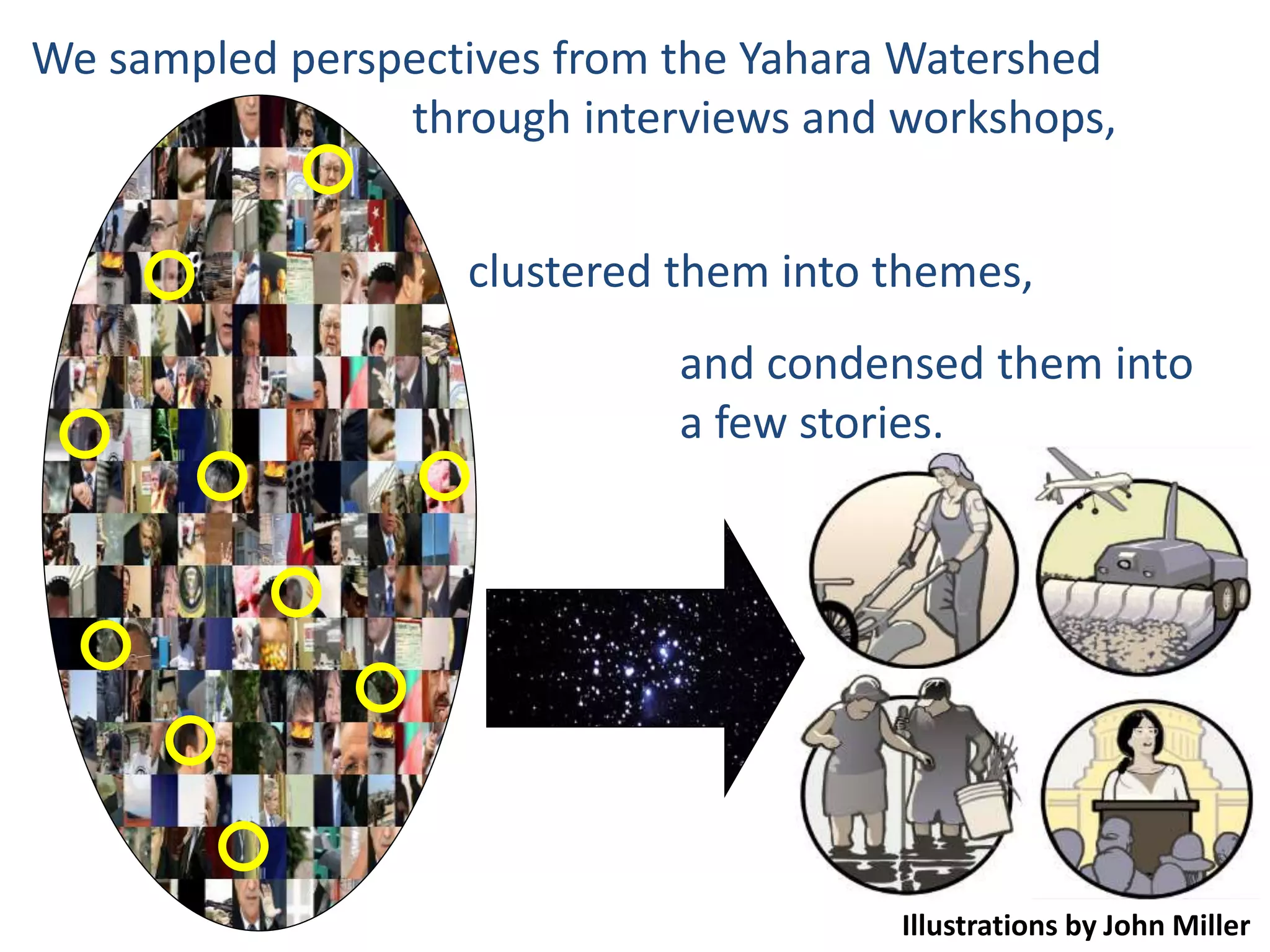
We sampled perspectives from the Yahara Watershed
through interviews and workshops,
clustered them into themes,
Illustrations by John Miller
and condensed them into
a few stories.
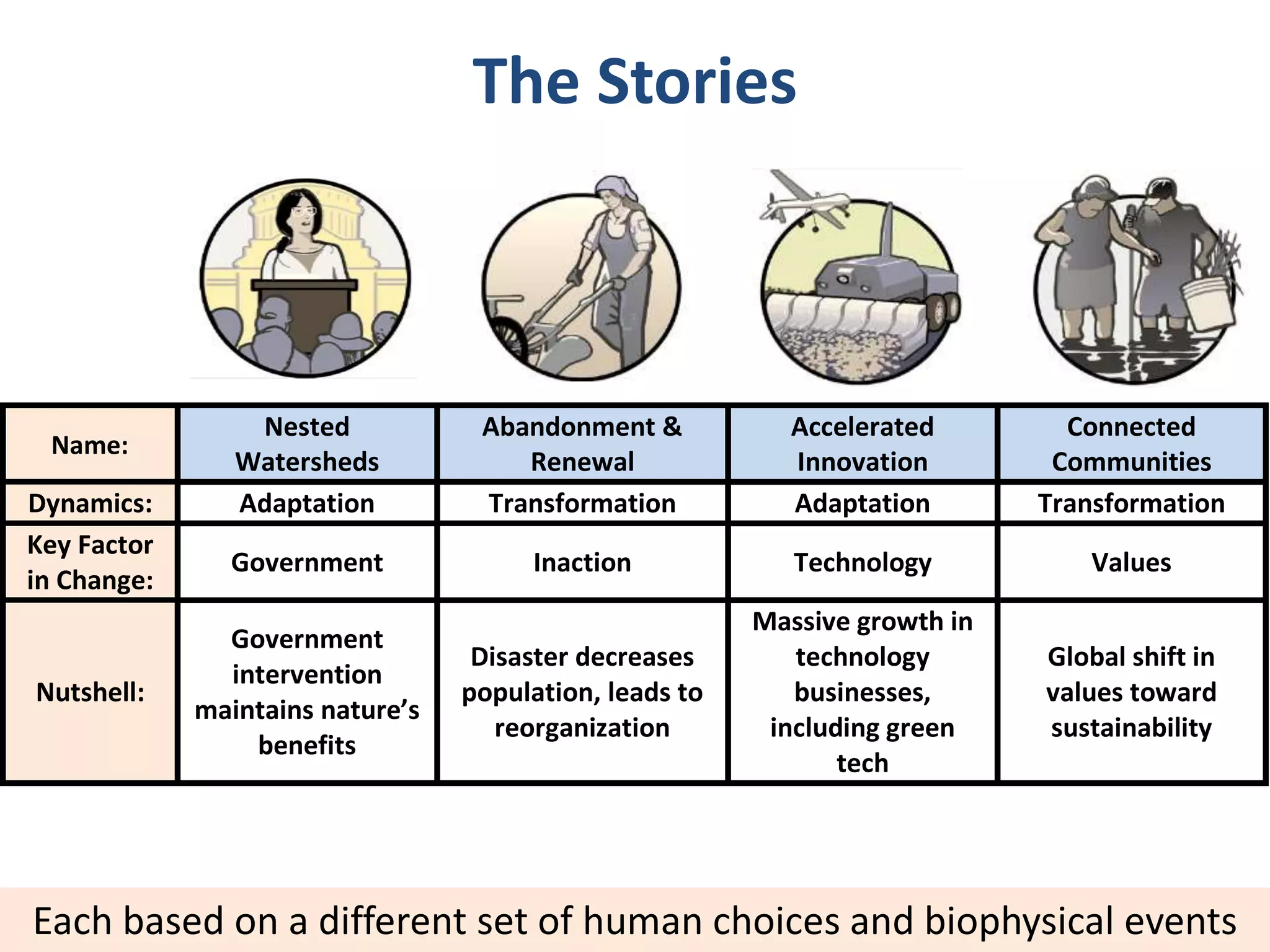
The Stories
Tentative
Name:
Nested
Watersheds
Abandonment &
Renewal
Accelerated
Innovation
Connected
Communities
Dynamics: Adaptation Transformation Adaptation Transformation
Key Factor
in Change:
Government Inaction Technology Values
Nutshell:
Government
intervention
maintains nature’s
benefits
Disaster decreases
population, leads to
reorganization
Massive growth in
technology
businesses,
including green
tech
Global shift in
values toward
sustainability
Name:
Each based on a different set of human choices and biophysical events
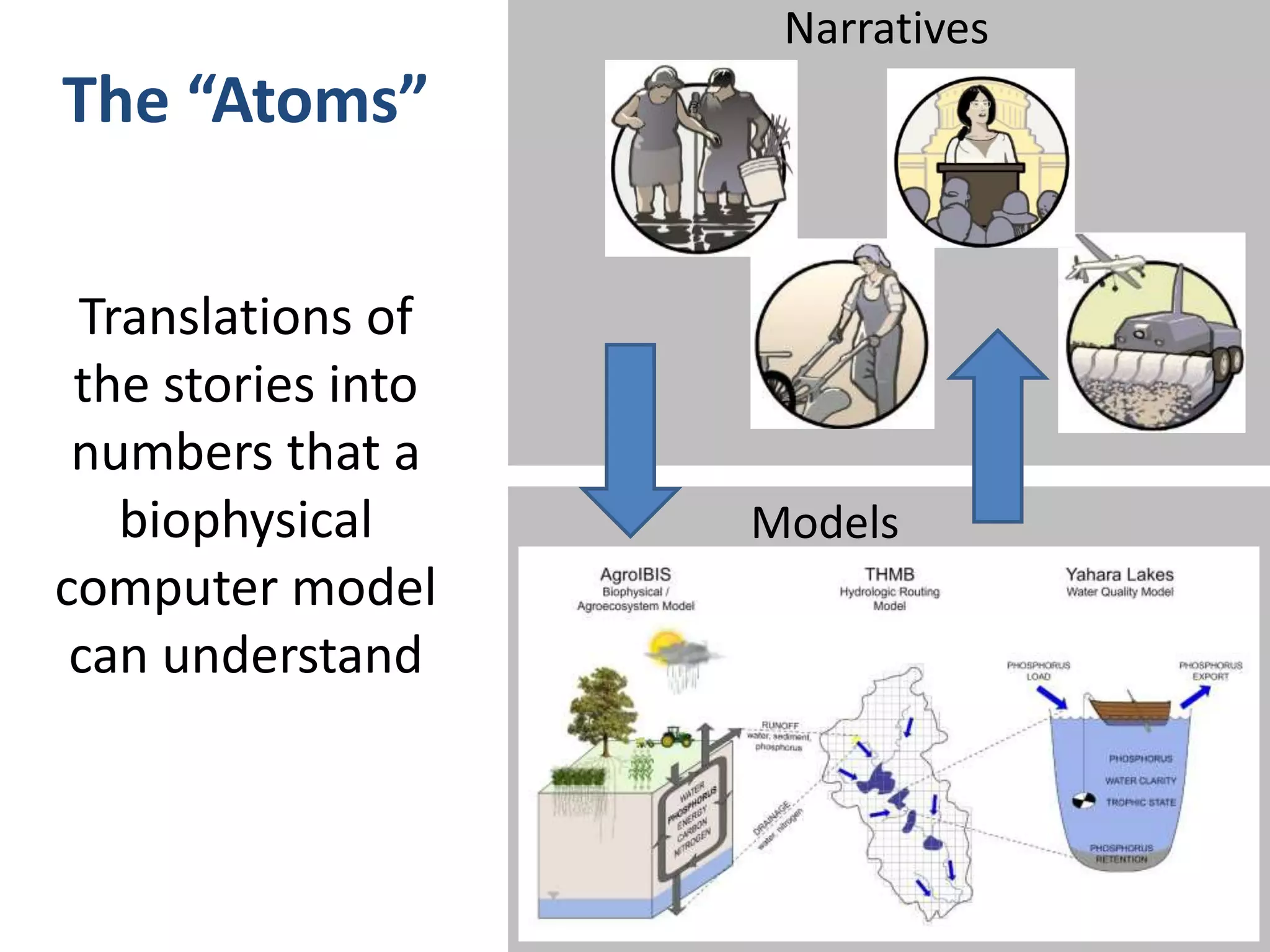
The “Atoms”
Translations of
the stories into
numbers that a
biophysical
computer model
can understand
Models
Narratives
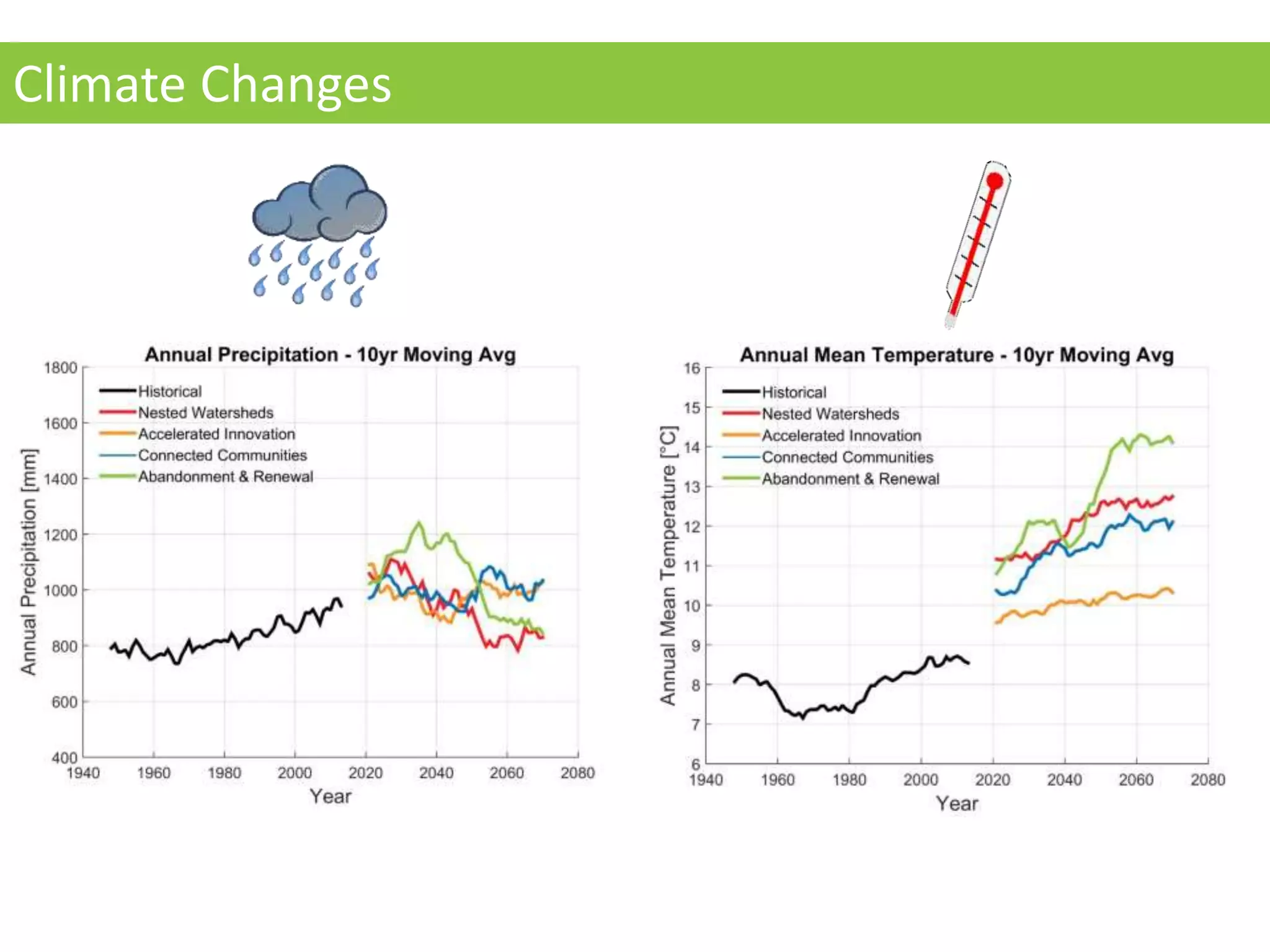
Climate Changes
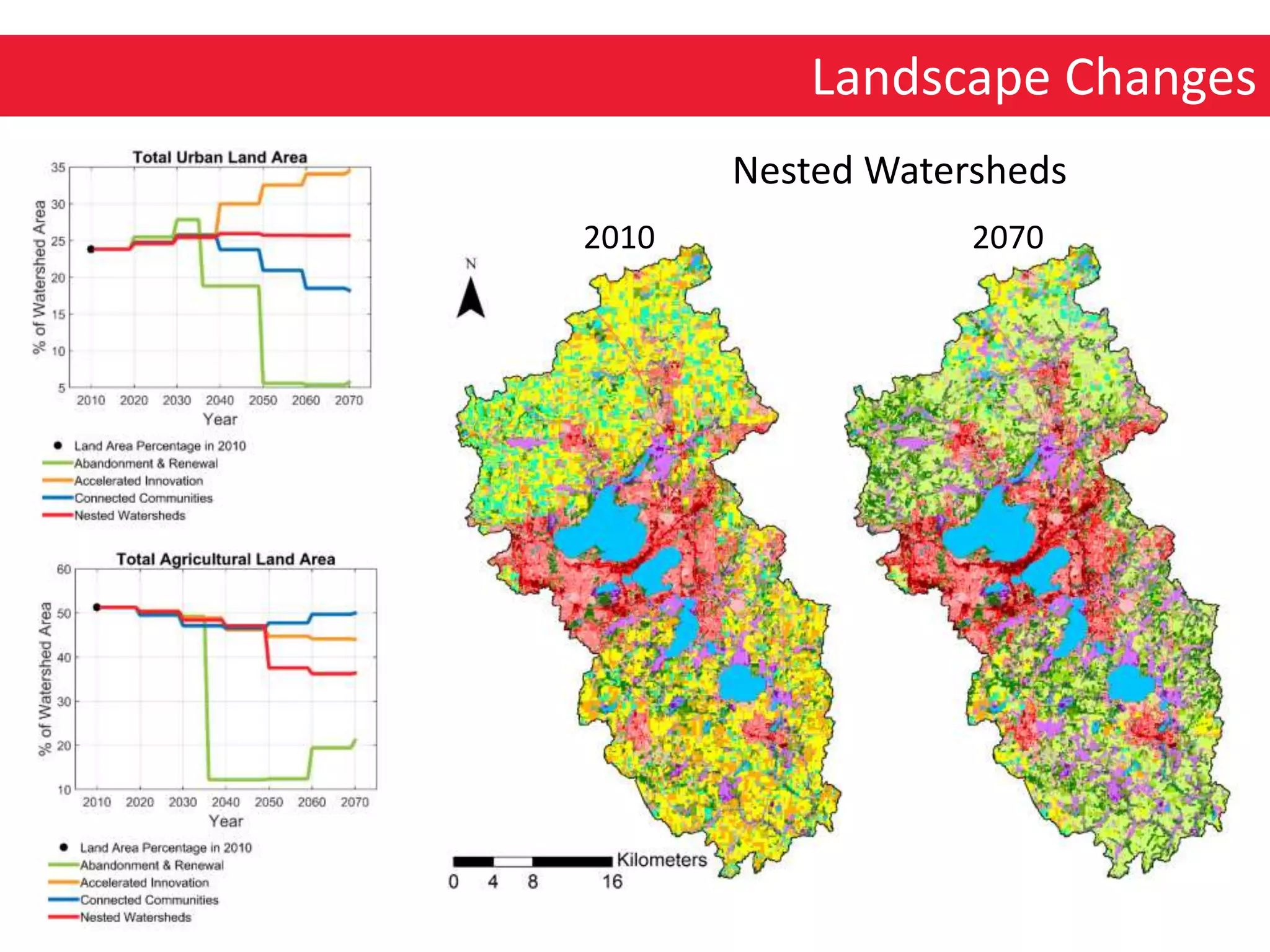
Nested Watersheds
Landscape Changes
2010 2070
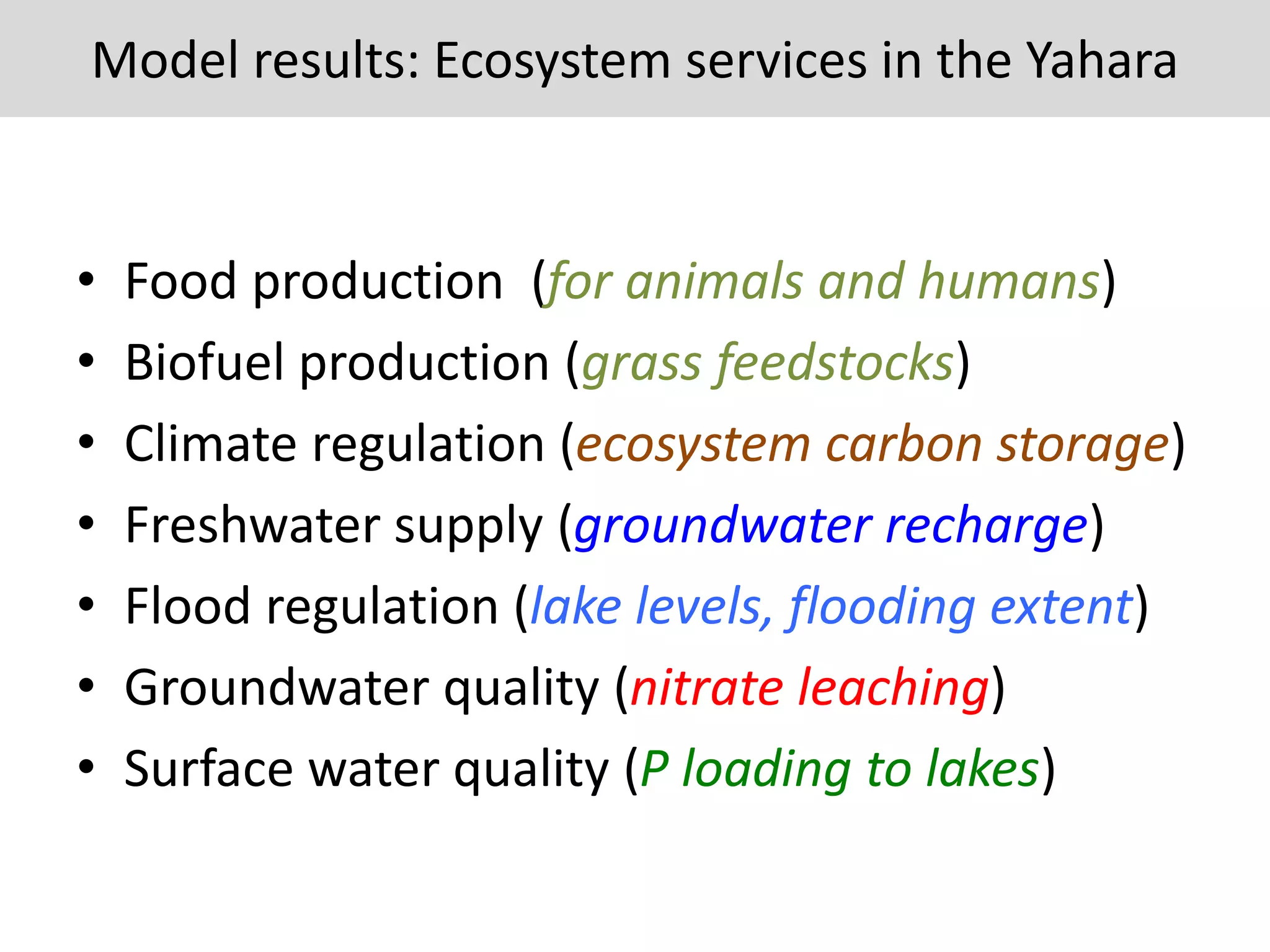
Model results: Ecosystem services in the Yahara
• Food production (for animals and humans)
• Biofuel production (grass feedstocks)
• Climate regulation (ecosystem carbon storage)
• Freshwater supply (groundwater recharge)
• Flood regulation (lake levels, flooding extent)
• Groundwater quality (nitrate leaching)
• Surface water quality (P loading to lakes)
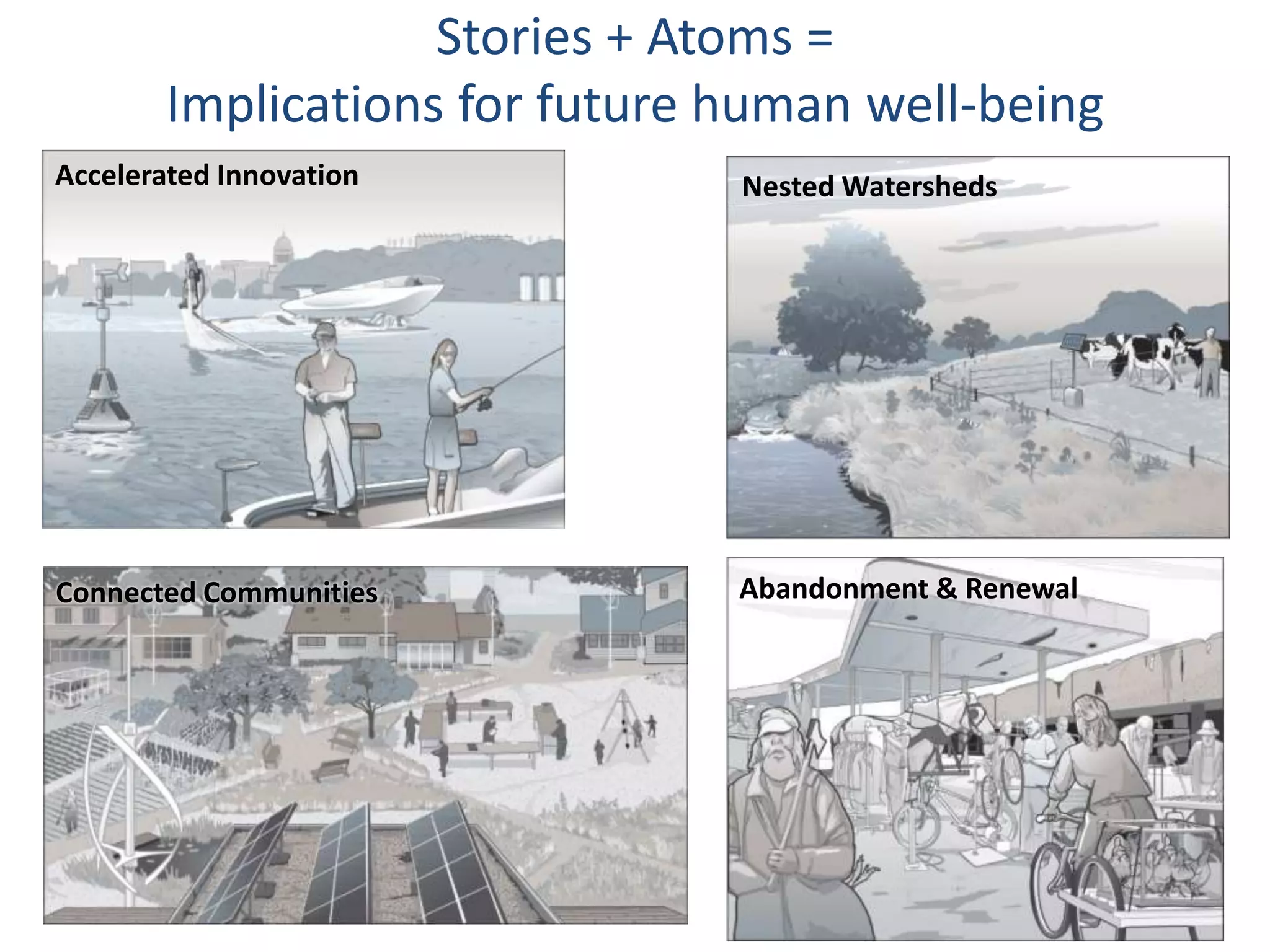
Stories + Atoms =
Implications for future human well-being
Accelerated Innovation Nested Watersheds
Connected Communities Abandonment & Renewal
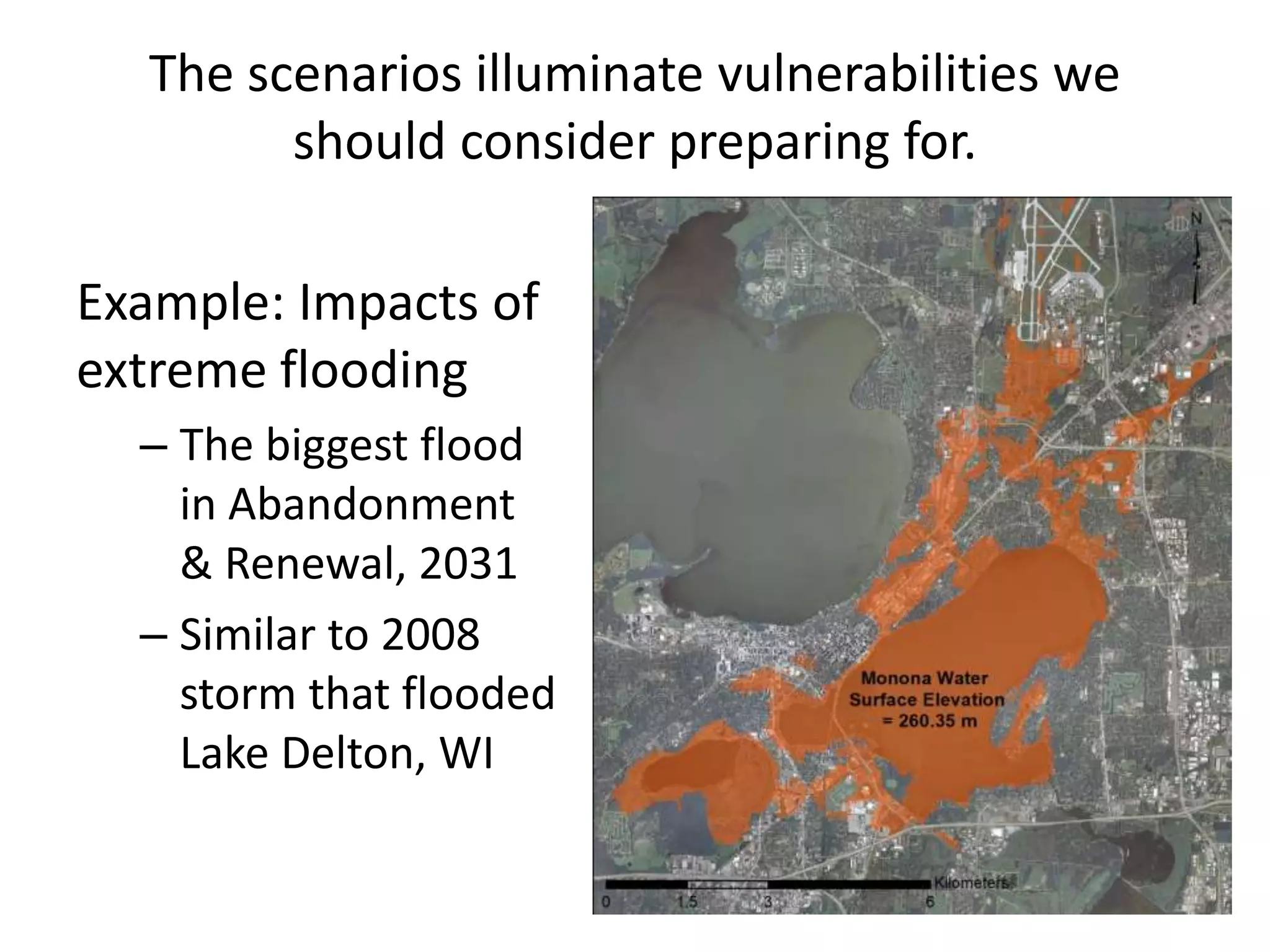
The scenarios illuminate vulnerabilities we
should consider preparing for.
Example: Impacts of
extreme flooding
– The biggest flood
in Abandonment
& Renewal, 2031
– Similar to 2008
storm that flooded
Lake Delton, WI
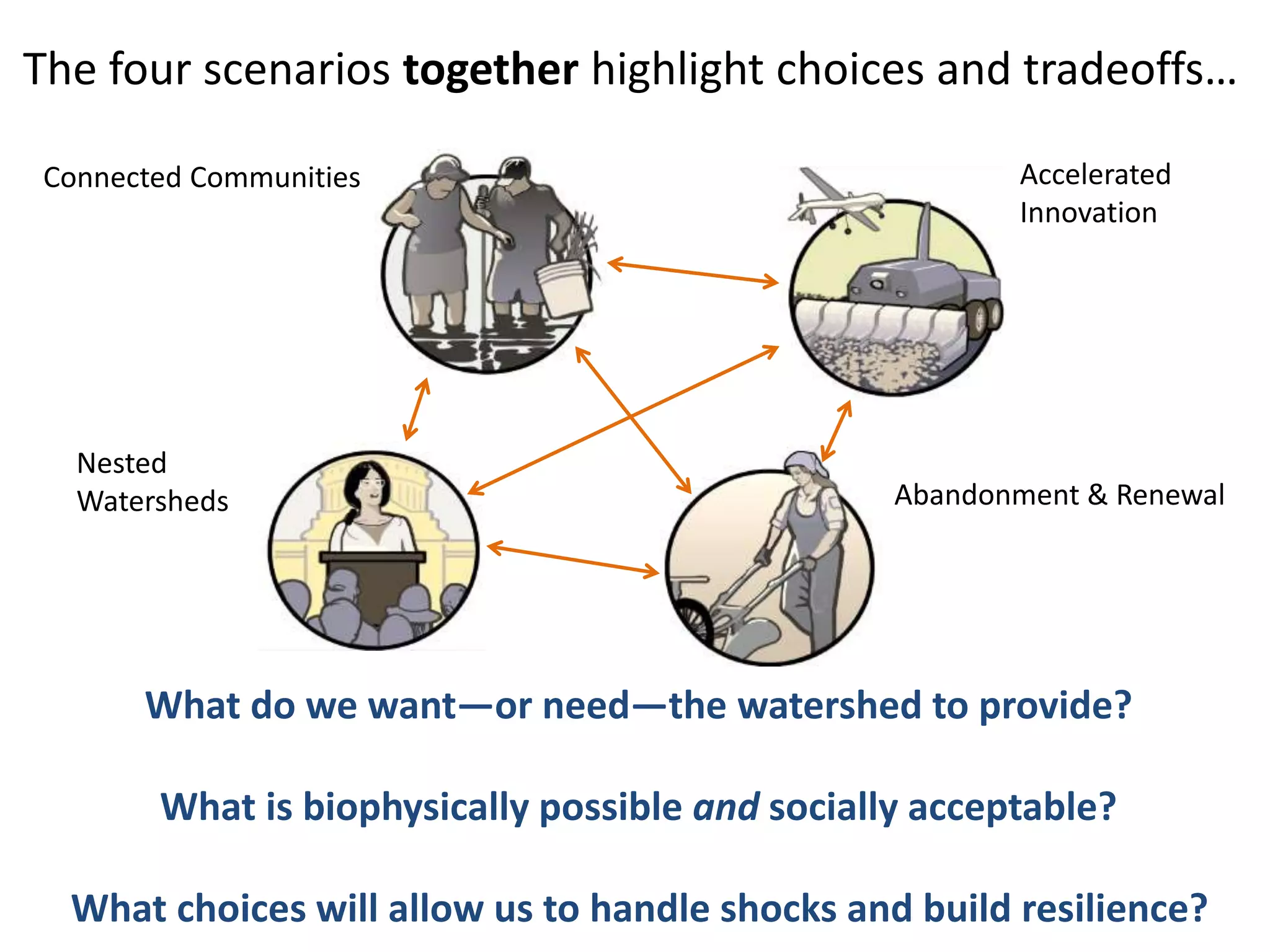
The four scenarios together highlight choices and tradeoffs…
What do we want—or need—the watershed to provide?
What is biophysically possible and socially acceptable?
What choices will allow us to handle shocks and build resilience?
Abandonment & Renewal
Nested
Watersheds
Connected Communities Accelerated
Innovation
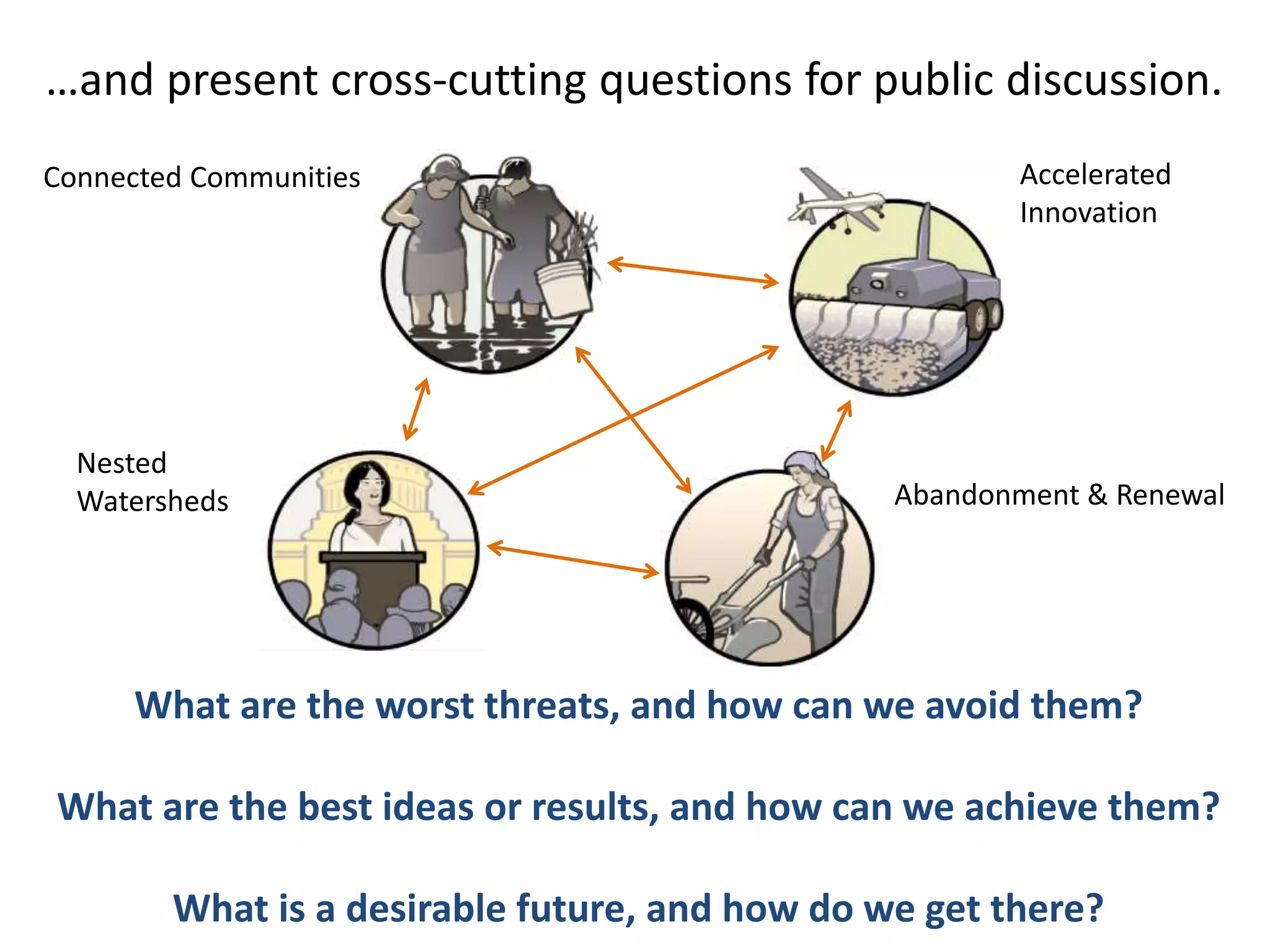
…and present cross-cutting questions for public discussion.
What are the worst threats, and how can we avoid them?
What are the best ideas or results, and how can we achieve them?
What is a desirable future, and how do we get there?
Abandonment & Renewal
Nested
Watersheds
Connected Communities Accelerated
Innovation
Ultimately, the scenarios can help stimulate conversations
about our vision of a desirable and possible future
“If you want to build a ship, don’t start with collecting wood,
cutting the plank and assigning work, but awake in people the
longing for the wide and open sea.”
– Antoine de Saint-Exupery (Citadelle)
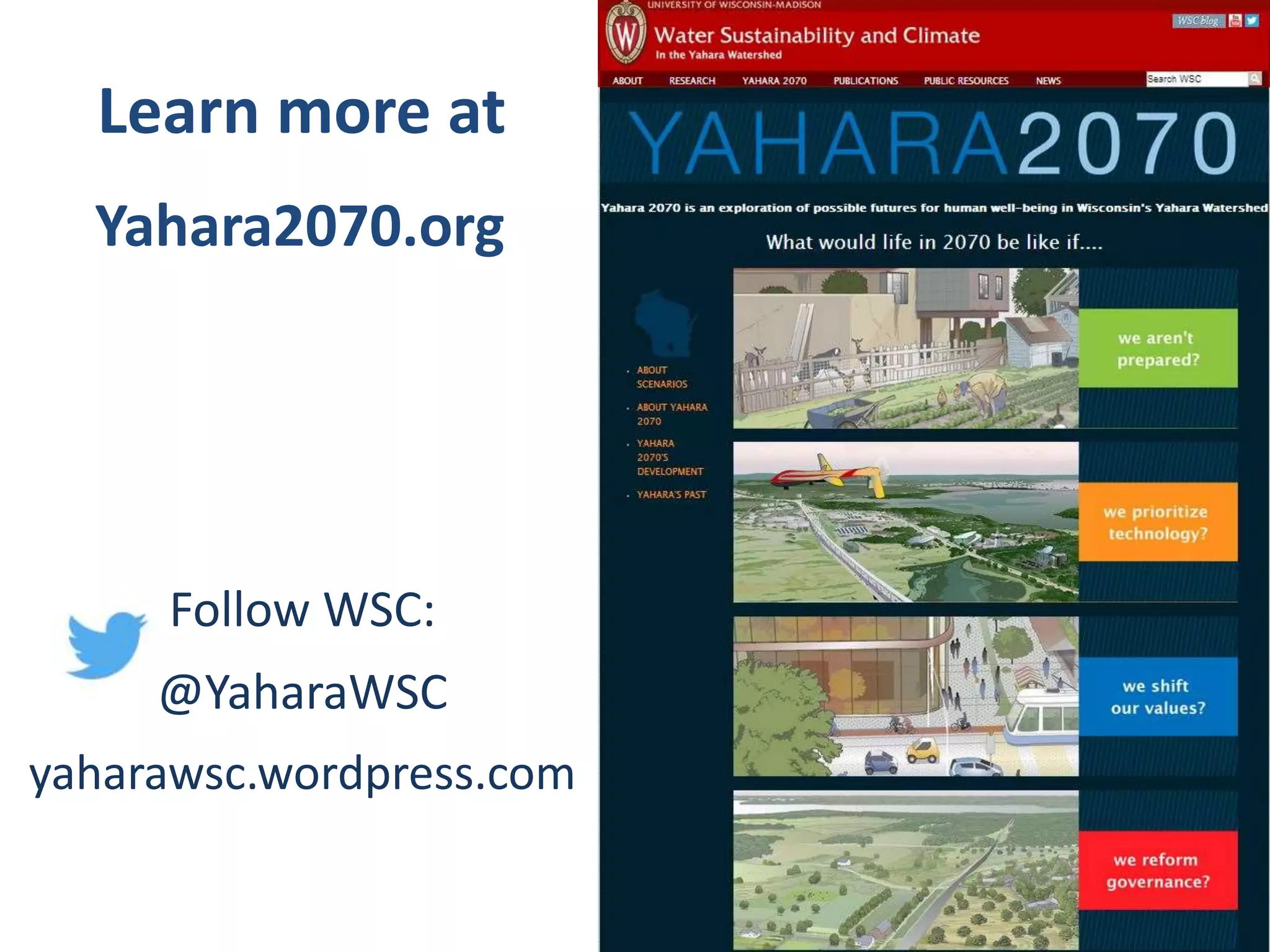
Yahara2070.org
Follow WSC:
@YaharaWSC
yaharawsc.wordpress.com
Learn more at

Yahara 2070 Introduction for Undergraduate Module

  • 1.
    Possible futures forthe Yahara Watershed The Science of Future Thinking
  • 2.
    “People are embeddedparts of the biosphere and shape it, from local to global scales, from the past to the future. At the same time people are fundamentally dependent on the capacity of the biosphere to sustain human development.” -- Carl Folke, Stockholm Resilience Center Future thinking is important because…
  • 3.
    But sustaining natureand human development is a complex problem: • Uncertainty is high. • Time frames of environmental change span many generations. • People will reach different conclusions. • Multiple solutions are “good enough.”
  • 4.
    To approach complexproblems, we can • Assume uncertainty is large, changeable, and co-created by people and nature. • Emphasize the diversity of perspectives. • Stress learning by individuals and groups. • Expect the unexpected.
  • 5.
    “While the futureis uncertain and much of it is beyond our control, we can control many aspects of it. We choose our future: we create it by what we do or fail to do.” – Wendy Schultz, futurist Importantly, we must recognize we can make choices about the future.
  • 6.
    TIME Principle 1: Throughouttime, we can make choices that will affect future outcomes.
  • 7.
    Principle 2: Wecan think about what might happen as a result of these choices, highlighting alternative pathways to alternative futures.
  • 8.
    Scenarios help usconsider these pathways • Scenarios are provocative, plausible stories about the future with contrasting social and environmental conditions. • They explore questions of “What if?” • They facilitate long-term thinking. • They help us learn ways to address change and vulnerability. 20702010
  • 9.
    To 2070 Today Principle 3:We can anticipate future consequences of the alternatives. Scenarios help us with this, too. The future is already here; it’s just unevenly distributed. - William Gibson, speculative fiction writer
  • 11.
    Water quality Groundwater supply ClimateregulationCrop production Flood regulation Recreation Aesthetics The complex problem: How could changes in land use, climate, and human demand impact ecosystem services, or natural benefits, for future generations in the Yahara Watershed?
  • 12.
  • 13.
    Long-term Changes andChallenges • Intensification of dairy agriculture – Trend towards fewer farms and cows but WAY more milk (and manure) per cow – Main source of water quality impairment • Increasing demand for biofuels • Urban development – Increase in impervious surfaces  lake flooding – Loss of agricultural land  concentration of manure • Changes in climate – Increase in annual precipitation – More frequent heavy rainfall events
  • 14.
    These changes spangenerations Major Changes in the Yahara Watershed 1800-present
  • 15.
    A consequence: persistentwater quality problems Nutrient pollution in lakes and streams – Multiple non-point sources (manure, agricultural fertilizer, urban, erosion) – Algal blooms, public health & aesthetics issues – 33 years of reduction efforts, but undetectable reduction in P-loading to lakes
  • 16.
    What futures forwater and people are possible, given these long-term challenges? What is a desirable future, and what solutions can lead us there?
  • 17.
    Yahara 2070’s creationstory Two Generations
  • 18.
    Stories connect uswith future generations.
  • 19.
    In the worldthere are lots of perspectives.
  • 20.
    We sampled perspectivesfrom the Yahara Watershed through interviews and workshops, clustered them into themes, Illustrations by John Miller and condensed them into a few stories.
  • 21.
    The Stories Tentative Name: Nested Watersheds Abandonment & Renewal Accelerated Innovation Connected Communities Dynamics:Adaptation Transformation Adaptation Transformation Key Factor in Change: Government Inaction Technology Values Nutshell: Government intervention maintains nature’s benefits Disaster decreases population, leads to reorganization Massive growth in technology businesses, including green tech Global shift in values toward sustainability Name: Each based on a different set of human choices and biophysical events
  • 22.
    The “Atoms” Translations of thestories into numbers that a biophysical computer model can understand Models Narratives
  • 23.
  • 24.
  • 25.
    Model results: Ecosystemservices in the Yahara • Food production (for animals and humans) • Biofuel production (grass feedstocks) • Climate regulation (ecosystem carbon storage) • Freshwater supply (groundwater recharge) • Flood regulation (lake levels, flooding extent) • Groundwater quality (nitrate leaching) • Surface water quality (P loading to lakes)
  • 26.
    Stories + Atoms= Implications for future human well-being Accelerated Innovation Nested Watersheds Connected Communities Abandonment & Renewal
  • 27.
    The scenarios illuminatevulnerabilities we should consider preparing for. Example: Impacts of extreme flooding – The biggest flood in Abandonment & Renewal, 2031 – Similar to 2008 storm that flooded Lake Delton, WI
  • 28.
    The four scenariostogether highlight choices and tradeoffs… What do we want—or need—the watershed to provide? What is biophysically possible and socially acceptable? What choices will allow us to handle shocks and build resilience? Abandonment & Renewal Nested Watersheds Connected Communities Accelerated Innovation
  • 29.
    …and present cross-cuttingquestions for public discussion. What are the worst threats, and how can we avoid them? What are the best ideas or results, and how can we achieve them? What is a desirable future, and how do we get there? Abandonment & Renewal Nested Watersheds Connected Communities Accelerated Innovation
  • 30.
    Ultimately, the scenarioscan help stimulate conversations about our vision of a desirable and possible future “If you want to build a ship, don’t start with collecting wood, cutting the plank and assigning work, but awake in people the longing for the wide and open sea.” – Antoine de Saint-Exupery (Citadelle)
  • 31.