Y2023 –Engineering Standoff Improvement
Prepared by: hvthe
13th Oct 23
POWERING THE WORLD’S CRITICAL SYSTEMS
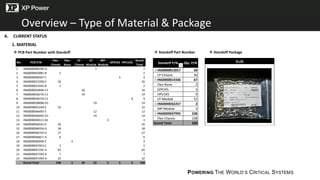
Overview – Type of Material & Package
A. CURRENT STATUS
1. MATERIAL
❖ Standoff Part Number
❖ PCB Part Number with Standoff
No. PCB P/N
Flex-
Chassis
Flex-
Nano
LP-
Chassis
LP-
Module
MP-
Module
GFR1K5 HPU1K5
Grand
Total
1 IN60000000794-D 7 7
2 IN60000002881-B 2 2
3 IN60000008507-C 3 3
4 IN60000022358-E 26 26
5 IN60000022442-B 2 2
6 IN60000034946-C1 16 16
7 IN60000036276-C1 14 14
8 IN60000036370-C1 9 9
9 IN60000038898-D1 19 19
10 IN60000041549-E 25 25
11 IN60000046492-E 12 12
12 IN60000046493-D1 14 14
13 IN60000046511-B1 3 3
14 IN60000046541-K 26 26
15 IN60000046554-G 18 18
16 IN60000046742-D 27 27
17 IN60000046817-A 6 6
18 IN60000046949-C 3 3
19 IN60000047053-C 2 2
20 IN60000047292-A 65 65
21 IN60000047293-A 7 7
22 IN60000047294-A 32 32
Grand Total 238 3 30 52 3 3 9 338
Standoff P/N Qty. P/N
IN60000013017 30
LP-Chassis 30
IN60000014336 67
Flex-Nano 3
GFR1K5 3
HPU1K5 9
LP-Module 52
IN60000032257 3
MP-Module 3
IN60000037995 238
Flex-Chassis 238
Grand Total 338
❖ Standoff Package
POWERING THE WORLD’S CRITICAL SYSTEMS
Overview – Method & Results
3) Work Instruction
1) Stencil Design 2) Solder paste printing 5) Post Reflow
• Design Stencil with Single
Side
• Apply Step up at bottom
side with tape for some
kind of PCB
• Details of design
aperture hold follow
material dimension
(Standoff, PCB)
• Printing solder
paste by Screen
Printer machine on
Bottom Side
• Work Instruction for
assembling standoff
on PCB Surface
• Top Side: Solder good full fill
4) Mounting Standoff
• Standoff will mount on PCB
by manual follow Work
instruction after SPI machine
• Bottom Side:
i. Solder fills around the holes of the PCBA
ii. There is no Solder paste raised to the side
of the standoff
6) Manual Solder
• Using manual soldering
for bottom side
POWERING THE WORLD’S CRITICAL SYSTEMS
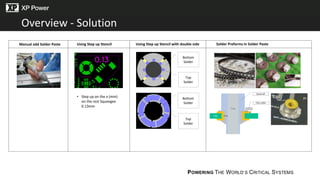
Overview - Solution
Using Step up Stencil with double side
Manual add Solder Paste Using Step up Stencil Solder Preforms in Solder Paste
• Step up on the x (mm)
on the rest Squeegee
0.13mm
Bottom
Solder
Top
Solder
Bottom
Solder
Top
Solder
POWERING THE WORLD’S CRITICAL SYSTEMS
Overview – Advantage & Disadvantage
Method Solder Preforms in Solder Paste Using Step up Stencil Using Step up Stencil with double side Manual add Solder Paste
Advantages
1) Improved first pass yield
2) 100% hole fill, fillets as required
3) No board thickness limitations
4) Increased solder volume without the need for PCB layout
changes or use of step stencils
5) Reduced rework and other manual processes to add solder
volume
6) Elimination of costly or time-consuming processes, such as
wave soldering or manual soldering
1) Just apply one Screen Printing process 1) Support for PCBs with dense
component density
NA
Disadvantages
1) Need to use of tape and reel packing
2) Components tolerate reflow temperature
3) Component stand-off height
4) No shoulder on pins
5) No paste is printed underneath stand-off
6) Pin protrusion is not excessive
7) Pin hole ratio is reasonable
1) Not suitable for PCBs with high density of
components around the Standoff position
2) Solder will not meet the requirements for
surrounding component locations
3) The Squeegee blade will quickly deform and must be
replaced
4) PCBs need to be reviewed and classified whether or
not this method can be used
1) Two printing processes need to be
applied during production
2) There may be a Solder Ball on the
other side
1) Solder is replenished unevenly
2) Need a Headcount to do the job
3) There is a risk of affecting other
locations during the addition process
4) Standoff may be slanted or
unevenly raised
Conclusion
1) Cannot be applied because there are no raw materials
2) If applied to add temporary fillets, it is necessary to prepare
Solder preforms and attach them manually or design a Tray to
place them.
3) If there are raw materials, Standoff must also ensure
packaging in Tape & Reel form
1) Review the PCB and apply the Step-up hole ratio and
thickness formula to get results on one type of PCB and
proceed with the next process.
1) Review the PCB and apply the Step-up
hole ratio and thickness formula to get
results on one type of PCB and proceed
with the next process.
1) NA
POWERING THE WORLD’S CRITICAL SYSTEMS
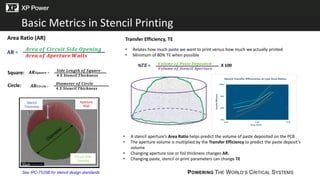
Basic Metrics in Stencil Printing
𝐀𝐑 =
𝑨𝒓𝒆𝒂 𝒐𝒇 𝑪𝒊𝒓𝒄𝒖𝒊𝒕 𝑺𝒊𝒅𝒆 𝑶𝒑𝒆𝒏𝒊𝒏𝒈
𝑨𝒓𝒆𝒂 𝒐𝒇 𝑨𝒑𝒆𝒓𝒕𝒖𝒓𝒆 𝑾𝒂𝒍𝒍𝒔
𝑺𝒊𝒅𝒆 𝑳𝒆𝒏𝒈𝒕𝒉 𝒐𝒇 𝑺𝒒𝒖𝒂𝒓𝒆
𝟒 𝑿 𝑺𝒕𝒆𝒏𝒄𝒊𝒍 𝑻𝒉𝒊𝒄𝒌𝒏𝒆𝒔𝒔
𝑨𝑹𝑺𝒒𝒖𝒂𝒓𝒆 =
Square:
𝑫𝒊𝒂𝒎𝒆𝒕𝒆𝒓 𝒐𝒇 𝑪𝒊𝒓𝒄𝒍𝒆
𝟒 𝑿 𝑺𝒕𝒆𝒏𝒄𝒊𝒍 𝑻𝒉𝒊𝒄𝒌𝒏𝒆𝒔𝒔
𝑨𝑹𝑪𝒊𝒓𝒄𝒍𝒆 =
Circle:
Area Ratio (AR) Transfer Efficiency, TE
• Relates how much paste we want to print versus how much we actually printed
• Minimum of 80% TE when possible
%𝑇𝐸 = 𝑽𝒐𝒍𝒖𝒎𝒆 𝒐𝒇 𝑷𝒂𝒔𝒕𝒆 𝑫𝒆𝒑𝒐𝒔𝒊𝒕𝒆𝒅
𝑽𝒐𝒍𝒖𝒎𝒆 𝒐𝒇 𝑺𝒕𝒆𝒏𝒄𝒊𝒍 𝑨𝒑𝒆𝒓𝒕𝒖𝒓𝒆
X 100
See IPC-7525B for stencil design standards
Aperture
Wall
Circuit Side
Opening
Stencil
Thickness
• A stencil aperture’s Area Ratio helps predict the volume of paste deposited on the PCB
• The aperture volume is multiplied by the Transfer Efficiency to predict the paste deposit’s
volume
• Changing aperture size or foil thickness changes AR.
• Changing paste, stencil or print parameters can change TE
POWERING THE WORLD’S CRITICAL SYSTEMS
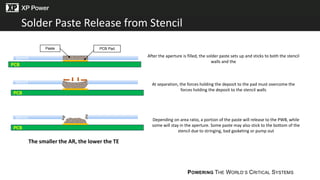
Solder Paste Release from Stencil
PCB
Stencil
Paste PCB Pad
PCB
Stencil
PCB
Stencil
After the aperture is filled, the solder paste sets up and sticks to both the stencil
walls and the
At separation, the forces holding the deposit to the pad must overcome the
forces holding the deposit to the stencil walls
Depending on area ratio, a portion of the paste will release to the PWB, while
some will stay in the aperture. Some paste may also stick to the bottom of the
stencil due to stringing, bad gasketing or pump out
The smaller the AR, the lower the TE
POWERING THE WORLD’S CRITICAL SYSTEMS
Stepping Stencil
Stepping is critical in many processes, especially when stencil design calculations are being performed based on aperture volumes and area
ratios
Keys to a successful print process
• As a general design guide K1should be 0.9mm[35.4mil] for every
0.025mm[0.98mil] of step-down thickness.
• K1 is distance form the step edge to the nearest aperture in
stepped down area
IPC 7525 stencil guidelines
Step Depth K1 Distance
0.010mm, 0.4mil 0.36mm, 14mil
0.025mm, 1mil 0.90mm, 35 mil
0.030mm, 1.2mil 1.08mm, 42mil
0.050mm, 2mil 1.80mm, 71mil
0.080mm, 3 mil 2.88mm, 113mil
0.100mm, 4mil 3.60mm, 142mil
Step Design Guidelines
K1
Step
Depth: no more than 2mil per step
Will lose fill pressure on solder paste
Keepout zone: distance from aperture to edge of step
Minimum recommended: 25mil
Preferred: as much as possible
Larger keepout zones:
Enable better squeegee deflection into recess
Keep the dried paste buildup in the corner of the pocket, away from the
apertures
SQUEEGEE
Keep out
perimeter
25mils
(0.625mm)
2mil, Max per step
Paste Buildup
PCB Layout Drives Stencil Print Process
POWERING THE WORLD’S CRITICAL SYSTEMS
Basis of calculation of the Stand-off process
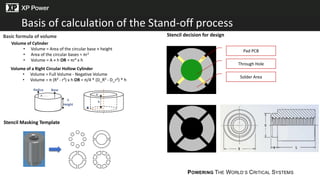
Volume of Cylinder
• Volume = Area of the circular base × height
• Area of the circular bases = πr2
• Volume = A × h OR = πr² x h
Volume of a Right Circular Hollow Cylinder
• Volume = Full Volume - Negative Volume
• Volume = π (R² - r²) x h OR = π/4 * (D_R² - D_r²) * h
Basic formula of volume
Pad PCB
Through Hole
Solder Area
Base
Radius
h
Height
r
h
r
R
Stencil Masking Template
Stencil decision for design
POWERING THE WORLD’S CRITICAL SYSTEMS
Details - Solder paste volume calculation
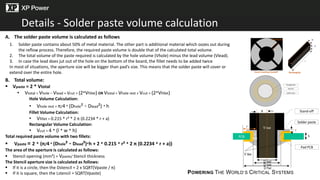
A. The solder paste volume is calculated as follows
1. Solder paste contains about 50% of metal material. The other part is additional material which oozes out during
the reflow process. Therefore, the required paste volume is double that of the calculated total volume.
2. The total volume of the paste required is calculated by the hole volume (Vhole) minus the lead volume (Vlead).
3. In case the lead does jut out of the hole on the bottom of the board, the fillet needs to be added twice
In most of situations, the aperture size will be bigger than pad’s size. This means that the solder paste will cover or
extend over the entire hole.
B. Total volume:
▪ Vpaste = 2 * Vtotal
• Vtotal = Vhole – Vlead + Vcut + (2*Vfillet) OR Vtotal = Vhole rest + Vcut + (2*Vfillet)
Hole Volume Calculation:
• Vhole rest = π/4 * (Dhole² - Dlead²) * h
Fillet Volume Calculation:
• Vfillet = 0.215 * r² * 2 π (0.2234 * r + a)
Rectangular Volume Calculation:
• Vcut = 4 * (l * w * h)
Total required paste volume with two fillets:
▪ Vpaste = 2 * (π/4 * (Dhole² - Dlead²)*h + 2 * 0.215 * r² * 2 π (0.2234 * r + a))
The area of the aperture is calculated as follows:
▪ Stencil opening (mm²) = Vpaste/ Stencil thickness
The Stencil aperture size is calculated as follows:
▪ If it is a circle, then the Dstencil = 2 x SQRT(Vpaste / π)
▪ If it is square, then the Lstencil = SQRT(Vpaste)
V
hole
V lead
PCB
Stand-off
V fillet
D lead
D hole
h
r
a
r
Solder paste
Pad PCB
D Pad
POWERING THE WORLD’S CRITICAL SYSTEMS
Formular Using Step up Stencil
Stencil
thickness
Solder
pad
diameter
PCB hole
diameter
Standoff
diameter
PCB
thickness
π/4*(Dhole
²)*h
π/4*(Dle
ad²)*h
π/4*(Dhole²-
Dlead²)*h
(Dpad-
Dlead)/2
Dlead/2 0.215*r²*2π(0.2
234*r+a)
Vhole rest +
(2*Vfillet)
2*(Vhole
rest+Vfillet)
2*(Vhole
rest+2*Vfillet)
Vpaste/ ts 2*SQRT(Vpaste
/ π)
SQRT*(Vpaste) Length
Rectangl
e
Width
Rectangle
Stencil
thickness
No. Model PCB PN FS - P/N SAP - P/N Description ts Dpad Dhole Dlead h
Vhole
(mm³)
Vlead
(mm³)
Vhole rest
(mm³)
r (mm) a (mm) Vfillet (mm³) Vtotal (mm³)
Vpaste with one
fillet
Vpaste with two
fillets (mm³)
Stencil opening
(mm²)
Circle Dstencil
(mm)
Square Lstencil
(mm)
l
w (defause
0.5mm)
h
Vcut
(mm³)
Vpaste
design
Stencil
opening
design
Circle
Dstencil
design
Square
Lstencil
design
0 MP 10000844C1 251014 IN60000048264 STANDOFFS SWAGE 1/4-HEX 6-32 X 1/8 BRS NICKEL PLATE
0.17 2.6 1.1 0.7 1.5 1.42 0.58 0.85 0.95 0.35 0.69 2.22 3.07 4.44 26.09 5.77 5.11 4.67 0.50 0.17 3.17 7.61 44.76 7.55 6.69
1 Flex 10010814B0 29-0100-002 IN60000006319 STANDOFF 6-32 1/4L 1/4 DIA 0.13 6.80 4.85 4.78 1.60 29.56 28.70 0.86 1.01 2.39 3.60 8.07 8.93 16.14 124.14 12.58 11.14 7.72 0.50 0.13 4.02 20.15 155.03 14.05 12.45
2 MP 10000844C1 251014 IN60000048264 STANDOFFS SWAGE 1/4-HEX 6-32 X 1/8 BRS NICKEL PLATE
0.13 7.2 4.8514 4.76 1.60 29.56 28.46 1.10 1.22 2.38 5.33 11.76 12.87 23.53 181.00 15.18 13.45 10.33 0.50 0.13 5.37 28.90 222.33 16.83 14.91
3 MP 10002195D0 10000708 IN60000035550 STANDOFF 4-40 X .250L X .187 OD SWAGE 0.13 6.5 3.7338 3.68 1.60 17.51 17.01 0.50 1.41 1.84 5.78 12.07 12.57 24.14 185.70 15.38 13.63 11.65 0.50 0.13 6.06 30.20 232.29 17.20 15.24
4 MP 10000679B0 10000708 IN60000035550 STANDOFF 4-40 X .250L X .187 OD SWAGE 0.13 6.5 3.7338 3.68 1.60 17.51 17.01 0.50 1.41 1.84 5.78 12.07 12.57 24.14 185.70 15.38 13.63 11.65 0.50 0.13 6.06 30.20 232.29 17.20 15.24
5 MP 10002338B1 10000745 IN60000032257 STANDOFF 4-40 X .1560L X .188 OD 0.13 6.5 3.7338 3.68 1.60 17.51 17.01 0.50 1.41 1.84 5.78 12.07 12.57 24.14 185.70 15.38 13.63 11.65 0.50 0.13 6.06 30.20 232.29 17.20 15.24
6 Flex 10014380-C 10001663 IN60000014336 STANDOFFS SWAGE 3/16 OD X 1/8 M3 0.13 6.5 3.6576 3.53 1.60 16.80 15.65 1.15 1.49 1.77 6.24 13.64 14.79 27.28 209.82 16.35 14.49 12.69 0.50 0.13 6.60 33.88 260.58 18.22 16.14
7 LP 10001263-E 10001663 IN60000014336 STANDOFFS SWAGE 3/16 OD X 1/8 M3 0.13 6.5 3.6576 3.53 1.60 16.80 15.65 1.15 1.49 1.77 6.24 13.64 14.79 27.28 209.82 16.35 14.49 12.69 0.50 0.13 6.60 33.88 260.58 18.22 16.14
8 LP 10001277-D1 10001663 IN60000014336 STANDOFFS SWAGE 3/16 OD X 1/8 M3 0.13 6.5 3.6576 3.53 1.60 16.80 15.65 1.15 1.49 1.77 6.24 13.64 14.79 27.28 209.82 16.35 14.49 12.69 0.50 0.13 6.60 33.88 260.58 18.22 16.14
9 LP 10001296-D1 10001663 IN60000014336 STANDOFFS SWAGE 3/16 OD X 1/8 M3 0.13 6.5 3.6576 3.53 1.60 16.80 15.65 1.15 1.49 1.77 6.24 13.64 14.79 27.28 209.82 16.35 14.49 12.69 0.50 0.13 6.60 33.88 260.58 18.22 16.14
10 LP 10001309-D1 10001663 IN60000014336 STANDOFFS SWAGE 3/16 OD X 1/8 M3 0.13 6.5 3.6576 3.53 1.60 16.80 15.65 1.15 1.49 1.77 6.24 13.64 14.79 27.28 209.82 16.35 14.49 12.69 0.50 0.13 6.60 33.88 260.58 18.22 16.14
11 LP 10001801-D 10001663 IN60000014336 STANDOFFS SWAGE 3/16 OD X 1/8 M3 0.13 6.5 3.6576 3.53 1.60 16.80 15.65 1.15 1.49 1.77 6.24 13.64 14.79 27.28 209.82 16.35 14.49 12.69 0.50 0.13 6.60 33.88 260.58 18.22 16.14
12 GFR1K5 10007070-C 10001663 IN60000014336 STANDOFFS SWAGE 3/16 OD X 1/8 M3 0.13 6.5 3.6576 3.53 1.60 16.80 15.65 1.15 1.49 1.77 6.24 13.64 14.79 27.28 209.82 16.35 14.49 12.69 0.50 0.13 6.60 33.88 260.58 18.22 16.14
13 HPU1K5 10010646-C1 10001663 IN60000014336 STANDOFFS SWAGE 3/16 OD X 1/8 M3 0.13 6.5 3.6576 3.53 1.60 16.80 15.65 1.15 1.49 1.77 6.24 13.64 14.79 27.28 209.82 16.35 14.49 12.69 0.50 0.13 6.60 33.88 260.58 18.22 16.14
14 LP 10004600D1 10001664 IN60000013017 STANDOFFS SWAGE 3/16 OD X 3/16 M3 0.13 6.5 3.6576 3.53 1.60 16.80 15.65 1.15 1.49 1.77 6.24 13.64 14.79 27.28 209.82 16.35 14.49 12.69 0.50 0.13 6.60 33.88 260.58 18.22 16.14
15 LP 10004652-C1 10001664 IN60000013017 STANDOFFS SWAGE 3/16 OD X 3/16 M3 0.13 6.5 3.6576 3.53 1.60 16.80 15.65 1.15 1.49 1.77 6.24 13.64 14.79 27.28 209.82 16.35 14.49 12.69 0.50 0.13 6.60 33.88 260.58 18.22 16.14
16 CCL400 10014999-B 10017247 IN60000028404 STANDOFF SWAGE 4.75 OD X 3.5 M3 0.13 6.5 3.6576 3.53 1.60 16.80 15.65 1.15 1.49 1.77 6.24 13.64 14.79 27.28 209.82 16.35 14.49 12.69 0.50 0.13 6.60 33.88 260.58 18.22 16.14
17 Flex 10004205-K 29-0100-002 IN60000006319 STANDOFF 6-32 1/4L 1/4 DIA 0.13 7.2 4.8514 4.78 1.60 29.56 28.70 0.86 1.21 2.39 5.26 11.38 12.25 22.76 175.10 14.94 13.23 10.08 0.50 0.13 5.24 28.01 215.44 16.57 14.68
18 Flex 10004503-G 29-0100-002 IN60000006319 STANDOFF 6-32 1/4L 1/4 DIA 0.13 7.2 4.8514 4.78 1.60 29.56 28.70 0.86 1.21 2.39 5.26 11.38 12.25 22.76 175.10 14.94 13.23 10.08 0.50 0.13 5.24 28.01 215.44 16.57 14.68
19 Flex 10004892-E 29-0100-002 IN60000006319 STANDOFF 6-32 1/4L 1/4 DIA 0.13 7.2 4.8514 4.78 1.60 29.56 28.70 0.86 1.21 2.39 5.26 11.38 12.25 22.76 175.10 14.94 13.23 10.08 0.50 0.13 5.24 28.01 215.44 16.57 14.68
20 Flex 10009046-D 29-0100-002 IN60000006319 STANDOFF 6-32 1/4L 1/4 DIA 0.13 7.2 4.8514 4.78 1.60 29.56 28.70 0.86 1.21 2.39 5.26 11.38 12.25 22.76 175.10 14.94 13.23 10.08 0.50 0.13 5.24 28.01 215.44 16.57 14.68
21 Flex 10009047-E 29-0100-002 IN60000006319 STANDOFF 6-32 1/4L 1/4 DIA 0.13 7.2 4.8514 4.78 1.60 29.56 28.70 0.86 1.21 2.39 5.26 11.38 12.25 22.76 175.10 14.94 13.23 10.08 0.50 0.13 5.24 28.01 215.44 16.57 14.68
22 Flex 10010526-A 29-0100-002 IN60000006319 STANDOFF 6-32 1/4L 1/4 DIA 0.13 7.2 4.8514 4.78 1.60 29.56 28.70 0.86 1.21 2.39 5.26 11.38 12.25 22.76 175.10 14.94 13.23 10.08 0.50 0.13 5.24 28.01 215.44 16.57 14.68
23 Flex 10016717-B 29-0100-002 IN60000006319 STANDOFF 6-32 1/4L 1/4 DIA 0.13 7.2 4.8514 4.78 1.60 29.56 28.70 0.86 1.21 2.39 5.26 11.38 12.25 22.76 175.10 14.94 13.23 10.08 0.50 0.13 5.24 28.01 215.44 16.57 14.68
24 Flex 10016719-B 29-0100-002 IN60000006319 STANDOFF 6-32 1/4L 1/4 DIA 0.13 7.2 4.8514 4.78 1.60 29.56 28.70 0.86 1.21 2.39 5.26 11.38 12.25 22.76 175.10 14.94 13.23 10.08 0.50 0.13 5.24 28.01 215.44 16.57 14.68
25 Flex 10024380-A 29-0100-002 IN60000006319 STANDOFF 6-32 1/4L 1/4 DIA 0.13 7.2 4.8514 4.78 1.60 29.56 28.70 0.86 1.21 2.39 5.26 11.38 12.25 22.76 175.10 14.94 13.23 10.08 0.50 0.13 5.24 28.01 215.44 16.57 14.68
26 Flex 10024373-A 29-0100-002 IN60000006319 STANDOFF 6-32 1/4L 1/4 DIA 0.13 7.2 4.8514 4.78 1.60 29.56 28.70 0.86 1.21 2.39 5.26 11.38 12.25 22.76 175.10 14.94 13.23 10.08 0.50 0.13 5.24 28.01 215.44 16.57 14.68
27 MP 10002159-C1 29-0100-046 IN60000029332 0.13 7.2 4.8514 4.78 1.60 29.56 28.70 0.86 1.21 2.39 5.26 11.38 12.25 22.76 175.10 14.94 13.23 10.08 0.50 0.13 5.24 28.01 215.44 16.57 14.68
28 MP 10000090C0 29-0100-046 IN60000029332 0.13 7.2 4.8514 4.78 1.60 29.56 28.70 0.86 1.21 2.39 5.26 11.38 12.25 22.76 175.10 14.94 13.23 10.08 0.50 0.13 5.24 28.01 215.44 16.57 14.68
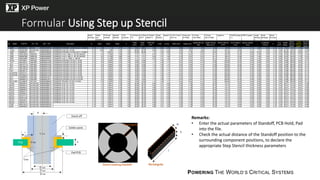
Remarks:
• Enter the actual parameters of Standoff, PCB Hold, Pad
into the file.
• Check the actual distance of the Standoff position to the
surrounding component positions, to declare the
appropriate Step Stencil thickness parameters
POWERING THE WORLD’S CRITICAL SYSTEMS
Flow Chart Step up Stencil for Standoff
Input info. Standoff
Dpad, Dhole, ts
START
Fail
Pass
Input info. Pad PCB
Dlead, h
Input Min. safe Distance
between
Adjust Stencil
thickness
END
Eng. Review
Next process
POWERING THE WORLD’S CRITICAL SYSTEMS
Actual Result- Solder Joint on Standoff
Description
method
Install method (Solder
Install method (Solder,
Standoff…)
Top Side Bottom Side Comment
Location #1
Location #2
Location #3
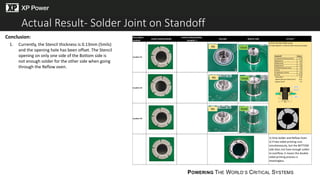
1) Only Solder and Reflow Oven
2) If two-sided printing runs
simultaneously, but the BOTTOM
side does not have enough solder
to overflow, it means the double-
sided printing process is
meaningless.
1) Only one Side Solder paste
2) Total Vpaste 7.5 (mm³) with result as photos
Standoff Value
ts (Stencil thickness) (mm) 0.13
Dpad (mm) 5.4
Dhole (mm) 3.7
Dlead (mm) 3.5
h (PCB thickness) (mm) 1.6
l (mm) 7.3
w (defause 0.5mm) 0.5
h (mm) 0.13
Vcut (mm³) 4.8
Vpaste with two fillets (mm³) 12.3
Vpaste (mm³) 7.5
Good
NG
NG
NG
Good
Good
Conclusion:
1. Currently, the Stencil thickness is 0.13mm (5mils)
and the opening hole has been offset. The Stencil
opening on only one side of the Bottom side is
not enough solder for the other side when going
through the Reflow oven.
POWERING THE WORLD’S CRITICAL SYSTEMS
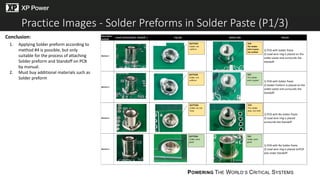
Practice Images - Solder Preforms in Solder Paste (P1/3)
Description
method
Install method (Solder, Standoff…) Top Side Bottom Side Remark
Method 1
1) PCB with Solder Paste
2) Lead wire ring is placed on the
solder paste and surrounds the
Standoff
Method 2
1) PCB with Solder Paste
2) Solder Preform is placed on the
solder paste and surrounds the
Standoff
Method 3
1) PCB with No Solder Paste
2) Lead wire ring is placed
surrounds the Standoff
Method 4
1) PCB with No Solder Paste
2) Lead wire ring is placed onPCB
and under Standoff
BOTTOM:
Solder not
uniform
TOP:
The Solder
joint is poor,
not melted
BOTTOM:
Solder not
uniform
TOP:
The Solder
joint is good
BOTTOM:
Solder do not
have
TOP:
The Solder
does not melt
BOTTOM:
Solder joint
good
TOP:
Solder joint
good
Conclusion:
1. Applying Solder preform according to
method #4 is possible, but only
suitable for the process of attaching
Solder preform and Standoff on PCB
by manual.
2. Must buy additional materials such as
Solder preform
POWERING THE WORLD’S CRITICAL SYSTEMS
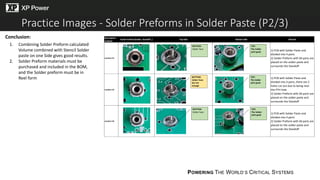
Practice Images - Solder Preforms in Solder Paste (P2/3)
Description
method
Install method (Solder, Standoff…) Top Side Bottom Side Remark
Location #1
1) PCB with Solder Paste and
divided into 4 parts
2) Solder Preform with 04 parts are
placed on the solder paste and
surrounds the Standoff
Location #2
1) PCB with Solder Paste and
divided into 4 parts, there are 2
holes cut out due to being near
the PTH hole
2) Solder Preform with 04 parts are
placed on the solder paste and
surrounds the Standoff
Location #3
1) PCB with Solder Paste and
divided into 4 parts
2) Solder Preform with 04 parts are
placed on the solder paste and
surrounds the Standoff
BOTTOM:
Solder have
TOP:
The Solder
joint good
BOTTOM:
Solder have
but not
enough
TOP:
The Solder
joint good
BOTTOM:
Solder have
TOP:
The Solder
joint good
Conclusion:
1. Combining Solder Preform calculated
Volume combined with Stencil Solder
paste on one Side gives good results.
2. Solder Preform materials must be
purchased and included in the BOM,
and the Solder preform must be in
Reel form
POWERING THE WORLD’S CRITICAL SYSTEMS
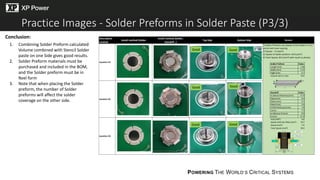
Practice Images - Solder Preforms in Solder Paste (P3/3)
Description
method
Install method (Solder
Install method (Solder,
Standoff…)
Top Side Bottom Side Remark
Location #1
Location #2
Location #3
1) Solder Preforms are placed at the Solder's V-Cut
points with even spacing
2) Vpaste : 7.5 (mm³)
3) Vpaste of Solder preform: 10.9 (mm³)
4) Total Vpaste 18.4 (mm³) with result as photos
Solder Preform Value
Length (mm) 2.46
Width (mm) 1.27
Hight (mm) 0.7
Volume (mmᶟ) x 5ea 10.9
Standoff Value
ts (Stencil thickness) (mm) 0.13
Dpad (mm) 5.4
Dhole (mm) 3.7
Dlead (mm) 3.5
h (PCB thickness) (mm) 1.6
l (mm) 7.3
w (defause 0.5mm) 0.5
h (mm) 0.13
Vcut (mm³) 4.8
Vpaste with two fillets (mm³) 12.3
Vpaste (mm³) 7.5
Total Vpaste (mm³) 18.4
h
w
l
Good Good
Good
Good
Good
Good
Conclusion:
1. Combining Solder Preform calculated
Volume combined with Stencil Solder
paste on one Side gives good results.
2. Solder Preform materials must be
purchased and included in the BOM,
and the Solder preform must be in
Reel form
3. Note that when placing the Solder
preform, the number of Solder
preforms will affect the solder
coverage on the other side.
POWERING THE WORLD’S CRITICAL SYSTEMS
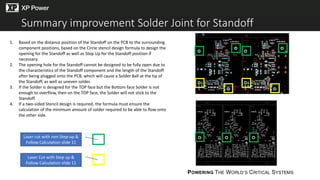
Summary improvement Solder Joint for Standoff
1. Based on the distance position of the Standoff on the PCB to the surrounding
component positions, based on the Circle stencil design formula to design the
opening for the Standoff as well as Step Up for the Standoff position if
necessary.
2. The opening hole for the Standoff cannot be designed to be fully open due to
the characteristics of the Standoff component and the length of the Standoff
after being plugged onto the PCB, which will cause a Solder Ball at the tip of
the Standoff, as well as uneven solder.
3. If the Solder is designed for the TOP face but the Bottom face Solder is not
enough to overflow, then on the TOP face, the Solder will not stick to the
Standoff.
4. If a two-sided Stencil design is required, the formula must ensure the
calculation of the minimum amount of solder required to be able to flow onto
the other side.
Laser cut with non Step-up &
Follow Calculation slide 11
Laser Cut with Step up &
Follow Calculation slide 11
xppower.com

Y2023 - Standoff Impovement V1.2.pdf

  • 1.
    Y2023 –Engineering StandoffImprovement Prepared by: hvthe 13th Oct 23
  • 2.
    POWERING THE WORLD’SCRITICAL SYSTEMS Overview – Type of Material & Package A. CURRENT STATUS 1. MATERIAL ❖ Standoff Part Number ❖ PCB Part Number with Standoff No. PCB P/N Flex- Chassis Flex- Nano LP- Chassis LP- Module MP- Module GFR1K5 HPU1K5 Grand Total 1 IN60000000794-D 7 7 2 IN60000002881-B 2 2 3 IN60000008507-C 3 3 4 IN60000022358-E 26 26 5 IN60000022442-B 2 2 6 IN60000034946-C1 16 16 7 IN60000036276-C1 14 14 8 IN60000036370-C1 9 9 9 IN60000038898-D1 19 19 10 IN60000041549-E 25 25 11 IN60000046492-E 12 12 12 IN60000046493-D1 14 14 13 IN60000046511-B1 3 3 14 IN60000046541-K 26 26 15 IN60000046554-G 18 18 16 IN60000046742-D 27 27 17 IN60000046817-A 6 6 18 IN60000046949-C 3 3 19 IN60000047053-C 2 2 20 IN60000047292-A 65 65 21 IN60000047293-A 7 7 22 IN60000047294-A 32 32 Grand Total 238 3 30 52 3 3 9 338 Standoff P/N Qty. P/N IN60000013017 30 LP-Chassis 30 IN60000014336 67 Flex-Nano 3 GFR1K5 3 HPU1K5 9 LP-Module 52 IN60000032257 3 MP-Module 3 IN60000037995 238 Flex-Chassis 238 Grand Total 338 ❖ Standoff Package
  • 3.
    POWERING THE WORLD’SCRITICAL SYSTEMS Overview – Method & Results 3) Work Instruction 1) Stencil Design 2) Solder paste printing 5) Post Reflow • Design Stencil with Single Side • Apply Step up at bottom side with tape for some kind of PCB • Details of design aperture hold follow material dimension (Standoff, PCB) • Printing solder paste by Screen Printer machine on Bottom Side • Work Instruction for assembling standoff on PCB Surface • Top Side: Solder good full fill 4) Mounting Standoff • Standoff will mount on PCB by manual follow Work instruction after SPI machine • Bottom Side: i. Solder fills around the holes of the PCBA ii. There is no Solder paste raised to the side of the standoff 6) Manual Solder • Using manual soldering for bottom side
  • 4.
    POWERING THE WORLD’SCRITICAL SYSTEMS Overview - Solution Using Step up Stencil with double side Manual add Solder Paste Using Step up Stencil Solder Preforms in Solder Paste • Step up on the x (mm) on the rest Squeegee 0.13mm Bottom Solder Top Solder Bottom Solder Top Solder
  • 5.
    POWERING THE WORLD’SCRITICAL SYSTEMS Overview – Advantage & Disadvantage Method Solder Preforms in Solder Paste Using Step up Stencil Using Step up Stencil with double side Manual add Solder Paste Advantages 1) Improved first pass yield 2) 100% hole fill, fillets as required 3) No board thickness limitations 4) Increased solder volume without the need for PCB layout changes or use of step stencils 5) Reduced rework and other manual processes to add solder volume 6) Elimination of costly or time-consuming processes, such as wave soldering or manual soldering 1) Just apply one Screen Printing process 1) Support for PCBs with dense component density NA Disadvantages 1) Need to use of tape and reel packing 2) Components tolerate reflow temperature 3) Component stand-off height 4) No shoulder on pins 5) No paste is printed underneath stand-off 6) Pin protrusion is not excessive 7) Pin hole ratio is reasonable 1) Not suitable for PCBs with high density of components around the Standoff position 2) Solder will not meet the requirements for surrounding component locations 3) The Squeegee blade will quickly deform and must be replaced 4) PCBs need to be reviewed and classified whether or not this method can be used 1) Two printing processes need to be applied during production 2) There may be a Solder Ball on the other side 1) Solder is replenished unevenly 2) Need a Headcount to do the job 3) There is a risk of affecting other locations during the addition process 4) Standoff may be slanted or unevenly raised Conclusion 1) Cannot be applied because there are no raw materials 2) If applied to add temporary fillets, it is necessary to prepare Solder preforms and attach them manually or design a Tray to place them. 3) If there are raw materials, Standoff must also ensure packaging in Tape & Reel form 1) Review the PCB and apply the Step-up hole ratio and thickness formula to get results on one type of PCB and proceed with the next process. 1) Review the PCB and apply the Step-up hole ratio and thickness formula to get results on one type of PCB and proceed with the next process. 1) NA
  • 6.
    POWERING THE WORLD’SCRITICAL SYSTEMS Basic Metrics in Stencil Printing 𝐀𝐑 = 𝑨𝒓𝒆𝒂 𝒐𝒇 𝑪𝒊𝒓𝒄𝒖𝒊𝒕 𝑺𝒊𝒅𝒆 𝑶𝒑𝒆𝒏𝒊𝒏𝒈 𝑨𝒓𝒆𝒂 𝒐𝒇 𝑨𝒑𝒆𝒓𝒕𝒖𝒓𝒆 𝑾𝒂𝒍𝒍𝒔 𝑺𝒊𝒅𝒆 𝑳𝒆𝒏𝒈𝒕𝒉 𝒐𝒇 𝑺𝒒𝒖𝒂𝒓𝒆 𝟒 𝑿 𝑺𝒕𝒆𝒏𝒄𝒊𝒍 𝑻𝒉𝒊𝒄𝒌𝒏𝒆𝒔𝒔 𝑨𝑹𝑺𝒒𝒖𝒂𝒓𝒆 = Square: 𝑫𝒊𝒂𝒎𝒆𝒕𝒆𝒓 𝒐𝒇 𝑪𝒊𝒓𝒄𝒍𝒆 𝟒 𝑿 𝑺𝒕𝒆𝒏𝒄𝒊𝒍 𝑻𝒉𝒊𝒄𝒌𝒏𝒆𝒔𝒔 𝑨𝑹𝑪𝒊𝒓𝒄𝒍𝒆 = Circle: Area Ratio (AR) Transfer Efficiency, TE • Relates how much paste we want to print versus how much we actually printed • Minimum of 80% TE when possible %𝑇𝐸 = 𝑽𝒐𝒍𝒖𝒎𝒆 𝒐𝒇 𝑷𝒂𝒔𝒕𝒆 𝑫𝒆𝒑𝒐𝒔𝒊𝒕𝒆𝒅 𝑽𝒐𝒍𝒖𝒎𝒆 𝒐𝒇 𝑺𝒕𝒆𝒏𝒄𝒊𝒍 𝑨𝒑𝒆𝒓𝒕𝒖𝒓𝒆 X 100 See IPC-7525B for stencil design standards Aperture Wall Circuit Side Opening Stencil Thickness • A stencil aperture’s Area Ratio helps predict the volume of paste deposited on the PCB • The aperture volume is multiplied by the Transfer Efficiency to predict the paste deposit’s volume • Changing aperture size or foil thickness changes AR. • Changing paste, stencil or print parameters can change TE
  • 7.
    POWERING THE WORLD’SCRITICAL SYSTEMS Solder Paste Release from Stencil PCB Stencil Paste PCB Pad PCB Stencil PCB Stencil After the aperture is filled, the solder paste sets up and sticks to both the stencil walls and the At separation, the forces holding the deposit to the pad must overcome the forces holding the deposit to the stencil walls Depending on area ratio, a portion of the paste will release to the PWB, while some will stay in the aperture. Some paste may also stick to the bottom of the stencil due to stringing, bad gasketing or pump out The smaller the AR, the lower the TE
  • 8.
    POWERING THE WORLD’SCRITICAL SYSTEMS Stepping Stencil Stepping is critical in many processes, especially when stencil design calculations are being performed based on aperture volumes and area ratios Keys to a successful print process • As a general design guide K1should be 0.9mm[35.4mil] for every 0.025mm[0.98mil] of step-down thickness. • K1 is distance form the step edge to the nearest aperture in stepped down area IPC 7525 stencil guidelines Step Depth K1 Distance 0.010mm, 0.4mil 0.36mm, 14mil 0.025mm, 1mil 0.90mm, 35 mil 0.030mm, 1.2mil 1.08mm, 42mil 0.050mm, 2mil 1.80mm, 71mil 0.080mm, 3 mil 2.88mm, 113mil 0.100mm, 4mil 3.60mm, 142mil Step Design Guidelines K1 Step Depth: no more than 2mil per step Will lose fill pressure on solder paste Keepout zone: distance from aperture to edge of step Minimum recommended: 25mil Preferred: as much as possible Larger keepout zones: Enable better squeegee deflection into recess Keep the dried paste buildup in the corner of the pocket, away from the apertures SQUEEGEE Keep out perimeter 25mils (0.625mm) 2mil, Max per step Paste Buildup PCB Layout Drives Stencil Print Process
  • 9.
    POWERING THE WORLD’SCRITICAL SYSTEMS Basis of calculation of the Stand-off process Volume of Cylinder • Volume = Area of the circular base × height • Area of the circular bases = πr2 • Volume = A × h OR = πr² x h Volume of a Right Circular Hollow Cylinder • Volume = Full Volume - Negative Volume • Volume = π (R² - r²) x h OR = π/4 * (D_R² - D_r²) * h Basic formula of volume Pad PCB Through Hole Solder Area Base Radius h Height r h r R Stencil Masking Template Stencil decision for design
  • 10.
    POWERING THE WORLD’SCRITICAL SYSTEMS Details - Solder paste volume calculation A. The solder paste volume is calculated as follows 1. Solder paste contains about 50% of metal material. The other part is additional material which oozes out during the reflow process. Therefore, the required paste volume is double that of the calculated total volume. 2. The total volume of the paste required is calculated by the hole volume (Vhole) minus the lead volume (Vlead). 3. In case the lead does jut out of the hole on the bottom of the board, the fillet needs to be added twice In most of situations, the aperture size will be bigger than pad’s size. This means that the solder paste will cover or extend over the entire hole. B. Total volume: ▪ Vpaste = 2 * Vtotal • Vtotal = Vhole – Vlead + Vcut + (2*Vfillet) OR Vtotal = Vhole rest + Vcut + (2*Vfillet) Hole Volume Calculation: • Vhole rest = π/4 * (Dhole² - Dlead²) * h Fillet Volume Calculation: • Vfillet = 0.215 * r² * 2 π (0.2234 * r + a) Rectangular Volume Calculation: • Vcut = 4 * (l * w * h) Total required paste volume with two fillets: ▪ Vpaste = 2 * (π/4 * (Dhole² - Dlead²)*h + 2 * 0.215 * r² * 2 π (0.2234 * r + a)) The area of the aperture is calculated as follows: ▪ Stencil opening (mm²) = Vpaste/ Stencil thickness The Stencil aperture size is calculated as follows: ▪ If it is a circle, then the Dstencil = 2 x SQRT(Vpaste / π) ▪ If it is square, then the Lstencil = SQRT(Vpaste) V hole V lead PCB Stand-off V fillet D lead D hole h r a r Solder paste Pad PCB D Pad
  • 11.
    POWERING THE WORLD’SCRITICAL SYSTEMS Formular Using Step up Stencil Stencil thickness Solder pad diameter PCB hole diameter Standoff diameter PCB thickness π/4*(Dhole ²)*h π/4*(Dle ad²)*h π/4*(Dhole²- Dlead²)*h (Dpad- Dlead)/2 Dlead/2 0.215*r²*2π(0.2 234*r+a) Vhole rest + (2*Vfillet) 2*(Vhole rest+Vfillet) 2*(Vhole rest+2*Vfillet) Vpaste/ ts 2*SQRT(Vpaste / π) SQRT*(Vpaste) Length Rectangl e Width Rectangle Stencil thickness No. Model PCB PN FS - P/N SAP - P/N Description ts Dpad Dhole Dlead h Vhole (mm³) Vlead (mm³) Vhole rest (mm³) r (mm) a (mm) Vfillet (mm³) Vtotal (mm³) Vpaste with one fillet Vpaste with two fillets (mm³) Stencil opening (mm²) Circle Dstencil (mm) Square Lstencil (mm) l w (defause 0.5mm) h Vcut (mm³) Vpaste design Stencil opening design Circle Dstencil design Square Lstencil design 0 MP 10000844C1 251014 IN60000048264 STANDOFFS SWAGE 1/4-HEX 6-32 X 1/8 BRS NICKEL PLATE 0.17 2.6 1.1 0.7 1.5 1.42 0.58 0.85 0.95 0.35 0.69 2.22 3.07 4.44 26.09 5.77 5.11 4.67 0.50 0.17 3.17 7.61 44.76 7.55 6.69 1 Flex 10010814B0 29-0100-002 IN60000006319 STANDOFF 6-32 1/4L 1/4 DIA 0.13 6.80 4.85 4.78 1.60 29.56 28.70 0.86 1.01 2.39 3.60 8.07 8.93 16.14 124.14 12.58 11.14 7.72 0.50 0.13 4.02 20.15 155.03 14.05 12.45 2 MP 10000844C1 251014 IN60000048264 STANDOFFS SWAGE 1/4-HEX 6-32 X 1/8 BRS NICKEL PLATE 0.13 7.2 4.8514 4.76 1.60 29.56 28.46 1.10 1.22 2.38 5.33 11.76 12.87 23.53 181.00 15.18 13.45 10.33 0.50 0.13 5.37 28.90 222.33 16.83 14.91 3 MP 10002195D0 10000708 IN60000035550 STANDOFF 4-40 X .250L X .187 OD SWAGE 0.13 6.5 3.7338 3.68 1.60 17.51 17.01 0.50 1.41 1.84 5.78 12.07 12.57 24.14 185.70 15.38 13.63 11.65 0.50 0.13 6.06 30.20 232.29 17.20 15.24 4 MP 10000679B0 10000708 IN60000035550 STANDOFF 4-40 X .250L X .187 OD SWAGE 0.13 6.5 3.7338 3.68 1.60 17.51 17.01 0.50 1.41 1.84 5.78 12.07 12.57 24.14 185.70 15.38 13.63 11.65 0.50 0.13 6.06 30.20 232.29 17.20 15.24 5 MP 10002338B1 10000745 IN60000032257 STANDOFF 4-40 X .1560L X .188 OD 0.13 6.5 3.7338 3.68 1.60 17.51 17.01 0.50 1.41 1.84 5.78 12.07 12.57 24.14 185.70 15.38 13.63 11.65 0.50 0.13 6.06 30.20 232.29 17.20 15.24 6 Flex 10014380-C 10001663 IN60000014336 STANDOFFS SWAGE 3/16 OD X 1/8 M3 0.13 6.5 3.6576 3.53 1.60 16.80 15.65 1.15 1.49 1.77 6.24 13.64 14.79 27.28 209.82 16.35 14.49 12.69 0.50 0.13 6.60 33.88 260.58 18.22 16.14 7 LP 10001263-E 10001663 IN60000014336 STANDOFFS SWAGE 3/16 OD X 1/8 M3 0.13 6.5 3.6576 3.53 1.60 16.80 15.65 1.15 1.49 1.77 6.24 13.64 14.79 27.28 209.82 16.35 14.49 12.69 0.50 0.13 6.60 33.88 260.58 18.22 16.14 8 LP 10001277-D1 10001663 IN60000014336 STANDOFFS SWAGE 3/16 OD X 1/8 M3 0.13 6.5 3.6576 3.53 1.60 16.80 15.65 1.15 1.49 1.77 6.24 13.64 14.79 27.28 209.82 16.35 14.49 12.69 0.50 0.13 6.60 33.88 260.58 18.22 16.14 9 LP 10001296-D1 10001663 IN60000014336 STANDOFFS SWAGE 3/16 OD X 1/8 M3 0.13 6.5 3.6576 3.53 1.60 16.80 15.65 1.15 1.49 1.77 6.24 13.64 14.79 27.28 209.82 16.35 14.49 12.69 0.50 0.13 6.60 33.88 260.58 18.22 16.14 10 LP 10001309-D1 10001663 IN60000014336 STANDOFFS SWAGE 3/16 OD X 1/8 M3 0.13 6.5 3.6576 3.53 1.60 16.80 15.65 1.15 1.49 1.77 6.24 13.64 14.79 27.28 209.82 16.35 14.49 12.69 0.50 0.13 6.60 33.88 260.58 18.22 16.14 11 LP 10001801-D 10001663 IN60000014336 STANDOFFS SWAGE 3/16 OD X 1/8 M3 0.13 6.5 3.6576 3.53 1.60 16.80 15.65 1.15 1.49 1.77 6.24 13.64 14.79 27.28 209.82 16.35 14.49 12.69 0.50 0.13 6.60 33.88 260.58 18.22 16.14 12 GFR1K5 10007070-C 10001663 IN60000014336 STANDOFFS SWAGE 3/16 OD X 1/8 M3 0.13 6.5 3.6576 3.53 1.60 16.80 15.65 1.15 1.49 1.77 6.24 13.64 14.79 27.28 209.82 16.35 14.49 12.69 0.50 0.13 6.60 33.88 260.58 18.22 16.14 13 HPU1K5 10010646-C1 10001663 IN60000014336 STANDOFFS SWAGE 3/16 OD X 1/8 M3 0.13 6.5 3.6576 3.53 1.60 16.80 15.65 1.15 1.49 1.77 6.24 13.64 14.79 27.28 209.82 16.35 14.49 12.69 0.50 0.13 6.60 33.88 260.58 18.22 16.14 14 LP 10004600D1 10001664 IN60000013017 STANDOFFS SWAGE 3/16 OD X 3/16 M3 0.13 6.5 3.6576 3.53 1.60 16.80 15.65 1.15 1.49 1.77 6.24 13.64 14.79 27.28 209.82 16.35 14.49 12.69 0.50 0.13 6.60 33.88 260.58 18.22 16.14 15 LP 10004652-C1 10001664 IN60000013017 STANDOFFS SWAGE 3/16 OD X 3/16 M3 0.13 6.5 3.6576 3.53 1.60 16.80 15.65 1.15 1.49 1.77 6.24 13.64 14.79 27.28 209.82 16.35 14.49 12.69 0.50 0.13 6.60 33.88 260.58 18.22 16.14 16 CCL400 10014999-B 10017247 IN60000028404 STANDOFF SWAGE 4.75 OD X 3.5 M3 0.13 6.5 3.6576 3.53 1.60 16.80 15.65 1.15 1.49 1.77 6.24 13.64 14.79 27.28 209.82 16.35 14.49 12.69 0.50 0.13 6.60 33.88 260.58 18.22 16.14 17 Flex 10004205-K 29-0100-002 IN60000006319 STANDOFF 6-32 1/4L 1/4 DIA 0.13 7.2 4.8514 4.78 1.60 29.56 28.70 0.86 1.21 2.39 5.26 11.38 12.25 22.76 175.10 14.94 13.23 10.08 0.50 0.13 5.24 28.01 215.44 16.57 14.68 18 Flex 10004503-G 29-0100-002 IN60000006319 STANDOFF 6-32 1/4L 1/4 DIA 0.13 7.2 4.8514 4.78 1.60 29.56 28.70 0.86 1.21 2.39 5.26 11.38 12.25 22.76 175.10 14.94 13.23 10.08 0.50 0.13 5.24 28.01 215.44 16.57 14.68 19 Flex 10004892-E 29-0100-002 IN60000006319 STANDOFF 6-32 1/4L 1/4 DIA 0.13 7.2 4.8514 4.78 1.60 29.56 28.70 0.86 1.21 2.39 5.26 11.38 12.25 22.76 175.10 14.94 13.23 10.08 0.50 0.13 5.24 28.01 215.44 16.57 14.68 20 Flex 10009046-D 29-0100-002 IN60000006319 STANDOFF 6-32 1/4L 1/4 DIA 0.13 7.2 4.8514 4.78 1.60 29.56 28.70 0.86 1.21 2.39 5.26 11.38 12.25 22.76 175.10 14.94 13.23 10.08 0.50 0.13 5.24 28.01 215.44 16.57 14.68 21 Flex 10009047-E 29-0100-002 IN60000006319 STANDOFF 6-32 1/4L 1/4 DIA 0.13 7.2 4.8514 4.78 1.60 29.56 28.70 0.86 1.21 2.39 5.26 11.38 12.25 22.76 175.10 14.94 13.23 10.08 0.50 0.13 5.24 28.01 215.44 16.57 14.68 22 Flex 10010526-A 29-0100-002 IN60000006319 STANDOFF 6-32 1/4L 1/4 DIA 0.13 7.2 4.8514 4.78 1.60 29.56 28.70 0.86 1.21 2.39 5.26 11.38 12.25 22.76 175.10 14.94 13.23 10.08 0.50 0.13 5.24 28.01 215.44 16.57 14.68 23 Flex 10016717-B 29-0100-002 IN60000006319 STANDOFF 6-32 1/4L 1/4 DIA 0.13 7.2 4.8514 4.78 1.60 29.56 28.70 0.86 1.21 2.39 5.26 11.38 12.25 22.76 175.10 14.94 13.23 10.08 0.50 0.13 5.24 28.01 215.44 16.57 14.68 24 Flex 10016719-B 29-0100-002 IN60000006319 STANDOFF 6-32 1/4L 1/4 DIA 0.13 7.2 4.8514 4.78 1.60 29.56 28.70 0.86 1.21 2.39 5.26 11.38 12.25 22.76 175.10 14.94 13.23 10.08 0.50 0.13 5.24 28.01 215.44 16.57 14.68 25 Flex 10024380-A 29-0100-002 IN60000006319 STANDOFF 6-32 1/4L 1/4 DIA 0.13 7.2 4.8514 4.78 1.60 29.56 28.70 0.86 1.21 2.39 5.26 11.38 12.25 22.76 175.10 14.94 13.23 10.08 0.50 0.13 5.24 28.01 215.44 16.57 14.68 26 Flex 10024373-A 29-0100-002 IN60000006319 STANDOFF 6-32 1/4L 1/4 DIA 0.13 7.2 4.8514 4.78 1.60 29.56 28.70 0.86 1.21 2.39 5.26 11.38 12.25 22.76 175.10 14.94 13.23 10.08 0.50 0.13 5.24 28.01 215.44 16.57 14.68 27 MP 10002159-C1 29-0100-046 IN60000029332 0.13 7.2 4.8514 4.78 1.60 29.56 28.70 0.86 1.21 2.39 5.26 11.38 12.25 22.76 175.10 14.94 13.23 10.08 0.50 0.13 5.24 28.01 215.44 16.57 14.68 28 MP 10000090C0 29-0100-046 IN60000029332 0.13 7.2 4.8514 4.78 1.60 29.56 28.70 0.86 1.21 2.39 5.26 11.38 12.25 22.76 175.10 14.94 13.23 10.08 0.50 0.13 5.24 28.01 215.44 16.57 14.68 Remarks: • Enter the actual parameters of Standoff, PCB Hold, Pad into the file. • Check the actual distance of the Standoff position to the surrounding component positions, to declare the appropriate Step Stencil thickness parameters
  • 12.
    POWERING THE WORLD’SCRITICAL SYSTEMS Flow Chart Step up Stencil for Standoff Input info. Standoff Dpad, Dhole, ts START Fail Pass Input info. Pad PCB Dlead, h Input Min. safe Distance between Adjust Stencil thickness END Eng. Review Next process
  • 13.
    POWERING THE WORLD’SCRITICAL SYSTEMS Actual Result- Solder Joint on Standoff Description method Install method (Solder Install method (Solder, Standoff…) Top Side Bottom Side Comment Location #1 Location #2 Location #3 1) Only Solder and Reflow Oven 2) If two-sided printing runs simultaneously, but the BOTTOM side does not have enough solder to overflow, it means the double- sided printing process is meaningless. 1) Only one Side Solder paste 2) Total Vpaste 7.5 (mm³) with result as photos Standoff Value ts (Stencil thickness) (mm) 0.13 Dpad (mm) 5.4 Dhole (mm) 3.7 Dlead (mm) 3.5 h (PCB thickness) (mm) 1.6 l (mm) 7.3 w (defause 0.5mm) 0.5 h (mm) 0.13 Vcut (mm³) 4.8 Vpaste with two fillets (mm³) 12.3 Vpaste (mm³) 7.5 Good NG NG NG Good Good Conclusion: 1. Currently, the Stencil thickness is 0.13mm (5mils) and the opening hole has been offset. The Stencil opening on only one side of the Bottom side is not enough solder for the other side when going through the Reflow oven.
  • 14.
    POWERING THE WORLD’SCRITICAL SYSTEMS Practice Images - Solder Preforms in Solder Paste (P1/3) Description method Install method (Solder, Standoff…) Top Side Bottom Side Remark Method 1 1) PCB with Solder Paste 2) Lead wire ring is placed on the solder paste and surrounds the Standoff Method 2 1) PCB with Solder Paste 2) Solder Preform is placed on the solder paste and surrounds the Standoff Method 3 1) PCB with No Solder Paste 2) Lead wire ring is placed surrounds the Standoff Method 4 1) PCB with No Solder Paste 2) Lead wire ring is placed onPCB and under Standoff BOTTOM: Solder not uniform TOP: The Solder joint is poor, not melted BOTTOM: Solder not uniform TOP: The Solder joint is good BOTTOM: Solder do not have TOP: The Solder does not melt BOTTOM: Solder joint good TOP: Solder joint good Conclusion: 1. Applying Solder preform according to method #4 is possible, but only suitable for the process of attaching Solder preform and Standoff on PCB by manual. 2. Must buy additional materials such as Solder preform
  • 15.
    POWERING THE WORLD’SCRITICAL SYSTEMS Practice Images - Solder Preforms in Solder Paste (P2/3) Description method Install method (Solder, Standoff…) Top Side Bottom Side Remark Location #1 1) PCB with Solder Paste and divided into 4 parts 2) Solder Preform with 04 parts are placed on the solder paste and surrounds the Standoff Location #2 1) PCB with Solder Paste and divided into 4 parts, there are 2 holes cut out due to being near the PTH hole 2) Solder Preform with 04 parts are placed on the solder paste and surrounds the Standoff Location #3 1) PCB with Solder Paste and divided into 4 parts 2) Solder Preform with 04 parts are placed on the solder paste and surrounds the Standoff BOTTOM: Solder have TOP: The Solder joint good BOTTOM: Solder have but not enough TOP: The Solder joint good BOTTOM: Solder have TOP: The Solder joint good Conclusion: 1. Combining Solder Preform calculated Volume combined with Stencil Solder paste on one Side gives good results. 2. Solder Preform materials must be purchased and included in the BOM, and the Solder preform must be in Reel form
  • 16.
    POWERING THE WORLD’SCRITICAL SYSTEMS Practice Images - Solder Preforms in Solder Paste (P3/3) Description method Install method (Solder Install method (Solder, Standoff…) Top Side Bottom Side Remark Location #1 Location #2 Location #3 1) Solder Preforms are placed at the Solder's V-Cut points with even spacing 2) Vpaste : 7.5 (mm³) 3) Vpaste of Solder preform: 10.9 (mm³) 4) Total Vpaste 18.4 (mm³) with result as photos Solder Preform Value Length (mm) 2.46 Width (mm) 1.27 Hight (mm) 0.7 Volume (mmᶟ) x 5ea 10.9 Standoff Value ts (Stencil thickness) (mm) 0.13 Dpad (mm) 5.4 Dhole (mm) 3.7 Dlead (mm) 3.5 h (PCB thickness) (mm) 1.6 l (mm) 7.3 w (defause 0.5mm) 0.5 h (mm) 0.13 Vcut (mm³) 4.8 Vpaste with two fillets (mm³) 12.3 Vpaste (mm³) 7.5 Total Vpaste (mm³) 18.4 h w l Good Good Good Good Good Good Conclusion: 1. Combining Solder Preform calculated Volume combined with Stencil Solder paste on one Side gives good results. 2. Solder Preform materials must be purchased and included in the BOM, and the Solder preform must be in Reel form 3. Note that when placing the Solder preform, the number of Solder preforms will affect the solder coverage on the other side.
  • 17.
    POWERING THE WORLD’SCRITICAL SYSTEMS Summary improvement Solder Joint for Standoff 1. Based on the distance position of the Standoff on the PCB to the surrounding component positions, based on the Circle stencil design formula to design the opening for the Standoff as well as Step Up for the Standoff position if necessary. 2. The opening hole for the Standoff cannot be designed to be fully open due to the characteristics of the Standoff component and the length of the Standoff after being plugged onto the PCB, which will cause a Solder Ball at the tip of the Standoff, as well as uneven solder. 3. If the Solder is designed for the TOP face but the Bottom face Solder is not enough to overflow, then on the TOP face, the Solder will not stick to the Standoff. 4. If a two-sided Stencil design is required, the formula must ensure the calculation of the minimum amount of solder required to be able to flow onto the other side. Laser cut with non Step-up & Follow Calculation slide 11 Laser Cut with Step up & Follow Calculation slide 11
  • 18.