Models, Programs and Executable UML Presented at the First International Workshop on  Combined Object-Oriented Modeling and Programming Ed Seidewitz
Models and Programs What is a model? A  model  is a set of statements in a  modeling language  about some  system under study  or  domain. * What is a program? A  program  is a specification for a computation to be a executed on a computer. * See Ed Seidewitz, “What Models Mean”,  IEEE Software,  September/October 2003 for more.
Contentions All programs are models. Executable UML models are programs. Executable UML models are useful.
1. All programs are models A program is a model of the specified computation, abstracting away from the details of how the computation is actually executed on a computer. A programming language is a modeling language for creating models of execution. Customer customer = customers.get(customerId); if  (customer !=  null ) { int  totalBalance = 0; for  (Account account: customer.accounts) { totalBalance += account.balance; } } … and a value called “totalBalance”… …  that is iteratively computed to be the sum of the customer’s account balances. There is a customer identified by “customerId”… Java
OO programs are also domain models public   class  Bank { private  String bankId; private  Set<Customer> customers; private  Set<Account> accounts; ... } public   class  Customer { private  String customerId; private  Set<Account> accounts; ... } public class  Account { private  String accountId; private   int  balance = 0; private  Set<Customer> accountOwners; ... } Classes are intended to reflect domain concepts. Fields reflect properties of those concepts… …  or relationships with other concepts.
But make implementation commitments public   class  Customer { ... private  Set<Account> accounts =  new  HashSet<Account>(); public   void  addAccount(Account account) { if  (account !=  null  && ! this .accounts.contains(account)) { this .accounts.add(account); account.addAccountOwner( this ); } } ... } public   class  Bank { ... private  Map<String, Account> customers =  new  HashMap<String, Customer>(); public  Integer totalAccountBalance(String customerId) { Integer totalBalance =  null ; Customer customer =  this .customers.get(customerId); if  (customer !=  null ) { totalBalance = 0; for  (Account account: customer.accounts) { totalBalance += account.balance; } } return  totalBalance; } ... } Pick implementation classes for collections. Deal with bidirectional relationships. Choose representations for efficient computation. Decide on (generally sequential) control structuring.
2. Executable UML models are programs UML began as a notation for models  of  programs. But UML 2 has constructs that allow the specification of Turing-complete computation models. Foundational UML (fUML) provides precise execution semantics. Action Language for fUML (Alf) provides a textual notation. customer = Customer ->  select  c (c.customerId == customerId); totalBalance = customer.accounts.balance ->  reduce  '+'; …  and a value called “totalBalance” that is sum of the customer’s account balances. There is a customer identified by “customerId”… Alf
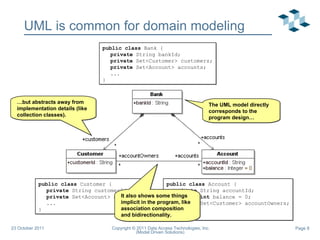
UML is common for domain modeling public   class  Bank { private  String bankId; private  Set<Customer> customers; private  Set<Account> accounts; ... } public   class  Customer { private  String customerId; private  Set<Account> accounts; ... } public class  Account { private  String accountId; private   int  balance = 0; private  Set<Customer> accountOwners; ... } The UML model directly corresponds to the program design… … but abstracts away from implementation details (like collection classes). It also shows some things implicit in the program, like association composition and bidirectionality.
But diagrams are just notation class  Bank { public  bankId: String; public  customers:  compose  Customer[*]; public  accounts:  compose  Account[*]; } assoc  AccountOwnership { public  accountOwners: Customer[*]; public  accounts: Account[*]; } class  Account { public  accountId: String; public  balance: Integer = 0; } class  Customer { public  customerId: String; } A UML class model has semantics independent of its mapping to any other language… … which can be notated textually as well as graphically. UML isn’t  “just pictures”!
Computation can be modeled, too class  Bank { public  bankId: String; public  customers: compose Customer[*]; public  accounts: compose Account[*]; public  totalAccountBalance( in  customerId: String): Integer[0..1] { customer = this.customers ->  select  c (c.customerId == customerId); return  customer.accounts.balance ->  reduce  '+'; } ... } The underlying semantics are based on data-flow, not an implicit von Neumann architecture. These actions are inherently concurrent. … with far fewer implementation commitments.
3. Executable UML models are useful Executable UML models… … can be tested,  because they are programs … don’t need to be “recoded”,  they can be “compiled” … abstract computation,  not machine architecture
Programming in UML is just programming … with models provisioned by a platform-specific “model compiler”. But at a higher level of abstraction… Past executable modeling approaches have demonstrated this can be done for with production quality. The models are validated in a development/test environment The models are deployed in a production environment Developers create fully executable models Developers iteratively execute, test and update the models
Resources Foundational UML (fUML) Specification http://www.omg.org/spec/FUML   Reference Implementation Project  http://www.modeldriven.org/fuml Action Language for fUML (Alf) Specification  http://www.omg.org/spec/ALF   Reference implementation repository  http://lib.modeldriven.org/MDLibrary/trunk/Applications/Alf-Reference-Implementation   /doc – Latest specification document (currently v1.0 Beta) /dist – Parser for latest language version Alf implementation in Eclipse Papyrus UML tool https://bugs.eclipse.org/bugs/show_bug.cgi?id=329865   Contact:  [email_address] ,  http://twitter.com/seidewitz

Models, Programs and Executable UML

  • 1.
    Models, Programs andExecutable UML Presented at the First International Workshop on Combined Object-Oriented Modeling and Programming Ed Seidewitz
  • 2.
    Models and ProgramsWhat is a model? A model is a set of statements in a modeling language about some system under study or domain. * What is a program? A program is a specification for a computation to be a executed on a computer. * See Ed Seidewitz, “What Models Mean”, IEEE Software, September/October 2003 for more.
  • 3.
    Contentions All programsare models. Executable UML models are programs. Executable UML models are useful.
  • 4.
    1. All programsare models A program is a model of the specified computation, abstracting away from the details of how the computation is actually executed on a computer. A programming language is a modeling language for creating models of execution. Customer customer = customers.get(customerId); if (customer != null ) { int totalBalance = 0; for (Account account: customer.accounts) { totalBalance += account.balance; } } … and a value called “totalBalance”… … that is iteratively computed to be the sum of the customer’s account balances. There is a customer identified by “customerId”… Java
  • 5.
    OO programs arealso domain models public class Bank { private String bankId; private Set<Customer> customers; private Set<Account> accounts; ... } public class Customer { private String customerId; private Set<Account> accounts; ... } public class Account { private String accountId; private int balance = 0; private Set<Customer> accountOwners; ... } Classes are intended to reflect domain concepts. Fields reflect properties of those concepts… … or relationships with other concepts.
  • 6.
    But make implementationcommitments public class Customer { ... private Set<Account> accounts = new HashSet<Account>(); public void addAccount(Account account) { if (account != null && ! this .accounts.contains(account)) { this .accounts.add(account); account.addAccountOwner( this ); } } ... } public class Bank { ... private Map<String, Account> customers = new HashMap<String, Customer>(); public Integer totalAccountBalance(String customerId) { Integer totalBalance = null ; Customer customer = this .customers.get(customerId); if (customer != null ) { totalBalance = 0; for (Account account: customer.accounts) { totalBalance += account.balance; } } return totalBalance; } ... } Pick implementation classes for collections. Deal with bidirectional relationships. Choose representations for efficient computation. Decide on (generally sequential) control structuring.
  • 7.
    2. Executable UMLmodels are programs UML began as a notation for models of programs. But UML 2 has constructs that allow the specification of Turing-complete computation models. Foundational UML (fUML) provides precise execution semantics. Action Language for fUML (Alf) provides a textual notation. customer = Customer -> select c (c.customerId == customerId); totalBalance = customer.accounts.balance -> reduce '+'; … and a value called “totalBalance” that is sum of the customer’s account balances. There is a customer identified by “customerId”… Alf
  • 8.
    UML is commonfor domain modeling public class Bank { private String bankId; private Set<Customer> customers; private Set<Account> accounts; ... } public class Customer { private String customerId; private Set<Account> accounts; ... } public class Account { private String accountId; private int balance = 0; private Set<Customer> accountOwners; ... } The UML model directly corresponds to the program design… … but abstracts away from implementation details (like collection classes). It also shows some things implicit in the program, like association composition and bidirectionality.
  • 9.
    But diagrams arejust notation class Bank { public bankId: String; public customers: compose Customer[*]; public accounts: compose Account[*]; } assoc AccountOwnership { public accountOwners: Customer[*]; public accounts: Account[*]; } class Account { public accountId: String; public balance: Integer = 0; } class Customer { public customerId: String; } A UML class model has semantics independent of its mapping to any other language… … which can be notated textually as well as graphically. UML isn’t “just pictures”!
  • 10.
    Computation can bemodeled, too class Bank { public bankId: String; public customers: compose Customer[*]; public accounts: compose Account[*]; public totalAccountBalance( in customerId: String): Integer[0..1] { customer = this.customers -> select c (c.customerId == customerId); return customer.accounts.balance -> reduce '+'; } ... } The underlying semantics are based on data-flow, not an implicit von Neumann architecture. These actions are inherently concurrent. … with far fewer implementation commitments.
  • 11.
    3. Executable UMLmodels are useful Executable UML models… … can be tested, because they are programs … don’t need to be “recoded”, they can be “compiled” … abstract computation, not machine architecture
  • 12.
    Programming in UMLis just programming … with models provisioned by a platform-specific “model compiler”. But at a higher level of abstraction… Past executable modeling approaches have demonstrated this can be done for with production quality. The models are validated in a development/test environment The models are deployed in a production environment Developers create fully executable models Developers iteratively execute, test and update the models
  • 13.
    Resources Foundational UML(fUML) Specification http://www.omg.org/spec/FUML Reference Implementation Project http://www.modeldriven.org/fuml Action Language for fUML (Alf) Specification http://www.omg.org/spec/ALF Reference implementation repository http://lib.modeldriven.org/MDLibrary/trunk/Applications/Alf-Reference-Implementation /doc – Latest specification document (currently v1.0 Beta) /dist – Parser for latest language version Alf implementation in Eclipse Papyrus UML tool https://bugs.eclipse.org/bugs/show_bug.cgi?id=329865 Contact: [email_address] , http://twitter.com/seidewitz