Copyright © 2004 InteliData
A Real-World Example of
MDA without Automation
Ed Seidewitz
26 August 2004
Copyright © 2004 InteliData2
Agenda
• Background
• Model-driven architecture
• Case study
• Conclusions
Copyright © 2004 InteliData3
Background
• Consumer bill payment
• InteliWorks architecture
• InteliWorks development
Copyright © 2004 InteliData4
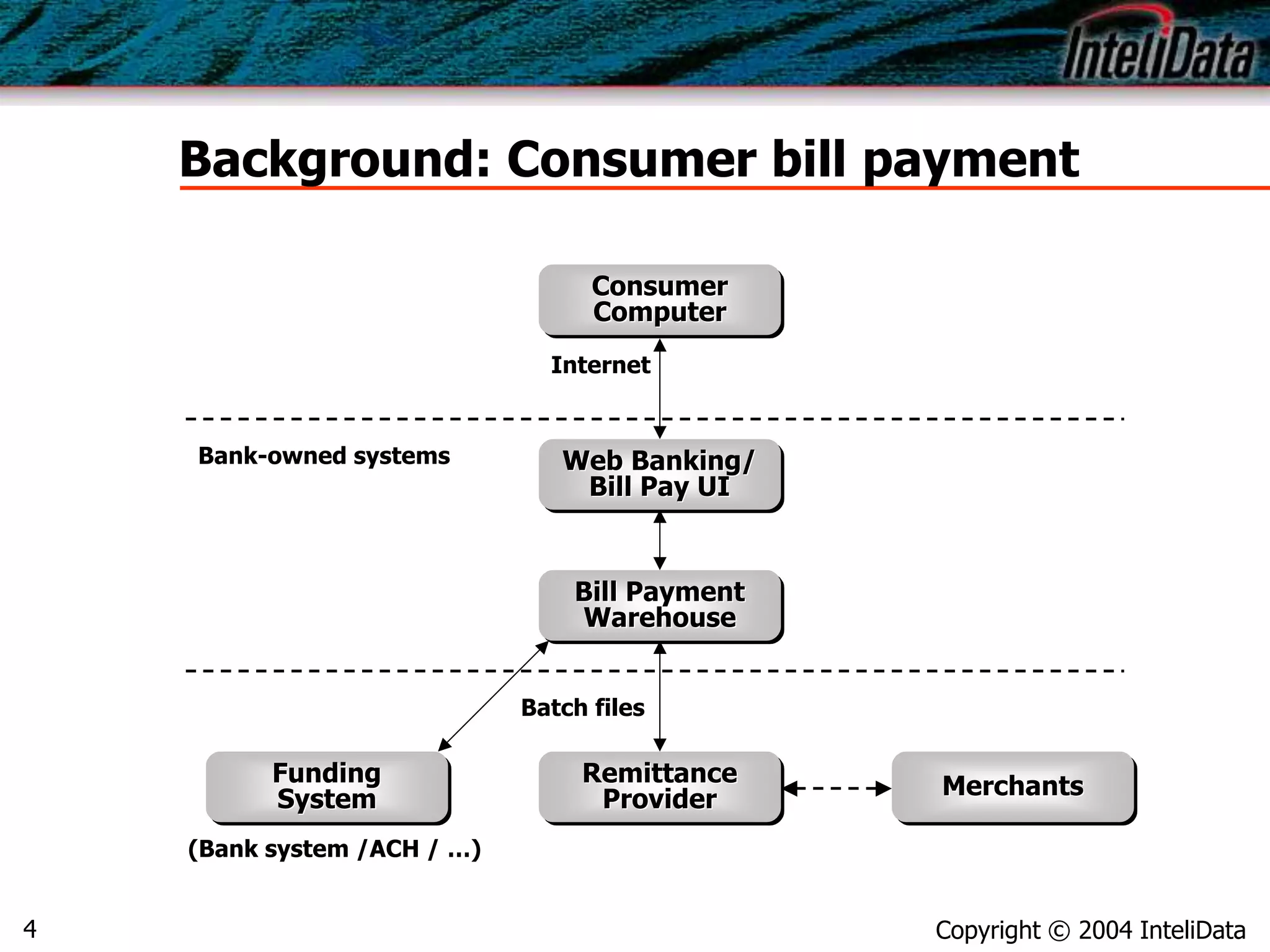
Background: Consumer bill payment
Consumer
Computer
ConsumerConsumer
ComputerComputer
Web Banking/
Bill Pay UI
Web Banking/Web Banking/
Bill Pay UIBill Pay UI
Bill Payment
Warehouse
Bill PaymentBill Payment
WarehouseWarehouse
Funding
System
FundingFunding
SystemSystem
Remittance
Provider
RemittanceRemittance
ProviderProvider
Internet
Bank-owned systems
Batch files
(Bank system /ACH / …)
MerchantsMerchantsMerchants
Copyright © 2004 InteliData5
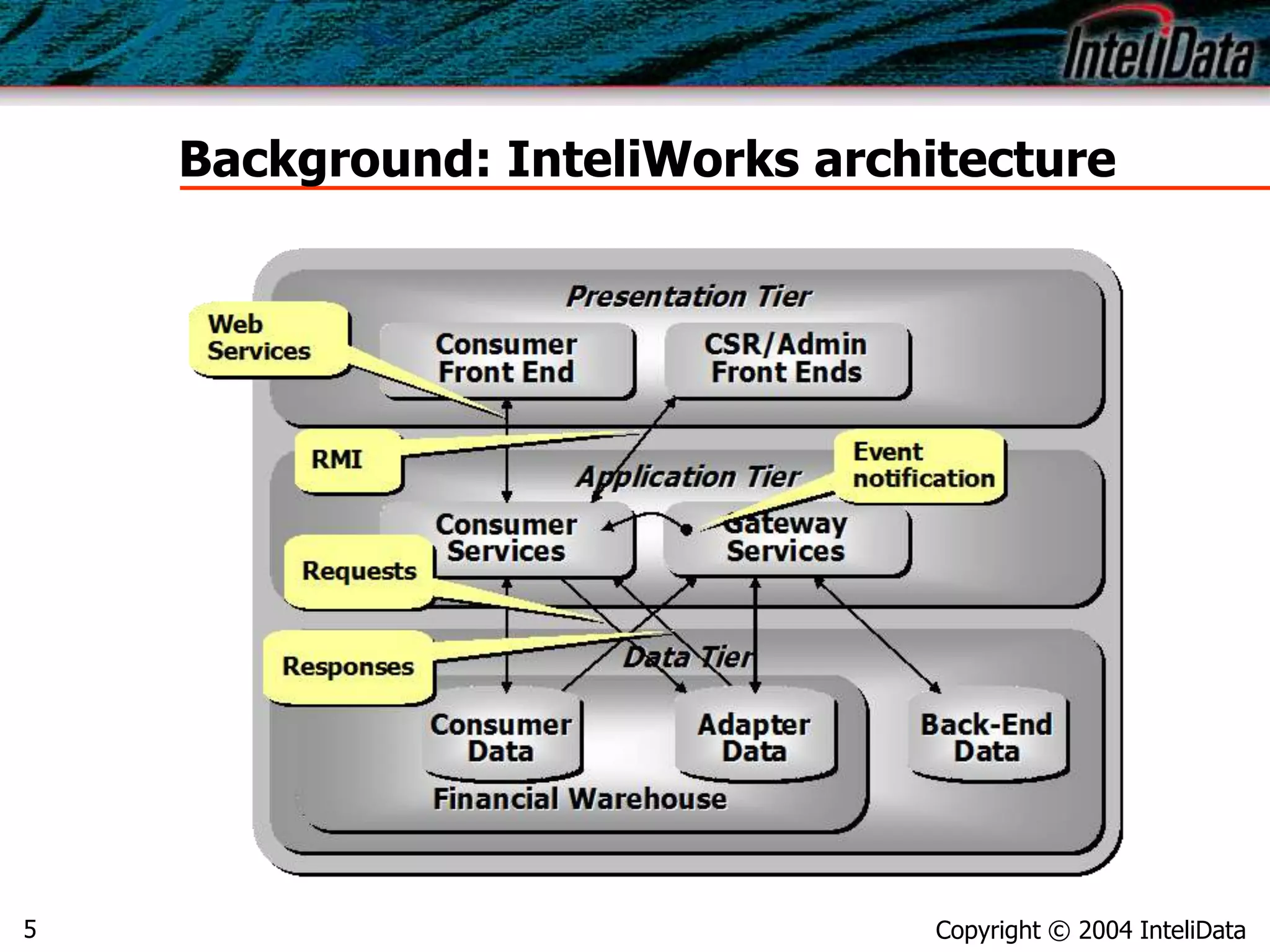
Background: InteliWorks architecture
Copyright © 2004 InteliData6
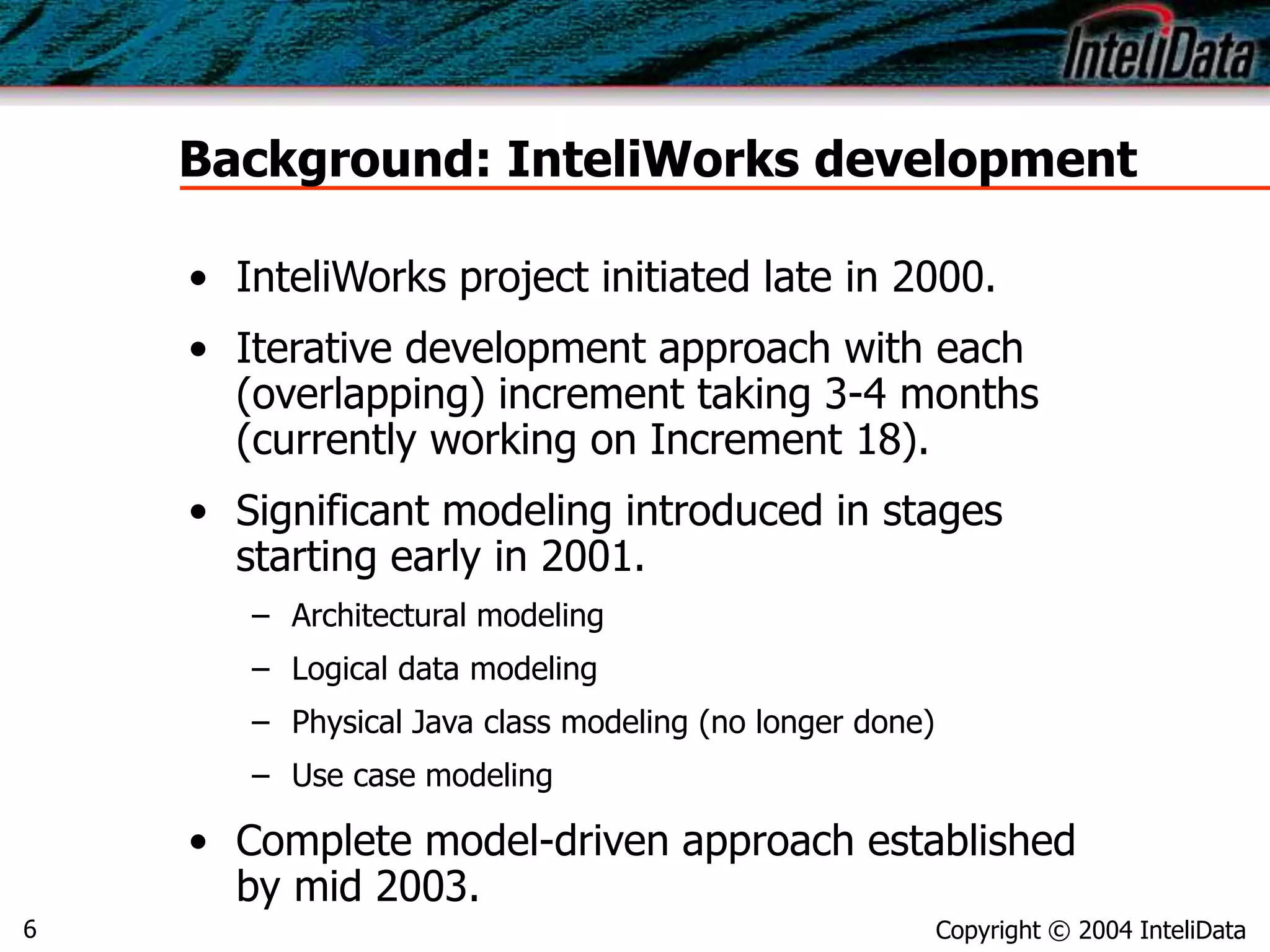
Background: InteliWorks development
• InteliWorks project initiated late in 2000.
• Iterative development approach with each
(overlapping) increment taking 3-4 months
(currently working on Increment 18).
• Significant modeling introduced in stages
starting early in 2001.
– Architectural modeling
– Logical data modeling
– Physical Java class modeling (no longer done)
– Use case modeling
• Complete model-driven approach established
by mid 2003.
Copyright © 2004 InteliData7
Model-driven architecture
• What is it?
• What is a platform?
• CIM, PIM, PSM and all that…
• Transformations
• Why “manual transformation”?
Copyright © 2004 InteliData8
MDA: What is it?
From the MDA Guide Version 1.0.1 (omg/2003-06-01)
“The Model-Driven Architecture starts with the well-
known and long established idea of separating the
specification of the operation of a system from the
details of the way that system uses the capabilities
of its platform.”
Copyright © 2004 InteliData9
MDA: What is a platform?
From the MDA Guide Version 1.0.1 (omg/2003-06-01)
“A platform is a set of subsystems and
technologies that provide a coherent set of
functionality through interfaces and specified
usage patterns, which any application supported
by that platform can use without concern for the
details of how the functionality provided by the
platform is implemented.”
Copyright © 2004 InteliData10
MDA: CIM, PIM, PSM and all that…
• “A computation independent model is a view of
a system” that “focuses on the on the
environment of the system, and the
requirements for the system.”
• “A platform independent model is a view of a
system” that “focuses on the operation of a
system while hiding the details necessary for a
particular platform.”
• “A platform specific model is a view of a
system” that “combines the platform
independent viewpoint with an additional focus
on the detail of the use of a specific platform
by a system.”
From the MDA Guide Version 1.0.1 (omg/2003-06-01)
Copyright © 2004 InteliData11
MDA: Transformations
• “The platform independent model is
transformed to be a model specific to a
particular platform.”
• “Four different transformation
approaches…illustrate the range of
possibilities:”
– manual transformation
– transforming a PIM that is prepared using a profile
– transformation using patterns and markings
– automatic transformation
Copyright © 2004 InteliData12
Case study
• Overview
• Architecture
• Data
Copyright © 2004 InteliData13
Case study: Overview
Consumer: Payment - View
Payments
Consumer
Consumer: Payment - Cancel
Consumer: Payment - Create
(without Bill)
Consumer: Payment - Modify
Consumer: Payment - View
Activity
<<extend>>
Consumer: Payment - Validate
<<extend>>
<<include>>
<<extend>>
<<include>>
Consumer: Payment - Route
<<include>> <<include>>
<<extend>>
Requirements Model
(use case and activity diagrams)
PaymentService
PaymentFe
<<Interface>>
addPayment()
cancelPayment()
getPayments()
getPaymentActivity()
updatePayment()
PaymentRead
PaymentEvent
<<Interface>>
processPayments()
PaymentFeExtended
<<Interface>>
addPaymentNoteExtended()
completePaymentExtended()
failPaymentExtended()
getPaymentsExtended()
pendPaymentExtended()
resubmitPaymentExtended()
reversePaymentExtended()
Notification
(from eMessenger)
FinancialTransactionCommon
(from Financial Transaction Service)
PayeeUtility
AccountUtility
FinancialTransactionWrite
OperationalDirectory
(from Operational Directory Service)
FinancialTransactionUtility
(from Financial Transaction Service)
FinancialTransaction
(from Financial Transaction Service)
SchedulingEvent
(from Scheduler)
Payment
<<Interface>>
handlePayeeChange()
FinancialTransactionRead
PaymentUtility
<<Interface>>
prepare()
getRouting()
checkForDuplicate()
Dependency Model
(class diagrams)
: Consumer : ConsumerFrontEnd : XmlConnector : PaymentService : FinancialTransactionService
Sequence Diagram: InteliWorks
Consumer: Payment Realizations /
Consumer: Payment - View Payments
1. Create payment
2.1. addPaymentRq
2.1.2. addPaymentRs
1.2. Display confirmation
2. Ok
3. Close view
3.1. View payments
2.1.1. addPayment( )
2.1.1.2. payment
1.1. Enter payment
Sequence Diagram: InteliWorks
Consumer: Payment Realizations /
Consumer: Payment - Enter
2.1.1.1. addFinancialTransaction( )
2.1.1.1.1. financialTransaction
Sequence Diagram: InteliWorks
Consumer: Financial Transaction
Realizations / Consumer: Financial
Transaction - Add
Architectural Realizations
(sequence diagrams)
FinancialTransactionBase
DisplayStatus
CreationData
FinancialTransactionConsumerData
1 11
+displayStatus
1
+creationData
11
FinancialTransactionData
FinancialTransaction
Note
FinancialTransactionExtended
0..1
*
0..1
+note*
CurrencyAmount
FinancialTransactionTypeCode
<<enumeration>>
PAYMENT
FUNDS_TRANSFER
FinancialTransactionSpecification
0..1
1
0..1
+specification1
0..11 0..1
+amount
1
+transactionType
11
ProcessingData
1 11
+processingData
1
ProcessingStatus
0..1
1
0..1
+status 1
ProcessingStep
0..1
*
0..1
+previousStep
{ordered}
*
+status
0..1
1
0..1
1
Logical Data Model
(class diagrams)
xxxxxxxxxxxxxxxxxxxxxxx
xxxxxxxxxxxxxxxxxxxx
xxxxxxxxxxxxxxxxxxxxx
xxxxxxxxxxxx
xxxxxxxxxxxxxxxxx
xxxxxxxxxxxxx
xxxxxxxxxxx
xxxxxxxxxxxxxx
xxxxxxxxxxxxx
xxxxxxxxx
xxxxxxxxx
xxxxxxx
xxxxxxxxxx
xxxxxxx
]xxxx
Interface Code
(EJB)
xxxxxxxxxxxxxxxxxxxxxxx
xxxxxxxxxxxxxxxxxxxx
xxxxxxxxxxxxxxxxxxxxx
xxxxxxxxxxxx
xxxxxxxxxxxxxxxxx
xxxxxxxxxxxxx
xxxxxxxxxxx
xxxxxxxxxxxxxx
xxxxxxxxxxxxx
xxxxxxxxx
xxxxxxxxx
xxxxxxx
xxxxxxxxxx
xxxxxxx
]xxxx
Web Services Code
(WSDL/SOAP)
xxxxxxxxxxxxxxxxxxxxxxx
xxxxxxxxxxxxxxxxxxxx
xxxxxxxxxxxxxxxxxxxxx
xxxxxxxxxxxx
xxxxxxxxxxxxxxxxx
xxxxxxxxxxxxx
xxxxxxxxxxx
xxxxxxxxxxxxxx
xxxxxxxxxxxxx
xxxxxxxxx
xxxxxxxxx
xxxxxxx
xxxxxxxxxx
xxxxxxx
]xxxx
Value Object Code
(Java)
xxxxxxxxxxxxxxxxxxxxxxx
xxxxxxxxxxxxxxxxxxxx
xxxxxxxxxxxxxxxxxxxxx
xxxxxxxxxxxx
xxxxxxxxxxxxxxxxx
xxxxxxxxxxxxx
xxxxxxxxxxx
xxxxxxxxxxxxxx
xxxxxxxxxxxxx
xxxxxxxxx
xxxxxxxxx
xxxxxxx
xxxxxxxxxx
xxxxxxx
]xxxx
Schema Code
(SQL)
PAYMENTS
AUDIT_ID : NUMBER(9, 0)
ACTION_CODE : NUMBER(9, 0)
FI_TRANSACTION_SEQ_ID : NUMBER(9, 0)
PAYEE_SEQ_ID : NUMBER(9, 0)
BILL_SEQ_ID : NUMBER(9, 0)
PROVIDER_SEQ_ID : NUMBER(9, 0)
PAYEE_NAME : VARCHAR2(255)
PAYEE_PHONE_NUMBER : VARCHAR2(32)
NAME_ON_ACCOUNT : VARCHAR2(255)
BILLING_ACCOUNT : VARCHAR2(255)
PAYMENT_DESTINATION_TYPE : NUMBER(9, 0)
ADDRESS1 : VARCHAR2(64)
ADDRESS2 : VARCHAR2(64)
ADDRESS3 : VARCHAR2(64)
ADDRESS4 : VARCHAR2(64)
CITY : VARCHAR2(32)
STATE_PROV : VARCHAR2(32)
POSTAL_CODE : VARCHAR2(11)
COUNTRY_CODE : CHAR(3)
ACT_PAYEE_NAME : VARCHAR2(255)
REMITTANCE_METHOD : NUMBER(9, 0)
ACT_PAYEE_PHONE_NUMBER : VARCHAR2(32)
ACT_NAME_ON_ACCOUNT : VARCHAR2(255)
ACT_BILLING_ACCOUNT : VARCHAR2(255)
ACT_PAYMENT_DESTINATION_TYPE : NUMBER(9, 0)
ACT_ADDRESS1 : VARCHAR2(64)
ACT_ADDRESS2 : VARCHAR2(64)
ACT_ADDRESS3 : VARCHAR2(64)
ACT_ADDRESS4 : VARCHAR2(64)
ACT_CITY : VARCHAR2(32)
ACT_STATE_PROV : VARCHAR2(32)
ACT_POSTAL_CODE : VARCHAR2(11)
ACT_COUNTRY_CODE : CHAR(3)
CHECK_NUMBER : VARCHAR2(40)
ACT_REMITTANCE_METHOD : NUMBER(9, 0)
SERVICE_CENTER_SEQ_ID : NUMBER(9, 0)
MERCHANT_SEQ_ID : NUMBER(9, 0)
DEFAULT_ROUTING_REASON : NUMBER(9, 0)
DAYS_TO_PROCESS : NUMBER(9, 0)
AUDIT_VERSION : NUMBER(9, 0)
AUDIT_GENERATION : NUMBER(9, 0)
AUDIT_DATE : DATE
FINANCIAL_TRANSACTIONS
AUDIT_ID : NUMBER(9, 0)
ACTION_CODE : NUMBER(9, 0)
FI_TRANSACTION_SEQ_ID : NUMBER(9, 0)
LAST_MODIFIED_BY : NUMBER(9, 0)
CONSUMER_SEQ_ID : NUMBER(9, 0)
TRANSACTION_TYPE : NUMBER(9, 0)
MODEL_INSTANCE_NUMBER : NUMBER(9, 0)
RECURRING_MODEL_SEQ_ID : NUMBER(9, 0)
SOURCE_ACCOUNT_SEQ_ID : NUMBER(9, 0)
SOURCE_ACCOUNT_TYPE_CODE : NUMBER(9, 0)
SOURCE_ACCOUNT_NUMBER : VARCHAR2(32)
SOURCE_ROUTING_NUMBER : VARCHAR2(9)
SOURCE_ACCOUNT_HOLDER : VARCHAR2(255)
REQUESTED_DATE : DATE
REQUESTED_SCHEDULE_TYPE : NUMBER(9, 0)
CREDIT_DATE : DATE
PROCESS_DATE : DATE
DISPLAY_STATUS_CODE : NUMBER(9, 0)
CURRENCY_CODE : CHAR(3)
AMOUNT : NUMBER(17, 2)
CONSUMER_MEMO : VARCHAR2(255)
DISPLAY_STATUS_MODIFIED_DATE : DATE
DISPLAY_STATUS_MODIFIED_BY : NUMBER(9, 0)
DISPLAY_STATUS_NOTE : VARCHAR2(255)
PROCESSING_FLOW_TYPE : NUMBER(9, 0)
PROCESSING_TIME : DATE
RETRY_COUNT : NUMBER(9, 0)
DESTINATION_PROVIDER_SEQ_ID : NUMBER(9, 0)
PROCESS_STATUS_CODE : NUMBER(9, 0)
AUTHORIZATION_PROVIDER_SEQ_ID : NUMBER(9, 0)
DAYS_TO_CREDIT : NUMBER(9, 0)
SOURCE_PROVIDER_SEQ_ID : NUMBER(9, 0)
VALIDATE_STATUS_CODE : NUMBER(9, 0)
PROCESS_STATUS_PROVIDER_SEQ_ID : NUMBER(9, 0)
PROCESS_STATUS_MODIFIED_BY : NUMBER(9, 0)
PROCESS_STATUS_MODIFIED_DATE : DATE
PROCESS_STATUS_NOTE : VARCHAR2(255)
VALIDATE_STATUS_MODIFIED_BY : NUMBER(9, 0)
VALIDATE_STATUS_MODIFIED_DATE : DATE
AUDIT_DATE : DATE
AUDIT_VERSION : NUMBER(9, 0)
VALIDATE_STATUS_NOTE : VARCHAR2(255)
AUDIT_GENERATION : NUMBER(9, 0)
Database Design Model
(class diagram)
xxxxxxxxxxxxxxxxxxxxxxx
xxxxxxxxxxxxxxxxxxxx
xxxxxxxxxxxxxxxxxxxxx
xxxxxxxxxxxx
xxxxxxxxxxxxxxxxx
xxxxxxxxxxxxx
xxxxxxxxxxx
xxxxxxxxxxxxxx
xxxxxxxxxxxxx
xxxxxxxxx
xxxxxxxxx
xxxxxxx
xxxxxxxxxx
xxxxxxx
]xxxx
Schema Definition
(Torque XML)
CIM
PIM
PSM
PIM/PSM
hand coded hand coded
handcoded
generated
generated
generated
reverse
engineered
hand modeled hand modeled
handmodeled
traceshand modeled
Implementation platform
• J2EE (WebLogic app server)
• Relational DB (Oracle DBMS)
• Web services (Apache Axis)
Copyright © 2004 InteliData14
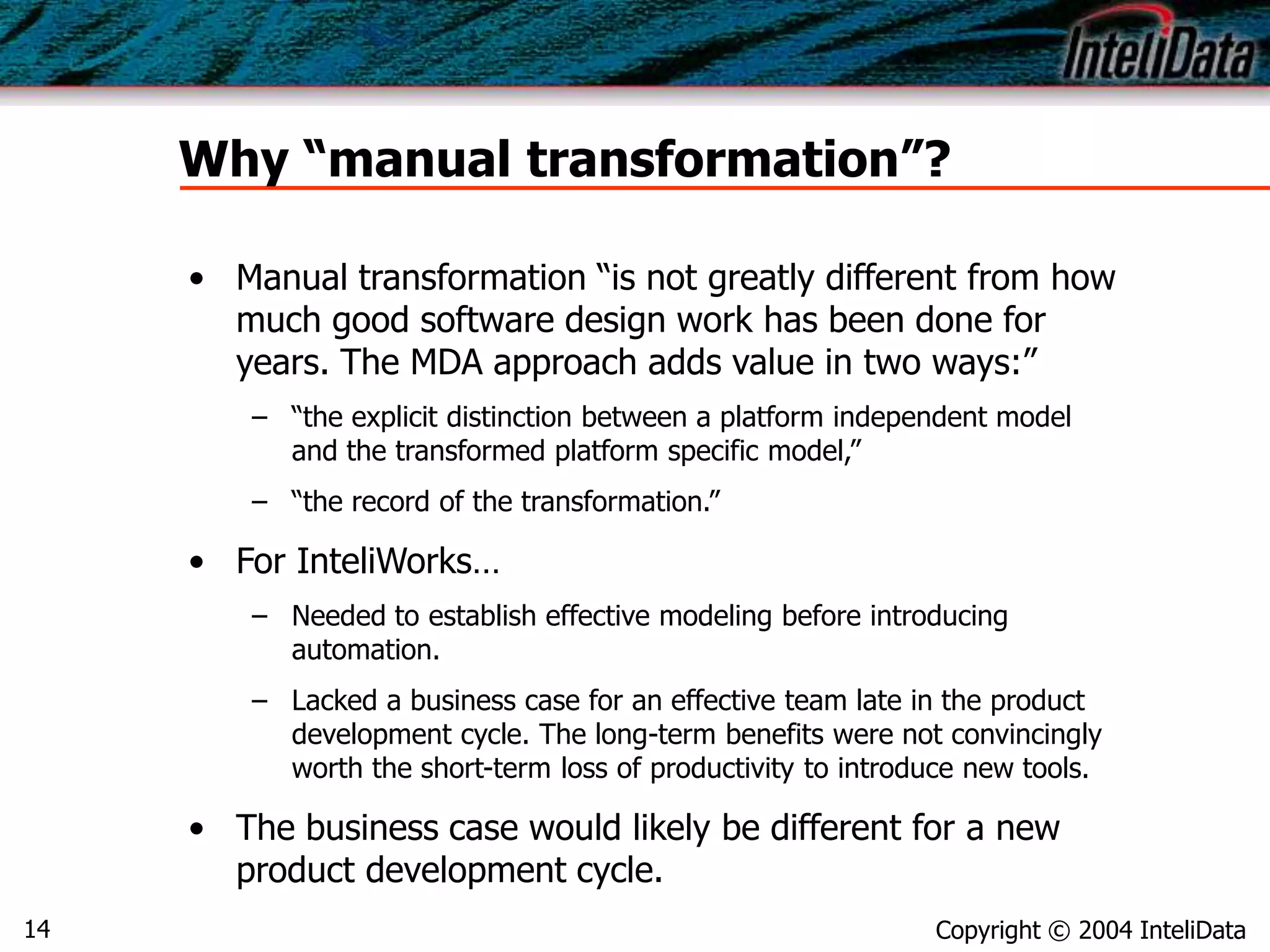
Why “manual transformation”?
• Manual transformation “is not greatly different from how
much good software design work has been done for
years. The MDA approach adds value in two ways:”
– “the explicit distinction between a platform independent model
and the transformed platform specific model,”
– “the record of the transformation.”
• For InteliWorks…
– Needed to establish effective modeling before introducing
automation.
– Lacked a business case for an effective team late in the product
development cycle. The long-term benefits were not convincingly
worth the short-term loss of productivity to introduce new tools.
• The business case would likely be different for a new
product development cycle.
Copyright © 2004 InteliData15
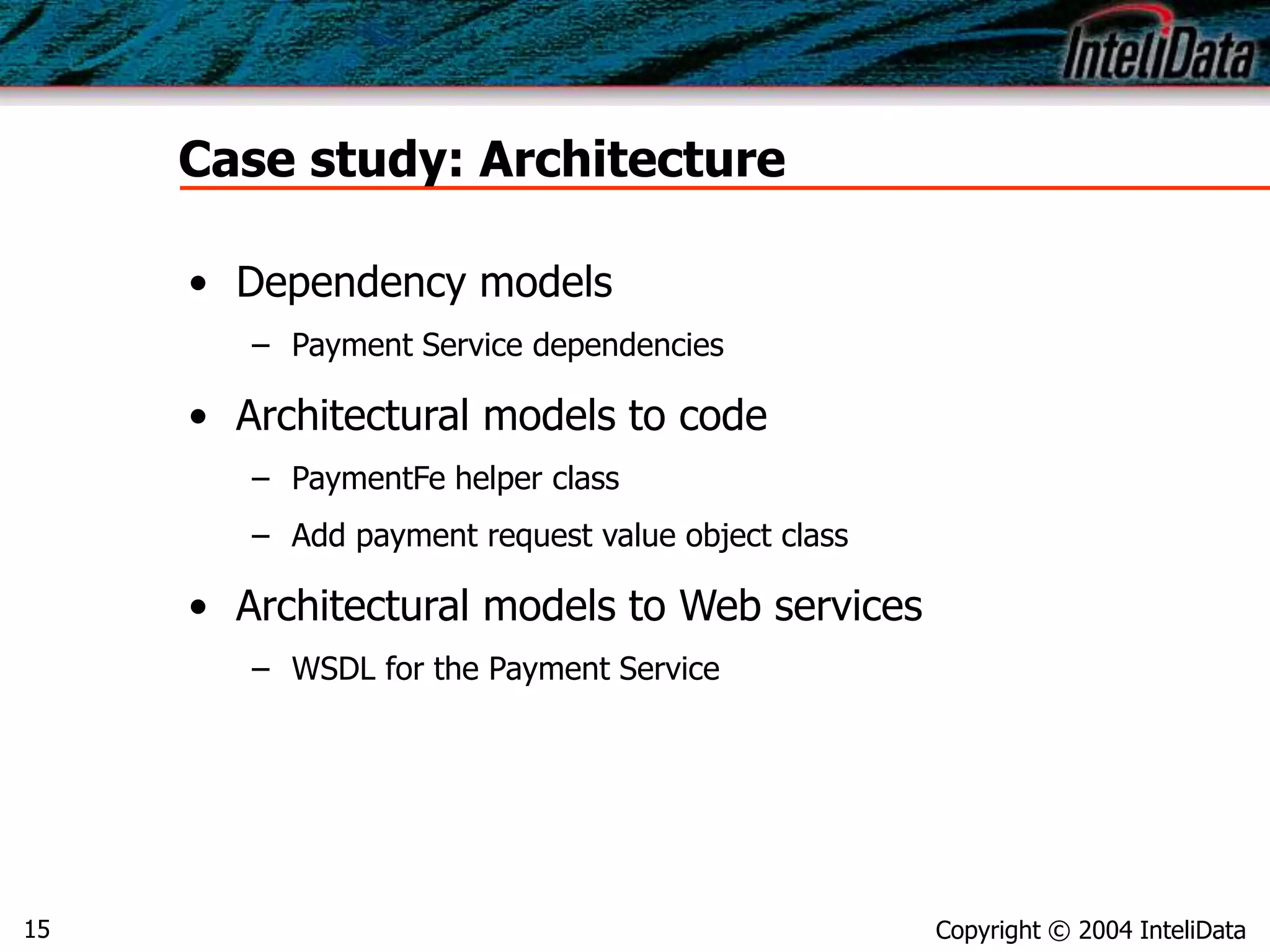
Case study: Architecture
• Dependency models
– Payment Service dependencies
• Architectural models to code
– PaymentFe helper class
– Add payment request value object class
• Architectural models to Web services
– WSDL for the Payment Service
Copyright © 2004 InteliData16
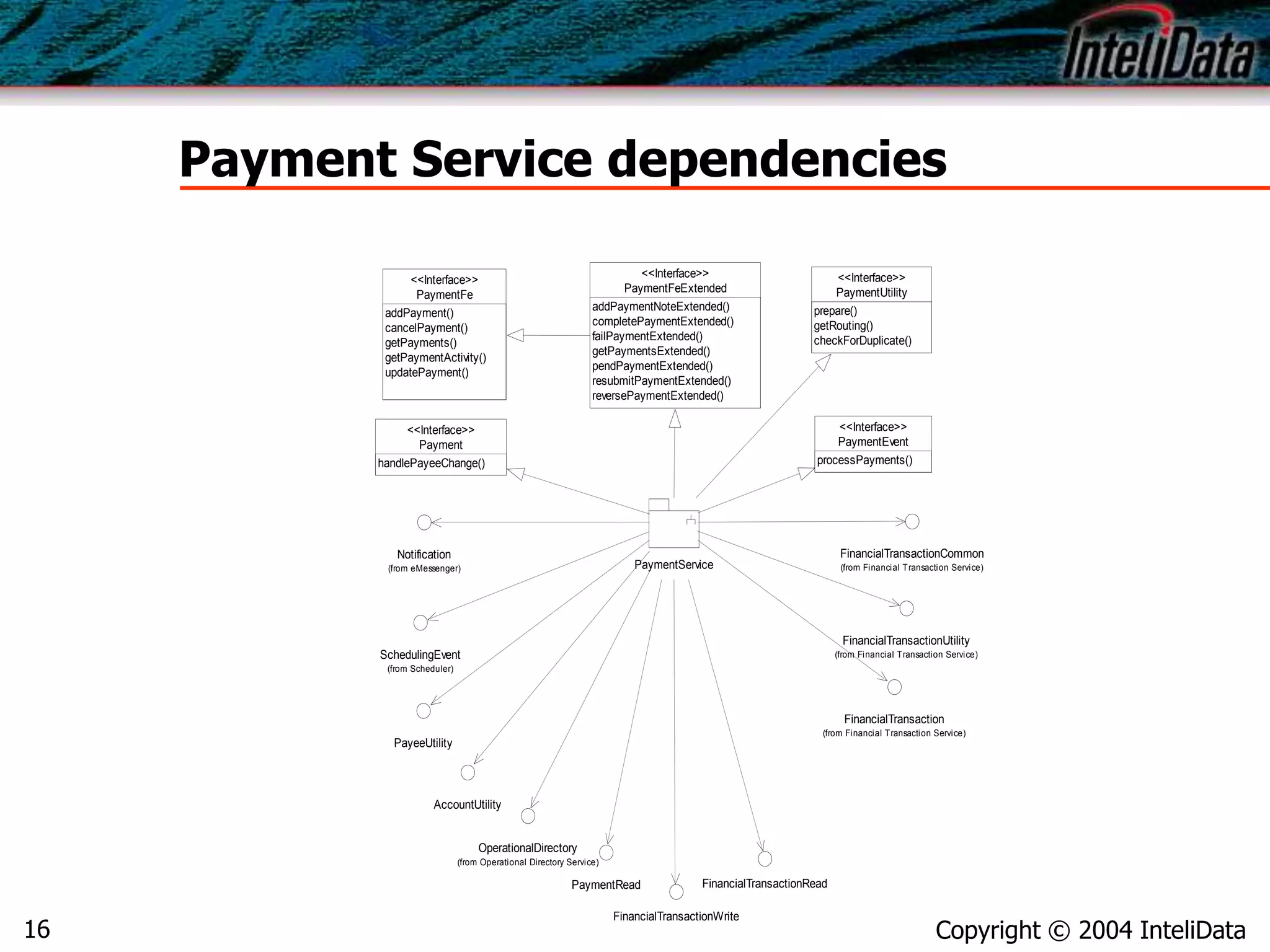
Payment Service dependencies
PaymentService
PaymentFe
<<Interface>>
addPayment()
cancelPayment()
getPayments()
getPaymentActivity()
updatePayment()
PaymentRead
PaymentEvent
<<Interface>>
processPayments()
PaymentFeExtended
<<Interface>>
addPaymentNoteExtended()
completePaymentExtended()
failPaymentExtended()
getPaymentsExtended()
pendPaymentExtended()
resubmitPaymentExtended()
reversePaymentExtended()
Notification
(from eMessenger)
FinancialTransactionCommon
(from Financial Transaction Service)
PayeeUtility
AccountUtility
FinancialTransactionWrite
OperationalDirectory
(from Operational Directory Service)
FinancialTransactionUtility
(from Financial Transaction Service)
FinancialTransaction
(from Financial Transaction Service)
SchedulingEvent
(from Scheduler)
Payment
<<Interface>>
handlePayeeChange()
FinancialTransactionRead
PaymentUtility
<<Interface>>
prepare()
getRouting()
checkForDuplicate()
Copyright © 2004 InteliData17
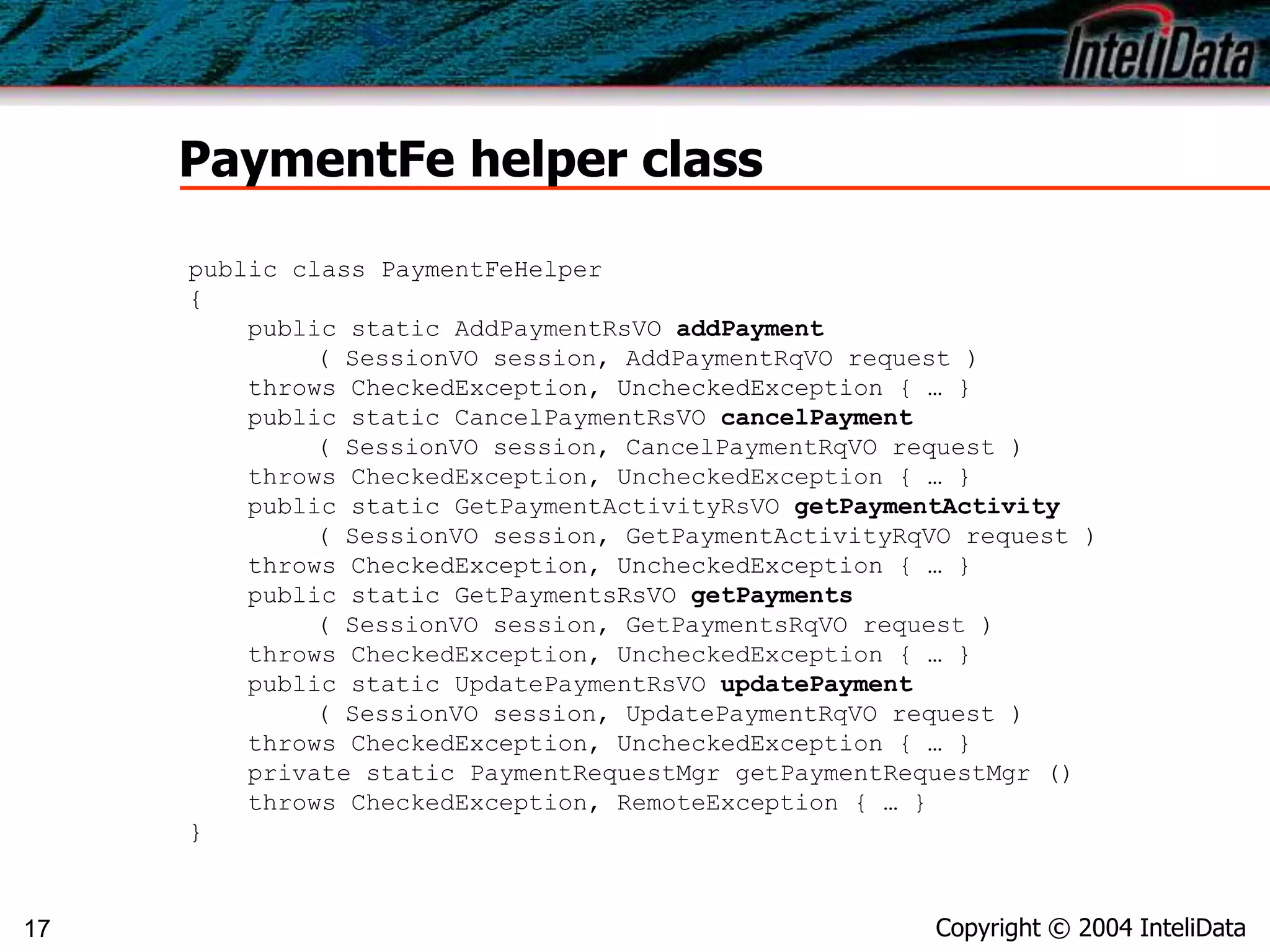
PaymentFe helper class
public class PaymentFeHelper
{
public static AddPaymentRsVO addPayment
( SessionVO session, AddPaymentRqVO request )
throws CheckedException, UncheckedException { … }
public static CancelPaymentRsVO cancelPayment
( SessionVO session, CancelPaymentRqVO request )
throws CheckedException, UncheckedException { … }
public static GetPaymentActivityRsVO getPaymentActivity
( SessionVO session, GetPaymentActivityRqVO request )
throws CheckedException, UncheckedException { … }
public static GetPaymentsRsVO getPayments
( SessionVO session, GetPaymentsRqVO request )
throws CheckedException, UncheckedException { … }
public static UpdatePaymentRsVO updatePayment
( SessionVO session, UpdatePaymentRqVO request )
throws CheckedException, UncheckedException { … }
private static PaymentRequestMgr getPaymentRequestMgr ()
throws CheckedException, RemoteException { … }
}
Copyright © 2004 InteliData18
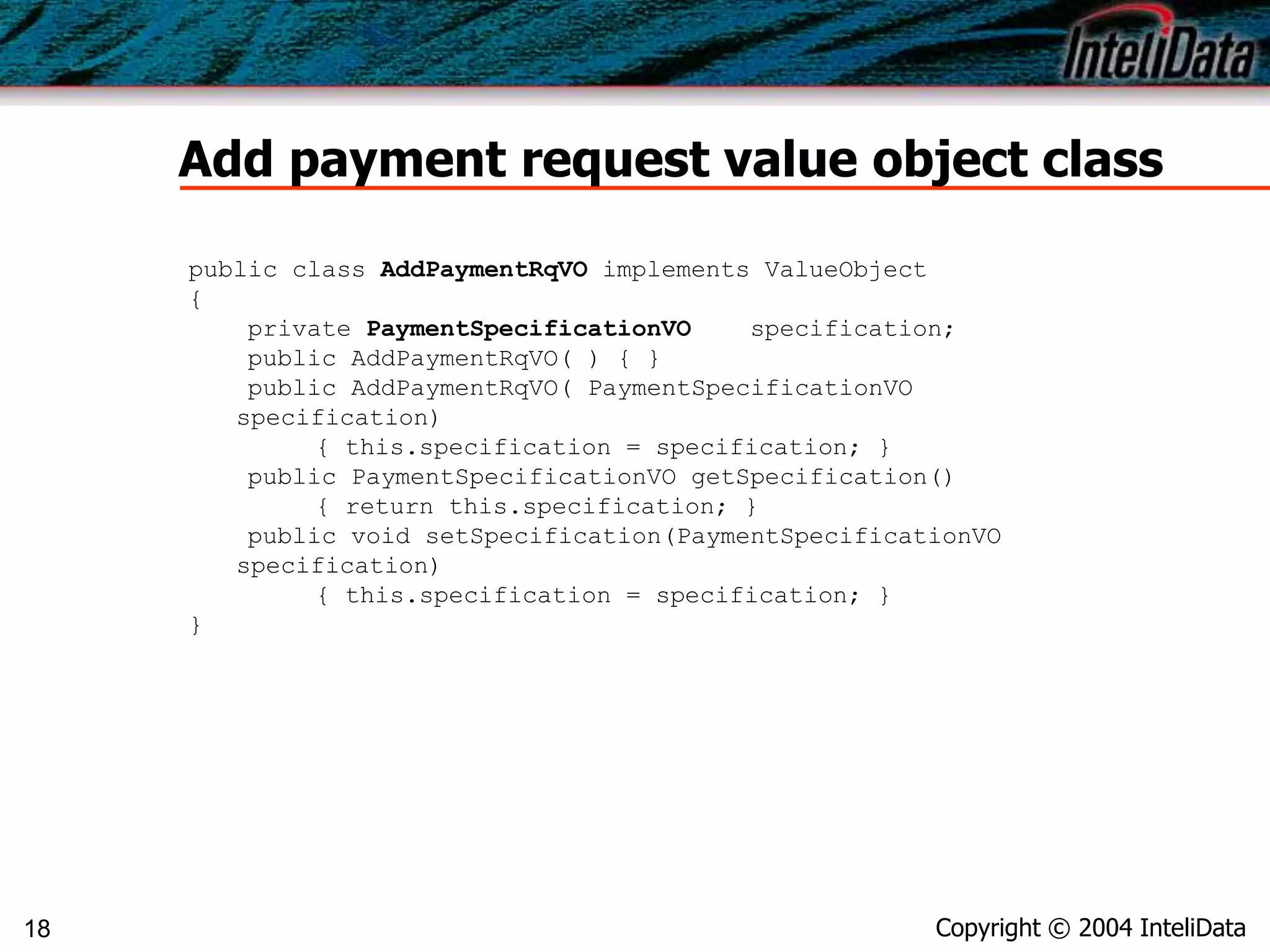
Add payment request value object class
public class AddPaymentRqVO implements ValueObject
{
private PaymentSpecificationVO specification;
public AddPaymentRqVO( ) { }
public AddPaymentRqVO( PaymentSpecificationVO
specification)
{ this.specification = specification; }
public PaymentSpecificationVO getSpecification()
{ return this.specification; }
public void setSpecification(PaymentSpecificationVO
specification)
{ this.specification = specification; }
}
Copyright © 2004 InteliData19
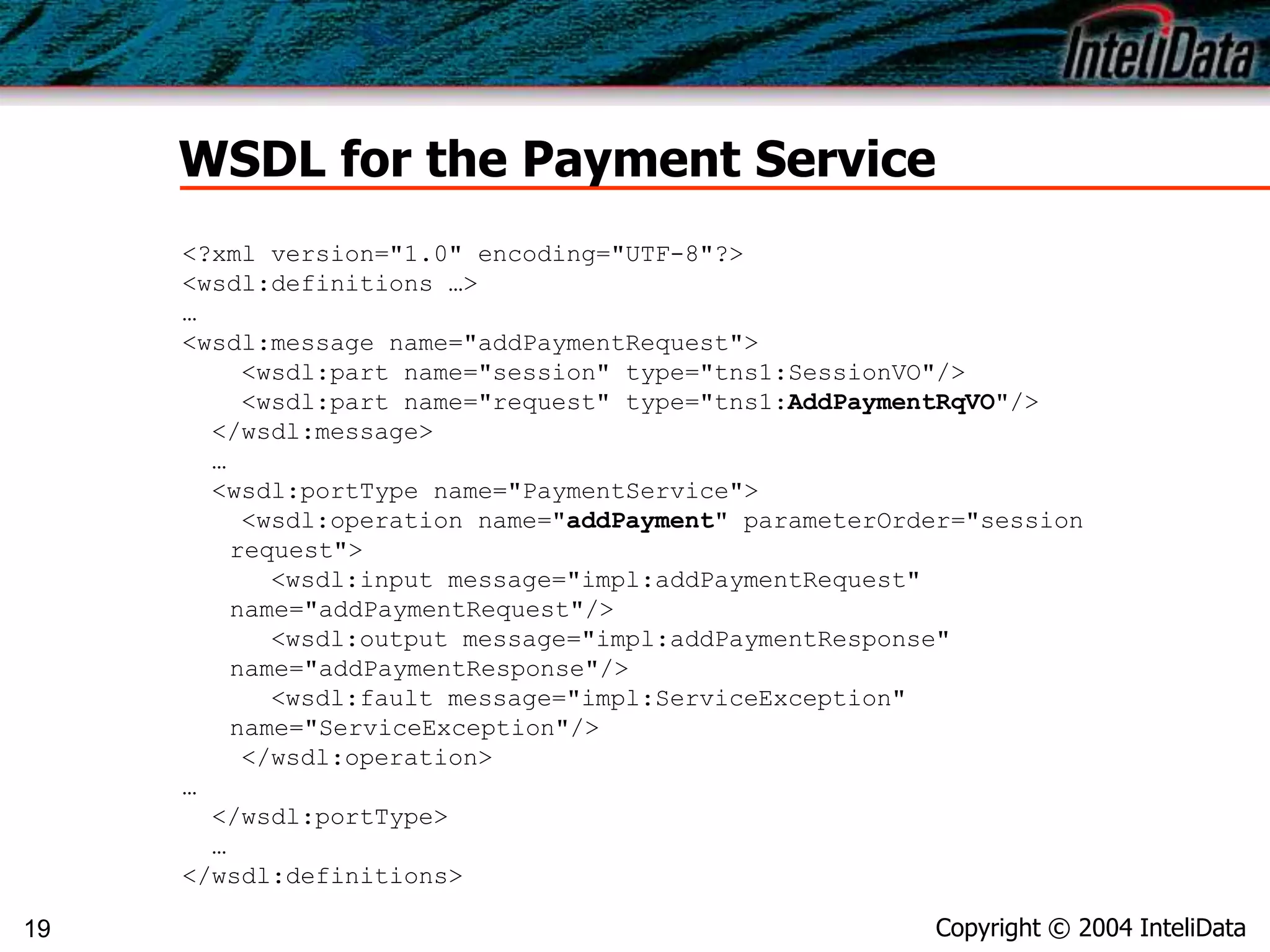
WSDL for the Payment Service
<?xml version="1.0" encoding="UTF-8"?>
<wsdl:definitions …>
…
<wsdl:message name="addPaymentRequest">
<wsdl:part name="session" type="tns1:SessionVO"/>
<wsdl:part name="request" type="tns1:AddPaymentRqVO"/>
</wsdl:message>
…
<wsdl:portType name="PaymentService">
<wsdl:operation name="addPayment" parameterOrder="session
request">
<wsdl:input message="impl:addPaymentRequest"
name="addPaymentRequest"/>
<wsdl:output message="impl:addPaymentResponse"
name="addPaymentResponse"/>
<wsdl:fault message="impl:ServiceException"
name="ServiceException"/>
</wsdl:operation>
…
</wsdl:portType>
…
</wsdl:definitions>
Copyright © 2004 InteliData20
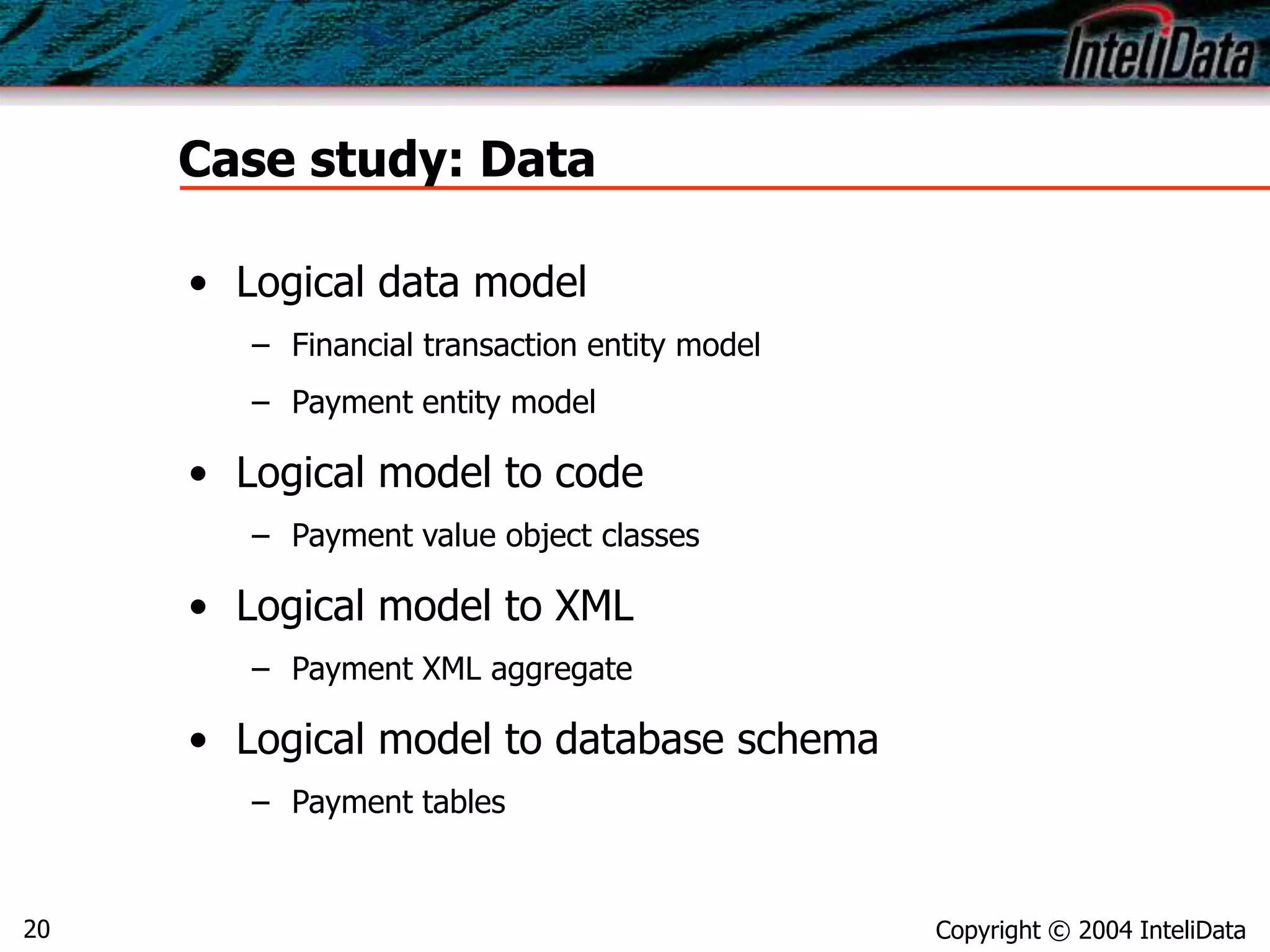
Case study: Data
• Logical data model
– Financial transaction entity model
– Payment entity model
• Logical model to code
– Payment value object classes
• Logical model to XML
– Payment XML aggregate
• Logical model to database schema
– Payment tables
Copyright © 2004 InteliData21
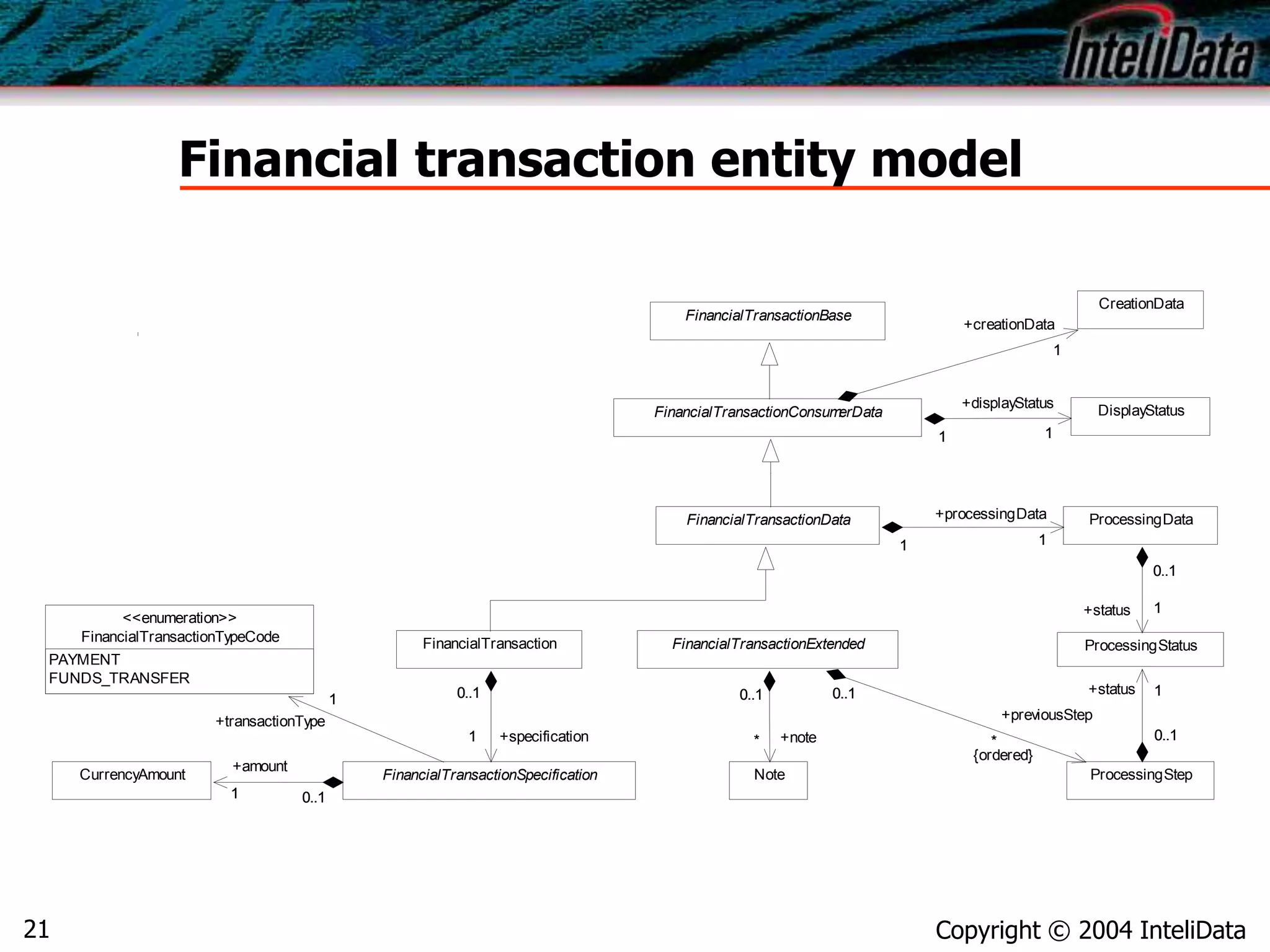
Financial transaction entity model
FinancialTransactionBase
DisplayStatus
CreationData
FinancialTransactionConsumerData
1 11
+displayStatus
1
+creationData
11
FinancialTransactionData
FinancialTransaction
Note
FinancialTransactionExtended
0..1
*
0..1
+note*
CurrencyAmount
FinancialTransactionTypeCode
<<enumeration>>
PAYMENT
FUNDS_TRANSFER
FinancialTransactionSpecification
0..1
1
0..1
+specification1
0..11 0..1
+amount
1
+transactionType
11
ProcessingData
1 11
+processingData
1
ProcessingStatus
0..1
1
0..1
+status 1
ProcessingStep
0..1
*
0..1
+previousStep
{ordered}
*
+status
0..1
1
0..1
1
Copyright © 2004 InteliData22
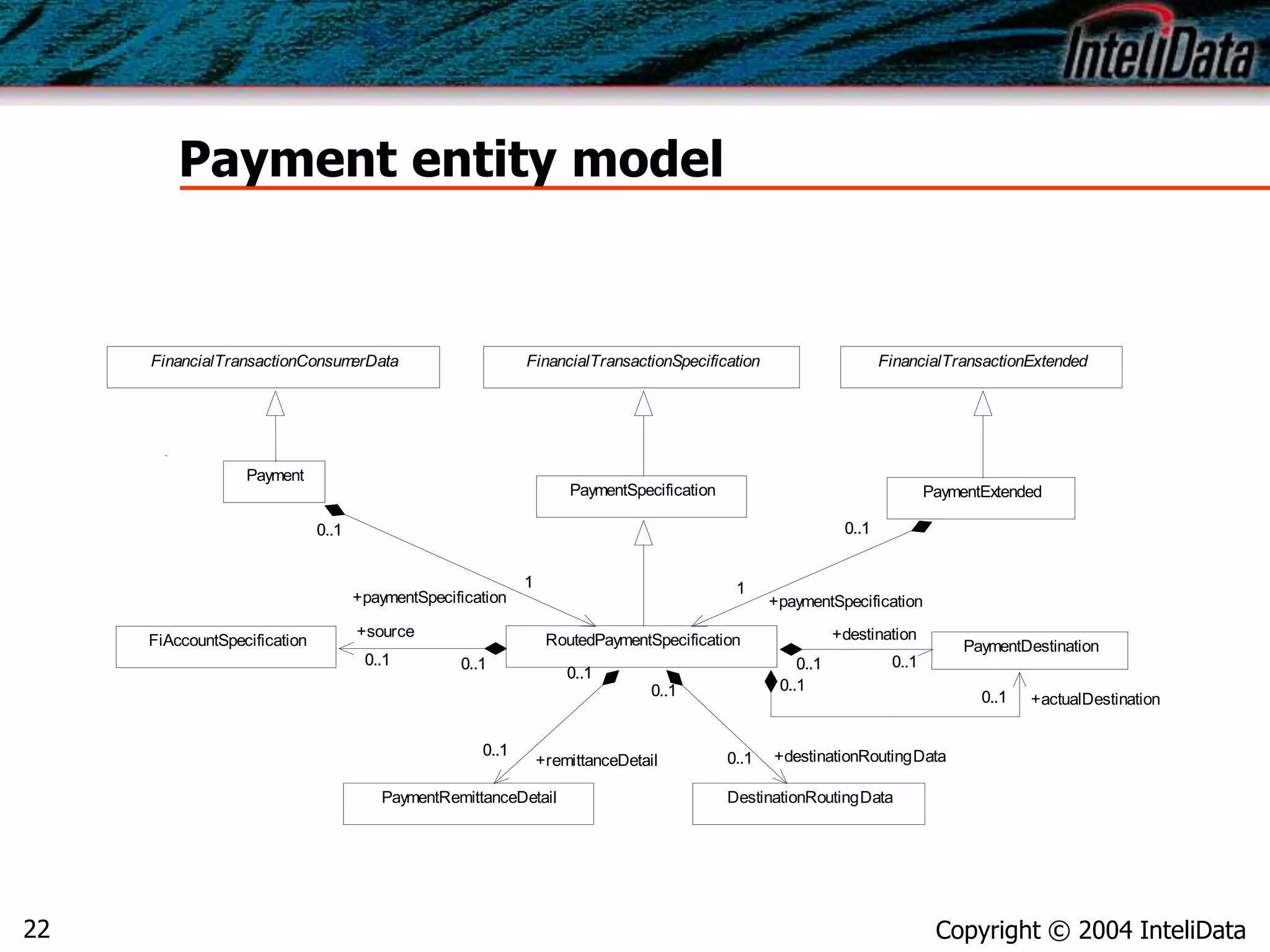
Payment entity model
PaymentExtended
PaymentRemittanceDetail DestinationRoutingData
FiAccountSpecification
Payment
FinancialTransactionConsumerData FinancialTransactionSpecification FinancialTransactionExtended
PaymentSpecification
PaymentDestinationRoutedPaymentSpecification
0..1
1
0..1
+paymentSpecification
1
0..1
0..1
0..1
+remittanceDetail
0..1
0..1
0..1
0..1
+destinationRoutingData0..1
0..10..1 0..1
+source
0..1
0..1
1
0..1
1
+paymentSpecification
0..1
0..1
0..1
+actualDestination0..1
+destination
0..1 0..10..1 0..1
Copyright © 2004 InteliData23
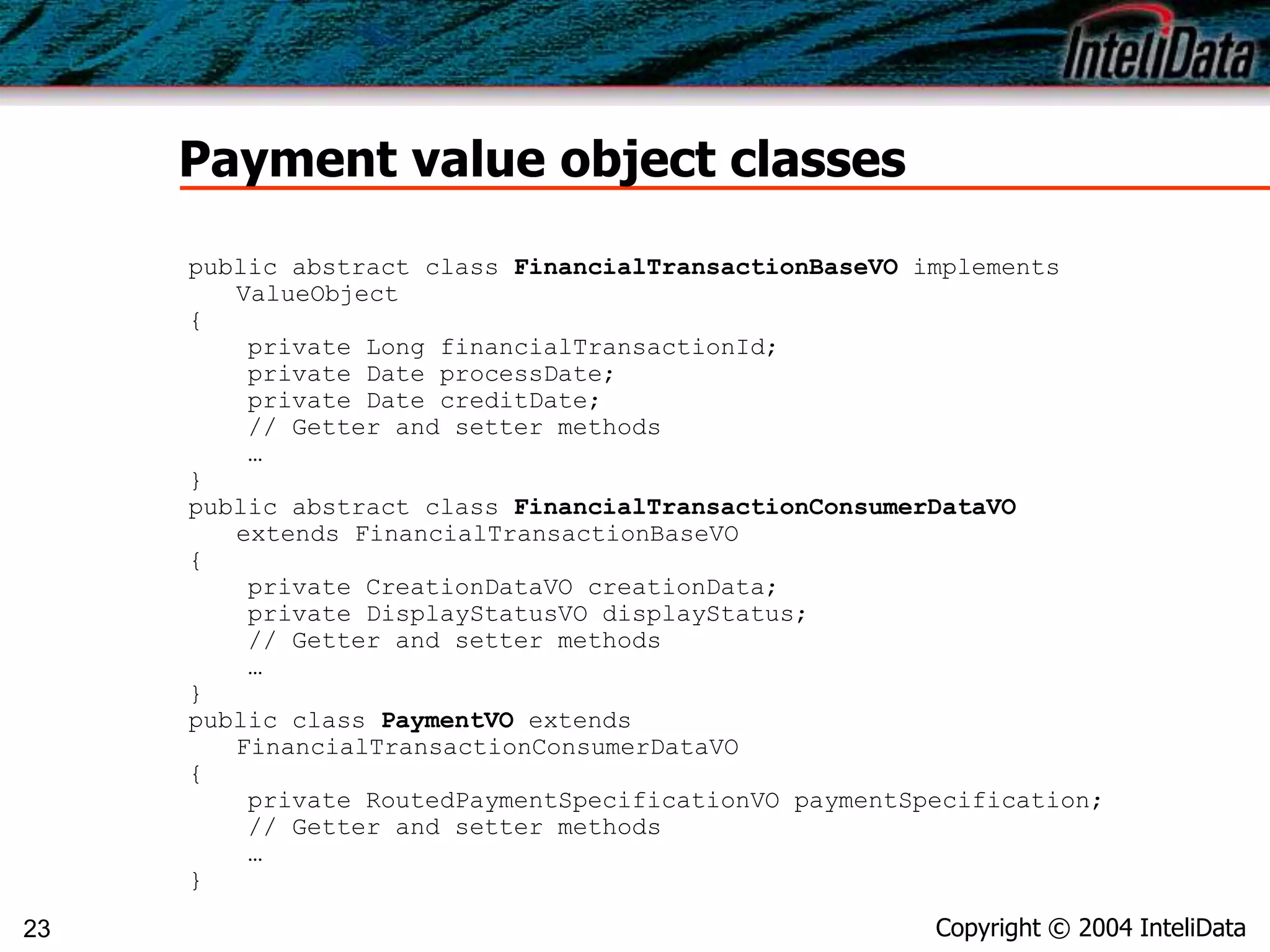
Payment value object classes
public abstract class FinancialTransactionBaseVO implements
ValueObject
{
private Long financialTransactionId;
private Date processDate;
private Date creditDate;
// Getter and setter methods
…
}
public abstract class FinancialTransactionConsumerDataVO
extends FinancialTransactionBaseVO
{
private CreationDataVO creationData;
private DisplayStatusVO displayStatus;
// Getter and setter methods
…
}
public class PaymentVO extends
FinancialTransactionConsumerDataVO
{
private RoutedPaymentSpecificationVO paymentSpecification;
// Getter and setter methods
…
}
Copyright © 2004 InteliData24
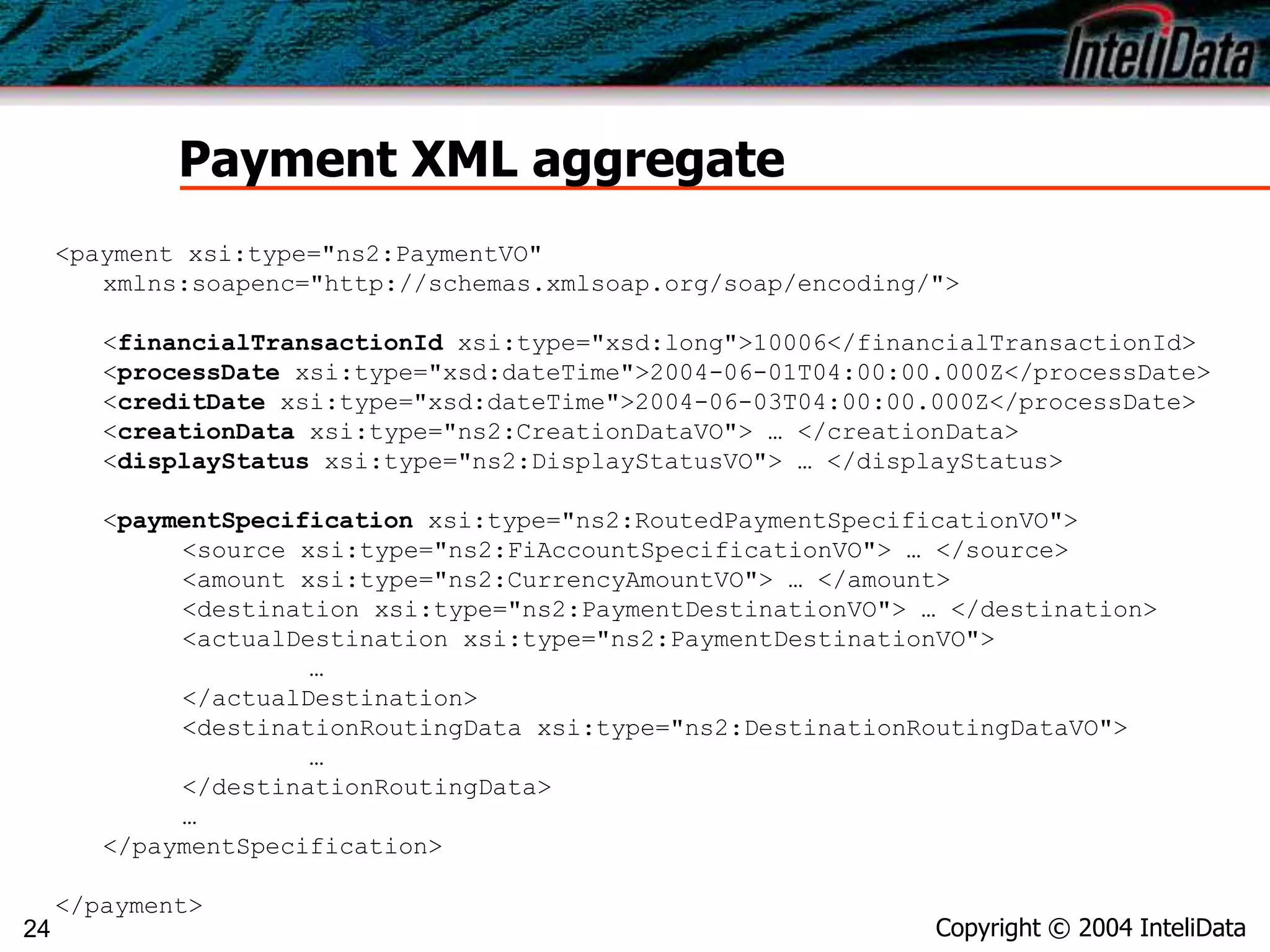
Payment XML aggregate
<payment xsi:type="ns2:PaymentVO"
xmlns:soapenc="http://schemas.xmlsoap.org/soap/encoding/">
<financialTransactionId xsi:type="xsd:long">10006</financialTransactionId>
<processDate xsi:type="xsd:dateTime">2004-06-01T04:00:00.000Z</processDate>
<creditDate xsi:type="xsd:dateTime">2004-06-03T04:00:00.000Z</processDate>
<creationData xsi:type="ns2:CreationDataVO"> … </creationData>
<displayStatus xsi:type="ns2:DisplayStatusVO"> … </displayStatus>
<paymentSpecification xsi:type="ns2:RoutedPaymentSpecificationVO">
<source xsi:type="ns2:FiAccountSpecificationVO"> … </source>
<amount xsi:type="ns2:CurrencyAmountVO"> … </amount>
<destination xsi:type="ns2:PaymentDestinationVO"> … </destination>
<actualDestination xsi:type="ns2:PaymentDestinationVO">
…
</actualDestination>
<destinationRoutingData xsi:type="ns2:DestinationRoutingDataVO">
…
</destinationRoutingData>
…
</paymentSpecification>
</payment>
Copyright © 2004 InteliData25
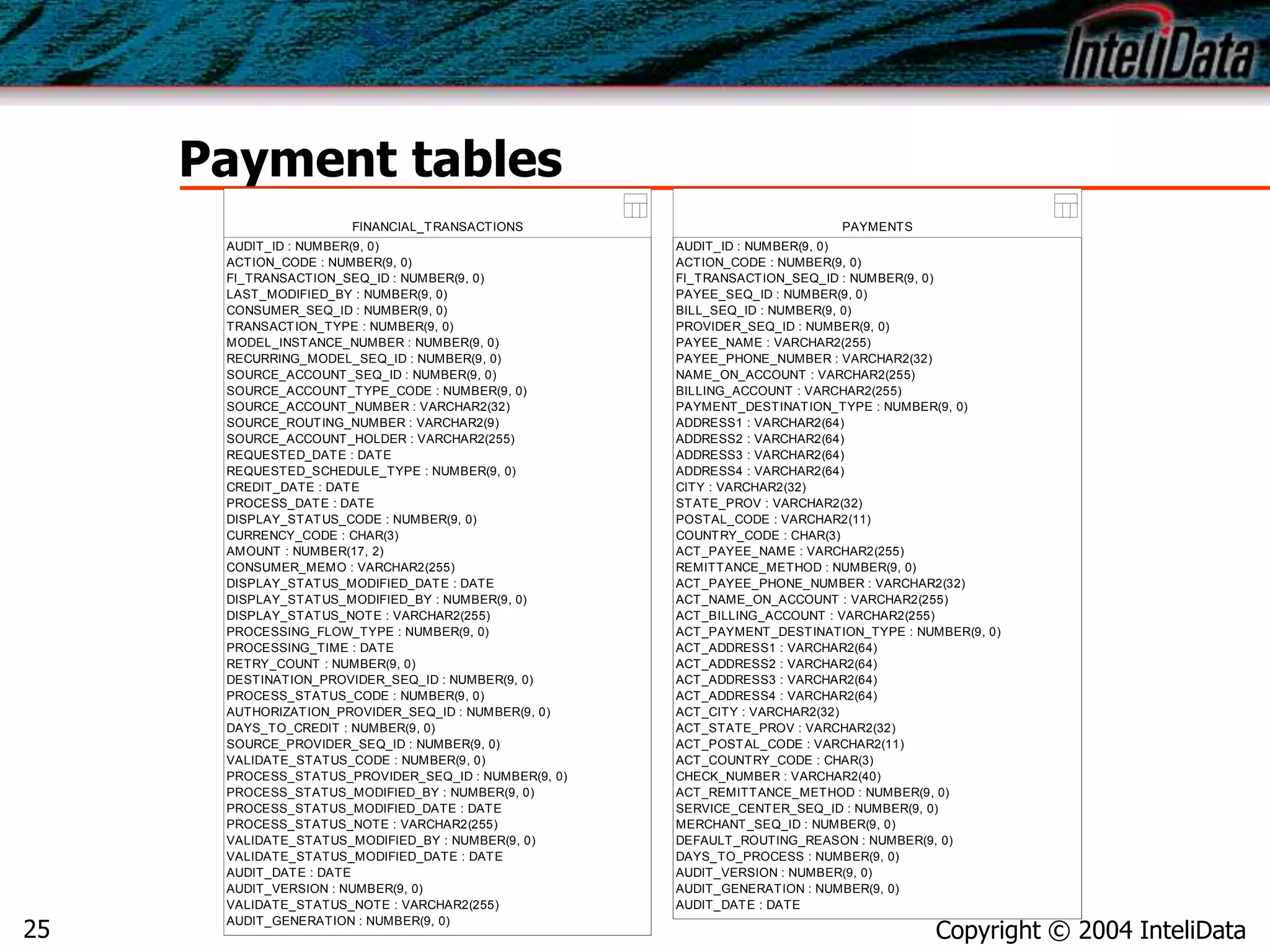
Payment tables
PAYMENTS
AUDIT_ID : NUMBER(9, 0)
ACTION_CODE : NUMBER(9, 0)
FI_TRANSACTION_SEQ_ID : NUMBER(9, 0)
PAYEE_SEQ_ID : NUMBER(9, 0)
BILL_SEQ_ID : NUMBER(9, 0)
PROVIDER_SEQ_ID : NUMBER(9, 0)
PAYEE_NAME : VARCHAR2(255)
PAYEE_PHONE_NUMBER : VARCHAR2(32)
NAME_ON_ACCOUNT : VARCHAR2(255)
BILLING_ACCOUNT : VARCHAR2(255)
PAYMENT_DESTINATION_TYPE : NUMBER(9, 0)
ADDRESS1 : VARCHAR2(64)
ADDRESS2 : VARCHAR2(64)
ADDRESS3 : VARCHAR2(64)
ADDRESS4 : VARCHAR2(64)
CITY : VARCHAR2(32)
STATE_PROV : VARCHAR2(32)
POSTAL_CODE : VARCHAR2(11)
COUNTRY_CODE : CHAR(3)
ACT_PAYEE_NAME : VARCHAR2(255)
REMITTANCE_METHOD : NUMBER(9, 0)
ACT_PAYEE_PHONE_NUMBER : VARCHAR2(32)
ACT_NAME_ON_ACCOUNT : VARCHAR2(255)
ACT_BILLING_ACCOUNT : VARCHAR2(255)
ACT_PAYMENT_DESTINATION_TYPE : NUMBER(9, 0)
ACT_ADDRESS1 : VARCHAR2(64)
ACT_ADDRESS2 : VARCHAR2(64)
ACT_ADDRESS3 : VARCHAR2(64)
ACT_ADDRESS4 : VARCHAR2(64)
ACT_CITY : VARCHAR2(32)
ACT_STATE_PROV : VARCHAR2(32)
ACT_POSTAL_CODE : VARCHAR2(11)
ACT_COUNTRY_CODE : CHAR(3)
CHECK_NUMBER : VARCHAR2(40)
ACT_REMITTANCE_METHOD : NUMBER(9, 0)
SERVICE_CENTER_SEQ_ID : NUMBER(9, 0)
MERCHANT_SEQ_ID : NUMBER(9, 0)
DEFAULT_ROUTING_REASON : NUMBER(9, 0)
DAYS_TO_PROCESS : NUMBER(9, 0)
AUDIT_VERSION : NUMBER(9, 0)
AUDIT_GENERATION : NUMBER(9, 0)
AUDIT_DATE : DATE
FINANCIAL_TRANSACTIONS
AUDIT_ID : NUMBER(9, 0)
ACTION_CODE : NUMBER(9, 0)
FI_TRANSACTION_SEQ_ID : NUMBER(9, 0)
LAST_MODIFIED_BY : NUMBER(9, 0)
CONSUMER_SEQ_ID : NUMBER(9, 0)
TRANSACTION_TYPE : NUMBER(9, 0)
MODEL_INSTANCE_NUMBER : NUMBER(9, 0)
RECURRING_MODEL_SEQ_ID : NUMBER(9, 0)
SOURCE_ACCOUNT_SEQ_ID : NUMBER(9, 0)
SOURCE_ACCOUNT_TYPE_CODE : NUMBER(9, 0)
SOURCE_ACCOUNT_NUMBER : VARCHAR2(32)
SOURCE_ROUTING_NUMBER : VARCHAR2(9)
SOURCE_ACCOUNT_HOLDER : VARCHAR2(255)
REQUESTED_DATE : DATE
REQUESTED_SCHEDULE_TYPE : NUMBER(9, 0)
CREDIT_DATE : DATE
PROCESS_DATE : DATE
DISPLAY_STATUS_CODE : NUMBER(9, 0)
CURRENCY_CODE : CHAR(3)
AMOUNT : NUMBER(17, 2)
CONSUMER_MEMO : VARCHAR2(255)
DISPLAY_STATUS_MODIFIED_DATE : DATE
DISPLAY_STATUS_MODIFIED_BY : NUMBER(9, 0)
DISPLAY_STATUS_NOTE : VARCHAR2(255)
PROCESSING_FLOW_TYPE : NUMBER(9, 0)
PROCESSING_TIME : DATE
RETRY_COUNT : NUMBER(9, 0)
DESTINATION_PROVIDER_SEQ_ID : NUMBER(9, 0)
PROCESS_STATUS_CODE : NUMBER(9, 0)
AUTHORIZATION_PROVIDER_SEQ_ID : NUMBER(9, 0)
DAYS_TO_CREDIT : NUMBER(9, 0)
SOURCE_PROVIDER_SEQ_ID : NUMBER(9, 0)
VALIDATE_STATUS_CODE : NUMBER(9, 0)
PROCESS_STATUS_PROVIDER_SEQ_ID : NUMBER(9, 0)
PROCESS_STATUS_MODIFIED_BY : NUMBER(9, 0)
PROCESS_STATUS_MODIFIED_DATE : DATE
PROCESS_STATUS_NOTE : VARCHAR2(255)
VALIDATE_STATUS_MODIFIED_BY : NUMBER(9, 0)
VALIDATE_STATUS_MODIFIED_DATE : DATE
AUDIT_DATE : DATE
AUDIT_VERSION : NUMBER(9, 0)
VALIDATE_STATUS_NOTE : VARCHAR2(255)
AUDIT_GENERATION : NUMBER(9, 0)
Copyright © 2004 InteliData26
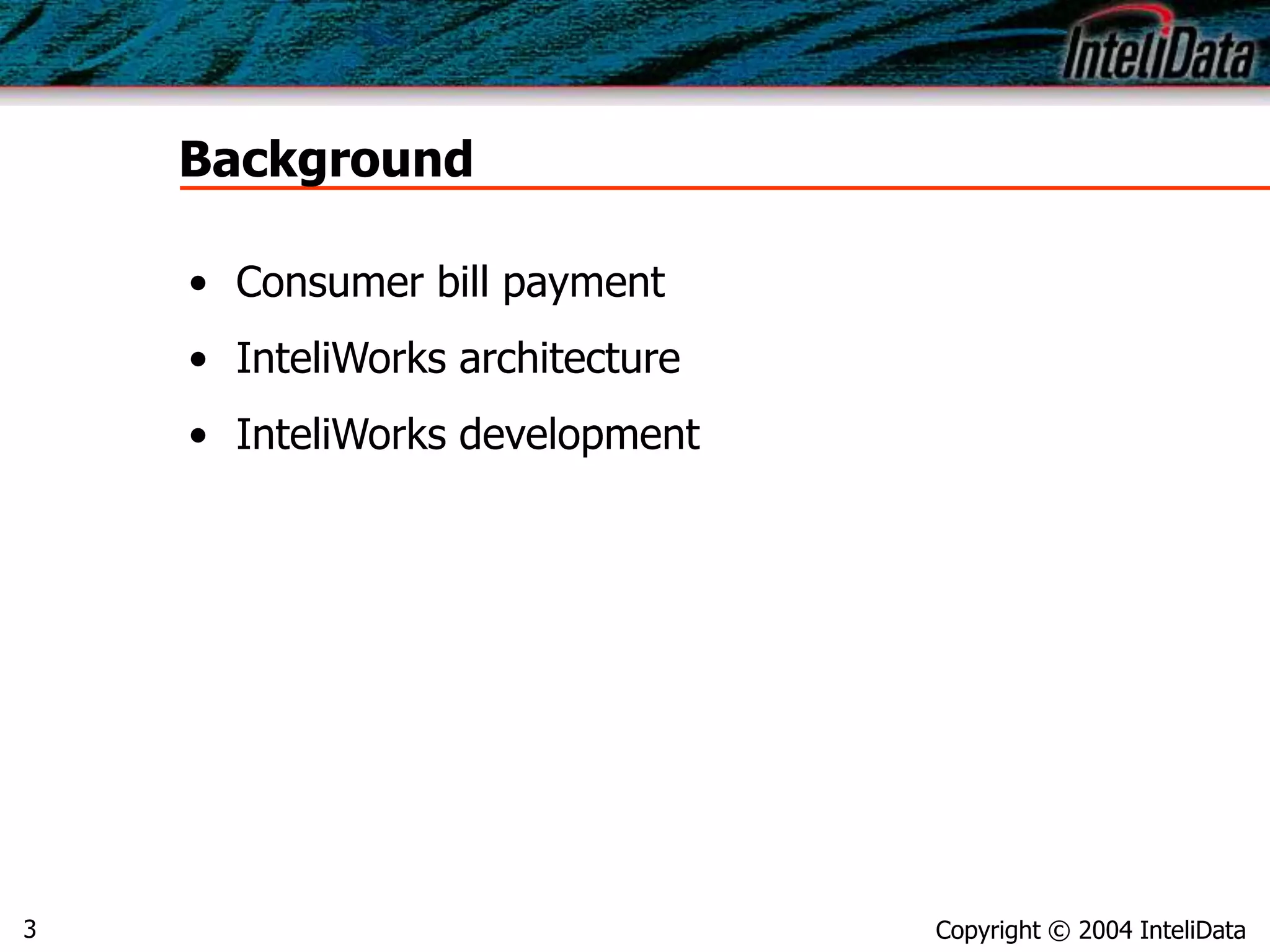
Conclusions
• MDA has value, even without automated transformation.
• Advantages of manual transformation
– No need to purchase and learn transformation tools.
– No need to develop and maintain formal, executable
transformation definitions.
– Ability to quickly adapt as circumstances dictate.
• Disadvantages of manual transformation
– Requires continuing effort and process discipline.
– Unintentional inconsistencies are inevitable.
– Compromises most be made to keep transformations simple
enough to be manually tractable.
– Care must be given to maintaining clear traceability.

Model Driven Architecture without Automation

  • 1.
    Copyright © 2004InteliData A Real-World Example of MDA without Automation Ed Seidewitz 26 August 2004
  • 2.
    Copyright © 2004InteliData2 Agenda • Background • Model-driven architecture • Case study • Conclusions
  • 3.
    Copyright © 2004InteliData3 Background • Consumer bill payment • InteliWorks architecture • InteliWorks development
  • 4.
    Copyright © 2004InteliData4 Background: Consumer bill payment Consumer Computer ConsumerConsumer ComputerComputer Web Banking/ Bill Pay UI Web Banking/Web Banking/ Bill Pay UIBill Pay UI Bill Payment Warehouse Bill PaymentBill Payment WarehouseWarehouse Funding System FundingFunding SystemSystem Remittance Provider RemittanceRemittance ProviderProvider Internet Bank-owned systems Batch files (Bank system /ACH / …) MerchantsMerchantsMerchants
  • 5.
    Copyright © 2004InteliData5 Background: InteliWorks architecture
  • 6.
    Copyright © 2004InteliData6 Background: InteliWorks development • InteliWorks project initiated late in 2000. • Iterative development approach with each (overlapping) increment taking 3-4 months (currently working on Increment 18). • Significant modeling introduced in stages starting early in 2001. – Architectural modeling – Logical data modeling – Physical Java class modeling (no longer done) – Use case modeling • Complete model-driven approach established by mid 2003.
  • 7.
    Copyright © 2004InteliData7 Model-driven architecture • What is it? • What is a platform? • CIM, PIM, PSM and all that… • Transformations • Why “manual transformation”?
  • 8.
    Copyright © 2004InteliData8 MDA: What is it? From the MDA Guide Version 1.0.1 (omg/2003-06-01) “The Model-Driven Architecture starts with the well- known and long established idea of separating the specification of the operation of a system from the details of the way that system uses the capabilities of its platform.”
  • 9.
    Copyright © 2004InteliData9 MDA: What is a platform? From the MDA Guide Version 1.0.1 (omg/2003-06-01) “A platform is a set of subsystems and technologies that provide a coherent set of functionality through interfaces and specified usage patterns, which any application supported by that platform can use without concern for the details of how the functionality provided by the platform is implemented.”
  • 10.
    Copyright © 2004InteliData10 MDA: CIM, PIM, PSM and all that… • “A computation independent model is a view of a system” that “focuses on the on the environment of the system, and the requirements for the system.” • “A platform independent model is a view of a system” that “focuses on the operation of a system while hiding the details necessary for a particular platform.” • “A platform specific model is a view of a system” that “combines the platform independent viewpoint with an additional focus on the detail of the use of a specific platform by a system.” From the MDA Guide Version 1.0.1 (omg/2003-06-01)
  • 11.
    Copyright © 2004InteliData11 MDA: Transformations • “The platform independent model is transformed to be a model specific to a particular platform.” • “Four different transformation approaches…illustrate the range of possibilities:” – manual transformation – transforming a PIM that is prepared using a profile – transformation using patterns and markings – automatic transformation
  • 12.
    Copyright © 2004InteliData12 Case study • Overview • Architecture • Data
  • 13.
    Copyright © 2004InteliData13 Case study: Overview Consumer: Payment - View Payments Consumer Consumer: Payment - Cancel Consumer: Payment - Create (without Bill) Consumer: Payment - Modify Consumer: Payment - View Activity <<extend>> Consumer: Payment - Validate <<extend>> <<include>> <<extend>> <<include>> Consumer: Payment - Route <<include>> <<include>> <<extend>> Requirements Model (use case and activity diagrams) PaymentService PaymentFe <<Interface>> addPayment() cancelPayment() getPayments() getPaymentActivity() updatePayment() PaymentRead PaymentEvent <<Interface>> processPayments() PaymentFeExtended <<Interface>> addPaymentNoteExtended() completePaymentExtended() failPaymentExtended() getPaymentsExtended() pendPaymentExtended() resubmitPaymentExtended() reversePaymentExtended() Notification (from eMessenger) FinancialTransactionCommon (from Financial Transaction Service) PayeeUtility AccountUtility FinancialTransactionWrite OperationalDirectory (from Operational Directory Service) FinancialTransactionUtility (from Financial Transaction Service) FinancialTransaction (from Financial Transaction Service) SchedulingEvent (from Scheduler) Payment <<Interface>> handlePayeeChange() FinancialTransactionRead PaymentUtility <<Interface>> prepare() getRouting() checkForDuplicate() Dependency Model (class diagrams) : Consumer : ConsumerFrontEnd : XmlConnector : PaymentService : FinancialTransactionService Sequence Diagram: InteliWorks Consumer: Payment Realizations / Consumer: Payment - View Payments 1. Create payment 2.1. addPaymentRq 2.1.2. addPaymentRs 1.2. Display confirmation 2. Ok 3. Close view 3.1. View payments 2.1.1. addPayment( ) 2.1.1.2. payment 1.1. Enter payment Sequence Diagram: InteliWorks Consumer: Payment Realizations / Consumer: Payment - Enter 2.1.1.1. addFinancialTransaction( ) 2.1.1.1.1. financialTransaction Sequence Diagram: InteliWorks Consumer: Financial Transaction Realizations / Consumer: Financial Transaction - Add Architectural Realizations (sequence diagrams) FinancialTransactionBase DisplayStatus CreationData FinancialTransactionConsumerData 1 11 +displayStatus 1 +creationData 11 FinancialTransactionData FinancialTransaction Note FinancialTransactionExtended 0..1 * 0..1 +note* CurrencyAmount FinancialTransactionTypeCode <<enumeration>> PAYMENT FUNDS_TRANSFER FinancialTransactionSpecification 0..1 1 0..1 +specification1 0..11 0..1 +amount 1 +transactionType 11 ProcessingData 1 11 +processingData 1 ProcessingStatus 0..1 1 0..1 +status 1 ProcessingStep 0..1 * 0..1 +previousStep {ordered} * +status 0..1 1 0..1 1 Logical Data Model (class diagrams) xxxxxxxxxxxxxxxxxxxxxxx xxxxxxxxxxxxxxxxxxxx xxxxxxxxxxxxxxxxxxxxx xxxxxxxxxxxx xxxxxxxxxxxxxxxxx xxxxxxxxxxxxx xxxxxxxxxxx xxxxxxxxxxxxxx xxxxxxxxxxxxx xxxxxxxxx xxxxxxxxx xxxxxxx xxxxxxxxxx xxxxxxx ]xxxx Interface Code (EJB) xxxxxxxxxxxxxxxxxxxxxxx xxxxxxxxxxxxxxxxxxxx xxxxxxxxxxxxxxxxxxxxx xxxxxxxxxxxx xxxxxxxxxxxxxxxxx xxxxxxxxxxxxx xxxxxxxxxxx xxxxxxxxxxxxxx xxxxxxxxxxxxx xxxxxxxxx xxxxxxxxx xxxxxxx xxxxxxxxxx xxxxxxx ]xxxx Web Services Code (WSDL/SOAP) xxxxxxxxxxxxxxxxxxxxxxx xxxxxxxxxxxxxxxxxxxx xxxxxxxxxxxxxxxxxxxxx xxxxxxxxxxxx xxxxxxxxxxxxxxxxx xxxxxxxxxxxxx xxxxxxxxxxx xxxxxxxxxxxxxx xxxxxxxxxxxxx xxxxxxxxx xxxxxxxxx xxxxxxx xxxxxxxxxx xxxxxxx ]xxxx Value Object Code (Java) xxxxxxxxxxxxxxxxxxxxxxx xxxxxxxxxxxxxxxxxxxx xxxxxxxxxxxxxxxxxxxxx xxxxxxxxxxxx xxxxxxxxxxxxxxxxx xxxxxxxxxxxxx xxxxxxxxxxx xxxxxxxxxxxxxx xxxxxxxxxxxxx xxxxxxxxx xxxxxxxxx xxxxxxx xxxxxxxxxx xxxxxxx ]xxxx Schema Code (SQL) PAYMENTS AUDIT_ID : NUMBER(9, 0) ACTION_CODE : NUMBER(9, 0) FI_TRANSACTION_SEQ_ID : NUMBER(9, 0) PAYEE_SEQ_ID : NUMBER(9, 0) BILL_SEQ_ID : NUMBER(9, 0) PROVIDER_SEQ_ID : NUMBER(9, 0) PAYEE_NAME : VARCHAR2(255) PAYEE_PHONE_NUMBER : VARCHAR2(32) NAME_ON_ACCOUNT : VARCHAR2(255) BILLING_ACCOUNT : VARCHAR2(255) PAYMENT_DESTINATION_TYPE : NUMBER(9, 0) ADDRESS1 : VARCHAR2(64) ADDRESS2 : VARCHAR2(64) ADDRESS3 : VARCHAR2(64) ADDRESS4 : VARCHAR2(64) CITY : VARCHAR2(32) STATE_PROV : VARCHAR2(32) POSTAL_CODE : VARCHAR2(11) COUNTRY_CODE : CHAR(3) ACT_PAYEE_NAME : VARCHAR2(255) REMITTANCE_METHOD : NUMBER(9, 0) ACT_PAYEE_PHONE_NUMBER : VARCHAR2(32) ACT_NAME_ON_ACCOUNT : VARCHAR2(255) ACT_BILLING_ACCOUNT : VARCHAR2(255) ACT_PAYMENT_DESTINATION_TYPE : NUMBER(9, 0) ACT_ADDRESS1 : VARCHAR2(64) ACT_ADDRESS2 : VARCHAR2(64) ACT_ADDRESS3 : VARCHAR2(64) ACT_ADDRESS4 : VARCHAR2(64) ACT_CITY : VARCHAR2(32) ACT_STATE_PROV : VARCHAR2(32) ACT_POSTAL_CODE : VARCHAR2(11) ACT_COUNTRY_CODE : CHAR(3) CHECK_NUMBER : VARCHAR2(40) ACT_REMITTANCE_METHOD : NUMBER(9, 0) SERVICE_CENTER_SEQ_ID : NUMBER(9, 0) MERCHANT_SEQ_ID : NUMBER(9, 0) DEFAULT_ROUTING_REASON : NUMBER(9, 0) DAYS_TO_PROCESS : NUMBER(9, 0) AUDIT_VERSION : NUMBER(9, 0) AUDIT_GENERATION : NUMBER(9, 0) AUDIT_DATE : DATE FINANCIAL_TRANSACTIONS AUDIT_ID : NUMBER(9, 0) ACTION_CODE : NUMBER(9, 0) FI_TRANSACTION_SEQ_ID : NUMBER(9, 0) LAST_MODIFIED_BY : NUMBER(9, 0) CONSUMER_SEQ_ID : NUMBER(9, 0) TRANSACTION_TYPE : NUMBER(9, 0) MODEL_INSTANCE_NUMBER : NUMBER(9, 0) RECURRING_MODEL_SEQ_ID : NUMBER(9, 0) SOURCE_ACCOUNT_SEQ_ID : NUMBER(9, 0) SOURCE_ACCOUNT_TYPE_CODE : NUMBER(9, 0) SOURCE_ACCOUNT_NUMBER : VARCHAR2(32) SOURCE_ROUTING_NUMBER : VARCHAR2(9) SOURCE_ACCOUNT_HOLDER : VARCHAR2(255) REQUESTED_DATE : DATE REQUESTED_SCHEDULE_TYPE : NUMBER(9, 0) CREDIT_DATE : DATE PROCESS_DATE : DATE DISPLAY_STATUS_CODE : NUMBER(9, 0) CURRENCY_CODE : CHAR(3) AMOUNT : NUMBER(17, 2) CONSUMER_MEMO : VARCHAR2(255) DISPLAY_STATUS_MODIFIED_DATE : DATE DISPLAY_STATUS_MODIFIED_BY : NUMBER(9, 0) DISPLAY_STATUS_NOTE : VARCHAR2(255) PROCESSING_FLOW_TYPE : NUMBER(9, 0) PROCESSING_TIME : DATE RETRY_COUNT : NUMBER(9, 0) DESTINATION_PROVIDER_SEQ_ID : NUMBER(9, 0) PROCESS_STATUS_CODE : NUMBER(9, 0) AUTHORIZATION_PROVIDER_SEQ_ID : NUMBER(9, 0) DAYS_TO_CREDIT : NUMBER(9, 0) SOURCE_PROVIDER_SEQ_ID : NUMBER(9, 0) VALIDATE_STATUS_CODE : NUMBER(9, 0) PROCESS_STATUS_PROVIDER_SEQ_ID : NUMBER(9, 0) PROCESS_STATUS_MODIFIED_BY : NUMBER(9, 0) PROCESS_STATUS_MODIFIED_DATE : DATE PROCESS_STATUS_NOTE : VARCHAR2(255) VALIDATE_STATUS_MODIFIED_BY : NUMBER(9, 0) VALIDATE_STATUS_MODIFIED_DATE : DATE AUDIT_DATE : DATE AUDIT_VERSION : NUMBER(9, 0) VALIDATE_STATUS_NOTE : VARCHAR2(255) AUDIT_GENERATION : NUMBER(9, 0) Database Design Model (class diagram) xxxxxxxxxxxxxxxxxxxxxxx xxxxxxxxxxxxxxxxxxxx xxxxxxxxxxxxxxxxxxxxx xxxxxxxxxxxx xxxxxxxxxxxxxxxxx xxxxxxxxxxxxx xxxxxxxxxxx xxxxxxxxxxxxxx xxxxxxxxxxxxx xxxxxxxxx xxxxxxxxx xxxxxxx xxxxxxxxxx xxxxxxx ]xxxx Schema Definition (Torque XML) CIM PIM PSM PIM/PSM hand coded hand coded handcoded generated generated generated reverse engineered hand modeled hand modeled handmodeled traceshand modeled Implementation platform • J2EE (WebLogic app server) • Relational DB (Oracle DBMS) • Web services (Apache Axis)
  • 14.
    Copyright © 2004InteliData14 Why “manual transformation”? • Manual transformation “is not greatly different from how much good software design work has been done for years. The MDA approach adds value in two ways:” – “the explicit distinction between a platform independent model and the transformed platform specific model,” – “the record of the transformation.” • For InteliWorks… – Needed to establish effective modeling before introducing automation. – Lacked a business case for an effective team late in the product development cycle. The long-term benefits were not convincingly worth the short-term loss of productivity to introduce new tools. • The business case would likely be different for a new product development cycle.
  • 15.
    Copyright © 2004InteliData15 Case study: Architecture • Dependency models – Payment Service dependencies • Architectural models to code – PaymentFe helper class – Add payment request value object class • Architectural models to Web services – WSDL for the Payment Service
  • 16.
    Copyright © 2004InteliData16 Payment Service dependencies PaymentService PaymentFe <<Interface>> addPayment() cancelPayment() getPayments() getPaymentActivity() updatePayment() PaymentRead PaymentEvent <<Interface>> processPayments() PaymentFeExtended <<Interface>> addPaymentNoteExtended() completePaymentExtended() failPaymentExtended() getPaymentsExtended() pendPaymentExtended() resubmitPaymentExtended() reversePaymentExtended() Notification (from eMessenger) FinancialTransactionCommon (from Financial Transaction Service) PayeeUtility AccountUtility FinancialTransactionWrite OperationalDirectory (from Operational Directory Service) FinancialTransactionUtility (from Financial Transaction Service) FinancialTransaction (from Financial Transaction Service) SchedulingEvent (from Scheduler) Payment <<Interface>> handlePayeeChange() FinancialTransactionRead PaymentUtility <<Interface>> prepare() getRouting() checkForDuplicate()
  • 17.
    Copyright © 2004InteliData17 PaymentFe helper class public class PaymentFeHelper { public static AddPaymentRsVO addPayment ( SessionVO session, AddPaymentRqVO request ) throws CheckedException, UncheckedException { … } public static CancelPaymentRsVO cancelPayment ( SessionVO session, CancelPaymentRqVO request ) throws CheckedException, UncheckedException { … } public static GetPaymentActivityRsVO getPaymentActivity ( SessionVO session, GetPaymentActivityRqVO request ) throws CheckedException, UncheckedException { … } public static GetPaymentsRsVO getPayments ( SessionVO session, GetPaymentsRqVO request ) throws CheckedException, UncheckedException { … } public static UpdatePaymentRsVO updatePayment ( SessionVO session, UpdatePaymentRqVO request ) throws CheckedException, UncheckedException { … } private static PaymentRequestMgr getPaymentRequestMgr () throws CheckedException, RemoteException { … } }
  • 18.
    Copyright © 2004InteliData18 Add payment request value object class public class AddPaymentRqVO implements ValueObject { private PaymentSpecificationVO specification; public AddPaymentRqVO( ) { } public AddPaymentRqVO( PaymentSpecificationVO specification) { this.specification = specification; } public PaymentSpecificationVO getSpecification() { return this.specification; } public void setSpecification(PaymentSpecificationVO specification) { this.specification = specification; } }
  • 19.
    Copyright © 2004InteliData19 WSDL for the Payment Service <?xml version="1.0" encoding="UTF-8"?> <wsdl:definitions …> … <wsdl:message name="addPaymentRequest"> <wsdl:part name="session" type="tns1:SessionVO"/> <wsdl:part name="request" type="tns1:AddPaymentRqVO"/> </wsdl:message> … <wsdl:portType name="PaymentService"> <wsdl:operation name="addPayment" parameterOrder="session request"> <wsdl:input message="impl:addPaymentRequest" name="addPaymentRequest"/> <wsdl:output message="impl:addPaymentResponse" name="addPaymentResponse"/> <wsdl:fault message="impl:ServiceException" name="ServiceException"/> </wsdl:operation> … </wsdl:portType> … </wsdl:definitions>
  • 20.
    Copyright © 2004InteliData20 Case study: Data • Logical data model – Financial transaction entity model – Payment entity model • Logical model to code – Payment value object classes • Logical model to XML – Payment XML aggregate • Logical model to database schema – Payment tables
  • 21.
    Copyright © 2004InteliData21 Financial transaction entity model FinancialTransactionBase DisplayStatus CreationData FinancialTransactionConsumerData 1 11 +displayStatus 1 +creationData 11 FinancialTransactionData FinancialTransaction Note FinancialTransactionExtended 0..1 * 0..1 +note* CurrencyAmount FinancialTransactionTypeCode <<enumeration>> PAYMENT FUNDS_TRANSFER FinancialTransactionSpecification 0..1 1 0..1 +specification1 0..11 0..1 +amount 1 +transactionType 11 ProcessingData 1 11 +processingData 1 ProcessingStatus 0..1 1 0..1 +status 1 ProcessingStep 0..1 * 0..1 +previousStep {ordered} * +status 0..1 1 0..1 1
  • 22.
    Copyright © 2004InteliData22 Payment entity model PaymentExtended PaymentRemittanceDetail DestinationRoutingData FiAccountSpecification Payment FinancialTransactionConsumerData FinancialTransactionSpecification FinancialTransactionExtended PaymentSpecification PaymentDestinationRoutedPaymentSpecification 0..1 1 0..1 +paymentSpecification 1 0..1 0..1 0..1 +remittanceDetail 0..1 0..1 0..1 0..1 +destinationRoutingData0..1 0..10..1 0..1 +source 0..1 0..1 1 0..1 1 +paymentSpecification 0..1 0..1 0..1 +actualDestination0..1 +destination 0..1 0..10..1 0..1
  • 23.
    Copyright © 2004InteliData23 Payment value object classes public abstract class FinancialTransactionBaseVO implements ValueObject { private Long financialTransactionId; private Date processDate; private Date creditDate; // Getter and setter methods … } public abstract class FinancialTransactionConsumerDataVO extends FinancialTransactionBaseVO { private CreationDataVO creationData; private DisplayStatusVO displayStatus; // Getter and setter methods … } public class PaymentVO extends FinancialTransactionConsumerDataVO { private RoutedPaymentSpecificationVO paymentSpecification; // Getter and setter methods … }
  • 24.
    Copyright © 2004InteliData24 Payment XML aggregate <payment xsi:type="ns2:PaymentVO" xmlns:soapenc="http://schemas.xmlsoap.org/soap/encoding/"> <financialTransactionId xsi:type="xsd:long">10006</financialTransactionId> <processDate xsi:type="xsd:dateTime">2004-06-01T04:00:00.000Z</processDate> <creditDate xsi:type="xsd:dateTime">2004-06-03T04:00:00.000Z</processDate> <creationData xsi:type="ns2:CreationDataVO"> … </creationData> <displayStatus xsi:type="ns2:DisplayStatusVO"> … </displayStatus> <paymentSpecification xsi:type="ns2:RoutedPaymentSpecificationVO"> <source xsi:type="ns2:FiAccountSpecificationVO"> … </source> <amount xsi:type="ns2:CurrencyAmountVO"> … </amount> <destination xsi:type="ns2:PaymentDestinationVO"> … </destination> <actualDestination xsi:type="ns2:PaymentDestinationVO"> … </actualDestination> <destinationRoutingData xsi:type="ns2:DestinationRoutingDataVO"> … </destinationRoutingData> … </paymentSpecification> </payment>
  • 25.
    Copyright © 2004InteliData25 Payment tables PAYMENTS AUDIT_ID : NUMBER(9, 0) ACTION_CODE : NUMBER(9, 0) FI_TRANSACTION_SEQ_ID : NUMBER(9, 0) PAYEE_SEQ_ID : NUMBER(9, 0) BILL_SEQ_ID : NUMBER(9, 0) PROVIDER_SEQ_ID : NUMBER(9, 0) PAYEE_NAME : VARCHAR2(255) PAYEE_PHONE_NUMBER : VARCHAR2(32) NAME_ON_ACCOUNT : VARCHAR2(255) BILLING_ACCOUNT : VARCHAR2(255) PAYMENT_DESTINATION_TYPE : NUMBER(9, 0) ADDRESS1 : VARCHAR2(64) ADDRESS2 : VARCHAR2(64) ADDRESS3 : VARCHAR2(64) ADDRESS4 : VARCHAR2(64) CITY : VARCHAR2(32) STATE_PROV : VARCHAR2(32) POSTAL_CODE : VARCHAR2(11) COUNTRY_CODE : CHAR(3) ACT_PAYEE_NAME : VARCHAR2(255) REMITTANCE_METHOD : NUMBER(9, 0) ACT_PAYEE_PHONE_NUMBER : VARCHAR2(32) ACT_NAME_ON_ACCOUNT : VARCHAR2(255) ACT_BILLING_ACCOUNT : VARCHAR2(255) ACT_PAYMENT_DESTINATION_TYPE : NUMBER(9, 0) ACT_ADDRESS1 : VARCHAR2(64) ACT_ADDRESS2 : VARCHAR2(64) ACT_ADDRESS3 : VARCHAR2(64) ACT_ADDRESS4 : VARCHAR2(64) ACT_CITY : VARCHAR2(32) ACT_STATE_PROV : VARCHAR2(32) ACT_POSTAL_CODE : VARCHAR2(11) ACT_COUNTRY_CODE : CHAR(3) CHECK_NUMBER : VARCHAR2(40) ACT_REMITTANCE_METHOD : NUMBER(9, 0) SERVICE_CENTER_SEQ_ID : NUMBER(9, 0) MERCHANT_SEQ_ID : NUMBER(9, 0) DEFAULT_ROUTING_REASON : NUMBER(9, 0) DAYS_TO_PROCESS : NUMBER(9, 0) AUDIT_VERSION : NUMBER(9, 0) AUDIT_GENERATION : NUMBER(9, 0) AUDIT_DATE : DATE FINANCIAL_TRANSACTIONS AUDIT_ID : NUMBER(9, 0) ACTION_CODE : NUMBER(9, 0) FI_TRANSACTION_SEQ_ID : NUMBER(9, 0) LAST_MODIFIED_BY : NUMBER(9, 0) CONSUMER_SEQ_ID : NUMBER(9, 0) TRANSACTION_TYPE : NUMBER(9, 0) MODEL_INSTANCE_NUMBER : NUMBER(9, 0) RECURRING_MODEL_SEQ_ID : NUMBER(9, 0) SOURCE_ACCOUNT_SEQ_ID : NUMBER(9, 0) SOURCE_ACCOUNT_TYPE_CODE : NUMBER(9, 0) SOURCE_ACCOUNT_NUMBER : VARCHAR2(32) SOURCE_ROUTING_NUMBER : VARCHAR2(9) SOURCE_ACCOUNT_HOLDER : VARCHAR2(255) REQUESTED_DATE : DATE REQUESTED_SCHEDULE_TYPE : NUMBER(9, 0) CREDIT_DATE : DATE PROCESS_DATE : DATE DISPLAY_STATUS_CODE : NUMBER(9, 0) CURRENCY_CODE : CHAR(3) AMOUNT : NUMBER(17, 2) CONSUMER_MEMO : VARCHAR2(255) DISPLAY_STATUS_MODIFIED_DATE : DATE DISPLAY_STATUS_MODIFIED_BY : NUMBER(9, 0) DISPLAY_STATUS_NOTE : VARCHAR2(255) PROCESSING_FLOW_TYPE : NUMBER(9, 0) PROCESSING_TIME : DATE RETRY_COUNT : NUMBER(9, 0) DESTINATION_PROVIDER_SEQ_ID : NUMBER(9, 0) PROCESS_STATUS_CODE : NUMBER(9, 0) AUTHORIZATION_PROVIDER_SEQ_ID : NUMBER(9, 0) DAYS_TO_CREDIT : NUMBER(9, 0) SOURCE_PROVIDER_SEQ_ID : NUMBER(9, 0) VALIDATE_STATUS_CODE : NUMBER(9, 0) PROCESS_STATUS_PROVIDER_SEQ_ID : NUMBER(9, 0) PROCESS_STATUS_MODIFIED_BY : NUMBER(9, 0) PROCESS_STATUS_MODIFIED_DATE : DATE PROCESS_STATUS_NOTE : VARCHAR2(255) VALIDATE_STATUS_MODIFIED_BY : NUMBER(9, 0) VALIDATE_STATUS_MODIFIED_DATE : DATE AUDIT_DATE : DATE AUDIT_VERSION : NUMBER(9, 0) VALIDATE_STATUS_NOTE : VARCHAR2(255) AUDIT_GENERATION : NUMBER(9, 0)
  • 26.
    Copyright © 2004InteliData26 Conclusions • MDA has value, even without automated transformation. • Advantages of manual transformation – No need to purchase and learn transformation tools. – No need to develop and maintain formal, executable transformation definitions. – Ability to quickly adapt as circumstances dictate. • Disadvantages of manual transformation – Requires continuing effort and process discipline. – Unintentional inconsistencies are inevitable. – Compromises most be made to keep transformations simple enough to be manually tractable. – Care must be given to maintaining clear traceability.