Copyright © 2014 Ivar Jacobson International SA. All rights reserved
Essence:
A Common Ground for Flexible Methods
Ed Seidewitz
• Embody essential concepts in a kernel.
• Work with methods in an agile way that are as close to
practitioners’ practice as possible.
• Focus on the things that matter the most.
• Focus on helping the least experienced developers over helping
more experienced developers.
• Understand that the majority of practitioners are interested in…
– the use of methods, not their definition.
– practice, not process or method engineering.
– intuitive and concrete graphical syntax, not formal semantics.
Principles of Essence
2
• “Foundation for Agile Creation and Enactment of Software
Engineering Methods” (FACESEM) RFP issued June, 2011
• Essence – Kernel and Language for Software Engineering
Methods submitted February 2013
• Essence 1.0 Finalization Task Force chartered March 2013
• Essence 1.0 (beta) adopted May 2014
The Essence Specification
3
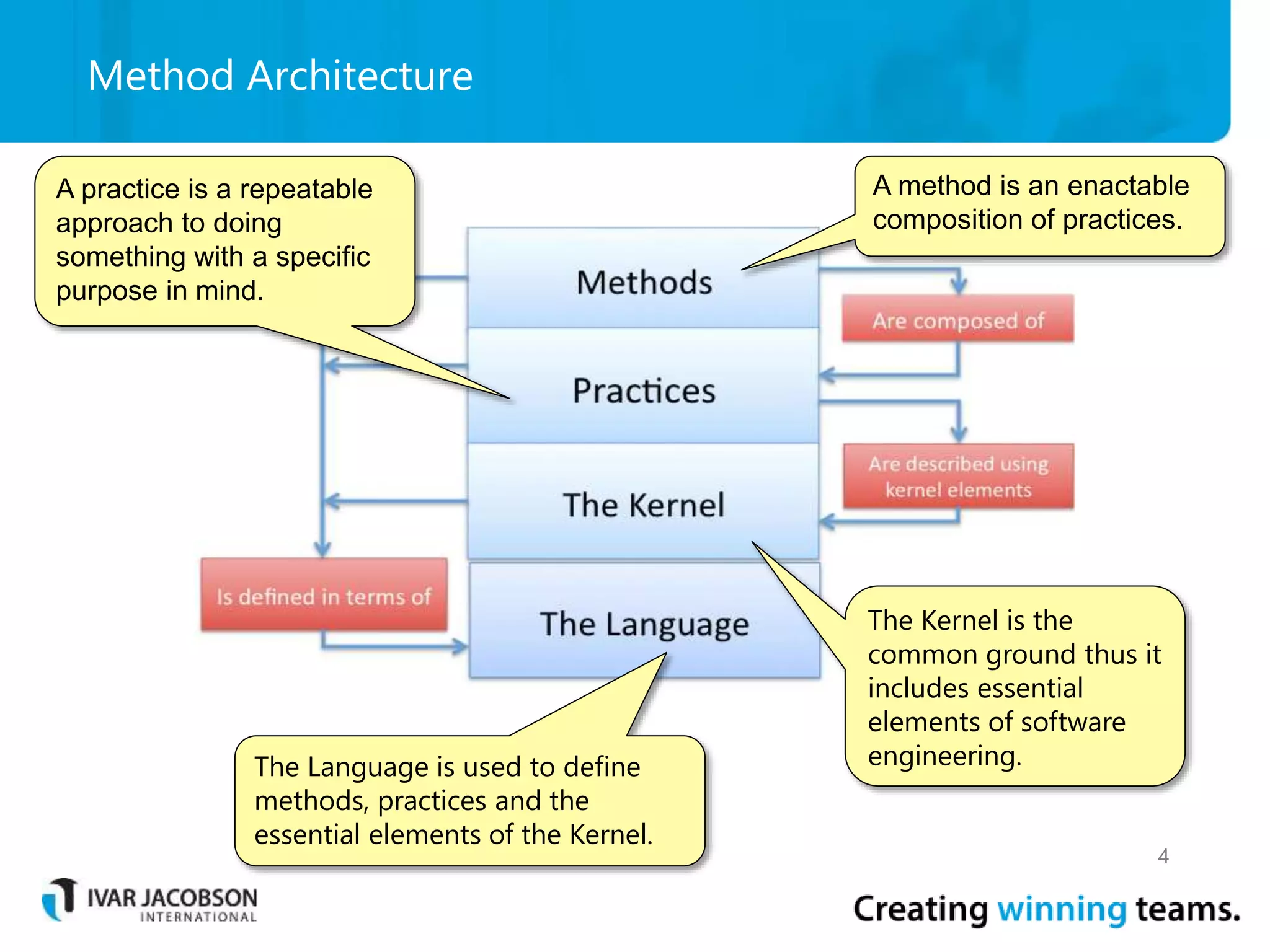
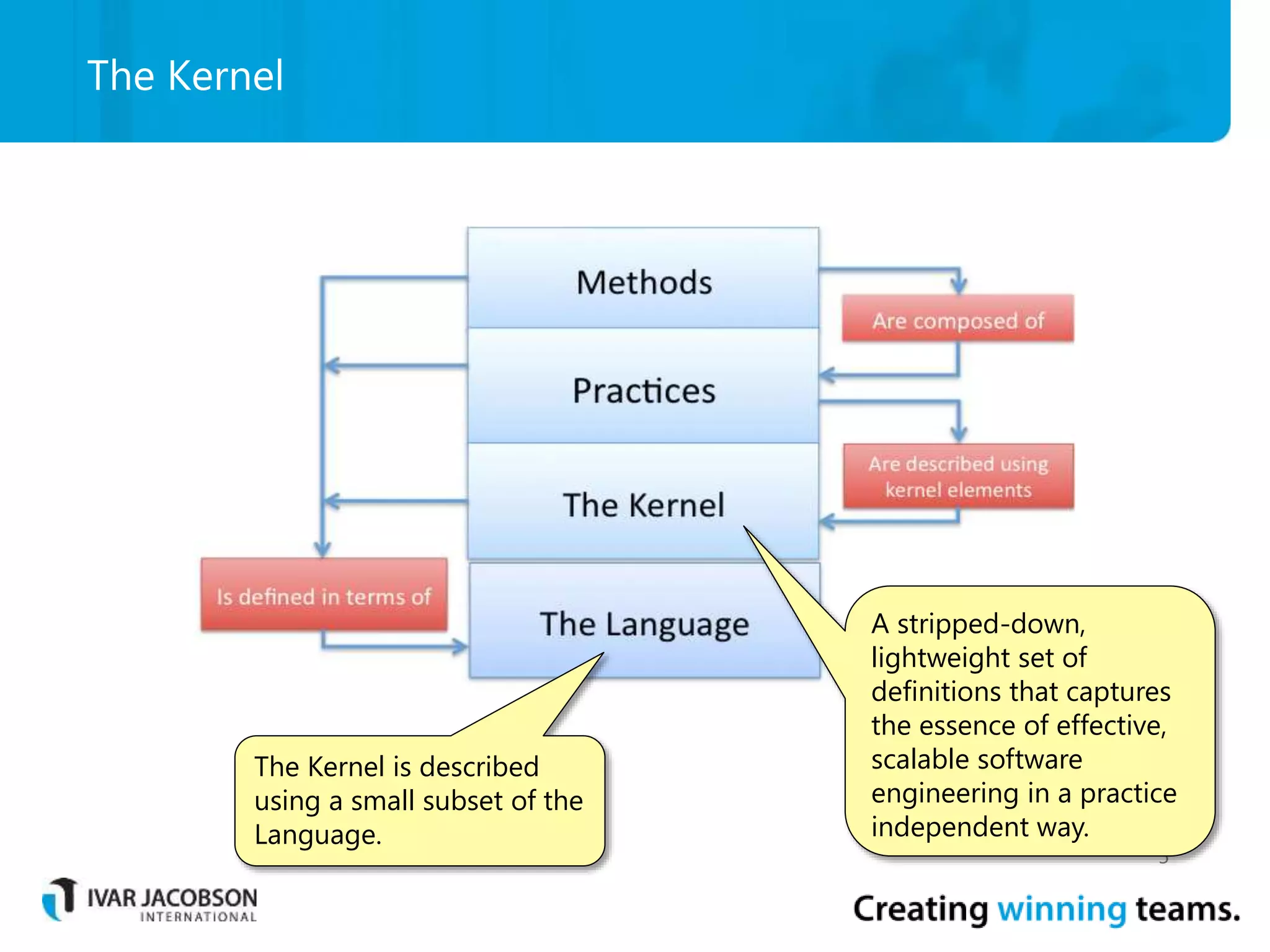
Method Architecture
4
The Kernel is the
common ground thus it
includes essential
elements of software
engineering.The Language is used to define
methods, practices and the
essential elements of the Kernel.
A practice is a repeatable
approach to doing
something with a specific
purpose in mind.
A method is an enactable
composition of practices.
The Kernel
5
A stripped-down,
lightweight set of
definitions that captures
the essence of effective,
scalable software
engineering in a practice
independent way.
The Kernel is described
using a small subset of the
Language.
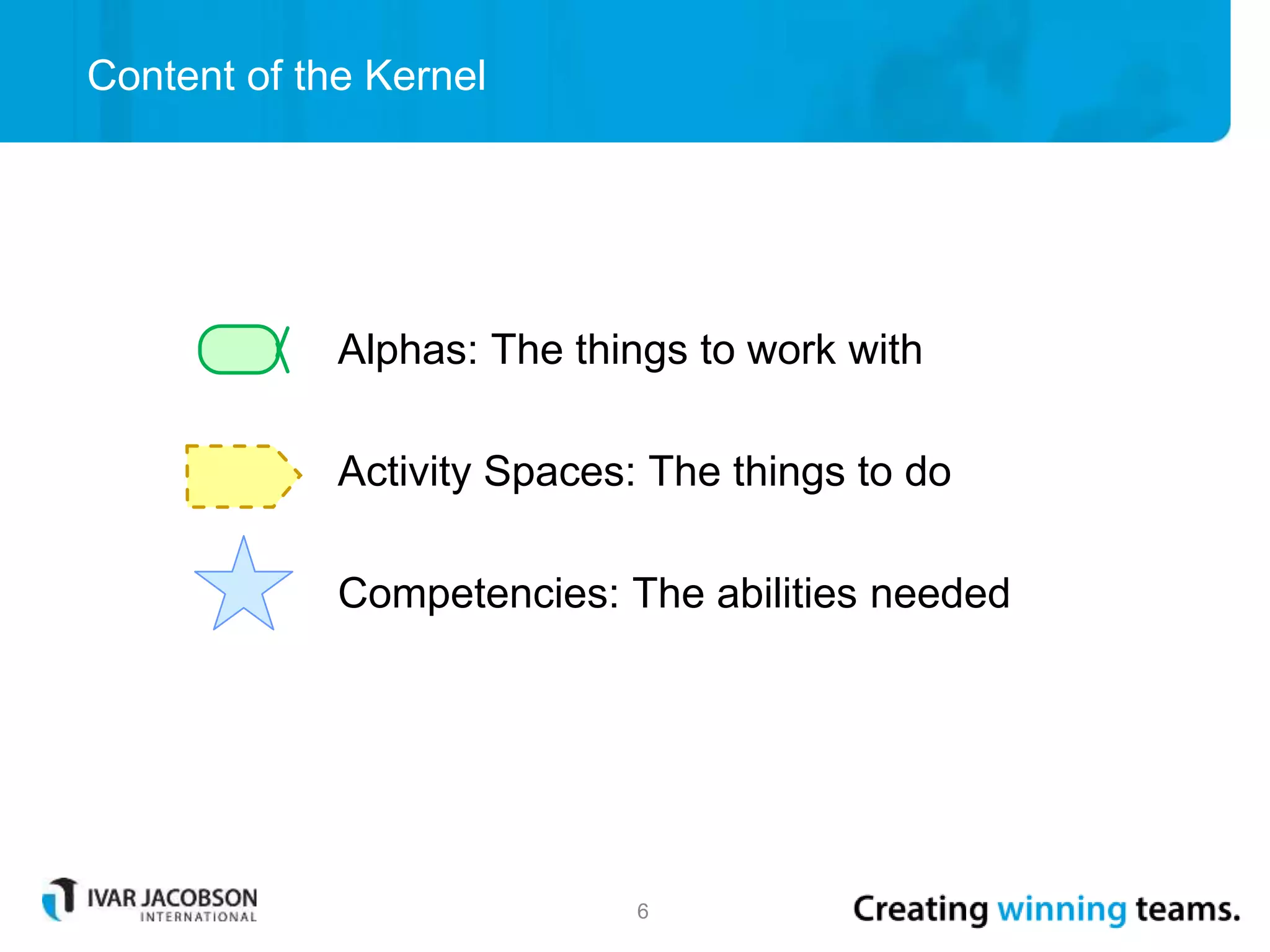
Alphas: The things to work with
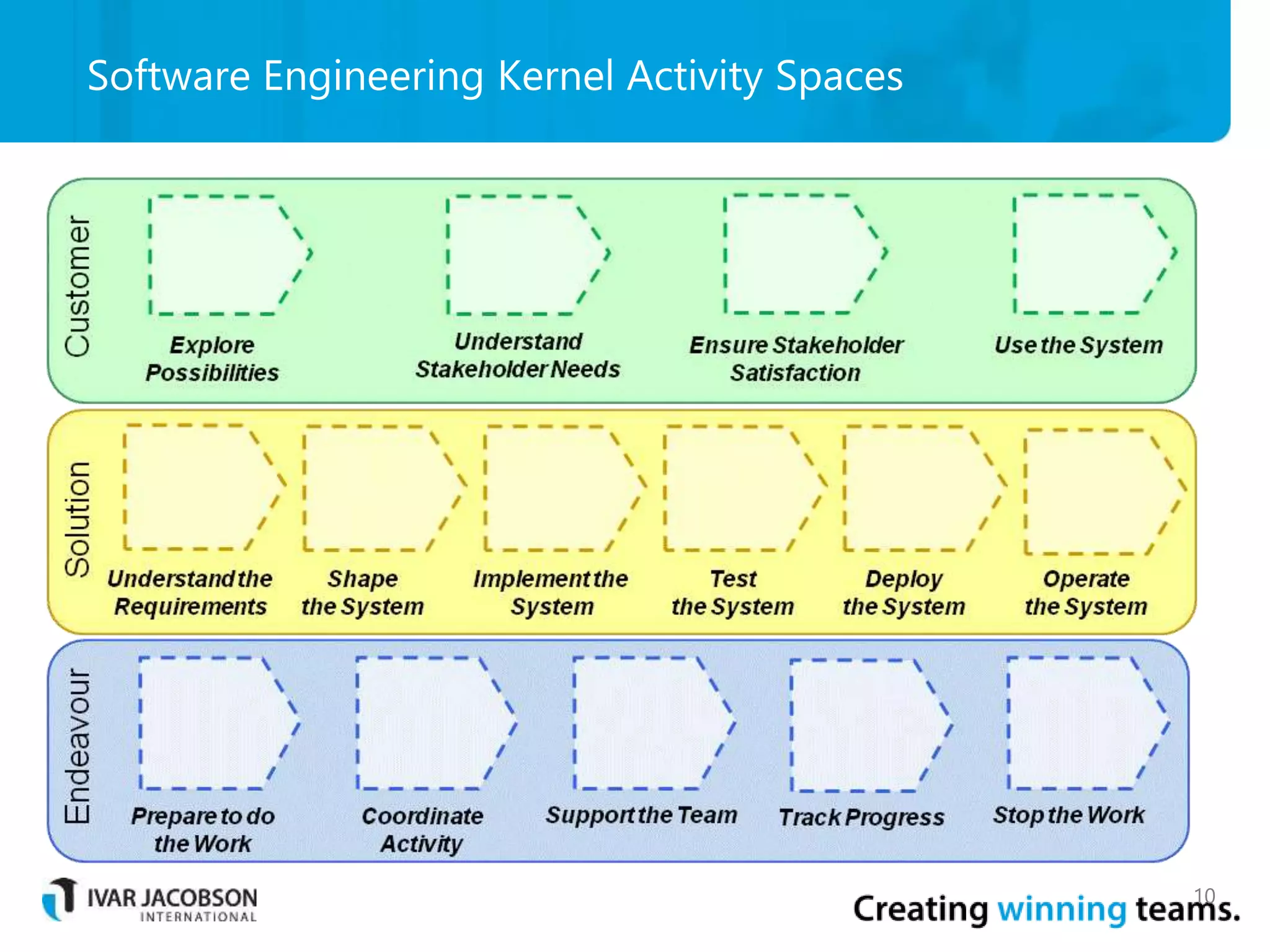
Activity Spaces: The things to do
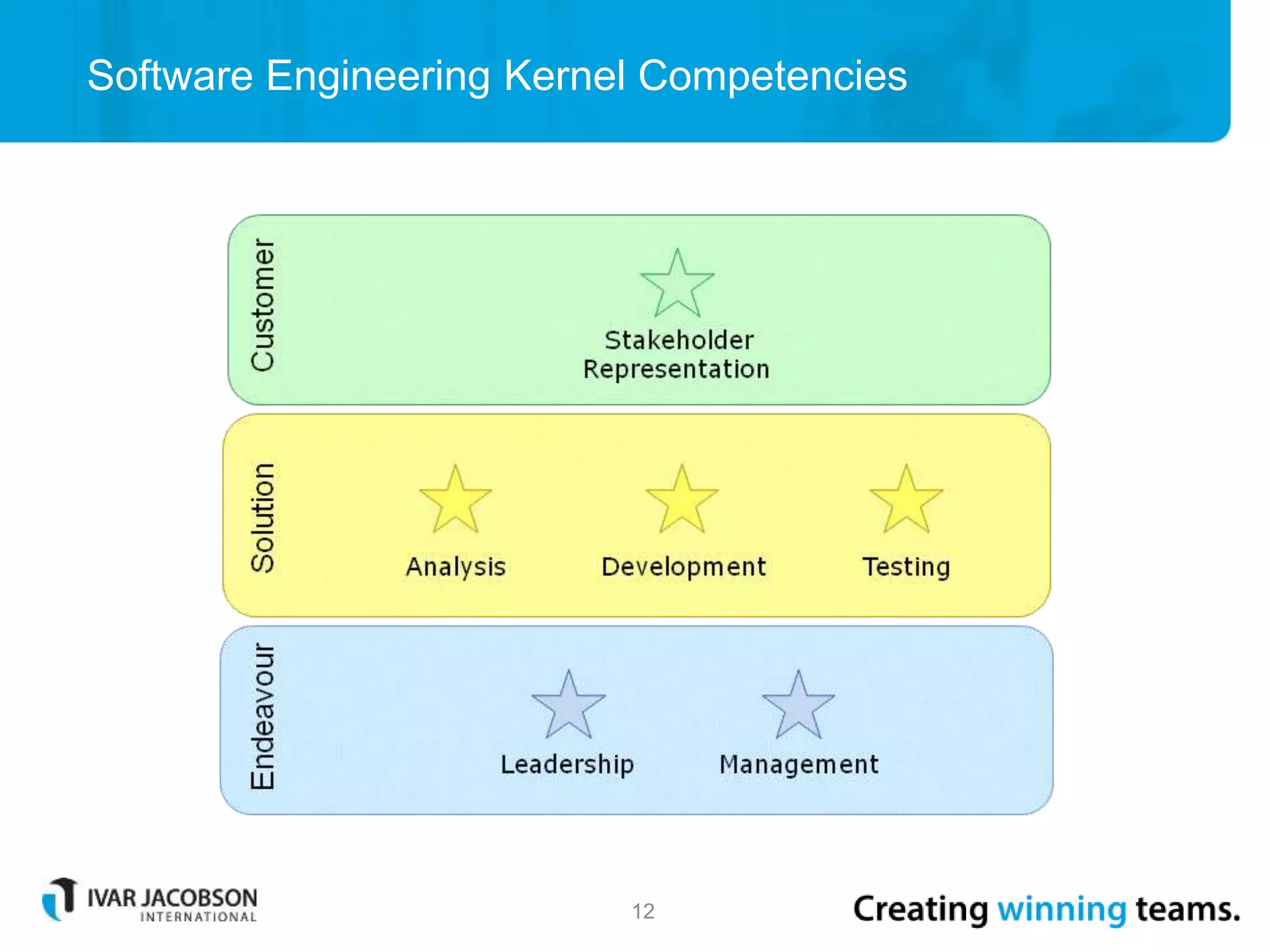
Competencies: The abilities needed
Content of the Kernel
6
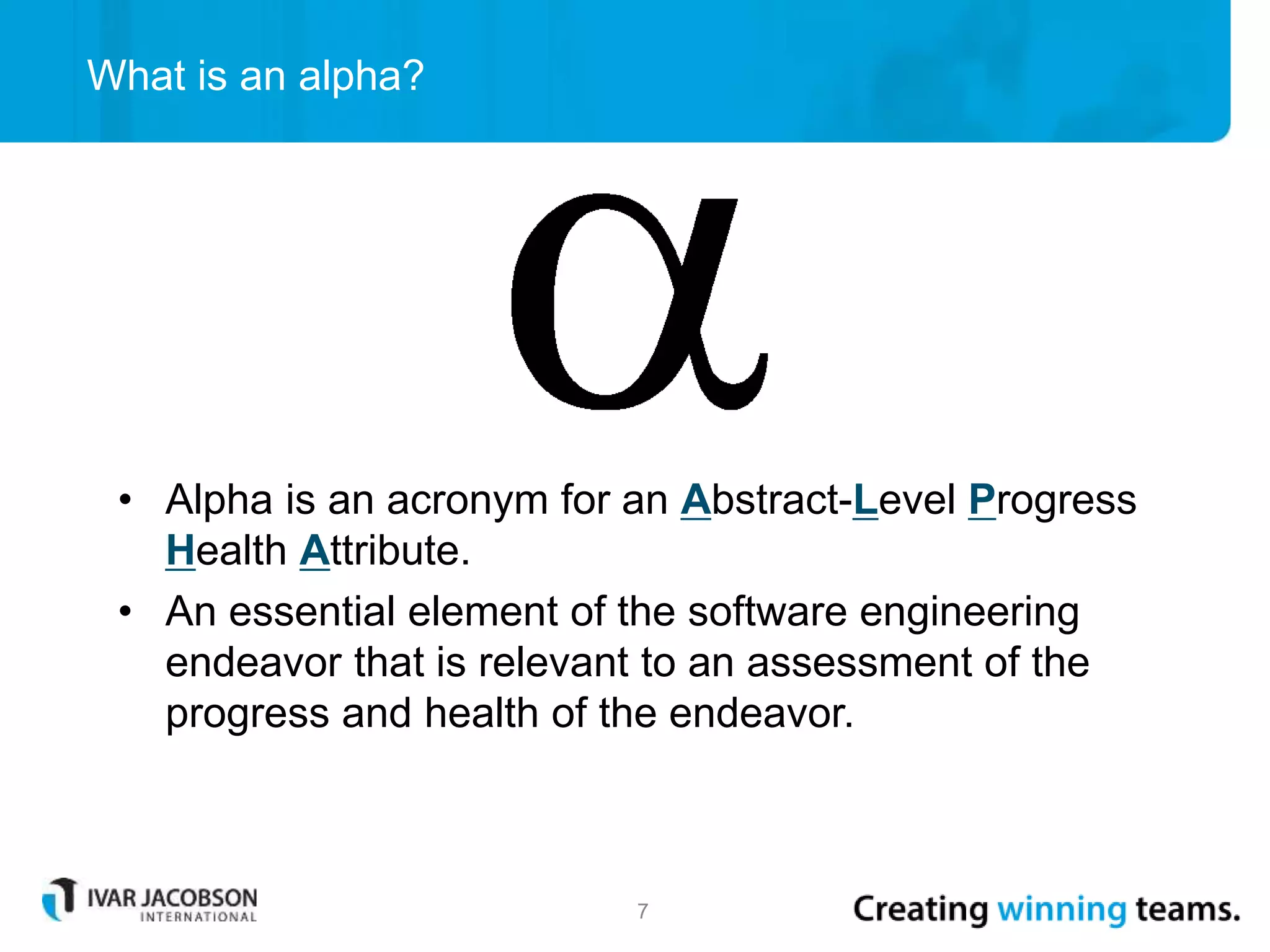
What is an alpha?
7
• Alpha is an acronym for an Abstract-Level Progress
Health Attribute.
• An essential element of the software engineering
endeavor that is relevant to an assessment of the
progress and health of the endeavor.
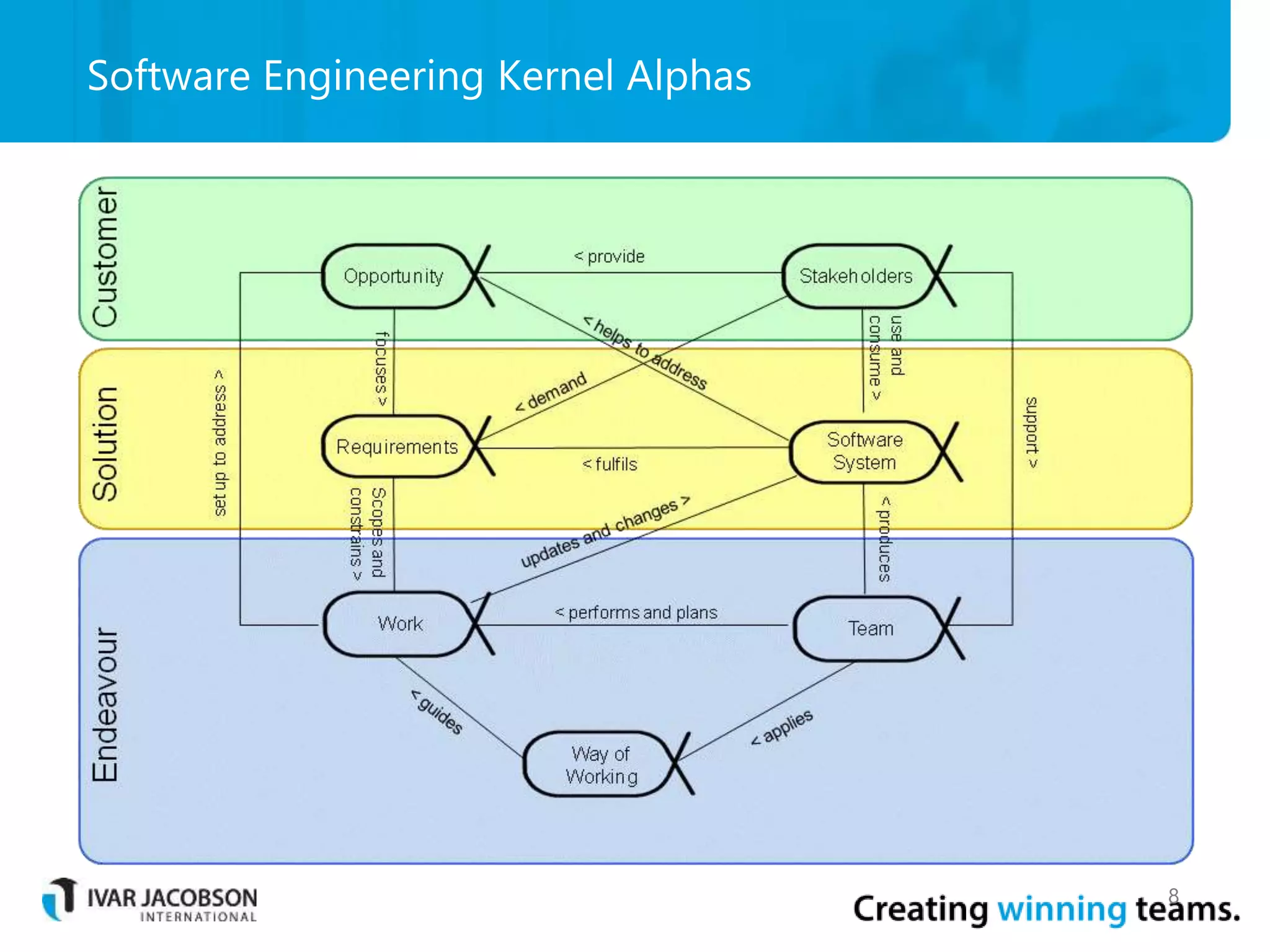
Software Engineering Kernel Alphas
8
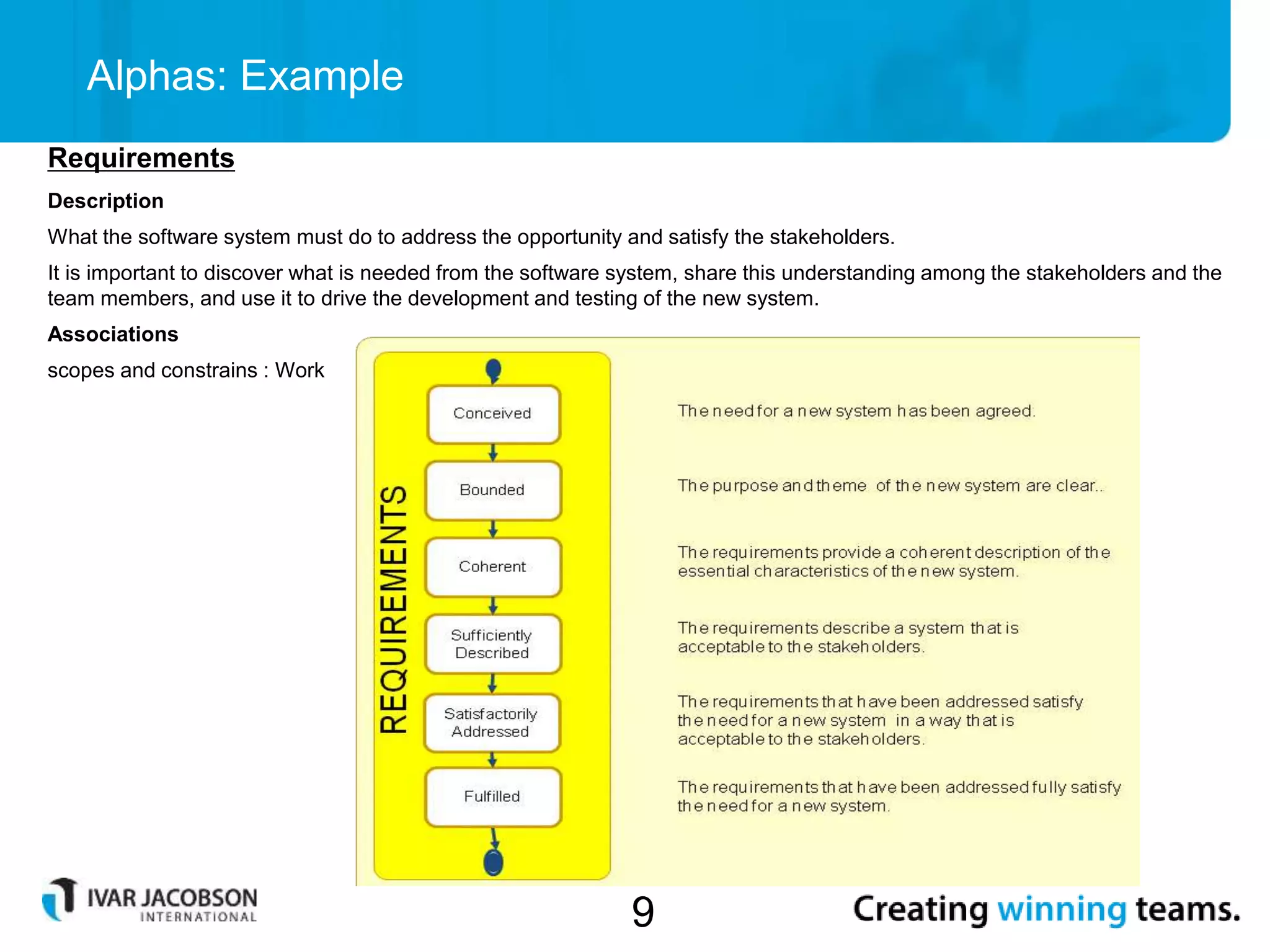
Alphas: Example
9
Requirements
Description
What the software system must do to address the opportunity and satisfy the stakeholders.
It is important to discover what is needed from the software system, share this understanding among the stakeholders and the
team members, and use it to drive the development and testing of the new system.
Associations
scopes and constrains : Work
Software Engineering Kernel Activity Spaces
10
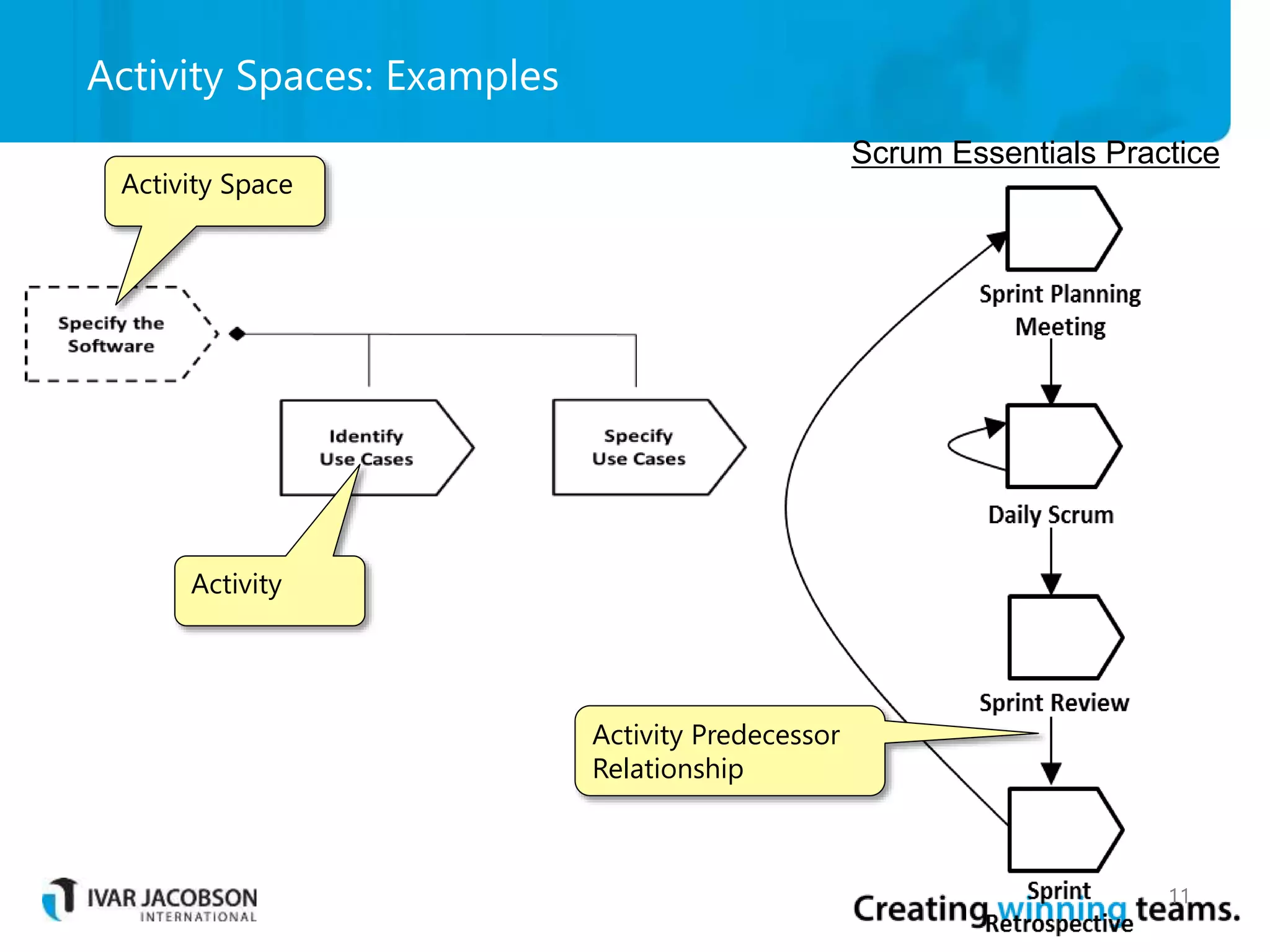
Activity Spaces: Examples
Scrum Essentials Practice
Activity Space
Activity
Activity Predecessor
Relationship
11
Software Engineering Kernel Competencies
12
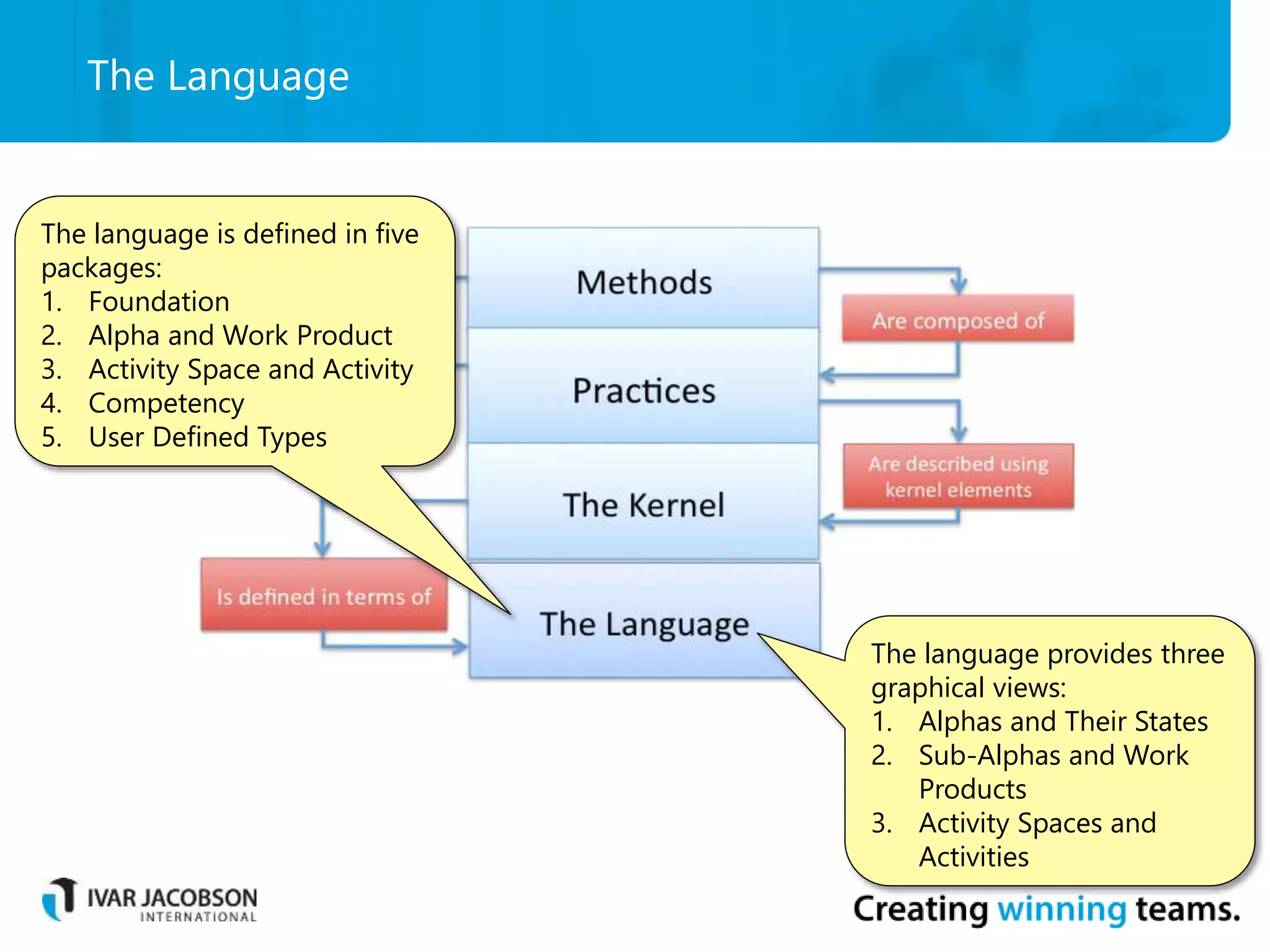
The Language
13
The language provides three
graphical views:
1. Alphas and Their States
2. Sub-Alphas and Work
Products
3. Activity Spaces and
Activities
The language is defined in five
packages:
1. Foundation
2. Alpha and Work Product
3. Activity Space and Activity
4. Competency
5. User Defined Types
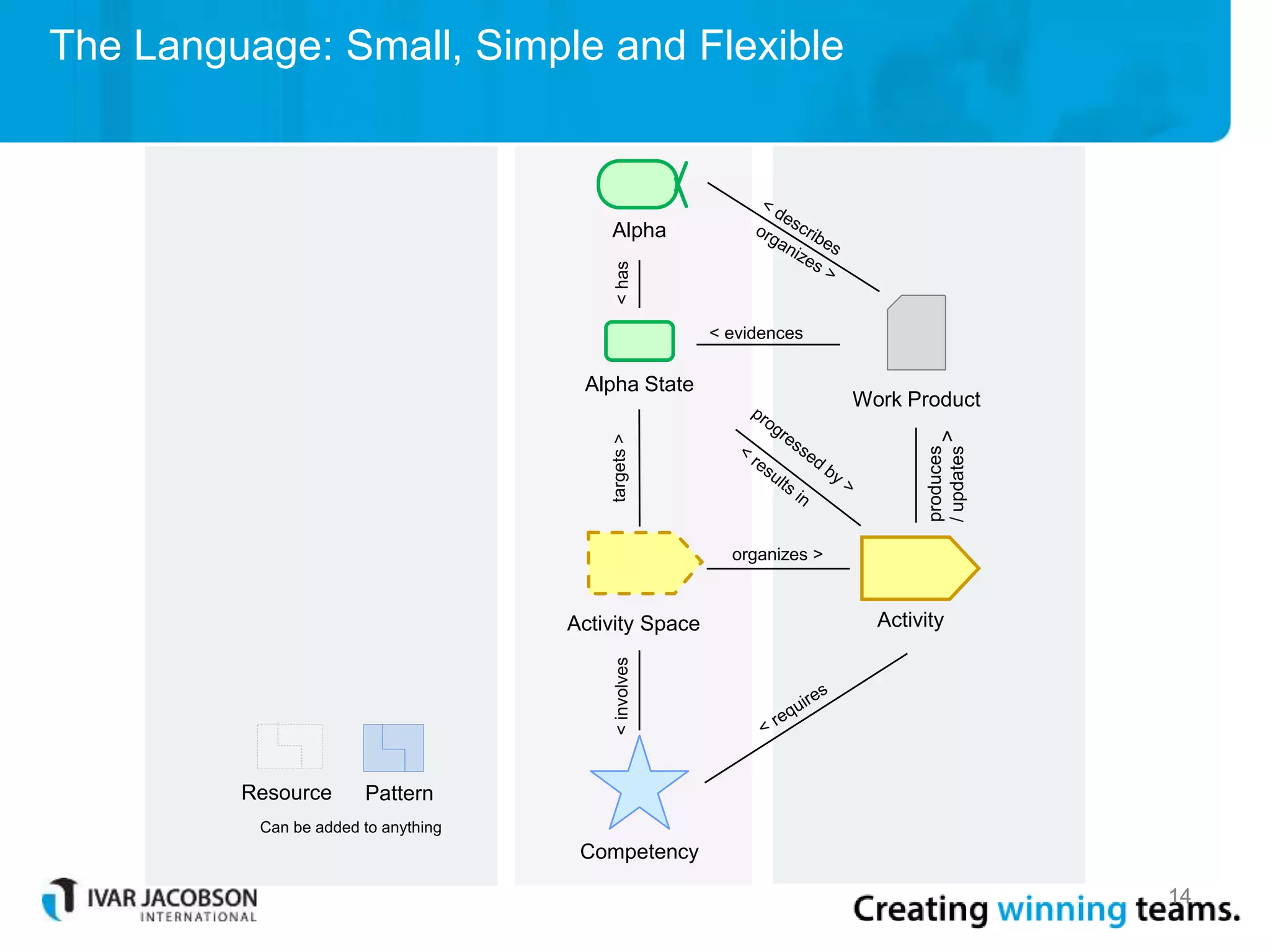
The Language: Small, Simple and Flexible
Competency
Alpha State
Activity Space<involvestargets>
Alpha
<has Activity
Work Product
produces
/updates>
organizes >
< evidences
PatternResource
Can be added to anything
14
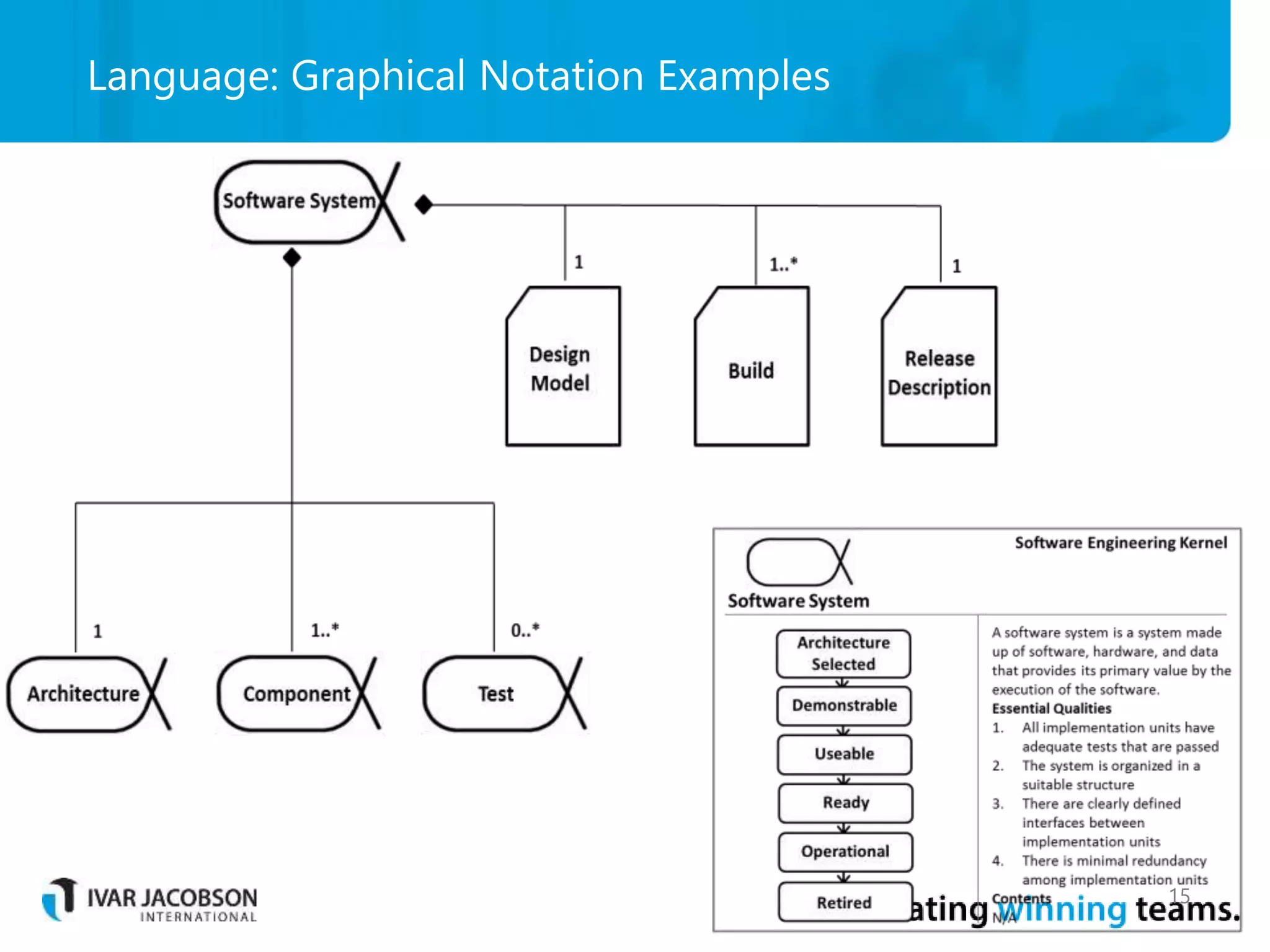
Language: Graphical Notation Examples
15
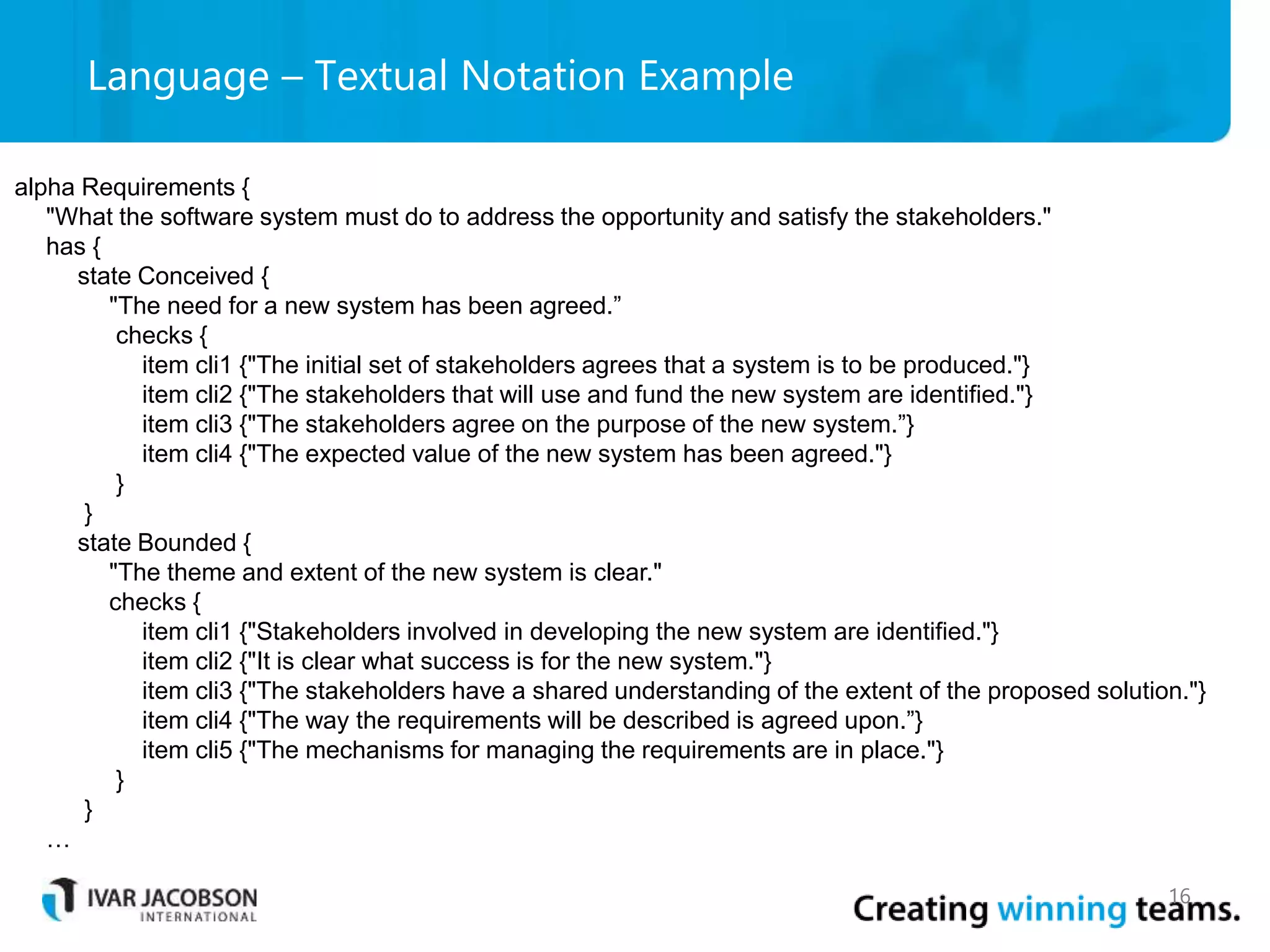
Language – Textual Notation Example
16
alpha Requirements {
"What the software system must do to address the opportunity and satisfy the stakeholders."
has {
state Conceived {
"The need for a new system has been agreed.”
checks {
item cli1 {"The initial set of stakeholders agrees that a system is to be produced."}
item cli2 {"The stakeholders that will use and fund the new system are identified."}
item cli3 {"The stakeholders agree on the purpose of the new system.”}
item cli4 {"The expected value of the new system has been agreed."}
}
}
state Bounded {
"The theme and extent of the new system is clear."
checks {
item cli1 {"Stakeholders involved in developing the new system are identified."}
item cli2 {"It is clear what success is for the new system."}
item cli3 {"The stakeholders have a shared understanding of the extent of the proposed solution."}
item cli4 {"The way the requirements will be described is agreed upon.”}
item cli5 {"The mechanisms for managing the requirements are in place."}
}
}
…
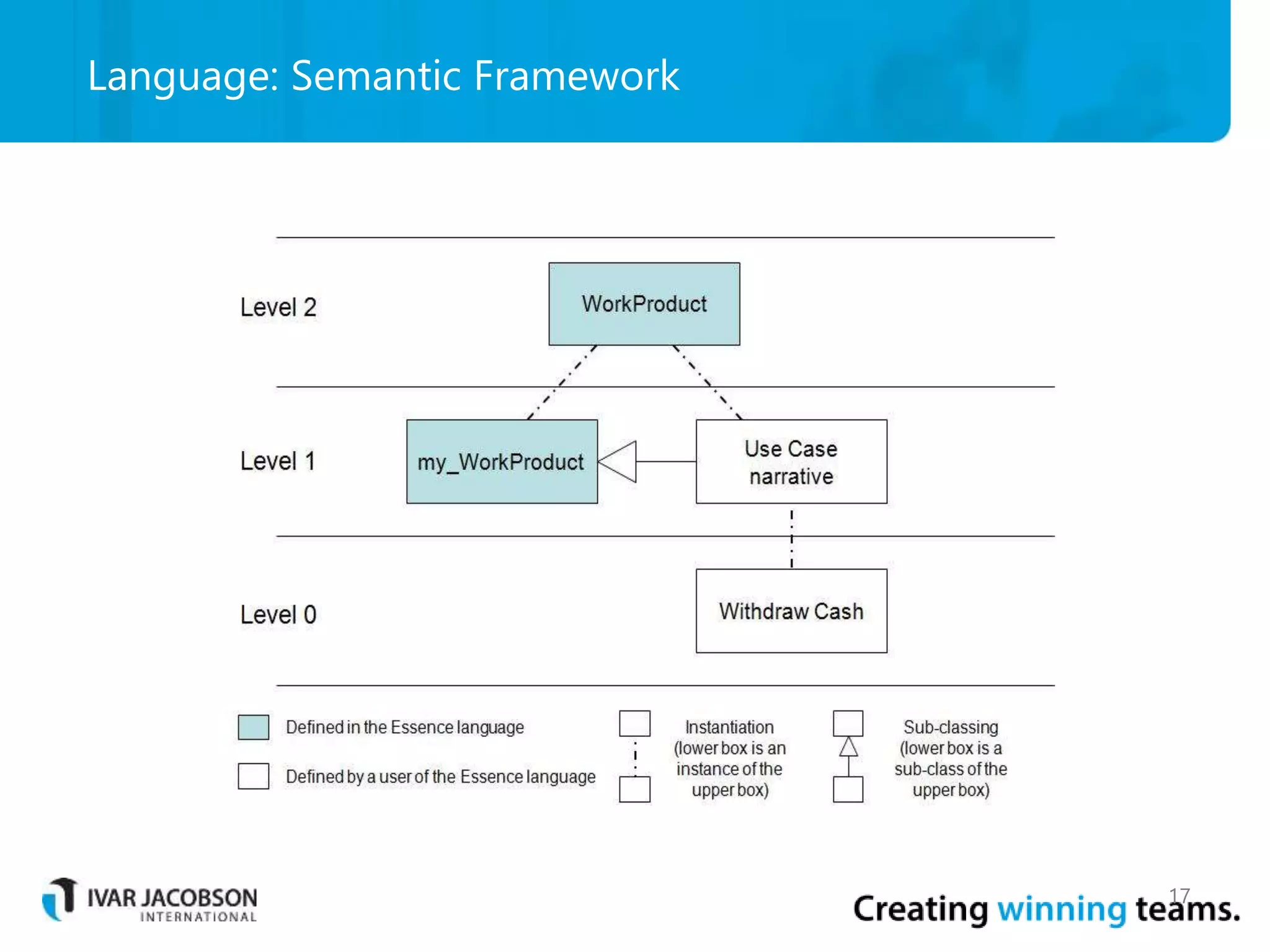
Language: Semantic Framework
17
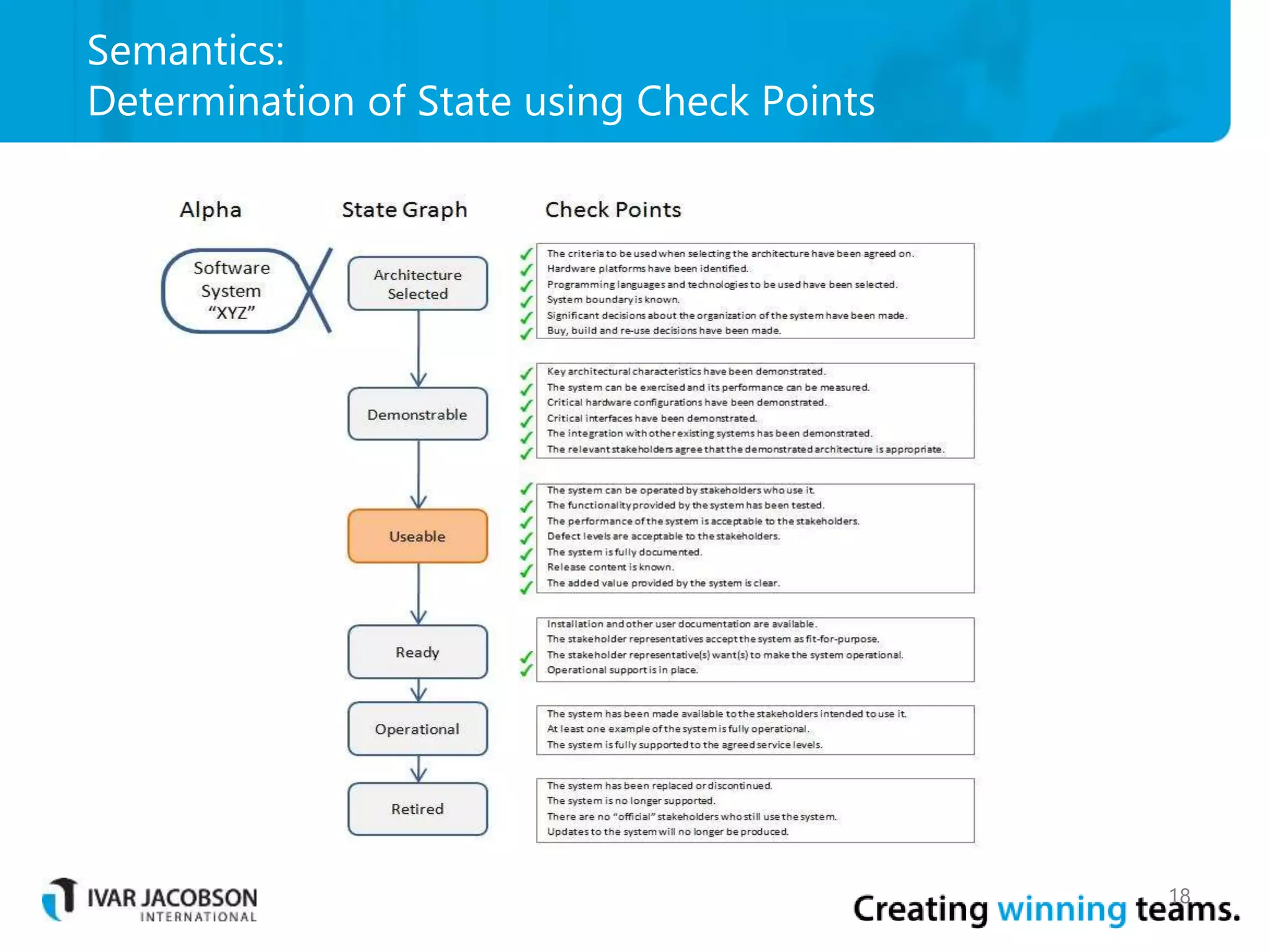
Semantics:
Determination of State using Check Points
18
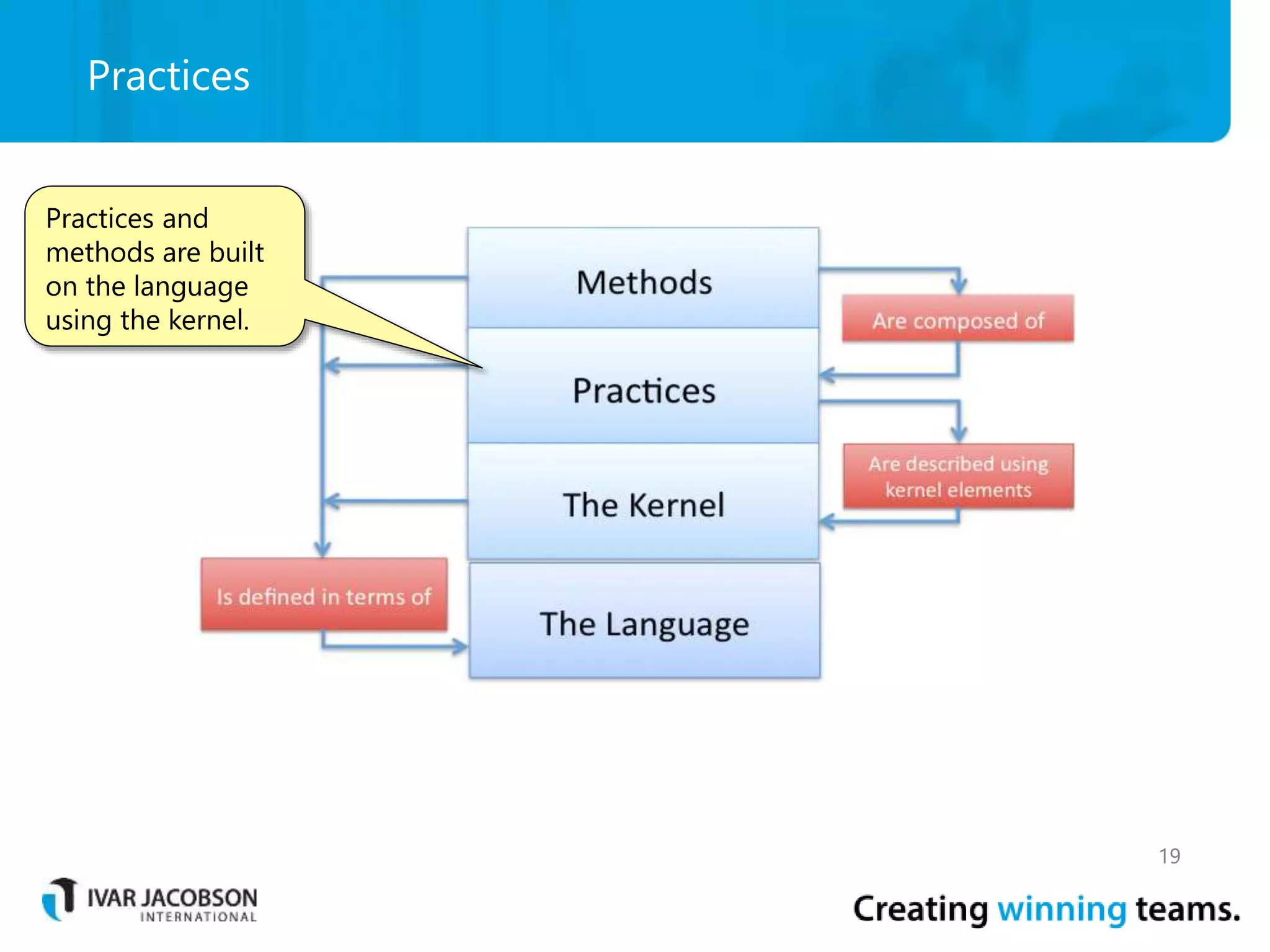
Practices
19
Practices and
methods are built
on the language
using the kernel.
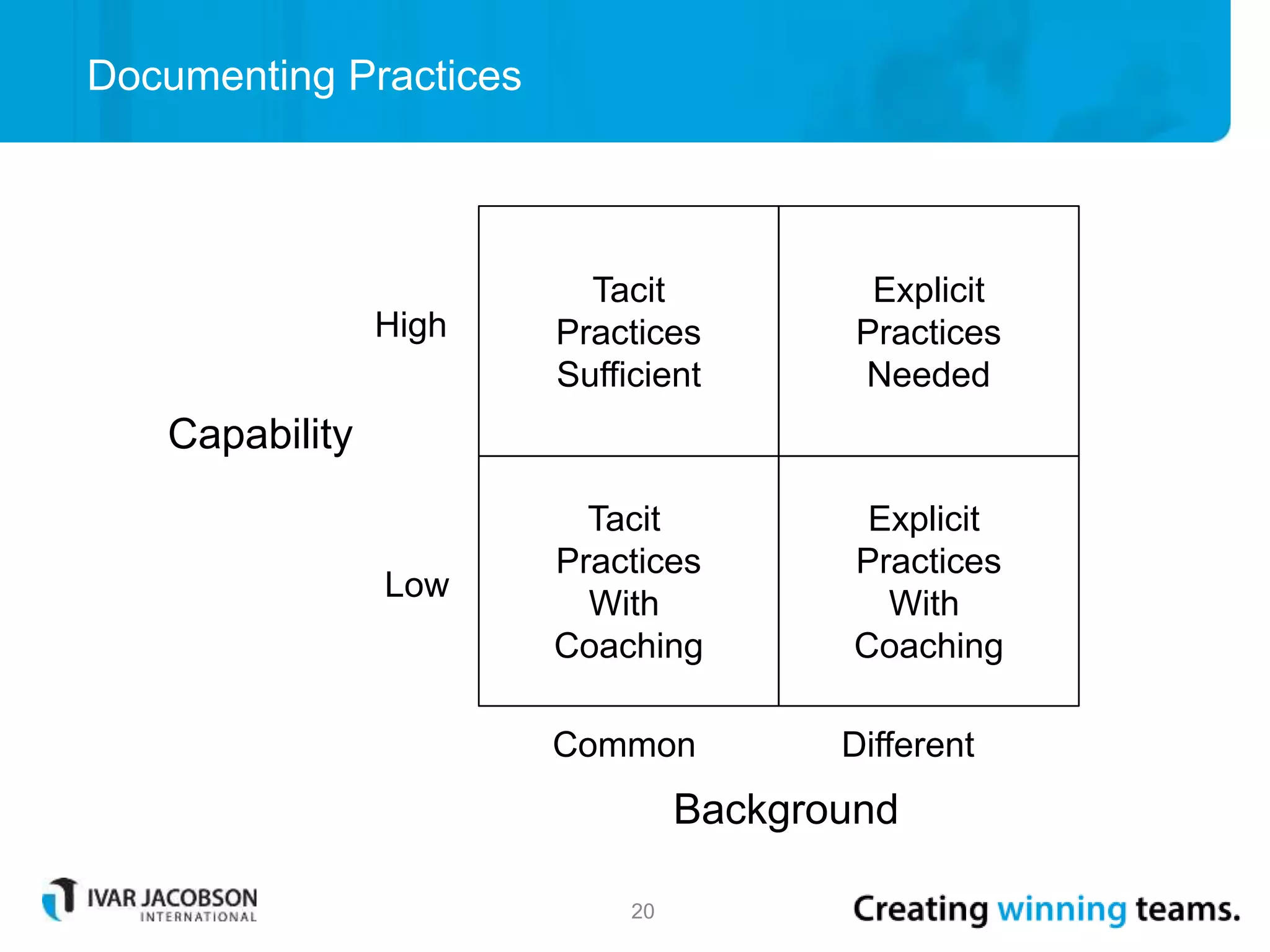
Documenting Practices
20
Tacit
Practices
With
Coaching
Explicit
Practices
With
Coaching
Background
Capability
Common Different
Explicit
Practices
Needed
Tacit
Practices
Sufficient
High
Low
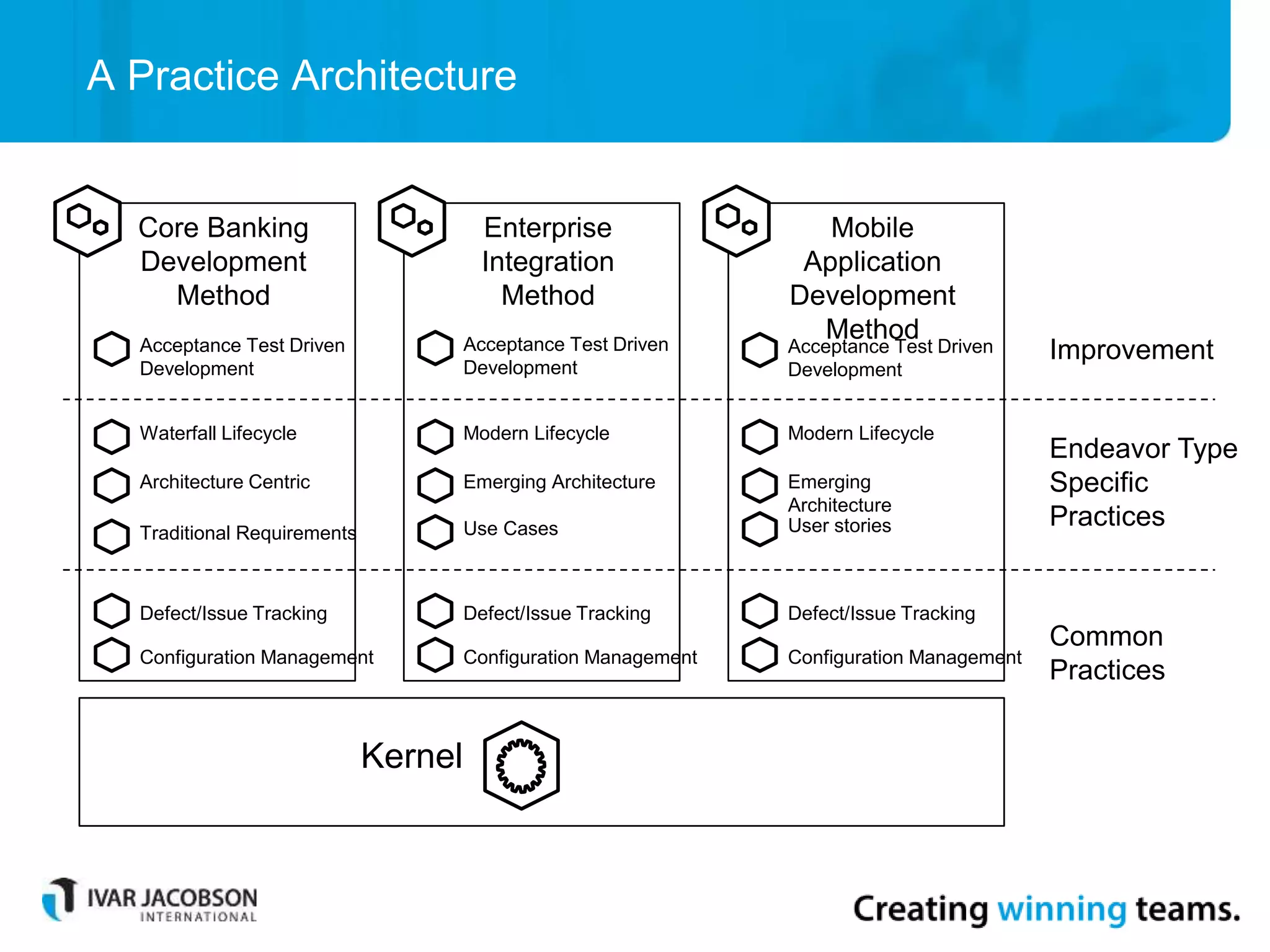
A Practice Architecture
Mobile
Application
Development
Method
Kernel
Core Banking
Development
Method
Enterprise
Integration
Method
Defect/Issue Tracking
Configuration Management
Defect/Issue Tracking
Configuration Management
Defect/Issue Tracking
Configuration Management
Common
Practices
Waterfall Lifecycle Modern Lifecycle Modern Lifecycle
Architecture Centric Emerging
Architecture
Emerging Architecture
Traditional Requirements User storiesUse Cases
Endeavor Type
Specific
Practices
Acceptance Test Driven
Development
Acceptance Test Driven
Development
Acceptance Test Driven
Development
Improvement
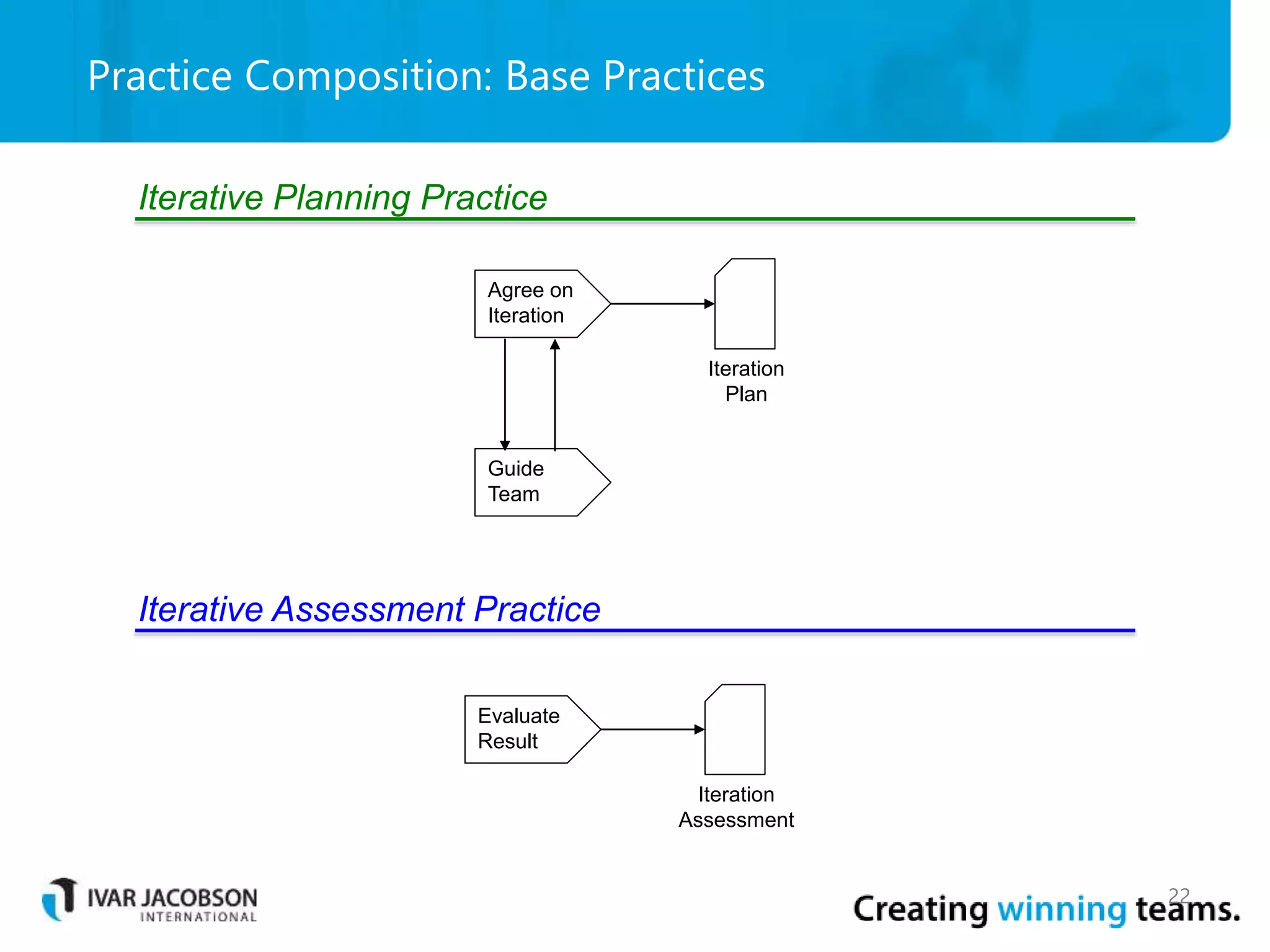
Practice Composition: Base Practices
22
Iterative Planning Practice
Iterative Assessment Practice
Agree on
Iteration
Guide
Team
Iteration
Plan
Evaluate
Result
Iteration
Assessment
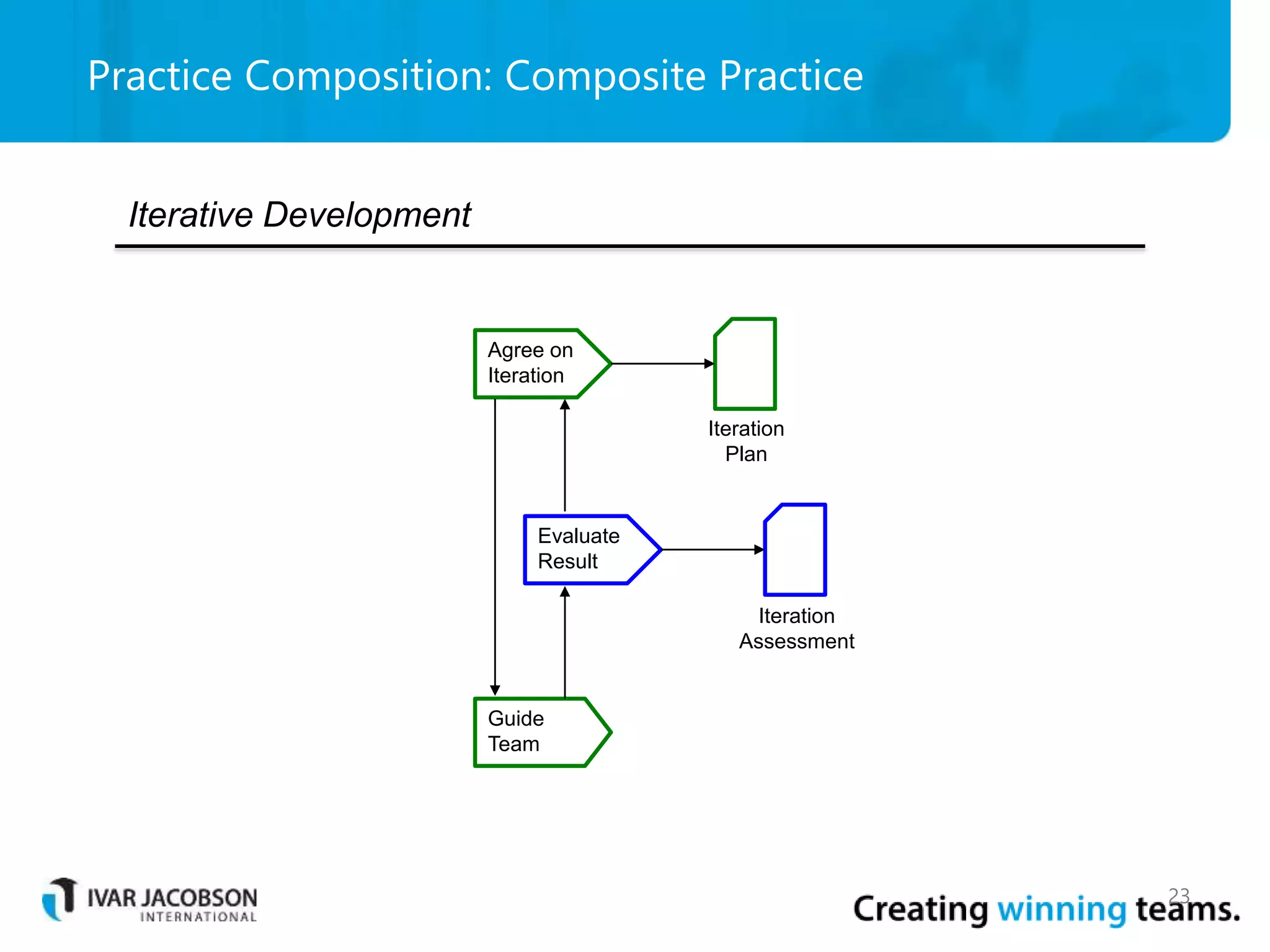
Practice Composition: Composite Practice
23
Iterative Development
Agree on
Iteration
Guide
Team
Iteration
Plan
Evaluate
Result
Iteration
Assessment
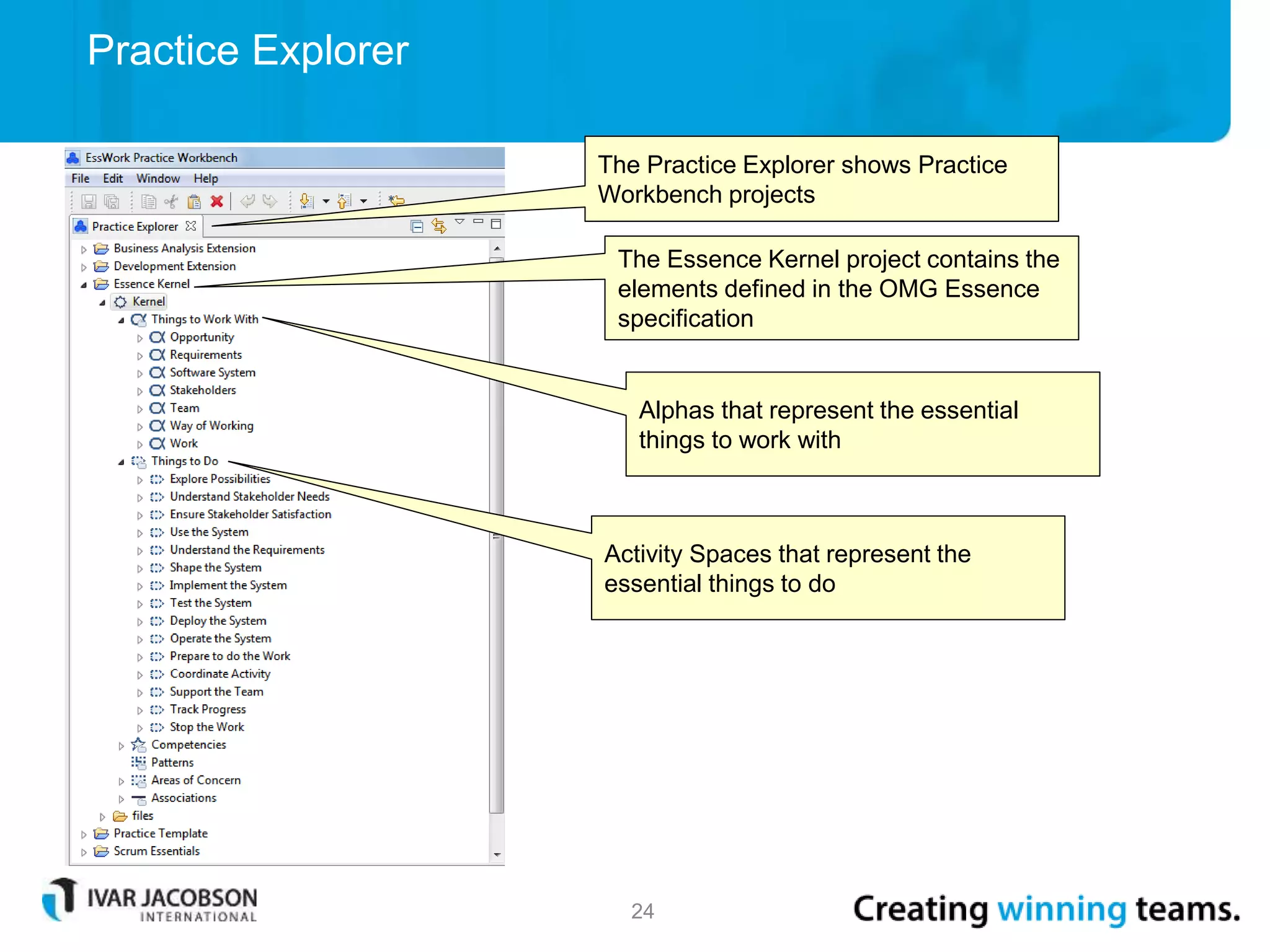
Practice Explorer
24
The Practice Explorer shows Practice
Workbench projects
The Essence Kernel project contains the
elements defined in the OMG Essence
specification
Alphas that represent the essential
things to work with
Activity Spaces that represent the
essential things to do
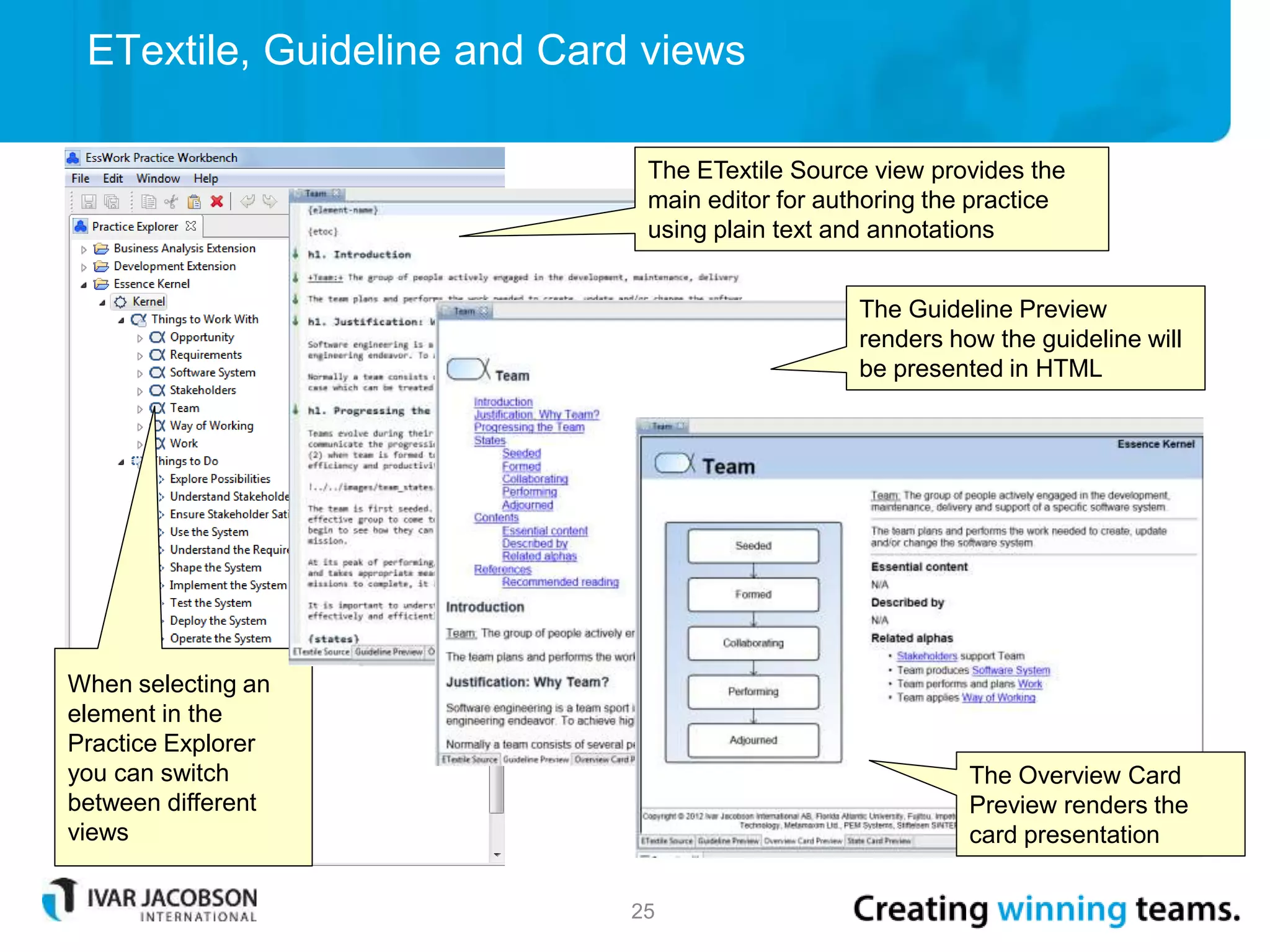
ETextile, Guideline and Card views
25
When selecting an
element in the
Practice Explorer
you can switch
between different
views
The ETextile Source view provides the
main editor for authoring the practice
using plain text and annotations
The Guideline Preview
renders how the guideline will
be presented in HTML
The Overview Card
Preview renders the
card presentation
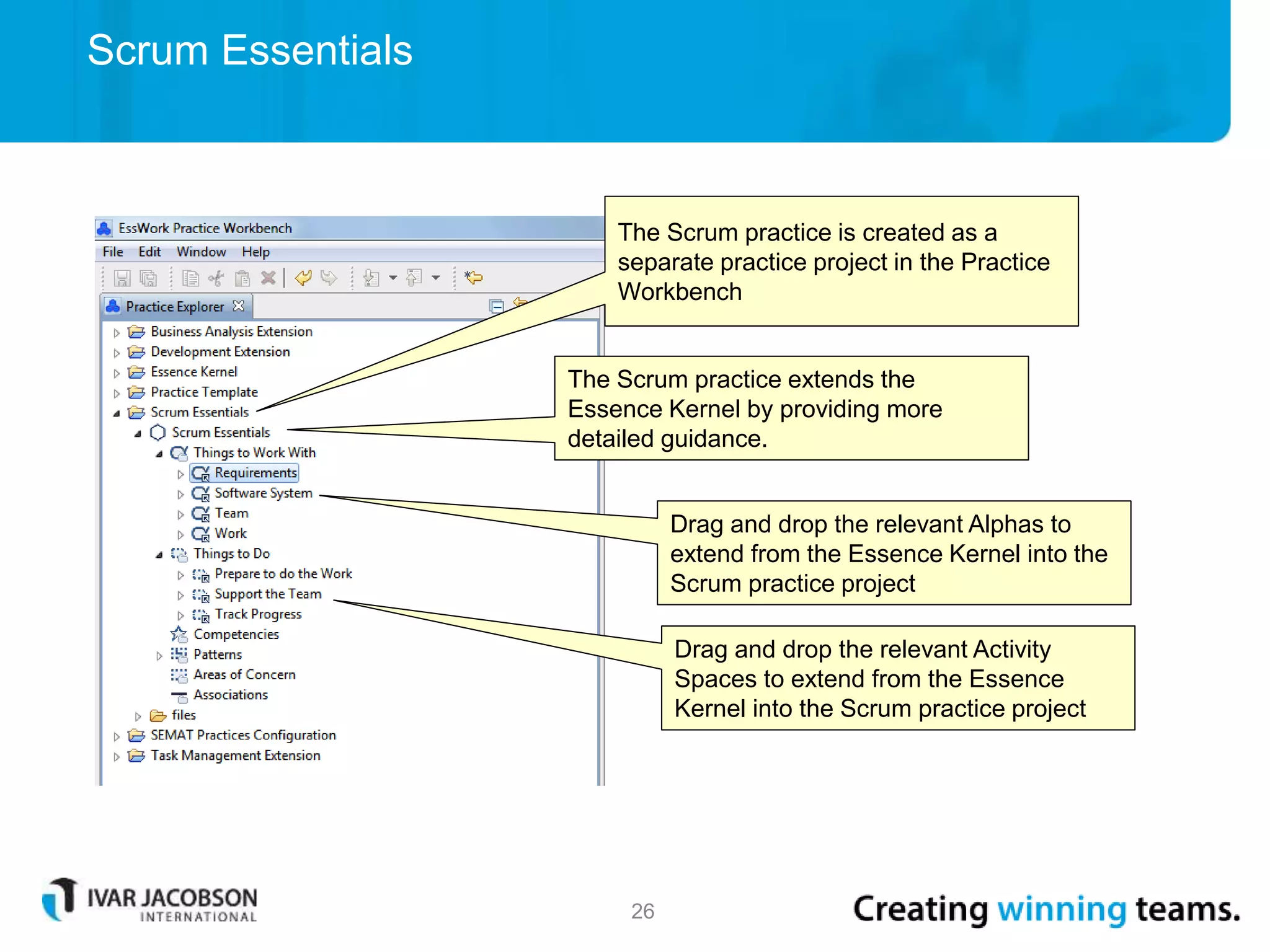
Scrum Essentials
26
The Scrum practice is created as a
separate practice project in the Practice
Workbench
The Scrum practice extends the
Essence Kernel by providing more
detailed guidance.
Drag and drop the relevant Alphas to
extend from the Essence Kernel into the
Scrum practice project
Drag and drop the relevant Activity
Spaces to extend from the Essence
Kernel into the Scrum practice project
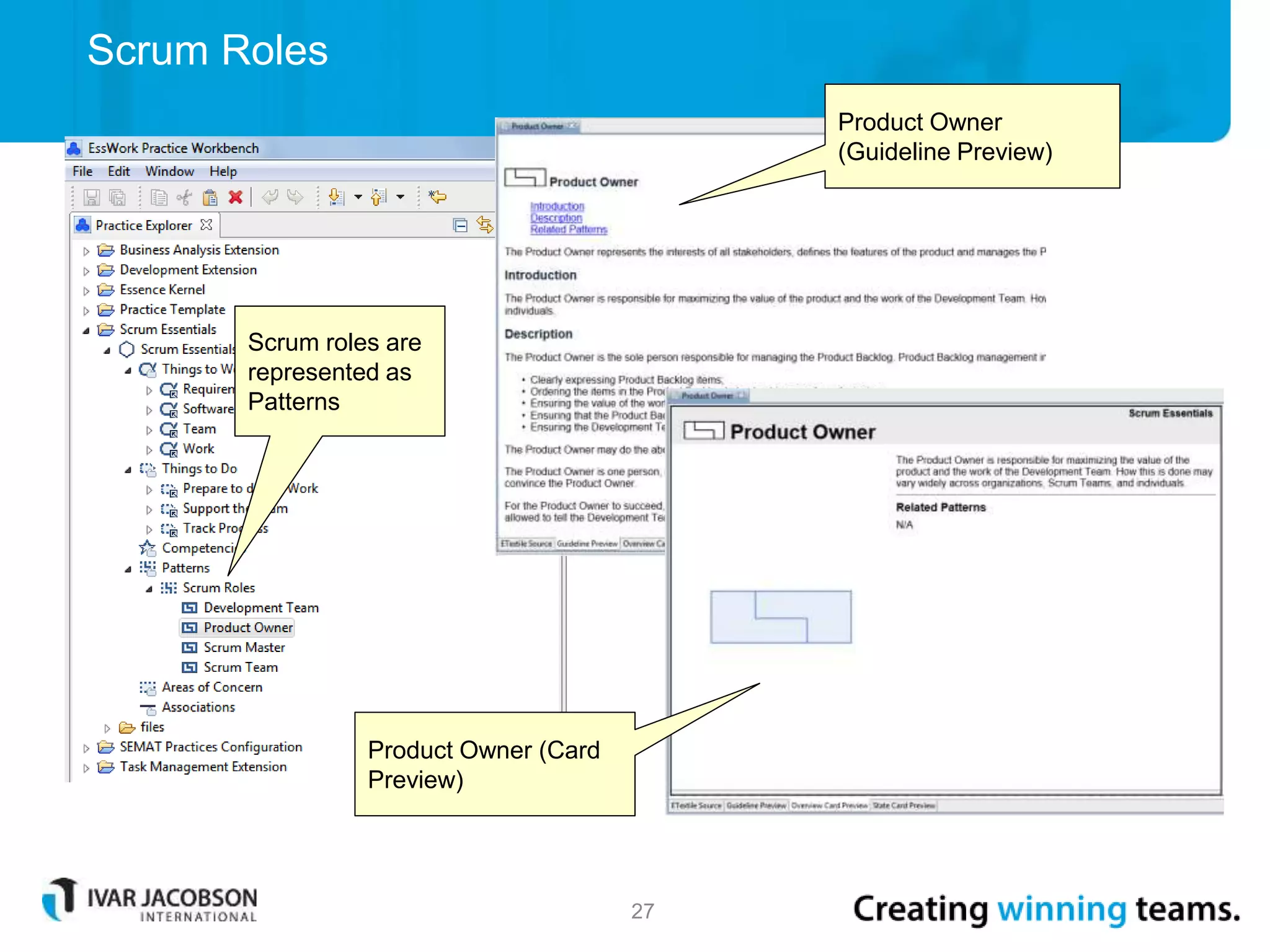
Scrum Roles
27
Scrum roles are
represented as
Patterns
Product Owner
(Guideline Preview)
Product Owner (Card
Preview)
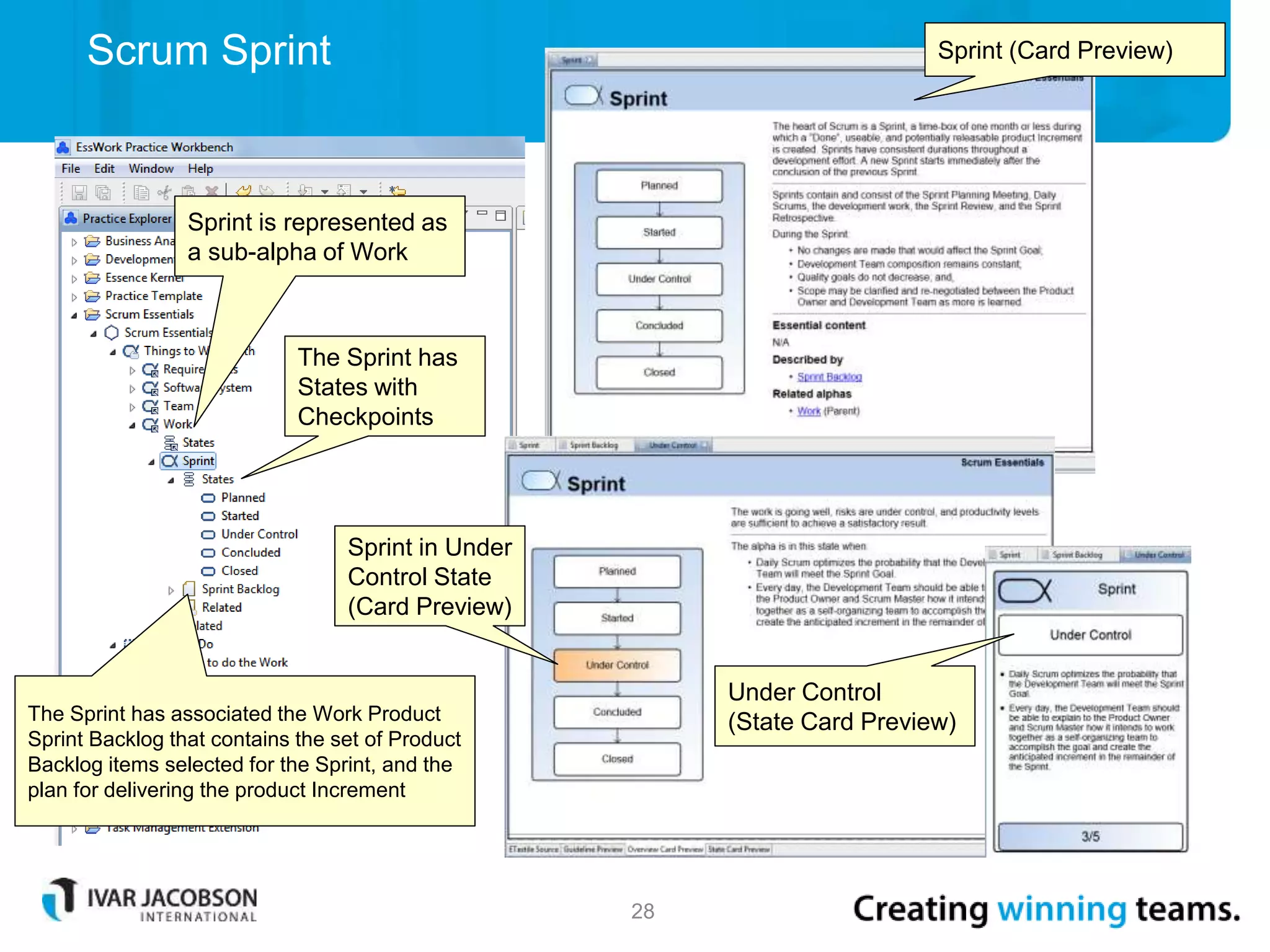
Scrum Sprint
28
Sprint is represented as
a sub-alpha of Work
The Sprint has
States with
Checkpoints
The Sprint has associated the Work Product
Sprint Backlog that contains the set of Product
Backlog items selected for the Sprint, and the
plan for delivering the product Increment
Sprint (Card Preview)
Sprint in Under
Control State
(Card Preview)
Under Control
(State Card Preview)

Essence: A Common Ground for Flexible Methods

  • 1.
    Copyright © 2014Ivar Jacobson International SA. All rights reserved Essence: A Common Ground for Flexible Methods Ed Seidewitz
  • 2.
    • Embody essentialconcepts in a kernel. • Work with methods in an agile way that are as close to practitioners’ practice as possible. • Focus on the things that matter the most. • Focus on helping the least experienced developers over helping more experienced developers. • Understand that the majority of practitioners are interested in… – the use of methods, not their definition. – practice, not process or method engineering. – intuitive and concrete graphical syntax, not formal semantics. Principles of Essence 2
  • 3.
    • “Foundation forAgile Creation and Enactment of Software Engineering Methods” (FACESEM) RFP issued June, 2011 • Essence – Kernel and Language for Software Engineering Methods submitted February 2013 • Essence 1.0 Finalization Task Force chartered March 2013 • Essence 1.0 (beta) adopted May 2014 The Essence Specification 3
  • 4.
    Method Architecture 4 The Kernelis the common ground thus it includes essential elements of software engineering.The Language is used to define methods, practices and the essential elements of the Kernel. A practice is a repeatable approach to doing something with a specific purpose in mind. A method is an enactable composition of practices.
  • 5.
    The Kernel 5 A stripped-down, lightweightset of definitions that captures the essence of effective, scalable software engineering in a practice independent way. The Kernel is described using a small subset of the Language.
  • 6.
    Alphas: The thingsto work with Activity Spaces: The things to do Competencies: The abilities needed Content of the Kernel 6
  • 7.
    What is analpha? 7 • Alpha is an acronym for an Abstract-Level Progress Health Attribute. • An essential element of the software engineering endeavor that is relevant to an assessment of the progress and health of the endeavor.
  • 8.
  • 9.
    Alphas: Example 9 Requirements Description What thesoftware system must do to address the opportunity and satisfy the stakeholders. It is important to discover what is needed from the software system, share this understanding among the stakeholders and the team members, and use it to drive the development and testing of the new system. Associations scopes and constrains : Work
  • 10.
    Software Engineering KernelActivity Spaces 10
  • 11.
    Activity Spaces: Examples ScrumEssentials Practice Activity Space Activity Activity Predecessor Relationship 11
  • 12.
  • 13.
    The Language 13 The languageprovides three graphical views: 1. Alphas and Their States 2. Sub-Alphas and Work Products 3. Activity Spaces and Activities The language is defined in five packages: 1. Foundation 2. Alpha and Work Product 3. Activity Space and Activity 4. Competency 5. User Defined Types
  • 14.
    The Language: Small,Simple and Flexible Competency Alpha State Activity Space<involvestargets> Alpha <has Activity Work Product produces /updates> organizes > < evidences PatternResource Can be added to anything 14
  • 15.
  • 16.
    Language – TextualNotation Example 16 alpha Requirements { "What the software system must do to address the opportunity and satisfy the stakeholders." has { state Conceived { "The need for a new system has been agreed.” checks { item cli1 {"The initial set of stakeholders agrees that a system is to be produced."} item cli2 {"The stakeholders that will use and fund the new system are identified."} item cli3 {"The stakeholders agree on the purpose of the new system.”} item cli4 {"The expected value of the new system has been agreed."} } } state Bounded { "The theme and extent of the new system is clear." checks { item cli1 {"Stakeholders involved in developing the new system are identified."} item cli2 {"It is clear what success is for the new system."} item cli3 {"The stakeholders have a shared understanding of the extent of the proposed solution."} item cli4 {"The way the requirements will be described is agreed upon.”} item cli5 {"The mechanisms for managing the requirements are in place."} } } …
  • 17.
  • 18.
    Semantics: Determination of Stateusing Check Points 18
  • 19.
    Practices 19 Practices and methods arebuilt on the language using the kernel.
  • 20.
  • 21.
    A Practice Architecture Mobile Application Development Method Kernel CoreBanking Development Method Enterprise Integration Method Defect/Issue Tracking Configuration Management Defect/Issue Tracking Configuration Management Defect/Issue Tracking Configuration Management Common Practices Waterfall Lifecycle Modern Lifecycle Modern Lifecycle Architecture Centric Emerging Architecture Emerging Architecture Traditional Requirements User storiesUse Cases Endeavor Type Specific Practices Acceptance Test Driven Development Acceptance Test Driven Development Acceptance Test Driven Development Improvement
  • 22.
    Practice Composition: BasePractices 22 Iterative Planning Practice Iterative Assessment Practice Agree on Iteration Guide Team Iteration Plan Evaluate Result Iteration Assessment
  • 23.
    Practice Composition: CompositePractice 23 Iterative Development Agree on Iteration Guide Team Iteration Plan Evaluate Result Iteration Assessment
  • 24.
    Practice Explorer 24 The PracticeExplorer shows Practice Workbench projects The Essence Kernel project contains the elements defined in the OMG Essence specification Alphas that represent the essential things to work with Activity Spaces that represent the essential things to do
  • 25.
    ETextile, Guideline andCard views 25 When selecting an element in the Practice Explorer you can switch between different views The ETextile Source view provides the main editor for authoring the practice using plain text and annotations The Guideline Preview renders how the guideline will be presented in HTML The Overview Card Preview renders the card presentation
  • 26.
    Scrum Essentials 26 The Scrumpractice is created as a separate practice project in the Practice Workbench The Scrum practice extends the Essence Kernel by providing more detailed guidance. Drag and drop the relevant Alphas to extend from the Essence Kernel into the Scrum practice project Drag and drop the relevant Activity Spaces to extend from the Essence Kernel into the Scrum practice project
  • 27.
    Scrum Roles 27 Scrum rolesare represented as Patterns Product Owner (Guideline Preview) Product Owner (Card Preview)
  • 28.
    Scrum Sprint 28 Sprint isrepresented as a sub-alpha of Work The Sprint has States with Checkpoints The Sprint has associated the Work Product Sprint Backlog that contains the set of Product Backlog items selected for the Sprint, and the plan for delivering the product Increment Sprint (Card Preview) Sprint in Under Control State (Card Preview) Under Control (State Card Preview)