Web Data Management
Xpath & XQuery
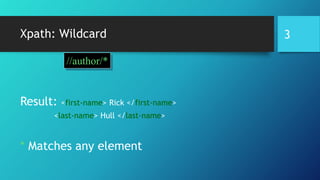
Xpath: Wildcard
Result: <first-name> Rick </first-name>
<last-name> Hull </last-name>
* Matches any element
//author/*
3
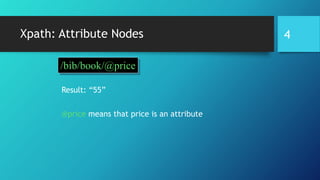
Xpath: Attribute Nodes
Result: “55”
@price means that price is an attribute
/bib/book/@price
4
Xpath: Predicates
Result: <author> <first-name> Rick </first-name>
<last-name> Hull </last-name>
</author>
/bib/book/author[firstname]
5
Xpath: More Predicates
Result: <lastname> … </lastname>
<lastname> … </lastname>
/bib/book/author[firstname][address[//zip][city]]/lastname
6
Xpath: More Predicates
/bib/book[@price < “60”]
/bib/book[author/@age < “25”]
/bib/book[author/text()]
7
Xpath: Summary
bib matches a bib element
* matches any element
/ matches the root element
/bib matches a bib element under root
bib/paper matches a paper in bib
bib//paper matches a paper in bib, at any depth
//paper matches a paper at any depth
paper|book matches a paper or a book
@price matches a price attribute
bib/book/@price matches price attribute in book, in bib
bib/book/[@price<“55”]/author/lastname matches…
8
Comments on XPath?
• What’s good about it?
• What can’t it do that you want it to do?
• How does it compare, say, to SQL?
9
XQuery
• Based on Quilt, which is based on XML-QL
• Uses XPath to express more complex queries
10
FLWR (“Flower”) Expressions
FOR ...
LET...
WHERE...
RETURN...
11
XQuery
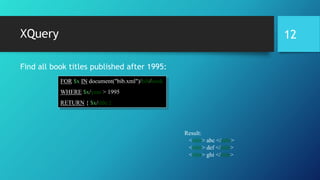
Find all book titles published after 1995:
FOR $x IN document("bib.xml")/bib/book
WHERE $x/year > 1995
RETURN { $x/title }
Result:
<title> abc </title>
<title> def </title>
<title> ghi </title>
12
XQuery
Find book titles by the coauthors of “Database Theory”:
FOR $x IN bib/book[title/text() = “Database Theory”]/author
$y IN bib/book[author/text() = $x/text()]/title
RETURN <answer> { $y/text() } </answer>
Result:
<answer> abc </ answer >
< answer > def </ answer >
< answer > ghi </ answer >
The answer will
contain duplicates !
13
XQuery
Same as before, but eliminate duplicates:
FOR $x IN bib/book[title/text() = “Database Theory”]/author
$y IN distinct(bib/book[author/text() = $x/text()]/title)
RETURN <answer> { $y/text() } </answer>
Result:
<answer> abc </ answer >
< answer > def </ answer >
< answer > ghi </ answer >
distinct = a function
that eliminates duplicates
14
XQuery: Nesting
For each author of a book by Morgan Kaufmann, list all
books she published:
FOR $a IN distinct(document("bib.xml")
/bib/book[publisher=“Morgan Kaufmann”]/author)
RETURN <result>
{ $a,
FOR $t IN /bib/book[author=$a]/title
RETURN $t
}
</result>
15
XQuery
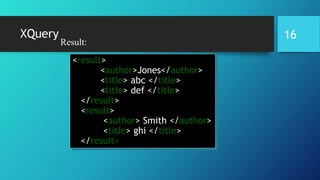
<result>
<author>Jones</author>
<title> abc </title>
<title> def </title>
</result>
<result>
<author> Smith </author>
<title> ghi </title>
</result>
Result:
16
XQuery
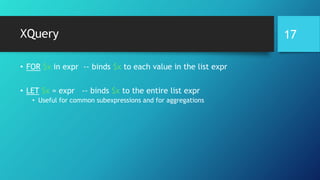
• FOR $x in expr -- binds $x to each value in the list expr
• LET $x = expr -- binds $x to the entire list expr
• Useful for common subexpressions and for aggregations
17
XQuery
count = a (aggregate) function that returns the number of elms
<big_publishers>
FOR $p IN distinct(document("bib.xml")//publisher)
LET $b := document("bib.xml")/book[publisher = $p]
WHERE count($b) > 100
RETURN { $p }
</big_publishers>
18
XQuery
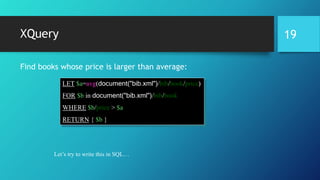
Find books whose price is larger than average:
LET $a=avg(document("bib.xml")/bib/book/price)
FOR $b in document("bib.xml")/bib/book
WHERE $b/price > $a
RETURN { $b }
Let’s try to write this in SQL…
19
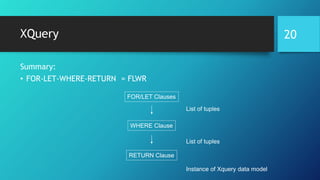
XQuery
Summary:
• FOR-LET-WHERE-RETURN = FLWR
FOR/LET Clauses
WHERE Clause
RETURN Clause
List of tuples
List of tuples
Instance of Xquery data model
20
FOR v.s. LET
FOR
• Binds node variables  iteration
LET
• Binds collection variables  one value
21
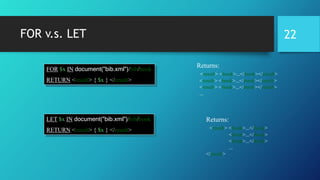
FOR v.s. LET
FOR $x IN document("bib.xml")/bib/book
RETURN <result> { $x } </result>
Returns:
<result> <book>...</book></result>
...
LET $x IN document("bib.xml")/bib/book
RETURN <result> { $x } </result>
Returns:
<result> <book>...</book>
<book>...</book>
<book>...</book>
...
</result>
22
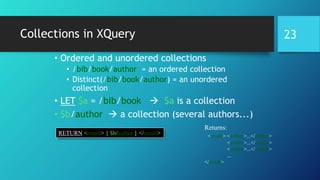
Collections in XQuery
• Ordered and unordered collections
• /bib/book/author = an ordered collection
• Distinct(/bib/book/author) = an unordered
collection
• LET $a = /bib/book  $a is a collection
• $b/author  a collection (several authors...)
RETURN <result> { $b/author } </result>
Returns:
<result> <author>...</author>
<author>...</author>
...
</result>
23
Collections in XQuery
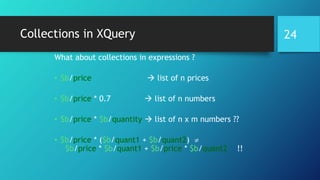
What about collections in expressions ?
• $b/price  list of n prices
• $b/price * 0.7  list of n numbers
• $b/price * $b/quantity  list of n x m numbers ??
• $b/price * ($b/quant1 + $b/quant2) 
$b/price * $b/quant1 + $b/price * $b/quant2 !!
24
Sorting in XQuery
<publisher_list>
FOR $p IN distinct(document("bib.xml")//publisher)
RETURN <publisher> <name> { $p/text() } </name> ,
FOR $b IN document("bib.xml")//book[publisher = $p]
RETURN <book>
{ $b/title ,
$b/price
}
</book> SORTBY(price DESCENDING)
</publisher> SORTBY(name)
</publisher_list>
25
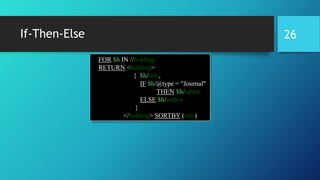
If-Then-Else
FOR $h IN //holding
RETURN <holding>
{ $h/title,
IF $h/@type = "Journal"
THEN $h/editor
ELSE $h/author
}
</holding> SORTBY (title)
26
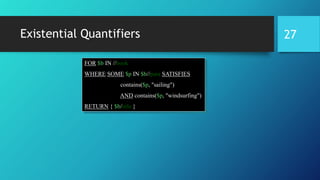
Existential Quantifiers
FOR $b IN //book
WHERE SOME $p IN $b//para SATISFIES
contains($p, "sailing")
AND contains($p, "windsurfing")
RETURN { $b/title }
27
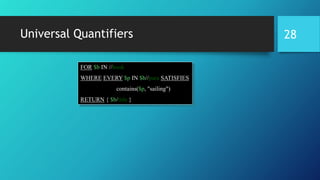
Universal Quantifiers
FOR $b IN //book
WHERE EVERY $p IN $b//para SATISFIES
contains($p, "sailing")
RETURN { $b/title }
28
Other Stuff in XQuery
• BEFORE and AFTER
• for dealing with order in the input
• FILTER
• deletes some edges in the result tree
• Recursive functions
• Currently: arbitrary recursion
• Perhaps more restrictions in the future ?
29
Prepared by:-
Meghavi Patel 30
Thank You 

Xpath & xquery

  • 1.
  • 2.
  • 3.
    Xpath: Wildcard Result: <first-name>Rick </first-name> <last-name> Hull </last-name> * Matches any element //author/* 3
  • 4.
    Xpath: Attribute Nodes Result:“55” @price means that price is an attribute /bib/book/@price 4
  • 5.
    Xpath: Predicates Result: <author><first-name> Rick </first-name> <last-name> Hull </last-name> </author> /bib/book/author[firstname] 5
  • 6.
    Xpath: More Predicates Result:<lastname> … </lastname> <lastname> … </lastname> /bib/book/author[firstname][address[//zip][city]]/lastname 6
  • 7.
    Xpath: More Predicates /bib/book[@price< “60”] /bib/book[author/@age < “25”] /bib/book[author/text()] 7
  • 8.
    Xpath: Summary bib matchesa bib element * matches any element / matches the root element /bib matches a bib element under root bib/paper matches a paper in bib bib//paper matches a paper in bib, at any depth //paper matches a paper at any depth paper|book matches a paper or a book @price matches a price attribute bib/book/@price matches price attribute in book, in bib bib/book/[@price<“55”]/author/lastname matches… 8
  • 9.
    Comments on XPath? •What’s good about it? • What can’t it do that you want it to do? • How does it compare, say, to SQL? 9
  • 10.
    XQuery • Based onQuilt, which is based on XML-QL • Uses XPath to express more complex queries 10
  • 11.
    FLWR (“Flower”) Expressions FOR... LET... WHERE... RETURN... 11
  • 12.
    XQuery Find all booktitles published after 1995: FOR $x IN document("bib.xml")/bib/book WHERE $x/year > 1995 RETURN { $x/title } Result: <title> abc </title> <title> def </title> <title> ghi </title> 12
  • 13.
    XQuery Find book titlesby the coauthors of “Database Theory”: FOR $x IN bib/book[title/text() = “Database Theory”]/author $y IN bib/book[author/text() = $x/text()]/title RETURN <answer> { $y/text() } </answer> Result: <answer> abc </ answer > < answer > def </ answer > < answer > ghi </ answer > The answer will contain duplicates ! 13
  • 14.
    XQuery Same as before,but eliminate duplicates: FOR $x IN bib/book[title/text() = “Database Theory”]/author $y IN distinct(bib/book[author/text() = $x/text()]/title) RETURN <answer> { $y/text() } </answer> Result: <answer> abc </ answer > < answer > def </ answer > < answer > ghi </ answer > distinct = a function that eliminates duplicates 14
  • 15.
    XQuery: Nesting For eachauthor of a book by Morgan Kaufmann, list all books she published: FOR $a IN distinct(document("bib.xml") /bib/book[publisher=“Morgan Kaufmann”]/author) RETURN <result> { $a, FOR $t IN /bib/book[author=$a]/title RETURN $t } </result> 15
  • 16.
    XQuery <result> <author>Jones</author> <title> abc </title> <title>def </title> </result> <result> <author> Smith </author> <title> ghi </title> </result> Result: 16
  • 17.
    XQuery • FOR $xin expr -- binds $x to each value in the list expr • LET $x = expr -- binds $x to the entire list expr • Useful for common subexpressions and for aggregations 17
  • 18.
    XQuery count = a(aggregate) function that returns the number of elms <big_publishers> FOR $p IN distinct(document("bib.xml")//publisher) LET $b := document("bib.xml")/book[publisher = $p] WHERE count($b) > 100 RETURN { $p } </big_publishers> 18
  • 19.
    XQuery Find books whoseprice is larger than average: LET $a=avg(document("bib.xml")/bib/book/price) FOR $b in document("bib.xml")/bib/book WHERE $b/price > $a RETURN { $b } Let’s try to write this in SQL… 19
  • 20.
    XQuery Summary: • FOR-LET-WHERE-RETURN =FLWR FOR/LET Clauses WHERE Clause RETURN Clause List of tuples List of tuples Instance of Xquery data model 20
  • 21.
    FOR v.s. LET FOR •Binds node variables  iteration LET • Binds collection variables  one value 21
  • 22.
    FOR v.s. LET FOR$x IN document("bib.xml")/bib/book RETURN <result> { $x } </result> Returns: <result> <book>...</book></result> <result> <book>...</book></result> <result> <book>...</book></result> ... LET $x IN document("bib.xml")/bib/book RETURN <result> { $x } </result> Returns: <result> <book>...</book> <book>...</book> <book>...</book> ... </result> 22
  • 23.
    Collections in XQuery •Ordered and unordered collections • /bib/book/author = an ordered collection • Distinct(/bib/book/author) = an unordered collection • LET $a = /bib/book  $a is a collection • $b/author  a collection (several authors...) RETURN <result> { $b/author } </result> Returns: <result> <author>...</author> <author>...</author> <author>...</author> ... </result> 23
  • 24.
    Collections in XQuery Whatabout collections in expressions ? • $b/price  list of n prices • $b/price * 0.7  list of n numbers • $b/price * $b/quantity  list of n x m numbers ?? • $b/price * ($b/quant1 + $b/quant2)  $b/price * $b/quant1 + $b/price * $b/quant2 !! 24
  • 25.
    Sorting in XQuery <publisher_list> FOR$p IN distinct(document("bib.xml")//publisher) RETURN <publisher> <name> { $p/text() } </name> , FOR $b IN document("bib.xml")//book[publisher = $p] RETURN <book> { $b/title , $b/price } </book> SORTBY(price DESCENDING) </publisher> SORTBY(name) </publisher_list> 25
  • 26.
    If-Then-Else FOR $h IN//holding RETURN <holding> { $h/title, IF $h/@type = "Journal" THEN $h/editor ELSE $h/author } </holding> SORTBY (title) 26
  • 27.
    Existential Quantifiers FOR $bIN //book WHERE SOME $p IN $b//para SATISFIES contains($p, "sailing") AND contains($p, "windsurfing") RETURN { $b/title } 27
  • 28.
    Universal Quantifiers FOR $bIN //book WHERE EVERY $p IN $b//para SATISFIES contains($p, "sailing") RETURN { $b/title } 28
  • 29.
    Other Stuff inXQuery • BEFORE and AFTER • for dealing with order in the input • FILTER • deletes some edges in the result tree • Recursive functions • Currently: arbitrary recursion • Perhaps more restrictions in the future ? 29
  • 30.
  • 31.