XML Parsers


  By Chongbing Liu
XML Parsers

   What is a XML parser?
   DOM and SAX parser API
   Xerces-J parsers overview
   Work with XML parsers (example)
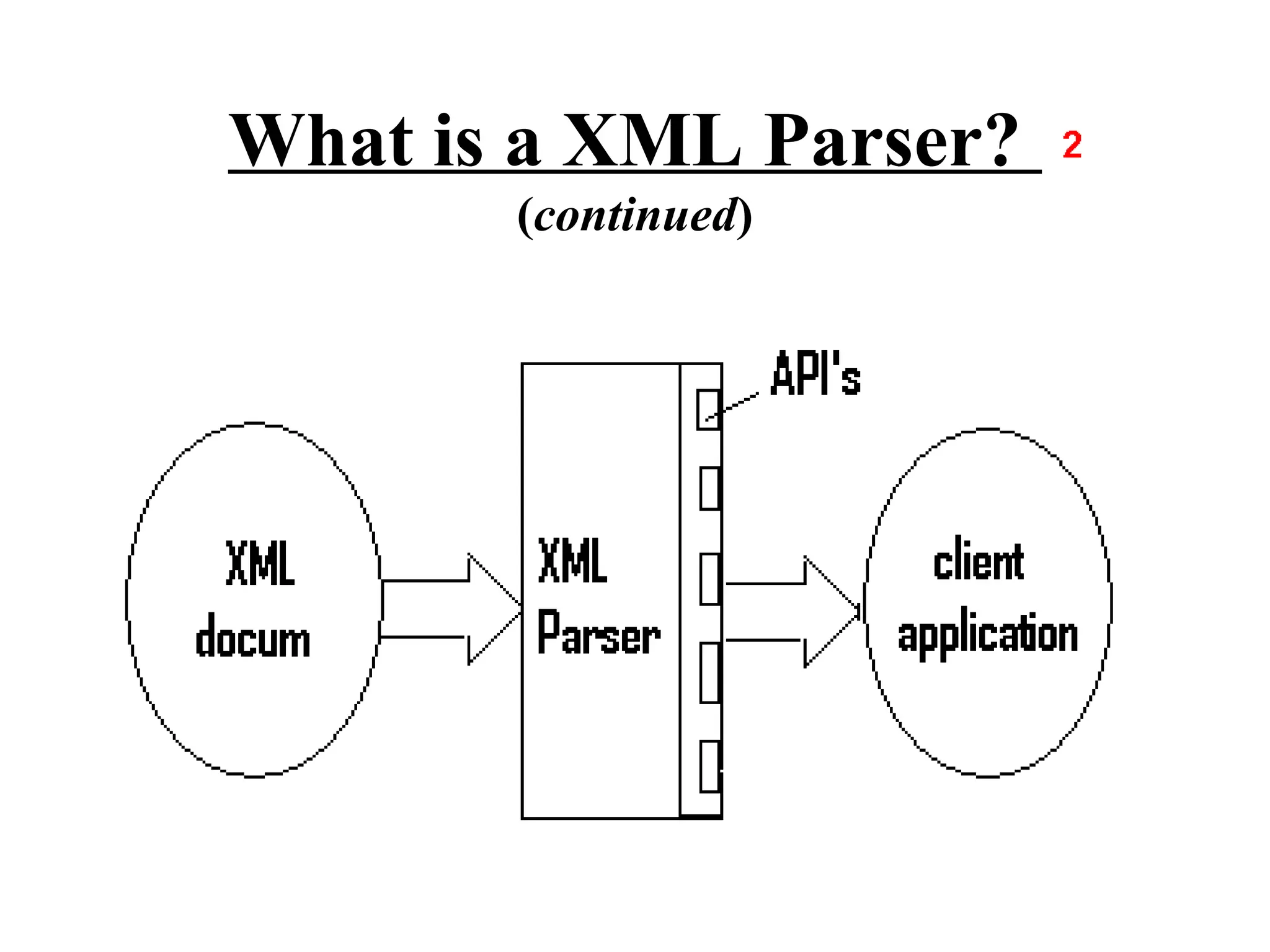
What is a XML Parser?
It is a software library (or a package) that
 provides methods (or interfaces) for client
 applications to work with XML documents
It checks the well-formattedness
It may validate the documents
It does a lot of other detailed things so that
 a client is shielded from that complexities
What is a XML Parser?
       (continued)
DOM and SAX Parsers
          in general


DOM: Document Object Model
SAX: Simple API for XML
A DOM parser implements DOM API
A SAX parser implement SAX API
Most major parsers implement both
 DOM and SAX API’s
DOM and SAX Parsers
        DOM parsers


• DOM Document object

• Main features of DOM parsers
DOM and SAX Parsers
          DOM Document Object
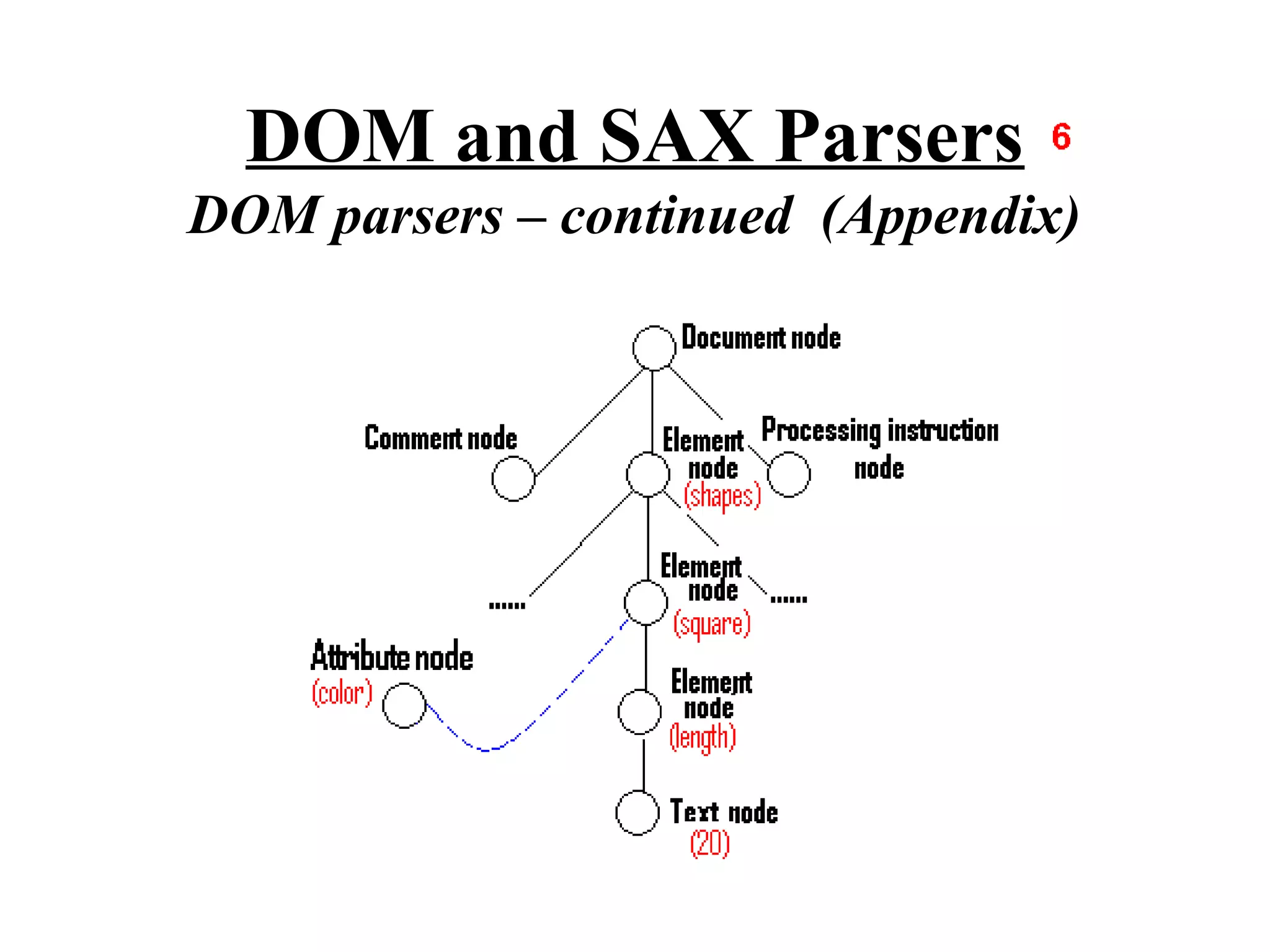
A DOM document is an object containing
 all the information of an XML document

It is composed of a tree (DOM tree) of
 nodes , and various nodes that are somehow
 associated with other nodes in the tree but
 are not themselves part of the DOM tree
DOM and SAX Parsers
      DOM Document Object
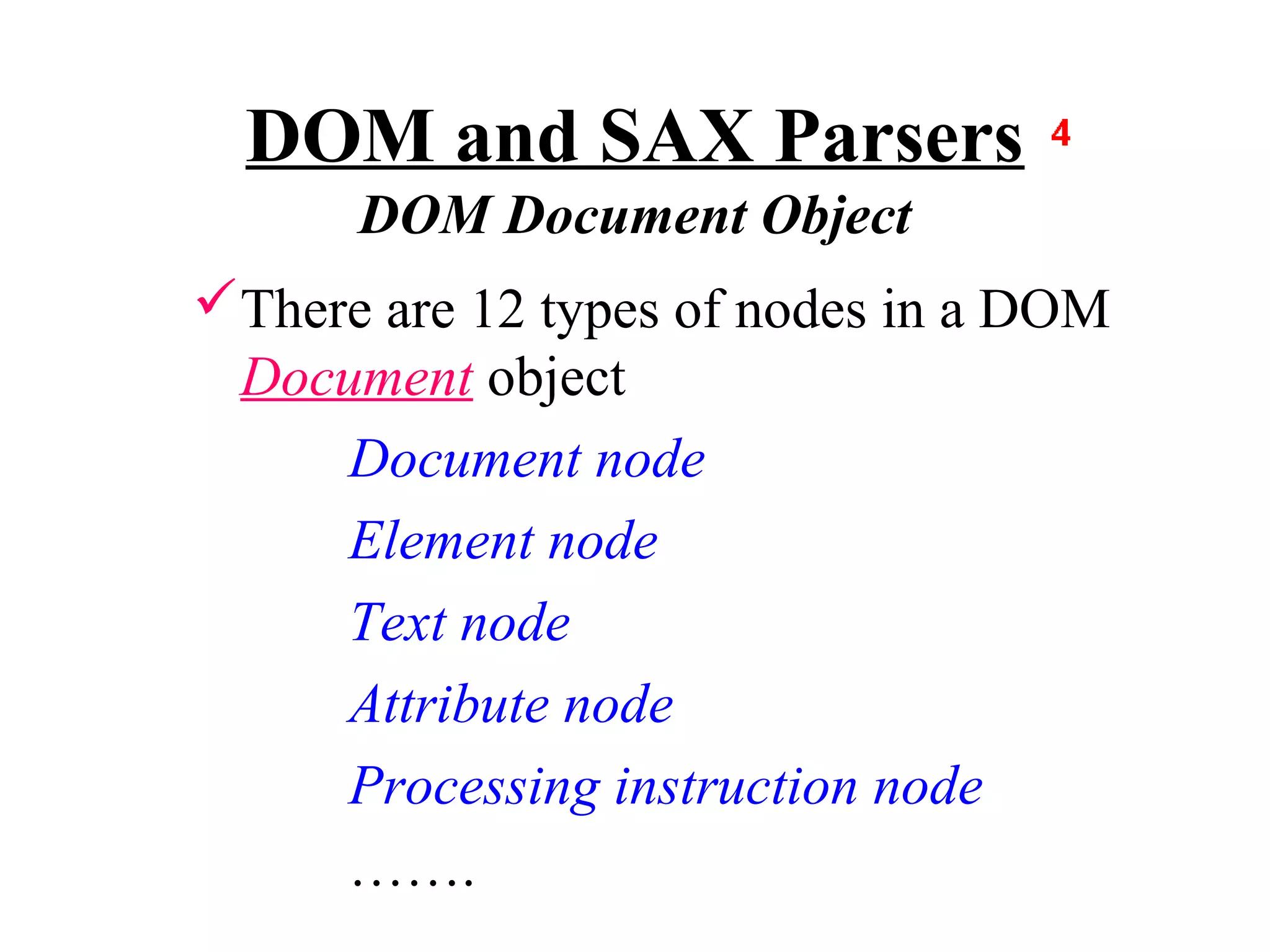
There are 12 types of nodes in a DOM
 Document object
     Document node
     Element node
     Text node
     Attribute node
     Processing instruction node
     …….
DOM and SAX Parsers
   DOM parsers – continued (Appendix)
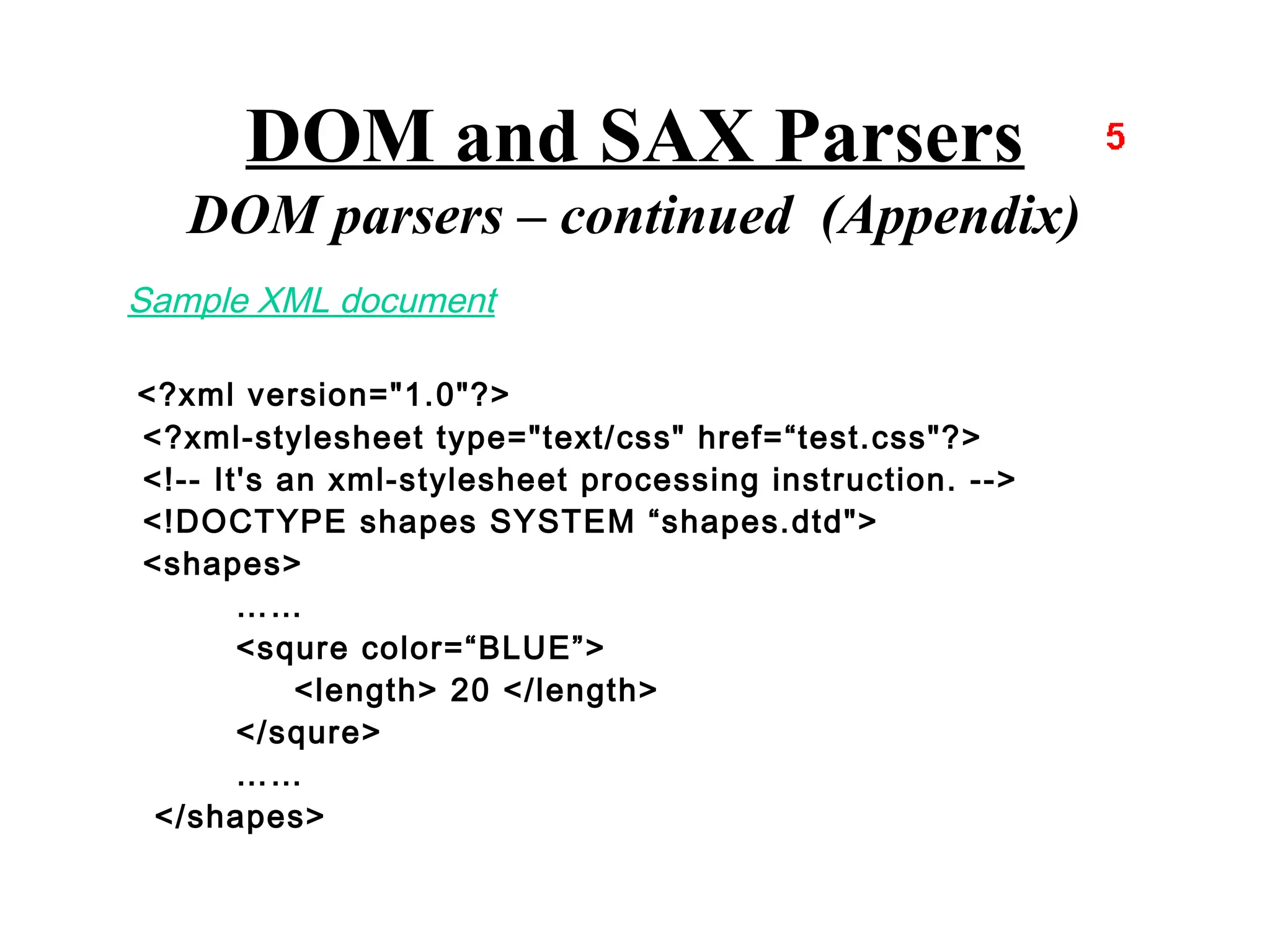
Sample XML document

<?xml version="1.0"?>
<?xml-stylesheet type="text/css" href=“test.css"?>
<!-- It's an xml-stylesheet processing instruction. -->
<!DOCTYPE shapes SYSTEM “shapes.dtd">
<shapes>
       ……
       <squre color=“BLUE”>
           <length> 20 </length>
       </squre>
       ……
 </shapes>
DOM and SAX Parsers
DOM parsers – continued (Appendix)
DOM and SAX Parsers
       main features of DOM parsers
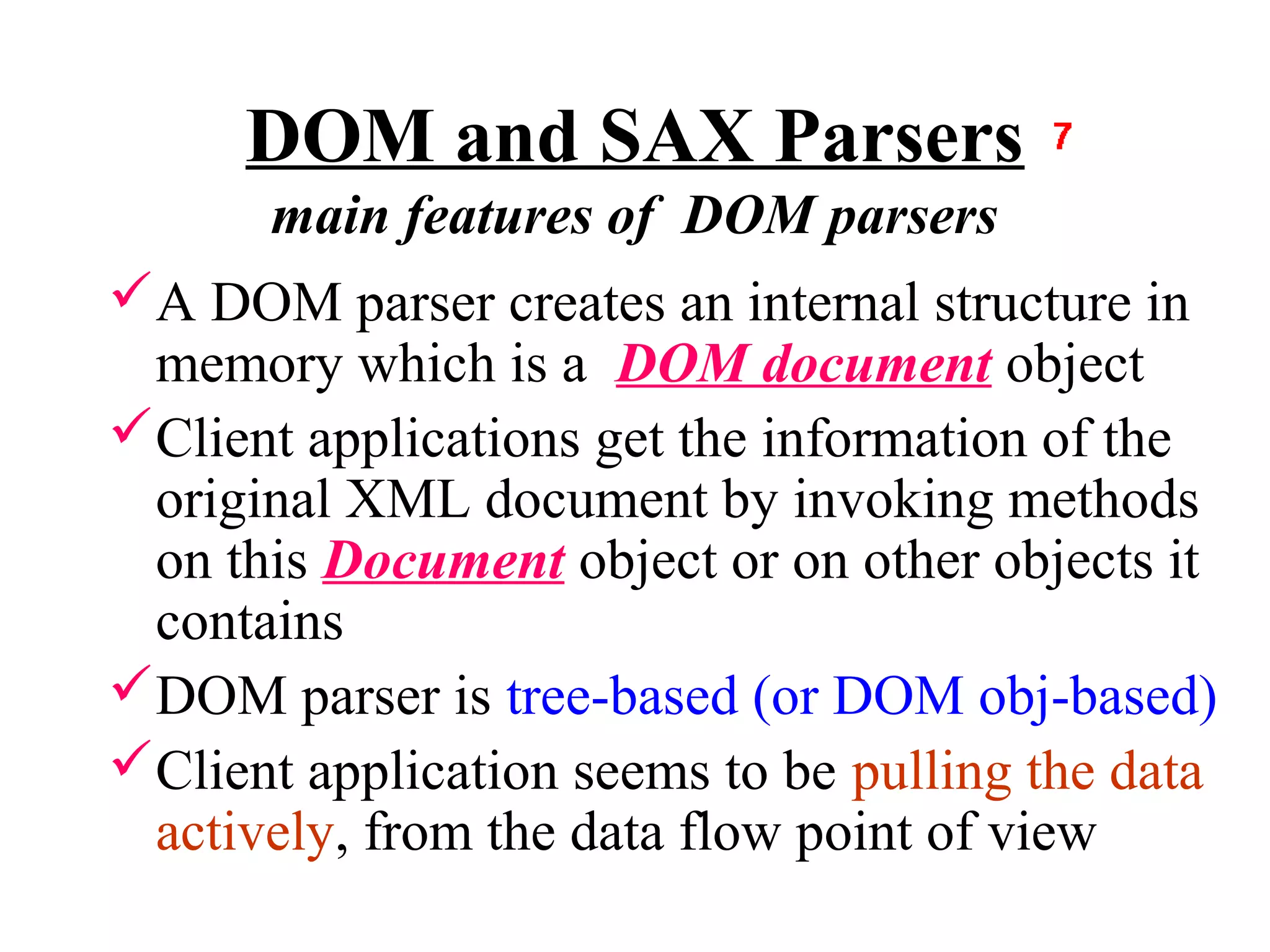
A DOM parser creates an internal structure in
 memory which is a DOM document object
Client applications get the information of the
 original XML document by invoking methods
 on this Document object or on other objects it
 contains
DOM parser is tree-based (or DOM obj-based)
Client application seems to be pulling the data
 actively, from the data flow point of view
DOM and SAX Parsers
 main features of DOM parsers (cont.)
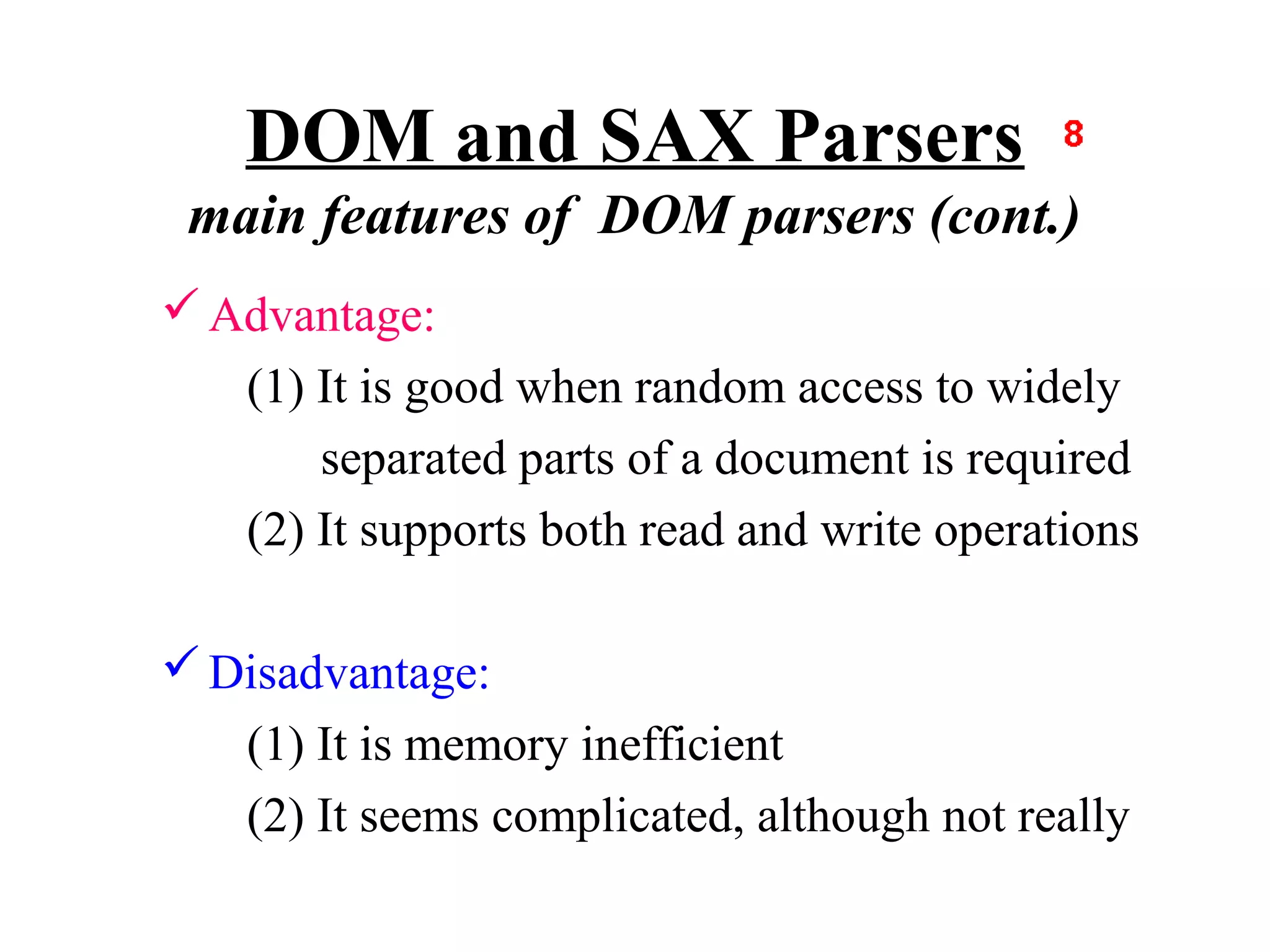
 Advantage:
   (1) It is good when random access to widely
       separated parts of a document is required
   (2) It supports both read and write operations

 Disadvantage:
   (1) It is memory inefficient
   (2) It seems complicated, although not really
DOM and SAX Parsers
                 SAX parsers

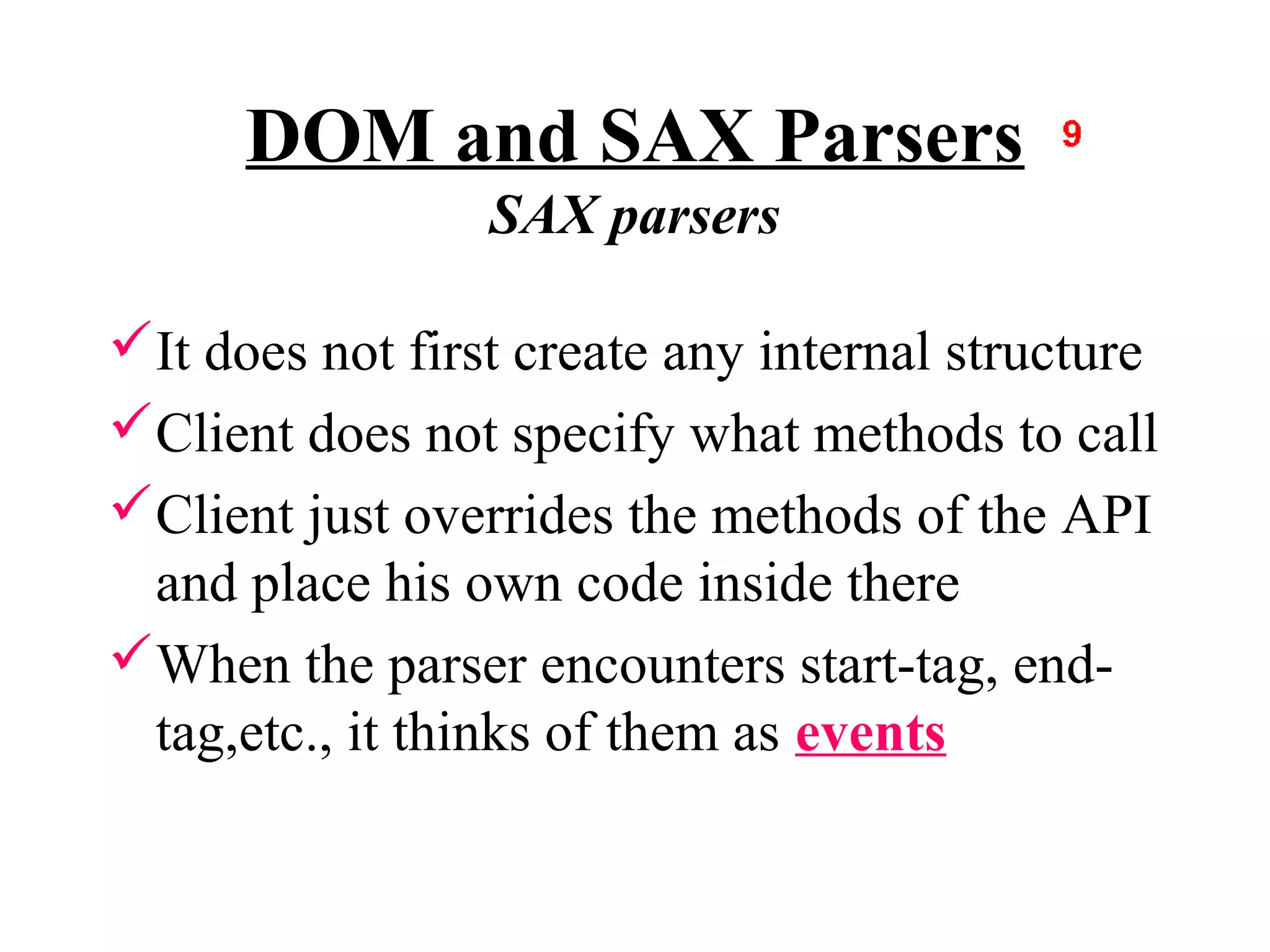
It does not first create any internal structure
Client does not specify what methods to call
Client just overrides the methods of the API
 and place his own code inside there
When the parser encounters start-tag, end-
 tag,etc., it thinks of them as events
DOM and SAX Parsers
             SAX parsers (cont.)
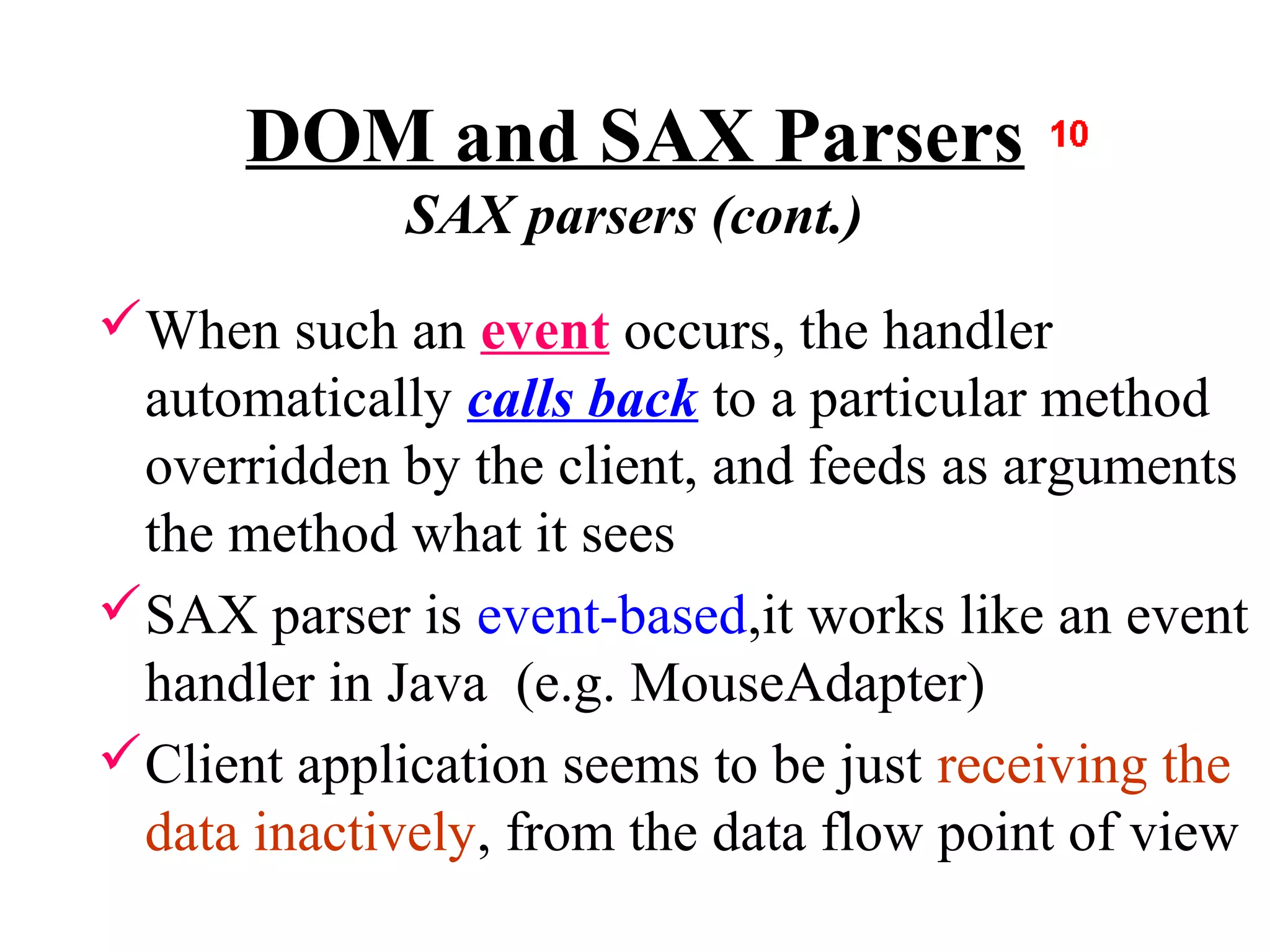
When such an event occurs, the handler
 automatically calls back to a particular method
 overridden by the client, and feeds as arguments
 the method what it sees
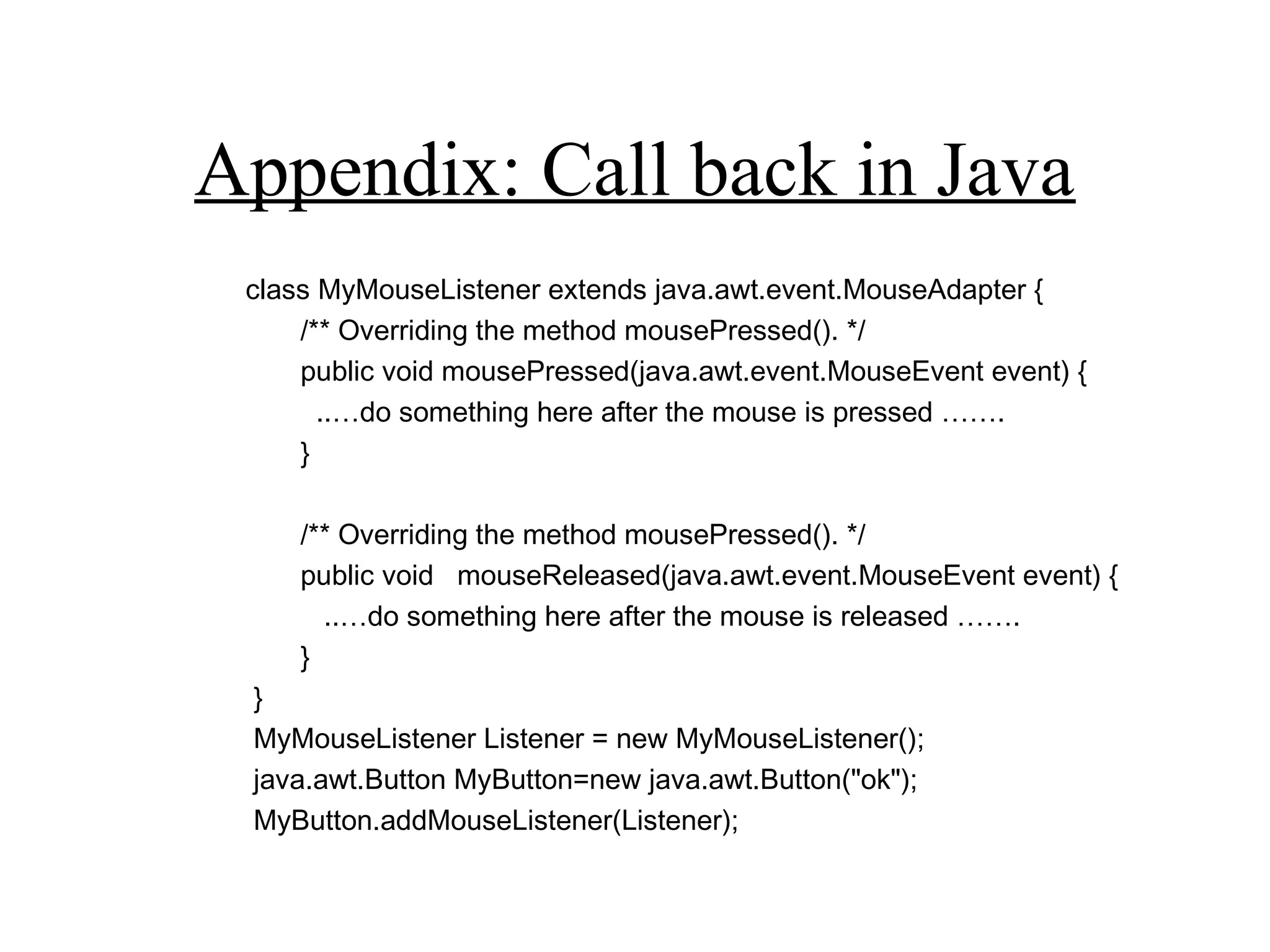
SAX parser is event-based,it works like an event
 handler in Java (e.g. MouseAdapter)
Client application seems to be just receiving the
 data inactively, from the data flow point of view
DOM and SAX Parsers
             SAX parsers (cont.)
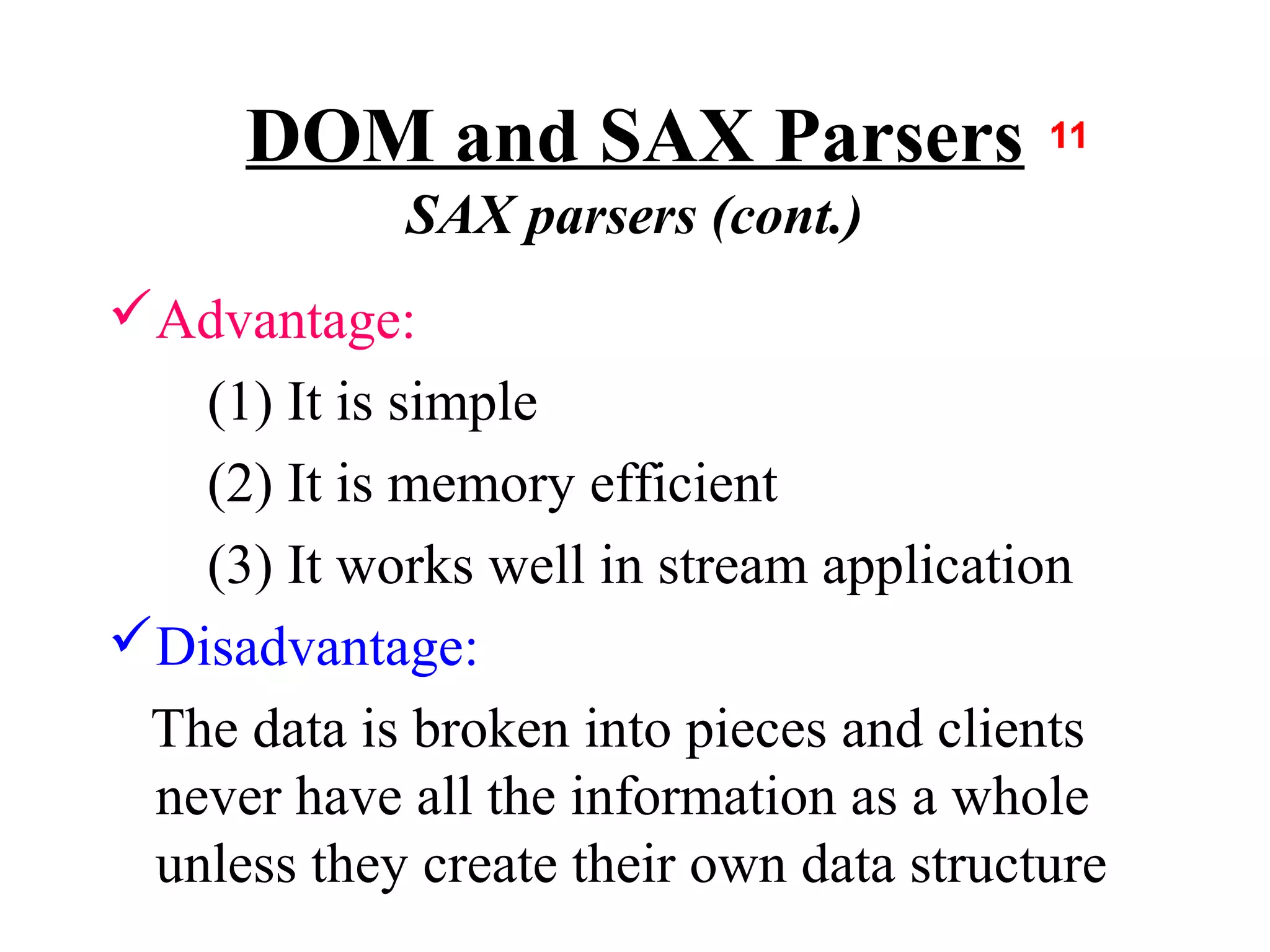
Advantage:
   (1) It is simple
   (2) It is memory efficient
   (3) It works well in stream application
Disadvantage:
 The data is broken into pieces and clients
 never have all the information as a whole
 unless they create their own data structure
Appendix: Call back in Java
 class MyMouseListener extends java.awt.event.MouseAdapter {
     /** Overriding the method mousePressed(). */
     public void mousePressed(java.awt.event.MouseEvent event) {
       ..…do something here after the mouse is pressed …….
     }

     /** Overriding the method mousePressed(). */
     public void mouseReleased(java.awt.event.MouseEvent event) {
       ..…do something here after the mouse is released …….
     }
 }
 MyMouseListener Listener = new MyMouseListener();
 java.awt.Button MyButton=new java.awt.Button("ok");
 MyButton.addMouseListener(Listener);
DOM and SAX Parsers
Xerces-J Parser Overview
It is a Java package
Provides two parsers, one is a DOM parser
 and another is a SAX parser
It is a validating parser
It fully supports DOM2 and SAX2, and
 partially supports DOM3 (W3C XML
 Schema)
It is very popular
Xerces-J Parser Overview
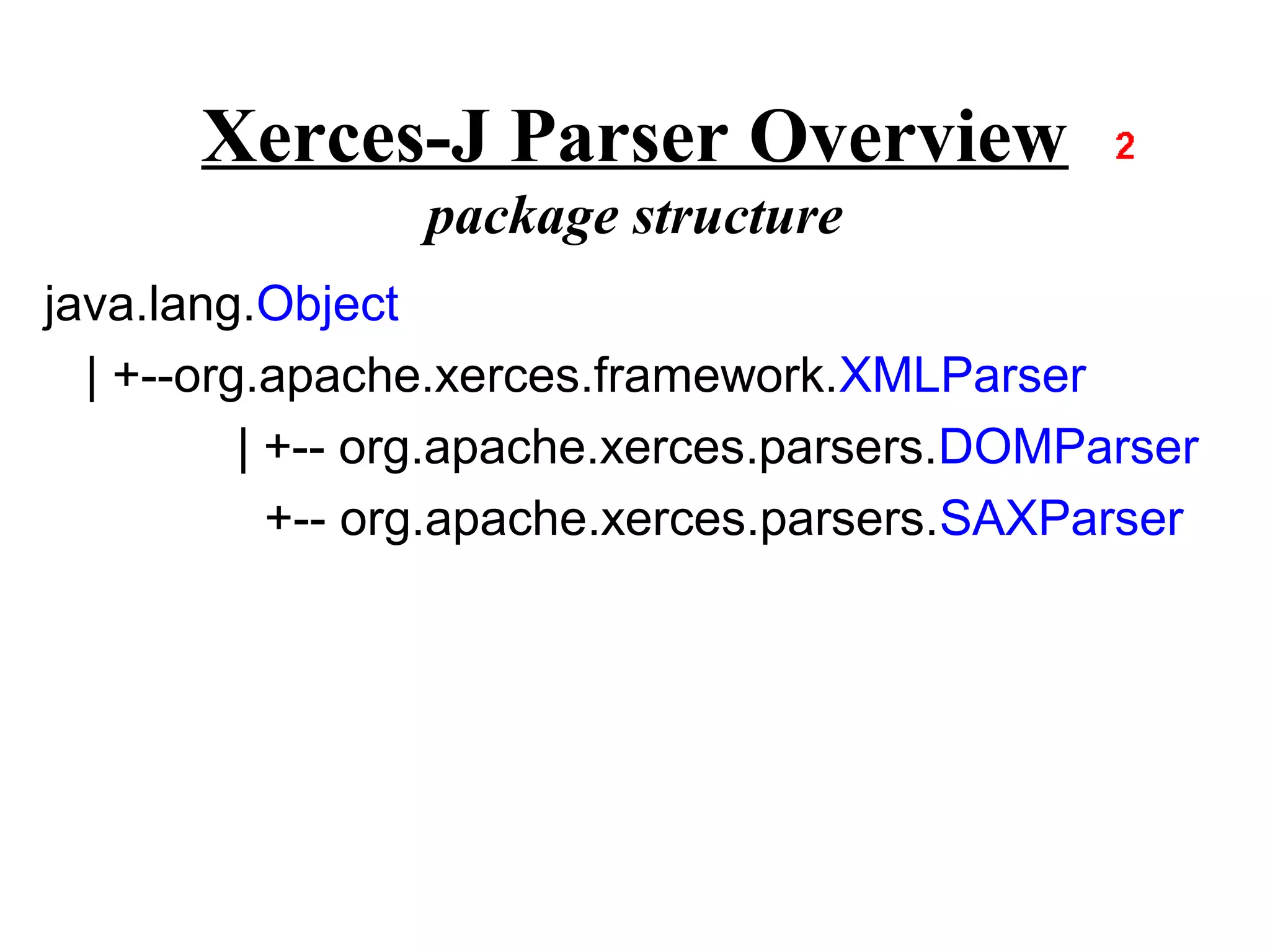
                package structure
java.lang.Object
  | +--org.apache.xerces.framework.XMLParser
          | +-- org.apache.xerces.parsers.DOMParser
            +-- org.apache.xerces.parsers.SAXParser
Xerces-J Parser Overview
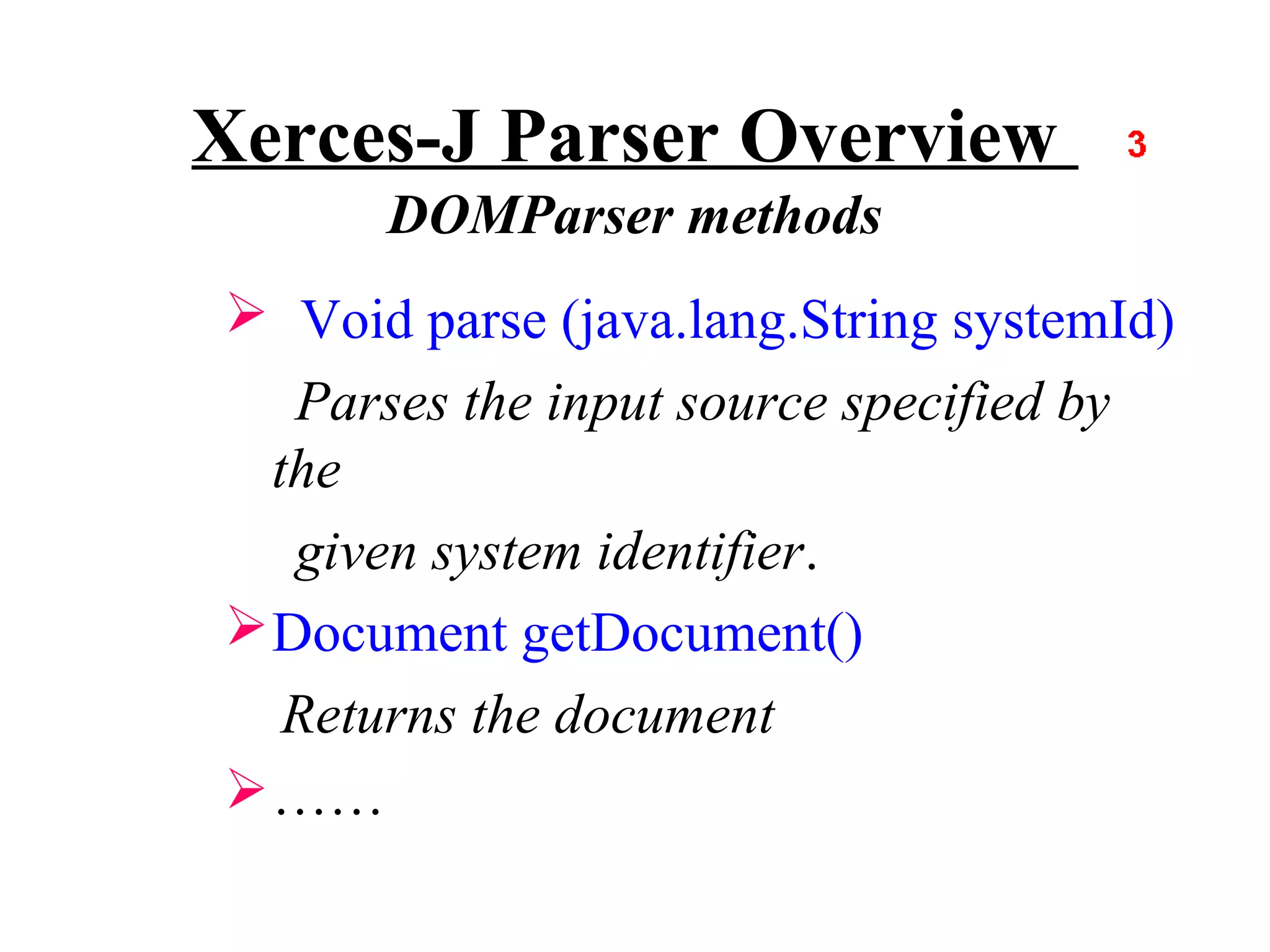
      DOMParser methods
 Void parse (java.lang.String systemId)
   Parses the input source specified by
  the
   given system identifier.
 Document getDocument()
   Returns the document
 ……
Xerces-J DOMParser
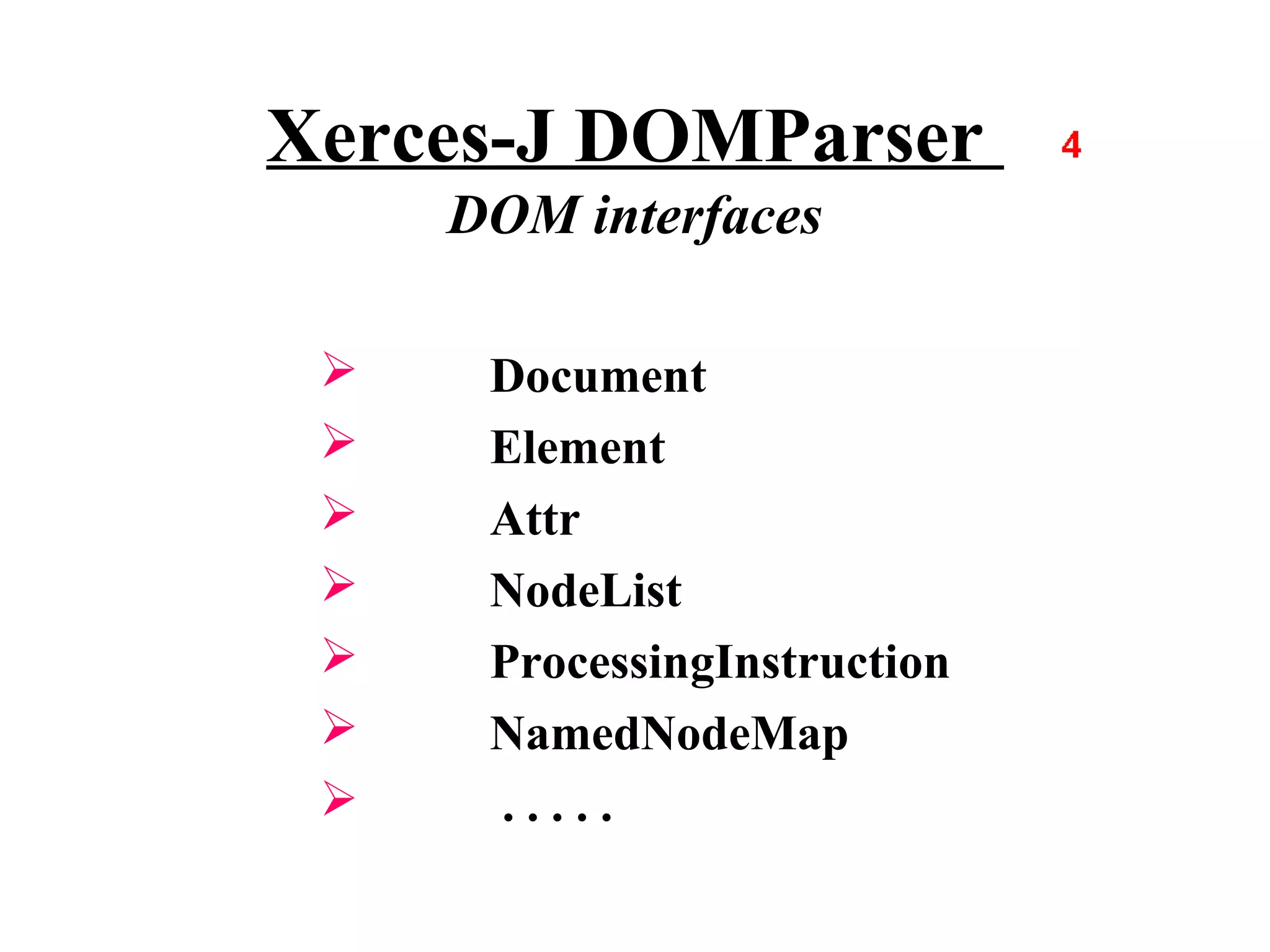
     DOM interfaces

     Document
     Element
     Attr
     NodeList
     ProcessingInstruction
     NamedNodeMap
     .....
Xerces-J Parser Overview
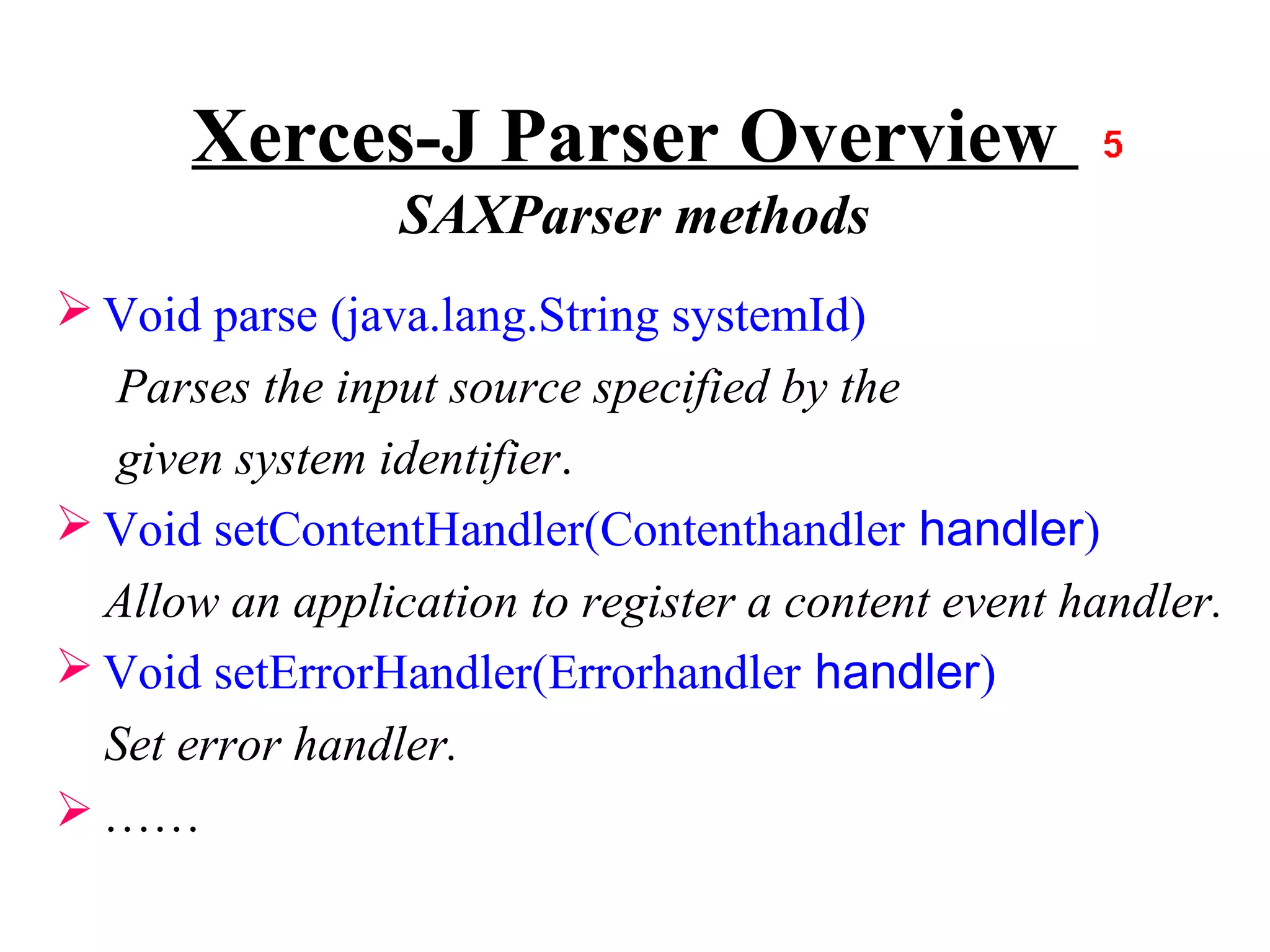
                 SAXParser methods
 Void parse (java.lang.String systemId)
   Parses the input source specified by the
   given system identifier.
 Void setContentHandler(Contenthandler handler)
  Allow an application to register a content event handler.
 Void setErrorHandler(Errorhandler handler)
  Set error handler.
 ……
Xerces-J Parser Overview
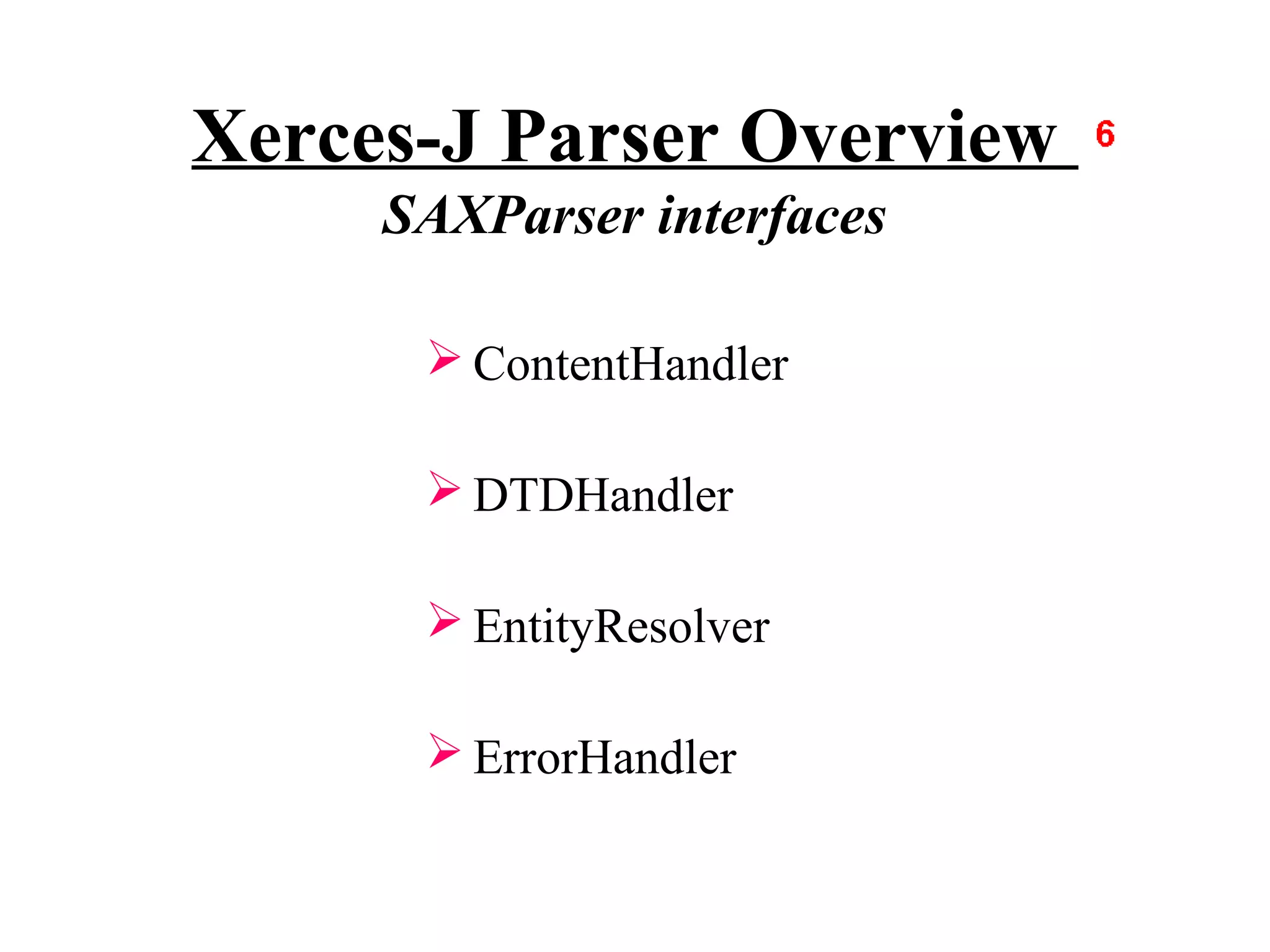
     SAXParser interfaces

       ContentHandler

       DTDHandler

       EntityResolver

       ErrorHandler
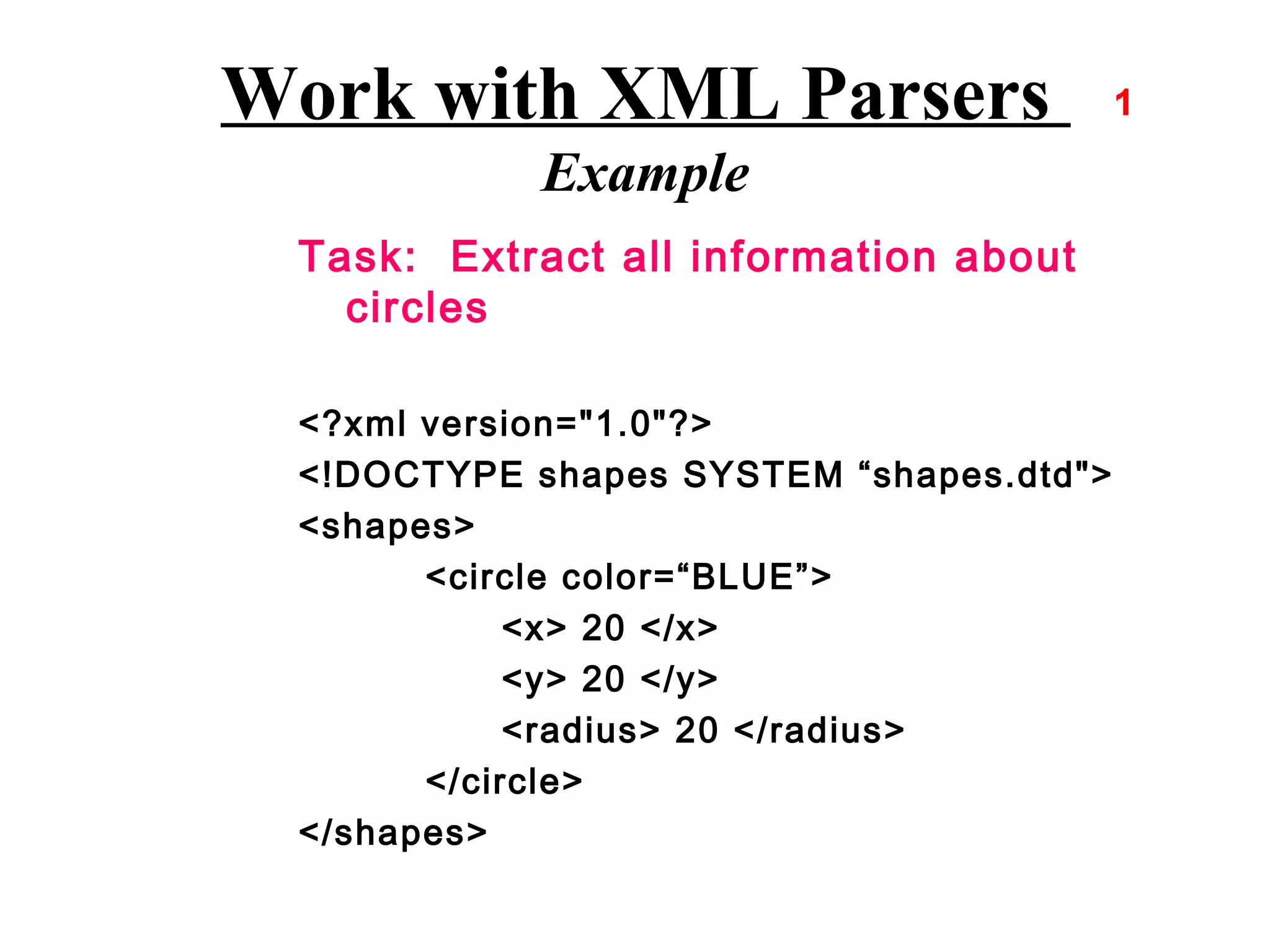
Work with XML Parsers
            Example
 Task: Extract all information about
   circles

 <?xml version="1.0"?>
 <!DOCTYPE shapes SYSTEM “shapes.dtd">
 <shapes>
       <circle color=“BLUE”>
            <x> 20 </x>
            <y> 20 </y>
            <radius> 20 </radius>
       </circle>
 </shapes>
Example
        DOMParser:create client class
public class shapes_DOM {
   static int numberOfCircles = 0;
   static int x[] = new int[1000];
   static int y[] = new int[1000];
   static int r[] = new int[1000];
   static String color[] = new String[1000];

    public static void main(String[] args) {
       ……
    }
}
Example
  (DOMParser: create a DOMParser)
import org.w3c.dom.*;
import org.apache.xerces.parsers.DOMParser;
 public class shapes_DOM {
     ……
    public static void main(String [ ] args ) {
          try{
               DOMParser parser=new DOMParser();

              parser.parse(args[0]);
              Document doc=parser.getDocument();
              ……
         }    catch (Exception e) {
                  e.printStackTrace(System.err);
              }
     }
Example
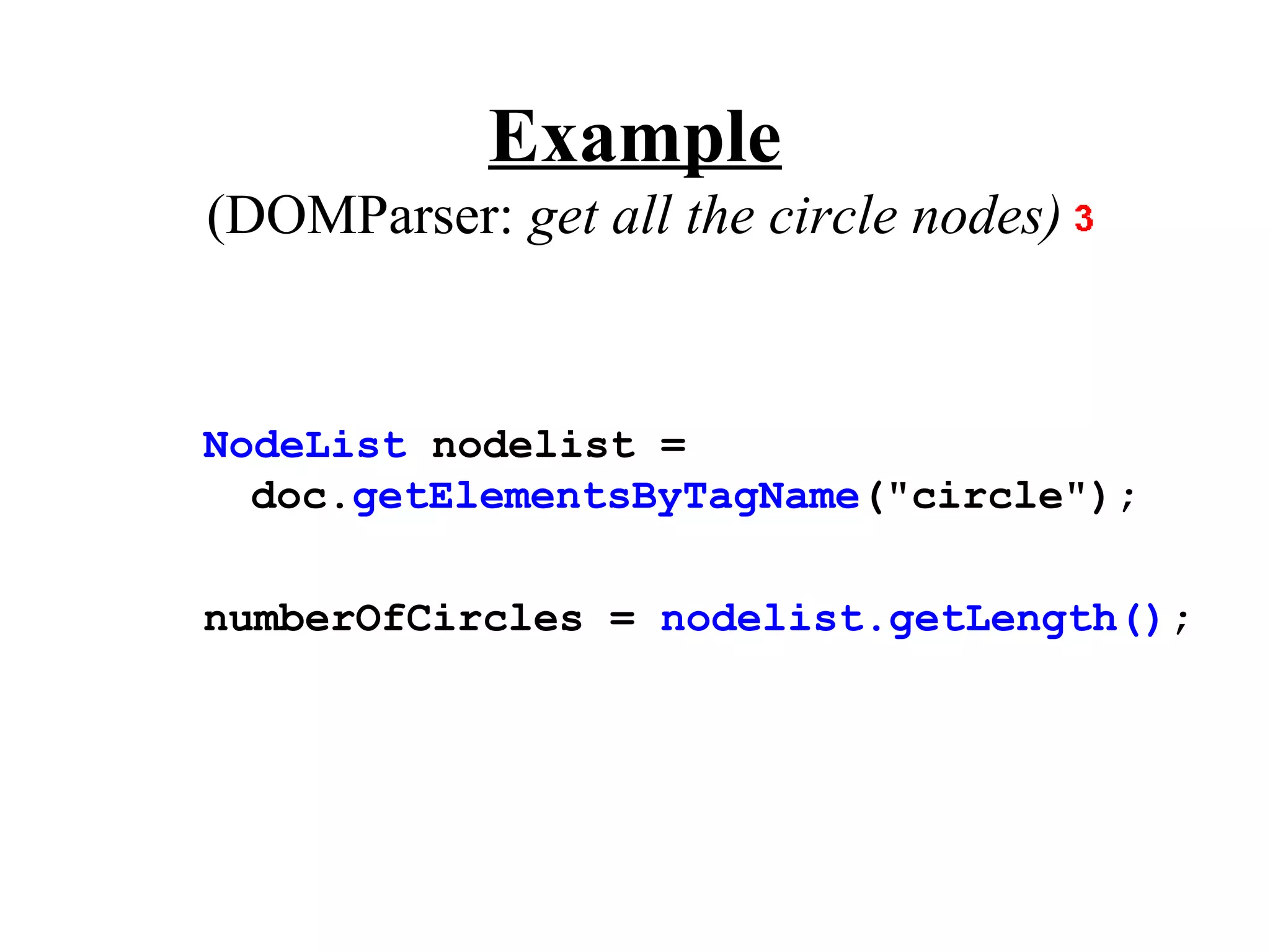
(DOMParser: get all the circle nodes)


NodeList nodelist =
  doc.getElementsByTagName("circle");

numberOfCircles = nodelist.getLength();
Example
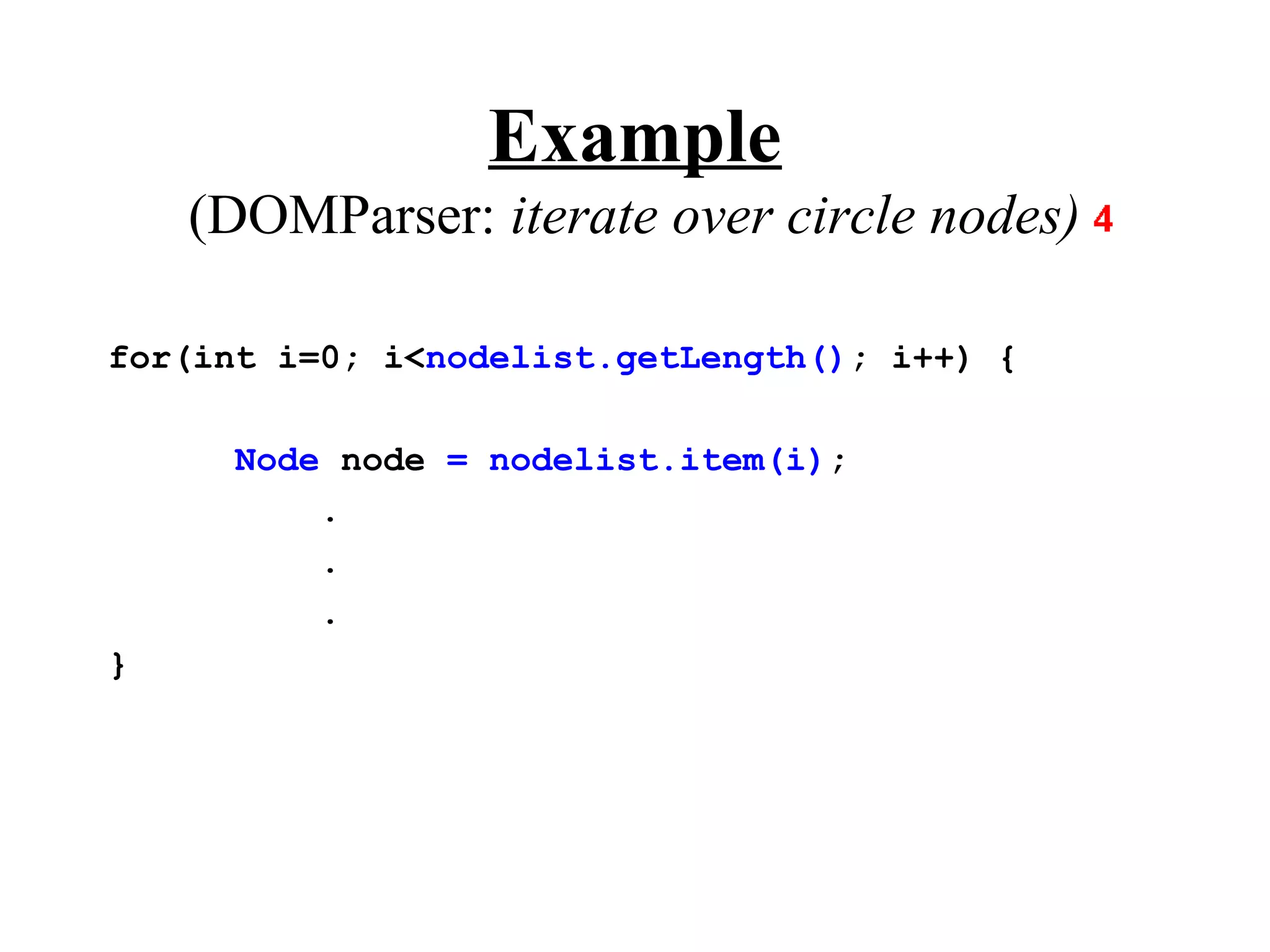
    (DOMParser: iterate over circle nodes)

for(int i=0; i<nodelist.getLength(); i++) {

     Node node = nodelist.item(i);
         .
         .
         .
}
Example
           (DOMParser: get color attribute)


25     NamedNodeMap attrs = node.getAttributes();
26     if(attrs.getLength()!=0)
26’       color[i]=
      (String)attrs.getNamedItem("color").getNodeValue();
Example
            (DOMParser: get child nodes)
27 // get the child nodes of a circle
28 NodeList childnodelist = node.getChildNodes();

29 // get the x and y
30 for(int j=0; j<childnodelist.getLength(); j++) {
31   Node childnode = childnodelist.item(j);
32   Node textnode = childnode.getFirstChild();
33   String childnodename = childnode.getNodeName();
34   if(childnodename.equals("x"))
35     x[i]=Integer.parseInt(textnode.getNodeValue().trim());
36   else if(childnodename.equals("y"))
37     y[i]=Integer.parseInt(textnode.getNodeValue().trim());
38   else if(childnodename.equals("radius"))
39     r[i]=Integer.parseInt(texxtnode.getNodeValue().trim())
40 }
Example
         (SAXarser: create client class)
public class shapes_SAX extends DefaultHandler {
   static int numberOfCircles = 0;
   static int x[] = new int[1000];
   static int y[] = new int[1000];
   static int r[] = new int[1000];
   static String color[] = new String[1000];

    public static void main(String[] args) {
       ……
    }
}
Example
      (SAXParser: create a SAXParser)
import org.xml.sax.*;
import org.xml.sax.helpers.DefaultHandler;
import org.apache.xerces.parsers.SAXParser;
  public class shapes_SAX extends DefaultHandler {
     public static void main(String [ ] args ) {
        try{
           shapes_SAX SAXHandler = new shapes_SAX();
           SAXParser parser = new SAXParser();
           parser.setContentHandler(SAXHandler);
           parser.parse(args[0]);
        }    catch (Exception e) { … … }
     }
}
Example
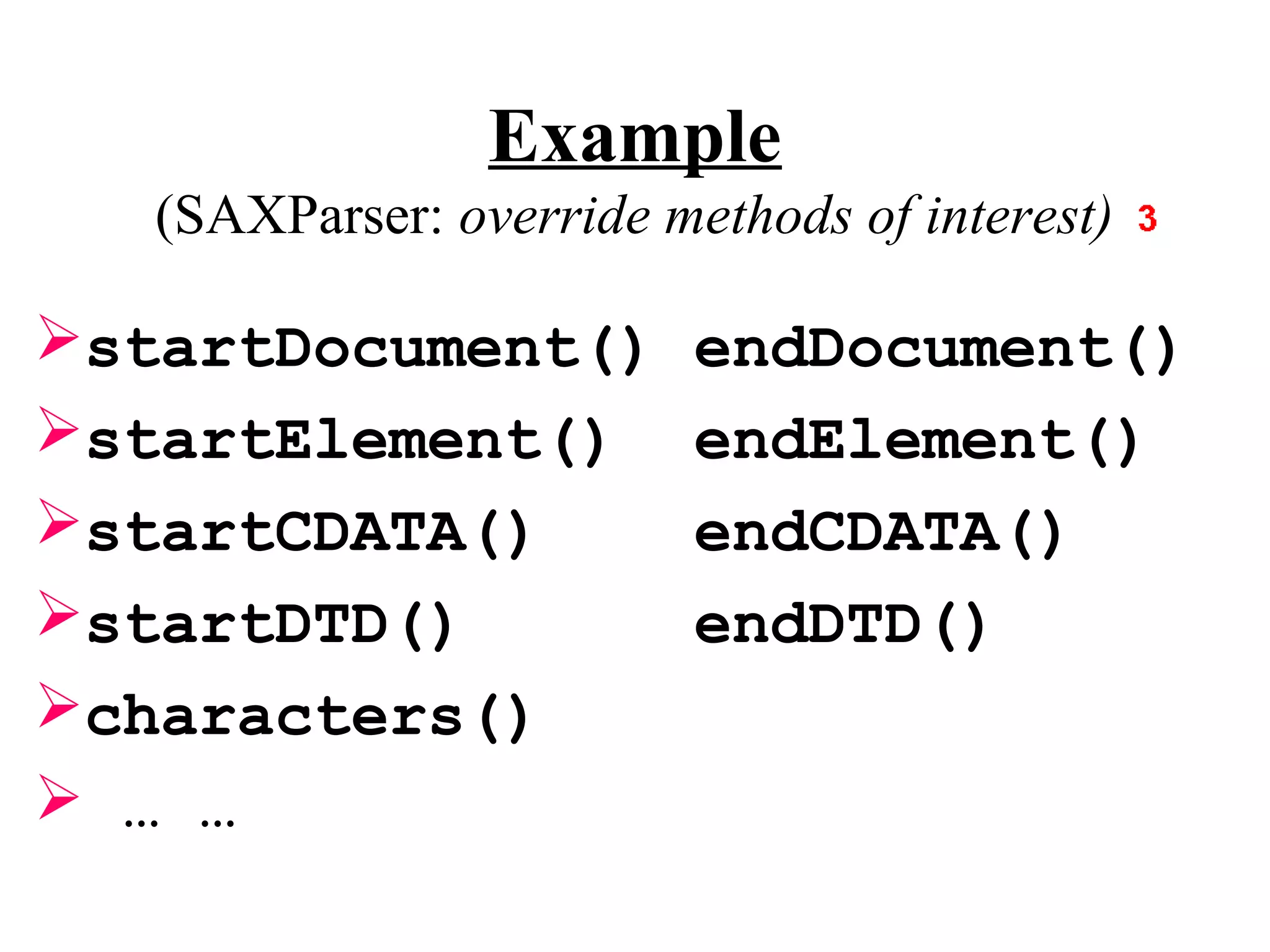
   (SAXParser: override methods of interest)

startDocument()          endDocument()
startElement()           endElement()
startCDATA()             endCDATA()
startDTD()               endDTD()
characters()
 … …
Example
        (SAXParser: override startElement() )
21 public void startElement(String uri, String localName,
                   String rawName, Attributes attributes) {
22 if(rawName.equals("circle" )
23     color[numberOfCircles]=attributes.getValue("color");
26 else if(rawName.equals("x"))
27    flagX = 1;
28 else if(rawName.equals("y"))
29    flagY = 1;
30 else if(rawName.equals("radius"))
31    flagR = 1;
32 }
Example
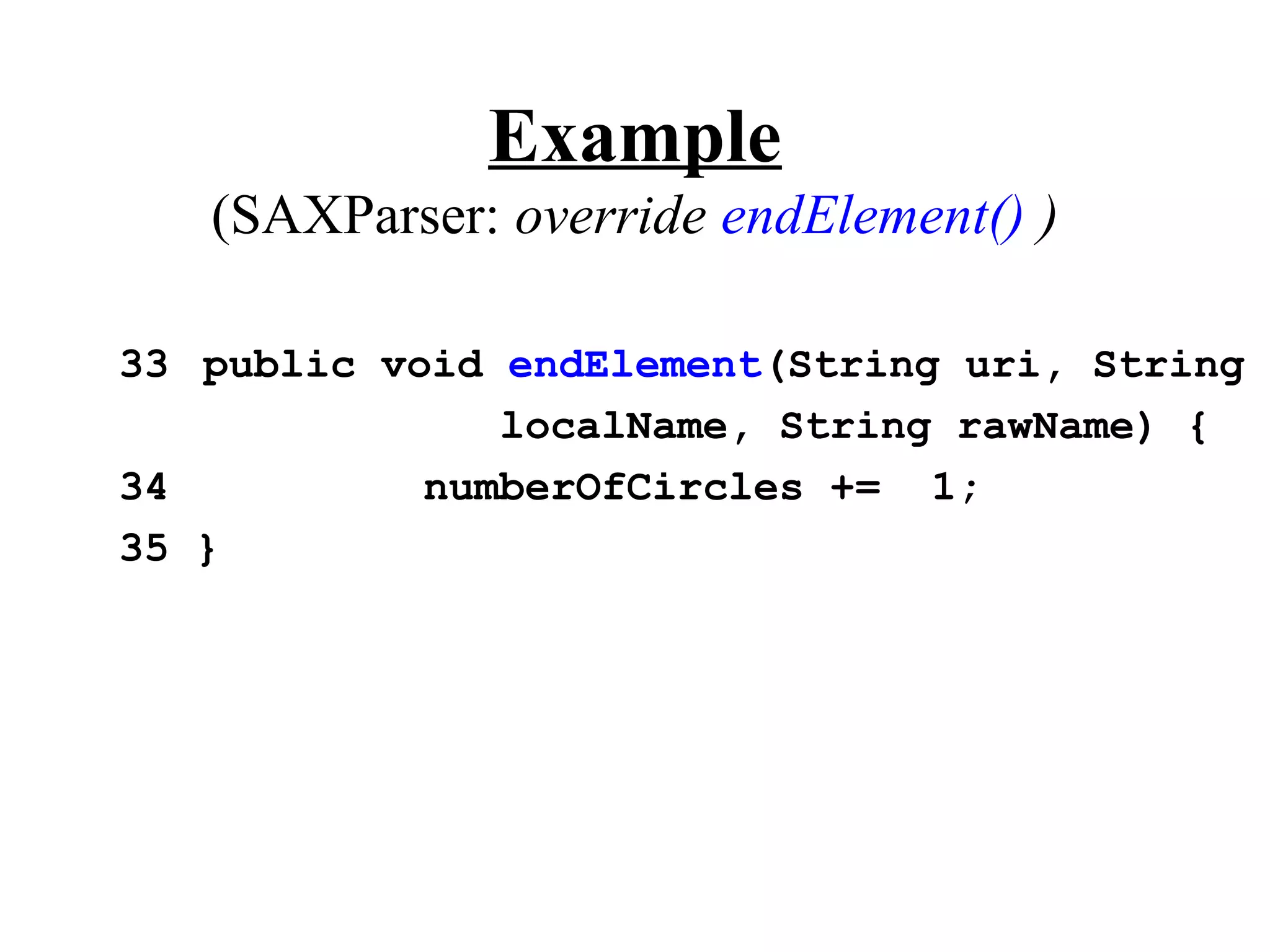
   (SAXParser: override endElement() )

33 public void endElement(String uri, String
               localName, String rawName) {
34          numberOfCircles += 1;
35 }
Example
         (SAXParser: override characters() )
36 public void characters(char characters[], int start,
                          int length) {
38         String characterData =
39             (new String(characters,start,length)).trim();
42         if(flagX==1) {
43             x[numberOfCircles] = Integer.parseInt(characterData);
               flagX=0;
           }
44         if(flagY==1) {
45             y[numberOfCircles] = Integer.parseInt(characterData);
               flagY=0;
           }
46         if(flagR==1) {
47             r[numberOfCircles] = Integer.parseInt(characterData);
               flagR=0;
           }
49 }
Example
    (SAXParser: override endDocument() )


50 public void endDocument() {
51         // print the result
52     System.out.println("circles="+numberOfCircles);
53     for(int i=0;i<numberOfCircles;i++) {
54        String line="";
55       line=line+"(x="+x[i]+",y="+y[i]+",r="+r[i]
                   +",color="+color[i]+")";
56        System.out.println(line);
57     }
58 }
DOM and SAX Parsers

Xm lparsers

  • 1.
    XML Parsers By Chongbing Liu
  • 2.
    XML Parsers  What is a XML parser?  DOM and SAX parser API  Xerces-J parsers overview  Work with XML parsers (example)
  • 3.
    What is aXML Parser? It is a software library (or a package) that provides methods (or interfaces) for client applications to work with XML documents It checks the well-formattedness It may validate the documents It does a lot of other detailed things so that a client is shielded from that complexities
  • 4.
    What is aXML Parser? (continued)
  • 5.
    DOM and SAXParsers in general DOM: Document Object Model SAX: Simple API for XML A DOM parser implements DOM API A SAX parser implement SAX API Most major parsers implement both DOM and SAX API’s
  • 6.
    DOM and SAXParsers DOM parsers • DOM Document object • Main features of DOM parsers
  • 7.
    DOM and SAXParsers DOM Document Object A DOM document is an object containing all the information of an XML document It is composed of a tree (DOM tree) of nodes , and various nodes that are somehow associated with other nodes in the tree but are not themselves part of the DOM tree
  • 8.
    DOM and SAXParsers DOM Document Object There are 12 types of nodes in a DOM Document object Document node Element node Text node Attribute node Processing instruction node …….
  • 9.
    DOM and SAXParsers DOM parsers – continued (Appendix) Sample XML document <?xml version="1.0"?> <?xml-stylesheet type="text/css" href=“test.css"?> <!-- It's an xml-stylesheet processing instruction. --> <!DOCTYPE shapes SYSTEM “shapes.dtd"> <shapes> …… <squre color=“BLUE”> <length> 20 </length> </squre> …… </shapes>
  • 10.
    DOM and SAXParsers DOM parsers – continued (Appendix)
  • 11.
    DOM and SAXParsers main features of DOM parsers A DOM parser creates an internal structure in memory which is a DOM document object Client applications get the information of the original XML document by invoking methods on this Document object or on other objects it contains DOM parser is tree-based (or DOM obj-based) Client application seems to be pulling the data actively, from the data flow point of view
  • 12.
    DOM and SAXParsers main features of DOM parsers (cont.)  Advantage: (1) It is good when random access to widely separated parts of a document is required (2) It supports both read and write operations  Disadvantage: (1) It is memory inefficient (2) It seems complicated, although not really
  • 13.
    DOM and SAXParsers SAX parsers It does not first create any internal structure Client does not specify what methods to call Client just overrides the methods of the API and place his own code inside there When the parser encounters start-tag, end- tag,etc., it thinks of them as events
  • 14.
    DOM and SAXParsers SAX parsers (cont.) When such an event occurs, the handler automatically calls back to a particular method overridden by the client, and feeds as arguments the method what it sees SAX parser is event-based,it works like an event handler in Java (e.g. MouseAdapter) Client application seems to be just receiving the data inactively, from the data flow point of view
  • 15.
    DOM and SAXParsers SAX parsers (cont.) Advantage: (1) It is simple (2) It is memory efficient (3) It works well in stream application Disadvantage: The data is broken into pieces and clients never have all the information as a whole unless they create their own data structure
  • 16.
    Appendix: Call backin Java class MyMouseListener extends java.awt.event.MouseAdapter { /** Overriding the method mousePressed(). */ public void mousePressed(java.awt.event.MouseEvent event) { ..…do something here after the mouse is pressed ……. } /** Overriding the method mousePressed(). */ public void mouseReleased(java.awt.event.MouseEvent event) { ..…do something here after the mouse is released ……. } } MyMouseListener Listener = new MyMouseListener(); java.awt.Button MyButton=new java.awt.Button("ok"); MyButton.addMouseListener(Listener);
  • 17.
    DOM and SAXParsers
  • 18.
    Xerces-J Parser Overview Itis a Java package Provides two parsers, one is a DOM parser and another is a SAX parser It is a validating parser It fully supports DOM2 and SAX2, and partially supports DOM3 (W3C XML Schema) It is very popular
  • 19.
    Xerces-J Parser Overview package structure java.lang.Object | +--org.apache.xerces.framework.XMLParser | +-- org.apache.xerces.parsers.DOMParser +-- org.apache.xerces.parsers.SAXParser
  • 20.
    Xerces-J Parser Overview DOMParser methods  Void parse (java.lang.String systemId) Parses the input source specified by the given system identifier.  Document getDocument() Returns the document  ……
  • 21.
    Xerces-J DOMParser DOM interfaces  Document  Element  Attr  NodeList  ProcessingInstruction  NamedNodeMap  .....
  • 22.
    Xerces-J Parser Overview SAXParser methods  Void parse (java.lang.String systemId) Parses the input source specified by the given system identifier.  Void setContentHandler(Contenthandler handler) Allow an application to register a content event handler.  Void setErrorHandler(Errorhandler handler) Set error handler.  ……
  • 23.
    Xerces-J Parser Overview SAXParser interfaces  ContentHandler  DTDHandler  EntityResolver  ErrorHandler
  • 24.
    Work with XMLParsers Example Task: Extract all information about circles <?xml version="1.0"?> <!DOCTYPE shapes SYSTEM “shapes.dtd"> <shapes> <circle color=“BLUE”> <x> 20 </x> <y> 20 </y> <radius> 20 </radius> </circle> </shapes>
  • 25.
    Example DOMParser:create client class public class shapes_DOM { static int numberOfCircles = 0; static int x[] = new int[1000]; static int y[] = new int[1000]; static int r[] = new int[1000]; static String color[] = new String[1000]; public static void main(String[] args) { …… } }
  • 26.
    Example (DOMParser:create a DOMParser) import org.w3c.dom.*; import org.apache.xerces.parsers.DOMParser; public class shapes_DOM { …… public static void main(String [ ] args ) { try{ DOMParser parser=new DOMParser(); parser.parse(args[0]); Document doc=parser.getDocument(); …… } catch (Exception e) { e.printStackTrace(System.err); } }
  • 27.
    Example (DOMParser: get allthe circle nodes) NodeList nodelist = doc.getElementsByTagName("circle"); numberOfCircles = nodelist.getLength();
  • 28.
    Example (DOMParser: iterate over circle nodes) for(int i=0; i<nodelist.getLength(); i++) { Node node = nodelist.item(i); . . . }
  • 29.
    Example (DOMParser: get color attribute) 25 NamedNodeMap attrs = node.getAttributes(); 26 if(attrs.getLength()!=0) 26’ color[i]= (String)attrs.getNamedItem("color").getNodeValue();
  • 30.
    Example (DOMParser: get child nodes) 27 // get the child nodes of a circle 28 NodeList childnodelist = node.getChildNodes(); 29 // get the x and y 30 for(int j=0; j<childnodelist.getLength(); j++) { 31 Node childnode = childnodelist.item(j); 32 Node textnode = childnode.getFirstChild(); 33 String childnodename = childnode.getNodeName(); 34 if(childnodename.equals("x")) 35 x[i]=Integer.parseInt(textnode.getNodeValue().trim()); 36 else if(childnodename.equals("y")) 37 y[i]=Integer.parseInt(textnode.getNodeValue().trim()); 38 else if(childnodename.equals("radius")) 39 r[i]=Integer.parseInt(texxtnode.getNodeValue().trim()) 40 }
  • 31.
    Example (SAXarser: create client class) public class shapes_SAX extends DefaultHandler { static int numberOfCircles = 0; static int x[] = new int[1000]; static int y[] = new int[1000]; static int r[] = new int[1000]; static String color[] = new String[1000]; public static void main(String[] args) { …… } }
  • 32.
    Example (SAXParser: create a SAXParser) import org.xml.sax.*; import org.xml.sax.helpers.DefaultHandler; import org.apache.xerces.parsers.SAXParser; public class shapes_SAX extends DefaultHandler { public static void main(String [ ] args ) { try{ shapes_SAX SAXHandler = new shapes_SAX(); SAXParser parser = new SAXParser(); parser.setContentHandler(SAXHandler); parser.parse(args[0]); } catch (Exception e) { … … } } }
  • 33.
    Example (SAXParser: override methods of interest) startDocument() endDocument() startElement() endElement() startCDATA() endCDATA() startDTD() endDTD() characters()  … …
  • 34.
    Example (SAXParser: override startElement() ) 21 public void startElement(String uri, String localName, String rawName, Attributes attributes) { 22 if(rawName.equals("circle" ) 23 color[numberOfCircles]=attributes.getValue("color"); 26 else if(rawName.equals("x")) 27 flagX = 1; 28 else if(rawName.equals("y")) 29 flagY = 1; 30 else if(rawName.equals("radius")) 31 flagR = 1; 32 }
  • 35.
    Example (SAXParser: override endElement() ) 33 public void endElement(String uri, String localName, String rawName) { 34 numberOfCircles += 1; 35 }
  • 36.
    Example (SAXParser: override characters() ) 36 public void characters(char characters[], int start, int length) { 38 String characterData = 39 (new String(characters,start,length)).trim(); 42 if(flagX==1) { 43 x[numberOfCircles] = Integer.parseInt(characterData); flagX=0; } 44 if(flagY==1) { 45 y[numberOfCircles] = Integer.parseInt(characterData); flagY=0; } 46 if(flagR==1) { 47 r[numberOfCircles] = Integer.parseInt(characterData); flagR=0; } 49 }
  • 37.
    Example (SAXParser: override endDocument() ) 50 public void endDocument() { 51 // print the result 52 System.out.println("circles="+numberOfCircles); 53 for(int i=0;i<numberOfCircles;i++) { 54 String line=""; 55 line=line+"(x="+x[i]+",y="+y[i]+",r="+r[i] +",color="+color[i]+")"; 56 System.out.println(line); 57 } 58 }
  • 38.
    DOM and SAXParsers