X.RAY & IT’S COMPONENTS
PRESENTED BY:UZMA HASSAN
COURSE:BRIT(C.T/MRI)
S.I:2018014895
SUBMITTED TO :BUSHRA MA’AM
INTRODUCTION
X-rays were discovered in 1895 by Wilhelm
Conrad Roentgen (1845-1923) who was a
Professor at Wuerzburg University in
Germany. Roentgen shielded the tube with heavy
black paper, and discovered a green colored
fluorescent light generated by a material located a
few feet away from the tube.
WHAT ARE X.RAYS
• X-rays are a type of radiation called electromagnetic waves Of
shorter wave length.
• The most familiar use of x-rays is checking for broken bones, but x-
rays are also used in other ways.
COMPONENTS OF X.RAY MACHINE
• Operating console
• Generators
• Transformers
• Rectifiers
• X.ray tube
• Kv meter
• Ammeter
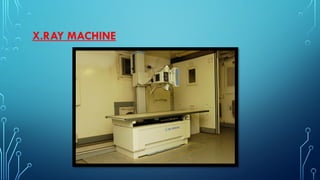
X.RAY MACHINE
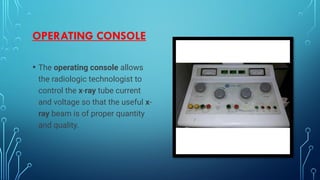
OPERATING CONSOLE
• The operating console allows
the radiologic technologist to
control the x-ray tube current
and voltage so that the useful x-
ray beam is of proper quantity
and quality.
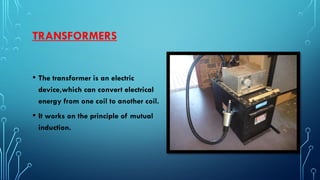
• The transformer is an electric
device,which can convert electrical
energy from one coil to another coil.
• It works on the principle of mutual
induction.
TRANSFORMERS
TYPES OF TRANSFORMERS
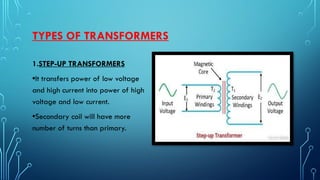
1.STEP-UP TRANSFORMERS
•It transfers power of low voltage
and high current into power of high
voltage and low current.
•Secondary coil will have more
number of turns than primary.
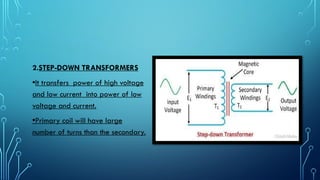
2.STEP-DOWN TRANSFORMERS
•It transfers power of high voltage
and low current into power of low
voltage and current.
•Primary coil will have large
number of turns than the secondary.
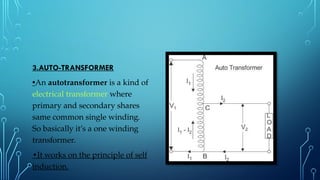
3.AUTO-TRANSFORMER
•An autotransformer is a kind of
electrical transformer where
primary and secondary shares
same common single winding.
So basically it’s a one winding
transformer.
•It works on the principle of self
induction.
RECTIFIER CIRCUIT
• Rectification is the process of changing alternating current
into direct current.
• The device that produces the change is called a RECTIFIER.
• It allows an electrical current to flow in one direction but does
not allow the current to flow in the other direction.
TYPES OF RECTIFIERS
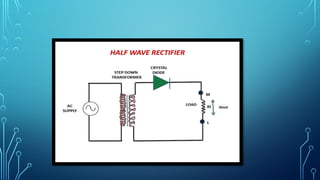
1.HALF-WAVE RECTIFIER
• A type of rectifier that only allows one half-cycle of an AC voltage
waveform to pass, blocking the other half-cycle.
• Half-wave rectifiers are used to convert AC voltage to DC voltage, and
only require a single diode to construct
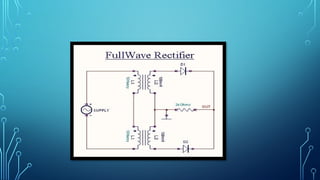
2.FULL-WAVE RECTIFIER
• A Full Wave Rectifier is a circuit, which converts an ac voltage into a
pulsating dc voltage using both half cycles of the applied ac voltage.
• It uses two diodes of which one conducts during one half cycle while
the other conducts during the other half cycle of the applied ac
voltage.
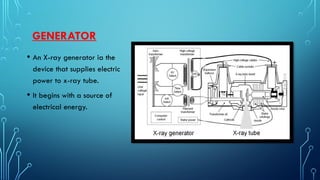
GENERATOR
• An X-ray generator ia the
device that supplies electric
power to x-ray tube.
• It begins with a source of
electrical energy.
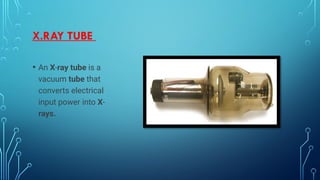
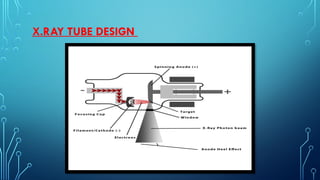
X.RAY TUBE
• An X-ray tube is a
vacuum tube that
converts electrical
input power into X-
rays.
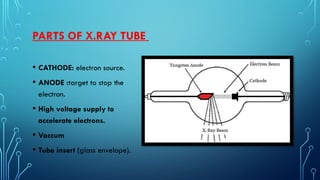
PARTS OF X.RAY TUBE
• CATHODE: electron source.
• ANODE :target to stop the
electron.
• High voltage supply to
accelerate electrons.
• Vaccum
• Tube insert (glass envelope).
X.RAY TUBE DESIGN
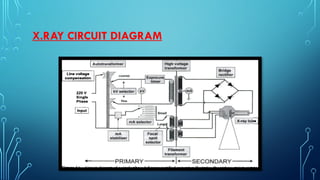
X.RAY CIRCUIT DIAGRAM
x.ray & its components by uzma sofi .pptx

x.ray & its components by uzma sofi .pptx

  • 1.
    X.RAY & IT’SCOMPONENTS PRESENTED BY:UZMA HASSAN COURSE:BRIT(C.T/MRI) S.I:2018014895 SUBMITTED TO :BUSHRA MA’AM
  • 2.
    INTRODUCTION X-rays were discoveredin 1895 by Wilhelm Conrad Roentgen (1845-1923) who was a Professor at Wuerzburg University in Germany. Roentgen shielded the tube with heavy black paper, and discovered a green colored fluorescent light generated by a material located a few feet away from the tube.
  • 3.
    WHAT ARE X.RAYS •X-rays are a type of radiation called electromagnetic waves Of shorter wave length. • The most familiar use of x-rays is checking for broken bones, but x- rays are also used in other ways.
  • 4.
    COMPONENTS OF X.RAYMACHINE • Operating console • Generators • Transformers • Rectifiers • X.ray tube • Kv meter • Ammeter
  • 5.
  • 6.
    OPERATING CONSOLE • Theoperating console allows the radiologic technologist to control the x-ray tube current and voltage so that the useful x- ray beam is of proper quantity and quality.
  • 7.
    • The transformeris an electric device,which can convert electrical energy from one coil to another coil. • It works on the principle of mutual induction. TRANSFORMERS
  • 8.
    TYPES OF TRANSFORMERS 1.STEP-UPTRANSFORMERS •It transfers power of low voltage and high current into power of high voltage and low current. •Secondary coil will have more number of turns than primary.
  • 9.
    2.STEP-DOWN TRANSFORMERS •It transferspower of high voltage and low current into power of low voltage and current. •Primary coil will have large number of turns than the secondary.
  • 10.
    3.AUTO-TRANSFORMER •An autotransformer isa kind of electrical transformer where primary and secondary shares same common single winding. So basically it’s a one winding transformer. •It works on the principle of self induction.
  • 11.
    RECTIFIER CIRCUIT • Rectificationis the process of changing alternating current into direct current. • The device that produces the change is called a RECTIFIER. • It allows an electrical current to flow in one direction but does not allow the current to flow in the other direction.
  • 12.
    TYPES OF RECTIFIERS 1.HALF-WAVERECTIFIER • A type of rectifier that only allows one half-cycle of an AC voltage waveform to pass, blocking the other half-cycle. • Half-wave rectifiers are used to convert AC voltage to DC voltage, and only require a single diode to construct
  • 14.
    2.FULL-WAVE RECTIFIER • AFull Wave Rectifier is a circuit, which converts an ac voltage into a pulsating dc voltage using both half cycles of the applied ac voltage. • It uses two diodes of which one conducts during one half cycle while the other conducts during the other half cycle of the applied ac voltage.
  • 16.
    GENERATOR • An X-raygenerator ia the device that supplies electric power to x-ray tube. • It begins with a source of electrical energy.
  • 17.
    X.RAY TUBE • AnX-ray tube is a vacuum tube that converts electrical input power into X- rays.
  • 18.
    PARTS OF X.RAYTUBE • CATHODE: electron source. • ANODE :target to stop the electron. • High voltage supply to accelerate electrons. • Vaccum • Tube insert (glass envelope).
  • 19.
  • 20.