DIVISION OF ADMINISTRATION
UTILITIES & ENERGY SERVICES
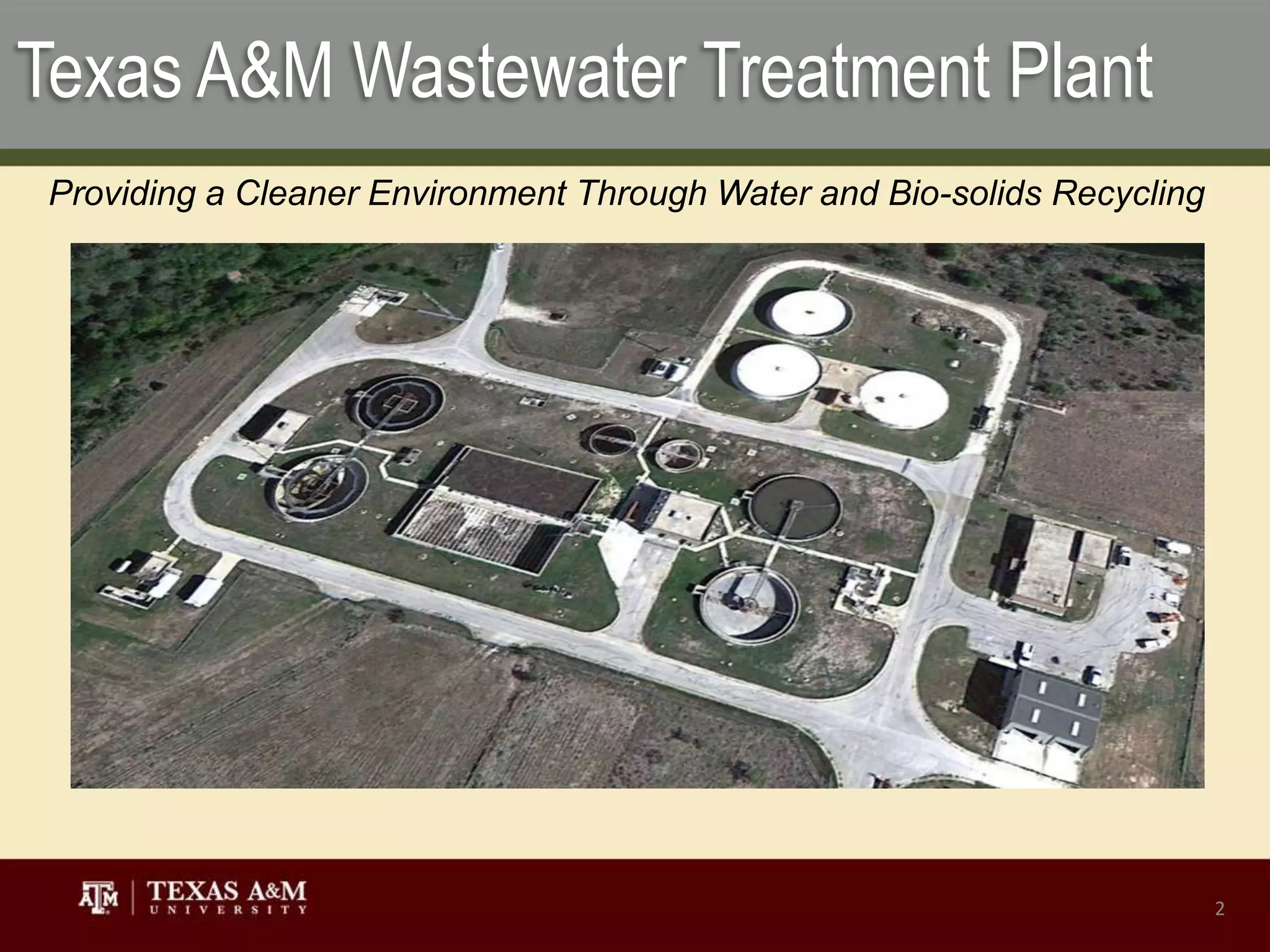
Texas A&M Wastewater Treatment Plant
 Providing a Cleaner Environment Through Water and Bio-solids Recycling


                                                                          2
Texas A&M Wastewater Treatment Plant
 Providing a Cleaner Environment Through Water and Bio-solids Recycling

 Plant Overview

 Texas A&M Wastewater Treatment Plant (WWTP) is a conventional
 activated sludge treatment facility.


 Treatment of wastewater can be divided into four major groups:

    Preliminary treatment
    Primary treatment
    Secondary treatment
    Sludge treatment and disposal


                                                                          3
Texas A&M Wastewater Treatment Plant
 Providing a Cleaner Environment Through Water and Bio-solids Recycling

 Design Criteria
  Designed to treat 11,700 lb. BOD/day on a maximum monthly avg basis.
   (This is a population equivalent of 69,900 persons)
  Load to the plant varies in proportion to the number of people on
   campus


                                                                          4
Texas A&M Wastewater Treatment Plant
 Providing a Cleaner Environment Through Water and Bio-solids Recycling

 Unit Operations and Processes
  Bar Screen/Flow Metering/Influent Lift Station
  Grit Removal Facility
  Aeration Blower Building
  Aeration Basins
  Primary and Secondary Clarifiers, Sludge Pump Stations, Sludge
   Thickeners, Anaerobic Digesters, Holding Tanks, and Pumping Stations


                                                                          5
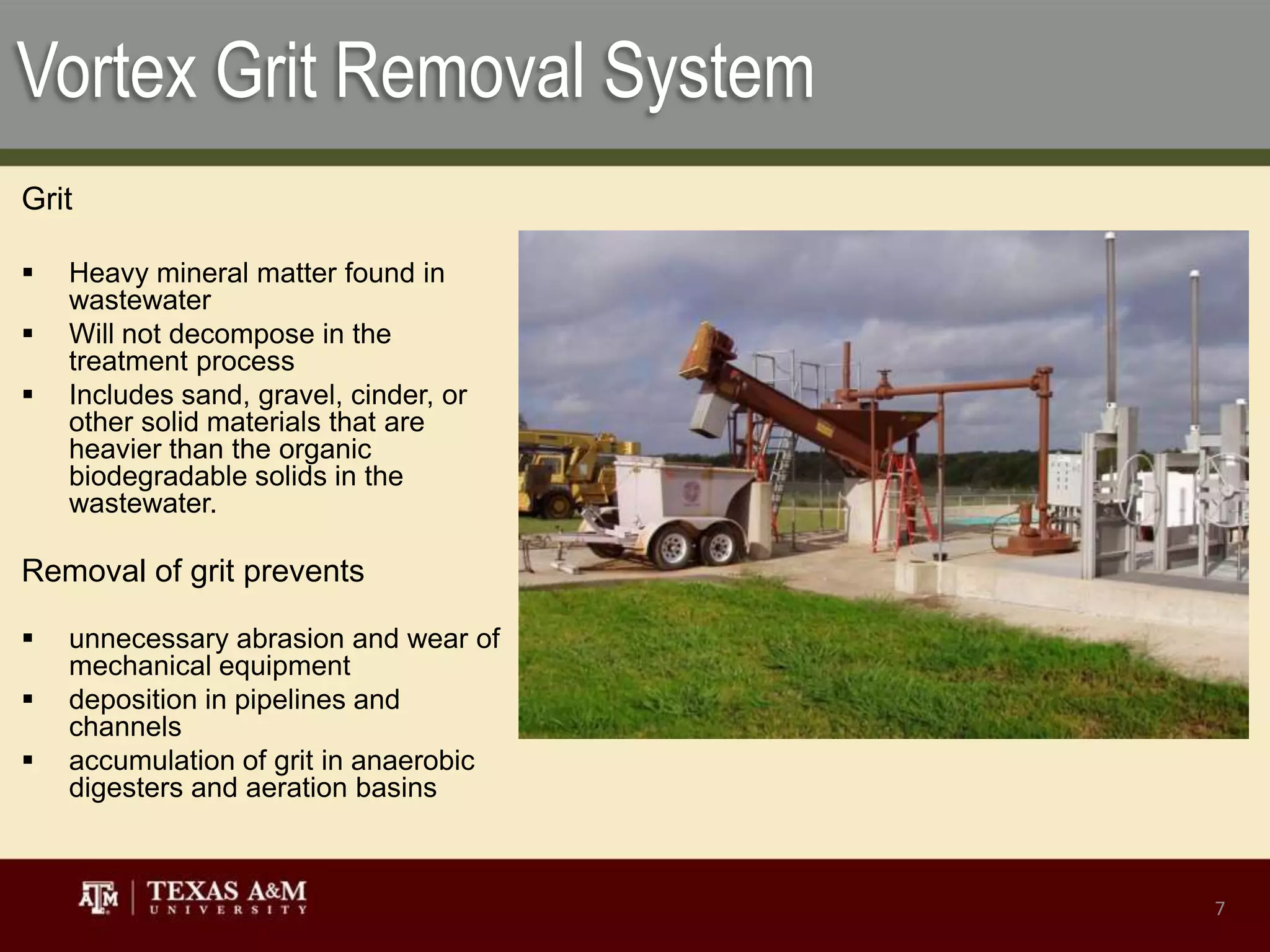
Vortex Grit Removal System
Grit

   Heavy mineral matter found in
    wastewater
   Will not decompose in the
    treatment process
   Includes sand, gravel, cinder, or
    other solid materials that are
    heavier than the organic
    biodegradable solids in the
    wastewater.

Removal of grit prevents

   unnecessary abrasion and wear of
    mechanical equipment
   deposition in pipelines and
    channels
   accumulation of grit in anaerobic
    digesters and aeration basins


                                        7
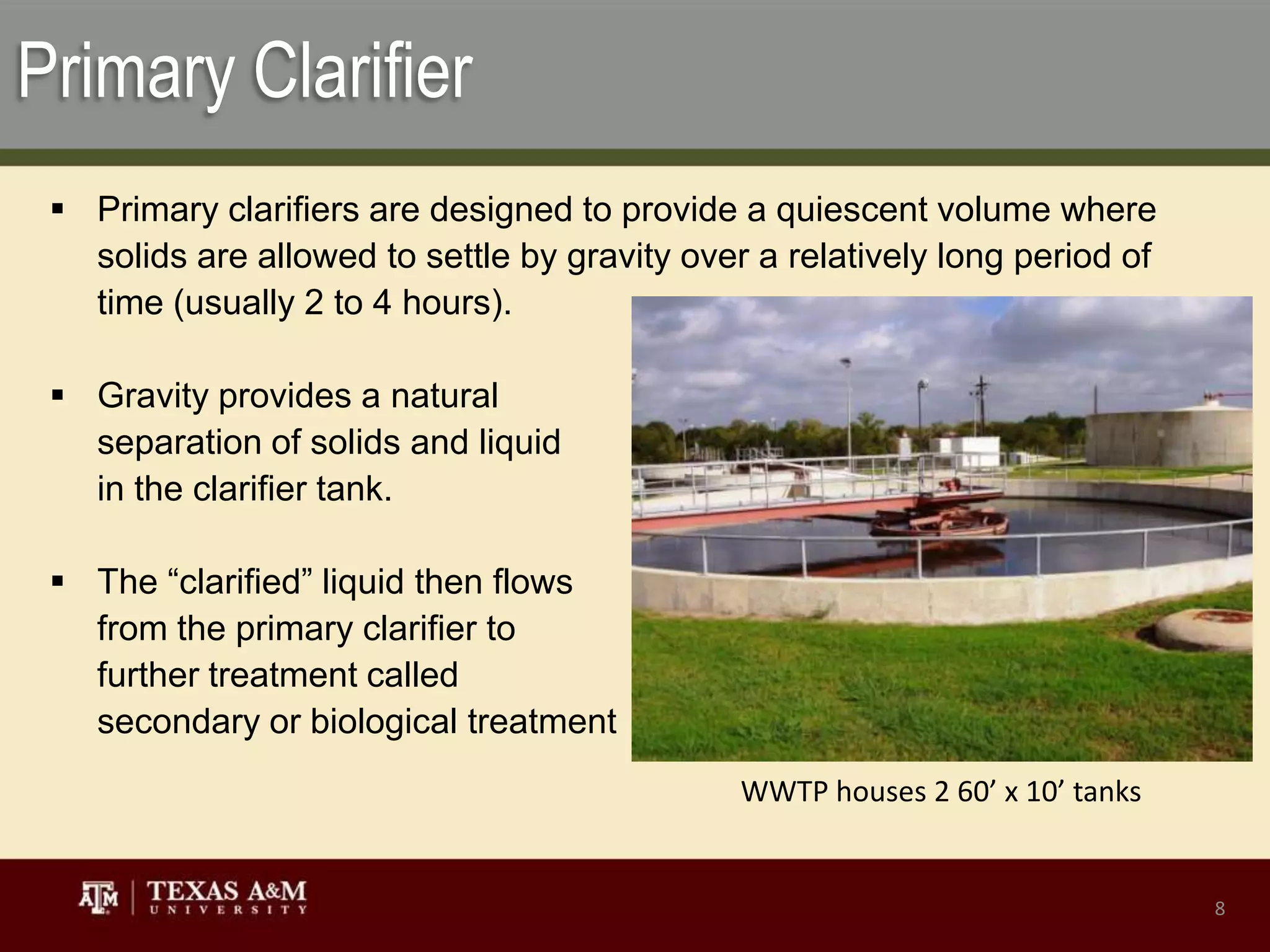
Primary Clarifier
  Primary clarifiers are designed to provide a quiescent volume where
   solids are allowed to settle by gravity over a relatively long period of
   time (usually 2 to 4 hours).

  Gravity provides a natural
   separation of solids and liquid
   in the clarifier tank.

  The “clarified” liquid then flows
   from the primary clarifier to
   further treatment called
   secondary or biological treatment
                                               WWTP houses 2 60’ x 10’ tanks


                                                                               8
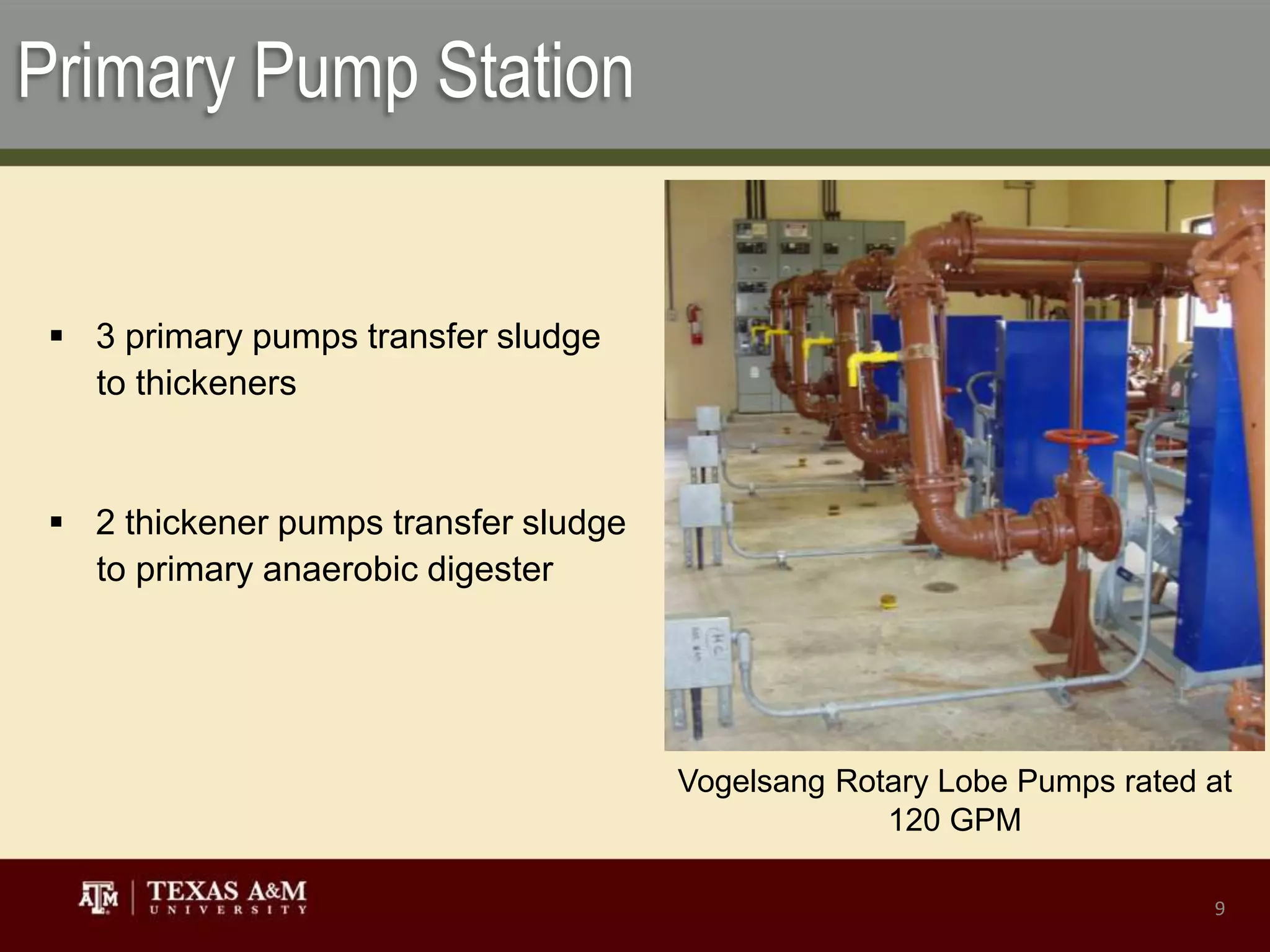
Primary Pump Station


  3 primary pumps transfer sludge
   to thickeners


  2 thickener pumps transfer sludge
   to primary anaerobic digester


                                       Vogelsang Rotary Lobe Pumps rated at
                                                    120 GPM

                                                                         9
Secondary Clarifier
    The basic purpose of the secondary clarifiers is to separate solids from
    liquids through the process of gravity sedimentation.

     The mixed liquid from the solids contact basins flows into the center of the
      secondary clarifier tanks through a vertical inlet pipe.

The well serves two main purposes.

     It directs flow downward in a vertical
      flow pattern to minimize short
      circuiting.

     Serves as a stilling basin that
      promotes flocculation and settling of
      solids.
                                                     WWTP houses two 70’ x 16’ tanks

                                                                                       11
Secondary Pump Station


Transfer settled sludge from secondary
clarifiers to aeration basin to prevent
sludge accumulation and to reseed micro-
organisms in aeration basin.


                                           3 Return Activated Sludge Pumps rated at
                                                           1200 GPM


                                                                               12
Ultraviolet Disinfection

 An ultraviolet (UV) disinfection
  system transfers electromagnetic
  energy from a mercury arclamp to an
  organisms genetic material,
  destroying the cells ability to
  reproduce.


 Each of these systems provides
  dosage of 250 Mw-s/cm2


                                        13
Aeration Blowers
   Introduces air into a liquid, providing an
    aerobic environment for microbial
    degradation of organic matter.

THE PURPOSE OF AERATION IS TWO-FOLD:

   To Supply the required oxygen to the
    metabolizing microorganisms
   To provide mixing so that the microorganisms
    come into contact with the dissolved and
    suspended organic matter


                                                   15
Land Application of Biosolids
     UTILIZE 60 ACRES LOCATED ADJACENT
    TO THE WASTEWATER TREATMENT PLANT
             TO INJECT BIOSOLIDS

    Terragator Model 2204
    Capacity 2200 gallon tank


  RECYCLING BIOSOLIDS THROUGH LAND
APPLICATION SERVES SEVERAL PURPOSES.

    Improves soil properties such as texture and water
     holding capacity.
    Supplies nutrients essential for plant growth,
     including nitrogen and phosphorous, as well as some
     essential micro-nutrients such as nickel, zinc and
     copper.
    Serves as an alternative or substitute for expensive
     chemical fertilizers.


                                                            16
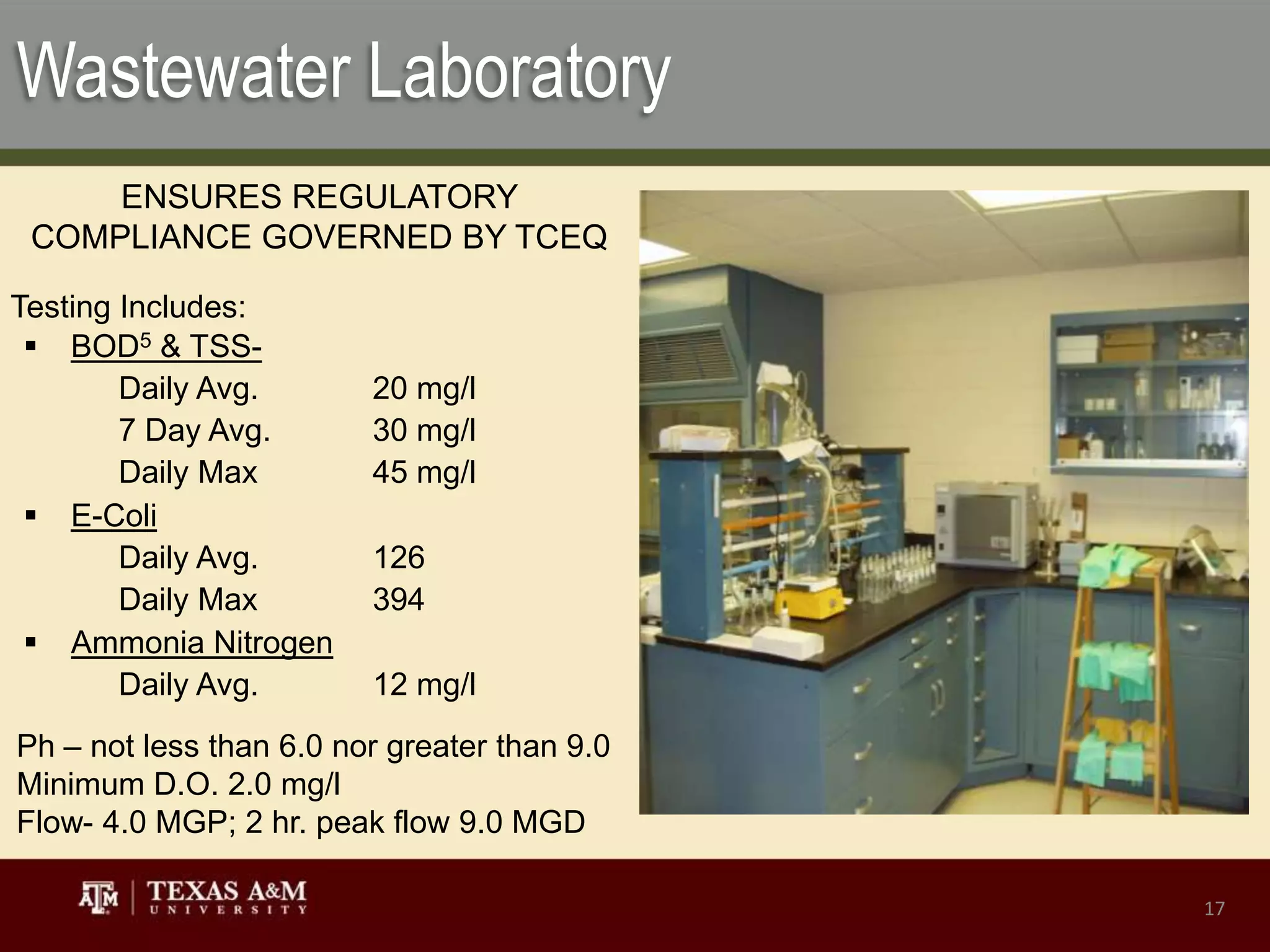
Wastewater Laboratory
     ENSURES REGULATORY
 COMPLIANCE GOVERNED BY TCEQ

Testing Includes:
  BOD5 & TSS-
        Daily Avg.       20 mg/l
        7 Day Avg.       30 mg/l
        Daily Max        45 mg/l
  E-Coli
        Daily Avg.       126
        Daily Max        394
  Ammonia Nitrogen
        Daily Avg.       12 mg/l
Ph – not less than 6.0 nor greater than 9.0
Minimum D.O. 2.0 mg/l
Flow- 4.0 MGP; 2 hr. peak flow 9.0 MGD

                                              17
Wastewater Treatment Plant Tour


                                  19

Wwtp tour guide updated

  • 1.
  • 2.
    Texas A&M WastewaterTreatment Plant Providing a Cleaner Environment Through Water and Bio-solids Recycling 2
  • 3.
    Texas A&M WastewaterTreatment Plant Providing a Cleaner Environment Through Water and Bio-solids Recycling Plant Overview Texas A&M Wastewater Treatment Plant (WWTP) is a conventional activated sludge treatment facility. Treatment of wastewater can be divided into four major groups:  Preliminary treatment  Primary treatment  Secondary treatment  Sludge treatment and disposal 3
  • 4.
    Texas A&M WastewaterTreatment Plant Providing a Cleaner Environment Through Water and Bio-solids Recycling Design Criteria  Designed to treat 11,700 lb. BOD/day on a maximum monthly avg basis. (This is a population equivalent of 69,900 persons)  Load to the plant varies in proportion to the number of people on campus 4
  • 5.
    Texas A&M WastewaterTreatment Plant Providing a Cleaner Environment Through Water and Bio-solids Recycling Unit Operations and Processes  Bar Screen/Flow Metering/Influent Lift Station  Grit Removal Facility  Aeration Blower Building  Aeration Basins  Primary and Secondary Clarifiers, Sludge Pump Stations, Sludge Thickeners, Anaerobic Digesters, Holding Tanks, and Pumping Stations 5
  • 6.
    Vortex Grit RemovalSystem Grit  Heavy mineral matter found in wastewater  Will not decompose in the treatment process  Includes sand, gravel, cinder, or other solid materials that are heavier than the organic biodegradable solids in the wastewater. Removal of grit prevents  unnecessary abrasion and wear of mechanical equipment  deposition in pipelines and channels  accumulation of grit in anaerobic digesters and aeration basins 7
  • 7.
    Primary Clarifier Primary clarifiers are designed to provide a quiescent volume where solids are allowed to settle by gravity over a relatively long period of time (usually 2 to 4 hours).  Gravity provides a natural separation of solids and liquid in the clarifier tank.  The “clarified” liquid then flows from the primary clarifier to further treatment called secondary or biological treatment WWTP houses 2 60’ x 10’ tanks 8
  • 8.
    Primary Pump Station  3 primary pumps transfer sludge to thickeners  2 thickener pumps transfer sludge to primary anaerobic digester Vogelsang Rotary Lobe Pumps rated at 120 GPM 9
  • 9.
    Secondary Clarifier The basic purpose of the secondary clarifiers is to separate solids from liquids through the process of gravity sedimentation.  The mixed liquid from the solids contact basins flows into the center of the secondary clarifier tanks through a vertical inlet pipe. The well serves two main purposes.  It directs flow downward in a vertical flow pattern to minimize short circuiting.  Serves as a stilling basin that promotes flocculation and settling of solids. WWTP houses two 70’ x 16’ tanks 11
  • 10.
    Secondary Pump Station Transfersettled sludge from secondary clarifiers to aeration basin to prevent sludge accumulation and to reseed micro- organisms in aeration basin. 3 Return Activated Sludge Pumps rated at 1200 GPM 12
  • 11.
    Ultraviolet Disinfection  Anultraviolet (UV) disinfection system transfers electromagnetic energy from a mercury arclamp to an organisms genetic material, destroying the cells ability to reproduce.  Each of these systems provides dosage of 250 Mw-s/cm2 13
  • 12.
    Aeration Blowers  Introduces air into a liquid, providing an aerobic environment for microbial degradation of organic matter. THE PURPOSE OF AERATION IS TWO-FOLD:  To Supply the required oxygen to the metabolizing microorganisms  To provide mixing so that the microorganisms come into contact with the dissolved and suspended organic matter 15
  • 13.
    Land Application ofBiosolids UTILIZE 60 ACRES LOCATED ADJACENT TO THE WASTEWATER TREATMENT PLANT TO INJECT BIOSOLIDS  Terragator Model 2204  Capacity 2200 gallon tank RECYCLING BIOSOLIDS THROUGH LAND APPLICATION SERVES SEVERAL PURPOSES.  Improves soil properties such as texture and water holding capacity.  Supplies nutrients essential for plant growth, including nitrogen and phosphorous, as well as some essential micro-nutrients such as nickel, zinc and copper.  Serves as an alternative or substitute for expensive chemical fertilizers. 16
  • 14.
    Wastewater Laboratory ENSURES REGULATORY COMPLIANCE GOVERNED BY TCEQ Testing Includes:  BOD5 & TSS- Daily Avg. 20 mg/l 7 Day Avg. 30 mg/l Daily Max 45 mg/l  E-Coli Daily Avg. 126 Daily Max 394  Ammonia Nitrogen Daily Avg. 12 mg/l Ph – not less than 6.0 nor greater than 9.0 Minimum D.O. 2.0 mg/l Flow- 4.0 MGP; 2 hr. peak flow 9.0 MGD 17
  • 15.