Marsha Morris, Commissioner Designated Agents for today’s presentation: Peter Groen, Director, SURC Jack Shaffer, CIO, CHNWV West Virginia Medicaid Transformation  Health IT Systems   Collaboration, Open Solutions, and Innovation
A 20/20 Vision of the Future for West Virginia Imagine a future healthcare system that is customer-focused and  patient-centered , one in which every citizen has health insurance and a secure, private  Electronic Health Record (EHR)  that is available whenever and wherever needed, enabling the highest degree of coordinated medical care based on the latest medical knowledge and evidence.   
A 20/20 Vision of the Future for West Virginia Imagine a healthcare system in which digital and mobile technologies,  medical knowledge  at the point of need, and  collaboration  among providers deliver safe,  high-quality care  for everyone—a healthcare system that does not require the patient to complete the same forms at every access point.
A 20/20 Vision of the Future for West Virginia Imagine a healthcare system where primary care physicians have access to your specialty medical information and specialists have access to your primary care information via  inter-connected  “smart” EHRs that are integrated with  personalized  eHealth service providers and delivered directly to a multi-purpose, intelligent,  mobile  digital device that can be carried in one’s pocket.
Electronic Medical Records (EMR)   - The State intends to support the acquisition and deployment of electronic medical record (EMR) systems to better manage costs, improve quality of care, and enhance patient safety. Medicaid providers will be able to access and record clinical and other data in these EMR systems for Medicaid members.  e-Health Network  -  The proposed West Virginia Health Information Network (WVHIN) will provide an electronic network to share electronic medical records (EMR), personal health records (PHR), and other clinical data between health care providers and payers.   West Virginia Medicaid Transformation Grant - Health IT Goals -
West Virginia HIT Strategies Collaboration, Open Solutions, and Innovation (COSI) *    Collaboration  – The State is collaborating with other HIT organizations and state on multiple eHealth initiatives within West Virginia and beyond, e.g. Veterans Affairs, State of Hawaii, Indian Health Service, WorldVistA. Etc. *    Open Solutions  – EMR Solutions for the state must be - CCHIT certified; standards based; public domain or open source; and interoperable *    Innovation  –  Collaboration + Open Solutions = Innovation Collaborating with the large, open source HIT community on EMR, PHR, HIE, TeleHealth, ePrescribing, Standards and other HIT solutions has led us to a range of low cost, innovative  alternatives
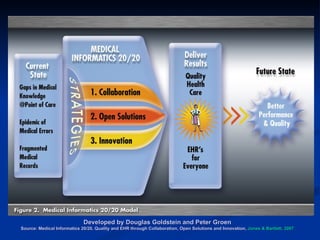
Developed by Douglas Goldstein and Peter Groen Source: Medical Informatics 20/20, Quality and EHR through Collaboration, Open Solutions and Innovation,  Jones & Bartlett, 2007
COSI Strategies The COSI strategies of  Collaboration, Open Solutions, and Innovation  are the key to  transforming  the health and medical culture, the processes, the leadership and the technology necessary to support better, safer and higher quality care in our healthcare system and other healthcare systems across the globe. The application of these strategies is already evident throughout other major industries.
Collaboration “ We start with the premise that we should partner with everyone.”  -  Tim Armstrong,  Vice President,  Google “ It is a great thing to make scientific discoveries of rare value, but it is even greater to be willing to share those discoveries and to encourage other workers in the same field of scientific research.”  -  W.J.  Mayo,  January,  1928
Open Solutions “ Open Source Everywhere—Software is just the beginning . . . open source is doing for mass innovation what the assembly line did for mass production.”    -  Thomas Goetz,   Editor, Wired Magazine But, we’re not just talking about Open Source, we’re talking about  Open Solutions
Growth in Open Source Software In the last few years, the growth in OSS has accelerated significantly.  Key contributing factors for this growth are:  growing awareness of open source  increased software functionality  increasing adoption of OSS by many organizations many high quality OSS applications now operating at the enterprise level - Linux Apache OpenOffice Mozilla/FireFox MySQL VistA / RPMS
Health IT Software in the ‘Public Domain’ Electronic Health Record (EHR) Systems  – VistA, RPMS, FreeMed, AMPATH, OpenEMR, OSCAR, etc.  Personal Health Record (PHR) Systems  – My HealtheVet,   iHealth Record, myPHR, etc.  Health Information Exchange (HIE) Systems  – FHIE/BHIE, OpenHRE, HCUP, caBIG, etc.  Disease Surveillanc Software  – HealthMap, RODS, NEDSS, SatSCAN, etc.  Public Health Software  – PHIN, Epi Info, SETS, etc.  Genomic Systems  – HUGN, BLAST, GeMCRIS, LocusLink, etc.   Clinical Imaging Software  – myPACS,  BLOX, ImageJ, etc. Specialty Software  – PHLIS, VAERS, etc. * Over 1000 ‘open source’ or ‘public domain’ health IT software projects and/or products to choose from and the list is growing.
Innovation “ Always and everywhere, free resources have been crucial to innovation and creativity.”  Lawrence Lessig,  The Future of Ideas :  The Fate of the Commons in a Connected World
Innovative Solutions to be Implemented by 2020 Electronic Health Record (EHR) with  CPOE  –   widespread deployment and use by 2015   (>80%) Health Information Exchange (HIE) Networks   -  widespread deployment and use by 2020 Personal Health Record (PHR) Systems  –  widespread deployment and use by 2020 Clinical Imaging & EHR Systems   – widespread deployment and use by 2015 ‘ Open Source’ HIT Software   – widespread deployment and use by 2015 Wearable Health IT Systems  –  widespread deployment and use by 2020 Genomic Information Systems & EHRs  –  widespread deployment and use beyond 2020 Robotics & EHRs  – widespread deployment and use of robotic devices interfaced to EHRs by 2020 Nanomedicine & EHRs  –  widespread use of nano-technologies and implantable devices interfaced to EHRs beyond 2020 Other technologies – VOIP, RFID, Encryption, …
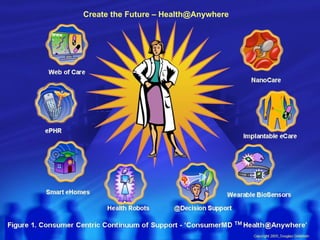
Imagine the Future … Create the Future – Health@Anywhere
Deficit Reduction Act of 2005 The DRA changes the face of Medicaid. Rx LTC Transfer of Assets Fraud and Abuse Benefits and Cost Sharing Financing Grants West Virginia is poised to move Medicaid to a model that emphasizes preventive care, partnership, personal empowerment and responsibility. Medicaid Transformation Deficit Reduction Act of 2005
Electronic Health Systems need to: support enhanced access to preventive and disease management services, defined personal health management goals and responsibilities and rewards for healthy behavior;  meet needs of “Advanced Medical Home”; provide integration with telehealth applications; and facilitate advanced planned care with strong self-management components. HIT and HIE to support  West Virginia Medicaid Redesign
52 acute care community hospitals, 18 critical access hospitals, 6 rehab, 4 VA, with a total of 70 hospitals;  Seven state-operated facilities, 2 behavioral health facilities, four long-term care, one community hospital (all implementing a version of the VA’s Vista EHR); 14 behavioral health centers, and 65 certified intermediate care facilities; 34 nonprofit primary care centers, with 139 primary care service sites (including 41 school-based health centers), providing services in or to 47 counties; 54 local health departments, 73 home health agencies and 20 hospice organizations;  3,743 MDs and 507 DOs active and practicing in West Virginia according to the respective licensing boards. Approximately one-third of West Virginia’s physicians are self-employed in a solo practice. More than one-third of West Virginia’s physicians provide primary care. Coordinating health care delivery– the opportunity for health information exchange
Studies indicate that 20% to 40% of diagnostic tests are duplicated due to lack of results being readily available and the potential benefit of full HIT integration as producing a “reduction in laboratory and radiology test ordering by 9 to 14%, lowering ancillary test charges by up to 8%, reducing hospital admissions, costing an average of $17,000 each, by 2% to 3%, and reducing excess medication usage by 11%.” Studies predict a gain of as much as 30% in efficiency from EHR use and HIE, mostly through reducing unnecessary tests and prescriptions, paperwork and medical mistakes.  In West Virginia, this amounts to a potential $3 billion savings of total health spending of $10 billion (the total state general revenue budget for 2007 was $3.629 billion) and nearly $1 billion for West Virginia Medicaid. Harnessing the Power of HIT for Health Improvement
Community health centers can be leaders in health improvement and EHR adoption; Leverage health improvement, EHR alone is not a “silver bullet” to improve outcomes and contain cost without system improvements; Data warehouse and HIE require ability to capture and report information electronically at the point of care (paper to bytes) Exploring ways to coordinate with MITA to build and finance infrastructure (90% match); Focus EHR acceleration and financing support at the primary care and community health level for greatest ROI. Lessons Learned - Early Stages
Advanced Medical Home Medicaid Transformation Grants Personal Responsibility Health System Improvement Applied Technology Stronger Medicaid Program Enhanced Medication Management
Advanced Medical Home Medicaid Transformation Grants Combined into (3) for implementation Pharmacy Improved Medicaid E-Health
Advanced Medical Home MTG – Improved Medicaid Project Management Advanced Medical Homes Health Improvement Institute Healthy Rewards Accounts Education and Outreach Clinical Data Warehouse
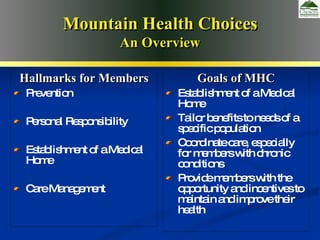
Goals of West Virginia  Medicaid Redesign Goals of MHC Establishment of a Medical Home Tailor benefits to needs of a specific population  Coordinate care, especially for members with chronic conditions Provide members with the opportunity and incentives to maintain and improve their health Hallmarks for Members Prevention Personal Responsibility Establishment of a Medical Home Care Management Mountain Health Choices An Overview
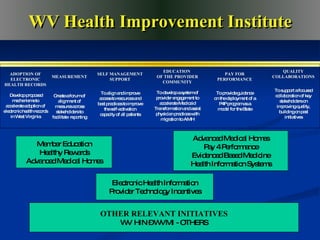
Advanced Medical Home WV Health Improvement Institute ADOPTION OF ELECTRONIC HEALTH RECORDS Develop proposed mechanisms to accelerate adoption of electronic health records in West Virginia MEASUREMENT Create a forum of alignment of measures across stakeholders to facilitate  reporting SELF MANAGEMENT SUPPORT To align and improve access to resources and best practices to improve the self-activation capacity of all patients EDUCATION  OF THE PROVIDER COMMUNITY To develop a system of provider engagement to accelerate Medicaid Transformation and assist physician practices with migration to AMH PAY FOR PERFORMANCE To provide guidance on the deployment of a P4P program as a model for the State QUALITY COLLABORATIONS To support a focused collaboration of key stakeholders on improving quality, building on past initiatives Member Education Healthy Rewards Advanced Medical Homes Advanced Medical Homes Pay 4 Performance Evidenced Based Medicine Health Information Systems Electronic Health Information Provider Technology Incentives OTHER RELEVANT INITIATIVES WV HIN – WVMI - OTHERS
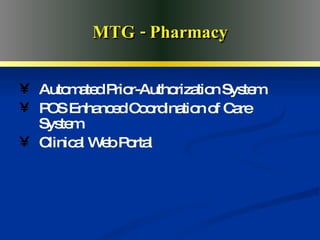
Advanced Medical Home MTG - Pharmacy Automated Prior-Authorization System POS Enhanced Coordination of Care System Clinical Web Portal
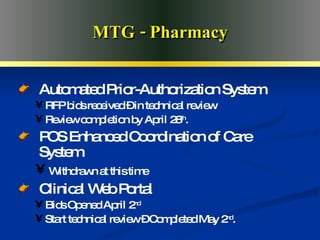
Advanced Medical Home MTG - Pharmacy Automated Prior-Authorization System RFP bids received – in technical review Review completion by April 28 th . POS Enhanced Coordination of Care System Withdrawn at this time Clinical Web Portal Bids Opened April 2 nd Start technical review – Completed May 2 nd .
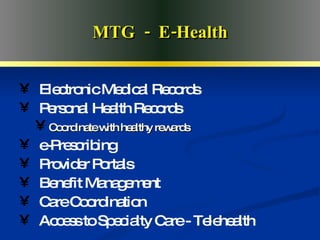
Advanced Medical Home MTG  -  E-Health Electronic Medical Records Personal Health Records Coordinate with healthy rewards e-Prescribing Provider Portals Benefit Management Care Coordination Access to Specialty Care - Telehealth
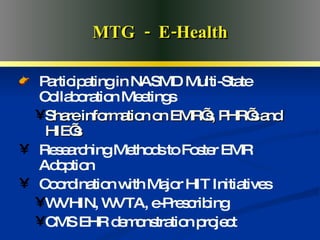
Advanced Medical Home MTG  -  E-Health Participating in NASMD Multi-State Collaboration Meetings Share information on EMR’s, PHR’s and HIE’s Researching Methods to Foster EMR Adoption Coordination with Major HIT Initiatives WVHIN, WVTA, e-Prescribing CMS EHR demonstration project
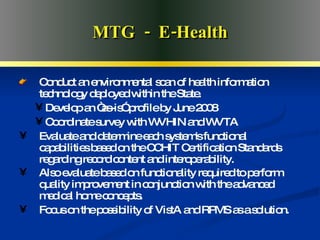
Advanced Medical Home MTG  -  E-Health Conduct an environmental scan of health information technology deployed within the State. Develop an “as-is” profile by June 2008 Coordinate survey with WVHIN and WVTA Evaluate and determine each system's functional capabilities based on the CCHIT Certification Standards regarding record content and interoperability.  Also evaluate based on functionality required to perform quality improvement in conjunction with the advanced medical home concepts.   Focus on the possibility of VistA and RPMS as a solution.
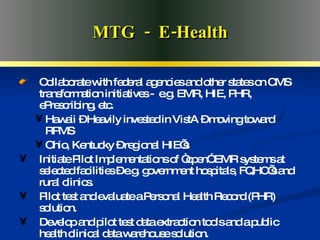
Advanced Medical Home MTG  -  E-Health Collaborate with federal agencies and other states on CMS transformation initiatives -  e.g. EMR, HIE, PHR, ePrescribing, etc. Hawaii – Heavily invested in VistA – moving toward RPMS Ohio, Kentucky – regional HIE’s Initiate Pilot Implementations of “open” EMR systems at selected facilities – e.g. government hospitals, FQHC’s and rural clinics.  Pilot test and evaluate a Personal Health Record (PHR) solution. Develop and pilot test data extraction tools and a public health clinical data warehouse solution.
Contact Marsha Morris, Commissioner West Virginia  Department of Health and Human Resources Bureau for Medical Services (304) 558-1700

WV transformation slide show may conference2

  • 1.
    Marsha Morris, CommissionerDesignated Agents for today’s presentation: Peter Groen, Director, SURC Jack Shaffer, CIO, CHNWV West Virginia Medicaid Transformation Health IT Systems Collaboration, Open Solutions, and Innovation
  • 2.
    A 20/20 Visionof the Future for West Virginia Imagine a future healthcare system that is customer-focused and patient-centered , one in which every citizen has health insurance and a secure, private Electronic Health Record (EHR) that is available whenever and wherever needed, enabling the highest degree of coordinated medical care based on the latest medical knowledge and evidence.  
  • 3.
    A 20/20 Visionof the Future for West Virginia Imagine a healthcare system in which digital and mobile technologies, medical knowledge at the point of need, and collaboration among providers deliver safe, high-quality care for everyone—a healthcare system that does not require the patient to complete the same forms at every access point.
  • 4.
    A 20/20 Visionof the Future for West Virginia Imagine a healthcare system where primary care physicians have access to your specialty medical information and specialists have access to your primary care information via inter-connected “smart” EHRs that are integrated with personalized eHealth service providers and delivered directly to a multi-purpose, intelligent, mobile digital device that can be carried in one’s pocket.
  • 5.
    Electronic Medical Records(EMR) - The State intends to support the acquisition and deployment of electronic medical record (EMR) systems to better manage costs, improve quality of care, and enhance patient safety. Medicaid providers will be able to access and record clinical and other data in these EMR systems for Medicaid members. e-Health Network - The proposed West Virginia Health Information Network (WVHIN) will provide an electronic network to share electronic medical records (EMR), personal health records (PHR), and other clinical data between health care providers and payers.   West Virginia Medicaid Transformation Grant - Health IT Goals -
  • 6.
    West Virginia HITStrategies Collaboration, Open Solutions, and Innovation (COSI) *   Collaboration – The State is collaborating with other HIT organizations and state on multiple eHealth initiatives within West Virginia and beyond, e.g. Veterans Affairs, State of Hawaii, Indian Health Service, WorldVistA. Etc. *   Open Solutions – EMR Solutions for the state must be - CCHIT certified; standards based; public domain or open source; and interoperable *   Innovation – Collaboration + Open Solutions = Innovation Collaborating with the large, open source HIT community on EMR, PHR, HIE, TeleHealth, ePrescribing, Standards and other HIT solutions has led us to a range of low cost, innovative alternatives
  • 7.
    Developed by DouglasGoldstein and Peter Groen Source: Medical Informatics 20/20, Quality and EHR through Collaboration, Open Solutions and Innovation, Jones & Bartlett, 2007
  • 8.
    COSI Strategies TheCOSI strategies of Collaboration, Open Solutions, and Innovation are the key to transforming the health and medical culture, the processes, the leadership and the technology necessary to support better, safer and higher quality care in our healthcare system and other healthcare systems across the globe. The application of these strategies is already evident throughout other major industries.
  • 9.
    Collaboration “ Westart with the premise that we should partner with everyone.” - Tim Armstrong, Vice President, Google “ It is a great thing to make scientific discoveries of rare value, but it is even greater to be willing to share those discoveries and to encourage other workers in the same field of scientific research.” - W.J. Mayo, January, 1928
  • 10.
    Open Solutions “Open Source Everywhere—Software is just the beginning . . . open source is doing for mass innovation what the assembly line did for mass production.” - Thomas Goetz, Editor, Wired Magazine But, we’re not just talking about Open Source, we’re talking about Open Solutions
  • 11.
    Growth in OpenSource Software In the last few years, the growth in OSS has accelerated significantly. Key contributing factors for this growth are: growing awareness of open source increased software functionality increasing adoption of OSS by many organizations many high quality OSS applications now operating at the enterprise level - Linux Apache OpenOffice Mozilla/FireFox MySQL VistA / RPMS
  • 12.
    Health IT Softwarein the ‘Public Domain’ Electronic Health Record (EHR) Systems – VistA, RPMS, FreeMed, AMPATH, OpenEMR, OSCAR, etc. Personal Health Record (PHR) Systems – My HealtheVet, iHealth Record, myPHR, etc. Health Information Exchange (HIE) Systems – FHIE/BHIE, OpenHRE, HCUP, caBIG, etc. Disease Surveillanc Software – HealthMap, RODS, NEDSS, SatSCAN, etc. Public Health Software – PHIN, Epi Info, SETS, etc. Genomic Systems – HUGN, BLAST, GeMCRIS, LocusLink, etc. Clinical Imaging Software – myPACS, BLOX, ImageJ, etc. Specialty Software – PHLIS, VAERS, etc. * Over 1000 ‘open source’ or ‘public domain’ health IT software projects and/or products to choose from and the list is growing.
  • 13.
    Innovation “ Alwaysand everywhere, free resources have been crucial to innovation and creativity.” Lawrence Lessig, The Future of Ideas : The Fate of the Commons in a Connected World
  • 14.
    Innovative Solutions tobe Implemented by 2020 Electronic Health Record (EHR) with CPOE – widespread deployment and use by 2015 (>80%) Health Information Exchange (HIE) Networks - widespread deployment and use by 2020 Personal Health Record (PHR) Systems – widespread deployment and use by 2020 Clinical Imaging & EHR Systems – widespread deployment and use by 2015 ‘ Open Source’ HIT Software – widespread deployment and use by 2015 Wearable Health IT Systems – widespread deployment and use by 2020 Genomic Information Systems & EHRs – widespread deployment and use beyond 2020 Robotics & EHRs – widespread deployment and use of robotic devices interfaced to EHRs by 2020 Nanomedicine & EHRs – widespread use of nano-technologies and implantable devices interfaced to EHRs beyond 2020 Other technologies – VOIP, RFID, Encryption, …
  • 15.
    Imagine the Future… Create the Future – Health@Anywhere
  • 16.
    Deficit Reduction Actof 2005 The DRA changes the face of Medicaid. Rx LTC Transfer of Assets Fraud and Abuse Benefits and Cost Sharing Financing Grants West Virginia is poised to move Medicaid to a model that emphasizes preventive care, partnership, personal empowerment and responsibility. Medicaid Transformation Deficit Reduction Act of 2005
  • 17.
    Electronic Health Systemsneed to: support enhanced access to preventive and disease management services, defined personal health management goals and responsibilities and rewards for healthy behavior; meet needs of “Advanced Medical Home”; provide integration with telehealth applications; and facilitate advanced planned care with strong self-management components. HIT and HIE to support West Virginia Medicaid Redesign
  • 18.
    52 acute carecommunity hospitals, 18 critical access hospitals, 6 rehab, 4 VA, with a total of 70 hospitals; Seven state-operated facilities, 2 behavioral health facilities, four long-term care, one community hospital (all implementing a version of the VA’s Vista EHR); 14 behavioral health centers, and 65 certified intermediate care facilities; 34 nonprofit primary care centers, with 139 primary care service sites (including 41 school-based health centers), providing services in or to 47 counties; 54 local health departments, 73 home health agencies and 20 hospice organizations; 3,743 MDs and 507 DOs active and practicing in West Virginia according to the respective licensing boards. Approximately one-third of West Virginia’s physicians are self-employed in a solo practice. More than one-third of West Virginia’s physicians provide primary care. Coordinating health care delivery– the opportunity for health information exchange
  • 19.
    Studies indicate that20% to 40% of diagnostic tests are duplicated due to lack of results being readily available and the potential benefit of full HIT integration as producing a “reduction in laboratory and radiology test ordering by 9 to 14%, lowering ancillary test charges by up to 8%, reducing hospital admissions, costing an average of $17,000 each, by 2% to 3%, and reducing excess medication usage by 11%.” Studies predict a gain of as much as 30% in efficiency from EHR use and HIE, mostly through reducing unnecessary tests and prescriptions, paperwork and medical mistakes. In West Virginia, this amounts to a potential $3 billion savings of total health spending of $10 billion (the total state general revenue budget for 2007 was $3.629 billion) and nearly $1 billion for West Virginia Medicaid. Harnessing the Power of HIT for Health Improvement
  • 20.
    Community health centerscan be leaders in health improvement and EHR adoption; Leverage health improvement, EHR alone is not a “silver bullet” to improve outcomes and contain cost without system improvements; Data warehouse and HIE require ability to capture and report information electronically at the point of care (paper to bytes) Exploring ways to coordinate with MITA to build and finance infrastructure (90% match); Focus EHR acceleration and financing support at the primary care and community health level for greatest ROI. Lessons Learned - Early Stages
  • 21.
    Advanced Medical HomeMedicaid Transformation Grants Personal Responsibility Health System Improvement Applied Technology Stronger Medicaid Program Enhanced Medication Management
  • 22.
    Advanced Medical HomeMedicaid Transformation Grants Combined into (3) for implementation Pharmacy Improved Medicaid E-Health
  • 23.
    Advanced Medical HomeMTG – Improved Medicaid Project Management Advanced Medical Homes Health Improvement Institute Healthy Rewards Accounts Education and Outreach Clinical Data Warehouse
  • 24.
    Goals of WestVirginia Medicaid Redesign Goals of MHC Establishment of a Medical Home Tailor benefits to needs of a specific population Coordinate care, especially for members with chronic conditions Provide members with the opportunity and incentives to maintain and improve their health Hallmarks for Members Prevention Personal Responsibility Establishment of a Medical Home Care Management Mountain Health Choices An Overview
  • 25.
    Advanced Medical HomeWV Health Improvement Institute ADOPTION OF ELECTRONIC HEALTH RECORDS Develop proposed mechanisms to accelerate adoption of electronic health records in West Virginia MEASUREMENT Create a forum of alignment of measures across stakeholders to facilitate reporting SELF MANAGEMENT SUPPORT To align and improve access to resources and best practices to improve the self-activation capacity of all patients EDUCATION OF THE PROVIDER COMMUNITY To develop a system of provider engagement to accelerate Medicaid Transformation and assist physician practices with migration to AMH PAY FOR PERFORMANCE To provide guidance on the deployment of a P4P program as a model for the State QUALITY COLLABORATIONS To support a focused collaboration of key stakeholders on improving quality, building on past initiatives Member Education Healthy Rewards Advanced Medical Homes Advanced Medical Homes Pay 4 Performance Evidenced Based Medicine Health Information Systems Electronic Health Information Provider Technology Incentives OTHER RELEVANT INITIATIVES WV HIN – WVMI - OTHERS
  • 26.
    Advanced Medical HomeMTG - Pharmacy Automated Prior-Authorization System POS Enhanced Coordination of Care System Clinical Web Portal
  • 27.
    Advanced Medical HomeMTG - Pharmacy Automated Prior-Authorization System RFP bids received – in technical review Review completion by April 28 th . POS Enhanced Coordination of Care System Withdrawn at this time Clinical Web Portal Bids Opened April 2 nd Start technical review – Completed May 2 nd .
  • 28.
    Advanced Medical HomeMTG - E-Health Electronic Medical Records Personal Health Records Coordinate with healthy rewards e-Prescribing Provider Portals Benefit Management Care Coordination Access to Specialty Care - Telehealth
  • 29.
    Advanced Medical HomeMTG - E-Health Participating in NASMD Multi-State Collaboration Meetings Share information on EMR’s, PHR’s and HIE’s Researching Methods to Foster EMR Adoption Coordination with Major HIT Initiatives WVHIN, WVTA, e-Prescribing CMS EHR demonstration project
  • 30.
    Advanced Medical HomeMTG - E-Health Conduct an environmental scan of health information technology deployed within the State. Develop an “as-is” profile by June 2008 Coordinate survey with WVHIN and WVTA Evaluate and determine each system's functional capabilities based on the CCHIT Certification Standards regarding record content and interoperability. Also evaluate based on functionality required to perform quality improvement in conjunction with the advanced medical home concepts. Focus on the possibility of VistA and RPMS as a solution.
  • 31.
    Advanced Medical HomeMTG - E-Health Collaborate with federal agencies and other states on CMS transformation initiatives - e.g. EMR, HIE, PHR, ePrescribing, etc. Hawaii – Heavily invested in VistA – moving toward RPMS Ohio, Kentucky – regional HIE’s Initiate Pilot Implementations of “open” EMR systems at selected facilities – e.g. government hospitals, FQHC’s and rural clinics. Pilot test and evaluate a Personal Health Record (PHR) solution. Develop and pilot test data extraction tools and a public health clinical data warehouse solution.
  • 32.
    Contact Marsha Morris,Commissioner West Virginia Department of Health and Human Resources Bureau for Medical Services (304) 558-1700

Editor's Notes

  • #17 On February 8, 2006 President Bush signed the Deficit Reduction Act of 2005. The DRA provides states with the ability to redesign Medicaid to meet specific health care needs. West Virginia, Kentucky, and Idaho were the first three states to take advantage of the DRA’s flexibility. The flexibility for states to tailor Medicaid program is a concept that has been discussed for years. In the early 90’s – Medicaid block grants were proposed but never passed. Flexibility provides states the opportunity to address their unique problems.
  • #23 In combining the grants for purposes of implementation, we identified three projects Pharmacy Improved Medicaid Health Technology
  • #24 The largest of the projects is the “Improved Medicaid”. We will have a project manager to assist in developing the benefits and time-lines of re-design for the remaining populations. We are developing our concept of an “Advanced Medical Home”. We will organize & establish a Health Improvement Institute. We will complete the work for the Healthy Rewards Accounts. We will develop “Education & Outreach” that encompasses members & providers.
  • #25 Prevention, personal responsibility and health management are hallmarks of Mountain Health Choices. Mountain Health Choices: We are trying to Creates a partnership between f Medicaid, its members and the medical homes Is patient-centered with pro-active personalized care Emphasizes the use of medical homes so that members are provided with a continuity of care, not episodic care. Seeks to address long term program growth by promoting prevention and wellness Encourages integration of technology into medical homes Provides Medicaid members with the opportunity to take ownership of their health care and their lives.
  • #26 ADOPTION OF ELECTRONIC HEALTH RECORDS Develop proposed mechanisms to accelerate adoption of electronic health records in West Virginia MEASUREMENT Create a forum of alignment of measures across stakeholders to facilitate reporting SELF MANAGEMENT SUPPORT To align and improve access to resources and best practices to improve the self-activation capacity of all patients EDUCATION OF THE PROVIDER COMMUNITY To develop a system of provider engagement to accelerate Medicaid Transformation and assist physician practices with migration to AMH PAY FOR PERFORMANCE To provide guidance on the deployment of a P4P program as a model for the State QUALITY COLLABORATIONS To support a focused collaboration of key stakeholders on improving quality, building on past initiatives