Health-e-World ( Healthy                         World)


The Economist, Technologist, Business-men, Physicians, Politicians – even right down to common man –is looking at
global scenario and wondering how to combat the ripple of issues that impact Healthcare practices; while
unearthing a mechanism that would help turn such reforms into a platform for sustained growth.


Debates, Court-Orders, View-points, Political-alignments/resolutions/sops are possibly adding another dimension of
murkiness to an already clouded world economic situation (Euro-crisis, Crude-Oil Prices, Political instability, Trade
imbalances, Downgrading investments etc.,.). Amidst all this, if there’s one thing that no one across the world
would ever compromise its Health. Surrounded by deep research and active engagement by all Govts & Public
entities, it can come as no surprise when one sees reports talking about taking it to another level and the willingness
to push harder for growth. Pledging investments and enacting reforms seems to be the mantra to reap true benefits
for 2 of the most influential domains of our lives - (i) Life-Sciences & (ii) Healthcare.


The recent turn of events in the US, coming on the back of some structured reforms in the Healthcare space; leaves
us with a compelling need to review, assess, evaluate, deduce, determine and act so with a purpose of aligning with
the changes in order to enable and expand within the framework of this new paradigm relating to Care Continuum
and Health care outcomes (Quality & Costs).


An exercise such as this would largely benefit the participants of this USD 2.5 Trillion (poised to grow to USD 4.9
trillion over next 5+Years) Healthcare industry; as we trace by capturing the background, elaborating on the nuances
that impact them and then elucidating the methods that will lead to a more comprehensive & inclusive model
dotting the contour of doing business even in the changed environment.


The various articles, whitepapers, documentary notes dissect the underpinnings outlining the approach along with a
sprinkling of tools that could help the participants derive mechanisms for implementing the recommendations to
tackle the changing environment. While this is a directional document for future-proofing your Healthcare
business, it is also an invisible consultant that provides insights into where the industry is headed highlight some of
the key markings that reveal the elements in the path to get to there….


<< NOTE to Web-Master >>:
<< The below document should only be included as a link and NOT as a document… This is done
primarily to obtain specific profile info of the participants / readers / parties that wish to sign-up for the
white-paper… Hence, don’t include the below notes into the main document… We should ask them to
create LOG-IN CREDENTIALS – Name, Phone#, E-MAIL ID, Title, Company, Area of Interest & Issues that
they would like to discuss/cover in future etc.,. >>………
Diagnosing the HealthCare Industry Reforms

World over there’s a conscious move to make Healthcare affordable. Govts across the globe have embarked on
several initiatives and the one common theme that they are all pushing for; seems to be to improve Quality of Care
while reducing the costs with specific emphasis on automation. So, if Australia, Bahrain, India, Israel, Malaysia, USA
(just to name a few countries) have publicly announced Wellness programs and have earmarked funds for some
innovative automation keeping futuristic needs in mind; it only depicts the real focus that Healthcare is receiving as
an industry.


Narrowing the focus to US Healthcare, one can examine the dynamics of the industry more so when it’s undergoing
multiple reforms. While there’s a cocoon of events that spread across the canvas of reforms, the need to string all
these together to invoke the elements that act as determinants of such a driving force is vital in order extract the
best for the public and the Healthcare industry as a whole.


It’s believed that the many facets of such reforms are either already leaving a footprint or is ideally positioned to do
so when unfolded in full, and hence there’s a clear need to understand its influence even as we learn about it /
debate on it. Given that the degree of influence could be wide spread, it’s therefore critical to reflect on its
outcome, by viewing the changes thro’ the lens of its impact on the existing Healthcare practices.


So, let’s begin with some of the key enactments that have caught the attention of the Govts/Law Makers, Public &
Supreme Courts as well…


 In 2010, Congress enacted the Patient Protection and Affordable Care Act (PPACA) in order to increase the number of
      Americans covered by health insurance and decrease the cost of health care.

          o   Reform-Impact:

  .
                      The Supreme Court debated and after hearing the proceedings, Justice Roberts announced the
                       judgment resolving the constitutional challenges facing the 2 provisions made in the Patient
                       Protection and Affordable Care Act. The announcement enforces the need for any Individual to
                       purchase a health insurance policy that provides for a minimum level of coverage at the very
                       least. The court also upheld the Medicaid expansion program that gives funds to the States on
                       the condition that they provide specified health care to all citizens whose income falls below a
                       certain threshold.


                    Translation:
   PPACA will create new Provider-Structures to enable Accountable Care Organizations
                             It’s believed that roughly 45- 55 Million US Citizens will now enroll for Health Care
                              insurance of which 33 Million would have got added onto the system by 2018
                             An additional 55 Million people are expected to reach the Age of 65 by 2020 pushing
                              the envelope on Medicare & Medicaid


   In 2009, the American Recovery and Reinvestment Act (ARRA) was introduced and the provisions under the Healthcare
    Information Technology for Economic and Clinical Health Act (HITECH) promoted “meaningful use” of IT such as EMR/E-HR,
    MPI, and such other tools that garnish the criteria for managing Healthcare dispensation. While this was a key influencer in
    2010, there are specific expectations set for 2011, 2013 & 2015. More so when this viewed along the lines of the mandate on
    Providers to adopt ICD-10 codes by 2013/2014 and the resultant emphasis to drive effective population & disease
    management - leading to wellness programs.


        o   Reform-Impact:

                    2010 proved to be the year organizations ramped up their approach to meet the Stages 1, 2
                     & 3 thro’ EMR adoption and Hospitals increased their EMR Adoption Model metrics (EMRAM)
                     in Stage 4 by more than 3%. Consequent to this positive momentum in the EMRAM, the
                     EMR-related applications increased significantly leading to doubling of the number of hospitals
                     entering Stage 6. The thrust towards Accountable Care Organizations becomes significant
                     because the approach is meshed with improvements in Quality of Care and reduction in Costs.


                  Translation:

                             $20B stimulus fund was distributed as part of the American Recovery & Reinvestment
                              Act (ARRA) to encourage Providers to use electronic health records (EHR)


                             The ARRA/HITECH funding proved essentially important to the U.S. healthcare industry
                              because IT budgets dipped to less than 40% in 2010 and is now back-up to ~50%+
                              in 2011 & 2012. Hospitals have improved their capital expense spend from 46.5% to
                              48.3% of their IT budget to ensure compliance and to earn “meaningful use” incentive.


                             There’s a likely hood of an additional spend in the range 14-15% to meet the
                              mandated requirements over the next 3-4 years and use of IT to enable adoption as
                              well as to drive efficiencies. It’s open secret that it encompasses EMR, ICD-10, RCM
                              improvements relating to Pay-for Performance and integrated business analytics.


                             With Healthcare costs set to increase at 6.7% annually until 2017 to meet these
                              reforms & growth, there’s also this constant push to ensure that Quality of Care is
                              improved thus decreasing the spend on Care Continuum process incorporated thro’ Care
                              Coordination, Prevention measures, Patient Safety criterion, Disease management/control.


                             Payers are pushing providers towards Pay-for-Performance which is estimated to see
                              an additional 5% increase. The estimate seems to have gained validity as roughly 80%
                              of the Providers seem to agree as against the 10% that have currently adopted it.
The expectations from all the above reforms and its associated impact can also be categorized & viewed in the
backdrop of its allied process(es) that constitute the entire chain from Patient to Provider to Payer and Population
as a whole…

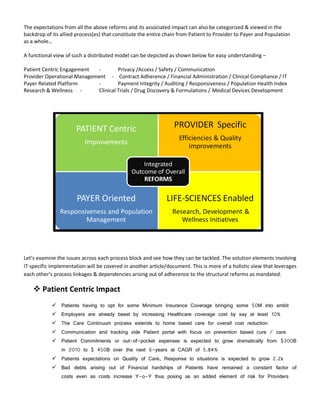
A functional view of such a distributed model can be depicted as shown below for easy understanding –

Patient Centric Engagement  -        Privacy /Access / Safety / Communication
Provider Operational Management - Contract Adherence / Financial Administration / Clinical Compliance / IT
Payer Related Platform      -        Payment Integrity / Auditing / Responsiveness / Population Health Index
Research & Wellness -       Clinical Trials / Drug Discovery & Formulations / Medical Devices Development


                      PATIENT Centric                            PROVIDER Specific
                                                                   Efficiencies & Quality
                          Improvements
                                                                       Improvements

                                                  Integrated
                                              Outcome of Overall
                                                  REFORMS

                       PAYER Oriented                         LIFE-SCIENCES Enabled
               Responsiveness and Population                    Research, Development &
                       Management                                  Wellness Initiatives


Let’s examine the issues across each process block and see how they can be tackled. The solution elements involving
IT specific implementation will be covered in another article/document. This is more of a holistic view that leverages
each other’s process linkages & dependencies arising out of adherence to the structural reforms as mandated.

     Patient Centric Impact
             Patients having to opt for some Minimum Insurance Coverage bringing some 50M into ambit
             Employers are already beset by increasing Healthcare coverage cost by say at least 10%
             The Care Continuum process extends to home based care for overall cost reduction
             Communication and tracking vide Patient portal with focus on prevention based cure / care
             Patient Commitments or out-of-pocket expenses is expected to grow dramatically from $300B
                in 2010 to $ 450B over the next 6-years at CAGR of 5.84%
             Patients expectations on Quality of Care, Response to situations is expected to grow 2.2x
             Bad debts arising out of Financial hardships of Patients have remained a constant factor of
                costs even as costs increase Y-o-Y thus posing as an added element of risk for Providers
 Provider Specific Impact
      HIPPA implementation & PHI safety costs and compliance measures – a function of sunk cost
      ICD-10 has been mandated to be implemented by 2013 and Clinical Coding Integrity check
      Adopting EMR/E-HR along with clinical decision support systems for coordinated care &
        Quality of care. Integrating Clinical and patient management data provides for cohesive analysis
      Engaging Physicians & Physician groups to enhance medication management and added referral
      Negotiate with Physicians to improve margins while knocking off support function costs for them
      Pre-Authorization, Eligibility tracking and incorporating within claims and document management
        for medical records and doctor notes exchange with defined parties for validation
      Contract Management and tracking Over & Under payment by Modality / Physician. Also being
        able to check for CPT level consistency across cure, impacting revenue & cost of claims
      Compliance & Governance Reporting with multiple level of auditing increases operational costs
        and the need to infuse mechanisms to improve efficiencies & productivity can’t be ignored
      The physician-owned practices represent 54% of PCMHs and with hospitals wooing them into
        their fold it’s believed that 22% have already opted for such a major amalgamation of entities.
      34% of hospitals reporting negative margins and subsequent reduction in cash reserves have
        adversely affected their spend limits but with “meaningful use” stimulus and the sharing of cost
        gains through Accountable Care model; have raised hopes for resurrecting hospital business
      The need to measure and monitor Quality of care and the impending Pay-for-Performance
        criteria is pushing hospitals to consider utilization and innovative care continuum approaches


 Provider Oriented Impact
      Medicare / Medicaid reimbursements are expected to move from the current levels of 38% of
        the US National Health care expenditure to about 47% within the next 3-4 years. This is
        much like a mandated spend and margins are not a factor for consideration
      Population Health Management thro’ Wellness programs, Disease control will now form part of
        the Payer expectations. Reduced Medicare payment in the case of preventable hospital
        readmission
      Population Stratification and Patient identification for preventive and continuous cure increases
        cost at one level – at least in the short term but improves overall expenses over long term
      Unable to directly influence Quality o Care on providers but engaging actively thro’ National
        Quality Standards implementation program will help track Physician outcomes and derive
        meaningful Pay-for-Performance index by Practice/Modality
      Deducing & Negotiating INS plans based on Demographical needs can be derived for better
        cost control
      Increase in the Providers expectations for being more responsive and reasonable in pay out
        within stipulated time period adds the costs from the point of adherence to such demands
      Conducting Recovery Audits, Quality Improvement audits, Compliance audits will also increase
        costs at one level and this can only be compensated thro’ efficiencies and optimized work flow
        framework
 LIFE-SCIENCES Impact
            Integrated view of diseases laced with demographic characteristics strains and tracked against
               clinical trial outcomes would be critical for more coordinated care
            Research findings like Stem Cell advancements, therapeutic findings would help in better drug
               discovery & formulations leading to medication that manages both preventive cure as well as
               continuum of care thereby reducing Healthcare costs over time
                Comprehensive   and related diagnosis     &   prognosis   management   also leads    to   reduced
               Healthcare costs and would enable Physicians to adopt modern methods & techniques for
               advanced cure / implementation
            Advancements in invasive & non-invasive implants lead to more sophisticated medication/care
            Disease vector and signature analysis will be used for more advanced diagnostic methods


As can be seen from the above by evaluating all of the impact and the measures that are needed to be taken this
article / whitepaper has covered some of the key aspects of how to manage the Healthcare business in the reform
driven world that US is propitiating.


The mechanics (Process, People/Culture, Engagement models), automation (IT – H/w, S/w, N/w, data) and business
recommendations (Use of Analytics, Interfaces) will be addressed through a separate article that would map against
the various implementation needs that the constituent participants of the Healthcare industry would need to meet
the desired outcomes.

Health e-world (healthy world)

  • 1.
    Health-e-World ( Healthy World) The Economist, Technologist, Business-men, Physicians, Politicians – even right down to common man –is looking at global scenario and wondering how to combat the ripple of issues that impact Healthcare practices; while unearthing a mechanism that would help turn such reforms into a platform for sustained growth. Debates, Court-Orders, View-points, Political-alignments/resolutions/sops are possibly adding another dimension of murkiness to an already clouded world economic situation (Euro-crisis, Crude-Oil Prices, Political instability, Trade imbalances, Downgrading investments etc.,.). Amidst all this, if there’s one thing that no one across the world would ever compromise its Health. Surrounded by deep research and active engagement by all Govts & Public entities, it can come as no surprise when one sees reports talking about taking it to another level and the willingness to push harder for growth. Pledging investments and enacting reforms seems to be the mantra to reap true benefits for 2 of the most influential domains of our lives - (i) Life-Sciences & (ii) Healthcare. The recent turn of events in the US, coming on the back of some structured reforms in the Healthcare space; leaves us with a compelling need to review, assess, evaluate, deduce, determine and act so with a purpose of aligning with the changes in order to enable and expand within the framework of this new paradigm relating to Care Continuum and Health care outcomes (Quality & Costs). An exercise such as this would largely benefit the participants of this USD 2.5 Trillion (poised to grow to USD 4.9 trillion over next 5+Years) Healthcare industry; as we trace by capturing the background, elaborating on the nuances that impact them and then elucidating the methods that will lead to a more comprehensive & inclusive model dotting the contour of doing business even in the changed environment. The various articles, whitepapers, documentary notes dissect the underpinnings outlining the approach along with a sprinkling of tools that could help the participants derive mechanisms for implementing the recommendations to tackle the changing environment. While this is a directional document for future-proofing your Healthcare business, it is also an invisible consultant that provides insights into where the industry is headed highlight some of the key markings that reveal the elements in the path to get to there…. << NOTE to Web-Master >>: << The below document should only be included as a link and NOT as a document… This is done primarily to obtain specific profile info of the participants / readers / parties that wish to sign-up for the white-paper… Hence, don’t include the below notes into the main document… We should ask them to create LOG-IN CREDENTIALS – Name, Phone#, E-MAIL ID, Title, Company, Area of Interest & Issues that they would like to discuss/cover in future etc.,. >>………
  • 2.
    Diagnosing the HealthCareIndustry Reforms World over there’s a conscious move to make Healthcare affordable. Govts across the globe have embarked on several initiatives and the one common theme that they are all pushing for; seems to be to improve Quality of Care while reducing the costs with specific emphasis on automation. So, if Australia, Bahrain, India, Israel, Malaysia, USA (just to name a few countries) have publicly announced Wellness programs and have earmarked funds for some innovative automation keeping futuristic needs in mind; it only depicts the real focus that Healthcare is receiving as an industry. Narrowing the focus to US Healthcare, one can examine the dynamics of the industry more so when it’s undergoing multiple reforms. While there’s a cocoon of events that spread across the canvas of reforms, the need to string all these together to invoke the elements that act as determinants of such a driving force is vital in order extract the best for the public and the Healthcare industry as a whole. It’s believed that the many facets of such reforms are either already leaving a footprint or is ideally positioned to do so when unfolded in full, and hence there’s a clear need to understand its influence even as we learn about it / debate on it. Given that the degree of influence could be wide spread, it’s therefore critical to reflect on its outcome, by viewing the changes thro’ the lens of its impact on the existing Healthcare practices. So, let’s begin with some of the key enactments that have caught the attention of the Govts/Law Makers, Public & Supreme Courts as well…  In 2010, Congress enacted the Patient Protection and Affordable Care Act (PPACA) in order to increase the number of Americans covered by health insurance and decrease the cost of health care. o Reform-Impact: .  The Supreme Court debated and after hearing the proceedings, Justice Roberts announced the judgment resolving the constitutional challenges facing the 2 provisions made in the Patient Protection and Affordable Care Act. The announcement enforces the need for any Individual to purchase a health insurance policy that provides for a minimum level of coverage at the very least. The court also upheld the Medicaid expansion program that gives funds to the States on the condition that they provide specified health care to all citizens whose income falls below a certain threshold.  Translation:
  • 3.
    PPACA will create new Provider-Structures to enable Accountable Care Organizations  It’s believed that roughly 45- 55 Million US Citizens will now enroll for Health Care insurance of which 33 Million would have got added onto the system by 2018  An additional 55 Million people are expected to reach the Age of 65 by 2020 pushing the envelope on Medicare & Medicaid  In 2009, the American Recovery and Reinvestment Act (ARRA) was introduced and the provisions under the Healthcare Information Technology for Economic and Clinical Health Act (HITECH) promoted “meaningful use” of IT such as EMR/E-HR, MPI, and such other tools that garnish the criteria for managing Healthcare dispensation. While this was a key influencer in 2010, there are specific expectations set for 2011, 2013 & 2015. More so when this viewed along the lines of the mandate on Providers to adopt ICD-10 codes by 2013/2014 and the resultant emphasis to drive effective population & disease management - leading to wellness programs. o Reform-Impact:  2010 proved to be the year organizations ramped up their approach to meet the Stages 1, 2 & 3 thro’ EMR adoption and Hospitals increased their EMR Adoption Model metrics (EMRAM) in Stage 4 by more than 3%. Consequent to this positive momentum in the EMRAM, the EMR-related applications increased significantly leading to doubling of the number of hospitals entering Stage 6. The thrust towards Accountable Care Organizations becomes significant because the approach is meshed with improvements in Quality of Care and reduction in Costs.  Translation:  $20B stimulus fund was distributed as part of the American Recovery & Reinvestment Act (ARRA) to encourage Providers to use electronic health records (EHR)  The ARRA/HITECH funding proved essentially important to the U.S. healthcare industry because IT budgets dipped to less than 40% in 2010 and is now back-up to ~50%+ in 2011 & 2012. Hospitals have improved their capital expense spend from 46.5% to 48.3% of their IT budget to ensure compliance and to earn “meaningful use” incentive.  There’s a likely hood of an additional spend in the range 14-15% to meet the mandated requirements over the next 3-4 years and use of IT to enable adoption as well as to drive efficiencies. It’s open secret that it encompasses EMR, ICD-10, RCM improvements relating to Pay-for Performance and integrated business analytics.  With Healthcare costs set to increase at 6.7% annually until 2017 to meet these reforms & growth, there’s also this constant push to ensure that Quality of Care is improved thus decreasing the spend on Care Continuum process incorporated thro’ Care Coordination, Prevention measures, Patient Safety criterion, Disease management/control.  Payers are pushing providers towards Pay-for-Performance which is estimated to see an additional 5% increase. The estimate seems to have gained validity as roughly 80% of the Providers seem to agree as against the 10% that have currently adopted it.
  • 4.
    The expectations fromall the above reforms and its associated impact can also be categorized & viewed in the backdrop of its allied process(es) that constitute the entire chain from Patient to Provider to Payer and Population as a whole… A functional view of such a distributed model can be depicted as shown below for easy understanding – Patient Centric Engagement - Privacy /Access / Safety / Communication Provider Operational Management - Contract Adherence / Financial Administration / Clinical Compliance / IT Payer Related Platform - Payment Integrity / Auditing / Responsiveness / Population Health Index Research & Wellness - Clinical Trials / Drug Discovery & Formulations / Medical Devices Development PATIENT Centric PROVIDER Specific Efficiencies & Quality Improvements Improvements Integrated Outcome of Overall REFORMS PAYER Oriented LIFE-SCIENCES Enabled Responsiveness and Population Research, Development & Management Wellness Initiatives Let’s examine the issues across each process block and see how they can be tackled. The solution elements involving IT specific implementation will be covered in another article/document. This is more of a holistic view that leverages each other’s process linkages & dependencies arising out of adherence to the structural reforms as mandated.  Patient Centric Impact  Patients having to opt for some Minimum Insurance Coverage bringing some 50M into ambit  Employers are already beset by increasing Healthcare coverage cost by say at least 10%  The Care Continuum process extends to home based care for overall cost reduction  Communication and tracking vide Patient portal with focus on prevention based cure / care  Patient Commitments or out-of-pocket expenses is expected to grow dramatically from $300B in 2010 to $ 450B over the next 6-years at CAGR of 5.84%  Patients expectations on Quality of Care, Response to situations is expected to grow 2.2x  Bad debts arising out of Financial hardships of Patients have remained a constant factor of costs even as costs increase Y-o-Y thus posing as an added element of risk for Providers
  • 5.
     Provider SpecificImpact  HIPPA implementation & PHI safety costs and compliance measures – a function of sunk cost  ICD-10 has been mandated to be implemented by 2013 and Clinical Coding Integrity check  Adopting EMR/E-HR along with clinical decision support systems for coordinated care & Quality of care. Integrating Clinical and patient management data provides for cohesive analysis  Engaging Physicians & Physician groups to enhance medication management and added referral  Negotiate with Physicians to improve margins while knocking off support function costs for them  Pre-Authorization, Eligibility tracking and incorporating within claims and document management for medical records and doctor notes exchange with defined parties for validation  Contract Management and tracking Over & Under payment by Modality / Physician. Also being able to check for CPT level consistency across cure, impacting revenue & cost of claims  Compliance & Governance Reporting with multiple level of auditing increases operational costs and the need to infuse mechanisms to improve efficiencies & productivity can’t be ignored  The physician-owned practices represent 54% of PCMHs and with hospitals wooing them into their fold it’s believed that 22% have already opted for such a major amalgamation of entities.  34% of hospitals reporting negative margins and subsequent reduction in cash reserves have adversely affected their spend limits but with “meaningful use” stimulus and the sharing of cost gains through Accountable Care model; have raised hopes for resurrecting hospital business  The need to measure and monitor Quality of care and the impending Pay-for-Performance criteria is pushing hospitals to consider utilization and innovative care continuum approaches  Provider Oriented Impact  Medicare / Medicaid reimbursements are expected to move from the current levels of 38% of the US National Health care expenditure to about 47% within the next 3-4 years. This is much like a mandated spend and margins are not a factor for consideration  Population Health Management thro’ Wellness programs, Disease control will now form part of the Payer expectations. Reduced Medicare payment in the case of preventable hospital readmission  Population Stratification and Patient identification for preventive and continuous cure increases cost at one level – at least in the short term but improves overall expenses over long term  Unable to directly influence Quality o Care on providers but engaging actively thro’ National Quality Standards implementation program will help track Physician outcomes and derive meaningful Pay-for-Performance index by Practice/Modality  Deducing & Negotiating INS plans based on Demographical needs can be derived for better cost control  Increase in the Providers expectations for being more responsive and reasonable in pay out within stipulated time period adds the costs from the point of adherence to such demands  Conducting Recovery Audits, Quality Improvement audits, Compliance audits will also increase costs at one level and this can only be compensated thro’ efficiencies and optimized work flow framework
  • 6.
     LIFE-SCIENCES Impact  Integrated view of diseases laced with demographic characteristics strains and tracked against clinical trial outcomes would be critical for more coordinated care  Research findings like Stem Cell advancements, therapeutic findings would help in better drug discovery & formulations leading to medication that manages both preventive cure as well as continuum of care thereby reducing Healthcare costs over time  Comprehensive and related diagnosis & prognosis management also leads to reduced Healthcare costs and would enable Physicians to adopt modern methods & techniques for advanced cure / implementation  Advancements in invasive & non-invasive implants lead to more sophisticated medication/care  Disease vector and signature analysis will be used for more advanced diagnostic methods As can be seen from the above by evaluating all of the impact and the measures that are needed to be taken this article / whitepaper has covered some of the key aspects of how to manage the Healthcare business in the reform driven world that US is propitiating. The mechanics (Process, People/Culture, Engagement models), automation (IT – H/w, S/w, N/w, data) and business recommendations (Use of Analytics, Interfaces) will be addressed through a separate article that would map against the various implementation needs that the constituent participants of the Healthcare industry would need to meet the desired outcomes.