Wi-Fi for Assisted Living and
Long Term Care Facilities
Improve Care Delivery
Enhance Resident’s Lives
Increase Efficiencies
WiFi
The
Futureof
Information Series
www.deepbluecommunications.com
2
Improve care delivery, enhance resident
services and increase efficiencies with Wi-Fi.
From mobile health technology to concierge services, long term and healthcare
facilities need to make sure the exchange of data is reliable, secure and efficient
across all platforms and locations. A solid Wi-Fi network is the most important factor
to keep things running smoothly. With new solutions that streamline the sharing
of health records, centralize communication within communities and provide live
resident data for those providing health care, those who choose not to“go wireless”
as a foundation could lose competitive edge.
Technology Tools on the Rise
Healthcare workers and employees for long term care
organizations are managing their work with everything
from their desktops to laptops to mobile devices – utilizing
software and applications in a myriad of ways. It is
increasingly important for healthcare practices to ensure
the exchange of all of this data is consistent, efficient and
secure across platforms and geographic locations.
As more and more long term care, assisted and
independent living, skilled nursing and day treatment
programs adopt technology, the easier it is for families to
communicate with loved ones, for residents to connect
to their interests, and for clinicians to connect to the vital
data they need to provide the best care.
Long term care organizations need to implement a solid
network backbone with enterprise Wi-Fi to enable all of
the technologies for the entire continuum of care – from
the back office and clinical bedside to resident monitoring,
claims management and interoperable EHR. Residents and
their families rely on providers to incorporate technology
not only for the best care, but also to stay connected with
the world outside your doors.
Wi-Fi for Long Term Care
WiFi
The
Futureof
3
Long Term Care in a Digital Age
EHRs and mobile health technology can bridge the
communication gap between post-acute, long term care,
pharmacies and other healthcare practices as we move
towards a more integrated model of care.
Back in the early days of EMR / EHR adoption, no one had
an iPhone or Kindle. Networks in facilities were hardwired
for the back office computer systems that finance used to
get the bills out the door. Larger facilities had computer
stations for clinicians to enter in MDS and other clinical
assessment data. And that was
about it.
Fast forward to today –
technology has taken over
our lives, and is increasingly
finding its way into LTPAC1
.
From location-based resident
monitoring to gaming, social
media and more, clinicians
and their residents are utilizing
technology to stay healthy,
active and connected. Some
mobile apps even have built in
a HIPAA-compliant way of secure text messaging between
physicians.
None of this happened overnight. It is the result of
decades of work by healthcare, information technology
and government organizations working together to
ensure technology can be used for everything from
family meetings to pharmacy integrations. The advent
of improved mobile technology, the tidal wave of new
devices, the demand for better care coordination and the
pressures of lower reimbursements and valued-based
payment models has LTPAC providers looking for answers.
There is a need to reduce errors and hospital readmissions
by improving outcomes and communication. Both
State and Federal governments along with The Centers
for Medicare and Medicaid (CMS) are demanding that
“providers communicate and coordinate with each other,
implement evidence-based practices, measure and analyze
clinical and financial performance, and engage in continuous
quality improvement.” 2
Easier said than done. Many LTPAC providers are struggling
to implement technology even though healthcare is
inevitably moving towards a more techno-centric model.
In the 2014 State of the
Healthcare Information
Exchange Industry , Black
Book™ surveyed 464 providers
of long term and post-acute
care (nursing homes, hospitals,
short term rehabilitation
facilities, home health
services, durable medical
equipment/DME distributors,
skilled nursing and sub-
acute facilities, and hospices)
to better understand the
planning, implementation and usage of health information
and how it is being exchanged. Some of their findings:
• Technology adoption: Two-thirds (63%) of all post-acute
care providers report that they either don’t have—or aren’t
fully using—information systems, technology and patient
data exchanges. This group includes 79% of all nursing
homes and skilled nursing facilities (SNF), and 73% of
durable medical equipment firms.
• Budget disparities: A sizable portion (89%) of single or
standalone nursing homes and SNFs report having no
money budgeted for 2014 technology projects. But most
(84%) large SNF and post-acute care providers have funds
allocated this year for technology improvements.
1
Long Term Post Acute Care: includes long term care facilities, skilled nursing, assisted living, senior housing, hospice and home care.
2
http://www.leadingageny.org/linkservid/2E102FA3-007E-0553-F50E1E2BB975E3DC/showMeta/0/
4
• Need for technical help: Only 5% of small chains say they
can develop and implement IT solutions without the help
of technology vendors and consultants. Yet, less than half
(43%) of chief executive officers (CEO) anticipate engaging
consultants and technology vendors to provide new
strategies and solutions in 2014. Three-quarters (78%) of
these CEOs are unaware of consulting organizations that
specialize in long-term care systems and solutions.
• New payment models: Half (52%) of all post-acute care
providers predict that up to 5% of their patient mix will
shift to value-based reimbursement and accountable care
models within the next 12 to 36 months. About the same
percentage of providers (56%) say they will participate in
a public or private Health Information Exchange in 2014 to
help them address lower fee-for-service reimbursements
and accountable care reforms.
• Underutilized technology: Despite 92 percent of post-
acute providers confirming that information technology
platforms for patient data sharing and comprehensive
care coordination would improve their organizations’
financial health and ability to thrive under accountable
care and lower fee-for-service reimbursement, 90 percent
of all post-acute providers report minimal or underutilized
technology currently across all settings.
Clearly there is a gap between what needs to happen in
information technology, and what is actually happening.
Through effective use of health care information
technology, clinicians can improve care coordination to
elevate quality measures and help reduce the skyrocketing
costs of health care. But providers can’t do it alone, and are
under mounting pressure to work together with entities
like hospitals, who have a much higher EHR adoption
rate primarily due to incentive-based programs as well as
involvement with health information exchanges.
In its 2015 prospective payment rule for skilled nursing
facilities, published in the Federal Register on Aug. 5, CMS
included a discussion of our commitment to accelerating
Health Information Exchange (HIE) in SNFs…through the use
of electronic health records (EHRs) and other types of health
information technology across the broader care continuum
through a number of initiatives including: (1) Alignment
of incentives and payment adjustments to encourage
provider adoption and optimization of health information
technology and HIE services through Medicare and Medicaid
payment policies; (2) adoption of common standards
and certification requirements for interoperable health
information technology; (3) support for privacy and security
of patient information across all HIE-focused initiatives; and
(4) governance of health information networks.
CMS and other health entities – both government and
private sector, are pushing HIT primarily because it allows
health care providers to share health information in a
timely and secure manner across care settings. According
to HealthIT.gov, when multiple physicians are treating
a patient following a hospital discharge, information
about the patient’s care is missing 78% of the time.
Technology like interoperable health records can enable
the secure exchange of vital health data to reduce errors,
readmission rates and help improve care while lowering
costs.
5
There are a number of incentives for facilities to pursue
interoperable technologies, including3
:
• Value-Based Purchasing Programs: The Affordable Care Act
requires the Secretary to develop value-based purchasing
programs for Skilled Nursing Facilities. It is anticipated that
performance in these programs will be improved through
better coordinated patient care and facilitated via EHR data
collection thus encouraging LTPAC providers to implement
EHRs.
• Readmission Penalties. HHS has launched the“Hospital
Readmissions Reduction Program”(HRRP) that penalizes
hospitals that have excess readmission rates for selected
health conditions.
• KeyHIE Tools. There are provider, community or state based
HIE services or portal views of EHRs from larger hospital
systems that refer to LTPAC facilities. This may include
using new (and low cost) tools such as the KeyHIE (http://
transform.keyhie.org/) to transform MDS into a summary of
care document to share with hospitals and other treating
providers in the community.
• ACOs / HIEs. There may be potential partnership
opportunities with Accountable Care Organizations (ACOs)
or Health Information Exchanges (HIEs) in your service
area. This could include working with them to implement
an interoperable HIE infrastructure and supporting care
transitions across providers and settings of care.
• The U.S. healthcare system is being transformed with
hospitals and physician practices increasingly using
health IT - in part because of incentive programs for the
use of EHRs, as well as new and expanded innovative care
delivery and payment models authorized by the Affordable
Care Act. The Health Information Technology for Economic
and Clinical Health (HITECH) Act provides monetary
incentives and technical assistance to help eligible
providers use certified technology to become meaningful
users of electronic health records (EHR).
According to the Health IT.gov overview: Health IT in Long
Term and Post Acute Care Issue Brief, adoption of basic EHR
systems by office-based physicians grew by over 80% between
2009 and 2012.4
As EHR adoption and interoperability
requirements continue to advance in the acute care and
ambulatory care sector, it will be increasingly important for
LTPAC providers to adopt EHRs that have the capability of
exchanging standardized clinical data with care partners.2
3
Source for following sectionhttps://www.healthit.gov/sites/default/files/pdf/HIT_LTPAC_IssueBrief031513.pdf
4
https://www.healthit.gov/sites/default/files/pdf/HIT_LTPAC_IssueBrief031513.pdf
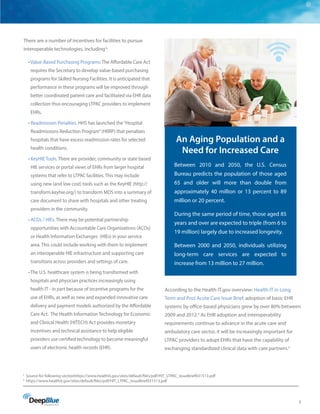
An Aging Population and a
Need for Increased Care
Between 2010 and 2050, the U.S. Census
Bureau predicts the population of those aged
65 and older will more than double from
approximately 40 million or 13 percent to 89
million or 20 percent.
During the same period of time, those aged 85
years and over are expected to triple (from 6 to
19 million) largely due to increased longevity.
Between 2000 and 2050, individuals utilizing
long-term care services are expected to
increase from 13 million to 27 million.
6
Why Wi-Fi
From the back office to resident safety systems, Wi-Fi enables
the technology facilities need to stay connected, compliant
and ahead of the competition.
The persistent drive for new technology to improve
resident care has taken a toll on old networks that don’t
have the capacity to handle multiple users and devices at
any given time. Wired networks - though still important,
are being overcome by Wi-Fi for many reasons. Older
EMR models required a clinician to stand at a hardwired
computer to type in clinical data. These days, Wi-Fi
enables instant communications between caregivers
and physicians at the point of care, offering immediate
access to real-time resident medical records and faster
response times. Staff can provide better care to residents
with bedside data collection, location-based monitoring
and instant communication with housekeeping, dietary
and therapy to make sure all of the resident’s needs are
met promptly, with the most accurate information at a
clinician’s fingertips. With Wi-Fi, medical records can be
updated in real time, with workflow ensuring clinical
protocols are followed and documented, reducing errors
and improving compliance. For example:
• CNAs and other nursing staff can have anywhere / anytime
access for centralized communications - has anyone been in
to provide meals or check on the resident? Has the resident
received scheduled medication / care?
• For residents in independent living, monitors can help
assess if the resident is keeping to their standard living
pattern.
• Physicians use tablet PCs and other devices to make
diagnosis and care decisions based on the live data from
the medical record and forward prescriptions directly to
pharmacies and order therapies and other services.
• Pressure sensors in bedding monitor resident activity and
vital signs, and door monitors prevent wandering.
• LBS / Facility Sensors – Location based services and user-
activated emergency response systems (PERS) allow real-
time notification of emergency and reduced medical staff
response time
• Wireless heat, smoke, and carbon monoxide detection and
motion sensors, access control and video surveillance add
an extra layer of security.
Not only do these elements keep residents safe and give
families peace of mind, they are also valuable assets for
reducing liability and litigation costs and preventing the
loss of Medicaid / Medicare reimbursements due to adverse
events.
But that isn’t all. Wi-Fi technology can also enhance the
operational efficiency of facilities with systems integration
for lighting and electrical usage. Systems can detect
whether commercial kitchen facilities wasting energy due
to poor freezer seals, if high-energy devices are being left
on, etc. and can automatically turn off lights, televisions,
and the like in unused common areas. Mobile security can
also be utilized to track devices so that you always know
where med carts, medical devices, tablets, and other facility
assets are located – reducing theft, damage and HIPAA
violations.
7
And it isn’t only clinicians, doctors and other LTPAC staff
who need reliable Wi-Fi, but residents and their families do
as well. One of the easiest“comforts of home”to provide,
Wi-Fi can enhance resident’s lives.
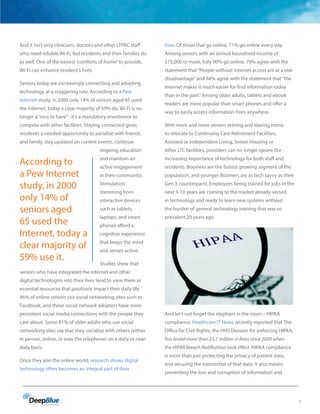
Seniors today are increasingly connecting and adopting
technology at a staggering rate. According to a Pew
Internet study, in 2000 only 14% of seniors aged 65 used
the Internet, today a clear majority of 59% do. Wi-Fi is no
longer a“nice to have”- it’s a mandatory investment to
compete with other facilities. Staying connected gives
residents a needed opportunity to socialize with friends
and family, stay updated on current events, continue
ongoing education
and maintain an
active engagement
in their community.
Stimulation
stemming from
interactive devices
such as tablets,
laptops, and smart
phones afford a
cognitive experience
that keeps the mind
and senses active.
Studies show that
seniors who have integrated the internet and other
digital technologies into their lives tend to view them as
essential resources that positively impact their daily life.
46% of online seniors use social networking sites such as
Facebook, and these social network adopters have more
persistent social media connections with the people they
care about. Some 81% of older adults who use social
networking sites say that they socialize with others (either
in person, online, or over the telephone) on a daily or near-
daily basis.
Once they join the online world, research shows digital
technology often becomes an integral part of their
lives. Of those that go online, 71% go online every day.
Among seniors with an annual household income of
$75,000 or more, fully 90% go online. 79% agree with the
statement that“People without internet access are at a real
disadvantage”and 94% agree with the statement that“the
internet makes it much easier for find information today
than in the past.”Among older adults, tablets and ebook
readers are more popular than smart phones and offer a
way to easily access information from anywhere.
With more and more seniors retiring and leaving home
to relocate to Continuing Care Retirement Facilities,
Assisted or Independent Living, Senior Housing or
other LTC facilities, providers can no longer ignore the
increasing importance of technology for both staff and
residents. Boomers are the fastest growing segment of the
population, and younger Boomers are as tech savvy as their
Gen X counterparts. Employees being trained for jobs in the
next 5-10 years are coming to the market already versed
in technology and ready to learn new systems without
the burden of general technology training that was so
prevalent 20 years ago.
And let’s not forget the elephant in the room – HIPAA
compliance. Healthcare IT News recently reported that The
Office for Civil Rights, the HHS Division for enforcing HIPAA,
has levied more than 25.1 million in fines since 2009 when
the HIPAA Breach Notification took effect. HIPAA compliance
is more than just protecting the privacy of patient data,
and securing the transmittal of that data. It also means
preventing the loss and corruption of information and
According to
a Pew Internet
study, in 2000
only 14% of
seniors aged
65 used the
Internet, today a
clear majority of
59% use it.
8
protecting it with the appropriate disaster recovery
measures. With electronic records, you not only reduce
paperwork with EMR / MDS / EMAR / ETAR integrations
and better coordinate care and housekeeping / dietary
/ therapy services, you can also protect that data with
security measures implemented on a software system
panel right down to a field on a form. Data is secured as it
is sent to other providers and is easily accessed for clinical
surveys and other administrative protocols. And with
the right systems in place, you can guarantee network
performance and security with real-time 24/7 monitoring
on all devices and touchpoints.
Futureproofing
Your Network
New Wi-Fi standards and technology are available and
should be a priority for facilities looking to upgrade networks
for the next 10-20 years. Managed Service Providers can
assist in the process of integrating legacy systems and new
technologies.
What ties all this technology together and enables
residents, staff, and administration to get full use of all
their devices is access to great Wi-Fi. In order for all of this
to work, facilities need excellent enterprise grade Internet
that can support the proliferation of devices that your
residents need to get online – from laptops and tablets to
wearables and smartphones. Facilities will need to have
Wi-Fi robust enough to accommodate all this expanding
technology. Failure is not an option.
As the need grows, wireless networks are being
developed not only for coverage, but for capacity.
Facilities need faster application performance, increased
data transfer capability and speed, and the ability to
support multiple users and concurrent sessions. With
new technology and streamlined implementations,
newer facilities and those who are restructuring their
networks can reap the benefits of a more responsive,
stable Wi-Fi network.
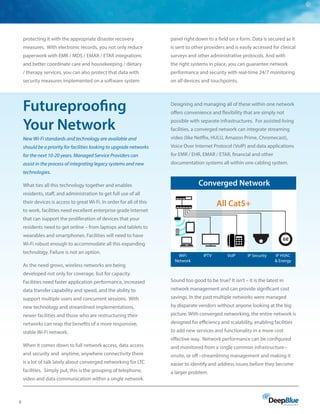
When it comes down to full network access, data access
and security and anytime, anywhere connectivity there
is a lot of talk lately about converged networking for LTC
facilities. Simply put, this is the grouping of telephone,
video and data communication within a single network.
Designing and managing all of these within one network
offers convenience and flexibility that are simply not
possible with separate infrastructures. For assisted living
facilities, a converged network can integrate streaming
video (like Netflix, HULU, Amazon Prime, Chromecast),
Voice Over Internet Protocol (VoIP) and data applications
for EMR / EHR, EMAR / ETAR, financial and other
documentation systems all within one cabling system.
Sound too good to be true? It isn’t – it is the latest in
network management and can provide significant cost
savings. In the past multiple networks were managed
by disparate vendors without anyone looking at the big
picture. With converged networking, the entire network is
designed for efficiency and scalability, enabling facilities
to add new services and functionality in a more cost
effective way. Network performance can be configured
and monitored from a single common infrastructure–
onsite, or off –streamlining management and making it
easier to identify and address issues before they become
a larger problem.
Converged Network
	 WiFi	 IPTV	 VoIP	 IP Security	 IP HVAC
	Network				  Energy
68
All Cat5+
9
Cabling once for all systems can mean significant cost
savings. By utilizing the same equipment and space for
multiple systems you eliminate redundancy and can
optimize the delivery of all services. In addition, once
the network is established it is easier to add new services
to the existing infrastructure – making it more cost
effective than laying down a whole new network for each
new service. Done correctly, a converged network can
eliminate redundancies in everything from power usage
and maintenance costs to reducing overall environmental
impact.
The integration of all these technologies certainly
increases the complexities of the Wi-Fi network but
when done correctly – with a well thought out design
and implementation, can lead to significant operational
efficiencies like easier network management. There are
different ways to combine services depending on your
needs. A new property may design a network from the
ground up to accommodate every system in one unified
network form the back office to bedside data collection.
Older facilities may see savings and efficiencies simply by
combining VoIP, IPTV and HSIA. Regardless, your cabling
infrastructure needs to be run in the right amount, and
in the right locations in order to support all of your
technology services.
So what technologies do facilities need to understand
and implement to accommodate all of these devices,
applications and bandwidth?
802.11ac Wave 2
To start with, there is a new 802.11 Wi-Fi standard
that promises more bandwidth, greater speeds,
and support for a new generation of compatible
devices. Understanding how the new standard and its
components and what it will mean for your infrastructure
planning over the next 5-10 years is key to staying ahead
of the competition.
802.11 is a set of standards, developed by the
International Institute of Electrical and Electronics
Engineers (IEEE), that govern wireless networking
transmission methods. The new standard in Wi-Fi is
802.11ac Wave 2. It is different from the first 802.11ac
wireless specification in that it utilizes Multi-user Multiple
Input Multiple Output (MU-MIMO) technology to help
increase wireless speeds from 3.47 Gbps to 6.93 Gbps.
Just like our devices have upgrades – smartphones,
tablets, laptops – each iteration of these 802.11 standards
makes improvements and advancements on the
previous standard. 802.11ac was designed to help deliver
increased bandwidth and improve wireless reliability to
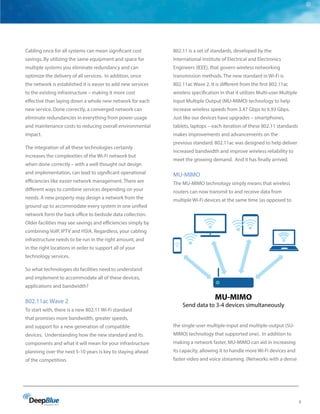
meet the growing demand. And it has finally arrived.
MU-MIMO
The MU-MIMO technology simply means that wireless
routers can now transmit to and receive data from
multiple Wi-Fi devices at the same time (as opposed to
the single-user multiple-input and multiple-output (SU-
MIMO) technology that supported one). In addition to
making a network faster, MU-MIMO can aid in increasing
its capacity, allowing it to handle more Wi-Fi devices and
faster video and voice streaming. (Networks with a dense
MU-MIMO
Send data to 3-4 devices simultaneously
10
number of users in an area, such as public Wi-Fi hotspots,
should do better as well with this technology).
Newer Wi-Fi networks also utilize both the 2.4GHz and 5.0
GHz spectrums. The 2.4 GHz spectrum has the greatest
range and universal capacity, however it’s limitation and
growing congestion makes it prone to interference from
itself and non-Wi-Fi devices (like when a doctor wants
to access a medical record and their tablet creeps to a
halt). As the 2.4GHz spectrum becomes overcrowded
and interference builds, the 5.0GHz is utilized to provide
additional coverage for more devices. Most modern mobile
devices look to connect via 5GHz first and 2.4 second.
Facilities should be looking for a dual-band (2.4  5 GHz)
solution, to double potential wireless bandwidth, support
backwards compatibility with older 801.11 b/d/n devices
and to help eliminate interference.
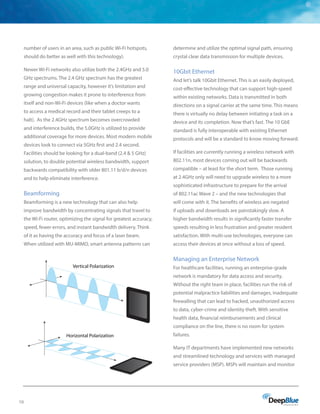
Beamforming
Beamforming is a new technology that can also help
improve bandwidth by concentrating signals that travel to
the Wi-Fi router, optimizing the signal for greatest accuracy,
speed, fewer errors, and instant bandwidth delivery. Think
of it as having the accuracy and focus of a laser beam.
When utilized with MU-MIMO, smart antenna patterns can
determine and utilize the optimal signal path, ensuring
crystal clear data transmission for multiple devices.
10Gbit Ethernet
And let’s talk 10Gbit Ethernet. This is an easily deployed,
cost-effective technology that can support high-speed
within existing networks. Data is transmitted in both
directions on a signal carrier at the same time. This means
there is virtually no delay between initiating a task on a
device and its completion. Now that’s fast. The 10 GbE
standard is fully interoperable with existing Ethernet
protocols and will be a standard to know moving forward.
If facilities are currently running a wireless network with
802.11n, most devices coming out will be backwards
compatible – at least for the short term. Those running
at 2.4GHz only will need to upgrade wireless to a more
sophisticated infrastructure to prepare for the arrival
of 802.11ac Wave 2 – and the new technologies that
will come with it. The benefits of wireless are negated
if uploads and downloads are painstakingly slow. A
higher bandwidth results in significantly faster transfer
speeds resulting in less frustration and greater resident
satisfaction. With multi-use technologies, everyone can
access their devices at once without a loss of speed.
Managing an Enterprise Network
For healthcare facilities, running an enterprise-grade
network is mandatory for data access and security.
Without the right team in place, facilities run the risk of
potential malpractice liabilities and damages, inadequate
firewalling that can lead to hacked, unauthorized access
to data, cyber-crime and identity theft. With sensitive
health data, financial reimbursements and clinical
compliance on the line, there is no room for system
failures.
Many IT departments have implemented new networks
and streamlined technology and services with managed
service providers (MSP). MSPs will maintain and monitor
Horizontal Polarization
Vertical Polarization
11
systems, keeping them at optimal efficiency, supporting
1:1 connection for staff and residents devices. With 100%
coverage and 100% reliability, mission-critical hardware
and software has full redundancy and is monitored
24/7/365 so small matters don’t become larger issues.
MSPs see the larger picture of all technology vendors and
can map out, integrate and recommend the components
you need from start to finish – including cabling, Wi-Fi,
financial and clinical software and all hardware devices.
By taking your existing network and applications and
retooling them for optimal performance and security,
you can take advantage of robust technology within your
timeframe and budget – with scalable design to enable
growth down the road.
Moving Ahead
While the explosion of Wi-Fi enabled devices may look daunting,
the future of Wi-Fi is here today. Technologies and solutions
are available now that will help LTC, assisted living and other
senior housing facilities create great networks, ensure resident
satisfaction, and enhance care for years to come.
Remember – your healthcare technology is only as good as
the network it runs on. When looking at how much to invest in
future proofing your technology, take into consideration the
costs of implementing a new network with almost unlimited
potential for adding new services in the next 10-15 years as
your staff’s and resident’s needs change. Research and apply
new technologies to make your network as robust as possible.
Although it might not be possible to implement everything at
once, make it mission critical to stay on top of the trends and
technologies that are making headlines and headway. You can
be assured the winners in the LTPAC space are the ones that
keep their residents connected to the things they love and
offer the caregiving technology to keep them healthy for years
to come. With the ability to apply new solutions that streamline
the sharing of health records, centralize communication
within communities and provide live resident data for those
providing health care, those who choose not to“go wireless”as
a foundation will lose out to those that do.
WiFi
The
Futureof
Information Series
12
Deep Blue Communications
At Deep Blue, we provide the enterprise Wi-Fi infrastructure, services and support to help keep your systems running
24x7x365. We monitor complex systems across multiple facilities from a single portal to ensure connectivity, reduce
inefficiencies and save money.
Deep Blue covers all of your facilities – Long Term Care, Assisted Living, Senior Housing, Adult Day Treatment, CCRCs –
across the continuum of care and can seamlessly add services and coverage as you grow.
Deep Blue Services
At Deep Blue, we design your entire network for efficiency
and scalability, enabling Long Term Care facilities to add
new services and functionality in a more cost effective
way.
We understand the complexities of existing infrastructure
and can optimize existing systems for future
performance. We can help ensure your projects open with
the right technology working the way it should, on time,
and on budget.
From the earliest stages of development Deep Blue will
be your partner in evaluating technologies, network
design, cabling infrastructure, 3rd party technology
vendor management, and implementation. Our team
of senior network engineers, project managers, and
business analysts will lower your risks and get you up and
running on-time with the best ROI for your budget.
Our comprehensive suite of services includes:
Certified Project Management-Certified project managers
delivering the technology and networking components
you need from start to finish. We’ll work with your team
on confirming all technology integrations and costs,
scheduling cost-effective installations and finding the
solutions that deliver the best ROI within your budget. We
will assist with funding applications for grants and State /
Federal programs and health information exchanges.
HIPAA Compliance-We’ll help you understand and meet
HIPAA standards and policies, and consult with you on
all technology services at the property, from security and
EMR / EHR to integrated voice, data and Internet.
Network Design  Integration - We’ll design a network
that will support your needs now with scalable design for
the future. We’ll work with you and all your technology
vendors, analyzing the benefit of a converged infrastructure
utilizing best of breed products, including (use logos) Ruckus
Wireless, Cisco, HP, Juniper and Palo Alto Networks.
Third Party  Legacy Cabling Infrastructure-We can do
the cabling ourselves or work with your chosen vendor to
ensure the right cable is run where needed, to support all
of the technology at your property, now and in the future.
We help lower the risk of costly last minute cabling changes
by assessing all of your technology needs upfront and
designing with a scalable infrastructure.
Implementation  Support-Deep Blue network engineers
and installation technicians bring it all together. We’ll
install the network components and onboard all 3rd part
technology services with 24/7 network support. Our help
desk, ISP management, remote monitoring and support
includes all vendors on the network reducing costs and
streamlining operations.
Contact us today to see how Deep Blue can help you lay the
groundwork for what’s next in healthcare.
Deep Blue Communications
7 Century Hill Drive
Latham, NY 12110
1-844-389-2718
www.deepbluecommunications.com
info@deepbluecommunications.com

Wifi for Long Term Care

  • 1.
    Wi-Fi for AssistedLiving and Long Term Care Facilities Improve Care Delivery Enhance Resident’s Lives Increase Efficiencies WiFi The Futureof Information Series www.deepbluecommunications.com
  • 2.
    2 Improve care delivery,enhance resident services and increase efficiencies with Wi-Fi. From mobile health technology to concierge services, long term and healthcare facilities need to make sure the exchange of data is reliable, secure and efficient across all platforms and locations. A solid Wi-Fi network is the most important factor to keep things running smoothly. With new solutions that streamline the sharing of health records, centralize communication within communities and provide live resident data for those providing health care, those who choose not to“go wireless” as a foundation could lose competitive edge. Technology Tools on the Rise Healthcare workers and employees for long term care organizations are managing their work with everything from their desktops to laptops to mobile devices – utilizing software and applications in a myriad of ways. It is increasingly important for healthcare practices to ensure the exchange of all of this data is consistent, efficient and secure across platforms and geographic locations. As more and more long term care, assisted and independent living, skilled nursing and day treatment programs adopt technology, the easier it is for families to communicate with loved ones, for residents to connect to their interests, and for clinicians to connect to the vital data they need to provide the best care. Long term care organizations need to implement a solid network backbone with enterprise Wi-Fi to enable all of the technologies for the entire continuum of care – from the back office and clinical bedside to resident monitoring, claims management and interoperable EHR. Residents and their families rely on providers to incorporate technology not only for the best care, but also to stay connected with the world outside your doors. Wi-Fi for Long Term Care WiFi The Futureof
  • 3.
    3 Long Term Carein a Digital Age EHRs and mobile health technology can bridge the communication gap between post-acute, long term care, pharmacies and other healthcare practices as we move towards a more integrated model of care. Back in the early days of EMR / EHR adoption, no one had an iPhone or Kindle. Networks in facilities were hardwired for the back office computer systems that finance used to get the bills out the door. Larger facilities had computer stations for clinicians to enter in MDS and other clinical assessment data. And that was about it. Fast forward to today – technology has taken over our lives, and is increasingly finding its way into LTPAC1 . From location-based resident monitoring to gaming, social media and more, clinicians and their residents are utilizing technology to stay healthy, active and connected. Some mobile apps even have built in a HIPAA-compliant way of secure text messaging between physicians. None of this happened overnight. It is the result of decades of work by healthcare, information technology and government organizations working together to ensure technology can be used for everything from family meetings to pharmacy integrations. The advent of improved mobile technology, the tidal wave of new devices, the demand for better care coordination and the pressures of lower reimbursements and valued-based payment models has LTPAC providers looking for answers. There is a need to reduce errors and hospital readmissions by improving outcomes and communication. Both State and Federal governments along with The Centers for Medicare and Medicaid (CMS) are demanding that “providers communicate and coordinate with each other, implement evidence-based practices, measure and analyze clinical and financial performance, and engage in continuous quality improvement.” 2 Easier said than done. Many LTPAC providers are struggling to implement technology even though healthcare is inevitably moving towards a more techno-centric model. In the 2014 State of the Healthcare Information Exchange Industry , Black Book™ surveyed 464 providers of long term and post-acute care (nursing homes, hospitals, short term rehabilitation facilities, home health services, durable medical equipment/DME distributors, skilled nursing and sub- acute facilities, and hospices) to better understand the planning, implementation and usage of health information and how it is being exchanged. Some of their findings: • Technology adoption: Two-thirds (63%) of all post-acute care providers report that they either don’t have—or aren’t fully using—information systems, technology and patient data exchanges. This group includes 79% of all nursing homes and skilled nursing facilities (SNF), and 73% of durable medical equipment firms. • Budget disparities: A sizable portion (89%) of single or standalone nursing homes and SNFs report having no money budgeted for 2014 technology projects. But most (84%) large SNF and post-acute care providers have funds allocated this year for technology improvements. 1 Long Term Post Acute Care: includes long term care facilities, skilled nursing, assisted living, senior housing, hospice and home care. 2 http://www.leadingageny.org/linkservid/2E102FA3-007E-0553-F50E1E2BB975E3DC/showMeta/0/
  • 4.
    4 • Need fortechnical help: Only 5% of small chains say they can develop and implement IT solutions without the help of technology vendors and consultants. Yet, less than half (43%) of chief executive officers (CEO) anticipate engaging consultants and technology vendors to provide new strategies and solutions in 2014. Three-quarters (78%) of these CEOs are unaware of consulting organizations that specialize in long-term care systems and solutions. • New payment models: Half (52%) of all post-acute care providers predict that up to 5% of their patient mix will shift to value-based reimbursement and accountable care models within the next 12 to 36 months. About the same percentage of providers (56%) say they will participate in a public or private Health Information Exchange in 2014 to help them address lower fee-for-service reimbursements and accountable care reforms. • Underutilized technology: Despite 92 percent of post- acute providers confirming that information technology platforms for patient data sharing and comprehensive care coordination would improve their organizations’ financial health and ability to thrive under accountable care and lower fee-for-service reimbursement, 90 percent of all post-acute providers report minimal or underutilized technology currently across all settings. Clearly there is a gap between what needs to happen in information technology, and what is actually happening. Through effective use of health care information technology, clinicians can improve care coordination to elevate quality measures and help reduce the skyrocketing costs of health care. But providers can’t do it alone, and are under mounting pressure to work together with entities like hospitals, who have a much higher EHR adoption rate primarily due to incentive-based programs as well as involvement with health information exchanges. In its 2015 prospective payment rule for skilled nursing facilities, published in the Federal Register on Aug. 5, CMS included a discussion of our commitment to accelerating Health Information Exchange (HIE) in SNFs…through the use of electronic health records (EHRs) and other types of health information technology across the broader care continuum through a number of initiatives including: (1) Alignment of incentives and payment adjustments to encourage provider adoption and optimization of health information technology and HIE services through Medicare and Medicaid payment policies; (2) adoption of common standards and certification requirements for interoperable health information technology; (3) support for privacy and security of patient information across all HIE-focused initiatives; and (4) governance of health information networks. CMS and other health entities – both government and private sector, are pushing HIT primarily because it allows health care providers to share health information in a timely and secure manner across care settings. According to HealthIT.gov, when multiple physicians are treating a patient following a hospital discharge, information about the patient’s care is missing 78% of the time. Technology like interoperable health records can enable the secure exchange of vital health data to reduce errors, readmission rates and help improve care while lowering costs.
  • 5.
    5 There are anumber of incentives for facilities to pursue interoperable technologies, including3 : • Value-Based Purchasing Programs: The Affordable Care Act requires the Secretary to develop value-based purchasing programs for Skilled Nursing Facilities. It is anticipated that performance in these programs will be improved through better coordinated patient care and facilitated via EHR data collection thus encouraging LTPAC providers to implement EHRs. • Readmission Penalties. HHS has launched the“Hospital Readmissions Reduction Program”(HRRP) that penalizes hospitals that have excess readmission rates for selected health conditions. • KeyHIE Tools. There are provider, community or state based HIE services or portal views of EHRs from larger hospital systems that refer to LTPAC facilities. This may include using new (and low cost) tools such as the KeyHIE (http:// transform.keyhie.org/) to transform MDS into a summary of care document to share with hospitals and other treating providers in the community. • ACOs / HIEs. There may be potential partnership opportunities with Accountable Care Organizations (ACOs) or Health Information Exchanges (HIEs) in your service area. This could include working with them to implement an interoperable HIE infrastructure and supporting care transitions across providers and settings of care. • The U.S. healthcare system is being transformed with hospitals and physician practices increasingly using health IT - in part because of incentive programs for the use of EHRs, as well as new and expanded innovative care delivery and payment models authorized by the Affordable Care Act. The Health Information Technology for Economic and Clinical Health (HITECH) Act provides monetary incentives and technical assistance to help eligible providers use certified technology to become meaningful users of electronic health records (EHR). According to the Health IT.gov overview: Health IT in Long Term and Post Acute Care Issue Brief, adoption of basic EHR systems by office-based physicians grew by over 80% between 2009 and 2012.4 As EHR adoption and interoperability requirements continue to advance in the acute care and ambulatory care sector, it will be increasingly important for LTPAC providers to adopt EHRs that have the capability of exchanging standardized clinical data with care partners.2 3 Source for following sectionhttps://www.healthit.gov/sites/default/files/pdf/HIT_LTPAC_IssueBrief031513.pdf 4 https://www.healthit.gov/sites/default/files/pdf/HIT_LTPAC_IssueBrief031513.pdf An Aging Population and a Need for Increased Care Between 2010 and 2050, the U.S. Census Bureau predicts the population of those aged 65 and older will more than double from approximately 40 million or 13 percent to 89 million or 20 percent. During the same period of time, those aged 85 years and over are expected to triple (from 6 to 19 million) largely due to increased longevity. Between 2000 and 2050, individuals utilizing long-term care services are expected to increase from 13 million to 27 million.
  • 6.
    6 Why Wi-Fi From theback office to resident safety systems, Wi-Fi enables the technology facilities need to stay connected, compliant and ahead of the competition. The persistent drive for new technology to improve resident care has taken a toll on old networks that don’t have the capacity to handle multiple users and devices at any given time. Wired networks - though still important, are being overcome by Wi-Fi for many reasons. Older EMR models required a clinician to stand at a hardwired computer to type in clinical data. These days, Wi-Fi enables instant communications between caregivers and physicians at the point of care, offering immediate access to real-time resident medical records and faster response times. Staff can provide better care to residents with bedside data collection, location-based monitoring and instant communication with housekeeping, dietary and therapy to make sure all of the resident’s needs are met promptly, with the most accurate information at a clinician’s fingertips. With Wi-Fi, medical records can be updated in real time, with workflow ensuring clinical protocols are followed and documented, reducing errors and improving compliance. For example: • CNAs and other nursing staff can have anywhere / anytime access for centralized communications - has anyone been in to provide meals or check on the resident? Has the resident received scheduled medication / care? • For residents in independent living, monitors can help assess if the resident is keeping to their standard living pattern. • Physicians use tablet PCs and other devices to make diagnosis and care decisions based on the live data from the medical record and forward prescriptions directly to pharmacies and order therapies and other services. • Pressure sensors in bedding monitor resident activity and vital signs, and door monitors prevent wandering. • LBS / Facility Sensors – Location based services and user- activated emergency response systems (PERS) allow real- time notification of emergency and reduced medical staff response time • Wireless heat, smoke, and carbon monoxide detection and motion sensors, access control and video surveillance add an extra layer of security. Not only do these elements keep residents safe and give families peace of mind, they are also valuable assets for reducing liability and litigation costs and preventing the loss of Medicaid / Medicare reimbursements due to adverse events. But that isn’t all. Wi-Fi technology can also enhance the operational efficiency of facilities with systems integration for lighting and electrical usage. Systems can detect whether commercial kitchen facilities wasting energy due to poor freezer seals, if high-energy devices are being left on, etc. and can automatically turn off lights, televisions, and the like in unused common areas. Mobile security can also be utilized to track devices so that you always know where med carts, medical devices, tablets, and other facility assets are located – reducing theft, damage and HIPAA violations.
  • 7.
    7 And it isn’tonly clinicians, doctors and other LTPAC staff who need reliable Wi-Fi, but residents and their families do as well. One of the easiest“comforts of home”to provide, Wi-Fi can enhance resident’s lives. Seniors today are increasingly connecting and adopting technology at a staggering rate. According to a Pew Internet study, in 2000 only 14% of seniors aged 65 used the Internet, today a clear majority of 59% do. Wi-Fi is no longer a“nice to have”- it’s a mandatory investment to compete with other facilities. Staying connected gives residents a needed opportunity to socialize with friends and family, stay updated on current events, continue ongoing education and maintain an active engagement in their community. Stimulation stemming from interactive devices such as tablets, laptops, and smart phones afford a cognitive experience that keeps the mind and senses active. Studies show that seniors who have integrated the internet and other digital technologies into their lives tend to view them as essential resources that positively impact their daily life. 46% of online seniors use social networking sites such as Facebook, and these social network adopters have more persistent social media connections with the people they care about. Some 81% of older adults who use social networking sites say that they socialize with others (either in person, online, or over the telephone) on a daily or near- daily basis. Once they join the online world, research shows digital technology often becomes an integral part of their lives. Of those that go online, 71% go online every day. Among seniors with an annual household income of $75,000 or more, fully 90% go online. 79% agree with the statement that“People without internet access are at a real disadvantage”and 94% agree with the statement that“the internet makes it much easier for find information today than in the past.”Among older adults, tablets and ebook readers are more popular than smart phones and offer a way to easily access information from anywhere. With more and more seniors retiring and leaving home to relocate to Continuing Care Retirement Facilities, Assisted or Independent Living, Senior Housing or other LTC facilities, providers can no longer ignore the increasing importance of technology for both staff and residents. Boomers are the fastest growing segment of the population, and younger Boomers are as tech savvy as their Gen X counterparts. Employees being trained for jobs in the next 5-10 years are coming to the market already versed in technology and ready to learn new systems without the burden of general technology training that was so prevalent 20 years ago. And let’s not forget the elephant in the room – HIPAA compliance. Healthcare IT News recently reported that The Office for Civil Rights, the HHS Division for enforcing HIPAA, has levied more than 25.1 million in fines since 2009 when the HIPAA Breach Notification took effect. HIPAA compliance is more than just protecting the privacy of patient data, and securing the transmittal of that data. It also means preventing the loss and corruption of information and According to a Pew Internet study, in 2000 only 14% of seniors aged 65 used the Internet, today a clear majority of 59% use it.
  • 8.
    8 protecting it withthe appropriate disaster recovery measures. With electronic records, you not only reduce paperwork with EMR / MDS / EMAR / ETAR integrations and better coordinate care and housekeeping / dietary / therapy services, you can also protect that data with security measures implemented on a software system panel right down to a field on a form. Data is secured as it is sent to other providers and is easily accessed for clinical surveys and other administrative protocols. And with the right systems in place, you can guarantee network performance and security with real-time 24/7 monitoring on all devices and touchpoints. Futureproofing Your Network New Wi-Fi standards and technology are available and should be a priority for facilities looking to upgrade networks for the next 10-20 years. Managed Service Providers can assist in the process of integrating legacy systems and new technologies. What ties all this technology together and enables residents, staff, and administration to get full use of all their devices is access to great Wi-Fi. In order for all of this to work, facilities need excellent enterprise grade Internet that can support the proliferation of devices that your residents need to get online – from laptops and tablets to wearables and smartphones. Facilities will need to have Wi-Fi robust enough to accommodate all this expanding technology. Failure is not an option. As the need grows, wireless networks are being developed not only for coverage, but for capacity. Facilities need faster application performance, increased data transfer capability and speed, and the ability to support multiple users and concurrent sessions. With new technology and streamlined implementations, newer facilities and those who are restructuring their networks can reap the benefits of a more responsive, stable Wi-Fi network. When it comes down to full network access, data access and security and anytime, anywhere connectivity there is a lot of talk lately about converged networking for LTC facilities. Simply put, this is the grouping of telephone, video and data communication within a single network. Designing and managing all of these within one network offers convenience and flexibility that are simply not possible with separate infrastructures. For assisted living facilities, a converged network can integrate streaming video (like Netflix, HULU, Amazon Prime, Chromecast), Voice Over Internet Protocol (VoIP) and data applications for EMR / EHR, EMAR / ETAR, financial and other documentation systems all within one cabling system. Sound too good to be true? It isn’t – it is the latest in network management and can provide significant cost savings. In the past multiple networks were managed by disparate vendors without anyone looking at the big picture. With converged networking, the entire network is designed for efficiency and scalability, enabling facilities to add new services and functionality in a more cost effective way. Network performance can be configured and monitored from a single common infrastructure– onsite, or off –streamlining management and making it easier to identify and address issues before they become a larger problem. Converged Network WiFi IPTV VoIP IP Security IP HVAC Network Energy 68 All Cat5+
  • 9.
    9 Cabling once forall systems can mean significant cost savings. By utilizing the same equipment and space for multiple systems you eliminate redundancy and can optimize the delivery of all services. In addition, once the network is established it is easier to add new services to the existing infrastructure – making it more cost effective than laying down a whole new network for each new service. Done correctly, a converged network can eliminate redundancies in everything from power usage and maintenance costs to reducing overall environmental impact. The integration of all these technologies certainly increases the complexities of the Wi-Fi network but when done correctly – with a well thought out design and implementation, can lead to significant operational efficiencies like easier network management. There are different ways to combine services depending on your needs. A new property may design a network from the ground up to accommodate every system in one unified network form the back office to bedside data collection. Older facilities may see savings and efficiencies simply by combining VoIP, IPTV and HSIA. Regardless, your cabling infrastructure needs to be run in the right amount, and in the right locations in order to support all of your technology services. So what technologies do facilities need to understand and implement to accommodate all of these devices, applications and bandwidth? 802.11ac Wave 2 To start with, there is a new 802.11 Wi-Fi standard that promises more bandwidth, greater speeds, and support for a new generation of compatible devices. Understanding how the new standard and its components and what it will mean for your infrastructure planning over the next 5-10 years is key to staying ahead of the competition. 802.11 is a set of standards, developed by the International Institute of Electrical and Electronics Engineers (IEEE), that govern wireless networking transmission methods. The new standard in Wi-Fi is 802.11ac Wave 2. It is different from the first 802.11ac wireless specification in that it utilizes Multi-user Multiple Input Multiple Output (MU-MIMO) technology to help increase wireless speeds from 3.47 Gbps to 6.93 Gbps. Just like our devices have upgrades – smartphones, tablets, laptops – each iteration of these 802.11 standards makes improvements and advancements on the previous standard. 802.11ac was designed to help deliver increased bandwidth and improve wireless reliability to meet the growing demand. And it has finally arrived. MU-MIMO The MU-MIMO technology simply means that wireless routers can now transmit to and receive data from multiple Wi-Fi devices at the same time (as opposed to the single-user multiple-input and multiple-output (SU- MIMO) technology that supported one). In addition to making a network faster, MU-MIMO can aid in increasing its capacity, allowing it to handle more Wi-Fi devices and faster video and voice streaming. (Networks with a dense MU-MIMO Send data to 3-4 devices simultaneously
  • 10.
    10 number of usersin an area, such as public Wi-Fi hotspots, should do better as well with this technology). Newer Wi-Fi networks also utilize both the 2.4GHz and 5.0 GHz spectrums. The 2.4 GHz spectrum has the greatest range and universal capacity, however it’s limitation and growing congestion makes it prone to interference from itself and non-Wi-Fi devices (like when a doctor wants to access a medical record and their tablet creeps to a halt). As the 2.4GHz spectrum becomes overcrowded and interference builds, the 5.0GHz is utilized to provide additional coverage for more devices. Most modern mobile devices look to connect via 5GHz first and 2.4 second. Facilities should be looking for a dual-band (2.4 5 GHz) solution, to double potential wireless bandwidth, support backwards compatibility with older 801.11 b/d/n devices and to help eliminate interference. Beamforming Beamforming is a new technology that can also help improve bandwidth by concentrating signals that travel to the Wi-Fi router, optimizing the signal for greatest accuracy, speed, fewer errors, and instant bandwidth delivery. Think of it as having the accuracy and focus of a laser beam. When utilized with MU-MIMO, smart antenna patterns can determine and utilize the optimal signal path, ensuring crystal clear data transmission for multiple devices. 10Gbit Ethernet And let’s talk 10Gbit Ethernet. This is an easily deployed, cost-effective technology that can support high-speed within existing networks. Data is transmitted in both directions on a signal carrier at the same time. This means there is virtually no delay between initiating a task on a device and its completion. Now that’s fast. The 10 GbE standard is fully interoperable with existing Ethernet protocols and will be a standard to know moving forward. If facilities are currently running a wireless network with 802.11n, most devices coming out will be backwards compatible – at least for the short term. Those running at 2.4GHz only will need to upgrade wireless to a more sophisticated infrastructure to prepare for the arrival of 802.11ac Wave 2 – and the new technologies that will come with it. The benefits of wireless are negated if uploads and downloads are painstakingly slow. A higher bandwidth results in significantly faster transfer speeds resulting in less frustration and greater resident satisfaction. With multi-use technologies, everyone can access their devices at once without a loss of speed. Managing an Enterprise Network For healthcare facilities, running an enterprise-grade network is mandatory for data access and security. Without the right team in place, facilities run the risk of potential malpractice liabilities and damages, inadequate firewalling that can lead to hacked, unauthorized access to data, cyber-crime and identity theft. With sensitive health data, financial reimbursements and clinical compliance on the line, there is no room for system failures. Many IT departments have implemented new networks and streamlined technology and services with managed service providers (MSP). MSPs will maintain and monitor Horizontal Polarization Vertical Polarization
  • 11.
    11 systems, keeping themat optimal efficiency, supporting 1:1 connection for staff and residents devices. With 100% coverage and 100% reliability, mission-critical hardware and software has full redundancy and is monitored 24/7/365 so small matters don’t become larger issues. MSPs see the larger picture of all technology vendors and can map out, integrate and recommend the components you need from start to finish – including cabling, Wi-Fi, financial and clinical software and all hardware devices. By taking your existing network and applications and retooling them for optimal performance and security, you can take advantage of robust technology within your timeframe and budget – with scalable design to enable growth down the road. Moving Ahead While the explosion of Wi-Fi enabled devices may look daunting, the future of Wi-Fi is here today. Technologies and solutions are available now that will help LTC, assisted living and other senior housing facilities create great networks, ensure resident satisfaction, and enhance care for years to come. Remember – your healthcare technology is only as good as the network it runs on. When looking at how much to invest in future proofing your technology, take into consideration the costs of implementing a new network with almost unlimited potential for adding new services in the next 10-15 years as your staff’s and resident’s needs change. Research and apply new technologies to make your network as robust as possible. Although it might not be possible to implement everything at once, make it mission critical to stay on top of the trends and technologies that are making headlines and headway. You can be assured the winners in the LTPAC space are the ones that keep their residents connected to the things they love and offer the caregiving technology to keep them healthy for years to come. With the ability to apply new solutions that streamline the sharing of health records, centralize communication within communities and provide live resident data for those providing health care, those who choose not to“go wireless”as a foundation will lose out to those that do. WiFi The Futureof Information Series
  • 12.
    12 Deep Blue Communications AtDeep Blue, we provide the enterprise Wi-Fi infrastructure, services and support to help keep your systems running 24x7x365. We monitor complex systems across multiple facilities from a single portal to ensure connectivity, reduce inefficiencies and save money. Deep Blue covers all of your facilities – Long Term Care, Assisted Living, Senior Housing, Adult Day Treatment, CCRCs – across the continuum of care and can seamlessly add services and coverage as you grow. Deep Blue Services At Deep Blue, we design your entire network for efficiency and scalability, enabling Long Term Care facilities to add new services and functionality in a more cost effective way. We understand the complexities of existing infrastructure and can optimize existing systems for future performance. We can help ensure your projects open with the right technology working the way it should, on time, and on budget. From the earliest stages of development Deep Blue will be your partner in evaluating technologies, network design, cabling infrastructure, 3rd party technology vendor management, and implementation. Our team of senior network engineers, project managers, and business analysts will lower your risks and get you up and running on-time with the best ROI for your budget. Our comprehensive suite of services includes: Certified Project Management-Certified project managers delivering the technology and networking components you need from start to finish. We’ll work with your team on confirming all technology integrations and costs, scheduling cost-effective installations and finding the solutions that deliver the best ROI within your budget. We will assist with funding applications for grants and State / Federal programs and health information exchanges. HIPAA Compliance-We’ll help you understand and meet HIPAA standards and policies, and consult with you on all technology services at the property, from security and EMR / EHR to integrated voice, data and Internet. Network Design Integration - We’ll design a network that will support your needs now with scalable design for the future. We’ll work with you and all your technology vendors, analyzing the benefit of a converged infrastructure utilizing best of breed products, including (use logos) Ruckus Wireless, Cisco, HP, Juniper and Palo Alto Networks. Third Party Legacy Cabling Infrastructure-We can do the cabling ourselves or work with your chosen vendor to ensure the right cable is run where needed, to support all of the technology at your property, now and in the future. We help lower the risk of costly last minute cabling changes by assessing all of your technology needs upfront and designing with a scalable infrastructure. Implementation Support-Deep Blue network engineers and installation technicians bring it all together. We’ll install the network components and onboard all 3rd part technology services with 24/7 network support. Our help desk, ISP management, remote monitoring and support includes all vendors on the network reducing costs and streamlining operations. Contact us today to see how Deep Blue can help you lay the groundwork for what’s next in healthcare. Deep Blue Communications 7 Century Hill Drive Latham, NY 12110 1-844-389-2718 www.deepbluecommunications.com info@deepbluecommunications.com