1
WTO intends to supervise and liberalize international
trade
The organization officially commenced on January 1, 1995
replacing the GATT (General Agreement on Tariffs and
Trade)
The World Trade Organization (WTO) is the only global
international organization dealing with the rules of trade
between the nations
2
It tries to provide market access to countries for their
products and services and promotes friendly investment
policies by eliminating:
trade distortions between countries
trimming down tariff and non-tariff barriers
removing quotas
abolishing subsidies in a phased manner
WTO has rules to address quality issues, labor standards,
environmental aspects, government regulation, and legal
frameworks
3
The need for an institution to promote rule based
trade was felt when in 1930s world suffered through
the Great Depression and World War II
This economic issue started with the 1929 Stock
Market Crash wiping out savings of people and
creating unemployment of the highest level in
Western World
That great Depression further resulted into WWII and
destroyed many European countries
4
In January 1948, 23 nations organized the GATT in Geneva
providing opportunity to start the tariff negotiations
This first round resulted in 45,000 tariff concessions
affecting $10 billion (about 1/5th of the world trade)
The WTO replaced GATT as the world's global trading body
in 1995
GATT trading regulations established between 1947 and
1994 remain the primary rule book for multilateral trade in
goods
5
 Raising standards of living
 Ensuring full employment
 Expanding production of goods and services
 Sustainable development
 Securing share in trade of developing and least
developed countries
 Designing reciprocal and mutually advantageous
arrangement directed to substantial reduction of
discriminatory treatment in international trade
relation
6
Protection to Domestic Industry through Tariffs
Member countries can protect their domestic
industry/production through tariffs only
It prohibits the use of quantitative restrictions, except in a
limited number of situations
Binding of Tariffs
The member countries are urged to eliminate protection to
domestic industry/ production by reducing tariffs and removing
other barriers to trade in multilateral trade negotiations
7
Most Favored-Nation (MFN) Treatment
 The rule lays down the principles of non-discrimination amongst
member countries
 Tariff and other regulations should be applied to imported or exported
goods without discrimination among countries
 Exceptions to the rules are to regional arrangements subjected to
preferential or duty free trade agreements, Generalized System of
Preferences (GSP) where developed countries apply preferential or
duty free rates to imports from developing countries
 4. National Treatment Rule
 The rule prohibits member countries from discriminating
between imported products and domestically produced goods in
the matter of internal taxes and in the application of internal
regulations.
8
National Treatment Rule
The rule prohibits member countries from discriminating
between imported products and domestically produced
goods in the matter of internal taxes and in the application
of internal regulations
9
At the heart of WTO are WTO agreements, negotiated
and signed by a large number of the world’s trading
nations and ratified by their parliaments
Agreement on trade related aspect of intellectual property
rights (TRIPS)
Agreement on agriculture (AOA)
Agreement on Sanitary and phytosanitary measures (SPS)
Technical barriers to trade (TBT) agreement
10
WTO AgreementsWTO Agreements
 Intellectual property rights
 Copyrights
 Patent trade marks
 Geographical names
 Industrial designs
 Trade secrets
11
Agreement on TRIPSAgreement on TRIPS
 Food safety through CAC
 Plant health standards
 Animal health standards specific towards;
 Additives, contaminants and toxic substances in
food
 Pesticides & drug residues and MRL compliance
12
Agreement on Application of Sanitary andAgreement on Application of Sanitary and
Phytosanitary Measures (SPS)Phytosanitary Measures (SPS)
 Food Certification (HACCP and GMP)
 Labeling requirements
 Plant and animal quarantine requirements
 Disease and Pest control
13
 Inspection, testing and certification
 Custom procedures
 High custom duties
 Violation of intellectual property rights
 Investment restrictions
14
Technical Barriers to Trade (TBT)Technical Barriers to Trade (TBT)
 Indiscriminate use of pesticides and chemicals results residues
in food
 Food additives are creating toxicity
 Chemicals generated during food processing- prolonged
heating of fats generates carcinogens
 Repeatedly deep fried foods are injurious to health
15
 Toxicity from packaging material
 Sewage, sludge, untreated industrial waste water
polluting ground water and used for vegetable
growing
 Poultry, beef and mutton- feed additives, hormones
and antibiotics
 Clean water is unavailable to the masses
16
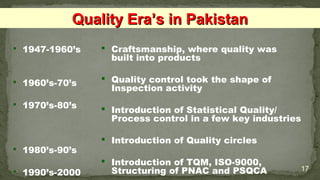
 1947-1960’s
 1960’s-70’s
 1970’s-80’s
 1980’s-90’s
 1990’s-2000 17
 Craftsmanship, where quality was
built into products
 Quality control took the shape of
Inspection activity
 Introduction of Statistical Quality/
Process control in a few key industries
 Introduction of Quality circles
 Introduction of TQM, ISO-9000,
Structuring of PNAC and PSQCA
Quality Era’s in PakistanQuality Era’s in Pakistan
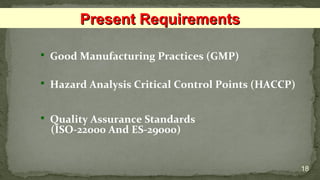
 Good Manufacturing Practices (GMP)
 Hazard Analysis Critical Control Points (HACCP)
 Quality Assurance Standards
(ISO-22000 And ES-29000)
18
Present RequirementsPresent Requirements
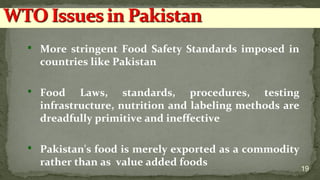
 More stringent Food Safety Standards imposed in
countries like Pakistan
 Food Laws, standards, procedures, testing
infrastructure, nutrition and labeling methods are
dreadfully primitive and ineffective
 Pakistan's food is merely exported as a commodity
rather than as value added foods
19
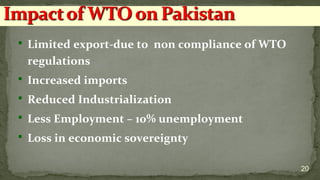
 Limited export-due to non compliance of WTO
regulations
 Increased imports
 Reduced Industrialization
 Less Employment – 10% unemployment
 Loss in economic sovereignty
20

WTO Trade Regulations

  • 1.
  • 2.
    WTO intends tosupervise and liberalize international trade The organization officially commenced on January 1, 1995 replacing the GATT (General Agreement on Tariffs and Trade) The World Trade Organization (WTO) is the only global international organization dealing with the rules of trade between the nations 2
  • 3.
    It tries toprovide market access to countries for their products and services and promotes friendly investment policies by eliminating: trade distortions between countries trimming down tariff and non-tariff barriers removing quotas abolishing subsidies in a phased manner WTO has rules to address quality issues, labor standards, environmental aspects, government regulation, and legal frameworks 3
  • 4.
    The need foran institution to promote rule based trade was felt when in 1930s world suffered through the Great Depression and World War II This economic issue started with the 1929 Stock Market Crash wiping out savings of people and creating unemployment of the highest level in Western World That great Depression further resulted into WWII and destroyed many European countries 4
  • 5.
    In January 1948,23 nations organized the GATT in Geneva providing opportunity to start the tariff negotiations This first round resulted in 45,000 tariff concessions affecting $10 billion (about 1/5th of the world trade) The WTO replaced GATT as the world's global trading body in 1995 GATT trading regulations established between 1947 and 1994 remain the primary rule book for multilateral trade in goods 5
  • 6.
     Raising standardsof living  Ensuring full employment  Expanding production of goods and services  Sustainable development  Securing share in trade of developing and least developed countries  Designing reciprocal and mutually advantageous arrangement directed to substantial reduction of discriminatory treatment in international trade relation 6
  • 7.
    Protection to DomesticIndustry through Tariffs Member countries can protect their domestic industry/production through tariffs only It prohibits the use of quantitative restrictions, except in a limited number of situations Binding of Tariffs The member countries are urged to eliminate protection to domestic industry/ production by reducing tariffs and removing other barriers to trade in multilateral trade negotiations 7
  • 8.
    Most Favored-Nation (MFN)Treatment  The rule lays down the principles of non-discrimination amongst member countries  Tariff and other regulations should be applied to imported or exported goods without discrimination among countries  Exceptions to the rules are to regional arrangements subjected to preferential or duty free trade agreements, Generalized System of Preferences (GSP) where developed countries apply preferential or duty free rates to imports from developing countries  4. National Treatment Rule  The rule prohibits member countries from discriminating between imported products and domestically produced goods in the matter of internal taxes and in the application of internal regulations. 8
  • 9.
    National Treatment Rule Therule prohibits member countries from discriminating between imported products and domestically produced goods in the matter of internal taxes and in the application of internal regulations 9
  • 10.
    At the heartof WTO are WTO agreements, negotiated and signed by a large number of the world’s trading nations and ratified by their parliaments Agreement on trade related aspect of intellectual property rights (TRIPS) Agreement on agriculture (AOA) Agreement on Sanitary and phytosanitary measures (SPS) Technical barriers to trade (TBT) agreement 10 WTO AgreementsWTO Agreements
  • 11.
     Intellectual propertyrights  Copyrights  Patent trade marks  Geographical names  Industrial designs  Trade secrets 11 Agreement on TRIPSAgreement on TRIPS
  • 12.
     Food safetythrough CAC  Plant health standards  Animal health standards specific towards;  Additives, contaminants and toxic substances in food  Pesticides & drug residues and MRL compliance 12 Agreement on Application of Sanitary andAgreement on Application of Sanitary and Phytosanitary Measures (SPS)Phytosanitary Measures (SPS)
  • 13.
     Food Certification(HACCP and GMP)  Labeling requirements  Plant and animal quarantine requirements  Disease and Pest control 13
  • 14.
     Inspection, testingand certification  Custom procedures  High custom duties  Violation of intellectual property rights  Investment restrictions 14 Technical Barriers to Trade (TBT)Technical Barriers to Trade (TBT)
  • 15.
     Indiscriminate useof pesticides and chemicals results residues in food  Food additives are creating toxicity  Chemicals generated during food processing- prolonged heating of fats generates carcinogens  Repeatedly deep fried foods are injurious to health 15
  • 16.
     Toxicity frompackaging material  Sewage, sludge, untreated industrial waste water polluting ground water and used for vegetable growing  Poultry, beef and mutton- feed additives, hormones and antibiotics  Clean water is unavailable to the masses 16
  • 17.
     1947-1960’s  1960’s-70’s 1970’s-80’s  1980’s-90’s  1990’s-2000 17  Craftsmanship, where quality was built into products  Quality control took the shape of Inspection activity  Introduction of Statistical Quality/ Process control in a few key industries  Introduction of Quality circles  Introduction of TQM, ISO-9000, Structuring of PNAC and PSQCA Quality Era’s in PakistanQuality Era’s in Pakistan
  • 18.
     Good ManufacturingPractices (GMP)  Hazard Analysis Critical Control Points (HACCP)  Quality Assurance Standards (ISO-22000 And ES-29000) 18 Present RequirementsPresent Requirements
  • 19.
     More stringentFood Safety Standards imposed in countries like Pakistan  Food Laws, standards, procedures, testing infrastructure, nutrition and labeling methods are dreadfully primitive and ineffective  Pakistan's food is merely exported as a commodity rather than as value added foods 19
  • 20.
     Limited export-dueto non compliance of WTO regulations  Increased imports  Reduced Industrialization  Less Employment – 10% unemployment  Loss in economic sovereignty 20

Editor's Notes

  • #14 Pesticides and Drug Residues have become a major concern relating the Food Sfety
  • #20 zSNMasdskcn