@Mineducacion
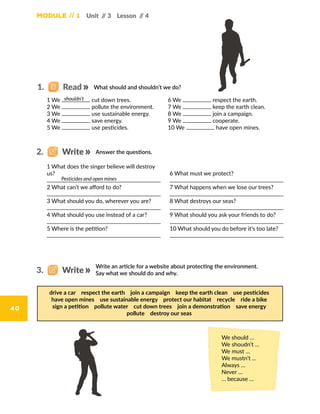
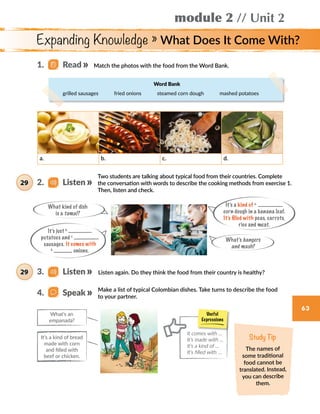
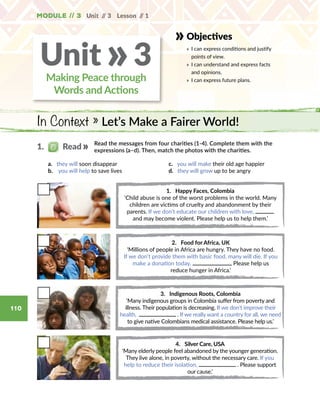
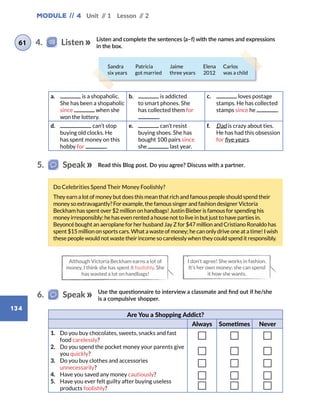
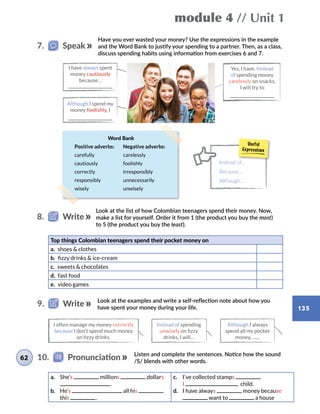
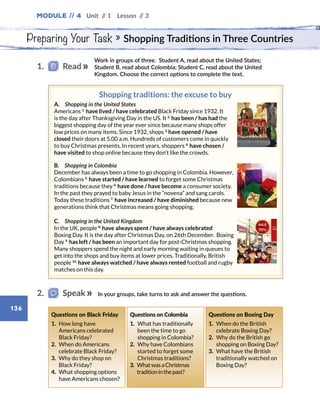
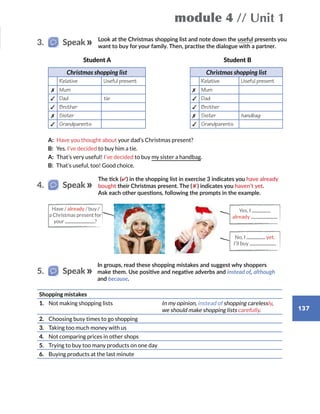
Ministerio de Educación Nacional
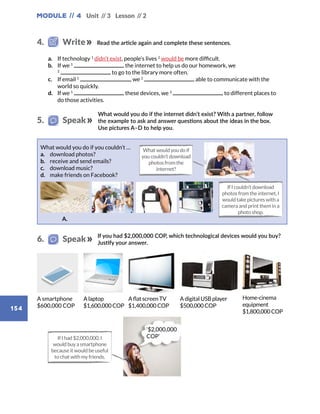
mineducacion_colombia
Ministerio de Educación Nacional
Calle 43 N.º 57-14
Centro Administrativo Nacional, CAN
Bogotá, D.C. - Colombia
Conmutador: (+571)2222800
Fax: (+571)2224953
Línea gratuita fuera de Bogotá: 01 8000 910122
2016
ISBN: 978-958-691-783-4
www.mieducacion.gov.co
www.colombiaaprende.edu.co/colombiabilingue
Student’s book
8th
grade
WAY TO GO 8.indd 1-3 29/12/16 16:58
Student’s Book
be completed in your own book, and not
in this book.
en este libro se deben realizar en un
cuaderno aparte, no en el libro.
JUAN MANUEL SANTOS CALDERÓN
Presidente de la República de Colombia
YANETH GIHA TOVAR
Ministra de Educación Nacional
VÍCTOR JAVIER SAAVEDRA MERCADO
Viceministro de Educación Preescolar, Básica y Media
PAOLA ANDREA TRUJILLO PULIDO
Directora de Calidad para la Educación Preescolar,
Básica y Media
ALFREDO OLAYA TORO
Subdirector de Fomento de Competencias (E)
ROSA MARÍA CELY HERRERA
Gerente Programa Colombia Bilingüe
Equipos técnicos
Ministerio de Educación Nacional
Colombia Bilingüe
Elena Urrutia Sánchez
Fressman Eduth Ávila
Marcela Forero Jiménez
Felipe Villalba
Mauricio Ríos
Juan Camilo Ortegón Sánchez- Gerente de Proyecto
Ricardo Romero Medina- Director Inglés
Miguel Ignacio Rodríguez Molano- Director Editorial
Carolina Cruz Corzo- Consultora Académica EES
Viviana Caicedo Triana- Coordinadora de Proyecto
Andrea Santos Castro- Asistente de Proyecto
Autores
Proceso pre-editorial
Mariluz Murcia Sierra; Luis Fernando Gómez
Jorge Quiroga
Ilustración y fotografía:
©2003-2016 Shutterstock, Archivo Santillana
Diseño de portada
Luisa Juliana Avella Vargas
Créditos fotográficos portada
Juan Gabriel Muñoz Duarte
Richmond, 58 St Aldate’s, Oxford, OX11ST, UK
Deborah Tricker, Luke Baxter
Richmond Colombia
Andrés Guerrero, Adriana Ramírez
Diseño:
Colaboradores de diseño: Luisa Juliana Avella Vargas,
Global Blended Learning, Colin Stobbart
Richmond design team: Lorna Heaslip, Dave Kuzmicki,
Magdalena Mayo
Edición:
Richmond editorial team:
Sue Ashcroft, Luke Baxter, Stephanie Bremner,
David Cole-Powney, Simone Foster, Fiona Hunt,
Jonathan Tasman, Deborah Tricker.
Colaboradores editoriales:
Manick Publishing S.L., Christina Broadbridge, Sarah Curtis,
Chloe Gathern, Ruth Goodman, Amanda Leigh, Stephanie
Parker, Claire Ransom, Sophie Sherlock, Rob Sved, Neil Wood
Chants:
Intelligent Audio
Vocalist: Georgina Jewson
Consultancy: Otto Baxter
© Ministerio de Educación Nacional (2016)
ISBN 978-958-xxxxxxxxx
Calle 43 No. 57-14 Piso 5, Bogotá D.C., Colombia
www.mineducacion.gov.co
Citación: Ministerio de Educación Nacional (2016)
XXXXXXXXXXX
Impresión:
Disponible en línea a través de la página:
www.colombiaaprende.edu.co/colombiabilingue
Todos los derechos reservados.
Prohibida la reproducción total o parcial, el registro o
la transmisión por cualquier medio de recuperación de
información, sin autorización previa del Ministerio de
Educación Nacional.
Bogotá, D. C. – Colombia
Coordinación Editorial:
JUAN MANUEL SANTOS CALDERÓN
Presidente de la República de Colombia
MINISTERIO DE EDUCACIÓN NACIONAL
YANETH GIHA
Ministra de Educación Nacional
VÍCTOR JAVIER SAAVEDRA MERCADO
Viceministro de Educación Preescolar, Básica y Media
PAOLA ANDREA TRUJILLO PULIDO
Directora de Calidad para la Educación Preescolar,
Básica y Media
ROSA MARÍA CELY HERRERA
Gerente Programa Colombia Bilingüe
Equipo técnico programa Colombia Bilingüe
Elena Urrutia Sánchez
Fressman Eduth Ávila
Marcela Forero Jiménez
Felipe Villalba Molano
Mauricio Ríos Delgado
British Council
Ricardo Romero Medina- Director Inglés
Juan Camilo Ortegón Sánchez- Gerente de Proyecto
Miguel Ignacio Rodríguez Molano- Director Editorial
Viviana Caicedo Triana- Coordinadora de Proyecto
Andrea Santos Castro- Asistente de Proyecto
Autores
Mariluz Murcia Sierra; Luis Fernando Gómez
Proceso pre-editorial
Jorge Quiroga
Ilustración y fotografía:
©2003-2016 Shutterstock, Archivo Santillana
Diseño de portada
Luisa Juliana Avella Vargas
Créditos fotográficos portada
Juan Gabriel Muñoz Duarte
Coordinación Editorial:
Richmond, 58 St Aldate’s, Oxford, OX11ST, UK
Deborah Tricker, Luke Baxter
Richmond Colombia
Andrés Guerrero, Adriana Ramírez
Diseño:
Colaboradores de diseño: Luisa Juliana Avella Vargas,
Global Blended Learning, Colin Stobbart
Equipo de diseño Richmond: Lorna Heaslip, Dave Kuzmicki,
Magdalena Mayo
Edición:
Equipo editorial Richmond:
Sue Ashcroft, Luke Baxter, Stephanie Bremner,
David Cole-Powney, Simone Foster, Fiona Hunt,
Jonathan Tasman, Deborah Tricker.
Colaboradores editoriales:
Manick Publishing S.L., Christina Broadbridge, Sarah Curtis,
Chloe Gathern, Ruth Goodman, Amanda Leigh, Stephanie
Parker, Claire Ransom, Sophie Sherlock, Rob Sved, Neil
Wood
Cántico: Intelligent Audio
Vocalista: Georgina Jewson
Consultoría: Otto Baxter
© Ministerio de Educación Nacional (2016)
ISBN 978-958-691-942-5
Calle 43 No. 57-14 Piso 5, Bogotá D.C., Colombia
www.mineducacion.gov.co
Citación: Ministerio de Educación Nacional (2016).
Way to go! 8th Grade. Bogotá D.C. - Colombia
Impresión:
Disponible en línea a través de la página:
www.colombiaaprende.edu.co/colombiabilingue
Todos los derechos reservados.
Prohibida la reproducción total o parcial, el registro o
la transmisión por cualquier medio de recuperación de
información, sin autorización previa del Ministerio de
Educación Nacional.
Bogotá, D. C. – Colombia
3
Respetada comunidad educativa,
Una de las metas del Ministerio de Educación Nacional es impulsar políticas acordes
con el Plan Nacional de Desarrollo 2014-2018 “Todos por un nuevo país”, que generen
un impacto positivo en la sociedad y en el mejoramiento de la calidad educativa,
impactando los tres pilares del actual gobierno: paz, equidad y educación. El gran reto
es convertirnos en el país mejor educado de América Latina en el año 2025.
Con el propósito de materializar dichas políticas, el Ministerio de Educación cuenta
con programas como Colombia Bilingüe, cuyo objetivo fundamental es lograr que
nuestras niñas, niños y jóvenes se comuniquen más y mejor en inglés y, de esta manera,
facilitar su acceso a nuevas oportunidades profesionales, laborales y culturales.
En este sentido, nos complace presentarle al país la serie de textos de inglés Way to
go!, dirigida a los estudiantes y docentes de los grados sexto (6º), séptimo (7º) y octavo
(8º) de educación básica secundaria, materiales enfocados en cuatro ejes temáticos
transversales: Democracia y Paz, Salud, Medio Ambiente y Globalización.
Los textos Way to go! fueron desarrollados bajo el enfoque comunicativo y las
metodologías de aprendizaje por tareas y proyectos, y se encuentran alineados con
el Currículo Sugerido de Inglés para grados de sexto (6º) a once (11º) y con la Cartilla
de los Derechos Básicos de Aprendizaje de Inglés. De esta manera, contribuimos
al desarrollo de las habilidades del Siglo XXI de los estudiantes, futuros ciudadanos
críticos, autónomos, seguros y mejor preparados para enfrentarse a retos académicos y
profesionales, para que puedan aprovechar los desafíos y las oportunidades del mundo
moderno.
Agradecemos el esfuerzo de los Secretarios de Educación, rectores, estudiantes y
padres de familia y, especialmente, a los docentes colombianos, quienes son el eje
de los procesos pedagógicos y de la calidad de la educación. !Lograr una Colombia
bilingüe es una meta de todos!
Ministerio de Educación Nacional
4
Dear eighth grade students,
Welcome, this is the Way to go!
The Colombian Ministry of Education, through its Colombia Bilingüe program,
is pleased to introduce Way to go! , the series of textbooks created to support your
English learning process for sixth (6th), seventh (7th), and eighth (8th) grades. With
this textbook, you will be able to learn English in a fun and dynamic way, and to
express yourself in English with your teachers, classmates, and friends. This material
will guide you through innovative topics related to the Colombian culture and that
in other countries by means of varied tasks and projects which integrate 21st century
skills, created to prepare you for a globalized world.
“Way to go!” is an expression that means you have done something well and that you
are proud of your progress; as this is your first year in secondary school, you will need
great materials to achieve that goal. The Way to Go! resources for eighth (8th) grade
will help you learn English in an effective way in and out of class:
1.	The student’s book: for you to learn when you are in class (Please do not write on it,
because other students will use this book next year)
2.	Your workbook: for you to have extra practice in class or at home (Yes, you can write
on it!)
3.	Audio tracks: for you to practice listening on the Colombia Bilingüe website* at your
own pace
4.	Interactive games: for you to play and learn at the same time*
5.	Interactive/digital version of the materials: for you to download or check online*
In this series, you will find four (4) modules that will help you learn English while you
discuss diverse topics like culture, health, democracy and peace, environment, and
global citizenship, among many more. These topics have been selected thinking about
the next generation of Colombian people living in peace and connecting with each
other in English.
We hope you enjoy learning English with your new textbooks, and that you are eager
to see the English language as a tool that will open great opportunities today, and in
the future.
Welcome to this new adventure of interacting in English with the world! This is the Way
to go!
*You can find the digital/interactive materials of the Way to go! series on the Colombia Bilingüe official
website: www.colombiaaprende.edu.co/colombiabilingue
5
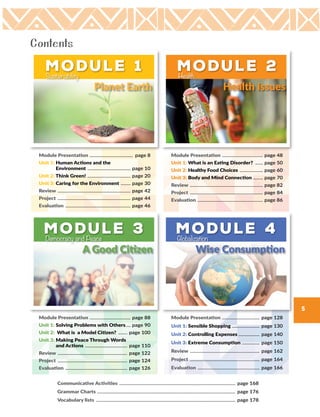
Module 3
A Good Citizen
Democracy and Peace
Module Presentation ...................................... page 88
Unit 1: Solving Problems with Others..... page 90
Unit 2: What is a Model Citizen? ......... page 100
Unit 3: Making Peace Through Words
and Actions ....................................... page 110
Review ................................................................ page 122
Project ................................................................ page 124
Evaluation ......................................................... page 126
Module 4
Wise Consumption
Globalization
Module Presentation ................................... page 128
Unit 1: Sensible Shopping .......................... page 130
Unit 2: Controlling Expenses .................... page 140
Unit 3: Extreme Consumption ................. page 150
Review ................................................................ page 162
Project ................................................................ page 164
Evaluation ......................................................... page 166
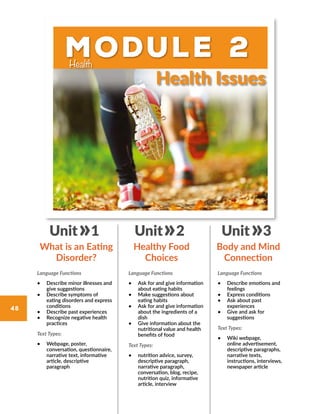
Module 2
Health Issues
Health
Module Presentation ...................................... page 48
Unit 1: What is an Eating Disorder? ........ page 50
Unit 2: Healthy Food Choices ...................... page 60
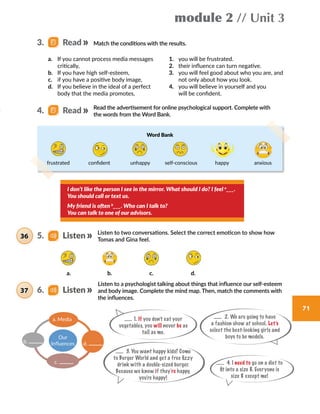
Unit 3: Body and Mind Connection ......... page 70
Review ................................................................... page 82
Project ................................................................... page 84
Evaluation ............................................................ page 86
Module 1
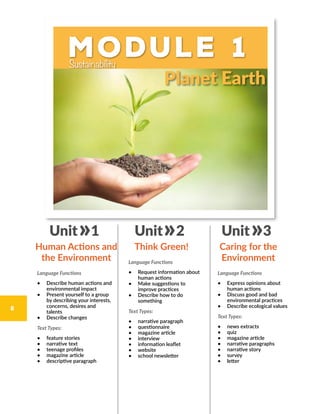
Planet Earth
Sustainability
Module Presentation ........................................ page 8
Unit 1: Human Actions and the
Environment ........................................ page 10
Unit 2: Think Green! ........................................ page 20
Unit 3: Caring for the Environment .......... page 30
Review ................................................................... page 42
Project ................................................................... page 44
Evaluation ............................................................ page 46
Communicative Activities .......................................................................................................... page 168
Grammar Charts .............................................................................................................................. page 176
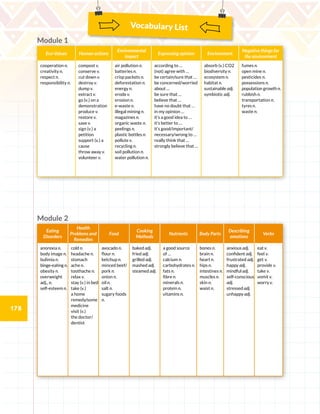
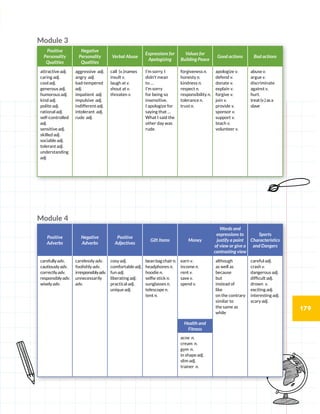
Vocabulary lists ............................................................................................................................... page 178
Contents
6
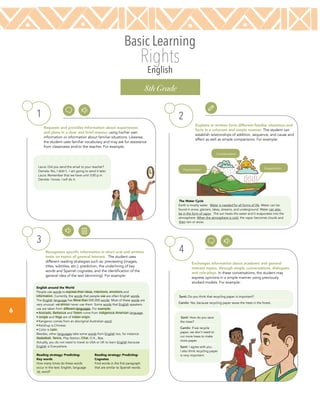
Basic Learning
Rights
English
8th Grade
1
Requests and provides information about experiences
and plans in a clear and brief manner using his/her own
information or information about familiar situations. Likewise,
the student uses familiar vocabulary and may ask for assistance
from classmates and/or the teacher. For example:
Recognizes specific information in short oral and written
texts on topics of general interest. The student uses
different reading strategies such as: previewing (images,
titles, subtitles, etc.), prediction, the underlining of key
words and Spanish cognates, and the identification of the
general idea of the text (skimming). For example:
Explains in written form different familiar situations and
facts in a coherent and simple manner. The student can
establish relationships of addition, sequence, and cause and
effect as well as simple comparisons. For example:
Exchanges information about academic and general
interest topics, through simple conversations, dialogues,
and role-plays. In these conversations, the student may
express opinions in a simple manner using previously
studied models. For example:
3
2
4
Laura: Did you send the email to your teacher?
Daniela: No, I didn’t. I am going to send it later.
Laura: Remember that we have until 3:00 p.m.
Daniela: I know. I will do it.
Santi: Do you think that recycling paper is important?
Camilo: Yes, because recycling paper saves the trees in the forest.
English around the World
People use words to express their ideas, intentions, emotions and
information. Currently, the words that people use are often English words.
The English language has More than 500.000 words. Most of these words are
very unusual: we almost never use them. Some words that English speakers
use are taken from different languages. For example:
• Avocado, Barbecue and Totem come from indigenous American language.
• Jungle and Yoga are of Indian origin.
• Kangaroo comes from an aboriginal Australian word.
• Ketchup is Chinese.
• Color is Latin.
Besides, other languages take some words from English too, for instance:
Basketball, Tennis, Play Station, Chat, O.K., Bye.
Actually, you do not need to travel to USA or UK to learn English because
English is Everywhere.
Reading strategy: Predicting:
Key words
How many times do these words
occur in the text: English, language
(s), word?
Reading strategy: Predicting:
Cognates
Find words in the first paragraph
that are similar to Spanish words.
Santi: How do you save
the trees?
Camilo: If we recycle
paper, we don’t need to
cut more trees to make
more paper.
Santi: I agree with you.
I also think recycling paper
is very important.
Precipitation
Condensation
Evaporation
The Water Cycle
Earth is mostly water. Water is needed for all forms of life. Water can be
found in snow, glaciers, lakes, streams, and underground. Water can also
be in the form of vapor. The sun heats the water and it evaporates into the
atmosphere. When the atmosphere is cold, the vapor becomes clouds and
then rain or snow.
7
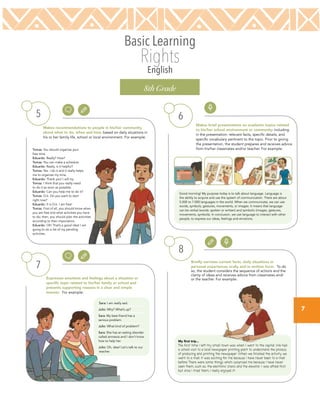
Basic Learning
Rights
English
8th Grade
5
Makes recommendations to people in his/her community
about what to do, when and how, based on daily situations in
his or her family life, school or local environment. For example:
Expresses emotions and feelings about a situation or
specific topic related to his/her family or school and
presents supporting reasons in a clear and simple
manner. For example:
Makes brief presentations on academic topics related
to his/her school environment or community including
in the presentation: relevant facts, specific details, and
specific vocabulary pertinent to the topic. Prior to giving
the presentation, the student prepares and receives advice
from his/her classmates and/or teacher. For example:
Briefly narrates current facts, daily situations or
personal experiences orally and in written form. To do
so, the student considers the sequence of actions and the
clarity of ideas and receives advice from classmates and/
or the teacher. For example:
7
6
8
Tomas: You should organize your
free time.
Eduardo: Really? How?
Tomas: You can make a schedule.
Eduardo: Really, is it helpful?
Tomas: Yes. I do it and it really helps
me to organize my time.
Eduardo: Thank you! I will try.
Tomas: I think that you really need
to do it as soon as possible.
Eduardo: Can you help me to do it?
Tomas: O.k. Do you want to start
right now?
Eduardo: It is O.k. I am free!
Tomas: First of all, you should know when
you are free and what activities you have
to do; then, you should plan the activities
according to their importance.
Eduardo: Oh! That’s a good idea! I am
going to do a list of my pending
activities.
Good morning! My purpose today is to talk about language. Language is
the ability to acquire and use the system of communication. There are about
5.000 to 7.000 languages in the world. When we communicate, we can use
words, symbols, gestures, movements, or images. It means that language
can be verbal (words: spoken or written) and symbolic (images, gestures,
movements, symbols). In conclusion, we use language to interact with other
people, to express our ideas, feelings and emotions.
Sara: I am really sad.
Julio: Why? What’s up?
Sara: My best friend has a
serious problem.
Julio: What kind of problem?
Sara: She has an eating disorder
called anorexia and I don’t know
how to help her.
Julio: Oh, dear! Let´s talk to our
teacher.
My first trip...
The first time I left my small town was when I went to the capital. We had
a school visit to a local newspaper printing plant to understand the process
of producing and printing the newspaper. When we finished the activity, we
went to a mall. It was exciting for me because I have never been to a mall
before. There were some things which surprised me because I have never
seen them, such as: the electronic stairs and the elevator. I was afraid first
but once I tried them, I really enjoyed it!
Module 1Sustainability
Language Functions
•	 Describe human actions and
environmental impact
•	 Present yourself to a group
by describing your interests,
concerns, desires and
talents
•	 Describe changes
Text Types:
•	 feature stories
•	 narrative text
•	 teenage profiles
•	 magazine article
•	 descriptive paragraph
Language Functions
•	 Request information about
human actions
•	 Make suggestions to
improve practices
•	 Describe how to do
something
Text Types:
•	 narrative paragraph
•	 questionnaire
•	 magazine article
•	 interview
•	 information leaflet
•	 website
•	 school newsletter
Language Functions
•	 Express opinions about
human actions
•	 Discuss good and bad
environmental practices
•	 Describe ecological values
Text Types:
•	 news extracts
•	 quiz
•	 magazine article
•	 narrative paragraphs
•	 narrative story
•	 survey
•	 letter
Human Actions and
the Environment
Think Green! Caring for the
Environment
Unit 1 Unit 2 Unit 3
Planet Earth
8
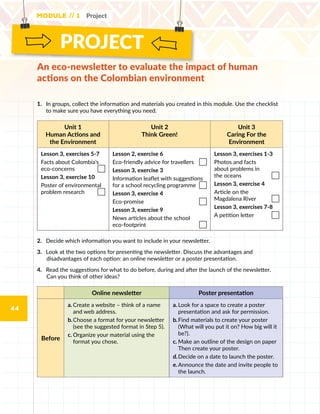
Project: An Eco-newsletter
In this module you will work in groups to prepare a formal presentation.
Unit 1 Unit 2 Unit 3
1.	 Facts about Colombia’s
eco-concerns
(Lesson 3,
exercises 5–7)
2.	 Poster of
environmental problem
research (Lesson 3,
exercise 9b)
3.	 Eco-friendly advice for
travellers (Lesson 2,
exercise 6)
4.	 Information leaflet with
suggestions for a school
recycling programme
(Lesson 3, exercise 3)
5.	 Eco-promise (Lesson 3,
exercise 4)
6.	 News articles about the
school eco-footprint
(Lesson 3, exercise 9)
7.	 Photos and facts about problems
in the oceans (Lesson 3,
exercise 1)
8.	 Article on the Magdalena River
(Lesson 3, exercise 5)
9.	 A petition letter (Lesson 3,
exercise 8)
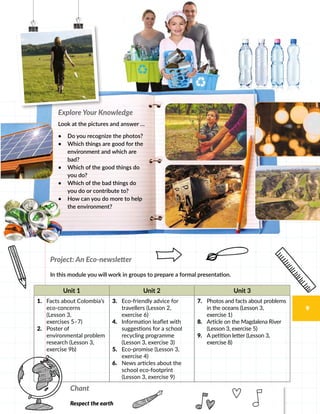
Explore Your Knowledge
Look at the pictures and answer …
•	 Do you recognize the photos?
•	 Which things are good for the
environment and which are
bad?
•	 Which of the good things do
you do?
•	 Which of the bad things do
you do or contribute to?
•	 How can you do more to help
the environment?
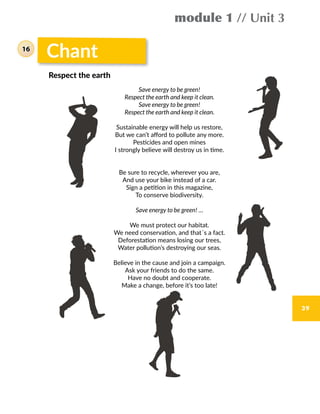
Chant
Respect the earth
9
Unit // 1 Lesson // 1
10
Module // 1
Objectives
»	 I can describe human actions that affect
the environment.
»	 I can present myself: my interests,
concerns, desires and talents.
» 	I can describe changes between the past
and the present.
In Context » Environmental Concerns
Human Actions and
the Environment
Unit 1»
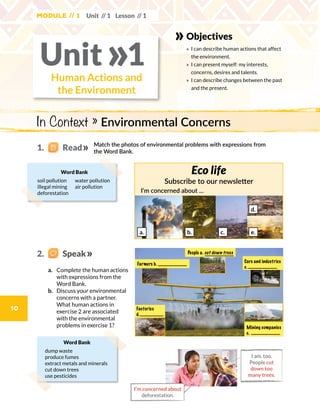
Match the photos of environmental problems with expressions from
the Word Bank.
Word Bank
soil pollution	 water pollution
illegal mining	 air pollution
deforestation
Word Bank
dump waste
produce fumes	
extract metals and minerals	
cut down trees
use pesticides
a.	 Complete the human actions
with expressions from the
Word Bank.
b.	 Discuss your environmental
concerns with a partner.
What human actions in
exercise 2 are associated
with the environmental
problems in exercise 1?
I’m concerned about ...
Subscribe to our newsletter
Eco life
I’m concerned about
deforestation.
I am, too.
People cut
down too
many trees.
1.   Read
2.    Speak
Farmers b.
Mining companies
e.
a. b. c.
d.
e.
People a. cut down trees
Cars and industries
c.
Factories
d.
module 1 // Unit 1
11
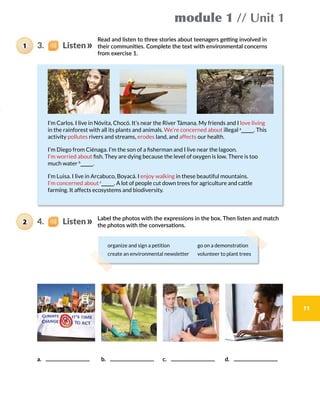
Read and listen to three stories about teenagers getting involved in
their communities. Complete the text with environmental concerns
from exercise 1.
Label the photos with the expressions in the box. Then listen and match
the photos with the conversations.
I’m Carlos. I live in Nóvita, Chocó. It’s near the River Támana. My friends and I love living
in the rainforest with all its plants and animals. We’re concerned about illegal a
. This
activity pollutes rivers and streams, erodes land, and affects our health.
I’m Diego from Ciénaga. I’m the son of a fisherman and I live near the lagoon.
I’m worried about fish. They are dying because the level of oxygen is low. There is too
much water b
.
I’m Luisa. I live in Arcabuco, Boyacá. I enjoy walking in these beautiful mountains.
I’m concerned about c
. A lot of people cut down trees for agriculture and cattle
farming. It affects ecosystems and biodiversity.
a.     b.    c.     d. 
organize and sign a petition go on a demonstration
create an environmental newsletter volunteer to plant trees
3.    Listen1
4.    Listen2
Module // 1 Unit // 1 Lesson // 1
12
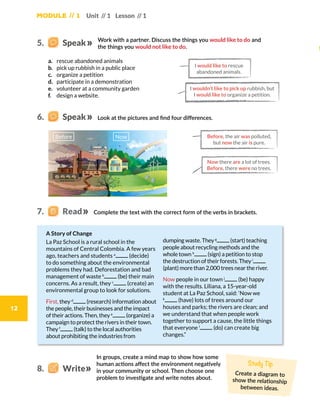
a.	 rescue abandoned animals
b.	 pick up rubbish in a public place
c.	 organize a petition
d.	 participate in a demonstration
e.	 volunteer at a community garden
f.	 design a website.
Complete the text with the correct form of the verbs in brackets.
Work with a partner. Discuss the things you would like to do and
the things you would not like to do.
Look at the pictures and find four differences.
A Story of Change
La Paz School is a rural school in the
mountains of Central Colombia. A few years
ago, teachers and students a
(decide)
to do something about the environmental
problems they had. Deforestation and bad
management of waste b
(be) their main
concerns. As a result, they c
(create) an
environmental group to look for solutions.
First, they d
(research) information about
the people, their businesses and the impact
of their actions. Then, they e
(organize) a
campaign to protect the rivers in their town.
They f
(talk) to the local authorities
about prohibiting the industries from
dumping waste. They g
(start) teaching
people about recycling methods and the
whole town h
(sign) a petition to stop
the destruction of their forests. They i
(plant) more than 2,000 trees near the river.
Now people in our town j
(be) happy
with the results. Liliana, a 15-year-old
student at La Paz School, said: ‘Now we
k
(have) lots of trees around our
houses and parks; the rivers are clean; and
we understand that when people work
together to support a cause, the little things
that everyone l
(do) can create big
changes.”
I wouldn’t like to pick up rubbish, but
I would like to organize a petition.
I would like to rescue
abandoned animals.
Now there are a lot of trees.
Before, there were no trees.
Before, the air was polluted,
but now the air is pure.
5.    Speak
6.    Speak
7.   Read
Before Now
In groups, create a mind map to show how some
human actions affect the environment negatively
in your community or school. Then choose one
problem to investigate and write notes about.
8.    Write
Study Tip
Create a diagram to
show the relationship
between ideas.
module 1 // Unit 1
13
Expanding Knowledge » Working for a Cause!
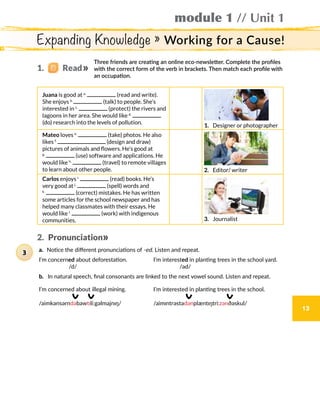
Three friends are creating an online eco-newsletter. Complete the profiles
with the correct form of the verb in brackets. Then match each profile with
an occupation.
Juana is good at a.
(read and write).
She enjoys b.
(talk) to people. She’s
interested in c.
(protect) the rivers and
lagoons in her area. She would like d.
(do) research into the levels of pollution.
1.  Designer or photographer
Mateo loves e.
(take) photos. He also
likes f.
(design and draw)
pictures of animals and flowers. He’s good at
g.
(use) software and applications. He
would like h.
(travel) to remote villages
to learn about other people. 2.  Editor/ writer
Carlos enjoys i.
(read) books. He’s
very good at j.
(spell) words and
k.
(correct) mistakes. He has written
some articles for the school newspaper and has
helped many classmates with their essays. He
would like l.
(work) with indigenous
communities. 3.  Journalist
2.  Pronunciation
1.   Read
3
Module // 1 Unit // 1 Lesson // 2
14
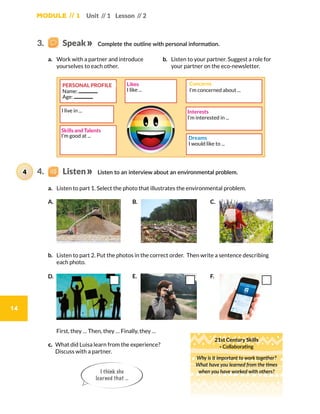
a.	 Listen to part 1. Select the photo that illustrates the environmental problem.
A. B. C.
First, they … Then, they … Finally, they …
Listen to an interview about an environmental problem.4.    Listen4
Complete the outline with personal information.
a.	 Work with a partner and introduce
yourselves to each other.
3.    Speak
c. What did Luisa learn from the experience?
Discuss with a partner.
21st Century Skills
· Collaborating
Why is it important to work together?
What have you learned from the times
when you have worked with others?I think she
learned that …
b.	 Listen to part 2. Put the photos in the correct order. Then write a sentence describing
each photo.
D. E. F.
b.	 Listen to your partner. Suggest a role for
your partner on the eco-newsletter.
Name:
Age:
PERSONAL PROFILE
I’m concerned about ...
Concerns
I would like to ...
Dreams
I’m interested in ...
Interests
I’m good at ...
Skills and Talents
Likes
I like ...
I live in ...
module 1 // Unit 1
15
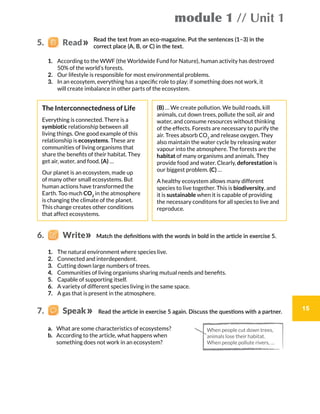
Read the text from an eco-magazine. Put the sentences (1–3) in the
correct place (A, B, or C) in the text.
1.	 According to the WWF (the Worldwide Fund for Nature), human activity has destroyed
50% of the world’s forests.
2.	 Our lifestyle is responsible for most environmental problems.
3.	 In an ecosytem, everything has a specific role to play: if something does not work, it
will create imbalance in other parts of the ecosystem.
The Interconnectedness of Life
Everything is connected. There is a
symbiotic relationship between all
living things. One good example of this
relationship is ecosystems. These are
communities of living organisms that
share the benefits of their habitat. They
get air, water, and food. (A) …
Our planet is an ecosystem, made up
of many other small ecosystems. But
human actions have transformed the
Earth. Too much CO2
in the atmosphere
is changing the climate of the planet.
This change creates other conditions
that affect ecosystems.
(B) … We create pollution. We build roads, kill
animals, cut down trees, pollute the soil, air and
water, and consume resources without thinking
of the effects. Forests are necessary to purify the
air. Trees absorb CO2
and release oxygen. They
also maintain the water cycle by releasing water
vapour into the atmosphere. The forests are the
habitat of many organisms and animals. They
provide food and water. Clearly, deforestation is
our biggest problem. (C) …
A healthy ecosystem allows many different
species to live together. This is biodiversity, and
it is sustainable when it is capable of providing
the necessary conditons for all species to live and
reproduce.
5.   Read
1.	 The natural environment where species live.
2.	 Connected and interdependent.
3.	 Cutting down large numbers of trees.
4.	 Communities of living organisms sharing mutual needs and benefits.
5.	 Capable of supporting itself.
6.	 A variety of different species living in the same space.
7.	 A gas that is present in the atmosphere.
Match the definitions with the words in bold in the article in exercise 5.6.    Write
Read the article in exercise 5 again. Discuss the questions with a partner.
a.	 What are some characteristics of ecosystems?
b.	 According to the article, what happens when
something does not work in an ecosystem?
7.    Speak
When people cut down trees,
animals lose their habitat.
When people pollute rivers, …
Module // 1 Unit // 1 Lesson // 3
16
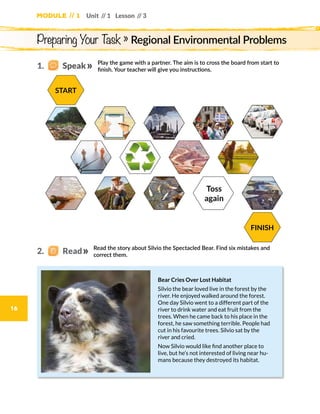
Preparing Your Task » Regional Environmental Problems
Play the game with a partner. The aim is to cross the board from start to
finish. Your teacher will give you instructions.
1.    Speak
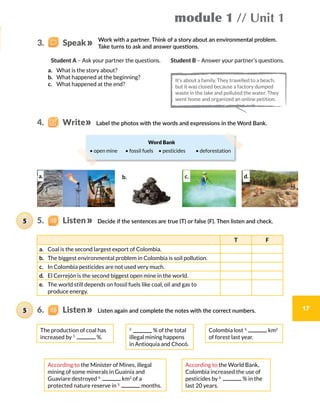
Read the story about Silvio the Spectacled Bear. Find six mistakes and
correct them.
Bear Cries Over Lost Habitat
Silvio the bear loved live in the forest by the
river. He enjoyed walked around the forest.
One day Silvio went to a different part of the
river to drink water and eat fruit from the
trees. When he came back to his place in the
forest, he saw something terrible. People had
cut in his favourite trees. Silvio sat by the
river and cried.
Now Silvio would like find another place to
live, but he’s not interested of living near hu-
mans because they destroyed its habitat.
2.   Read
START
FINISH
Toss
again
module 1 // Unit 1
17
Work with a partner. Think of a story about an environmental problem.
Take turns to ask and answer questions.
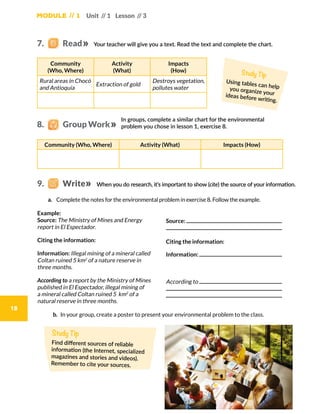
Label the photos with the words and expressions in the Word Bank.
Decide if the sentences are true (T) or false (F). Then listen and check.
Student A – Ask your partner the questions.
a.	 What is the story about?
b.	 What happened at the beginning?
c.	 What happened at the end?
Student B – Answer your partner’s questions.
The production of coal has
increased by 1.
%.
Colombia lost 3.
km2
of forest last year.
2.
% of the total
illegal mining happens
in Antioquia and Chocó.
According to the Minister of Mines, illegal
mining of some minerals in Guainía and
Guaviare destroyed 4.
km2
of a
protected nature reserve in 5.
months.
According to the World Bank,
Colombia increased the use of
pesticides by 6.
% in the
last 20 years.
T F
a.	 Coal is the second largest export of Colombia.
b.	 The biggest environmental problem in Colombia is soil pollution.
c.	 In Colombia pesticides are not used very much.
d.	 El Cerrejón is the second biggest open mine in the world.
e.	 The world still depends on fossil fuels like coal, oil and gas to
produce energy.
Word Bank
• open mine   • fossil fuels  • pesticides   • deforestation
4.    Write
5.    Listen5
It’s about a family. They travelled to a beach,
but it was closed because a factory dumped
waste in the lake and polluted the water. They
went home and organized an online petition.
3.    Speak
a. c. d.b.
Listen again and complete the notes with the correct numbers.6.    Listen5
Module // 1 Unit // 1 Lesson // 3
18
Your teacher will give you a text. Read the text and complete the chart.
In groups, complete a similar chart for the environmental
problem you chose in lesson 1, exercise 8.
When you do research, it’s important to show (cite) the source of your information.
8.    Group Work
Community
(Who, Where)
Activity
(What)
Impacts
(How)
Rural areas in Chocó
and Antioquia
Extraction of gold
Destroys vegetation,
pollutes water
Community (Who, Where) Activity (What) Impacts (How)
Study Tip
Using tables can helpyou organize yourideas before writing.
Example:
Source: The Ministry of Mines and Energy
report in El Espectador.
Citing the information:
Information: Illegal mining of a mineral called
Coltan ruined 5 km2
of a nature reserve in
three months.
According to a report by the Ministry of Mines
published in El Espectador, illegal mining of
a mineral called Coltan ruined 5 km2
of a
natural reserve in three months.
Source:
Citing the information:
Information:
According to
a.	 Complete the notes for the environmental problem in exercise 8. Follow the example.
b.  In your group, create a poster to present your environmental problem to the class.
Study Tip
Find different sources of reliable
information (the Internet, specialized
magazines and stories and videos).
Remember to cite your sources.
7.   Read
9.    Write
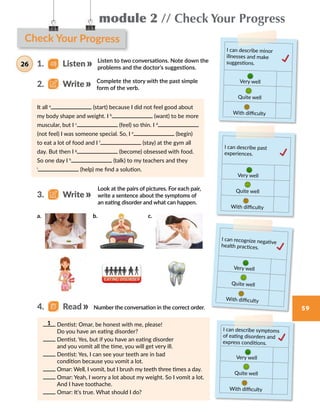
Check Your Progress
module 1 // Check Your Progress
19
Listen to Juana and Marcos talking about their
environmental concerns. Complete the chart.
Complete the texts with the human actions.
Complete the article with the correct form
of the verb in brackets.
What are
they concerned
about?
What would
they like
to do?
What are they
good at?
Juana She’s concerned
about the pollution
in her city.
Marcos
Industries
and toxins in rivers.
When people
, they
kill vegetation and
damage the soil.
When people
,
many animals
lose their habitat.
I can describe
human actions
that affect the
environment
Very well
Quite well
With difficulty
I can describe
changes between
the past and the
present
Very well
Quite well
With difficulty
National Park Is Closed
The National Park was a beautiful place to go hiking. You could
see many different plants and animals there. The trees 1.
(be) very tall and very old. Things changed when an illegal mining
business came to the park. They 2.
(start) an open
mine and quickly cut down most of the trees near the river. They
3.
(want) to extract some important and valuable minerals.
Sadly, the local authorities 4.
(be) not interested in taking
care of the park. Time passed and many more illegal miners came.
They 5.
(pollute) the water with mercury and other toxic
substances.
Now, some environmental groups 6.
(be)
concerned about the problem. But it may be too late.
The damage from the illegal mining is irreparable.
The soil in the affected areas will never regenerate.
I can present myself: my
interests, concerns,
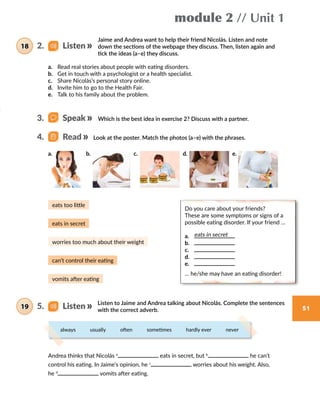
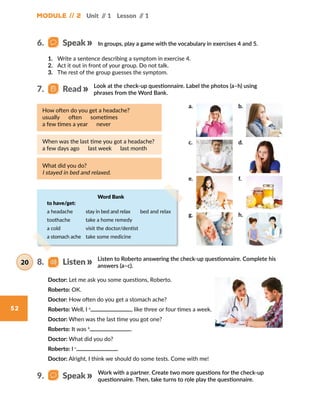
desires and talents.
Very well
Quite well
With difficulty
1.    Listen6
Industries DeforestationAgriculture
2.    Write
3.    Write
20
Module // 1 Unit // 2 Lesson // 1
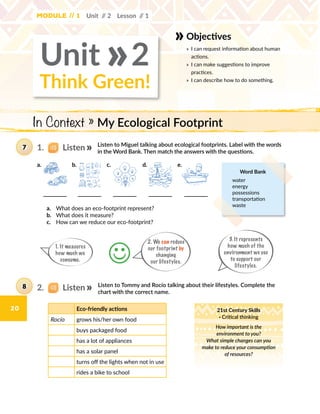
Listen to Miguel talking about ecological footprints. Label with the words
in the Word Bank. Then match the answers with the questions.
7
Listen to Tommy and Rocío talking about their lifestyles. Complete the
chart with the correct name.
a.	 What does an eco-footprint represent?
b.	 What does it measure?
c.	 How can we reduce our eco-footprint?
Word Bank
water
energy
possessions
transportation
waste
3. It represents
how much of the
environment we use
to support our
lifestyles.
2. We can reduce
our footprint by
changing
our lifestyles.
1. It measures
how much we
consume. J
8
1.   Listen
2.   Listen
Think Green!
Unit 2
Objectives
»	 I can request information about human
actions.
»	 I can make suggestions to improve
practices.
»	 I can describe how to do something.
»
In Context » My Ecological Footprint
Eco-friendly actions
Rocío grows his/her own food
buys packaged food
has a lot of appliances
has a solar panel
turns off the lights when not in use
rides a bike to school
21st Century Skills
· Critical thinking
How important is the
environment to you?
What simple changes can you
make to reduce your consumption
of resources?
c.b. e.a. d.
module 1 // Unit 2
21
3.   Read
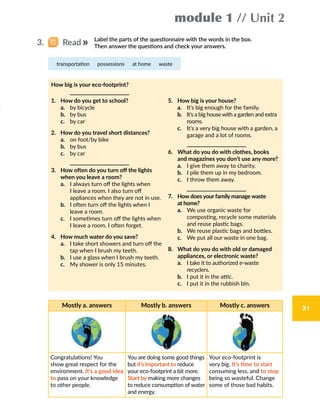
Mostly a. answers Mostly b. answers Mostly c. answers
Congratulations! You
show great respect for the
environment. It’s a good idea
to pass on your knowledge
to other people.
You are doing some good things
but it’s important to reduce
your eco-footprint a bit more.
Start by making more changes
to reduce consumption of water
and energy.
Your eco-footprint is
very big. It’s time to start
consuming less, and to stop
being so wasteful. Change
some of those bad habits.
Label the parts of the questionnaire with the words in the box.
Then answer the questions and check your answers.
transportation  possessions  at home  waste
How big is your eco-footprint?
	
1.	 How do you get to school?
	 a.	 by bicycle
	 b.	 by bus
	 c.	 by car
2.	 How do you travel short distances?
	 a.	 on foot/by bike
	 b.	 by bus
	 c.	 by car
		
3.	How often do you turn off the lights
when you leave a room?
	 a.	 I always turn off the lights when
I leave a room. I also turn off
appliances when they are not in use.
	 b.	 I often turn off the lights when I
leave a room.
	 c.	 I sometimes turn off the lights when
I leave a room. I often forget.
4.	 How much water do you save?
	 a.	 I take short showers and turn off the
tap when I brush my teeth.
	 b.	 I use a glass when I brush my teeth.
	 c.	 My shower is only 15 minutes.
5.	 How big is your house?
	 a.	 It’s big enough for the family.
	 b.	 It’s a big house with a garden and extra
rooms.
	 c.	 It’s a very big house with a garden, a
garage and a lot of rooms.
		
6.	What do you do with clothes, books
and magazines you don’t use any more?
	 a.	 I give them away to charity.
	 b.	 I pile them up in my bedroom.
	 c.	 I throw them away.
		
7.	How does your family manage waste
at home?
	 a.	We use organic waste for
composting, recycle some materials
and reuse plastic bags.  
	 b.	 We reuse plastic bags and bottles.
	 c.	 We put all our waste in one bag.
8.	What do you do with old or damaged
appliances, or electronic waste?
	 a.	I take it to authorized e-waste
recyclers.
	 b.	 I put it in the attic.
	 c.	 I put it in the rubbish bin.
Module // 1 Unit // 2 Lesson // 1
22
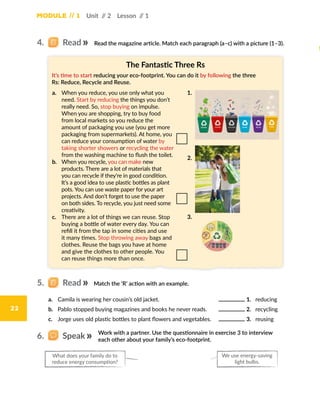
Read the magazine article. Match each paragraph (a–c) with a picture (1–3).
Match the ‘R’ action with an example.
Work with a partner. Use the questionnaire in exercise 3 to interview
each other about your family’s eco-footprint.
The Fantastic Three Rs
It’s time to start reducing your eco-footprint. You can do it by following the three
Rs: Reduce, Recycle and Reuse.
a.	 When you reduce, you use only what you
need. Start by reducing the things you don’t
really need. So, stop buying on impulse.
When you are shopping, try to buy food
from local markets so you reduce the
amount of packaging you use (you get more
packaging from supermarkets). At home, you
can reduce your consumption of water by
taking shorter showers or recycling the water
from the washing machine to flush the toilet.
b.	 When you recycle, you can make new
products. There are a lot of materials that
you can recycle if they’re in good condition.
It’s a good idea to use plastic bottles as plant
pots. You can use waste paper for your art
projects. And don’t forget to use the paper
on both sides. To recycle, you just need some
creativity.
c.	 There are a lot of things we can reuse. Stop
buying a bottle of water every day. You can
refill it from the tap in some cities and use
it many times. Stop throwing away bags and
clothes. Reuse the bags you have at home
and give the clothes to other people. You
can reuse things more than once.
1.
3.
2.
a.	 Camila is wearing her cousin’s old jacket.
b.	 Pablo stopped buying magazines and books he never reads.
c.	 Jorge uses old plastic bottles to plant flowers and vegetables.
1. reducing
2. recycling
3. reusing
4.   Read
5.   Read
6.   Speak
We use energy-saving
light bulbs.
What does your family do to
reduce energy consumption?
Expanding Knowledge » Changing Lifestyles
module 1 // Unit 2
23
Put the words in the correct order to complete the questions. Then listen
to the interview and check your answers.
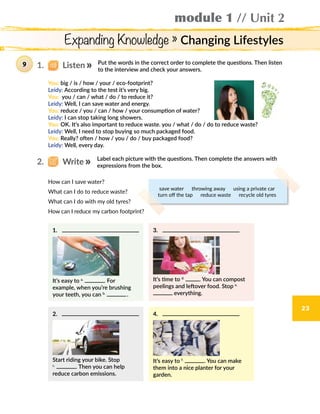
Label each picture with the questions. Then complete the answers with
expressions from the box.
9
You: big / is / how / your / eco-footprint?
Leidy: According to the test it’s very big.
You: you / can / what / do / to reduce it?
Leidy: Well, I can save water and energy.
You: reduce / you / can / how / your consumption of water?
Leidy: I can stop taking long showers.
You: OK. It’s also important to reduce waste. you / what / do / do to reduce waste?
Leidy: Well, I need to stop buying so much packaged food.
You: Really? often / how / you / do / buy packaged food?
Leidy: Well, every day.
save water  throwing away  using a private car
turn off the tap  reduce waste  recycle old tyres
1.   Listen
2.   Write
1.	
It’s easy to a.
. For
example, when you’re brushing
your teeth, you can b.
 .
2.	 .
Start riding your bike. Stop
c.
. Then you can help
reduce carbon emissions.
3.	
It’s time to d.
. You can compost
peelings and leftover food. Stop e.
everything.
4.	
It’s easy to f.
. You can make
them into a nice planter for your
garden.
How can I save water?
What can I do to reduce waste?
What can I do with my old tyres?
How can I reduce my carbon footprint?
Module // 1
24
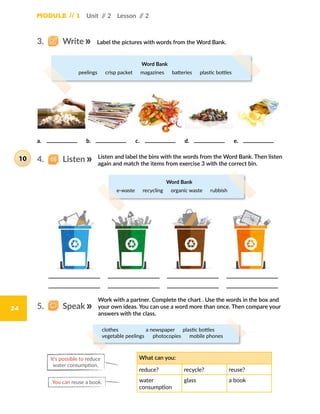
Word Bank
peelings  crisp packet  magazines  batteries  plastic bottles
Unit // 2 Lesson // 2
3.   Write
4.   Listen
5.   Speak
Label the pictures with words from the Word Bank.
a.	 b.	 c.	 d.	 e.	
Listen and label the bins with the words from the Word Bank. Then listen
again and match the items from exercise 3 with the correct bin.
Work with a partner. Complete the chart . Use the words in the box and
your own ideas. You can use a word more than once. Then compare your
answers with the class.
Word Bank
e-waste  recycling  organic waste  rubbish
What can you:
reduce? recycle? reuse?
water
consumption
glass a book
It’s possible to reduce
water consumption.
You can reuse a book.
clothes       a newspaper  plastic bottles
vegetable peelings  photocopies  mobile phones
10
module 1 // Unit 2
25
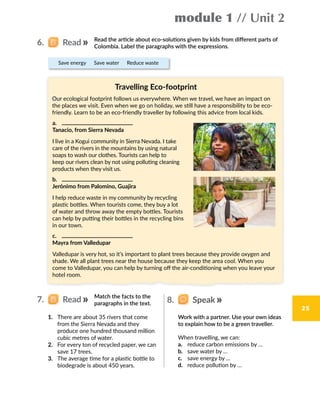
6.   Read
7.   Read 8.   Speak
Work with a partner. Use your own ideas
to explain how to be a green traveller.
Save energy  Save water  Reduce waste
Read the article about eco-solutions given by kids from different parts of
Colombia. Label the paragraphs with the expressions.
Match the facts to the
paragraphs in the text.
Travelling Eco-footprint
Our ecological footprint follows us everywhere. When we travel, we have an impact on
the places we visit. Even when we go on holiday, we still have a responsibility to be eco-
friendly. Learn to be an eco-friendly traveller by following this advice from local kids.   
a.	
Tanacio, from Sierra Nevada
I live in a Kogui community in Sierra Nevada. I take
care of the rivers in the mountains by using natural
soaps to wash our clothes. Tourists can help to
keep our rivers clean by not using polluting cleaning
products when they visit us.
b.	
Jerónimo from Palomino, Guajira
I help reduce waste in my community by recycling
plastic bottles. When tourists come, they buy a lot
of water and throw away the empty bottles. Tourists
can help by putting their bottles in the recycling bins
in our town.
c.	
Mayra from Valledupar
Valledupar is very hot, so it’s important to plant trees because they provide oxygen and
shade. We all plant trees near the house because they keep the area cool. When you
come to Valledupar, you can help by turning off the air-conditioning when you leave your
hotel room.
1.	 There are about 35 rivers that come
from the Sierra Nevada and they
produce one hundred thousand million
cubic metres of water.
2.	 For every ton of recycled paper, we can
save 17 trees.
3.	 The average time for a plastic bottle to
biodegrade is about 450 years.
When travelling, we can:
a.	 reduce carbon emissions by …  
b.	 save water by …
c.	 save energy by …
d.	 reduce pollution by …
Module // 1 Unit // 2 Lesson // 3
26
4.   Speak
Invite a student from another class to sign an eco-promise. Tell your class
what they promised to do.
It’s important to …	
Stop -ing …	
Think about …	
We can …	
Start -ing …
I’m going to start:
 recycling all paper and cardboard.
 using paper on both sides.
 turning off lights or equipment.
 turning off the taps.
Other:
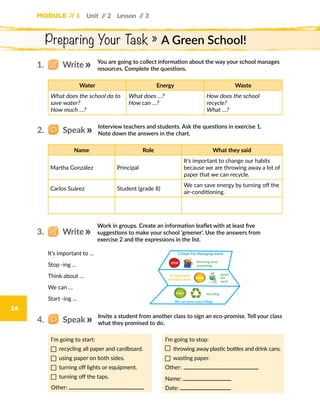
Preparing Your Task » A Green School!
1.   Write
3.   Write
You are going to collect information about the way your school manages
resources. Complete the questions.
Work in groups. Create an information leaflet with at least five
suggestions to make your school ‘greener’. Use the answers from
exercise 2 and the expressions in the list.
Water Energy Waste
What does the school do to
save water?
How much …?
What does …?
How can …?
How does the school
recycle?
What …?
Name Role What they said
Martha González Principal
It’s important to change our habits
because we are throwing away a lot of
paper that we can recycle.
Carlos Suárez Student (grade 8)
We can save energy by turning off the
air-conditioning.
2.   Speak
Interview teachers and students. Ask the questions in exercise 1.
Note down the answers in the chart.
I’m going to stop:
 throwing away plastic bottles and drink cans.
 wasting paper.
Other:
Name:
Date:
3 Steps For Managing waste
It's important
to reduce trash
throwing away
everything
about
the
earth
recycling
STOP
THINK
START
We can reuse many things
module 1 // Unit 2
27
How can you help
save energy?
reduce CO2
?
reduce waste?
save water?
6.   Listen Do the quiz. Select true (T) or false (F). Then listen and check your answers.11
Facts about Recycling T F
a.	 You can recycle all waste materials.
b.	 The most recycled objects are aluminium cans.
c.	 One ton of recycled paper can save up to five trees.
d.	 Recycling a plastic bottle can power a light bulb for six hours.
e.	 Colombia produces 12 million tons of rubbish every year.
f.	 Colombia recycles only 17% of the rubbish it produces.
7.   Read Read the article quickly. Select the best headline.
a.	 San Pedro School Waste Problem
b.	 Successful Recycling Programme At San Pedro School
c.	 San Pedro School Eco-Promise
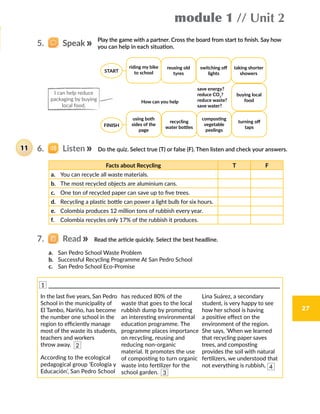
5.   Speak
Play the game with a partner. Cross the board from start to finish. Say how
you can help in each situation.
In the last five years, San Pedro
School in the municipality of
El Tambo, Nariño, has become
the number one school in the
region to efficiently manage
most of the waste its students,
teachers and workers
throw away.
According to the ecological
pedagogical group ‘Ecología y
Educación’, San Pedro School
has reduced 80% of the
waste that goes to the local
rubbish dump by promoting
an interesting environmental
education programme. The
programme places importance
on recycling, reusing and
reducing non-organic
material. It promotes the use
of composting to turn organic
waste into fertilizer for the
school garden.
Lina Suárez, a secondary
student, is very happy to see
how her school is having
a positive effect on the
environment of the region.
She says, ‘When we learned
that recycling paper saves
trees, and composting
provides the soil with natural
fertilizers, we understood that
not everything is rubbish,
I can help reduce
packaging by buying
local food.
1
2
3
4
riding my bike
to school
reusing old
tyres
switching off
lights
taking shorter
showers
buying local
food
turning off
taps
composting
vegetable
peelings
recycling
water bottles
using both
sides of the
page
START
FINISH
Module // 1 Unit // 2 Lesson // 3
28
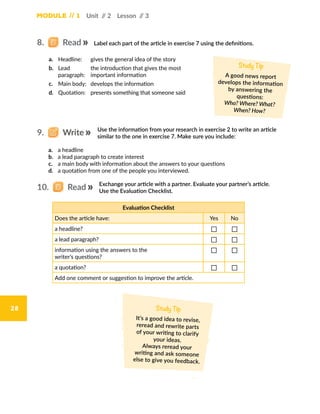
9.   Write
Label each part of the article in exercise 7 using the definitions.
Use the information from your research in exercise 2 to write an article
similar to the one in exercise 7. Make sure you include:
a.	 Headline: gives the general idea of the story
b.	 Lead
paragraph:
the introduction that gives the most
important information
c.	 Main body: develops the information
d.	 Quotation: presents something that someone said
Study Tip
A good news report
develops the information
by answering the
questions:
Who? Where? What?
When? How?
Study Tip
It’s a good idea to revise,
reread and rewrite parts
of your writing to clarify
your ideas.
Always reread your
writing and ask someone
else to give you feedback.
a.	 a headline
b.	 a lead paragraph to create interest
c.	 a main body with information about the answers to your questions
d.	 a quotation from one of the people you interviewed.
10.   Read Exchange your article with a partner. Evaluate your partner’s article.
Use the Evaluation Checklist.
Evaluation Checklist
Does the article have: Yes No
a headline?
a lead paragraph?
information using the answers to the
writer’s questions?
a quotation?
Add one comment or suggestion to improve the article.
8.   Read
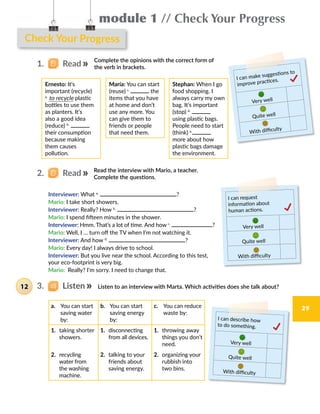
module 1 // Check Your Progress
29
Check Your Progress
Complete the opinions with the correct form of
the verb in brackets.
Read the interview with Mario, a teacher.
Complete the questions.
2.   Read
Ernesto: It's
important (recycle)
a.
to recycle plastic  
bottles to use them
as planters. It’s
also a good idea
(reduce) b.
their consumption
because making
them causes
pollution.
María: You can start
(reuse) c.
the
items that you have
at home and don’t
use any more. You
can give them to
friends or people
that need them.
Stephan: When I go
food shopping. I
always carry my own
bag. It’s important
(stop) d.
using plastic bags.
People need to start
(think) e.
more about how
plastic bags damage
the environment.
Interviewer: What a.
?
Mario: I take short showers.  
Interviewer: Really? How b.
?
Mario: I spend fifteen minutes in the shower.  
Interviewer: Hmm. That’s a lot of time. And how c.
?
Mario: Well, I … turn off the TV when I’m not watching it.   
Interviewer: And how d.
?
Mario: Every day! I always drive to school.
Interviewer: But you live near the school. According to this test,
your eco-footprint is very big.
Mario:  Really? I’m sorry. I need to change that.
I can make suggestions to
improve practices.
Very well
Quite well
With difficulty
I can request
information about
human actions.
Very well
Quite well
With difficulty
3.   Listen Listen to an interview with Marta. Which activities does she talk about?
a.	 You can start
saving water
by:
b.	 You can start
saving energy
by:
c.	 You can reduce
waste by:
1. taking shorter
showers.
1. disconnecting
from all devices.
1. throwing away
things you don’t
need.
2. recycling
water from
the washing
machine.
2. talking to your
friends about
saving energy.
2. organizing your
rubbish into
two bins.
I can describe how
to do something.
Very well
Quite well
With difficulty
1.   Read
12
30
Objectives
» 	I can express opinions about human
actions
» 	I can discuss good and bad environmental
practices
» 	I can describe ecological values.Caring for the
Environment
Unit 3»
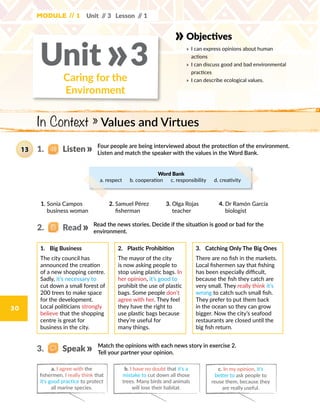
In Context » Values and Virtues
Four people are being interviewed about the protection of the environment.
Listen and match the speaker with the values in the Word Bank.
Word Bank
a. respect  b. cooperation  c. responsibility  d. creativity
1.	 Big Business
The city council has
announced the creation
of a new shopping centre.
Sadly, it’s necessary to
cut down a small forest of
200 trees to make space
for the development.
Local politicians strongly
believe that the shopping
centre is great for
business in the city.
2.	 Plastic Prohibition
The mayor of the city
is now asking people to
stop using plastic bags. In
her opinion, it’s good to
prohibit the use of plastic
bags. Some people don’t
agree with her. They feel
they have the right to
use plastic bags because
they’re useful for
many things.
3.	 Catching Only The Big Ones
There are no fish in the markets.
Local fishermen say that fishing
has been especially difficult,
because the fish they catch are
very small. They really think it’s
wrong to catch such small fish.
They prefer to put them back
in the ocean so they can grow
bigger. Now the city’s seafood
restaurants are closed until the
big fish return.
Read the news stories. Decide if the situation is good or bad for the
environment.
Module // 1 Unit // 3 Lesson // 1
Match the opinions with each news story in exercise 2.
Tell your partner your opinion.
b. I have no doubt that it’s a
mistake to cut down all those
trees. Many birds and animals
will lose their habitat.
a. I agree with the
fishermen. I really think that
it’s good practice to protect
all marine species.
c. In my opinion, it’s
better to ask people to
reuse them, because they
are really useful.
1.   Listen13
2.   Read
3.   Speak
1. Sonia Campos
business woman
2. Samuel Pérez
fisherman
3. Olga Rojas
teacher
4. Dr Ramón García
biologist
module 1 // Unit 3
31
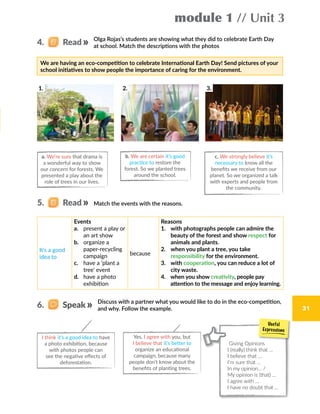
We are having an eco-competition to celebrate International Earth Day! Send pictures of your
school initiatives to show people the importance of caring for the environment.
Olga Rojas’s students are showing what they did to celebrate Earth Day
at school. Match the descriptions with the photos
Match the events with the reasons.
a. We’re sure that drama is
a wonderful way to show
our concern for forests. We
presented a play about the
role of trees in our lives.
b. We are certain it’s good
practice to restore the
forest. So we planted trees
around the school.
c. We strongly believe it’s
necessary to know all the
benefits we receive from our
planet. So we organized a talk
with experts and people from
the community.
It’s a good
idea to
Events
a.	 present a play or
an art show
b.	 organize a
paper-recycling
campaign
c.	 have a ‘plant a
tree’ event
d.	 have a photo
exhibition
because
Reasons
1.  with photographs people can admire the
beauty of the forest and show respect for
animals and plants.
2.  when you plant a tree, you take
responsibility for the environment.
3.  with cooperation, you can reduce a lot of
city waste.
4.  when you show creativity, people pay
attention to the message and enjoy learning.
4.   Read
5.   Read
1. 2. 3.
Discuss with a partner what you would like to do in the eco-competition,
and why. Follow the example.
I think it’s a good idea to have
a photo exhibition, because
with photos people can
see the negative effects of
deforestation.
Yes, I agree with you, but
I believe that it’s better to
organize an educational
campaign, because many
people don’t know about the
benefits of planting trees.
6.   Speak
Giving Opinions
I (really) think that …
I believe that …
I’m sure that …
In my opinion… /
My opinion is (that) …
I agree with …
I have no doubt that …
Module // 1 Unit // 3 Lesson // 1
32
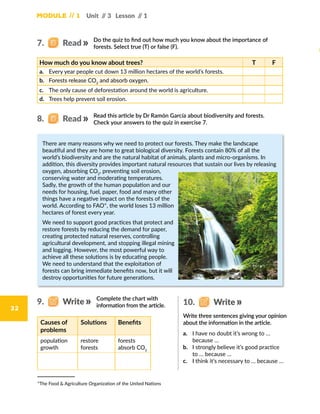
Do the quiz to find out how much you know about the importance of
forests. Select true (T) or false (F).
Read this article by Dr Ramón García about biodiversity and forests.
Check your answers to the quiz in exercise 7.
How much do you know about trees? T F
a.	 Every year people cut down 13 million hectares of the world’s forests.
b.	 Forests release CO2
and absorb oxygen.
c.	 The only cause of deforestation around the world is agriculture.
d.	 Trees help prevent soil erosion.
There are many reasons why we need to protect our forests. They make the landscape
beautiful and they are home to great biological diversity. Forests contain 80% of all the
world’s biodiversity and are the natural habitat of animals, plants and micro-organisms. In
addition, this diversity provides important natural resources that sustain our lives by releasing
oxygen, absorbing CO2
, preventing soil erosion,
conserving water and moderating temperatures.
Sadly, the growth of the human population and our
needs for housing, fuel, paper, food and many other
things have a negative impact on the forests of the
world. According to FAO*, the world loses 13 million
hectares of forest every year.
We need to support good practices that protect and
restore forests by reducing the demand for paper,
creating protected natural reserves, controlling
agricultural development, and stopping illegal mining
and logging. However, the most powerful way to
achieve all these solutions is by educating people.
We need to understand that the exploitation of
forests can bring immediate benefits now, but it will
destroy opportunities for future generations.
Complete the chart with
information from the article.
Write three sentences giving your opinion
about the information in the article.
a.	 I have no doubt it’s wrong to …
because …
b.	 I strongly believe it’s good practice
to … because …
c.	 I think it’s necessary to … because …
7.   Read
8.   Read
9.   Write 10.   Write
*The Food  Agriculture Organization of the United Nations
Causes of
problems
Solutions Benefits
population
growth
restore
forests
forests
absorb CO2
module 1 // Unit 3
33
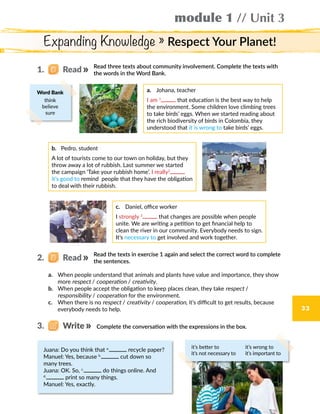
Expanding Knowledge » Respect Your Planet!
Read three texts about community involvement. Complete the texts with
the words in the Word Bank.
Read the texts in exercise 1 again and select the correct word to complete
the sentences.
a.	 Johana, teacher
I am 1
that education is the best way to help
the environment. Some children love climbing trees
to take birds’ eggs. When we started reading about
the rich biodiversity of birds in Colombia, they
understood that it is wrong to take birds’ eggs.
b.	 Pedro, student
A lot of tourists come to our town on holiday, but they
throw away a lot of rubbish. Last summer we started
the campaign ‘Take your rubbish home’. I really2
it’s good to remind people that they have the obligation
to deal with their rubbish.
c.	 Daniel, office worker
I strongly 3
that changes are possible when people
unite. We are writing a petition to get financial help to
clean the river in our community. Everybody needs to sign.
It’s necessary to get involved and work together.
a.	 When people understand that animals and plants have value and importance, they show
more respect / cooperation / creativity.
b.	 When people accept the obligation to keep places clean, they take respect /
responsibility / cooperation for the environment.
c.	 When there is no respect / creativity / cooperation, it’s difficult to get results, because
everybody needs to help.
Complete the conversation with the expressions in the box.
Juana: Do you think that a.
recycle paper?
Manuel: Yes, because b.
cut down so
many trees.
Juana: OK. So, c.
do things online. And
d.
print so many things.
Manuel: Yes, exactly.
1.   Read
2.   Read
Word Bank
think
believe
sure
3.   Write
it’s better to	 it’s wrong to
it’s not necessary to	 it’s important to
Module // 1 Unit // 3 Lesson // 2
34
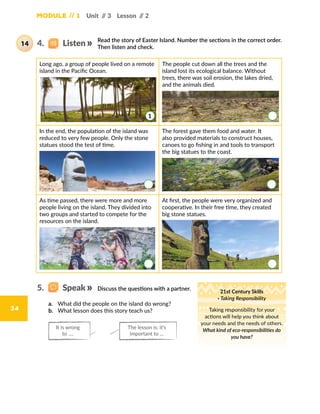
Read the story of Easter Island. Number the sections in the correct order.
Then listen and check.
Long ago, a group of people lived on a remote
island in the Pacific Ocean.
The people cut down all the trees and the
island lost its ecological balance. Without
trees, there was soil erosion, the lakes dried,
and the animals died.
In the end, the population of the island was
reduced to very few people. Only the stone
statues stood the test of time.
The forest gave them food and water. It
also provided materials to construct houses,
canoes to go fishing in and tools to transport
the big statues to the coast.
As time passed, there were more and more
people living on the island. They divided into
two groups and started to compete for the
resources on the island.
At first, the people were very organized and
cooperative. In their free time, they created
big stone statues.
1
4.   Listen14
Discuss the questions with a partner. 21st Century Skills
· Taking Responsibility
Taking responsibility for your
actions will help you think about
your needs and the needs of others.
What kind of eco-responsibilities do
you have?
a.	 What did the people on the island do wrong?
b.	 What lesson does this story teach us?
The lesson is: it’s
important to …
It is wrong
to ….
5.   Speak
module 1 // Unit 3
35
I agree with you that respect is very
important, but I believe cooperation is
more important in our city.
Because when you live in a big city,
you need cooperation to build things.
Read each category in this survey. Decide if the items (a–d) are very
important (V), quite important (Q), or not very important (N). Compare
your answers with a partner.
The Ideal City
1.	 For people living in your city, an important
value is:
a. respect
b. cooperation
c. responsibility
d. creativity.
2.  In your city, a bad environmental
practice is:
a.	 destroying forest for industrial purposes
b.	 polluting water for industrial purposes
c.	 throwing away rubbish
d.	 killing animals for food.
3.  A good environmental practice in your
city is:
a.	 recycling
b.	 conserving the green areas
c.	 restoring forest
d.	 saving water and energy.
4.  In your city, it’s necessary to improve:
a.	 air quality
b.	 access to water
c.	 transportation
d.	 waste management.
Find someone in your class who agrees with the opinions. Find out their
reasons for agreeing.
In groups, read the text and discuss the city’s dilemma. What is your
opinion? Who do you agree with, A, B or C?
You live in a coastal town. Fishing is a very important economic activity, but in recent years the
number of fish has decreased. This has had a negative impact. A foreign company is interested in
building a port to export coal by ship. It has offered to buy a part of the beach for this project. The
town has to decide what to do.
Find someone who …
a.	 thinks respect is the most important eco-value
b.	 strongly believes it’s wrong to kill animals for food
c.	 is sure that restoring forests is the best environmental practice
d.	 agrees with the need to stop using private cars	
6.   Read
7.   Speak
8.   Speak
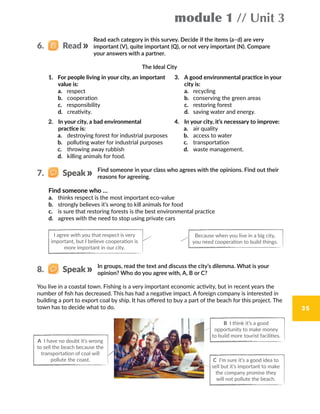
A I have no doubt it’s wrong
to sell the beach because the
transportation of coal will
pollute the coast. C I’m sure it’s a good idea to
sell but it’s important to make
the company promise they
will not pollute the beach.
B I think it’s a good
opportunity to make money
to build more tourist facilities.
Module // 1
36
Unit // 3 Lesson // 3
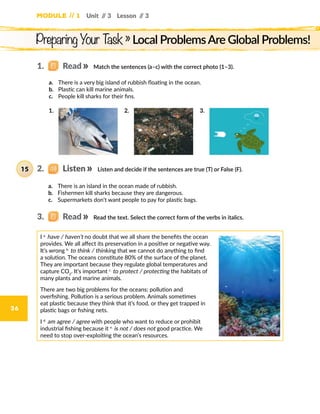
Match the sentences (a–c) with the correct photo (1–3).
a.	 There is a very big island of rubbish floating in the ocean.
b.	 Plastic can kill marine animals.
c.	 People kill sharks for their fins.
a.	 There is an island in the ocean made of rubbish.
b.	 Fishermen kill sharks because they are dangerous.
c.	 Supermarkets don’t want people to pay for plastic bags.
I a.
have / haven’t no doubt that we all share the benefits the ocean
provides. We all affect its preservation in a positive or negative way.
It’s wrong b.
to think / thinking that we cannot do anything to find
a solution. The oceans constitute 80% of the surface of the planet.
They are important because they regulate global temperatures and
capture CO2
. It’s important c.
to protect / protecting the habitats of
many plants and marine animals.
There are two big problems for the oceans: pollution and
overfishing. Pollution is a serious problem. Animals sometimes
eat plastic because they think that it’s food, or they get trapped in
plastic bags or fishing nets.
I d.
am agree / agree with people who want to reduce or prohibit
industrial fishing because it e.
is not / does not good practice. We
need to stop over-exploiting the ocean’s resources.
1.	 2.	 3.	
Listen and decide if the sentences are true (T) or False (F).
Read the text. Select the correct form of the verbs in italics.
Preparing Your Task » Local ProblemsAre Global Problems!
1.   Read
2.   Listen15
3.   Read
37
module 1 // Unit 3
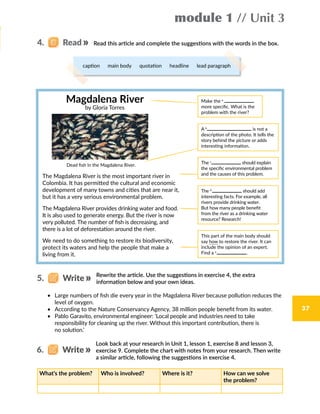
Magdalena River
by Gloria Torres
Make the a
more specific. What is the
problem with the river?
A b
is not a
description of the photo. It tells the
story behind the picture or adds
interesting information.
Dead fish in the Magdalena River.
The Magdalena River is the most important river in
Colombia. It has permitted the cultural and economic
development of many towns and cities that are near it,
but it has a very serious environmental problem.
The Magdalena River provides drinking water and food.
It is also used to generate energy. But the river is now
very polluted. The number of fish is decreasing, and
there is a lot of deforestation around the river.
We need to do something to restore its biodiversity,
protect its waters and help the people that make a
living from it.
The c
should explain
the specific environmental problem
and the causes of this problem.
This part of the main body should
say how to restore the river. It can
include the opinion of an expert.
Find a e 
.
The d
  should add
interesting facts. For example, all
rivers provide drinking water.
But how many people benefit
from the river as a drinking water
resource? Research!
Read this article and complete the suggestions with the words in the box.4.   Read
caption  main body  quotation  headline  lead paragraph
•	 Large numbers of fish die every year in the Magdalena River because pollution reduces the
level of oxygen.
•	 According to the Nature Conservancy Agency, 38 million people benefit from its water.
•	 Pablo Garavito, environmental engineer: ‘Local people and industries need to take
responsibility for cleaning up the river. Without this important contribution, there is
no solution.’
Rewrite the article. Use the suggestions in exercise 4, the extra
information below and your own ideas.
5.   Write
Look back at your research in Unit 1, lesson 1, exercise 8 and lesson 3,
exercise 9. Complete the chart with notes from your research. Then write
a similar article, following the suggestions in exercise 4.
What’s the problem? Who is involved? Where is it? How can we solve
the problem?
6.   Write
Module // 1
38
Unit // 3 Lesson // 3
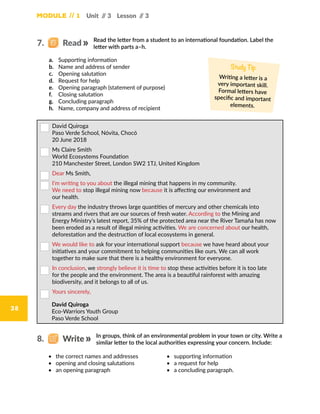
a.	 Supporting information
b.	 Name and address of sender
c.	 Opening salutation
d.	 Request for help
e.	 Opening paragraph (statement of purpose)
f.	 Closing salutation
g.	 Concluding paragraph
h.	 Name, company and address of recipient
Study Tip
Writing a letter is a
very important skill.
Formal letters have
specific and important
elements.
Read the letter from a student to an international foundation. Label the
letter with parts a–h.
7.   Read
•	 the correct names and addresses
•	 opening and closing salutations
•	 an opening paragraph
 David Quiroga
Paso Verde School, Nóvita, Chocó
20 June 2018
 Ms Claire Smith
World Ecosystems Foundation
210 Manchester Street, London SW2 1TJ, United Kingdom
 Dear Ms Smith,
 I’m writing to you about the illegal mining that happens in my community.
We need to stop illegal mining now because it is affecting our environment and
our health.
 Every day the industry throws large quantities of mercury and other chemicals into
streams and rivers that are our sources of fresh water. According to the Mining and
Energy Ministry’s latest report, 35% of the protected area near the River Tamaña has now
been eroded as a result of illegal mining activities. We are concerned about our health,
deforestation and the destruction of local ecosystems in general.
 We would like to ask for your international support because we have heard about your
initiatives and your commitment to helping communities like ours. We can all work
together to make sure that there is a healthy environment for everyone.
 In conclusion, we strongly believe it is time to stop these activities before it is too late
for the people and the environment. The area is a beautiful rainforest with amazing
biodiversity, and it belongs to all of us.
 Yours sincerely,
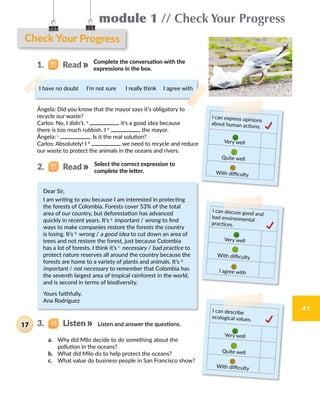
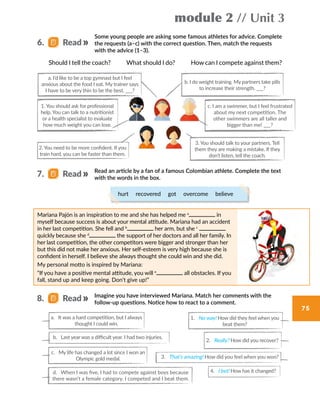
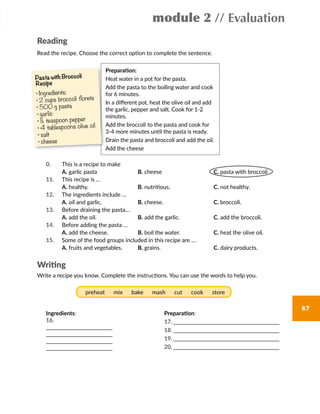
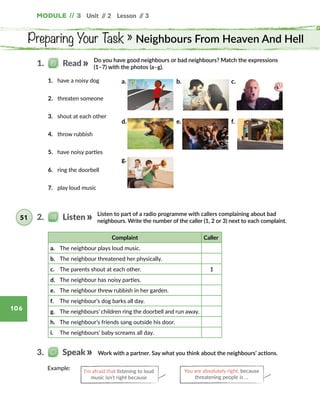
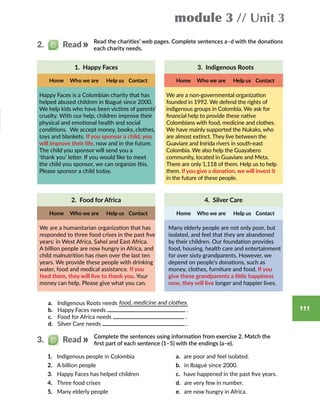
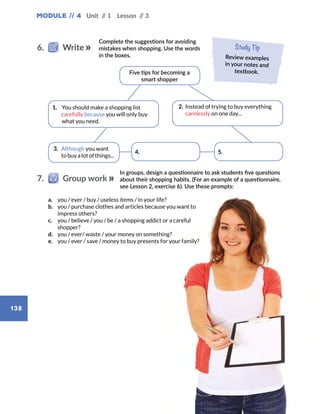
	David Quiroga
Eco-Warriors Youth Group
Paso Verde School
In groups, think of an environmental problem in your town or city. Write a
similar letter to the local authorities expressing your concern. Include:
8.   Write
•	 supporting information
•	 a request for help
•	 a concluding paragraph.
39
Chant
Save energy to be green!
Respect the earth and keep it clean.
Save energy to be green!
Respect the earth and keep it clean.
Sustainable energy will help us restore,
But we can’t afford to pollute any more.
Pesticides and open mines
I strongly believe will destroy us in time.
Be sure to recycle, wherever you are,
And use your bike instead of a car.
Sign a petition in this magazine,
To conserve biodiversity.
Save energy to be green! …
We must protect our habitat.
We need conservation, and that´s a fact.
Deforestation means losing our trees,
Water pollution’s destroying our seas.
Believe in the cause and join a campaign.
Ask your friends to do the same.
Have no doubt and cooperate.
Make a change, before it’s too late!
Respect the earth
module 1 // Unit 3
16
Module // 1
40
Unit // 3 Lesson // 4
1 We cut down trees.
2 We pollute the environment.
3 We use sustainable energy.
4 We save energy.
5 We use pesticides.
6 We respect the earth.
7 We keep the earth clean.
8 We join a campaign.
9 We cooperate.
10 We have open mines.
drive a car respect the earth join a campaign keep the earth clean use pesticides
have open mines use sustainable energy protect our habitat recycle ride a bike
sign a petition pollute water cut down trees join a demonstration save energy
pollute destroy our seas
shouldn’t
1 What does the singer believe will destroy
us?
2 What can’t we afford to do?
3 What should you do, wherever you are?
4 What should you use instead of a car?
5 Where is the petition?
6 What must we protect?
7 What happens when we lose our trees?
8 What destroys our seas?
9 What should you ask your friends to do?
10 What should you do before it’s too late?
Pesticides and open mines
We should …
We shoudn’t …
We must …
We mustn’t …
Always …
Never …
… because …
What should and shouldn’t we do?1.   Read
Answer the questions.2.   Write
Write an article for a website about protecting the environment.
Say what we should do and why.3.   Write
module 1 // Check Your Progress
41
Check Your Progress
			Complete the conversation with the
expressions in the box.
I have no doubt I’m not sure I really think I agree with
Ángela: Did you know that the mayor says it’s obligatory to
recycle our waste?
Carlos: No, I didn’t. a.
  it’s a good idea because
there is too much rubbish. I b.
  the mayor.
Ángela: c.
  . Is it the real solution?
Carlos: Absolutely! I d.
  we need to recycle and reduce
our waste to protect the animals in the oceans and rivers.
I can express opinions
about human actions.
Very well
Quite well
With difficulty
I can discuss good and
bad environmental
practices.
Very well
With difficulty
I agree with
Dear Sir,
I am writing to you because I am interested in protecting
the forests of Colombia. Forests cover 53% of the total
area of our country, but deforestation has advanced
quickly in recent years. It’s a.
important / wrong to find
ways to make companies restore the forests the country
is losing. It’s b.
wrong / a good idea to cut down an area of
trees and not restore the forest, just because Colombia
has a lot of forests. I think it’s c.
necessary / bad practice to
protect nature reserves all around the country because the
forests are home to a variety of plants and animals. It’s d.
important / not necessary to remember that Colombia has
the seventh largest area of tropical rainforest in the world,
and is second in terms of biodiversity.
Yours faithfully,
Ana Rodríguez
I can describe
ecological values.
Very well
Quite well
With difficulty
Listen and answer the questions.
a.	 Why did Milo decide to do something about the
pollution in the oceans?
b.	 What did Milo do to help protect the oceans?
c.	 What value do business people in San Francisco show?
3.   Listen17
1.   Read
2.   Read Select the correct expression to
complete the letter.
Module // 1 Review
42
Quiz
Everyone picks a square in the same category and
answers the question or instruction in that square.
When you answer correctly, you get the points. The
person with the most points at the end wins!
Negative Effects on
the Environment
Helping the
Environment
Expressing your
Opinion Recycling
Describe an
environmental problem
in your community.
800 points
Talk about what you
can do to help the
environment.
800 points
Say why you think it is
important to protect
forests.
800 points
Describe actions taken
in your community
to recycle.
800 points
What happens when
people don’t care about
the environment?
700 points
What environmental
issue have you recently
read about in the news?
700 points
Name two actions to the
environment that you
strongly disagree with.
700 points
Explain how you
can reduce water
consumption.
700 points
What is the problem
with pesticides?
600 points
How is life
interconnected?
600 points
Complete: I have no
doubt that …
600 points
Name one item
you can reuse.
600 points
Name one eco-friendly
action you do at home.
500 points
What do you have
to do to recycle?
500 points
Describe something
you and your friends
strongly believe in?
500 points
Do you respect
public spaces?
500 points
Describe what’s
happening.
400 points
What can people do to
solve this problem?
400 points
Express your opinion
about adopting animals
from a shelter.
400 points
Explain what you can do
with these items.
400 points
What concerns do
you have about the
environment?
300 points
How does planting
trees help the
environment?
300 points
Complete: It’s wrong
to …
300 points
Describe one action
you can take to start
reducing waste.
300 points
What is illegal mining?
200 points
How does signing
a petition help the
environment?
200 points
Complete: I really think
that …
200 points
Name three eco-friendly
actions.
200 points
42
module1 // Review
4343
Eco-Friendly
Actions Writing a Letter Problems Working for
a Cause
Explain how your
school can be more
eco-friendly.
800 points
Write a short letter
expressing an
environmental
concern.
800 points
Describe what
habitat loss
means.
800 points
Discuss a possible
solution for the
island of rubbish in
the Pacific Ocean.
800 points
How can carbon
emissions be reduced?
700 points
What is the closing
paragraph of a letter?
700 points
What is the effect of
cutting down trees for
cattle farming?
700 points
Briefly tell the story of
Easter Island. What can
we learn from it?
700 points
Describe some eco-
friendly things you can
do when traveling.
600 points
What is the purpose
of the letter in the box
below?
600 points
How do human
actions impact the
environment?
600 points
Is it possible to work
together and change the
world? Explain.
600 points
Define composting.
500 points
Continue the letter:
500 points
Explain what was
happening before and
what happened after.
500 points
What can teenagers
do to help the
environment?
500 points
Is buying bottled water
every day an eco-
friendly action?
400 points
What part of a letter
is this?
‘I’m writing to
you because …’
400 points
What environmental
problems are there in
Colombia?
400 points
What can a teacher
do to help the
environment?
400 points
Describe one way you
can save energy.
300 points
Mention the three
important parts of a
letter.
300 points
What is deforestation?
300 points
What can a farmer do to
help the environment?
300 points
What is an eco-
footprint?
200 points
What is the first part of
a letter?
200 points
What is air pollution?
200 points
What can a
photographer do to help
the environment?
200 points
Dear Sirs,
Our community is not
recycling. There is
rubbish in the park and
public spaces …
43
PROJECT
Module // 1 Project
44
An eco-newsletter to evaluate the impact of human
actions on the Colombian environment
1.	 	In groups, collect the information and materials you created in this module. Use the checklist
to make sure you have everything you need.
Unit 1
Human Actions and
the Environment
Unit 2
Think Green!
Unit 3
Caring For the
Environment
Lesson 3, exercises 5-7
Facts about Colombia’s
eco-concerns
Lesson 3, exercise 10
Poster of environmental
problem research
Lesson 2, exercise 6
Eco-friendly advice for travellers
Lesson 3, exercise 3
Information leaflet with suggestions
for a school recycling programme
Lesson 3, exercise 4
Eco-promise
Lesson 3, exercise 9
News articles about the school
eco-footprint
Lesson 3, exercises 1-3
Photos and facts
about problems in
the oceans
Lesson 3, exercise 4
Article on the
Magdalena River
Lesson 3, exercises 7-8
A petition letter
2.	 Decide which information you want to include in your newsletter.
3.	 Look at the two options for presenting the newsletter. Discuss the advantages and
disadvantages of each option: an online newsletter or a poster presentation.
4.	 Read the suggestions for what to do before, during and after the launch of the newsletter.  
Can you think of other ideas?
Online newsletter Poster presentation
Before
a.	Create a website – think of a name
and web address.
b.	Choose a format for your newsletter
(see the suggested format in Step 5).
c.	Organize your material using the
format you chose.
a.	Look for a space to create a poster
presentation and ask for permission.
b.	Find materials to create your poster
(What will you put it on? How big will it
be?).
c.	Make an outline of the design on paper
Then create your poster.
d.	Decide on a date to launch the poster.
e.	Announce the date and invite people to
the launch.
module1 // Project
45
Online newsletter Poster presentation
During
d.	Give a presentation of your website
(e.g. a PowerPoint presentation, a
presentation to the class).
e.	Answer questions.
f.	Think of different strategies to
promote your website (e.g. by email,
using social media).
f.	Put up your poster.
g.	Present the information while people
read the sections of the poster.
h.	Answer questions.
After
g.	Invite people to sign the eco-
promise and to vote in your online
survey.
h.	Publish the results of the survey.
i.	 Ask for feedback online.
i.	 Invite people to sign the eco-promise
and to vote in your online survey.
j.	 Publish the results of the survey.
k.	 Ask people present for feedback.
5.	 Here are some suggestions for how to organize the information in your online newsletter or
poster.
Name of the newsletter:
Web address: Launch date:
WHO ARE WE?
• Personal information about the people in
the group
FEATURE STORIES / REGIONAL NEWS
• News article about the school eco-footprint
• Article on environmental problems
• Article on the Magdalena River
EDITORIAL
• Map of environmental problems
ECO-ACTIONS
• Suggestions for travellers – how to reduce
your eco-footprint
• Eco-promise – ask people to sign
DID YOU KNOW …?
• Eco-facts, e.g. rainforest, recycling,
Colombian problems
ONLINE SURVEY
• Ask people to vote on ideas to reduce
the impact of human actions on the
environment.
PETITION LETTER
Read and sign!
PHOTO CONTEST
• Exhibition of photos showing
environmental problems
Module // 1 Evaluation
46
Vocabulary
Circle the word or phrase that doesn’t belong to the same category. There is one example.
0. A. use pesticides B. illegal mining C. deforestation D. recycling   
1. A. volunteer B. pollute C. rescue an animal D. sign a petition   
2. A.waste B. reduce C. reuse D. recycle   
3. A. plastic bottles B. recycle C. fruit peelings D. magazines
4. A. protect the
environment
B. take shorter
showers
C. have solar panels D. use energy saving
light bulbs
5. A. I strongly
believe…
B. I’m certain… C. launch a petition D. I’m sure…
Grammar
Circle the word that best completes the sentence.  There is one example.
	 0.	 I enjoy .
		A. pollution
		B. walking
		C. deforestation
	 6.	 There are many trees in our neighbourhood.
		Before, there none.
		A. were
		B. are
		C. weren’t
	 7. 	 Jessica is really good at .
		A. sing
		B. doesn’t sing	
		C. singing
Evaluation
8. 	 We can reduce pollution by
less plastic.
	 A. buy
	 B. buying
	 C. is buying
9.	 It’s important to consuming
less.
	 A. have started
	 B. starting
	 C. start
10.	I strongly we can help the
environment.
	 A. believe
	 B. sure
	 C. opinion
module 1 // Evaluation
47
Reading
Read the following text. Circle the best answer for each question. There is one example.
In recent years, climatic phenomena such as El Niño and La Niña have increased the lack of
water in several countries. Fog catchers are nets between two wooden poles that capture
water without polluting the environment. Scientists are starting to think that fog catchers can
help us collect water in an efficient way. They are especially effective in deserts, mountains
and other places that have a lot of fog. In the Atacama Desert in Chile, fog catchers are
used for water supply and agriculture with wonderful results. A team of engineers from the
Massachusetts Institute of Technology (MIT) is working to improve fog catchers. Scientists
believe that, because they are easy to assemble and effective, fog catchers could become a
globalized solution for water supply and agriculture all over the world.
0. Where have El Niño and La Niña increased the lack of water?
a. In the Atacama Desert b. In places that have a lot of
fog
c. In several countries
11. What are El Niño and La Niña?
a. They are objects that collect
water.
b. They are climatic
phenomena.
c. They are a solution to the
lack of water.
12. What is a fog catcher?
a. A type of agriculture. b. An object that pollutes
water.
c. A net that collects water.
13. Why are fog catchers helpful?
a. Because are useful for
collecting water.
b. Because they are easy to
make.
c. Because they are made of
wood and a net.
14. Where are fog catchers especially efficient?
a. Near the ocean. b. In places with a polluted
environment.
c. In deserts and mountains.
15. What is the MIT team doing?
a. They are working in the
Atacama Desert in Chile.
b. They are studying El Niño
and La Niña.
c. They are working to
improve fog catchers.
Writing
Complete the chart below about yourself.
What are you good at?
(17)___________
What do you like?
(18)___________
A description of you:
(16)___________
What are you interested
in? (19)___________
What worries you?
(20)___________
Module 2
Health Issues
Health
Language Functions
•	 Describe minor illnesses and
give suggestions
•	 Describe symptoms of
eating disorders and express
conditions
•	 Describe past experiences
•	 Recognize negative health
practices
Text Types:
•	 Webpage, poster,
conversation, questionnaire,
narrative text, informative
article, descriptive
paragraph
Language Functions
•	 Ask for and give information
about eating habits
•	 Make suggestions about
eating habits
•	 Ask for and give information
about the ingredients of a
dish
•	 Give information about the
nutritional value and health
benefits of food
Text Types:
•	 nutrition advice, survey,
descriptive paragraph,
narrative paragraph,
conversation, blog, recipe,
nutrition quiz, informative
article, interview
Language Functions
•	 Describe emotions and
feelings
•	 Express conditions
•	 Ask about past
experiences
•	 Give and ask for
suggestions
Text Types:
•	 Wiki webpage,
online advertisement,
descriptive paragraphs,
narrative texts,
instructions, interviews,
newspaper article
What is an Eating
Disorder?
Healthy Food
Choices
Body and Mind
Connection
Unit 1 Unit 2 Unit 3
48
Unit 1 Unit 2 Unit 3
1.	 Lesson 2, exercise 9
21st
Century skills
Ideas to raise
awareness about
being overweight and
obesity.
2.	 Lesson 3, exercise 8
A text about a specific
eating disorder
including definition,
causes, symptoms,
treatment.
3.	 Lesson 1, exercise 8
Survey on eating habits.
4.	 Lesson 2, exercises 8 and 9
Instructions on how to
prepare a healthy snack.
5.	 Lesson 3, exercise 5
Nutrition quiz questions.
6.	 Lesson 3, exercise 7
Text and infographic
describing a healthy food.
7.	 Lesson 3, exercise 8
Nutrition suggestions with
infographics.
8.	 Lesson 1, exercise 7
Infographic suggesting positive
ways to improve self-esteem and
body image.
9.	 Lesson 3, exercise 8 Checklist
to discover if people contribute
to their own low self-esteem and
body image problems.
10.	Lesson 3, exercise 10
Presenting ideas about the role
of self-esteem and body
image in the prevention
of eating disorders.
Explore Your Knowledge
Look at the pictures and answer …
•	 Do you recognize the different
food items?
•	 Which foods are healthy and
which are unhealthy?
•	 Which foods do you like eating?
•	 Do you recognize some of the
different body parts?
•	 What is each body part used for?
Chant
Be good to your body
Project: Create an Eating Disorder Prevention Plan and Present It at a Health Fair
In this module you will work in groups to prepare a formal presentation.
49
50
Objectives
» 	I can describe symptoms of eating
disorders and express conditions.
» 	I can describe minor illnesses and
give suggestions.
» 	I can describe past experiences.
» 	I can recognize negative health practices.
What Is an Eating
Disorder?
Unit 1»
Module // 2 Unit // 1 Lesson // 1
It is the International Week of Eating Disorders at Kennedy School. The
school has created a webpage to inform students about the activities.
Read the webpage and answer questions a–d.
a.	 There’s a health fair at the school. When is it? From 2nd
to 9th
June.
b.	 Where can you find information about being overweight in Colombia?
c.	 Where can you find information about the symptoms of anorexia?
d.	 How can you contact a health specialist?
Kennedy School International Week of Eating Disorders
HEAL TH NEWS
Health Ministry reports half the population of Colombia is overweight.
Do you often have headaches? Do you feel low in energy? Are you worried about obesity?
Get a health check! Read more: Colombianews.com
Doctor speaking!
What is an eating disorder? Talk to the health specialist!
Telephone: 364-555-896
HEALTH CHECKLISTS
Not sure if your friend has an eating disorder? Use these checklists to find out.
Helping you prevent: Anorexia, Bulimia, Binge-eating
Join us! Show you care!
Health Fair 2nd
–9th
June
Special events! Healthy recipes! Active life workshops!
Talks, competitions, concerts … and more!
EATING DISORDERS – REAL STORIES!
Read Claudia and Nicolás’s stories about recovering from eating disorders.
The Digital Storytelling Project
Share your personal stories to work out problems together.
In Context » I’m Interested in My Health!
1.   Read
module 2 // Unit 1
51
Jaime and Andrea want to help their friend Nicolás. Listen and note
down the sections of the webpage they discuss. Then, listen again and
tick the ideas (a–e) they discuss.
Listen to Jaime and Andrea talking about Nicolás. Complete the sentences
with the correct adverb.
always    usually    often    sometimes    hardly ever    never
a.	 Read real stories about people with eating disorders.
b.	 Get in touch with a psychologist or a health specialist.
c.	 Share Nicolás’s personal story online.
d.	 Invite him to go to the Health Fair.
e.	 Talk to his family about the problem.
Which is the best idea in exercise 2? Discuss with a partner.
Look at the poster. Match the photos (a–e) with the phrases.
Andrea thinks that Nicolás a
eats in secret, but b
he can’t
control his eating. In Jaime’s opinion, he c
worries about his weight. Also,
he d
vomits after eating.
4.   Read
2.   Listen18
5.   Listen19
3.   Speak
Do you care about your friends?
These are some symptoms or signs of a
possible eating disorder. If your friend …
a.	
b.	
c.	
d.	
e.	
… he/she may have an eating disorder!
eats in secret
eats in secret
eats too little
worries too much about their weight
can’t control their eating
vomits after eating
a. b. c. d. e.
Unit // 1 Lesson // 1
52
Module // 2
In groups, play a game with the vocabulary in exercises 4 and 5.
1.	 Write a sentence describing a symptom in exercise 4.
2.	 Act it out in front of your group. Do not talk.
3.	 The rest of the group guesses the symptom.
How often do you get a headache?
usually  often  sometimes  
a few times a year  never
When was the last time you got a headache?
a few days ago  last week  last month
What did you do?
I stayed in bed and relaxed.
Doctor: Let me ask you some questions, Roberto.
Roberto: OK.
Doctor: How often do you get a stomach ache?
Roberto: Well, I a
, like three or four times a week.
Doctor: When was the last time you got one?
Roberto: It was b
.
Doctor: What did you do?
Roberto: I c
.
Doctor: Alright, I think we should do some tests. Come with me!
Look at the check-up questionnaire. Label the photos (a–h) using
phrases from the Word Bank.
Word Bank
to have/get:
a headache stay in bed and relax bed and relax
toothache take a home remedy
a cold visit the doctor/dentist
a stomach ache take some medicine
Listen to Roberto answering the check-up questionnaire. Complete his
answers (a–c).
Work with a partner. Create two more questions for the check-up
questionnaire. Then, take turns to role play the questionnaire.
6.   Speak
7.   Read
8.   Listen20
9.   Speak
a.
c.
e.
g.
b.
d.
f.
h.
module 2 // Unit 1
53
Expanding Knowledge » I Feel Under the Weather
Valentina is at the doctor’s office. Listen and complete the conversation.
Listen to three more conversations. Match the conversations (1–3) with
the pictures (a–c).
don’t drink enough water / get a headache
drink more water / feel better
If you don’t drink enough water, you may get
a headache.
If you drink more water, you will feel better.
a.	 don’t wash your hands / get a virus
get a virus / get ill
b.	 don’t eat before taking pills / get a stomach ache
take pills on an empty stomach / get a stomach ache
c.	 don’t brush your teeth every day / get toothache
get toothache / go to the dentist a lot
Doctor: How are you today?
Valentina: I a
under the weather. I have a terrible headache.
Doctor: b
you hit your head?
Valentina: No, I haven’t.
Doctor: OK. Let me check your eyes ... Open your mouth, please. It’s been very hot today.
Your mouth is dry. Have you c
enough water? If you don’t drink enough water,
you d
get a headache.
Valentina: Well, no. I haven’t drunk much water today.
Doctor: You e
drink a lot of water. Especially when it’s hot. If you drink more
water, you f
feel better.
Write three sentences to express conditions. Use the words from the
conversations in exercise 2. Follow the examples.
1.   Listen21
2.   Listen22
3.   Write
Example:
a. b. c.
54
Module // 2 Unit // 1 Lesson // 2
Role play these situations with a partner. Ask about experiences,
express conditions, and make suggestions.
Discuss the questions about Claudia’s story with a partner.
Example:
A: How are you today?
B: I feel under the weather.
A: You should eat more. If you eat more, you may feel better.
a.	 Student A: You often get ill. You eat very little.
Student B: Express a condition. Make suggestions.
b.	 Student A: You have a toothache.
Student B: Express a condition. Make suggestions.
c.	 Student A: Ask some questions about habits and experiences.
Student B: You are a patient at a doctor’s office. Express conditions.
A few years ago Claudia (not feel) a
good about her body shape and her weight.
She (decide) b
to go on a diet without any specialist help.
Time (pass) c
and Claudia (continue) d
eating less and less food.
She (start) e
to feel really bad.
She also (avoid) f
her friends when they (have) g
plans to go
out. Claudia (feel) h
really lonely.
But one day, Claudia had to go to the hospital.
Fortunately, Claudia got medical help. When her mother came to the hospital, Claudia (realize)
i
that she was not alone.
a.	 What caused her eating disorder?
b.	 What did she do to deal with her problem?
c.	 How did the eating disorder affect her?
d.	 What kind of eating disorder do you think she has?
e.	 What will happen if she doesn’t talk to her mother?
This text describes how Claudia recovered from an eating disorder.
Complete the text with the Past simple form of the verbs (a–i).
Look at the word cloud. What is the topic
of the article you are going to read? Study Tip
Use word clouds to identify
key words in a text. Key words
will tell you the most important
ideas in a text. In a word cloud,
the bigger the word, the more
important the idea.
4.   Speak
6.   Speak
5.   Write
7.   Read
module 2 // Unit 1
55
Read the article. Complete it with the key words from the word cloud in
exercise 7. Then, complete the pie chart with the correct percentages.
Look at the bar chart. Explain the facts from FUNCOBES in your own words.
By Jairo Leal
The Colombian Ministry of Health has found that over half (52%) of the
a
of our country is b
. The study confirms that there is also a
smaller group of 15% that is obese.
The figures from FUNCOBES (Colombian Obesity Foundation) show that one in two people
are overweight. This is more common in people over 45 years old who are living in cities. The
Ministry also says that one child in six is overweight.
Health specialists agree that the information is worrying, especially because c
people continue to eat junk food and drink
fizzy drinks without taking more exercise
to use up the extra energy.
Sara Rojas, an obesity specialist at
FUNCOBES, says: ‘It is sad to see that
Colombian
d
do not worry about their
e
until they develop serious
illnesses like diabetes, heart disease or
strokes. These illnesses may be prevented
if we drink more water, f
more fruit and vegetables, eat less junk g
and take more exercise’.
Did you know that … is
the region in Colombia
with the most obesity?
In my family, four out
of seven people are
overweight.
If we don’t do something
now, it will be worse later.
I’m going to suggest …
21st Century Skills
· Leadership
Think about the people in your
family or your community.
Are they affected by this
problem? How can you help to
raise awareness about being
overweight and obesity?
9.   Speak
8.   Read
Preparing Your Task » Let’s Get Balanced
56
Health complaints
Suggestions
Eatinghabits
Remedies
Select a path.
You’re safe!
W
hat do
you do if
youhavea
headache?
How
often
do you go
to the
doctor?
??
Your
question
?? Your question
??
Yourquestion
??
Your
question
Name2
eating
disorders.
W
hatdo
youdoif
youfeel ill?
Doyoutake
pillsfor
stomach aches?
Name2
symptoms
oraneating
disorder.
??
Your
question
Doyou
eatin
front
theTV?
Doyou
eat
slowlyor
quickly?
??
Your
question
Doyou
likegoing
tothe
doctor?
What’s
your
favourite
remedy?
Have youfelt ill
recently?
Have you
had any
cavities?
Experiences
Eatingdisorders
Module // 2 Unit // 1 Lesson // 3
Listen and repeat the questions and answers. Notice how the word
have is pronounced.
Link the final consonant sound of a word with an initial vowel sound.
Read and listen to the conversation.
Mark the linking and the reduction of have.
A: Have you had a headache lately? B: Yes, I have. I had one last week. It hurt a lot.
Conversation 1
A: Have you been ill recently?  B: Yes, I have.
Conversation 2
A: How have you been?  B: I’ve been fine.
			      /aiv/
	 /ᵊvju/
	
  
Study Tip
Have is reduced and linked in
questions and long answers. It is
not reduced in short answers.
In groups, play the game. Your teacher will give you instructions about
how to play. Start at any ‘feeling’ square and move from one side of the
board to any other side, passing through the centre.
1.   Listen23
2.   Listen24
3.   Listen25
4.   Speak
/ᵊvju/
	
  
Listen and repeat.
A: Have you been ill?	
   B: Yeah, I’ve been in hospital.	
  
module 2 // Unit 1
57
Work with a partner. Student A, read part 1 of the article. Student B,
read part 2. As you read, match each paragraph (1–4) with one of the
questions (a–d).
a.	 What kind of treatment does a person with an eating disorder need?
b.	 What is an eating disorder?
c.	 What causes eating disorders?
d.	 What are some symptoms and behaviour?
Eating Disorders by Angie Roa
PART 1
1.	
An eating disorder is a serious illness. It is characterized by extreme and dangerous eating
behaviour. This can have very serious physical and psychological consequences. This illness
affects all kinds of people: young and old, men and women, rich and poor. It is often difficult
to know when someone has an eating disorder – you can’t always tell by looking at them.
2.	
Health specialists are not completely sure about the causes of many eating disorders.
There are many different reasons, such as bad eating habits, family history, attitudes and
emotions, a person’s income, and even where they live. However, some things are clear:
eating disorders are mainly the result of unhealthy eating habits, the desire for an ultra-thin
body and very low self-confidence.
PART 2
3.	
It is very difficult to find out if a person has an eating disorder. However, some typical
symptoms include losing or gaining weight drastically, vomiting, excessive fatigue and
emotional distress. In addition, some typical behaviour includes paying excessive attention
to body weight and shape, not sleeping well, getting stomach aches and avoiding social
situations, especially for eating out.
4.	
Fortunately, it is possible to treat most eating disorders if they are diagnosed in time.
People can be helped if they accept that they have an eating disorder, and get the
necessary nutritional and psychological treatment. People with eating disorders should
learn to eat well, change bad eating habits and get help from their family. They should also
accept their bodies the way they are.
In conclusion, eating disorders are complex illnesses, but treatment is possible. However,
people need a trained health specialist to diagnose and treat these disorders.
5.   Read
Match the questions from exercise 5 with the one-word paragraph
headings. Then note down the main ideas in each paragraph. Ask your
partner for the missing information.
1.	 Introduction  ?
2.	 Causes  ?
3.	 Symptoms  ?
4.	 Treatment  ?
6.   Write
58
Module // 2 Unit // 1 Lesson // 3
Write a paragraph summarizing the article in your own words.
Use your notes from exercise 6.
a.	 Write one sentence as an introduction with the main idea.
b.	 Write three sentences about the main ideas in paragraphs 2, 3 and 4.
c.	 Write a concluding sentence for your paragraph, starting with In conclusion …
d.	 Exchange your paragraph with a partner. Evaluate your partner’s paragraph.
Use the Evaluation Checklist.
Evaluation Checklist
Does your partner:
organize his/her paragraph correctly?		 Yes   No
summarize the main ideas? 			 Yes   No
use his/her own words?			 Yes   No
include a concluding sentence?		 Yes   No
Study Tip
When you summarize a
text, identify the most
important ideas, and
write them in your
own words.
In groups, create a prevention plan for a specific eating disorder
that you choose to research. The purpose is to raise awareness
about the disorder at your school’s Health Fair.
Step 1 – Research
Find out about existing eating disorders in your school.
Select an eating disorder and research its:
definition
causes
symptoms
treatment
Decide what research methods you will use – for example, surveys and interviews, internet
searches. Look for different sources of information.
Make a note of all the information you find.
Step 2 – Organization
In your group, put together all the information from your research.
Decide what you want to include and how you would like to present it. You can use ideas
from this lesson, the results from your surveys or interviews, posters, recipes or any other
activity.
Plan how to organize and present your information. Use a mind map, table or other diagram
to organize your ideas.
Step 3 – Presentation
Together, write an informative text to raise awareness about the eating disorder you
researched. Include information about the research and about the disorder. Make sure you
include ideas for how to recognize the disorder, and what people can do if they are worried
about any of their friends.
7.   Write
8.   Group Work
59
module 2 // Check Your Progress
It all a
(start) because I did not feel good about
my body shape and weight. I b
(want) to be more
muscular, but I c
(feel) so thin. I d
(not feel) I was someone special. So, I e
(begin)
to eat a lot of food and I f
(stay) at the gym all
day. But then I g
(become) obsessed with food.
So one day I h
(talk) to my teachers and they
i
(help) me find a solution.
Check Your Progress
I can describe minor
illnesses and make
suggestions.
Very well
Quite well
With difficulty
I can recognize negative
health practices.
Very well
Quite well
With difficulty
I can describe past
experiences.
Very well
Quite well
With difficulty
I can describe symptoms
of eating disorders and
express conditions.
Very well
Quite well
With difficulty
Listen to two conversations. Note down the
problems and the doctor’s suggestions.
Complete the story with the past simple
form of the verb.
Look at the pairs of pictures. For each pair,
write a sentence about the symptoms of
an eating disorder and what can happen.
1.   Listen26
2.   Write
3.   Write
Number the conversation in the correct order.
Dentist: Omar, be honest with me, please!
Do you have an eating disorder?
Dentist. Yes, but if you have an eating disorder
and you vomit all the time, you will get very ill.
Dentist: Yes, I can see your teeth are in bad
condition because you vomit a lot.
Omar: Well, I vomit, but I brush my teeth three times a day.
Omar: Yeah, I worry a lot about my weight. So I vomit a lot.
And I have toothache.
Omar: It’s true. What should I do?
1
4.   Read
a. b. c.
Unit // 2 Lesson // 1
60
Objectives
» 	I can ask for and give information about eating
habits.
» 	I can make suggestions about eating habits.
» 	I can ask for and give information about the
ingredients of a dish.
» 	I can give information about the nutritional value
and health benefits of food.
In Context » Nutrition and Health
Healthy Food Choices
Unit 2»
Look at the pictures relating to dishes from Australia, Japan and Colombia.
Label the ingredients with the words in the Word Bank.
Listen and complete the chart.
Description
Nikuman It is healthy because it contains a
, a
good source of protein.
Meat pie The b
is healthy, but if you add
too much ketchup, it is high in c
.
Empanada This empanada is filled with d
and
e
. It is better to eat it if it is f
,
not fried.
a.	 What are the ingredients of
the dish?
b.	 What is it filled with?
c.	 What is the cooking method?
Answer questions about the
three dishes in exercise 1.
Module // 2
2.   Listen
27
1.   Read
3.   Write
The ingredients of nikuman are …
It is filled with …
The cooking method is …
Word Bank
onions 
minced beef 
flour 
potatoes 
oil 
salt 
ketchup 
pork
meat pie
empanada
nikuman
fried baked
baked
steamedgarlic
module 2 // Unit 2
61
Listen to a teacher talking about nutrition. Match the nutrients A–E with
the parts of the body.
Read this nutrition advice. Complete the text with words from the Word Bank.
Don’t forget to drink lots of water.
Include 5
. They give your
body protein, vitamins and
minerals. Choose
low-fat cheese and milk.
Eat plenty of 4
. They
provide vitamins and minerals.
Try to eat a variety of both.
Make sure to include
carbohydrates like 1
because this food group
provides energy for our bodies.
You can get protein
from 2
.
Limit your consumption of 3
fats and sugary food.
THE FIVE FOOD GROUPS
5.   Listen28
4.   Read
heart  teeth  muscles  eyes  skin  intestines  brain  bones x2  
Word Bank
Word Bank
bread, cereals and potatoes meat and eggs fats and sugary food
fruit and vegetables dairy products
A These need vitamins and minerals to
function properly.
B Calcium is important to keep these
healthy.
C Fibre helps these to function
correctly.
D Lipids help this to function correctly,
and protect the whole body.
E These need protein to be strong and
to grow.
Module // 2 Unit // 2 Lesson // 1
62
Research some different foods and make notes in the chart.
STUDENT NUTRITION SURVEY
1.	 How often do you eat breakfast?
	 a. I always eat breakfast.
	 b. I sometimes skip breakfast and I feel very hungry during the morning.
	 c. I never eat breakfast because I never feel hungry very early in the morning.
2.	 How much do you eat?
	 a.	 I eat regular portions. If I feel full, I stop eating.
	 b.	 I eat a lot. I am never full.
	c.	 It depends. I eat small portions but I’m always eating.
3.	 How many glasses of water do you drink a day?
	 a.	 I drink 3–4 glasses.
	 b.	 I drink 1 or 2 glasses.
	 c.	 I never drink water.
4.	 What kind of food do you prefer?
	 a.	 I like fresh food like fruit and vegetables.
	 b.	 I like snacks like biscuits and potato crisps.
	 c.	 I like fast food like hot dogs and pizza at weekends.
Sources of vitamins
and minerals
Sources of
protein
Sources of
carbohydrates
Sources of  fibre
Meat, eggs
Read the guidelines for good nutrition. Match them with the
questions in the survey.
Guideline 1: Drink plenty of water
Guideline 2: Choose fresh, natural food
Guideline 3: Measure your portions
Guideline 4: Don’t skip breakfast
6.   Write
7.   Read
In groups, research the eating habits of people in your school.8.   Group Work
a.	 Think of two more guidelines for good nutrition. Add them to the survey in exercise 7.
b.	 Add two more questions to the survey using your ideas in a.
c.	 Each person in the group should choose a different question. Ask your question to ten people.
d.	 Note down the answers and share them with your group.
e.	 In your groups, write a report.
f.	 Share your results with the class. Are the results surprising?
module 2 // Unit 2
63
Expanding Knowledge » What Does It Come With?
Match the photos with the food from the Word Bank.
a. b. c. d.
Two students are talking about typical food from their countries. Complete
the conversation with words to describe the cooking methods from exercise 1.
Then, listen and check.
Listen again. Do they think the food from their country is healthy?
What kind of dish
is a tamal?
What’s bangers
and mash?
It’s just b.
potatoes and c.
sausages. It comes with
d.
onions.
It’s a kind of a.
corn dough in a banana leaf.
It’s filled with peas, carrots,
rice and meat.
Make a list of typical Colombian dishes. Take turns to describe the food
to your partner.
What’s an
empanada?
It’s a kind of bread
made with corn
and filled with
beef or chicken.
Study Tip
The names of
some traditional
food cannot be
translated. Instead,
you can describe
them.
Useful
Expressions
It comes with …
It’s made with …
It’s a kind of ...
It’s filled with …
1.   Read
2.   Listen29
3.   Listen29
4.   Speak
Word Bank
grilled sausages    fried onions    steamed corn dough    mashed potatoes
Module // 2 Unit // 2 Lesson // 2
64
Look at the ingredients of a famous Colombian dish. Match the photos
with the words from the Word Bank. What dish is it? Which two
ingredients are not shown in the photos?
Complete the traveller’s blog post using words from the Word Bank. Then,
discuss the blogger’s opinion about the dish with a partner. Do you agree?
Travel Blog: Colombian Cuisine
Posted by James Lee, August 31st
.
I am a Canadian traveller and I have just come back from Colombia. I loved my stay there.
The food is a gastronomical adventure! I really recommend the paisa platter (bandeja paisa).
It’s a a
of protein because it has eggs, red beans, fried pork and minced beef.
It b
with rice and slices of fried plantain called patacón. It’s served with
avocado. Avocados c
a lot of vitamins and minerals. Personally, I love this dish
because it mixes a lot of flavours and nutrients. I suppose fried pork, minced beef and eggs
d
a lot of cholesterol, so this dish is not healthy if you eat it every day or if
you are not very active! But if it’s your first time in Colombia and you are in Antioquia, you
should try it!
COMMENTS
Lorie, 15 September, 2016 at 3:24 pm
I’m a nutritionist. I agree the mix of flavours sounds interesting: eggs,
avocados and pork are great sources of protein. But unfortunately, it’s very e
in fat. Maybe you should include more vegetables and use a
different cooking method for some ingredients.
South American countries
COLOMBIA
a. b. c. d.
5.   Speak
6.   Read
Word Bank
avocado    beans    rice    minced beef    fried egg
Word Bank
comes    good source    contain    high    provide
module 2 // Unit 2
65
Write a comment to James Lee. Ask him about some typical food from his
country. Complete questions a–d.
Hi James! I’m glad you like Colombian food. I have a couple of questions about the food in your
country. I’ve heard that traditional Canadian food is delicious. What’s your a
from
Canada? What b
method? What does c
with? Do people from
Canada d
healthily? I hope you come back to Colombia soon!
Lorie, the nutritionist, shares a video on her blog. It gives instructions on
making an energy bar. Look at the ingredients for the energy bar. Listen to
Part 1 and note down the quantities.
Listen to Part 2. Number the photos in the correct order.
In groups, think about a recipe for a healthy snack.
a.	 Make a list of the ingredients with the correct quantity.
b.	 Write the instructions to make the snack.
c.	 Create some pictures for the instructions.
Share your recipe with other groups. Use the prompts
to ask questions about other groups’ recipes.
Think about the recipes and their nutritional
value. Make suggestions to make them
healthier. Then, choose the winning recipe.
For the sandwich, try to
use whole wheat bread!
How much milk
does it need?
8.   Listen30
7.   Write
10.   Group Work
a.	 What / ingredients / need?
b.	 How much / (ingredient) / need?
c.	 What / nutrients / contain?
31 9.   Listen
11.   Speak
12.   Speak
bananas quinoa oats nuts honey
cups cup cup tablespoons
a. b. c. d. e. f.
1
Store in the
fridge for up
to five days.
When ready,
cut into bars
and let them
cool.
Bake at 150°C
for 25 minutes
or until
light brown.
Mix all the
ingredients
together.
Shape the
mixture into
a large bar or
rectangle.
Peel and mash
the bananas.
Module // 2
66
Unit // 2 Lesson // 3
Preparing Your Task » Do You Know About Nutrition?
Listen and repeat the words. Notice how the sounds
/əʊ/ and /ə/ are pronounced.
Listen and repeat.
Answer the questions about nutrition. Then, listen and check.
a. carbohydrates /ˌkɑːbəʊˈhaɪdreɪts/
b. proteins /ˈprəʊtiːnz/
c. vitamins /ˈvɪtəmɪnz/
d. minerals /ˈmɪnərəlz/
proteins   vitamins   minerals
but: carbohydrates
a. Our bodies need carbohydrates to get energy.
b. Meat and eggs are a good source of protein.
c. Fruit and vegetables contain a lot of vitamins and minerals.
Notice that in many words the
first syllable is stressed. Listen
and repeat again.
How much do you know about nutrients?
Choose the best answer!
1.	 Which food is highest in vitamin C?
	 a. apples
	 b. mangoes
	 c. oranges
	 d. broccoli
2.	 Which food is a good source of iron?
	a. fish
	 b. milk
	 c. bread
	 d. carrots
3.	 Which meal is most important?
	a. lunch
	 b. dinner
	 c. breakfast
4.	 Which mineral is essential for
healthy bones?
	a. calcium
	 b. potassium
	 c. iron
5.	 What is a good source of
vitamin D?
	a. sunlight
	 b. eggs
	 c. onions
	 d. chicken
1.   Pronunciation32 2.   Pronunciation32
3.   Pronunciation33
4.   Listen34
module 2 // Unit 2
67
In groups, write a similar nutrition quiz.5.   Group Work
a.	 Research some foods that are good sources of important nutrients.
b.	 Write five questions with four possible answers. Include the
correct answer.
	 Bread, cereal, rice and pasta are good sources of ?
	 a. carbohydrates b. cholesterol c. protein d. vitamins
c.	 Ask another group your questions. Then, answer their questions.
Which group has more correct answers?
Read the text and the nutritional value of tomatoes.
Tomatoes are not vegetables as many people think. They
are a fruit. They come in different sizes and colours. Tomatoes are a
basic ingredient of many popular foods like pizzas and ketchup and
healthier dishes like salads and sauces of all kinds.
Tomatoes contain essential nutrients and are high in vitamin C. This
vitamin helps the body grow and it can help to repair it. In addition,
tomatoes are a source of vitamin H. This vitamin helps the body in the
production of energy. Tomatoes also contain minerals like potassium
and copper. These minerals help to regulate body functions. Finally,
tomatoes can help digestion because they are a good source of fibre.
In summary, you should eat tomatoes in your daily diet, because
they are a tasty fruit with many benefits for
your health.
Write a similar description of a food.
a.	 Select a food and research information about it.
b.	 Describe it. Include its name, colour, size, shape, taste,
ways to eat it, or how it is usually served (in other
dishes, soups, juices, etc.).
c.	 Describe its essential nutrients – vitamins, minerals,
protein, etc. (select the ones with the highest percentages).
d.	 Explain some of the benefits. Connect similar ideas with
and, also, In addition.
e.	 Write a concluding sentence to say why people should
eat this food. Use In summary.
f.	 Exchange your paragraph with a partner.
Evaluate your partner’s paragraph. Use the
Evaluation Checklist.
g.	 Create an infographic to summarize the nutritional
information.
Evaluation Checklist
Does your partner:
... describe the food and its
appearance? Yes  No
... describe its essential
nutrients? Yes No
... connect ideas with words like
and, also, in addition?
Yes No
... include a concluding sentence
starting with In summary?
... include an infographic?
Yes No
Useful
Expressions
I have no idea!
I don’t know!
I think it’s …
7.   Write
6.   Read
Module // 2 Unit // 2 Lesson // 3
68
In your group, provide suggestions for preventing the eating
disorders discussed in Unit 1.
Step 1
Think of foods, cooking methods and eating habits to be careful of, or to avoid. Suggest
nutritional alternatives. Complete the chart as a group.
Step 2
Discuss questions a–c. Then, complete the mind map to summarize your ideas.
a.	 What are the three worst eating habits?
b.	 How do they affect people?
c.	 What are some suggestions for better eating habits?
Step 3
Create two more mind maps to summarize your ideas for:
•	 foods to avoid / eat more of
•	 cooking methods to avoid / alternative cooking
methods.
Example Reason
Bad eating habits Skipping breakfast You eat more snacks later in
the day.
Alternative or good eating habits
Foods to be careful of
Foods to eat more of
Cooking methods to avoid
Alternative cooking methods
8.   Group Work
21st Century Skills
· Creativity
Being creative will help you
communicate ideas more
effectively.
Make a poster using all your
creativity!
skipping breakfast
Worst habits
Suggestions
eating disorders
make smart food
choices
How it affects people
Bad habits
module 2 // Check Your Progress
69
Check Your Progress
I can ask for and give
information about
eating habits.
Very well
Quite well
With difficulty
I can give information
about the nutritional
value and health
benefits of food.
Very well
Quite well
With difficulty
I can make suggestions
about eating habits.
Very well
Quite well
With difficulty
Read the interview with Manuel about his
eating habits. Complete the questions.
Make suggestions to help Manuel improve
his eating habits.
Read the interview with Todd, a participant
in an international cooking competition.
Complete the questions in your notebook.
You should eat / drink / include / avoid …	Don’t eat / drink …
a.	 ... because fast food contains too much salt and fat.
b.	 ... because cola has a lot of sugar in it.
c.	 ... because breakfast is the most important meal of the day.
d.	 ... because all the parts of your body need water to function
correctly
Interviewer: So, Todd, what (a) ?
Todd: I’m preparing a French recipe. It’s called hachis Parmentier.
Interviewer: I love French food. What (b) ?
Todd: Well, the main ingredients are potatoes, beef and cheese.
Interviewer: And what (c) ?
Todd: It’s filled with beef and sausages.
Interviewer: It sounds good. What (d) ?
Todd: The potatoes are mashed and the beef and sausages are fried.
Interviewer: (a) What kind ?
Manuel: I like eating fast food like hamburgers and hot dogs.
Interviewer: (b) How many ?
Manuel: I drink five or six cans of cola a week.
Interviewer: (c) How often ?
Manuel: I don’t eat breakfast but I have a big lunch.
Interviewer: (d) How much ?
Manuel: I never drink water. I don’t like it.
I can ask for and give
information about the
ingredients of a dish.
Very well
Quite well
With difficulty
1.   Read
2.   Write
3.   Read
Listen and select the best answer.
1. Bananas are a
good source of
2. Bananas are
high in
3. Potassium is
good for
a.	 vitamin C. a. fibre. a. your muscles.
b.	 vitamin B6. b. carbohydrates. b. your intestines.
c.	 vitamin B2. c. protein. c. your eyes.
4.   Listen35
70
Objectives
» 	I can describe emotions and feelings.
» 	I can express conditions.
» 	I can ask about past experiences.
» 	I can give and ask for suggestions.
Body and Mind
Connection
Unit 3»
Module // 2 Unit // 3 Lesson // 1
Discuss the photos with a partner. Which
photo best represents the society we live in?
a.	 What is body image?
b.	 Why is self-esteem important?
c.	 How does the media affect people negatively?
In Context » Everybody Is Different!
Read the three texts from a wiki. Match the questions with the correct text.
A B
1 In our lives, we all interact with
different kinds of media which
provide information and messages
that influence our perception of
reality. This influence can turn
negative ifwe cannot process the
messagesinacriticalandhealthyway.
First of all, if we believe in the ideal
of a ‘perfect body’ that the media
promotes, we will be frustrated at
not being beautiful enough. This
can create a negative body image.
Secondly, if we let the media tell
us how to be happy and successful,
we will spend a lot of time, money
and energy going after the wrong
ideals and values.
2 The picture we create in our mind of how we look
is called body image. But this perception is not just
an image or an idea. It is a feeling that influences our
personality and our behaviour. If you have a positive
body image, you will feel good about who you are, not
only about how you look. If you are unhappy with your
body image, this can affect your self-esteem and create
negative feelings. If those feelings continue, they can turn
into serious illnesses like eating disorders or depression.
3 The value you attribute to yourself is your self-
esteem. It is important because it is something that
influences your personality and your emotions. If you
have high self-esteem, you will believe in yourself and be
confident in all areas of your life. On the contrary, if you
have low self-esteem, you may be unhappy, anxious or
extremely self-conscious.
1.   Speak
2.   Read
21st Century Skills
· Critical Thinking
How do you think photo B
influences how we feel about
our bodies?
module 2 // Unit 3
71
Listen to two conversations. Select the correct emoticon to show how
Tomas and Gina feel.
I don’t like the person I see in the mirror. What should I do? I feel a
___.
You should call or text us.
My friend is often b
___. Who can I talk to?
You can talk to one of our advisors.
Match the conditions with the results.
Read the advertisement for online psychological support. Complete with
the words from the Word Bank.
1.	 you will be frustrated.
2.	 their influence can turn negative.
3.	 you will feel good about who you are, and
not only about how you look.
4.	 you will believe in yourself and you
will be confident.
a.	 If you cannot process media messages
critically,
b.	 If you have high self-esteem,
c.	 if you have a positive body image,
d.	 If you believe in the ideal of a perfect
body that the media promotes,
a. b. c. d.
3.   Read
4.   Read
5.   Listen36
Listen to a psychologist talking about things that influence our self-esteem
and body image. Complete the mind map. Then, match the comments with
the influences.
1. If you don’t eat your
vegetables, you will never be as
tall as me.
2. We are going to have
a fashion show at school. Let’s
select the best-looking girls and
boys to be models.
4. I need to go on a diet to
fit into a size 8. Everyone is
size 8 except me!
3. You want happy kids? Come
to Burger World and get a free fizzy
drink with a double-sized burger.
Because we know if they’re happy,
you’re happy!
a. Media
b.
c.
d.
Our
Influences
6.   Listen37
Word Bank
frustrated confident unhappy self-conscious happy anxious
Module // 2 Unit // 3 Lesson // 1
72
Classify these behaviours as positive (+) or negative (–). Then discuss ways
to promote positive behaviours about body image and self-esteem.
Read the text. Put the paragraphs (1–4) in the correct sequence.
Behaviours (+) (–)
a.	 Listen to friends when they want to talk about their feelings.
b.	 Encourage someone to lose weight to improve their body image.
c.	 Try to manage strong emotions without help.
d.	 Tell people about a friend’s personal feelings or emotions.
e.	 Compliment a person’s talents and special skills.
f.	 Promote events where beauty is the most important thing.
Use need to, should,
shouldn’t, can, can’t.
The Myth of Narcissus
1. He also stopped talking to his friends; he even stopped
eating and drinking. Narcissus became so weak and
confused that one day, as he was looking at his reflection, he
fell into the lake and drowned.
2. The myth says he turned into a flower, which is called
the narcissus.
4. Long ago in ancient times, there lived a boy called Narcissus.
He was a very beautiful boy and everyone admired him.
One day, he was walking past a lake and saw his reflection in
the water. Immediately, he fell in love with the image
he saw.
3. From that moment on, Narcissus started coming to the
lake every day just to look at his reflection in the water.
Time passed and Narcissus became a different person. He
became vain and obsessed with his image. The only person
he loved and admired was himself.
We need to promote events for
people to show their talents.
Schools shouldn’t promote
beauty contests.
8.   Read
7.   Speak
In groups, create your own modern version of the story. Use the
questions in Exercise 9. Discuss how it compares to the myth.
10.   Speak
Answer these questions about the story. Practise telling the story with
a partner.
9.   Speak
1.	 Who are the characters?
2.	 What happened to the characters?
3.	 What were the obstacles?
4.	 How did the story end?
module 2 // Unit 3
73
a.	 Look in the mirror and see the good qualities in your body.
b.	 Exercise every day to try to have a perfect body.
c.	 Eat slowly and concentrate on the flavours and textures of the food.
d.	 Dance thinking about what others think of the way you dance.
mindful: adj /’maindfəl/ paying attention to your own actions, emotions and sensations
self-conscious: adj /sɛlf `konʃəs/ paying too much attention to what others think of you
Expanding Knowledge » Mindful Living
Read the definitions. Match each behaviour (a–d) with being mindful (M)
or self-conscious (S)
Work with a partner. Listen and complete the infographic about ‘mindful
living’. Add one suggestion for each category.
Look at the example. Write two more sentence chains.
you won’t feel
stressed.
youwill concentrate
more easilyin class.
you’ll get good
grades.
If you sleep
well,
If you don’t feel
stressed,
If you concentrate
easily in class,
(sleep well / (not) feel stressed / concentrate more easilyin class / get good grades)
2.   Listen38
1.   Read
3.   Write
SLEEP WELLa. You sleep for at least eight hours.
If you don’t sleep well, .
Suggestion:
b. You to eat slowly. Ifyou eat slowly,
.
EAT WELL
Suggestion:
c. You reduce your screen time and get
more exercise. If you exercise, .
BE ACTIVE
Suggestion:
a. (eat slowly / better digestion / eat less / lose weight)
b. (take exercise / have more energy / (not) feel
anxious / feel more positive)
Study Tip
Use a comma
to separate the
condition and
the result.
Module // 2
74
Unit // 3 Lesson // 2
1.	 A: I’m very stressed after exams. What exercise
should I do to relax the muscles in my
a
and my shoulders?
	B: OK. Stand with your b
apart
and your hands on your c
. Then,
slowly rotate your d
to the left,
back, right and front. Change direction and repeat a
couple of times.
2.	 A: I often get backache. My doctor told me to
exercise. What exercises can I do?
	B: Put your e
on your hips. Move
your f
to the left and then slowly
to the right. Keep your g
down.
3.	 A: I want to start running, but I have heard you can
get injured if you don’t start carefully. What do I
need to do before starting?
	B: It’s important to warm up your muscles before
you run. You can walk for a few minutes, or you
might like to do this exercise. Stand with your
h
together, put your hands on
your i
_______and bend them a little. Slowly rotate
your knees to the left and then to the right.
Label the parts of the body with the words from the Word Bank.
Look at the pictures. Complete the instructions with the parts of the body.
4.   Write
5.   Write
knee	 neck	 leg	 arm	 shoulder
foot	 hand	 hip	 waist	 head 	
Word Bank
a.
b.
c.
d.
e. f.
g.
h.
i.
j.
module 2 // Unit 3
75
Some young people are asking some famous athletes for advice. Complete
the requests (a–c) with the correct question. Then, match the requests
with the advice (1–3).
Should I tell the coach?     What should I do?     How can I compete against them?
Read an article by a fan of a famous Colombian athlete. Complete the text
with the words in the box.
Imagine you have interviewed Mariana. Match her comments with the
follow-up questions. Notice how to react to a comment.
a. I’d like to be a top gymnast but I feel
anxious about the food I eat. My trainer says
I have to be very thin to be the best. ___?
2. You need to be more confident. If you
train hard, you can be faster than them.
a. It was a hard competition, but I always
thought I could win.
1. No way! How did they feel when you
beat them?
4. I bet! How has it changed?
2. Really? How did you recover?
c. My life has changed a lot since I won an
Olympic gold medal.
1. You should ask for professional
help. You can talk to a nutritionist
or a health specialist to evaluate
how much weight you can lose.
b. I do weight training. My partners take pills
to increase their strength. ___?
Mariana Pajón is an inspiration to me and she has helped me a
in
myself because success is about your mental attitude. Mariana had an accident
in her last competition. She fell and b
her arm, but she c
quickly because she d
the support of her doctors and all her family. In
her last competition, the other competitors were bigger and stronger than her
but this did not make her anxious. Her self-esteem is very high because she is
confident in herself. I believe she always thought she could win and she did.
My personal motto is inspired by Mariana:
“If you have a positive mental attitude, you will e
all obstacles. If you
fall, stand up and keep going. Don’t give up!”
c. I am a swimmer, but I feel frustrated
about my next competition. The
other swimmers are all taller and
bigger than me! ___?
b. Last year was a difficult year. I had two injuries.
3. That’s amazing! How did you feel when you won?
d. When I was five, I had to compete against boys because
there wasn’t a female category. I competed and I beat them.
6.   Read
7.   Read
8.   Read
3. You should talk to your partners. Tell
them they are making a mistake. If they
don’t listen, tell the coach.
hurt  recovered  got  overcome  believe
Module // 2 Unit // 3 Lesson // 3
76
Preparing Your Task » The Power of Self–esteem
Listen to four conversations. Match the conversations with the pictures.
Tina García, the famous gymnast, has openly admitted
that she has an eating disorder. Ms García told the press it
started after she became famous because she felt a lot of
pressure from the media to be thin. She also confessed that
her coach told her it was normal for a successful athlete. She
finished by saying that she recovered by herself. She says
she’s now ready to win a lot of medals for Colombia!
21st Century Skills
· Critical Thinking
Asking critical questions will help
you identify inaccurate or biased
information. What can you do to get
reliable information?
1.   Listen39
a. b. c. d.
Conversation 1     a. He/She said that the whole team played badly, not just the friend.
Conversation 2     b. He/She told the friend what they were good at.
Conversation 3     c. He/She offered to work on a difficult exercise together.
Conversation 4     d. He/She said the friend looked great.
Read the interview with an athlete, Tina García. Complete the questions (a–c)
with the words in the box. Then, match the questions with the answers.
Listen again. Match the conversations with the way each person helped
their friend feel better.
2.   Listen40
3.   Read
Read the newspaper article. Then, correct the information with a partner.4.   Speak
B: When did it start exactly?A: Her eating disorder didn’t
start after she became famous.
A: When shewas at school.
did x2   helped   start   recover
a.	 How this
problem ?
b.	 How you ?
c.	 Who you?
1.	 I got specialized treatment from health experts. You cannot do it
on your own. And, after some time, I overcame the problem.
Now I am helping other people with the same problem.
2.	 It started when I joined the school team. I was under a lot of
pressure to be the right weight.
3.	 My coach helped me realize that I had a problem and then my
family gave me the support I needed.
module 2 // Unit 3
77
In speech, the sounds d /d/ and y /j/ create a new sound
/dʒ/. The sounds t /t/ and y /j/ create /tʃ/. Listen and notice
the sounds.
Notice the intonation for Wh-questions. Listen and repeat.
A: What did you do?     B: I got help.
A: Who helped you?     B: My family did.
Tip Stress the most important words. Tip Use falling intonation for Wh– questions.
A: What did you do? 	 A: Who helped you?
6.   Pronunciation42
5.   Pronunciation41
7.   Speak
Read the activities in the chart and think of a follow-up question for each
activity. Ask and answer questions to find someone in your class who has
done the activities. Follow your teacher’s instructions and the example.
Find someone who:
Did you go biking last week?
Who did you go with?
Yes I did.
went cycling last week.
Who did you go with?
did stretching this
week.
Where ?
played football
yesterday.
Who ?
went dancing last
week.
?
didn’t sleep well last
night.
?
had a big breakfast
today.
?
didn’t do exercise
yesterday.
?
went jogging with a
friend last week.
?
has done Zumba.
?
has done weight
training.
?
has run in a race.
?
did yoga last week.
?
slept for a long time
last weekend.
?
played a sport last
week (not football).
?
walked to school
today.
?
didn’t have breakfast
this morning.
?
Module // 2 Unit // 3 Lesson // 3
78
Discuss the behaviours in the list. Which are healthy and which are
unhealthy? Which of them are common in your school community?
Add any other behaviours you can think of.
It is (un)healthy if you …
a.	 criticize yourself and your friends
all the time.
b.	 do anything to be perfect.
c.	 develop a talent or special skills.
d.	 appreciate your body the way it is.
e.	 talk to other people about your feelings.
f.	 pay too much attention to how you and
others look.
I think it’s wrong/
OK if you…
I think some
people also…
Ifyou...
8.   Speak
a. In conclusion    b. First of all    c. Additionally
‘I want to talk about the importance of self-esteem for the prevention of mental and eating
disorders.
First, we should remember that if we have good self-esteem, we feel confident about who we
are. We don’t feel the need to criticize ourselves all the time. In addition, we should appreciate
ourselves for who we are, not how we look.
Our looks are not as important as our personalities, our talents and our values. When we truly
appreciate ourselves, we don’t spend a lot of time in front of the mirror comparing ourselves with
others. Instead, we exercise and eat healthy food because we care about our health. To sum up,
we respect ourselves and others because we believe that to be an individual is beautiful.
Read a short presentation about self-esteem and body image. Match the
expressions (a–c) with an expression in bold in the presentation with the
same meaning.
9.   Read
In groups, prepare a similar mini-presentation about the connection
between body image and eating disorders. Look back at the story you
created in lesson 1, exercise 10 and your ideas in exercise 8 of
this lesson.
a.	 Discuss the questions.
1.	 How can an obsession with your appearance lead to eating disorders?
2.	 How can an eating disorder affect a person’s family life, school work and social life?
3.	 How do people with a negative body image see their bodies?
4.	 Does the person they see in the mirror always match reality?
5.	 How can they change this?
b.	 Plan a presentation based on your answers to the questions. Organize your presentation
like this:
	 Introduction: I want to talk about …
	 Point 1: First … / First of all …
	 Point 2: In addition … / Additionally …
	 Conclusion: In conclusion … / To sum up …
c.	 Give your presentation to another group.
10.   Speak
module 2 // Unit 3
79
Chant
Be good to your body, be good to your body,
Come on everyone, be good to your body.
We’re all singing the healthy song
Come on everyone, sing along!
Make good choices with food you’re making
Before you start grilling and baking.
Don’t eat sugar, it’s not good,
But protein and fibres are really good!
So if you’re worried and overweight,
Just put healthy food on your plate.
Drinking water is good for your skin,
Sugary drinks go in the bin.
Be good to your body, be good to your body …
Calcium keeps our bones really strong,
Carbohydrates turn our energy on.
Vitamins and minerals, they’re OK,
So eat them at breakfast, every day!
If you’re unhappy, stressed or sad,
Try not to worry; life’s not that bad!
Just keep healthy and stay strong,
And remember to sing the healthy song!
Be good to your body
43
Module // 2
80
Unit // 3 Lesson // 4
1 Sugar
2 Protein
3 Fibres
4 Healthy food
5 Sugary drinks
6 Calcium
7 Carbohydrates
8 Vitamins
9 Minerals
10 Breakfast
1 When should you make good choices with
food?
2 What does the chant tell us about sugar?
3 If you’re worried and overweight, what
should you do?
4 What should you do with sugary drinks?
5 What does calcium do?
6 What does the song tell us to do with
vitamins and minerals?
7 What should you do if you are sad?
8 What does the song tell you to remember?
Before you start grilling and baking.
Should I eat sugar?
No. You shouldn’t
eat sugar.
Hi everyone,
Can you help me? I need some
advice on healthy eating.
Karl.
Charlie
Karl
Hi Karl,
Here are some tips for healthy eating:
You should eat lots of …
You should avoid …
To be really healthy, you could …
Some really healthy foods are …
Good luck!
Charlie.
Ask your partner questions about the things in the chant.1.   Speak
Read the chant again and answer the questions.2.   Read
Write advice on how to eat healthily. Use the
words from the chant to help you and the phrases.
3.   Write
module 2 // Check Your Progress
81
Check Your Progress
a. My sister has an eating disorder, but she doesn’t want to admit
that she is hurting herself. What ?
b. My son is part of the school weight-lifting team. He gets really
stressed about being the right weight for the competitions.
What ?
Complete the questions. Then, write an
appropriate suggestion.
Interviewer: ?
Singer: Well, when I was fifteen I was diagnosed with anorexia.
Interviewer: ?
Singer: I felt depressed and anxious. I had very low self-esteem.
Interviewer: ?
Singer: I overcame it with the help of a therapist and my own
determination.
I can give and ask for
suggestions.
Very well
Quite well
With difficulty
I can ask about past
experiences.
Very well
Quite well
With difficulty
1.   Write
A journalist is interviewing a famous singer.
Write the interview questions.
2.   Write
a. If you have a healthy
body image,
1. you to do some
yoga.
b. If you don’t sleep well, 2. you tell your
parents about it.
c. If you feel stressed, 3. you accept yourself
the way you are.
d. If your sister has an
eating disorder,
4. you be anxious and
tired all the time.
I can express conditions.
Very well
Quite well
With difficulty
Match the conditions (a–d) with the results
(1–4). Complete with words in the box.
3.   Read
may     will     need     should
Listen to two conversations. Select the
correct answer.
Conversation 1
1.	 Julio feels a. really tired b. ill c. really depressed.
2.	 Sara thinks he should a. not tell Ana’s parents b. talk to her
c. tell her parents.
Conversation 2
3.	 Germán feels a. anxious b. excited c. confident.
4.	 Diego thinks he should a. go for a run b. believe in himself
c. work hard.
I can describe
emotions and feelings.
Very well
Quite well
With difficulty
4.   Listen44
Module // 2 Review
82
“Health Issues” Checkers
Talk about the
importance of
self-esteem.
Why is it
important to
drink enough
water?
Name a food
that is usually
baked.
What is your
favourite food?
Describe
a healthy
behaviour.
Complete:
If you believe
everything the
media says, …
What food is a
good source
of protein?
What food is
a good source
of iron?
What should
you do if
you have a
headache?
Complete:
If you believe
in yourself, …
Name a food
that is a
dairy product.
What is a
typical dish
in Colombia?
Ask a friend
how often
he/she gets ill.
Is it important
to have a
positive
attitude?
Name the five
food groups.
Why is
breakfast
important?
Complete:
If you don’t
drink enough
water, …
Have you tried
a new sport
recently?
What is a good
source of
carbohydrate?
Name a
traditional
Christmas food.
Complete:
If you don’t
brush your teeth
frequently, …
Explain a
simple recipe.
Why is
calcium
important?
Name three
healthy things
you’ve eaten
today.
The game is for two players. Start on one side of the board and choose a
colour. Put your counter in that square. Take turns to play. If you answer the
question correctly, go to the next square with the same colour. The one who
gets to the other side first wins!
module 2 // Review
83
Name two
cooking
methods.
What mineral
is essential for
your bones?
Complete:
if people
have high
self-esteem, …
You have a
headache and
a stomach ache.
Tell the doctor.
What is a
typical dish in
your region?
What food is a
good source
of protein?
Complete:
If people are
confident about
themselves, …
What should
you do if you
have toothache?
What is a
good source of
vitamin D?
What is a
good source of
vitamins and
minerals?
Is it important
to warm up
before
exercising?
Name two
symptoms of an
eating disorder.
Name three
healthy things
you’ve eaten
today.
What food is a
good source
of fibre?
Explain a
simple recipe.
Complete:
If you eat
a lot of
sweets, …
Name a typical
food from
a different
country.
Why are
vegetables
important?
Have you tried
a new sport
recently?
Complete:
If you don’t
wash your
hands, …
Name two
sources of
vitamin C.
What does
fibre do in
your body?
Name a healthy
behaviour.
Ask a friend
how often he/
she gets
a headache.
83
PROJECT
Module // 2 Project
84
1.	 	In groups, collect the information and materials you created in this module. Use the checklist
to make sure you have everything you need.
Unit 1
What is an eating
disorder?
Unit 2
Healthy food choices
Unit 3
Everybody is different!
Lesson 2, exercise 9
21st Century skills
Ideas to raise awareness
about being overweight
and obesity.
Lesson 3, exercise 9
A text about the specific
eating disorder you
researched, including
definition, causes and
symptoms.
Lesson 1, exercises 7-8
Survey on eating habits.
Lesson 2, exercise 9
Instructions on how to
prepare a healthy snack.
Lesson 3, exercise 5
Nutrition quiz questions.
Lesson 3, exercise 7
Text and infographic
describing a healthy food.
Lesson 3, exercise 8
Nutrition suggestions
with infographics.
Lesson 1, exercise 8
Infographic suggesting positive
ways to improve self-esteem and
body image.
Lesson 3, exercise 9
Checklist to discover if people
contribute to their own low self-
esteem and body image problems.

Lesson 3, exercise 11
Presenting ideas about the role of
self-esteem and body image in the
prevention of eating disorders.
2.	 Organize the material into a presentation of guidelines to prevent eating disorders. Try to:
•	motivate and engage your audience (posters, games, quiz, pictures, recipes)
•	inform your audience (texts, survey results)
•	persuade your audience (suggestions on nutrition, mindful living and healthy behaviour).
3.	 Look at the two options for presenting your information. Discuss the advantages and
disadvantages of each option: an exhibition or a presentation. Can you think of other ideas?
1 Exhibition
The audience arrives. Different groups each have a
stand or table with their presentation material. The
audience walks round the room, listening to the
different groups.
Advantages: The groups and the audience can all
participate at the same time.
2 Presentation
The audience listens to each group’s
presentation.
Advantages: The audience sees all the
information from all the groups.
All the groups can use the same
equipment (e.g. digital projector).
All groups have an equal amount of time. All the groups can watch each other
giving their presentations.
Final decision: ______________________________________________________________________________________________
A health fair to create an eating disorder prevention plan.
module 2 // Project
85
4.	 Set up three committees to prepare for the health fair.
5.	 Decide on their responsibilities. Add more examples to the chart if necessary.
6.	 Discuss what committee you would like to be part of, and why.
1 Promotion committee 2 Logistics committee
3 Presentations
committee
Promote the event (include
information about place,
date and time).
Create material: posters,
leaflets, e-mails, social
media messages.
Before the fair:
- reserve a room; find tables,
projectors and other equipment.
On the day of the fair:
- put up posters, arrange exhibition
stands, tables and chairs.
- check that all equipment is
working.
Create the agenda and
make a list of the activities
for people to explore at
the fair.
Help the other students
while they prepare
and practise their
presentations.
7.	 Use this checklist to make sure everything is ready. Add anything that is missing.
Before the fair starts During the fair After the fair finishes
a. Put up posters, arrange
equipment, tables and
chairs.
b. Committees do their
work.
______________________________
______________________________
a. Greet the audience, show
them round, make sure they
know where to go and what
to do.
b. Collect all posters and
equipment. Leave the
place clean, and return all
equipment and materials
c. Take photos of the event.
___________________________________
___________________________________
a. Hand out feedback
forms (see Step 8) to the
audience and collect them.
b. Present the objectives and
the agenda for the event.
c. Give presentations.
d. Evaluate your presentations.
_________________________________
_________________________________
8.	 Create a feedback form using questions 1-5. Ask the audience to give feedback on the
presentation.
Yes No
	1. Was the presentation clear?
	2. Was the presentation well organized?
	3. Was the presentation complete?
	4. Did the presentation meet its objective?
	5. Did everyone in the group participate?
Module // 2 Evaluation
86
Evaluation
Vocabulary
Choose the sentence that is closest in meaning to the one provided.
0. Alejandra plays basketball four times a week.
A. She does sport often. B. She never does sport. C. She does sport once a week.
1. Mario has a headache and a stomach ache.
A. He needs to drink some
water.
B. He’s feeling ill. C. He should go to the doctor.
2. Jane has a nutritious diet.
A. She only eats sweets. B. She drinks plenty of water. C. She eats food from the five
food groups in a balanced way.
3. Bake the mixture at 180°.
A. Store the mixture in the
fridge.
B. Put the mixture in the
oven.
C. Mix all the ingredients.
4. In order to be healthy, you need to sleep well.
A. In order to be healthy, you
have to sleep for six to
eight hours.
B. In order to be healthy, you
should sleep for six to eight
hours.
C. In order to be healthy, you
can sleep for six to eight
hours.
5. If you believe everything the media say, you’ll feel frustrated.
A. You have to believe
everything the media say.
B. You’ll feel frustrated if you
don’t see the media.
C. You shouldn’t believe
everything the media say.
Grammar
Choose the correct question for the answer.
0. I sometimes watch TV.
A. How often do you watch TV?
B. Have you watched TV?
C. Do you like watching TV?
6. You should go to the doctor.
A. How are you?
B. I don’t feel well. What should I do?
C. Should I wash my hands before eating?
7.Yes, it is. It provides protein and fibre.
A. Do you like quinoa?
B. Is quinoa from the grains group?
C. Is quinoa nutritious?
8. Milk and soy products are a good source
of calcium.
A. Is milk from the dairy group?	
B. Are soy products and milk nutritious?
C. What food is a good source of calcium?
9.I felt positive and ready to participate!
A. Do you have good self-esteem?
B. How did you feel before the race?
C. Did you win the competition?
10.You will feel more confident and prepared.
A. What happens if you have positive thoughts?
B. What should you do to be healthy?	
C. How often should you have positive
thoughts?
module 2 // Evaluation
87
Reading
Read the recipe. Choose the correct option to complete the sentence.
Preparation:
Heat water in a pot for the pasta.
Add the pasta to the boiling water and cook
for 6 minutes.
In a different pot, heat the olive oil and add
the garlic, pepper and salt. Cook for 1-2
minutes.
Add the broccoli to the pasta and cook for
3-4 more minutes until the pasta is ready.
Drain the pasta and broccoli and add the oil.
Add the cheese
0. This is a recipe to make
A. garlic pasta B. cheese C. pasta with broccoli
11. This recipe is …
A. healthy. B. nutritious. C. not healthy.
12. The ingredients include …
A. oil and garlic. B. cheese. C. broccoli.
13. Before draining the pasta…
A. add the oil. B. add the garlic. C. add the broccoli.
14. Before adding the pasta …
A. add the cheese. B. boil the water. C. heat the olive oil.
15. Some of the food groups included in this recipe are …
A. fruits and vegetables. B. grains. C. dairy products.
Writing
Write a recipe you know. Complete the instructions. You can use the words to help you.
Ingredients:
16.
______________________________
______________________________
______________________________
______________________________
Preparation:
17.	________________________________________________
18.	________________________________________________
19.	________________________________________________
20.	________________________________________________
preheat mix bake mash cut cook store
Pasta with Broccoli
Recipe
•	Ingredients:
•	2 cups broccoli florets
•	500 g pasta
•	garlic
•	½ teaspoon pepper
•	4 tablespoons olive oil
•	salt
•	cheese
Module 3Democracy and Peace
Language Functions
•	 Give advice
•	 Apologize and admit
mistakes
•	 Talk about duties and rights
•	 Talk about cultural
characteristics
Text Types:
•	 online forum comments,
descriptive paragraph,
informative paragraph,
article, poster
Language Functions
•	 Talk about past/present
experiences
•	 Express facts and opinions
•	 Complain and apologize
Text Types:
•	 article, informative
paragraph, graph, survey,
descriptive paragraph, letter,
interview
Language Functions
•	 Express facts and justify
opinions
•	 Express conditions and
justify points of view
•	 Express future plans
Text Types:
•	 headlines, descriptive
paragraph, web articles,
informative paragraph,
resolutions list, email
Solving Problems
with Others
Have You Been a
Model Citizen?
Making Peace
through Words
and Actions
Unit 1 Unit 2 Unit 3
A Good Citizen
88
Project: A Poster Campaign on How to Be a Good Colombian Citizen
In this module you will work in groups to prepare a formal presentation.
Unit 1 Unit 2 Unit 3
1.	 Advice on how to be
emotionally intelligent
(Lesson 1, exercise 10)
2.	 A poster to promote
the good citizen
campaign, including
a slogan and advice
(Lesson 3, exercise 8)
3.	 A few sentences explaining
how you have been a
good citizen (Lesson 1,
exercise 8)
4.	 Profile of your best
neighbour (Lesson 3,
exercise 6)
5.	 Analysis of the results of
the good citizen survey
(Lesson 3, exercise 9)
6.	 Resolutions for being a better
citizen (Lesson 2, exercise 7).
7.	 Behaviours to create peace in
your school (Lesson 3, exercise 7)
8.	 Results of the school survey
on helping your community
(Lesson 3, exercise 10)
Explore Your Knowledge
Look at the pictures and answer …
•	 What is happening in each
situation?
•	 How many positive actions
can you identify? Which are
they?
•	 How many negative actions
can you identify? Which are
they?
Chant
Help support people in need
89
Unit // 1 Lesson // 1
90
Module // 3
Objectives
»	 I can give advice.
»	 I can apologize and admit mistakes.
»	 I can talk about duties and rights.
»	 I can talk about cultural characteristics.
In Context » Giving Advice
Solving Problems
With Others
Unit 1»
Some teenagers are sharing their experiences online. Match the
comments (1–3) with the replies (a–c).
You should / shouldn’t …
Forum: When People Hurt Your Feelings
This topic contains 4 replies, and was updated by Susi0072 one minute ago.
TommiCoolguy Comment 1 Like · Reply · 1 · Feb 23, 2016 12:49 p.m. a. Reply to comment       
You should speak to the
team coach about their
comments.  You probably
just need more practice.
I_love_football
Comment 2 Like · Reply · 1 · Feb 24, 2016 5:10 p.m. b. Reply to comment       
Karen2017
Comment 3 Like · Reply · 1 · Feb 27, 2016 6:00 p.m. c. Reply to comment        
1.   Read
2.   Write Think of some advice for Susi0072 in comment 4. Write a reply.
Susi0072 Comment 4 Like · Reply · 1 · Feb 27, 2016  7: 10 p.m. d. Reply to comment
My best friend is angry with me. He said that I was
selfish because I didn’t let him copy my homework.
Now he doesn’t want to speak to me any more.
I feel really bad today. The other players in my
football team say that I’m lazy and fat. They say I
should run faster. They make me feel I’m a bad player.
I feel bad because I arguedwith mymum. She said that
I can´t go to a party with my friends. So I said, ‘It’s not
fair! You’re ruining my life!’ She started to cry. Should I
say sorry or just forget about it?
I posted some photos of my 15th birthday party
on Facebook. One of my friends commented that
I looked skinny and ridiculous in my dress. I feel
really hurt.
You should speak to your
mum and sayyou are sorry.
You were rude to her. She is
just worried about you.You
should tryto understand her.
You should speak to him about
the importance of honesty.
Copying someone’s homework
is never OK. Don’t worry, you
did the right thing.
module 3 // Unit 1
91
Work with a partner. Think of some more advice for the bloggers in exercise 1.
Use the expressions in the Word Bank and the Good Advice box.
Word Bank
good daughter
generous friend
caring mum
attractive girl
skilled player
cool friend
Tommi Coolguy
Don’t worry. You’re a generous friend. I think you
should suggest you do your homework together.
Match the photos (A–D) with the incidents 1–4.
1.	 You said a bad word to your teacher because she told you to be quiet.
2.	 It is 7.00 p.m. You forgot that today was your best friend’s birthday.
3.	 You said something insensitive to friend A about friend B. Friend B was listening to you.
4.	 You laughed at a girl’s accent because she is from another region of the country.
Good Advice
– Talk to him/her and
apologize
– Invite him/her to . . .
– Practise your football
skills with your dad
– Suggest you do your
homework together
– Be careful when posting
photos online
3.   Speak
4.   Read
A. B. D.C.
Read the definition of emotional intelligence. Discuss the questions.
a.	 Do Colombian people have emotional intelligence?
b.	 Do you think you have emotional intelligence?
c.	 Does emotional intelligence help you to be a
good citizen?
Emotional intelligence is the ability
to understand, control and express
your emotions. It helps you to be a
good person and a good citizen.
I´m sorry for forgetting
your birthday. Could I
buy you an ice-cream?
Work with a partner. Apologize for the mistakes in exercise 4 and suggest
a solution.
5.   Speak
6.   Speak
Apologizing
I’m sorry. I didn’t
mean to …
I’m sorry for being so
insensitive …
I apologize for
saying that …
What I said the
other day was rude …
Module // 3 Unit // 1 Lesson // 1
92
Write three sentences about your personal qualities and how you can
be more emotionally intelligent, and become a better citizen.
Read the lists of positive and negative personal qualities.
With a partner, discuss how Colombians could improve their emotional
intelligence to be better citizens. Use the words in exercise 7.
a.	 Select the personal qualities, positive or negative, that describe you. Be honest!
b.	 Select the qualities that can help you to be emotionally intelligent.
In my opinion, Colombians don’t
have a lot of emotional intelligence
because they are intolerant. They
should be more understanding.
I’m sorry, but I disagree. I think
they have high emotional
intelligence because they are
very sociable.   
Listen to a presentation about how Colombian citizens deal with emotional
intelligence. Decide if the statements are true (T) or false (F).
T F
a.	 80% don’t know what emotional intelligence is.
b.	 90% try to control their emotions, but can’t.
c.	 10 people said that they get impatient in stressful situations.
d.	 The presenters interviewed their parents for the survey.
e.	 One conclusion is that Colombians control their emotions easily.
Positive Qualities
tolerant  self-controlled  rational 
polite  sensitive  sociable  kind
humorous  understanding  
Negative Qualities
impatient  impulsive  angry  
aggressive  intolerant  indifferent
rude  bad-tempered  
7.   Read
8.   Speak
9.   Listen45
10.   Write
1.	 Your positive qualities: I am …
2.	 Your negative qualities: I am …
3.	 The qualities you can improve: I can try to …
Final project activity!
module 3 // Unit 1
93
Expanding Knowledge » Children’s Duties and Rights
A. B. C. D. E.
do the laundry make your bed wash the dishes feed your pet clean your room
A psychologist is speaking about responsibility. Read the first part of
the talk. Then, listen and complete the notes.
Work with a partner. Discuss who has to do the duties in photos
A–E at home.
So, today I want to talk about responsibility. Being responsible takes dedication and it
sometimes means doing things you don’t want to do. Or not doing things you want to
do. OK, there are three types of responsibility.
In my house, I have to
make my bed. How
about you?
I have to feed my dog.
Being responsible for
yourself
Being responsible for
doing the right things
Being responsible in
society
1. You are responsible for your own  
2. You have to take  
3. You have to     yourself.
1. You have to  
2. You have to say  
1. You have to   and
2. At home you have to  
3. You can also  
Responsibility
2.   Listen46
1.   Speak
The psychologist also talks about things you mustn’t do. Listen again and
note down as many as you can.
3.   Listen46
Module // 3 Unit // 1 Lesson // 2
94
A news reporter interviewed some children about their lives and duties.
Listen and complete the interviews with a–h.
Work with a partner. Ask and answer questions about your duties at
home. Say what you have to do and don’t have to do.
What are your duties
at home?
I have to walk the dog
before school. What
about you?
I don’t have to walk the
dog. But I have to make
breakfast.
I have to clean my room,
too.
a.	 I have to go to class
b.	 I have to take care of them
c.	 I have to plant rice and water seeds
d.	 I have to cook and clean the house
e.	 I have to work ten hours a day
f.	 I have to work as a rubbish collector
g.	 I have to stay at school for eight hours a day
h.	 I have to give the money
5.   Listen47
4.   Speak
Juan
Adhira
My name is Adhira. I live in Andhra Pradesh, in India. I had to leave school to go to work
because my family has economic problems. I work in the fields. 1.   .  2.   . I would like
to go back to school some day like my brother. He goes to school every day and he is
learning many things. I’m sorry I can’t do that.
Masashi
My name is Masashi and I live in Seto, Japan. I have to study hard. Education in Japan
is very strict. 3.    . I have two hours of homework every night, plus 4.    on Saturday.
Exams are difficult, so I sometimes get very tired.
Juan
My name is Juan.  I’m 14 years old. I live in Bogotá, Colombia. I go to school every day,
but 7.    in the afternoons. 8.    to my parents because they are poor. I really want to
finish high school soon to get a better job. I don’t like this job.
Alala
My name is Alala. I live in a small town in Ghana, Africa. I’m 13 years old, and I don’t
go to school. I don’t know how to read and write. 5.   .  My parents have ten children.
Because I’m the oldest, 6.   . Soon, I will marry and have many children.
1.
2.
3.
4.
Alala
Adhira
Masashi
Work with a partner. Discuss the questions about the children in exercise 5.
a.	 Are these children responsible? Why/Why not?
b.	 Who is more fortunate with his/her duties?
c.	 Should children have to work? Why/Why not?
6.   Speak
Juan
module 3 // Unit 1
95
Read the six articles from the European Convention on Human Rights
(child-friendly version). Match the articles (1–6) with the headings (a–f).
a.	 Article 27, Adequate standard of living
b.	 Article 4, Freedom from slavery and
forced labour
c.	 Article 2, Freedom from discrimination
d.	 Article 18, Parents’ joint responsibilities
e.	 Article 12, Respect for the child’s
opinion
f.	 Article 28, Right to education
1.	 Article 2, Freedom from discrimination
	You should not be discriminated against
for any reason, including your race,
colour, sex, language, religion, opinion,
origin, or any other characteristic or
those of your parents.
2.	
	No one should treat you as a slave, and
you should not make anyone your slave.
No one can make you work by force.
3.	
	 Both your parents share responsibility
for your care, and should always
consider what is best for you.
Governments should provide services
to help parents, especially if both
parents work.
4.	
	 When adults are making decisions that
affect you, you have the right to speak
and give your opinion freely.
5.	
	You should live in good conditions that
help you develop physically, mentally,
spiritually, morally and socially. The
government should help families who
cannot afford to provide this.
6.	
	 You have a right to education. Discipline
in schools should respect your human
dignity. Primary education should be
free. Rich countries should help poorer
countries to  achieve this.
8.   Group Work
9.   Group Work
a.	 What is the difference between a right and a duty?
b.	 Can you think of other children’s human rights?
In groups, discuss the questions.
In groups, read these statements and decide if each one is a
right or a duty. Explain your decision to the class.
People should treat me kindly I can tell my parents about my feelings
Teachers should listen to me I have to arrive on time
at school
I have to use my time wisely I have to learn a lot about
the world
I can ask for help
I need time to play with
my friends
I should be kind
I have to do my best
at school
7.   Read
Module // 3 Unit // 1 Lesson // 3
96
Preparing Your Task » Learning About Colombian Cultural Groups
Work with a partner. Look at the pictures of two cultural groups who live
in Colombia. Discuss what you know about them.
With your partner, choose one of the groups of words related to these
two cultural groups. Use a dictionary to find out the meaning of the
words. Then, explain them to your partner.
The Roma people
nomads   bilingual   clan
fortune-tellers   artists
The Palenqueros
rainbow   drums   ritual
slave   dead
Read texts A and B on page 97 about the Roma people and the Palenqueros.
The paragraphs in each text are in the wrong order. Match the headings in the
box (1–4) with the correct paragraph in each text.
1.   Speak
2.   Speak
3.   Read
1. Origin and location in Colombia  2. Daily lives   
3. Traditions and beliefs   4. Their needs
Make notes about the Roma people and the
Palenqueros in the chart, using the cultural
information in the texts on the next page.
Compare your notes with a partner.
Note down something you
learned that was:
The Roma people The Palenqueros
exotic Women are fortune-tellers.
new
interesting
artistic
unjust
4.   Write
The Roma people
The Palenqueros
Study Tip
Skim-reading helps
you find the main
ideas of a text
without having to
focus on every word.
module 3 // Unit 1
97
A The Roma People
Many Colombian people do not recognize them as citizens of the country. Roma people are
‘invisible’ Colombians, a minority group that live in poverty. They need health care, better
nutrition and education. There are about 5,000 Roma people in Colombia.
Roma people are nomads – they travel from one place to another. They are good artists.
In their culture singing, dancing and playing musical instruments are very important. The
women sometimes sell shoes or kitchen utensils. They are also fortune-tellers.
1. Origin and location in Colombia
Roma, or Rom, people arrived in Colombia in the 16th
century from European countries
such as Spain and Portugal. Rom originally meant ‘men of low class who live on singing and
dancing’. They live in Bolívar, Antioquia, Tolima and Nariño.
Girls and boys get married when they are teenagers. Roma people don’t value individuality
because they belong to a clan. They only learn to read and write. They are bilingual: they
speak their native language, Romany, and Spanish.
B The Palenqueros
The women go to Cartagena every day to sell fruit and sweets. They wear colourful clothes
that represent the colours of the rainbow, and to show they are happy. Women carry
water from casimbas (holes near the river where they store the water). The men often
work on farms.
The Palenqueros suffer from racial discrimination. Many don’t know how to read or write.
They need more support from the government because they don’t have electricity or
running water. They live in extreme poverty.
They speak Palenquero, a language that combines Spanish and African languages. They have
a ritual for the dead called Lumbalú. They don’t cry. They sing, play the marimba and the
drums, and dance around the dead person to say goodbye.
The Palenqueros are descended from African slaves. Today, the Palenqueros form a group
of 3,500 inhabitants of Palenque de San Basilio, which is located in Montes de María, three
hours away from Cartagena. In 2005, UNESCO declared San Basilio a ‘masterpiece of the
oral and intangible heritage of humanity’.
Module // 3 Unit // 1 Lesson // 3
98
Discuss the questions as a class.
a.	 What is a ‘minority group’?
b.	 Why are the Roma people and
the Palenqueros minority groups?
c.	 Do you know any other minority groups in
Colombia?
d.	 What are their traditions, beliefs and needs?
5.   Speak
Look at the chart about Wayuu culture and write a description of
the Wayuu culture using the verbs in column A and the information
in column B. Use exercise 3 as a model.
Outline: The Wayuu Culture
Paragraph 1: Location
The Wayuu live on the Guajira peninsula by …
Paragraph 2: Daily life
Paragraph 3: Traditions and beliefs
Paragraph 4: Needs
The texts in exercise 3 describe some of the problems of the
Roma people and the Palenqueros. In groups, discuss how
other Colombians can help to improve their lives.
What can we do to help the Roma people? The government should…
7.   Write
6.   Group Work
A B
Paragraph 1 live / be on the Guajira peninsula by the Caribbean Sea, northern Colombia and
north-west Venezuela
warm and dry environment
Paragraph 2 live by / grow /
make / work on
farming cows, sheep and horses
beans and corn
Paragraph 3 live in / play /
believe
small groups of houses called rancherías
musical instruments called kashi and sawawa (a type of flute)
music is very important for the economy and social life of the clan
Paragraph 4 need better food and medicine
a fresh water supply
better resources for children
chinchorros and mochilas
extracting salt from the sea
a.	 Make a poster with a slogan for your campaign. For example: ‘Citizenship means serving
others’; ‘To be a good Colombian citizen is to have a sense of responsibility’.
b.	 Look back at lesson 1, exercise 10. Share your ideas and use them in your poster to give
more advice on how students can be good citizens. Use: You should/shouldn’t …, You can/
can’t …, You have to …, You mustn’t ... Write four sentences.
In groups, prepare a campaign on how to be a good Colombian
citizen. Your campaign will involve the school community,
including students and teachers.
8.   Group Work
Final task activity!
module 3 // Check Your Progress
99
Check Your Progress
Read the problems and give an apology
for each.
a.	 What a problem! You
b.	 Don’t worry. You
c.	 Well, I think you
d.	 That’s not a serious problem. You
Listen to four people talking about their
problems. Give them advice using should,
shouldn’t or could.
Write about your friends’ duties at
home today.
Write four sentences about the Palenqueros.
Use the information in the chart and the
correct verbs from the box.
I can give advice
Very well
Quite well
With difficulty
I can apologize and
admit mistakes.
Very well
Quite well
With difficulty
I can talk about
duties and rights.
Very well
Quite well
With difficulty
1.	 You didn’t remember to meet your friends after school.
2.	 You shouted at your English teacher.
3.	 You hurt your friend by accident.
1.   Listen
3.   Write
4.   Write
grow/sell  need  live  play
The Palenqueros
Location San Basilio, near Cartagena
Daily life fruit / agricultural products
Traditions Marimba and drums at funerals
Needs electricity and water
I can talk about
cultural characteristics
Very well
Quite well
With difficulty
a. Marta b. Pepa c. Francia d. Tomás and
Jaime
48
2.   Speak
In Context » What Is A Model Citizen?
Module // 3 Unit // 2 Lesson // 1
100
a.	 has felt
b.	 has said
c.	 has been
d.	 has done
e.	 has helped
f.	 has visited
Two Great Model Citizens From Colombia
By: Julián caballero
Shakira isn't only a great pop singer. She's a model citizen who has helped
people since she founded Bare Feet (in Spanish, Pies Descalzos) in 1997.
Bare Feet is a non-governmental organization that 1.
to promote
education for poor children in Colombia. Bare Feet has supported seven
schools in Barranquilla. More than 10,000 children have gone to these
schools. Shakira 2.
a Goodwill Ambassador for UNICEF since 2003.
Shakira 3.
prestigious universities such as Oxford and Harvard to talk
to students about her campaign, Education For All. She has been a model
citizen in Colombia and in the rest of the world.
J Balvin, the famous Paisa, urban music singer and Grammy Award winner, is
also a model citizen. He 4.
a lot of charity work. He has collected money
and given donations through his social networks to help Fundación La Familia,
an institution that helps children with cancer. He has also helped displaced
children in South America. Like Shakira, he became a Goodwill Ambassador
for UNICEF in 2010. Since then, he has supported a campaign to defend
women against domestic violence. He 5.
very patriotic about Colombia
all his life. He believes in a superior being, and 6.
that he thinks God is Colombian!
Read the article and complete
it with phrases a–f in the box.
2.   Read
Study Tip
Think about the meaning of
model. Define it.
Predict why the celebrities
could be models.
Work with a partner. Look at the magazine article in exercise 2.
Discuss what you know about the two celebrities in the photos.
1.   Speak
Objectives
»	 I can talk about past and present
experiences.
»	 I can express facts and opinions.
»	 I can complain and apologize.
Have You Been
A Model Citizen?
Unit 2»
module 3 // Unit 2
101
Study Tip
When you find a new
word in a text, try to
infer its meaning from
the context.
Read the article again. Match the words (1–5) with the correct definition,
a or b. Do not use a dictionary.
3.   Read
1.	 promote a.	 make better b.	 help make something happen
2.	 poor a.	 without a job b. 	 with no money
3.	 campaign a.	 a cause to support b.	 a serious problem
4.	 charity work a.	 artistic work b.	 work helping other people
5.	 displaced a.	 without a home b.	 with a lot of money
How many schools has
Bare Feet supported
since 1997?
Wait a minute. I don’t
remember . . . Bare Feet
has supported …
Example:
Student A asks Student B
a.	 How many schools has Bare
Feet supported since 1997?
b.	 Which universities has
Shakira visited?
c.	 How long has J Balvin
worked with UNICEF?
d.	 Which campaigns has
J Balvin supported?
a.	 ‘We have to help poor children in Colombia to go to school.’
b.	 ‘Men should stop physical abuse against women.’
c.	 ‘Displaced children from Guatemala and El Salvador need our love.’
d.	 ‘We need to build more schools in Barranquilla for more children.’
e.	 ‘Children with cancer are also our children. Let’s help them.’
Student B asks Student A
a.	 How many children has Bare
Feet supported?
b.	 How long has Shakira been a
Goodwill ambassador?
c.	 What has J Balvin done
through his social networks?
d.	 What has J Balvin said about
God?
Decide who is saying statements a–e. Write S for Shakira or JB for J Balvin.5.   Read
21st Century Skills
· Information literacy
Making inferences will
help you identify implied
information
Work with a partner. Ask and answer the
questions about Shakira and J Balvin. Check the
article if you don’t remember the information.
4.   Speak
Module // 3 Unit // 2 Lesson // 1
102
A reporter is interviewing ordinary Colombians in the street. Listen and
match the names (a–f) with the photos (1–6).
Notice how some sounds are
blended together. Listen and repeat.
6.   Listen49
Study Tip
Check the meaning of
the vocabulary before
you listen.
a.	 Have you ever won a race?
b.	 Have you ever made a donation?
c.	 Have you ever given an interview?
Have you done something to make you a model citizen? Answer
questions 1–8. Then ask and answer the questions with a partner.
8.   Speak
Have you ever . . . You Your partner
1.	 defended a friend from bullies?
2.	 visited a sick friend or relative?
3.	 volunteered for a social cause?
4.	 helped someone who has fallen down?
5.	 explained a difficult maths problem to a classmate?
6.	 forgiven a person who has offended you?
7.	 invited someone to have dinner with you?
8.	 bought a present for a person with your own money?
7.   Pronunciation50
1.	 2.	 3.	 4.	 5.	 6.	
visit someone teach
someone
take care of
someone
help someone volunteer for
social work
take food to
someone
a.	 Diana b.	 Martha c.	 Lupe d.	 Andrés e.	 Amanda f.	 Carlos
Prepare a short presentation to tell the class how you have been a model
Colombian citizen. Choose one question from the box. Give details.
9.   Speak
Examples:
1.	 I think I am a model Colombian citizen because I have given donations. Last Christmas
I donated some clothes to a Charity Fair.
2.	 I think I am a model Colombian citizen because I have helped many people. For example,
I have helped my grandmother feed the animals on her farm in Boyacá ...
a.	 Have you ever given a donation to someone or to an organization?
b.	 Have you ever helped an old person?
c.	 Have you ever done something for your school or community?
d.	 Have you ever helped a close friend?
module 3 // Unit 2
103
a.	 threaten someone
b.	 call someone names
c.	 insult someone
d.	 laugh at someone
e.	 shout at someone
f.	 post negative comments about someone
Expanding Knowledge » Let’s Stop Verbal Abuse!
As a class, discuss the meaning of the types of verbal abuse.1.   Speak
Read the introduction to an article. Complete it with the correct form of
the verbs in brackets.
2.   Read
The graph shows the
percentage (%) of students
who admit using these
types of verbal abuse.
*Departamento Administrativo
Nacional de Estadistica
Stop Verbal Abuse
By: Cecilia Rodríguez
According to a statistical report by DANE*, in recent years
verbal abuse has 1.
(increase) in many Colombian
schools. More students have 2.
(be) disrespectful
to their parents, teachers and classmates. Over the past
decade, many students have 3.
(become) aggressive,
and have 4.
(find) it difficult to use polite language.
They often use offensive language to establish status and
power. Verbal abuse includes name-calling, insults and
threats. These types of verbal abuse have 5.
(destroy)
students’ social relationships. Table 1 shows the results of
a survey conducted by DANE with 5,000 students around
the country. The students were asked if they have 6.
(use) verbal abuse in their
school lives.
So how can students avoid verbal abuse? How can we stop them being offensive to their
classmates? How can they become model citizens and use more positive, less abusive
language? How can parents educate their children at home to reduce offensive language?
Have you ever:
1.	 called a classmate names?
2.	 insulted a friend?
3.	 laughed at someone’s appearance?
4.	 shouted at someone?
5.	 threatened someone?
6.	 posted negative comments about
someone on social media?
Questionnaire
1 2 3 4 5 6
Unit // 2 Lesson // 2Module // 3
104
Work with a partner. Look at the results in the graph. Ask and answer
questions and suggest solutions to reduce verbal abuse in schools.3.   Speak
Example:
How many boys have
called a classmate
names?
According to the survey, 80% of boys
have called their classmates names.
In my opinion, students should think
about the negative effect of this.
In my opinion,
I think that
I believe that
Answer the DANE survey for yourself. Then write notes about how you
can change your behaviour in future.
4.   Write
Match the situations (a–f) with the photos (1–6).5.   Read
a.	 Your friend has told you that he has taken some money from his sister.
b.	 You have noticed that a new girl at school doesn’t have any friends.
c.	 Your best friend has been very unhappy for two weeks.
d.	 Someone has written offensive comments on your Facebook page.
e.	 Someone is bullying your little brother because he always gets top grades.
f.	 You have heard that an older student has threatened your classmate.
Survey on verbal abuse (DANE)
Have you ever: YES NO
called a classmate names?
insulted a friend?
laughed at someone’s appearance?
shouted at someone?
threatened someone?
posted negative comments about someone on social media?
1.	 2.	 3.	
4.	 5.	 6.	
I have insulted my friends and used bad words.
In future I will try to control my temper and
speak with respect.
module 3 // Unit 2
105
Work with a partner. Use one expression from box A and one from box B
to resolve the situations in exercise 5.
Work with a partner.
Tell the class about something you have
achieved recently. Add one detail. You can use
pictures from your photo album if you like.
6.   Speak
7.   Speak
8.   Speak
A Polite requests
Could you tell me why you …?
Can you stop -ing …?
Can you leave him/her alone, please?
B Saying what should happen
You should … / You shouldn’t …
You have to … / You need to …
You mustn’t …
Student A: announce the achievements using the photos and the prompts (1–6). Add some details.
Student B: make positive comments using the expressions in the box. Then change roles.
Example:
That’s great! You should
be very proud!
That’s fantastic/
wonderful!
You deserve it.
You’ve worked really hard.
Well done!
Good for you!
You must be really happy/
excited.
1.  2. 
I / graduate / from high
school
I / write / my first book of
poems
3.  4. 
I / get /a job at a café I / win / a race
5.  6. 
I / finish / my swimming
classes
I / play piano in the school
concert
Student A: Great news!
I have graduated from
high school! My parents
took me to a restaurant
to celebrate last night. It
was really fun!
Student B: That’s
great! You should
be very proud!
Could you tell me why you
took your sister’s money?
You have to return the
money right now.
I have won a medal for table tennis. It was in the
Cundinamarca tennis tournament last week.
Unit // 2 Lesson // 3Module // 3
106
Preparing Your Task » Neighbours From Heaven And Hell
Do you have good neighbours or bad neighbours? Match the expressions
(1–7) with the photos (a–g).
1.   Read
1.	 have a noisy dog
2.	 threaten someone
3.	 shout at each other
4.	 throw rubbish
5.	 have noisy parties
6.	 ring the doorbell
7.	 play loud music
Listen to part of a radio programme with callers complaining about bad
neighbours. Write the number of the caller (1, 2 or 3) next to each complaint.
2.   Listen51
Complaint Caller
a.	 The neighbour plays loud music.
b.	 The neighbour threatened her physically.
c.	 The parents shout at each other. 1
d.	 The neighbour has noisy parties.
e.	 The neighbour threw rubbish in her garden.
f.	 The neighbour’s dog barks all day.
g.	 The neighbours’ children ring the doorbell and run away.
h.	 The neighbour’s friends sang outside his door.
i.	 The neighbours’ baby screams all day.
Work with a partner. Say what you think about the neighbours’ actions.3.   Speak
Example: I’m afraid that listening to loud
music isn’t right because
You are absolutely right, because
threatening people is …
a. b. c.
d. e. f.
g.
module 3 // Unit 2
107
Work with a partner. Role-play two of the situations.4.   Speak
Student A: Knock on the door and complain about the situation.
Student B: Open the door and listen to your neighbour’s
complaint. Apologize using the expressions in the box. I’m (really) sorry, I didn’t
mean to disturb you.
Please accept my
apologies.
Sorry for disturbing you. It
won’t happen again.
I will take care of it now.
1.  2.  3.  4.  5. 
people fighting a dog barking a child crying loud music a bad smell
Take a survey. Answer questions 1–8 for yourself. Then ask and answer
the questions with a partner.
5.   Read
Are you a neighbour from heaven or a neighbour from hell?
Have you ever … Never Once or twice Many times
1.	 played loud music and disturbed your neighbours?
2.	 done something helpful for your neighbours?
3.	 left rubbish near your neighbours’ door?
4.	 said ‘good morning’ or ‘good afternoon’ to your
neighbours?
5.	 used bad language with your neighbours?
6.	 been told how to be a good neighbour?
7.	 helped to keep the neighbourhood clean and neat?
8.	 broken a neighbour’s window?
Decide who is the best neighbour in your neighbourhood / town.
Prepare a profile of that person, then tell the class.
6.   Speak
My uncle William is
a good neighbour
Example: Name Carlos’s Uncle William
What is his/her personality? Kind, friendly, helpful
What activities has he/she
done for the community?
Excuse me. It’s late, and your dog
has been very noisy all evening.
She hasn’t stopped barking.
I’m really sorry. I didn’t mean to
disturb you. Bella has been ill. I’m
taking her to the vet tomorrow.
Unit // 2 Lesson // 3Module // 3
108
Continue your campaign on how to be a good Colombian citizen.
Interview people at your school to find what positive things they
have done in their community.
9.   Group Work
a.	 Interview them using questions from the unit.
b.	 Summarize the results. Say how many people
have done each positive thing.
Write a letter to your teacher telling her/him why you are a ‘neighbour
from heaven’. Include anything you need to improve to become a model
neighbour. Use the ideas in the box and the outline to help you.
8.   Write
Useful ideas
listen to loud music ...
say bad things about ...
fight with …
disturb ...
make a noise late at night
argue with ...
say ‘hello’ and ‘goodbye’ to…
put the rubbish …
respect ...
help with ...
visit …
speak kindly to…
Mompox, Antioquia
25 May
Dear (teacher’s name),
I personally think that I am a neighbour from
heaven because I help to take care of my town.
As a neighbour, I’ve never / I've always …
In future, I will try to …
Best wishes,
(your name)
Being a good neighbour is sometimes difficult because you
need to be tolerant. In groups, discuss the ideas (a–c). Say if
you agree or disagree.
7.   Group Work
a.	 ‘You are a citizen,
and a citizen carries
responsibilities.’
-Paul Collier
b.	 ‘You can be a good
neighbour only if you have
good neighbours.’
-Howard Koch
c.	 ‘A good neighbour is a
priceless treasure.’
-Chinese proverb
I agree, because …
In my opinion …
I’m afraid that isn’t
right, because …
I agree completely,
because …
Five people have defended a
friend from bullies.
module 3 // Check Your Progress
109
Check Your Progress
I can talk about past /
present events.
Very well
Quite well
With difficulty
I can express facts and
opinions.
Very well
Quite well
With difficulty
I can complain and
apologize.
Very well
Quite well
With difficulty
Example:
boys / have / insult / a
friend using bad words
Forty boys have insulted a
friend using bad words.
a.	 boys / have / call / their
classmates names
b.	 girls / have / shout / at
their classmates
c.	 boys / have / laugh/ at
someone’s appearance
d.	 girls / have / post /
negative comments on
Facebook
Verbal abuse
results
Boys Girls
1. Insult a friend
using bad words
40 9
2. Call their
classmates names
86 10
3. Laugh at
someone’s
appearance
50 50
4. Shout at
classmates
46 47
5. Post negative
comments on
Facebook
10 0
a.	 give / a donation to a hospital
b.	 defend / my friends from bullies
c.	 not offend / my classmates
Write three sentences saying why you
think you are a model citizen. Use the
clues in brackets.
2.   Write
Read the table giving the results of a survey on verbal abuse at a school
in Argentina. One hundred students answered the survey. Write four
sentences reporting the results. Use the prompts.
1.   Read
Listen to three situations. Match them to the photos (a–c) in the order
you hear them from 1 to 3. Then decide if each
situation is an apology, a complaint or both.
3.   Listen52
     
a.	 Complaint /
Apology /
Both
b.	 Complaint /
Apology /
Both
c.	 Complaint /
Apology /
Both
volunteer/ Red Cross: I think I am a model citizen
because I have volunteered for the Red Cross.
Unit // 3 Lesson // 1
110
Module // 3
Objectives
» 	I can express conditions and justify
points of view.
» 	I can understand and express facts
and opinions.
» 	I can express future plans.
In Context » Let’s Make a Fairer World!
Making Peace through
Words and Actions
Unit 3»
Read the messages from four charities (1-4). Complete them with the
expressions (a–d). Then, match the photos with the charities.
a. they will soon disappear
b.  you will help to save lives
c. you will make their old age happier
d. they will grow up to be angry
1. Happy Faces, Colombia
‘Child abuse is one of the worst problems in the world. Many
children are victims of cruelty and abandonment by their
parents. If we don’t educate our children with love,
and may become violent. Please help us to help them.’
2. Food for Africa, UK
‘Millions of people in Africa are hungry. They have no food.
If we don’t provide them with basic food, many will die. If you
make a donation today, Please help us
reduce hunger in Africa.’
3. Indigenous Roots, Colombia
‘Many indigenous groups in Colombia suffer from poverty and
illness. Their population is decreasing. If we don’t improve their
health, . If we really want a country for all, we need
to give native Colombians medical assistance. Please help us.’
4. Silver Care, USA
‘Many elderly people feel abandoned by the younger generation.
They live alone, in poverty, without the necessary care. If you
help to reduce their isolation, . Please support
our cause.’
1.   Read
module 3 // Unit 3
111
Read the charities’ web pages. Complete sentences a–d with the donations
each charity needs.
2.   Read
Home Help us ContactWho we are Home Help us ContactWho we are
Happy Faces is a Colombian charity that has
helped abused children in Ibagué since 2000.
We help kids who have been victims of parents’
cruelty. With our help, children improve their
physical and emotional health and social
conditions. We accept money, books, clothes,
toys and blankets. If you sponsor a child, you
will improve their life, now and in the future.
The child you sponsor will send you a
‘thank you’ letter. If you would like to meet
the child you sponsor, we can organize this.
Please sponsor a child today.
We are a non-governmental organization
founded in 1992. We defend the rights of
indigenous groups in Colombia. We ask for
financial help to provide these native
Colombians with food, medicine and clothes.
We have mainly supported the Nukaks, who
are almost extinct. They live between the
Guaviare and Inírida rivers in south-east
Colombia. We also help the Guayabero
community, located in Guaviare and Meta.
There are only 1,118 of them. Help us to help
them. If you give a donation, we will invest it
in the future of these people.
Home Help us ContactWho we are Home Help us ContactWho we are
We are a humanitarian organization that has
responded to three food crises in the past five
years: in West Africa, Sahel and East Africa.
A billion people are now hungry in Africa, and
child malnutrition has risen over the last ten
years. We provide these people with drinking
water, food and medical assistance. If you
feed them, they will live to thank you. Your
money can help. Please give what you can.
Many elderly people are not only poor, but
isolated, and feel that they are abandoned
by their children. Our foundation provides
food, housing, health care and entertainment
for over sixty grandparents. However, we
depend on people’s donations, such as
money, clothes, furniture and food. If you
give these grandparents a little happiness
now, they will live longer and happier lives.
Complete the sentences using information from exercise 2. Match the
first part of each sentence (1–5) with the endings (a–e).
1.	 Indigenous people in Colombia a. are poor and feel isolated.
2.	 A billion people b. in Ibagué since 2000.
3.	 Happy Faces has helped children c. have happened in the past five years.
4.	 Three food crises d. are very few in number.
5.	 Many elderly people e. are now hungry in Africa.
3.   Read
a.	 Indigenous Roots needs food, medicine and clothes.
b.	 Happy Faces needs .
c.	 Food for Africa needs .
d.	 Silver Care needs .
1. Happy Faces
2. Food for Africa
3. Indigenous Roots
4. Silver Care
Module // 3 Unit // 3 Lesson // 1
112
a.	 Make notes to answer the questions:
•	 When and where was the charity founded?
•	 What is its mission?
•	 What kind of support does it need?
•	 What will happen if people help?
b.	 Use your notes to write a short report about the
charity. Use the information about the charities
in exercise 2 as a model for your writing.
•	 The Children of the Andes Foundation
(Fundación Niños de los Andes)
•	 Help in Action (Ayuda en Acción),
Valle del Cauca
•	 María José Foundation – Heroes, Big
and Small (Fundación María José,
Pequeños y Grandes Héroes)
Exactly, if you want to be
happy, you need to …
I agree with the Dalai Lama. If you
practise compassion, you will …
Select one of the Colombian charities in the box and do some research
into their activities.
With a partner, discuss the quotation from the Dalai Lama. Do you agree?
Use the expressions in exercise 4 and ideas in exercise 5.
6.   Speak
7.   Write
Work with a partner. Talk about the possible consequences if people
don’t support each charity in exercise 2. Use the Word Bank and the
Useful Expressions to express and justify your opinion.
If we don’t support Food for Africa, many
children will become ill. They need our
support. We should help them with ...
You’re absolutely right.
If we don’t provide them
with donations, they will …
Word Bank
join provide sponsor
help support donate
Read the quotation from the Dalai Lama. Listen to part of a talk at a
conference. Tick (✔) the ideas the speaker mentions.
‘If you want others to
be happy, practise compassion. If you
want to be happy, practise compassion.’
(the Dalai Lama)
Expressing points of view
You’re absolutely right/correct.
Exactly, I couldn’t agree more.
I think that … /In my opinion, …
4.   Speak
5.   Listen53
1.	 Provide food for a homeless person
2.	 Send a nice email
3.	 Donate things you don’t use
4.	 Donate some money
5.	 Talk to a person who is lonely
6.	 Say ‘hello’ and ‘thank you’
7.	 Give sweets to children
8.	 Share with your family
module 3 // Unit 3
113
Expanding Knowledge » Solving Personal Problems Wisely!
Read the dictionary definitions. Then, read the text. Match the headings (a–d)
with the correct tip.
forgive v. stop feeling angry with someone for something bad they did
forgiveness n. the action of forgiving someone
The Power of Forgiveness
According to statistics, many Colombian people are intolerant
and violent because they don’t forgive their relatives, friends
and neighbours easily when they have a fight or an argument.
Colombians need to start making a change. If Colombians learn
to forgive and reconcile their differences, they will reduce
cruelty and violence in their daily lives. Here are some useful
tips for why you should forgive the people who have hurt you
and how to do this.
1. 
If you really want to forgive someone who hurt you, you have to
forget your feelings of resentment. Resentment can destroy your
inner peace. For your own well-being, give yourself time to calm
down. Talk about your resentful feelings to a friend or write them
down. Soon you will feel better and will forgive more easily.
2. 
If you feel you are a victim of intolerance, think how that violent experience taught you a lesson
for life. You can learn how to choose good friends and how to trust other people. You can also
learn about respect.
3. 
If you try to understand the other person, you will learn that he or she is not all bad. Maybe that
person never meant to hurt you. It was just a misunderstanding.
4. 
Find the right moment to speak with the other person. Let that friend or relative know how you
feel. Listen to how they feel, and accept their apology. You can also say you are sorry.
Forgiveness has the power to cure body and soul. If you forgive, you will make people feel better and
more emotionally secure. You will also feel better and will be someone who promotes peace.
1.   Read
a.	 See if you learned a lesson for life
b.	 Take action to resolve the situation
c.	 Let go of resentment
d.	 Put yourself in the other person’s shoes
Look at the words in blue in the text. Match them with a word
or expression (1–7) that has a similar meaning.
2.   Read
1.	 make better
2.	 anger
3.	 believe (in someone)
4.	 relax
5.	 a fight with words
6.	 happiness
7.	 resolve
Module // 3 Unit // 3 Lesson // 2
114
Intonation is about how we say sentences, rather than what we say.
When we speak, our voice rises and falls. Listen to the intonation in
conditional sentences. Notice that the tone rises (↗)
in the first clause and falls (↘) in the second clause.
a. If you forgive your friends, you’ll feel better about yourself.
b. If you apologize to your parents, they’ll be happy.
c. If people use rude language, I’ll ask them to be more respectful.
↗ ↘
1.	 Two students are fighting
in class.
2.	 A student is talking on her
mobile phone and is not paying
attention in class.
3.	 A student is late
for class.
a. solve the conflict/see it was
just a misunderstanding
a. pay attention in class/learn
something important
a. be on time for class/
set a good example
to your classmates
b. • forgive each other
• agree to respect each other
b. • turn the mobile phone off
• show respect to the teacher
b. • get up earlier
• be more punctual
Complete the ideas (a–f) with information from the text in exercise 1.3.   Write
4.   Listen54
Work with a partner. Read situations 1–3. Use the a prompts to form a
conditional sentence (If you …, you will/may …) to comment on each situation.
Then, make a suggestion using should or have to and one of the b options.
5.   Speak
If you try to solve the conflict, you will see it was just a misunderstanding. You should
forgive each other.
a.	 If Colombians learn to forgive, …
b.	 If you feel you are a victim of intolerance, …
c.	 Forgiveness has the power to …
d.	 If you really want to forgive someone, …
e.	 If you try to understand the other person, …
f.	 If you forgive, …
module 3 // Unit 3
115
Read the positive characteristics (a–j) in column A. Use a dictionary to
find the correct prefix (dis-, in-, ir-, un-) to change them to a negative
characteristic in column B. Then find the correct suffixes to complete
the values in column C.
A
Positive
characteristic
(adjective)
B
Negative characteristic
(adjective prefix: dis-, in-,
ir-, un-)
C
Value
(noun, suffixes: -ity,
-ce, -ness, -ship)
a.	 honest dishonest honesty
b.	 responsible
c.	 respectful respect
d.	 trustful trust
e.	 fair unfair
f.	 tolerant
g.	 kind
h.	 forgiving
i.	 friendly friendship
j.	 punctual
Study Tip
PREFIXES are added at
the beginning of a word
and may be used to give
a negative/opposite
meaning to a word.
SUFFIXES are added
at the end of a word to
form a verb, a noun, an
adjective or an adverb.
6.   Write
In this module you have learned about being a good citizen and how to
solve problems. This week, you want to be a better citizen. Complete the
resolutions for what you will do in these situations. Write the values that
correspond to each resolution.
Resolution list for this week Values
1.	 If I am not on time for class, I will apologize to
my teacher and ask if I can come in.
punctuality,
respect
2.	 If I accidentally hurt any of my classmates, I …
3.	 If people use bad language, I …
4.	 If one of my classmates doesn’t understand the
lesson, I …
5.	 If I am rude to my sister or brother, I …
6.	 If one of my classmates is hungry, I …
7.	 If a neighbour complains that I am listening to
loud music, I …
8.	 If a charity needs help, I …
Values
collaboration
forgiveness
friendship
honesty
kindness
punctuality
respect
responsibility
tolerance
Study Tip
A resolution is a firm
decision to change
your life and be a better
person. When you write
a resolution list, you are
determined to change
in a positive way.
7.   Write
Module // 3 Unit // 3 Lesson // 3
116
Preparing Your Task » Solving Cultural Misunderstandings
Charlie, from England, is planning to visit his friend Andrés in Colombia. They
are sharing some cultural information about their countries. Complete the
two emails with the words in the boxes.
Study Tip
Read the emails with the
help of your dictionary.
Write a list
of the new words in
your notebook.
Hi Charlie,
If you’re planning to come to Colombia, you 1
to understand some cultural information. For example, many
Colombians celebrate birthdays, 2
, baptisms
and graduations in a very noisy way. Parents, cousins, friends
and grandparents dance salsa and vallenatos until 4.00 a.m.
Many foreigners think that we party all the time. However, some
Colombians prefer to travel and are quieter.
Another 3
is that if you spell the word Colombia
incorrectly as Columbia, many Colombians 4
offended. Foreigners sometimes confuse the name of our country
with the city of Columbia in the United States. It may be silly, but some
people can get annoyed.
Anyway, when you come to Colombia, I 5
more about
my country.
I look forward to seeing you soon.
Andrés
1.   Read
a. cultural tip b. will feel c. will teach you d. weddings e. will have
f. will need g. will see h. misunderstandings i. island j. inhabitants
Hi Andrés,
We British also experience cultural 6
. For example, most people think that all
British people are English, but that’s not true. Great Britain is the name of an 7
containing three different countries: England, Scotland and Wales. The United Kingdom (UK)
also includes Northern Ireland. Only people from England are English. The 8
of
these countries can be very different.
Everyone thinks that if you come to England you 9
an umbrella because it rains
every day. Well, it can be warm and sunny a lot of the time. People also think that the British are
cold and a bit serious – some of us are, but some of us like to party as well!
Anyway, I think that if we get to know each other’s culture, we 10
our own
cultures with different eyes.
See you soon at El Dorado airport in Bogotá.
Charlie
117
module 3 // Unit 3
Work with a partner. Explain the cultural misunderstandings (a–d) in your
own words. Use the information in the emails in exercise 1.
a.	 People think that in England … c. Foreigners confuse …
b. People think that all British people are … d. Many foreigners think that Colombians …
2.   Speak
Find this information in the emails in exercise 1. Decide if statements a–h are
facts (something that is true) or opinions (something people think is true).
Cultural Facts
1.	 Animals, birds and plants
2.	 Tourist sites in your area
3.	 An unfair cultural stereotype or
misunderstanding about Colombians
Discuss what other cultural information about Colombia you could give
Charlie before he comes to visit. Research some cultural facts about
Colombia. Give your opinion about those facts. Use the ideas in the box.
Fact: The Gold Museum has a collection of
Quimbaya and Muisca golden pieces.
Opinion: I think it is a fascinating place to visit.
3.   Read
4.   Speak
Listen to the conversations about cultural misunderstandings about
three countries. Number the photos 1 to 3.
5.   Listen55
a. b. c.
Listen again and select the correct option, a or b. Decide if the speakers
refer to a fact, or express an opinion.
1.	 Colombia means a. drugs and violence b. poverty and malnutrition
2.	 Colombia borders with a. Venezuela and Ecuador b. the Atlantic and the
Pacific Oceans
3.	 represents power and
dominance
a. The Statue of Liberty b. The United States
4.	 represents freedom and
friendship
a. The United States b. The Statue of Liberty
5.	 is a very British tradition a. Drinking coffee b. Drinking tea
6.   Listen55
a.	 Colombians party all the time.
b.	 Great Britain is an island containing
three countries.
c.	 El Dorado airport is in Bogotá.
d.	 It rains all the time in England.
e.	 The city of Columbia is in the United States.
f.	 All British people are English.
g.	 Many foreigners say Columbia, not Colombia.
h.	 British people are cold and serious.
Module // 3 Unit // 3 Lesson // 3
118
Decide if the behaviours belong to a ‘peace-maker’ or a ‘peace-breaker’.
Make two lists. Explain how you will be a peace-maker.
I will respect cultural differences in my country. I will value different races and tolerate their traditions.
Shout at people Be friendly and helpful Forgive others’ mistakes
Be intolerant in arguments
Post negative
comments on Facebook
Respect cultural differences
Contradict parents and teachers
Defend innocent people
Be resentful
Say bad things to classmates
Recognize others’ achievements
Say ‘thank you’
7.   Read
Work with a partner. Some friends from another country are coming to
visit your town/city. Make a plan of the activities you will do with them
using the ideas in Things to consider.
Things to consider
a.	 go sightseeing?
b.	 eat typical food?
c.	 have fun?
d.	 travel around Colombia?
8.   Speak
Responding to an idea
That’s a great idea!
Yes, let’s do that!
I’m not sure about that.
What will we do if theywant to
go sightseeing?
If they want to go sightseeing,
we’ll take them to …
In groups, develop your campaign on how to be a good
Colombian citizen.
Prepare to interview 20 people from your school or community.
a. Identify four values students should practise to make peace in your school. Look at the
values in Lesson 2, exercises 6 and 7. Discuss why they are important in school life.
b. Based on the values you chose, propose four resolutions that the school community
should make to be good Colombian citizens.
a.	 Write eight questions to find out what positive things they have done in the
community. Ask questions with Have you ever …?
b.	 Show the questions to your teacher.
c.	 Make a plan to conduct the survey, including typing, printing and
photocopying the interviews. Select a date to interview the 20 people.
9.   Teamwork
10.   Teamwork
21st Century Skills
· Social Skills
Do you tolerate and respect
differences?
119
Chant
Help support people in need.
Practice forgiveness and honesty.
Never argue that’s the key.
Sing the values song with me.
Try to be generous, kind and polite.
Trust in people that you like.
Be humorous and rational,
And everyone will think you’re cool.
Live your life with no regrets,
Be honest, forgive and show respect.
Caring and kindness go a long way,
So let’s start helping people today.
Help support people in need …
If you´ve told terrible lies,
Then do what´s right and apologize!
Don’t insult and never shout,
There are better things to think about.
If someone discriminates against you
Try to forgive: it´s a good thing to do.
Don´t be aggressive, angry or sad.
Life isn´t kind to those who are bad.
Help support people in need
module 3 // Unit 3
56
Module // 2
120
Unit // 2 Lesson // 4
mean
You should be generous.
You shouldn’t tell lies.
be generous tell lies shout be humorous be honest insult discriminate against anyone
be rational be aggressive forgive show respect have regrets be sad argue be polite
be angry be kind trust people
mean dishonest irrational hold a grudge humourless
unkindness cruelty full of regrets rude unkind nobody
You should/shouldn’t …
You must/mustn’t …
Try to …
Don’t …
Never …
Always …
You overhear someone being mean to your friend. Write constructive
advice to your friend and the bully, using the phrases in the box and
words from the chant.
3.   Write
Work with a partner. What should and shouldn’t you do?1.   Speak
	 1 Write a letter to the bully.
	 2 Write a letter to your friend.
Read verses 2 and 3 again. Complete the verse below with antonyms from
the box so that it has a similar meaning.
2.   Read
	 Don­’t be , and .
	 Trust in people that you like.
	 Don­’t be or ,
	 Or will think you’re cool.
	 Don­’t live your life .
	 Don­’t be or , just show respect.
	 and just make us sad.
	 So let’s agree not to be bad!
module 3 // Check Your Progress
121
Check Your Progress
I can understand and expressfacts and opinions.
Very well
Quite well
With difficulty
Read the information about a charity
organization. Complete the sentences with
if … will … to justify why it is important to help
this organization. Use the verbs in brackets.
a.	 I think that (provide) children with food, they
(not/be) hungry.
b.	 In my opinion, (not/help) these children with
medicine, they (be) ill.
c.	 I believe that (sponsor) a child, he/she (go)
to school.
d.	 In my opinion, (not/donate) money to the
Children of the Andes Foundation, they (not/have)
any cultural and sports activities.
The Children of the Andes Foundation is a Colombian organization
that has helped abandoned street children for more than 40 years.
We provide children with food, medicine, education and sports
and cultural activities to improve their lives. Help us with your
donation. If you sponsor a child, you will help him / her to be a
better Colombian citizen.
Their rights are our duty. Contact us now.
Listen to the conversations. Write (F) if
the speakers refer to a fact and (O) if they
refer to an opinion.
Situation Fact or opinion?
Conversation 1 About the United Kingdom
Conversation 2
About a bad experience
yesterday
Conversation 3 About a trip to New York
Conversation 4 About Colombia
Conversation 5 About a poster of Colombia
Imagine a friend from another country is
coming to visit your town/city. Make a
plan of the activities you will do with him/
her. Write complete sentences.
Plans
Sightseeing a.
Food b.
Entertainment c.
Shopping d.
Show how you are a peace-maker e.
I can express conditions andjustify points of view.
Very well
Quite well
With difficulty
I can express
future plans.
Very well
Quite well
With difficulty
1.   Read
2.   Listen57
3.   Write
Module // 3 Review
122
1.	 Read your neighbour’s complaint and apologize. “Excuse me,
your dog left mess over there where we are playing football and you
didn’t pick it up.”
2.	 If you see a little boy on the streets suffering from
malnutrition, what should you do?
3.	 Select the correct word in bold.
She has forgiven / invited / given her friend to the cinema.
4.	 Name two negative qualities of a bad citizen.
5.	 Complete with the correct form of the verb in parentheses.
They have _________ (donate) blood.
6.	Use must and mustn’t to talk about 2 obligations (or lack of
obligation) at home.
7.	 Complete the following question. “Have you ever…?”
8.	 Complete the sentence with should.
If you want people to trust you, …
9.	 What are two important values for building peace?
10.	 You accidently closed the door in a neighbour’s face. Use
positive language and apologize.
20 points
Question 1
20 points
Question 24
Review Race
START
FINISH
Play in pairs or teams of up to 4 players. Take turns to roll the die
and move your counter the corresponding number of squares.
When you arrive at a square, answer the question or do what it says
there. If you answer correctly, stay on the square.  If you answer
incorrectly, return to the previous square. The first team to get to
the FINISH is the winner.
Go back
3 squares
25 points
Question 2
10 points
Question 3
Go back
3 squares
15 points
Answer questions
17  18
15 points
Question 16
10 points
Question 23
15 points
Question 22
20 points
Question 21
10 points
Question 20
10 points
Question 19
20 points
Question 18
module 3 // Review
123
11.	 Agree with or disagree with the following sentence. Give
your reasons why. “To be a good neighbour, you should invite your
neighbours for dinner.”
12.	 If someone hurts your feelings, how should you act?
13.	 Answer the question. Have you ever defended someone from
bullies?”
14.	 Name two things you must do at school.
15.	 Agree with or disagree with the following sentence. Give your
reasonswhy. “To be a good citizen, you must respect and be tolerant
towards others.”
16.	 Offer some advice for the following problem. “I failed my exam.
What should I do?”
17.	 Complete the sentence with will. If I am a responsible person, …
18.	 Read your neighbour’s complaint and apologize. “Excuse me, but
it’s late and the music at your party is too loud. I can’t sleep!”
19.	 Name two positive qualities of a good citizen.
20.	 Select the correct word in bold. He has defended / visited /
helped an old lady cross the road.
21.	 You broke your classmate’s guitar. Use positive language and
apologize
22.	 Offer some advice for the following problem. “They always bully
me. What should I do?”
23.	 Name two things you mustn’t do at school.
24.	 Make a polite request to your maths teacher asking for some
extra help.
Miss a turn
Go back
4 squares
15 points
Question 13
10 points
Question 4
10 points
Question 6
25 points
Answer questions
5  6
10 points
Question 14
20 points
Question 7
15 points
Question 8
10 points
Question 9
20 points
Question 10
20 points
Question 11
15 points
Question 12
20 points
Question 15
Module // 3 Project
124
Project
1.	 	In groups, collect the information and materials you created in this module. Use the checklist
to make sure you have everything you need.
Unit 1
Solving Problems with
Others
Unit 2
Have You Been a Model
Citizen?
Unit 3
Making Peace through Words
and Actions
Lesson 1, exercise 10
Advice on how to
be emotionally
intelligent
Lesson 3, exercise 8
A poster to promote
the good citizen
campaign, including
a slogan and advice.
Lesson 1, exercise 8
A few sentences
explaining how you
have been a good citizen
Lesson 3, exercise 6
Profile of your best
neighbour
Lesson 3, exercise 9
Analysis of the results of the
good citizen survey
Lesson 2, exercise 8
Resolutions for being a
better citizen
Lesson 3, exercise 8
Behaviours to create peace
in your school
Lesson 3, exercise 11
Results of the school survey
on helping your community
2.	 You have completed some of the planning activities (✔). As a group, decide how you will
complete the others and who will do which activities.
3.	 Tick (✔) activities as soon as you complete them.
Planning the campaign Planning the launch Managing the launch
1.	Design a poster on how
to be a good Colombian
citizen. ✔
1.	Select a date for the launch of
the campaign.
1.	Prepare an agenda of the
activities for the launch.
2.	Design an eight-
question survey. ✔
2.	Decide the time and book a
room for the launch.
2.	Prepare to present your
poster to the school
community.
3. Analyse the results of
the survey. ✔
3. Book any equipment you
need (e.g. TV, digital projector,
computer).
3. Explain the reasons for the
questions in your survey.
4.	Make a chart, similar to
the one in Unit 2, Lesson
2, exercise 4, to show the
results.
4.	Decide how to invite the
school community to the
launch.
4.	Present the results
of the survey and the
commitment of the school
to be better citizens.
A poster campaign to make people aware of what makes a
good neighbour and a good Colombian citizen.
module 3 // Project
125
A neighbour from
heaven is someone who
serves their community.
You should …
If you …
My resolution
If somebody says bad things
about me, I will …
We have won the poster
competition!
4.	 Look at the two options for launching your campaign. Discuss the advantages and
disadvantages of each option: in a lecture room/auditorium or in another classroom.. Can you
think of other ideas?
Option 1: Have the launch in a lecture room
or auditorium
Option 2: Visit another classroom and have
the launch there
1.	Welcome the audience and explain the
purpose of your campaign.
2.	Show your poster to the school community.
Read it and explain it.
3.	Present the results of the survey and the
commitment of the school to be better
citizens.
4.	Invite the audience to write their personal
resolutions.
5.	Show all the resolutions in a part of the
school where everyone can see them.
1.	Follow steps 1, 2 and 3 of Option 1.
2.	Ask the audience to create their own
posters, in groups, on how to be a good
citizen. Provide them with paper and
coloured pens to complete their poster in
30 minutes.
3.	Select the best poster and give the winners
a prize.
4.	Show all the posters on the wall of the
classroom.
We must be good neighbours
and help each other.
This is my
resolution.
Module // 3 Evaluation
126
Evaluation
Vocabulary
Read the text. Choose the correct word for each space.
‘Help the Homeless’ is a charity that provides (0)_____________and assistance to the
thousands of homeless people living on the streets of Bogotá. We firmly believe that all
(1)_____________of Colombia, without (2)_____________, deserve the dignity that comes with
having our basic human rights guaranteed. The (3)_____________and indifference of our
society towards our homeless neighbours has created a social crisis and needs urgent
attention. No more (4)_____________at the hands of aggressive police officers or bad-
tempered citizens. Come and join our (5)_____________by participating in our demonstration
this Saturday in the National Park.
Donations in the form of food, clothes, toys or money are more than welcome!
0. A. discipline B. support C. honesty
1. A. neighbours B. slaves C. citizens
2. A. discrimination B. rights C. wellbeing
3. A. respectfulness B. punctuality C. intolerance
4. A. abuse B. kindness C. apologies
5. A. indigenous B. campaign C. resentment
Grammar
Complete the conversation with the phrases in the box.
have donated should be really fit have run must be at least
have volunteered you will help
Pablo:	Hi Tina! Do you consider yourself to be a good citizen?
Tina:	Hmm, I think so. I (0)__________________________my old toys to a children’s
foundation and I (6)__________________________with the Red Cross.
Pablo:	Really? I have always wanted to work with the Red Cross.
Tina:	Well, if you volunteer with the Red Cross,
(7)__________________________lots of people in need.
Pablo:	What advice can you give me for becoming a volunteer?
Tina:	Well, you (8)__________________________, because we do a lot of
walking.
Pablo:	That’s no problem. I (9)__________________________every day for
the last year.
Tina:	Oh, and you (10)__________________________14 years old to
volunteer for the youth programme.
Pablo:	Great. Thanks a lot, Tina.
support
have donated
module 3 // Evaluation
127
Reading
Read the following passage. Choose True, False or Not enough information according to the text.
Write your answers in the box.
Afro-ColombianisatermthatappliestoColombiancitizensthataredirectdescendantsofAfricans.
Backintheearly16thcentury,AfricansfromcountriesliketheRepublicofCongo,Angola,Ghana
andMaliwerebroughttoColombiatoworkasslavesinthegoldmines,sugarcaneplantationsand
cattleranches.Whentheyarrived,manyAfro-Colombianslavesbegantofightfortheirfreedom.
They formed towns, called Palenques, where black slaves who escaped their oppressors
could live in freedom. In fact, Afro-Colombians played a very important role in the fight for
independencefromSpain,withmorethanhalfofSimónBolívar’sarmybeingofAfricandescent.
Finally, in 1851, slavery was formally abolished in Colombia but, unfortunately, life didn’t
immediatelyimprovefortheAfro-Colombians.Manywereforcedtoliveinthejungleregionsof
thecountrytoprotecttheirculturaltraditions,becausetheColombiangovernmentwantedthem
tobemorelikeEuropeans.Todaythesituationhasimproved.However,Afro-Colombianscontinue
to be displaced by armed groups that want to take their land for farming and mining purposes.
True False
Not enough
information
0.	Africans were brought to Colombia at the end of the 16th
century.
✔
11.	Afro-Colombians didn’t fight for freedom for many years
after arriving in Colombia.
12.	There were towns where black people could enjoy their
freedom.
13.	Afro-Colombians held high positions in Simón Bolívar’s army.
14.	After slavery was abolished, Afro-Colombians began to lose
their cultural traditions.
15.	 Today, Afro-Colombians have taken land from armed groups.
Writing
Your best friend has had problems with bullies at his new school. Complete the sentences in the
email to give him some advice about how to deal with the problem.
Include: a. your friend’s name, b. what will happen if your friend doesn’t stop the bullies,
c. two suggestions to stop the bullies, d. your name.
Hello (16) a.__________________________!
Thank you for your email. I have some ideas about how you can stop the bullies from annoying
you. It is important to stop them immediately! If you don’t stop them now, (17) b._______________
_________________________________________________________________________________________.
First, I think you should (18) c1._______________________________________________________________________
__________________________________________________________________________________________________________.
If this doesn’t work, then you could (19) c2.__________________________________________________________
__________________________________________________________________________________________________________.
I hope this advice helps you. Have a great day!
(20) d.__________________________.
Module 4
Wise Consumption
Globalization
Language Functions
•	 Describe present and past
experiences
•	 Express opinions (about
shopping practices)
•	 Justify points of view (about
shopping practices)
Text Types:
•	 web page
•	 news article
•	 blog
•	 questionnaire
•	 magazine article
•	 narrative text
•	 descriptive paragraph
Language Functions
•	 Describe present and past
experiences
•	 Justify points of view
•	 Propose or present a
solution
Text Types:
•	 email
•	 advertisement
•	 report
•	 survey
•	 descriptive paragraph
Language Functions
•	 Talk about possibilities
•	 Express conditions
•	 Talk about the future
•	 Ask and answer questions
on sports, technology and
fashion
Text Types:
•	 email
•	 advertisements
•	 questionnaire
•	 article
•	 letter
•	 posts to a forum
•	 survey
•	 descriptive paragraphs
•	 narrative text
Sensible
Shopping
Controlling
Expenses
Extreme
Consumers
Unit 1 Unit 2 Unit 3
128
Project: A Documentary Film about Teenagers’ Shopping Needs and Habits
In this module you will work in groups to prepare a formal presentation.
Unit 1 Unit 2 Unit 3
1.	 Quiz: “Are you a
shopping addict?”
(Lesson 2, exercise 6)
2.	 Questionnaire about
students’ shopping
habits (Lesson 3,
exercise 7)
3.	 Interview teenagers and
report on their monthly
expenses (Lesson 2,
exercise 5)
4.	 Survey and recorded
interview on adolescents’
needs and spending habits
(Lesson 3, exercises 9–10)
5.	 Chart based on survey results
and video report (Lesson 3,
exercises 8–9)
Explore Your Knowledge
Look at the pictures and answer …
•	 Which of these are items that
you can buy?
•	 Which items do you have and
which would you like to buy?
•	 Which pictures show
experiences?
•	 Which experiences have you
tried?
•	 Are there any experiences you
would like to try?
•	 Is it better to spend your money
on items or experiences? Why?
Chant
Be careful with your money
129
130
Objectives:
» 	I can describe present and past
experiences.
» 	I can justify points of view about shopping
practices.
» I can express opinions about shopping
practices.
Module // 4 Unit // 1 Lesson // 1
Best Gifts for Teens is a webpage suggesting presents for teenagers.
Listen and match the photos (a–f) with the radio advertisements for
the products (1–6).
Listen again and match the photos (a–f) with the prices (1–6).
1.	 £69.99 2.	 £120 3.	 £45.50 4.	 £150 5.	 £23 6.	 £95
a.	 The hoodie will be really on cold nights; it will
keep your head nice and warm.
b.	 The sunglasses are really ; they make you look like
a film star.
c.	 It is great taking photos of you and your friends
with a selfie stick.
d.	 This telescope is completely ; no one else will
have one.
e.	 Our bean bag chair is very ; you can sit in it for
hours.
f.	 This is the most tent you can buy. It is very big but
it goes into a small, light bag.
1.   Listen58
2.   Listen58
Complete the sentences with words
from the Word Bank.
3.   Write
Word Bank
cool
cosy
comfortable
practical
unique
fun
Sensible Shopping
Unit 1»
In Context » Shopping for Useful Items
a.	 b.	 c.	
d.	 e.	 f.	 f
module 4 // Unit 1
131
Alicia and Elena are looking at Best Gifts for Teens to buy a present for Alicia’s
boyfriend. Complete the sentences with words and prices from exercises 1–3.
4.   Write
A:  Elena, help me, I need to buy a present for Ricardo’s birthday.
E: Haven’t you bought him anything yet? He will look cool in this a.
 .
A:  He already has one of those and I always buy him clothes.
E:  What about this b.
 ? Ricardo is studying astronomy, so it will be really c.
 .
A:  No way! It costs d.
 . That’s expensive.
E: I know! What about a e.
 ? They are f.
because you can take pictures
together and it only costs g.
 .
A:  Perfect! Thanks, Elena.
Practise the dialogue. Use your own ideas with products from
Best Gifts for Teens and words from exercises 1–3.
5.   Speak
Read the text messages between two parents buying Christmas presents
for their eight children. Complete the gaps with already or yet.
6.   Read
I’ve a.
bought a football for Jaime.
Have you decided what to buy him b.
 ?
I’ve bought him a skateboard, but I haven’t
bought a pair of skates for Carolina c.
 .
What about the other children?
Look at the shopping list and discuss with a partner what Dad has already
bought ( ✔ ) and what he hasn’t bought yet ( ✘ ).
7.   Speak
Shopping list
A hoodie for Jane
A selfie stick for Laura
A skateboard for Alejandra
✓
✗
✓
A football for Andrés
A cap for Felipe
Sunglasses for David
✓
✗
✗
21st Century Skills
· Analyzing
Look carefully at all the products.
Decide what is best for you.
a.  Think about what you really need
now.
b.  Decide if you will use it every day
or occasionally.
Dad has already
bought a present for
his daughter Jane.
It’s a hoodie.
He hasn’t bought
sunglasses for his son
David yet.
Module // 4 Unit // 1 Lesson // 2
132
Do you know the meaning of these words?
Find somebody in the class who knows the
meanings of the words you don’t know.
9.   Speak
Listen to the introduction of a radio programme. What is the main
subject of the programme? Choose a, b or c.
a.	 Because we want to impress other people. 	
b.	 Because shopping makes us feel safe and satisfied. 	
c.	 Because we don’t like having money in our pockets. 	
d.	 Because we are influenced by advertising. 	
e.	 Because buying makes us happy. 	
1.	 Today, Shopper 1 has
already bought
a.	 a pair of jeans.
b.	 a watch.
c.	 some perfume.
2.	 Shopper 2 has already bought
a.	 jeans and a necklace.
b.	 a watch and shoes.
c.	 jeans and some perfume.
3.	 Shopper 3 hasn’t found
yet.
a.	 a book
b.	 a watch
c.	 some perfume
Listen to the rest of the programme and write S1 (shopper 1), S2
(shopper 2) or S3 (shopper 3), as they answer the question: Why do
we buy more things than we need? There is an extra answer.
Listen again and choose the correct option (a–c).
10.   Listen59
11.   Listen60
12.   Listen60
a.	 People’s favourite clothes, music and accessories.
b.	 How to impress other people.
c.	 The reasons people buy things.
a.	 strange b.	 necklace c.	 possessions d.	 to secure e.	 to impress people
We can buy useful (essential) or useless (unnecessary) things. Choose an
item from options a–d below and justify to your partner why it will be
useful for you. Then, listen to your partner’s choice.
8.   Speak
OK, although I like all the items, I’ve already
decided to buy the headphones. They will be
useful because my parents don’t like the music
I listen to. So, I won’t disturb them.
I really need new ...
I need to change my
wardrobe. I only have…
It is / They are old-
fashioned and…
a. b. c. d.
module 4 // Unit 1
133
Expanding Knowledge » Extreme Consumers
Read the article. Then, complete the sentences with the correct form
of the verbs in brackets.
1.   Read
Answer the questions about Bettina and Jay using since or for.2.   Write
How long has…
a.	 Bettina been interested in Barbie dolls? d.  Jay collected cars?
b.	 Bettina been a Barbie dolls collector? e.  Jay had a passion for cars?
c.	 Bettina been a professional collector? f.  Jay owned his ’55 Buick Roadmaster?
Bettina Dorfmann, a woman
from Germany, has collected
15,000 Barbie dolls since
she was 13 years old. She
has a.
(be) interested
in Barbie dolls since she
was five years old when
her father gave her her
first doll in 1966. However,
she has b.
(be) a
professional collector for
24 years. Of course, she
has c.
(spend) a lot
of money since she started
this hobby. Apparently, she
has d.
(pay) nearly
£200,000 since 1993 for all
the dolls she has e.
(purchase). She won’t stop.
Bettina possesses the world
record for her collection.
Jay Leno, the famous US
chat show host, is crazy
about cars. He bought his
first car for $350 when
he was fourteen. He has
f.
(spend) a lot of
money on cars. He has
g.
(collect) hundreds
of cars since the mid-1980s.
He has h.
(buy)
famous cars like Bentleys
and Jaguars and less famous
ones. He has i.
(have)
an intense passion for cars
since he was a child. He has
j.
(own) one car, a ’55
Buick Roadmaster, for over
40 years. Luckily, he has had
the money since he became
famous.
Passionate Collectors or Shopping Addicts? You Decide!
a.	 Do Bettina and Jay collect useful things? Use evidence from the text.
b.	 Are Bettina and Jay collectors or shopping addicts?
c.	 Have you collected anything in your life? If not, what would you like to collect?
Discuss the questions with a partner.3.   Speak
Module // 4 Unit // 1 Lesson // 2
134
Read this Blog post. Do you agree? Discuss with a partner.
Use the questionnaire to interview a classmate and find out if he/she
is a compulsive shopper.
5.   Speak
6.   Speak
Although Victoria Beckham earns a lot of
money, I think she has spent it foolishly. She
has wasted a lot on handbags!
I don’t agree! She works in fashion.
It’s her own money; she can spend
it how she wants.
Do Celebrities Spend Their Money Foolishly?
They earn a lot of money but does this mean that rich and famous people should spend their
money so extravagantly? For example, the famous singer and fashion designer Victoria
Beckham has spent over $2 million on handbags! Justin Bieber is famous for spending his
money irresponsibly: he has even rented a house not to live in but just to have parties in.
Beyoncé bought an aeroplane for her husband Jay Z for $47 million and Cristiano Ronaldo has
spent $15 million on sports cars. What a waste of money; he can only drive one at a time! I wish
these people would not waste their income so carelessly when they could spend it responsibly.
Are You a Shopping Addict?
Always Sometimes Never
1.	 Do you buy chocolates, sweets, snacks and fast
food carelessly?
2.	 Do you spend the pocket money your parents give
you quickly?
3.	 Do you buy clothes and accessories
unnecessarily?
4.	 Have you saved any money cautiously?
5.	 Have you ever felt guilty after buying useless
products foolishly?
a.	 is a shopaholic.
She has been a shopaholic
since when she
won the lottery.
b.	 is addicted
to smart phones. She
has collected them for
.
c.	 loves postage
stamps. He has collected
stamps since he .
d.	 can’t stop
buying old clocks. He
has spent money on this
hobby for .
e.	 can’t resist
buying shoes. She has
bought 100 pairs since
she last year.
f.	 Dad is crazy about ties.
He has had this obsession
for five years.
Listen and complete the sentences (a–f) with the names and expressions
in the box.
4.   Listen61
Sandra   Patricia   Jaime   Elena  Carlos
six years   got married   three years   2012   was a child
module 4 // Unit 1
135
Word Bank
Positive adverbs: Negative adverbs:
carefully carelessly
cautiously foolishly
correctly irresponsibly
responsibly unnecessarily
wisely unwisely
Have you ever wasted your money? Use the expressions in the example
and the Word Bank to justify your spending to a partner. Then, as a class,
discuss spending habits using information from exercises 6 and 7.
7.   Speak
I often manage my money correctly
because I don’t spend much money
on fizzy drinks.
Instead of spending
unwisely on fizzy
drinks, I will…
Although I always
spend all my pocket
money, ……
Instead of…
Because…
Although…
Look at the list of how Colombian teenagers spend their money. Now,
make a list for yourself. Order it from 1 (the product you buy the most)
to 5 (the product you buy the least).
Look at the examples and write a self-reflection note about how you
have spent your money during your life.
8.   Write
9.   Write
Top things Colombian teenagers spend their pocket money on
a.  shoes  clothes	
b.  fizzy drinks  ice-cream	
c.  sweets  chocolates
d.  fast food
e.  video games
Listen and complete the sentences. Notice how the sound
/S/ blends with other words.
10.   Pronunciation62
a.	 She’s millions dollars
 .
b.	 He’s all his
this  .
c.	 I’ve collected stamps
I child.
d.	 I have always money because
want to a house
Yes, I have. Instead
of spending money
carelessly on snacks,
I will try to
I have always spent
money cautiously
because…
Although I spend my
money foolishly, I
Module // 4 Unit // 1 Lesson // 3
136
Preparing Your Task » Shopping Traditions in Three Countries
Work in groups of three. Student A, read about the United States;
Student B, read about Colombia; Student C, read about the United
Kingdom. Choose the correct options to complete the text.
1.   Read
Shopping traditions: the excuse to buy
A.  Shopping in the United States
Americans 1.
have lived / have celebrated Black Friday since 1932. It
is the day after Thanksgiving Day in the US. It 2.
has been / has had the
biggest shopping day of the year ever since because many shops offer
low prices on many items. Since 1932, shops 3. 
have opened / have
closed their doors at 5.00 a.m. Hundreds of customers come in quickly
to buy Christmas presents. In recent years, shoppers 4.
have chosen /
have visited to shop online because they don’t like the crowds.
B.  Shopping in Colombia
December has always been a time to go shopping in Colombia. However,
Colombians 5.
have started / have learned to forget some Christmas
traditions because they 6.
have done / have become a consumer society.
In the past they prayed to baby Jesus in the “novena” and sang carols.
Today these traditions 7.
have increased / have diminished because new
generations think that Christmas means going shopping.
C.  Shopping in the United Kingdom
In the UK, people 8.
have always spent / have always celebrated
Boxing Day. It is the day after Christmas Day, on 26th December. Boxing
Day 9.
has left / has been an important day for post-Christmas shopping.
Many shoppers spend the night and early morning waiting in queues to
get into the shops and buy items at lower prices. Traditionally, British
people 10.
have always watched / have always rented football and rugby
matches on this day.
In your groups, take turns to ask and answer the questions.2.   Speak
Questions on Black Friday
1. How long have
Americans celebrated
Black Friday?
2. When do Americans
celebrate Black Friday?
3. Why do they shop on
Black Friday?
4. What shopping options
have Americans chosen?
Questions on Colombia
1. What has traditionally
been the time to go
shopping in Colombia?
2. Why have Colombians
started to forget some
Christmas traditions?
3. WhatwasaChristmas
traditioninthepast?
Questions on Boxing Day
1. When do the British
celebrate Boxing Day?
2. Why do the British go
shopping on Boxing Day?
3. What have the British
traditionally watched on
Boxing Day?
module 4 // Unit 1
137
Look at the Christmas shopping list and note down the useful presents you
want to buy for your family. Then, practise the dialogue with a partner.
The tick (✔) in the shopping list in exercise 3 indicates you have already
bought their Christmas present. The ( ✘ ) indicates you haven’t yet.
Ask each other questions, following the prompts in the example.
In groups, read these shopping mistakes and suggest why shoppers
make them. Use positive and negative adverbs and instead of, although
and because.
3.   Speak
4.   Speak
5.   Speak
Christmas shopping list Christmas shopping list
Relative Useful present Relative Useful present
✗ Mum ✗ Mum
✓ Dad tie ✓ Dad
✓ Brother ✓ Brother
✗ Sister ✗ Sister handbag
✓ Grandparents ✓ Grandparents
Student A Student B
A:  Have you thought about your dad’s Christmas present?
B: Yes. I’ve decided to buy him a tie.
A:  That’s very useful! I’ve decided to buy my sister a handbag.
B:  That’s useful, too! Good choice.
Have / already / buy /
a Christmas present for
your ?
Yes, I
already
No, I yet.
I’ll buy
Shopping mistakes
1.	 Not making shopping lists In my opinion, instead of shopping carelessly,
we should make shopping lists carefully.
2.	 Choosing busy times to go shopping
3.	 Taking too much money with us
4.	 Not comparing prices in other shops
5.	 Trying to buy too many products on one day
6.	 Buying products at the last minute
Module // 4 Unit // 1 Lesson // 3
138
Complete the suggestions for avoiding
mistakes when shopping. Use the words
in the boxes.
6.   Write Study Tip
Review examples
in your notes and
textbook.Five tips for becoming a
smart shopper
1.	 You should make a shopping list
carefully because you will only buy
what you need.
3.	 Although you want
tobuyalotofthings...
4.	 5.	
2.	 Instead of trying to buy everything
carelessly on one day...
In groups, design a questionnaire to ask students five questions
about their shopping habits. (For an example of a questionnaire,
see Lesson 2, exercise 6). Use these prompts:
7.   Group work
a.	 you / ever / buy / useless items / in your life?
b.	 you / purchase clothes and articles because you want to
impress others?
c.	 you / believe / you / be / a shopping addict or a careful
shopper?
d.	 you / ever/ waste / your money on something?
e.	 you / ever / save / money to buy presents for your family?
module 4 // Check Your Progress
139
Check Your Progress
Sebastián and Carolina are talking about
their mother’s birthday. Complete the
conversation with already or yet.
Justify your points of view by completing
these ideas.
I can express opinions
about shopping
practices.
Very well
Quite well
With difficulty
I can describe present
and past experiences.
Very well
Quite well
With difficulty
I can justify points of
view about shopping
practices.
Very well
Quite well
With difficulty
Sebastián: 	I have a.
bought a phone
for Mum. Have you decided what to buy
b.
 ?
Carolina: 	Yes, I have. But I haven´t bought her cake
c.
 . You said you would
give me some money.
Sebastián:	I have d.
given it to you.
Haven’t you spent it e.
 ?
Carolina:	Oh, I remember now. It is in my purse.
a.  Instead of spending money on sweets and
snacks,  .
b. I would like to save money because
 .
c. You should make a shopping list carefully
because  .
d. Although we waste money on things to
impress people,  .
Listen and choose the things three
celebrities have spent their money on.
Also, tick (✔) if they have spent the money
wisely or unnecessarily.
3.   Listen63
Wisely Unnecessarily
1.   Write
2.   Write
Celebrity Spent money on
1.	 Andrew Jackson,
painter
a.	sports
cars
b.	antique
statues
c.	 jewels
2.	 Sasha, top model a.	 clothes
b.	beauty
products
c.	 trips
3.	 Bobby Smith, actor a.	 trips
b.	antique
statues
c.	sports
cars
Unit // 2 Lesson // 1
140
Module // 4
Objectives
» 	I can describe present and past
experiences.
» 	I can justify points of view.
» 	I can propose or present a solution.
In Context » Too Good to Be True!
Unit 2»
Read the definitions in the crossword. Then, complete the spaces with the words.
Listen to the radio advertisements. Complete the gaps.
a.	 Small spots on your face A C N E
b.	 Having a good body
c.	 Thin in an attractive way
d.	 A soft ingredient to put on your skin
e.	 A place to do exercise and aerobics
f.	  A person who helps people in a gym
Controlling Expenses!
1.   Read
2.    Listen64
The acne 1.
that
really works!
“I have been using
it for only two
weeks and my 2.
has
disappeared.”
1
Dersa Secret
Call 1-800-948-8488 or contact us at
orderdersasecret.com
The newest 3.
in the area!
•  Weight programme
• “Get 4.
Fast” aerobics
•  Olympic swimming pool
Come and meet your personal
5.
. They have all
been training for years. Get in
6.
with us!
2
Body Strength
Fitness Centre
Call us now on: 3105698354 or visit our website:
bodystrength.com
slim   trainer   acne   cream   gym   in shape
module 4 // Unit 2
141
Listen again. Reorder the words to make phrases you heard in the
radio advertisements.
1.	 for two months / with this lotion / I / cleaning / my face / have been
	
2.	 two weeks / have been / I / using / for only / it
	
3.	 have been / our personal trainers / for years / training
	
4.	 that you / this is / looking for / have been / the gym
	
Read the emails. Then, match them to the radio
advertisements (1 and 2) in exercise 2.
64 3.    Listen
4.   Read
Use the prompts (a–e) to make phrases. Complete the gaps in the emails
in exercise 4.
5.   Read
a.	 have / be / go
c.	 have / be / think
e.	 have / be / pay
b.	 have / be / do
d.	 have / be / use
Dear Mr Jones,
Although I 1.
have been going to your
Body Strength Fitness Centre gym for
two months to get in shape, I haven’t
had a personal trainer as you said in the
advertisement because he is always late.
In fact, I 2.
my exercise
routine alone.
I think, because you are the owner of the
gym, you should speak to your personal
trainer and give me some money back.
I 3.
for a
trainer for two months.
Yours,
Alicia
Hi Richard,
I am writing to you about the acne cream
because I know you 4.
about
buying this cream too. If you could see my
face, you wouldn’t!
It’s terrible. 5.
I Dersa
Secret for four months, but my acne
hasn’t gone. In fact, I have more acne.
I have been calling the laboratory to
complain, but they never answer. I think
the whole thing is a fraud. I look horrible.
And while I don’t want acne any more,
I don’t want to waste my money.
Best,
Frank
Module // 4 Unit // 2 Lesson // 1
142
Listen to two people making complaints. Then, order the sentences in
each conversation from 1 to 4.
Match the Organization, Situation and Complaint in the three columns.
With a partner, practise short conversations. Student A calls to complain
about the fraud. Student B gives excuses. Then, switch roles.
Match the first part of each sentence (1–4) with the endings (a–d).
1.	 Body Strength Fitness Centre claims to offer
a personal trainer
a. the laboratory never answer when he
calls to complain.
2.	 Alicia wants the owner to speak to the
personal trainer
b. but Alicia has been exercising alone.
3.	 Frank thinks Dersa Secret is a fraud because c. as well as some money back.
4.	 Frank has been using Dersa Secret for
four months
d. but his acne hasn’t gone.
Conversation 1.
Shampoo to
control hair loss
Conversation 2. 
Payment for an
Italian course
a. I haven’t seen any
results.
a. I’ve been waiting
patiently for the package.
b. Although I’ve been
washing my hair . . .
b. That’s strange. What’s
the purchase order
number?
c. Give me my
money back.
c. Hello, Language
Institute. May I
help you?
d. We don’t sell
shampoo.
d. I paid for an Italian
course with my
credit card.
6.   Read
7.    Listen65
8.   Speak
Word Bank
fraud
make a complaint
false advertising
to complain
Organization Situation Complaint Sentences to use
1.	 National
Lottery Office
a. You paid for a
French course with
your credit card.
i. The International
Language School
hasn’t sent you the
books and material
to study.
I’ve been waiting for
I’ve been putting
I’ve been calling,
but . . .
2.	 International
Language
School
b. You want to have a
clean face.
ii. The National Lottery
Office hasn’t given
you the money.
3.	 Dersa Secret c. You won the lottery!! iii. You have more acne.
module 4 // Unit 2
143
Expanding Knowledge » Do I Control My Expenses?
The graph shows the results of a survey conducted with 1,000 teenagers
in Cali about what they spend their money on. Read the statements (a–d)
and choose True (T), False (F), or the survey doesn’t say (DS).
This year, Cali teenagers have been . . . T F DS
a.	 spending more money on clothes than last year
b.	 eating more fast food than last year
c.	 spending less money on personal care
d.	 drinking more fizzy drinks than last year
1.   Read
Today, Colombian teenagers want to
be more independent and spend their
own money on what they want. Their
consumption of some things has changed
significantly this year. These are the figures
for what teenage Caleños spent their
money on this year compared to last year.
Complete the sentences (a–c) with the words in the box.2.   Write
a.	 Less than a of Cali teenagers have been spending money on books this year.
b.	 This year over 60% of teenagers have been spending money on clothes while last year it
was just over .
c.	 of Cali teenagers have been spending money on personal care this year, the
same as last year.
three quarters   half   quarter
Teenagers’ Spending in Cali, Colombia
%ofCaliteenagers
This year Last Year
Clothes
FastfoodPersonalcare
ShoesVideogam
esFilm
s/m
usic
Books
Module // 4 Unit // 2 Lesson // 2
144
Work with a partner. Calculate your monthly expenses and write the
figures in the ‘You’ column. Then, interview your partner and complete
the information in the column ‘Your partner’ column.
Listen again. Which of these expressions (a–c) are mentioned in
each conversation?
1. a.  instead of buying b.  while buying c.  as well as buying
2. a.  while this year b.  as well as this year c.  but this year
3. a. although b.  the same as	 c. while
Our monthly expenses You Your partner
a.	 School supplies (notebooks,
photocopies, pencils, paper …)
$ $
b.	 Snacks $ $
c.	 Clothes (jeans, T-shirts …) $ $
d.	 Going to the cinema $ $
How much do you spend on
school supplies per month?
According to my calculations,
I spend $ on school
supplies. How about you?
4.    Listen66
5.   Speak
These people spend too much money on their lifestyles. Listen and
match the conversations (1–3) to the photos (a–c).
66 3.    Listen
b.a. c.
module 4 // Unit 2
145
Write a report comparing your monthly expenses with your partner’s.
Use the words and expressions in the box to help you.
The graph shows how Colombians spent their money during their holidays
last December compared to how they have spent their money this December.
Use the information in the graph to complete the sentences (a–d).
similar to
the same as
while
but
like
although
Report on monthly expenses
I spend $20,000 on school supplies but my partner spends
$30,000. He has spent more money on school supplies
than me.
6.   Write
7.   Write
a. While 60% of Colombians travelled to the
coast last year,
b. This year
like
c. Although
d. 
but
Travelling to
the coast
Buying
Christmas
presents
Going to
small towns
Going to
festivals
How Colombians spent money on their
December holiday
Last December This December
Module // 4 Unit // 2 Lesson // 3
146
Listen to two friends talking about spending money. Answer the
questions (a and b).
Listen again. Match the first part of each sentence (a–h) with the
endings (1–8).
Preparing Your Project » Things that MoneyCan’t Buy
a.	 Who do you think is more
responsible, Juan or Andrés?
b.	 What two things does Juan say he
wants to buy?
a.	 If you buy the smart phone, 1.  you’ll practise your English.
b.	 If you buy those jeans, 2. I will be able to buy cool smart phones and
fashionable jeans.
c.	 If you save all the money your
grandmother gives you,
3.  you will earn lots of money.
d.	 And if you go travelling, 4.  you’ll look silly.
e.	 And if you meet new people, 5.  you will get a good job.
f.	 And if you practise your English, 6.  you’ll be able to go travelling.
g.	 And if you get a good job, 7.  you will meet new people.
h.	 And if I earn lots of money, 8.  you’ll only lose it.
Imagine you have won a cash prize in a competition, but you don’t know
how much. What will you do with the money? Complete the sentences
(a–d) with your own ideas.
a.	 If I win 100,000 pesos, I will .
b.	 If I win 500,000 pesos, I will .
c.	 If I win 1,000,000 pesos, I will .
d.	 If I win 10,000,000 pesos, I will .
21st Century Skills
· Interpretation and analysis will help you
learn to respect different ways living.
Which things have a monetary value and
which a sentimental value in your life?
1.    Listen67
2.    Listen67
3.   Write
module 4 // Unit 2
147
Work in groups to discuss the questions (a–c) about the situation in
exercise 3.
Read the ideas about spending (a–c). Decide if you agree (A), disagree (D)
or are not sure (NS). Then, as a class, discuss and justify your ideas about
spending money on travelling.
Prepare a two-minute presentation about a memorable experience you
have had in your life. Use the ideas below or think of your own. The
prompts (a–d) will help you plan your presentation.
a.	 Will you spend the money or save the money?
b.	 Will you spend the money on things or on experiences?
c.	 Do you think the money will make you happier?
Well, although travelling is
interesting, I want to buy some
make-up that I need right now.
because
instead of + verb (-ing) …
although …
A celebrationA festival A family holiday
4.   Speak
5.   Speak
6.   Speak
I disagree because spending
money on travelling will
give you memories that will
last forever.
  Ideas about spending money on travelling A D NS
a.	 Traveling is a waste of money.
We need to pay monthly bills first.
b.	 Colombia has everything.
Why travel?
c.	 Spending money on travelling gives
you important experiences.
d.	 I don’t need money. I just want
to see the world.
a.	 Introduce the experience
b.	 Give details about the experience. Talk about the places you visited, the activities
you did, and the food you ate.
c.	 Calculate the cost of the experience (ask your parents).
d.	 Discuss the sentimental value of the experience.
Module // 4
148
Unit // 2 Lesson // 3
You have been in London for one week. You have spent a lot of money.
Complete the sentences to show what you have been spending your money
on. Match the first part of each sentence (a–d) with the endings (1–4).
You still have four more days in London. Work in groups to discuss how
you can save money.
a.	 You’ve been eating 1. souvenirs for all your
friends and family.
b.	 You’ve been taking 2. in expensive restaurants.
c.	 You’ve been shopping 3. taxis to get around London.
d.	 You’ve been buying 4. for fashionable clothes.
We can save money if we …
7.   Speak
8.   Speak
Prepare the second part of the survey on adolescents’ needs and
spending habits. Match the first column (a–e) with the second column
(1–5). Then, include the five questions you prepared in unit 1, lesson 3,
exercise 8, for the final version of the survey.
Use both sets of questions and interview ten students in your school.
Use your smart phone or a camera to film five of the interviews. Save
the videos for unit 3.
10.   Speak
a.	 Do you spend more money on 1. when you travel on holiday?
b.	 Have you ever bought 2. money in your wallet?
c.	 Do you spend much money 3. things or experiences?
d.	 Do you always have 4. to spend on holiday?
e.	 Do you save money 5. a product that doesn’t work?
9.   Speak
Do you spend more money
on things or experiences?
Check Your Progress
module 4 // Check Your Progress
149
1.   Write
2.   Write
Complete the sentences (a–d). Use the
prompts in brackets.
Look at Luisa’s expenses last month and
this month. Write sentences with the
same as, although, while, and but.
I can describe present
and past experiences
Very well
Quite well
With difficulty
I can justify points
of view.
Very well
Quite well
With difficulty
I can propose or
present a solution.
Very well
Quite well
With difficulty
a.  My mother (have/be/use) a moisturizing cream for two weeks,
but she (have/no/see) any results. Her face is still dry.
	
b.  My father and my older brother (have/be/go) to the gym all
this month, but they (have/no/lose) any weight.
	
c.  I (have/be/use) an anti-acne cream for two months, but it
(have/no/work).
	
d.  My uncle (have/be/look) for a new house, but he (have/no/find)
one he likes.
	
Luisa’s expenses Last month This month
a.	 spent on school supplies
(notebooks, photocopies…)
$20,000 $20,000
b.	 buying a snack for break time $10,000 $15,000
c.	 spent on clothes (jeans) $80,000 $90,000
d.	 buying magazines $20,000 $25,000
Listen to three people talking about their
spending problems. Then, suggest a solution.
a.	 Tomás b.	 Carolina c.	 Diana
Solution: Solution: Solution:
68 3.    Listen
Unit // 3 Lesson // 1
150
Module // 4
Objectives
» 	I can talk about possibility and certainty.
» 	I can express conditions when talking
about possible situations.
» 	I can ask and answer questions on sports,
technology and fashion.
In Context » Extreme Consumers
Extreme
Consumption
Unit 3»
Read the email. Complete the text with words from the box.
Listen to two conversations about people who are going on an extreme
sports holiday. Match the conversations with photos A and B.
Listen again and choose the correct options (a–c).
A. B.
1.	 Julia is going to to learn wingsuit
flying.
	 a.  San Andrés  b. Vasiliki  c. California
2.	 Sara thinks that wingsuit flying a
dangerous sport.
	 a.  could be  b.  might not be  c.  must be
3.	 Juan’s mum is worried because she thinks
Juan problems in the sea.
	 a.  can have  b.  might have  c.  must have
4.	 Juan is taking a windsurfing course
in Greece.
	 a.  five-year  b.  two-day  c.  two-week
dangerous difficult
careful scary
Hi Lorena,
I’ve been researching good places to go mountain climbing next year. I think that Los Nevados
could be a good area to visit. There are lots of different mountains to climb, but I think that El
Cisne might not be as 1
because it is the lowest. My mum says that I should be
2
because I might have an accident. I don’t agree – it looks 3
 ,
but I will have a guide with me to help. I will need to stay for ten days because it could be
4
to climb too quickly – you can get sick from the altitude. What do you think?
Would you like to come with me?
Javi
1.    Listen69
2.    Listen69
3.   Read
module 4 // Unit 3
151
Look at photos A–D. Complete the risks with words from the box.
fall break
drown crash
A.  into a rock
C.  off
B.  in the sea
D.  your leg
21st Century Skills
· Information literacy
Are you a sports participant, spectator
or both? Do you spend money on any
sport you enjoy?
4.   Speak
Work with a partner. Read the example sentence. Use the diagram below
to tell your partner two more possible negative results of the extreme
sports. Then, listen to your partner.
I think that wingsuit flying might be
dangerous because you could crash into a tree.
Think about possible positive results of the sports. Write sentences with
could, might or must and words from the box.
1.	 Wingsuit flying could be exciting because
I could jump from a helicopter.
2.	 Wingsuit flying …
3.	 Mountain climbing …
4.	 Wind surfing …
5.   Speak
6.   Write
Then, choose
an adjective:
First, choose
a sport:
Then, how
certain are you
of the result?
Choose the
right word:
If you are less
than 50%
certain, use
might be
If you are
50–70%
certain, use
could be
If you are more
than 70%
certain, use
must be
Mountain
climbing
Windsurfing
Wingsuit
flying
Add:
because
difficult
risky
Finally, finish
your sentence
with a
description of
what could or
might happen.
dangerous
fun interesting
exciting liberating
Module // 4 Unit // 3 Lesson // 1
152
Look at photos A–D. Which sport is the most expensive? Order the
photos (A–D) from 1 (most expensive) to 4 (least expensive). Then, listen
and confirm your answers.
A. Sailing B. Ski jumping C. Formula 1 racing D. Wingsuit flying
Match the advertisements with the photos (A–D).
Get out of your routine and experience the extreme with a day in San Gil, Santander
Breathe in the fresh air and go white water rafting in the Suárez river, known as ‘The Wild
Discovery’. You might also want to have a picnic at Juan Curi and later you could go
swimming at the bottom of the waterfalls there. It will be the best extreme day of your life.
$40,000 COP (Rafting tour is not included. It is $130,000 COP per person.)
A. B. C. D.
70 7.    Listen
8.   Read
If you love adrenaline and adventure, come and enjoy Villa de Leyva. You could go
mountain climbing near the river. You could walk or rent a quad bike and explore the
dramatic scenery. Don’t stay at home, come and experience the extreme! You will remember
this adventure forever.
$45,000 COP (Quad bike rental is not included. It is $80,000 COP per hour.)
Take a risk and have an extreme day in Villa de Leyva, Boyacá
a.	 Which plan is better value for money?
b.	 Which plan is closer to your town/city?
c.	 What might be the risks of doing the
activities in each plan?
Decide which would be the best extreme sports day. Write three
sentences. Use questions a–c and the Useful Expressions to help you.
9.   Write
1.
2.
I think … is better value because …
… is closer to my town/city …
… might be / could be dangerous /
scary / fun / exciting because …
module 4 // Unit 3
153
Read the questions (1–4) in the chart. Match the questions with the
photos (A–D).
How many hours a week do you spend … 1–2 hrs 2–4 hrs 6–8 hrs 9–10 hrs
1.  looking for information online?
2.  chatting on WhatsApp?
3.  talking on the phone?
4.  visiting Facebook?
A. B. C. D.
Complete the chart in exercise 1. Ask a partner the questions. Then,
complete the chart with your partner’s answers.
Read the article about technology. Complete the sentences (1–5) with words
from the box.
1.   Read
3.   Read
2.   Speak
library    film    development    entertain    Google Maps
Expanding Knowledge » Consumers of Technology
Overmatter
Our lives in the 21st century have changed
because of the 1
of information
and communication technologies such as the
internet, smartphones and smart televisions.
Life has become easier with technology, and
we use it every day to communicate, work and
2
ourselves. If the technology
didn’t exist, people’s lives would be more
difficult. Life would be the same as it was at the
beginning of the
20th century. For example, if 3
and satellite navigation didn’t exist, we would
have to use a paper map or stop people and ask
for directions. If we didn’t have the internet
to help us do our homework, we would have
to go to the 4
more often.
If email didn’t exist, we wouldn’t be able to
communicate
with the world so
quickly, and we
wouldhavetowait
weeks for letters
and postcards to
arrivefromfriends
or relatives living
in other countries. We also use technology
for entertainment. With electronic devices
like smartphones and smart TVs, we can play
video games, listen to music, see a good
5
, and even shop online from
our homes. If we didn’t have these devices, we
would have to go to different places to do those
activities in our free time. Can you imagine what
your life would be like without technology?
What Would Life Be Like Without Technology?
Module // 4 Unit // 3 Lesson // 2
154
Read the article again and complete these sentences.
a.	 If technology 1
didn’t exist, people’s lives 2
would be more difficult.
b.	 If we 1
the internet to help us do our homework, we
2
to go to the library more often.
c.	 If email 1
, we 2
able to communicate with the
world so quickly.
d.	 If we 1
these devices, we 2
to different places to
do those activities.
What would you do if the internet didn’t exist? With a partner, follow
the example to ask and answer questions about the ideas in the box.
Use pictures A–D to help you.
If you had $2,000,000 COP, which technological devices would you buy?
Justify your answer.
A smartphone
$600,000 COP
A laptop
$1,600,000 COP
A flat screen TV
$1,400,000 COP
A digital USB player
$500,000 COP
Home-cinema
equipment
$1,800,000COP
If I had $2,000,000, I
would buy a smartphone
because it would be useful
to chat with my friends.
‘$2,000,000
COP’
What would you do if you couldn’t …
a.	 download photos?
b.	 receive and send emails?
c.	 download music?
d.	 make friends on Facebook?
A.
4.   Write
5.   Speak
6.   Speak
What would you do if
you couldn’t download
photos from the
internet?
If I couldn’t download
photos from the internet, I
would take pictures with a
camera and print them in a
photo shop.
module 4 // Unit 3
155
Javier and Camila are playing a game called ‘Guess what it is.’ Listen to
their clues. Guess the answer.
a.	 gain weight because
you’re less active.
b.	 become distant from
your family
c.	 get low grades at school
d.	 be shy in social contexts
e.	 have/get backache
Ideas for the Proposal
1.	If students (do) physical activity after class,
they (spend) less time on their computers.
2.	If parents (control) their children’s time on the
internet, students (spend) more time with their
families.
3.	If teachers (explain) the dangers of the internet to
the class, the students (be) safer online.
4.	(Your own idea)
Item 1 is a   Item 2 is a   Item 3 is   Item 4 is a
What are the negative effects of spending too much time on the
internet? Discuss the question in groups and suggest a solution. Use
the ideas (a–e) and the Useful Expressions.
Dear Ms/Mr
I would like to present a proposal to suggest
four important ways to help students control
their time on the internet.
1.	 I’d like to say that if students did
more physical activity after school,
2.	
3.	
4.	
Yours sincerely,
Write a letter to your head teacher to suggest four possible solutions
to internet addiction. The Ideas for the Proposal will help you. Use the
correct form of the verbs in brackets.
I’d like to say that …
You’re absolutely
right/correct.
Exactly, I couldn’t
agree more.
I think that if I spent
too much time on
the internet, then I
could get backache.
In that case, I
would have to go to
the doctor.
71 7.    Listen
8.   Speak
9.   Write
Listen and repeat each question. Notice how the words
would and you blend together. Then, take it in turns to ask
and answer questions 1–3 with a partner.
1.	 What would you do if the internet didn’t exist?
2.	 What electronic devices would you buy if you had a lot of money?
3.	 What would you do if you had a new smartphone?
72 10.    Pronunciation
Module // 4 Unit // 3 Lesson // 3
156
Preparing Your Task » The Effects of Consumerism
Susana has called you because her mum is angry about her shopping.
Match the problems (1–4) with the best solutions (a–d). Then, discuss
your answers with a partner.
Listen to the conversation about shopping and complete the sentences (1–4).
Susana: Hi Lucía, would you like to come over to do some 1
with me today?
I need to get some jeans for my holiday.
Lucía:   OK, but we went shopping yesterday. Do you really need more clothes?
Susana: I always need more clothes! I want to get some new ripped 2
and
I could buy a pair of trainers.
Lucía:    They must be expensive. Do you have enough money?
Susana: No, but I have my mum’s 3
.
Lucía:    She might be angry if you use her card without asking.
Susana: She could be angry, but I need 4
so she will understand.
Lucía:    OK, I’ll be there soon.
My shopping has really
upset my mum, what
can I do?
1.	 I used my mum’s credit card without permission.
2.	 Mum says the trainers are too expensive.
3.	 I used my mum’s money to buy clothes for me.
4.	 I don’t have enough money to pay mum for the clothes.
	 a.	 You could cancel the order with the online shop.
	 b.	 You must apologize for using your mum’s card.
	 c.	You could sell some clothes you don’t need to make
some money.
	 d.	 You could give your mum some money to pay for the clothes.
Home Help us ContactAbout us
1.    Listen73
2.   Speak
Read two posts from an online forum for teenagers about arguments with
their families. Then, read the statements 1–5 and write David or Milton.
3.   Read
Hi everyone, I love listening to electronic dance music. It is my passion
and I have an app on my smartphone that lets me listen to music all
day. The problem is that my mum and dad are always angry with me
because I don’t talk to them very much now. My mum says I have to
eat dinner with them every day whether I like it or not, but we always
argue. What can I do? David, 13
Hi guys, I don’t know what to do. Last week, I went to get my
nose pierced. All of my friends have a piercing and I wanted to
have one too. The problem is I didn’t tell my parents. My dad is so
disappointed in me because I did the same thing as my friends,
but they all think it’s cool. What should I do? Milton, 14
157
module 4 // Unit 3
Home Help us ContactAbout usHome Help us ContactAbout us
My parents say that I spend all day chatting on WhatsApp and I
don’t have time for them, but I like it. It’s the only hobby I have.
1.	 He has a lot of arguments with his parents.
2.	 He doesn’t want to spend time with his family.
3.	 He copied something that his friends did.
4.	 He has disappointed his father.
5.	 He uses his smartphone every day.
Make suggestions for how David and Milton could make things better
with their parents. Write sentences using could, should and the prompts
below.
Read Claudia’s problem. Write an email to her. Use the possible solutions
below with could and should to suggest how she could control the
negative effects of using technology.
David, I think your mum and dad
are angry because you listen to
music and you don’t talk to them.
– (not) listen to / music so often
– spend / more time with your family
Milton, I think your dad is disappointed
because you copied your friends.
– remove / the piercing
– (not) copy / your friends
4.   Write
5.   Write
Possible solutions:
talk to her parents about why she likes WhatsApp
spend some time every day with her parents
find more hobbies
(your own idea)
Tip
Identify the purpose of
the task: you want to
present a solution to
the problems.
21st Century Skills
· Critical Thinking
Who do you think is right?
What could they do to solve the problems?
Module // 4 Unit // 3 Lesson // 3
158
Listen to Angélica’s suggestions on how to save money to buy what you want.
Read statements 1–5. Choose T (true), F (false) or NM (not mentioned).
Ask your classmates this survey question and record their answers (a–c)
in a chart.
1.	 You need to know how much money you receive weekly.
2.	 You might want to save all the money you receive.
3.	 You could sell things you don’t need any more.
4.	 You could find opportunities to make money.
5.	 You might want to spend your money, but control yourself.
What do you think is the best way to be a better consumer?
a.	 If you bought cheaper products, you could buy more things for the same money.
b.	 If you did less shopping, you could save money for something big.
c.	 If you sold your old things, you could make money and buy new things.
Look at the chart you created in exercise 7. Write sentences to explain
the results of the survey. Do you agree with the results? Use the useful
expressions to help you.
Design a bar chart using the answers to the survey in Unit 2, Lesson 3,
exercise 10. Then, present the results. Film your presentation. Include
examples of the students you filmed during the interview.
buy useless things
buy to impress
others
spend more money on
things than experiences
spend more money on
experiences than things
80% 70% 65% 35%
Title: Teenagers’ needs and spending habits
Some students think …
The survey results show that …
Many students …
Nearly all of the students …
6.    Listen74
7.   Speak
8.   Write
9.    Group Work
module 4 // Unit 3
159
Chant
Be careful, be cautious with your money,
‘Cause when it runs out, it’s not funny!
It might be liberating at the time,
Although you’ll regret it
When you’re left behind.
I’m wearing my hoodie and I’m going into town.
I bought a selfie stick to take pictures all around.
I’ve foolishly spent my money on a tent,
Instead of wisely paying for my rent.
It is very cosy with a beanbag chair,
And there is also a telescope in there.
Be careful, be cautious with your money, …
I use the internet cautiously;
I only chat to people who are nice to me.
I go to the gym to have a fun time,
Instead of spending all my time online.
I download music on my laptop,
And I use my headphones quite a lot.
I bought some sunglasses unnecessarily,
I don’t need them but they look cool on me.
Be careful, be cautious with your money, …
Be careful with your money
75
Module // 4
160
Unit // 3 Lesson // 4
I buy …
I don’t buy …
I foolishly …
I wisely …
Instead of … I …
I need …
I don’t need …
Foolish
A hoodie.
Wise
	 1 What is the singer wearing?	
	 2 What does the singer use the selfie stick for?	
	 3 What did the singer spend his/her money on instead of rent?	
	 4 What is in the tent?	
	 5 Who does the singer talk to on the internet?	
	 6 Why does the singer go to the gym?	
	 7 What does the singer do instead of spending all his/her time online?	
	 8 What does the singer do on his/her laptop?	
	 9 How often does the singer use his/her headphones?	
	 10 Why did the singer buy sunglasses?	
Read the chant again. What is foolish and what is wise? Work with
a partner and draw lines.
1.   Read
	 1 be careful with your money
	 2 spend money on a tent
	 3 pay for my rent
	 4 buy a beanbag chair
	 5 buy a telescope
	 6 use the internet cautiously
	 7 chat to people who are nice to you
	 8 go to the gym
	 9 spend all my time online
	 10 buy sunglasses
Answer the questions.2.   Write
Are you good with money? Write about your spending habits. Use
the phrase below and words from the chant, and your own ideas.3.   Write
module 4 // Check Your Progress
161
Check Your Progress
I can speak about
possibility and
certainty.
Very well
Quite well
With difficulty
I can express conditions
when talking about
possible situations.
Very well
Quite well
With difficulty
Write two positive possibilities (PP) and two
negative possibilities (NP). Use could, might,
and must and the prompts to help you.
Write three ideas to describe what your life
would be like if the internet didn’t exist.
Listen to the interview with Francisco.
Choose the correct answers (a–c).
I can ask and answer
questions on sports,
technology and fashion.
Very well
Quite well
With difficulty
1.	 NP: Climbing / risky / because I / fall .
2.	 PP: Climbing / interesting / because I / walk down a rocky
mountain .
3.	 NP: White water rafting / dangerous / because I / crash into
the rocks .
4.	 PP: White water rafting / exciting / because I / go down a
wild river .
1.	 If  , I
2.	 If  , I
3.	 If  , I
1.	 What would Francisco do if the internet didn’t exist?
	 a.	 He’d watch TV.
	 b.	 He’d read newspapers.
	 c.	 He’d buy a radio.
2.	 What kind of clothes has Francisco bought?
	 a.	 a T-shirt
	 b.	 a pair of trainers
	 c.	 a pair of jeans
3.	 What’s Francisco’s main problem with technology?
	 a.	 He’s been distant from his family.
	 b.	 He’s had problems at school.
	 c.	 He’s always on the internet.
4.	 What will he do to control technology consumption?
	 a.	 do an extreme sport
	 b.	 spend more time with friends and family
	 c.	 never play video games
1.   Write
2.   Write
76 3.    Listen
Module // 4 Review
162
Having fun Bingo
A B C D
2
What have you been
doing lately?
What book have you
been reading lately?
What do you like to
collect?
What does ‘spending
foolishly’ mean?
3
Imagine you bought
these. Tell your
mother why you
need them.
Imagine you bought
these. Tell your father
why you need them.
What is this sport?
Can it be dangerous?
What positive
characteristics does
this sport have?
4
Complete: Although I
have the money, …
Complete: Instead of
buying a video game,
…
What should a smart
buyer know?
Tell your friend about
a time when you spent
money carelessly.
5
Complete: If I spend
all my money, I …
Complete: If I play a
sport, I …
Complete: If we didn’t
have cars, …
Complete: If we didn’t
have the internet, …
6
Is this practical? Is this useful? Are these warm and
cosy?
Is this cool and
modern?
7
Say the price:
£130
Say the price:
£210
Complete: Car racing
could be …
Complete: ____________
is an exciting sport.
8
Pretend you are
at a shop. Ask the
salesperson about the
price of a sweater.
Complete with yet or
already:
I have __________
bought my textbooks.
Name two essential
items you need to buy.
Complete with yet or
already:
I haven’t studied for
the test __________.
river photo missing
module 4 // Review
163163
E F G H
2
What sport have you
been playing recently?
What have you been
studying recently?
Do you know a
person who collects
something? What does
he/she collect?
What does ‘spending
wisely’ mean?
3
Imagine you bought
this. Tell your mother
why this is something
you need.
Imagine you bought
these. Tell your father
why you need them.
What is this sport?
Can it be dangerous?
What positive
characteristics does
this sport have?
4
Complete: Have you
spent much money
this year? On the
contrary, I …
Complete: Please buy
some notebooks as
well as …
Complete: (You spent
too much and your
mum is angry.)
I will …
Complete: (You had a
piercing done and your
mum is angry.)
I will …
5
Complete: If I study a
lot, I …
Complete: If I save
some money, I …
Complete: If we didn’t
have schools, …
Complete: If we didn’t
have computers, …
6
Is this useful? Is this practical? Are these modern? Is this unique and fun?
7
Say the price:
£332
Say the price:
£567
Complete: Sailing can
be …
Complete: ____________
is a dangerous sport.
8
Pretend you are a
salesperson. Tell a
customer how much a
sweater costs.
Complete with yet
or already: I haven’t
bought my textbooks
____________.
Name two
unnecessary items
you have bought in
the last month.
Complete with yet
or already: I have
____________studied for
the test.
Pick two columns and roll the dice, answer the
question in the square and write the number of the
square down if you answer correctly (e.g. 6B). The first
person that completes their two columns wins!
163
Project
Module // 4 Project
164
A documentary film is a short film that shows a real situation or event.
It usually has a narrator or reporters who describe the event and interview people.
1.	 	In groups, collect the information and materials you created in this module. Use the checklist
to make sure you have everything you need.
Unit 1
Sensible shopping
Unit 2
Controlling expenses!
Unit 3
Extreme consumption
Lesson 2, exercise 6
Quiz: Are you a
shopping addict?
Lesson 3, exercise 8
Questionnaire about
students’ shopping habits.
Lesson 2, exercises 5-6
Interview teenagers and
report on their monthly
expenses.
Lesson 3, exercises 10-11
Survey and interview on
adolescents’ needs and
spending habits.
Lesson 3, exercises 8-9
Chart based on survey
results and video report.
2.	 Look at the six stages of making a documentary film. Decide who in your group will work on
the different stages.
a.	 Choose a topic for your film (e.g. teenagers’ shopping needs).
b.	 Write interview questions to ask people about the topic.
c.	 Decide who will be the interviewer/reporter. Start filming. Use a camera or smartphone.
Interview as many people as possible about the topic.
d.	 Watch the interviews and note down the results. Create a chart or infographic to show the
results.
e.	 Prepare a script for the narrator. Think about what you will say to introduce the topic and
the results of the interviews.
f.	 Edit the film.
•	 Decide how you will organize the interviews.
•	 Include some images of your school or community.
•	 Add a title at the beginning.
A documentary film to present information
on teenagers’ shopping needs and habits.
module 4 // Project
165
3.	 Look at the two suggestions for ways to show your film. Discuss the advantages and
disadvantages of each one: showing your film in the school theatre/lecture room or uploading
it to the internet. Can you think of other ideas?
Option 1: Show your film in the school
theatre or a lecture room
Option 2: Upload the film to the internet
1.	Select a date and book a room.
2.	Book the equipment you need (e.g. TV,
digital projector, computer).
3.	Decide how to invite the school community
to see the film. What information will you
give them about the film?
4.	On the day, welcome the audience and
introduce the group who made the film.
5.	Show the film.
6.	After the film, have a ‘question and answer’
session with the audience.
1.	Upload your film to YouTube or a similar
social media website.
2.	Visit classrooms in your school and invite
students and teachers to watch the film
online. Make sure you give them the
correct link!
3.	Invite students to click ‘like’ (Ä) and to write
positive comments about your film.
4.	Reply to the comments.
5.	Keep a note of the number of people
who watched and ‘liked’ the film, and the
comments.
4.	 In your groups, discuss the questions or comments and any other feedback from your
audience.
a.	 What was good about your film?
b.	 What could you improve?
c.	 What would you do differently in future?
Module // 4 Evaluation
166
Vocabulary
Circle ALL the words and phrases with similar meanings.
0. A. cool B. modern C. useful D. ugly
1. A. foolishly B. imprudently C. responsibly D. carelessly
2. A. similar to B. in the same way as C. although D. as well as
3. A. unique B. prudent C. dangerous D. risky
4. A. boring B. fun C. interesting D. exciting
5. A. pay B. spend C. buy D. save
Grammar
Choose the sentence that is correct.
	0.	 A. I have already bought a new tent.
		B. I have yet bought a new tent.
		C. I have already buy a new tent.
	6. 	 A. Although I like this jacket, it is also beautiful
		B. Although I like this jacket, it’s too expensive.
		C. Although I like this jacket, I bought it.
	7. 	 A. I have wait for a package for three weeks.
		B. I have been waiting for a package for three weeks.	
		C. I’m waiting for a package for three weeks.
	8.	 A. Instead of buying so many unnecessary things, buy some more.
		B. Instead of buying so many unnecessary things, waste your money.
		C. Instead of buying so many unnecessary things, try to save some money.	
	9.	 A. Mountain climbing could be dangerous.
		B. Mountain climbing should be dangerous.
		C. Mountain climbing be dangerous.
	10.	A. If mobile phones didn’t exist, we won’t be able to communicate so easily.
		B. If mobile phones didn’t exist, we wouldn’t be able to communicate so easily.
		C. If mobile phones didn’t exist, we can’t be able to communicate so easily.	
Evaluation
module 4 // Evaluation
167
Reading
Read the following text. Choose the best answer, True or False, for each question.
We are now living in a ‘digital world’. Everyone has a mobile phone, and people are
always looking for the newest model. Every teenager depends on their phone not only to
communicate, but also to play games, check their social networks, listen to music, use the
internet, etc. Every day, new terms related to communication appear: ‘texting’, ‘messaging’
and ‘chatting’ are some of the words that refer to communicating using a mobile phone.
Although schools are now aware of this, their opinion on this issue seems to vary. Some
schools, for example, accept the use of mobile phones and allow them to be used for
homework. Other schools prohibit the use of mobile phones and students use them in
secret. Should schools have a balanced view on mobile phone use and take advantage of
these new forms of communication and words? Of course. If this was the case, students
would feel free but at the same time only use their mobile phones when it is appropriate.
True False
0.	The term ‘digital world’ means that there is new technology such as
mobile phones that everyone uses.
✔
11.	According to the article, people don’t use their mobile phones.
12.	According to the article, teenagers use their phones only to talk.
13.	New ways of communication and words related to communication
have appeared because of new technology.
14.	All schools accept the use of mobile phones in class.
15.	The article says that schools shouldn’t allow students to use their
mobile phone in class.
Writing
Write what would happen if the following situations happened. Use the Word Bank.
	 (0)	What would happen if we didn’t have
technological resources?
		_______________________________________________________
	16.	What would happen if we didn’t have the internet?
		_______________________________________________________
	17.	What would happen if people didn’t have books? 		
_______________________________________________________
	18.	What would happen if there weren’t phones?
		_______________________________________________________
	19.	What would happen if there weren’t planes?
		_______________________________________________________
	20.	What would happen if we didn’t have TVs?
		_______________________________________________________
- We would not have any cultural
development.
- We wouldn’t be able to travel so
easily.
- We wouldn’t be able to research
topics so fast.
- We wouldn’t be able to study and
read about different topics.
- We wouldn’t be able to
communicate easily from one
place to the other.
- We wouldn’t be able to watch
shows and movies.
We would not have any cultural development.
168
Module // 1 Gap Activity
Gap Activity
Student A
Stage 1
Look at expressions and pictures about illegal mining and its effects. Match three expressions to
your pictures.
About a ago, the town where I lived had a lot of illegal mining. It wasterrible. The beautiful forests and mountains near our home were completelydestroyed. Over time, the mining b and destroyed theforests. It was so terrible that it even c the air we breathe. It becameso bad that our town was constantly covered in black smoke. As you can imagine,it really d our health. Many people began to suffer from respiratoryproblems and there was an increase in cancer.
People in the town decided to do something about it. We started e andwrote letters to the local government. We also began several education programs.We managed to improve the local regulations for mining. We also saw thegovernment and the police working with the local community to stop a lot of illegalmining. Today, there are not as many illegal mines and we feel there has been a bigimprovement in the air quality and local environment here.
Stage 2
Now ask your questions to
Student B. Listen and write
down the answers to complete
your text. Listen to Student B’s
questions and answer them with
information in your text.
Now, read the text about illegal mining. Then, complete the questions.
affected health
campaigns
contaminated the air
destroyed the forests
education programs
writing letters
polluted the rivers
1 2 3
Questions
a	 When did the illegal begin?
b	 What happened time?
c	 What to the air?
d	 What did the mining do to people’s health?
e	 What did people start to ?
169
module 1 // Gap Activity
Student B
Stage 1
Look at expressions and pictures about illegal mining and its effects. Match three expressions to
your pictures.
About 5 years’ ago, the town where I lived had a lot of illegal mining. It was a  .The beautiful forests and mountains near our home were completely destroyed. Over time,the mining polluted the rivers and b  . It was so terrible that it evencontaminated the air we breathe. It became so bad that our town was constantly coveredc  . As you can imagine, it really damaged our health. Many people began tosuffer from d and there was an increase in cancer.
People in the town decided to do something about it. We started campaigns ande to the local government. We also began several education programs.We managed to improve the local regulations for mining. We also saw the governmentand the police working with the local community to stop a lot of illegal mining. Today,there are not as many illegal mines and we feel there has been a big improvement inthe air quality and local environment here.
Stage 2
Now ask your questions to
Student A. Listen and write
down the answers to complete
your text. Listen to Student A’s
questions and answer them with
information in your text.
Now, read the text about illegal mining. Then, complete the questions.
affected health
campaigns
contaminated air
destroyed forests
education programs
writing letters
polluted the rivers
1 2 3
Questions
a	 How the illegal mining?
b	 What happened time?
c	 What to the town?
d	 What did people begin to from?
e	 What did people start to do?
170
Module // 2 Gap Activity
Student A
Stage 1
Complete the questions that a doctor might ask when
somebody is ill. Work with Student B to check your answers.
a	 How you feel today?
b	 are your symptoms?
c	 did your symptoms begin?
d	 What you do yesterday?
e	 Do you ill all the time?
f	 you sleeping enough?
g	 Are eating enough?
h	 Do you drink lots water?
Word Bank
feeling really stressed  have a fever
feeling really tired  have a headache
have a bad cough  have a stomach ache
Stage 3
Now, you will pretend to be ill. Think of your symptoms, using the Word Bank to help you. Student
B is the doctor. Tell the doctor what’s wrong. Write down the doctor’s advice. Thank the doctor at
the end of your conversation.
Stage 4
Now, you will pretend to be the doctor.
Find out what’s wrong with Student B.
Listen carefully to Student B’s
symptoms. Give advice to Student B
for getting better.
Stage 2
Now, decide what advice a doctor normally gives somebody who is ill. Work with Student B to
check your answers.
i	 You should / shouldn’t take antibiotics.
j	 You should / shouldn’t take vitamin C.
k	 You should / shouldn’t take lots of rest.
l	 You should / shouldn’t stay at home.
m	
n	You should / shouldn’t drink plenty
of water.
o	You should / shouldn’t go outside in
the cold.
p	 You should / shouldn’t eat some garlic.
Gap Activity
171
module 2 // Gap Activity
Student B
Stage 1
Complete the questions that a doctor might ask when
somebody is ill. Work with Student A to check your answers.
a	 How you feel today?
b	 are your symptoms?
c	 did your symptoms begin?
d	 What you do yesterday?
e	 Do you ill all the time?
f	 you sleeping enough?
g	 Are eating enough?
h	 Do you drink lots water?
Word Box
feeling really stressed  have a fever
feeling really tired  have a headache
have a bad cough  have a stomach ache
Stage 3
Now, you will pretend to be the doctor. Find out what’s wrong with Student A. Listen carefully to
Student A’s symptoms. Give advice to Student A for getting better.
Stage 4
Now, you will pretend to be ill. Think of your
symptoms, using the Word Bank to help you.
Student A is the doctor. Tell the doctor
what’s wrong. Write down the doctor’s
advice. Thank the doctor at the end of your
conversation.
Stage 2
Now, decide what advice a doctor normally gives somebody who is ill. Work with Student A to
check your answers.
i	 You should / shouldn’t take antibiotics.
j	 You should / shouldn’t take vitamin C.
k	 You should / shouldn’t take lots of rest.
l	 You should / shouldn’t stay at home.
m	 You should / shouldn’t eat plenty of sweets.
n	You should / shouldn’t drink plenty of water.
o	You should / shouldn’t go outside in
the cold.
p	 You should / shouldn’t eat some garlic.
172
Module // 3 Gap Activity
My neighbour …
Doesn’t clear the front garden – it’s always messyHas a smelly back garden – I saw rats there
Burns rubbish in the back garden – it’s quite dangerous on a hot day
Student A
Stage 1
Read about your neighbour. He or she isn’t a very good neighbour!
Stage 2
Complete the missing words to make sentences you might use to complain to your neighbour.
Two of the missing words are should and shouldn’t.
Stage 3
Your neighbour is Student B!
Student B doesn’t know you are
unhappy. You need to tell Student B
about the problems. Be polite.
Try to help the situation.
Student B is also unhappy with you!
Listen to Student B’s complaints
and write them down. Be polite. Try
to help the situation.
1	 Your front is really messy.
2	 Could tidy it up, please?
3	 I’m afraid I also saw in your back garden. It’s really smelly there.
4	 You clear it up.
5	 And I’ve seen you burning in your back garden.
6	 You burn rubbish on a hot day. It might cause a fire.
Excuse me, do you
have a moment? …
Gap Activity
173
module 3 // Gap Activity
My neighbour …
Hasn’t painted our garden fence – it’s his or her repsonsibility to do thatAlways plays loud music late at night
Leaves rubbish in the street in front of my home
Student B
Stage 1
Read about your neighbour. He or she isn’t a very good neighbour!
Stage 2
Complete the missing words to make sentences you might use to complain to your neighbour.
Two of the missing words are should and shouldn’t.
Stage 3
Your neighbour is Student A!
Student A doesn’t know you are
unhappy. You need to tell Student A
about the problems. Be polite. Try to
help the situation.
Student A is also unhappy with you!
Listen to Student A’s complaints and
write them down. Be polite. Try to
help the situation.
1	 You haven’t painted our garden – it’s your responsibility to do that.
2	 Could do it this weekend, please?
3	 I’m afraid I often hear loud at night, after 11pm.
4	 You play loud music or have the TV on loudly late at night.
5	 And you leave in the street in front of my home.
6	 You put it in the rubbish bin for collection.
Excuse me, do you
have a moment? …
174
Module // 4 Gap Activity
Student A
Stage 1
Look at the picture. Then, complete the questions
about shopping habits. Work with Student B to check
your answers.
Stage 2
Use your completed questions about shopping from Stage 1 to find out the shopping habits of
Student B. Listen and write down Student B’s answers.
Do you think Student B is a ‘smart shopper’ or a ‘compulsive shopper’? Why? Why not?
a	 you like shopping?
b	How time do you spend each week shopping?
c	Do prefer to spend lots of money or small amounts of money when you are shopping?
d	 Have you ever bought something that never used?
e	 Have your parents ever become irritated because you wanted to buy much?
f	 Do you like buying things buying experiences?
g	 Does advertising help you decide what things to ?
h	 you buy things according to the fashions?
i	 Was the last thing bought absolutely necessary?
j	 Would you describe yourself as a ‘smart shopper’ a ‘compulsive shopper’?
Gap Activity
175
module 4 // Gap Activity
Student B
Stage 1
Look at the picture. Then, complete the questions
about shopping habits. Work with Student A to check
your answers.
Stage 2
Use your completed questions about shopping from Stage 1 to find out the shopping habits of
Student A. Listen and write down Student A’s answers.
Do you think Student A is a ‘smart shopper’ or a ‘compulsive shopper’? Why? Why not?
a	 you like shopping?
b	How time do you spend each week shopping?
c	Do prefer to spend lots of money or small
amounts of money when you are shopping?
d	 Have you ever bought something that never used?
e	 Have your parents ever become irritated because you wanted to buy much?
f	 Do you like buying things buying experiences?
g	 Does advertising help you decide what things to ?
h	 you buy things according to the fashions?
i	 Was the last thing bought absolutely necessary?
j	 Would you describe yourself as a ‘smart shopper’ a ‘compulsive shopper’?
176
Grammar Chart
Unit 1 Unit 2 Unit 3
Would (not) like to …
Used to let someone know what you
would or wouldn’t be interested in doing.
I would like to rescue abandoned animals
I wouldn’t like to pick up rubbish.
Adjective and preposition combinations
Some adjectives often go with
prepositions. They are normally followed
by a verb in gerund form.
I am good at using computers.
Verbs followed by gerunds.
Some verbs are followed by other verbs in
gerund form.
Carlos enjoys reading books.
Past simple
Use before and now to show change.
Before, the water was polluted; now, it is
clean.
Wh- questions
Used to request information.
How can I save water?
What do you do with damaged appliances?
Making suggestions
Use can to make suggestions.
You can reuse a plastic bottle.
Giving explanations
by followed by a gerund is used to explain
how something is done.
You can help by putting your bottles in the
recycling bins.
Collocations to express opinion
Use certain collocations to express your
opinion.
I believe that it’s better to organize an
educational campaign
In my opinion, the school should have more
recycling bins.
Giving reasons
because is used to express a reason for
something.
We need to stop using private cars because
they pollute the environment.
Unit 1 Unit 2 Unit 3
Adverbs of Frequency
never, usually, often, sometimes, hardly
ever, always
Use these to say how often something
happens.
Nicolás usually eats in secret.
First Conditional
This is used to talk about something that
will happen (a consequence) if a particular
condition is completed.
It is formed as follows:
Use the present simple after if, and the
future simple with will to talk about the
consequence:
If + present simple, will + infinitive
If you have breakfast every day, you will
feel great.
Past simple
Use this tense to talk about past
experiences
It all started because I was not happy with
my weight
Present simple questions
Used to ask for information. Often used
with a wh- question word.
Which mineral is essential for healthy
bones?
What’s an empanada?
Imperative
You can use this to give advice or
instructions.
Mix all the ingredients together.
Don’t forget to drink lots of water.
Put your hands on your waist
Zero Conditional
This is used to talk about things that are
generally always true. It is formed as
follows:
Use the present simple after if, and the
present simple or imperative for the
consequence:
If + present simple, present simple or
imperative
If you cannot process media messages
critically, their influence turns negative.
Making suggestions
Use need to and let’s to make suggestions.
You need to feel happy about your body
image.
Let’s start by drinking more water.
Past simple questions
Used to ask about past experiences
How did this problem start?
Module 1
Module 2
177
Unit 1 Unit 2 Unit 3
Modal verbs
should and could
These are modal verbs that are used to
give advice and suggestions.
What should I do?
You should wash your hands before eating
You should speak with your friend about
the problem.
You shouldn’t shout at her.
He could be more respectful.
must/have to
These are modal verbs that are used to
show obligation.
What must you do at home?
I must wash the dishes.
I mustn’t go to bed late.
What do you have to do at school?
I have to wear my uniform properly.
Present perfect
This tense is used to talk about something
that started in the past and continues in
the present.
It is formed using the present form of the
auxiliary verb have and the past participle
of a verb:
I have insulted my friends with bad words.
I haven’t donated clothes to a foundation.
She has volunteered at the Red Cross.
She hasn’t forgiven her friend for shouting
at her.
Have you ever…?
This question asks if once in your life you
have done something.
Have you ever defended a friend from
bullies?
First Conditional
This is used to talk about something that
will happen (a consequence) if a particular
condition is completed.
It is formed as follows:
Use the present simple after if and the
future simple with will to talk about the
consequence:
If + present simple, will + infinitive
If you give your grandparents a little
happiness, they will show their gratitude.
If we don’t support Food for Africa, children
will be sick and weak.
This conditional form is also used to make
future plans.
If they come to visit, we’ll take them to the
carnival.
Unit 1 Unit 2 Unit 3
Present perfect with yet and already
Use yet in negative statements to say that
something hasn’t happened before now.
I haven’t bought Juan’s present yet.
We also use it in questions.
Have you bought the present yet?
Use already to talk about an action that
has happened before now and doesn’t
need to be repeated.
I’ve already bought a present for Juan.
Present perfect with since and for
Use since to talk about a starting point of
an action that still happens in the present.
She has collected Barbie dolls since she was
5 years old.
Use for to talk about a period of time up
until the present.
She has been a professional collector for
24 years.
Present perfect continuous
Used to talk about an action that started
in the past and is still happening at the
moment of speaking.
How long have you been going to the gym?
I have been going to the gym for two
months now.
First Conditional
Used to talk about hypothetical situations
that are likely to happen in the future.
If we travel, we will meet people from
different countries.
Talking about statistics
Use half, quarter and three quarters to say
how many people did something.
Three years ago, less than half the
teenagers in school recycled their plastic
bottles. Now, three quarters of the students
recycle regularly.
Modal Verbs
These verbs can be used to express levels
of certainty about future events
Could - 50% certain
It could be very dangerous.
Might - 50% certain
You might have problems in the sea.
Can - 70% certain
You can go scuba diving on the Caribbean
coast.
Must - 100% certain
You must be careful.
Second Conditional
Used to talk about hypothetical situations
that are not very likely to happen in the
future.
If students spent less time on the computer,
they would do more physical activity.
Module 4
Module 3
178
Vocabulary List
Module 1
Module 2
Eco-Values Human actions
Environmental
impact
Expressing opinion Environment
Negative things for
the environment
cooperation n.
creativity n.
respect n.
responsibility n.
compost v.
conserve v.
cut down v.
destroy v.
dump v.
extract v.
go (v.) on a
demonstration
produce v.
restore v.
save v.
sign (v.) a
petition
support (v.) a
cause
throw away v.
volunteer v.
air pollution n.
batteries n.
crisp packets n.
deforestation n.
energy n.
erode v.
erosion n.
e-waste n.
illegal mining n.
magazines n.
organic waste n.
peelings n.
plastic bottles n.
pollute v.
recycling n.
soil pollution n.
water pollution n.
according to …
(not) agree with …
be certain/sure that …
be concerned/worried
about …
be sure that …
believe that …
have no doubt that …
in my opinion …
it’s a good idea to …
it’s better to …
it’s good/important/
necessary/wrong to …
really think that …
strongly believe that …
absorb (v.) CO2
biodiversity n.
ecosystem n.
habitat n.
sustainable adj.
symbiotic adj.
fumes n.
open mine n.
pesticides n.
possessions n.
population growth n.
rubbish n.
transportation n.
tyres n.
waste n.
Eating
Disorders
Health
Problems and
Remedies
Food
Cooking
Methods
Nutrients Body Parts
Describing
emotions
Verbs
anorexia n.
body image n.
bulimia n.
binge-eating n.
obesity n.
overweight
adj., n.
self-esteem n.
cold n.
headache n.
stomach
ache n.
toothache n.
relax v.
stay (v.) in bed
take (v.)
a home
remedy/some
medicine
visit (v.)
the doctor/
dentist
avocado n.
flour n.
ketchup n.
minced beef/
pork n.
onion n.
oil n.
salt n.
sugary foods
n.
baked adj.
fried adj.
grilled adj.
mashed adj.
steamed adj.
a good source
of …
calcium n.
carbohydrates n.
fats n.
fibre n.
minerals n.
protein n.
vitamins n.
bones n.
brain n.
heart n.
hips n.
intestines n.
muscles n.
skin n.
waist n.
anxious adj.
confident adj.
frustrated adj.
happy adj.
mindful adj.
self-conscious
adj.
stressed adj.
unhappy adj.
eat v.
feel v.
get v.
provide v.
take v.
vomit v.
worry v.
179
Module 4
Module 3
Positive
Personality
Qualities
Negative
Personality
Qualities
Verbal Abuse
Expressions for
Apologizing
Values for
Building Peace
Good actions Bad actions
attractive adj.
caring adj.
cool adj.
generous adj.
humorous adj.
kind adj.
polite adj.
rational adj.
self-controlled
adj.
sensitive adj.
skilled adj.
sociable adj.
tolerant adj.
understanding
adj.
aggressive adj.
angry adj.
bad-tempered
adj.
impatient adj.
impulsive adj.
indifferent adj.
intolerant adj.
rude adj.
call (v.)names
insult v.
laugh at v.
shout at v.
threaten v.
I’m sorry, I
didn’t mean
to …
I’m sorry
for being so
insensitive.
I apologize for
saying that …
What I said the
other day was
rude.
forgiveness n.
honesty n.
kindness n.
respect n.
responsibility n.
tolerance n.
trust n.
apologize v.
defend v.
donate v.
explain v.
forgive v.
join v.
provide v.
sponsor v.
support v.
teach v.
volunteer v.
abuse v.
argue v.
discriminate
against v.
hurt.
treat(v.)asa
slave
Positive
Adverbs
Negative
Adverbs
Positive
Adjectives
Gift Items Money
Words and
expressions to
justify a point
of view or give a
contrasting view
Sports
Characteristics
and Dangers
carefully adv.
cautiously adv.
correctly adv.
responsibly adv.
wisely adv.
carelessly adv.
foolishly adv.
irresponsiblyadv.
unnecessarily
adv.
cosy adj.
comfortable adj.
fun adj.
liberating adj.
practical adj.
unique adj.
bean bag chair n.
headphones n.
hoodie n.
selfie stick n.
sunglasses n.
telescope n.
tent n.
earn v.
income n.
rent v.
save v.
spend v.
although
as well as
because
but
instead of
like
on the contrary
similar to
the same as
while
careful adj.
crash v.
dangerous adj.
difficult adj.
drown v.
exciting adj.
interesting adj.
scary adj.
Health and
Fitness
acne n.
cream n.
gym n.
in shape adj.
slim adj.
trainer n.
180
Agradecimientos:
Equipo técnico Ministerio de Educación Nacional – Apoyo Revisión de Textos:
Diana Marcela Agatón, Jeimmy Herrera, Milton Mendoza, Daniel Quitián, Laura Higuera y Andrés
Najar.
Instituciones Educativas, Secretarías de Educación y docentes participantes en el pilotaje de ma-
quetas:
Alain Arturo Tapia y Duván Armando Vargas Marín (Institución Educativa La Merced – Mosquera),
Vilma Papagayo Lara (Secretaría de Educación de Zipaquirá), Carlos Andrés Mora González (Sec-
retaría de Educación de Chía), Carolina Campo Sánchez, Adriana Velandia y Camilo Díaz (Insti-
tución Educativa Bicentenario - Cundinamarca), Silvana Tutistar (Institución Educativa Miguel de
Cervantes Saavedra – Bogotá D.C.), Diana Camila Amaya (Instituto Bogotá Centro - Bogotá D.C.),
Laura Merlo (Secretaría de Educación de Facatativá), Liliana Ballesteros (Colegio Ciudadela Educa-
tiva de Bosa – Bogotá D.C.) y Esmeralda Silva (Institución Educativa José Joaquín Casas – Chía)
Instituciones Educativas y docentes participantes en el pilotaje de los materiales:
Selene Candela Sáenz (Institución Educativa CASD Hermógenes Maza – Armenia), Alexander
Franco Pineda (Institución Educativa Los Fundadores – Montenegro), Gracce Llanos Guevara (Es-
cuela Normal Superior La Hacienda – Barranquilla), Román Rodríguez Vargas (Institución Educa-
tiva San Nicolás de Tolentino – Puerto Colombia), Andrés Eduardo Corrales Valencia (Institución
Educativa Normal Superior Santiago de Cali – Cali), Ayda Lucy Zambrano Pasos (Institución Educa-
tiva Técnico Industrial Antonio José Camacho – Cali), Ana Lucía Arias Mayorga (Institución Educa-
tiva Fagua – Chía), Neyla Esperanza Prieto (Institución Educativa Departamental Carlos Abondano
González – Sesquilé), Diana Paola Pedroza Bello (Institución Educativa Distrital Republica Estados
Unidos de América – Bogotá D.C.), Silvana Tutistar (Institución Educativa Miguel de Cervantes
Saavedra – Bogotá D.C.), Carolina Toloza (Institución Educativa Colegio Holanda - Piedecuesta) ,
Elizabeth Mantilla Lucerna (Girón), Julia Yasodara Trujillo (Institución Educativa Raíces del Futu-
ro – Ibagué), Leonardo Herreño (Institución Educativa Policarpa Salavarrieta – Yopal) y Esperanza
Carbonell Sierra (Normal Superior de Acacías – Acacías).
@Mineducacion
Ministerio de Educación Nacional
mineducacion_colombia
Ministerio de Educación Nacional
Calle 43 N.º 57-14
Centro Administrativo Nacional, CAN
Bogotá, D.C. - Colombia
Conmutador: (+571)2222800
Fax: (+571)2224953
Línea gratuita fuera de Bogotá: 01 8000 910122
2016
ISBN: 978-958-691-783-4
www.mieducacion.gov.co
www.colombiaaprende.edu.co/colombiabilingue
Student’s book
8th
grade
WAY TO GO 8.indd 1-3 29/12/16 16:58

Wtg sb 8

  • 1.
    @Mineducacion Ministerio de EducaciónNacional mineducacion_colombia Ministerio de Educación Nacional Calle 43 N.º 57-14 Centro Administrativo Nacional, CAN Bogotá, D.C. - Colombia Conmutador: (+571)2222800 Fax: (+571)2224953 Línea gratuita fuera de Bogotá: 01 8000 910122 2016 ISBN: 978-958-691-783-4 www.mieducacion.gov.co www.colombiaaprende.edu.co/colombiabilingue Student’s book 8th grade WAY TO GO 8.indd 1-3 29/12/16 16:58
  • 3.
    Student’s Book be completedin your own book, and not in this book. en este libro se deben realizar en un cuaderno aparte, no en el libro.
  • 4.
    JUAN MANUEL SANTOSCALDERÓN Presidente de la República de Colombia YANETH GIHA TOVAR Ministra de Educación Nacional VÍCTOR JAVIER SAAVEDRA MERCADO Viceministro de Educación Preescolar, Básica y Media PAOLA ANDREA TRUJILLO PULIDO Directora de Calidad para la Educación Preescolar, Básica y Media ALFREDO OLAYA TORO Subdirector de Fomento de Competencias (E) ROSA MARÍA CELY HERRERA Gerente Programa Colombia Bilingüe Equipos técnicos Ministerio de Educación Nacional Colombia Bilingüe Elena Urrutia Sánchez Fressman Eduth Ávila Marcela Forero Jiménez Felipe Villalba Mauricio Ríos Juan Camilo Ortegón Sánchez- Gerente de Proyecto Ricardo Romero Medina- Director Inglés Miguel Ignacio Rodríguez Molano- Director Editorial Carolina Cruz Corzo- Consultora Académica EES Viviana Caicedo Triana- Coordinadora de Proyecto Andrea Santos Castro- Asistente de Proyecto Autores Proceso pre-editorial Mariluz Murcia Sierra; Luis Fernando Gómez Jorge Quiroga Ilustración y fotografía: ©2003-2016 Shutterstock, Archivo Santillana Diseño de portada Luisa Juliana Avella Vargas Créditos fotográficos portada Juan Gabriel Muñoz Duarte Richmond, 58 St Aldate’s, Oxford, OX11ST, UK Deborah Tricker, Luke Baxter Richmond Colombia Andrés Guerrero, Adriana Ramírez Diseño: Colaboradores de diseño: Luisa Juliana Avella Vargas, Global Blended Learning, Colin Stobbart Richmond design team: Lorna Heaslip, Dave Kuzmicki, Magdalena Mayo Edición: Richmond editorial team: Sue Ashcroft, Luke Baxter, Stephanie Bremner, David Cole-Powney, Simone Foster, Fiona Hunt, Jonathan Tasman, Deborah Tricker. Colaboradores editoriales: Manick Publishing S.L., Christina Broadbridge, Sarah Curtis, Chloe Gathern, Ruth Goodman, Amanda Leigh, Stephanie Parker, Claire Ransom, Sophie Sherlock, Rob Sved, Neil Wood Chants: Intelligent Audio Vocalist: Georgina Jewson Consultancy: Otto Baxter © Ministerio de Educación Nacional (2016) ISBN 978-958-xxxxxxxxx Calle 43 No. 57-14 Piso 5, Bogotá D.C., Colombia www.mineducacion.gov.co Citación: Ministerio de Educación Nacional (2016) XXXXXXXXXXX Impresión: Disponible en línea a través de la página: www.colombiaaprende.edu.co/colombiabilingue Todos los derechos reservados. Prohibida la reproducción total o parcial, el registro o la transmisión por cualquier medio de recuperación de información, sin autorización previa del Ministerio de Educación Nacional. Bogotá, D. C. – Colombia Coordinación Editorial: JUAN MANUEL SANTOS CALDERÓN Presidente de la República de Colombia MINISTERIO DE EDUCACIÓN NACIONAL YANETH GIHA Ministra de Educación Nacional VÍCTOR JAVIER SAAVEDRA MERCADO Viceministro de Educación Preescolar, Básica y Media PAOLA ANDREA TRUJILLO PULIDO Directora de Calidad para la Educación Preescolar, Básica y Media ROSA MARÍA CELY HERRERA Gerente Programa Colombia Bilingüe Equipo técnico programa Colombia Bilingüe Elena Urrutia Sánchez Fressman Eduth Ávila Marcela Forero Jiménez Felipe Villalba Molano Mauricio Ríos Delgado British Council Ricardo Romero Medina- Director Inglés Juan Camilo Ortegón Sánchez- Gerente de Proyecto Miguel Ignacio Rodríguez Molano- Director Editorial Viviana Caicedo Triana- Coordinadora de Proyecto Andrea Santos Castro- Asistente de Proyecto Autores Mariluz Murcia Sierra; Luis Fernando Gómez Proceso pre-editorial Jorge Quiroga Ilustración y fotografía: ©2003-2016 Shutterstock, Archivo Santillana Diseño de portada Luisa Juliana Avella Vargas Créditos fotográficos portada Juan Gabriel Muñoz Duarte Coordinación Editorial: Richmond, 58 St Aldate’s, Oxford, OX11ST, UK Deborah Tricker, Luke Baxter Richmond Colombia Andrés Guerrero, Adriana Ramírez Diseño: Colaboradores de diseño: Luisa Juliana Avella Vargas, Global Blended Learning, Colin Stobbart Equipo de diseño Richmond: Lorna Heaslip, Dave Kuzmicki, Magdalena Mayo Edición: Equipo editorial Richmond: Sue Ashcroft, Luke Baxter, Stephanie Bremner, David Cole-Powney, Simone Foster, Fiona Hunt, Jonathan Tasman, Deborah Tricker. Colaboradores editoriales: Manick Publishing S.L., Christina Broadbridge, Sarah Curtis, Chloe Gathern, Ruth Goodman, Amanda Leigh, Stephanie Parker, Claire Ransom, Sophie Sherlock, Rob Sved, Neil Wood Cántico: Intelligent Audio Vocalista: Georgina Jewson Consultoría: Otto Baxter © Ministerio de Educación Nacional (2016) ISBN 978-958-691-942-5 Calle 43 No. 57-14 Piso 5, Bogotá D.C., Colombia www.mineducacion.gov.co Citación: Ministerio de Educación Nacional (2016). Way to go! 8th Grade. Bogotá D.C. - Colombia Impresión: Disponible en línea a través de la página: www.colombiaaprende.edu.co/colombiabilingue Todos los derechos reservados. Prohibida la reproducción total o parcial, el registro o la transmisión por cualquier medio de recuperación de información, sin autorización previa del Ministerio de Educación Nacional. Bogotá, D. C. – Colombia
  • 5.
    3 Respetada comunidad educativa, Unade las metas del Ministerio de Educación Nacional es impulsar políticas acordes con el Plan Nacional de Desarrollo 2014-2018 “Todos por un nuevo país”, que generen un impacto positivo en la sociedad y en el mejoramiento de la calidad educativa, impactando los tres pilares del actual gobierno: paz, equidad y educación. El gran reto es convertirnos en el país mejor educado de América Latina en el año 2025. Con el propósito de materializar dichas políticas, el Ministerio de Educación cuenta con programas como Colombia Bilingüe, cuyo objetivo fundamental es lograr que nuestras niñas, niños y jóvenes se comuniquen más y mejor en inglés y, de esta manera, facilitar su acceso a nuevas oportunidades profesionales, laborales y culturales. En este sentido, nos complace presentarle al país la serie de textos de inglés Way to go!, dirigida a los estudiantes y docentes de los grados sexto (6º), séptimo (7º) y octavo (8º) de educación básica secundaria, materiales enfocados en cuatro ejes temáticos transversales: Democracia y Paz, Salud, Medio Ambiente y Globalización. Los textos Way to go! fueron desarrollados bajo el enfoque comunicativo y las metodologías de aprendizaje por tareas y proyectos, y se encuentran alineados con el Currículo Sugerido de Inglés para grados de sexto (6º) a once (11º) y con la Cartilla de los Derechos Básicos de Aprendizaje de Inglés. De esta manera, contribuimos al desarrollo de las habilidades del Siglo XXI de los estudiantes, futuros ciudadanos críticos, autónomos, seguros y mejor preparados para enfrentarse a retos académicos y profesionales, para que puedan aprovechar los desafíos y las oportunidades del mundo moderno. Agradecemos el esfuerzo de los Secretarios de Educación, rectores, estudiantes y padres de familia y, especialmente, a los docentes colombianos, quienes son el eje de los procesos pedagógicos y de la calidad de la educación. !Lograr una Colombia bilingüe es una meta de todos! Ministerio de Educación Nacional
  • 6.
    4 Dear eighth gradestudents, Welcome, this is the Way to go! The Colombian Ministry of Education, through its Colombia Bilingüe program, is pleased to introduce Way to go! , the series of textbooks created to support your English learning process for sixth (6th), seventh (7th), and eighth (8th) grades. With this textbook, you will be able to learn English in a fun and dynamic way, and to express yourself in English with your teachers, classmates, and friends. This material will guide you through innovative topics related to the Colombian culture and that in other countries by means of varied tasks and projects which integrate 21st century skills, created to prepare you for a globalized world. “Way to go!” is an expression that means you have done something well and that you are proud of your progress; as this is your first year in secondary school, you will need great materials to achieve that goal. The Way to Go! resources for eighth (8th) grade will help you learn English in an effective way in and out of class: 1. The student’s book: for you to learn when you are in class (Please do not write on it, because other students will use this book next year) 2. Your workbook: for you to have extra practice in class or at home (Yes, you can write on it!) 3. Audio tracks: for you to practice listening on the Colombia Bilingüe website* at your own pace 4. Interactive games: for you to play and learn at the same time* 5. Interactive/digital version of the materials: for you to download or check online* In this series, you will find four (4) modules that will help you learn English while you discuss diverse topics like culture, health, democracy and peace, environment, and global citizenship, among many more. These topics have been selected thinking about the next generation of Colombian people living in peace and connecting with each other in English. We hope you enjoy learning English with your new textbooks, and that you are eager to see the English language as a tool that will open great opportunities today, and in the future. Welcome to this new adventure of interacting in English with the world! This is the Way to go! *You can find the digital/interactive materials of the Way to go! series on the Colombia Bilingüe official website: www.colombiaaprende.edu.co/colombiabilingue
  • 7.
    5 Module 3 A GoodCitizen Democracy and Peace Module Presentation ...................................... page 88 Unit 1: Solving Problems with Others..... page 90 Unit 2: What is a Model Citizen? ......... page 100 Unit 3: Making Peace Through Words and Actions ....................................... page 110 Review ................................................................ page 122 Project ................................................................ page 124 Evaluation ......................................................... page 126 Module 4 Wise Consumption Globalization Module Presentation ................................... page 128 Unit 1: Sensible Shopping .......................... page 130 Unit 2: Controlling Expenses .................... page 140 Unit 3: Extreme Consumption ................. page 150 Review ................................................................ page 162 Project ................................................................ page 164 Evaluation ......................................................... page 166 Module 2 Health Issues Health Module Presentation ...................................... page 48 Unit 1: What is an Eating Disorder? ........ page 50 Unit 2: Healthy Food Choices ...................... page 60 Unit 3: Body and Mind Connection ......... page 70 Review ................................................................... page 82 Project ................................................................... page 84 Evaluation ............................................................ page 86 Module 1 Planet Earth Sustainability Module Presentation ........................................ page 8 Unit 1: Human Actions and the Environment ........................................ page 10 Unit 2: Think Green! ........................................ page 20 Unit 3: Caring for the Environment .......... page 30 Review ................................................................... page 42 Project ................................................................... page 44 Evaluation ............................................................ page 46 Communicative Activities .......................................................................................................... page 168 Grammar Charts .............................................................................................................................. page 176 Vocabulary lists ............................................................................................................................... page 178 Contents
  • 8.
    6 Basic Learning Rights English 8th Grade 1 Requestsand provides information about experiences and plans in a clear and brief manner using his/her own information or information about familiar situations. Likewise, the student uses familiar vocabulary and may ask for assistance from classmates and/or the teacher. For example: Recognizes specific information in short oral and written texts on topics of general interest. The student uses different reading strategies such as: previewing (images, titles, subtitles, etc.), prediction, the underlining of key words and Spanish cognates, and the identification of the general idea of the text (skimming). For example: Explains in written form different familiar situations and facts in a coherent and simple manner. The student can establish relationships of addition, sequence, and cause and effect as well as simple comparisons. For example: Exchanges information about academic and general interest topics, through simple conversations, dialogues, and role-plays. In these conversations, the student may express opinions in a simple manner using previously studied models. For example: 3 2 4 Laura: Did you send the email to your teacher? Daniela: No, I didn’t. I am going to send it later. Laura: Remember that we have until 3:00 p.m. Daniela: I know. I will do it. Santi: Do you think that recycling paper is important? Camilo: Yes, because recycling paper saves the trees in the forest. English around the World People use words to express their ideas, intentions, emotions and information. Currently, the words that people use are often English words. The English language has More than 500.000 words. Most of these words are very unusual: we almost never use them. Some words that English speakers use are taken from different languages. For example: • Avocado, Barbecue and Totem come from indigenous American language. • Jungle and Yoga are of Indian origin. • Kangaroo comes from an aboriginal Australian word. • Ketchup is Chinese. • Color is Latin. Besides, other languages take some words from English too, for instance: Basketball, Tennis, Play Station, Chat, O.K., Bye. Actually, you do not need to travel to USA or UK to learn English because English is Everywhere. Reading strategy: Predicting: Key words How many times do these words occur in the text: English, language (s), word? Reading strategy: Predicting: Cognates Find words in the first paragraph that are similar to Spanish words. Santi: How do you save the trees? Camilo: If we recycle paper, we don’t need to cut more trees to make more paper. Santi: I agree with you. I also think recycling paper is very important. Precipitation Condensation Evaporation The Water Cycle Earth is mostly water. Water is needed for all forms of life. Water can be found in snow, glaciers, lakes, streams, and underground. Water can also be in the form of vapor. The sun heats the water and it evaporates into the atmosphere. When the atmosphere is cold, the vapor becomes clouds and then rain or snow.
  • 9.
    7 Basic Learning Rights English 8th Grade 5 Makesrecommendations to people in his/her community about what to do, when and how, based on daily situations in his or her family life, school or local environment. For example: Expresses emotions and feelings about a situation or specific topic related to his/her family or school and presents supporting reasons in a clear and simple manner. For example: Makes brief presentations on academic topics related to his/her school environment or community including in the presentation: relevant facts, specific details, and specific vocabulary pertinent to the topic. Prior to giving the presentation, the student prepares and receives advice from his/her classmates and/or teacher. For example: Briefly narrates current facts, daily situations or personal experiences orally and in written form. To do so, the student considers the sequence of actions and the clarity of ideas and receives advice from classmates and/ or the teacher. For example: 7 6 8 Tomas: You should organize your free time. Eduardo: Really? How? Tomas: You can make a schedule. Eduardo: Really, is it helpful? Tomas: Yes. I do it and it really helps me to organize my time. Eduardo: Thank you! I will try. Tomas: I think that you really need to do it as soon as possible. Eduardo: Can you help me to do it? Tomas: O.k. Do you want to start right now? Eduardo: It is O.k. I am free! Tomas: First of all, you should know when you are free and what activities you have to do; then, you should plan the activities according to their importance. Eduardo: Oh! That’s a good idea! I am going to do a list of my pending activities. Good morning! My purpose today is to talk about language. Language is the ability to acquire and use the system of communication. There are about 5.000 to 7.000 languages in the world. When we communicate, we can use words, symbols, gestures, movements, or images. It means that language can be verbal (words: spoken or written) and symbolic (images, gestures, movements, symbols). In conclusion, we use language to interact with other people, to express our ideas, feelings and emotions. Sara: I am really sad. Julio: Why? What’s up? Sara: My best friend has a serious problem. Julio: What kind of problem? Sara: She has an eating disorder called anorexia and I don’t know how to help her. Julio: Oh, dear! Let´s talk to our teacher. My first trip... The first time I left my small town was when I went to the capital. We had a school visit to a local newspaper printing plant to understand the process of producing and printing the newspaper. When we finished the activity, we went to a mall. It was exciting for me because I have never been to a mall before. There were some things which surprised me because I have never seen them, such as: the electronic stairs and the elevator. I was afraid first but once I tried them, I really enjoyed it!
  • 10.
    Module 1Sustainability Language Functions • Describe human actions and environmental impact • Present yourself to a group by describing your interests, concerns, desires and talents • Describe changes Text Types: • feature stories • narrative text • teenage profiles • magazine article • descriptive paragraph Language Functions • Request information about human actions • Make suggestions to improve practices • Describe how to do something Text Types: • narrative paragraph • questionnaire • magazine article • interview • information leaflet • website • school newsletter Language Functions • Express opinions about human actions • Discuss good and bad environmental practices • Describe ecological values Text Types: • news extracts • quiz • magazine article • narrative paragraphs • narrative story • survey • letter Human Actions and the Environment Think Green! Caring for the Environment Unit 1 Unit 2 Unit 3 Planet Earth 8
  • 11.
    Project: An Eco-newsletter Inthis module you will work in groups to prepare a formal presentation. Unit 1 Unit 2 Unit 3 1. Facts about Colombia’s eco-concerns (Lesson 3, exercises 5–7) 2. Poster of environmental problem research (Lesson 3, exercise 9b) 3. Eco-friendly advice for travellers (Lesson 2, exercise 6) 4. Information leaflet with suggestions for a school recycling programme (Lesson 3, exercise 3) 5. Eco-promise (Lesson 3, exercise 4) 6. News articles about the school eco-footprint (Lesson 3, exercise 9) 7. Photos and facts about problems in the oceans (Lesson 3, exercise 1) 8. Article on the Magdalena River (Lesson 3, exercise 5) 9. A petition letter (Lesson 3, exercise 8) Explore Your Knowledge Look at the pictures and answer … • Do you recognize the photos? • Which things are good for the environment and which are bad? • Which of the good things do you do? • Which of the bad things do you do or contribute to? • How can you do more to help the environment? Chant Respect the earth 9
  • 12.
    Unit // 1Lesson // 1 10 Module // 1 Objectives » I can describe human actions that affect the environment. » I can present myself: my interests, concerns, desires and talents. » I can describe changes between the past and the present. In Context » Environmental Concerns Human Actions and the Environment Unit 1» Match the photos of environmental problems with expressions from the Word Bank. Word Bank soil pollution water pollution illegal mining air pollution deforestation Word Bank dump waste produce fumes extract metals and minerals cut down trees use pesticides a. Complete the human actions with expressions from the Word Bank. b. Discuss your environmental concerns with a partner. What human actions in exercise 2 are associated with the environmental problems in exercise 1? I’m concerned about ... Subscribe to our newsletter Eco life I’m concerned about deforestation. I am, too. People cut down too many trees. 1.   Read 2.    Speak Farmers b. Mining companies e. a. b. c. d. e. People a. cut down trees Cars and industries c. Factories d.
  • 13.
    module 1 //Unit 1 11 Read and listen to three stories about teenagers getting involved in their communities. Complete the text with environmental concerns from exercise 1. Label the photos with the expressions in the box. Then listen and match the photos with the conversations. I’m Carlos. I live in Nóvita, Chocó. It’s near the River Támana. My friends and I love living in the rainforest with all its plants and animals. We’re concerned about illegal a . This activity pollutes rivers and streams, erodes land, and affects our health. I’m Diego from Ciénaga. I’m the son of a fisherman and I live near the lagoon. I’m worried about fish. They are dying because the level of oxygen is low. There is too much water b . I’m Luisa. I live in Arcabuco, Boyacá. I enjoy walking in these beautiful mountains. I’m concerned about c . A lot of people cut down trees for agriculture and cattle farming. It affects ecosystems and biodiversity. a.     b.    c.     d.  organize and sign a petition go on a demonstration create an environmental newsletter volunteer to plant trees 3.    Listen1 4.    Listen2
  • 14.
    Module // 1Unit // 1 Lesson // 1 12 a. rescue abandoned animals b. pick up rubbish in a public place c. organize a petition d. participate in a demonstration e. volunteer at a community garden f. design a website. Complete the text with the correct form of the verbs in brackets. Work with a partner. Discuss the things you would like to do and the things you would not like to do. Look at the pictures and find four differences. A Story of Change La Paz School is a rural school in the mountains of Central Colombia. A few years ago, teachers and students a (decide) to do something about the environmental problems they had. Deforestation and bad management of waste b (be) their main concerns. As a result, they c (create) an environmental group to look for solutions. First, they d (research) information about the people, their businesses and the impact of their actions. Then, they e (organize) a campaign to protect the rivers in their town. They f (talk) to the local authorities about prohibiting the industries from dumping waste. They g (start) teaching people about recycling methods and the whole town h (sign) a petition to stop the destruction of their forests. They i (plant) more than 2,000 trees near the river. Now people in our town j (be) happy with the results. Liliana, a 15-year-old student at La Paz School, said: ‘Now we k (have) lots of trees around our houses and parks; the rivers are clean; and we understand that when people work together to support a cause, the little things that everyone l (do) can create big changes.” I wouldn’t like to pick up rubbish, but I would like to organize a petition. I would like to rescue abandoned animals. Now there are a lot of trees. Before, there were no trees. Before, the air was polluted, but now the air is pure. 5.    Speak 6.    Speak 7.   Read Before Now In groups, create a mind map to show how some human actions affect the environment negatively in your community or school. Then choose one problem to investigate and write notes about. 8.    Write Study Tip Create a diagram to show the relationship between ideas.
  • 15.
    module 1 //Unit 1 13 Expanding Knowledge » Working for a Cause! Three friends are creating an online eco-newsletter. Complete the profiles with the correct form of the verb in brackets. Then match each profile with an occupation. Juana is good at a. (read and write). She enjoys b. (talk) to people. She’s interested in c. (protect) the rivers and lagoons in her area. She would like d. (do) research into the levels of pollution. 1.  Designer or photographer Mateo loves e. (take) photos. He also likes f. (design and draw) pictures of animals and flowers. He’s good at g. (use) software and applications. He would like h. (travel) to remote villages to learn about other people. 2.  Editor/ writer Carlos enjoys i. (read) books. He’s very good at j. (spell) words and k. (correct) mistakes. He has written some articles for the school newspaper and has helped many classmates with their essays. He would like l. (work) with indigenous communities. 3.  Journalist 2.  Pronunciation 1.   Read 3
  • 16.
    Module // 1Unit // 1 Lesson // 2 14 a. Listen to part 1. Select the photo that illustrates the environmental problem. A. B. C. First, they … Then, they … Finally, they … Listen to an interview about an environmental problem.4.    Listen4 Complete the outline with personal information. a. Work with a partner and introduce yourselves to each other. 3.    Speak c. What did Luisa learn from the experience? Discuss with a partner. 21st Century Skills · Collaborating Why is it important to work together? What have you learned from the times when you have worked with others?I think she learned that … b. Listen to part 2. Put the photos in the correct order. Then write a sentence describing each photo. D. E. F. b. Listen to your partner. Suggest a role for your partner on the eco-newsletter. Name: Age: PERSONAL PROFILE I’m concerned about ... Concerns I would like to ... Dreams I’m interested in ... Interests I’m good at ... Skills and Talents Likes I like ... I live in ...
  • 17.
    module 1 //Unit 1 15 Read the text from an eco-magazine. Put the sentences (1–3) in the correct place (A, B, or C) in the text. 1. According to the WWF (the Worldwide Fund for Nature), human activity has destroyed 50% of the world’s forests. 2. Our lifestyle is responsible for most environmental problems. 3. In an ecosytem, everything has a specific role to play: if something does not work, it will create imbalance in other parts of the ecosystem. The Interconnectedness of Life Everything is connected. There is a symbiotic relationship between all living things. One good example of this relationship is ecosystems. These are communities of living organisms that share the benefits of their habitat. They get air, water, and food. (A) … Our planet is an ecosystem, made up of many other small ecosystems. But human actions have transformed the Earth. Too much CO2 in the atmosphere is changing the climate of the planet. This change creates other conditions that affect ecosystems. (B) … We create pollution. We build roads, kill animals, cut down trees, pollute the soil, air and water, and consume resources without thinking of the effects. Forests are necessary to purify the air. Trees absorb CO2 and release oxygen. They also maintain the water cycle by releasing water vapour into the atmosphere. The forests are the habitat of many organisms and animals. They provide food and water. Clearly, deforestation is our biggest problem. (C) … A healthy ecosystem allows many different species to live together. This is biodiversity, and it is sustainable when it is capable of providing the necessary conditons for all species to live and reproduce. 5.   Read 1. The natural environment where species live. 2. Connected and interdependent. 3. Cutting down large numbers of trees. 4. Communities of living organisms sharing mutual needs and benefits. 5. Capable of supporting itself. 6. A variety of different species living in the same space. 7. A gas that is present in the atmosphere. Match the definitions with the words in bold in the article in exercise 5.6.    Write Read the article in exercise 5 again. Discuss the questions with a partner. a. What are some characteristics of ecosystems? b. According to the article, what happens when something does not work in an ecosystem? 7.    Speak When people cut down trees, animals lose their habitat. When people pollute rivers, …
  • 18.
    Module // 1Unit // 1 Lesson // 3 16 Preparing Your Task » Regional Environmental Problems Play the game with a partner. The aim is to cross the board from start to finish. Your teacher will give you instructions. 1.    Speak Read the story about Silvio the Spectacled Bear. Find six mistakes and correct them. Bear Cries Over Lost Habitat Silvio the bear loved live in the forest by the river. He enjoyed walked around the forest. One day Silvio went to a different part of the river to drink water and eat fruit from the trees. When he came back to his place in the forest, he saw something terrible. People had cut in his favourite trees. Silvio sat by the river and cried. Now Silvio would like find another place to live, but he’s not interested of living near hu- mans because they destroyed its habitat. 2.   Read START FINISH Toss again
  • 19.
    module 1 //Unit 1 17 Work with a partner. Think of a story about an environmental problem. Take turns to ask and answer questions. Label the photos with the words and expressions in the Word Bank. Decide if the sentences are true (T) or false (F). Then listen and check. Student A – Ask your partner the questions. a. What is the story about? b. What happened at the beginning? c. What happened at the end? Student B – Answer your partner’s questions. The production of coal has increased by 1. %. Colombia lost 3. km2 of forest last year. 2. % of the total illegal mining happens in Antioquia and Chocó. According to the Minister of Mines, illegal mining of some minerals in Guainía and Guaviare destroyed 4. km2 of a protected nature reserve in 5. months. According to the World Bank, Colombia increased the use of pesticides by 6. % in the last 20 years. T F a. Coal is the second largest export of Colombia. b. The biggest environmental problem in Colombia is soil pollution. c. In Colombia pesticides are not used very much. d. El Cerrejón is the second biggest open mine in the world. e. The world still depends on fossil fuels like coal, oil and gas to produce energy. Word Bank • open mine   • fossil fuels  • pesticides   • deforestation 4.    Write 5.    Listen5 It’s about a family. They travelled to a beach, but it was closed because a factory dumped waste in the lake and polluted the water. They went home and organized an online petition. 3.    Speak a. c. d.b. Listen again and complete the notes with the correct numbers.6.    Listen5
  • 20.
    Module // 1Unit // 1 Lesson // 3 18 Your teacher will give you a text. Read the text and complete the chart. In groups, complete a similar chart for the environmental problem you chose in lesson 1, exercise 8. When you do research, it’s important to show (cite) the source of your information. 8.    Group Work Community (Who, Where) Activity (What) Impacts (How) Rural areas in Chocó and Antioquia Extraction of gold Destroys vegetation, pollutes water Community (Who, Where) Activity (What) Impacts (How) Study Tip Using tables can helpyou organize yourideas before writing. Example: Source: The Ministry of Mines and Energy report in El Espectador. Citing the information: Information: Illegal mining of a mineral called Coltan ruined 5 km2 of a nature reserve in three months. According to a report by the Ministry of Mines published in El Espectador, illegal mining of a mineral called Coltan ruined 5 km2 of a natural reserve in three months. Source: Citing the information: Information: According to a. Complete the notes for the environmental problem in exercise 8. Follow the example. b.  In your group, create a poster to present your environmental problem to the class. Study Tip Find different sources of reliable information (the Internet, specialized magazines and stories and videos). Remember to cite your sources. 7.   Read 9.    Write
  • 21.
    Check Your Progress module1 // Check Your Progress 19 Listen to Juana and Marcos talking about their environmental concerns. Complete the chart. Complete the texts with the human actions. Complete the article with the correct form of the verb in brackets. What are they concerned about? What would they like to do? What are they good at? Juana She’s concerned about the pollution in her city. Marcos Industries and toxins in rivers. When people , they kill vegetation and damage the soil. When people , many animals lose their habitat. I can describe human actions that affect the environment Very well Quite well With difficulty I can describe changes between the past and the present Very well Quite well With difficulty National Park Is Closed The National Park was a beautiful place to go hiking. You could see many different plants and animals there. The trees 1. (be) very tall and very old. Things changed when an illegal mining business came to the park. They 2. (start) an open mine and quickly cut down most of the trees near the river. They 3. (want) to extract some important and valuable minerals. Sadly, the local authorities 4. (be) not interested in taking care of the park. Time passed and many more illegal miners came. They 5. (pollute) the water with mercury and other toxic substances. Now, some environmental groups 6. (be) concerned about the problem. But it may be too late. The damage from the illegal mining is irreparable. The soil in the affected areas will never regenerate. I can present myself: my interests, concerns, desires and talents. Very well Quite well With difficulty 1.    Listen6 Industries DeforestationAgriculture 2.    Write 3.    Write
  • 22.
    20 Module // 1Unit // 2 Lesson // 1 Listen to Miguel talking about ecological footprints. Label with the words in the Word Bank. Then match the answers with the questions. 7 Listen to Tommy and Rocío talking about their lifestyles. Complete the chart with the correct name. a. What does an eco-footprint represent? b. What does it measure? c. How can we reduce our eco-footprint? Word Bank water energy possessions transportation waste 3. It represents how much of the environment we use to support our lifestyles. 2. We can reduce our footprint by changing our lifestyles. 1. It measures how much we consume. J 8 1.   Listen 2.   Listen Think Green! Unit 2 Objectives » I can request information about human actions. » I can make suggestions to improve practices. » I can describe how to do something. » In Context » My Ecological Footprint Eco-friendly actions Rocío grows his/her own food buys packaged food has a lot of appliances has a solar panel turns off the lights when not in use rides a bike to school 21st Century Skills · Critical thinking How important is the environment to you? What simple changes can you make to reduce your consumption of resources? c.b. e.a. d.
  • 23.
    module 1 //Unit 2 21 3.   Read Mostly a. answers Mostly b. answers Mostly c. answers Congratulations! You show great respect for the environment. It’s a good idea to pass on your knowledge to other people. You are doing some good things but it’s important to reduce your eco-footprint a bit more. Start by making more changes to reduce consumption of water and energy. Your eco-footprint is very big. It’s time to start consuming less, and to stop being so wasteful. Change some of those bad habits. Label the parts of the questionnaire with the words in the box. Then answer the questions and check your answers. transportation  possessions  at home  waste How big is your eco-footprint? 1. How do you get to school? a. by bicycle b. by bus c. by car 2. How do you travel short distances? a. on foot/by bike b. by bus c. by car 3. How often do you turn off the lights when you leave a room? a. I always turn off the lights when I leave a room. I also turn off appliances when they are not in use. b. I often turn off the lights when I leave a room. c. I sometimes turn off the lights when I leave a room. I often forget. 4. How much water do you save? a. I take short showers and turn off the tap when I brush my teeth. b. I use a glass when I brush my teeth. c. My shower is only 15 minutes. 5. How big is your house? a. It’s big enough for the family. b. It’s a big house with a garden and extra rooms. c. It’s a very big house with a garden, a garage and a lot of rooms. 6. What do you do with clothes, books and magazines you don’t use any more? a. I give them away to charity. b. I pile them up in my bedroom. c. I throw them away. 7. How does your family manage waste at home? a. We use organic waste for composting, recycle some materials and reuse plastic bags. b. We reuse plastic bags and bottles. c. We put all our waste in one bag. 8. What do you do with old or damaged appliances, or electronic waste? a. I take it to authorized e-waste recyclers. b. I put it in the attic. c. I put it in the rubbish bin.
  • 24.
    Module // 1Unit // 2 Lesson // 1 22 Read the magazine article. Match each paragraph (a–c) with a picture (1–3). Match the ‘R’ action with an example. Work with a partner. Use the questionnaire in exercise 3 to interview each other about your family’s eco-footprint. The Fantastic Three Rs It’s time to start reducing your eco-footprint. You can do it by following the three Rs: Reduce, Recycle and Reuse. a. When you reduce, you use only what you need. Start by reducing the things you don’t really need. So, stop buying on impulse. When you are shopping, try to buy food from local markets so you reduce the amount of packaging you use (you get more packaging from supermarkets). At home, you can reduce your consumption of water by taking shorter showers or recycling the water from the washing machine to flush the toilet. b. When you recycle, you can make new products. There are a lot of materials that you can recycle if they’re in good condition. It’s a good idea to use plastic bottles as plant pots. You can use waste paper for your art projects. And don’t forget to use the paper on both sides. To recycle, you just need some creativity. c. There are a lot of things we can reuse. Stop buying a bottle of water every day. You can refill it from the tap in some cities and use it many times. Stop throwing away bags and clothes. Reuse the bags you have at home and give the clothes to other people. You can reuse things more than once. 1. 3. 2. a. Camila is wearing her cousin’s old jacket. b. Pablo stopped buying magazines and books he never reads. c. Jorge uses old plastic bottles to plant flowers and vegetables. 1. reducing 2. recycling 3. reusing 4.   Read 5.   Read 6.   Speak We use energy-saving light bulbs. What does your family do to reduce energy consumption?
  • 25.
    Expanding Knowledge »Changing Lifestyles module 1 // Unit 2 23 Put the words in the correct order to complete the questions. Then listen to the interview and check your answers. Label each picture with the questions. Then complete the answers with expressions from the box. 9 You: big / is / how / your / eco-footprint? Leidy: According to the test it’s very big. You: you / can / what / do / to reduce it? Leidy: Well, I can save water and energy. You: reduce / you / can / how / your consumption of water? Leidy: I can stop taking long showers. You: OK. It’s also important to reduce waste. you / what / do / do to reduce waste? Leidy: Well, I need to stop buying so much packaged food. You: Really? often / how / you / do / buy packaged food? Leidy: Well, every day. save water  throwing away  using a private car turn off the tap  reduce waste  recycle old tyres 1.   Listen 2.   Write 1. It’s easy to a. . For example, when you’re brushing your teeth, you can b.  . 2. . Start riding your bike. Stop c. . Then you can help reduce carbon emissions. 3. It’s time to d. . You can compost peelings and leftover food. Stop e. everything. 4. It’s easy to f. . You can make them into a nice planter for your garden. How can I save water? What can I do to reduce waste? What can I do with my old tyres? How can I reduce my carbon footprint?
  • 26.
    Module // 1 24 WordBank peelings  crisp packet  magazines  batteries  plastic bottles Unit // 2 Lesson // 2 3.   Write 4.   Listen 5.   Speak Label the pictures with words from the Word Bank. a. b. c. d. e. Listen and label the bins with the words from the Word Bank. Then listen again and match the items from exercise 3 with the correct bin. Work with a partner. Complete the chart . Use the words in the box and your own ideas. You can use a word more than once. Then compare your answers with the class. Word Bank e-waste  recycling  organic waste  rubbish What can you: reduce? recycle? reuse? water consumption glass a book It’s possible to reduce water consumption. You can reuse a book. clothes       a newspaper  plastic bottles vegetable peelings  photocopies  mobile phones 10
  • 27.
    module 1 //Unit 2 25 6.   Read 7.   Read 8.   Speak Work with a partner. Use your own ideas to explain how to be a green traveller. Save energy  Save water  Reduce waste Read the article about eco-solutions given by kids from different parts of Colombia. Label the paragraphs with the expressions. Match the facts to the paragraphs in the text. Travelling Eco-footprint Our ecological footprint follows us everywhere. When we travel, we have an impact on the places we visit. Even when we go on holiday, we still have a responsibility to be eco- friendly. Learn to be an eco-friendly traveller by following this advice from local kids. a. Tanacio, from Sierra Nevada I live in a Kogui community in Sierra Nevada. I take care of the rivers in the mountains by using natural soaps to wash our clothes. Tourists can help to keep our rivers clean by not using polluting cleaning products when they visit us. b. Jerónimo from Palomino, Guajira I help reduce waste in my community by recycling plastic bottles. When tourists come, they buy a lot of water and throw away the empty bottles. Tourists can help by putting their bottles in the recycling bins in our town. c. Mayra from Valledupar Valledupar is very hot, so it’s important to plant trees because they provide oxygen and shade. We all plant trees near the house because they keep the area cool. When you come to Valledupar, you can help by turning off the air-conditioning when you leave your hotel room. 1. There are about 35 rivers that come from the Sierra Nevada and they produce one hundred thousand million cubic metres of water. 2. For every ton of recycled paper, we can save 17 trees. 3. The average time for a plastic bottle to biodegrade is about 450 years. When travelling, we can: a. reduce carbon emissions by … b. save water by … c. save energy by … d. reduce pollution by …
  • 28.
    Module // 1Unit // 2 Lesson // 3 26 4.   Speak Invite a student from another class to sign an eco-promise. Tell your class what they promised to do. It’s important to … Stop -ing … Think about … We can … Start -ing … I’m going to start:  recycling all paper and cardboard.  using paper on both sides.  turning off lights or equipment.  turning off the taps. Other: Preparing Your Task » A Green School! 1.   Write 3.   Write You are going to collect information about the way your school manages resources. Complete the questions. Work in groups. Create an information leaflet with at least five suggestions to make your school ‘greener’. Use the answers from exercise 2 and the expressions in the list. Water Energy Waste What does the school do to save water? How much …? What does …? How can …? How does the school recycle? What …? Name Role What they said Martha González Principal It’s important to change our habits because we are throwing away a lot of paper that we can recycle. Carlos Suárez Student (grade 8) We can save energy by turning off the air-conditioning. 2.   Speak Interview teachers and students. Ask the questions in exercise 1. Note down the answers in the chart. I’m going to stop:  throwing away plastic bottles and drink cans.  wasting paper. Other: Name: Date: 3 Steps For Managing waste It's important to reduce trash throwing away everything about the earth recycling STOP THINK START We can reuse many things
  • 29.
    module 1 //Unit 2 27 How can you help save energy? reduce CO2 ? reduce waste? save water? 6.   Listen Do the quiz. Select true (T) or false (F). Then listen and check your answers.11 Facts about Recycling T F a. You can recycle all waste materials. b. The most recycled objects are aluminium cans. c. One ton of recycled paper can save up to five trees. d. Recycling a plastic bottle can power a light bulb for six hours. e. Colombia produces 12 million tons of rubbish every year. f. Colombia recycles only 17% of the rubbish it produces. 7.   Read Read the article quickly. Select the best headline. a. San Pedro School Waste Problem b. Successful Recycling Programme At San Pedro School c. San Pedro School Eco-Promise 5.   Speak Play the game with a partner. Cross the board from start to finish. Say how you can help in each situation. In the last five years, San Pedro School in the municipality of El Tambo, Nariño, has become the number one school in the region to efficiently manage most of the waste its students, teachers and workers throw away. According to the ecological pedagogical group ‘Ecología y Educación’, San Pedro School has reduced 80% of the waste that goes to the local rubbish dump by promoting an interesting environmental education programme. The programme places importance on recycling, reusing and reducing non-organic material. It promotes the use of composting to turn organic waste into fertilizer for the school garden. Lina Suárez, a secondary student, is very happy to see how her school is having a positive effect on the environment of the region. She says, ‘When we learned that recycling paper saves trees, and composting provides the soil with natural fertilizers, we understood that not everything is rubbish, I can help reduce packaging by buying local food. 1 2 3 4 riding my bike to school reusing old tyres switching off lights taking shorter showers buying local food turning off taps composting vegetable peelings recycling water bottles using both sides of the page START FINISH
  • 30.
    Module // 1Unit // 2 Lesson // 3 28 9.   Write Label each part of the article in exercise 7 using the definitions. Use the information from your research in exercise 2 to write an article similar to the one in exercise 7. Make sure you include: a. Headline: gives the general idea of the story b. Lead paragraph: the introduction that gives the most important information c. Main body: develops the information d. Quotation: presents something that someone said Study Tip A good news report develops the information by answering the questions: Who? Where? What? When? How? Study Tip It’s a good idea to revise, reread and rewrite parts of your writing to clarify your ideas. Always reread your writing and ask someone else to give you feedback. a. a headline b. a lead paragraph to create interest c. a main body with information about the answers to your questions d. a quotation from one of the people you interviewed. 10.   Read Exchange your article with a partner. Evaluate your partner’s article. Use the Evaluation Checklist. Evaluation Checklist Does the article have: Yes No a headline? a lead paragraph? information using the answers to the writer’s questions? a quotation? Add one comment or suggestion to improve the article. 8.   Read
  • 31.
    module 1 //Check Your Progress 29 Check Your Progress Complete the opinions with the correct form of the verb in brackets. Read the interview with Mario, a teacher. Complete the questions. 2.   Read Ernesto: It's important (recycle) a. to recycle plastic bottles to use them as planters. It’s also a good idea (reduce) b. their consumption because making them causes pollution. María: You can start (reuse) c. the items that you have at home and don’t use any more. You can give them to friends or people that need them. Stephan: When I go food shopping. I always carry my own bag. It’s important (stop) d. using plastic bags. People need to start (think) e. more about how plastic bags damage the environment. Interviewer: What a. ? Mario: I take short showers. Interviewer: Really? How b. ? Mario: I spend fifteen minutes in the shower. Interviewer: Hmm. That’s a lot of time. And how c. ? Mario: Well, I … turn off the TV when I’m not watching it. Interviewer: And how d. ? Mario: Every day! I always drive to school. Interviewer: But you live near the school. According to this test, your eco-footprint is very big. Mario: Really? I’m sorry. I need to change that. I can make suggestions to improve practices. Very well Quite well With difficulty I can request information about human actions. Very well Quite well With difficulty 3.   Listen Listen to an interview with Marta. Which activities does she talk about? a. You can start saving water by: b. You can start saving energy by: c. You can reduce waste by: 1. taking shorter showers. 1. disconnecting from all devices. 1. throwing away things you don’t need. 2. recycling water from the washing machine. 2. talking to your friends about saving energy. 2. organizing your rubbish into two bins. I can describe how to do something. Very well Quite well With difficulty 1.   Read 12
  • 32.
    30 Objectives » I canexpress opinions about human actions » I can discuss good and bad environmental practices » I can describe ecological values.Caring for the Environment Unit 3» In Context » Values and Virtues Four people are being interviewed about the protection of the environment. Listen and match the speaker with the values in the Word Bank. Word Bank a. respect  b. cooperation  c. responsibility  d. creativity 1. Big Business The city council has announced the creation of a new shopping centre. Sadly, it’s necessary to cut down a small forest of 200 trees to make space for the development. Local politicians strongly believe that the shopping centre is great for business in the city. 2. Plastic Prohibition The mayor of the city is now asking people to stop using plastic bags. In her opinion, it’s good to prohibit the use of plastic bags. Some people don’t agree with her. They feel they have the right to use plastic bags because they’re useful for many things. 3. Catching Only The Big Ones There are no fish in the markets. Local fishermen say that fishing has been especially difficult, because the fish they catch are very small. They really think it’s wrong to catch such small fish. They prefer to put them back in the ocean so they can grow bigger. Now the city’s seafood restaurants are closed until the big fish return. Read the news stories. Decide if the situation is good or bad for the environment. Module // 1 Unit // 3 Lesson // 1 Match the opinions with each news story in exercise 2. Tell your partner your opinion. b. I have no doubt that it’s a mistake to cut down all those trees. Many birds and animals will lose their habitat. a. I agree with the fishermen. I really think that it’s good practice to protect all marine species. c. In my opinion, it’s better to ask people to reuse them, because they are really useful. 1.   Listen13 2.   Read 3.   Speak 1. Sonia Campos business woman 2. Samuel Pérez fisherman 3. Olga Rojas teacher 4. Dr Ramón García biologist
  • 33.
    module 1 //Unit 3 31 We are having an eco-competition to celebrate International Earth Day! Send pictures of your school initiatives to show people the importance of caring for the environment. Olga Rojas’s students are showing what they did to celebrate Earth Day at school. Match the descriptions with the photos Match the events with the reasons. a. We’re sure that drama is a wonderful way to show our concern for forests. We presented a play about the role of trees in our lives. b. We are certain it’s good practice to restore the forest. So we planted trees around the school. c. We strongly believe it’s necessary to know all the benefits we receive from our planet. So we organized a talk with experts and people from the community. It’s a good idea to Events a. present a play or an art show b. organize a paper-recycling campaign c. have a ‘plant a tree’ event d. have a photo exhibition because Reasons 1.  with photographs people can admire the beauty of the forest and show respect for animals and plants. 2.  when you plant a tree, you take responsibility for the environment. 3.  with cooperation, you can reduce a lot of city waste. 4.  when you show creativity, people pay attention to the message and enjoy learning. 4.   Read 5.   Read 1. 2. 3. Discuss with a partner what you would like to do in the eco-competition, and why. Follow the example. I think it’s a good idea to have a photo exhibition, because with photos people can see the negative effects of deforestation. Yes, I agree with you, but I believe that it’s better to organize an educational campaign, because many people don’t know about the benefits of planting trees. 6.   Speak Giving Opinions I (really) think that … I believe that … I’m sure that … In my opinion… / My opinion is (that) … I agree with … I have no doubt that …
  • 34.
    Module // 1Unit // 3 Lesson // 1 32 Do the quiz to find out how much you know about the importance of forests. Select true (T) or false (F). Read this article by Dr Ramón García about biodiversity and forests. Check your answers to the quiz in exercise 7. How much do you know about trees? T F a. Every year people cut down 13 million hectares of the world’s forests. b. Forests release CO2 and absorb oxygen. c. The only cause of deforestation around the world is agriculture. d. Trees help prevent soil erosion. There are many reasons why we need to protect our forests. They make the landscape beautiful and they are home to great biological diversity. Forests contain 80% of all the world’s biodiversity and are the natural habitat of animals, plants and micro-organisms. In addition, this diversity provides important natural resources that sustain our lives by releasing oxygen, absorbing CO2 , preventing soil erosion, conserving water and moderating temperatures. Sadly, the growth of the human population and our needs for housing, fuel, paper, food and many other things have a negative impact on the forests of the world. According to FAO*, the world loses 13 million hectares of forest every year. We need to support good practices that protect and restore forests by reducing the demand for paper, creating protected natural reserves, controlling agricultural development, and stopping illegal mining and logging. However, the most powerful way to achieve all these solutions is by educating people. We need to understand that the exploitation of forests can bring immediate benefits now, but it will destroy opportunities for future generations. Complete the chart with information from the article. Write three sentences giving your opinion about the information in the article. a. I have no doubt it’s wrong to … because … b. I strongly believe it’s good practice to … because … c. I think it’s necessary to … because … 7.   Read 8.   Read 9.   Write 10.   Write *The Food Agriculture Organization of the United Nations Causes of problems Solutions Benefits population growth restore forests forests absorb CO2
  • 35.
    module 1 //Unit 3 33 Expanding Knowledge » Respect Your Planet! Read three texts about community involvement. Complete the texts with the words in the Word Bank. Read the texts in exercise 1 again and select the correct word to complete the sentences. a. Johana, teacher I am 1 that education is the best way to help the environment. Some children love climbing trees to take birds’ eggs. When we started reading about the rich biodiversity of birds in Colombia, they understood that it is wrong to take birds’ eggs. b. Pedro, student A lot of tourists come to our town on holiday, but they throw away a lot of rubbish. Last summer we started the campaign ‘Take your rubbish home’. I really2 it’s good to remind people that they have the obligation to deal with their rubbish. c. Daniel, office worker I strongly 3 that changes are possible when people unite. We are writing a petition to get financial help to clean the river in our community. Everybody needs to sign. It’s necessary to get involved and work together. a. When people understand that animals and plants have value and importance, they show more respect / cooperation / creativity. b. When people accept the obligation to keep places clean, they take respect / responsibility / cooperation for the environment. c. When there is no respect / creativity / cooperation, it’s difficult to get results, because everybody needs to help. Complete the conversation with the expressions in the box. Juana: Do you think that a. recycle paper? Manuel: Yes, because b. cut down so many trees. Juana: OK. So, c. do things online. And d. print so many things. Manuel: Yes, exactly. 1.   Read 2.   Read Word Bank think believe sure 3.   Write it’s better to it’s wrong to it’s not necessary to it’s important to
  • 36.
    Module // 1Unit // 3 Lesson // 2 34 Read the story of Easter Island. Number the sections in the correct order. Then listen and check. Long ago, a group of people lived on a remote island in the Pacific Ocean. The people cut down all the trees and the island lost its ecological balance. Without trees, there was soil erosion, the lakes dried, and the animals died. In the end, the population of the island was reduced to very few people. Only the stone statues stood the test of time. The forest gave them food and water. It also provided materials to construct houses, canoes to go fishing in and tools to transport the big statues to the coast. As time passed, there were more and more people living on the island. They divided into two groups and started to compete for the resources on the island. At first, the people were very organized and cooperative. In their free time, they created big stone statues. 1 4.   Listen14 Discuss the questions with a partner. 21st Century Skills · Taking Responsibility Taking responsibility for your actions will help you think about your needs and the needs of others. What kind of eco-responsibilities do you have? a. What did the people on the island do wrong? b. What lesson does this story teach us? The lesson is: it’s important to … It is wrong to …. 5.   Speak
  • 37.
    module 1 //Unit 3 35 I agree with you that respect is very important, but I believe cooperation is more important in our city. Because when you live in a big city, you need cooperation to build things. Read each category in this survey. Decide if the items (a–d) are very important (V), quite important (Q), or not very important (N). Compare your answers with a partner. The Ideal City 1. For people living in your city, an important value is: a. respect b. cooperation c. responsibility d. creativity. 2.  In your city, a bad environmental practice is: a. destroying forest for industrial purposes b. polluting water for industrial purposes c. throwing away rubbish d. killing animals for food. 3.  A good environmental practice in your city is: a. recycling b. conserving the green areas c. restoring forest d. saving water and energy. 4.  In your city, it’s necessary to improve: a. air quality b. access to water c. transportation d. waste management. Find someone in your class who agrees with the opinions. Find out their reasons for agreeing. In groups, read the text and discuss the city’s dilemma. What is your opinion? Who do you agree with, A, B or C? You live in a coastal town. Fishing is a very important economic activity, but in recent years the number of fish has decreased. This has had a negative impact. A foreign company is interested in building a port to export coal by ship. It has offered to buy a part of the beach for this project. The town has to decide what to do. Find someone who … a. thinks respect is the most important eco-value b. strongly believes it’s wrong to kill animals for food c. is sure that restoring forests is the best environmental practice d. agrees with the need to stop using private cars 6.   Read 7.   Speak 8.   Speak A I have no doubt it’s wrong to sell the beach because the transportation of coal will pollute the coast. C I’m sure it’s a good idea to sell but it’s important to make the company promise they will not pollute the beach. B I think it’s a good opportunity to make money to build more tourist facilities.
  • 38.
    Module // 1 36 Unit// 3 Lesson // 3 Match the sentences (a–c) with the correct photo (1–3). a. There is a very big island of rubbish floating in the ocean. b. Plastic can kill marine animals. c. People kill sharks for their fins. a. There is an island in the ocean made of rubbish. b. Fishermen kill sharks because they are dangerous. c. Supermarkets don’t want people to pay for plastic bags. I a. have / haven’t no doubt that we all share the benefits the ocean provides. We all affect its preservation in a positive or negative way. It’s wrong b. to think / thinking that we cannot do anything to find a solution. The oceans constitute 80% of the surface of the planet. They are important because they regulate global temperatures and capture CO2 . It’s important c. to protect / protecting the habitats of many plants and marine animals. There are two big problems for the oceans: pollution and overfishing. Pollution is a serious problem. Animals sometimes eat plastic because they think that it’s food, or they get trapped in plastic bags or fishing nets. I d. am agree / agree with people who want to reduce or prohibit industrial fishing because it e. is not / does not good practice. We need to stop over-exploiting the ocean’s resources. 1. 2. 3. Listen and decide if the sentences are true (T) or False (F). Read the text. Select the correct form of the verbs in italics. Preparing Your Task » Local ProblemsAre Global Problems! 1.   Read 2.   Listen15 3.   Read
  • 39.
    37 module 1 //Unit 3 Magdalena River by Gloria Torres Make the a more specific. What is the problem with the river? A b is not a description of the photo. It tells the story behind the picture or adds interesting information. Dead fish in the Magdalena River. The Magdalena River is the most important river in Colombia. It has permitted the cultural and economic development of many towns and cities that are near it, but it has a very serious environmental problem. The Magdalena River provides drinking water and food. It is also used to generate energy. But the river is now very polluted. The number of fish is decreasing, and there is a lot of deforestation around the river. We need to do something to restore its biodiversity, protect its waters and help the people that make a living from it. The c should explain the specific environmental problem and the causes of this problem. This part of the main body should say how to restore the river. It can include the opinion of an expert. Find a e  . The d   should add interesting facts. For example, all rivers provide drinking water. But how many people benefit from the river as a drinking water resource? Research! Read this article and complete the suggestions with the words in the box.4.   Read caption  main body  quotation  headline  lead paragraph • Large numbers of fish die every year in the Magdalena River because pollution reduces the level of oxygen. • According to the Nature Conservancy Agency, 38 million people benefit from its water. • Pablo Garavito, environmental engineer: ‘Local people and industries need to take responsibility for cleaning up the river. Without this important contribution, there is no solution.’ Rewrite the article. Use the suggestions in exercise 4, the extra information below and your own ideas. 5.   Write Look back at your research in Unit 1, lesson 1, exercise 8 and lesson 3, exercise 9. Complete the chart with notes from your research. Then write a similar article, following the suggestions in exercise 4. What’s the problem? Who is involved? Where is it? How can we solve the problem? 6.   Write
  • 40.
    Module // 1 38 Unit// 3 Lesson // 3 a. Supporting information b. Name and address of sender c. Opening salutation d. Request for help e. Opening paragraph (statement of purpose) f. Closing salutation g. Concluding paragraph h. Name, company and address of recipient Study Tip Writing a letter is a very important skill. Formal letters have specific and important elements. Read the letter from a student to an international foundation. Label the letter with parts a–h. 7.   Read • the correct names and addresses • opening and closing salutations • an opening paragraph  David Quiroga Paso Verde School, Nóvita, Chocó 20 June 2018  Ms Claire Smith World Ecosystems Foundation 210 Manchester Street, London SW2 1TJ, United Kingdom  Dear Ms Smith,  I’m writing to you about the illegal mining that happens in my community. We need to stop illegal mining now because it is affecting our environment and our health.  Every day the industry throws large quantities of mercury and other chemicals into streams and rivers that are our sources of fresh water. According to the Mining and Energy Ministry’s latest report, 35% of the protected area near the River Tamaña has now been eroded as a result of illegal mining activities. We are concerned about our health, deforestation and the destruction of local ecosystems in general.  We would like to ask for your international support because we have heard about your initiatives and your commitment to helping communities like ours. We can all work together to make sure that there is a healthy environment for everyone.  In conclusion, we strongly believe it is time to stop these activities before it is too late for the people and the environment. The area is a beautiful rainforest with amazing biodiversity, and it belongs to all of us.  Yours sincerely, David Quiroga Eco-Warriors Youth Group Paso Verde School In groups, think of an environmental problem in your town or city. Write a similar letter to the local authorities expressing your concern. Include: 8.   Write • supporting information • a request for help • a concluding paragraph.
  • 41.
    39 Chant Save energy tobe green! Respect the earth and keep it clean. Save energy to be green! Respect the earth and keep it clean. Sustainable energy will help us restore, But we can’t afford to pollute any more. Pesticides and open mines I strongly believe will destroy us in time. Be sure to recycle, wherever you are, And use your bike instead of a car. Sign a petition in this magazine, To conserve biodiversity. Save energy to be green! … We must protect our habitat. We need conservation, and that´s a fact. Deforestation means losing our trees, Water pollution’s destroying our seas. Believe in the cause and join a campaign. Ask your friends to do the same. Have no doubt and cooperate. Make a change, before it’s too late! Respect the earth module 1 // Unit 3 16
  • 42.
    Module // 1 40 Unit// 3 Lesson // 4 1 We cut down trees. 2 We pollute the environment. 3 We use sustainable energy. 4 We save energy. 5 We use pesticides. 6 We respect the earth. 7 We keep the earth clean. 8 We join a campaign. 9 We cooperate. 10 We have open mines. drive a car respect the earth join a campaign keep the earth clean use pesticides have open mines use sustainable energy protect our habitat recycle ride a bike sign a petition pollute water cut down trees join a demonstration save energy pollute destroy our seas shouldn’t 1 What does the singer believe will destroy us? 2 What can’t we afford to do? 3 What should you do, wherever you are? 4 What should you use instead of a car? 5 Where is the petition? 6 What must we protect? 7 What happens when we lose our trees? 8 What destroys our seas? 9 What should you ask your friends to do? 10 What should you do before it’s too late? Pesticides and open mines We should … We shoudn’t … We must … We mustn’t … Always … Never … … because … What should and shouldn’t we do?1.   Read Answer the questions.2.   Write Write an article for a website about protecting the environment. Say what we should do and why.3.   Write
  • 43.
    module 1 //Check Your Progress 41 Check Your Progress Complete the conversation with the expressions in the box. I have no doubt I’m not sure I really think I agree with Ángela: Did you know that the mayor says it’s obligatory to recycle our waste? Carlos: No, I didn’t. a.   it’s a good idea because there is too much rubbish. I b.   the mayor. Ángela: c.   . Is it the real solution? Carlos: Absolutely! I d.   we need to recycle and reduce our waste to protect the animals in the oceans and rivers. I can express opinions about human actions. Very well Quite well With difficulty I can discuss good and bad environmental practices. Very well With difficulty I agree with Dear Sir, I am writing to you because I am interested in protecting the forests of Colombia. Forests cover 53% of the total area of our country, but deforestation has advanced quickly in recent years. It’s a. important / wrong to find ways to make companies restore the forests the country is losing. It’s b. wrong / a good idea to cut down an area of trees and not restore the forest, just because Colombia has a lot of forests. I think it’s c. necessary / bad practice to protect nature reserves all around the country because the forests are home to a variety of plants and animals. It’s d. important / not necessary to remember that Colombia has the seventh largest area of tropical rainforest in the world, and is second in terms of biodiversity. Yours faithfully, Ana Rodríguez I can describe ecological values. Very well Quite well With difficulty Listen and answer the questions. a. Why did Milo decide to do something about the pollution in the oceans? b. What did Milo do to help protect the oceans? c. What value do business people in San Francisco show? 3.   Listen17 1.   Read 2.   Read Select the correct expression to complete the letter.
  • 44.
    Module // 1Review 42 Quiz Everyone picks a square in the same category and answers the question or instruction in that square. When you answer correctly, you get the points. The person with the most points at the end wins! Negative Effects on the Environment Helping the Environment Expressing your Opinion Recycling Describe an environmental problem in your community. 800 points Talk about what you can do to help the environment. 800 points Say why you think it is important to protect forests. 800 points Describe actions taken in your community to recycle. 800 points What happens when people don’t care about the environment? 700 points What environmental issue have you recently read about in the news? 700 points Name two actions to the environment that you strongly disagree with. 700 points Explain how you can reduce water consumption. 700 points What is the problem with pesticides? 600 points How is life interconnected? 600 points Complete: I have no doubt that … 600 points Name one item you can reuse. 600 points Name one eco-friendly action you do at home. 500 points What do you have to do to recycle? 500 points Describe something you and your friends strongly believe in? 500 points Do you respect public spaces? 500 points Describe what’s happening. 400 points What can people do to solve this problem? 400 points Express your opinion about adopting animals from a shelter. 400 points Explain what you can do with these items. 400 points What concerns do you have about the environment? 300 points How does planting trees help the environment? 300 points Complete: It’s wrong to … 300 points Describe one action you can take to start reducing waste. 300 points What is illegal mining? 200 points How does signing a petition help the environment? 200 points Complete: I really think that … 200 points Name three eco-friendly actions. 200 points 42
  • 45.
    module1 // Review 4343 Eco-Friendly ActionsWriting a Letter Problems Working for a Cause Explain how your school can be more eco-friendly. 800 points Write a short letter expressing an environmental concern. 800 points Describe what habitat loss means. 800 points Discuss a possible solution for the island of rubbish in the Pacific Ocean. 800 points How can carbon emissions be reduced? 700 points What is the closing paragraph of a letter? 700 points What is the effect of cutting down trees for cattle farming? 700 points Briefly tell the story of Easter Island. What can we learn from it? 700 points Describe some eco- friendly things you can do when traveling. 600 points What is the purpose of the letter in the box below? 600 points How do human actions impact the environment? 600 points Is it possible to work together and change the world? Explain. 600 points Define composting. 500 points Continue the letter: 500 points Explain what was happening before and what happened after. 500 points What can teenagers do to help the environment? 500 points Is buying bottled water every day an eco- friendly action? 400 points What part of a letter is this? ‘I’m writing to you because …’ 400 points What environmental problems are there in Colombia? 400 points What can a teacher do to help the environment? 400 points Describe one way you can save energy. 300 points Mention the three important parts of a letter. 300 points What is deforestation? 300 points What can a farmer do to help the environment? 300 points What is an eco- footprint? 200 points What is the first part of a letter? 200 points What is air pollution? 200 points What can a photographer do to help the environment? 200 points Dear Sirs, Our community is not recycling. There is rubbish in the park and public spaces … 43
  • 46.
    PROJECT Module // 1Project 44 An eco-newsletter to evaluate the impact of human actions on the Colombian environment 1. In groups, collect the information and materials you created in this module. Use the checklist to make sure you have everything you need. Unit 1 Human Actions and the Environment Unit 2 Think Green! Unit 3 Caring For the Environment Lesson 3, exercises 5-7 Facts about Colombia’s eco-concerns Lesson 3, exercise 10 Poster of environmental problem research Lesson 2, exercise 6 Eco-friendly advice for travellers Lesson 3, exercise 3 Information leaflet with suggestions for a school recycling programme Lesson 3, exercise 4 Eco-promise Lesson 3, exercise 9 News articles about the school eco-footprint Lesson 3, exercises 1-3 Photos and facts about problems in the oceans Lesson 3, exercise 4 Article on the Magdalena River Lesson 3, exercises 7-8 A petition letter 2. Decide which information you want to include in your newsletter. 3. Look at the two options for presenting the newsletter. Discuss the advantages and disadvantages of each option: an online newsletter or a poster presentation. 4. Read the suggestions for what to do before, during and after the launch of the newsletter. Can you think of other ideas? Online newsletter Poster presentation Before a. Create a website – think of a name and web address. b. Choose a format for your newsletter (see the suggested format in Step 5). c. Organize your material using the format you chose. a. Look for a space to create a poster presentation and ask for permission. b. Find materials to create your poster (What will you put it on? How big will it be?). c. Make an outline of the design on paper Then create your poster. d. Decide on a date to launch the poster. e. Announce the date and invite people to the launch.
  • 47.
    module1 // Project 45 Onlinenewsletter Poster presentation During d. Give a presentation of your website (e.g. a PowerPoint presentation, a presentation to the class). e. Answer questions. f. Think of different strategies to promote your website (e.g. by email, using social media). f. Put up your poster. g. Present the information while people read the sections of the poster. h. Answer questions. After g. Invite people to sign the eco- promise and to vote in your online survey. h. Publish the results of the survey. i. Ask for feedback online. i. Invite people to sign the eco-promise and to vote in your online survey. j. Publish the results of the survey. k. Ask people present for feedback. 5. Here are some suggestions for how to organize the information in your online newsletter or poster. Name of the newsletter: Web address: Launch date: WHO ARE WE? • Personal information about the people in the group FEATURE STORIES / REGIONAL NEWS • News article about the school eco-footprint • Article on environmental problems • Article on the Magdalena River EDITORIAL • Map of environmental problems ECO-ACTIONS • Suggestions for travellers – how to reduce your eco-footprint • Eco-promise – ask people to sign DID YOU KNOW …? • Eco-facts, e.g. rainforest, recycling, Colombian problems ONLINE SURVEY • Ask people to vote on ideas to reduce the impact of human actions on the environment. PETITION LETTER Read and sign! PHOTO CONTEST • Exhibition of photos showing environmental problems
  • 48.
    Module // 1Evaluation 46 Vocabulary Circle the word or phrase that doesn’t belong to the same category. There is one example. 0. A. use pesticides B. illegal mining C. deforestation D. recycling 1. A. volunteer B. pollute C. rescue an animal D. sign a petition 2. A.waste B. reduce C. reuse D. recycle 3. A. plastic bottles B. recycle C. fruit peelings D. magazines 4. A. protect the environment B. take shorter showers C. have solar panels D. use energy saving light bulbs 5. A. I strongly believe… B. I’m certain… C. launch a petition D. I’m sure… Grammar Circle the word that best completes the sentence. There is one example. 0. I enjoy . A. pollution B. walking C. deforestation 6. There are many trees in our neighbourhood. Before, there none. A. were B. are C. weren’t 7. Jessica is really good at . A. sing B. doesn’t sing C. singing Evaluation 8. We can reduce pollution by less plastic. A. buy B. buying C. is buying 9. It’s important to consuming less. A. have started B. starting C. start 10. I strongly we can help the environment. A. believe B. sure C. opinion
  • 49.
    module 1 //Evaluation 47 Reading Read the following text. Circle the best answer for each question. There is one example. In recent years, climatic phenomena such as El Niño and La Niña have increased the lack of water in several countries. Fog catchers are nets between two wooden poles that capture water without polluting the environment. Scientists are starting to think that fog catchers can help us collect water in an efficient way. They are especially effective in deserts, mountains and other places that have a lot of fog. In the Atacama Desert in Chile, fog catchers are used for water supply and agriculture with wonderful results. A team of engineers from the Massachusetts Institute of Technology (MIT) is working to improve fog catchers. Scientists believe that, because they are easy to assemble and effective, fog catchers could become a globalized solution for water supply and agriculture all over the world. 0. Where have El Niño and La Niña increased the lack of water? a. In the Atacama Desert b. In places that have a lot of fog c. In several countries 11. What are El Niño and La Niña? a. They are objects that collect water. b. They are climatic phenomena. c. They are a solution to the lack of water. 12. What is a fog catcher? a. A type of agriculture. b. An object that pollutes water. c. A net that collects water. 13. Why are fog catchers helpful? a. Because are useful for collecting water. b. Because they are easy to make. c. Because they are made of wood and a net. 14. Where are fog catchers especially efficient? a. Near the ocean. b. In places with a polluted environment. c. In deserts and mountains. 15. What is the MIT team doing? a. They are working in the Atacama Desert in Chile. b. They are studying El Niño and La Niña. c. They are working to improve fog catchers. Writing Complete the chart below about yourself. What are you good at? (17)___________ What do you like? (18)___________ A description of you: (16)___________ What are you interested in? (19)___________ What worries you? (20)___________
  • 50.
    Module 2 Health Issues Health LanguageFunctions • Describe minor illnesses and give suggestions • Describe symptoms of eating disorders and express conditions • Describe past experiences • Recognize negative health practices Text Types: • Webpage, poster, conversation, questionnaire, narrative text, informative article, descriptive paragraph Language Functions • Ask for and give information about eating habits • Make suggestions about eating habits • Ask for and give information about the ingredients of a dish • Give information about the nutritional value and health benefits of food Text Types: • nutrition advice, survey, descriptive paragraph, narrative paragraph, conversation, blog, recipe, nutrition quiz, informative article, interview Language Functions • Describe emotions and feelings • Express conditions • Ask about past experiences • Give and ask for suggestions Text Types: • Wiki webpage, online advertisement, descriptive paragraphs, narrative texts, instructions, interviews, newspaper article What is an Eating Disorder? Healthy Food Choices Body and Mind Connection Unit 1 Unit 2 Unit 3 48
  • 51.
    Unit 1 Unit2 Unit 3 1. Lesson 2, exercise 9 21st Century skills Ideas to raise awareness about being overweight and obesity. 2. Lesson 3, exercise 8 A text about a specific eating disorder including definition, causes, symptoms, treatment. 3. Lesson 1, exercise 8 Survey on eating habits. 4. Lesson 2, exercises 8 and 9 Instructions on how to prepare a healthy snack. 5. Lesson 3, exercise 5 Nutrition quiz questions. 6. Lesson 3, exercise 7 Text and infographic describing a healthy food. 7. Lesson 3, exercise 8 Nutrition suggestions with infographics. 8. Lesson 1, exercise 7 Infographic suggesting positive ways to improve self-esteem and body image. 9. Lesson 3, exercise 8 Checklist to discover if people contribute to their own low self-esteem and body image problems. 10. Lesson 3, exercise 10 Presenting ideas about the role of self-esteem and body image in the prevention of eating disorders. Explore Your Knowledge Look at the pictures and answer … • Do you recognize the different food items? • Which foods are healthy and which are unhealthy? • Which foods do you like eating? • Do you recognize some of the different body parts? • What is each body part used for? Chant Be good to your body Project: Create an Eating Disorder Prevention Plan and Present It at a Health Fair In this module you will work in groups to prepare a formal presentation. 49
  • 52.
    50 Objectives » I candescribe symptoms of eating disorders and express conditions. » I can describe minor illnesses and give suggestions. » I can describe past experiences. » I can recognize negative health practices. What Is an Eating Disorder? Unit 1» Module // 2 Unit // 1 Lesson // 1 It is the International Week of Eating Disorders at Kennedy School. The school has created a webpage to inform students about the activities. Read the webpage and answer questions a–d. a. There’s a health fair at the school. When is it? From 2nd to 9th June. b. Where can you find information about being overweight in Colombia? c. Where can you find information about the symptoms of anorexia? d. How can you contact a health specialist? Kennedy School International Week of Eating Disorders HEAL TH NEWS Health Ministry reports half the population of Colombia is overweight. Do you often have headaches? Do you feel low in energy? Are you worried about obesity? Get a health check! Read more: Colombianews.com Doctor speaking! What is an eating disorder? Talk to the health specialist! Telephone: 364-555-896 HEALTH CHECKLISTS Not sure if your friend has an eating disorder? Use these checklists to find out. Helping you prevent: Anorexia, Bulimia, Binge-eating Join us! Show you care! Health Fair 2nd –9th June Special events! Healthy recipes! Active life workshops! Talks, competitions, concerts … and more! EATING DISORDERS – REAL STORIES! Read Claudia and Nicolás’s stories about recovering from eating disorders. The Digital Storytelling Project Share your personal stories to work out problems together. In Context » I’m Interested in My Health! 1.   Read
  • 53.
    module 2 //Unit 1 51 Jaime and Andrea want to help their friend Nicolás. Listen and note down the sections of the webpage they discuss. Then, listen again and tick the ideas (a–e) they discuss. Listen to Jaime and Andrea talking about Nicolás. Complete the sentences with the correct adverb. always    usually    often    sometimes    hardly ever    never a. Read real stories about people with eating disorders. b. Get in touch with a psychologist or a health specialist. c. Share Nicolás’s personal story online. d. Invite him to go to the Health Fair. e. Talk to his family about the problem. Which is the best idea in exercise 2? Discuss with a partner. Look at the poster. Match the photos (a–e) with the phrases. Andrea thinks that Nicolás a eats in secret, but b he can’t control his eating. In Jaime’s opinion, he c worries about his weight. Also, he d vomits after eating. 4.   Read 2.   Listen18 5.   Listen19 3.   Speak Do you care about your friends? These are some symptoms or signs of a possible eating disorder. If your friend … a. b. c. d. e. … he/she may have an eating disorder! eats in secret eats in secret eats too little worries too much about their weight can’t control their eating vomits after eating a. b. c. d. e.
  • 54.
    Unit // 1Lesson // 1 52 Module // 2 In groups, play a game with the vocabulary in exercises 4 and 5. 1. Write a sentence describing a symptom in exercise 4. 2. Act it out in front of your group. Do not talk. 3. The rest of the group guesses the symptom. How often do you get a headache? usually  often  sometimes   a few times a year  never When was the last time you got a headache? a few days ago  last week  last month What did you do? I stayed in bed and relaxed. Doctor: Let me ask you some questions, Roberto. Roberto: OK. Doctor: How often do you get a stomach ache? Roberto: Well, I a , like three or four times a week. Doctor: When was the last time you got one? Roberto: It was b . Doctor: What did you do? Roberto: I c . Doctor: Alright, I think we should do some tests. Come with me! Look at the check-up questionnaire. Label the photos (a–h) using phrases from the Word Bank. Word Bank to have/get: a headache stay in bed and relax bed and relax toothache take a home remedy a cold visit the doctor/dentist a stomach ache take some medicine Listen to Roberto answering the check-up questionnaire. Complete his answers (a–c). Work with a partner. Create two more questions for the check-up questionnaire. Then, take turns to role play the questionnaire. 6.   Speak 7.   Read 8.   Listen20 9.   Speak a. c. e. g. b. d. f. h.
  • 55.
    module 2 //Unit 1 53 Expanding Knowledge » I Feel Under the Weather Valentina is at the doctor’s office. Listen and complete the conversation. Listen to three more conversations. Match the conversations (1–3) with the pictures (a–c). don’t drink enough water / get a headache drink more water / feel better If you don’t drink enough water, you may get a headache. If you drink more water, you will feel better. a. don’t wash your hands / get a virus get a virus / get ill b. don’t eat before taking pills / get a stomach ache take pills on an empty stomach / get a stomach ache c. don’t brush your teeth every day / get toothache get toothache / go to the dentist a lot Doctor: How are you today? Valentina: I a under the weather. I have a terrible headache. Doctor: b you hit your head? Valentina: No, I haven’t. Doctor: OK. Let me check your eyes ... Open your mouth, please. It’s been very hot today. Your mouth is dry. Have you c enough water? If you don’t drink enough water, you d get a headache. Valentina: Well, no. I haven’t drunk much water today. Doctor: You e drink a lot of water. Especially when it’s hot. If you drink more water, you f feel better. Write three sentences to express conditions. Use the words from the conversations in exercise 2. Follow the examples. 1.   Listen21 2.   Listen22 3.   Write Example: a. b. c.
  • 56.
    54 Module // 2Unit // 1 Lesson // 2 Role play these situations with a partner. Ask about experiences, express conditions, and make suggestions. Discuss the questions about Claudia’s story with a partner. Example: A: How are you today? B: I feel under the weather. A: You should eat more. If you eat more, you may feel better. a. Student A: You often get ill. You eat very little. Student B: Express a condition. Make suggestions. b. Student A: You have a toothache. Student B: Express a condition. Make suggestions. c. Student A: Ask some questions about habits and experiences. Student B: You are a patient at a doctor’s office. Express conditions. A few years ago Claudia (not feel) a good about her body shape and her weight. She (decide) b to go on a diet without any specialist help. Time (pass) c and Claudia (continue) d eating less and less food. She (start) e to feel really bad. She also (avoid) f her friends when they (have) g plans to go out. Claudia (feel) h really lonely. But one day, Claudia had to go to the hospital. Fortunately, Claudia got medical help. When her mother came to the hospital, Claudia (realize) i that she was not alone. a. What caused her eating disorder? b. What did she do to deal with her problem? c. How did the eating disorder affect her? d. What kind of eating disorder do you think she has? e. What will happen if she doesn’t talk to her mother? This text describes how Claudia recovered from an eating disorder. Complete the text with the Past simple form of the verbs (a–i). Look at the word cloud. What is the topic of the article you are going to read? Study Tip Use word clouds to identify key words in a text. Key words will tell you the most important ideas in a text. In a word cloud, the bigger the word, the more important the idea. 4.   Speak 6.   Speak 5.   Write 7.   Read
  • 57.
    module 2 //Unit 1 55 Read the article. Complete it with the key words from the word cloud in exercise 7. Then, complete the pie chart with the correct percentages. Look at the bar chart. Explain the facts from FUNCOBES in your own words. By Jairo Leal The Colombian Ministry of Health has found that over half (52%) of the a of our country is b . The study confirms that there is also a smaller group of 15% that is obese. The figures from FUNCOBES (Colombian Obesity Foundation) show that one in two people are overweight. This is more common in people over 45 years old who are living in cities. The Ministry also says that one child in six is overweight. Health specialists agree that the information is worrying, especially because c people continue to eat junk food and drink fizzy drinks without taking more exercise to use up the extra energy. Sara Rojas, an obesity specialist at FUNCOBES, says: ‘It is sad to see that Colombian d do not worry about their e until they develop serious illnesses like diabetes, heart disease or strokes. These illnesses may be prevented if we drink more water, f more fruit and vegetables, eat less junk g and take more exercise’. Did you know that … is the region in Colombia with the most obesity? In my family, four out of seven people are overweight. If we don’t do something now, it will be worse later. I’m going to suggest … 21st Century Skills · Leadership Think about the people in your family or your community. Are they affected by this problem? How can you help to raise awareness about being overweight and obesity? 9.   Speak 8.   Read
  • 58.
    Preparing Your Task» Let’s Get Balanced 56 Health complaints Suggestions Eatinghabits Remedies Select a path. You’re safe! W hat do you do if youhavea headache? How often do you go to the doctor? ?? Your question ?? Your question ?? Yourquestion ?? Your question Name2 eating disorders. W hatdo youdoif youfeel ill? Doyoutake pillsfor stomach aches? Name2 symptoms oraneating disorder. ?? Your question Doyou eatin front theTV? Doyou eat slowlyor quickly? ?? Your question Doyou likegoing tothe doctor? What’s your favourite remedy? Have youfelt ill recently? Have you had any cavities? Experiences Eatingdisorders Module // 2 Unit // 1 Lesson // 3 Listen and repeat the questions and answers. Notice how the word have is pronounced. Link the final consonant sound of a word with an initial vowel sound. Read and listen to the conversation. Mark the linking and the reduction of have. A: Have you had a headache lately? B: Yes, I have. I had one last week. It hurt a lot. Conversation 1 A: Have you been ill recently?  B: Yes, I have. Conversation 2 A: How have you been?  B: I’ve been fine.      /aiv/ /ᵊvju/   Study Tip Have is reduced and linked in questions and long answers. It is not reduced in short answers. In groups, play the game. Your teacher will give you instructions about how to play. Start at any ‘feeling’ square and move from one side of the board to any other side, passing through the centre. 1.   Listen23 2.   Listen24 3.   Listen25 4.   Speak /ᵊvju/   Listen and repeat. A: Have you been ill?   B: Yeah, I’ve been in hospital.  
  • 59.
    module 2 //Unit 1 57 Work with a partner. Student A, read part 1 of the article. Student B, read part 2. As you read, match each paragraph (1–4) with one of the questions (a–d). a. What kind of treatment does a person with an eating disorder need? b. What is an eating disorder? c. What causes eating disorders? d. What are some symptoms and behaviour? Eating Disorders by Angie Roa PART 1 1. An eating disorder is a serious illness. It is characterized by extreme and dangerous eating behaviour. This can have very serious physical and psychological consequences. This illness affects all kinds of people: young and old, men and women, rich and poor. It is often difficult to know when someone has an eating disorder – you can’t always tell by looking at them. 2. Health specialists are not completely sure about the causes of many eating disorders. There are many different reasons, such as bad eating habits, family history, attitudes and emotions, a person’s income, and even where they live. However, some things are clear: eating disorders are mainly the result of unhealthy eating habits, the desire for an ultra-thin body and very low self-confidence. PART 2 3. It is very difficult to find out if a person has an eating disorder. However, some typical symptoms include losing or gaining weight drastically, vomiting, excessive fatigue and emotional distress. In addition, some typical behaviour includes paying excessive attention to body weight and shape, not sleeping well, getting stomach aches and avoiding social situations, especially for eating out. 4. Fortunately, it is possible to treat most eating disorders if they are diagnosed in time. People can be helped if they accept that they have an eating disorder, and get the necessary nutritional and psychological treatment. People with eating disorders should learn to eat well, change bad eating habits and get help from their family. They should also accept their bodies the way they are. In conclusion, eating disorders are complex illnesses, but treatment is possible. However, people need a trained health specialist to diagnose and treat these disorders. 5.   Read Match the questions from exercise 5 with the one-word paragraph headings. Then note down the main ideas in each paragraph. Ask your partner for the missing information. 1. Introduction  ? 2. Causes  ? 3. Symptoms  ? 4. Treatment  ? 6.   Write
  • 60.
    58 Module // 2Unit // 1 Lesson // 3 Write a paragraph summarizing the article in your own words. Use your notes from exercise 6. a. Write one sentence as an introduction with the main idea. b. Write three sentences about the main ideas in paragraphs 2, 3 and 4. c. Write a concluding sentence for your paragraph, starting with In conclusion … d. Exchange your paragraph with a partner. Evaluate your partner’s paragraph. Use the Evaluation Checklist. Evaluation Checklist Does your partner: organize his/her paragraph correctly? Yes   No summarize the main ideas? Yes   No use his/her own words? Yes   No include a concluding sentence? Yes   No Study Tip When you summarize a text, identify the most important ideas, and write them in your own words. In groups, create a prevention plan for a specific eating disorder that you choose to research. The purpose is to raise awareness about the disorder at your school’s Health Fair. Step 1 – Research Find out about existing eating disorders in your school. Select an eating disorder and research its: definition causes symptoms treatment Decide what research methods you will use – for example, surveys and interviews, internet searches. Look for different sources of information. Make a note of all the information you find. Step 2 – Organization In your group, put together all the information from your research. Decide what you want to include and how you would like to present it. You can use ideas from this lesson, the results from your surveys or interviews, posters, recipes or any other activity. Plan how to organize and present your information. Use a mind map, table or other diagram to organize your ideas. Step 3 – Presentation Together, write an informative text to raise awareness about the eating disorder you researched. Include information about the research and about the disorder. Make sure you include ideas for how to recognize the disorder, and what people can do if they are worried about any of their friends. 7.   Write 8.   Group Work
  • 61.
    59 module 2 //Check Your Progress It all a (start) because I did not feel good about my body shape and weight. I b (want) to be more muscular, but I c (feel) so thin. I d (not feel) I was someone special. So, I e (begin) to eat a lot of food and I f (stay) at the gym all day. But then I g (become) obsessed with food. So one day I h (talk) to my teachers and they i (help) me find a solution. Check Your Progress I can describe minor illnesses and make suggestions. Very well Quite well With difficulty I can recognize negative health practices. Very well Quite well With difficulty I can describe past experiences. Very well Quite well With difficulty I can describe symptoms of eating disorders and express conditions. Very well Quite well With difficulty Listen to two conversations. Note down the problems and the doctor’s suggestions. Complete the story with the past simple form of the verb. Look at the pairs of pictures. For each pair, write a sentence about the symptoms of an eating disorder and what can happen. 1.   Listen26 2.   Write 3.   Write Number the conversation in the correct order. Dentist: Omar, be honest with me, please! Do you have an eating disorder? Dentist. Yes, but if you have an eating disorder and you vomit all the time, you will get very ill. Dentist: Yes, I can see your teeth are in bad condition because you vomit a lot. Omar: Well, I vomit, but I brush my teeth three times a day. Omar: Yeah, I worry a lot about my weight. So I vomit a lot. And I have toothache. Omar: It’s true. What should I do? 1 4.   Read a. b. c.
  • 62.
    Unit // 2Lesson // 1 60 Objectives » I can ask for and give information about eating habits. » I can make suggestions about eating habits. » I can ask for and give information about the ingredients of a dish. » I can give information about the nutritional value and health benefits of food. In Context » Nutrition and Health Healthy Food Choices Unit 2» Look at the pictures relating to dishes from Australia, Japan and Colombia. Label the ingredients with the words in the Word Bank. Listen and complete the chart. Description Nikuman It is healthy because it contains a , a good source of protein. Meat pie The b is healthy, but if you add too much ketchup, it is high in c . Empanada This empanada is filled with d and e . It is better to eat it if it is f , not fried. a. What are the ingredients of the dish? b. What is it filled with? c. What is the cooking method? Answer questions about the three dishes in exercise 1. Module // 2 2.   Listen 27 1.   Read 3.   Write The ingredients of nikuman are … It is filled with … The cooking method is … Word Bank onions  minced beef  flour  potatoes  oil  salt  ketchup  pork meat pie empanada nikuman fried baked baked steamedgarlic
  • 63.
    module 2 //Unit 2 61 Listen to a teacher talking about nutrition. Match the nutrients A–E with the parts of the body. Read this nutrition advice. Complete the text with words from the Word Bank. Don’t forget to drink lots of water. Include 5 . They give your body protein, vitamins and minerals. Choose low-fat cheese and milk. Eat plenty of 4 . They provide vitamins and minerals. Try to eat a variety of both. Make sure to include carbohydrates like 1 because this food group provides energy for our bodies. You can get protein from 2 . Limit your consumption of 3 fats and sugary food. THE FIVE FOOD GROUPS 5.   Listen28 4.   Read heart  teeth  muscles  eyes  skin  intestines  brain  bones x2   Word Bank Word Bank bread, cereals and potatoes meat and eggs fats and sugary food fruit and vegetables dairy products A These need vitamins and minerals to function properly. B Calcium is important to keep these healthy. C Fibre helps these to function correctly. D Lipids help this to function correctly, and protect the whole body. E These need protein to be strong and to grow.
  • 64.
    Module // 2Unit // 2 Lesson // 1 62 Research some different foods and make notes in the chart. STUDENT NUTRITION SURVEY 1. How often do you eat breakfast? a. I always eat breakfast. b. I sometimes skip breakfast and I feel very hungry during the morning. c. I never eat breakfast because I never feel hungry very early in the morning. 2. How much do you eat? a. I eat regular portions. If I feel full, I stop eating. b. I eat a lot. I am never full. c. It depends. I eat small portions but I’m always eating. 3. How many glasses of water do you drink a day? a. I drink 3–4 glasses. b. I drink 1 or 2 glasses. c. I never drink water. 4. What kind of food do you prefer? a. I like fresh food like fruit and vegetables. b. I like snacks like biscuits and potato crisps. c. I like fast food like hot dogs and pizza at weekends. Sources of vitamins and minerals Sources of protein Sources of carbohydrates Sources of fibre Meat, eggs Read the guidelines for good nutrition. Match them with the questions in the survey. Guideline 1: Drink plenty of water Guideline 2: Choose fresh, natural food Guideline 3: Measure your portions Guideline 4: Don’t skip breakfast 6.   Write 7.   Read In groups, research the eating habits of people in your school.8.   Group Work a. Think of two more guidelines for good nutrition. Add them to the survey in exercise 7. b. Add two more questions to the survey using your ideas in a. c. Each person in the group should choose a different question. Ask your question to ten people. d. Note down the answers and share them with your group. e. In your groups, write a report. f. Share your results with the class. Are the results surprising?
  • 65.
    module 2 //Unit 2 63 Expanding Knowledge » What Does It Come With? Match the photos with the food from the Word Bank. a. b. c. d. Two students are talking about typical food from their countries. Complete the conversation with words to describe the cooking methods from exercise 1. Then, listen and check. Listen again. Do they think the food from their country is healthy? What kind of dish is a tamal? What’s bangers and mash? It’s just b. potatoes and c. sausages. It comes with d. onions. It’s a kind of a. corn dough in a banana leaf. It’s filled with peas, carrots, rice and meat. Make a list of typical Colombian dishes. Take turns to describe the food to your partner. What’s an empanada? It’s a kind of bread made with corn and filled with beef or chicken. Study Tip The names of some traditional food cannot be translated. Instead, you can describe them. Useful Expressions It comes with … It’s made with … It’s a kind of ... It’s filled with … 1.   Read 2.   Listen29 3.   Listen29 4.   Speak Word Bank grilled sausages    fried onions    steamed corn dough    mashed potatoes
  • 66.
    Module // 2Unit // 2 Lesson // 2 64 Look at the ingredients of a famous Colombian dish. Match the photos with the words from the Word Bank. What dish is it? Which two ingredients are not shown in the photos? Complete the traveller’s blog post using words from the Word Bank. Then, discuss the blogger’s opinion about the dish with a partner. Do you agree? Travel Blog: Colombian Cuisine Posted by James Lee, August 31st . I am a Canadian traveller and I have just come back from Colombia. I loved my stay there. The food is a gastronomical adventure! I really recommend the paisa platter (bandeja paisa). It’s a a of protein because it has eggs, red beans, fried pork and minced beef. It b with rice and slices of fried plantain called patacón. It’s served with avocado. Avocados c a lot of vitamins and minerals. Personally, I love this dish because it mixes a lot of flavours and nutrients. I suppose fried pork, minced beef and eggs d a lot of cholesterol, so this dish is not healthy if you eat it every day or if you are not very active! But if it’s your first time in Colombia and you are in Antioquia, you should try it! COMMENTS Lorie, 15 September, 2016 at 3:24 pm I’m a nutritionist. I agree the mix of flavours sounds interesting: eggs, avocados and pork are great sources of protein. But unfortunately, it’s very e in fat. Maybe you should include more vegetables and use a different cooking method for some ingredients. South American countries COLOMBIA a. b. c. d. 5.   Speak 6.   Read Word Bank avocado    beans    rice    minced beef    fried egg Word Bank comes    good source    contain    high    provide
  • 67.
    module 2 //Unit 2 65 Write a comment to James Lee. Ask him about some typical food from his country. Complete questions a–d. Hi James! I’m glad you like Colombian food. I have a couple of questions about the food in your country. I’ve heard that traditional Canadian food is delicious. What’s your a from Canada? What b method? What does c with? Do people from Canada d healthily? I hope you come back to Colombia soon! Lorie, the nutritionist, shares a video on her blog. It gives instructions on making an energy bar. Look at the ingredients for the energy bar. Listen to Part 1 and note down the quantities. Listen to Part 2. Number the photos in the correct order. In groups, think about a recipe for a healthy snack. a. Make a list of the ingredients with the correct quantity. b. Write the instructions to make the snack. c. Create some pictures for the instructions. Share your recipe with other groups. Use the prompts to ask questions about other groups’ recipes. Think about the recipes and their nutritional value. Make suggestions to make them healthier. Then, choose the winning recipe. For the sandwich, try to use whole wheat bread! How much milk does it need? 8.   Listen30 7.   Write 10.   Group Work a. What / ingredients / need? b. How much / (ingredient) / need? c. What / nutrients / contain? 31 9.   Listen 11.   Speak 12.   Speak bananas quinoa oats nuts honey cups cup cup tablespoons a. b. c. d. e. f. 1 Store in the fridge for up to five days. When ready, cut into bars and let them cool. Bake at 150°C for 25 minutes or until light brown. Mix all the ingredients together. Shape the mixture into a large bar or rectangle. Peel and mash the bananas.
  • 68.
    Module // 2 66 Unit// 2 Lesson // 3 Preparing Your Task » Do You Know About Nutrition? Listen and repeat the words. Notice how the sounds /əʊ/ and /ə/ are pronounced. Listen and repeat. Answer the questions about nutrition. Then, listen and check. a. carbohydrates /ˌkɑːbəʊˈhaɪdreɪts/ b. proteins /ˈprəʊtiːnz/ c. vitamins /ˈvɪtəmɪnz/ d. minerals /ˈmɪnərəlz/ proteins   vitamins   minerals but: carbohydrates a. Our bodies need carbohydrates to get energy. b. Meat and eggs are a good source of protein. c. Fruit and vegetables contain a lot of vitamins and minerals. Notice that in many words the first syllable is stressed. Listen and repeat again. How much do you know about nutrients? Choose the best answer! 1. Which food is highest in vitamin C? a. apples b. mangoes c. oranges d. broccoli 2. Which food is a good source of iron? a. fish b. milk c. bread d. carrots 3. Which meal is most important? a. lunch b. dinner c. breakfast 4. Which mineral is essential for healthy bones? a. calcium b. potassium c. iron 5. What is a good source of vitamin D? a. sunlight b. eggs c. onions d. chicken 1.   Pronunciation32 2.   Pronunciation32 3.   Pronunciation33 4.   Listen34
  • 69.
    module 2 //Unit 2 67 In groups, write a similar nutrition quiz.5.   Group Work a. Research some foods that are good sources of important nutrients. b. Write five questions with four possible answers. Include the correct answer. Bread, cereal, rice and pasta are good sources of ? a. carbohydrates b. cholesterol c. protein d. vitamins c. Ask another group your questions. Then, answer their questions. Which group has more correct answers? Read the text and the nutritional value of tomatoes. Tomatoes are not vegetables as many people think. They are a fruit. They come in different sizes and colours. Tomatoes are a basic ingredient of many popular foods like pizzas and ketchup and healthier dishes like salads and sauces of all kinds. Tomatoes contain essential nutrients and are high in vitamin C. This vitamin helps the body grow and it can help to repair it. In addition, tomatoes are a source of vitamin H. This vitamin helps the body in the production of energy. Tomatoes also contain minerals like potassium and copper. These minerals help to regulate body functions. Finally, tomatoes can help digestion because they are a good source of fibre. In summary, you should eat tomatoes in your daily diet, because they are a tasty fruit with many benefits for your health. Write a similar description of a food. a. Select a food and research information about it. b. Describe it. Include its name, colour, size, shape, taste, ways to eat it, or how it is usually served (in other dishes, soups, juices, etc.). c. Describe its essential nutrients – vitamins, minerals, protein, etc. (select the ones with the highest percentages). d. Explain some of the benefits. Connect similar ideas with and, also, In addition. e. Write a concluding sentence to say why people should eat this food. Use In summary. f. Exchange your paragraph with a partner. Evaluate your partner’s paragraph. Use the Evaluation Checklist. g. Create an infographic to summarize the nutritional information. Evaluation Checklist Does your partner: ... describe the food and its appearance? Yes  No ... describe its essential nutrients? Yes No ... connect ideas with words like and, also, in addition? Yes No ... include a concluding sentence starting with In summary? ... include an infographic? Yes No Useful Expressions I have no idea! I don’t know! I think it’s … 7.   Write 6.   Read
  • 70.
    Module // 2Unit // 2 Lesson // 3 68 In your group, provide suggestions for preventing the eating disorders discussed in Unit 1. Step 1 Think of foods, cooking methods and eating habits to be careful of, or to avoid. Suggest nutritional alternatives. Complete the chart as a group. Step 2 Discuss questions a–c. Then, complete the mind map to summarize your ideas. a. What are the three worst eating habits? b. How do they affect people? c. What are some suggestions for better eating habits? Step 3 Create two more mind maps to summarize your ideas for: • foods to avoid / eat more of • cooking methods to avoid / alternative cooking methods. Example Reason Bad eating habits Skipping breakfast You eat more snacks later in the day. Alternative or good eating habits Foods to be careful of Foods to eat more of Cooking methods to avoid Alternative cooking methods 8.   Group Work 21st Century Skills · Creativity Being creative will help you communicate ideas more effectively. Make a poster using all your creativity! skipping breakfast Worst habits Suggestions eating disorders make smart food choices How it affects people Bad habits
  • 71.
    module 2 //Check Your Progress 69 Check Your Progress I can ask for and give information about eating habits. Very well Quite well With difficulty I can give information about the nutritional value and health benefits of food. Very well Quite well With difficulty I can make suggestions about eating habits. Very well Quite well With difficulty Read the interview with Manuel about his eating habits. Complete the questions. Make suggestions to help Manuel improve his eating habits. Read the interview with Todd, a participant in an international cooking competition. Complete the questions in your notebook. You should eat / drink / include / avoid … Don’t eat / drink … a. ... because fast food contains too much salt and fat. b. ... because cola has a lot of sugar in it. c. ... because breakfast is the most important meal of the day. d. ... because all the parts of your body need water to function correctly Interviewer: So, Todd, what (a) ? Todd: I’m preparing a French recipe. It’s called hachis Parmentier. Interviewer: I love French food. What (b) ? Todd: Well, the main ingredients are potatoes, beef and cheese. Interviewer: And what (c) ? Todd: It’s filled with beef and sausages. Interviewer: It sounds good. What (d) ? Todd: The potatoes are mashed and the beef and sausages are fried. Interviewer: (a) What kind ? Manuel: I like eating fast food like hamburgers and hot dogs. Interviewer: (b) How many ? Manuel: I drink five or six cans of cola a week. Interviewer: (c) How often ? Manuel: I don’t eat breakfast but I have a big lunch. Interviewer: (d) How much ? Manuel: I never drink water. I don’t like it. I can ask for and give information about the ingredients of a dish. Very well Quite well With difficulty 1.   Read 2.   Write 3.   Read Listen and select the best answer. 1. Bananas are a good source of 2. Bananas are high in 3. Potassium is good for a. vitamin C. a. fibre. a. your muscles. b. vitamin B6. b. carbohydrates. b. your intestines. c. vitamin B2. c. protein. c. your eyes. 4.   Listen35
  • 72.
    70 Objectives » I candescribe emotions and feelings. » I can express conditions. » I can ask about past experiences. » I can give and ask for suggestions. Body and Mind Connection Unit 3» Module // 2 Unit // 3 Lesson // 1 Discuss the photos with a partner. Which photo best represents the society we live in? a. What is body image? b. Why is self-esteem important? c. How does the media affect people negatively? In Context » Everybody Is Different! Read the three texts from a wiki. Match the questions with the correct text. A B 1 In our lives, we all interact with different kinds of media which provide information and messages that influence our perception of reality. This influence can turn negative ifwe cannot process the messagesinacriticalandhealthyway. First of all, if we believe in the ideal of a ‘perfect body’ that the media promotes, we will be frustrated at not being beautiful enough. This can create a negative body image. Secondly, if we let the media tell us how to be happy and successful, we will spend a lot of time, money and energy going after the wrong ideals and values. 2 The picture we create in our mind of how we look is called body image. But this perception is not just an image or an idea. It is a feeling that influences our personality and our behaviour. If you have a positive body image, you will feel good about who you are, not only about how you look. If you are unhappy with your body image, this can affect your self-esteem and create negative feelings. If those feelings continue, they can turn into serious illnesses like eating disorders or depression. 3 The value you attribute to yourself is your self- esteem. It is important because it is something that influences your personality and your emotions. If you have high self-esteem, you will believe in yourself and be confident in all areas of your life. On the contrary, if you have low self-esteem, you may be unhappy, anxious or extremely self-conscious. 1.   Speak 2.   Read 21st Century Skills · Critical Thinking How do you think photo B influences how we feel about our bodies?
  • 73.
    module 2 //Unit 3 71 Listen to two conversations. Select the correct emoticon to show how Tomas and Gina feel. I don’t like the person I see in the mirror. What should I do? I feel a ___. You should call or text us. My friend is often b ___. Who can I talk to? You can talk to one of our advisors. Match the conditions with the results. Read the advertisement for online psychological support. Complete with the words from the Word Bank. 1. you will be frustrated. 2. their influence can turn negative. 3. you will feel good about who you are, and not only about how you look. 4. you will believe in yourself and you will be confident. a. If you cannot process media messages critically, b. If you have high self-esteem, c. if you have a positive body image, d. If you believe in the ideal of a perfect body that the media promotes, a. b. c. d. 3.   Read 4.   Read 5.   Listen36 Listen to a psychologist talking about things that influence our self-esteem and body image. Complete the mind map. Then, match the comments with the influences. 1. If you don’t eat your vegetables, you will never be as tall as me. 2. We are going to have a fashion show at school. Let’s select the best-looking girls and boys to be models. 4. I need to go on a diet to fit into a size 8. Everyone is size 8 except me! 3. You want happy kids? Come to Burger World and get a free fizzy drink with a double-sized burger. Because we know if they’re happy, you’re happy! a. Media b. c. d. Our Influences 6.   Listen37 Word Bank frustrated confident unhappy self-conscious happy anxious
  • 74.
    Module // 2Unit // 3 Lesson // 1 72 Classify these behaviours as positive (+) or negative (–). Then discuss ways to promote positive behaviours about body image and self-esteem. Read the text. Put the paragraphs (1–4) in the correct sequence. Behaviours (+) (–) a. Listen to friends when they want to talk about their feelings. b. Encourage someone to lose weight to improve their body image. c. Try to manage strong emotions without help. d. Tell people about a friend’s personal feelings or emotions. e. Compliment a person’s talents and special skills. f. Promote events where beauty is the most important thing. Use need to, should, shouldn’t, can, can’t. The Myth of Narcissus 1. He also stopped talking to his friends; he even stopped eating and drinking. Narcissus became so weak and confused that one day, as he was looking at his reflection, he fell into the lake and drowned. 2. The myth says he turned into a flower, which is called the narcissus. 4. Long ago in ancient times, there lived a boy called Narcissus. He was a very beautiful boy and everyone admired him. One day, he was walking past a lake and saw his reflection in the water. Immediately, he fell in love with the image he saw. 3. From that moment on, Narcissus started coming to the lake every day just to look at his reflection in the water. Time passed and Narcissus became a different person. He became vain and obsessed with his image. The only person he loved and admired was himself. We need to promote events for people to show their talents. Schools shouldn’t promote beauty contests. 8.   Read 7.   Speak In groups, create your own modern version of the story. Use the questions in Exercise 9. Discuss how it compares to the myth. 10.   Speak Answer these questions about the story. Practise telling the story with a partner. 9.   Speak 1. Who are the characters? 2. What happened to the characters? 3. What were the obstacles? 4. How did the story end?
  • 75.
    module 2 //Unit 3 73 a. Look in the mirror and see the good qualities in your body. b. Exercise every day to try to have a perfect body. c. Eat slowly and concentrate on the flavours and textures of the food. d. Dance thinking about what others think of the way you dance. mindful: adj /’maindfəl/ paying attention to your own actions, emotions and sensations self-conscious: adj /sɛlf `konʃəs/ paying too much attention to what others think of you Expanding Knowledge » Mindful Living Read the definitions. Match each behaviour (a–d) with being mindful (M) or self-conscious (S) Work with a partner. Listen and complete the infographic about ‘mindful living’. Add one suggestion for each category. Look at the example. Write two more sentence chains. you won’t feel stressed. youwill concentrate more easilyin class. you’ll get good grades. If you sleep well, If you don’t feel stressed, If you concentrate easily in class, (sleep well / (not) feel stressed / concentrate more easilyin class / get good grades) 2.   Listen38 1.   Read 3.   Write SLEEP WELLa. You sleep for at least eight hours. If you don’t sleep well, . Suggestion: b. You to eat slowly. Ifyou eat slowly, . EAT WELL Suggestion: c. You reduce your screen time and get more exercise. If you exercise, . BE ACTIVE Suggestion: a. (eat slowly / better digestion / eat less / lose weight) b. (take exercise / have more energy / (not) feel anxious / feel more positive) Study Tip Use a comma to separate the condition and the result.
  • 76.
    Module // 2 74 Unit// 3 Lesson // 2 1. A: I’m very stressed after exams. What exercise should I do to relax the muscles in my a and my shoulders? B: OK. Stand with your b apart and your hands on your c . Then, slowly rotate your d to the left, back, right and front. Change direction and repeat a couple of times. 2. A: I often get backache. My doctor told me to exercise. What exercises can I do? B: Put your e on your hips. Move your f to the left and then slowly to the right. Keep your g down. 3. A: I want to start running, but I have heard you can get injured if you don’t start carefully. What do I need to do before starting? B: It’s important to warm up your muscles before you run. You can walk for a few minutes, or you might like to do this exercise. Stand with your h together, put your hands on your i _______and bend them a little. Slowly rotate your knees to the left and then to the right. Label the parts of the body with the words from the Word Bank. Look at the pictures. Complete the instructions with the parts of the body. 4.   Write 5.   Write knee neck leg arm shoulder foot hand hip waist head Word Bank a. b. c. d. e. f. g. h. i. j.
  • 77.
    module 2 //Unit 3 75 Some young people are asking some famous athletes for advice. Complete the requests (a–c) with the correct question. Then, match the requests with the advice (1–3). Should I tell the coach?     What should I do?     How can I compete against them? Read an article by a fan of a famous Colombian athlete. Complete the text with the words in the box. Imagine you have interviewed Mariana. Match her comments with the follow-up questions. Notice how to react to a comment. a. I’d like to be a top gymnast but I feel anxious about the food I eat. My trainer says I have to be very thin to be the best. ___? 2. You need to be more confident. If you train hard, you can be faster than them. a. It was a hard competition, but I always thought I could win. 1. No way! How did they feel when you beat them? 4. I bet! How has it changed? 2. Really? How did you recover? c. My life has changed a lot since I won an Olympic gold medal. 1. You should ask for professional help. You can talk to a nutritionist or a health specialist to evaluate how much weight you can lose. b. I do weight training. My partners take pills to increase their strength. ___? Mariana Pajón is an inspiration to me and she has helped me a in myself because success is about your mental attitude. Mariana had an accident in her last competition. She fell and b her arm, but she c quickly because she d the support of her doctors and all her family. In her last competition, the other competitors were bigger and stronger than her but this did not make her anxious. Her self-esteem is very high because she is confident in herself. I believe she always thought she could win and she did. My personal motto is inspired by Mariana: “If you have a positive mental attitude, you will e all obstacles. If you fall, stand up and keep going. Don’t give up!” c. I am a swimmer, but I feel frustrated about my next competition. The other swimmers are all taller and bigger than me! ___? b. Last year was a difficult year. I had two injuries. 3. That’s amazing! How did you feel when you won? d. When I was five, I had to compete against boys because there wasn’t a female category. I competed and I beat them. 6.   Read 7.   Read 8.   Read 3. You should talk to your partners. Tell them they are making a mistake. If they don’t listen, tell the coach. hurt  recovered  got  overcome  believe
  • 78.
    Module // 2Unit // 3 Lesson // 3 76 Preparing Your Task » The Power of Self–esteem Listen to four conversations. Match the conversations with the pictures. Tina García, the famous gymnast, has openly admitted that she has an eating disorder. Ms García told the press it started after she became famous because she felt a lot of pressure from the media to be thin. She also confessed that her coach told her it was normal for a successful athlete. She finished by saying that she recovered by herself. She says she’s now ready to win a lot of medals for Colombia! 21st Century Skills · Critical Thinking Asking critical questions will help you identify inaccurate or biased information. What can you do to get reliable information? 1.   Listen39 a. b. c. d. Conversation 1     a. He/She said that the whole team played badly, not just the friend. Conversation 2     b. He/She told the friend what they were good at. Conversation 3     c. He/She offered to work on a difficult exercise together. Conversation 4     d. He/She said the friend looked great. Read the interview with an athlete, Tina García. Complete the questions (a–c) with the words in the box. Then, match the questions with the answers. Listen again. Match the conversations with the way each person helped their friend feel better. 2.   Listen40 3.   Read Read the newspaper article. Then, correct the information with a partner.4.   Speak B: When did it start exactly?A: Her eating disorder didn’t start after she became famous. A: When shewas at school. did x2   helped   start   recover a. How this problem ? b. How you ? c. Who you? 1. I got specialized treatment from health experts. You cannot do it on your own. And, after some time, I overcame the problem. Now I am helping other people with the same problem. 2. It started when I joined the school team. I was under a lot of pressure to be the right weight. 3. My coach helped me realize that I had a problem and then my family gave me the support I needed.
  • 79.
    module 2 //Unit 3 77 In speech, the sounds d /d/ and y /j/ create a new sound /dʒ/. The sounds t /t/ and y /j/ create /tʃ/. Listen and notice the sounds. Notice the intonation for Wh-questions. Listen and repeat. A: What did you do?     B: I got help. A: Who helped you?     B: My family did. Tip Stress the most important words. Tip Use falling intonation for Wh– questions. A: What did you do? A: Who helped you? 6.   Pronunciation42 5.   Pronunciation41 7.   Speak Read the activities in the chart and think of a follow-up question for each activity. Ask and answer questions to find someone in your class who has done the activities. Follow your teacher’s instructions and the example. Find someone who: Did you go biking last week? Who did you go with? Yes I did. went cycling last week. Who did you go with? did stretching this week. Where ? played football yesterday. Who ? went dancing last week. ? didn’t sleep well last night. ? had a big breakfast today. ? didn’t do exercise yesterday. ? went jogging with a friend last week. ? has done Zumba. ? has done weight training. ? has run in a race. ? did yoga last week. ? slept for a long time last weekend. ? played a sport last week (not football). ? walked to school today. ? didn’t have breakfast this morning. ?
  • 80.
    Module // 2Unit // 3 Lesson // 3 78 Discuss the behaviours in the list. Which are healthy and which are unhealthy? Which of them are common in your school community? Add any other behaviours you can think of. It is (un)healthy if you … a. criticize yourself and your friends all the time. b. do anything to be perfect. c. develop a talent or special skills. d. appreciate your body the way it is. e. talk to other people about your feelings. f. pay too much attention to how you and others look. I think it’s wrong/ OK if you… I think some people also… Ifyou... 8.   Speak a. In conclusion    b. First of all    c. Additionally ‘I want to talk about the importance of self-esteem for the prevention of mental and eating disorders. First, we should remember that if we have good self-esteem, we feel confident about who we are. We don’t feel the need to criticize ourselves all the time. In addition, we should appreciate ourselves for who we are, not how we look. Our looks are not as important as our personalities, our talents and our values. When we truly appreciate ourselves, we don’t spend a lot of time in front of the mirror comparing ourselves with others. Instead, we exercise and eat healthy food because we care about our health. To sum up, we respect ourselves and others because we believe that to be an individual is beautiful. Read a short presentation about self-esteem and body image. Match the expressions (a–c) with an expression in bold in the presentation with the same meaning. 9.   Read In groups, prepare a similar mini-presentation about the connection between body image and eating disorders. Look back at the story you created in lesson 1, exercise 10 and your ideas in exercise 8 of this lesson. a. Discuss the questions. 1. How can an obsession with your appearance lead to eating disorders? 2. How can an eating disorder affect a person’s family life, school work and social life? 3. How do people with a negative body image see their bodies? 4. Does the person they see in the mirror always match reality? 5. How can they change this? b. Plan a presentation based on your answers to the questions. Organize your presentation like this: Introduction: I want to talk about … Point 1: First … / First of all … Point 2: In addition … / Additionally … Conclusion: In conclusion … / To sum up … c. Give your presentation to another group. 10.   Speak
  • 81.
    module 2 //Unit 3 79 Chant Be good to your body, be good to your body, Come on everyone, be good to your body. We’re all singing the healthy song Come on everyone, sing along! Make good choices with food you’re making Before you start grilling and baking. Don’t eat sugar, it’s not good, But protein and fibres are really good! So if you’re worried and overweight, Just put healthy food on your plate. Drinking water is good for your skin, Sugary drinks go in the bin. Be good to your body, be good to your body … Calcium keeps our bones really strong, Carbohydrates turn our energy on. Vitamins and minerals, they’re OK, So eat them at breakfast, every day! If you’re unhappy, stressed or sad, Try not to worry; life’s not that bad! Just keep healthy and stay strong, And remember to sing the healthy song! Be good to your body 43
  • 82.
    Module // 2 80 Unit// 3 Lesson // 4 1 Sugar 2 Protein 3 Fibres 4 Healthy food 5 Sugary drinks 6 Calcium 7 Carbohydrates 8 Vitamins 9 Minerals 10 Breakfast 1 When should you make good choices with food? 2 What does the chant tell us about sugar? 3 If you’re worried and overweight, what should you do? 4 What should you do with sugary drinks? 5 What does calcium do? 6 What does the song tell us to do with vitamins and minerals? 7 What should you do if you are sad? 8 What does the song tell you to remember? Before you start grilling and baking. Should I eat sugar? No. You shouldn’t eat sugar. Hi everyone, Can you help me? I need some advice on healthy eating. Karl. Charlie Karl Hi Karl, Here are some tips for healthy eating: You should eat lots of … You should avoid … To be really healthy, you could … Some really healthy foods are … Good luck! Charlie. Ask your partner questions about the things in the chant.1.   Speak Read the chant again and answer the questions.2.   Read Write advice on how to eat healthily. Use the words from the chant to help you and the phrases. 3.   Write
  • 83.
    module 2 //Check Your Progress 81 Check Your Progress a. My sister has an eating disorder, but she doesn’t want to admit that she is hurting herself. What ? b. My son is part of the school weight-lifting team. He gets really stressed about being the right weight for the competitions. What ? Complete the questions. Then, write an appropriate suggestion. Interviewer: ? Singer: Well, when I was fifteen I was diagnosed with anorexia. Interviewer: ? Singer: I felt depressed and anxious. I had very low self-esteem. Interviewer: ? Singer: I overcame it with the help of a therapist and my own determination. I can give and ask for suggestions. Very well Quite well With difficulty I can ask about past experiences. Very well Quite well With difficulty 1.   Write A journalist is interviewing a famous singer. Write the interview questions. 2.   Write a. If you have a healthy body image, 1. you to do some yoga. b. If you don’t sleep well, 2. you tell your parents about it. c. If you feel stressed, 3. you accept yourself the way you are. d. If your sister has an eating disorder, 4. you be anxious and tired all the time. I can express conditions. Very well Quite well With difficulty Match the conditions (a–d) with the results (1–4). Complete with words in the box. 3.   Read may     will     need     should Listen to two conversations. Select the correct answer. Conversation 1 1. Julio feels a. really tired b. ill c. really depressed. 2. Sara thinks he should a. not tell Ana’s parents b. talk to her c. tell her parents. Conversation 2 3. Germán feels a. anxious b. excited c. confident. 4. Diego thinks he should a. go for a run b. believe in himself c. work hard. I can describe emotions and feelings. Very well Quite well With difficulty 4.   Listen44
  • 84.
    Module // 2Review 82 “Health Issues” Checkers Talk about the importance of self-esteem. Why is it important to drink enough water? Name a food that is usually baked. What is your favourite food? Describe a healthy behaviour. Complete: If you believe everything the media says, … What food is a good source of protein? What food is a good source of iron? What should you do if you have a headache? Complete: If you believe in yourself, … Name a food that is a dairy product. What is a typical dish in Colombia? Ask a friend how often he/she gets ill. Is it important to have a positive attitude? Name the five food groups. Why is breakfast important? Complete: If you don’t drink enough water, … Have you tried a new sport recently? What is a good source of carbohydrate? Name a traditional Christmas food. Complete: If you don’t brush your teeth frequently, … Explain a simple recipe. Why is calcium important? Name three healthy things you’ve eaten today. The game is for two players. Start on one side of the board and choose a colour. Put your counter in that square. Take turns to play. If you answer the question correctly, go to the next square with the same colour. The one who gets to the other side first wins!
  • 85.
    module 2 //Review 83 Name two cooking methods. What mineral is essential for your bones? Complete: if people have high self-esteem, … You have a headache and a stomach ache. Tell the doctor. What is a typical dish in your region? What food is a good source of protein? Complete: If people are confident about themselves, … What should you do if you have toothache? What is a good source of vitamin D? What is a good source of vitamins and minerals? Is it important to warm up before exercising? Name two symptoms of an eating disorder. Name three healthy things you’ve eaten today. What food is a good source of fibre? Explain a simple recipe. Complete: If you eat a lot of sweets, … Name a typical food from a different country. Why are vegetables important? Have you tried a new sport recently? Complete: If you don’t wash your hands, … Name two sources of vitamin C. What does fibre do in your body? Name a healthy behaviour. Ask a friend how often he/ she gets a headache. 83
  • 86.
    PROJECT Module // 2Project 84 1. In groups, collect the information and materials you created in this module. Use the checklist to make sure you have everything you need. Unit 1 What is an eating disorder? Unit 2 Healthy food choices Unit 3 Everybody is different! Lesson 2, exercise 9 21st Century skills Ideas to raise awareness about being overweight and obesity. Lesson 3, exercise 9 A text about the specific eating disorder you researched, including definition, causes and symptoms. Lesson 1, exercises 7-8 Survey on eating habits. Lesson 2, exercise 9 Instructions on how to prepare a healthy snack. Lesson 3, exercise 5 Nutrition quiz questions. Lesson 3, exercise 7 Text and infographic describing a healthy food. Lesson 3, exercise 8 Nutrition suggestions with infographics. Lesson 1, exercise 8 Infographic suggesting positive ways to improve self-esteem and body image. Lesson 3, exercise 9 Checklist to discover if people contribute to their own low self- esteem and body image problems. Lesson 3, exercise 11 Presenting ideas about the role of self-esteem and body image in the prevention of eating disorders. 2. Organize the material into a presentation of guidelines to prevent eating disorders. Try to: • motivate and engage your audience (posters, games, quiz, pictures, recipes) • inform your audience (texts, survey results) • persuade your audience (suggestions on nutrition, mindful living and healthy behaviour). 3. Look at the two options for presenting your information. Discuss the advantages and disadvantages of each option: an exhibition or a presentation. Can you think of other ideas? 1 Exhibition The audience arrives. Different groups each have a stand or table with their presentation material. The audience walks round the room, listening to the different groups. Advantages: The groups and the audience can all participate at the same time. 2 Presentation The audience listens to each group’s presentation. Advantages: The audience sees all the information from all the groups. All the groups can use the same equipment (e.g. digital projector). All groups have an equal amount of time. All the groups can watch each other giving their presentations. Final decision: ______________________________________________________________________________________________ A health fair to create an eating disorder prevention plan.
  • 87.
    module 2 //Project 85 4. Set up three committees to prepare for the health fair. 5. Decide on their responsibilities. Add more examples to the chart if necessary. 6. Discuss what committee you would like to be part of, and why. 1 Promotion committee 2 Logistics committee 3 Presentations committee Promote the event (include information about place, date and time). Create material: posters, leaflets, e-mails, social media messages. Before the fair: - reserve a room; find tables, projectors and other equipment. On the day of the fair: - put up posters, arrange exhibition stands, tables and chairs. - check that all equipment is working. Create the agenda and make a list of the activities for people to explore at the fair. Help the other students while they prepare and practise their presentations. 7. Use this checklist to make sure everything is ready. Add anything that is missing. Before the fair starts During the fair After the fair finishes a. Put up posters, arrange equipment, tables and chairs. b. Committees do their work. ______________________________ ______________________________ a. Greet the audience, show them round, make sure they know where to go and what to do. b. Collect all posters and equipment. Leave the place clean, and return all equipment and materials c. Take photos of the event. ___________________________________ ___________________________________ a. Hand out feedback forms (see Step 8) to the audience and collect them. b. Present the objectives and the agenda for the event. c. Give presentations. d. Evaluate your presentations. _________________________________ _________________________________ 8. Create a feedback form using questions 1-5. Ask the audience to give feedback on the presentation. Yes No 1. Was the presentation clear? 2. Was the presentation well organized? 3. Was the presentation complete? 4. Did the presentation meet its objective? 5. Did everyone in the group participate?
  • 88.
    Module // 2Evaluation 86 Evaluation Vocabulary Choose the sentence that is closest in meaning to the one provided. 0. Alejandra plays basketball four times a week. A. She does sport often. B. She never does sport. C. She does sport once a week. 1. Mario has a headache and a stomach ache. A. He needs to drink some water. B. He’s feeling ill. C. He should go to the doctor. 2. Jane has a nutritious diet. A. She only eats sweets. B. She drinks plenty of water. C. She eats food from the five food groups in a balanced way. 3. Bake the mixture at 180°. A. Store the mixture in the fridge. B. Put the mixture in the oven. C. Mix all the ingredients. 4. In order to be healthy, you need to sleep well. A. In order to be healthy, you have to sleep for six to eight hours. B. In order to be healthy, you should sleep for six to eight hours. C. In order to be healthy, you can sleep for six to eight hours. 5. If you believe everything the media say, you’ll feel frustrated. A. You have to believe everything the media say. B. You’ll feel frustrated if you don’t see the media. C. You shouldn’t believe everything the media say. Grammar Choose the correct question for the answer. 0. I sometimes watch TV. A. How often do you watch TV? B. Have you watched TV? C. Do you like watching TV? 6. You should go to the doctor. A. How are you? B. I don’t feel well. What should I do? C. Should I wash my hands before eating? 7.Yes, it is. It provides protein and fibre. A. Do you like quinoa? B. Is quinoa from the grains group? C. Is quinoa nutritious? 8. Milk and soy products are a good source of calcium. A. Is milk from the dairy group? B. Are soy products and milk nutritious? C. What food is a good source of calcium? 9.I felt positive and ready to participate! A. Do you have good self-esteem? B. How did you feel before the race? C. Did you win the competition? 10.You will feel more confident and prepared. A. What happens if you have positive thoughts? B. What should you do to be healthy? C. How often should you have positive thoughts?
  • 89.
    module 2 //Evaluation 87 Reading Read the recipe. Choose the correct option to complete the sentence. Preparation: Heat water in a pot for the pasta. Add the pasta to the boiling water and cook for 6 minutes. In a different pot, heat the olive oil and add the garlic, pepper and salt. Cook for 1-2 minutes. Add the broccoli to the pasta and cook for 3-4 more minutes until the pasta is ready. Drain the pasta and broccoli and add the oil. Add the cheese 0. This is a recipe to make A. garlic pasta B. cheese C. pasta with broccoli 11. This recipe is … A. healthy. B. nutritious. C. not healthy. 12. The ingredients include … A. oil and garlic. B. cheese. C. broccoli. 13. Before draining the pasta… A. add the oil. B. add the garlic. C. add the broccoli. 14. Before adding the pasta … A. add the cheese. B. boil the water. C. heat the olive oil. 15. Some of the food groups included in this recipe are … A. fruits and vegetables. B. grains. C. dairy products. Writing Write a recipe you know. Complete the instructions. You can use the words to help you. Ingredients: 16. ______________________________ ______________________________ ______________________________ ______________________________ Preparation: 17. ________________________________________________ 18. ________________________________________________ 19. ________________________________________________ 20. ________________________________________________ preheat mix bake mash cut cook store Pasta with Broccoli Recipe • Ingredients: • 2 cups broccoli florets • 500 g pasta • garlic • ½ teaspoon pepper • 4 tablespoons olive oil • salt • cheese
  • 90.
    Module 3Democracy andPeace Language Functions • Give advice • Apologize and admit mistakes • Talk about duties and rights • Talk about cultural characteristics Text Types: • online forum comments, descriptive paragraph, informative paragraph, article, poster Language Functions • Talk about past/present experiences • Express facts and opinions • Complain and apologize Text Types: • article, informative paragraph, graph, survey, descriptive paragraph, letter, interview Language Functions • Express facts and justify opinions • Express conditions and justify points of view • Express future plans Text Types: • headlines, descriptive paragraph, web articles, informative paragraph, resolutions list, email Solving Problems with Others Have You Been a Model Citizen? Making Peace through Words and Actions Unit 1 Unit 2 Unit 3 A Good Citizen 88
  • 91.
    Project: A PosterCampaign on How to Be a Good Colombian Citizen In this module you will work in groups to prepare a formal presentation. Unit 1 Unit 2 Unit 3 1. Advice on how to be emotionally intelligent (Lesson 1, exercise 10) 2. A poster to promote the good citizen campaign, including a slogan and advice (Lesson 3, exercise 8) 3. A few sentences explaining how you have been a good citizen (Lesson 1, exercise 8) 4. Profile of your best neighbour (Lesson 3, exercise 6) 5. Analysis of the results of the good citizen survey (Lesson 3, exercise 9) 6. Resolutions for being a better citizen (Lesson 2, exercise 7). 7. Behaviours to create peace in your school (Lesson 3, exercise 7) 8. Results of the school survey on helping your community (Lesson 3, exercise 10) Explore Your Knowledge Look at the pictures and answer … • What is happening in each situation? • How many positive actions can you identify? Which are they? • How many negative actions can you identify? Which are they? Chant Help support people in need 89
  • 92.
    Unit // 1Lesson // 1 90 Module // 3 Objectives » I can give advice. » I can apologize and admit mistakes. » I can talk about duties and rights. » I can talk about cultural characteristics. In Context » Giving Advice Solving Problems With Others Unit 1» Some teenagers are sharing their experiences online. Match the comments (1–3) with the replies (a–c). You should / shouldn’t … Forum: When People Hurt Your Feelings This topic contains 4 replies, and was updated by Susi0072 one minute ago. TommiCoolguy Comment 1 Like · Reply · 1 · Feb 23, 2016 12:49 p.m. a. Reply to comment You should speak to the team coach about their comments. You probably just need more practice. I_love_football Comment 2 Like · Reply · 1 · Feb 24, 2016 5:10 p.m. b. Reply to comment Karen2017 Comment 3 Like · Reply · 1 · Feb 27, 2016 6:00 p.m. c. Reply to comment 1.   Read 2.   Write Think of some advice for Susi0072 in comment 4. Write a reply. Susi0072 Comment 4 Like · Reply · 1 · Feb 27, 2016 7: 10 p.m. d. Reply to comment My best friend is angry with me. He said that I was selfish because I didn’t let him copy my homework. Now he doesn’t want to speak to me any more. I feel really bad today. The other players in my football team say that I’m lazy and fat. They say I should run faster. They make me feel I’m a bad player. I feel bad because I arguedwith mymum. She said that I can´t go to a party with my friends. So I said, ‘It’s not fair! You’re ruining my life!’ She started to cry. Should I say sorry or just forget about it? I posted some photos of my 15th birthday party on Facebook. One of my friends commented that I looked skinny and ridiculous in my dress. I feel really hurt. You should speak to your mum and sayyou are sorry. You were rude to her. She is just worried about you.You should tryto understand her. You should speak to him about the importance of honesty. Copying someone’s homework is never OK. Don’t worry, you did the right thing.
  • 93.
    module 3 //Unit 1 91 Work with a partner. Think of some more advice for the bloggers in exercise 1. Use the expressions in the Word Bank and the Good Advice box. Word Bank good daughter generous friend caring mum attractive girl skilled player cool friend Tommi Coolguy Don’t worry. You’re a generous friend. I think you should suggest you do your homework together. Match the photos (A–D) with the incidents 1–4. 1. You said a bad word to your teacher because she told you to be quiet. 2. It is 7.00 p.m. You forgot that today was your best friend’s birthday. 3. You said something insensitive to friend A about friend B. Friend B was listening to you. 4. You laughed at a girl’s accent because she is from another region of the country. Good Advice – Talk to him/her and apologize – Invite him/her to . . . – Practise your football skills with your dad – Suggest you do your homework together – Be careful when posting photos online 3.   Speak 4.   Read A. B. D.C. Read the definition of emotional intelligence. Discuss the questions. a. Do Colombian people have emotional intelligence? b. Do you think you have emotional intelligence? c. Does emotional intelligence help you to be a good citizen? Emotional intelligence is the ability to understand, control and express your emotions. It helps you to be a good person and a good citizen. I´m sorry for forgetting your birthday. Could I buy you an ice-cream? Work with a partner. Apologize for the mistakes in exercise 4 and suggest a solution. 5.   Speak 6.   Speak Apologizing I’m sorry. I didn’t mean to … I’m sorry for being so insensitive … I apologize for saying that … What I said the other day was rude …
  • 94.
    Module // 3Unit // 1 Lesson // 1 92 Write three sentences about your personal qualities and how you can be more emotionally intelligent, and become a better citizen. Read the lists of positive and negative personal qualities. With a partner, discuss how Colombians could improve their emotional intelligence to be better citizens. Use the words in exercise 7. a. Select the personal qualities, positive or negative, that describe you. Be honest! b. Select the qualities that can help you to be emotionally intelligent. In my opinion, Colombians don’t have a lot of emotional intelligence because they are intolerant. They should be more understanding. I’m sorry, but I disagree. I think they have high emotional intelligence because they are very sociable. Listen to a presentation about how Colombian citizens deal with emotional intelligence. Decide if the statements are true (T) or false (F). T F a. 80% don’t know what emotional intelligence is. b. 90% try to control their emotions, but can’t. c. 10 people said that they get impatient in stressful situations. d. The presenters interviewed their parents for the survey. e. One conclusion is that Colombians control their emotions easily. Positive Qualities tolerant  self-controlled  rational  polite  sensitive  sociable  kind humorous  understanding Negative Qualities impatient  impulsive  angry   aggressive  intolerant  indifferent rude  bad-tempered 7.   Read 8.   Speak 9.   Listen45 10.   Write 1. Your positive qualities: I am … 2. Your negative qualities: I am … 3. The qualities you can improve: I can try to … Final project activity!
  • 95.
    module 3 //Unit 1 93 Expanding Knowledge » Children’s Duties and Rights A. B. C. D. E. do the laundry make your bed wash the dishes feed your pet clean your room A psychologist is speaking about responsibility. Read the first part of the talk. Then, listen and complete the notes. Work with a partner. Discuss who has to do the duties in photos A–E at home. So, today I want to talk about responsibility. Being responsible takes dedication and it sometimes means doing things you don’t want to do. Or not doing things you want to do. OK, there are three types of responsibility. In my house, I have to make my bed. How about you? I have to feed my dog. Being responsible for yourself Being responsible for doing the right things Being responsible in society 1. You are responsible for your own 2. You have to take 3. You have to yourself. 1. You have to 2. You have to say 1. You have to and 2. At home you have to 3. You can also Responsibility 2.   Listen46 1.   Speak The psychologist also talks about things you mustn’t do. Listen again and note down as many as you can. 3.   Listen46
  • 96.
    Module // 3Unit // 1 Lesson // 2 94 A news reporter interviewed some children about their lives and duties. Listen and complete the interviews with a–h. Work with a partner. Ask and answer questions about your duties at home. Say what you have to do and don’t have to do. What are your duties at home? I have to walk the dog before school. What about you? I don’t have to walk the dog. But I have to make breakfast. I have to clean my room, too. a. I have to go to class b. I have to take care of them c. I have to plant rice and water seeds d. I have to cook and clean the house e. I have to work ten hours a day f. I have to work as a rubbish collector g. I have to stay at school for eight hours a day h. I have to give the money 5.   Listen47 4.   Speak Juan Adhira My name is Adhira. I live in Andhra Pradesh, in India. I had to leave school to go to work because my family has economic problems. I work in the fields. 1.   . 2.   . I would like to go back to school some day like my brother. He goes to school every day and he is learning many things. I’m sorry I can’t do that. Masashi My name is Masashi and I live in Seto, Japan. I have to study hard. Education in Japan is very strict. 3.    . I have two hours of homework every night, plus 4.    on Saturday. Exams are difficult, so I sometimes get very tired. Juan My name is Juan. I’m 14 years old. I live in Bogotá, Colombia. I go to school every day, but 7.    in the afternoons. 8.    to my parents because they are poor. I really want to finish high school soon to get a better job. I don’t like this job. Alala My name is Alala. I live in a small town in Ghana, Africa. I’m 13 years old, and I don’t go to school. I don’t know how to read and write. 5.   . My parents have ten children. Because I’m the oldest, 6.   . Soon, I will marry and have many children. 1. 2. 3. 4. Alala Adhira Masashi Work with a partner. Discuss the questions about the children in exercise 5. a. Are these children responsible? Why/Why not? b. Who is more fortunate with his/her duties? c. Should children have to work? Why/Why not? 6.   Speak Juan
  • 97.
    module 3 //Unit 1 95 Read the six articles from the European Convention on Human Rights (child-friendly version). Match the articles (1–6) with the headings (a–f). a. Article 27, Adequate standard of living b. Article 4, Freedom from slavery and forced labour c. Article 2, Freedom from discrimination d. Article 18, Parents’ joint responsibilities e. Article 12, Respect for the child’s opinion f. Article 28, Right to education 1. Article 2, Freedom from discrimination You should not be discriminated against for any reason, including your race, colour, sex, language, religion, opinion, origin, or any other characteristic or those of your parents. 2. No one should treat you as a slave, and you should not make anyone your slave. No one can make you work by force. 3. Both your parents share responsibility for your care, and should always consider what is best for you. Governments should provide services to help parents, especially if both parents work. 4. When adults are making decisions that affect you, you have the right to speak and give your opinion freely. 5. You should live in good conditions that help you develop physically, mentally, spiritually, morally and socially. The government should help families who cannot afford to provide this. 6. You have a right to education. Discipline in schools should respect your human dignity. Primary education should be free. Rich countries should help poorer countries to achieve this. 8.   Group Work 9.   Group Work a. What is the difference between a right and a duty? b. Can you think of other children’s human rights? In groups, discuss the questions. In groups, read these statements and decide if each one is a right or a duty. Explain your decision to the class. People should treat me kindly I can tell my parents about my feelings Teachers should listen to me I have to arrive on time at school I have to use my time wisely I have to learn a lot about the world I can ask for help I need time to play with my friends I should be kind I have to do my best at school 7.   Read
  • 98.
    Module // 3Unit // 1 Lesson // 3 96 Preparing Your Task » Learning About Colombian Cultural Groups Work with a partner. Look at the pictures of two cultural groups who live in Colombia. Discuss what you know about them. With your partner, choose one of the groups of words related to these two cultural groups. Use a dictionary to find out the meaning of the words. Then, explain them to your partner. The Roma people nomads   bilingual   clan fortune-tellers   artists The Palenqueros rainbow   drums   ritual slave   dead Read texts A and B on page 97 about the Roma people and the Palenqueros. The paragraphs in each text are in the wrong order. Match the headings in the box (1–4) with the correct paragraph in each text. 1.   Speak 2.   Speak 3.   Read 1. Origin and location in Colombia  2. Daily lives    3. Traditions and beliefs   4. Their needs Make notes about the Roma people and the Palenqueros in the chart, using the cultural information in the texts on the next page. Compare your notes with a partner. Note down something you learned that was: The Roma people The Palenqueros exotic Women are fortune-tellers. new interesting artistic unjust 4.   Write The Roma people The Palenqueros Study Tip Skim-reading helps you find the main ideas of a text without having to focus on every word.
  • 99.
    module 3 //Unit 1 97 A The Roma People Many Colombian people do not recognize them as citizens of the country. Roma people are ‘invisible’ Colombians, a minority group that live in poverty. They need health care, better nutrition and education. There are about 5,000 Roma people in Colombia. Roma people are nomads – they travel from one place to another. They are good artists. In their culture singing, dancing and playing musical instruments are very important. The women sometimes sell shoes or kitchen utensils. They are also fortune-tellers. 1. Origin and location in Colombia Roma, or Rom, people arrived in Colombia in the 16th century from European countries such as Spain and Portugal. Rom originally meant ‘men of low class who live on singing and dancing’. They live in Bolívar, Antioquia, Tolima and Nariño. Girls and boys get married when they are teenagers. Roma people don’t value individuality because they belong to a clan. They only learn to read and write. They are bilingual: they speak their native language, Romany, and Spanish. B The Palenqueros The women go to Cartagena every day to sell fruit and sweets. They wear colourful clothes that represent the colours of the rainbow, and to show they are happy. Women carry water from casimbas (holes near the river where they store the water). The men often work on farms. The Palenqueros suffer from racial discrimination. Many don’t know how to read or write. They need more support from the government because they don’t have electricity or running water. They live in extreme poverty. They speak Palenquero, a language that combines Spanish and African languages. They have a ritual for the dead called Lumbalú. They don’t cry. They sing, play the marimba and the drums, and dance around the dead person to say goodbye. The Palenqueros are descended from African slaves. Today, the Palenqueros form a group of 3,500 inhabitants of Palenque de San Basilio, which is located in Montes de María, three hours away from Cartagena. In 2005, UNESCO declared San Basilio a ‘masterpiece of the oral and intangible heritage of humanity’.
  • 100.
    Module // 3Unit // 1 Lesson // 3 98 Discuss the questions as a class. a. What is a ‘minority group’? b. Why are the Roma people and the Palenqueros minority groups? c. Do you know any other minority groups in Colombia? d. What are their traditions, beliefs and needs? 5.   Speak Look at the chart about Wayuu culture and write a description of the Wayuu culture using the verbs in column A and the information in column B. Use exercise 3 as a model. Outline: The Wayuu Culture Paragraph 1: Location The Wayuu live on the Guajira peninsula by … Paragraph 2: Daily life Paragraph 3: Traditions and beliefs Paragraph 4: Needs The texts in exercise 3 describe some of the problems of the Roma people and the Palenqueros. In groups, discuss how other Colombians can help to improve their lives. What can we do to help the Roma people? The government should… 7.   Write 6.   Group Work A B Paragraph 1 live / be on the Guajira peninsula by the Caribbean Sea, northern Colombia and north-west Venezuela warm and dry environment Paragraph 2 live by / grow / make / work on farming cows, sheep and horses beans and corn Paragraph 3 live in / play / believe small groups of houses called rancherías musical instruments called kashi and sawawa (a type of flute) music is very important for the economy and social life of the clan Paragraph 4 need better food and medicine a fresh water supply better resources for children chinchorros and mochilas extracting salt from the sea a. Make a poster with a slogan for your campaign. For example: ‘Citizenship means serving others’; ‘To be a good Colombian citizen is to have a sense of responsibility’. b. Look back at lesson 1, exercise 10. Share your ideas and use them in your poster to give more advice on how students can be good citizens. Use: You should/shouldn’t …, You can/ can’t …, You have to …, You mustn’t ... Write four sentences. In groups, prepare a campaign on how to be a good Colombian citizen. Your campaign will involve the school community, including students and teachers. 8.   Group Work Final task activity!
  • 101.
    module 3 //Check Your Progress 99 Check Your Progress Read the problems and give an apology for each. a. What a problem! You b. Don’t worry. You c. Well, I think you d. That’s not a serious problem. You Listen to four people talking about their problems. Give them advice using should, shouldn’t or could. Write about your friends’ duties at home today. Write four sentences about the Palenqueros. Use the information in the chart and the correct verbs from the box. I can give advice Very well Quite well With difficulty I can apologize and admit mistakes. Very well Quite well With difficulty I can talk about duties and rights. Very well Quite well With difficulty 1. You didn’t remember to meet your friends after school. 2. You shouted at your English teacher. 3. You hurt your friend by accident. 1.   Listen 3.   Write 4.   Write grow/sell  need  live  play The Palenqueros Location San Basilio, near Cartagena Daily life fruit / agricultural products Traditions Marimba and drums at funerals Needs electricity and water I can talk about cultural characteristics Very well Quite well With difficulty a. Marta b. Pepa c. Francia d. Tomás and Jaime 48 2.   Speak
  • 102.
    In Context »What Is A Model Citizen? Module // 3 Unit // 2 Lesson // 1 100 a. has felt b. has said c. has been d. has done e. has helped f. has visited Two Great Model Citizens From Colombia By: Julián caballero Shakira isn't only a great pop singer. She's a model citizen who has helped people since she founded Bare Feet (in Spanish, Pies Descalzos) in 1997. Bare Feet is a non-governmental organization that 1. to promote education for poor children in Colombia. Bare Feet has supported seven schools in Barranquilla. More than 10,000 children have gone to these schools. Shakira 2. a Goodwill Ambassador for UNICEF since 2003. Shakira 3. prestigious universities such as Oxford and Harvard to talk to students about her campaign, Education For All. She has been a model citizen in Colombia and in the rest of the world. J Balvin, the famous Paisa, urban music singer and Grammy Award winner, is also a model citizen. He 4. a lot of charity work. He has collected money and given donations through his social networks to help Fundación La Familia, an institution that helps children with cancer. He has also helped displaced children in South America. Like Shakira, he became a Goodwill Ambassador for UNICEF in 2010. Since then, he has supported a campaign to defend women against domestic violence. He 5. very patriotic about Colombia all his life. He believes in a superior being, and 6. that he thinks God is Colombian! Read the article and complete it with phrases a–f in the box. 2.   Read Study Tip Think about the meaning of model. Define it. Predict why the celebrities could be models. Work with a partner. Look at the magazine article in exercise 2. Discuss what you know about the two celebrities in the photos. 1.   Speak Objectives » I can talk about past and present experiences. » I can express facts and opinions. » I can complain and apologize. Have You Been A Model Citizen? Unit 2»
  • 103.
    module 3 //Unit 2 101 Study Tip When you find a new word in a text, try to infer its meaning from the context. Read the article again. Match the words (1–5) with the correct definition, a or b. Do not use a dictionary. 3.   Read 1. promote a. make better b. help make something happen 2. poor a. without a job b. with no money 3. campaign a. a cause to support b. a serious problem 4. charity work a. artistic work b. work helping other people 5. displaced a. without a home b. with a lot of money How many schools has Bare Feet supported since 1997? Wait a minute. I don’t remember . . . Bare Feet has supported … Example: Student A asks Student B a. How many schools has Bare Feet supported since 1997? b. Which universities has Shakira visited? c. How long has J Balvin worked with UNICEF? d. Which campaigns has J Balvin supported? a. ‘We have to help poor children in Colombia to go to school.’ b. ‘Men should stop physical abuse against women.’ c. ‘Displaced children from Guatemala and El Salvador need our love.’ d. ‘We need to build more schools in Barranquilla for more children.’ e. ‘Children with cancer are also our children. Let’s help them.’ Student B asks Student A a. How many children has Bare Feet supported? b. How long has Shakira been a Goodwill ambassador? c. What has J Balvin done through his social networks? d. What has J Balvin said about God? Decide who is saying statements a–e. Write S for Shakira or JB for J Balvin.5.   Read 21st Century Skills · Information literacy Making inferences will help you identify implied information Work with a partner. Ask and answer the questions about Shakira and J Balvin. Check the article if you don’t remember the information. 4.   Speak
  • 104.
    Module // 3Unit // 2 Lesson // 1 102 A reporter is interviewing ordinary Colombians in the street. Listen and match the names (a–f) with the photos (1–6). Notice how some sounds are blended together. Listen and repeat. 6.   Listen49 Study Tip Check the meaning of the vocabulary before you listen. a. Have you ever won a race? b. Have you ever made a donation? c. Have you ever given an interview? Have you done something to make you a model citizen? Answer questions 1–8. Then ask and answer the questions with a partner. 8.   Speak Have you ever . . . You Your partner 1. defended a friend from bullies? 2. visited a sick friend or relative? 3. volunteered for a social cause? 4. helped someone who has fallen down? 5. explained a difficult maths problem to a classmate? 6. forgiven a person who has offended you? 7. invited someone to have dinner with you? 8. bought a present for a person with your own money? 7.   Pronunciation50 1. 2. 3. 4. 5. 6. visit someone teach someone take care of someone help someone volunteer for social work take food to someone a. Diana b. Martha c. Lupe d. Andrés e. Amanda f. Carlos Prepare a short presentation to tell the class how you have been a model Colombian citizen. Choose one question from the box. Give details. 9.   Speak Examples: 1. I think I am a model Colombian citizen because I have given donations. Last Christmas I donated some clothes to a Charity Fair. 2. I think I am a model Colombian citizen because I have helped many people. For example, I have helped my grandmother feed the animals on her farm in Boyacá ... a. Have you ever given a donation to someone or to an organization? b. Have you ever helped an old person? c. Have you ever done something for your school or community? d. Have you ever helped a close friend?
  • 105.
    module 3 //Unit 2 103 a. threaten someone b. call someone names c. insult someone d. laugh at someone e. shout at someone f. post negative comments about someone Expanding Knowledge » Let’s Stop Verbal Abuse! As a class, discuss the meaning of the types of verbal abuse.1.   Speak Read the introduction to an article. Complete it with the correct form of the verbs in brackets. 2.   Read The graph shows the percentage (%) of students who admit using these types of verbal abuse. *Departamento Administrativo Nacional de Estadistica Stop Verbal Abuse By: Cecilia Rodríguez According to a statistical report by DANE*, in recent years verbal abuse has 1. (increase) in many Colombian schools. More students have 2. (be) disrespectful to their parents, teachers and classmates. Over the past decade, many students have 3. (become) aggressive, and have 4. (find) it difficult to use polite language. They often use offensive language to establish status and power. Verbal abuse includes name-calling, insults and threats. These types of verbal abuse have 5. (destroy) students’ social relationships. Table 1 shows the results of a survey conducted by DANE with 5,000 students around the country. The students were asked if they have 6. (use) verbal abuse in their school lives. So how can students avoid verbal abuse? How can we stop them being offensive to their classmates? How can they become model citizens and use more positive, less abusive language? How can parents educate their children at home to reduce offensive language? Have you ever: 1. called a classmate names? 2. insulted a friend? 3. laughed at someone’s appearance? 4. shouted at someone? 5. threatened someone? 6. posted negative comments about someone on social media? Questionnaire 1 2 3 4 5 6
  • 106.
    Unit // 2Lesson // 2Module // 3 104 Work with a partner. Look at the results in the graph. Ask and answer questions and suggest solutions to reduce verbal abuse in schools.3.   Speak Example: How many boys have called a classmate names? According to the survey, 80% of boys have called their classmates names. In my opinion, students should think about the negative effect of this. In my opinion, I think that I believe that Answer the DANE survey for yourself. Then write notes about how you can change your behaviour in future. 4.   Write Match the situations (a–f) with the photos (1–6).5.   Read a. Your friend has told you that he has taken some money from his sister. b. You have noticed that a new girl at school doesn’t have any friends. c. Your best friend has been very unhappy for two weeks. d. Someone has written offensive comments on your Facebook page. e. Someone is bullying your little brother because he always gets top grades. f. You have heard that an older student has threatened your classmate. Survey on verbal abuse (DANE) Have you ever: YES NO called a classmate names? insulted a friend? laughed at someone’s appearance? shouted at someone? threatened someone? posted negative comments about someone on social media? 1. 2. 3. 4. 5. 6. I have insulted my friends and used bad words. In future I will try to control my temper and speak with respect.
  • 107.
    module 3 //Unit 2 105 Work with a partner. Use one expression from box A and one from box B to resolve the situations in exercise 5. Work with a partner. Tell the class about something you have achieved recently. Add one detail. You can use pictures from your photo album if you like. 6.   Speak 7.   Speak 8.   Speak A Polite requests Could you tell me why you …? Can you stop -ing …? Can you leave him/her alone, please? B Saying what should happen You should … / You shouldn’t … You have to … / You need to … You mustn’t … Student A: announce the achievements using the photos and the prompts (1–6). Add some details. Student B: make positive comments using the expressions in the box. Then change roles. Example: That’s great! You should be very proud! That’s fantastic/ wonderful! You deserve it. You’ve worked really hard. Well done! Good for you! You must be really happy/ excited. 1.  2.  I / graduate / from high school I / write / my first book of poems 3.  4.  I / get /a job at a café I / win / a race 5.  6.  I / finish / my swimming classes I / play piano in the school concert Student A: Great news! I have graduated from high school! My parents took me to a restaurant to celebrate last night. It was really fun! Student B: That’s great! You should be very proud! Could you tell me why you took your sister’s money? You have to return the money right now. I have won a medal for table tennis. It was in the Cundinamarca tennis tournament last week.
  • 108.
    Unit // 2Lesson // 3Module // 3 106 Preparing Your Task » Neighbours From Heaven And Hell Do you have good neighbours or bad neighbours? Match the expressions (1–7) with the photos (a–g). 1.   Read 1. have a noisy dog 2. threaten someone 3. shout at each other 4. throw rubbish 5. have noisy parties 6. ring the doorbell 7. play loud music Listen to part of a radio programme with callers complaining about bad neighbours. Write the number of the caller (1, 2 or 3) next to each complaint. 2.   Listen51 Complaint Caller a. The neighbour plays loud music. b. The neighbour threatened her physically. c. The parents shout at each other. 1 d. The neighbour has noisy parties. e. The neighbour threw rubbish in her garden. f. The neighbour’s dog barks all day. g. The neighbours’ children ring the doorbell and run away. h. The neighbour’s friends sang outside his door. i. The neighbours’ baby screams all day. Work with a partner. Say what you think about the neighbours’ actions.3.   Speak Example: I’m afraid that listening to loud music isn’t right because You are absolutely right, because threatening people is … a. b. c. d. e. f. g.
  • 109.
    module 3 //Unit 2 107 Work with a partner. Role-play two of the situations.4.   Speak Student A: Knock on the door and complain about the situation. Student B: Open the door and listen to your neighbour’s complaint. Apologize using the expressions in the box. I’m (really) sorry, I didn’t mean to disturb you. Please accept my apologies. Sorry for disturbing you. It won’t happen again. I will take care of it now. 1.  2.  3.  4.  5.  people fighting a dog barking a child crying loud music a bad smell Take a survey. Answer questions 1–8 for yourself. Then ask and answer the questions with a partner. 5.   Read Are you a neighbour from heaven or a neighbour from hell? Have you ever … Never Once or twice Many times 1. played loud music and disturbed your neighbours? 2. done something helpful for your neighbours? 3. left rubbish near your neighbours’ door? 4. said ‘good morning’ or ‘good afternoon’ to your neighbours? 5. used bad language with your neighbours? 6. been told how to be a good neighbour? 7. helped to keep the neighbourhood clean and neat? 8. broken a neighbour’s window? Decide who is the best neighbour in your neighbourhood / town. Prepare a profile of that person, then tell the class. 6.   Speak My uncle William is a good neighbour Example: Name Carlos’s Uncle William What is his/her personality? Kind, friendly, helpful What activities has he/she done for the community? Excuse me. It’s late, and your dog has been very noisy all evening. She hasn’t stopped barking. I’m really sorry. I didn’t mean to disturb you. Bella has been ill. I’m taking her to the vet tomorrow.
  • 110.
    Unit // 2Lesson // 3Module // 3 108 Continue your campaign on how to be a good Colombian citizen. Interview people at your school to find what positive things they have done in their community. 9.   Group Work a. Interview them using questions from the unit. b. Summarize the results. Say how many people have done each positive thing. Write a letter to your teacher telling her/him why you are a ‘neighbour from heaven’. Include anything you need to improve to become a model neighbour. Use the ideas in the box and the outline to help you. 8.   Write Useful ideas listen to loud music ... say bad things about ... fight with … disturb ... make a noise late at night argue with ... say ‘hello’ and ‘goodbye’ to… put the rubbish … respect ... help with ... visit … speak kindly to… Mompox, Antioquia 25 May Dear (teacher’s name), I personally think that I am a neighbour from heaven because I help to take care of my town. As a neighbour, I’ve never / I've always … In future, I will try to … Best wishes, (your name) Being a good neighbour is sometimes difficult because you need to be tolerant. In groups, discuss the ideas (a–c). Say if you agree or disagree. 7.   Group Work a. ‘You are a citizen, and a citizen carries responsibilities.’ -Paul Collier b. ‘You can be a good neighbour only if you have good neighbours.’ -Howard Koch c. ‘A good neighbour is a priceless treasure.’ -Chinese proverb I agree, because … In my opinion … I’m afraid that isn’t right, because … I agree completely, because … Five people have defended a friend from bullies.
  • 111.
    module 3 //Check Your Progress 109 Check Your Progress I can talk about past / present events. Very well Quite well With difficulty I can express facts and opinions. Very well Quite well With difficulty I can complain and apologize. Very well Quite well With difficulty Example: boys / have / insult / a friend using bad words Forty boys have insulted a friend using bad words. a. boys / have / call / their classmates names b. girls / have / shout / at their classmates c. boys / have / laugh/ at someone’s appearance d. girls / have / post / negative comments on Facebook Verbal abuse results Boys Girls 1. Insult a friend using bad words 40 9 2. Call their classmates names 86 10 3. Laugh at someone’s appearance 50 50 4. Shout at classmates 46 47 5. Post negative comments on Facebook 10 0 a. give / a donation to a hospital b. defend / my friends from bullies c. not offend / my classmates Write three sentences saying why you think you are a model citizen. Use the clues in brackets. 2.   Write Read the table giving the results of a survey on verbal abuse at a school in Argentina. One hundred students answered the survey. Write four sentences reporting the results. Use the prompts. 1.   Read Listen to three situations. Match them to the photos (a–c) in the order you hear them from 1 to 3. Then decide if each situation is an apology, a complaint or both. 3.   Listen52       a. Complaint / Apology / Both b. Complaint / Apology / Both c. Complaint / Apology / Both volunteer/ Red Cross: I think I am a model citizen because I have volunteered for the Red Cross.
  • 112.
    Unit // 3Lesson // 1 110 Module // 3 Objectives » I can express conditions and justify points of view. » I can understand and express facts and opinions. » I can express future plans. In Context » Let’s Make a Fairer World! Making Peace through Words and Actions Unit 3» Read the messages from four charities (1-4). Complete them with the expressions (a–d). Then, match the photos with the charities. a. they will soon disappear b.  you will help to save lives c. you will make their old age happier d. they will grow up to be angry 1. Happy Faces, Colombia ‘Child abuse is one of the worst problems in the world. Many children are victims of cruelty and abandonment by their parents. If we don’t educate our children with love, and may become violent. Please help us to help them.’ 2. Food for Africa, UK ‘Millions of people in Africa are hungry. They have no food. If we don’t provide them with basic food, many will die. If you make a donation today, Please help us reduce hunger in Africa.’ 3. Indigenous Roots, Colombia ‘Many indigenous groups in Colombia suffer from poverty and illness. Their population is decreasing. If we don’t improve their health, . If we really want a country for all, we need to give native Colombians medical assistance. Please help us.’ 4. Silver Care, USA ‘Many elderly people feel abandoned by the younger generation. They live alone, in poverty, without the necessary care. If you help to reduce their isolation, . Please support our cause.’ 1.   Read
  • 113.
    module 3 //Unit 3 111 Read the charities’ web pages. Complete sentences a–d with the donations each charity needs. 2.   Read Home Help us ContactWho we are Home Help us ContactWho we are Happy Faces is a Colombian charity that has helped abused children in Ibagué since 2000. We help kids who have been victims of parents’ cruelty. With our help, children improve their physical and emotional health and social conditions. We accept money, books, clothes, toys and blankets. If you sponsor a child, you will improve their life, now and in the future. The child you sponsor will send you a ‘thank you’ letter. If you would like to meet the child you sponsor, we can organize this. Please sponsor a child today. We are a non-governmental organization founded in 1992. We defend the rights of indigenous groups in Colombia. We ask for financial help to provide these native Colombians with food, medicine and clothes. We have mainly supported the Nukaks, who are almost extinct. They live between the Guaviare and Inírida rivers in south-east Colombia. We also help the Guayabero community, located in Guaviare and Meta. There are only 1,118 of them. Help us to help them. If you give a donation, we will invest it in the future of these people. Home Help us ContactWho we are Home Help us ContactWho we are We are a humanitarian organization that has responded to three food crises in the past five years: in West Africa, Sahel and East Africa. A billion people are now hungry in Africa, and child malnutrition has risen over the last ten years. We provide these people with drinking water, food and medical assistance. If you feed them, they will live to thank you. Your money can help. Please give what you can. Many elderly people are not only poor, but isolated, and feel that they are abandoned by their children. Our foundation provides food, housing, health care and entertainment for over sixty grandparents. However, we depend on people’s donations, such as money, clothes, furniture and food. If you give these grandparents a little happiness now, they will live longer and happier lives. Complete the sentences using information from exercise 2. Match the first part of each sentence (1–5) with the endings (a–e). 1. Indigenous people in Colombia a. are poor and feel isolated. 2. A billion people b. in Ibagué since 2000. 3. Happy Faces has helped children c. have happened in the past five years. 4. Three food crises d. are very few in number. 5. Many elderly people e. are now hungry in Africa. 3.   Read a. Indigenous Roots needs food, medicine and clothes. b. Happy Faces needs . c. Food for Africa needs . d. Silver Care needs . 1. Happy Faces 2. Food for Africa 3. Indigenous Roots 4. Silver Care
  • 114.
    Module // 3Unit // 3 Lesson // 1 112 a. Make notes to answer the questions: • When and where was the charity founded? • What is its mission? • What kind of support does it need? • What will happen if people help? b. Use your notes to write a short report about the charity. Use the information about the charities in exercise 2 as a model for your writing. • The Children of the Andes Foundation (Fundación Niños de los Andes) • Help in Action (Ayuda en Acción), Valle del Cauca • María José Foundation – Heroes, Big and Small (Fundación María José, Pequeños y Grandes Héroes) Exactly, if you want to be happy, you need to … I agree with the Dalai Lama. If you practise compassion, you will … Select one of the Colombian charities in the box and do some research into their activities. With a partner, discuss the quotation from the Dalai Lama. Do you agree? Use the expressions in exercise 4 and ideas in exercise 5. 6.   Speak 7.   Write Work with a partner. Talk about the possible consequences if people don’t support each charity in exercise 2. Use the Word Bank and the Useful Expressions to express and justify your opinion. If we don’t support Food for Africa, many children will become ill. They need our support. We should help them with ... You’re absolutely right. If we don’t provide them with donations, they will … Word Bank join provide sponsor help support donate Read the quotation from the Dalai Lama. Listen to part of a talk at a conference. Tick (✔) the ideas the speaker mentions. ‘If you want others to be happy, practise compassion. If you want to be happy, practise compassion.’ (the Dalai Lama) Expressing points of view You’re absolutely right/correct. Exactly, I couldn’t agree more. I think that … /In my opinion, … 4.   Speak 5.   Listen53 1. Provide food for a homeless person 2. Send a nice email 3. Donate things you don’t use 4. Donate some money 5. Talk to a person who is lonely 6. Say ‘hello’ and ‘thank you’ 7. Give sweets to children 8. Share with your family
  • 115.
    module 3 //Unit 3 113 Expanding Knowledge » Solving Personal Problems Wisely! Read the dictionary definitions. Then, read the text. Match the headings (a–d) with the correct tip. forgive v. stop feeling angry with someone for something bad they did forgiveness n. the action of forgiving someone The Power of Forgiveness According to statistics, many Colombian people are intolerant and violent because they don’t forgive their relatives, friends and neighbours easily when they have a fight or an argument. Colombians need to start making a change. If Colombians learn to forgive and reconcile their differences, they will reduce cruelty and violence in their daily lives. Here are some useful tips for why you should forgive the people who have hurt you and how to do this. 1.  If you really want to forgive someone who hurt you, you have to forget your feelings of resentment. Resentment can destroy your inner peace. For your own well-being, give yourself time to calm down. Talk about your resentful feelings to a friend or write them down. Soon you will feel better and will forgive more easily. 2.  If you feel you are a victim of intolerance, think how that violent experience taught you a lesson for life. You can learn how to choose good friends and how to trust other people. You can also learn about respect. 3.  If you try to understand the other person, you will learn that he or she is not all bad. Maybe that person never meant to hurt you. It was just a misunderstanding. 4.  Find the right moment to speak with the other person. Let that friend or relative know how you feel. Listen to how they feel, and accept their apology. You can also say you are sorry. Forgiveness has the power to cure body and soul. If you forgive, you will make people feel better and more emotionally secure. You will also feel better and will be someone who promotes peace. 1.   Read a. See if you learned a lesson for life b. Take action to resolve the situation c. Let go of resentment d. Put yourself in the other person’s shoes Look at the words in blue in the text. Match them with a word or expression (1–7) that has a similar meaning. 2.   Read 1. make better 2. anger 3. believe (in someone) 4. relax 5. a fight with words 6. happiness 7. resolve
  • 116.
    Module // 3Unit // 3 Lesson // 2 114 Intonation is about how we say sentences, rather than what we say. When we speak, our voice rises and falls. Listen to the intonation in conditional sentences. Notice that the tone rises (↗) in the first clause and falls (↘) in the second clause. a. If you forgive your friends, you’ll feel better about yourself. b. If you apologize to your parents, they’ll be happy. c. If people use rude language, I’ll ask them to be more respectful. ↗ ↘ 1. Two students are fighting in class. 2. A student is talking on her mobile phone and is not paying attention in class. 3. A student is late for class. a. solve the conflict/see it was just a misunderstanding a. pay attention in class/learn something important a. be on time for class/ set a good example to your classmates b. • forgive each other • agree to respect each other b. • turn the mobile phone off • show respect to the teacher b. • get up earlier • be more punctual Complete the ideas (a–f) with information from the text in exercise 1.3.   Write 4.   Listen54 Work with a partner. Read situations 1–3. Use the a prompts to form a conditional sentence (If you …, you will/may …) to comment on each situation. Then, make a suggestion using should or have to and one of the b options. 5.   Speak If you try to solve the conflict, you will see it was just a misunderstanding. You should forgive each other. a. If Colombians learn to forgive, … b. If you feel you are a victim of intolerance, … c. Forgiveness has the power to … d. If you really want to forgive someone, … e. If you try to understand the other person, … f. If you forgive, …
  • 117.
    module 3 //Unit 3 115 Read the positive characteristics (a–j) in column A. Use a dictionary to find the correct prefix (dis-, in-, ir-, un-) to change them to a negative characteristic in column B. Then find the correct suffixes to complete the values in column C. A Positive characteristic (adjective) B Negative characteristic (adjective prefix: dis-, in-, ir-, un-) C Value (noun, suffixes: -ity, -ce, -ness, -ship) a. honest dishonest honesty b. responsible c. respectful respect d. trustful trust e. fair unfair f. tolerant g. kind h. forgiving i. friendly friendship j. punctual Study Tip PREFIXES are added at the beginning of a word and may be used to give a negative/opposite meaning to a word. SUFFIXES are added at the end of a word to form a verb, a noun, an adjective or an adverb. 6.   Write In this module you have learned about being a good citizen and how to solve problems. This week, you want to be a better citizen. Complete the resolutions for what you will do in these situations. Write the values that correspond to each resolution. Resolution list for this week Values 1. If I am not on time for class, I will apologize to my teacher and ask if I can come in. punctuality, respect 2. If I accidentally hurt any of my classmates, I … 3. If people use bad language, I … 4. If one of my classmates doesn’t understand the lesson, I … 5. If I am rude to my sister or brother, I … 6. If one of my classmates is hungry, I … 7. If a neighbour complains that I am listening to loud music, I … 8. If a charity needs help, I … Values collaboration forgiveness friendship honesty kindness punctuality respect responsibility tolerance Study Tip A resolution is a firm decision to change your life and be a better person. When you write a resolution list, you are determined to change in a positive way. 7.   Write
  • 118.
    Module // 3Unit // 3 Lesson // 3 116 Preparing Your Task » Solving Cultural Misunderstandings Charlie, from England, is planning to visit his friend Andrés in Colombia. They are sharing some cultural information about their countries. Complete the two emails with the words in the boxes. Study Tip Read the emails with the help of your dictionary. Write a list of the new words in your notebook. Hi Charlie, If you’re planning to come to Colombia, you 1 to understand some cultural information. For example, many Colombians celebrate birthdays, 2 , baptisms and graduations in a very noisy way. Parents, cousins, friends and grandparents dance salsa and vallenatos until 4.00 a.m. Many foreigners think that we party all the time. However, some Colombians prefer to travel and are quieter. Another 3 is that if you spell the word Colombia incorrectly as Columbia, many Colombians 4 offended. Foreigners sometimes confuse the name of our country with the city of Columbia in the United States. It may be silly, but some people can get annoyed. Anyway, when you come to Colombia, I 5 more about my country. I look forward to seeing you soon. Andrés 1.   Read a. cultural tip b. will feel c. will teach you d. weddings e. will have f. will need g. will see h. misunderstandings i. island j. inhabitants Hi Andrés, We British also experience cultural 6 . For example, most people think that all British people are English, but that’s not true. Great Britain is the name of an 7 containing three different countries: England, Scotland and Wales. The United Kingdom (UK) also includes Northern Ireland. Only people from England are English. The 8 of these countries can be very different. Everyone thinks that if you come to England you 9 an umbrella because it rains every day. Well, it can be warm and sunny a lot of the time. People also think that the British are cold and a bit serious – some of us are, but some of us like to party as well! Anyway, I think that if we get to know each other’s culture, we 10 our own cultures with different eyes. See you soon at El Dorado airport in Bogotá. Charlie
  • 119.
    117 module 3 //Unit 3 Work with a partner. Explain the cultural misunderstandings (a–d) in your own words. Use the information in the emails in exercise 1. a. People think that in England … c. Foreigners confuse … b. People think that all British people are … d. Many foreigners think that Colombians … 2.   Speak Find this information in the emails in exercise 1. Decide if statements a–h are facts (something that is true) or opinions (something people think is true). Cultural Facts 1. Animals, birds and plants 2. Tourist sites in your area 3. An unfair cultural stereotype or misunderstanding about Colombians Discuss what other cultural information about Colombia you could give Charlie before he comes to visit. Research some cultural facts about Colombia. Give your opinion about those facts. Use the ideas in the box. Fact: The Gold Museum has a collection of Quimbaya and Muisca golden pieces. Opinion: I think it is a fascinating place to visit. 3.   Read 4.   Speak Listen to the conversations about cultural misunderstandings about three countries. Number the photos 1 to 3. 5.   Listen55 a. b. c. Listen again and select the correct option, a or b. Decide if the speakers refer to a fact, or express an opinion. 1. Colombia means a. drugs and violence b. poverty and malnutrition 2. Colombia borders with a. Venezuela and Ecuador b. the Atlantic and the Pacific Oceans 3. represents power and dominance a. The Statue of Liberty b. The United States 4. represents freedom and friendship a. The United States b. The Statue of Liberty 5. is a very British tradition a. Drinking coffee b. Drinking tea 6.   Listen55 a. Colombians party all the time. b. Great Britain is an island containing three countries. c. El Dorado airport is in Bogotá. d. It rains all the time in England. e. The city of Columbia is in the United States. f. All British people are English. g. Many foreigners say Columbia, not Colombia. h. British people are cold and serious.
  • 120.
    Module // 3Unit // 3 Lesson // 3 118 Decide if the behaviours belong to a ‘peace-maker’ or a ‘peace-breaker’. Make two lists. Explain how you will be a peace-maker. I will respect cultural differences in my country. I will value different races and tolerate their traditions. Shout at people Be friendly and helpful Forgive others’ mistakes Be intolerant in arguments Post negative comments on Facebook Respect cultural differences Contradict parents and teachers Defend innocent people Be resentful Say bad things to classmates Recognize others’ achievements Say ‘thank you’ 7.   Read Work with a partner. Some friends from another country are coming to visit your town/city. Make a plan of the activities you will do with them using the ideas in Things to consider. Things to consider a. go sightseeing? b. eat typical food? c. have fun? d. travel around Colombia? 8.   Speak Responding to an idea That’s a great idea! Yes, let’s do that! I’m not sure about that. What will we do if theywant to go sightseeing? If they want to go sightseeing, we’ll take them to … In groups, develop your campaign on how to be a good Colombian citizen. Prepare to interview 20 people from your school or community. a. Identify four values students should practise to make peace in your school. Look at the values in Lesson 2, exercises 6 and 7. Discuss why they are important in school life. b. Based on the values you chose, propose four resolutions that the school community should make to be good Colombian citizens. a. Write eight questions to find out what positive things they have done in the community. Ask questions with Have you ever …? b. Show the questions to your teacher. c. Make a plan to conduct the survey, including typing, printing and photocopying the interviews. Select a date to interview the 20 people. 9.   Teamwork 10.   Teamwork 21st Century Skills · Social Skills Do you tolerate and respect differences?
  • 121.
    119 Chant Help support peoplein need. Practice forgiveness and honesty. Never argue that’s the key. Sing the values song with me. Try to be generous, kind and polite. Trust in people that you like. Be humorous and rational, And everyone will think you’re cool. Live your life with no regrets, Be honest, forgive and show respect. Caring and kindness go a long way, So let’s start helping people today. Help support people in need … If you´ve told terrible lies, Then do what´s right and apologize! Don’t insult and never shout, There are better things to think about. If someone discriminates against you Try to forgive: it´s a good thing to do. Don´t be aggressive, angry or sad. Life isn´t kind to those who are bad. Help support people in need module 3 // Unit 3 56
  • 122.
    Module // 2 120 Unit// 2 Lesson // 4 mean You should be generous. You shouldn’t tell lies. be generous tell lies shout be humorous be honest insult discriminate against anyone be rational be aggressive forgive show respect have regrets be sad argue be polite be angry be kind trust people mean dishonest irrational hold a grudge humourless unkindness cruelty full of regrets rude unkind nobody You should/shouldn’t … You must/mustn’t … Try to … Don’t … Never … Always … You overhear someone being mean to your friend. Write constructive advice to your friend and the bully, using the phrases in the box and words from the chant. 3.   Write Work with a partner. What should and shouldn’t you do?1.   Speak 1 Write a letter to the bully. 2 Write a letter to your friend. Read verses 2 and 3 again. Complete the verse below with antonyms from the box so that it has a similar meaning. 2.   Read Don­’t be , and . Trust in people that you like. Don­’t be or , Or will think you’re cool. Don­’t live your life . Don­’t be or , just show respect. and just make us sad. So let’s agree not to be bad!
  • 123.
    module 3 //Check Your Progress 121 Check Your Progress I can understand and expressfacts and opinions. Very well Quite well With difficulty Read the information about a charity organization. Complete the sentences with if … will … to justify why it is important to help this organization. Use the verbs in brackets. a. I think that (provide) children with food, they (not/be) hungry. b. In my opinion, (not/help) these children with medicine, they (be) ill. c. I believe that (sponsor) a child, he/she (go) to school. d. In my opinion, (not/donate) money to the Children of the Andes Foundation, they (not/have) any cultural and sports activities. The Children of the Andes Foundation is a Colombian organization that has helped abandoned street children for more than 40 years. We provide children with food, medicine, education and sports and cultural activities to improve their lives. Help us with your donation. If you sponsor a child, you will help him / her to be a better Colombian citizen. Their rights are our duty. Contact us now. Listen to the conversations. Write (F) if the speakers refer to a fact and (O) if they refer to an opinion. Situation Fact or opinion? Conversation 1 About the United Kingdom Conversation 2 About a bad experience yesterday Conversation 3 About a trip to New York Conversation 4 About Colombia Conversation 5 About a poster of Colombia Imagine a friend from another country is coming to visit your town/city. Make a plan of the activities you will do with him/ her. Write complete sentences. Plans Sightseeing a. Food b. Entertainment c. Shopping d. Show how you are a peace-maker e. I can express conditions andjustify points of view. Very well Quite well With difficulty I can express future plans. Very well Quite well With difficulty 1.   Read 2.   Listen57 3.   Write
  • 124.
    Module // 3Review 122 1. Read your neighbour’s complaint and apologize. “Excuse me, your dog left mess over there where we are playing football and you didn’t pick it up.” 2. If you see a little boy on the streets suffering from malnutrition, what should you do? 3. Select the correct word in bold. She has forgiven / invited / given her friend to the cinema. 4. Name two negative qualities of a bad citizen. 5. Complete with the correct form of the verb in parentheses. They have _________ (donate) blood. 6. Use must and mustn’t to talk about 2 obligations (or lack of obligation) at home. 7. Complete the following question. “Have you ever…?” 8. Complete the sentence with should. If you want people to trust you, … 9. What are two important values for building peace? 10. You accidently closed the door in a neighbour’s face. Use positive language and apologize. 20 points Question 1 20 points Question 24 Review Race START FINISH Play in pairs or teams of up to 4 players. Take turns to roll the die and move your counter the corresponding number of squares. When you arrive at a square, answer the question or do what it says there. If you answer correctly, stay on the square. If you answer incorrectly, return to the previous square. The first team to get to the FINISH is the winner. Go back 3 squares 25 points Question 2 10 points Question 3 Go back 3 squares 15 points Answer questions 17 18 15 points Question 16 10 points Question 23 15 points Question 22 20 points Question 21 10 points Question 20 10 points Question 19 20 points Question 18
  • 125.
    module 3 //Review 123 11. Agree with or disagree with the following sentence. Give your reasons why. “To be a good neighbour, you should invite your neighbours for dinner.” 12. If someone hurts your feelings, how should you act? 13. Answer the question. Have you ever defended someone from bullies?” 14. Name two things you must do at school. 15. Agree with or disagree with the following sentence. Give your reasonswhy. “To be a good citizen, you must respect and be tolerant towards others.” 16. Offer some advice for the following problem. “I failed my exam. What should I do?” 17. Complete the sentence with will. If I am a responsible person, … 18. Read your neighbour’s complaint and apologize. “Excuse me, but it’s late and the music at your party is too loud. I can’t sleep!” 19. Name two positive qualities of a good citizen. 20. Select the correct word in bold. He has defended / visited / helped an old lady cross the road. 21. You broke your classmate’s guitar. Use positive language and apologize 22. Offer some advice for the following problem. “They always bully me. What should I do?” 23. Name two things you mustn’t do at school. 24. Make a polite request to your maths teacher asking for some extra help. Miss a turn Go back 4 squares 15 points Question 13 10 points Question 4 10 points Question 6 25 points Answer questions 5 6 10 points Question 14 20 points Question 7 15 points Question 8 10 points Question 9 20 points Question 10 20 points Question 11 15 points Question 12 20 points Question 15
  • 126.
    Module // 3Project 124 Project 1. In groups, collect the information and materials you created in this module. Use the checklist to make sure you have everything you need. Unit 1 Solving Problems with Others Unit 2 Have You Been a Model Citizen? Unit 3 Making Peace through Words and Actions Lesson 1, exercise 10 Advice on how to be emotionally intelligent Lesson 3, exercise 8 A poster to promote the good citizen campaign, including a slogan and advice. Lesson 1, exercise 8 A few sentences explaining how you have been a good citizen Lesson 3, exercise 6 Profile of your best neighbour Lesson 3, exercise 9 Analysis of the results of the good citizen survey Lesson 2, exercise 8 Resolutions for being a better citizen Lesson 3, exercise 8 Behaviours to create peace in your school Lesson 3, exercise 11 Results of the school survey on helping your community 2. You have completed some of the planning activities (✔). As a group, decide how you will complete the others and who will do which activities. 3. Tick (✔) activities as soon as you complete them. Planning the campaign Planning the launch Managing the launch 1. Design a poster on how to be a good Colombian citizen. ✔ 1. Select a date for the launch of the campaign. 1. Prepare an agenda of the activities for the launch. 2. Design an eight- question survey. ✔ 2. Decide the time and book a room for the launch. 2. Prepare to present your poster to the school community. 3. Analyse the results of the survey. ✔ 3. Book any equipment you need (e.g. TV, digital projector, computer). 3. Explain the reasons for the questions in your survey. 4. Make a chart, similar to the one in Unit 2, Lesson 2, exercise 4, to show the results. 4. Decide how to invite the school community to the launch. 4. Present the results of the survey and the commitment of the school to be better citizens. A poster campaign to make people aware of what makes a good neighbour and a good Colombian citizen.
  • 127.
    module 3 //Project 125 A neighbour from heaven is someone who serves their community. You should … If you … My resolution If somebody says bad things about me, I will … We have won the poster competition! 4. Look at the two options for launching your campaign. Discuss the advantages and disadvantages of each option: in a lecture room/auditorium or in another classroom.. Can you think of other ideas? Option 1: Have the launch in a lecture room or auditorium Option 2: Visit another classroom and have the launch there 1. Welcome the audience and explain the purpose of your campaign. 2. Show your poster to the school community. Read it and explain it. 3. Present the results of the survey and the commitment of the school to be better citizens. 4. Invite the audience to write their personal resolutions. 5. Show all the resolutions in a part of the school where everyone can see them. 1. Follow steps 1, 2 and 3 of Option 1. 2. Ask the audience to create their own posters, in groups, on how to be a good citizen. Provide them with paper and coloured pens to complete their poster in 30 minutes. 3. Select the best poster and give the winners a prize. 4. Show all the posters on the wall of the classroom. We must be good neighbours and help each other. This is my resolution.
  • 128.
    Module // 3Evaluation 126 Evaluation Vocabulary Read the text. Choose the correct word for each space. ‘Help the Homeless’ is a charity that provides (0)_____________and assistance to the thousands of homeless people living on the streets of Bogotá. We firmly believe that all (1)_____________of Colombia, without (2)_____________, deserve the dignity that comes with having our basic human rights guaranteed. The (3)_____________and indifference of our society towards our homeless neighbours has created a social crisis and needs urgent attention. No more (4)_____________at the hands of aggressive police officers or bad- tempered citizens. Come and join our (5)_____________by participating in our demonstration this Saturday in the National Park. Donations in the form of food, clothes, toys or money are more than welcome! 0. A. discipline B. support C. honesty 1. A. neighbours B. slaves C. citizens 2. A. discrimination B. rights C. wellbeing 3. A. respectfulness B. punctuality C. intolerance 4. A. abuse B. kindness C. apologies 5. A. indigenous B. campaign C. resentment Grammar Complete the conversation with the phrases in the box. have donated should be really fit have run must be at least have volunteered you will help Pablo: Hi Tina! Do you consider yourself to be a good citizen? Tina: Hmm, I think so. I (0)__________________________my old toys to a children’s foundation and I (6)__________________________with the Red Cross. Pablo: Really? I have always wanted to work with the Red Cross. Tina: Well, if you volunteer with the Red Cross, (7)__________________________lots of people in need. Pablo: What advice can you give me for becoming a volunteer? Tina: Well, you (8)__________________________, because we do a lot of walking. Pablo: That’s no problem. I (9)__________________________every day for the last year. Tina: Oh, and you (10)__________________________14 years old to volunteer for the youth programme. Pablo: Great. Thanks a lot, Tina. support have donated
  • 129.
    module 3 //Evaluation 127 Reading Read the following passage. Choose True, False or Not enough information according to the text. Write your answers in the box. Afro-ColombianisatermthatappliestoColombiancitizensthataredirectdescendantsofAfricans. Backintheearly16thcentury,AfricansfromcountriesliketheRepublicofCongo,Angola,Ghana andMaliwerebroughttoColombiatoworkasslavesinthegoldmines,sugarcaneplantationsand cattleranches.Whentheyarrived,manyAfro-Colombianslavesbegantofightfortheirfreedom. They formed towns, called Palenques, where black slaves who escaped their oppressors could live in freedom. In fact, Afro-Colombians played a very important role in the fight for independencefromSpain,withmorethanhalfofSimónBolívar’sarmybeingofAfricandescent. Finally, in 1851, slavery was formally abolished in Colombia but, unfortunately, life didn’t immediatelyimprovefortheAfro-Colombians.Manywereforcedtoliveinthejungleregionsof thecountrytoprotecttheirculturaltraditions,becausetheColombiangovernmentwantedthem tobemorelikeEuropeans.Todaythesituationhasimproved.However,Afro-Colombianscontinue to be displaced by armed groups that want to take their land for farming and mining purposes. True False Not enough information 0. Africans were brought to Colombia at the end of the 16th century. ✔ 11. Afro-Colombians didn’t fight for freedom for many years after arriving in Colombia. 12. There were towns where black people could enjoy their freedom. 13. Afro-Colombians held high positions in Simón Bolívar’s army. 14. After slavery was abolished, Afro-Colombians began to lose their cultural traditions. 15. Today, Afro-Colombians have taken land from armed groups. Writing Your best friend has had problems with bullies at his new school. Complete the sentences in the email to give him some advice about how to deal with the problem. Include: a. your friend’s name, b. what will happen if your friend doesn’t stop the bullies, c. two suggestions to stop the bullies, d. your name. Hello (16) a.__________________________! Thank you for your email. I have some ideas about how you can stop the bullies from annoying you. It is important to stop them immediately! If you don’t stop them now, (17) b._______________ _________________________________________________________________________________________. First, I think you should (18) c1._______________________________________________________________________ __________________________________________________________________________________________________________. If this doesn’t work, then you could (19) c2.__________________________________________________________ __________________________________________________________________________________________________________. I hope this advice helps you. Have a great day! (20) d.__________________________.
  • 130.
    Module 4 Wise Consumption Globalization LanguageFunctions • Describe present and past experiences • Express opinions (about shopping practices) • Justify points of view (about shopping practices) Text Types: • web page • news article • blog • questionnaire • magazine article • narrative text • descriptive paragraph Language Functions • Describe present and past experiences • Justify points of view • Propose or present a solution Text Types: • email • advertisement • report • survey • descriptive paragraph Language Functions • Talk about possibilities • Express conditions • Talk about the future • Ask and answer questions on sports, technology and fashion Text Types: • email • advertisements • questionnaire • article • letter • posts to a forum • survey • descriptive paragraphs • narrative text Sensible Shopping Controlling Expenses Extreme Consumers Unit 1 Unit 2 Unit 3 128
  • 131.
    Project: A DocumentaryFilm about Teenagers’ Shopping Needs and Habits In this module you will work in groups to prepare a formal presentation. Unit 1 Unit 2 Unit 3 1. Quiz: “Are you a shopping addict?” (Lesson 2, exercise 6) 2. Questionnaire about students’ shopping habits (Lesson 3, exercise 7) 3. Interview teenagers and report on their monthly expenses (Lesson 2, exercise 5) 4. Survey and recorded interview on adolescents’ needs and spending habits (Lesson 3, exercises 9–10) 5. Chart based on survey results and video report (Lesson 3, exercises 8–9) Explore Your Knowledge Look at the pictures and answer … • Which of these are items that you can buy? • Which items do you have and which would you like to buy? • Which pictures show experiences? • Which experiences have you tried? • Are there any experiences you would like to try? • Is it better to spend your money on items or experiences? Why? Chant Be careful with your money 129
  • 132.
    130 Objectives: » I candescribe present and past experiences. » I can justify points of view about shopping practices. » I can express opinions about shopping practices. Module // 4 Unit // 1 Lesson // 1 Best Gifts for Teens is a webpage suggesting presents for teenagers. Listen and match the photos (a–f) with the radio advertisements for the products (1–6). Listen again and match the photos (a–f) with the prices (1–6). 1. £69.99 2. £120 3. £45.50 4. £150 5. £23 6. £95 a. The hoodie will be really on cold nights; it will keep your head nice and warm. b. The sunglasses are really ; they make you look like a film star. c. It is great taking photos of you and your friends with a selfie stick. d. This telescope is completely ; no one else will have one. e. Our bean bag chair is very ; you can sit in it for hours. f. This is the most tent you can buy. It is very big but it goes into a small, light bag. 1.   Listen58 2.   Listen58 Complete the sentences with words from the Word Bank. 3.   Write Word Bank cool cosy comfortable practical unique fun Sensible Shopping Unit 1» In Context » Shopping for Useful Items a. b. c. d. e. f. f
  • 133.
    module 4 //Unit 1 131 Alicia and Elena are looking at Best Gifts for Teens to buy a present for Alicia’s boyfriend. Complete the sentences with words and prices from exercises 1–3. 4.   Write A:  Elena, help me, I need to buy a present for Ricardo’s birthday. E: Haven’t you bought him anything yet? He will look cool in this a.  . A:  He already has one of those and I always buy him clothes. E:  What about this b.  ? Ricardo is studying astronomy, so it will be really c.  . A:  No way! It costs d.  . That’s expensive. E: I know! What about a e.  ? They are f. because you can take pictures together and it only costs g.  . A:  Perfect! Thanks, Elena. Practise the dialogue. Use your own ideas with products from Best Gifts for Teens and words from exercises 1–3. 5.   Speak Read the text messages between two parents buying Christmas presents for their eight children. Complete the gaps with already or yet. 6.   Read I’ve a. bought a football for Jaime. Have you decided what to buy him b.  ? I’ve bought him a skateboard, but I haven’t bought a pair of skates for Carolina c.  . What about the other children? Look at the shopping list and discuss with a partner what Dad has already bought ( ✔ ) and what he hasn’t bought yet ( ✘ ). 7.   Speak Shopping list A hoodie for Jane A selfie stick for Laura A skateboard for Alejandra ✓ ✗ ✓ A football for Andrés A cap for Felipe Sunglasses for David ✓ ✗ ✗ 21st Century Skills · Analyzing Look carefully at all the products. Decide what is best for you. a.  Think about what you really need now. b.  Decide if you will use it every day or occasionally. Dad has already bought a present for his daughter Jane. It’s a hoodie. He hasn’t bought sunglasses for his son David yet.
  • 134.
    Module // 4Unit // 1 Lesson // 2 132 Do you know the meaning of these words? Find somebody in the class who knows the meanings of the words you don’t know. 9.   Speak Listen to the introduction of a radio programme. What is the main subject of the programme? Choose a, b or c. a. Because we want to impress other people. b. Because shopping makes us feel safe and satisfied. c. Because we don’t like having money in our pockets. d. Because we are influenced by advertising. e. Because buying makes us happy. 1. Today, Shopper 1 has already bought a. a pair of jeans. b. a watch. c. some perfume. 2. Shopper 2 has already bought a. jeans and a necklace. b. a watch and shoes. c. jeans and some perfume. 3. Shopper 3 hasn’t found yet. a. a book b. a watch c. some perfume Listen to the rest of the programme and write S1 (shopper 1), S2 (shopper 2) or S3 (shopper 3), as they answer the question: Why do we buy more things than we need? There is an extra answer. Listen again and choose the correct option (a–c). 10.   Listen59 11.   Listen60 12.   Listen60 a. People’s favourite clothes, music and accessories. b. How to impress other people. c. The reasons people buy things. a. strange b. necklace c. possessions d. to secure e. to impress people We can buy useful (essential) or useless (unnecessary) things. Choose an item from options a–d below and justify to your partner why it will be useful for you. Then, listen to your partner’s choice. 8.   Speak OK, although I like all the items, I’ve already decided to buy the headphones. They will be useful because my parents don’t like the music I listen to. So, I won’t disturb them. I really need new ... I need to change my wardrobe. I only have… It is / They are old- fashioned and… a. b. c. d.
  • 135.
    module 4 //Unit 1 133 Expanding Knowledge » Extreme Consumers Read the article. Then, complete the sentences with the correct form of the verbs in brackets. 1.   Read Answer the questions about Bettina and Jay using since or for.2.   Write How long has… a. Bettina been interested in Barbie dolls? d.  Jay collected cars? b. Bettina been a Barbie dolls collector? e.  Jay had a passion for cars? c. Bettina been a professional collector? f.  Jay owned his ’55 Buick Roadmaster? Bettina Dorfmann, a woman from Germany, has collected 15,000 Barbie dolls since she was 13 years old. She has a. (be) interested in Barbie dolls since she was five years old when her father gave her her first doll in 1966. However, she has b. (be) a professional collector for 24 years. Of course, she has c. (spend) a lot of money since she started this hobby. Apparently, she has d. (pay) nearly £200,000 since 1993 for all the dolls she has e. (purchase). She won’t stop. Bettina possesses the world record for her collection. Jay Leno, the famous US chat show host, is crazy about cars. He bought his first car for $350 when he was fourteen. He has f. (spend) a lot of money on cars. He has g. (collect) hundreds of cars since the mid-1980s. He has h. (buy) famous cars like Bentleys and Jaguars and less famous ones. He has i. (have) an intense passion for cars since he was a child. He has j. (own) one car, a ’55 Buick Roadmaster, for over 40 years. Luckily, he has had the money since he became famous. Passionate Collectors or Shopping Addicts? You Decide! a. Do Bettina and Jay collect useful things? Use evidence from the text. b. Are Bettina and Jay collectors or shopping addicts? c. Have you collected anything in your life? If not, what would you like to collect? Discuss the questions with a partner.3.   Speak
  • 136.
    Module // 4Unit // 1 Lesson // 2 134 Read this Blog post. Do you agree? Discuss with a partner. Use the questionnaire to interview a classmate and find out if he/she is a compulsive shopper. 5.   Speak 6.   Speak Although Victoria Beckham earns a lot of money, I think she has spent it foolishly. She has wasted a lot on handbags! I don’t agree! She works in fashion. It’s her own money; she can spend it how she wants. Do Celebrities Spend Their Money Foolishly? They earn a lot of money but does this mean that rich and famous people should spend their money so extravagantly? For example, the famous singer and fashion designer Victoria Beckham has spent over $2 million on handbags! Justin Bieber is famous for spending his money irresponsibly: he has even rented a house not to live in but just to have parties in. Beyoncé bought an aeroplane for her husband Jay Z for $47 million and Cristiano Ronaldo has spent $15 million on sports cars. What a waste of money; he can only drive one at a time! I wish these people would not waste their income so carelessly when they could spend it responsibly. Are You a Shopping Addict? Always Sometimes Never 1. Do you buy chocolates, sweets, snacks and fast food carelessly? 2. Do you spend the pocket money your parents give you quickly? 3. Do you buy clothes and accessories unnecessarily? 4. Have you saved any money cautiously? 5. Have you ever felt guilty after buying useless products foolishly? a. is a shopaholic. She has been a shopaholic since when she won the lottery. b. is addicted to smart phones. She has collected them for . c. loves postage stamps. He has collected stamps since he . d. can’t stop buying old clocks. He has spent money on this hobby for . e. can’t resist buying shoes. She has bought 100 pairs since she last year. f. Dad is crazy about ties. He has had this obsession for five years. Listen and complete the sentences (a–f) with the names and expressions in the box. 4.   Listen61 Sandra   Patricia   Jaime   Elena  Carlos six years   got married   three years   2012   was a child
  • 137.
    module 4 //Unit 1 135 Word Bank Positive adverbs: Negative adverbs: carefully carelessly cautiously foolishly correctly irresponsibly responsibly unnecessarily wisely unwisely Have you ever wasted your money? Use the expressions in the example and the Word Bank to justify your spending to a partner. Then, as a class, discuss spending habits using information from exercises 6 and 7. 7.   Speak I often manage my money correctly because I don’t spend much money on fizzy drinks. Instead of spending unwisely on fizzy drinks, I will… Although I always spend all my pocket money, …… Instead of… Because… Although… Look at the list of how Colombian teenagers spend their money. Now, make a list for yourself. Order it from 1 (the product you buy the most) to 5 (the product you buy the least). Look at the examples and write a self-reflection note about how you have spent your money during your life. 8.   Write 9.   Write Top things Colombian teenagers spend their pocket money on a.  shoes clothes b.  fizzy drinks ice-cream c.  sweets chocolates d.  fast food e.  video games Listen and complete the sentences. Notice how the sound /S/ blends with other words. 10.   Pronunciation62 a. She’s millions dollars  . b. He’s all his this  . c. I’ve collected stamps I child. d. I have always money because want to a house Yes, I have. Instead of spending money carelessly on snacks, I will try to I have always spent money cautiously because… Although I spend my money foolishly, I
  • 138.
    Module // 4Unit // 1 Lesson // 3 136 Preparing Your Task » Shopping Traditions in Three Countries Work in groups of three. Student A, read about the United States; Student B, read about Colombia; Student C, read about the United Kingdom. Choose the correct options to complete the text. 1.   Read Shopping traditions: the excuse to buy A.  Shopping in the United States Americans 1. have lived / have celebrated Black Friday since 1932. It is the day after Thanksgiving Day in the US. It 2. has been / has had the biggest shopping day of the year ever since because many shops offer low prices on many items. Since 1932, shops 3.  have opened / have closed their doors at 5.00 a.m. Hundreds of customers come in quickly to buy Christmas presents. In recent years, shoppers 4. have chosen / have visited to shop online because they don’t like the crowds. B.  Shopping in Colombia December has always been a time to go shopping in Colombia. However, Colombians 5. have started / have learned to forget some Christmas traditions because they 6. have done / have become a consumer society. In the past they prayed to baby Jesus in the “novena” and sang carols. Today these traditions 7. have increased / have diminished because new generations think that Christmas means going shopping. C.  Shopping in the United Kingdom In the UK, people 8. have always spent / have always celebrated Boxing Day. It is the day after Christmas Day, on 26th December. Boxing Day 9. has left / has been an important day for post-Christmas shopping. Many shoppers spend the night and early morning waiting in queues to get into the shops and buy items at lower prices. Traditionally, British people 10. have always watched / have always rented football and rugby matches on this day. In your groups, take turns to ask and answer the questions.2.   Speak Questions on Black Friday 1. How long have Americans celebrated Black Friday? 2. When do Americans celebrate Black Friday? 3. Why do they shop on Black Friday? 4. What shopping options have Americans chosen? Questions on Colombia 1. What has traditionally been the time to go shopping in Colombia? 2. Why have Colombians started to forget some Christmas traditions? 3. WhatwasaChristmas traditioninthepast? Questions on Boxing Day 1. When do the British celebrate Boxing Day? 2. Why do the British go shopping on Boxing Day? 3. What have the British traditionally watched on Boxing Day?
  • 139.
    module 4 //Unit 1 137 Look at the Christmas shopping list and note down the useful presents you want to buy for your family. Then, practise the dialogue with a partner. The tick (✔) in the shopping list in exercise 3 indicates you have already bought their Christmas present. The ( ✘ ) indicates you haven’t yet. Ask each other questions, following the prompts in the example. In groups, read these shopping mistakes and suggest why shoppers make them. Use positive and negative adverbs and instead of, although and because. 3.   Speak 4.   Speak 5.   Speak Christmas shopping list Christmas shopping list Relative Useful present Relative Useful present ✗ Mum ✗ Mum ✓ Dad tie ✓ Dad ✓ Brother ✓ Brother ✗ Sister ✗ Sister handbag ✓ Grandparents ✓ Grandparents Student A Student B A:  Have you thought about your dad’s Christmas present? B: Yes. I’ve decided to buy him a tie. A:  That’s very useful! I’ve decided to buy my sister a handbag. B:  That’s useful, too! Good choice. Have / already / buy / a Christmas present for your ? Yes, I already No, I yet. I’ll buy Shopping mistakes 1. Not making shopping lists In my opinion, instead of shopping carelessly, we should make shopping lists carefully. 2. Choosing busy times to go shopping 3. Taking too much money with us 4. Not comparing prices in other shops 5. Trying to buy too many products on one day 6. Buying products at the last minute
  • 140.
    Module // 4Unit // 1 Lesson // 3 138 Complete the suggestions for avoiding mistakes when shopping. Use the words in the boxes. 6.   Write Study Tip Review examples in your notes and textbook.Five tips for becoming a smart shopper 1. You should make a shopping list carefully because you will only buy what you need. 3. Although you want tobuyalotofthings... 4. 5. 2. Instead of trying to buy everything carelessly on one day... In groups, design a questionnaire to ask students five questions about their shopping habits. (For an example of a questionnaire, see Lesson 2, exercise 6). Use these prompts: 7.   Group work a. you / ever / buy / useless items / in your life? b. you / purchase clothes and articles because you want to impress others? c. you / believe / you / be / a shopping addict or a careful shopper? d. you / ever/ waste / your money on something? e. you / ever / save / money to buy presents for your family?
  • 141.
    module 4 //Check Your Progress 139 Check Your Progress Sebastián and Carolina are talking about their mother’s birthday. Complete the conversation with already or yet. Justify your points of view by completing these ideas. I can express opinions about shopping practices. Very well Quite well With difficulty I can describe present and past experiences. Very well Quite well With difficulty I can justify points of view about shopping practices. Very well Quite well With difficulty Sebastián: I have a. bought a phone for Mum. Have you decided what to buy b.  ? Carolina: Yes, I have. But I haven´t bought her cake c.  . You said you would give me some money. Sebastián: I have d. given it to you. Haven’t you spent it e.  ? Carolina: Oh, I remember now. It is in my purse. a.  Instead of spending money on sweets and snacks,  . b. I would like to save money because  . c. You should make a shopping list carefully because  . d. Although we waste money on things to impress people,  . Listen and choose the things three celebrities have spent their money on. Also, tick (✔) if they have spent the money wisely or unnecessarily. 3.   Listen63 Wisely Unnecessarily 1.   Write 2.   Write Celebrity Spent money on 1. Andrew Jackson, painter a. sports cars b. antique statues c. jewels 2. Sasha, top model a. clothes b. beauty products c. trips 3. Bobby Smith, actor a. trips b. antique statues c. sports cars
  • 142.
    Unit // 2Lesson // 1 140 Module // 4 Objectives » I can describe present and past experiences. » I can justify points of view. » I can propose or present a solution. In Context » Too Good to Be True! Unit 2» Read the definitions in the crossword. Then, complete the spaces with the words. Listen to the radio advertisements. Complete the gaps. a. Small spots on your face A C N E b. Having a good body c. Thin in an attractive way d. A soft ingredient to put on your skin e. A place to do exercise and aerobics f.  A person who helps people in a gym Controlling Expenses! 1.   Read 2.    Listen64 The acne 1. that really works! “I have been using it for only two weeks and my 2. has disappeared.” 1 Dersa Secret Call 1-800-948-8488 or contact us at orderdersasecret.com The newest 3. in the area! •  Weight programme • “Get 4. Fast” aerobics •  Olympic swimming pool Come and meet your personal 5. . They have all been training for years. Get in 6. with us! 2 Body Strength Fitness Centre Call us now on: 3105698354 or visit our website: bodystrength.com slim   trainer   acne   cream   gym   in shape
  • 143.
    module 4 //Unit 2 141 Listen again. Reorder the words to make phrases you heard in the radio advertisements. 1. for two months / with this lotion / I / cleaning / my face / have been 2. two weeks / have been / I / using / for only / it 3. have been / our personal trainers / for years / training 4. that you / this is / looking for / have been / the gym Read the emails. Then, match them to the radio advertisements (1 and 2) in exercise 2. 64 3.    Listen 4.   Read Use the prompts (a–e) to make phrases. Complete the gaps in the emails in exercise 4. 5.   Read a. have / be / go c. have / be / think e. have / be / pay b. have / be / do d. have / be / use Dear Mr Jones, Although I 1. have been going to your Body Strength Fitness Centre gym for two months to get in shape, I haven’t had a personal trainer as you said in the advertisement because he is always late. In fact, I 2. my exercise routine alone. I think, because you are the owner of the gym, you should speak to your personal trainer and give me some money back. I 3. for a trainer for two months. Yours, Alicia Hi Richard, I am writing to you about the acne cream because I know you 4. about buying this cream too. If you could see my face, you wouldn’t! It’s terrible. 5. I Dersa Secret for four months, but my acne hasn’t gone. In fact, I have more acne. I have been calling the laboratory to complain, but they never answer. I think the whole thing is a fraud. I look horrible. And while I don’t want acne any more, I don’t want to waste my money. Best, Frank
  • 144.
    Module // 4Unit // 2 Lesson // 1 142 Listen to two people making complaints. Then, order the sentences in each conversation from 1 to 4. Match the Organization, Situation and Complaint in the three columns. With a partner, practise short conversations. Student A calls to complain about the fraud. Student B gives excuses. Then, switch roles. Match the first part of each sentence (1–4) with the endings (a–d). 1. Body Strength Fitness Centre claims to offer a personal trainer a. the laboratory never answer when he calls to complain. 2. Alicia wants the owner to speak to the personal trainer b. but Alicia has been exercising alone. 3. Frank thinks Dersa Secret is a fraud because c. as well as some money back. 4. Frank has been using Dersa Secret for four months d. but his acne hasn’t gone. Conversation 1. Shampoo to control hair loss Conversation 2.  Payment for an Italian course a. I haven’t seen any results. a. I’ve been waiting patiently for the package. b. Although I’ve been washing my hair . . . b. That’s strange. What’s the purchase order number? c. Give me my money back. c. Hello, Language Institute. May I help you? d. We don’t sell shampoo. d. I paid for an Italian course with my credit card. 6.   Read 7.    Listen65 8.   Speak Word Bank fraud make a complaint false advertising to complain Organization Situation Complaint Sentences to use 1. National Lottery Office a. You paid for a French course with your credit card. i. The International Language School hasn’t sent you the books and material to study. I’ve been waiting for I’ve been putting I’ve been calling, but . . . 2. International Language School b. You want to have a clean face. ii. The National Lottery Office hasn’t given you the money. 3. Dersa Secret c. You won the lottery!! iii. You have more acne.
  • 145.
    module 4 //Unit 2 143 Expanding Knowledge » Do I Control My Expenses? The graph shows the results of a survey conducted with 1,000 teenagers in Cali about what they spend their money on. Read the statements (a–d) and choose True (T), False (F), or the survey doesn’t say (DS). This year, Cali teenagers have been . . . T F DS a. spending more money on clothes than last year b. eating more fast food than last year c. spending less money on personal care d. drinking more fizzy drinks than last year 1.   Read Today, Colombian teenagers want to be more independent and spend their own money on what they want. Their consumption of some things has changed significantly this year. These are the figures for what teenage Caleños spent their money on this year compared to last year. Complete the sentences (a–c) with the words in the box.2.   Write a. Less than a of Cali teenagers have been spending money on books this year. b. This year over 60% of teenagers have been spending money on clothes while last year it was just over . c. of Cali teenagers have been spending money on personal care this year, the same as last year. three quarters   half   quarter Teenagers’ Spending in Cali, Colombia %ofCaliteenagers This year Last Year Clothes FastfoodPersonalcare ShoesVideogam esFilm s/m usic Books
  • 146.
    Module // 4Unit // 2 Lesson // 2 144 Work with a partner. Calculate your monthly expenses and write the figures in the ‘You’ column. Then, interview your partner and complete the information in the column ‘Your partner’ column. Listen again. Which of these expressions (a–c) are mentioned in each conversation? 1. a.  instead of buying b.  while buying c.  as well as buying 2. a.  while this year b.  as well as this year c.  but this year 3. a. although b.  the same as c. while Our monthly expenses You Your partner a. School supplies (notebooks, photocopies, pencils, paper …) $ $ b. Snacks $ $ c. Clothes (jeans, T-shirts …) $ $ d. Going to the cinema $ $ How much do you spend on school supplies per month? According to my calculations, I spend $ on school supplies. How about you? 4.    Listen66 5.   Speak These people spend too much money on their lifestyles. Listen and match the conversations (1–3) to the photos (a–c). 66 3.    Listen b.a. c.
  • 147.
    module 4 //Unit 2 145 Write a report comparing your monthly expenses with your partner’s. Use the words and expressions in the box to help you. The graph shows how Colombians spent their money during their holidays last December compared to how they have spent their money this December. Use the information in the graph to complete the sentences (a–d). similar to the same as while but like although Report on monthly expenses I spend $20,000 on school supplies but my partner spends $30,000. He has spent more money on school supplies than me. 6.   Write 7.   Write a. While 60% of Colombians travelled to the coast last year, b. This year like c. Although d.  but Travelling to the coast Buying Christmas presents Going to small towns Going to festivals How Colombians spent money on their December holiday Last December This December
  • 148.
    Module // 4Unit // 2 Lesson // 3 146 Listen to two friends talking about spending money. Answer the questions (a and b). Listen again. Match the first part of each sentence (a–h) with the endings (1–8). Preparing Your Project » Things that MoneyCan’t Buy a. Who do you think is more responsible, Juan or Andrés? b. What two things does Juan say he wants to buy? a. If you buy the smart phone, 1.  you’ll practise your English. b. If you buy those jeans, 2. I will be able to buy cool smart phones and fashionable jeans. c. If you save all the money your grandmother gives you, 3.  you will earn lots of money. d. And if you go travelling, 4.  you’ll look silly. e. And if you meet new people, 5.  you will get a good job. f. And if you practise your English, 6.  you’ll be able to go travelling. g. And if you get a good job, 7.  you will meet new people. h. And if I earn lots of money, 8.  you’ll only lose it. Imagine you have won a cash prize in a competition, but you don’t know how much. What will you do with the money? Complete the sentences (a–d) with your own ideas. a. If I win 100,000 pesos, I will . b. If I win 500,000 pesos, I will . c. If I win 1,000,000 pesos, I will . d. If I win 10,000,000 pesos, I will . 21st Century Skills · Interpretation and analysis will help you learn to respect different ways living. Which things have a monetary value and which a sentimental value in your life? 1.    Listen67 2.    Listen67 3.   Write
  • 149.
    module 4 //Unit 2 147 Work in groups to discuss the questions (a–c) about the situation in exercise 3. Read the ideas about spending (a–c). Decide if you agree (A), disagree (D) or are not sure (NS). Then, as a class, discuss and justify your ideas about spending money on travelling. Prepare a two-minute presentation about a memorable experience you have had in your life. Use the ideas below or think of your own. The prompts (a–d) will help you plan your presentation. a. Will you spend the money or save the money? b. Will you spend the money on things or on experiences? c. Do you think the money will make you happier? Well, although travelling is interesting, I want to buy some make-up that I need right now. because instead of + verb (-ing) … although … A celebrationA festival A family holiday 4.   Speak 5.   Speak 6.   Speak I disagree because spending money on travelling will give you memories that will last forever.   Ideas about spending money on travelling A D NS a. Traveling is a waste of money. We need to pay monthly bills first. b. Colombia has everything. Why travel? c. Spending money on travelling gives you important experiences. d. I don’t need money. I just want to see the world. a. Introduce the experience b. Give details about the experience. Talk about the places you visited, the activities you did, and the food you ate. c. Calculate the cost of the experience (ask your parents). d. Discuss the sentimental value of the experience.
  • 150.
    Module // 4 148 Unit// 2 Lesson // 3 You have been in London for one week. You have spent a lot of money. Complete the sentences to show what you have been spending your money on. Match the first part of each sentence (a–d) with the endings (1–4). You still have four more days in London. Work in groups to discuss how you can save money. a. You’ve been eating 1. souvenirs for all your friends and family. b. You’ve been taking 2. in expensive restaurants. c. You’ve been shopping 3. taxis to get around London. d. You’ve been buying 4. for fashionable clothes. We can save money if we … 7.   Speak 8.   Speak Prepare the second part of the survey on adolescents’ needs and spending habits. Match the first column (a–e) with the second column (1–5). Then, include the five questions you prepared in unit 1, lesson 3, exercise 8, for the final version of the survey. Use both sets of questions and interview ten students in your school. Use your smart phone or a camera to film five of the interviews. Save the videos for unit 3. 10.   Speak a. Do you spend more money on 1. when you travel on holiday? b. Have you ever bought 2. money in your wallet? c. Do you spend much money 3. things or experiences? d. Do you always have 4. to spend on holiday? e. Do you save money 5. a product that doesn’t work? 9.   Speak Do you spend more money on things or experiences?
  • 151.
    Check Your Progress module4 // Check Your Progress 149 1.   Write 2.   Write Complete the sentences (a–d). Use the prompts in brackets. Look at Luisa’s expenses last month and this month. Write sentences with the same as, although, while, and but. I can describe present and past experiences Very well Quite well With difficulty I can justify points of view. Very well Quite well With difficulty I can propose or present a solution. Very well Quite well With difficulty a.  My mother (have/be/use) a moisturizing cream for two weeks, but she (have/no/see) any results. Her face is still dry. b.  My father and my older brother (have/be/go) to the gym all this month, but they (have/no/lose) any weight. c.  I (have/be/use) an anti-acne cream for two months, but it (have/no/work). d.  My uncle (have/be/look) for a new house, but he (have/no/find) one he likes. Luisa’s expenses Last month This month a. spent on school supplies (notebooks, photocopies…) $20,000 $20,000 b. buying a snack for break time $10,000 $15,000 c. spent on clothes (jeans) $80,000 $90,000 d. buying magazines $20,000 $25,000 Listen to three people talking about their spending problems. Then, suggest a solution. a. Tomás b. Carolina c. Diana Solution: Solution: Solution: 68 3.    Listen
  • 152.
    Unit // 3Lesson // 1 150 Module // 4 Objectives » I can talk about possibility and certainty. » I can express conditions when talking about possible situations. » I can ask and answer questions on sports, technology and fashion. In Context » Extreme Consumers Extreme Consumption Unit 3» Read the email. Complete the text with words from the box. Listen to two conversations about people who are going on an extreme sports holiday. Match the conversations with photos A and B. Listen again and choose the correct options (a–c). A. B. 1. Julia is going to to learn wingsuit flying. a.  San Andrés  b. Vasiliki  c. California 2. Sara thinks that wingsuit flying a dangerous sport. a.  could be  b.  might not be  c.  must be 3. Juan’s mum is worried because she thinks Juan problems in the sea. a.  can have  b.  might have  c.  must have 4. Juan is taking a windsurfing course in Greece. a.  five-year  b.  two-day  c.  two-week dangerous difficult careful scary Hi Lorena, I’ve been researching good places to go mountain climbing next year. I think that Los Nevados could be a good area to visit. There are lots of different mountains to climb, but I think that El Cisne might not be as 1 because it is the lowest. My mum says that I should be 2 because I might have an accident. I don’t agree – it looks 3  , but I will have a guide with me to help. I will need to stay for ten days because it could be 4 to climb too quickly – you can get sick from the altitude. What do you think? Would you like to come with me? Javi 1.    Listen69 2.    Listen69 3.   Read
  • 153.
    module 4 //Unit 3 151 Look at photos A–D. Complete the risks with words from the box. fall break drown crash A.  into a rock C.  off B.  in the sea D.  your leg 21st Century Skills · Information literacy Are you a sports participant, spectator or both? Do you spend money on any sport you enjoy? 4.   Speak Work with a partner. Read the example sentence. Use the diagram below to tell your partner two more possible negative results of the extreme sports. Then, listen to your partner. I think that wingsuit flying might be dangerous because you could crash into a tree. Think about possible positive results of the sports. Write sentences with could, might or must and words from the box. 1. Wingsuit flying could be exciting because I could jump from a helicopter. 2. Wingsuit flying … 3. Mountain climbing … 4. Wind surfing … 5.   Speak 6.   Write Then, choose an adjective: First, choose a sport: Then, how certain are you of the result? Choose the right word: If you are less than 50% certain, use might be If you are 50–70% certain, use could be If you are more than 70% certain, use must be Mountain climbing Windsurfing Wingsuit flying Add: because difficult risky Finally, finish your sentence with a description of what could or might happen. dangerous fun interesting exciting liberating
  • 154.
    Module // 4Unit // 3 Lesson // 1 152 Look at photos A–D. Which sport is the most expensive? Order the photos (A–D) from 1 (most expensive) to 4 (least expensive). Then, listen and confirm your answers. A. Sailing B. Ski jumping C. Formula 1 racing D. Wingsuit flying Match the advertisements with the photos (A–D). Get out of your routine and experience the extreme with a day in San Gil, Santander Breathe in the fresh air and go white water rafting in the Suárez river, known as ‘The Wild Discovery’. You might also want to have a picnic at Juan Curi and later you could go swimming at the bottom of the waterfalls there. It will be the best extreme day of your life. $40,000 COP (Rafting tour is not included. It is $130,000 COP per person.) A. B. C. D. 70 7.    Listen 8.   Read If you love adrenaline and adventure, come and enjoy Villa de Leyva. You could go mountain climbing near the river. You could walk or rent a quad bike and explore the dramatic scenery. Don’t stay at home, come and experience the extreme! You will remember this adventure forever. $45,000 COP (Quad bike rental is not included. It is $80,000 COP per hour.) Take a risk and have an extreme day in Villa de Leyva, Boyacá a. Which plan is better value for money? b. Which plan is closer to your town/city? c. What might be the risks of doing the activities in each plan? Decide which would be the best extreme sports day. Write three sentences. Use questions a–c and the Useful Expressions to help you. 9.   Write 1. 2. I think … is better value because … … is closer to my town/city … … might be / could be dangerous / scary / fun / exciting because …
  • 155.
    module 4 //Unit 3 153 Read the questions (1–4) in the chart. Match the questions with the photos (A–D). How many hours a week do you spend … 1–2 hrs 2–4 hrs 6–8 hrs 9–10 hrs 1.  looking for information online? 2.  chatting on WhatsApp? 3.  talking on the phone? 4.  visiting Facebook? A. B. C. D. Complete the chart in exercise 1. Ask a partner the questions. Then, complete the chart with your partner’s answers. Read the article about technology. Complete the sentences (1–5) with words from the box. 1.   Read 3.   Read 2.   Speak library    film    development    entertain    Google Maps Expanding Knowledge » Consumers of Technology Overmatter Our lives in the 21st century have changed because of the 1 of information and communication technologies such as the internet, smartphones and smart televisions. Life has become easier with technology, and we use it every day to communicate, work and 2 ourselves. If the technology didn’t exist, people’s lives would be more difficult. Life would be the same as it was at the beginning of the 20th century. For example, if 3 and satellite navigation didn’t exist, we would have to use a paper map or stop people and ask for directions. If we didn’t have the internet to help us do our homework, we would have to go to the 4 more often. If email didn’t exist, we wouldn’t be able to communicate with the world so quickly, and we wouldhavetowait weeks for letters and postcards to arrivefromfriends or relatives living in other countries. We also use technology for entertainment. With electronic devices like smartphones and smart TVs, we can play video games, listen to music, see a good 5 , and even shop online from our homes. If we didn’t have these devices, we would have to go to different places to do those activities in our free time. Can you imagine what your life would be like without technology? What Would Life Be Like Without Technology?
  • 156.
    Module // 4Unit // 3 Lesson // 2 154 Read the article again and complete these sentences. a. If technology 1 didn’t exist, people’s lives 2 would be more difficult. b. If we 1 the internet to help us do our homework, we 2 to go to the library more often. c. If email 1 , we 2 able to communicate with the world so quickly. d. If we 1 these devices, we 2 to different places to do those activities. What would you do if the internet didn’t exist? With a partner, follow the example to ask and answer questions about the ideas in the box. Use pictures A–D to help you. If you had $2,000,000 COP, which technological devices would you buy? Justify your answer. A smartphone $600,000 COP A laptop $1,600,000 COP A flat screen TV $1,400,000 COP A digital USB player $500,000 COP Home-cinema equipment $1,800,000COP If I had $2,000,000, I would buy a smartphone because it would be useful to chat with my friends. ‘$2,000,000 COP’ What would you do if you couldn’t … a. download photos? b. receive and send emails? c. download music? d. make friends on Facebook? A. 4.   Write 5.   Speak 6.   Speak What would you do if you couldn’t download photos from the internet? If I couldn’t download photos from the internet, I would take pictures with a camera and print them in a photo shop.
  • 157.
    module 4 //Unit 3 155 Javier and Camila are playing a game called ‘Guess what it is.’ Listen to their clues. Guess the answer. a. gain weight because you’re less active. b. become distant from your family c. get low grades at school d. be shy in social contexts e. have/get backache Ideas for the Proposal 1. If students (do) physical activity after class, they (spend) less time on their computers. 2. If parents (control) their children’s time on the internet, students (spend) more time with their families. 3. If teachers (explain) the dangers of the internet to the class, the students (be) safer online. 4. (Your own idea) Item 1 is a   Item 2 is a   Item 3 is   Item 4 is a What are the negative effects of spending too much time on the internet? Discuss the question in groups and suggest a solution. Use the ideas (a–e) and the Useful Expressions. Dear Ms/Mr I would like to present a proposal to suggest four important ways to help students control their time on the internet. 1. I’d like to say that if students did more physical activity after school, 2. 3. 4. Yours sincerely, Write a letter to your head teacher to suggest four possible solutions to internet addiction. The Ideas for the Proposal will help you. Use the correct form of the verbs in brackets. I’d like to say that … You’re absolutely right/correct. Exactly, I couldn’t agree more. I think that if I spent too much time on the internet, then I could get backache. In that case, I would have to go to the doctor. 71 7.    Listen 8.   Speak 9.   Write Listen and repeat each question. Notice how the words would and you blend together. Then, take it in turns to ask and answer questions 1–3 with a partner. 1. What would you do if the internet didn’t exist? 2. What electronic devices would you buy if you had a lot of money? 3. What would you do if you had a new smartphone? 72 10.    Pronunciation
  • 158.
    Module // 4Unit // 3 Lesson // 3 156 Preparing Your Task » The Effects of Consumerism Susana has called you because her mum is angry about her shopping. Match the problems (1–4) with the best solutions (a–d). Then, discuss your answers with a partner. Listen to the conversation about shopping and complete the sentences (1–4). Susana: Hi Lucía, would you like to come over to do some 1 with me today? I need to get some jeans for my holiday. Lucía:   OK, but we went shopping yesterday. Do you really need more clothes? Susana: I always need more clothes! I want to get some new ripped 2 and I could buy a pair of trainers. Lucía:    They must be expensive. Do you have enough money? Susana: No, but I have my mum’s 3 . Lucía:    She might be angry if you use her card without asking. Susana: She could be angry, but I need 4 so she will understand. Lucía:    OK, I’ll be there soon. My shopping has really upset my mum, what can I do? 1. I used my mum’s credit card without permission. 2. Mum says the trainers are too expensive. 3. I used my mum’s money to buy clothes for me. 4. I don’t have enough money to pay mum for the clothes. a. You could cancel the order with the online shop. b. You must apologize for using your mum’s card. c. You could sell some clothes you don’t need to make some money. d. You could give your mum some money to pay for the clothes. Home Help us ContactAbout us 1.    Listen73 2.   Speak Read two posts from an online forum for teenagers about arguments with their families. Then, read the statements 1–5 and write David or Milton. 3.   Read Hi everyone, I love listening to electronic dance music. It is my passion and I have an app on my smartphone that lets me listen to music all day. The problem is that my mum and dad are always angry with me because I don’t talk to them very much now. My mum says I have to eat dinner with them every day whether I like it or not, but we always argue. What can I do? David, 13 Hi guys, I don’t know what to do. Last week, I went to get my nose pierced. All of my friends have a piercing and I wanted to have one too. The problem is I didn’t tell my parents. My dad is so disappointed in me because I did the same thing as my friends, but they all think it’s cool. What should I do? Milton, 14
  • 159.
    157 module 4 //Unit 3 Home Help us ContactAbout usHome Help us ContactAbout us My parents say that I spend all day chatting on WhatsApp and I don’t have time for them, but I like it. It’s the only hobby I have. 1. He has a lot of arguments with his parents. 2. He doesn’t want to spend time with his family. 3. He copied something that his friends did. 4. He has disappointed his father. 5. He uses his smartphone every day. Make suggestions for how David and Milton could make things better with their parents. Write sentences using could, should and the prompts below. Read Claudia’s problem. Write an email to her. Use the possible solutions below with could and should to suggest how she could control the negative effects of using technology. David, I think your mum and dad are angry because you listen to music and you don’t talk to them. – (not) listen to / music so often – spend / more time with your family Milton, I think your dad is disappointed because you copied your friends. – remove / the piercing – (not) copy / your friends 4.   Write 5.   Write Possible solutions: talk to her parents about why she likes WhatsApp spend some time every day with her parents find more hobbies (your own idea) Tip Identify the purpose of the task: you want to present a solution to the problems. 21st Century Skills · Critical Thinking Who do you think is right? What could they do to solve the problems?
  • 160.
    Module // 4Unit // 3 Lesson // 3 158 Listen to Angélica’s suggestions on how to save money to buy what you want. Read statements 1–5. Choose T (true), F (false) or NM (not mentioned). Ask your classmates this survey question and record their answers (a–c) in a chart. 1. You need to know how much money you receive weekly. 2. You might want to save all the money you receive. 3. You could sell things you don’t need any more. 4. You could find opportunities to make money. 5. You might want to spend your money, but control yourself. What do you think is the best way to be a better consumer? a. If you bought cheaper products, you could buy more things for the same money. b. If you did less shopping, you could save money for something big. c. If you sold your old things, you could make money and buy new things. Look at the chart you created in exercise 7. Write sentences to explain the results of the survey. Do you agree with the results? Use the useful expressions to help you. Design a bar chart using the answers to the survey in Unit 2, Lesson 3, exercise 10. Then, present the results. Film your presentation. Include examples of the students you filmed during the interview. buy useless things buy to impress others spend more money on things than experiences spend more money on experiences than things 80% 70% 65% 35% Title: Teenagers’ needs and spending habits Some students think … The survey results show that … Many students … Nearly all of the students … 6.    Listen74 7.   Speak 8.   Write 9.    Group Work
  • 161.
    module 4 //Unit 3 159 Chant Be careful, be cautious with your money, ‘Cause when it runs out, it’s not funny! It might be liberating at the time, Although you’ll regret it When you’re left behind. I’m wearing my hoodie and I’m going into town. I bought a selfie stick to take pictures all around. I’ve foolishly spent my money on a tent, Instead of wisely paying for my rent. It is very cosy with a beanbag chair, And there is also a telescope in there. Be careful, be cautious with your money, … I use the internet cautiously; I only chat to people who are nice to me. I go to the gym to have a fun time, Instead of spending all my time online. I download music on my laptop, And I use my headphones quite a lot. I bought some sunglasses unnecessarily, I don’t need them but they look cool on me. Be careful, be cautious with your money, … Be careful with your money 75
  • 162.
    Module // 4 160 Unit// 3 Lesson // 4 I buy … I don’t buy … I foolishly … I wisely … Instead of … I … I need … I don’t need … Foolish A hoodie. Wise 1 What is the singer wearing? 2 What does the singer use the selfie stick for? 3 What did the singer spend his/her money on instead of rent? 4 What is in the tent? 5 Who does the singer talk to on the internet? 6 Why does the singer go to the gym? 7 What does the singer do instead of spending all his/her time online? 8 What does the singer do on his/her laptop? 9 How often does the singer use his/her headphones? 10 Why did the singer buy sunglasses? Read the chant again. What is foolish and what is wise? Work with a partner and draw lines. 1.   Read 1 be careful with your money 2 spend money on a tent 3 pay for my rent 4 buy a beanbag chair 5 buy a telescope 6 use the internet cautiously 7 chat to people who are nice to you 8 go to the gym 9 spend all my time online 10 buy sunglasses Answer the questions.2.   Write Are you good with money? Write about your spending habits. Use the phrase below and words from the chant, and your own ideas.3.   Write
  • 163.
    module 4 //Check Your Progress 161 Check Your Progress I can speak about possibility and certainty. Very well Quite well With difficulty I can express conditions when talking about possible situations. Very well Quite well With difficulty Write two positive possibilities (PP) and two negative possibilities (NP). Use could, might, and must and the prompts to help you. Write three ideas to describe what your life would be like if the internet didn’t exist. Listen to the interview with Francisco. Choose the correct answers (a–c). I can ask and answer questions on sports, technology and fashion. Very well Quite well With difficulty 1. NP: Climbing / risky / because I / fall . 2. PP: Climbing / interesting / because I / walk down a rocky mountain . 3. NP: White water rafting / dangerous / because I / crash into the rocks . 4. PP: White water rafting / exciting / because I / go down a wild river . 1. If  , I 2. If  , I 3. If  , I 1. What would Francisco do if the internet didn’t exist? a. He’d watch TV. b. He’d read newspapers. c. He’d buy a radio. 2. What kind of clothes has Francisco bought? a. a T-shirt b. a pair of trainers c. a pair of jeans 3. What’s Francisco’s main problem with technology? a. He’s been distant from his family. b. He’s had problems at school. c. He’s always on the internet. 4. What will he do to control technology consumption? a. do an extreme sport b. spend more time with friends and family c. never play video games 1.   Write 2.   Write 76 3.    Listen
  • 164.
    Module // 4Review 162 Having fun Bingo A B C D 2 What have you been doing lately? What book have you been reading lately? What do you like to collect? What does ‘spending foolishly’ mean? 3 Imagine you bought these. Tell your mother why you need them. Imagine you bought these. Tell your father why you need them. What is this sport? Can it be dangerous? What positive characteristics does this sport have? 4 Complete: Although I have the money, … Complete: Instead of buying a video game, … What should a smart buyer know? Tell your friend about a time when you spent money carelessly. 5 Complete: If I spend all my money, I … Complete: If I play a sport, I … Complete: If we didn’t have cars, … Complete: If we didn’t have the internet, … 6 Is this practical? Is this useful? Are these warm and cosy? Is this cool and modern? 7 Say the price: £130 Say the price: £210 Complete: Car racing could be … Complete: ____________ is an exciting sport. 8 Pretend you are at a shop. Ask the salesperson about the price of a sweater. Complete with yet or already: I have __________ bought my textbooks. Name two essential items you need to buy. Complete with yet or already: I haven’t studied for the test __________. river photo missing
  • 165.
    module 4 //Review 163163 E F G H 2 What sport have you been playing recently? What have you been studying recently? Do you know a person who collects something? What does he/she collect? What does ‘spending wisely’ mean? 3 Imagine you bought this. Tell your mother why this is something you need. Imagine you bought these. Tell your father why you need them. What is this sport? Can it be dangerous? What positive characteristics does this sport have? 4 Complete: Have you spent much money this year? On the contrary, I … Complete: Please buy some notebooks as well as … Complete: (You spent too much and your mum is angry.) I will … Complete: (You had a piercing done and your mum is angry.) I will … 5 Complete: If I study a lot, I … Complete: If I save some money, I … Complete: If we didn’t have schools, … Complete: If we didn’t have computers, … 6 Is this useful? Is this practical? Are these modern? Is this unique and fun? 7 Say the price: £332 Say the price: £567 Complete: Sailing can be … Complete: ____________ is a dangerous sport. 8 Pretend you are a salesperson. Tell a customer how much a sweater costs. Complete with yet or already: I haven’t bought my textbooks ____________. Name two unnecessary items you have bought in the last month. Complete with yet or already: I have ____________studied for the test. Pick two columns and roll the dice, answer the question in the square and write the number of the square down if you answer correctly (e.g. 6B). The first person that completes their two columns wins! 163
  • 166.
    Project Module // 4Project 164 A documentary film is a short film that shows a real situation or event. It usually has a narrator or reporters who describe the event and interview people. 1. In groups, collect the information and materials you created in this module. Use the checklist to make sure you have everything you need. Unit 1 Sensible shopping Unit 2 Controlling expenses! Unit 3 Extreme consumption Lesson 2, exercise 6 Quiz: Are you a shopping addict? Lesson 3, exercise 8 Questionnaire about students’ shopping habits. Lesson 2, exercises 5-6 Interview teenagers and report on their monthly expenses. Lesson 3, exercises 10-11 Survey and interview on adolescents’ needs and spending habits. Lesson 3, exercises 8-9 Chart based on survey results and video report. 2. Look at the six stages of making a documentary film. Decide who in your group will work on the different stages. a. Choose a topic for your film (e.g. teenagers’ shopping needs). b. Write interview questions to ask people about the topic. c. Decide who will be the interviewer/reporter. Start filming. Use a camera or smartphone. Interview as many people as possible about the topic. d. Watch the interviews and note down the results. Create a chart or infographic to show the results. e. Prepare a script for the narrator. Think about what you will say to introduce the topic and the results of the interviews. f. Edit the film. • Decide how you will organize the interviews. • Include some images of your school or community. • Add a title at the beginning. A documentary film to present information on teenagers’ shopping needs and habits.
  • 167.
    module 4 //Project 165 3. Look at the two suggestions for ways to show your film. Discuss the advantages and disadvantages of each one: showing your film in the school theatre/lecture room or uploading it to the internet. Can you think of other ideas? Option 1: Show your film in the school theatre or a lecture room Option 2: Upload the film to the internet 1. Select a date and book a room. 2. Book the equipment you need (e.g. TV, digital projector, computer). 3. Decide how to invite the school community to see the film. What information will you give them about the film? 4. On the day, welcome the audience and introduce the group who made the film. 5. Show the film. 6. After the film, have a ‘question and answer’ session with the audience. 1. Upload your film to YouTube or a similar social media website. 2. Visit classrooms in your school and invite students and teachers to watch the film online. Make sure you give them the correct link! 3. Invite students to click ‘like’ (Ä) and to write positive comments about your film. 4. Reply to the comments. 5. Keep a note of the number of people who watched and ‘liked’ the film, and the comments. 4. In your groups, discuss the questions or comments and any other feedback from your audience. a. What was good about your film? b. What could you improve? c. What would you do differently in future?
  • 168.
    Module // 4Evaluation 166 Vocabulary Circle ALL the words and phrases with similar meanings. 0. A. cool B. modern C. useful D. ugly 1. A. foolishly B. imprudently C. responsibly D. carelessly 2. A. similar to B. in the same way as C. although D. as well as 3. A. unique B. prudent C. dangerous D. risky 4. A. boring B. fun C. interesting D. exciting 5. A. pay B. spend C. buy D. save Grammar Choose the sentence that is correct. 0. A. I have already bought a new tent. B. I have yet bought a new tent. C. I have already buy a new tent. 6. A. Although I like this jacket, it is also beautiful B. Although I like this jacket, it’s too expensive. C. Although I like this jacket, I bought it. 7. A. I have wait for a package for three weeks. B. I have been waiting for a package for three weeks. C. I’m waiting for a package for three weeks. 8. A. Instead of buying so many unnecessary things, buy some more. B. Instead of buying so many unnecessary things, waste your money. C. Instead of buying so many unnecessary things, try to save some money. 9. A. Mountain climbing could be dangerous. B. Mountain climbing should be dangerous. C. Mountain climbing be dangerous. 10. A. If mobile phones didn’t exist, we won’t be able to communicate so easily. B. If mobile phones didn’t exist, we wouldn’t be able to communicate so easily. C. If mobile phones didn’t exist, we can’t be able to communicate so easily. Evaluation
  • 169.
    module 4 //Evaluation 167 Reading Read the following text. Choose the best answer, True or False, for each question. We are now living in a ‘digital world’. Everyone has a mobile phone, and people are always looking for the newest model. Every teenager depends on their phone not only to communicate, but also to play games, check their social networks, listen to music, use the internet, etc. Every day, new terms related to communication appear: ‘texting’, ‘messaging’ and ‘chatting’ are some of the words that refer to communicating using a mobile phone. Although schools are now aware of this, their opinion on this issue seems to vary. Some schools, for example, accept the use of mobile phones and allow them to be used for homework. Other schools prohibit the use of mobile phones and students use them in secret. Should schools have a balanced view on mobile phone use and take advantage of these new forms of communication and words? Of course. If this was the case, students would feel free but at the same time only use their mobile phones when it is appropriate. True False 0. The term ‘digital world’ means that there is new technology such as mobile phones that everyone uses. ✔ 11. According to the article, people don’t use their mobile phones. 12. According to the article, teenagers use their phones only to talk. 13. New ways of communication and words related to communication have appeared because of new technology. 14. All schools accept the use of mobile phones in class. 15. The article says that schools shouldn’t allow students to use their mobile phone in class. Writing Write what would happen if the following situations happened. Use the Word Bank. (0) What would happen if we didn’t have technological resources? _______________________________________________________ 16. What would happen if we didn’t have the internet? _______________________________________________________ 17. What would happen if people didn’t have books? _______________________________________________________ 18. What would happen if there weren’t phones? _______________________________________________________ 19. What would happen if there weren’t planes? _______________________________________________________ 20. What would happen if we didn’t have TVs? _______________________________________________________ - We would not have any cultural development. - We wouldn’t be able to travel so easily. - We wouldn’t be able to research topics so fast. - We wouldn’t be able to study and read about different topics. - We wouldn’t be able to communicate easily from one place to the other. - We wouldn’t be able to watch shows and movies. We would not have any cultural development.
  • 170.
    168 Module // 1Gap Activity Gap Activity Student A Stage 1 Look at expressions and pictures about illegal mining and its effects. Match three expressions to your pictures. About a ago, the town where I lived had a lot of illegal mining. It wasterrible. The beautiful forests and mountains near our home were completelydestroyed. Over time, the mining b and destroyed theforests. It was so terrible that it even c the air we breathe. It becameso bad that our town was constantly covered in black smoke. As you can imagine,it really d our health. Many people began to suffer from respiratoryproblems and there was an increase in cancer. People in the town decided to do something about it. We started e andwrote letters to the local government. We also began several education programs.We managed to improve the local regulations for mining. We also saw thegovernment and the police working with the local community to stop a lot of illegalmining. Today, there are not as many illegal mines and we feel there has been a bigimprovement in the air quality and local environment here. Stage 2 Now ask your questions to Student B. Listen and write down the answers to complete your text. Listen to Student B’s questions and answer them with information in your text. Now, read the text about illegal mining. Then, complete the questions. affected health campaigns contaminated the air destroyed the forests education programs writing letters polluted the rivers 1 2 3 Questions a When did the illegal begin? b What happened time? c What to the air? d What did the mining do to people’s health? e What did people start to ?
  • 171.
    169 module 1 //Gap Activity Student B Stage 1 Look at expressions and pictures about illegal mining and its effects. Match three expressions to your pictures. About 5 years’ ago, the town where I lived had a lot of illegal mining. It was a  .The beautiful forests and mountains near our home were completely destroyed. Over time,the mining polluted the rivers and b  . It was so terrible that it evencontaminated the air we breathe. It became so bad that our town was constantly coveredc  . As you can imagine, it really damaged our health. Many people began tosuffer from d and there was an increase in cancer. People in the town decided to do something about it. We started campaigns ande to the local government. We also began several education programs.We managed to improve the local regulations for mining. We also saw the governmentand the police working with the local community to stop a lot of illegal mining. Today,there are not as many illegal mines and we feel there has been a big improvement inthe air quality and local environment here. Stage 2 Now ask your questions to Student A. Listen and write down the answers to complete your text. Listen to Student A’s questions and answer them with information in your text. Now, read the text about illegal mining. Then, complete the questions. affected health campaigns contaminated air destroyed forests education programs writing letters polluted the rivers 1 2 3 Questions a How the illegal mining? b What happened time? c What to the town? d What did people begin to from? e What did people start to do?
  • 172.
    170 Module // 2Gap Activity Student A Stage 1 Complete the questions that a doctor might ask when somebody is ill. Work with Student B to check your answers. a How you feel today? b are your symptoms? c did your symptoms begin? d What you do yesterday? e Do you ill all the time? f you sleeping enough? g Are eating enough? h Do you drink lots water? Word Bank feeling really stressed  have a fever feeling really tired  have a headache have a bad cough  have a stomach ache Stage 3 Now, you will pretend to be ill. Think of your symptoms, using the Word Bank to help you. Student B is the doctor. Tell the doctor what’s wrong. Write down the doctor’s advice. Thank the doctor at the end of your conversation. Stage 4 Now, you will pretend to be the doctor. Find out what’s wrong with Student B. Listen carefully to Student B’s symptoms. Give advice to Student B for getting better. Stage 2 Now, decide what advice a doctor normally gives somebody who is ill. Work with Student B to check your answers. i You should / shouldn’t take antibiotics. j You should / shouldn’t take vitamin C. k You should / shouldn’t take lots of rest. l You should / shouldn’t stay at home. m n You should / shouldn’t drink plenty of water. o You should / shouldn’t go outside in the cold. p You should / shouldn’t eat some garlic. Gap Activity
  • 173.
    171 module 2 //Gap Activity Student B Stage 1 Complete the questions that a doctor might ask when somebody is ill. Work with Student A to check your answers. a How you feel today? b are your symptoms? c did your symptoms begin? d What you do yesterday? e Do you ill all the time? f you sleeping enough? g Are eating enough? h Do you drink lots water? Word Box feeling really stressed  have a fever feeling really tired  have a headache have a bad cough  have a stomach ache Stage 3 Now, you will pretend to be the doctor. Find out what’s wrong with Student A. Listen carefully to Student A’s symptoms. Give advice to Student A for getting better. Stage 4 Now, you will pretend to be ill. Think of your symptoms, using the Word Bank to help you. Student A is the doctor. Tell the doctor what’s wrong. Write down the doctor’s advice. Thank the doctor at the end of your conversation. Stage 2 Now, decide what advice a doctor normally gives somebody who is ill. Work with Student A to check your answers. i You should / shouldn’t take antibiotics. j You should / shouldn’t take vitamin C. k You should / shouldn’t take lots of rest. l You should / shouldn’t stay at home. m You should / shouldn’t eat plenty of sweets. n You should / shouldn’t drink plenty of water. o You should / shouldn’t go outside in the cold. p You should / shouldn’t eat some garlic.
  • 174.
    172 Module // 3Gap Activity My neighbour … Doesn’t clear the front garden – it’s always messyHas a smelly back garden – I saw rats there Burns rubbish in the back garden – it’s quite dangerous on a hot day Student A Stage 1 Read about your neighbour. He or she isn’t a very good neighbour! Stage 2 Complete the missing words to make sentences you might use to complain to your neighbour. Two of the missing words are should and shouldn’t. Stage 3 Your neighbour is Student B! Student B doesn’t know you are unhappy. You need to tell Student B about the problems. Be polite. Try to help the situation. Student B is also unhappy with you! Listen to Student B’s complaints and write them down. Be polite. Try to help the situation. 1 Your front is really messy. 2 Could tidy it up, please? 3 I’m afraid I also saw in your back garden. It’s really smelly there. 4 You clear it up. 5 And I’ve seen you burning in your back garden. 6 You burn rubbish on a hot day. It might cause a fire. Excuse me, do you have a moment? … Gap Activity
  • 175.
    173 module 3 //Gap Activity My neighbour … Hasn’t painted our garden fence – it’s his or her repsonsibility to do thatAlways plays loud music late at night Leaves rubbish in the street in front of my home Student B Stage 1 Read about your neighbour. He or she isn’t a very good neighbour! Stage 2 Complete the missing words to make sentences you might use to complain to your neighbour. Two of the missing words are should and shouldn’t. Stage 3 Your neighbour is Student A! Student A doesn’t know you are unhappy. You need to tell Student A about the problems. Be polite. Try to help the situation. Student A is also unhappy with you! Listen to Student A’s complaints and write them down. Be polite. Try to help the situation. 1 You haven’t painted our garden – it’s your responsibility to do that. 2 Could do it this weekend, please? 3 I’m afraid I often hear loud at night, after 11pm. 4 You play loud music or have the TV on loudly late at night. 5 And you leave in the street in front of my home. 6 You put it in the rubbish bin for collection. Excuse me, do you have a moment? …
  • 176.
    174 Module // 4Gap Activity Student A Stage 1 Look at the picture. Then, complete the questions about shopping habits. Work with Student B to check your answers. Stage 2 Use your completed questions about shopping from Stage 1 to find out the shopping habits of Student B. Listen and write down Student B’s answers. Do you think Student B is a ‘smart shopper’ or a ‘compulsive shopper’? Why? Why not? a you like shopping? b How time do you spend each week shopping? c Do prefer to spend lots of money or small amounts of money when you are shopping? d Have you ever bought something that never used? e Have your parents ever become irritated because you wanted to buy much? f Do you like buying things buying experiences? g Does advertising help you decide what things to ? h you buy things according to the fashions? i Was the last thing bought absolutely necessary? j Would you describe yourself as a ‘smart shopper’ a ‘compulsive shopper’? Gap Activity
  • 177.
    175 module 4 //Gap Activity Student B Stage 1 Look at the picture. Then, complete the questions about shopping habits. Work with Student A to check your answers. Stage 2 Use your completed questions about shopping from Stage 1 to find out the shopping habits of Student A. Listen and write down Student A’s answers. Do you think Student A is a ‘smart shopper’ or a ‘compulsive shopper’? Why? Why not? a you like shopping? b How time do you spend each week shopping? c Do prefer to spend lots of money or small amounts of money when you are shopping? d Have you ever bought something that never used? e Have your parents ever become irritated because you wanted to buy much? f Do you like buying things buying experiences? g Does advertising help you decide what things to ? h you buy things according to the fashions? i Was the last thing bought absolutely necessary? j Would you describe yourself as a ‘smart shopper’ a ‘compulsive shopper’?
  • 178.
    176 Grammar Chart Unit 1Unit 2 Unit 3 Would (not) like to … Used to let someone know what you would or wouldn’t be interested in doing. I would like to rescue abandoned animals I wouldn’t like to pick up rubbish. Adjective and preposition combinations Some adjectives often go with prepositions. They are normally followed by a verb in gerund form. I am good at using computers. Verbs followed by gerunds. Some verbs are followed by other verbs in gerund form. Carlos enjoys reading books. Past simple Use before and now to show change. Before, the water was polluted; now, it is clean. Wh- questions Used to request information. How can I save water? What do you do with damaged appliances? Making suggestions Use can to make suggestions. You can reuse a plastic bottle. Giving explanations by followed by a gerund is used to explain how something is done. You can help by putting your bottles in the recycling bins. Collocations to express opinion Use certain collocations to express your opinion. I believe that it’s better to organize an educational campaign In my opinion, the school should have more recycling bins. Giving reasons because is used to express a reason for something. We need to stop using private cars because they pollute the environment. Unit 1 Unit 2 Unit 3 Adverbs of Frequency never, usually, often, sometimes, hardly ever, always Use these to say how often something happens. Nicolás usually eats in secret. First Conditional This is used to talk about something that will happen (a consequence) if a particular condition is completed. It is formed as follows: Use the present simple after if, and the future simple with will to talk about the consequence: If + present simple, will + infinitive If you have breakfast every day, you will feel great. Past simple Use this tense to talk about past experiences It all started because I was not happy with my weight Present simple questions Used to ask for information. Often used with a wh- question word. Which mineral is essential for healthy bones? What’s an empanada? Imperative You can use this to give advice or instructions. Mix all the ingredients together. Don’t forget to drink lots of water. Put your hands on your waist Zero Conditional This is used to talk about things that are generally always true. It is formed as follows: Use the present simple after if, and the present simple or imperative for the consequence: If + present simple, present simple or imperative If you cannot process media messages critically, their influence turns negative. Making suggestions Use need to and let’s to make suggestions. You need to feel happy about your body image. Let’s start by drinking more water. Past simple questions Used to ask about past experiences How did this problem start? Module 1 Module 2
  • 179.
    177 Unit 1 Unit2 Unit 3 Modal verbs should and could These are modal verbs that are used to give advice and suggestions. What should I do? You should wash your hands before eating You should speak with your friend about the problem. You shouldn’t shout at her. He could be more respectful. must/have to These are modal verbs that are used to show obligation. What must you do at home? I must wash the dishes. I mustn’t go to bed late. What do you have to do at school? I have to wear my uniform properly. Present perfect This tense is used to talk about something that started in the past and continues in the present. It is formed using the present form of the auxiliary verb have and the past participle of a verb: I have insulted my friends with bad words. I haven’t donated clothes to a foundation. She has volunteered at the Red Cross. She hasn’t forgiven her friend for shouting at her. Have you ever…? This question asks if once in your life you have done something. Have you ever defended a friend from bullies? First Conditional This is used to talk about something that will happen (a consequence) if a particular condition is completed. It is formed as follows: Use the present simple after if and the future simple with will to talk about the consequence: If + present simple, will + infinitive If you give your grandparents a little happiness, they will show their gratitude. If we don’t support Food for Africa, children will be sick and weak. This conditional form is also used to make future plans. If they come to visit, we’ll take them to the carnival. Unit 1 Unit 2 Unit 3 Present perfect with yet and already Use yet in negative statements to say that something hasn’t happened before now. I haven’t bought Juan’s present yet. We also use it in questions. Have you bought the present yet? Use already to talk about an action that has happened before now and doesn’t need to be repeated. I’ve already bought a present for Juan. Present perfect with since and for Use since to talk about a starting point of an action that still happens in the present. She has collected Barbie dolls since she was 5 years old. Use for to talk about a period of time up until the present. She has been a professional collector for 24 years. Present perfect continuous Used to talk about an action that started in the past and is still happening at the moment of speaking. How long have you been going to the gym? I have been going to the gym for two months now. First Conditional Used to talk about hypothetical situations that are likely to happen in the future. If we travel, we will meet people from different countries. Talking about statistics Use half, quarter and three quarters to say how many people did something. Three years ago, less than half the teenagers in school recycled their plastic bottles. Now, three quarters of the students recycle regularly. Modal Verbs These verbs can be used to express levels of certainty about future events Could - 50% certain It could be very dangerous. Might - 50% certain You might have problems in the sea. Can - 70% certain You can go scuba diving on the Caribbean coast. Must - 100% certain You must be careful. Second Conditional Used to talk about hypothetical situations that are not very likely to happen in the future. If students spent less time on the computer, they would do more physical activity. Module 4 Module 3
  • 180.
    178 Vocabulary List Module 1 Module2 Eco-Values Human actions Environmental impact Expressing opinion Environment Negative things for the environment cooperation n. creativity n. respect n. responsibility n. compost v. conserve v. cut down v. destroy v. dump v. extract v. go (v.) on a demonstration produce v. restore v. save v. sign (v.) a petition support (v.) a cause throw away v. volunteer v. air pollution n. batteries n. crisp packets n. deforestation n. energy n. erode v. erosion n. e-waste n. illegal mining n. magazines n. organic waste n. peelings n. plastic bottles n. pollute v. recycling n. soil pollution n. water pollution n. according to … (not) agree with … be certain/sure that … be concerned/worried about … be sure that … believe that … have no doubt that … in my opinion … it’s a good idea to … it’s better to … it’s good/important/ necessary/wrong to … really think that … strongly believe that … absorb (v.) CO2 biodiversity n. ecosystem n. habitat n. sustainable adj. symbiotic adj. fumes n. open mine n. pesticides n. possessions n. population growth n. rubbish n. transportation n. tyres n. waste n. Eating Disorders Health Problems and Remedies Food Cooking Methods Nutrients Body Parts Describing emotions Verbs anorexia n. body image n. bulimia n. binge-eating n. obesity n. overweight adj., n. self-esteem n. cold n. headache n. stomach ache n. toothache n. relax v. stay (v.) in bed take (v.) a home remedy/some medicine visit (v.) the doctor/ dentist avocado n. flour n. ketchup n. minced beef/ pork n. onion n. oil n. salt n. sugary foods n. baked adj. fried adj. grilled adj. mashed adj. steamed adj. a good source of … calcium n. carbohydrates n. fats n. fibre n. minerals n. protein n. vitamins n. bones n. brain n. heart n. hips n. intestines n. muscles n. skin n. waist n. anxious adj. confident adj. frustrated adj. happy adj. mindful adj. self-conscious adj. stressed adj. unhappy adj. eat v. feel v. get v. provide v. take v. vomit v. worry v.
  • 181.
    179 Module 4 Module 3 Positive Personality Qualities Negative Personality Qualities VerbalAbuse Expressions for Apologizing Values for Building Peace Good actions Bad actions attractive adj. caring adj. cool adj. generous adj. humorous adj. kind adj. polite adj. rational adj. self-controlled adj. sensitive adj. skilled adj. sociable adj. tolerant adj. understanding adj. aggressive adj. angry adj. bad-tempered adj. impatient adj. impulsive adj. indifferent adj. intolerant adj. rude adj. call (v.)names insult v. laugh at v. shout at v. threaten v. I’m sorry, I didn’t mean to … I’m sorry for being so insensitive. I apologize for saying that … What I said the other day was rude. forgiveness n. honesty n. kindness n. respect n. responsibility n. tolerance n. trust n. apologize v. defend v. donate v. explain v. forgive v. join v. provide v. sponsor v. support v. teach v. volunteer v. abuse v. argue v. discriminate against v. hurt. treat(v.)asa slave Positive Adverbs Negative Adverbs Positive Adjectives Gift Items Money Words and expressions to justify a point of view or give a contrasting view Sports Characteristics and Dangers carefully adv. cautiously adv. correctly adv. responsibly adv. wisely adv. carelessly adv. foolishly adv. irresponsiblyadv. unnecessarily adv. cosy adj. comfortable adj. fun adj. liberating adj. practical adj. unique adj. bean bag chair n. headphones n. hoodie n. selfie stick n. sunglasses n. telescope n. tent n. earn v. income n. rent v. save v. spend v. although as well as because but instead of like on the contrary similar to the same as while careful adj. crash v. dangerous adj. difficult adj. drown v. exciting adj. interesting adj. scary adj. Health and Fitness acne n. cream n. gym n. in shape adj. slim adj. trainer n.
  • 182.
    180 Agradecimientos: Equipo técnico Ministeriode Educación Nacional – Apoyo Revisión de Textos: Diana Marcela Agatón, Jeimmy Herrera, Milton Mendoza, Daniel Quitián, Laura Higuera y Andrés Najar. Instituciones Educativas, Secretarías de Educación y docentes participantes en el pilotaje de ma- quetas: Alain Arturo Tapia y Duván Armando Vargas Marín (Institución Educativa La Merced – Mosquera), Vilma Papagayo Lara (Secretaría de Educación de Zipaquirá), Carlos Andrés Mora González (Sec- retaría de Educación de Chía), Carolina Campo Sánchez, Adriana Velandia y Camilo Díaz (Insti- tución Educativa Bicentenario - Cundinamarca), Silvana Tutistar (Institución Educativa Miguel de Cervantes Saavedra – Bogotá D.C.), Diana Camila Amaya (Instituto Bogotá Centro - Bogotá D.C.), Laura Merlo (Secretaría de Educación de Facatativá), Liliana Ballesteros (Colegio Ciudadela Educa- tiva de Bosa – Bogotá D.C.) y Esmeralda Silva (Institución Educativa José Joaquín Casas – Chía) Instituciones Educativas y docentes participantes en el pilotaje de los materiales: Selene Candela Sáenz (Institución Educativa CASD Hermógenes Maza – Armenia), Alexander Franco Pineda (Institución Educativa Los Fundadores – Montenegro), Gracce Llanos Guevara (Es- cuela Normal Superior La Hacienda – Barranquilla), Román Rodríguez Vargas (Institución Educa- tiva San Nicolás de Tolentino – Puerto Colombia), Andrés Eduardo Corrales Valencia (Institución Educativa Normal Superior Santiago de Cali – Cali), Ayda Lucy Zambrano Pasos (Institución Educa- tiva Técnico Industrial Antonio José Camacho – Cali), Ana Lucía Arias Mayorga (Institución Educa- tiva Fagua – Chía), Neyla Esperanza Prieto (Institución Educativa Departamental Carlos Abondano González – Sesquilé), Diana Paola Pedroza Bello (Institución Educativa Distrital Republica Estados Unidos de América – Bogotá D.C.), Silvana Tutistar (Institución Educativa Miguel de Cervantes Saavedra – Bogotá D.C.), Carolina Toloza (Institución Educativa Colegio Holanda - Piedecuesta) , Elizabeth Mantilla Lucerna (Girón), Julia Yasodara Trujillo (Institución Educativa Raíces del Futu- ro – Ibagué), Leonardo Herreño (Institución Educativa Policarpa Salavarrieta – Yopal) y Esperanza Carbonell Sierra (Normal Superior de Acacías – Acacías).
  • 184.
    @Mineducacion Ministerio de EducaciónNacional mineducacion_colombia Ministerio de Educación Nacional Calle 43 N.º 57-14 Centro Administrativo Nacional, CAN Bogotá, D.C. - Colombia Conmutador: (+571)2222800 Fax: (+571)2224953 Línea gratuita fuera de Bogotá: 01 8000 910122 2016 ISBN: 978-958-691-783-4 www.mieducacion.gov.co www.colombiaaprende.edu.co/colombiabilingue Student’s book 8th grade WAY TO GO 8.indd 1-3 29/12/16 16:58