Integration Microservices
Bridging Microservices, Integration, and APIs
SF Microservices - June Meetup 2017
Kasun Indrasiri
Director-Integration Architecture at WSO2
About Me
● Director - Integration Architecture at WSO2
● Author ‘Beginning WSO2 ESB’, several microservices articles
● Committer/PMC Apache Synapse
WSO2
● Open source middleware company
● API Management, Integration, IAM and IOT platforms.
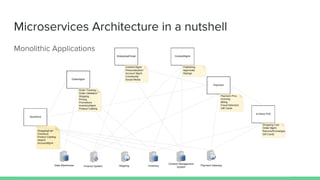
Microservices Architecture in a nutshell
Monolithic Applications
Microservices Architecture in a nutshell
SOA
Microservices Architecture in a nutshell
SOA with APIs
Microservices Architecture in a nutshell
Microservices
Why Microservices Compositions?
● Too many fine-grained microservices.
● Business functionalities often require to interact with more than one
(micro)service.
● Microservices typically don't publish their APIs for direct invocation.
● Brown-field Reality requires ‘Integration’
○ Green fields enterprises don’t exists.
○ Hybrid usage of Microservices and monolithic architecture is quite common.
○ Need to integrate with existing legacy systems, proprietary systems, databases and
SaaS.
Microservices and ESB - Facts and Myths
● How to Integrate Microservices/How to create microservice compositions?
● From ESB to ‘Smart endpoints and dumb pipes’
○ Routing logic or business logic that resides at the central ESB layer has to be segregated and
distributed among the (smart) clients and (micro) services.
(source : YOW! 2016 — Microservices by Martin Fowler)
Microservices and ESB - Myths and Facts
Point to Point Interactions
● Strict, dogmatic adherence to ‘smart-endpoint and dumb pipes’ results
Point-to-point(P2P) connectivity between your services and consumers.
● P2P approach is not scalable and exponentially increases the complexity of
the service interactions.
 ‘Smart-endpoint and dumb pipes’ in practice (source : Microservices in Practice)
Glimpse of existing Microservice Implementations
● How do the existing microservice implementations handle the service
compositions/service orchestration?
Microservice - Compositions
Netflix
● The Netflix API is the “front door” to the Netflix
ecosystem of microservices.
● API provides the logic of composing calls to all
services that are required to construct a
response.
● The Netflix API is an orchestration service that
exposes coarse grained APIs by composing
fined grained functionality provided by the
microservices.
● Orchestration logic is built with Java, RxJava
Microservice - Compositions
Uber
● ‘Edge Services’ which are exposed to the
external client/mobile applications and the
service orchestration logic is burnt into the
edge service.
● Edge services are primarily implemented
on top of Node.js
Microservice - Compositions
Paypal
● The API façade layer exposes Paypal
business functionalities to various internal
and external client applications
● The orchestration logic resides in the API
façade layer and its implemented using
Groovy.
Miniservices
“A miniservice is a coarse-grained, independently deployable and independently
scalable application component.”
● “Innovation Insight for Miniservices” : Published: 21 February 2017
○ https://www.gartner.com/doc/3615120/innovation-insight-miniservices
Pragmatic Microservices Architecture
● Microservices types with different granularities
Integration Microservices
● Composing microservices and create a new service
● Similar to the ‘Miniservice’ concept wrt to the granularity
● Integrate web APIs/SaaS, legacy systems and microservices
● API services/Edge service is also an integration microservice with some API
gateway capabilities.
Technologies for building Integration Microservices
● Frameworks based on general purpose lang. : Java, Node.js, Groovy - e.g.:
SpringBoot, Dropwizard
○ Not designed with suitable abstractions for integration/network interactions
○ Compositions cannot be illustrated graphically.
● Apache Camel and other ESBs.
○ Bulky traditional ESB architecture -> Not fully compatible with MSA principles.
○ High level DSLs with a lot of tweaks to make it a powerful programming lang. (e.g. expression
languages, properties)
● Ballerina - ballerinalang.org.
Ballerina (ballerinalang.org)
● Ballerina is a new parallel programming language that is designed and
optimized for integration.
● Graphical and textual syntax which is built on top of the sequence diagram
metaphor.
● Designed for network interactions with JSON/XML/SQL/MIME and
HTTP/JMS/File/WebSockets
● Lightweight, high-performance and container native Integration runtime
● 100% open source.
Hello World - Service
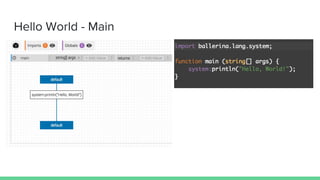
Hello World - Main
Ballerina - Key Concepts
Components Overview
Ballerina - Key Concepts
Service and Resource
● A service comprises of a homogeneous collection of network accessible entry
points; ‘resources’.
● A ‘resource’ contains the set of statements which are executed sequentially.
Ballerina - Key Concepts
Workers
● Worker is a thread of execution that can be programmed independently.
● A resource or a function contains the default worker that where you
sequentially configure the ballerina programming logic.
Ballerina - Key Concepts
Server Connectors
● Services are protocol agnostic.
● You can bind a ‘Server Connector’ to any service to receive messages from
respective the network protocol.
● Are defined as platform extensions – not written in Ballerina
● May offer of utility functions to access info in the message
● Can be configured via annotations that bind a service to a server connector.
Ballerina - Key Concepts
Connectors and Actions
● Ballerina is all about integrating with other systems using connectors
● “Other systems” are represented by a (client) “connector” that defines a set of
“actions” that you can do with that system
● The client connectors represent an external system that is accessible through
the network such as HTTP service, Database or any SaaS application.
● Graphically, the connector is represented as an actor in the sequence diagram
(i.e. a vertical line) and actions are boxes that go into a worker with lines going
to the actor.
Ballerina - Key Concepts
Functions
● Represent the reusable integration scenarios/code.
Ballerina Demo
Code is located at :
https://github.com/kasun04/rnd/tree/master/ballerina_use_cases
Ballerina knows main() and services
● Run as a command line program
● Run as a network service.
Ballerina knows JSON, XML and SQL data
● All part of Ballerina type system
● Deeply unified and integrated both syntactically and semantically
● Data transformation across all of these graphically and textually
● Transactional data management
Ballerina knows network protocols
● HTTP, WebSockets, JMS, FTP, Files, ...
● Popular APIs: Facebook, Twitter, Gmail, LinkedIn, …
● Extensible authentication / policy support
Ballerina knows Swagger
● Ballerina services’ interface is Swagger and Ballerina syntax, Swagger YAML
syntax and graphical syntaxes are interchangeable
● Reduces pains of interface-first design
Ballerina is naturally parallel
● Sequence diagram approach makes parallelism innate
● Think parallel first, not sequential first
Ballerina supports safety & resiliency
● Highly structured error and exception handling
● Taint tracking of network delivered data
● Stability Patterns : Supports Timeout, Circuit Breaker
● Failover, Load balancing, Reliable delivery.
High Performance and Container-native runtime
● Performance
○ Extremely lightweight and high performant runtime.
○ Minimal Startup time(< 1s), low resource consumption.
● Container-native
○ Built in ability to create Docker image with executable Ballerina program package
○ Run on any container management platform
Ballerina is Open Source!
● Implementation released under Apache License v2.0
○ Fork me on GitHub: https://github.com/ballerinalang/
● Community
○ Developers: ballerina-dev@googlegroups.com
○ Slack: #ballerinalang
○ Twitter: @ballerinalang
○ StackOverflow: #ballerinalang
Ballerina - Future
● Why yet another language?
○ Make it easier to consume and produce networked services and applications.
○ Ballerina has been influenced by Java, Go, C, Node, Javascript, Maven, Tomcat, and a variety of
other awesome tools.
● When should I use Ballerina?
○ Write integration microservices/miniservices: 80-20 rule
■ If 80% of your service is about integrating with other services, data and APIs then use
Ballerina.
■ If just 20% is integration then use Java / Node / Go / PHP / XYZ
○ Re-compose existing services to be API backends
○ Write integration scripts
■ Replacement for shell scripts that use curl a lot
Ballerina - Try it!
● DOWNLOAD v0.87 and twirl away:
○ http://ballerinalang.org/
● Source Code : https://github.com/ballerinalang/
● NOTE: Still work-in-progress. New releases every two weeks with major
features still coming along. Missing docs. A (few) bugs. Etc.!
● Integration Microservices plays a key part of MSA.
● Understanding service granularities.
● Technologies for building integration microservices.
Summary
Thank You!
● kasun@wso2.com
● https://twitter.com/kasunindrasiri

Integration Microservices

  • 1.
    Integration Microservices Bridging Microservices,Integration, and APIs SF Microservices - June Meetup 2017 Kasun Indrasiri Director-Integration Architecture at WSO2
  • 2.
    About Me ● Director- Integration Architecture at WSO2 ● Author ‘Beginning WSO2 ESB’, several microservices articles ● Committer/PMC Apache Synapse WSO2 ● Open source middleware company ● API Management, Integration, IAM and IOT platforms.
  • 3.
    Microservices Architecture ina nutshell Monolithic Applications
  • 4.
  • 5.
    Microservices Architecture ina nutshell SOA with APIs
  • 6.
    Microservices Architecture ina nutshell Microservices
  • 7.
    Why Microservices Compositions? ●Too many fine-grained microservices. ● Business functionalities often require to interact with more than one (micro)service. ● Microservices typically don't publish their APIs for direct invocation. ● Brown-field Reality requires ‘Integration’ ○ Green fields enterprises don’t exists. ○ Hybrid usage of Microservices and monolithic architecture is quite common. ○ Need to integrate with existing legacy systems, proprietary systems, databases and SaaS.
  • 8.
    Microservices and ESB- Facts and Myths ● How to Integrate Microservices/How to create microservice compositions? ● From ESB to ‘Smart endpoints and dumb pipes’ ○ Routing logic or business logic that resides at the central ESB layer has to be segregated and distributed among the (smart) clients and (micro) services. (source : YOW! 2016 — Microservices by Martin Fowler)
  • 9.
    Microservices and ESB- Myths and Facts Point to Point Interactions ● Strict, dogmatic adherence to ‘smart-endpoint and dumb pipes’ results Point-to-point(P2P) connectivity between your services and consumers. ● P2P approach is not scalable and exponentially increases the complexity of the service interactions.  ‘Smart-endpoint and dumb pipes’ in practice (source : Microservices in Practice)
  • 10.
    Glimpse of existingMicroservice Implementations ● How do the existing microservice implementations handle the service compositions/service orchestration?
  • 11.
    Microservice - Compositions Netflix ●The Netflix API is the “front door” to the Netflix ecosystem of microservices. ● API provides the logic of composing calls to all services that are required to construct a response. ● The Netflix API is an orchestration service that exposes coarse grained APIs by composing fined grained functionality provided by the microservices. ● Orchestration logic is built with Java, RxJava
  • 12.
    Microservice - Compositions Uber ●‘Edge Services’ which are exposed to the external client/mobile applications and the service orchestration logic is burnt into the edge service. ● Edge services are primarily implemented on top of Node.js
  • 13.
    Microservice - Compositions Paypal ●The API façade layer exposes Paypal business functionalities to various internal and external client applications ● The orchestration logic resides in the API façade layer and its implemented using Groovy.
  • 14.
    Miniservices “A miniservice isa coarse-grained, independently deployable and independently scalable application component.” ● “Innovation Insight for Miniservices” : Published: 21 February 2017 ○ https://www.gartner.com/doc/3615120/innovation-insight-miniservices
  • 15.
    Pragmatic Microservices Architecture ●Microservices types with different granularities
  • 16.
    Integration Microservices ● Composingmicroservices and create a new service ● Similar to the ‘Miniservice’ concept wrt to the granularity ● Integrate web APIs/SaaS, legacy systems and microservices ● API services/Edge service is also an integration microservice with some API gateway capabilities.
  • 17.
    Technologies for buildingIntegration Microservices ● Frameworks based on general purpose lang. : Java, Node.js, Groovy - e.g.: SpringBoot, Dropwizard ○ Not designed with suitable abstractions for integration/network interactions ○ Compositions cannot be illustrated graphically. ● Apache Camel and other ESBs. ○ Bulky traditional ESB architecture -> Not fully compatible with MSA principles. ○ High level DSLs with a lot of tweaks to make it a powerful programming lang. (e.g. expression languages, properties) ● Ballerina - ballerinalang.org.
  • 18.
    Ballerina (ballerinalang.org) ● Ballerinais a new parallel programming language that is designed and optimized for integration. ● Graphical and textual syntax which is built on top of the sequence diagram metaphor. ● Designed for network interactions with JSON/XML/SQL/MIME and HTTP/JMS/File/WebSockets ● Lightweight, high-performance and container native Integration runtime ● 100% open source.
  • 19.
  • 20.
  • 21.
    Ballerina - KeyConcepts Components Overview
  • 22.
    Ballerina - KeyConcepts Service and Resource ● A service comprises of a homogeneous collection of network accessible entry points; ‘resources’. ● A ‘resource’ contains the set of statements which are executed sequentially.
  • 23.
    Ballerina - KeyConcepts Workers ● Worker is a thread of execution that can be programmed independently. ● A resource or a function contains the default worker that where you sequentially configure the ballerina programming logic.
  • 24.
    Ballerina - KeyConcepts Server Connectors ● Services are protocol agnostic. ● You can bind a ‘Server Connector’ to any service to receive messages from respective the network protocol. ● Are defined as platform extensions – not written in Ballerina ● May offer of utility functions to access info in the message ● Can be configured via annotations that bind a service to a server connector.
  • 25.
    Ballerina - KeyConcepts Connectors and Actions ● Ballerina is all about integrating with other systems using connectors ● “Other systems” are represented by a (client) “connector” that defines a set of “actions” that you can do with that system ● The client connectors represent an external system that is accessible through the network such as HTTP service, Database or any SaaS application. ● Graphically, the connector is represented as an actor in the sequence diagram (i.e. a vertical line) and actions are boxes that go into a worker with lines going to the actor.
  • 26.
    Ballerina - KeyConcepts Functions ● Represent the reusable integration scenarios/code.
  • 27.
    Ballerina Demo Code islocated at : https://github.com/kasun04/rnd/tree/master/ballerina_use_cases
  • 28.
    Ballerina knows main()and services ● Run as a command line program ● Run as a network service.
  • 29.
    Ballerina knows JSON,XML and SQL data ● All part of Ballerina type system ● Deeply unified and integrated both syntactically and semantically ● Data transformation across all of these graphically and textually ● Transactional data management
  • 30.
    Ballerina knows networkprotocols ● HTTP, WebSockets, JMS, FTP, Files, ... ● Popular APIs: Facebook, Twitter, Gmail, LinkedIn, … ● Extensible authentication / policy support
  • 31.
    Ballerina knows Swagger ●Ballerina services’ interface is Swagger and Ballerina syntax, Swagger YAML syntax and graphical syntaxes are interchangeable ● Reduces pains of interface-first design
  • 32.
    Ballerina is naturallyparallel ● Sequence diagram approach makes parallelism innate ● Think parallel first, not sequential first
  • 33.
    Ballerina supports safety& resiliency ● Highly structured error and exception handling ● Taint tracking of network delivered data ● Stability Patterns : Supports Timeout, Circuit Breaker ● Failover, Load balancing, Reliable delivery.
  • 34.
    High Performance andContainer-native runtime ● Performance ○ Extremely lightweight and high performant runtime. ○ Minimal Startup time(< 1s), low resource consumption. ● Container-native ○ Built in ability to create Docker image with executable Ballerina program package ○ Run on any container management platform
  • 35.
    Ballerina is OpenSource! ● Implementation released under Apache License v2.0 ○ Fork me on GitHub: https://github.com/ballerinalang/ ● Community ○ Developers: ballerina-dev@googlegroups.com ○ Slack: #ballerinalang ○ Twitter: @ballerinalang ○ StackOverflow: #ballerinalang
  • 36.
    Ballerina - Future ●Why yet another language? ○ Make it easier to consume and produce networked services and applications. ○ Ballerina has been influenced by Java, Go, C, Node, Javascript, Maven, Tomcat, and a variety of other awesome tools. ● When should I use Ballerina? ○ Write integration microservices/miniservices: 80-20 rule ■ If 80% of your service is about integrating with other services, data and APIs then use Ballerina. ■ If just 20% is integration then use Java / Node / Go / PHP / XYZ ○ Re-compose existing services to be API backends ○ Write integration scripts ■ Replacement for shell scripts that use curl a lot
  • 37.
    Ballerina - Tryit! ● DOWNLOAD v0.87 and twirl away: ○ http://ballerinalang.org/ ● Source Code : https://github.com/ballerinalang/ ● NOTE: Still work-in-progress. New releases every two weeks with major features still coming along. Missing docs. A (few) bugs. Etc.!
  • 38.
    ● Integration Microservicesplays a key part of MSA. ● Understanding service granularities. ● Technologies for building integration microservices. Summary
  • 39.
    Thank You! ● kasun@wso2.com ●https://twitter.com/kasunindrasiri