

Securing	Your	APIs:		
How,	What,	Why	and	When	
Dulanja	Liyanage	
Technical	Lead,	WSO2	
dulanja@wso2.com
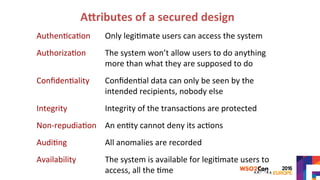
A:ributes	of	a	secured	design	
Authen>ca>on	 Only	legi>mate	users	can	access	the	system	
Authoriza>on	 The	system	won’t	allow	users	to	do	anything	
more	than	what	they	are	supposed	to	do	
Confiden>ality	 Confiden>al	data	can	only	be	seen	by	the	
intended	recipients,	nobody	else	
Integrity	 Integrity	of	the	transac>ons	are	protected	
Non-repudia>on	 An	en>ty	cannot	deny	its	ac>ons	
Audi>ng	 All	anomalies	are	recorded	
Availability	 The	system	is	available	for	legi>mate	users	to	
access,	all	the	>me
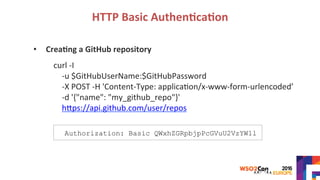
HTTP	Basic	Authen?ca?on	
•  Crea?ng	a	GitHub	repository	
	
				curl	-I	
	-u	$GitHubUserName:$GitHubPassword			
	-X	POST	-H	'Content-Type:	applica>on/x-www-form-urlencoded’	
	-d	'{"name":	"my_github_repo"}'		
	hYps://api.github.com/user/repos	
	
Authorization: Basic QWxhZGRpbjpPcGVuU2VzYW1l
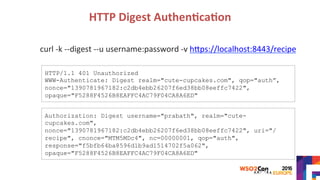
HTTP	Digest	Authen?ca?on	
curl	-k	--digest	--u	username:password	-v	hYps://localhost:8443/recipe	


Authorization: Digest username="prabath", realm="cute-
cupcakes.com",
nonce="1390781967182:c2db4ebb26207f6ed38bb08eeffc7422", uri="/
recipe", cnonce="MTM5MDc4", nc=00000001, qop="auth",
response="f5bfb64ba8596d1b9ad1514702f5a062",
opaque="F5288F4526B8EAFFC4AC79F04CA8A6ED"
HTTP/1.1 401 Unauthorized
WWW-Authenticate: Digest realm="cute-cupcakes.com", qop="auth”,
nonce="1390781967182:c2db4ebb26207f6ed38bb08eeffc7422",
opaque="F5288F4526B8EAFFC4AC79F04CA8A6ED"
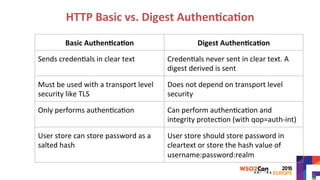
HTTP	Basic	vs.	Digest	Authen?ca?on	
Basic	Authen?ca?on	 Digest	Authen?ca?on	
Sends	creden>als	in	clear	text	 Creden>als	never	sent	in	clear	text.	A	
digest	derived	is	sent		
Must	be	used	with	a	transport	level	
security	like	TLS	
Does	not	depend	on	transport	level	
security	
Only	performs	authen>ca>on	 Can	perform	authen>ca>on	and	
integrity	protec>on	(with	qop=auth-int)	
User	store	can	store	password	as	a	
salted	hash	
User	store	should	store	password	in	
cleartext	or	store	the	hash	value	of	
username:password:realm
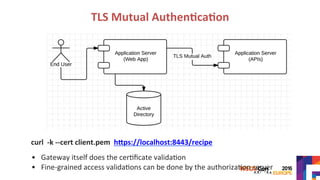
TLS	Mutual	Authen?ca?on	
curl		-k	--cert	client.pem		h:ps://localhost:8443/recipe	
	
•  Gateway	itself	does	the	cer>ficate	valida>on	
•  Fine-grained	access	valida>ons	can	be	done	by	the	authoriza>on	server
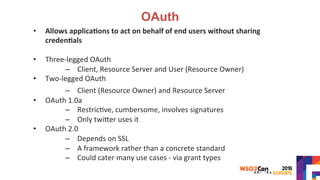
OAuth
•  Allows	applica?ons	to	act	on	behalf	of	end	users	without	sharing	
creden?als	
	
•  Three-legged	OAuth	
–  Client,	Resource	Server	and	User	(Resource	Owner)	
•  Two-legged	OAuth	
–  Client	(Resource	Owner)	and	Resource	Server	
•  OAuth	1.0a	
–  Restric>ve,	cumbersome,	involves	signatures	
–  Only	twiYer	uses	it	
•  OAuth	2.0	
–  Depends	on	SSL	
–  A	framework	rather	than	a	concrete	standard	
–  Could	cater	many	use	cases	-	via	grant	types
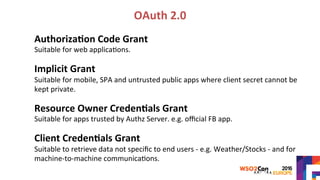
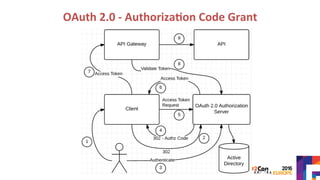
Authoriza?on	Code	Grant	
Suitable	for	web	applica>ons.	
Implicit	Grant	
Suitable	for	mobile,	SPA	and	untrusted	public	apps	where	client	secret	cannot	be	
kept	private.	
Resource	Owner	Creden?als	Grant	
Suitable	for	apps	trusted	by	Authz	Server.	e.g.	official	FB	app.	
Client	Creden?als	Grant	
Suitable	to	retrieve	data	not	specific	to	end	users	-	e.g.	Weather/Stocks	-	and	for	
machine-to-machine	communica>ons.	
OAuth	2.0
OAuth	2.0	-	Authoriza?on	Code	Grant
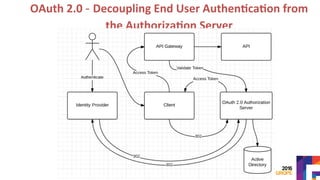
OAuth	2.0	- Decoupling	End	User	Authen?ca?on	from	
the	Authoriza?on	Server
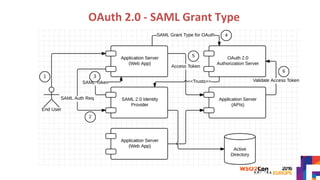
OAuth	2.0	-	SAML	Grant	Type
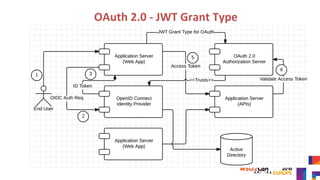
OAuth	2.0	-	JWT	Grant	Type
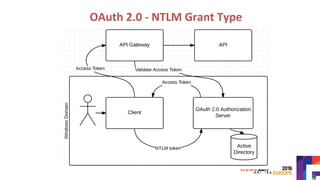
OAuth	2.0	-	NTLM	Grant	Type
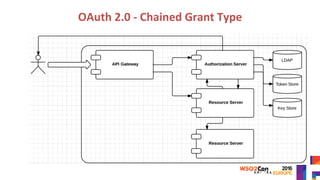
OAuth	2.0	-	Chained	Grant	Type
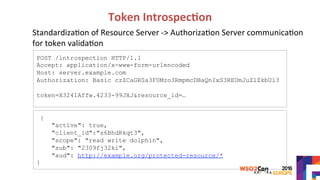
Token	Introspec?on	
			
	
POST /introspection HTTP/1.1
Accept: application/x-www-form-urlencoded
Host: server.example.com
Authorization: Basic czZCaGRSa3F0Mzo3RmpmcDBaQnIxS3REUmJuZlZkbUl3
token=X3241Affw.4233-99JXJ&resource_id=…
{
"active": true,
"client_id":"s6BhdRkqt3",
"scope": "read write dolphin",
"sub": "2309fj32kl",
"aud": http://example.org/protected-resource/*
}
Standardiza>on	of	Resource	Server	->	Authoriza>on	Server	communica>on	
for	token	valida>on
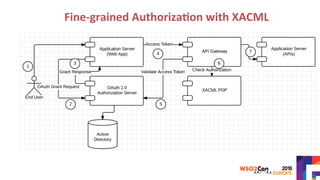
Fine-grained	Authoriza?on	with	XACML
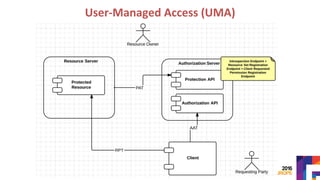
User-Managed	Access	(UMA)	
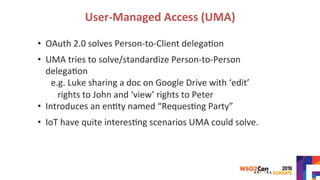
•  OAuth	2.0	solves	Person-to-Client	delega>on	
	
•  UMA	tries	to	solve/standardize	Person-to-Person	
delega>on	
e.g.	Luke	sharing	a	doc	on	Google	Drive	with	‘edit’	
rights	to	John	and	‘view’	rights	to	Peter	
•  Introduces	an	en>ty	named	“Reques>ng	Party”	
	
•  IoT	have	quite	interes>ng	scenarios	UMA	could	solve.
User-Managed	Access	(UMA)
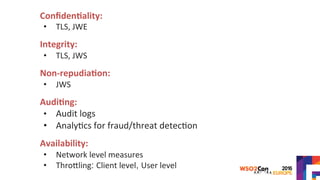
Confiden?ality:		
•  TLS,	JWE	
	
Integrity:		
•  TLS,	JWS	
	
Non-repudia?on:		
•  JWS	
	
Audi?ng:	
•  Audit	logs	
•  Analy>cs	for	fraud/threat	detec>on		
	
Availability:		
•  Network	level	measures	
•  ThroYling: Client	level, User	level
Thank	You!	
#WSO2ConEU	
Share	your	feedback	for	this	session	
wso2con.com/app

WSO2Con EU 2016: Securing APIs: How, What, Why, When