
Delivering the Goods?
Integrated Order Management
& Billing with BPS and ESB


by
Brad Svee
Sr. IT Development Manager
Growth = More Products, More Customers
and More Billing Runs
• Too many Lines of Custom PL/ SQL in Oracle EBS
  to support complex billing and account structures
  •   Not sustainable, not scalable, not favorable, not
      healthy
• Oracle Upgrades are harder with custom code
  •   Why upgrade all that custom stuff?
• What can we do to make billing more flexible,
  scalable and performant?
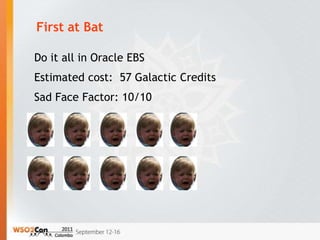
First at Bat

Do it all in Oracle EBS
Estimated cost: 57 Galactic Credits
Sad Face Factor: 10/10
Now What?

Hire a consultant who knows these things
Write a bunch of academic type papers and
 documents outlining the problems and goals
Start to evaluate vendors
Find a new Billing Engine and make them do it all
The State of the Billing Engines

• In the beginning, only giant telecom companies
  needed big billing, aka gazillions of transactions a
  minute rated across tons of kooky contracts
• Most established transactional billing engines are
  very telecom oriented
• Starting from telecom means that order
  management and quoting capabilities are weak or
  missing in these systems
• SaaS companies need to bill too, right?
Goals of Billing Project

•   Move away from Oracle EBS and tons of custom code
•   Speed billing process up from weeks to days
•   Consolidate invoicing
•   Online bill presentment and payment
•   Account Hierarchies
•   Support complex partner account relationships
•   Multi-currency invoicing
•   Empower more complex pricing & product structures
•   Sprinkle in Some Order Management…
Second at Bat

Nice new Billing Engine chosen
Missing Order Management and Catalog Rules
  functionality OOB, but they will customize
Estimated cost: 27 Galactic Credits
Sad Face Factor: 6* / 10


*That’s a lot of dough to for an untested “custom” Order Management
   Module and Price Catalog..
Basics of Quote & Order Management

• Sales people configure a set of products & prices
  of items within those products
• Rules control what can be sold with what
  (e.g. you can’t by 2 X-wings and only 1 R2)
• Permission levels allow more senior sales people
  to give larger discounts
• Workflow approvals prevent bad deals from
  sneaking through.
Goals of Order Management Project

•   Structured product catalog & configuration rules available
    within SFDC
•   Empower hundreds of sales people to easily create quotes
    online
•   Automate orders and approval workflow
•   Finalize SOF & Assets within SFDC
•   Highly configurable: different rules & configuration for
    different sales channels
•   Eliminate Excel Spreadsheets
•   Faster quoting & accurate Sales Order Forms
Choose Your Weapons

Billing System selection:
  •   On Premise
  •   .NET + SQL Server
  •   Small set of granular web services
Quote & Order System selection:
  •   SaaS + connectivity to SFDC
  •   Limited need to use web services
  •   Order is delivered via flat XML over HTTPS POST
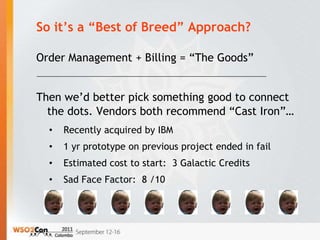
So it’s a “Best of Breed” Approach?

Order Management + Billing = “The Goods”


Then we’d better pick something good to connect
  the dots. Vendors both recommend “Cast Iron”…
  •   Recently acquired by IBM
  •   1 yr prototype on previous project ended in fail
  •   Estimated cost to start: 3 Galactic Credits
  •   Sad Face Factor: 8 /10
Enter WSO2

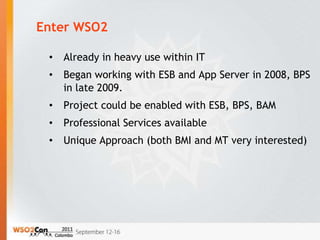
 •   Already in heavy use within IT
 •   Began working with ESB and App Server in 2008, BPS
     in late 2009.
 •   Project could be enabled with ESB, BPS, BAM
 •   Professional Services available
 •   Unique Approach (both BMI and MT very interested)
Third at Bat

Two Systems: Order Management and Billing Engine,
  connected by WSO2 ESB and BPS
Estimated cost: 15 Galactic Credits
Sad Face Factor: 0/10
Guiding Principles of the Integrations Team

• Source the data (identify keys) as far up-stream as
  possible to minimize round trips
• Eliminate complex rules within the billing engine by using
  mediation logic on the output from Order system
• Use the BPS whenever possible to avoid writing custom
  code or services in the billing engine
• Reusability of the BPEL
• Manual execution/recovery plans just in case
• Timing
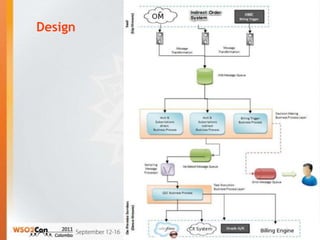
Design
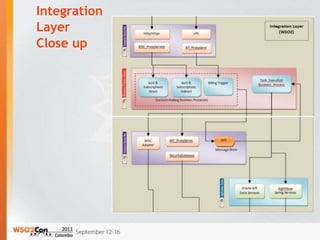
Integration
Layer
Close up
Challenges Addressed by WSO2

“Hidden Product Offerings”
Certain billing strategies required the creation of
  special Product Offering entries in the billing
  engine to create the back-end calculation.
  However, these offering items are not something
  that needs to be shown on the quote/order.
Solution: BPS sees Order XML with specific products
  and automatically creates the hidden objects in
  the billing engine
Challenges Addressed by WSO2

“Pre-Production Billing”
Certain products require extra time to implement,
  and therefore are sold with a re-occurring pre-
  production fee that is much lower than the actual
  re-occurring fee that will be assessed when the
  product is actually live in production.
Solution: BPS sees Order XML “Pre-Prod PO” and
  sets all other charge types on the subscription to a
  start day 3 years in the future.
Challenges Addressed by WSO2

“Pre-Production Billing Cont.”
When the Product is finally in “production mode”, a
 date is set out in another system. A file is sent
 containing the date, the customer entity and the
 billing ID.
Solution: ESB grabs the file via VFS and looks up the
  subscription, and sets the end date of the Pre-
  Prod PO and recalculates the start dates of all the
  other Products and Prices within the subscription,
  thereby activating production billing.
Challenges Addressed by WSO2

“.NET Activity Service calls are costly”
The billing engine’s web services are doing a lot of
  work and therefore are expected to be able to
  handle only a small continuous flow of orders
  unless we buy huge servers(already 12cpu 48GB).
Solution: ESB will use its message queue and
  throttling capability to restrict the amount of
  orders that are sent to the BPS to insert/update in
  the billing engine.
Challenges Addressed by WSO2

“Importing Data from Legacy Systems”
The billing engine’s only avenue for loading data
  (save paying for a custom loader) is through it’s
  default web services.
Solution: The two tiered BPS model and our own
  Order XML Schema allows us to extract legacy
  data with simple PL-SQL creating our XML and we
  place those messages into the second message
  queue as if they were just new orders.
Challenges Addressed by WSO2

“Orders from Multiple Sources”
Orders are expected to come from Indirect resellers
  as well as the OM system. Not to mention any
  future acquisitions may have order entry systems
  as well.
Solution: The two tiered BPS model and our own
  Order XML Schema allows us to parse orders from
  different sources, validate them, and queue a
  standard XML message for the worker BPEL to be
  loaded. Also allows common readability of orders
  for manual error investigation.
Challenges Addressed by WSO2

“Oracle EBS 11i: No Customer Create Services”
Customer records need to exist in Oracle AR module
  after they are loaded into Billing, however no
  standard interface exists.
Solution: Develop a set of custom PL/SQL
  procedures to create customer, bill-to, ship-to
  and contact records in the DB. Wrapping these
  procedures with WSO2 Data Services allows the
  BPS to easily create the necessary records.
Challenges Addressed by WSO2

“Minimize the Number of Invoices Sent”
Billing engine uses Billing Account to determine that
  an invoice should be created, but does not have a
  service to search for existing billing accounts, only
  a single expensive service that pulls the entire
  dataset for a single customer.
Solution: The first leg of the order validation BPEL pulls
  that full record once, searches through it for a matching
  billing address on the order and validates other customer
  attributes.
Challenges Addressed by WSO2

“SaaS OM System Posts Order over HTTPS”
The delivery mechanism for the final Order XML is a
  single POST and forget with basic security and
  reliability built in.
Solution: ESB Message Queue, and Security
  Throttling to only accept post from that IP
  address, and store the message in a queue
  immediately and reliably.
Questions?

WSO2Con2011: Delivering the Goods? Integrated Order Management & Billing with BPS and ESB

  • 1.
    Delivering the Goods? IntegratedOrder Management & Billing with BPS and ESB by Brad Svee Sr. IT Development Manager
  • 2.
    Growth = MoreProducts, More Customers and More Billing Runs • Too many Lines of Custom PL/ SQL in Oracle EBS to support complex billing and account structures • Not sustainable, not scalable, not favorable, not healthy • Oracle Upgrades are harder with custom code • Why upgrade all that custom stuff? • What can we do to make billing more flexible, scalable and performant?
  • 3.
    First at Bat Doit all in Oracle EBS Estimated cost: 57 Galactic Credits Sad Face Factor: 10/10
  • 4.
    Now What? Hire aconsultant who knows these things Write a bunch of academic type papers and documents outlining the problems and goals Start to evaluate vendors Find a new Billing Engine and make them do it all
  • 5.
    The State ofthe Billing Engines • In the beginning, only giant telecom companies needed big billing, aka gazillions of transactions a minute rated across tons of kooky contracts • Most established transactional billing engines are very telecom oriented • Starting from telecom means that order management and quoting capabilities are weak or missing in these systems • SaaS companies need to bill too, right?
  • 6.
    Goals of BillingProject • Move away from Oracle EBS and tons of custom code • Speed billing process up from weeks to days • Consolidate invoicing • Online bill presentment and payment • Account Hierarchies • Support complex partner account relationships • Multi-currency invoicing • Empower more complex pricing & product structures • Sprinkle in Some Order Management…
  • 7.
    Second at Bat Nicenew Billing Engine chosen Missing Order Management and Catalog Rules functionality OOB, but they will customize Estimated cost: 27 Galactic Credits Sad Face Factor: 6* / 10 *That’s a lot of dough to for an untested “custom” Order Management Module and Price Catalog..
  • 8.
    Basics of Quote& Order Management • Sales people configure a set of products & prices of items within those products • Rules control what can be sold with what (e.g. you can’t by 2 X-wings and only 1 R2) • Permission levels allow more senior sales people to give larger discounts • Workflow approvals prevent bad deals from sneaking through.
  • 9.
    Goals of OrderManagement Project • Structured product catalog & configuration rules available within SFDC • Empower hundreds of sales people to easily create quotes online • Automate orders and approval workflow • Finalize SOF & Assets within SFDC • Highly configurable: different rules & configuration for different sales channels • Eliminate Excel Spreadsheets • Faster quoting & accurate Sales Order Forms
  • 10.
    Choose Your Weapons BillingSystem selection: • On Premise • .NET + SQL Server • Small set of granular web services Quote & Order System selection: • SaaS + connectivity to SFDC • Limited need to use web services • Order is delivered via flat XML over HTTPS POST
  • 11.
    So it’s a“Best of Breed” Approach? Order Management + Billing = “The Goods” Then we’d better pick something good to connect the dots. Vendors both recommend “Cast Iron”… • Recently acquired by IBM • 1 yr prototype on previous project ended in fail • Estimated cost to start: 3 Galactic Credits • Sad Face Factor: 8 /10
  • 12.
    Enter WSO2 • Already in heavy use within IT • Began working with ESB and App Server in 2008, BPS in late 2009. • Project could be enabled with ESB, BPS, BAM • Professional Services available • Unique Approach (both BMI and MT very interested)
  • 13.
    Third at Bat TwoSystems: Order Management and Billing Engine, connected by WSO2 ESB and BPS Estimated cost: 15 Galactic Credits Sad Face Factor: 0/10
  • 14.
    Guiding Principles ofthe Integrations Team • Source the data (identify keys) as far up-stream as possible to minimize round trips • Eliminate complex rules within the billing engine by using mediation logic on the output from Order system • Use the BPS whenever possible to avoid writing custom code or services in the billing engine • Reusability of the BPEL • Manual execution/recovery plans just in case • Timing
  • 15.
  • 16.
  • 17.
    Challenges Addressed byWSO2 “Hidden Product Offerings” Certain billing strategies required the creation of special Product Offering entries in the billing engine to create the back-end calculation. However, these offering items are not something that needs to be shown on the quote/order. Solution: BPS sees Order XML with specific products and automatically creates the hidden objects in the billing engine
  • 18.
    Challenges Addressed byWSO2 “Pre-Production Billing” Certain products require extra time to implement, and therefore are sold with a re-occurring pre- production fee that is much lower than the actual re-occurring fee that will be assessed when the product is actually live in production. Solution: BPS sees Order XML “Pre-Prod PO” and sets all other charge types on the subscription to a start day 3 years in the future.
  • 19.
    Challenges Addressed byWSO2 “Pre-Production Billing Cont.” When the Product is finally in “production mode”, a date is set out in another system. A file is sent containing the date, the customer entity and the billing ID. Solution: ESB grabs the file via VFS and looks up the subscription, and sets the end date of the Pre- Prod PO and recalculates the start dates of all the other Products and Prices within the subscription, thereby activating production billing.
  • 20.
    Challenges Addressed byWSO2 “.NET Activity Service calls are costly” The billing engine’s web services are doing a lot of work and therefore are expected to be able to handle only a small continuous flow of orders unless we buy huge servers(already 12cpu 48GB). Solution: ESB will use its message queue and throttling capability to restrict the amount of orders that are sent to the BPS to insert/update in the billing engine.
  • 21.
    Challenges Addressed byWSO2 “Importing Data from Legacy Systems” The billing engine’s only avenue for loading data (save paying for a custom loader) is through it’s default web services. Solution: The two tiered BPS model and our own Order XML Schema allows us to extract legacy data with simple PL-SQL creating our XML and we place those messages into the second message queue as if they were just new orders.
  • 22.
    Challenges Addressed byWSO2 “Orders from Multiple Sources” Orders are expected to come from Indirect resellers as well as the OM system. Not to mention any future acquisitions may have order entry systems as well. Solution: The two tiered BPS model and our own Order XML Schema allows us to parse orders from different sources, validate them, and queue a standard XML message for the worker BPEL to be loaded. Also allows common readability of orders for manual error investigation.
  • 23.
    Challenges Addressed byWSO2 “Oracle EBS 11i: No Customer Create Services” Customer records need to exist in Oracle AR module after they are loaded into Billing, however no standard interface exists. Solution: Develop a set of custom PL/SQL procedures to create customer, bill-to, ship-to and contact records in the DB. Wrapping these procedures with WSO2 Data Services allows the BPS to easily create the necessary records.
  • 24.
    Challenges Addressed byWSO2 “Minimize the Number of Invoices Sent” Billing engine uses Billing Account to determine that an invoice should be created, but does not have a service to search for existing billing accounts, only a single expensive service that pulls the entire dataset for a single customer. Solution: The first leg of the order validation BPEL pulls that full record once, searches through it for a matching billing address on the order and validates other customer attributes.
  • 25.
    Challenges Addressed byWSO2 “SaaS OM System Posts Order over HTTPS” The delivery mechanism for the final Order XML is a single POST and forget with basic security and reliability built in. Solution: ESB Message Queue, and Security Throttling to only accept post from that IP address, and store the message in a queue immediately and reliably.
  • 26.