The Doctrine of  Jurisdictional Error
The Doctrine of Jurisdictional Error
The Doctrine of Jurisdictional Error THE DOCTRINE OF JURISDICTIONAL ERROR IS  VERY  RELEVANT ... AND TOPICAL
The Mohamed Haneef Affair   A Case of ‘Jurisdictional Error’ ‘ The Federal Court today quashed [the] decision to cancel the former Gold Coast-based Indian doctor's work visa on character grounds. Justice Jeffrey Spender ruled that Mr Andrews had made a " jurisdictional error " in cancelling Dr Haneef's visa.’ –  The Age , August 21, 2007.
The Doctrine of Jurisdictional Error INTRODUCTION
Distinction between  UV  and  JE ? [Reviewing] courts usually said that an inferior court or tribunal that had exceeded its powers had made a jurisdictional error; whereas an administrative officer who had gone beyond power was said to have acted  ultra vires .  Whitmore & Aronson, Review of Administrative Action, LBC, 1978, p. 143
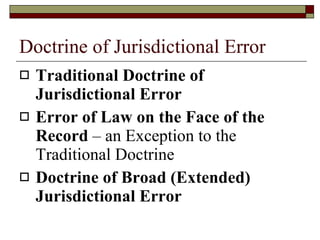
Doctrine of Jurisdictional Error Traditional Doctrine of Jurisdictional Error Error of Law on the Face of the Record  – an Exception to the Traditional Doctrine Doctrine of Broad (Extended) Jurisdictional Error
Doctrine of Jurisdictional Error THE TRADITIONAL DOCTRINE OF JURISDICTIONAL ERROR
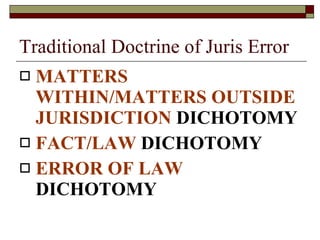
Traditional Doctrine of Juris Error MATTERS WITHIN/MATTERS OUTSIDE JURISDICTION  DICHOTOMY FACT/LAW  DICHOTOMY ERROR OF LAW  DICHOTOMY
Traditional Doctrine of Juris Error THE MATTERS WITHIN/MATTERS OUTSIDE JURISDICTION DICHOTOMY
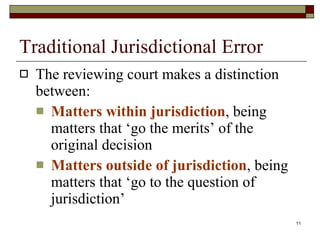
Traditional Jurisdictional Error The reviewing court makes a distinction between: Matters within jurisdiction , being matters that ‘go the merits’ of the original decision Matters outside of jurisdiction , being matters that ‘go to the question of jurisdiction’
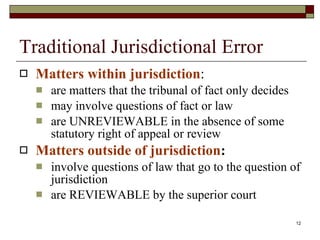
Traditional Jurisdictional Error Matters within jurisdiction : are matters that the tribunal of fact only decides may involve questions of fact or law are UNREVIEWABLE in the absence of some statutory right of appeal or review Matters outside of jurisdiction : involve questions of law that go to the question of jurisdiction are REVIEWABLE by the superior court
Traditional Doctrine of Juris Error THE FACT/LAW DICHOTOMY
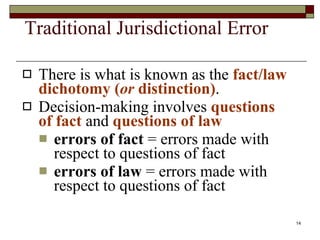
Traditional Jurisdictional Error There is what is known as the  fact/law dichotomy ( or  distinction) . Decision-making involves  questions of fact  and  questions of law errors of fact  = errors made with respect to questions of fact errors of law  = errors made with respect to questions of fact
Traditional Jurisdictional Error THE ERROR OF LAW DICHOTOMY
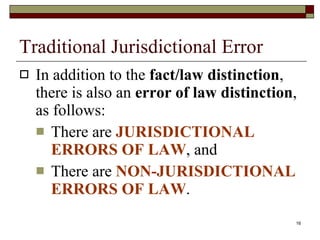
Traditional Jurisdictional Error In addition to the  fact/law distinction , there is also an  error of law distinction , as follows: There are  JURISDICTIONAL ERRORS OF LAW , and There are  NON-JURISDICTIONAL ERRORS OF LAW .
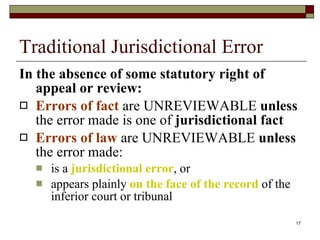
Traditional Jurisdictional Error In the absence of some statutory right of appeal or review: Errors of fact  are UNREVIEWABLE  unless  the error made is one of  jurisdictional fact Errors of law  are UNREVIEWABLE  unless  the error made: is a  jurisdictional error , or appears plainly  on the face of the record  of the inferior court or tribunal
Traditional Jurisdictional Error Under the traditional doctrine of jurisdictional error, only  JURISDICTIONAL ERRORS OF LAW  are ordinarily reviewable (subject to one exception known as ‘error of law on the face of the record’). NON-JURISDICTIONAL ERRORS OF LAW   are (subject to the above mentioned exception) unreviewable.
Traditional Jurisdictional Error Under the traditional doctrine of jurisdictional error  NON-JURISDICTIONAL ERRORS OF LAW   are  ALL  errors of law  other than  those that go the question of jurisdiction.
Traditional Jurisdictional Error NON-JURISDICTIONAL ERRORS  of law thus include: “ abuse of power ” errors  – eg acting in bad faith or for an improper purpose, taking into account an irrelevant consideration, failing to take into account a relevant consideration, acting manifestly unreasonably, etc,  and “ failure to exercise power ” errors  – eg fettering discretion, acting inflexibly on a policy, acting under dictation,  and  until fairly recently ,  acting contrary to the rules of procedural fairness .
Traditional Jurisdictional Error NOTE . In recent years a  breach of the requirement of procedural fairness  has generally been assimilated within  traditional jurisdictional error . See eg  Vanmeld Pty Ltd v Fairfield City Council  (1999) 46 NSWLR 78;  Re Refugee Review Tribunal; Ex parte Aala  (2000) 204 CLR 82;  Re Minister for Immigration and Multicultural Affairs; Ex parte Miah   (2001) 179 ALR 238;  Plaintiff S157/2000 v Commonwealth  (2003) 211 CLR 476.
Traditional Jurisdictional Error MORE ON THE FACT/LAW DICHOTOMY
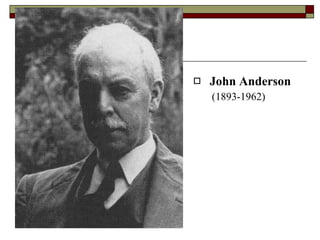
Traditional Jurisdictional Error Fact/Law Distinction What is a fact? A FACT IS AN OCCURRENCE IN SPACE AND TIME. John Anderson  (1893-1962) Challis Professor of Philosophy University of Sydney, 1927-58 “ Father of Australian Realism”.
John Anderson (1893-1962)
Matters of ‘fact’ and matters of ‘opinion’ Every ‘opinion’, to be ‘valid’, must be based upon, and supported by,  facts  relevant to the particular question or issue. Opinions can be said to be ‘true’ or ‘false’ when attention is directed, not to the opinion itself, but to the thing that the opinion is  of . The test of a ‘true’ opinion is to ‘see’ whether or not something  is  the case.
Matters of fact …  and  opinion To find out whether a fact exists, you ‘ look and see ’ or  observe  … or  examine .
Traditional Jurisdictional Error DIFFERENT ‘KINDS’ OF FACTS
Traditional Jurisdictional Error There are  PRIMARY FACTS  and  ULTIMATE QUESTIONS OF FACT . For example, whether or not there is a “ furnished dwelling-house ” (the ultimate question of fact) involves the following questions of  primary fact  …
Traditional Jurisdictional Error …  all of which are logically interconnected  on the same level of observability and being :
Traditional Jurisdictional Error Is there a “ structure ” (that is, something built up of component parts)? If so, is there a structure  in the nature of  a “ building ”? … A question of fact and degree in each particular case. If so, does the building comprise a “ dwelling ”? that is, “a room or suite or suite of rooms occupied or used or so constructed or adapted as to be capable of being occupied or used as a separate domicile”.
Traditional Jurisdictional Error If so, and leaving aside what are known as dual occupancies, semi-detached dwellings and the like for the moment, is the dwelling separate from any other such dwelling such that it is a “ dwelling-house ”? that is, “a building containing 1 but not more than 1 dwelling”. If so, is the dwelling-house “ furnished ”?
Traditional Jurisdictional Error Facts need to be adduced to prove all of the above matters.  The adduced facts comprise what are known as the basic or primary facts ( facta probantia ). They are the basic facts that must be adduced to prove or disprove the ultimate question of fact (the  factum probandum ).
Traditional Jurisdictional Error In  Hayes v Federal Commissioner of Taxation   (1956) 96 CLR 47 at 51 Fullagar J said: Where the  factum probandum  involves a term used in a statute, the question whether the accepted  facta probantia   establish that  factum probandum  will generally - so far as I can see, always - be a question of law.
Traditional Jurisdictional Error With respect, and regrettably, the true legal position is more complex than that .  These are the questions that must be asked: 1. In what  sense , legal or otherwise, does the statute use the particular word or phrase (the “statutory description”)? That is a  question of law .
Traditional Jurisdictional Error If the legislative intention is that the word or phrase be given its “ ordinary ” meaning, then the meaning of the word or phrase is a  question of fact .  If, however, the legislative intention is that the word or phrase be used in its technical “ legal ” sense, its meaning is a  question of law .
Traditional Jurisdictional Error Does the material with respect to the primary facts reasonably admit of  different conclusions or inferences  as to whether those facts come within the ambit of the statutory description?  Again, that is a  question of law .
Traditional Jurisdictional Error If the answer to Question 3 is yes, what is the “correct” conclusion? That is a  question of fact . If, however, the answer to Question 3 is no, a  question of law  is involved.
Traditional Jurisdictional Error 6. Where  only  one  conclusion or inference can be drawn from a set of primary facts as to whether or not they come within the ambit of a statutory description, in circumstances where a contrary decision has been drawn by the original decision-maker, an error with respect to a  question of law  (that is, an  error of law ) has been committed by the original decision-maker.
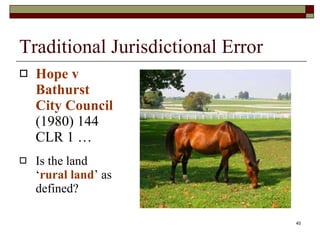
Traditional Jurisdictional Error Hope v Bathurst City Council  (1980) 144 CLR 1 … Is the land ‘ rural land ’ as defined?
Consequences of errors in fact finding .. ‘where only one conclusion can be drawn from a set of primary facts, that those facts, fully found, come within or fall outside a statutory description, and an contrary decision has been made, an error of law has been made. That error may or may not be jurisdictional’ Hope v Bathurst City Council  (1980) 144 CLR 1
  Traditional Jurisdictional Error Important distinction between errors of fact and errors of law Questions/Errors of fact a finding of fact – thus, the following have been held by the NSW Court of Appeal to involve only  an error of  fact ,   at least as regards “ primary ” (as opposed to “ultimate”)  questions of fact :  a “wrong” finding of fact, a “perverse” finding of fact,  a finding of fact “contrary to the overwhelming weight of the evidence”,  a finding of fact “against the evidence and the weight of the evidence”,  a finding of fact that “ignores the probative force of the evidence which is all one way”,  a finding of fact that “no reasonable person could have made”,
Traditional Jurisdictional Error Important distinction between errors of fact and errors of law Questions/Errors of fact  (cont’d) “ demonstrably unsound” reasoning at least as regards the reasoning by which the original decision-maker arrived at the finding of fact the drawing of a conclusion or an inference from or as to a primary fact, but  only  if rightly directed in law including correctly understanding the statutory language (in which case it is a conclusion or an inference of fact only)
Traditional Jurisdictional Error Important distinction between errors of fact and errors of law Questions/Errors of fact  (cont’d) whether primary facts, fully found,  come  within the ambit of a statutory description  in circumstances where  divergent conclusions or inferences can, on the evidence, reasonably be drawn as to whether or not those facts come within the ambit of a statutory description (at least in circumstances where the statute uses the words comprising the statutory description according to their ordinary meaning)
Traditional Jurisdictional Error Important distinction between errors of fact and errors of law Questions/Errors of fact  (cont’d) whether evidence ought to be accepted, and the “ordinary” (that is, everyday or common understanding) meaning of a word or phrase in the English language, or its non-legal technical meaning, where the legislative intention is that the word or phrase be given its “ordinary” or non-legal technical meaning as the case may be, as well as the meaning of a word or phrase the meaning of which is a matter of degree.
Errors of fact not generally reviewable    - exception - jurisdictional fact Factual errors are generally  unreviewable  under the principles of jurisdictional error  with  one exception .  The Exception : Where the fact, or fact-situation, is a …  JURISDICTIONAL FACT .
Traditional Jurisdictional Error Important distinction between errors of fact and errors of law JURISDICTIONAL   FACTS
What is a jurisdictional fact? ‘ A fact will be a jurisdictional fact if it must exist in fact and the legislature intends that the absence or presence of the fact will invalidate action under the statute’ Timbarra Protection Coalition v Ross Mining NL  (1999) 46 NSWLR 55 (NSWCA)
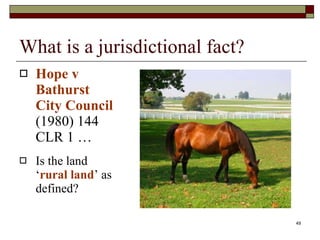
What is a jurisdictional fact? Hope v Bathurst City Council  (1980) 144 CLR 1 … Is the land ‘ rural land ’ as defined?
What is a jurisdictional fact? The expression " rural land " was defined in s.118 (1) of the  Local Government Act 1919  (NSW), so far as it is material, to mean: ‘ a  parcel of ratable land  which is  valued as one assessment  and  exceeds 8,000 square metres in area , and which is  wholly  or  mainly   used   for the time being by the  occupier  for  carrying on  one or more of the  businesses   or  industries  of grazing, dairying, pig-farming, poultry farming, viticulture, orcharding, bee-keeping horticulture, vegetable growing, the growing of crops of any kind or forestry.’
What is a jurisdictional fact? This definition threw up as an issue for determination by the primary judge, viz: the question  whether the appellant's land was wholly or mainly used by him for carrying on the business or industry of grazing .
What is a jurisdictional fact? The ‘ wrong ’ approach: Byron Shire Businesses for the Future Inc v Byron Council  (1994) 84 LGERA 434 Londish v Knox Grammar School  (1997) 97 LGERA 1
What is a jurisdictional fact? The ‘ right ’ approach: Timbarra Protection Coalition v Ross Mining NL  (1999) 46 NSWLR 55 Corporation of the City of Enfield v Development Assessment Commission  (2000) 199 CLR 135 Chambers v Maclean Shire Council  (2003) 57 NSWLR 152
Traditional Jurisdictional Error Important distinction between errors of fact and errors of law Questions/Errors of law “ pure” questions of statutory interpretation including but not limited to the sense, legal or otherwise, in which a statute uses a particular word or phrase, and the determination of whether or not a phrase in a statute is a composite phrase the meaning of a word or phrase in a statute where that word or phrase is used in a technical “legal” sense or in circumstances where the determination of the matter requires legal training
Traditional Jurisdictional Error Important distinction between errors of fact and errors of law Questions/Errors of law  (cont’d) the effect or construction of a word or phrase in a statute whose meaning or interpretation is established whether the original decision-maker has misdirected itself in law including but not limited to having defined otherwise than in accordance with law the question of fact to be answered (but  only  as regards “ultimate” as opposed to “primary” findings of fact)
Traditional Jurisdictional Error Important distinction between errors of fact and errors of law Questions/Errors of law  (cont’d) the drawing of a conclusion or an inference from or as to a primary fact, but only where  not  rightly directed in law including but not limited to incorrectly understanding or otherwise misinterpreting the statutory language (otherwise it is a conclusion or an inference of fact only) whether conclusions or inferences from or as to primary facts are, on the evidence,  capable  of being drawn or  can  reasonably be drawn
Traditional Jurisdictional Error Important distinction between errors of fact and errors of law Questions/Errors of law  (cont’d) the existence or non-existence of a  jurisdictional fact whether primary facts, fully found,  come  within the ambit of a statutory description, in circumstances where: the statute uses the words comprising the statutory description in a sense  other than  their ordinary meaning, or only one  conclusion can be drawn from a set of primary facts, as to whether or not they come within the ambit of a statutory description, in circumstances where a contrary decision has been drawn by the original decision-maker
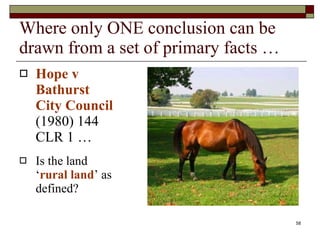
Where only ONE conclusion can be drawn from a set of primary facts … Hope v Bathurst City Council  (1980) 144 CLR 1 … Is the land ‘ rural land ’ as defined?
Where only ONE conclusion can be drawn from a set of primary facts … Hope v Bathurst City Council  (1980) 144 CLR 1 … Once the ‘ right ’ meaning was given to the word ‘ business ’ in the statutory description, there was only  ONE  conclusion that could be drawn from the set of primary facts, viz: Hope’s land  was  ‘ rural land ’ as defined in the LG Act.
Traditional Jurisdictional Error Important distinction between errors of fact and errors of law Questions/Errors of law  (cont’d) whether primary facts, fully found, are  capable  of coming within the ambit of a statutory description, including: whether the evidence reasonably admits of different conclusions or inferences as to whether the primary facts come within the ambit of the statutory description (rightly construed), and whether a conclusion or an inference that primary facts, fully found,  come  within the ambit of a statutory description  could  reasonably be drawn,
Traditional Jurisdictional Error Important distinction between errors of fact and errors of law Questions/Errors of law  (cont’d) Why? Because before a conclusion or inference is or can be drawn, there is the  preliminary or threshold question  of  whether the evidence reasonably admits of different conclusions
Traditional Jurisdictional Error Important distinction between errors of fact and errors of law Questions/Errors of law  (cont’d) whether there is evidence of a particular fact, whether the evidence reasonably admits of different conclusions, and whether the evidence is  insufficient  to prove a fact, and whether the original decision is one that could reasonably have been made on the evidence adduced.
Traditional Jurisdictional Error TRADITIONAL JURISDICTIONAL ERROR  is of  3 kinds
Traditional jurisdictional error: 3 Kinds Lack or want of jurisdiction Excess of jurisdiction Wrongful failure or refusal to exercise jurisdiction
Traditional jurisdictional error Any  other  error of law is known as a  non-jurisdictional  error (that is, an error made  within  jurisdiction).
Traditional jurisdictional error Subject to  ONE  exception, a  non-jurisdictional  error of law is  unreviewable   in the absence of some statutory right of appeal or review .
Traditional jurisdictional error That  exception  – to be discussed later – is known as  ERROR OF LAW ON THE FACE OF THE RECORD .
Traditional jurisdictional error THE THREE TYPES OF TRADITIONAL JURISDICTIONAL ERROR
Traditional jurisdictional error WANT/LACK OF JURISDICTION EXCESS OF JURISDICTION WRONGFUL FAILURE OR REFUSAL TO EXERCISE JURISDICTION
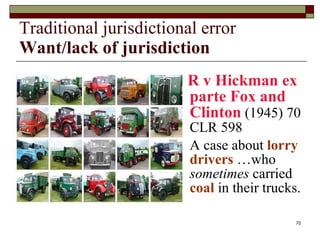
Traditional jurisdictional error Want/lack of jurisdiction R v Hickman ex parte Fox and Clinton  (1945) 70 CLR 598 A case about  lorry drivers  …who  sometimes  carried  coal  in their trucks.
Traditional jurisdictional error Want/lack of jurisdiction ‘ In my opinion, the whole of the evidence shows that the employers and employees concerned are not engaged in the coal mining industry, and that therefore the decision of the Local Reference Board was made without jurisdiction’,  per  Latham CJ at 609 R v Hickman ex p Fox and Clinton   (1945) 70 CLR 598
Traditional jurisdictional error Want/lack of jurisdiction Ex parte Wurth; Re Tully  (1954) 55 SR (NSW) 47 …  Was a refusal to appoint to a permanent position a ‘ dismissal ’ within the meaning of the Act?
Traditional jurisdictional error Want/lack of jurisdiction Potter v Melbourne & Metropolitan Tramways Board  (1957) 98 CLR 337  Was a reduction in grade and salary a ‘ punishment ’ within the meaning of the Act?
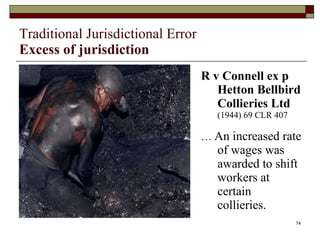
Traditional Jurisdictional Error Excess of jurisdiction R v Connell ex p Hetton Bellbird Collieries Ltd   (1944) 69 CLR 407 …  An increased rate of wages was awarded to shift workers at certain collieries.
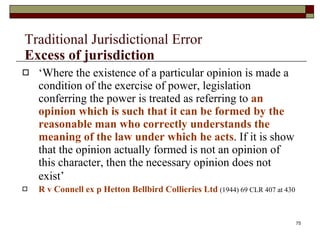
Traditional Jurisdictional Error Excess of jurisdiction   ‘ Where the existence of a particular opinion is made a condition of the exercise of power, legislation conferring the power is treated as referring to  an opinion which is such that it can be formed by the reasonable man who correctly understands the meaning of the law under which he acts . If it is show that the opinion actually formed is not an opinion of this character, then the necessary opinion does not exist’   R v Connell ex p Hetton Bellbird Collieries Ltd   (1944) 69 CLR 407 at 430
R v Connell ex p Hetton Bellbird Collieries  (cont’d) ‘ It should be emphasised that the application of the principle now under discussion does not mean that the court substitutes its opinion for the opinion of the person or authority in question. What the court does is to inquire whether the opinion required by the relevant legislative provision has really been formed. …  (cont’d)
R v Connell ex p Hetton Bellbird Collieries  (cont’d) …  If the opinion which was in fact formed was reached by  taking into account irrelevant considerations  or by  otherwise misconstruing the terms of the relevant legislation , then it must be held that the opinion required has not been formed. In that event  the basis for the exercise of power is absent , just as if it were shown that the opinion was arbitrary, capricious, irrational or not bona fide’ ( per  Latham CJ at p 432)
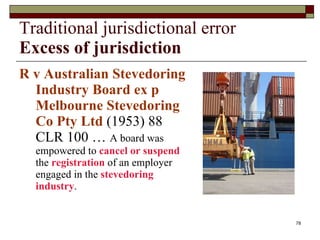
Traditional jurisdictional error Excess of jurisdiction R v Australian Stevedoring Industry Board ex p Melbourne Stevedoring Co Pty Ltd  (1953) 88 CLR 100 …  A board was empowered to  cancel or suspend  the  registration  of an employer engaged in the  stevedoring industry .
Traditional jurisdictional error Excess of jurisdiction ...But the power of the Board … to cancel or suspend registration ..depends upon the  satisfaction  of the Board or its delegate that one or other of the conditions does exist. If the Board … is subjectively  satisfied  that the … company is either  unfit  to continue to be registered ...  then the power exists to cancel or suspend the company’s registration no matter how erroneous in point of fact the opinion of the Board … may be.  … (cont’d)
Traditional jurisdictional error Excess of jurisdiction But it does matter if the opinion is erroneous in point of law. That is to say the board or its delegate must understand correctly the test provided ...and actually apply it.  R v Australian Stevedoring Industry Board  (1953) 88 CLR 100 per Dixon at 118.
The Mohamed Haneef Affair   A Case of ‘Jurisdictional Error’ … ‘Excess’ ‘ The Federal Court today quashed [the] decision to cancel the former Gold Coast-based Indian doctor's work visa on character grounds. Justice Jeffrey Spender ruled that Mr Andrews had made a " jurisdictional error " in cancelling Dr Haneef's visa.’ –  The Age , August 21, 2007.
Minister for Immigration & Citizenship v Haneef   [2007] FCAFC 203   Full Bench of Federal Court of Australia  Black CJ ‘ Character test ’: s.501(6)(b),  Migration Act 1958  (Cth) Full Bench unanimously rejected Minister's interpretation of the ‘ character test ’ relied on in the cancellation former terrorism suspect Dr Mohamed Haneef’s visa.
Minister for Immigration & Citizenship v Haneef   [2007] FCAFC 203 Visa had been cancelled  on the basis that the Minister: ‘ reasonably suspected ’  Dr Haneef did not pass the character test, and  the Minister was satisfied that it was in the national interest to cancel the visa.
Minister for Immigration & Citizenship v Haneef   [2007] FCAFC 203 Migration Act 1958  specified various  circumstances  under which a person did not pass the character test.  The circumstances included that a person has or has had ‘an  association  with someone else, or with a group or organisation, whom the Minister reasonably suspects has been or is involved in criminal conduct’.
Minister for Immigration & Citizenship v Haneef   [2007] FCAFC 203 Minister had relied on Dr Haneef’s ‘association’ with the Ahmeds The Ahmeds were allegedly involved in the failed car bomb attacks in Glasgow and London.
Minister for Immigration & Citizenship v Haneef   [2007] FCAFC 203 Minister had applied a wide interpretation of the word ‘ association ’, which …  did not require any suspicion that Dr Haneef was sympathetic to, or supportive of, or in any way involved in the criminal conduct of which the Ahmeds were suspected.
Minister for Immigration & Citizenship v Haneef   [2007] FCAFC 203 HELD : The ‘ association ’ to which the Act refers:  is one involving some sympathy with, or support for, or involvement in, the criminal conduct of the person, group or organisation with whom the visa holder is said to have associated, and must have some bearing upon the person's character.
Minister for Immigration & Citizenship v Haneef   [2007] FCAFC 203 An ‘innocent’ association is not enough. There must be some  nexus  between the relationship that the visa holder has to the other person, and the criminal activity of that other person.
Minister for Immigration & Citizenship v Haneef   [2007] FCAFC 203 HELD : In interpreting the provision, the Minister must take into account: the  context  in which it appears the  purpose  of the Act the  legislative history considerations of the consequences  of adopting competing interpretations. The Court applied the principles of common law concerning the interpretation of statutes in circumstances where the  rights of individuals  may be  adversely affected .
Minister for Immigration & Citizenship v Haneef   [2007] FCAFC 203 Full Federal Court  confirmed the decision of Spender J Minster had committed a  jurisdictional error He had applied the  wrong jurisdictional test  – he   misinterpreted the character test  and  applied a test that was  too wide  and could encompass links that could not have conceivably had any bearing on the visa holder's character
Traditional Jurisdictional Error Wrongful failure/refusal to exercise jurisdiction Sinclair  v  Mining Warden at Maryborough  (1975) 132 CLR 473 ‘…  The mining warden, in misconceiving his function, failed to perform his duty.’
Traditional Jurisdictional Error Wrongful failure/refusal to exercise jurisdiction ‘ If a person having a duty to hear and consider  misconceives what is his relevant duty , he will have failed to perform that duty and may be compelled by mandamus to perform it according to law’  Per  Barwick CJ No evidence  presented by the company  upon which the warden could base his opinion – thus, he misconceived what was his duty.  Sinclair v Mining Warden at Maryborough  (1975) 132 CLR 473
Traditional Jurisdictional Error Wrongful failure/refusal to exercise jurisdiction ‘ The use by the warden of the expression “public interest as a whole’ indicates ..that the warden failed to understand that irrespective of the interests of the objectors of their number and, indeed, irrespective of the existence of an objection on that ground, he was bound to consider whether the granting of the application would prejudicially affect the public interest.  …  (cont’d)
Traditional Jurisdictional Error Wrongful failure/refusal to exercise jurisdiction If he had realized this he could not, in my opinion, have drawn the irrelevant distinction between the views of a section of the public and the public interest as a whole. In my opinion, he has not considered the real question which it was his duty to consider, namely,  whether the granting of the application would prejudicially affect the public interest.’ Sinclair  v  Mining Warden at Maryborough  (1975) 132 CLR 473  per  Barwick CJ.
Identifying jurisdictional error First, identify the nature of the body exercising power and the jurisdiction in question. eg  The  Coal Compensation Tribunal  was established under section X of the  Coal Compensation Act 2002  (NSW). The Coal Compensation Tribunal is a NSW statutory  administrative tribunal . Its  jurisdiction  is to award compensation (up to a maximum amount) to any person entitled to claim compensation.  However , it may  only  do so IF …
Jurisdiction of specific tribunal The Tribunal’s  jurisdiction  is to do X (eg award compensation, revoke a person’s registration, vary an award, etc) For the Tribunal to exercise jurisdiction the Tribunal must … Now, list, in an orderly and sequential fashion, the various matters of jurisdictional fact and jurisdictional law that go to make up what is known as the ‘ jurisdictional test ’.
Identifying jurisdictional error Is there a ‘conventional’ jurisdictional error?  Is there a ‘constructive jurisdictional error’? eg if  a tribunal misunderstood the test it had to apply, ie didn’t apply the test correctly or ask itself the right question. If so, the tribunal has made a jurisdictional error. (See, eg,  R v Connell .)
Traditional Jurisdictional Error ERROR OF LAW ON THE FACE OF THE RECORD
Error on the face of the record An  exception  – the  ONLY  exception - to the traditional doctrine of jurisdictional error  Any  error of law is judicially reviewable if it appears  plainly on the face of the record
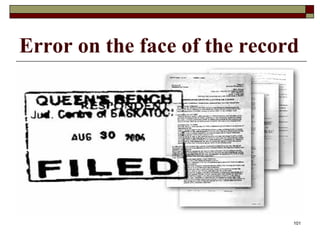
Error of law on the face of the record: Historical development R v Northumberland Compensation Appeals Tribunal; ex p Shaw Record = ‘formal set of documents comprising the court’s proceedings’ includes  initiating documents ,  pleadings  (if any), and the  adjudication   evidence and judicial reasoning  not  included unless expressly incorporated
Error on the face of the record
Error of law on the face of the record: Historical development Baldwin v Francis Ltd v Patents Appeal Tribunal ‘ a record is  not just the formal order , but ..  all those documents  which appear …to be the  basis for the decision ’  R v Knightsbridge Crown Court ex p International Sporting Club (London) Ltd reasons  in transcript of oral judgment of court part of the record Commissioner of Police v District Court of NSW transcript , including  judicial reasoning  part of the record
Error on the face of the record ‘ The next step is to determine what constitutes the record.  There is no fixed rule which requires the same answer to be given in every case . It is for the court undertaking the review to determine what constitutes the record in the particular case but this is not in any way to countenance a roving commission through the materials in a case in an attempt to discover an error of law.’  Hockey v Yelland   (1984) 157 CLR 124  per  Wilson J.
Error on the face of the record The determination of the precise documents which constitute ‘the record’ of the inferior court for the purposes of a particular  application for certiorari is ultimately a matter for the court hearing the application.  Craig v South Australia   (1995) 184 CLR 163; 69 ALJR 873 at 879.
Error on the face of the record At  common law  – the record  doesn’t  usually include  reasons  expressed or  transcripts of evidence  or the  exhibits  unless the Tribunal has incorporated the reasons into the record ( Craig v SA ) In NSW, see s.69  Supreme Court Act 1970
SUPREME COURT ACT 1970 - SECT 69  Proceedings in lieu of writs   (3) It is declared that the jurisdiction of the Court to grant any relief or remedy in the nature of a writ of certiorari includes jurisdiction to quash the ultimate determination of a court or tribunal in any proceedings if that determination has been made on the basis of an error of law that appears on the face of the record of the proceedings.  (4) For the purposes of subsection (3),  the face of the record includes the reasons expressed by the court or tribunal for its ultimate determination.
Traditional Jurisdictional Error THE VOID/VOIDABLE DISTINCTION Jurisdictional error  = void Non-jurisdictional error  = voidable NOTE . A  non-jurisdictional error  is, in the absence of some statutory right of appeal or review,  reviewable  in any event  ONLY  if it appears  plainly on the face of the record  of the inferior court or tribunal’s proceedings.
Doctrine of Jurisdictional Error THE DOCTRINE OF BROAD (EXTENDED) JURISDICTIONAL ERROR
Extended jurisdictional error Anisminic Ltd v Foreign Compensation Commission  [1969] 2 AC 147  Craig  v State Of South Australia  (1995) 184 CLR 163 Minister for Immigration and Multicultural Affairs v  Yusuf  (2001) 206 CLR 323 Ellis-Jones I,  The Anisminic Revolution in Australian Administrative Law: An Analysis of Extended Jurisdictional Error  (Local Legal, 1998) [See  UTSOnline:Admin Law  for LLM Thesis copy.]
Extended jurisdictional error Anisminic Ltd v Foreign Compensation Commission  [1969] 2 AC 147   …  Anisminic had owned a mining property in Egypt.
Anisminic Ltd v Foreign Compensation Commission
Anisminic  – jurisdictional error ‘ (i)...the owner of the property;  or  is the successor in title of such person; .... and   (ii) that the person referred to as aforesaid  and  any person who became successor in title of such person ....... were  British nationals ....’
Anisminic  – jurisdictional error Lord Reid : <173> ..It appears from the commission’s reasons that they construed this provision as requiring them to inquire, when the applicant is himself the original owner, whether he had a successor in title. So they made that inquiry in this case and held that TEDO was the applicant’s successor in title. As TEDO was not <174> a British national they rejected the appellant’s claim.
Anisminic-type jurisdictional errors Examples of  Anisminic -jurisdictional errors of law: Acting in bad faith Making a decision the tribunal has no power to make Failing to comply with the requirements of procedural fairness … (cont’d)
Anisminic-type jurisdictional errors Misconstruing the empowering statute or delegated legislation so that the tribunal fails to deal with the question remitted to it and decides some question not remitted to it; refusing to take into account something which it was required to take into account or basing its decision on some matter which it had no right to take into account ( Lord Reid  at 171).
Anisminic-type jurisdictional errors There may be an absence of those formalities or things which are conditions precedent to the tribunal having any jurisdiction or things which are conditions precedent to the tribunal having any jurisdiction to embark on an inquiry. Or the tribunal may at the end make an order that it has no jurisdiction to make.  Or in the intervening stage, while engaged on a proper inquiry, the tribunal may depart from the rules of natural justice;  …  (cont’d)
Anisminic-type jurisdictional errors Or it may ask itself the wrong questions; Or it may take into account matters which it was not directed to take into account.  ....Thereby it would step outside its jurisdiction. It would turn its inquiry into something not directed by Parliament and failed to make the inquiry which Parliament did direct. Any of these things would cause its purported decision to be a nullity’.  Lord Pearce at 195
Post-Anisminic: United Kingdom Pearlman v Keepers & Governors of Harrow School  [1979] QB 56 In Re Racal Communications  [1981] AC 374 O’Reilly v Mackman  [1983] 2 AC 237 R v Greater Manchester Coroner ex p Tal  [1984] 3 WLR 643 R v Hull University Visitor ex p Page  (1992) 3 WLR 1112
Post-Anisminic: Australia Thelander v Woodward  (1981) Public Service Association of SA v Federated Clerks Union of Australia, SA Branch  (1991) Commissioner of Police v District Court of NSW  (1993) Walker v Industrial Court of NSW  (1994) Craig v South Australia  (1995) Newcastle Wallsend Coal P/L v Court of Coal Mines Regulation  (1997) Londish v Knox Grammar School  (1997) MIMA v Yusuf  (2001) Plaintiff S157/2002 v Commonwealth of Australia  (2003)
CRAIG v THE STATE OF SOUTH AUSTRALIA  Examples of Extended Jurisdictional Errors An administrative tribunal may fall into error of law which causes it to:  identify a wrong issue ask itself a wrong question ignore relevant material rely on irrelevant material, and at least in some circumstances, to make an erroneous finding or to reach a mistaken conclusion  AND  the tribunal’s exercise or purported exercise of power is thereby affected, it exceeds its authority of powers. Such an error of law is  jurisdictional error  which will invalidate … .
CRAIG v THE STATE OF SOUTH AUSTRALIA  Examples of Extended Jurisdictional Errors In  Craig  the idea of jurisdictional error was found to encompass virtually all of the matters listed in the  Administrative Decisions (Judicial Review) Act 1977  (Cth), as picked up in the  Judicial Review Act 1991  (Qld), except the catch-all of ‘abuse of power’.  See  Craig v South Australia  (1995) 184 CLR 163 at 179.
Post-Craig: High Court of Australia Minister for Immigration and Multicultural Affairs v Yusuf  (2001) 206 CLR 323 The list in  Craig  is not exhaustive Those different kinds of errors may well overlap More than one categorisation of the error of law made may be possible Must show how the error affected the exercise of power
Edwards v Justice Giudice  (1999) 94 FCR 561 107  The Court of Appeal of the Supreme Court of Victoria in  Returned & Services League of Australia (Vic Branch) Inc (Pascoe Vale Sub Branch) v Liquor Licensing Commission   [1999] VSCA 37  pointed out that in  Craig  the High Court had said that the error of law in respect of which certiorari is available is one where &quot;the tribunal's exercise or purported exercise of power is thereby affected&quot;. The Court of Appeal described this as the &quot;critical expression&quot; in the passage of the judgment of the High Court that I have set out. No doubt it is. The question is what did the High Court mean by this &quot;critical expression&quot;? ...
Edwards v Justice Giudice  (1999) 94 FCR 561 In my view an error will relevantly &quot;affect&quot; a tribunal's exercise or purported exercise of power  if the erroneous finding forms the basis of the decision or is an element in the processes of reasoning that led to the decision . In other words, the point that the High Court was making is that only those errors of law that cause the tribunal to err in the result will lead to the decision being quashed.  Per Finkelstein J  [Emphasis added]
Post  Craig  – NSWCA  Newcastle Wallsend Coal Co Pty Ltd v Court of Coal Mines Regulation  (1997) 42 NSWLR  351 -  review of a decision of an inferior court Londish v Knox Grammar School  (1997) 97 LGERA 1 - review of a local council decision Woolworths Ltd v Hawke  [1998] 45 NSWLR 13 - review of a decision of an inferior court Vanmeld Pty Limited v Fairfield City Council  ( 1999) 46 NSWLR 78 – review of a local council decision
Post  Craig  – NSWCA Brodyn Pty Ltd t/as Time Cost and Quality v Davenport  (2004) 61 NSWLR 421  – review of a decision of an administrative tribunal belated acceptance by NSW Court of Appeal of the potential applicability of the  Anisminic-Craig  formulation of jurisdictional error  PROVIDED  it can be shown that the impugned error of law is one on which the decision of the case depends  See also  Coordinated Construction Co Pty Ltd v J M Hargreaves (NSW) Pty Ltd  [2005] NSWCA 22

THE DOCTRINE OF JURISDICTIONAL ERROR

  • 1.
    The Doctrine of Jurisdictional Error
  • 2.
    The Doctrine ofJurisdictional Error
  • 3.
    The Doctrine ofJurisdictional Error THE DOCTRINE OF JURISDICTIONAL ERROR IS VERY RELEVANT ... AND TOPICAL
  • 4.
    The Mohamed HaneefAffair A Case of ‘Jurisdictional Error’ ‘ The Federal Court today quashed [the] decision to cancel the former Gold Coast-based Indian doctor's work visa on character grounds. Justice Jeffrey Spender ruled that Mr Andrews had made a &quot; jurisdictional error &quot; in cancelling Dr Haneef's visa.’ – The Age , August 21, 2007.
  • 5.
    The Doctrine ofJurisdictional Error INTRODUCTION
  • 6.
    Distinction between UV and JE ? [Reviewing] courts usually said that an inferior court or tribunal that had exceeded its powers had made a jurisdictional error; whereas an administrative officer who had gone beyond power was said to have acted ultra vires . Whitmore & Aronson, Review of Administrative Action, LBC, 1978, p. 143
  • 7.
    Doctrine of JurisdictionalError Traditional Doctrine of Jurisdictional Error Error of Law on the Face of the Record – an Exception to the Traditional Doctrine Doctrine of Broad (Extended) Jurisdictional Error
  • 8.
    Doctrine of JurisdictionalError THE TRADITIONAL DOCTRINE OF JURISDICTIONAL ERROR
  • 9.
    Traditional Doctrine ofJuris Error MATTERS WITHIN/MATTERS OUTSIDE JURISDICTION DICHOTOMY FACT/LAW DICHOTOMY ERROR OF LAW DICHOTOMY
  • 10.
    Traditional Doctrine ofJuris Error THE MATTERS WITHIN/MATTERS OUTSIDE JURISDICTION DICHOTOMY
  • 11.
    Traditional Jurisdictional ErrorThe reviewing court makes a distinction between: Matters within jurisdiction , being matters that ‘go the merits’ of the original decision Matters outside of jurisdiction , being matters that ‘go to the question of jurisdiction’
  • 12.
    Traditional Jurisdictional ErrorMatters within jurisdiction : are matters that the tribunal of fact only decides may involve questions of fact or law are UNREVIEWABLE in the absence of some statutory right of appeal or review Matters outside of jurisdiction : involve questions of law that go to the question of jurisdiction are REVIEWABLE by the superior court
  • 13.
    Traditional Doctrine ofJuris Error THE FACT/LAW DICHOTOMY
  • 14.
    Traditional Jurisdictional ErrorThere is what is known as the fact/law dichotomy ( or distinction) . Decision-making involves questions of fact and questions of law errors of fact = errors made with respect to questions of fact errors of law = errors made with respect to questions of fact
  • 15.
    Traditional Jurisdictional ErrorTHE ERROR OF LAW DICHOTOMY
  • 16.
    Traditional Jurisdictional ErrorIn addition to the fact/law distinction , there is also an error of law distinction , as follows: There are JURISDICTIONAL ERRORS OF LAW , and There are NON-JURISDICTIONAL ERRORS OF LAW .
  • 17.
    Traditional Jurisdictional ErrorIn the absence of some statutory right of appeal or review: Errors of fact are UNREVIEWABLE unless the error made is one of jurisdictional fact Errors of law are UNREVIEWABLE unless the error made: is a jurisdictional error , or appears plainly on the face of the record of the inferior court or tribunal
  • 18.
    Traditional Jurisdictional ErrorUnder the traditional doctrine of jurisdictional error, only JURISDICTIONAL ERRORS OF LAW are ordinarily reviewable (subject to one exception known as ‘error of law on the face of the record’). NON-JURISDICTIONAL ERRORS OF LAW are (subject to the above mentioned exception) unreviewable.
  • 19.
    Traditional Jurisdictional ErrorUnder the traditional doctrine of jurisdictional error NON-JURISDICTIONAL ERRORS OF LAW are ALL errors of law other than those that go the question of jurisdiction.
  • 20.
    Traditional Jurisdictional ErrorNON-JURISDICTIONAL ERRORS of law thus include: “ abuse of power ” errors – eg acting in bad faith or for an improper purpose, taking into account an irrelevant consideration, failing to take into account a relevant consideration, acting manifestly unreasonably, etc, and “ failure to exercise power ” errors – eg fettering discretion, acting inflexibly on a policy, acting under dictation, and until fairly recently , acting contrary to the rules of procedural fairness .
  • 21.
    Traditional Jurisdictional ErrorNOTE . In recent years a breach of the requirement of procedural fairness has generally been assimilated within traditional jurisdictional error . See eg Vanmeld Pty Ltd v Fairfield City Council (1999) 46 NSWLR 78; Re Refugee Review Tribunal; Ex parte Aala (2000) 204 CLR 82; Re Minister for Immigration and Multicultural Affairs; Ex parte Miah (2001) 179 ALR 238; Plaintiff S157/2000 v Commonwealth (2003) 211 CLR 476.
  • 22.
    Traditional Jurisdictional ErrorMORE ON THE FACT/LAW DICHOTOMY
  • 23.
    Traditional Jurisdictional ErrorFact/Law Distinction What is a fact? A FACT IS AN OCCURRENCE IN SPACE AND TIME. John Anderson (1893-1962) Challis Professor of Philosophy University of Sydney, 1927-58 “ Father of Australian Realism”.
  • 24.
  • 25.
    Matters of ‘fact’and matters of ‘opinion’ Every ‘opinion’, to be ‘valid’, must be based upon, and supported by, facts relevant to the particular question or issue. Opinions can be said to be ‘true’ or ‘false’ when attention is directed, not to the opinion itself, but to the thing that the opinion is of . The test of a ‘true’ opinion is to ‘see’ whether or not something is the case.
  • 26.
    Matters of fact… and opinion To find out whether a fact exists, you ‘ look and see ’ or observe … or examine .
  • 28.
    Traditional Jurisdictional ErrorDIFFERENT ‘KINDS’ OF FACTS
  • 29.
    Traditional Jurisdictional ErrorThere are PRIMARY FACTS and ULTIMATE QUESTIONS OF FACT . For example, whether or not there is a “ furnished dwelling-house ” (the ultimate question of fact) involves the following questions of primary fact …
  • 30.
    Traditional Jurisdictional Error… all of which are logically interconnected on the same level of observability and being :
  • 31.
    Traditional Jurisdictional ErrorIs there a “ structure ” (that is, something built up of component parts)? If so, is there a structure in the nature of a “ building ”? … A question of fact and degree in each particular case. If so, does the building comprise a “ dwelling ”? that is, “a room or suite or suite of rooms occupied or used or so constructed or adapted as to be capable of being occupied or used as a separate domicile”.
  • 32.
    Traditional Jurisdictional ErrorIf so, and leaving aside what are known as dual occupancies, semi-detached dwellings and the like for the moment, is the dwelling separate from any other such dwelling such that it is a “ dwelling-house ”? that is, “a building containing 1 but not more than 1 dwelling”. If so, is the dwelling-house “ furnished ”?
  • 33.
    Traditional Jurisdictional ErrorFacts need to be adduced to prove all of the above matters. The adduced facts comprise what are known as the basic or primary facts ( facta probantia ). They are the basic facts that must be adduced to prove or disprove the ultimate question of fact (the factum probandum ).
  • 34.
    Traditional Jurisdictional ErrorIn Hayes v Federal Commissioner of Taxation (1956) 96 CLR 47 at 51 Fullagar J said: Where the factum probandum involves a term used in a statute, the question whether the accepted facta probantia establish that factum probandum will generally - so far as I can see, always - be a question of law.
  • 35.
    Traditional Jurisdictional ErrorWith respect, and regrettably, the true legal position is more complex than that . These are the questions that must be asked: 1. In what sense , legal or otherwise, does the statute use the particular word or phrase (the “statutory description”)? That is a question of law .
  • 36.
    Traditional Jurisdictional ErrorIf the legislative intention is that the word or phrase be given its “ ordinary ” meaning, then the meaning of the word or phrase is a question of fact . If, however, the legislative intention is that the word or phrase be used in its technical “ legal ” sense, its meaning is a question of law .
  • 37.
    Traditional Jurisdictional ErrorDoes the material with respect to the primary facts reasonably admit of different conclusions or inferences as to whether those facts come within the ambit of the statutory description? Again, that is a question of law .
  • 38.
    Traditional Jurisdictional ErrorIf the answer to Question 3 is yes, what is the “correct” conclusion? That is a question of fact . If, however, the answer to Question 3 is no, a question of law is involved.
  • 39.
    Traditional Jurisdictional Error6. Where only one conclusion or inference can be drawn from a set of primary facts as to whether or not they come within the ambit of a statutory description, in circumstances where a contrary decision has been drawn by the original decision-maker, an error with respect to a question of law (that is, an error of law ) has been committed by the original decision-maker.
  • 40.
    Traditional Jurisdictional ErrorHope v Bathurst City Council (1980) 144 CLR 1 … Is the land ‘ rural land ’ as defined?
  • 41.
    Consequences of errorsin fact finding .. ‘where only one conclusion can be drawn from a set of primary facts, that those facts, fully found, come within or fall outside a statutory description, and an contrary decision has been made, an error of law has been made. That error may or may not be jurisdictional’ Hope v Bathurst City Council (1980) 144 CLR 1
  • 42.
    TraditionalJurisdictional Error Important distinction between errors of fact and errors of law Questions/Errors of fact a finding of fact – thus, the following have been held by the NSW Court of Appeal to involve only an error of fact , at least as regards “ primary ” (as opposed to “ultimate”) questions of fact : a “wrong” finding of fact, a “perverse” finding of fact, a finding of fact “contrary to the overwhelming weight of the evidence”, a finding of fact “against the evidence and the weight of the evidence”, a finding of fact that “ignores the probative force of the evidence which is all one way”, a finding of fact that “no reasonable person could have made”,
  • 43.
    Traditional Jurisdictional ErrorImportant distinction between errors of fact and errors of law Questions/Errors of fact (cont’d) “ demonstrably unsound” reasoning at least as regards the reasoning by which the original decision-maker arrived at the finding of fact the drawing of a conclusion or an inference from or as to a primary fact, but only if rightly directed in law including correctly understanding the statutory language (in which case it is a conclusion or an inference of fact only)
  • 44.
    Traditional Jurisdictional ErrorImportant distinction between errors of fact and errors of law Questions/Errors of fact (cont’d) whether primary facts, fully found, come within the ambit of a statutory description in circumstances where divergent conclusions or inferences can, on the evidence, reasonably be drawn as to whether or not those facts come within the ambit of a statutory description (at least in circumstances where the statute uses the words comprising the statutory description according to their ordinary meaning)
  • 45.
    Traditional Jurisdictional ErrorImportant distinction between errors of fact and errors of law Questions/Errors of fact (cont’d) whether evidence ought to be accepted, and the “ordinary” (that is, everyday or common understanding) meaning of a word or phrase in the English language, or its non-legal technical meaning, where the legislative intention is that the word or phrase be given its “ordinary” or non-legal technical meaning as the case may be, as well as the meaning of a word or phrase the meaning of which is a matter of degree.
  • 46.
    Errors of factnot generally reviewable - exception - jurisdictional fact Factual errors are generally unreviewable under the principles of jurisdictional error with one exception . The Exception : Where the fact, or fact-situation, is a … JURISDICTIONAL FACT .
  • 47.
    Traditional Jurisdictional ErrorImportant distinction between errors of fact and errors of law JURISDICTIONAL FACTS
  • 48.
    What is ajurisdictional fact? ‘ A fact will be a jurisdictional fact if it must exist in fact and the legislature intends that the absence or presence of the fact will invalidate action under the statute’ Timbarra Protection Coalition v Ross Mining NL (1999) 46 NSWLR 55 (NSWCA)
  • 49.
    What is ajurisdictional fact? Hope v Bathurst City Council (1980) 144 CLR 1 … Is the land ‘ rural land ’ as defined?
  • 50.
    What is ajurisdictional fact? The expression &quot; rural land &quot; was defined in s.118 (1) of the Local Government Act 1919 (NSW), so far as it is material, to mean: ‘ a parcel of ratable land which is valued as one assessment and exceeds 8,000 square metres in area , and which is wholly or mainly used for the time being by the occupier for carrying on one or more of the businesses or industries of grazing, dairying, pig-farming, poultry farming, viticulture, orcharding, bee-keeping horticulture, vegetable growing, the growing of crops of any kind or forestry.’
  • 51.
    What is ajurisdictional fact? This definition threw up as an issue for determination by the primary judge, viz: the question whether the appellant's land was wholly or mainly used by him for carrying on the business or industry of grazing .
  • 52.
    What is ajurisdictional fact? The ‘ wrong ’ approach: Byron Shire Businesses for the Future Inc v Byron Council (1994) 84 LGERA 434 Londish v Knox Grammar School (1997) 97 LGERA 1
  • 53.
    What is ajurisdictional fact? The ‘ right ’ approach: Timbarra Protection Coalition v Ross Mining NL (1999) 46 NSWLR 55 Corporation of the City of Enfield v Development Assessment Commission (2000) 199 CLR 135 Chambers v Maclean Shire Council (2003) 57 NSWLR 152
  • 54.
    Traditional Jurisdictional ErrorImportant distinction between errors of fact and errors of law Questions/Errors of law “ pure” questions of statutory interpretation including but not limited to the sense, legal or otherwise, in which a statute uses a particular word or phrase, and the determination of whether or not a phrase in a statute is a composite phrase the meaning of a word or phrase in a statute where that word or phrase is used in a technical “legal” sense or in circumstances where the determination of the matter requires legal training
  • 55.
    Traditional Jurisdictional ErrorImportant distinction between errors of fact and errors of law Questions/Errors of law (cont’d) the effect or construction of a word or phrase in a statute whose meaning or interpretation is established whether the original decision-maker has misdirected itself in law including but not limited to having defined otherwise than in accordance with law the question of fact to be answered (but only as regards “ultimate” as opposed to “primary” findings of fact)
  • 56.
    Traditional Jurisdictional ErrorImportant distinction between errors of fact and errors of law Questions/Errors of law (cont’d) the drawing of a conclusion or an inference from or as to a primary fact, but only where not rightly directed in law including but not limited to incorrectly understanding or otherwise misinterpreting the statutory language (otherwise it is a conclusion or an inference of fact only) whether conclusions or inferences from or as to primary facts are, on the evidence, capable of being drawn or can reasonably be drawn
  • 57.
    Traditional Jurisdictional ErrorImportant distinction between errors of fact and errors of law Questions/Errors of law (cont’d) the existence or non-existence of a jurisdictional fact whether primary facts, fully found, come within the ambit of a statutory description, in circumstances where: the statute uses the words comprising the statutory description in a sense other than their ordinary meaning, or only one conclusion can be drawn from a set of primary facts, as to whether or not they come within the ambit of a statutory description, in circumstances where a contrary decision has been drawn by the original decision-maker
  • 58.
    Where only ONEconclusion can be drawn from a set of primary facts … Hope v Bathurst City Council (1980) 144 CLR 1 … Is the land ‘ rural land ’ as defined?
  • 59.
    Where only ONEconclusion can be drawn from a set of primary facts … Hope v Bathurst City Council (1980) 144 CLR 1 … Once the ‘ right ’ meaning was given to the word ‘ business ’ in the statutory description, there was only ONE conclusion that could be drawn from the set of primary facts, viz: Hope’s land was ‘ rural land ’ as defined in the LG Act.
  • 60.
    Traditional Jurisdictional ErrorImportant distinction between errors of fact and errors of law Questions/Errors of law (cont’d) whether primary facts, fully found, are capable of coming within the ambit of a statutory description, including: whether the evidence reasonably admits of different conclusions or inferences as to whether the primary facts come within the ambit of the statutory description (rightly construed), and whether a conclusion or an inference that primary facts, fully found, come within the ambit of a statutory description could reasonably be drawn,
  • 61.
    Traditional Jurisdictional ErrorImportant distinction between errors of fact and errors of law Questions/Errors of law (cont’d) Why? Because before a conclusion or inference is or can be drawn, there is the preliminary or threshold question of whether the evidence reasonably admits of different conclusions
  • 62.
    Traditional Jurisdictional ErrorImportant distinction between errors of fact and errors of law Questions/Errors of law (cont’d) whether there is evidence of a particular fact, whether the evidence reasonably admits of different conclusions, and whether the evidence is insufficient to prove a fact, and whether the original decision is one that could reasonably have been made on the evidence adduced.
  • 63.
    Traditional Jurisdictional ErrorTRADITIONAL JURISDICTIONAL ERROR is of 3 kinds
  • 64.
    Traditional jurisdictional error:3 Kinds Lack or want of jurisdiction Excess of jurisdiction Wrongful failure or refusal to exercise jurisdiction
  • 65.
    Traditional jurisdictional errorAny other error of law is known as a non-jurisdictional error (that is, an error made within jurisdiction).
  • 66.
    Traditional jurisdictional errorSubject to ONE exception, a non-jurisdictional error of law is unreviewable in the absence of some statutory right of appeal or review .
  • 67.
    Traditional jurisdictional errorThat exception – to be discussed later – is known as ERROR OF LAW ON THE FACE OF THE RECORD .
  • 68.
    Traditional jurisdictional errorTHE THREE TYPES OF TRADITIONAL JURISDICTIONAL ERROR
  • 69.
    Traditional jurisdictional errorWANT/LACK OF JURISDICTION EXCESS OF JURISDICTION WRONGFUL FAILURE OR REFUSAL TO EXERCISE JURISDICTION
  • 70.
    Traditional jurisdictional errorWant/lack of jurisdiction R v Hickman ex parte Fox and Clinton (1945) 70 CLR 598 A case about lorry drivers …who sometimes carried coal in their trucks.
  • 71.
    Traditional jurisdictional errorWant/lack of jurisdiction ‘ In my opinion, the whole of the evidence shows that the employers and employees concerned are not engaged in the coal mining industry, and that therefore the decision of the Local Reference Board was made without jurisdiction’, per Latham CJ at 609 R v Hickman ex p Fox and Clinton (1945) 70 CLR 598
  • 72.
    Traditional jurisdictional errorWant/lack of jurisdiction Ex parte Wurth; Re Tully (1954) 55 SR (NSW) 47 … Was a refusal to appoint to a permanent position a ‘ dismissal ’ within the meaning of the Act?
  • 73.
    Traditional jurisdictional errorWant/lack of jurisdiction Potter v Melbourne & Metropolitan Tramways Board (1957) 98 CLR 337 Was a reduction in grade and salary a ‘ punishment ’ within the meaning of the Act?
  • 74.
    Traditional Jurisdictional ErrorExcess of jurisdiction R v Connell ex p Hetton Bellbird Collieries Ltd (1944) 69 CLR 407 … An increased rate of wages was awarded to shift workers at certain collieries.
  • 75.
    Traditional Jurisdictional ErrorExcess of jurisdiction ‘ Where the existence of a particular opinion is made a condition of the exercise of power, legislation conferring the power is treated as referring to an opinion which is such that it can be formed by the reasonable man who correctly understands the meaning of the law under which he acts . If it is show that the opinion actually formed is not an opinion of this character, then the necessary opinion does not exist’ R v Connell ex p Hetton Bellbird Collieries Ltd (1944) 69 CLR 407 at 430
  • 76.
    R v Connellex p Hetton Bellbird Collieries (cont’d) ‘ It should be emphasised that the application of the principle now under discussion does not mean that the court substitutes its opinion for the opinion of the person or authority in question. What the court does is to inquire whether the opinion required by the relevant legislative provision has really been formed. … (cont’d)
  • 77.
    R v Connellex p Hetton Bellbird Collieries (cont’d) … If the opinion which was in fact formed was reached by taking into account irrelevant considerations or by otherwise misconstruing the terms of the relevant legislation , then it must be held that the opinion required has not been formed. In that event the basis for the exercise of power is absent , just as if it were shown that the opinion was arbitrary, capricious, irrational or not bona fide’ ( per Latham CJ at p 432)
  • 78.
    Traditional jurisdictional errorExcess of jurisdiction R v Australian Stevedoring Industry Board ex p Melbourne Stevedoring Co Pty Ltd (1953) 88 CLR 100 … A board was empowered to cancel or suspend the registration of an employer engaged in the stevedoring industry .
  • 79.
    Traditional jurisdictional errorExcess of jurisdiction ...But the power of the Board … to cancel or suspend registration ..depends upon the satisfaction of the Board or its delegate that one or other of the conditions does exist. If the Board … is subjectively satisfied that the … company is either unfit to continue to be registered ... then the power exists to cancel or suspend the company’s registration no matter how erroneous in point of fact the opinion of the Board … may be. … (cont’d)
  • 80.
    Traditional jurisdictional errorExcess of jurisdiction But it does matter if the opinion is erroneous in point of law. That is to say the board or its delegate must understand correctly the test provided ...and actually apply it. R v Australian Stevedoring Industry Board (1953) 88 CLR 100 per Dixon at 118.
  • 81.
    The Mohamed HaneefAffair A Case of ‘Jurisdictional Error’ … ‘Excess’ ‘ The Federal Court today quashed [the] decision to cancel the former Gold Coast-based Indian doctor's work visa on character grounds. Justice Jeffrey Spender ruled that Mr Andrews had made a &quot; jurisdictional error &quot; in cancelling Dr Haneef's visa.’ – The Age , August 21, 2007.
  • 82.
    Minister for Immigration& Citizenship v Haneef [2007] FCAFC 203 Full Bench of Federal Court of Australia Black CJ ‘ Character test ’: s.501(6)(b), Migration Act 1958 (Cth) Full Bench unanimously rejected Minister's interpretation of the ‘ character test ’ relied on in the cancellation former terrorism suspect Dr Mohamed Haneef’s visa.
  • 83.
    Minister for Immigration& Citizenship v Haneef [2007] FCAFC 203 Visa had been cancelled on the basis that the Minister: ‘ reasonably suspected ’ Dr Haneef did not pass the character test, and the Minister was satisfied that it was in the national interest to cancel the visa.
  • 84.
    Minister for Immigration& Citizenship v Haneef [2007] FCAFC 203 Migration Act 1958 specified various circumstances under which a person did not pass the character test. The circumstances included that a person has or has had ‘an association with someone else, or with a group or organisation, whom the Minister reasonably suspects has been or is involved in criminal conduct’.
  • 85.
    Minister for Immigration& Citizenship v Haneef [2007] FCAFC 203 Minister had relied on Dr Haneef’s ‘association’ with the Ahmeds The Ahmeds were allegedly involved in the failed car bomb attacks in Glasgow and London.
  • 86.
    Minister for Immigration& Citizenship v Haneef [2007] FCAFC 203 Minister had applied a wide interpretation of the word ‘ association ’, which … did not require any suspicion that Dr Haneef was sympathetic to, or supportive of, or in any way involved in the criminal conduct of which the Ahmeds were suspected.
  • 87.
    Minister for Immigration& Citizenship v Haneef [2007] FCAFC 203 HELD : The ‘ association ’ to which the Act refers: is one involving some sympathy with, or support for, or involvement in, the criminal conduct of the person, group or organisation with whom the visa holder is said to have associated, and must have some bearing upon the person's character.
  • 88.
    Minister for Immigration& Citizenship v Haneef [2007] FCAFC 203 An ‘innocent’ association is not enough. There must be some nexus between the relationship that the visa holder has to the other person, and the criminal activity of that other person.
  • 89.
    Minister for Immigration& Citizenship v Haneef [2007] FCAFC 203 HELD : In interpreting the provision, the Minister must take into account: the context in which it appears the purpose of the Act the legislative history considerations of the consequences of adopting competing interpretations. The Court applied the principles of common law concerning the interpretation of statutes in circumstances where the rights of individuals may be adversely affected .
  • 90.
    Minister for Immigration& Citizenship v Haneef [2007] FCAFC 203 Full Federal Court confirmed the decision of Spender J Minster had committed a jurisdictional error He had applied the wrong jurisdictional test – he misinterpreted the character test and applied a test that was too wide and could encompass links that could not have conceivably had any bearing on the visa holder's character
  • 91.
    Traditional Jurisdictional ErrorWrongful failure/refusal to exercise jurisdiction Sinclair v Mining Warden at Maryborough (1975) 132 CLR 473 ‘… The mining warden, in misconceiving his function, failed to perform his duty.’
  • 92.
    Traditional Jurisdictional ErrorWrongful failure/refusal to exercise jurisdiction ‘ If a person having a duty to hear and consider misconceives what is his relevant duty , he will have failed to perform that duty and may be compelled by mandamus to perform it according to law’ Per Barwick CJ No evidence presented by the company upon which the warden could base his opinion – thus, he misconceived what was his duty. Sinclair v Mining Warden at Maryborough (1975) 132 CLR 473
  • 93.
    Traditional Jurisdictional ErrorWrongful failure/refusal to exercise jurisdiction ‘ The use by the warden of the expression “public interest as a whole’ indicates ..that the warden failed to understand that irrespective of the interests of the objectors of their number and, indeed, irrespective of the existence of an objection on that ground, he was bound to consider whether the granting of the application would prejudicially affect the public interest. … (cont’d)
  • 94.
    Traditional Jurisdictional ErrorWrongful failure/refusal to exercise jurisdiction If he had realized this he could not, in my opinion, have drawn the irrelevant distinction between the views of a section of the public and the public interest as a whole. In my opinion, he has not considered the real question which it was his duty to consider, namely, whether the granting of the application would prejudicially affect the public interest.’ Sinclair v Mining Warden at Maryborough (1975) 132 CLR 473 per Barwick CJ.
  • 95.
    Identifying jurisdictional errorFirst, identify the nature of the body exercising power and the jurisdiction in question. eg The Coal Compensation Tribunal was established under section X of the Coal Compensation Act 2002 (NSW). The Coal Compensation Tribunal is a NSW statutory administrative tribunal . Its jurisdiction is to award compensation (up to a maximum amount) to any person entitled to claim compensation. However , it may only do so IF …
  • 96.
    Jurisdiction of specifictribunal The Tribunal’s jurisdiction is to do X (eg award compensation, revoke a person’s registration, vary an award, etc) For the Tribunal to exercise jurisdiction the Tribunal must … Now, list, in an orderly and sequential fashion, the various matters of jurisdictional fact and jurisdictional law that go to make up what is known as the ‘ jurisdictional test ’.
  • 97.
    Identifying jurisdictional errorIs there a ‘conventional’ jurisdictional error? Is there a ‘constructive jurisdictional error’? eg if a tribunal misunderstood the test it had to apply, ie didn’t apply the test correctly or ask itself the right question. If so, the tribunal has made a jurisdictional error. (See, eg, R v Connell .)
  • 98.
    Traditional Jurisdictional ErrorERROR OF LAW ON THE FACE OF THE RECORD
  • 99.
    Error on theface of the record An exception – the ONLY exception - to the traditional doctrine of jurisdictional error Any error of law is judicially reviewable if it appears plainly on the face of the record
  • 100.
    Error of lawon the face of the record: Historical development R v Northumberland Compensation Appeals Tribunal; ex p Shaw Record = ‘formal set of documents comprising the court’s proceedings’ includes initiating documents , pleadings (if any), and the adjudication evidence and judicial reasoning not included unless expressly incorporated
  • 101.
    Error on theface of the record
  • 102.
    Error of lawon the face of the record: Historical development Baldwin v Francis Ltd v Patents Appeal Tribunal ‘ a record is not just the formal order , but .. all those documents which appear …to be the basis for the decision ’ R v Knightsbridge Crown Court ex p International Sporting Club (London) Ltd reasons in transcript of oral judgment of court part of the record Commissioner of Police v District Court of NSW transcript , including judicial reasoning part of the record
  • 103.
    Error on theface of the record ‘ The next step is to determine what constitutes the record. There is no fixed rule which requires the same answer to be given in every case . It is for the court undertaking the review to determine what constitutes the record in the particular case but this is not in any way to countenance a roving commission through the materials in a case in an attempt to discover an error of law.’ Hockey v Yelland (1984) 157 CLR 124 per Wilson J.
  • 104.
    Error on theface of the record The determination of the precise documents which constitute ‘the record’ of the inferior court for the purposes of a particular application for certiorari is ultimately a matter for the court hearing the application. Craig v South Australia (1995) 184 CLR 163; 69 ALJR 873 at 879.
  • 105.
    Error on theface of the record At common law – the record doesn’t usually include reasons expressed or transcripts of evidence or the exhibits unless the Tribunal has incorporated the reasons into the record ( Craig v SA ) In NSW, see s.69 Supreme Court Act 1970
  • 106.
    SUPREME COURT ACT1970 - SECT 69 Proceedings in lieu of writs (3) It is declared that the jurisdiction of the Court to grant any relief or remedy in the nature of a writ of certiorari includes jurisdiction to quash the ultimate determination of a court or tribunal in any proceedings if that determination has been made on the basis of an error of law that appears on the face of the record of the proceedings. (4) For the purposes of subsection (3), the face of the record includes the reasons expressed by the court or tribunal for its ultimate determination.
  • 107.
    Traditional Jurisdictional ErrorTHE VOID/VOIDABLE DISTINCTION Jurisdictional error = void Non-jurisdictional error = voidable NOTE . A non-jurisdictional error is, in the absence of some statutory right of appeal or review, reviewable in any event ONLY if it appears plainly on the face of the record of the inferior court or tribunal’s proceedings.
  • 108.
    Doctrine of JurisdictionalError THE DOCTRINE OF BROAD (EXTENDED) JURISDICTIONAL ERROR
  • 109.
    Extended jurisdictional errorAnisminic Ltd v Foreign Compensation Commission [1969] 2 AC 147 Craig v State Of South Australia (1995) 184 CLR 163 Minister for Immigration and Multicultural Affairs v Yusuf (2001) 206 CLR 323 Ellis-Jones I, The Anisminic Revolution in Australian Administrative Law: An Analysis of Extended Jurisdictional Error (Local Legal, 1998) [See UTSOnline:Admin Law for LLM Thesis copy.]
  • 110.
    Extended jurisdictional errorAnisminic Ltd v Foreign Compensation Commission [1969] 2 AC 147 … Anisminic had owned a mining property in Egypt.
  • 111.
    Anisminic Ltd vForeign Compensation Commission
  • 112.
    Anisminic –jurisdictional error ‘ (i)...the owner of the property; or is the successor in title of such person; .... and (ii) that the person referred to as aforesaid and any person who became successor in title of such person ....... were British nationals ....’
  • 113.
    Anisminic –jurisdictional error Lord Reid : <173> ..It appears from the commission’s reasons that they construed this provision as requiring them to inquire, when the applicant is himself the original owner, whether he had a successor in title. So they made that inquiry in this case and held that TEDO was the applicant’s successor in title. As TEDO was not <174> a British national they rejected the appellant’s claim.
  • 114.
    Anisminic-type jurisdictional errorsExamples of Anisminic -jurisdictional errors of law: Acting in bad faith Making a decision the tribunal has no power to make Failing to comply with the requirements of procedural fairness … (cont’d)
  • 115.
    Anisminic-type jurisdictional errorsMisconstruing the empowering statute or delegated legislation so that the tribunal fails to deal with the question remitted to it and decides some question not remitted to it; refusing to take into account something which it was required to take into account or basing its decision on some matter which it had no right to take into account ( Lord Reid at 171).
  • 116.
    Anisminic-type jurisdictional errorsThere may be an absence of those formalities or things which are conditions precedent to the tribunal having any jurisdiction or things which are conditions precedent to the tribunal having any jurisdiction to embark on an inquiry. Or the tribunal may at the end make an order that it has no jurisdiction to make. Or in the intervening stage, while engaged on a proper inquiry, the tribunal may depart from the rules of natural justice; … (cont’d)
  • 117.
    Anisminic-type jurisdictional errorsOr it may ask itself the wrong questions; Or it may take into account matters which it was not directed to take into account. ....Thereby it would step outside its jurisdiction. It would turn its inquiry into something not directed by Parliament and failed to make the inquiry which Parliament did direct. Any of these things would cause its purported decision to be a nullity’. Lord Pearce at 195
  • 118.
    Post-Anisminic: United KingdomPearlman v Keepers & Governors of Harrow School [1979] QB 56 In Re Racal Communications [1981] AC 374 O’Reilly v Mackman [1983] 2 AC 237 R v Greater Manchester Coroner ex p Tal [1984] 3 WLR 643 R v Hull University Visitor ex p Page (1992) 3 WLR 1112
  • 119.
    Post-Anisminic: Australia Thelanderv Woodward (1981) Public Service Association of SA v Federated Clerks Union of Australia, SA Branch (1991) Commissioner of Police v District Court of NSW (1993) Walker v Industrial Court of NSW (1994) Craig v South Australia (1995) Newcastle Wallsend Coal P/L v Court of Coal Mines Regulation (1997) Londish v Knox Grammar School (1997) MIMA v Yusuf (2001) Plaintiff S157/2002 v Commonwealth of Australia (2003)
  • 120.
    CRAIG v THESTATE OF SOUTH AUSTRALIA Examples of Extended Jurisdictional Errors An administrative tribunal may fall into error of law which causes it to: identify a wrong issue ask itself a wrong question ignore relevant material rely on irrelevant material, and at least in some circumstances, to make an erroneous finding or to reach a mistaken conclusion AND the tribunal’s exercise or purported exercise of power is thereby affected, it exceeds its authority of powers. Such an error of law is jurisdictional error which will invalidate … .
  • 121.
    CRAIG v THESTATE OF SOUTH AUSTRALIA Examples of Extended Jurisdictional Errors In Craig the idea of jurisdictional error was found to encompass virtually all of the matters listed in the Administrative Decisions (Judicial Review) Act 1977 (Cth), as picked up in the Judicial Review Act 1991 (Qld), except the catch-all of ‘abuse of power’. See Craig v South Australia (1995) 184 CLR 163 at 179.
  • 122.
    Post-Craig: High Courtof Australia Minister for Immigration and Multicultural Affairs v Yusuf (2001) 206 CLR 323 The list in Craig is not exhaustive Those different kinds of errors may well overlap More than one categorisation of the error of law made may be possible Must show how the error affected the exercise of power
  • 123.
    Edwards v JusticeGiudice (1999) 94 FCR 561 107 The Court of Appeal of the Supreme Court of Victoria in Returned & Services League of Australia (Vic Branch) Inc (Pascoe Vale Sub Branch) v Liquor Licensing Commission [1999] VSCA 37 pointed out that in Craig the High Court had said that the error of law in respect of which certiorari is available is one where &quot;the tribunal's exercise or purported exercise of power is thereby affected&quot;. The Court of Appeal described this as the &quot;critical expression&quot; in the passage of the judgment of the High Court that I have set out. No doubt it is. The question is what did the High Court mean by this &quot;critical expression&quot;? ...
  • 124.
    Edwards v JusticeGiudice (1999) 94 FCR 561 In my view an error will relevantly &quot;affect&quot; a tribunal's exercise or purported exercise of power if the erroneous finding forms the basis of the decision or is an element in the processes of reasoning that led to the decision . In other words, the point that the High Court was making is that only those errors of law that cause the tribunal to err in the result will lead to the decision being quashed. Per Finkelstein J [Emphasis added]
  • 125.
    Post Craig – NSWCA Newcastle Wallsend Coal Co Pty Ltd v Court of Coal Mines Regulation (1997) 42 NSWLR 351 - review of a decision of an inferior court Londish v Knox Grammar School (1997) 97 LGERA 1 - review of a local council decision Woolworths Ltd v Hawke [1998] 45 NSWLR 13 - review of a decision of an inferior court Vanmeld Pty Limited v Fairfield City Council ( 1999) 46 NSWLR 78 – review of a local council decision
  • 126.
    Post Craig – NSWCA Brodyn Pty Ltd t/as Time Cost and Quality v Davenport (2004) 61 NSWLR 421 – review of a decision of an administrative tribunal belated acceptance by NSW Court of Appeal of the potential applicability of the Anisminic-Craig formulation of jurisdictional error PROVIDED it can be shown that the impugned error of law is one on which the decision of the case depends See also Coordinated Construction Co Pty Ltd v J M Hargreaves (NSW) Pty Ltd [2005] NSWCA 22