Equitable Remedy
1Jackie
 1: Introduction:
 Injunctions not self contained
 Prohibits/restrains/compels a particular activity
 Attempt to try and prevent the violation of the right of a person
 Temporary restraining order usually granted until the time of a trial
 Discretionary remedy granted by the court
 a. Perpetual:
 Perpetual injunctions means that the condition that produced them
remains (dumping on another persons property)
 It’s a permanent injunction
 Deemed to be a final relief
 Granted after a trial
 b. Interlocutory/Interim Injunction:
 Granted to maintain the status quo
 Prevents irreparable damage
 Acquired between the filing of the matter and the trial
 Binds a party to do or not to do something
2Jackie
 Temporary order that has effect until the final determination of the
matter by the court
 c. Mandatory Injunctions:
 Impose a duty of positive action, must be done
 Requires particular discretion because it may require constant
supervision (Redland v Bricks: clay digging remove some of P’s
land, court ordered that it be restored
 d. Qua timet Injunctions:
 Means because he fears,
 right is not yet infringed he seeks an injunction because he fears
(Redland v Bricks (p162)
 Restrain wrongful acts which are imminent
 Must prove imminent danger
 The threatened injury will be irreparable
 Impossible to protect P in the injunction is not granted
 Vague apprehension not sufficient, must be immediate threat
 2. GENERAL PRINCIPLES GOVERNING THE GRANT OF
INJUNCTIONS
3Jackie
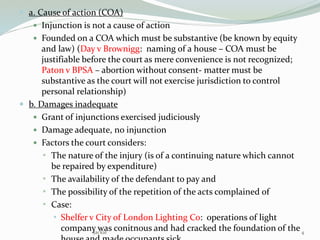
 a. Cause of action (COA)
 Injunction is not a cause of action
 Founded on a COA which must be substantive (be known by equity
and law) (Day v Brownigg: naming of a house – COA must be
justifiable before the court as mere convenience is not recognized;
Paton v BPSA – abortion without consent- matter must be
substantive as the court will not exercise jurisdiction to control
personal relationship)
 b. Damages inadequate
 Grant of injunctions exercised judiciously
 Damage adequate, no injunction
 Factors the court considers:
 The nature of the injury (is of a continuing nature which cannot
be repaired by expenditure)
 The availability of the defendant to pay and
 The possibility of the repetition of the acts complained of
 Case:
 Shelfer v City of London Lighting Co: operations of light
company was conitnous and had cracked the foundation of the4Jackie
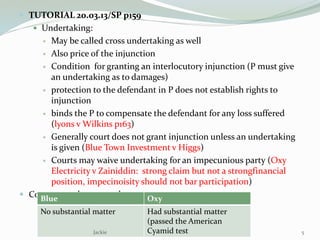
 TUTORIAL 20.03.13/SP p159
 Undertaking:
 May be called cross undertaking as well
 Also price of the injunction
 Condition for granting an interlocutory injunction (P must give
an undertaking as to damages)
 protection to the defendant in P does not establish rights to
injunction
 binds the P to compensate the defendant for any loss suffered
(lyons v Wilkins p163)
 Generally court does not grant injunction unless an undertaking
is given (Blue Town Investment v Higgs)
 Courts may waive undertaking for an impecunious party (Oxy
Electricity v Zainiddin: strong claim but not a strongfinancial
position, impecinoisity should not bar participation)
 Compare and contrast the two cases:Blue Oxy
No substantial matter Had substantial matter
(passed the American
Cyamid test 5Jackie
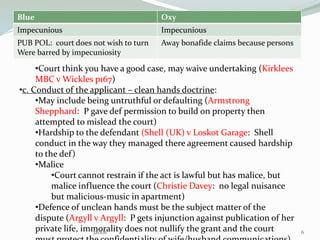
Blue Oxy
Impecunious Impecunious
PUB POL: court does not wish to turn
Were barred by impecuniosity
Away bonafide claims because persons
•Court think you have a good case, may waive undertaking (Kirklees
MBC v Wickles p167)
•c. Conduct of the applicant – clean hands doctrine:
•May include being untruthful or defaulting (Armstrong
Shepphard: P gave def permission to build on property then
attempted to mislead the court)
•Hardship to the defendant (Shell (UK) v Loskot Garage: Shell
conduct in the way they managed there agreement caused hardship
to the def)
•Malice
•Court cannot restrain if the act is lawful but has malice, but
malice influence the court (Christie Davey: no legal nuisance
but malicious-music in apartment)
•Defence of unclean hands must be the subject matter of the
dispute (Argyll v Argyll: P gets injunction against publication of her
private life, immorality does not nullify the grant and the court 6Jackie
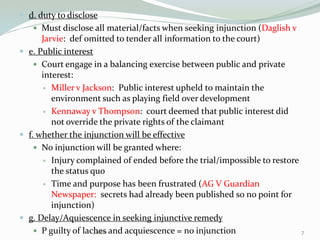
 d. duty to disclose
 Must disclose all material/facts when seeking injunction (Daglish v
Jarvie: def omitted to tender all information to the court)
 e. Public interest
 Court engage in a balancing exercise between public and private
interest:
 Miller v Jackson: Public interest upheld to maintain the
environment such as playing field over development
 Kennaway v Thompson: court deemed that public interest did
not override the private rights of the claimant
 f. whether the injunction will be effective
 No injunction will be granted where:
 Injury complained of ended before the trial/impossible to restore
the status quo
 Time and purpose has been frustrated (AG V Guardian
Newspaper: secrets had already been published so no point for
injunction)
 g. Delay/Aquiescence in seeking injunctive remedy
 P guilty of laches and acquiescence = no injunction 7Jackie
 Lapse of time and element to determine acquiescence(mere delay is
not a bar for enforcing legal right (Braville v Applebee: P voice
concern before house built but did not effect proceeds till after, no
injunction)
 3: Interim/Interlocutory Injunction (fellows & Sons v Fischer:
supports the below points: cases do not go by trial, parties accept
the prima facie view of the court and settle)
 Prohibits def temporarily from what P seeks to prevent permanently
 Preserve status quo until trial (may get a perpetual injunction after
the trial)
 Trial for inj is not based on the merits of the case
 a. Undertaking (see earlier slide)
 b. Principles governing grant/refusal: American Cyamid:
 Four principles emanated from this:
 1) Serious question to be tried (p177)
 Evidence must disclose some prospect of winning
 Does not have to show 50% chance of winning (old way prima
facie)
 Demonstrate that there is a serious question to be tried.
 Rationale Lord Diplock: not stage to resolve conflict
8Jackie
 Prior to American Cyamid, test was prima facie-showing 50&
chance of success (Fellows v Fischer)
 Effect of prima facie test, trial w/in a trial or outcome of case may be
decided (Fellows & Son v Fischer)
 ii. Inadequacy of damages for other party:
 Is damage an adequate remedy (between seeking the inj and the
trial) (Allen v Jambo: claimant not in financial position to honour
undertaking and an appreciable damage, as a general rule inj will
not be granted; Cambridge Nutrition v BBC: irrespective of mean
damage may still be inadequate-broadcast situation)
 Ps impossibility to pay is not a reason for refusal of the injunction
(remember the gen rule of undertaking - Blue Town Investment v
Higgs)
 iii. Balance of convenience
 If there is a serious question to be answered, court weighs the
inconvenience or damage if the inj is not granted
 Avoid placing any of the party at an inconvenience at the granting of
the injunction, so BC examined
9Jackie
 Doubt as to the adequacy of damage, Who will be more
disadvantaged (balance of risk)
 Potential injustice, is damage sufficient
 a. irreparable loss: (Hubbard v Pitt: picketing in front of office
was irreparable loss or damage, inj granted)
 b. losing job with good prospects: (Fellows & Sons v Fischer: no
irreparable loss, but rather restraint of trade, no inj because
possibility of losing a job with excellent prospects)
 c. Public and confidential material: (AG v Guardian Newspaper:
injunction would be futile as the information had already been
published)
 d. Political nature of dispute: wider public interest must be
considered in this case
 e. Balance evenly weighed: no balance of convenience
preservation of the status quo ( Fellows & Sons v Fischer: special
factors must be considered when trying to balance the advantage
or disadvantages p 183)
 f. Preservation of the status quo: nothing changes in there the
balance of convenience is even during period immediately
preceding the application for inj 10Jackie
 B. Criticism of American Cyamid:
 Judges ignore side step AC
 Contends whether there is a two/three stage test(see comments
p184)
 i. Three/two stages Inquiry:
 Toojays v westerhaven Ltd: inquiry is a two stage test: 1)
serious question to be asked; 2) Balance of convenience
 Fellows & Son v Fischer: adequacy of damage was treated as a
part of the the balance of convenience
 ii. Balance of convenience/Balance of justice:
 Toojays v westerhaven (p 187): indicates that the balance of
convenience does not fully reflect the standard impose by
statute...hence it was better framed a balance of justice
 iii. Serious question to be tried test (limitations of AC)
 Not an inflexible rule and should be considered
 Intention that conflict would not be resolved at the injunction
stage
 Prima facie v serious questions:
Jackie 11
 Prima facie test, high threshold (lord Diplock contends
there us no rule for this test)
 Applying the serious question test was no attempt to restrict
the court’s discretion from applying the prima facie test (not
attempting to fetter the court discretion
 Instances where AC is not applicable:
 a. Restraining of legal proceedings or abuse of process
(Bryanston Finance v DeVires: company could not show
bonafide dispute where a shareholdre threatened to wind up
company)
 b. Unquantifiable losses (Lewis v Heffer: rules in AC was
designed to address hardship, loss, misfortune...could not
apply in a political situation, not quantifiable)
 c. Mandatory Injunctions: Previously only granted where
the strong prima facie case was made out (Defalco v
Crawley: no injunction should be granted unless
undertaking has been granted and the prima facie case was
made out. (there has been changes since the American
Cyanamid case)
Jackie 12
 d. Industrial dispute cases
 e. Covenants in restraint of trade (Fellows & Sons v Fischer)
 f. Transmission of program where time is important
(Cambridge Nutrition v BBC)
 Cases involving the final determination of the rights of the parties:
 NWL v Wood: case of industrial action where the defendant was
asked to cease.
 Described the limits within which American Cyanamid must be
applied
 Indicating that sometimes the prima facie case issue more
applicable than the serious question to be tried (it had become
statutorized that the court must consider the prospect of success
and so the Hl hands were tied and that was more applicable than
AC)
 Cayne v Global Natural Resources, Cambridge Nutrition v BBC:
cases where AC was not applicable p193)
 Principles that governs injunction:
 Delay
Jackie 13
 Acquiescence
 Clean hands doctrine (this is never waived)
 Test to get injunction lies between the AC and the prima facie
 Criticism of prima facie: required too much time and caused the
court to delve too deep in matters, Lord Diplock in AC said that
conflicts were not to be resolved at this stage)
 Criticism of AC: floodgates argument and it would seem that the
threshold was reduced or replaced
 Limitations and criticism of AC
 Criticism:
 Application and applicability (Nwl v Wood, Cayne v Global
Natural Resource, Cambridge Nutrition v BBC)
 3/two stage approach (Toojays v Westerhaven)
 Not a new and inflexible rule and should be considered (Series 5
Software)
 Limitations:
Jackie 14
 The effect is equivalent to a final judgment(Cambridge Nutrition
v BBC: must mot be used as straight jacket but rather as a useful
guidelines and should not be treated as a statutory provision.
Interpret with flexibility)
 There is no arguable defense
 Where the trial is likely to be delayed
 where losses are unquantifiable (Lewis v Heffer: situation was
apolitical one and could not be covered by AC)
 Abuse of the courts process (bryanston Finances v DeVires (see
earlier slide/p190)
 Mandatory Interlocutory injunction:
 Originally done under the prima facie test (defalco v Crawley)
 American Cyanamid (p195): cases may be settle at this stage
albeit court not to resolve conflicts (ensure that the court time
was not taken up as with the prima facie test)
 Injunction orders clear and unambiguous: (Redland Bricks v Morris: cannot be
compensated by inj, there will be no relief)
 Type of injunction insignificant
 Parties interest must be balanced and the defendant must know what he isJackie 15

Ws injunctions

  • 1.
  • 2.
     1: Introduction: Injunctions not self contained  Prohibits/restrains/compels a particular activity  Attempt to try and prevent the violation of the right of a person  Temporary restraining order usually granted until the time of a trial  Discretionary remedy granted by the court  a. Perpetual:  Perpetual injunctions means that the condition that produced them remains (dumping on another persons property)  It’s a permanent injunction  Deemed to be a final relief  Granted after a trial  b. Interlocutory/Interim Injunction:  Granted to maintain the status quo  Prevents irreparable damage  Acquired between the filing of the matter and the trial  Binds a party to do or not to do something 2Jackie
  • 3.
     Temporary orderthat has effect until the final determination of the matter by the court  c. Mandatory Injunctions:  Impose a duty of positive action, must be done  Requires particular discretion because it may require constant supervision (Redland v Bricks: clay digging remove some of P’s land, court ordered that it be restored  d. Qua timet Injunctions:  Means because he fears,  right is not yet infringed he seeks an injunction because he fears (Redland v Bricks (p162)  Restrain wrongful acts which are imminent  Must prove imminent danger  The threatened injury will be irreparable  Impossible to protect P in the injunction is not granted  Vague apprehension not sufficient, must be immediate threat  2. GENERAL PRINCIPLES GOVERNING THE GRANT OF INJUNCTIONS 3Jackie
  • 4.
     a. Causeof action (COA)  Injunction is not a cause of action  Founded on a COA which must be substantive (be known by equity and law) (Day v Brownigg: naming of a house – COA must be justifiable before the court as mere convenience is not recognized; Paton v BPSA – abortion without consent- matter must be substantive as the court will not exercise jurisdiction to control personal relationship)  b. Damages inadequate  Grant of injunctions exercised judiciously  Damage adequate, no injunction  Factors the court considers:  The nature of the injury (is of a continuing nature which cannot be repaired by expenditure)  The availability of the defendant to pay and  The possibility of the repetition of the acts complained of  Case:  Shelfer v City of London Lighting Co: operations of light company was conitnous and had cracked the foundation of the4Jackie
  • 5.
     TUTORIAL 20.03.13/SPp159  Undertaking:  May be called cross undertaking as well  Also price of the injunction  Condition for granting an interlocutory injunction (P must give an undertaking as to damages)  protection to the defendant in P does not establish rights to injunction  binds the P to compensate the defendant for any loss suffered (lyons v Wilkins p163)  Generally court does not grant injunction unless an undertaking is given (Blue Town Investment v Higgs)  Courts may waive undertaking for an impecunious party (Oxy Electricity v Zainiddin: strong claim but not a strongfinancial position, impecinoisity should not bar participation)  Compare and contrast the two cases:Blue Oxy No substantial matter Had substantial matter (passed the American Cyamid test 5Jackie
  • 6.
    Blue Oxy Impecunious Impecunious PUBPOL: court does not wish to turn Were barred by impecuniosity Away bonafide claims because persons •Court think you have a good case, may waive undertaking (Kirklees MBC v Wickles p167) •c. Conduct of the applicant – clean hands doctrine: •May include being untruthful or defaulting (Armstrong Shepphard: P gave def permission to build on property then attempted to mislead the court) •Hardship to the defendant (Shell (UK) v Loskot Garage: Shell conduct in the way they managed there agreement caused hardship to the def) •Malice •Court cannot restrain if the act is lawful but has malice, but malice influence the court (Christie Davey: no legal nuisance but malicious-music in apartment) •Defence of unclean hands must be the subject matter of the dispute (Argyll v Argyll: P gets injunction against publication of her private life, immorality does not nullify the grant and the court 6Jackie
  • 7.
     d. dutyto disclose  Must disclose all material/facts when seeking injunction (Daglish v Jarvie: def omitted to tender all information to the court)  e. Public interest  Court engage in a balancing exercise between public and private interest:  Miller v Jackson: Public interest upheld to maintain the environment such as playing field over development  Kennaway v Thompson: court deemed that public interest did not override the private rights of the claimant  f. whether the injunction will be effective  No injunction will be granted where:  Injury complained of ended before the trial/impossible to restore the status quo  Time and purpose has been frustrated (AG V Guardian Newspaper: secrets had already been published so no point for injunction)  g. Delay/Aquiescence in seeking injunctive remedy  P guilty of laches and acquiescence = no injunction 7Jackie
  • 8.
     Lapse oftime and element to determine acquiescence(mere delay is not a bar for enforcing legal right (Braville v Applebee: P voice concern before house built but did not effect proceeds till after, no injunction)  3: Interim/Interlocutory Injunction (fellows & Sons v Fischer: supports the below points: cases do not go by trial, parties accept the prima facie view of the court and settle)  Prohibits def temporarily from what P seeks to prevent permanently  Preserve status quo until trial (may get a perpetual injunction after the trial)  Trial for inj is not based on the merits of the case  a. Undertaking (see earlier slide)  b. Principles governing grant/refusal: American Cyamid:  Four principles emanated from this:  1) Serious question to be tried (p177)  Evidence must disclose some prospect of winning  Does not have to show 50% chance of winning (old way prima facie)  Demonstrate that there is a serious question to be tried.  Rationale Lord Diplock: not stage to resolve conflict 8Jackie
  • 9.
     Prior toAmerican Cyamid, test was prima facie-showing 50& chance of success (Fellows v Fischer)  Effect of prima facie test, trial w/in a trial or outcome of case may be decided (Fellows & Son v Fischer)  ii. Inadequacy of damages for other party:  Is damage an adequate remedy (between seeking the inj and the trial) (Allen v Jambo: claimant not in financial position to honour undertaking and an appreciable damage, as a general rule inj will not be granted; Cambridge Nutrition v BBC: irrespective of mean damage may still be inadequate-broadcast situation)  Ps impossibility to pay is not a reason for refusal of the injunction (remember the gen rule of undertaking - Blue Town Investment v Higgs)  iii. Balance of convenience  If there is a serious question to be answered, court weighs the inconvenience or damage if the inj is not granted  Avoid placing any of the party at an inconvenience at the granting of the injunction, so BC examined 9Jackie
  • 10.
     Doubt asto the adequacy of damage, Who will be more disadvantaged (balance of risk)  Potential injustice, is damage sufficient  a. irreparable loss: (Hubbard v Pitt: picketing in front of office was irreparable loss or damage, inj granted)  b. losing job with good prospects: (Fellows & Sons v Fischer: no irreparable loss, but rather restraint of trade, no inj because possibility of losing a job with excellent prospects)  c. Public and confidential material: (AG v Guardian Newspaper: injunction would be futile as the information had already been published)  d. Political nature of dispute: wider public interest must be considered in this case  e. Balance evenly weighed: no balance of convenience preservation of the status quo ( Fellows & Sons v Fischer: special factors must be considered when trying to balance the advantage or disadvantages p 183)  f. Preservation of the status quo: nothing changes in there the balance of convenience is even during period immediately preceding the application for inj 10Jackie
  • 11.
     B. Criticismof American Cyamid:  Judges ignore side step AC  Contends whether there is a two/three stage test(see comments p184)  i. Three/two stages Inquiry:  Toojays v westerhaven Ltd: inquiry is a two stage test: 1) serious question to be asked; 2) Balance of convenience  Fellows & Son v Fischer: adequacy of damage was treated as a part of the the balance of convenience  ii. Balance of convenience/Balance of justice:  Toojays v westerhaven (p 187): indicates that the balance of convenience does not fully reflect the standard impose by statute...hence it was better framed a balance of justice  iii. Serious question to be tried test (limitations of AC)  Not an inflexible rule and should be considered  Intention that conflict would not be resolved at the injunction stage  Prima facie v serious questions: Jackie 11
  • 12.
     Prima facietest, high threshold (lord Diplock contends there us no rule for this test)  Applying the serious question test was no attempt to restrict the court’s discretion from applying the prima facie test (not attempting to fetter the court discretion  Instances where AC is not applicable:  a. Restraining of legal proceedings or abuse of process (Bryanston Finance v DeVires: company could not show bonafide dispute where a shareholdre threatened to wind up company)  b. Unquantifiable losses (Lewis v Heffer: rules in AC was designed to address hardship, loss, misfortune...could not apply in a political situation, not quantifiable)  c. Mandatory Injunctions: Previously only granted where the strong prima facie case was made out (Defalco v Crawley: no injunction should be granted unless undertaking has been granted and the prima facie case was made out. (there has been changes since the American Cyanamid case) Jackie 12
  • 13.
     d. Industrialdispute cases  e. Covenants in restraint of trade (Fellows & Sons v Fischer)  f. Transmission of program where time is important (Cambridge Nutrition v BBC)  Cases involving the final determination of the rights of the parties:  NWL v Wood: case of industrial action where the defendant was asked to cease.  Described the limits within which American Cyanamid must be applied  Indicating that sometimes the prima facie case issue more applicable than the serious question to be tried (it had become statutorized that the court must consider the prospect of success and so the Hl hands were tied and that was more applicable than AC)  Cayne v Global Natural Resources, Cambridge Nutrition v BBC: cases where AC was not applicable p193)  Principles that governs injunction:  Delay Jackie 13
  • 14.
     Acquiescence  Cleanhands doctrine (this is never waived)  Test to get injunction lies between the AC and the prima facie  Criticism of prima facie: required too much time and caused the court to delve too deep in matters, Lord Diplock in AC said that conflicts were not to be resolved at this stage)  Criticism of AC: floodgates argument and it would seem that the threshold was reduced or replaced  Limitations and criticism of AC  Criticism:  Application and applicability (Nwl v Wood, Cayne v Global Natural Resource, Cambridge Nutrition v BBC)  3/two stage approach (Toojays v Westerhaven)  Not a new and inflexible rule and should be considered (Series 5 Software)  Limitations: Jackie 14
  • 15.
     The effectis equivalent to a final judgment(Cambridge Nutrition v BBC: must mot be used as straight jacket but rather as a useful guidelines and should not be treated as a statutory provision. Interpret with flexibility)  There is no arguable defense  Where the trial is likely to be delayed  where losses are unquantifiable (Lewis v Heffer: situation was apolitical one and could not be covered by AC)  Abuse of the courts process (bryanston Finances v DeVires (see earlier slide/p190)  Mandatory Interlocutory injunction:  Originally done under the prima facie test (defalco v Crawley)  American Cyanamid (p195): cases may be settle at this stage albeit court not to resolve conflicts (ensure that the court time was not taken up as with the prima facie test)  Injunction orders clear and unambiguous: (Redland Bricks v Morris: cannot be compensated by inj, there will be no relief)  Type of injunction insignificant  Parties interest must be balanced and the defendant must know what he isJackie 15