History of Equity
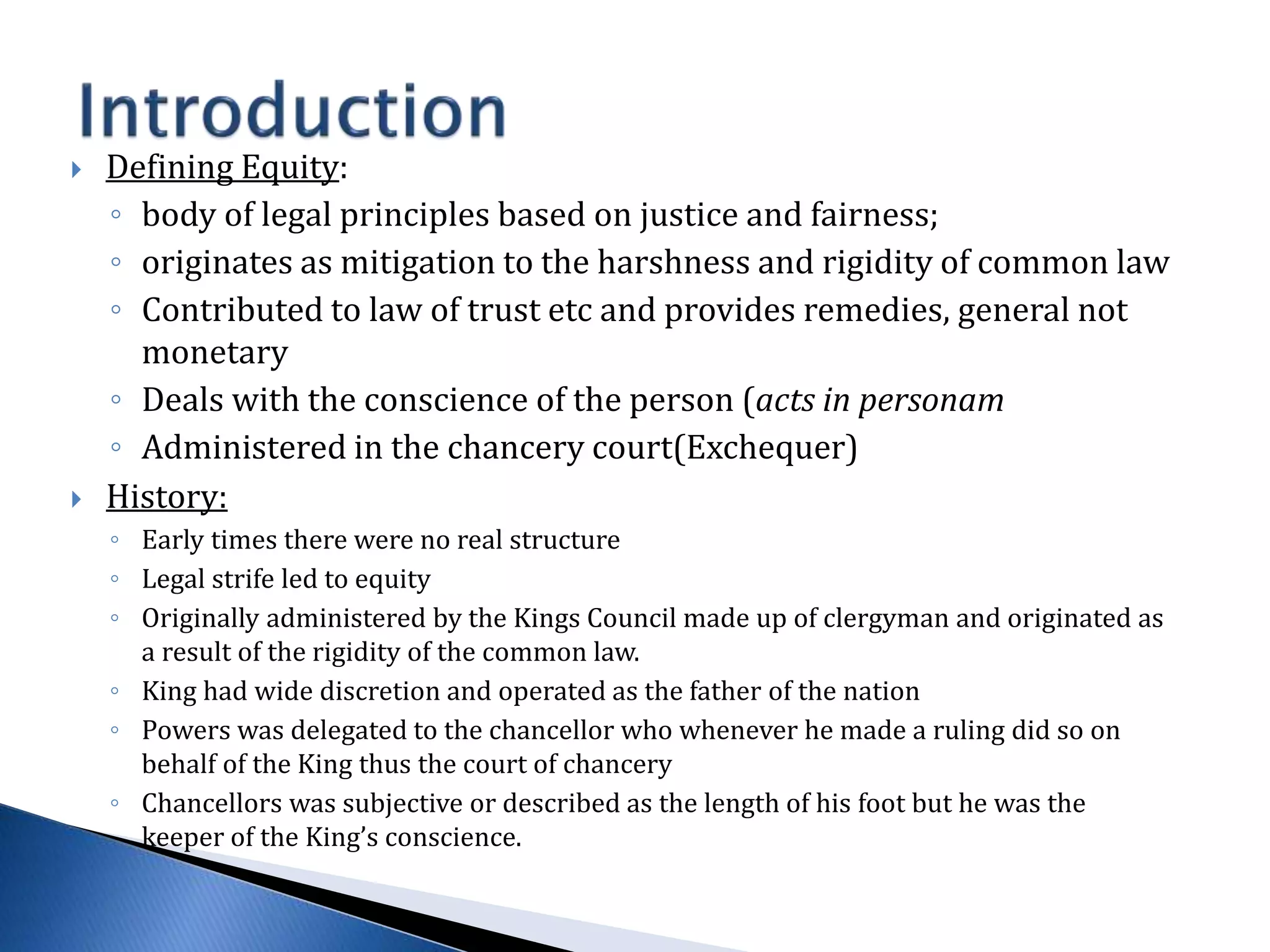
 Defining Equity:
◦ body of legal principles based on justice and fairness;
◦ originates as mitigation to the harshness and rigidity of common law
◦ Contributed to law of trust etc and provides remedies, general not
monetary
◦ Deals with the conscience of the person (acts in personam
◦ Administered in the chancery court(Exchequer)
 History:
◦ Early times there were no real structure
◦ Legal strife led to equity
◦ Originally administered by the Kings Council made up of clergyman and originated as
a result of the rigidity of the common law.
◦ King had wide discretion and operated as the father of the nation
◦ Powers was delegated to the chancellor who whenever he made a ruling did so on
behalf of the King thus the court of chancery
◦ Chancellors was subjective or described as the length of his foot but he was the
keeper of the King’s conscience.
◦ 14th 16th century varied development from the court getting a
lawyer as the Chancellor to writs and bills be addressed by the
Chancellor
◦ 16th Century, injunctions became the terror of the common law
courts and this gave rise to conflicts between the common law and
equity(Earl of oxford – questioned whether the monarch was subject
the laws like common people; maxim originated: where equity and the
law conflict equity prevailed)
◦ Equitable decision was final and this prevented jurisdictional
shopping
◦ Equity not intended to vacate common law judgments because it
acts against the person conscience.
◦ Contributions from equity: excel jurisdiction (new rights created by
the court); concurrent jurisdictions (new remedies such as Specific
performance, injunctions), auxiliary jurisdictions (new processes –
subpoena, discovery, testimony, etc)
◦ Morality was the bedrock of the CC
◦ Earl of Oxford: CL cannot prevent litigant from the CC; decision
rendered in equity not subject to reversion; prevented jurisdiction
shopping


Ws 1 history of equity

  • 1.
  • 2.
     Defining Equity: ◦body of legal principles based on justice and fairness; ◦ originates as mitigation to the harshness and rigidity of common law ◦ Contributed to law of trust etc and provides remedies, general not monetary ◦ Deals with the conscience of the person (acts in personam ◦ Administered in the chancery court(Exchequer)  History: ◦ Early times there were no real structure ◦ Legal strife led to equity ◦ Originally administered by the Kings Council made up of clergyman and originated as a result of the rigidity of the common law. ◦ King had wide discretion and operated as the father of the nation ◦ Powers was delegated to the chancellor who whenever he made a ruling did so on behalf of the King thus the court of chancery ◦ Chancellors was subjective or described as the length of his foot but he was the keeper of the King’s conscience.
  • 3.
    ◦ 14th 16thcentury varied development from the court getting a lawyer as the Chancellor to writs and bills be addressed by the Chancellor ◦ 16th Century, injunctions became the terror of the common law courts and this gave rise to conflicts between the common law and equity(Earl of oxford – questioned whether the monarch was subject the laws like common people; maxim originated: where equity and the law conflict equity prevailed) ◦ Equitable decision was final and this prevented jurisdictional shopping ◦ Equity not intended to vacate common law judgments because it acts against the person conscience. ◦ Contributions from equity: excel jurisdiction (new rights created by the court); concurrent jurisdictions (new remedies such as Specific performance, injunctions), auxiliary jurisdictions (new processes – subpoena, discovery, testimony, etc) ◦ Morality was the bedrock of the CC ◦ Earl of Oxford: CL cannot prevent litigant from the CC; decision rendered in equity not subject to reversion; prevented jurisdiction shopping 