WELCOME
USING WRITING CONFERENCES TO DEVELOP
WRITING SKILLS AT TERTIARY LEVEL:
AN EXPERIMENTAL STUDY
BY
M. ANJAIAH
THIS PRESENTATION LAYS OUT………
 Introduction
 Statement of the problem
 Aim of the study
 Theoretical framework
 Research methodology
 Data collection and analysis
 Findings of the study
 Recommendations
 References
11/29/2019
3
M.ANJAIAH.
INTRODUCTION
Importance of writing
 Writing is pivotal for the development and sustainability of
world cultures (Stubs, 1980).
 It is useful for accumulation and distribution of information
over generations and cultures.
 It represents a unique mode of learning (Emig, 1977)
 It develops the higher cognitive functions (Vygotsky, Luria,
Bruner).
 Writing English well gives the impression of displaying our
intellect as people subtly judge our character through reading
our writings presented before them.
 It works as a navigator to know learners problems (Harklau,
2002).
11/29/2019
4
M.ANJAIAH.
IMPORTANCE OF WRITING IN INDIAN CONTEXT
 Literacy levels are rising in India (Stubs, 1980) and writing
ability is considered as a step to literacy.
 Education system completely depends on end-term exams
which are obviously in written mode.
 Unless written, nothing is valued in educational and
evaluative system.
 Curriculum is also based on end-term exams.
 Students are expected to write well in English and compete
with others.
 If students fail to perform well in written tests, they are hardly
promoted to higher classes.
 In many cases, selection for employment is based on written
exams.
11/29/2019
5
M.ANJAIAH.
PROBLEMS RELATED TO TEACHING OF WRITING AT
SECONDARY AND TERTIARY LEVELS
 Teaching of writing in India mostly product-oriented. So very
little attention is given to process-oriented teaching of writing
at both secondary and tertiary levels.
 Syntactic variations of Indian languages often pose problem
for acquiring proficiency in second language writing system.
 Though CLT has been introduced, teachers are still giving
importance to final product.
 There is dearth of trained teachers to teach process-oriented
writing in innovative ways and in-service teachers are not
aware of new ways of teachings. They are hardly interested to
change their mode of teaching writing.
11/29/2019
6
M.ANJAIAH.
STATEMENT OF THE PROBLEM
 Most previous research on the teacher feedback has
examined the written feedback. It is possible that some
students may have trouble fully comprehending written
feedback.
 Ferris (1995) reported that 50% of the students surveyed
answered that they had problems understanding written
teacher feedback, and that half of them did no go to the
teacher to have it explained.
 It is thus necessary to have some kind of dialogue
between the teacher and students.
11/29/2019
7
M.ANJAIAH.
OBJECTIVES OF THE STUDY
 The main objective of this study is to use writing
conferences as a tool to provide feedback on
students’ writing and improve their writing skills at
tertiary level in professional colleges.
 The study also aims to enable these learners to
become independent writers.
11/29/2019
8
M.ANJAIAH.
SPECIFIC OBJECTIVES
 To understand the students’ perceptions about their
needs and ability in writing.
 To examining how writing conferences work to
improve student’s writing.
 To help students understand the basic process of
writing in order to make them independent writers.
 To identify and record any change in student’s
writing because of writing conferences.
11/29/2019
9
M.ANJAIAH.
BENEFITS OF WRITING CONFERENCES
 According to Donald Graves, writing conferences
help students become independent writers.
 It provides immediate feedback
 It creates a positive attitude among students
towards writing and motivates them to improve their
work
 It structures the teaching process around the
student’s skill level and understanding
 It addresses limitations in writing and helps to
develop good writing skills
11/29/2019
10
M.ANJAIAH.
 It is more personal (many students prefer them).
 It enables better learning that is tailored to individual
student’s needs and requirements
 Feedback given in person may have more impact
(students don’t always read comments—some just look
at the grade/ marks).
 Conferences provide an opportunity to build a
relationship between teacher and student.
 It provides teachers an opportunity:
to explain writing strategies and processes
to discuss the strengths and weaknesses of
student’s work
11/29/2019
11
M.ANJAIAH.
THEORETICAL FRAMEWORK
 The conceptual framework for this study is based on a
cognitive and social constructivist model for learning as it
relates to writing conferences.
Vygotsky (1987) claims that social interaction is essential for
learning to occur. Before making learning and skills internal,
students first need to interact with their teachers who are
more experienced and capable.
Teachers collaborate and scaffold learning and support
students in the zone of proximal development.
According to Vygotsky, students can solve harder
problems, and learn more and faster with the help of
others than working alone.
Therefore, in terms of collaboration, guiding, and modelling,
writing conferences provide opportunities for teachers to
scaffold strategies and content for the student according to
individual level, needs, and skills.
11/29/2019
12
M.ANJAIAH.
RESEARCH QUESTIONS
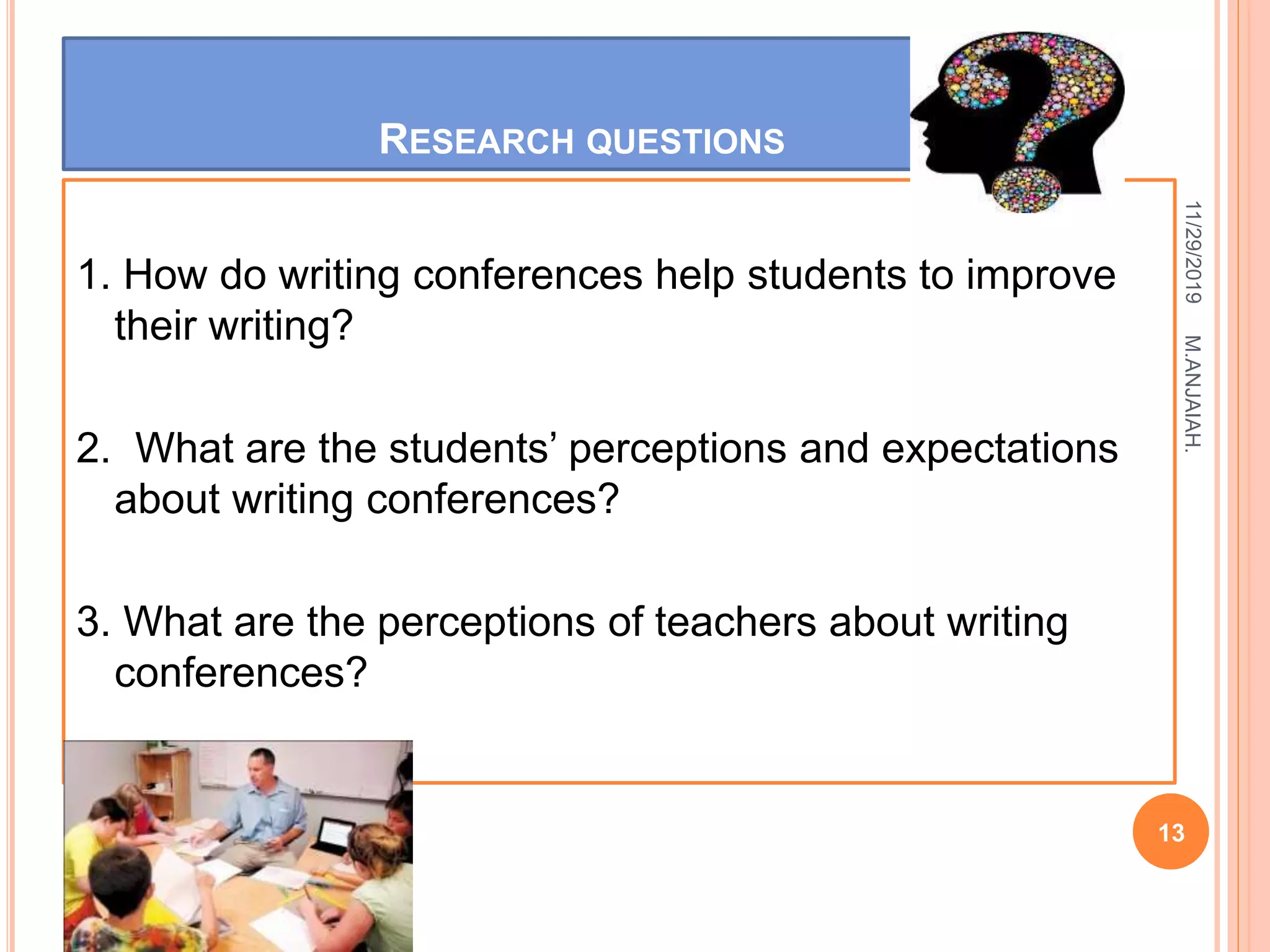
1. How do writing conferences help students to improve
their writing?
2. What are the students’ perceptions and expectations
about writing conferences?
3. What are the perceptions of teachers about writing
conferences?
11/29/2019
13
M.ANJAIAH.
RESEARCH METHODOLOGY AND TOOLS
 Experimental Study
Tools used for the study
 - Student questionnaire
 - Classroom observation checklist
 - Pre-test
 Writing tasks
 - Teacher feedback
 - Writing conferences
 - Students’ rewritten scripts
 Teacher diary
 Error codes
 - Pre-test
 - Informal discussion with students
 - Informal discussion with teachers
11/29/2019
14
M.ANJAIAH.
SUBJECTS OF THE STUDY
 Thirty first year students from an engineering college were
selected for this study.
 Sample consisted of randomly selected students of the
engineering college in Telangana region.
 First year students were chosen to collect data because of the
availability of the sample and all these students get into this
course with EAMCET exam which is a state level entrance test.
 So, all these students have the same level of proficiency in
terms of English language.
11/29/2019
15
M.ANJAIAH.
 Phase 1 Preliminary Study
 Questionnaire
 Classroom observation with a checklist
 Pre-test
 Phase 2 Main Study
Intervention Study with 30 students
 Two writing tasks, each task was revised twice
 Writing conferences were conducted with students
 Post-test
 Questionnaire
 Phase 3 Discussions
 Informal discussions with students
 Informal discussions with teachers
DETAILS OF DATA COLLECTION
11/29/2019
16
M.ANJAIAH.
WRITING TASKS
S.NO TOPIC PURPOSE
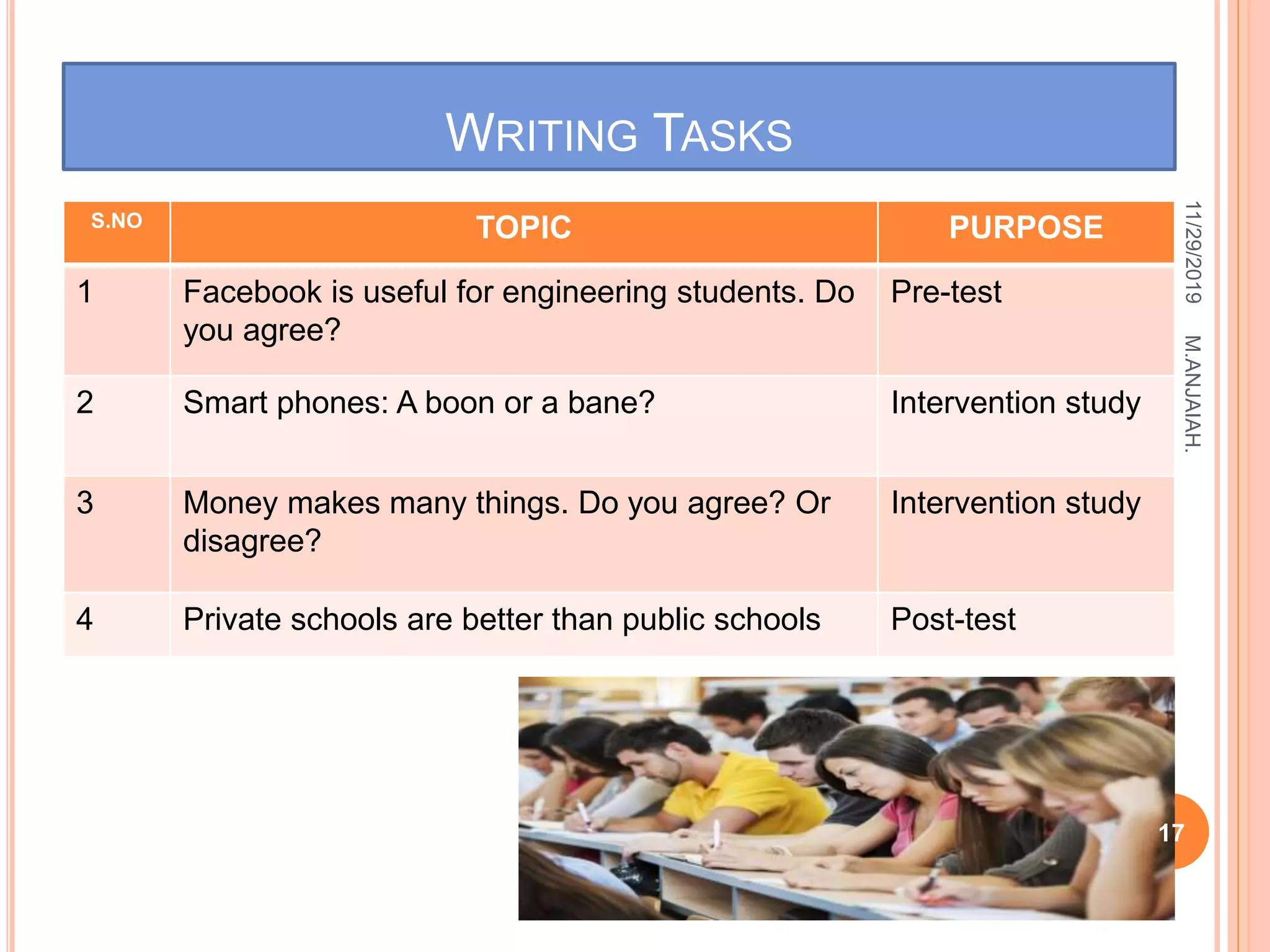
1 Facebook is useful for engineering students. Do
you agree?
Pre-test
2 Smart phones: A boon or a bane? Intervention study
3 Money makes many things. Do you agree? Or
disagree?
Intervention study
4 Private schools are better than public schools Post-test
11/29/2019
17
M.ANJAIAH.
INTERVENTION STUDY
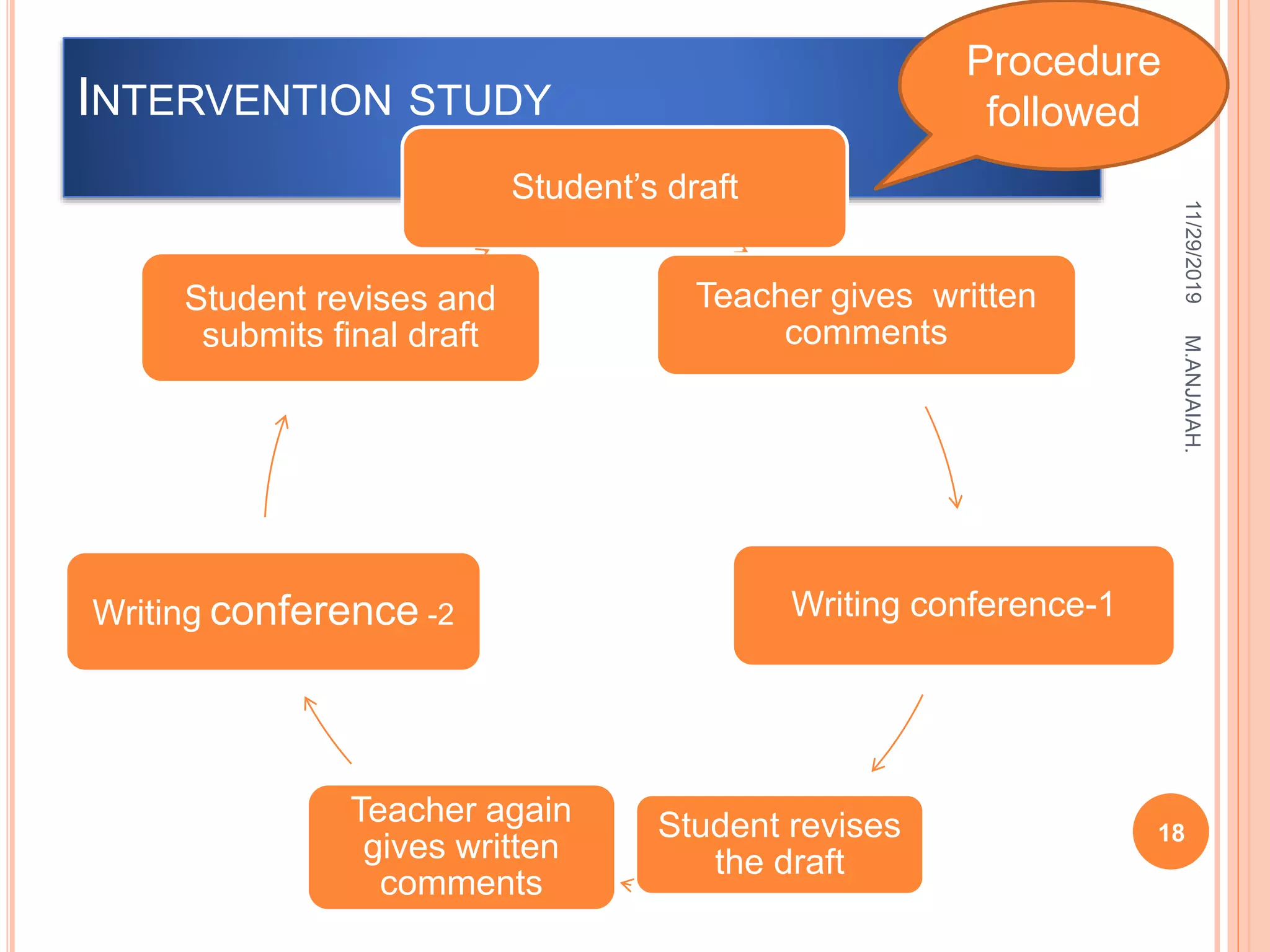
Student’s draft
Teacher gives written
comments
Writing conference-1
Student revises
the draft
Teacher again
gives written
comments
Writing conference -2
Student revises and
submits final draft
Procedure
followed
11/29/2019
18
M.ANJAIAH.
DATA ANALYSIS
 Out of fifty students, thirty students scripts were
selected for the data analysis
 Selection was done on the basis of understanding teacher
comments and completion of two tasks.
 Students wrote two compositions during intervention
stage. Each composition was revised twice.
 Pre and post intervention tests were analyzed using
qualitative and quantitative analysis methods.
 Informal discussions with students and teachers were
also analysed to understand what they felt about writing
conference.
11/29/2019
19
M.ANJAIAH.
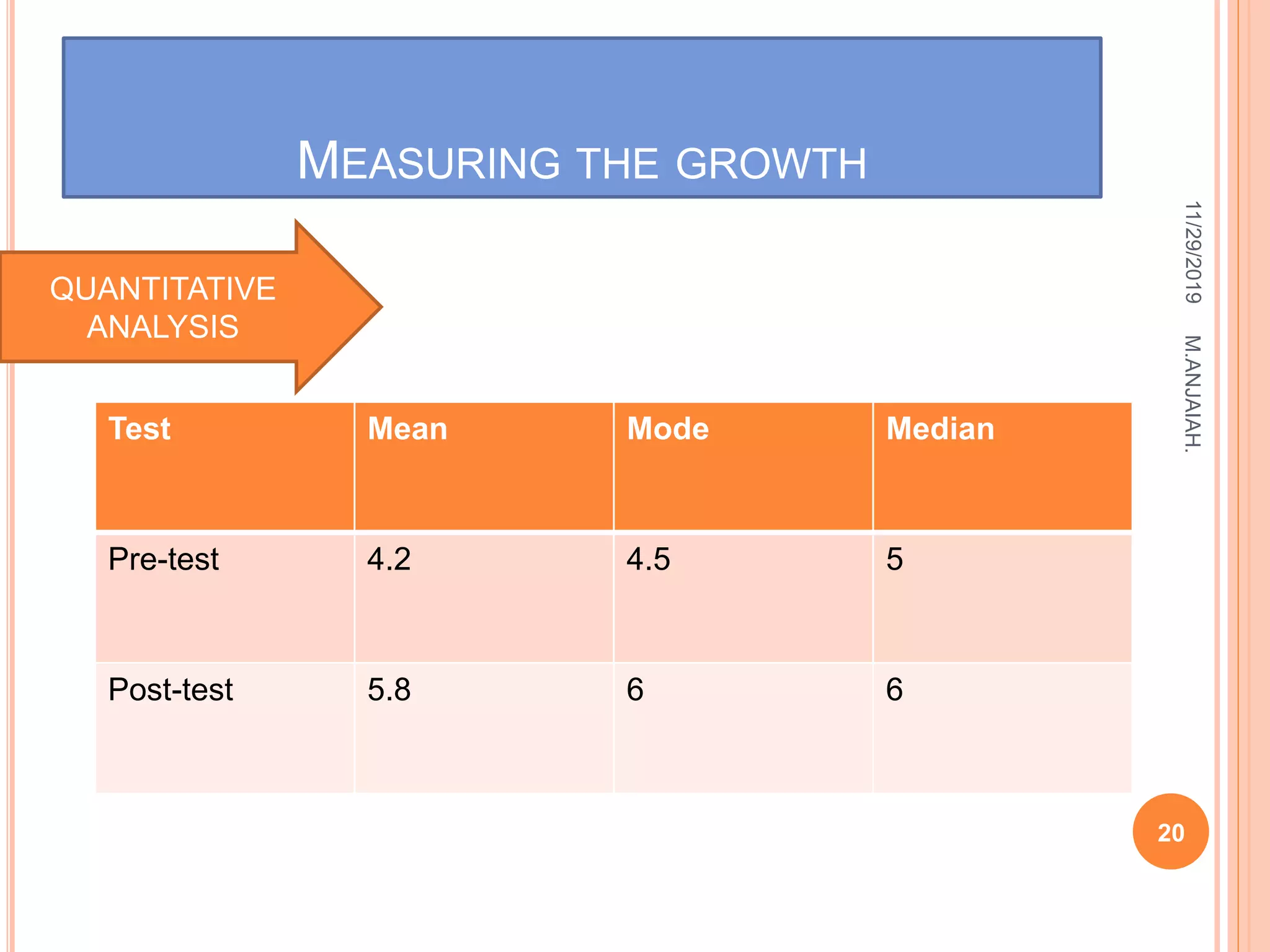
MEASURING THE GROWTH
Test Mean Mode Median
Pre-test 4.2 4.5 5
Post-test 5.8 6 6
11/29/2019
20
M.ANJAIAH.
QUANTITATIVE
ANALYSIS
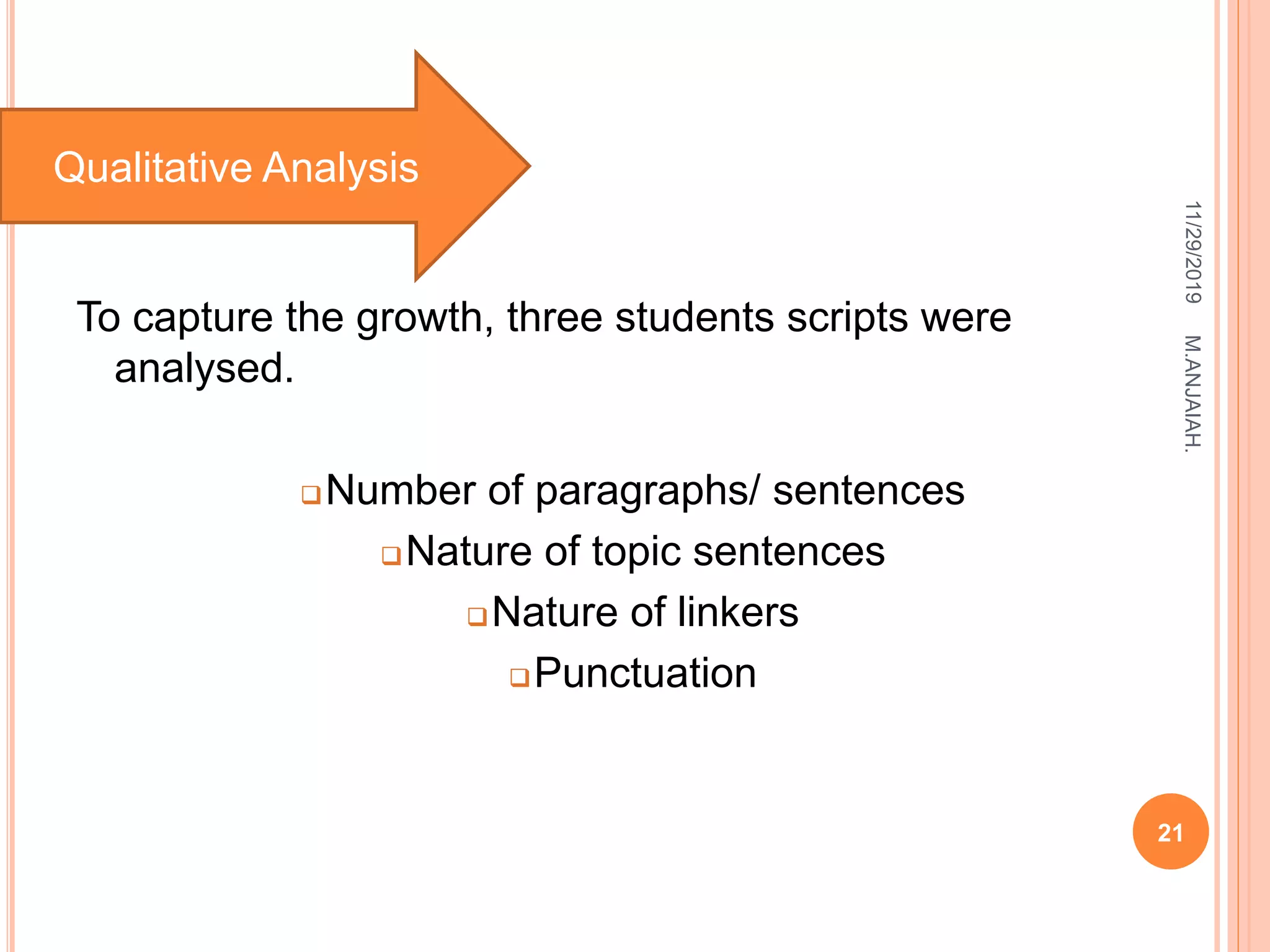
To capture the growth, three students scripts were
analysed.
Number of paragraphs/ sentences
Nature of topic sentences
Nature of linkers
Punctuation
11/29/2019
21
M.ANJAIAH.
Qualitative Analysis
FINDINGS
Research questions
1. How do writing conferences help students to
improve their writing?
2. What are the students’ perceptions and
expectations about writing conferences?
3. What are the perceptions of teachers about writing
conferences?
11/29/2019
22
M.ANJAIAH.
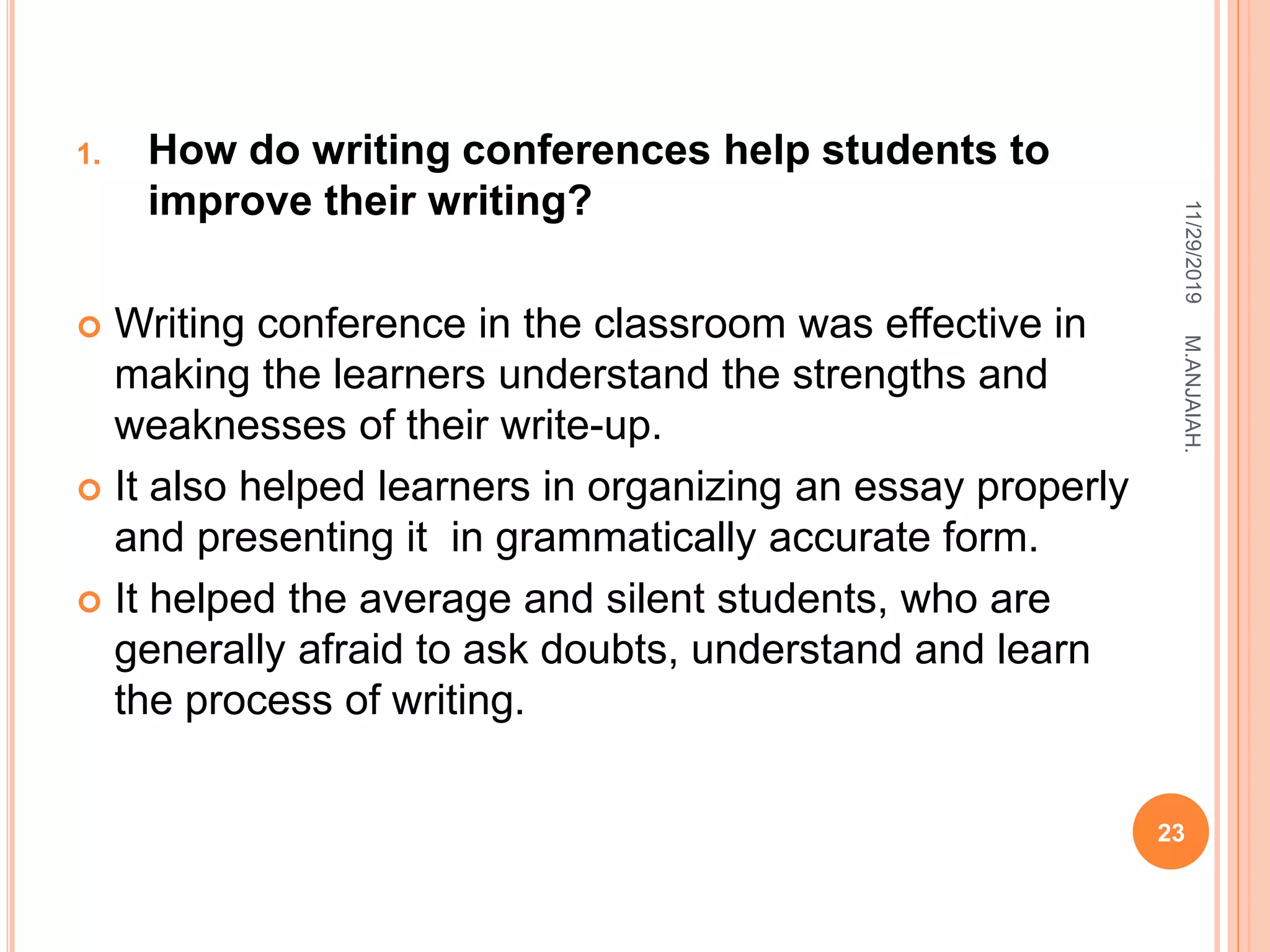
1. How do writing conferences help students to
improve their writing?
 Writing conference in the classroom was effective in
making the learners understand the strengths and
weaknesses of their write-up.
 It also helped learners in organizing an essay properly
and presenting it in grammatically accurate form.
 It helped the average and silent students, who are
generally afraid to ask doubts, understand and learn
the process of writing.
11/29/2019
23
M.ANJAIAH.
 There was a considerable improvement in students’
writing through written feedback and writing
conferences.
 It helped students in understanding their problems
through the interaction with the researcher during
conferences.
 By getting an opportunity to have dialogue with the
teacher about their writing, the students were able
to understand their strengths and weaknesses.
11/29/2019
24
M.ANJAIAH.
 2. What are the students’ perceptions and
expectations about writing conferences?
 Perceptions
 It could be a platform for them to express their doubts.
 It is very useful to learn writing with the help of a teacher.
 It provides clarity on their mistakes and solutions to them.
 Expectations
 Expected their grammatical errors to be corrected by teachers
 private talk with teachers
 Suggestions from teachers
11/29/2019
25
M.ANJAIAH.
3. What are the perceptions of teachers about
writing conferences?
Teachers also felt that;
 it is a source for negotiating meaning
 it imparts confidence to students
 it saves teacher’s time by not giving lengthy
comments
 it gives time to examine students’ drafts
11/29/2019
26
M.ANJAIAH.
PEDAGOGICAL IMPLICATIONS
 Teacher plays a vital role in teaching. Unless
teacher asks students may not come forward to do
a writing task.
 time constraints
 lack of awareness in giving feedback
 lack of awareness about how feedback helps students
 lack of interest to give feedback
11/29/2019
27
M.ANJAIAH.
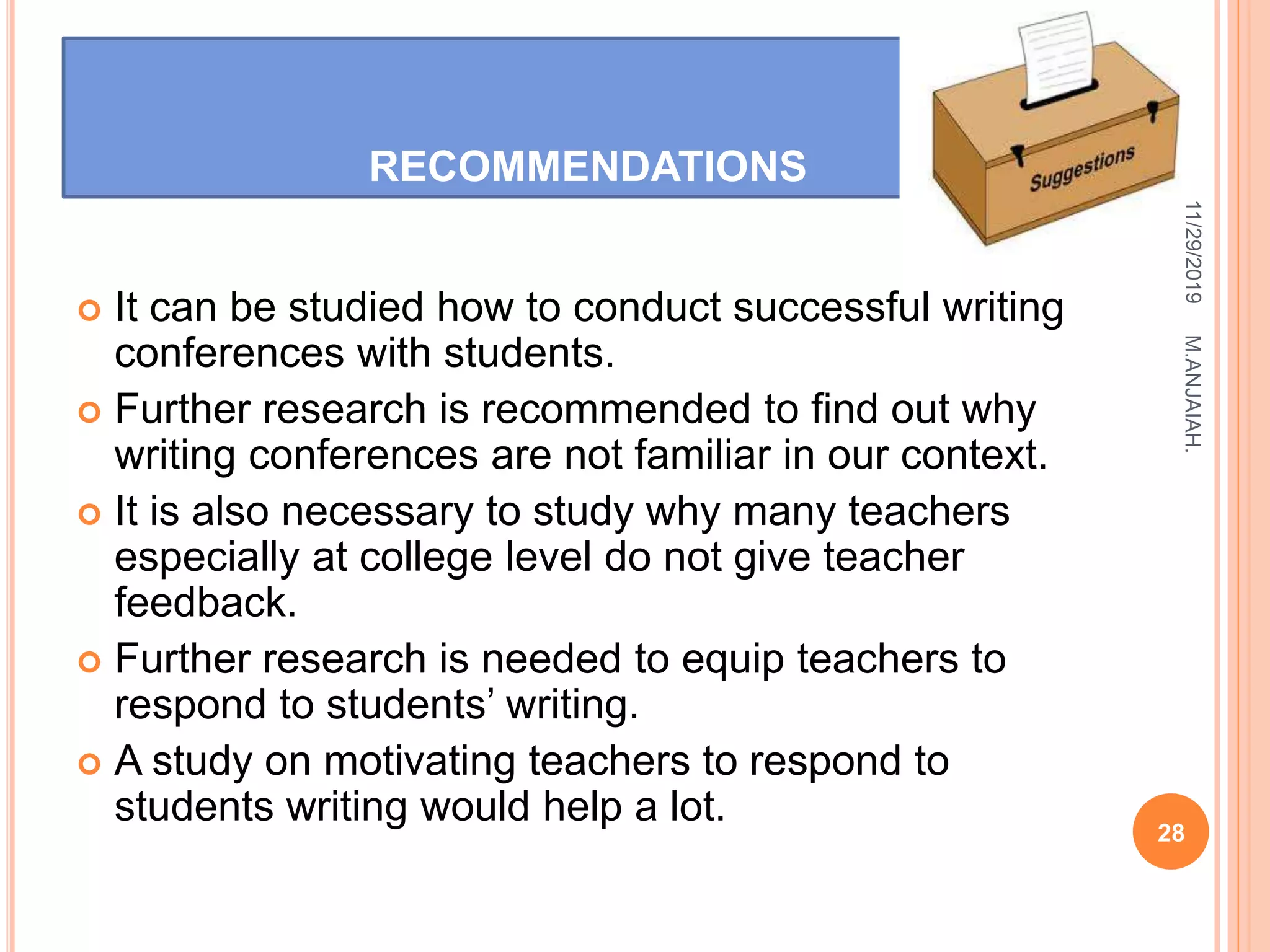
RECOMMENDATIONS
 It can be studied how to conduct successful writing
conferences with students.
 Further research is recommended to find out why
writing conferences are not familiar in our context.
 It is also necessary to study why many teachers
especially at college level do not give teacher
feedback.
 Further research is needed to equip teachers to
respond to students’ writing.
 A study on motivating teachers to respond to
students writing would help a lot.
11/29/2019
28
M.ANJAIAH.
REFERENCES
 Anderson, C. (2000). How's it going?: A practical guide to
conferring with student writers. Portsmouth, NH: Heinemann.
 Dipti Misra, Sharma, (2010) Structural Differences between English and
Indian Languages at the Sentence and Discourse Level Indian Journal of
Applied Linguistics, v36 n1-2 p23-35
 Graves, D. (1982). Six guideposts to a successful writing conference.
Learning, 11(4), 76-77.
 Harklau, L. 2002. The Role of Writing in Classroom Second Language
Acquisition. Journal of Second Language Writing. Vol. 11. P. 329-350.
 Hua & Khazriyati (2007), Interference in learning English: grammatical
errors in English essay writing among rural Malay secondary school
students in Malaysia, Jurnal e-Bangi 2 (2), 1-15
 Leki, I. (1991), The preferences of ESL students for error correction in
college-level writing classes. Foreign Language Annals, 24, 203–218
 Leki, I. (2002). Second Language Writing. In Robert B. Kaplan (Ed.).
The Oxford Hand Book of Applied Linguistics. Oxford University
Press.
11/29/2019
29
M.ANJAIAH.
 Kaplan, R. B. (1967). Contrastive rhetoric and the teaching of composition. TESOL
Quarterly, 1, 10-16.
 Stubs, M. (1980). Language and Literacy: The Sociolinguistics of Reading and
Writing. Routledge. London. New York
 Vygotsky, L.S. (1978). Mind in Society. Cambridge, MA: Harvard University Press.
 Vygotsky, L. (1986). Thought and language. Cambridge, MA: The MIT Press.
11/29/2019
30
M.ANJAIAH.
11/29/2019
31
M.ANJAIAH.
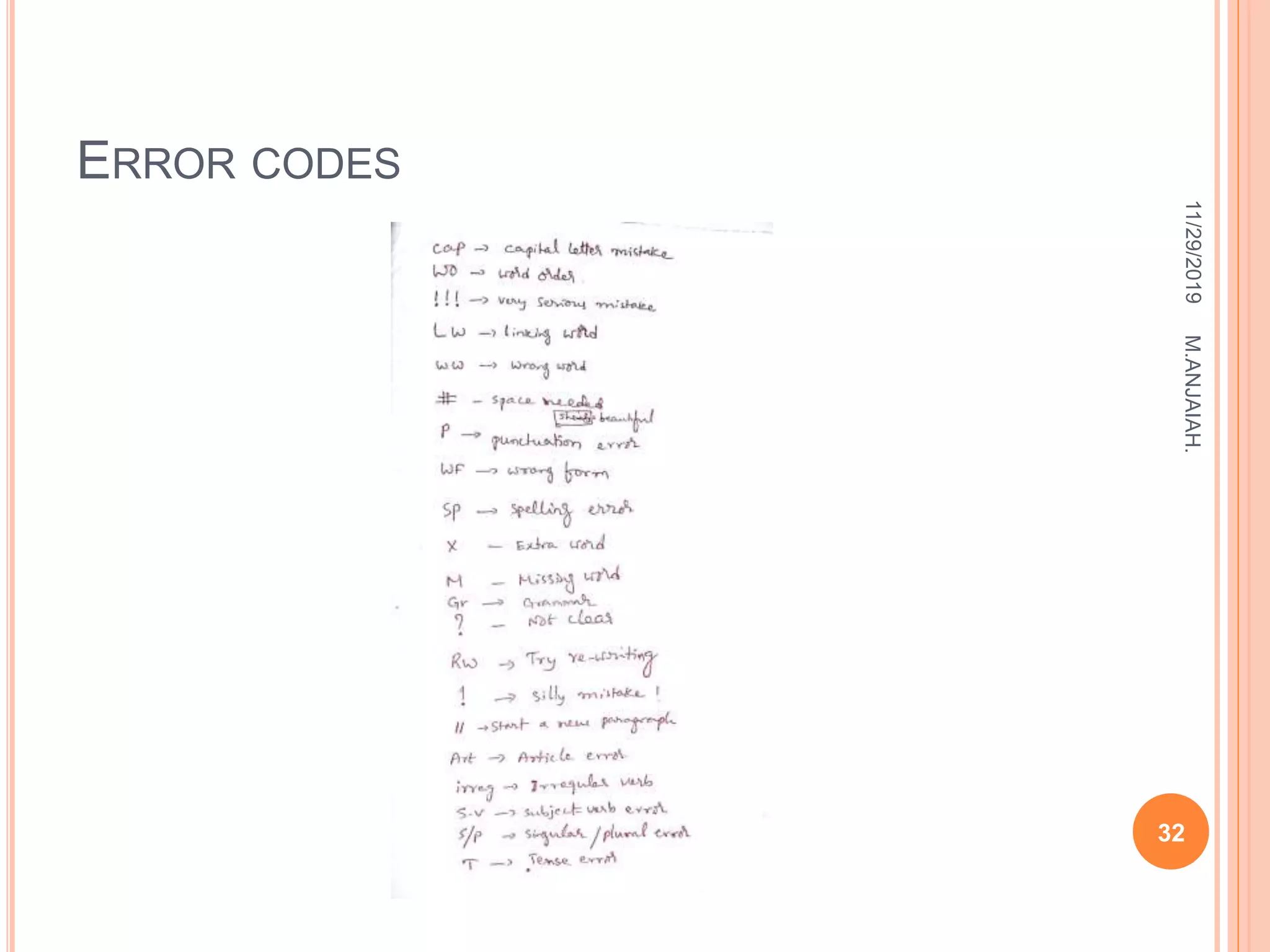
ERROR CODES
11/29/2019
32
M.ANJAIAH.
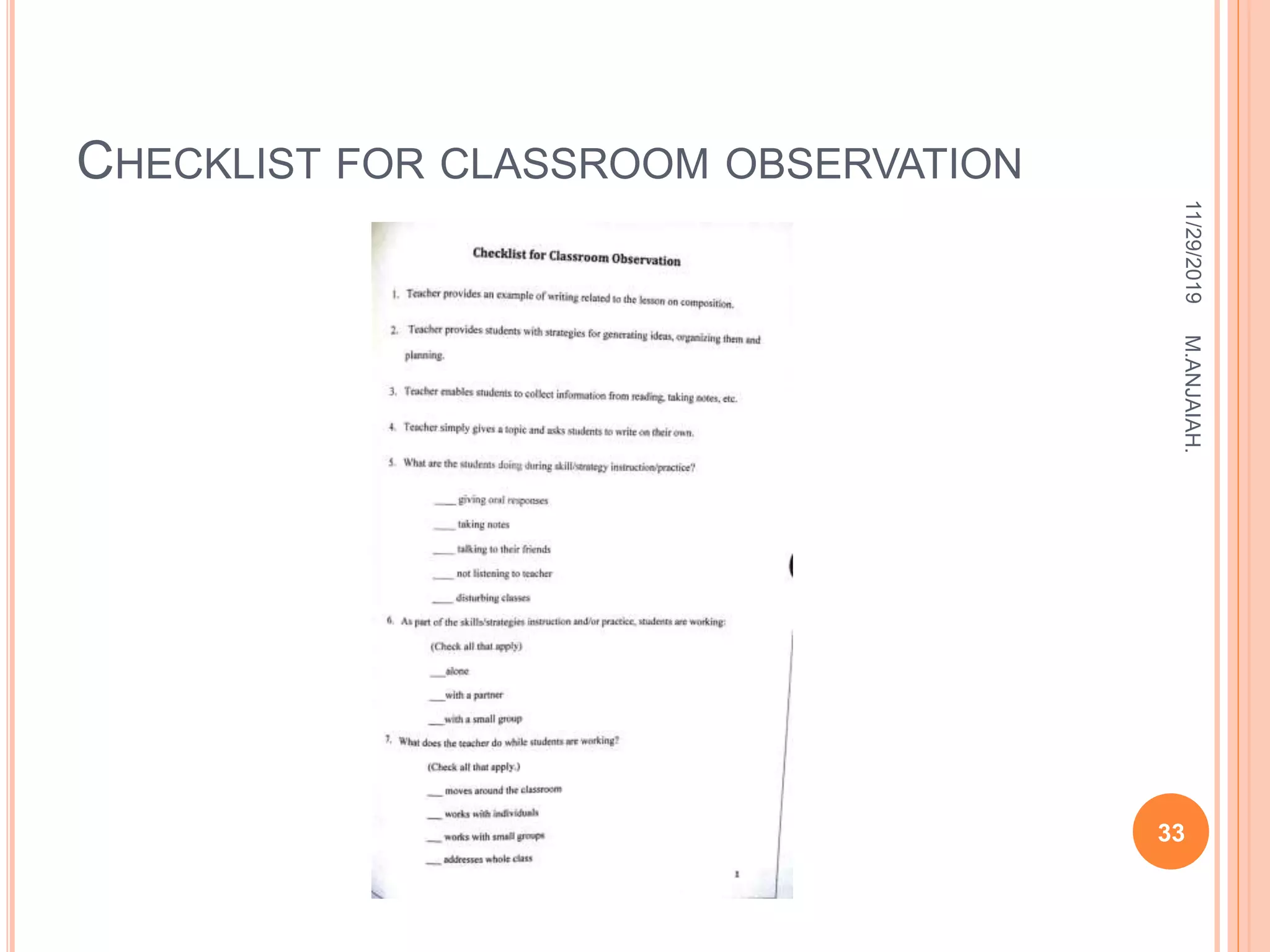
CHECKLIST FOR CLASSROOM OBSERVATION
11/29/2019
33
M.ANJAIAH.
11/29/2019
34
M.ANJAIAH.

Writing conferences to develop writing skills

  • 1.
  • 2.
    USING WRITING CONFERENCESTO DEVELOP WRITING SKILLS AT TERTIARY LEVEL: AN EXPERIMENTAL STUDY BY M. ANJAIAH
  • 3.
    THIS PRESENTATION LAYSOUT………  Introduction  Statement of the problem  Aim of the study  Theoretical framework  Research methodology  Data collection and analysis  Findings of the study  Recommendations  References 11/29/2019 3 M.ANJAIAH.
  • 4.
    INTRODUCTION Importance of writing Writing is pivotal for the development and sustainability of world cultures (Stubs, 1980).  It is useful for accumulation and distribution of information over generations and cultures.  It represents a unique mode of learning (Emig, 1977)  It develops the higher cognitive functions (Vygotsky, Luria, Bruner).  Writing English well gives the impression of displaying our intellect as people subtly judge our character through reading our writings presented before them.  It works as a navigator to know learners problems (Harklau, 2002). 11/29/2019 4 M.ANJAIAH.
  • 5.
    IMPORTANCE OF WRITINGIN INDIAN CONTEXT  Literacy levels are rising in India (Stubs, 1980) and writing ability is considered as a step to literacy.  Education system completely depends on end-term exams which are obviously in written mode.  Unless written, nothing is valued in educational and evaluative system.  Curriculum is also based on end-term exams.  Students are expected to write well in English and compete with others.  If students fail to perform well in written tests, they are hardly promoted to higher classes.  In many cases, selection for employment is based on written exams. 11/29/2019 5 M.ANJAIAH.
  • 6.
    PROBLEMS RELATED TOTEACHING OF WRITING AT SECONDARY AND TERTIARY LEVELS  Teaching of writing in India mostly product-oriented. So very little attention is given to process-oriented teaching of writing at both secondary and tertiary levels.  Syntactic variations of Indian languages often pose problem for acquiring proficiency in second language writing system.  Though CLT has been introduced, teachers are still giving importance to final product.  There is dearth of trained teachers to teach process-oriented writing in innovative ways and in-service teachers are not aware of new ways of teachings. They are hardly interested to change their mode of teaching writing. 11/29/2019 6 M.ANJAIAH.
  • 7.
    STATEMENT OF THEPROBLEM  Most previous research on the teacher feedback has examined the written feedback. It is possible that some students may have trouble fully comprehending written feedback.  Ferris (1995) reported that 50% of the students surveyed answered that they had problems understanding written teacher feedback, and that half of them did no go to the teacher to have it explained.  It is thus necessary to have some kind of dialogue between the teacher and students. 11/29/2019 7 M.ANJAIAH.
  • 8.
    OBJECTIVES OF THESTUDY  The main objective of this study is to use writing conferences as a tool to provide feedback on students’ writing and improve their writing skills at tertiary level in professional colleges.  The study also aims to enable these learners to become independent writers. 11/29/2019 8 M.ANJAIAH.
  • 9.
    SPECIFIC OBJECTIVES  Tounderstand the students’ perceptions about their needs and ability in writing.  To examining how writing conferences work to improve student’s writing.  To help students understand the basic process of writing in order to make them independent writers.  To identify and record any change in student’s writing because of writing conferences. 11/29/2019 9 M.ANJAIAH.
  • 10.
    BENEFITS OF WRITINGCONFERENCES  According to Donald Graves, writing conferences help students become independent writers.  It provides immediate feedback  It creates a positive attitude among students towards writing and motivates them to improve their work  It structures the teaching process around the student’s skill level and understanding  It addresses limitations in writing and helps to develop good writing skills 11/29/2019 10 M.ANJAIAH.
  • 11.
     It ismore personal (many students prefer them).  It enables better learning that is tailored to individual student’s needs and requirements  Feedback given in person may have more impact (students don’t always read comments—some just look at the grade/ marks).  Conferences provide an opportunity to build a relationship between teacher and student.  It provides teachers an opportunity: to explain writing strategies and processes to discuss the strengths and weaknesses of student’s work 11/29/2019 11 M.ANJAIAH.
  • 12.
    THEORETICAL FRAMEWORK  Theconceptual framework for this study is based on a cognitive and social constructivist model for learning as it relates to writing conferences. Vygotsky (1987) claims that social interaction is essential for learning to occur. Before making learning and skills internal, students first need to interact with their teachers who are more experienced and capable. Teachers collaborate and scaffold learning and support students in the zone of proximal development. According to Vygotsky, students can solve harder problems, and learn more and faster with the help of others than working alone. Therefore, in terms of collaboration, guiding, and modelling, writing conferences provide opportunities for teachers to scaffold strategies and content for the student according to individual level, needs, and skills. 11/29/2019 12 M.ANJAIAH.
  • 13.
    RESEARCH QUESTIONS 1. Howdo writing conferences help students to improve their writing? 2. What are the students’ perceptions and expectations about writing conferences? 3. What are the perceptions of teachers about writing conferences? 11/29/2019 13 M.ANJAIAH.
  • 14.
    RESEARCH METHODOLOGY ANDTOOLS  Experimental Study Tools used for the study  - Student questionnaire  - Classroom observation checklist  - Pre-test  Writing tasks  - Teacher feedback  - Writing conferences  - Students’ rewritten scripts  Teacher diary  Error codes  - Pre-test  - Informal discussion with students  - Informal discussion with teachers 11/29/2019 14 M.ANJAIAH.
  • 15.
    SUBJECTS OF THESTUDY  Thirty first year students from an engineering college were selected for this study.  Sample consisted of randomly selected students of the engineering college in Telangana region.  First year students were chosen to collect data because of the availability of the sample and all these students get into this course with EAMCET exam which is a state level entrance test.  So, all these students have the same level of proficiency in terms of English language. 11/29/2019 15 M.ANJAIAH.
  • 16.
     Phase 1Preliminary Study  Questionnaire  Classroom observation with a checklist  Pre-test  Phase 2 Main Study Intervention Study with 30 students  Two writing tasks, each task was revised twice  Writing conferences were conducted with students  Post-test  Questionnaire  Phase 3 Discussions  Informal discussions with students  Informal discussions with teachers DETAILS OF DATA COLLECTION 11/29/2019 16 M.ANJAIAH.
  • 17.
    WRITING TASKS S.NO TOPICPURPOSE 1 Facebook is useful for engineering students. Do you agree? Pre-test 2 Smart phones: A boon or a bane? Intervention study 3 Money makes many things. Do you agree? Or disagree? Intervention study 4 Private schools are better than public schools Post-test 11/29/2019 17 M.ANJAIAH.
  • 18.
    INTERVENTION STUDY Student’s draft Teachergives written comments Writing conference-1 Student revises the draft Teacher again gives written comments Writing conference -2 Student revises and submits final draft Procedure followed 11/29/2019 18 M.ANJAIAH.
  • 19.
    DATA ANALYSIS  Outof fifty students, thirty students scripts were selected for the data analysis  Selection was done on the basis of understanding teacher comments and completion of two tasks.  Students wrote two compositions during intervention stage. Each composition was revised twice.  Pre and post intervention tests were analyzed using qualitative and quantitative analysis methods.  Informal discussions with students and teachers were also analysed to understand what they felt about writing conference. 11/29/2019 19 M.ANJAIAH.
  • 20.
    MEASURING THE GROWTH TestMean Mode Median Pre-test 4.2 4.5 5 Post-test 5.8 6 6 11/29/2019 20 M.ANJAIAH. QUANTITATIVE ANALYSIS
  • 21.
    To capture thegrowth, three students scripts were analysed. Number of paragraphs/ sentences Nature of topic sentences Nature of linkers Punctuation 11/29/2019 21 M.ANJAIAH. Qualitative Analysis
  • 22.
    FINDINGS Research questions 1. Howdo writing conferences help students to improve their writing? 2. What are the students’ perceptions and expectations about writing conferences? 3. What are the perceptions of teachers about writing conferences? 11/29/2019 22 M.ANJAIAH.
  • 23.
    1. How dowriting conferences help students to improve their writing?  Writing conference in the classroom was effective in making the learners understand the strengths and weaknesses of their write-up.  It also helped learners in organizing an essay properly and presenting it in grammatically accurate form.  It helped the average and silent students, who are generally afraid to ask doubts, understand and learn the process of writing. 11/29/2019 23 M.ANJAIAH.
  • 24.
     There wasa considerable improvement in students’ writing through written feedback and writing conferences.  It helped students in understanding their problems through the interaction with the researcher during conferences.  By getting an opportunity to have dialogue with the teacher about their writing, the students were able to understand their strengths and weaknesses. 11/29/2019 24 M.ANJAIAH.
  • 25.
     2. Whatare the students’ perceptions and expectations about writing conferences?  Perceptions  It could be a platform for them to express their doubts.  It is very useful to learn writing with the help of a teacher.  It provides clarity on their mistakes and solutions to them.  Expectations  Expected their grammatical errors to be corrected by teachers  private talk with teachers  Suggestions from teachers 11/29/2019 25 M.ANJAIAH.
  • 26.
    3. What arethe perceptions of teachers about writing conferences? Teachers also felt that;  it is a source for negotiating meaning  it imparts confidence to students  it saves teacher’s time by not giving lengthy comments  it gives time to examine students’ drafts 11/29/2019 26 M.ANJAIAH.
  • 27.
    PEDAGOGICAL IMPLICATIONS  Teacherplays a vital role in teaching. Unless teacher asks students may not come forward to do a writing task.  time constraints  lack of awareness in giving feedback  lack of awareness about how feedback helps students  lack of interest to give feedback 11/29/2019 27 M.ANJAIAH.
  • 28.
    RECOMMENDATIONS  It canbe studied how to conduct successful writing conferences with students.  Further research is recommended to find out why writing conferences are not familiar in our context.  It is also necessary to study why many teachers especially at college level do not give teacher feedback.  Further research is needed to equip teachers to respond to students’ writing.  A study on motivating teachers to respond to students writing would help a lot. 11/29/2019 28 M.ANJAIAH.
  • 29.
    REFERENCES  Anderson, C.(2000). How's it going?: A practical guide to conferring with student writers. Portsmouth, NH: Heinemann.  Dipti Misra, Sharma, (2010) Structural Differences between English and Indian Languages at the Sentence and Discourse Level Indian Journal of Applied Linguistics, v36 n1-2 p23-35  Graves, D. (1982). Six guideposts to a successful writing conference. Learning, 11(4), 76-77.  Harklau, L. 2002. The Role of Writing in Classroom Second Language Acquisition. Journal of Second Language Writing. Vol. 11. P. 329-350.  Hua & Khazriyati (2007), Interference in learning English: grammatical errors in English essay writing among rural Malay secondary school students in Malaysia, Jurnal e-Bangi 2 (2), 1-15  Leki, I. (1991), The preferences of ESL students for error correction in college-level writing classes. Foreign Language Annals, 24, 203–218  Leki, I. (2002). Second Language Writing. In Robert B. Kaplan (Ed.). The Oxford Hand Book of Applied Linguistics. Oxford University Press. 11/29/2019 29 M.ANJAIAH.
  • 30.
     Kaplan, R.B. (1967). Contrastive rhetoric and the teaching of composition. TESOL Quarterly, 1, 10-16.  Stubs, M. (1980). Language and Literacy: The Sociolinguistics of Reading and Writing. Routledge. London. New York  Vygotsky, L.S. (1978). Mind in Society. Cambridge, MA: Harvard University Press.  Vygotsky, L. (1986). Thought and language. Cambridge, MA: The MIT Press. 11/29/2019 30 M.ANJAIAH.
  • 31.
  • 32.
  • 33.
    CHECKLIST FOR CLASSROOMOBSERVATION 11/29/2019 33 M.ANJAIAH.
  • 34.